JESUS – The Name

Psalm-34-8-1.jpg

There are many names and titles of Jesus found in the Bible, and each of them contains a description or illustration of his life and work. Let us examine some of those names, and gain the lessons to be found in the deeper meanings in Jesus’ name.

Jesus

First, let us look at the most familiar name, Jesus. Matthew 1:18‑23 tells about the angel of the Lord appearing to Joseph in a dream explaining to him to call the boy who would be born to Mary “JESUS: for he shall save his people from their sins.”

“Now all this was done, that it might be fulfilled which was spoken of the Lord by the prophet, saying, Behold, a virgin shall be with child, and shall bring forth a son, and they shall call his name Immanuel, which being interpreted is, God with us.” These words directly reference the words of Isaiah 7:14.

Bible dictionaries tell us that Jesus is the Greek form of the Hebrew name Joshua and both these names are English adaptations of these respective forms of the word just as Elisheba (the wife of Aaron, Exodus 6:23) is a Hebrew form, and Elisabeth (mother of John the Baptist, Luke 1:5) is a grecianized form, but both of these names also are English adaptations. The full form of the name Joshua has two parts—Jeho‑shua, or Jehovah‑shua, meaning Jehovah saves. Later, this name assumed the form Jeshua (sometimes pronounced Yeshua), from which came the Greek form Jesus. But the Hebrew origin of the Greek name Jesus literally means Jehovah saves, or, God saves, and that name was given to our Lord to describe the mission of his life, to save the people from their sins, as we just read in Matthew 1:21.

Why did not Joseph call Jesus’ name Immanuel, like Isaiah prophesied? Here’s where understanding the meaning of names makes everything clear.

The word El means might, strength, power. The Schofield Reference Bible states that God (El) signifies the Strong One. In the Old Testament El refers not only to God, but also to mighty men of earth. The word El was often made part of peoples’ names to include a reference to God. For example, the name Elijah, or El‑i‑Jah, begins with El and means Jehovah is God. The name Daniel, or Dan‑i‑El ends with El and means God is my judge.

Here is a list of text containing the Hebrew word El for your consideration with a link for each from the Strongs Concordance: Genesis 31:29, Deuteronomy 28:32, Psalm 36:6, Proverbs 3:27, Isaiah 45:20, Psalm 89:6, Psalm 82:1, Exodus 15:11, Psalm 29:1, Psalm 50:1.

“Notice the above texts carefully and critically and all will agree that the context in every case shows the meaning of the Hebrew word El to be powerful one. How clearly it is stated in the last three quotations that JEHOVAH is the chief “el” and ruleth over all other el—powerful ones. And it should be known to all, that JEHOVAH is the name applied to none other than the Supreme Being—our Father, and him whom Jesus called Father and God. (John 20:17.) The meaning then of the words ‘Mighty God’ in our text, is,—He shall be called the mighty powerful. And so he is, for to him the Father has given all power in earth and heaven—(Matt. 28:19, and 11:27.) ‘He is Lord of all’next to the Father for “The head of Christ is God.” (1 Cor. 11:3.) They are one in mind, purpose, etc., because Jesus gave up his own will and took the Father’s (John 5:30) just as we must give up our will, mind, spirit and receive the Father’s if we would be made heirs of God, joint-heirs with Jesus Christ our Lord. Does any one ask further proof of a distinction of persons? If so we request such to read Matt. 22:44—Jesus’ application to himself of Psa. 110:1, remembering that the words used by David, translated Lord [Master] are totally distinct and entirely different words, the first one being Jehovah, and the other adon. We give Young’s translation of this verse—’The affirmation of Jehovah to my Lord—sit at my right hand, till I make thine enemies thy footstool.’(Reprint 296, Watch Tower and Herald of Christ’s Presence)

Immanuel

In the name Immanuel, the suffix ‑El is at the end, which tells us that the word God is part of that name. Bible dictionaries say that the first part of that name, Immanu, means with us. Thus, the entire name means God is with us. Indeed, God was with mankind in that He turned His favor toward mankind when he gave us his only begotten son to be Jesus—the savior of the world.

Since both names, Jesus and Immanuel, convey the thought of God sending his son Jesus to be the savior of the world, what is the deeper meaning of the name Jesus—which the son of man was to be named by Joseph?

It is salvation! But what does “being saved” mean?

Let us first explain what the Bible says is the punishment for sin.

Is it Hell?

No. It is simply death.

The Bible answers in Romans 6:23: “For the wages of sin is death.” God’s punishment upon Adam in the Garden of Eden extends to all of Adam’s progeny, the entire world of mankind, as explained in the following three Scriptures.

“And the LORD God commanded the man, saying, Of every tree of the garden thou mayest freely eat: But of the tree of the knowledge of good and evil, thou shalt not eat of it: for in the day that thou eatest thereof thou shalt surely die” (Genesis 2:16,17).

“Wherefore, as by one man [Adam] sin entered into the world, and death by sin; and so death passed upon all men, for that all have sinned” (Romans 5:12).

“Behold, I was shapen in iniquity; and in sin did my mother conceive me” (Psalms 51:5).

This scripture explains to us that death is unescapable. Right from birth, humans inherited the penalty God imposed upon Adam, and that is why everyone dies.

The good news of salvation is all about being saved from death.

What are we saved to, and how? The Bible answers in the following way.

“(3) For this is good and acceptable in the sight of God our Saviour; (4) Who will have all men to be saved, and to come unto the knowledge of the truth. (5) For there is one God, and one mediator between God and men, the man Christ Jesus; (6) Who gave himself a ransom for all, to be testified in due time” (1 Timothy 2:3‑6).

“(21) For since by man came death, by man came also the resurrection of the dead. (22) For as in Adam all die, even so in Christ shall all be made alive” (1 Corinthians 15:21, 22).

The word ransom means a price of release. As by one man’s (Adam’s) sin of disobedience, death came upon him and all mankind, so too, by one man, Jesus, mankind is saved from the just penalty of death. Jesus’ willing sacrifice of his life on the cross provided a ransom, a price of release for Adam and all mankind. The scales of God’s justice remain balanced, yet mankind is allowed relief from the penalty of death. They can be freed from condemnation because Jesus provided the price of release by accepting the penalty upon himself. Mankind may thus be freed from condemnation, and released from death in a resurrection.

Those who come into Christ presently are released from condemnation now. Romans 8:33,34, “Who shall lay any thing to the charge of God’s elect? It is God that justifieth. (34) Who is he that condemneth? It is Christ that died, yea rather, that is risen again, who is even at the right hand of God, who also maketh intercession for us.” Others will have their condemnation lifted during the Kingdom (Revelation 22:3).

Now the deeper meaning of the name Jesus is clear: we have the whole picture of salvation, and its two main features—the ransom and the resurrection. Jesus is the savior of the world because by his ransom sacrifice he saved mankind from death, to a resurrection to life. We also gain a correct understanding of the nature of man, specifically that he is mortal human flesh, and does not have an immortal soul. For if man had an immortal soul that could not die, then there would be no need for the resurrection of the dead, which is so clearly taught in the Bible.

And he is the propitiation for our sins: and not for ours only, but also for the sins of the whole world” (1 John 2:2).

Wonderful, Counsellor, Mighty God, Everlasting Father, Prince of Peace

What will this resurrection be like, and when? Let us answer that question by considering the five names of Jesus found in Isaiah 9:6,7 (a prophecy of Jesus’ birth, and a scripture we often hear read or even sung in Handel’s Messiah).

“(6) For unto us a child is born, unto us a son is given: and the government shall be upon his shoulder: and his name shall be called Wonderful, Counsellor, The Mighty God, The Everlasting Father, The Prince of Peace.

(7) Of the increase of his government and peace there shall be no end, upon the throne of David, and upon his kingdom, to order it, and to establish it with judgment and with justice from henceforth even for ever.”

The first few words of Verse 6 refer to Jesus’ birth in Bethlehem over 2000 years ago. The rest of these two verses fast‑forward to a time yet future, as the tense changes from present tense (“unto us a child is born”) to future tense (“and the government shall be”). It is apparent that Jesus’ government, Jesus’ kingdom of peace, is not yet established with judgment and justice. When it is, all mankind will say, this is the government we have always wanted, but never had. This promised government, this kingdom, was the most frequent topic Jesus preached about, during his three and a half year ministry on earth. When Jesus taught his disciples, and us, how to pray in the model prayer, He included these words.

“Thy kingdom come. Thy will be done on earth, as it is in heaven” (Matthew 6:10).

In Isaiah 11:9 we read, “They shall not hurt nor destroy in all my holy mountain: for the earth shall be full of the knowledge of the LORD, as the waters cover the sea.”

Mountain is used as another word for kingdom or government. The earth will be full of the knowledge of the Lord, just as the Apostle Paul wrote in that scripture we read earlier, “God wills that all men will come into a knowledge of the Truth” (1 Timothy 2:4). Jesus will be mankind’s Counselor, or teacher, in that Kingdom.

When will Christ’s kingdom be established “on earth as it is in heaven” (Matthew 6:10)? Examining John 18:36 sheds light on the answer to this question. In the context, Jesus stood before Pontius Pilate to answer the charge that claimed Jesus had committed treason against Caesar by claiming to be King of the Jews, which if true would be punishable by death, hence why Pilate put the question directly to Jesus in John 18:33. “Art thou the King of the Jews?”

Jesus answered, “My kingdom is not of this world: if my kingdom were of this world, then would my servants fight, that I should not be delivered to the Jews: but now is my kingdom not from hence” (John 18:36).

At first reading, it might be thought that Jesus is saying, I am indeed a king, but my kingdom is not of this world, this planet, this earth; my kingdom is in heaven. But that is not what Jesus is saying. A closer examination of the names of Jesus helps us gain a deeper understanding of his life and work. The word world in Jesus’ reply is kosmos in Greek and it means order. When Jesus said, my kingdom is not of this kosmos, he was as if saying, I am not establishing my kingdom now; it is not of this present order, but there is a new world order coming. And when it does, that new world order, that new social order, that new kosmos, will be my kingdom, here on earth.

In relation to the resurrection to life in God’s Kingdom on earth, some sincere Christians believe that this world will be destroyed by literal fire (based on Scriptures such as 2 Peter 3:12) and that only the true followers of Jesus who have done their best to live a righteous life will be saved from destruction by being taken up to heaven.

That is not what this means.

In fact, Ecclesiastes 1:4 says the opposite: “One generation passeth away, and another generation cometh: but the earth abideth for ever.”

How do we harmonize these two seemingly contradictory scriptures?

We do so by recognizing that 2 Peter 3:12 is symbolic. Here the Greek word for elements is stoicheion, which, like that other Greek word, kosmos, means an orderly arrangement. It is describing the end of the old social order of things in this present evil world, not the end of the planet.

In Ecclesiastes 1:4, the Hebrew word for earth, means the dirt, the planet—these will never pass away.

Coming back to the names of Jesus in Isaiah 9:6,7

Jesus will be the world’s Counselor, instructor, teacher, and guide to give assistance and direction, whereby the billions of resurrected people will return to harmony with Jehovah and to the enjoyment of the blessings provided through the ransom.

His name, The Mighty God, or Mighty, Mighty One, will be recognized then, on earth, as well as in Heaven. As the Heavenly, Divine Being he became after his own resurrection, he will have all the power necessary not only to resurrect mankind, but also to bring to pass justice and righteousness for everyone.

The name, The Everlasting Father, will apply to him as the Life‑Giver of the world, during the thousand years of his reign. In all that time he will be giving “life more abundant” to mankind—everlasting life to all who will obey him—therefore his title, The Everlasting Father, or the Father who will give everlasting life to humanity, is a fitting one. All the world of mankind, resurrected on the human plane, will obtain their right to everlasting life as human beings in an earthly Paradise from their Redeemer, who will then be their King.

His name, The Prince of Peace, will not apply to Him at the beginning of His reign when He will be tearing down the old order of this Present Evil World. However, true peace will speedily be established and he shall be known as The Prince of Peace, whose reign will be undisputed and uncontested. “Of the increase of his government and of peace there shall be no end,” there will be no rebellion, and his kingdom will not pass away.

Combining all these names and the future works they reveal to us, his name will be Wonderful—the one who will be recognized by all as the embodiment, the expression, of Divine Justice, Love, Wisdom, and Power. That will be the Kingdom on earth for which Jesus taught us to pray, “Thy Kingdom come, thy will be done, on earth.”

King of Kings and Lord of Lords

Another name or title of Jesus mentioned in 1 Timothy 6:15: “Which in his times he shall shew, who is the blessed and only Potentate, the King of kings, and Lord of lords.

The meaning of this title is fairly straightforward, and this scripture also tells us what the other Scriptures have been telling us about Christ’s kingdom, namely, that it is not yet fully established, but will be, in his times, and we believe that time is soon as we will examine a little later.

Christ

A Bible dictionary gives the following definition for the name Christ:

(1) Jesus of Nazareth (Jesus Christ), regarded by Christians as fulfilling Old Testament prophecies of the Messiah,
(2) The Messiah or anointed one of God as the subject of Old Testament prophecies.

An ordinary dictionary says that Christ comes from the Latin Christus, which in turn comes from the Greek Khristos, which means anointed. Thus, the name Christ carries the thought of, anointed. We can understand that because we have a few English words derived from Christ which convey the idea of anointing. We speak of babies and even ships being christened, with some ceremonious application of a liquid in the manner of anointing.

So when we say the compound name “Jesus Christ,” we are saying, Jesus Anointed, or Jesus, the Anointed one.

What, then, is the deeper significance of this name of Jesus, Anointed, or the Anointed One?

In Old Testament times, a special anointing oil was prepared according to a formula given by God Himself in Exodus chapter 30. It was to be used only to anoint the persons who were to serve as Israel’s priests, as well as the furniture and utensils used in the sacrifices God commanded the nation of Israel to offer on various occasions. This anointing signified that the ones being anointed were authorized to serve as priests. This holy anointing oil was so restricted in its usage, that if anyone used the holy anointing oil for any other purpose, or if anyone concocted an oil like the holy anointing oil, they were to be put to death (Exodus 30:32‑33).

A different oil was also used to anoint Israel’s kings, in a type of inauguration ceremony, to signify the authority of the one being anointed to legitimately assume the office of King. The one doing the anointing was often a prophet whom the people recognized as God’s spokesperson; authorized by God to anoint a king to his office.

We can think of these words anointing, or anointed, as an Old Testament equivalent of what we commonly see today when a president, or governor, or other high official, is sworn into office by placing his hand on a Bible and taking the oath of office administered by a judge or other official.

We now see that this term, Christ, defined as anointed, has a deeper meaning of authorized by God Himself to serve in the capacity or office given to them.

Messiah

anointed.png

The word “Messiah” comes from a Hebrew term meaning “to smear or anoint.” When grease or oil was applied to objects by Israelites, the commonly used term was “anoint.” However, the name “Messiah” is used in reference only to persons, rather than to “anointed” objects. As mentioned before while discussing the name Christ, persons who were anointed had been appointed and given authority for specific offices and tasks given to them. So, then, “Messiah” is the Hebrew equivalent of the Greek name, “Christ.”

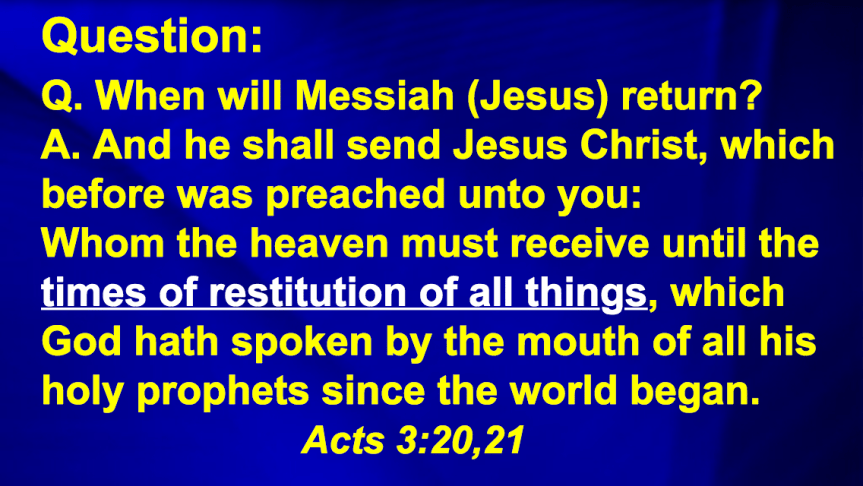
Since Old Testament times, Jews have been looking for the Messiah to come and fulfill all the prophecies that foretold his work of delivering Israel from their oppression as a people, and their scattering as a nation. Even today, religious and even non‑religious Jews will say something like, “When Messiah comes, Israel will prosper and the world will be a better place.” So the name Messiah has a connotation of deliverer to the Jews. This matches nicely with the equivalent name Christ, because ever since Jesus died and was resurrected, Christians have been looking forward to his return, or coming again, as mankind’s deliverer. Thus the name Messiah is associated with Jesus’ return. Jews in general do not believe that Jesus Christ is their long awaited Messiah. But when they see the establishment of his kingdom and how it meets and exceeds their grandest expectations, they will.
Acts-3-20-21.png

The restitution, or restoration, of all things means to restore mankind, and the earth, to the perfection Adam and Eve enjoyed in the Garden of Eden.

The spiritual part of the restitution phase has begun since our Lord’s second presence (invisible to the world, but visible by the eyes of understanding to the spirit begotten of the Gospel Age).

The presence of Christ is referred to by the word parousia in the New Testament, in scriptures such as Matthew 24:3 (where the word “coming” is properly translated “presence”).

NOTE: See booklet titled : “I WILL COME AGAIN”

i-will-come-again.png


When mankind is restored to perfection, then they will be tested individually, as Adam was.

If they are obedient they will live—if they are disobedient they will not.

In that future test, mankind will have the enormous advantage of their past experience with sin and its consequences, that will enable them to

choose life through obedience, and pass the test.

This doctrine of Restitution now gives us the third “R” in a trio of precious truths concerning salvation:

RRR.jpg      

Christ, Revisited

Let us now consider our key scripture, Colossians 1:26,27.

“(26) Even the mystery which hath been hid from ages and from generations, but now is made manifest to his saints: (27) To whom God would make known what is the riches of the glory of this mystery among the Gentiles; which is, Christ in you, the hope of glory.”

Remembering that the anointing represents authorization to a work or office, like the priests and the kings of Israel, this passage tells us that Jesus’ close, footstep followers, can be, like he was, anointed or authorized to join him in his kingdom work.

Is not this thought incredible!

The following Scriptures support this:

  • “If we suffer (with him), we shall also reign with him: if we deny him, he also will deny us” (2 Timothy 2:12).


  • “To them who by patient continuance in well doing seek for glory and honour and immortality, eternal life” (Romans 2:7).


  • “For this corruptible must put on incorruption, and this mortal must put on immortality” (1 Corinthians 15:53).


  • “Blessed and holy is he that hath part in the first resurrection: on such the second death hath no power, but they shall be priests of God and of Christ, and shall reign with him a thousand years” (Revelation 20:6).

This means that there are actually two resurrections, and therefore, two salvations (See the HOPE & RESURRECTION posts: PART A, PART B, and PART C).

There is a first resurrection, now during the Gospel Age (from Christ’s ascension until the end of the age of the High Calling, ending six millenniums of the permission of evil), to a salvation of glory, honor, and immortality in heaven (Romans 2:7). This is for the very few who share in Christ’s sufferings by living their lives as peculiar people, a Royal Priesthood (1 Peter 2:9), following in Jesus’ footsteps.

Then there will also be a general resurrection in the future, on a perfect earth, of the rest of mankind, to a salvation in God’s kingdom.

Why is it taking so long for the Kingdom Jesus taught us to pray for, to come?

Why is it taking Jesus so long to establish his kingdom and do all the things his names imply?

Here is the answer:

Before the general resurrection and earthly salvation can begin, the first resurrection to the heavenly salvation must be complete. Romans 8:19 explains:

“The earnest expectation of the creature [all mankind] waiteth for the manifestation of the sons of God [the completion of the Bride class].”

All this truth is embodied in the name Christ—Jesus, the anointed redeemer, and the anointed class, his footstep followers, who will reign with him as kings and priests in his kingdom.

Summary

By examining the several names and titles of Jesus and their meaning, deeper illustrations of our Savior’s teachings, life, and work can be learned.

  •  In the name Jesus we see his work of salvation, from death to life, which the doctrine of the Ransom teaches us about.


  • In the names Wonderful, Counselor, the Mighty God, the Everlasting father, the Prince of Peace, we see when that due time when that Ransom will have its fullest effect. It will be in the coming Kingdom on earth for which Jesus taught us to pray, “Thy Kingdom come.” In that Kingdom the resurrection will take place. Everyone who has ever lived since Adam and Eve were created will be raised from death to life by the Everlasting father or life‑giver and taught by that Counselor in the peaceful kingdom where none will hurt anyone else.


  • In the name Messiah we see the return of Jesus when the spiritual phase of the restitution period begins, after which time shall commence the process of resurrecting, teaching, and guiding mankind back to the perfection enjoyed by Adam and Eve before sin entered the world. Since restitution means to restore to a previous state or condition, here mankind shall be restored to perfect bodies, perfect minds, and perfect characters. After that restitution work is complete, everyone in that kingdom will be equipped and ready to pass the test that Adam failed: obey and live, disobey and die. But this time mankind will have the enormous advantage of experience with sin and its consequences, which will enable them to choose life through obedience, and live.


  • In the name Christ, which means anointed and is the New Testament equivalent of the Old Testament word Messiah, we see Jesus, authorized by God to be our Savior and to accomplish all things required for the salvation of mankind. More than this, the scriptures tell us that there is also an anointed class of Jesus’ true footstep followers who are also called to be assistants in Jesus’ work for mankind in the kingdom. These footstep followers will have a first resurrection in heaven, following which will come a resurrection for the remainder of mankind on earth. This is the key doctrine of the two salvations.


In learning about Jesus’ life and work, we have gained some key insights into commonly held misconceptions that are not supported by the scriptures. We have seen that there is no Hell of torment, and that man does not have an immortal soul.

Matthew-20-26-28-crossandcrown.jpg

[NOTE: The word “many” in the above Matthew 20:28 verse reaffirms that many are involved in being freed from the sentence of death. Thus similarly, in Romans 5:19—many were constitutes sinners but really, ALL of us were (Ecclesiastes 7:20, Romans 3:10, 1 John 1:8).]

Hymns of Millennial Dawn No. 96

AUDIO [Hymn 96] – The Name of Jesus
In Jesus' Name - Hymn.png

It makes the wounded spirit whole
And calms the troubled breast;
‘Tis manna to the hungry soul,
And to the weary, rest.

Dear name! the rock on which we build,
Our shield and hiding place;
Our neverfailing treasure, filled
With boundless stores of grace!

Jesus, our Shepherd, Saviour, Friend,
Our Prophet, Priest, and King,
Our hearts in gratitude ascend;
Accept the praise we bring.

We would thy boundless love proclaim
With ev’ry fleeting breath;
And sound the music of thy name
Abroad through all the earth.

References:

“In Jesus Name”—Public Lecture by Br. Joe Megacz December 2016.
URL: https://chicagobible.org/public‑lecture‑in‑jesus‑name/

In Jesus' Name.png


Reprint 296-297 from The Reprints of the Original Watch Tower and Herald of  Christ’s Presence. The Everlasting Father.
URL: http://www.htdbv8.com/1881/r296.htm

Hymns of Millennial Dawn—URL: http://www.htdbv8.com/indexhd.html

Further Suggested Bible Study Material:

“The Ransom” video power point presentation discourse by Br. David Rice
URL: http://bibleresources.info/ransom‑david‑rice/

Soul and Spirit. Faithbuilders Fellowship. January 2006.
URL: http://2043ad.com/journal/2006/01_jan_06.pdf

Free Booklet titled: “I Will Come Again – John 14:3”
URL: https://chicagobible.org/wp-content/uploads/2015/05/I-WILL-COME-AGAIN.pdf

Immortality and the Human Soul. The Dawn Magazine. 1959
URL: http://www.dawnbible.com/1959/5904tbs1.htm

The Doctrine of Christ—Booklet.
URL: http://www.biblestudents.com/docs/DoctrineChrist.pdf

How Does “the Son of Man” Title, Speak Volumes About Jesus?
URL: https://biblestudentsdaily.com/2016/06/10/how-does-the-son-of-man-title-speak-volumes-about-jesus/

Acts 23:6—HOPE & RESURRECTION. PART A: What Is Jesus All About?
URL: https://biblestudentsdaily.com/2016/11/03/acts-236-hope-resurrection-part-a-what-is-jesus-all-about/

Acts 23:6—HOPE & RESURRECTION. PART B: Will Mankind Resurrection With The Same Mind?
URL: https://biblestudentsdaily.com/2016/11/05/acts-236-hope-resurrection-part-b-will-mankind-resurrect-with-the-same-mind/

Acts 23:6—HOPE & RESURRECTION. PART C: The Order Of The Resurrection Process.
URL: https://biblestudentsdaily.com/2016/11/11/acts-236-hope-resurrection-part-c-the-order-of-the-resurrection-process/

God’s Name—What Is The Heavenly Father’s Name That We Are To Hallow And Why?
URL: https://biblestudentsdaily.com/2017/06/27/gods-name-what-is-the-heavenly-fathers-name-that-we-are-to-hallow-and-why/

Acknowledgment:

  • Br Joe Megacz—content of this post.
  • Br David Rice—editing assistance.

The URL of this post: https://biblestudentsdaily.com/2017/07/05/jesus-the-name/

Enter your email address to subscribe to this blog and receive notifications of new posts by email.

GOD’S NAME – What Is The Heavenly Father’s Name That We Are To “Hallow” And Why?

MATTHEW-6-9-Rotherham.jpg

In Psalm 148:13 (KJV) the Psalmist David wrote, “Let them praise the name of the LORD: for his name alone is excellent; his glory is above the earth and heaven.”

But what is God’s actual name?

In this study we discuss the various names mentioned for God in the Old Testament Hebrew. Each of our Heavenly Father’s names describe different shades of His magnificent character, being, and personality, allowing us to know our Father better and learn what God wishes us to develop in our character, in order to bring joy, honor, glory, and praise to the Creator of all.

Almighty God—”El Shaddai”

The basic form for the Hebrew name of God is “El.” The word “El” means “might, strength, power.” The Schofield Reference Bible states that God (El) signifies the “Strong One.”

The word “Shaddai” is formed from the Hebrew words shadthe breast—and shadahto shed, to pour out. Thus, El Shaddai is “the God who pours out blessings, who gives them richly, abundantly, continually” (Adam Clark’s Commentary, Genesis 17:1). God is “Shaddai” because He is the nourisher, the strength‑giver, and thus the satisfier, who pours Himself into believing lives.

The primary translations of this root in the scriptures are “god” (for pagan or false gods), and “God” (for the true God of Israel). However, in Strong’s Concordance “El Shaddai” is not found under the English words “God” or “Lord,” but rather “Almighty” (Strong’s 7706). “All‑sufficient” would express the Almighty God (El Shaddai) for He not only enriches, but also makes fruitful. This is nowhere better illustrated than in the first occurrence of the name “El Shaddai” in the Bible, in Genesis 17:1.

“(1) And it came to pass that, when Abram was ninety and nine years old [being “as good as dead,” Hebrews 11:12] Yahweh appeared unto Abram, and said unto him, I, am GOD Almighty,—Walk, thou before me and become thou blameless: (2) That I may set my covenant betwixt me and thee, And may multiply thee, exceedingly. (3) And Abram fell on his face,—and God spake with him, saying: (4) As for me, lo! my covenant is with thee,—So shalt thou become—father of a multitude of nations; (5) And thy name shall no more be called Abram,—but thy name shall become Abraham, for father of a multitude of nations, have I appointed thee” (Genesis 17:1‑5, Rotherham).

All‑Powerful and All‑Sufficient

We can now best understand God’s character when combining these two named attributes of God’s being: All‑Powerful (“El“) and All‑Sufficient (“El Shaddai“).

Genesis 17:1 is a beautifully clear and direct statement from God of His unlimited, supreme, divine power and this quality of God can be best described in one word as God’s OMNIPOTENCE. Even simply because of God’s omnipotence, we should focus on being “blameless” through Christ. That is, through a firm belief (based on testing/studying the Scriptures, Romans 10:17, 1 Thessalonians 5:21), and thus from a steadfast faith (1 Corinthians 15:58, Hebrews 6:19) in Christ as a ransom for our sins (and for the whole world, 1 Corinthians 15:21), we are redeemed and reckoned as righteous children of God (Romans 8).

Our Heavenly Father is able to meet every need (Philippians 4:19) and protect us from any danger to our spiritual lives (Jude 1:24).

Our faith and trust in El Shaddai can turn any temporal difficulty into a spiritual blessing for our eternal interests (Romans 8:28). Our responsibility is to manifest complete faith and trust in God (Isaiah 40:28‑31, 41:10, Jeremiah 17:5, Exodus 15:2, 1 Chronicles 16:11, Luke 12:8‑10, John 12:37‑43, 2 Kings 5:13‑15, Genesis 15:6‑10). Then we can have perfect peace of mind in His all‑sufficient grace (Isaiah 26:3, 2 Corinthians 12:9).

“We must supply our best effort, which will always be too weak and insufficient to overcome all of our imperfections, but El Shaddai will supply whatever is needed to make up for our shortcomings. God’s name, El Shaddai, describes not only what God is, but also what He does for us. El Shaddai sustains us, nourishes us, comforts us, and provides everything we need. This should make us more grateful, more peaceful; and make us feel our complete dependence upon Him. Knowing God as El Shaddai helps us more readily to praise Jehovah, our Heavenly Father, in all the experiences of life” (Br. Allan Ross, “El Shaddai,” Beauties of the Truth, November 2014).

The Patriarchs were close to El Shaddai, our Heavenly Father. They depended on Him for everything in normal life. They were a pastoral people and depended on their crops and herds for food. If there was a drought, or a disease in their herds, they could starve. They did not have unemployment benefits or retirement plans through difficult times. They had El Shaddai and that was all they needed.

The Name “Jehovah”

Jehovahthe “Self Existing One,” “The Eternal One”—is God’s primary name. It is a translation of what is known as the Tetragrammaton. The Greek word “Tetragrammaton” means “four (tetra) letters (gramma)” because “Jehovah” comes from four Hebrew letters יהוה‎ (yod, he, waw, he)—transliterated into English as “JHWH” sometimes written as “YHWH.” Some Bible translations do render the Tetragrammaton as Jehovah, just as it occurs in the Hebrew Old Testament, such as The American Standard Version 1901 edition (in 6,823 places) and The Emphatic Diaglott (in 18 places.)

“Jehovah” is the name that God gave to himself in Exodus 3:13‑15.

“(13) Moses said unto God, Behold, when I come unto the children of Israel, and shall say unto them, The God of your fathers hath sent me unto you; and they shall say to me, what is his name? What shall I say unto them? (14) And God [elohiym, Strongs 430] said unto Moses, I AM [hayah, Strongs 1961] THAT I AM [hayah]: and he said, Thus shalt thou say unto the children of Israel, I AM [Jehovah] hath sent me unto you. (15) And God said moreover unto Moses, Thus shalt thou say unto the children of Israel, Jehovah God of your fathers, the God of Abraham, the God of Isaac, and the God of Jacob, hath sent me unto you: this is my name for ever, and this is my memorial unto all generations.”

The RVIC Bible (by Br. Jim Parkinson) has footnotes for Genesis 3:14‑15 which read:

“(14) Or, I AM BECAUSE I AM. or, I AM WHO AM. or, I WILL BE WHAT I WILL TO BE. or, I CONTINUE TO BE THE ONE CONTINUING EVERMORE. (15) Hb. Ehyeh — future tense (all three times). From the same root as Jehovah or Yahweh.”

Similarly Br. Ronald Day explains in his website study titled “The Divine Name” the following: “Yahweh [Jehovah] is the third person singular of the Hebrew verb hayah (to be or become). In Exodus 3:14 Jehovah gives Moses a different variation of his name in the first person: ‘I will be what I will be (Ehyeh’ asher’ ehyeh’).’ (Revised Standard Version – footnote) Many translations render this ‘I AM THAT I AM.’ However, according some authorities, the Hebrew word hayah, as used in this verse, means more than just to exist. It also carries with it the thought of coming into existence, or causing to exist. Thus the third person would mean: ‘He will cause to be,’ or ‘He causes to be.’

In relation to Exodus 3:14, the Catholic Encyclopedia, 1967, vol. 14, page 1065, states that in this particular verse “a merely folk etymology of the name, based on the qal form of the verb ‘to be,’ is given.” “Grammatically, because of its vocalization, yahweh can only be a … causative form of this verb, with the meaning ‘He causes to be, He brings into being.’ Probably, therefore, Yahweh is an abbreviated form of the longer, yahweh aser yihweh, ‘He brings into being whatever exists.’ The name, therefore, describes the God of Israel as the Creator of the universe.” (Ronald Day, “The Divine Name”.) That this meaning is correct can be seen by observing the indicated meaning of Jehovah in Exodus 6:2,3 – which is discussed further in this study.

Today you will not find the divine name “Jehovah” (English) (nor “Yahweh”) in the New American Standard Bible, not even in the four places that were in the original AKJV (i.e. Exodus 6:3, Psalms 83:18, Isaiah 12:2, Isaiah 26:4).

The name was removed quite simply because there was many thousands of years ago a Usurper to the throne of God, the great liar, the Adversary. His first act of rebellion was to accuse Jehovah of lying to Adam and Eve about the tree of knowledge telling Eve that if she ate of the fruit she would become like God knowing all things and that she would not die. Ever since, Satan has opposed the Most High and His Son as well as all faithful followers of God’s Word. Thus, by having the divine name removed and substituted with “Lord” it made it so much easier to introduce the false doctrine of the Trinity whereas both the Heavenly Father and His firstborn son, Jesus Christ, the Logos, are called “Lord,” and the word is interchangeable to mean that both are coeternal and equal which is not true. The Heavenly Father had no beginning and no end, while Jesus had a beginning, and was God’s firstborn son (Br. Richard Tazzyman, 2017 Discourse: “I Am”).

“For He rescued us from the domain of darkness, and transferred us to the kingdom of His beloved Son, (14) in whom we have redemption, the forgiveness of sins. (15) He is the image of the invisible God, the firstborn of all creation” (Colossians 1:13‑15).

This change of removing the name “Jehovah” stems from the 1880s when the council of the church of England recommended to the British Crown that a revision of the AKJV be produced, and at the same time a group of translators from the United States of America were invited to collaborate with the translators of the RV of the AKJV Bible to produce a version of the Bible in American English. Thus, the American Standard Version of 1901 was created. Br. Richard Tazzyman comments in his discourse “I AM” about how the original committee felt towards the importance of the divine name, in the Foreword of the 1901 ASV Bible.

“The change first proposed in the Appendix, that which substitutes JEHOVAH for LORD or GOD, is one which will be unwelcome to many, because of the frequency and familiarity of the terms displaced, but the American Revisers after a careful consideration were brought to the unanimous conviction that a Jewish substitution which regarded the divine name as too sacred to be uttered, ought no longer to dominate in the English or any other version of the old Testament.”

Here are two other texts with God’s name as “Jehovah.”

“I am Jehovah; this is my name, and my glory will I not give to another” (Isaiah 42:8).

“That men may know that thou whose name alone is Jehovah, art El Elyon, the Most High over all the earth” (Psalms 83:18).

[Note: the difference between the name “Jehovah” and “Yahweh” is that “Jehovah” is the English word that represents the name of God, just as Jesus is the English word that represents the name of our Savior. When one uses a name in one language, it is often not the same pronunciation or form as the name in the original language. For example, with the name “Joshua” — as there was no “J” in English for some centuries, it is evident that this name that we all know as a familiar English language name today sounded different before, and as to its actual pronunciation in Hebrew, who would recognize it if we tried to simulate Hebrew in the English language. Jesus is surely not the sound his contemporaries used when they called his name. But it is our English name for him. In the same way, we know the name of God as Jehovah. Yahweh is a closer sound alike to the Hebrew, perhaps — at least some seem to think so — but even that presumably is different than a real Hebrew speaker of antiquity would have pronounced the name. There is no necessity to modify the word that English speakers know the name as. It is Jehovah. When we use that name, we are communicating. If we all began to use some other pronunciation, most people may get the point, but there would be some confusion. However, whether one prefers “Yahweh,” or the more familiar “Jehovah,” may the name of God be “hallowed.”]

By What Name Was God Known to the Patriarchs?

The name “Jehovah” appears in Exodus 3:15.

“And God said moreover unto Moses, Thus shalt thou say to the children of Israel, The Lord [Jehovah] God of your fathers, the God of Abraham, the God of Isaac, and the God of Jacob, hath sent me to you: this is my name for ever, and this is my memorial unto all generations.”

Only three chapters onward, we read of “El Shaddai” and “Jehovah” both being mentioned in Exodus 6:2,3.

“God spake unto Moses, and said unto him, I am Jehovah; And I appeared unto Abraham, unto Isaac, and unto Jacob, by the name of El Shaddai [The All Mighty, All Sufficient God], but by my name JEHOVAH [“The Self Existing, Eternal One”] was I not known to them.”

This verse could not mean that up until the time of Exodus 6 no one knew God by the name of “Jehovah.” For even Adam knew God by the name of Jehovah as confirmed in Genesis 4:25,26.

“Adam knew his wife again; and she bare a son, and called his name Seth: For God, said she, hath appointed me another seed instead of Abel, whom Cain slew. And to Seth, to him also there was born a son; and he called his name Enos: then began men to call upon the name of Jehovah.” Adam lived 700 years after Seth begat Enos. Thus he would have been one of those that knew Jehovah by name.

In Genesis 15:2, God revealed himself to Abraham by this very name: “And he said unto him, I am JEHOVAH, that brought thee out of Ur of the Chaldees.”

From the very beginning the Patriarchs knew the name JEHOVAH El‑Shaddai, God All‑sufficient, since they recognized God’s continual provision made for them and the constant protection that God afforded them. However, the name “Jehovah” refers particularly to the accomplishment of promises already made; to giving them a being, and thus bringing them into existence, which could not have been done in the order of His providence sooner than until the deliverance from Egypt and the settlement in the promised land. Then the usage of “El Shaddai” became infrequent after the Law Covenant was established.

Hence in the earlier scripture mentioned — Exodus 6:2,3 — Jehovah had to be referring to the meaning of his name (as the one who causes) rather just to the word used to designate his name. In verse four Jehovah calls attention to the covenant he had made with Abraham, Isaac, and Jacob, to give them the land of Canaan. They never saw Jehovah cause the fulfillment of that promise. It is in this respect that Jehovah says that He did not make his name known to them. However, now, Jehovah is saying that he is going to cause a fulfillment of that promise. He will bring the Israelites out of Egypt into the land that he had promised to Abraham, Isaac, and Jacob (Exodus 6:6-8).

Thus the name Jehovah signifies the one who accomplishes what he desires and we can fully trust that His magnificent plan for man will be completely accomplished (Isaiah 55:11, 45:21).

El-Shaddai—An All-Sufficient, Covenant-Keeping God

When the patriarchs wanted to give the strongest assurance to those that were going on a dangerous mission, they used the divine name El Shaddai.

Genesis 28:1‑4—Isaac called Jacob, and blessed him, and charged him, and said unto him, Thou shalt not take a wife of the daughters of Canaan. Arise, go to Padan‑aram, to the house of Bethuel thy mother’s father; and take thee a wife from thence of the daughters of Laban thy mother’s brother. And El Shaddai bless thee, and make thee fruitful, and multiply thee, that thou mayest be a multitude of people; And give thee the blessing of Abraham, to thee, and to thy seed with thee; that thou mayest inherit the land wherein thou art a stranger, which God gave unto Abraham.”

“As Abraham had sent Eliezer to find a covenant wife for Isaac, so Isaac sent Jacob to find a covenant wife—not from the Canaanites, but from Abraham’s extended family. The patriarchs Abraham, Isaac, and Jacob, were all under the Abrahamic Covenant, a Covenant of Grace. As consecrated Christians, we also are under a Grace Covenant. Like Jacob, who here typified the New Creation, we have been sent on a journey and blessed by the antitypical Isaac, our Lord Jesus. So we can repeat this blessing, transferring the thought from the type to the antitype as coming from our Lord Jesus to us: ‘May El Shaddai bless thee’ (verses 3,4).

“That helps to reinforce the thought that our Savior assures us that El Shaddai, the Almighty, All sufficient One, will be with us all the way in our dangerous journey through life. He is always near, always sufficient for any contingency. In the Promised Land, the Patriarchs had complete trust in El Shaddai. If we can completely trust Him now, then we can rest in full assurance of faith in our spiritual inheritance in the Promised Land.”

“Genesis 35:9‑12—Here God confirmed His Covenant to Jacob and changed Jacob’s name to Israel.

‘God appeared unto Jacob again, when he came out of Padan‑aram, and blessed him. And God said unto him, Thy name is Jacob: thy name shall not be called any more Jacob, but Israel shall be thy name: and he called his name Israel. And God said unto him, I am El Shaddai: be fruitful and multiply; a nation and a company of nations shall be of thee, and kings shall come out of thy loins; And the land which I gave Abraham and Isaac, to thee I will give it, and to thy seed after thee will I give the land.’

“After this confirmation, Jacob journeyed to Bethlehem. There his wife, Rachel, died giving birth to Benjamin. Then Jacob travelled to Hebron where his father, Isaac, had died. Thus this revelation to Jacob of El Shaddai as his All Mighty, All Sufficient God was a specially needed blessing. It was a reassurance to Jacob to have the covenant confirmed to him, and to know that El Shaddai would be with him throughout his walk.

“Genesis 37:35—This text speaks of the time Joseph had been sold into Egypt, and Jacob was told that Joseph was dead.

‘All his sons and all his daughters rose up to comfort him; but he refused to be comforted; and he said, For I will go down into the grave unto my son mourning. Thus his father wept for him.’

“Though Rachel, Isaac, and Joseph—the three people that Jacob loved the most—were gone, and no one on earth could comfort him, El Shaddai comforted Jacob. There was nothing that he and El Shaddai could not handle together.

“Genesis 43:14—Later, Judah promised Jacob that he would return to Egypt as surety for Benjamin. But before sending Judah, Jacob asked the blessing of El Shaddai upon him in.

‘And El Shaddai give you mercy before the man, that he may send away your other brother, and Benjamin. If I be bereaved of my children, I am bereaved.’

“Genesis 48:3,4—Years later, when Jacob was on his death bed, Joseph brought his sons, Manasseh and Ephraim, to be blessed.

‘Jacob said unto Joseph, El Shaddai appeared unto me at Luz in the land of Canaan, and blessed me, And said unto me, Behold, I will make thee fruitful, and multiply thee, and I will make of thee a multitude of people; and will give this land to thy seed after thee for an everlasting possession.’

“Genesis 49:25—Jacob gave a final blessing to each of his sons just before he passed away.

‘Even by the God of thy father, who shall help thee; and by El Shaddai, who shall bless thee with blessings of heaven above, blessings of the deep that lieth under, blessings of the breasts, and of the womb.’ ” (Br. Allan Ross, “El Shaddai”).

EL SHADDAI in the Book of Ruth

By considering the usage of El Shaddai in the Book of Ruth and the Book of Job, we understand an additional aspect of what God does for His people, that He permits short‑term pain for long‑term blessings. God’s people do not always understand His Grace when they are in the midst of a painful experience. But we must fully trust our All‑Powerful, All‑Sufficient, God. El Shaddai only allows experiences that bless us, if we take them in the right way.

In the Book of Ruth, Naomi, her husband Elimelech, and their two sons left Bethlehem‑Judah because of a famine and travelled to Moab. Within ten years of entering Moab, Naomi’s husband and two sons died. Naomi was downcast and confused. If God was All‑Mighty, All‑Sufficient, why would he allow her husband and her sons to die so quickly? To answer this, we have to look at the big picture, the long‑term view. El Shaddai takes the long view.

Should Elimelech have taken Naomi and his sons and left Bethlehem to go to Moab in the first place?

No, since El Shaddai is All‑Sufficient, He would have cared for them IN the Promised Land. If Elimelech had a stronger faith, he would have kept his family in Judah and waited for El Shaddai to bless his faithfulness.

Short‑term satisfaction
of fleshly desires
will NOT bring
long‑term happiness.

As in Naomi’s case, God may allow afflictions to come so that we will return to Him. 

God took away what was keeping Naomi from being close to Him!

If Naomi had stayed in Moab we never would have heard of Naomi or Ruth. There would not be a Book of Ruth in the Bible. It was the return to El Shaddai that allowed El Shaddai to abundantly bless both Naomi and her daughter-in-law Ruth (who chose to return with Naomi to the Promised Land).

One of the guiding principles of this lesson is stated in James 4:8: “Draw near to God and he will draw near to you.”

Because Naomi and Ruth returned to the Promised Land, Ruth married Boaz. As King David’s great grandmother, Ruth became identified through the lineage of Mary with David’s greatest Son and Lord, our Lord Jesus.

Because Ruth drew near to God in devotion, she received eternal blessings.

EL SHADDAI in the Book of Job

The first use of the word “El Shaddai” in the Book of Job is in Job 5:17,18, where we read the words of Eliphaz to Job.

“Behold, happy is the man whom Eloah [Strongs 433, the Majestic God] correcteth: therefore despise not thou the chastening of El Shaddai [Strongs 7706, the All Sufficient God]: For he maketh sore, and bindeth up: he woundeth, and his hands make whole.”

The last use of “El Shaddai” in the Book of Job appears in Job 40:1,2.

“Moreover Jehovah [Strongs 3068, the Eternal One, the Existing One] answered Job, and said, Shall he that contendeth with El Shaddai [Strongs 7706, the All‑Mighty, All‑Sufficient One] instruct him? He that reproveth El‑oah [the Majestic God], let him answer it.”

New Testament References

In the New Testament, Jesus begins to refer to God as “Our Father” when he gives us the model prayer of Matthew 6:9: “After this manner therefore pray ye: Our Father which art in heaven, Hallowed be thy name.”

Jesus is the first person in Scripture to begin referring to God as my heavenly Father,” and our and your heavenly Father.” Jesus only used these terms in the presence of his disciples; they were not applied to others who were not yet prospective sons. Jesus was the first son of God, who opened up a “new and living way” gives us the opportunity to also become sons of God (John 1:141 John 3:1,2).

Revelation 15:3—refers to Jehovah as Almighty.

“They sing the song of Moses the servant of God, and the song of the Lamb, saying, Great and marvelous are thy works, Lord God Almighty; just and true are thy ways, thou King of saints.”

We also have scriptures that declare the almighty power of our Heavenly Father.

Psalm 77:10‑15—“I said, This is my infirmity: but I will remember the years of the right hand of the most High [El Elyon, The Supreme God]. I will remember the works of Jehovah [the Eternal One]: surely I will remember thy wonders of old. I will meditate also of all thy work, and talk of thy doings. Thy way, O God, is in the sanctuary: who is so great a God as our God? Thou art the God that doest wonders: thou hast declared thy strength among the people. Thou hast with thine arm [our Lord Jesus] redeemed thy people, the sons of Jacob and Joseph.”

Psalms 91:1‑3—In these verses David represents our Lord Jesus addressing his Church.

“He that dwelleth in the secret place of the most High [El Elyon, The Supreme God] shall abide under the shadow of El Shaddai [the All‑Sufficient One]. I will say of Jehovah [the Self‑Existing One], He is my refuge and my fortress: my [Elohiym] Supreme God; in him will I trust. Surely he shall deliver thee from the snare of the fowler, and from the noisome pestilence.”

Jesus is telling his Church that we, who abide in the Secret Place of consecration in the antitypical Tabernacle, close to Jehovah, have nothing to fear despite the dangers that surround us because our God will protect us. Thus in the above passage of Scripture, four of God’s names are invoked to emphasize this—El Elyon, El Shaddai, Elohiym and Jehovah.

God Has Many Names

As the various verses shared highlight, God has used many different names to describe Himself indicating to us, that one name is not sufficient to describe the Heavenly Father. If God wanted to have only one descriptive name for Himself, He could have had the Bible written that way. But instead God has been described as “Eternal (Ezekiel 1:24)”, “Majestic,” “All‑Mighty,” and “All‑Sufficient (Ezekiel 10:4,5).”

It would be unfortunate to always read these descriptive names generically as “God” or “Lord.” So when we read Scriptures, let us consider referring to the Rotherham’s version or RVIC for a more exact translation of the original biblical manuscripts. Then there is no confusion between whether the verse refers to our Heavenly Father, or if the verse(s) refer to Jesus, Jehovah’s firstborn creation and the world’s Redeemer.

Based on the understandings shared here about the breadth of God’s being and character through an examination of the Heavenly Father’s names, we conclude with these thoughts about our God, “Whose—

  • Memory never fails,
  • Judgment is never inaccurate,
  • Plans for eternity are without any possibility of even the minutest failure,
  • Timing of His Divine plans of eternity are with unerring precision,
  • Grandest, most mighty power and skill can harness even every opposing element, animate or inanimate, making them all work together for the accomplishment of his grand designs,
  • Tireless vigilance never ceases, nor seeks relief from the pressing cares of universal dominion,
  • Eye never sleeps, whose ear is ever open, and who is ever cognizant of all the necessities, and active in all the interests, of his broad domains.”

To answer our opening question—Jehovah occupies the highest position of authority and glory in the universe. We hallow our Heavenly Father’s authority and bow in reverent and humble submission before Him in ALL His glorious attire of royal grandeur.


PSALM-31-23-24.jpg


References:

Br. Allan Ross, “El Shaddai,” Beauties of the Truth, November 2014.

Br. Charles T. Russell. “Reprints of the Original Watch Tower and Herald of Christ’s Presence.

Br. Richard Tazzyman, 2017 Discourse: “I Am,” Australia. (Br Tazzyman’s discourse is to be given at the Bible Students Convention in England this year in July 2017.)

Br. Ronald Day. John 10:30 – The Oneness of Jesus and His God
http://jesusnotyhwh.blogspot.com.au/2016/10/john10-30.html

Br. W.J. Siekman. “One Lord and His Name One,” The Herald of Christ’s Kingdom, May-June 1986

Vines Expository Dictionary of OT and NT Words, page 161.

Br. Jim Parkinson’s RVIC BIBLE – The Revised Version (American Edition) Improved and Corrected from manuscripts discovered and published to A.D. 1999


Acknowledgement

The authors of the above references for their content utilized for the above written work.

Br. David Rice, editing.

Enter your email address to subscribe to this blog and receive notifications of new posts by email.


The Agony In Gethsemane

Jesus in Gethsemane.jpg

As we consider the solemn scenes of this lesson, let it be with reverence and deep gratitude, remembering it was our load the Master bore, that it was the chastisement of our peace that was upon him, and that with his stripes we are healed.

The narrative, so familiar to every Christian, is one full of precious lessons, especially to those who, by his grace, are endeavoring to follow in the Lord’s footsteps.

We observe:

(1) that when the Master realized that his hour of betrayal and fierce temptation was close at hand, having first comforted, counselled, and prayed for and with his disciples, his next strong impulse was to seek a solitary place for prayer and communion with God, that he might find grace to help in time of need.

(2) We note also his love for his disciples, and his desire for their love and sympathy in return. “Having loved his own, he loved them to the end.” And because he loved them, and knew that they loved him, he permitted them to accompany him to the place of prayer, that they might watch and pray with him.

Leaving all but Peter and James and John at the entrance of the garden, as a sort of outer guard against the sudden intrusion of his betrayer upon his last hour of prayer, he advanced with the three—the three in whose ardent natures he seemed to find the most active and consoling sympathy—and, with an earnest appeal to them to watch and pray, he left them and went about a stone’s throw beyond.

Three times did he rise from prayer and return to them in anguish of soul to feel the touch of human sympathy, saying, “My soul is exceeding sorrowful, even unto death.” It was a sorrow, an agony, which, of itself, would have worn him out shortly—an intense mental and nervous strain which caused him to sweat great drops of blood.

It was no sign of weakness in the Master that he thus craved human sympathy. His was no coarse, stoical nature, insensible to pain and shame and loss; nor was it a proud, self-centered nature which stood aloof from human fellowship, although those with whom he associated were so far beneath his glorious perfection. Gracefully he condescended to men of low estate, and esteemed them brethren beloved, of whom he was not ashamed.  His was a refined nature, keenly appreciative of all that is lovely and pure and good, and correspondingly sensitive to pain from everything to the contrary of these.

Human degradation and human woe must continually have borne heavily upon him during all his earthly life. 

But in this awful hour all the griefs and burdens of the whole world were rolled upon his shoulders, and he was to suffer as though he himself were the sinner—to suffer death, extinction of being, trusting alone in the Father’s grace for a resurrection. 

Into this one hour were crowded, not only the mental realization of death and the physical agony and shame, the cruelty and torture of a horrible death, but also the sense of desolation to be experienced when even his beloved disciples, overcome by fear and dismay, should forsake him; and the sorrowful reflections upon the irretrievable loss of Judas, and upon the course of the Jewish nation—”his own” people, who despised him and were about to call down upon their own heads the vengeance of his blood, saying, “His blood be upon us and on our children” (Matthew 27:25). He foresaw the terrible calamities that in consequence must soon overwhelm them. Then the degradation of a whole guilty world, which must continue to groan and travail in pain until by his sacrifice he should gain deliverance for them from sin and death, caused him to feel the burden of responsibility to an extent which we can only approximate, but cannot fully comprehend.

And in addition to all this was his knowledge of the fact that every jot and tittle of the law with reference to the sacrifice must be perfectly fulfilled according to the pattern in the typical sacrifice of the day of atonement.

If he should fail in any part of the work, all would be lost, both for himself and for men.

And yet, though a perfect man, he realized that the flesh, however perfect, was unequal to the task.

How much depended upon our Lord’s fortitude in that awful hour, alone and defenceless in the darkness of overwhelming night, awaiting the certain arrival of his betrayer and the will of his persecutors maddened with hate and full of the energy of Satan!

Oh, how the destinies of the world and of himself seemed to tremble in the balances!

Even the perfect human nature was not equal to such an emergency without divine aid, therefore it was that he offered up prayers and supplications with strong crying and tears unto him who was able to save him from death, by a resurrection.

The necessary comfort was provided through the Prophet Isaiah (42:1,6), by whom Jehovah said,

“Behold my servant whom I uphold, mine elect, in whom my soul delighteth: …I, the Lord, have called thee in righteousness, and will hold thine hand, and will keep thee [from falling or failure], and give thee for a covenant of the people, for a light of the Gentiles… He shall not fail nor be discouraged.

When the fearful ordeal in Gethsemane strained the powers of endurance almost to their utmost tension his prayer was only, “If it be possible, let this cup pass from me: nevertheless, not my will, but thine be done.” Then, though the cup might not pass from him, an angel came and ministered to him.  Just how, we know not, but probably by refreshing his mind with the precious promises and prophetic pictures of the coming glory, which none of his disciples had sufficiently comprehended to thus comfort him in this hour when the gloom of thick darkness settled down upon his soul, crowding out hope and bringing a sorrow exceeding great, “even unto death.”  Ah, it was Jehovah’s hand upholding him, blessed by his holy name! according to his promise, that he might not fail nor be discouraged.

 The result of that blessed ministry was a reinforced courage which commands the deepest admiration.  It was not a courage born of stoical indifference to pain and shame and loss, but a courage born of that faith which is anchored fast within the vail of the divine promises and power. With his eye of faith upon the glorious victory of truth and righteousness, when he should see of the travail of his soul and be satisfied—satisfied with:

  • the eternal joy and blessedness of a redeemed world,
  • with the welcome and wealth of the Father’s blessing, and
  • the love and gratitude of every loyal creature in heaven and in earth—yes, comforted and encouraged thus with a realizing sense of the rewards of faith and faithful endurance to the end, he could now calmly and even courageously, go forth to meet the foe.

Yes, this was the victory by which he overcame, even his faith, and so we also are to overcome.

Now commenced the realization of the dreadful forebodings of Gethsemane.

Mark his calm, dignified fortitude, as he addresses Judas and the Roman soldiers, and its effect upon them. They were so overpowered with the grandeur and nobility of this wonderful man that they could not have taken him had he not voluntarily placed himself in their hand. Notice, too, his kind consideration for the bewildered and weary disciples, and his loving excuse for them, “The spirit truly is willing, but the flesh is weak,” and his request to the Roman soldiers at the time of his arrest that they might be permitted to go their way (John 18:8), that so they might escape sharing in his persecutions.

Through all the trial and mocking, and finally the crucifixion, his courage and solicitude for the welfare of others never failed.

 As we thus view our Lord under a trial so crucial, and mark how the hand of Jehovah upheld him, let it strengthen the faith of all who are endeavoring to walk in his footsteps, to whom he says,

Be of good cheer, I have overcome the world: and this is the victory that overcometh, even your faith (John 16:33; 1 John 5:4).

Has not the Lord, Jehovah, commissioned his angels also to bear up the “feet” of the body of Christ, lest at any time they be dashed against a stone (lest some overwhelming trial should prove too much for them)? (Psalm 91:11,12). Yes, as surely as his hand upheld the Head, our Lord Jesus, so surely will he bear up the feet. “Fear not, little flock: it is your Father’s good pleasure to give you the Kingdom,” though through much tribulation ye shall enter it.

The angels are all ministering spirits sent forth to minister for them who shall be heirs of salvation.  Though their ministry is unseen by us, it is not therefore unreal, but potent for good. Our fellow-members, too, in the body of Christ, are all the Lord’s active messengers to each other, thus in turn sharing the privilege of bearing up the feet.

But to have this help in time of need we must invoke it. 

Every day and every hour is indeed a time of need; hence our necessity of living in an atmosphere of prayer—to pray without ceasing. 

And if the Lord needed often to seek retirement from the busy scenes of his active life to be alone with God, to keep the close bond of loving sympathy established, surely we need to do so; and in so doing we shall always find grace to help in time of need.

In seasons of heavy trial the darkness may indeed so deepen upon the soul, as in our dear Lord’s case, as almost to shut out the stars of hope; yet if, like the Lord, we hold on to the omnipotent arm of Jehovah and meekly say,

“Nevertheless, not my will, but thine be done,”

His grace will always be sufficient; and with the Psalmist we can say, Though my flesh and my heart fail, yet God is the strength of my heart and my portion forever (Psalm 73:26); and, with the Lord, our hearts will respond—“The cup which my Father hath given me, shall I not drink it?”

Acknowledgment and References:

Br. Charles Taze Russell – “The Agony of Gethsemane” —from Reprints (R.1801) of the Original Watchtower and Herald of Christ’s Presence.

JUST AS I AM


[Note: the same melody of the above song “Just As I Am” (sung by Alan Jackson) is Hymns No. 64 in the Hymns of Dawn hymnal and titled “I Come To Thee.”

I Come To Thee

I come to thee, I come to thee,
Thou precious Lamb who died for me;
I rest confiding in thy Word,
And cast my burden on the Lord.

I come to thee with all my grief,
To find in thee a sweet relief;
Thy blessed name my only plea,
With this, O Lord, I come to thee.

I come to thee, whose sovereign pow’r
Can cheer me in the darkest hour;
I come to thee thru storm and shade,
Since thou hast said, “Be not afraid.”

I come to thee with all my tears,
My pain and sorrow, griefs and fears:
Thou precious Lamb who died for me,
I come to thee, I come to thee.

To thee my trembling spirit flies,
When faith seems weak and comfort dies;
I bow adoring at thy feet,
And hold with thee communion sweet.

O wondrous love! what joy is mine,
To feel that I am truly thine.
Thou precious Lamb who died for me,
I come to thee, I come to thee.


Suggested Further Reading:

Gethsemane
https://biblestudentsdaily.com/2017/04/09/gethsemane/


The URL of this post:
https://biblestudentsdaily.com/2017/04/09/the-agony-in-gethsemane/

Enter your email address to subscribe to this blog and receive notifications of new posts by email.

Save

Doing and Saying the Kindest Thing in the Kindest Way

1 PETER 3, 9 - DOING & SAYING THE KINDEST THING IN THE KINDEST WAY

What is the SPIRIT OF HELPFULNESS all about?

“Let every one of us please his neighbour for his good to edification(Romans 15:2).

In Romans 15:2, the Apostle Paul is not saying, let the younger ones please their neighbour, nor does he say, let the older ones please their neighbour; but he says,

 “Let EVERY ONE of us please his neighbour.”  

All of the Lord’s people should have such an interest in one another and in the Lord’s cause, and should have so much of the spirit of the Master, that they would seek rather to sacrifice themselves than to gratify self, especially at the expense of others.

If we have the spirit of Christ, we shall find various ways in which we will sacrifice self without waiting for specific directions.

The Law of Love will incite us to act contrary to our own natural preferences, if by so doing we shall help one another in the good way.

In his letter to the Corinthian Church the apostle illustrates this principle by a practical application regarding the Greek custom of offering their meat in their temples. After having been thus offered to the idols, the meat was considered to be especially sacred. Nearly all of the meat available was offered to idols, so that whenever one wished to have meat he could find none that had not been thus offered.

Those who had come out of idolatry into Christianity, knew that the worship of idols was wrong; for they had learned that there is only the one true God.

The apostle declares that he would abstain altogether from eating meat rather than risk stumbling a brother who could not take the broader, truer view. To stumble such a one, might be to throw him out of the right way entirely.

Responsibility For Our Influence

The apostle Paul did not say that it is not right to eat meat; but rather, that he was willing to forego his rights and privileges in order to edify another.

These others of whom the apostle Paul had spoke had not come to appreciate fully the fact that meat offered to idols had not suffered any ill effect or been changed in any way from having had this done. To set meat before a piece of stone would not injure it; and so to set it before an idol would not cause it any ill effects.

But Paul so self-sacrificially, preferred to give up eating meat altogether rather than to stumble any brother or sister in Christ.

What a glorious lesson for us dear friends!

Let us ask our self the follow questions:

When necessary, do I willing deny myself some of my privileges and rights in striving to be of any assistance to my brethren in Christ and in avoiding to stumble them?

Some of the Lord’s people have very sensitive consciences, others are less sensitive.

The longer one has been in the “School of Christ” and/or the more ability one may have, the more easily should one be able to discern what would be pleasing to the Lord we would hope based on each individual’s uniquely permitted experiences, of course that only the Heavenly Father and His son Jesus perfectly understand best, as they are Divine beings.

As a Christian, one would not want to do anything to offend the Lord, even if he were to go without meat for the remainder of his life.

Another introspective question for Christ-like development may be perhaps this one:

Would I, even if it be for the remainder of this carnal life, prefer to deny myself of something (that of course would not harm the New Creation of Christ within self,) that would be for the best interests of another beloved one in Christ so as not to stumble a weaker one in faith or one who may have their conscience violated by doing so?

This involves walking and talking with the Heavenly Father moment to moment to discern God’s will—who mercifully gives wisdom and provides us with His answers to all who ask, seek, and knock to Jehovah for help (Matthew 7:7).

These may be very personal items of decision-making here under consideration, yet how reassured we are through the words of the Prophet Isaiah,

“And your ears shall hear a word behind you, saying, ‘This is the way, walk in it,’ when you turn to the right or when you turn to the left” (Isaiah 30:21).

The Heavenly Father makes clear one’s path through an exercised conscience—that is, a conscience that is disciplined and trained in seeking after that which is righteous in the eyes of the divine perfect God of the universe (Matthew 5:6).

Another introspective question for Christ-like development may be:

Would I wish to lose all my influence for the good of my fellow brother and sister in Christ?

The apostle answers this suggestion in the negative; he says, “…(12) when ye sin so against the brethren, and wound their weak conscience, ye sin against Christ. (13) Wherefore, if meat make my brother to offend, I will eat no flesh while the world standeth, lest I make my brother to offend” (1 Corinthians 8:1-13).

Let us consider some practical “life” scenarios.

Example 1: Regarding clothing…

Perhaps you attend an ecclesia where consecrated sisters in Christ wear head coverings and believe that dressing modestly means to wear skirts and dresses below the knee and which cover the shoulders and not to wear pants (considering that to be a traditional male item of clothing and relying on the words of 1 Corinthians 11:4-16 and Deuteronomy 22:5 for their convictions of belief). After examining the Scriptures on these topics one may realize that wearing a head covering and wearing a modest dress or skirt does not seem in any way to violate the laws of God, and hence will see no reason why not to do so, in order to help create peace around and least offend in any way any dear member in the ecclesia attended. Yet if this does cause contention then considering it a suffering for Christ, may each be humbled—recognizing even more, one’s own ignorance or errors of self for as the words of Philippians 2:3 teach us:

“Let nothing be done through strife or vainglory; but in lowliness of mind let each esteem other better than themselves.”

As the apostle Paul stated best in regards to the above issue about clothing or hair apparel:

“But if any man seem to be contentious, we have no such custom, neither the churches of God” (1 Corinthians 11:16).

Probably the NAS Bible gives the sense better, “But if one is inclined to be contentious, we have no other practice, nor have the churches of God.”

Example 2: Our words or actions…

Perhaps at a testimony meeting in your ecclesia, one would share something that they believe would be of great edification to all, yet something in one’s conduct or words has caused offense in another—perhaps due to language or cultural barriers or perhaps a result of another mis-hearing correctly yet the results of each one’s intentions and conduct involved in such a situation shall be best understood and credited to each involved by the Heavenly Father who sees each heart and each motive. Again, we are ALL ignorant each moment of each day no matter how great or small the issue at hand—which depends on one’s closeness with the Heavenly Father—and thus, how in tune to the Father’s will each dear child of God is to be, being reassured that God through Christ, shall “reward each according to what they have done” (Romans 2:6).

“For we must all appear before the judgment seat of Christ; that every one may receive the things done in his body, according to that he hath done, whether it be good or bad” (2 Corinthians 5:10).

“Not rendering evil for evil, or railing for railing: but contrariwise blessing; knowing that ye are thereunto called, that ye should inherit a blessing” (1 Peter 3:9).

Would one not rather suffer any unkind effects towards us from our words or actions in having done what an educated conscience before the Father believes was done seeking towards righteousness rather than suffering the outcomes of results and the self-inflicted cross of guilt for knowing we had not done how Christ Jesus our Head, would wish us to?

Example 3: Sunday observance…

Applying the above principle—our responsibility for our influence—to Sunday observance, we are not to feel a bondage under the Old Law, during the Sabbath day. However we should avoid what would be considered by others as not observing the Sabbath.

To our understanding EVERY day is a part of the great Sabbath into which we have entered—rest in Christ.

We have a greater liberty. But we are not to use this liberty to the injury of others.

Many people think that any kind of labor is a violation of the Fourth Commandment.

From our viewpoint we know that the Sabbath of the Jew was typical; and we see what the antitype is. We are enjoying the antitype of that Sabbath.

But while we might have liberty to work on Sunday, our so doing might stumble our neighbour. We would not be violating any principle in not observing Sunday; but for the sake of not stumbling our neighbour we are glad to rest from our work and to give ourselves to the study of God’s Word.

Sunday should be a day that is quiet and reverential in every way, and devoted specially to the service of God—a day in which business is restricted, and as far as possible eliminated. But for the interests of the Lord’s work to forbid refraining from the use of today’s transportation blessings such as cars or trains and trams on Sunday would not apply to today’s world as once it may have been the case. Each place… each time period… each culture… each community even… have certain ways of functioning and by best striving to not offend anyone, but with gentleness of mind and being lowly of heart as Christ was, let us strive to represent Christ as best we can now, knowing that where we fall short after doing our best, Christ’s robe of righteousness covers all the failures that surround us.

Sabbath signifies rest, as the Apostle used it (Hebrews 4:9, margin), we can see that the Church of Christ keeps the Sabbath, or rest, every day, and recognizes God’s arrangement in connection with this matter. Those who keep every seventh day as a Sabbath, but who fail to enter into and keep the rest of faith, are not keeping the true Sabbath, but keeping another, so far as the Church is concerned.

The Sabbath arrangement was for the Jews. We have the better arrangement under our Covenant.

We enter into rest, our Sabbath, EVERY day; and we are hoping that soon we will enter into the still Greater Sabbath.

In that Sabbath, the Millennium, we shall have not only rest of heart, but also perfection, no longer to be challenged by trials and difficulties of life.

During His ministry Jesus chose the Sabbath day in which to perform miracles and heal the sick, that He might show forth the kind of works which He will perform during the Great Sabbath Day, the seventh-thousand-year day—the Millennium.

Helping, Not Hindering Our Neighbours

We can apply this principle in a general way. We can apply it to our conversation with Christian people.

There is a way of taunting people on their ignorance, etc. This is not love.

LOVE does not delight to expose another’s weaknesses.

The more careful we become in our words and our actions, the more polite we shall be, the more helpful.

Politeness is :

to do and say the kindest thing in the kindest way.

One may be polite for the sake of policy or for the sake of principle.

E.g. You have a business and you are polite to your clients or else you will not have any to buy from you, and in turn, no income to live from.

Our pleasing of our neighbours should be for their edification.

We should be glad to do ALL that we can for their assistance, their edification, their uplift, their upbuilding.

If we can speak a pleasant word, a kind word, it would be for upbuilding and have in mind primarily the upbuilding of the Lord’s people in spiritual things. As the apostle Paul says, we are “to provoke one another.”

In the ISV translation Hebrews 10:24 reads:

And let us continue to consider how to MOTIVATE one another
to love and good deeds…

What the apostle had in mind here was the reverse of provoking to anger, hatred and strife.

Brother Charles Russell comments in Reprints of the Original Watchtower (R.5413):

 “Some of the dear brethren who are evidently very sincere have not caught the spirit of the Truth on this subject; and wherever they go, they are apt to stir up the evil mind of others, instead of stirring up their good mind and provoking to love and good works.”

We are to please our neighbors so far as it would be for their good, and according to right principles. But to upbuild one in injustice would not be right.

Now here are our final questions to put theory into practice:

For our Australian friends: Would we think it right to let our neighbour’s emus run all over our front driveway?

emus.jpg

For our local and international friends: Would we think it right to let our neighbour’s dogs run all over our front lawn?

6a00d83451c9f669e20167678794a1970b-400wi

Take a moment or two to think of what you would do.

We believe here is a most lovingly wise, compassionate and merciful response to such a question … (but in regards to chickens) by Pastor Charles Russell:

“We think that he [his neighbor] would thus be more edified by our firm stand for right. But we must not tell him how to manage his chickens. We must do our best to keep his chickens off our place; but we would make a mistake if we were to go in and order our neighbor’s chickens, house and children.  To do so would be busybodying. We shall have enough to do to look after the weaknesses of our own family.”

Further Reading:

Bible verses for consideration:

Is the Sabbath Day a Saturday, Sunday, or any day of the Week?
https://biblestudentsdaily.com/2017/10/19/is-the-sabbath-day-a-saturday-sunday-or-any-day-of-the-week/

Acknowledgment & Reference:

Br Charles Russell—R.5413. Reprints of the Original Watch Tower & Herald of Christ’s Presence.

The URL of this post:
https://biblestudentsdaily.com/2017/03/18/doing-and-saying-the-kindest-thing-in-the-kindest-way/

Enter your email address to subscribe to this blog and receive notifications of new posts by email.


Save

Save

Phileo & Agape Love – Helpful Reminders

1 JOHN 4, 8.jpg

Love is …

perfection of character.

“So we have come to know and to believe the love that God has for us. God is love, and whoever abides in love abides in God, and God abides in him.” – 1 John 4:16

The LOVE that our Heavenly Father seeks to have us develop is a love which is in full harmony and in total surrender to God’s will. When we please our Divine Father of Life, He will bless with eternal life,

“To those who by patience in well-doing seek for glory and honor an immortality, he will give eternal life” (Romans 2:7).

You therefore must be perfect, as your heavenly Father is perfect” (Matthew 5:48).

One element of Love is MEEKNESS.

Meekness does not mean weakness.

Consider Moses. He was a meek man and did he have a weak character? Not at all. He was humble-minded, not boastful, not proud or haughty.

“Now the man Moses was very meek, above all the men who were upon the face of the earth” (Numbers 12:3).

So the New Creatures in Christ, must develop and maintain this quality of meekness, from the divine standpoint.

Another element of love is GENTLENESS.

Does this signify weakness or fear? No.

Gentleness is part of a character of love.

Jesus said, “take my yoke upon you, and learn of me; for I am meek and lowly in heart: and ye shall find rest unto your souls” (Matthew 11:29).

In Galatians 5:22-23, the Apostle Paul writes, that the fruit of the Spirit is love, joy, peace, forbearance, kindness, goodness, faithfulness, gentleness and self-control. Against such things there is no law.”

To the Ephesians, the Apostle Paul writes, “I urge you to live a life worthy of the calling you have received. Be completely humble and gentle; be patient, bearing with one another in love. Make every effort to keep the unity of the Spirit through the bond of peace. There is one body and one Spirit, just as you were called to one hope when you were called; one Lord, one faith, one baptism; one God and Father of all, who is over all and through all and in all” (Ephesians 4:1-6).

“Let your moderation be known unto all men” (Philippians 4:5).

“Moderation”reasonableness, gentleness—the spirit of a sound mind, of gentleness, meekness.

This attitude of mind comes in large measure as a result of knowledge of God and his plans (R5840:3). Surely there never was a time when this counsel was so much needed as now!

Let the fact that we know only in part and understand only in part keep us humble and moderate in word and deed and thought (R5249:6).
Temperance, self-control—let men see by our thoughtful (not rash and hasty), careful and considerate demeanor in every affair of life, that we honor our profession (R4809:1, R2460:4).

Here is a practical example:

If we feel the leader of a meeting is not following the best Scriptural course, we must show moderation in our approach—approving what we can, objecting in kindness, meekness, and brotherly love. R3866:2 The Greek seems to carry the thought of reasonableness, of not exacting our rights too rigorouslymercy and leniency (R3128:2). Keep yourselves well in hand, subject and obedient to the will of God.

In 2 Timothy 3:3-5, the Apostle Paul warns against those “in the last days” (today) who he describes as “lovers of themselves, lovers of money, boastful, proud, abusive, disobedient to their parents, ungrateful, unholy, without love, unforgiving, slanderous, without self-control, brutal, not lovers of the good, treacherous, rash, conceited, lovers of pleasure rather than lovers of God— having a form of godliness but denying its power.” The Apostle Paul then states, “have nothing to do with such people.”

Even in discussing the time of trouble, emphasis should be laid upon the glorious Kingdom which will be inaugurated (R5716:4). We should be using the knowledge we possess, doing with our might what our hands find to do (R5249:3).
Let us be specially on guard that the influence of every word and act should be in accord with law, order and peace—“live peaceably with all men” (Romans 12:18).

Our gentleness toward all men would begin at home—more particularly in the Church—but should be manifested toward all with whom we have dealings (R5840:6).
Messiah’s Kingdom is shortly to be established—this should help the Lord’s people in living an exemplary life (R5840:6). This clause implies the exhortation belongs specially to the closing of this Gospel age—thus, to this time period we are currently living in.

We are expecting great changes soon and can well afford to be generous and liberal in our sentiments toward others (R3128:3).

PATIENCE is another element of love and a part of the true Christian character.

“With all lowliness and meekness, with longsuffering, forbearing one another in love” (Ephesians 4:2).

Patience is an element of character. We read in Revelation 3:10,

“Because thou hast kept the word of my patience I will also keep thee from the hour of temptation which shall come upon all the world to try them that dwell upon the earth.”

When examining the word “patience” we find that two quite distinct words in the Greek are translated by our English word patience in the New Testament:

  • hupomonee: this is used in the Revelation text quoted above which has a much deeper and fuller significance than attaches to our English word patience. It signifies rather constancy,—the thought being :

An endurance of evil in a cheerful, willing, patient manner. It represents, therefore, an element of character, and not merely a temporary condition or restraint of feeling or action.

For instance, a worldly man might have a great deal of patience in connection with the running of his business;—he might be very attentive to his customers, very obliging, very painstaking, and show no dissatisfaction in connection with the inconsiderateness of his customers; and “patience,” in its ordinary sense, might be ascribed to his conduct.

But the word in the Revelation text rendered patience” signifies such a development of heart and character as manifests itself in an endurance of wrong or affliction with contentment, without rebellion of will, with full acquiescence in the divine wisdom and love.

In Luke 8:15, in the parable of the sower, we read:

“That [sown] on the good ground are they which in an honest and good heart, having heard the word, keep it, and bring forth fruit with patience [with cheerful endurance, constancy].”

The thought here is that in order to be of the fruit-bearing class which the Lord will approve and accept to his Kingdom, it is necessary TO DO MORE than to receive the word of his testimony, even thou we receive it with joy—for that class in the parable is represented by the stony ground, which at first gave evidence of great fruitfulness and vigor, but which, when the sun of persecution arose, withered, because of lack of depth of soil. That stony, shallow soil represents, the Lord explains, a class of hearers who rejoice greatly in the truth, but do not endure, such as cannot withstand persecution or opposition, but wither under it, become discouraged. Such cannot be of the Kingdom class, all of whom must be overcomers.

In this parable our Lord shows us that patient endurance, constancy, is the final test, following after the readiness of preparation to receive the seed; following after the seed has been received and has sprouted; following after love and hope and joy and faith have caused it to spring forth and to give fruitage (R.2791).

Patient endurance, then, is necessary, in order that the grain may be developed and thoroughly ripened, and made fit for the garner.

Ah! how important patient endurance seems to be, in the light of this our Lord’s word—cheerful endurance; for we cannot suppose that he who judges the thoughts and intents of the heart would be pleased with his children, even if he saw them enduring much for his sake, if they endured in an impatient or dissatisfied or unhappy frame of mind. They would not, in that event, be copies of God’s dear Son, our Lord, whose sentiment is expressed in the words,

“I delight to do thy will, O God!” (Psalm 40:8)

All of the Royal Priesthood are sacrificers, as was the Chief Priest, our Redeemer and example, who offered up himself: we, as the under priests, have also presented our bodies living sacrifices, and are to lay down our lives for the brethren—in the service of the truth. And God, who accepts these sacrifices through the merit of Christ, informs us that he appreciates or loves the cheerful giver, those who perform their sacrifices of a willing heart, cheerfully.

The other instance in which our Lord used the word “patience” during his ministry is recorded in Luke 21:19. He had just been telling his followers what they must expect as the result of being his disciples during the present time, when sin abounds, and when Satan is the prince of this world—they must expect tribulation, opposition from various quarters; but he assures them that they would nevertheless be fully and completely under divine care and protection, even though the persecutions would be permitted to reach and to affect them. Then follow the words,

“In your patience [patient endurance, cheerful constancy] possess ye your souls” (Luke 21:19).

BROTHERLY KINDNESS is another element of love.

And beside this, giving all diligence, add to your faith virtue; and to virtue knowledge; (6) And to knowledge temperance; and to temperance patience; and to patience godliness; (7) And to godliness brotherly kindness; and to brotherly kindness charity. (8) For if these things be in you, and abound, they make you that ye shall neither be barren nor unfruitful in the knowledge of our Lord Jesus Christ” (2 Peter 1:5-8).

The Greek word “Philadelpia” signifies brotherly love (R3949:4; Q449:1).
“Phileo”—is duty love, a love which has a cause or demand upon it (R2807:4).
Phileo love is evidenced in the natural family relationship, and also in the spiritual family, the Church. We may not love our brethren’s peculiarities, their features, but we love them as brethren, whether black or white, bond or free, because they are brethren, comrades in the same race (Q449:1).

Phileo love means to make due allowance for inherited weaknesses and circumstantial misfortunes of others—to deal patiently and helpfully so far as wisdom may dictate, with a view to the correction of those faults, even at the expense of self-interest, if necessary and prudent (R4809:2, 1114:5).

Phileo love means to meekly bear reproof, determining to overcome deformities of character, and prove a help rather than a hindrance to others; no longer fostering old dispositions (R4809).

Phileo love allows one to exercise and manifest the principles of the divine character toward our fellow-men (R3090:2, 1628:2).

Phileo is a love for all who are brethren and yoke fellows in the cause of righteousness and truth, the cause of God (R2037:3).

Instead of disdaining those who are ignoble, instead of putting them away, treat them kindly (R448:2). This of necessity grows out of godliness. As god-likeness presupposes the other graces mentioned, so its development implies an enlargement of our hearts to all who are of the household of faith (R2155:5).

There is also “AGAPE” LOVE…

This is known as Charity (R5693:1, 5208:5).

Greek, agape, is the higher grade of disinterested love; the broader, more comprehensive, or divine love (R3949:4;Q449:1).

Love as a general expression covers all the elements of character which are really parts of love (F186).

We might divide the race-course into four quarters:

(1) duty-love;

(2) love for the Lord because we see something of the glorious majesty of his character;

(3) love for the brethren;

(4) perfect love—for all, even our enemies. (F187-189)

As we get agape love it means that we love all (Q449:1). We must reach this climax of love before we can be counted worthy of a place in the new creation (F190).

Agape Love:

  • Is deep, pure and true.
  • Thinketh no evil.
  • Does not puff itself up.
  • Is not easily offended;
  • Rejoiceth always in the truth and never in iniquity;
  • Is the climax of Christian attainment in the present life, the grace of all graces, which never fades, and which will be perfected when we receive the new resurrection body (R2037:3, 2155:5).
  • Is sincere love for the unrighteous and unlovely, as well as for the good and beautiful (R4809:3, 1114:5).
  • Is a love which is ever ready to manifest itself in wise and helpful activity for saint and sinner; and which pities, helps, comforts, cheers and blesses all within its reach—manifesting and cultivating the disposition which must be found in every member of the Christ company (R4809:3, 1114:5).
  • Is a broad, generous love, taking in the whole world, even our enemies (R5678:2, 5757:2, 5460:1).

We do not attain to the perfection of love at the beginning of our course, but it is the mark or standard which indicates the end of the course (F186).

Love is the chief of all graces.

Acts of kindness will gradually lead to an attitude of love, even where the subject does not seem to deserve it (1628:2).

Love is an experience, and includes in it an earnest desire for the well-being of the object loved (R78:5).

Love excels all the other virtues, because it is the most enduring (R4732:4).

True love on our part will manifest itself in obediencedisobedience is an evidence of the loss of love as viewed from the Lord’s standpoint (R2466:5).

“WITHOUT LOVE I AM NOTHING”

If we could speak all the languages known amongst men and even the angelic tongue as well, and if we were to use these talents in preaching, if we were to preach without being inspired by love, it would be completely unprofitable.

God would esteem it no more than the sound proceeding from cymbals or any brass instrument. Does GOD want to give cymbals and brass horns glory, honor and immortality? Of course not!

If man were to preach the whole Truth in all its grandeur, and have the ability to comprehend it even through the holy Spirit yet if there be a weakness in character development of love towards the brethren, then we could not be fit enough for divine favor and a share in the Kingdom, just like that brass horn would not be.

What a glorious lesson as we attempt to sound forth the praises of Him who has called us from darkness to light! How necessary it is that we speak the Truth in the love of it, with hearts full of devotion and appreciation!

By quieting the mind… and heading to the voice of our Heavenly Father through the inspired words of God in Bible and through prayer, we may learn to absorb and appreciate each lesson step by step as God unfolds it to us. God is the ultimate example of PATIENCE, waiting perhaps billions of years before finally confronting the pain of watching His own firstborn Son being sacrificed on Calvary and be the ransom for all mankind.

And Jesus… has been waiting for the completion of His Bride… His Body members of 144,000 since 33 A.D!

JAMES 5, 7-8.jpg

Everyone knows the saying “take time to smell the roses.”

And in the same way let’s remember to TAKE TIME TO HEAR GOD SPEAK
digest it…
absorb it…
and grow from it…

The Apostle suggests that if he had mountain-moving faith, if his knowledge of Divine mysteries were very great, superior to those of all other men, and even if in his zeal for man or for God he should become a martyr and permit his body to be burned, yet, notwithstanding all this, if the primary influence in these matters were not love, all the sacrifice, all the self-denials, all the labors, even the burning, would profit nothing.

Dear friends,

When we come to get the Divine standpoint of things we find indeed that we have a very high standard to achieve; and yet our judgment assures us that it is right, that it is just, that it is proper, that God should thus set the standard of love as the only standard by which we shall ultimately be measured. But whoever thinks to have this perfect love for God and for man and make no manifestations of it is equally mistaken.

Wherever love is in the heart words, works, thoughts and looks will testify to it, so that he who loves much will serve much.

If we love the Lord we shall delight in His service regardless of failures, regardless of fame, regardless of any earthly consideration; yea, even though the service of the Lord should cause us the loss of human approbation, fellowship, etc…

Hence every true Christian may link the two words love and service, and be sure that his love will manifest itself in zeal. Similarly, love of the brethren will mean a desire to serve the brethren; love of the home and family will mean a desire to do good to them; love of our neighbor will signify a desire to do for his interests according to our knowledge and limitations.

THE RESTRAINTS OF LOVE

The Apostle points out some of the restraints of love.

It cannot be quick, irascible; for “love SUFFERS LONG and is kind” (1 Corinthians 13:4).

  • He who is loving cannot be envious of others, nor covetous of the blessings and favors they are enjoying; for “Love envieth not.”
  • He who is loving cannot be boastful and proud; for “love vaunteth not itself, is not puffed up.”
  • He who is controlled by the spirit of love will not be ungracious, unkind, rude; for “love doth not behave itself unseemly.”
  • He who is full of the spirit of love will not be selfish, grasping, neglectful of the interests of others; for “Love does not seeks its own” (1 Corinthians 13:5).
  • The truly loving one will not be quickly angered, will not be easily offended; for “Love is not easily provoked.”

The one controlled by the spirit of love will not be imagining unkindness and rudeness nor seeking to interpret the words or conduct of others unkindly; for “Love thinketh no evil”.

What a beautiful example we see in our Master’s words to Simon:

“Simon, Simon, behold, Satan has demanded permission to sift you like wheat; but I have prayed for you, that your faith may not fail; and you, when once you have turned again, strengthen your brothers.”(Luke 22:32).

Let us not neglect to pray for our fellow brethren in CHRIST always.

“LOVE NEVER FAILS” (1 Corinthians 13:8).

Reference

The Reprints of the Original Watchtower and Herald of Christ’s Presence, http://www.htdbv8.com

Enter your email address to subscribe to this blog and receive notifications of new posts by email.

The Sacrifice

psalm-40-8-11

I laid my life on the altar, I said…

“dear Lord it is thine.”

Hence forth Thy will is my only law, my humble heart Thy shrine.
Barely I went forth to conquer, ready to die for His sake.
No sacrifice that He could ask seemed too great for me to make,
And the more I learned of His wonderful love, the dearer my Lord became,
Till I thought I could follow His pathway through any loss or shame.

But he led me by pleasant waters, where the sky was clear and bright,
And fed me in sweet green pastures and sheltered me at night.
Like a lamb I was shielded, protected. I knew no pain or fear,
Why should I shrink or falter when the tender Shepherd was near?
I had nothing that I could give in return, nothing to sacrifice.

Then I found in my pathway a jewel bright and fair,
In facets threw back the sunlight in beauty beyond compare.
I took that lovely, precious gem and hid it in my breast.
It kindled a fire that seared my heart. My spirit could not rest.
I feasted upon its beauty. I watched its glory shine,
Rejoicing in the wonderful thought that this beautiful gem was mine.

Then something dimmed its luster. It gave me grief and pain.
I brushed and polished my treasure but it would not shine again.
Then I heard the Savior whisper, “Can you give this treasure to me?”
But I said “It has no beauty now. It is dark and lifeless you see.”
I thought about my early vows, all, all I would give to Him.
Could it be that the cloud that had come between was making my jewel dim?

Could I lay at His feet a treasure whose beauty had faded away?
A jewel devoid of luster, all colorless and gray?

I laid my gift on the altar, I felt alone and bereft
Such a small and worthless offering, how could my Lord accept.

But the clouds rolled back and the sun shone out.

index.jpg

My jewel sprang to life;
There on the altar it blazed and burned, a thing with beauty rife.

My dear Lord smiled upon me and my heart was glad and free;

The jewel my heart had treasured so had never belonged to me.

He had tested my love, I had almost failed; I wanted that jewel so.

And the spin it cost me to see it fade, only the Lord can know;

I had treasured it still when its beauty was gone and fondled it to my breast;

But not till my Lord had accepted it could my weary heart find rest.

There is not grief so bitter that His love cannot share.
There is no trial of faith so great that His hand is not there.
He guarded me from the snare prepared to tangle my erring feet.
He shielded me from my own desire and tempered the cruel heat.
The fire that burned in my aching heart did but consume’ the dross;

For the soul that is really committed to Him can never suffer loss.

by L.K. Poole

“1Therefore, I urge you, brothers and sisters, in view of God’s mercy, to offer your bodies as a living sacrifice, holy and pleasing to God—this is your true and proper worship. 2Do not conform to the pattern of this world, but be transformed by the renewing of your mind. Then you will be able to test and approve what God’s will is—his good, pleasing and perfect will” (Romans 12:1).

Do your best to present yourself to God as one approved, a worker who does not need to be ashamed and who correctly handles the word of truth” (2 Timothy 2:15).

SACRIFICING WITH CHRIST

“He that saith he abideth in him ought himself also so to walk, even as he walked” (1 John 2:6).

May we encourage all who suffer with Christ in any measure to bear it with the same humility, benevolence and fortitude that characterized him under the most crucial tests of endurance.

Our Beloved Jesus knew that he was in an unfriendly world bound by sin and largely under the dominion of the prince of darkness.

Therefore he expected reproaches, taunts and persecutions, all of which he endured patiently while his great loving heart, almost unmindful of its own sufferings, was full of pity and of loving concern for others. May we like our Master, suffer with Christ, meekly bearing reproach and trusting to heaven’s vindication of us in due time.

“If, when ye do well and suffer for it, ye take it patiently, this is acceptable with God; for even hereunto were ye called. Because Christ also suffered for us, leaving us an example that ye should follow his steps: who did no sin, neither was guile found in his mouth. When he was reviled, he reviled not again. When he suffered he threatened not, but committed himself to him that judges righteously” (1 Peter 2:20-23).

“Consider him that endured such contradictions of sinners against himself, lest we be wearied and faint in our minds” (Hebrews 12:3).

It is a privilege to prove our devotion to the Lord by enduring hardness in his service as
good soldiers of the Cross of Christ.

Let us keep melodies of joy in our hearts as we walk along the narrow way, pressing onward and upward fellow pilgrims of the Cross of Christ, putting righteous effort into all we do “all for Jesus all for Jesus” as diligent stewards, to bring our Heavenly Father, Jehovah, all praise and glory and honor forevermore!

Here are 3 songs for your consideration, to build faith and strengthen our hope in Christ as by God’s grace we are transformed moment by moment, experience by experience into the character likeness of God’s dear Son and our Redeemer—Christ Jesus.


The URL for this post:
https://biblestudentsdaily.com/2017/01/05/the-sacrifice/

Enter your email address to subscribe to this blog and receive notifications of new posts by email.

Save

Save

Save

Save

Save

Save

Save

Save

Save

Great Gain(s)

1-timothy-6-6-poem-great-gains

A test of patient cheerful endurance
In faith currently still remains,
For the last feet members of the Church,

That will prove great gains.

These do experience ridicule

And rejection both from those near and far,
As the Gospel message they proclaim,

Even on their guitar.

Having no fleshly interests,
Just a desire to heed God’s will,
Their consciences are in tune with God’s voice,

As in their Father’s presence they remain still.

As they adhere to the Divine Words of Jehovah,

Leaning on Jesus as their rock,
They watch and pray and help others understand Divine Scriptures,

Like shepherds of a flock.

With heart and minds that desire
To know what is best,
What is purest and most righteous,

To be perfect like Christ—this is their quest.

Sacrificing every earthly and fleshly interest
Is a pleasure to do,
For it means a share in the sin offering through grace,

A privilege for only but a few.
 
When soon all 144,000 Bride members
Are beyond the Vail,
They shall begin their roles as the heavenly judges and kings—

WHY? Because they did not fail!

These win the prize of the High Calling,
Which was the longing of their hearts.
What mattered to these dear Ones most,
Was to please God, and of Him and His dear Son Jesus, to boast!

When Armageddon comes,
The faithful few will have been taken from earth;
They will have completed their race
Having proven their worth.
 
Belonging to Jesus—
They shall forever with him remain,
Bringing greatest pleasure to the Heavenly Father—
Like the Lamb of God that had once been slain.
 
So dear brethren in Christ Jesus
who are our crown and joy:

Let’s continue to put away behind us,
What would cloud the narrow way ahead,
Not even for a split second look back at the wrong,
Only disciplining the mind to keep focused on what Jesus has said.

Feasting on God’s Words in the Bible
Every moment we can in this life that remains,
God promises to reward justly,
For all good done, with great gains.

romans-2-6-7-c


The URL for this post:
https://biblestudentsdaily.com/2016/11/13/great-gain/

Enter your email address to subscribe to this blog and receive notifications of new posts by email.

Save

Save

Save

Do Not Rush In – (…Where Angels Fear to Tread.)

PROVERBS-19-2


Gradually, Jehovah God, reveals to us his plan,
Of all the wondrous things he’ll do, to raise up sinful man;
How often in the past we’ve seen, so many rush ahead,
And lose out on the blessings that they could have had instead.
 

We do recall the bowl of stew that Esau rushed to eat,
And thereby lost the birthright-he cast it to his feet;
Saul rushed ahead of Samuel, offered up the sacrifice,
And so doing, lost the Kingship-he valued not the price.
 

Judas the betrayer, he rushed in to “meet the sword”
For thirty silver pieces, he so surely sold the Lord;
And Peter he did rush to say, “My Lord I’ll ne’er deny,”
But later begged with deep regret, forgiveness from on high.
 

And even Lot’s two daughters, rushed ahead to found the seed,
Lacking faith in God, who would, provide the One we need;
And not forgetting Moses, who rushed in and struck the rock,
The Promised Land was never his, for God held key and lock.
 

And though King David was a man after God’s own heart,
He rushed ahead-against God’s will-a census he did start;
Then, looking at Bathsheba, he did steal Uriah’s wife;
And the price, he had to pay, was his offspring’s life.
 

Ananias and Sapphira-rushed in and lived a lie,
They grieved God’s holy spirit, and so they had to die;
Achan hid the garment, the silver and the gold
He was stoned for disobedience, back there in days of old.
 

So many lessons we can learn, by looking to God’s Word,
For waiting on God patiently is much to be preferred…
To rushing in, where even…all God’s angels fear to go,
So, let’s follow their example, all God’s people have below.


A poem from “Where Eagles Gather” – Rosemary Page, Blackpool, England

The URL of this post:


Enter your email address to subscribe to this blog and receive notifications of new posts by email.


Save

Save

Isaiah 45:15 – A GOD Who Hides Himself

ISA. 45, 15.jpg

Have you ever thought that God has withdrawn his favor from you?

Have you ever questioned… Is God really still dealing with me on a personal level, like His daughter/son?

We think to ourselves, could I really be in such a bad spiritually state?

We question ourselves:

Why could God be hiding from me?

In Isaiah 45:15 (NASV) we read, Truly, You are a God who hides Himself, O God of Israel, Savior!”

Here we note that hiding from man, is one of God’s attributes. Is it because we have done something to displease the Lord, and where God disapproves of our actions? Perhaps in such a situation, we find we don’t have the prayer life anymore or one that we would wish to have where there is ease of communication without guilt or feeling unworthy. Or, we may be saying to ourselves “my life is no different than that of the world around me.”

So when we can’t distinguish any difference in our life then in the life of a person who has not given himself to the Lord then we say “there is no specific purpose to my individual experiences compared to another person in the world.”

Or, perhaps our experiences feel like they no longer have any spiritual meaning when we can’t identify what the experiences are for, and we get into a rut; when our experiences mean I am merely just existing or surviving this experience and I know I am just existing because I experience, but I cannot identify with me this experience spiritually.

Maybe we recognize that for most of us, when we grasped the Truth, we had a great outburst of emotion for it — we loved it; we were enthused about it; we talked about it; we were excited about it and when we heard a discourse we would get goose bumps from joy! And all of a sudden we come to a place where that is no longer true. We just go to meeting because it’s a habit and we expose ourselves to creation experiences which we are sort of glad about having, but beyond that, there is no quickening of the heart beat.

Here are some possible reasons WHY we may experience that God has hidden himself from us:-

(A) God wishes to AWAKE US TO RIGHTEOUSNESS

It is good to remember that when it comes to God’s dealing with anyone, they are never intended to be a harsh, burdensome experience but God’s aim of  allowing certain trying experiences in our lives, is for the purpose of CORRECTING a situation…. correction of action … and ultimately to correct our character so that we may learn to be perfect  (Matthew 5:48) – that is, “reckoned as righteous” through our Faith (see Romans Chapter 4) and LOVE RIGHTEOUSNESS (Hebrews 1:9) so that we can be used in His future kingdom as administrators of the blessings to all the world of mankind – teaching mankind how to walk up the Highway of Holiness, having attained to the highest levels while going through the experiences of the Gospel Age now, while the permission of evil abounds.

In Hebrews 12:6, Apostle Paul writes, “For the Lord disciplines the one he loves, and chastises every son whom he receives.”

The chastenings of the Lord are not necessarily designed for punishment, but rather for discipline. They are necessary as a part of our training, and to test our humility before the Lord, and our loyalty to him. Peter wrote, “Humble yourselves therefore under the mighty hand of God, that he may exalt you in due time” (1 Peter 5:6). This is what it means to be “patient in tribulation” (Rom.12:12); and if we are thus patient we will rejoice in a hope which “maketh not ashamed.”

In Ephesians 6:4 (ESV) we read, Fathers, do not provoke your children to anger, but bring them up in the discipline and instruction of the Lord.”

Our Heavenly Father does not deal with all in this manner but only with some, His sons.

He thus dealt with our Lord Jesus — “the captain of our salvation” — as he lived in this world of sin and suffered the “contradiction of sinners against Himself.” For, “what son is he whom the Father chasteneth not?” (Hebrews 2:7).

 So the apostle admonishes that we “look unto Him” lest we become weary and faint in our minds (Hebrews 2:2,3). The rigors and the discipline to which a well-trained child is subjected by a loving father may at times seem irksome, unpleasant and painful, but it is for the ultimate good and development of the child in every sense. So it is in the life of the child of GOD but in a perfect manner.

The tests of faith, of fidelity, of love for God and righteousness, of obedience, of patient endurance and suffering wrongfully, the discipline of the Word under adversity, the submission in love to the Father’s will, and an awareness of the guidance of the Spirit, are some aspects of the Father’s discipline as He trains us for the purpose He has in view.

These are all tangible evidences of the heavenly Father’s love and concern. Like those to whom the apostle wrote, we also tend to forget this when the way is hard and difficult. Frustrations, pressures, and perplexities surround us. “Ye have forgotten” says the apostle, “the exhortation that speaketh unto you as unto sons” (Hebrews 2:5).

If we remember this always, we will rejoice even when all things seem to be against us as we earnestly seek to do His will, inasmuch as we know we are under His loving hand.

The life of the child of God, wholly surrendered to Him and to Christ, is an entirely new life, in and of Godly character, under the Father’s influence, control and leading, the Heavenly Father’s constant special and infinite care for our training in the principles of His laws, so that, we can be ministers of these laws and processes of training for all humanity.

We are “hid with Christ in God” (Romans 8:1-4; 8:14, 28; John 1:13; 16:27; Luke 12:4-7, 22-32; 1 Peter 5:6, 7; Colossians 3:1-4). Sometimes the Father withholds or hides Himself in order that the depth of our longing and love for Him and for Christ may be put to the test, that we may be conscious of a sense of loss, that me may yearn for Him and learn to fully depend on Him to reveal Himself more fully in all His love and tenderness.

God may withdraw His favor to awaken us to the situation that we have begun to slip or that we are near the point of slipping and that we need to reassert ourselves spiritually. The best example of this in the Bible, is when we look at the account of Queen Esther.

In the 4th chapter of the Book of Esther, we are told that Esther, (who had become the Queen of the Persian empire), had now an enemy against her uncle Mordecai and all the Jewish people (so this would include her, as she was Jewish). A man named Haman had become a chief counselor of the empire and had put into motion a plan that would mean the destruction of every Jew throughout the Medo-Persian empire. Mordecai realizes this; he tears his clothes; he puts on sack cloths and ashes, and he sits in mourning. Esther’s initial response is documented in Esther 4:4, “So Esther’s maids and her chamberlains came and told it her. Then was the queen exceedingly grieved; and she sent raiment to clothe Mordecai, and to take away his sackcloth from him: but he received it not.”

So we can see that Esther’s first response is “let us stop mourning; let us not face the reality of the problems that we have.” Esther’s initial reaction is not a good reaction. Her reaction is one of not comprehending the true danger of the situation. It is Mordecai who wakens her to the danger by mentioning one thing specifically and that is, that this is not a danger, remote to someone else; it is, that YOUR VERY LIFE IS AT STAKE! YOU TOO, won’t escape this! You too, are Jewish and so your in just as much danger of death as I am in and all the rest of our people, the Jews, are in. But then Esther experiences the alienation that she has already experiences from the King himself and this is noticed in Esther 4:11, where she is speaking to Hathach, one of the King’s eunuchs assigned to attend her, and instructs him to say to Mordecai.

“All the king’s servants and the people of the king’s provinces know that if any man or woman goes to the king inside the inner court without being called, there is but one law—to be put to death, except the one to whom the king holds out the golden scepter so that he may live. But as for me, I have not been called to come in to the king these thirty days” (Esther 4:11).

Esther realizes that she has become estranged from the King and notice, that she says, as if “I am free to go to him but if I go to him without being invited to, by him, then I am afraid my life may be at stake even earlier because I have been so presumptuous to come to him.”

We may experience this too, in our spiritual lives as consecrated. We may at some point in our spiritual walk feel like we do not feel free to go to our Heavenly Father. We feel “I am not bidden to come to God anymore or feel God is not communicating with me anymore; that God has hidden Himself from me (just like King Xerxes has from Esther), Jehovah God has hidden himself for the past perhaps 30 days too, and we don’t feel we can go and plead our cause.

And this is what Mordecai is bringing out to Esther — the reason for Him hiding. He is saying, “remember Esther … You’re life is at stake! You think you will die if you go to the King … I know you will die if you do not go!”

So in our lives God may bring us to this point in our lives to show us that if we don’t continuously communicate with Him, then we WILL DIE!

You know dear friends, there is a far greater then Haman out there looking to kill us … that is… a “Haman” who is called Satan. Satan wishes to kill our New Creature developing in us — the embryonic New Creation which is developing into maturity until the Jesus agape love in us, overflows towards our beloved brethren and our will becomes dead to self but alive in Christ — being crucified in ALL we think and do, having our minds super-glued on Christ Jesus no matter how ridiculous we sound to the world or how humiliated we are for striving to conform to the LIKENESS OF OUR LORD JESUS.

Dear brethren in Christ, as we are now on an arena and we are a spectacle unto angels and men, let us endure it with great Joy in our Hope that promised for the faithful unto death isn’t just eternal life in perfect conditions, but IMMORTAL life and those who suffer with CHRIST for doing good now, shall reign with CHRIST. They are those who grow into the maturity in Christ, learning and CUTTING OFF and TURN AWAY from sin -from mistakes made in blind ignorance according to any uniquely individual situation allowed by God, and turning completely away from past errors, learning to well appreciate the failings of all their brethren and the world through their own experiences of enduring the sacrificial experiences as prospective Bride of Christ members, and learning to only FULLY depend on and seek out their Heavenly Father’ will in ALL.

So this experience is to help bring us back to the place where we will come and pour out our hearts to our Heavenly Father, but in doing it, we face that one big emotional problem: that problem of … “well I can’t do this because I’ve gotten out of the habit … I don’t have that feeling anymore.” And that’s when we have to awaken to the righteousness that says, “even if I don’t feel comfortable in praying to God, if I don’t do it, the result is certainly DISASTROUS! If I do do this, then there is the ONE and the ONLY potential of overcoming in doing this and as we come to the remedies we’ll find that the first remedy, is the remedy suggested by the first cause, and that is PRAYER.

PRAYER is the beginning of the remedy even though it may be the very hardest to apply when we feel estranged from the Lord individually.

This situation of Queen Esther’s, may remind us of a certain class in the Bible; a class mentioned in the prophecy of Jeremiah 8; a class that ends up saying “the harvest has ended the summer is passed and we are not saved.” That class that speaks those words in Jeremiah 8:20, in Jeremiah 8:11 said that the reason for their punishment is because they said “they have healed the wound of my people lightly, saying, ‘Peace, peace,’ when there is no peace.”

Is this not the very thing that Esther was doing! Esther was telling Mordecai “your problem is you need to get out of your sack clothes … You need new clothes.” And Mordecai was telling her that’s like saying “peace, peace when there is no peace.” That is not the problem but rather is the symptom. The problem was that she needed to approach the King on behalf of Israel.

And so the alienation we sometimes feel is to awaken us to the deeper problems that lie there to bring us to the Lord not to solve the alienation but to solve a deeper problem; to find out what it is to not keep us away.

(B) God may hide himself from us, to teach us FAITH, TRUST and RELIANCE upon Him through Jesus Christ, our Master and King.

Sometimes our Heavenly Father teaches us that our life isn’t different from anybody else’s or to bring us to a place where we can’t see any purpose from an experience, He then says,

“That’s when YOU NEED TO TRUST IN ME when you can’t trace Me.” This is brought out beautifully in Job 23: 3-5,8,9,15 (NIV) and this pin-points the problem.

(3-5) If only I knew where to find Him; if only I could go to His dwelling! I would state my case before Him and fill my mouth with arguments. I would find out what He would answer me, and consider what He would say to me.”

(8-9) “But if I go to the east, He is not there; if I go to the west, I do not find Him. When He is at work in the north, I do not see Him; when he turns to the south, I catch no glimpse of Him.”

(11) “My feet have closely followed His steps; I have kept to His way without turning aside.”

This is a sad set of scriptures. Job looks everywhere for God, yet cannot find God to feel that He is with him in his experiences at a time of experiencing so much pain and misery. These experiences seem over his head and as a result, Job was beginning to sink in the experiences he had. It isn’t until later in the Book of Job, that Job starts swimming upward again and begins getting over these experiences.

In Job chapter 23: 3-5, Job wanted to find God to plead his case before God.

Let’s look at verse 6 & 7 to fill in some answers.

(6) “Would He vigorously oppose me? No, He would not press charges against me. (7) There the upright can establish their innocence before Him, and there I would be delivered forever from my judge.”

In verse 6, Job realizes if he could find God, he would find Him a Merciful God, who would give him strength.
In verse 7 is the realization that if we feel we have lost God, we firstly need to find our Advocate — the one who pleads on our behalf! We know it is our Beloved, Precious Jesus who is the Best Lawyer in the whole universe!

When we feel we have lost our ability to approach God then more than ever we feel “if only someone spoke God’s language and could get through to Him for me”, and that is exactly what Jesus does! And Job was as if saying, “if only Jesus would argue for me … if I could just enlist the upright one on my side, then he would deliver me from this judgement forever … Then I would be over this particular experience”.

So friends, IT IS FINDING THE UPRIGHT ONE, JESUS, IN OUR LIVES.

And Job says he can’t. He goes upward, downward, backward, front, and simply can’t find him. So now let’s look at verses 10 & 12:

(10) “But He knows the way that I take; when He has tested me, I will come forth as gold.”
(12) I have not departed from the commands of His lips; I have treasured the words of His mouth more than my daily bread.”

So just like Job highlights through these words of his, let us look for the realization that even though we feel God is hiding himself from us for a brief moment, He knows exactly where we are and has not departed from us, and it is HE who FIRST FOUND US, called out us of darkness into His marvelous light, and adopted us as we are told in Ephesians 1:5 (NLT). God decided in advance to adopt us into His own family by bringing us to Himself through Jesus Christ. This is what He wanted to do, and it gave Him great pleasure.”

God wishes for us to develop faith in Him, that He is taking charge in our life and to TRUST COMPLETELY in Him.

In verse 11 & 12, Job says what he felt he had done, and they are a stimulus to us about things WE MUST DO to feel this pull to our Heavenly Father. We must trust and be convinced that God will pull us through and make us more than gold IF:

1.      Our feet will hold to His steps;
2.      His way we keep and do not decline;
3.      We do not go back from the commandment of His lips;
4.      We esteem the words of His mouth more than necessary food.

It is at this point God is telling us we will be in a good place IF WE DO OUR PART. God is saying, “I’m putting you in a place where you can’t see Me, but if you just do your responsibilities then trust that then I will do what I promise to do and bring you closer to Me.”

And Job tells why he’s so confident in Job 23: 13-14. “But He stands alone, and who can oppose Him? He does whatever He pleases. He carries out His decree against me, and many such plans He still has in store.”

The Leeser’s Jewish Bible translation of Job 23:14 reads, He will bring to completion what is destined for me.”

Each one of the Church of the Body of Christ members (that’s you and me dear brethren) are being trained and fitted for a peculiar specific and each different part of the body that requires a different treatment. I can’t be treated in exactly the same way as Sister X, Y or Z or Brother A, B or C as we each need specific experiences and as we come into these experiences as their all different, we don’t see what the end result is, and God’s saying to us, “the reason I give you these experiences is because I want you to have confidence that I KNOW BEST what the end result should be and so I’m not going to let you see what this end result is, so that you will learn that my hand will lead you through this to safely overcome and develop a Christlike character that I require from you, so that I can present you to my Son when I’m through with you.”

It will take every inch of TRUST, of DISCIPLINE over the mind, and FAITH. It will require us to LAY DOWN OUR COMPLETE UTTER ALL for God to direct us now so we can prove to Him our LOYALTY to God’s PRINCIPLES OF RIGHTEOUSNESS so that we can receive the Highest possible reward because of proving to God that we please Him through overcoming the most unfavorable circumstances of the permission of evil.

And the end of this verse is saying that just like God has this kind of experience in store, so HE has other experiences for us also.

Now, the hiding of God’s face is only one tool in His tool box. 

The heavenly Father has tools of throwing His arms around us too!

At other times in our walk up towards spiritual Holy “Mount Zion”, God is showing us, that He really likes what we are doing.

God gives us His tools of directing us, just when we need that direction.
Our Divine Father testing us to the words we sing in that hymn,

“I’d rather walk in the dark with God,

than go alone in the light”. 

So would you really? That is what God is TESTING.

God is as if saying, “Are you willing to really walk in the dark with me when you can’t see the next step? Will you trust to take the steps in the dark and know that it will lead to gold? Would you really rather walk by Faith then walk by sight? Show me how”.

Let us look at one more thing here. Job’s attitude in Job 10:2. Even to day is my complaint bitter: my stroke is heavier than my groaning.”

This same word “bitter” is used in Deuteronomy 31:27. “For I know thy rebellion…?” The word “rebellion” here, is the same word as the one written as “bitter” in Job 23:2.

Job in verse 2 is saying, ” I just want to argue with God and show and explain to Him that this hiding from me just isn’t fair!”

This attitude is the one God is trying to correct, to bring us into a complacent one that Job shows and had in Job 23:10.

(C) God may hide himself to TEST THE SINCERITY OF OUR CONSECRATION.

How much easier it is to say “whatever your will God, I’ll do it!” but then when hammered down as life unfold, through the Christian pilgrimage to our heavenly home, how easy is it to accept our Heavenly Father’s will when we experience agonizing experiences of pain, sickness & disease, and death?

When we first made our consecration, it may have been far more easily said “God may it be your will”, yet we learn to understand what this means ONLY through the BIGGEST BLESSING OF ALL that follow: LIFE; EXPERIENCE; PHYSICAL and MENTAL PAIN, and /or SICKNESS, and SUFFERING.

We now see that being a soldier in the Lord’s army takes every inch of mental and physical energy that we have into the fight for the victory of being a member of the 144,000!

Never give up!

Never, never, never give up!

A martyr means “a witness” and to be a witness of CHRIST will cost us our ENTIRE ALL not just half of us… No way! God doesn’t want a lukewarm CHRISTIAN as a King to reign with His Son Jesus in future… God does not want a COLD Christian either who has a non- repentant or non-forgiving heart… God WANTS A ZEALOUS follower of Christ who shall defend JESUS and those who are His; who have professed consecrating into Christ, to the best of their human abilities -seeing them all as better than self (Phil. 2:3).

So our tools to overcoming is prayer and the studying of Holy Scriptures every day and immersing the mind into Scripture at every point you have even if it’s a few minutes here or there then do that! ALL our time is consecrated unto the Lord so we no longer even own it, as we lay down our ALL on the altar of sacrifice daily, and daily seek to fulfill our covenant sacrifice until death.

Never stop to rest from activity in the Lord’s service, even for one minute!

Don’t ever think the battle is won till faithful until death!

By hiding himself, God is in fact asking us “are you willing to take a path where you now can no longer identify with me, where you find your confused and say God how does this experience identify with me?”

This was the test our Lord Jesus experienced too. Remember when Jesus hung on the cross, for the first time he did not call God “Father but said:

 “Eli, Eli, lema sabachthani?”

that is,

“My God, my God, Why have you forsaken me?” (Matthew 27:46).

Jesus felt our Divine Father’s face hidden from him!

Look at the depth that Jesus felt this experience …

I mean here is a PERFECT human, the Son of the Almighty Jehovah God, who had had a prior relationship with the Father when he was the Logos in his pre-human existence. Jesus knew God intimately!

God was testing our Lord Jesus to the very depth of his consecration. Could he take that alienation? In Jesus case, the experience was very temporary. It had to be, as his life was very temporary; it was only a more few hours on the cross and so at last his life WAS RESTORED and Jesus’s last words (which were called out by him in a loud voice) were,

Father, into your hands I commit my spirit.” When he had said this, he breathed his last” (Luke 23:46).

God had tested Jesus to the point of seeing if Jesus would really take and accept any experience, even the experience of turning his back on Jesus, turning away from him so that he could not even see the Father’s face.

(D) God may hid himself from us to TEACH US leadership and principles.

Under the Old Law, the Israelites were told exactly how to order their life. They were given a set of Laws and were instructed by God how to follow these laws to inherit eternal life. Every experience of life related to what God did want or didn’t want.

But when it comes to the Church of the Firstborn, God says, “I’m not going to give you a whole set of Laws and tell you what to do and what not to do, but rather I want YOU TO THINK OF IT FOR YOURSELVES … I’ll give you the material to based your thoughts upon, (and that’s in the Bible) but YOU HAVE TO DETERMINE what I want you to do and what I don’t want you to do.” And that’s HARDER, as it’s no longer the case of reading what the law is, but trying to learn HOW GOD OPERATES. And as a result God gives us the Gospel, a broad sketch outlines of HIS will. He gives us a book full of biographies – of both Old and New Testament characters and God doesn’t tell us which experiences they did right and which they did wrong but gives us these experiences and tells us “now you decide which ones I approve of and which ones are right and which ones are wrong based on an EDUCATED CONSCIENCE that you’ll gain from works in developing your Faith in Me”. And in most cases, God doesn’t give us the answers in our own individual experiences but wants us to think on His principles to deal with our challenges of life.

God does not want us as His children to memorize rules, but HE wishes us to be like philosophers and reasoned upon and apply His Righteous Principles… to figure out what He would wish of us and this takes continual leaning on HIM and HIS word through prayer and study.

That is WHY our Father hides himself, so it is better for us to see the principles.

Let’s share a practical example.

You have a new employee and there is only so long you can stand over your new friend’s shoulder and say “do it this way, this way, this way and this way.” After a while, you need to tell the new employee, “this is the end result I want so do it the best way you can.” You LET THEM figure out the best way in realizing how to accomplish the job and the LORD is telling us the same thing. “I want your character like mine. I’m not going to show you every step. I want you to figure it out on your own based on the principles to develop leadership potential.
Why does God work like this? Because God’s training us!

For what? To be Kings who will reign with Christ.

And a King must learn to think.

A King must know what the principles are to actively apply them.

God is training us to be teachers. There are good teachers and bad teachers. One feature distinguishes the two:

A bad teacher — teaches merely facts. He tells you what is the answer. What it is.

A good teacher — teaches how to think and how to arrive at the facts. These students can surpass their teacher and then they become even better teachers.

God is a good teacher. God is saying “if you just look at Me you’ll never learn to teach others so I’m going to hide from you so you can figure out what I’m trying to accomplish in your life.

God teaches us that we must be governed in our life by PRINCIPLES, not by emotions.

The emotional response to Truth can sometimes be an asset but it can be out of balance in our lives because that’s the only response we look for, so God may withdraw the emotional response and withdrawn that which produces that emotional response to see if we’re really serving him out of the principles of righteousness.

(E ) God hides himself in order to STIMULATE STUDY. 

We learn to go back to our Father’s word to see why He is hiding His face.

It’s like God’s way of tapping us on the shoulder and saying, “Read 2 Timothy 2:15 again … ‘Study to shew thyself approved unto God, a workman that needeth not to be ashamed, rightly dividing the word of truth.'”

Just as one doesn’t study a verse of the Bible out of its context, so too we study the book of our lives IN THE CONTEXT OF OUR LIVES and we don’t take an experience all by itself and say why did GOD let this develop but we relate it to the context of our whole life.

When we go to school to be trained we relate what we study to the job we will do afterwards. So to, in the school of Christ, we are being trained for a particular job which includes many functions and let’s incorporate them into one job — Mediator.

What makes a good mediator?

The Vines Expository Dictionary definitions the word “mediator” in the following way:

“A mediator should himself possess the nature and attributes of him toward whom he acts (man) and should likewise participate in the nature of those for whom he acts (God). Only by being possessed of both deity and humanity can the mediator comprehend the claims of the one and the needs of the other.

And in the final analysis that is exactly the point. We will have the Divine nature (deity) if we are faithful unto death. Jesus got the Divine nature at death, when he was faithful. Only by having that, could he really understand what God required because then he shared the same requirements. Only by being with men and possessing their nature could he understand what they needed and he could then diagnose them. And so with us. Our experiences are to give us a common identity with the world. In fact that is why our life is no different from the world around us, and we’re told it wouldn’t be.

(F) God hides his face to BROADEN OUR BASE OF SYMPATHY

1 Corinthians 10:13 talks about what kind of experiences God gives us.

1 COR. 10, 13 -with cross

There is no experience we have that is different to man’s. So we look around and see that our experiences are no different to those we see around us and so therefore we say…”God is not with me”… It is just the opposite. BECAUSE YOUR LIFE IS NO DIFFERENT FROM THOSE AROUND YOU, GOD IS WITH YOU!

If we look for our lesson and apply ourselves in learning to trust God’s providential care and leading we will know how to endure the experience and use the strength God gives us to overcome any and every test of character development God allows to come our way.

Our Divine Father tells us, “I’m giving you these experiences because that’s what you are here for… to learn to be part of the Mediator.”

In the tabernacle picture, you had two animals making ONE SIN OFFERING. But there was a distinction between those two animals. One signified Christ; one signified the Church. They both died; both had the blood applied on the mercy seat. But the blood of the bullock was for Aaron the High priest and his house, the Levites. The blood of the goat was for the whole family of Israel.

Christ’s part in the sin offering is peculiarly and particularly for the Church and the Church’s part of the sin offering is peculiarity and particularly for mankind.

And we can substantiate this in Hebrews 2: 17-18, “Wherefore in all things it behoved him to be made like unto his brethren, that he might be a merciful and faithful high priest in things pertaining to God, to make reconciliation for the sins of the people. For in that he himself hath suffered being tempted, he is able to succour them that are tempted.”

For we have not an high priest which cannot be touched with the feeling of our infirmities; but was in all points tempted like as we are, yet without sin. Let us therefore come boldly unto the throne of grace, that we may obtain mercy, and find grace to help in time of need” (Hebrews 4:15,16).

So mankind will have the same experiences that the Church has because that is required in the body of experiences in the sin offering to most effectually help back the world of mankind in the kingdom that someone has gone through a life no different; that they have gone through the most common experience that mankind has had and that is universal and that is, that God is hiding his face from me.

So one of the most common experiences he must give us is that He hides His face from us so that we can learn to find it and so that, in turn, we can help mankind find God’s face again so that their lives are more meaningful even as we look to find God’s face in our experiences so that likewise the experiences can be more meaningful to us.
May the Lord add His bless.

Acknowledgment

Br. Carl Hagensick – words from his discourse titled “When God Hides Himself” have been used to create this post.


I KNOW NOT WHAT AWAITS ME

I know not what awaits me,
  God kindly veils my eyes,
And o’er each step of my onward way
  He makes new scenes to rise;
And every joy He sends me comes
  A sweet and glad surprise.

Where He may lead I’ll follow,
  My trust in Him repose;
And every hour in perfect peace,
  I’ll sing, “He knows, He knows“;
And every hour in perfect peace,
  I’ll sing, “He knows, He knows.”

One step I see before me,
  ’Tis all I need to see,
The light of heaven more brightly shines
  When earth’s illusions flee;
And sweetly through the silence comes,
  His loving, “Trust in Me!”

Oh, blissful lack of wisdom,
  ’Tis blessed not to know;
He holds me with His own right hand,
  And will not let me go,
And lulls my troubled soul to rest
  In Him who loves me so.

So on I go not knowing;
  I would not if I might;
I’d rather walk in the dark with God
  Than go alone in the light;
I’d rather walk by faith with Him
  Than go alone by sight.


This post’s URL:
https://biblestudentsdaily.com/2016/07/14/isaiah-4515-a-god-who-hides-himself/

Enter your email address to subscribe to this blog and receive notifications of new posts by email.

Save

Father, Son, and Holy Spirit

father son and holy spirit - NO ADDRESS.jpg

ALL are born with an inherent tendency to worship a higher power—a Supreme Being. Some have tried to dismiss the idea of GOD, and to get along without religion, but sooner or later come back to the worship of some kind of a higher power. Others, in their anxiety not to overlook any advantage that might accrue to them from allegiance to deity, have had a multiplicity of gods. The Athenians of old even went so far as to erect an idol to the “unknown God” (Acts 17:23).

The true Deity of the Bible has been an “unknown God” to most people in all ages, and is even today.

The Bible tells is that there is one GOD, whose name is Jehovah, Yahweh who is addressed by Christians as their Heavenly Father.

The Bible also tells us of the “Son of GOD,” who is our Lord Jesus Christ, the Redeemer and Savior of the world. The first chapter of the Gospel according to St. John states that Jesus, in his prehuman existence was known as the Logos,” that is, the “Word,” or mouthpiece of Jehovah, the Creator. In his relationship to mankind, as Savior and Redeemer, Jesus is prophetically spoken of as the “Prince of Peace”; the “Mighty God”; “Emmanuel”; “Michael”; “King of kings”; “Mediator”; etc. These various titles do not describe different gods, but various characteristics of this one Son of GOD, whom the Father has commanded shall be honored even as he himself is honored (Isaiah 9:6, Matthew 1:23, Daniel 12:1, Revelation 19:16, 1 Timothy 2:5).

The Bible also speaks of the “Holy Spirit.” Through a misunderstanding the Holy Spirit has been construed to be a personality, a third mighty being, equal in power and glory to the Father and Son, yet in some mysterious way, one in substance with them. But this view is not scriptural, as we shall see. Rather, the Holy Spirit mentioned so prominently in the Scriptures is the holy power or influence of GOD—a power which operates for the accomplishment of the Divine purposes wherever and whatever they may be. This fact will become readily apparent as we examine the Bible scriptures.

1. JEHOVAH –  a GOD of Love

In a more or less widespread misconception of Jehovah, he is thought of as being austere and unsympathetic, demanding cruel punishment for all who deviate from the doing of his will. In this view, Jesus is looked upon as the loving GOD of the Bible, the One who stepped between the stern Creator and man as a Redeemer and Savior of the human race.

In our search of the Scriptures to find what they say about the “GOD of love and mercy,” it is important, first of all, to note that Jehovah himself, as well as Jesus, is clearly shown to possess the quality of love. In Titus 3:4, in fact, He is spoken of as our “Savior,” and is there said to be kind and loving. This, the scriptural view of Jehovah, reveals Him as being the Author of the plan of salvation, and Jesus as heartily co-operating.

“God so loved the world, that he gave his only begotten Son, that whosoever believeth in him should not perish, but have everlasting life” (John 3:16; 1 John 4:9,10; Hebrews 10:5-7).

The name Jehovah means the Self-existent, or Eternal One. (Dr. James Strong) In the Bible it is applied exclusively to the Creator, the great First Cause of everything.

“From everlasting to everlasting,” is one of the scriptural expressions used by the Holy Spirit to emphasize that Jehovah is not a created being, but the Creator of all things (Psalm 90:2).

The name Jehovah is never applied to Jesus.

The name Jehovah is, of course, an Old Testament word. It is not used by the New Testament writers, evidently for the reason that they considered it too sacred a name to translate into another language, or, perhaps because there was no suitable Greek word to use in translating it. But this does not mean that Jehovah is merely a tribal god of the Jews, as some would try to make us believe. He is the one true GOD, the Creator of the universe, and the one in whom all animate creation lives and moves and has its being (Acts 17:24-28).

Other Gods in the Old Testament

There are other Hebrew words in the Old Testament translated Lord and God. These, while sometimes applied to Jehovah, are also sometimes prophetically applied to Jesus; sometimes to one or more of the angels; and sometimes even to heathen rulers, and heathen gods. There are three of these Hebrew words—adon, Adonai, and elohim.

  • The most frequent application of adon is to great and mighty ones of the earth.
  • Adonai is always applied to deity, but not always to Jehovah. E.g. Psalm 110:5, the Lord at thy right hand shall strike through kings in the day of his wrath.” Here the name Lord is a translation of the Hebrew word Adonai, and refers to Christ, while the pronoun “thy” refers to Jehovah.
  • The Hebrew word elohim in the Old Testament is a plural form most frequently translated “God” and “Gods,” and is sometimes used with reference to Jehovah, sometimes prophetically of Christ, occasionally, by way of deference, to magistrates, sometimes to angels, and sometimes to false gods. We mention the use of these various Hebrew words translated Lord and God in order to emphasize the fact that Jehovah is the one and only Almighty GOD, who is “from everlasting to everlasting.” There are other lords and other gods referred to in the Scriptures, but Jehovah, even when mentioned as Adonai, or Elohim, is The Adonai, and The Elohim.

Attributes of Jehovah’s Character

Jehovah has been belittled in the minds of many by a traditional misconception of his personality that has been handed down to us from the Dark Ages, in which he was depicted as an old man with a beard. The Bible does not attempt to give us a description of the bodily appearance of the great Eternal One, because our finite minds could not conceive of his glory even though it were described to us.

The Bible does, however, reveal a great deal concerning the outstanding attributes of the Divine character. It tells us of his infinite wisdom, justice, love, and power. These attributes of Jehovah’s character are in perfect balance; and by their manifestation through his dealings with the human race, his glory is revealed. However, it is largely to the degree that we understand the Divine plan for the human race, that we can appreciate the beauty of the Divine character.

While the Bible, of course, does say that GOD is love, that he is just, and wise and powerful, yet it is only as we see the outworking of these glorious attributes in the Creator’s designs toward the children of men that they become truly meaningful to us. While we can, it is true, behold the power of Jehovah in the works of creation with which we are surrounded, yet God’s plan for a resurrection of the dead; and especially his resurrection of Jesus, is a display of his power surpassing even that of his creative work (Ephesians 1:19,20).

Without a knowledge of God’s plan as a whole, one might wonder why he does not use his power to put an immediate stop to human suffering, especially in view of the fact that he is reputed to be loving as well as powerful. But we must remember that GOD is just and wise, as well as powerful and loving. Everything he does must be fully in harmony with all these attributes of his character (Psalm 89:14).

If GOD was only loving and merciful he would not have condemned our first parents to death, although he had told them if they sinned they would die. One of the fundamentals of GOD’s law is that the “wages of sin is death” (Romans 6:23). His justice, therefore, demanded that our first parents pay the penalty of their sin.

Some may argue that GOD’s plan to raise the dead is, in effect, a setting aside of GOD’s justice in demanding the death sentence for the violation of his law. But that is where GOD’s wisdom and love can be seen. If only justice alone had been considered, no provision would have been made to set aside that original sentence of death; but divine wisdom and love found a way whereby God could be just, yet use his power to restore the dead to life. This way is through Christ, the Redeemer. Jesus was the world’s “ransom,” which means a corresponding price. It was Divine love that allowed for this, for the Scriptures say that “God so loved the world, that he gave his only begotten Son, that whosoever believeth in him should not perish, but have everlasting life” (John 3:16, Hebrews 2:9).

Jehovah has changed his mind concerning the “wages of sin.” GOD’s Divine wisdom saw that it would be highly desirable that man obtain a thorough knowledge of sin and its disasterous consequences so that all men can learn obedience to GOD’s standard principle = RIGHTEOUSNESS, which shall be the ultimate result in due time.

GOD could have created enough human beings to fill the whole earth, and thus have the planet populated without the process of procreation. This would have meant that each one would have been individually on trial for life. In this case, if those who transgressed were to be redeemed from death, it would have required a separate Redeemer for each one of them. Hence, we can see the wisdom in the divine arrangement whereby Adam was held the responsible head of the entire human race. Thus his sin not only brought condemnation upon all, in that from the very start they were born imperfect, but it also made possible the redemption of all through the death of but one Redeemer (Romans 5:12).

SO all the human race has been receiving an experimental knowledge of sin and its results, and then they have been passes away temporarily in the sleep of death, to be restored during the coming kingdom period when their present experience will be a most valuable asset to them in weighing the advantages of obedience to the divine law then in force.

By this infinitely wise arrangement every child of Adam will be given an experimental knowledge of both good and evil, and thus will be equipped to choose intelligently between the two. Those who choose the good, and accept of GOD’s grace through Christ, the Redeemer, will then live forever.

GOD’s Diversified Wisdom

In Ephesians 3:10, Paul speaks of the “manifold” wisdom of GOD. The Emphatic Diaglott translation of this text uses the word “diversified.” The apostle also shows that this “diversified” wisdom of GOD is being manifested even to the angelic beings in the universe, being revealed to them specially through GOD’s dealings with the church (the 144,000 Elect and the Great Company – as explained in the Book of Revelation) of this age.

In the selection and preparation of the Church to co-operate with Jesus in the future kingdom work of rehabilitating the lost race, there is a still further manifestation of Divine wisdom. How wise that representatives of the fallen race should be chosen, tested, and then equipped to deal with and bless their fellows in the mediatorial arrangements of the new age soon to begin.

And the qualification test placed upon these is that they love GOD’s will supremely and their fellow men so unselfishly that they gladly lay down their lives in service now—imperfect though that service may be—in order that they may be exalted to a glorious future service which will actually give life to all mankind. It is this that Apostle Paul refers to as a baptism for the dead (1 Corinthians 15:29).

Yes, those who will follow in Jesus’ footsteps now, will reign with him in his thousand-year kingdom.

The purpose of that kingdom is the restoration of the entire human race to the lost earthly paradise. During those thousand years Christ and the church will serve as a mediatorial board to instruct and bless the world; and finally, to restore the people to atonement with the Creator (Revelation 20:4, Acts 3:20,21, Acts 15:16,17).

2. JESUS

Jehovah of the Old Testament Scriptures is the Heavenly Father of the New Testament.

Thus, Jesus taught his disciples to pray, “Our Father which art in heaven.”

Jesus is the Son of GOD, this being the relationship he has always enjoyed with Jehovah, the Creator. The Scriptures make it plain that Jesus had been actively associated with his Father since the earliest dawn of creation. They tell us, in fact, that he was the “beginning of the creation of GOD” (Revelation 3:14), and also, “the firstborn of every creature” (Colossians 1:15).

These passages indicate that Jesus was the direct creation of the Father, and therefore properly spoken of as his only begotten Son.” The apostle also tells us that Jesus was the active agent of Jehovah in all the creative work. He says: “For by him were all things created, that are in heaven, and that are in earth, visible, and invisible, whether they be thrones, or dominions, or principalities, or powers: all things were created by him” (Colossians 1:16, Hebrew 1:2, John 1:3, Ephesians 3:9).

In John 1:14, Jesus in his prehuman existence is referred to as the “Word” of GOD. Verse 14 says that the “Word was made flesh, and dwelt among us.” The term “Word” here used is a translation of the Greek word Logos. Ancient kings when addressing their people, customarily sat behind a lattice in front of which stood a representative who proclaimed the king’s message to the people. The representative was styled the logos—the king’s word, or mouthpiece.

God’s Son, as the Logos, has always been the active agent of Jehovah, and the Bible assures us that he always will be. Not only in the work of creation, but in the call and preparation of the church in this age, and also in the gigantic task of restitution scheduled for the approaching 1000 years of Mediatorial Reign, this beloved Son of GOD acts for the Father, expressing his will, and doing his work. In the millennial age Christ with his church, will speak peace to all the nations, and they will beat their swords into plowshares, and their spears into pruninghooks (Micah 4:3, Psalm 46:9).

The Apostle Paul explains in 2 Corinthians 15:25-28, “He must REIGN, till he hath put ALL enemies under his feet. The last enemy that shall be destroyed is death. For He [Jehovah] hath put all things under his [Jesus’] feet. But when he saith, all things are put under him [Jesus], it is manifest that he [Jehovah] is excepted, which did put all things under him [Jesus]. And when all things shall be subdued unto him, then shall the Son also himself be subject unto him [Jehovah] that put all things under him, that God [Jehovah] may be all in all.

Considerable confusion has resulted from an inaccurate translation of John 1:1,2, where the King James Version makes it appear that the “Word,” or Logos, is the same personality as GOD. The “Word was God,” is the way this faulty translation puts it. But in the original Greek text the matter is made clear. There a distinction is made between the Logos, who was “a” God, and the Father, who is referred to as “The” GOD. The translation should read, “In the beginning was the Logos, and the Logos was a God. The same was in the beginning with The God.”

The Greek word Theos is the one in this text that is translated God. Theos simply means a mighty one, and it must be determined from the text in which it is used, whether the reference is to Jehovah, the Great and Almighty One, or to His Son, Christ Jesus, formerly the Logos, who is “a” mighty One. As a matter of fact, this same word Theos is used in 2 Corinthians 4:4, where the reference is to Satan, the “god [theos] of this world.” However, in the Greek text, the definite article “The,” makes it clear who is meant.

Thus we see that it was the Logos, as “a” God, the one who was the active agent of Jehovah in the creative work, who was “made flesh.” It is interesting to note, in this connection, the form of expression used in the Genesis account of creation, where we read, “Let US make man in OUR image,” etc. Here Jehovah is speaking to the Logos, outlining and directing the work in hand (Genesis 1:26).

And, in keeping with this spirit of oneness and co-operation, when the time came for fallen man to be redeemed, the Logos “humbled himself,” becoming a servant in lowly form, for the suffering of death upon the cross. (Philippians 2:7,8) During the whole period of his earthly ministry Jesus remained humble, always reminding those to whom he ministered that the words which he spoke, and the works which he did, were not his own, but those of the Heavenly Father. This was in full keeping with his plain assertion, “My Father is greater than I” (John 14:28).

Jesus’ Oneness with the Father

Jesus declared to his disciples, “I and my Father are one.” (John 10:30) This statement has been misused in an effort to prove that Jesus and his Father were one and the same Person. But all will concede, we believe, that there are forms of oneness other than that of a similarity of being. In John chapter 17, Jesus is quoted as praying for the oneness of his church. In this prayer he asks his Father to bring about the same kind of oneness between his church and himself as existed between himself and his Father. This, obviously, is a oneness of will and purpose.

During Jesus’s ministry, he emphasized over and over that he came not to do his own will, but the will of the Heavenly Father who sent him. When Jesus was facing mockery, ignominy, and death, he asked the Father to let this cup pass from him if it were possible. “Nevertheless,” he said, “not my will, but thine, be done.” (Luke 22:42; Matt. 26:39; John 5:30; 6:38) The Heavenly Father’s will was ever paramount in the Master’s life, hence he could truly say, “I and my Father are one.”

This is also the reason Jesus could truthfully say, “He who hath seen me hath seen the Father.” (John 14:9) This statement of Jesus does not mean that in seeing him one actually saw Jehovah, as throughout the Bible we have statements to the effect that no one can look upon GOD and live. (Exod. 33:20; I Tim. 6:16; 1:17; John 1:18) If those who looked upon Jesus in the flesh thereby actually saw GOD, it would mean that GOD, the creator of the universe, is a human being. What Jesus meant was that his life and ministry served to reveal the Father to those who had “eyes to see.”

And besides, it should be remembered that Jesus in the flesh was an exact counterpart of father Adam, of whom it is said, that he was created in the “image of God.” This, of course, refers to a moral image, not a physical likeness. It means that Adam was capable of discerning between right and wrong, as those principles were enunciated in the law of his Creator. This is the reason he was held responsible for his sin.

Jesus, like Adam before the fall, was also in the image of God—a perfect, sinless human being. It was necessary that Jesus be thus, else he could not have redeemed Adam and his race from death. He came to earth as a representative of the Heavenly Father, and everything he did and said was just what the Father would have done and said had he personally visited the earth. Thus it was true that, in a very wonderful way, those who saw him saw the Father. It was the only way that a fallen human being could I see GOD and live.

We should honor the Son even as we honor the Father. (John 5:23) God so highly regarded and honored the Son that he even commanded the angels to worship him, (Heb. 1:6,7) If we take the view that Jesus was GOD himself, then we have the inconsistency of the Master praying to himself, as well as other incongruities in connection with his earthly life and ministry.

Jesus Now Highly Exalted

The Bible shows that in carrying out the Divine plan of redemption for the human race, the only begotten Son of GOD has experienced two changes of nature. Before his human existence, he was a glorious spirit being, next in honor and authority to the Heavenly Father himself. Jesus referred to his prehuman glory, when he prayed, “O Father, glorify thou me with thine own self with the glory which I had with thee before the world was.” (John 17:5) That glory was laid aside when the Logos was “made flesh.” Jesus was made flesh, the apostle explains, “for the suffering of death.” (Heb. 2:9,14) As a spirit being he could not give himself as a corresponding price for father Adam and his race, so he humbled himself that he might die as a ransom to save the human race from eternal destruction.—Phil. 2:7, 8; I Tim. 2:5,6

In raising the Master from the dead the Father did more than restore his Son to his former position of glory in the heavenly realm. He highly exalted him to a place next to himself on the throne of the universe. GOD exalted him to the Divine nature, also, so that now he is truly the Divine Christ—the “express image of the Father’s person.” (Ps. 110:1; Acts 2:34,36; Phil. 2:9-11; Heb. 1:3,13) Hallelujah, what a Savior!

3. THE HOLY SPIRIT

Through mistranslation and otherwise, many have been led erroneously to believe that the Holy spirit is a person, the third person of a trinity God; but the Scriptures, when properly understood, do not warrant this thought. One of the mistranslations contributing to this misunderstanding is where the Greek word pneuma is rendered by the English word “ghost.” This makes the holy Spirit to be a holy “Ghost.”

But this is a gross mistranslation, and so recognized by the American Revision Committee who translated the Revised Version. In a number of instances, both the British and American Revisers corrected “Ghost” to “Spirit.” The American Revisers use the word “Spirit” where the King James Version reads “Ghost.”

The King James Version was translated at a time when superstition was rife, hence the word “Ghost” would command a great deal more respect and reverence than it does today. Back in the days when the KJV Bible was written, ghosts were very real in the minds of most people, yet very mysterious. They were always associated with the thought of personality, and the translators, believing in a personal holy Spirit, conceived the idea of calling it a holy “Ghost.”

In the Old Testament the word “spirit” is a translation of the Hebrew word ruach. The primary significance of this word is wind. We do not mean to imply by this, however, that the holy Spirit is a holy wind. This is merely the root meaning of the word. Wind is both invisible and powerful, hence the ancients applied this word to various invisible and powerful influences. Since Divine power is exercised through channels and by agencies beyond human sight and understanding, this word ruach came to be applied more and more to all of GOD’s dealings.

The word ruach, in addition to being translated “Spirit,” is also translated in the Old Testament by the English words “blast,” “breath,” “tempest,” “mind,” “smell,” “wind,” and “windy.” It will be seen that in each of these translations the thought behind the word is that of invisible power, or influence. There is power in the mind, for example, but it is a power that is invisible, and its operation but little understood.

As already noted, in the New Testament the Greek word translated “Spirit,” or “Ghost,” in the expressions holy Spirit or holy “Ghost,” is pneuma. The primary meaning of this word is also wind, or air. It is the word from which our English word pneumatic is derived. In addition to being translated Spirit and Ghost, it is also translated in the New ‘testament by the words “life,” “spiritual,” and sometimes “wind.” In Revelation 13:15 it is translated life, and here the reference is to life that is given to the image of the beast.”

The holy Spirit then is the invisible power of GOD, a power that is manifested in a great variety of ways. Speaking of GOD’s creative power we read that his “Spirit moved upon the face of the waters.” (Genesis 1:2) That was a life-giving Power.

The influence of the holy Spirit in our lives as Christians is primarily that of GOD’s mind—the power of his expressed will for us.

Various manifestations of the holy Spirit are referred to as “The Spirit of Christ,” the “Spirit of holiness,” the “Spirit of truth,” the “Holy Spirit of promise,” the “Spirit of meekness,” the “Spirit of grace,” the “Spirit of prophecy.”

The various manifestations of the spirit of Satan are described as the “spirit of fear,” the “spirit of bondage,” the “spirit of the world,” the “spirit of error,” the “spirit of divination,” the “spirit of antichrist,” and the “spirit of slumber.” No one would conclude that because the word spirit is thus used to describe the various manifestations of Satan’s influence in the world, that there is a personal unholy spirit, that is one in substance with the Devil.

Born of the Spirit

There are a number of expressions used in the Scriptures to describe the work of the holy Spirit in the hearts and lives of Christians. One of these is “born.” This is a word which suggests the coming into existence of a new life, and this is one of the things accomplished by the Power of the holy Spirit. This new life, when it conics fully to birth, will be so different from the human life that concerning it Jesus said, “The wind bloweth where it listeth, and thou hearest the sound thereof, but canal not tell whence it cometh and whither it goeth: so is every one that is born of the Spirit” (John 3:8).

The Greek word in the Bible translated “born” is also correctly translated “begotten”. When one comes to GOD in repentance and, through faith in Christ as his Redeemer, surrenders himself in full consecration to do GOD’s will, what occurs is properly described as a “begetting” of the Spirit of GOD. In other words, a new life is then begun.

But this new life, to continue the symbolism, is merely an embryo. It needs to be nourished by the Word of GOD, and thus to develop, growing strong in the Lord and in the power of his night. It is not until the resurrection that this new life comes to the birth. Not until then is one truly born of the Spirit. Not until then are the words of Jesus true that one thus born is able to go and come invisibly as the wind.

Baptism of the Spirit

The Scriptures also speak of the “baptism” of the Spirit. The word baptize means to bury, and to be baptized by the Spirit of GOD simply means to be so fully surrendered to the doing of GOD’s will that one comes fully under its control, having no will of one’s own.

The Apostle Paul wrote, “For by one Spirit are we all baptized,” and he explains that for the individual this baptism occurs when one comes into the body of Christ (1 Corinthians 12:13). It is a burial of our wills into the will of God as expressed through Christ, the Head of the “body.”

When we understand what to expect as a result of placing ourselves under the influence of the Holy Spirit, we will not be wondering why we cannot speak with tongues as did the disciples at Pentecost and for a short time thereafter. Speaking with tongues as practiced by the early Church was a necessity at that time. At Pentecost, for example, Jews were gathered at Jerusalem from all parts of the known world. They spoke various languages, yet it was the Lord’s will that they should receive a witness of the truth as proclaimed by the apostles. In order for this to be accomplished, the disciples were miraculously empowered to speak in these various languages. As the church grew, and conversions were made among these various language groups, the need for speaking with tongues no longer existed, for there were disciples among all the various groups capable of witnessing to the Gospel in their native tongues.

Filled with the Spirit

The Scriptures declare, “Be ye filled with the Spirit.” (Ephesians 5:18) How void of meaning would this expression be if the Holy Spirit were a person! But when we recognize that it is simply the power, or influence, of GOD, exercised in the Christian life largely through his written Word, then we can understand how it is possible to have either more or less of the Spirit influencing our lives.

To be filled with the Spirit calls for an emptying of self and self-will, and a diligent application of ourselves to the study of GOD’s Word and to putting into practice all of its righteous precepts.

In the Scriptures, Christians are also said to be “sealed” by the “holy Spirit of promise.” (Ephesians 1:13) GOD’s Spirit directed the minds of the prophets in writing the Old Testament in which are recorded many promises vouchsafing GOD’s blessing upon His faithful people. The New Testament was also written under the direct inspiration of the Spirit, or power of GOD, and it contains additional promises by which GOD guarantees victory through Christ for every faithful follower of the Master. Thus He “seals” us by His promises; that is, He assures us that if we are faithful to Him He will give us Grace to help in every time of need, and in the resurrection will give us a crown of life.

All Flesh to be Blessed

GOD’s Spirit will be poured out in various ways for the blessing of mankind during the 1000 Year Messianic Reign of CHRIST and His Bride, the 144,000 Elect.. He will cause the knowledge of his glory to fill the whole earth as the waters cover the sea. (Isa. 11:9) His power will also operate to restore the dead to life, for the promise is that there “shall be a resurrection of the dead, both of the just and the unjust” (Acts 24:15).

In a promise of a New Covenant which the Lord will make, first with the house of Israel, and then with the whole world, the statement is made that the Lord will write His law in the hearts of the people. (Jeremiah 31:31-34) This, too, will result from the operation of His Holy Spirit in the lives of those who obey the laws of Christ’s kingdom.

During this 1000 year Mediatorial Reign,  Satan and all his army of evil angels will be bound, thus his spirit will not be influencing people to do wrong. Instead, every condition of the new social order will be favorable to the doing of GOD’s righteous will. Love will take the place of selfishness as a motivating power in all human activity. The people will learn that the greatest and only enduring joy comes from DOING RIGHTEOUSLY to others rather than from selfishly seeking always to take care of one’s own interests first.

Thus the whole outlook of the human race gradually will be changed as a result of the outpouring of GOD’s Spirit upon all flesh.

How glad we should be that the power of GOD is thus to be manifested for solving the problems of a distressed and dying race! When the blessings accruing from this outpouring of the holy Spirit will be recognized as coming from the great and true GOD of the universe, the Creator of heaven an d earth, the people will be glad to give glory to him, for they will then know that he is truly a GOD of PERFECT AGAPE LOVE -what more could one ask for then this level of PURE LOVE?

Acknowledgment

The Dawn Bible Students Association for content from the Booklet, “Father, Son, Holy Spirit.”

Suggested Further Reading

The Doctrine of the Trinity – Mystery or Confusion
http://www.heraldmag.org/1999/99nd_3.htm

The Origin of the Trinity – From Paganism To Constantine
http://www.heraldmag.org/olb/Contents/doctrine/The%20Origin%20of%20the%20Trinity.htm

Facts About the Trinity
http://www.heraldmag.org/olb/contents/doctrine/FACTS%20ABOUT%20THE%20TRINITY.htm

God and the Trinities
http://www.heraldmag.org/literature/doc_42.htm

What Is The Heavenly Father’s Name

GOD’S NAME – What Is The Heavenly Father’s Name That We Are To “Hallow” And Why?

Jesus – The Name

JESUS – The Name

The Doctrine of Christ – Booklet

Click to access DoctrineChrist.pdf

The Truth About Hell

What Does the Word “HELL” Really Mean?

What Does It Mean To Be Baptized Into Christ?

What Does It Mean To Be Baptized Into Christ?

Is Mere Faith In God Enough?

2 PETER 1:5-11 – Is Mere FAITH IN GOD Enough?


The URL of this post:

Father, Son, and Holy Spirit

Enter your email address to subscribe to this blog and receive notifications of new posts by email.