Doing and Saying the Kindest Thing in the Kindest Way

1 PETER 3, 9 - DOING & SAYING THE KINDEST THING IN THE KINDEST WAY

What is the SPIRIT OF HELPFULNESS all about?

“Let every one of us please his neighbour for his good to edification(Romans 15:2).

In Romans 15:2, the Apostle Paul is not saying, let the younger ones please their neighbour, nor does he say, let the older ones please their neighbour; but he says,

 “Let EVERY ONE of us please his neighbour.”  

All of the Lord’s people should have such an interest in one another and in the Lord’s cause, and should have so much of the spirit of the Master, that they would seek rather to sacrifice themselves than to gratify self, especially at the expense of others.

If we have the spirit of Christ, we shall find various ways in which we will sacrifice self without waiting for specific directions.

The Law of Love will incite us to act contrary to our own natural preferences, if by so doing we shall help one another in the good way.

In his letter to the Corinthian Church the apostle illustrates this principle by a practical application regarding the Greek custom of offering their meat in their temples. After having been thus offered to the idols, the meat was considered to be especially sacred. Nearly all of the meat available was offered to idols, so that whenever one wished to have meat he could find none that had not been thus offered.

Those who had come out of idolatry into Christianity, knew that the worship of idols was wrong; for they had learned that there is only the one true God.

The apostle declares that he would abstain altogether from eating meat rather than risk stumbling a brother who could not take the broader, truer view. To stumble such a one, might be to throw him out of the right way entirely.

Responsibility For Our Influence

The apostle Paul did not say that it is not right to eat meat; but rather, that he was willing to forego his rights and privileges in order to edify another.

These others of whom the apostle Paul had spoke had not come to appreciate fully the fact that meat offered to idols had not suffered any ill effect or been changed in any way from having had this done. To set meat before a piece of stone would not injure it; and so to set it before an idol would not cause it any ill effects.

But Paul so self-sacrificially, preferred to give up eating meat altogether rather than to stumble any brother or sister in Christ.

What a glorious lesson for us dear friends!

Let us ask our self the follow questions:

When necessary, do I willing deny myself some of my privileges and rights in striving to be of any assistance to my brethren in Christ and in avoiding to stumble them?

Some of the Lord’s people have very sensitive consciences, others are less sensitive.

The longer one has been in the “School of Christ” and/or the more ability one may have, the more easily should one be able to discern what would be pleasing to the Lord we would hope based on each individual’s uniquely permitted experiences, of course that only the Heavenly Father and His son Jesus perfectly understand best, as they are Divine beings.

As a Christian, one would not want to do anything to offend the Lord, even if he were to go without meat for the remainder of his life.

Another introspective question for Christ-like development may be perhaps this one:

Would I, even if it be for the remainder of this carnal life, prefer to deny myself of something (that of course would not harm the New Creation of Christ within self,) that would be for the best interests of another beloved one in Christ so as not to stumble a weaker one in faith or one who may have their conscience violated by doing so?

This involves walking and talking with the Heavenly Father moment to moment to discern God’s will—who mercifully gives wisdom and provides us with His answers to all who ask, seek, and knock to Jehovah for help (Matthew 7:7).

These may be very personal items of decision-making here under consideration, yet how reassured we are through the words of the Prophet Isaiah,

“And your ears shall hear a word behind you, saying, ‘This is the way, walk in it,’ when you turn to the right or when you turn to the left” (Isaiah 30:21).

The Heavenly Father makes clear one’s path through an exercised conscience—that is, a conscience that is disciplined and trained in seeking after that which is righteous in the eyes of the divine perfect God of the universe (Matthew 5:6).

Another introspective question for Christ-like development may be:

Would I wish to lose all my influence for the good of my fellow brother and sister in Christ?

The apostle answers this suggestion in the negative; he says, “…(12) when ye sin so against the brethren, and wound their weak conscience, ye sin against Christ. (13) Wherefore, if meat make my brother to offend, I will eat no flesh while the world standeth, lest I make my brother to offend” (1 Corinthians 8:1-13).

Let us consider some practical “life” scenarios.

Example 1: Regarding clothing…

Perhaps you attend an ecclesia where consecrated sisters in Christ wear head coverings and believe that dressing modestly means to wear skirts and dresses below the knee and which cover the shoulders and not to wear pants (considering that to be a traditional male item of clothing and relying on the words of 1 Corinthians 11:4-16 and Deuteronomy 22:5 for their convictions of belief). After examining the Scriptures on these topics one may realize that wearing a head covering and wearing a modest dress or skirt does not seem in any way to violate the laws of God, and hence will see no reason why not to do so, in order to help create peace around and least offend in any way any dear member in the ecclesia attended. Yet if this does cause contention then considering it a suffering for Christ, may each be humbled—recognizing even more, one’s own ignorance or errors of self for as the words of Philippians 2:3 teach us:

“Let nothing be done through strife or vainglory; but in lowliness of mind let each esteem other better than themselves.”

As the apostle Paul stated best in regards to the above issue about clothing or hair apparel:

“But if any man seem to be contentious, we have no such custom, neither the churches of God” (1 Corinthians 11:16).

Probably the NAS Bible gives the sense better, “But if one is inclined to be contentious, we have no other practice, nor have the churches of God.”

Example 2: Our words or actions…

Perhaps at a testimony meeting in your ecclesia, one would share something that they believe would be of great edification to all, yet something in one’s conduct or words has caused offense in another—perhaps due to language or cultural barriers or perhaps a result of another mis-hearing correctly yet the results of each one’s intentions and conduct involved in such a situation shall be best understood and credited to each involved by the Heavenly Father who sees each heart and each motive. Again, we are ALL ignorant each moment of each day no matter how great or small the issue at hand—which depends on one’s closeness with the Heavenly Father—and thus, how in tune to the Father’s will each dear child of God is to be, being reassured that God through Christ, shall “reward each according to what they have done” (Romans 2:6).

“For we must all appear before the judgment seat of Christ; that every one may receive the things done in his body, according to that he hath done, whether it be good or bad” (2 Corinthians 5:10).

“Not rendering evil for evil, or railing for railing: but contrariwise blessing; knowing that ye are thereunto called, that ye should inherit a blessing” (1 Peter 3:9).

Would one not rather suffer any unkind effects towards us from our words or actions in having done what an educated conscience before the Father believes was done seeking towards righteousness rather than suffering the outcomes of results and the self-inflicted cross of guilt for knowing we had not done how Christ Jesus our Head, would wish us to?

Example 3: Sunday observance…

Applying the above principle—our responsibility for our influence—to Sunday observance, we are not to feel a bondage under the Old Law, during the Sabbath day. However we should avoid what would be considered by others as not observing the Sabbath.

To our understanding EVERY day is a part of the great Sabbath into which we have entered—rest in Christ.

We have a greater liberty. But we are not to use this liberty to the injury of others.

Many people think that any kind of labor is a violation of the Fourth Commandment.

From our viewpoint we know that the Sabbath of the Jew was typical; and we see what the antitype is. We are enjoying the antitype of that Sabbath.

But while we might have liberty to work on Sunday, our so doing might stumble our neighbour. We would not be violating any principle in not observing Sunday; but for the sake of not stumbling our neighbour we are glad to rest from our work and to give ourselves to the study of God’s Word.

Sunday should be a day that is quiet and reverential in every way, and devoted specially to the service of God—a day in which business is restricted, and as far as possible eliminated. But for the interests of the Lord’s work to forbid refraining from the use of today’s transportation blessings such as cars or trains and trams on Sunday would not apply to today’s world as once it may have been the case. Each place… each time period… each culture… each community even… have certain ways of functioning and by best striving to not offend anyone, but with gentleness of mind and being lowly of heart as Christ was, let us strive to represent Christ as best we can now, knowing that where we fall short after doing our best, Christ’s robe of righteousness covers all the failures that surround us.

Sabbath signifies rest, as the Apostle used it (Hebrews 4:9, margin), we can see that the Church of Christ keeps the Sabbath, or rest, every day, and recognizes God’s arrangement in connection with this matter. Those who keep every seventh day as a Sabbath, but who fail to enter into and keep the rest of faith, are not keeping the true Sabbath, but keeping another, so far as the Church is concerned.

The Sabbath arrangement was for the Jews. We have the better arrangement under our Covenant.

We enter into rest, our Sabbath, EVERY day; and we are hoping that soon we will enter into the still Greater Sabbath.

In that Sabbath, the Millennium, we shall have not only rest of heart, but also perfection, no longer to be challenged by trials and difficulties of life.

During His ministry Jesus chose the Sabbath day in which to perform miracles and heal the sick, that He might show forth the kind of works which He will perform during the Great Sabbath Day, the seventh-thousand-year day—the Millennium.

Helping, Not Hindering Our Neighbours

We can apply this principle in a general way. We can apply it to our conversation with Christian people.

There is a way of taunting people on their ignorance, etc. This is not love.

LOVE does not delight to expose another’s weaknesses.

The more careful we become in our words and our actions, the more polite we shall be, the more helpful.

Politeness is :

to do and say the kindest thing in the kindest way.

One may be polite for the sake of policy or for the sake of principle.

E.g. You have a business and you are polite to your clients or else you will not have any to buy from you, and in turn, no income to live from.

Our pleasing of our neighbours should be for their edification.

We should be glad to do ALL that we can for their assistance, their edification, their uplift, their upbuilding.

If we can speak a pleasant word, a kind word, it would be for upbuilding and have in mind primarily the upbuilding of the Lord’s people in spiritual things. As the apostle Paul says, we are “to provoke one another.”

In the ISV translation Hebrews 10:24 reads:

And let us continue to consider how to MOTIVATE one another
to love and good deeds…

What the apostle had in mind here was the reverse of provoking to anger, hatred and strife.

Brother Charles Russell comments in Reprints of the Original Watchtower (R.5413):

 “Some of the dear brethren who are evidently very sincere have not caught the spirit of the Truth on this subject; and wherever they go, they are apt to stir up the evil mind of others, instead of stirring up their good mind and provoking to love and good works.”

We are to please our neighbors so far as it would be for their good, and according to right principles. But to upbuild one in injustice would not be right.

Now here are our final questions to put theory into practice:

For our Australian friends: Would we think it right to let our neighbour’s emus run all over our front driveway?

emus.jpg

For our local and international friends: Would we think it right to let our neighbour’s dogs run all over our front lawn?

6a00d83451c9f669e20167678794a1970b-400wi

Take a moment or two to think of what you would do.

We believe here is a most lovingly wise, compassionate and merciful response to such a question … (but in regards to chickens) by Pastor Charles Russell:

“We think that he [his neighbor] would thus be more edified by our firm stand for right. But we must not tell him how to manage his chickens. We must do our best to keep his chickens off our place; but we would make a mistake if we were to go in and order our neighbor’s chickens, house and children.  To do so would be busybodying. We shall have enough to do to look after the weaknesses of our own family.”

Further Reading:

Bible verses for consideration:

Is the Sabbath Day a Saturday, Sunday, or any day of the Week?
https://biblestudentsdaily.com/2017/10/19/is-the-sabbath-day-a-saturday-sunday-or-any-day-of-the-week/

Acknowledgment & Reference:

Br Charles Russell—R.5413. Reprints of the Original Watch Tower & Herald of Christ’s Presence.

The URL of this post:
https://biblestudentsdaily.com/2017/03/18/doing-and-saying-the-kindest-thing-in-the-kindest-way/

Enter your email address to subscribe to this blog and receive notifications of new posts by email.


Save

Save

Phileo & Agape Love – Helpful Reminders

1 JOHN 4, 8.jpg

Love is …

perfection of character.

“So we have come to know and to believe the love that God has for us. God is love, and whoever abides in love abides in God, and God abides in him.” – 1 John 4:16

The LOVE that our Heavenly Father seeks to have us develop is a love which is in full harmony and in total surrender to God’s will. When we please our Divine Father of Life, He will bless with eternal life,

“To those who by patience in well-doing seek for glory and honor an immortality, he will give eternal life” (Romans 2:7).

You therefore must be perfect, as your heavenly Father is perfect” (Matthew 5:48).

One element of Love is MEEKNESS.

Meekness does not mean weakness.

Consider Moses. He was a meek man and did he have a weak character? Not at all. He was humble-minded, not boastful, not proud or haughty.

“Now the man Moses was very meek, above all the men who were upon the face of the earth” (Numbers 12:3).

So the New Creatures in Christ, must develop and maintain this quality of meekness, from the divine standpoint.

Another element of love is GENTLENESS.

Does this signify weakness or fear? No.

Gentleness is part of a character of love.

Jesus said, “take my yoke upon you, and learn of me; for I am meek and lowly in heart: and ye shall find rest unto your souls” (Matthew 11:29).

In Galatians 5:22-23, the Apostle Paul writes, that the fruit of the Spirit is love, joy, peace, forbearance, kindness, goodness, faithfulness, gentleness and self-control. Against such things there is no law.”

To the Ephesians, the Apostle Paul writes, “I urge you to live a life worthy of the calling you have received. Be completely humble and gentle; be patient, bearing with one another in love. Make every effort to keep the unity of the Spirit through the bond of peace. There is one body and one Spirit, just as you were called to one hope when you were called; one Lord, one faith, one baptism; one God and Father of all, who is over all and through all and in all” (Ephesians 4:1-6).

“Let your moderation be known unto all men” (Philippians 4:5).

“Moderation”reasonableness, gentleness—the spirit of a sound mind, of gentleness, meekness.

This attitude of mind comes in large measure as a result of knowledge of God and his plans (R5840:3). Surely there never was a time when this counsel was so much needed as now!

Let the fact that we know only in part and understand only in part keep us humble and moderate in word and deed and thought (R5249:6).
Temperance, self-control—let men see by our thoughtful (not rash and hasty), careful and considerate demeanor in every affair of life, that we honor our profession (R4809:1, R2460:4).

Here is a practical example:

If we feel the leader of a meeting is not following the best Scriptural course, we must show moderation in our approach—approving what we can, objecting in kindness, meekness, and brotherly love. R3866:2 The Greek seems to carry the thought of reasonableness, of not exacting our rights too rigorouslymercy and leniency (R3128:2). Keep yourselves well in hand, subject and obedient to the will of God.

In 2 Timothy 3:3-5, the Apostle Paul warns against those “in the last days” (today) who he describes as “lovers of themselves, lovers of money, boastful, proud, abusive, disobedient to their parents, ungrateful, unholy, without love, unforgiving, slanderous, without self-control, brutal, not lovers of the good, treacherous, rash, conceited, lovers of pleasure rather than lovers of God— having a form of godliness but denying its power.” The Apostle Paul then states, “have nothing to do with such people.”

Even in discussing the time of trouble, emphasis should be laid upon the glorious Kingdom which will be inaugurated (R5716:4). We should be using the knowledge we possess, doing with our might what our hands find to do (R5249:3).
Let us be specially on guard that the influence of every word and act should be in accord with law, order and peace—“live peaceably with all men” (Romans 12:18).

Our gentleness toward all men would begin at home—more particularly in the Church—but should be manifested toward all with whom we have dealings (R5840:6).
Messiah’s Kingdom is shortly to be established—this should help the Lord’s people in living an exemplary life (R5840:6). This clause implies the exhortation belongs specially to the closing of this Gospel age—thus, to this time period we are currently living in.

We are expecting great changes soon and can well afford to be generous and liberal in our sentiments toward others (R3128:3).

PATIENCE is another element of love and a part of the true Christian character.

“With all lowliness and meekness, with longsuffering, forbearing one another in love” (Ephesians 4:2).

Patience is an element of character. We read in Revelation 3:10,

“Because thou hast kept the word of my patience I will also keep thee from the hour of temptation which shall come upon all the world to try them that dwell upon the earth.”

When examining the word “patience” we find that two quite distinct words in the Greek are translated by our English word patience in the New Testament:

  • hupomonee: this is used in the Revelation text quoted above which has a much deeper and fuller significance than attaches to our English word patience. It signifies rather constancy,—the thought being :

An endurance of evil in a cheerful, willing, patient manner. It represents, therefore, an element of character, and not merely a temporary condition or restraint of feeling or action.

For instance, a worldly man might have a great deal of patience in connection with the running of his business;—he might be very attentive to his customers, very obliging, very painstaking, and show no dissatisfaction in connection with the inconsiderateness of his customers; and “patience,” in its ordinary sense, might be ascribed to his conduct.

But the word in the Revelation text rendered patience” signifies such a development of heart and character as manifests itself in an endurance of wrong or affliction with contentment, without rebellion of will, with full acquiescence in the divine wisdom and love.

In Luke 8:15, in the parable of the sower, we read:

“That [sown] on the good ground are they which in an honest and good heart, having heard the word, keep it, and bring forth fruit with patience [with cheerful endurance, constancy].”

The thought here is that in order to be of the fruit-bearing class which the Lord will approve and accept to his Kingdom, it is necessary TO DO MORE than to receive the word of his testimony, even thou we receive it with joy—for that class in the parable is represented by the stony ground, which at first gave evidence of great fruitfulness and vigor, but which, when the sun of persecution arose, withered, because of lack of depth of soil. That stony, shallow soil represents, the Lord explains, a class of hearers who rejoice greatly in the truth, but do not endure, such as cannot withstand persecution or opposition, but wither under it, become discouraged. Such cannot be of the Kingdom class, all of whom must be overcomers.

In this parable our Lord shows us that patient endurance, constancy, is the final test, following after the readiness of preparation to receive the seed; following after the seed has been received and has sprouted; following after love and hope and joy and faith have caused it to spring forth and to give fruitage (R.2791).

Patient endurance, then, is necessary, in order that the grain may be developed and thoroughly ripened, and made fit for the garner.

Ah! how important patient endurance seems to be, in the light of this our Lord’s word—cheerful endurance; for we cannot suppose that he who judges the thoughts and intents of the heart would be pleased with his children, even if he saw them enduring much for his sake, if they endured in an impatient or dissatisfied or unhappy frame of mind. They would not, in that event, be copies of God’s dear Son, our Lord, whose sentiment is expressed in the words,

“I delight to do thy will, O God!” (Psalm 40:8)

All of the Royal Priesthood are sacrificers, as was the Chief Priest, our Redeemer and example, who offered up himself: we, as the under priests, have also presented our bodies living sacrifices, and are to lay down our lives for the brethren—in the service of the truth. And God, who accepts these sacrifices through the merit of Christ, informs us that he appreciates or loves the cheerful giver, those who perform their sacrifices of a willing heart, cheerfully.

The other instance in which our Lord used the word “patience” during his ministry is recorded in Luke 21:19. He had just been telling his followers what they must expect as the result of being his disciples during the present time, when sin abounds, and when Satan is the prince of this world—they must expect tribulation, opposition from various quarters; but he assures them that they would nevertheless be fully and completely under divine care and protection, even though the persecutions would be permitted to reach and to affect them. Then follow the words,

“In your patience [patient endurance, cheerful constancy] possess ye your souls” (Luke 21:19).

BROTHERLY KINDNESS is another element of love.

And beside this, giving all diligence, add to your faith virtue; and to virtue knowledge; (6) And to knowledge temperance; and to temperance patience; and to patience godliness; (7) And to godliness brotherly kindness; and to brotherly kindness charity. (8) For if these things be in you, and abound, they make you that ye shall neither be barren nor unfruitful in the knowledge of our Lord Jesus Christ” (2 Peter 1:5-8).

The Greek word “Philadelpia” signifies brotherly love (R3949:4; Q449:1).
“Phileo”—is duty love, a love which has a cause or demand upon it (R2807:4).
Phileo love is evidenced in the natural family relationship, and also in the spiritual family, the Church. We may not love our brethren’s peculiarities, their features, but we love them as brethren, whether black or white, bond or free, because they are brethren, comrades in the same race (Q449:1).

Phileo love means to make due allowance for inherited weaknesses and circumstantial misfortunes of others—to deal patiently and helpfully so far as wisdom may dictate, with a view to the correction of those faults, even at the expense of self-interest, if necessary and prudent (R4809:2, 1114:5).

Phileo love means to meekly bear reproof, determining to overcome deformities of character, and prove a help rather than a hindrance to others; no longer fostering old dispositions (R4809).

Phileo love allows one to exercise and manifest the principles of the divine character toward our fellow-men (R3090:2, 1628:2).

Phileo is a love for all who are brethren and yoke fellows in the cause of righteousness and truth, the cause of God (R2037:3).

Instead of disdaining those who are ignoble, instead of putting them away, treat them kindly (R448:2). This of necessity grows out of godliness. As god-likeness presupposes the other graces mentioned, so its development implies an enlargement of our hearts to all who are of the household of faith (R2155:5).

There is also “AGAPE” LOVE…

This is known as Charity (R5693:1, 5208:5).

Greek, agape, is the higher grade of disinterested love; the broader, more comprehensive, or divine love (R3949:4;Q449:1).

Love as a general expression covers all the elements of character which are really parts of love (F186).

We might divide the race-course into four quarters:

(1) duty-love;

(2) love for the Lord because we see something of the glorious majesty of his character;

(3) love for the brethren;

(4) perfect love—for all, even our enemies. (F187-189)

As we get agape love it means that we love all (Q449:1). We must reach this climax of love before we can be counted worthy of a place in the new creation (F190).

Agape Love:

  • Is deep, pure and true.
  • Thinketh no evil.
  • Does not puff itself up.
  • Is not easily offended;
  • Rejoiceth always in the truth and never in iniquity;
  • Is the climax of Christian attainment in the present life, the grace of all graces, which never fades, and which will be perfected when we receive the new resurrection body (R2037:3, 2155:5).
  • Is sincere love for the unrighteous and unlovely, as well as for the good and beautiful (R4809:3, 1114:5).
  • Is a love which is ever ready to manifest itself in wise and helpful activity for saint and sinner; and which pities, helps, comforts, cheers and blesses all within its reach—manifesting and cultivating the disposition which must be found in every member of the Christ company (R4809:3, 1114:5).
  • Is a broad, generous love, taking in the whole world, even our enemies (R5678:2, 5757:2, 5460:1).

We do not attain to the perfection of love at the beginning of our course, but it is the mark or standard which indicates the end of the course (F186).

Love is the chief of all graces.

Acts of kindness will gradually lead to an attitude of love, even where the subject does not seem to deserve it (1628:2).

Love is an experience, and includes in it an earnest desire for the well-being of the object loved (R78:5).

Love excels all the other virtues, because it is the most enduring (R4732:4).

True love on our part will manifest itself in obediencedisobedience is an evidence of the loss of love as viewed from the Lord’s standpoint (R2466:5).

“WITHOUT LOVE I AM NOTHING”

If we could speak all the languages known amongst men and even the angelic tongue as well, and if we were to use these talents in preaching, if we were to preach without being inspired by love, it would be completely unprofitable.

God would esteem it no more than the sound proceeding from cymbals or any brass instrument. Does GOD want to give cymbals and brass horns glory, honor and immortality? Of course not!

If man were to preach the whole Truth in all its grandeur, and have the ability to comprehend it even through the holy Spirit yet if there be a weakness in character development of love towards the brethren, then we could not be fit enough for divine favor and a share in the Kingdom, just like that brass horn would not be.

What a glorious lesson as we attempt to sound forth the praises of Him who has called us from darkness to light! How necessary it is that we speak the Truth in the love of it, with hearts full of devotion and appreciation!

By quieting the mind… and heading to the voice of our Heavenly Father through the inspired words of God in Bible and through prayer, we may learn to absorb and appreciate each lesson step by step as God unfolds it to us. God is the ultimate example of PATIENCE, waiting perhaps billions of years before finally confronting the pain of watching His own firstborn Son being sacrificed on Calvary and be the ransom for all mankind.

And Jesus… has been waiting for the completion of His Bride… His Body members of 144,000 since 33 A.D!

JAMES 5, 7-8.jpg

Everyone knows the saying “take time to smell the roses.”

And in the same way let’s remember to TAKE TIME TO HEAR GOD SPEAK
digest it…
absorb it…
and grow from it…

The Apostle suggests that if he had mountain-moving faith, if his knowledge of Divine mysteries were very great, superior to those of all other men, and even if in his zeal for man or for God he should become a martyr and permit his body to be burned, yet, notwithstanding all this, if the primary influence in these matters were not love, all the sacrifice, all the self-denials, all the labors, even the burning, would profit nothing.

Dear friends,

When we come to get the Divine standpoint of things we find indeed that we have a very high standard to achieve; and yet our judgment assures us that it is right, that it is just, that it is proper, that God should thus set the standard of love as the only standard by which we shall ultimately be measured. But whoever thinks to have this perfect love for God and for man and make no manifestations of it is equally mistaken.

Wherever love is in the heart words, works, thoughts and looks will testify to it, so that he who loves much will serve much.

If we love the Lord we shall delight in His service regardless of failures, regardless of fame, regardless of any earthly consideration; yea, even though the service of the Lord should cause us the loss of human approbation, fellowship, etc…

Hence every true Christian may link the two words love and service, and be sure that his love will manifest itself in zeal. Similarly, love of the brethren will mean a desire to serve the brethren; love of the home and family will mean a desire to do good to them; love of our neighbor will signify a desire to do for his interests according to our knowledge and limitations.

THE RESTRAINTS OF LOVE

The Apostle points out some of the restraints of love.

It cannot be quick, irascible; for “love SUFFERS LONG and is kind” (1 Corinthians 13:4).

  • He who is loving cannot be envious of others, nor covetous of the blessings and favors they are enjoying; for “Love envieth not.”
  • He who is loving cannot be boastful and proud; for “love vaunteth not itself, is not puffed up.”
  • He who is controlled by the spirit of love will not be ungracious, unkind, rude; for “love doth not behave itself unseemly.”
  • He who is full of the spirit of love will not be selfish, grasping, neglectful of the interests of others; for “Love does not seeks its own” (1 Corinthians 13:5).
  • The truly loving one will not be quickly angered, will not be easily offended; for “Love is not easily provoked.”

The one controlled by the spirit of love will not be imagining unkindness and rudeness nor seeking to interpret the words or conduct of others unkindly; for “Love thinketh no evil”.

What a beautiful example we see in our Master’s words to Simon:

“Simon, Simon, behold, Satan has demanded permission to sift you like wheat; but I have prayed for you, that your faith may not fail; and you, when once you have turned again, strengthen your brothers.”(Luke 22:32).

Let us not neglect to pray for our fellow brethren in CHRIST always.

“LOVE NEVER FAILS” (1 Corinthians 13:8).

Reference

The Reprints of the Original Watchtower and Herald of Christ’s Presence, http://www.htdbv8.com

Enter your email address to subscribe to this blog and receive notifications of new posts by email.

Our Trial

 1 Peter 4, 12-13 - poem OUR TRIAL.jpg

Come into the furnace, brother dear,
Do trust the Lord, for he is near;
You must not faint, be of good cheer,
Our trial, it soon shall end.

Forget all thoughts of world or self,
And every coin of earthly wealth;
God’s holy spirit-means good health!
Our trial, it soon shall end.

Cut all ties of earthly kin,
For the prize we want to win;
Farewell to every taint of sin,
Our trial, it soon shall end.

Though every friend should be a foe,
Our hearts, the Lord, does surely know;
He has no doubt-we love him so,
Our trial, it soon shall end.

From Where Eagles Gather
By Sr Rosemary Page

1 Peter Chapter 4

1 Forasmuch then as Christ hath suffered for us in the flesh, arm yourselves likewise with the same mind: for he that hath suffered in the flesh hath ceased from sin;

2 That he no longer should live the rest of his time in the flesh to the lusts of men, but to the will of God.

3 For the time past of our life may suffice us to have wrought the will of the Gentiles, when we walked in lasciviousness, lusts, excess of wine, revellings, banquetings, and abominable idolatries:

4 Wherein they think it strange that ye run not with them to the same excess of riot, speaking evil of you:

5 Who shall give account to him that is ready to judge the quick and the dead.

6 For for this cause was the gospel preached also to them that are dead, that they might be judged according to men in the flesh, but live according to God in the spirit.

7 But the end of all things is at hand: be ye therefore sober, and watch unto prayer.

8 And above all things have fervent charity among yourselves: for charity shall cover the multitude of sins.

9 Use hospitality one to another without grudging.

10 As every man hath received the gift, even so minister the same one to another, as good stewards of the manifold grace of God.

11 If any man speak, let him speak as the oracles of God; if any man minister, let him do it as of the ability which God giveth: that God in all things may be glorified through Jesus Christ, to whom be praise and dominion for ever and ever. Amen.

12 Beloved, think it not strange concerning the fiery trial which is to try you, as though some strange thing happened unto you:

13 But rejoice,

inasmuch as ye are partakers of Christ’s sufferings; that, when his glory shall be revealed, ye may be glad also with exceeding joy.

14 If ye be reproached for the name of Christ, happy are ye; for the spirit of glory and of God resteth upon you: on their part he is evil spoken of, but on your part he is glorified.

15 But let none of you suffer as a murderer, or as a thief, or as an evildoer, or as a busybody in other men’s matters.

16 Yet if any man suffer as a Christian, let him not be ashamed; but let him glorify God on this behalf.

17 For the time is come that judgment must begin at the house of God: and if it first begin at us, what shall the end be of them that obey not the gospel of God?

18 And if the righteous scarcely be saved, where shall the ungodly and the sinner appear?

19 Wherefore let them that suffer according to the will of God commit the keeping of their souls to him in well doing, as unto a faithful Creator.


The URL for this post:
https://biblestudentsdaily.com/2016/11/10/our-trial/

Enter your email address to subscribe to this blog and receive notifications of new posts by email.

Continue reading “Our Trial”

His Way Is Best

Psalm 34,19-c.jpg

“All things shall work together for good to them that love God…” (Romans 8:28).

Just how this statement can be true
Perhaps has often puzzled you.
You’ve wondered how that “all things” could
Work out for your eternal good;
How trouble, sorrow, and unrest
Could work together for the best.
How this could be, you did not know,
And yet, you felt it must be so.

Now “all things” mean both good and bad,
Yes, things that really make you sad.
It means your sickness and your health,
Your poverty as well as wealth.
Of trouble you will have your share
While in this world of toil and care.
But rest assured, you have a Friend
Who knows your life from start to end.

Should God permit dark clouds some day
To cast a gloom across your way,
Just take it as your Father’s will.
You’re in His care–He loves you still.
Be not alarmed, nor be cast down,
“Tis through these trials you win a crown.
All earthly sorrow soon shall cease,
While joys eternal shall increase.

There’s much we do not understand,
But “all things” are within His hand.
Remember God’s mysterious plan
Cannot be solved by mortal man;
But when we reach the land of rest,
We then shall see that He knew best.
The things we had not understood,
We’ll then realize were for our good.

A poem from “Poem of the Way.”


The URL for this post:
https://biblestudentsdaily.com/2016/10/30/his-way-is-best/

Enter your email address to subscribe to this blog and receive notifications of new posts by email.

Save

Save

The Book of Revelation: A 2016 Perspective

John the Revelator  - 1 -crossFINAL

“The Revelation of Jesus Christ, which GOD gave unto him, to show unto his servants things which must shortly come to pass; and he sent and signified it by his angel unto his servant John.” — Revelation 1:1

The Book of Revelation is a prophetic picture of the experiences and purpose of the Christian Age. Its symbols illustrate what the true Church would suffer at the hands of the false church and the glorious outcome of patient endurance through agonizing trials of faith. As with many prophecies, these events would not be fully understood by the Church until their fulfillment. But now, at the end of the Christian Age, since many of these prophecies have been fulfilled, we should expect to have a clearer insight into what the signs and symbols of Revelation mean. Indeed, this book itself reveals that the complete prophetic picture written in symbolic code would be shown only to the end time Church.

The Unfolding of the Vision

While in prison on the Isle of Patmos, the Apostle John received the “Revelation of Jesus Christ to all of the Churches.” As its name implies, it is a revealing—an unfolding. In his vision, John was shown amazing scenes which were prophetic signs of things to come. Note the first verse: “…he sent and signified it by his angel…” Signified here means “to put into signs—symbolic depictions.” This book, therefore, is written in a kind of code language, and so, when it says “beast,” it does not mean a literal beast, and when it says “angel,” it may not refer to an actual spirit-being.

When symbols such as these are understood, the results are inspiring—as we might expect from a book given by Jesus to the Apostle John for the Church living in the last days. And, while some view these signs and symbols to be terrifying, the Christian who longs for a better day finds hope for everyone in its words, as the final chapters portray.

Time Frame One: THE CHRISTIAN / GOSPEL AGE

The Book of Revelation is neatly divided into three sections corresponding to the three major time periods of GOD’s dealings with the Church of Christ and their role in the ages to come.

The first time frame is from chapters 1 – 13, which primarily refer to the history of the Church from Christ’s death to his second advent (‘Parousia’, invisible presence, in 1874). This period of time was set apart for calling out from among mankind a group of people referred to by various scriptural names: the Church, the Bride, Christians, a people for His name, the 144,000, the little flock, saints, etc. (Acts 15:14; Acts 11:26; Philippians 1:1; Luke 12:32; Revelation 21:9)

This time frame tells of the suffering of Jesus’ true followers at the hands of the powerful apostate (false) church systems, of which the Apostle Paul warned. (2 Thessalonians 2:2-7). Jesus summed up this history in only a few words: “the beginning of sorrows…” Matthew 24:4-14

The history of the Church, as shown in Chapter 1, is divided into seven time periods which are each unique in both their doctrine and experiences. Jesus watches over these seven Churches as symbolized by his appearance “in the midst of seven candlesticks...the seven Churches.” (Revelation 1:13, 20)

Recall that Jesus told his disciples they were like candles on a candlestick—“the light of the world.” Matthew 5:14-16

In Revelation 1:16 Jesus holds seven stars in his right hand. Stars are used in Scripture to symbolize teachers—both good and bad. (Daniel 12:3; Jude 13; Revelation 12:1)

In Revelation 1:20, the seven stars are identified as the seven angels sent to the seven Churches described in Chapters 2 and 3. Note that the word angel has the meaning of messenger in the Greek, and GOD has sent a special Messenger to each of the seven time periods throughout the history of the Church. The Apostle John was one such messenger.

Between Chapters 2 -11, these seven periods of Church history are illustrated three times under different symbols.

The seven Churches are listed in Chapters 2 – 3:-

(1) EPHESUS             =     33 ad, Paul
(2) SMYRNA              =    73 ad, John
(3) PERGAMOS         =     325 ad, Arius
(4) THYATIRA           =    1157 ad, Waldo
(5) SARDIS                 =    1517 ad, Luther   
(6) PHILADELPHIA  =     1667 ad, Penn (he was baptized that year)
(7) LAODICEA           =    1874 ad, Russell

The 7 Messages to the Churches (for the godly) are as follows (each message corresponds to the same church number):

(1) Jesus surpasses Judaism
(2) Gnosticism is wrong
(3) Jesus was the son of GOD
(4) Christian discipleship
(5) Reform
(6) Brotherly love
(7) Harvest message

The Scroll of Revelation 5:

The scroll contains judgments against the ungodly. In particular, the judgments of the seven trumpets. That is why the seven angels blaring forth the seven trumpet judgments follow immediately upon the loosing of the last seal — for now the scroll can be unrolled and read and its judgments expressed.

Let us compare Zechariah 5:1-4 which is clear on this point with also Ezekiel 2:9,10 :-

Zechariah 5:1-4:- Then I turned, and lifted up mine eyes, and looked, and behold a flying roll.And he said unto me, What seest thou? And I answered, I see a flying roll; the length thereof is twenty cubits, and the breadth thereof ten cubits.Then said he unto me, This is the curse that goeth forth over the face of the whole earth: for every one that stealeth shall be cut off as on this side according to it; and every one that sweareth shall be cut off as on that side according to it.I will bring it forth, saith the Lord of hosts, and it shall enter into the house of the thief, and into the house of him that sweareth falsely by my name: and it shall remain in the midst of his house, and shall consume it with the timber thereof and the stones thereof.

Ezekiel 2:9-10:- And when I looked, behold, an hand was sent unto me; and, lo, a roll of a book was therein;10 And he spread it before me; and it was written within and without: and there was written therein lamentations, and mourning, and woe.

The scroll contents are the seven trumpets.

Those trumpets are judgments.

Note: The scroll in Hebrews 10:7 is a different scroll than the one in Revelation 5; Hebrews 10 refers to the Old Testament. The scroll of Revelation 5 is a series of judgments that form the seven trumpets.

While the seals are being loosed, we are not progressing through the Gospel Age. We are merely seeing a vision on each loosing, representing what will later occur in the development of the Gospel Age. They are foregleams of coming events. The entire scroll is opened before the first trumpet judgment. The scroll was opened at the beginning of the age, not the end of the age.

The seven seals are listed in Chapters 6 – 8;

We believe the seals were all broken when Jesus was given the scroll after his resurrection, and that the 1/2 hour of silence was the pause before the judgment followed on Judaism.

The seals describe events that would later develop during the Gospel Age. Let us remember that the visions of the seals do not reflect the contents of the scroll. They are merely visions of coming events. Not until the seventh seal is loosed do we actually get to the contents of the scroll itself. Those contents are the judgments of the Trumpets.

The visions revealed at the loosening of each seal are these (very briefly):-

SEAL 1.  Christianity spreading rapidly
SEAL 2 False doctrine coming in
SEAL 3.  Famine for the word of GOD
SEAL 4Spiritual death rampant during dark ages

SEAL5.   Reformation and the hope for release from oppression
SEAL 6.  French Revolution and Napoleonic Wars, followed by the second advent. The vision following the loosening of this seal includes events that pertain to periods six and seven of the Gospel Age. Thus when the 7th seal is loosened, we proceed to the judgments contained in the scroll.

The seven trumpets are found in Chapters 8 – 11.

The message of the trumpets contain judgments on Judaism, Pagan Rome, wayward Christendom, and the nations supporting Papacy.

Recall the text in Ezekiel 2:10, “it was written within and without: and there was written therein lamentations, and mourning, and woe.”

These judgments of the 7 trumpets and the 7 blasts under the 7th trumpet do not include original sin and the curse. The trumpets are against Gospel Age systems. The original curse was upon Adam and Eve and descended to others. Of course original sin is related to all other problems. But nothing in the trumpets speaks to Adam or Eve.

So, the trumpet judgments usually highlight a particular distress during the period of the church that corresponds to that trumpet period, and they are as follows:

JUDGMENT 1. The judgment against Judaism and the polity of Israel, that really fell hard from 66 to 73 ad with the seven years of the Roman Wars against Judea.

JUDGMENT 2. The overthrow of the Pagan Roman Empire. That would not pertain to the saints. (But it was a big relief for them.)

JUDGMENT 3. The third trumpet describes the pollution of the sweet waters of truth, which made the message “bitter” and caused the forfeiture of many spiritual hopes.

JUDGMENT 4. The fourth trumpet take us to the darkest part of the “dark ages”, when the Gospel Sun, the light of the Apostolic Stars, and the typical teachings of the Law were substantially darkened.

JUDGMENT 5. The Reformation.

JUDGMENT 6. The French Revolution (1789-1799) and subsequent Napoleonic Wars that ravaged Europe and broke up the hold of Papacy in 1799.

JUDGMENT 7. The Harvest in 1874 and its accompanying Time of Trouble from 1914 onward.

—————————————

1260, 539ad – Some Specifics about the 1260 years of Papal Power.

The date 539 ad is used as the time when Papacy came into temporal political authority. In 538 ad the Pope was left in control of Rome as Belisarius, general of Justinian the Roman Emperor from Constantinople, left Rome to pursue the Goths who had recently sieged the city. Thereafter, in 539 ad, Ravenna, the then capital of Italy, was taken by Belisarius, and he subsequently left Italy to return to Constantinople with his victory. In his wake the Pope was left as the political ally and figurehead in Italy — thus the beginning of his political authority.

This came to an end 1260 years later in 1798 when the Pope was taken out of Rome by the French General Berthier, and subsequently died in 1799 in France, Napoleon declaring that no new pontiff would be elected (though one was by other arrangements after a few months). One history of the poes throughout the age breaks for a new chapter at 1799.

1914 was the end of Gentile Times – representing the smiting of the image of Daniel chapter two, thus the end of the political assemblage that had governed Europe for so long, as the iron (political) and clay (imitation Christian church) system.

Babylon at first conquered the holy land from 607 to 603 bc — a four year period — the corresponding four year period 2520 years later is 1914 to 1918, World War I.

—————————————

Each period of the Church has its corresponding concurrent seal, vision and trumpet.

Here are four examples illustrate just a few of the many parallels between the Churches, seals and trumpets:

1.“Four angels” are mentioned in both the sixth seal (7:1) and the sixth trumpet (9:15).

2. An earthquake is shown in both the sixth seal (6:12) and in the sixth trumpet (11:13). An earthquake pictures, in symbol, the shaking up of earth’s society through discontent and revolution.

3. The return of Jesus is mentioned in both the seventh Church (3:20—he is “standing at the door”) and the seventh trumpet (11:15—his “reign” begins).

4. Increased enlightenment is shown in both the seventh Church (3:20—Jesus promises to serve the evening meal—“sup”) and in the seventh trumpet (10:7—enlightenment clears up “the mystery”).

One fascinating example of symbols related to the seals of Chapter 6 is the picture of the four horses.

Horsesin symbol, often represent doctrines, ideologies. (Isaiah 31:1-3, Deuteronomy 17:15-16).

Horsemenrepresent the teachers who bring forth those doctrines.

White horsethe 1st horse pictures the pureness of doctrine delivered to the early Church by the twelve Apostles. (Revelation 3:5, 15:6, 19:8,14)

Red horsethe 2nd horse, illustrates how the doctrine began to be polluted with sinful heresies by the developing apostate church. Red is the colour of war and speaks of spiritual warfare because of doctrinal changes. This horse represents the period of time in history from Nero (37-68 AD) until Diocletian (244-311 AD).

Black horse – the 3rd horse, represents a dark period in Church history brought about by dark age doctrines. Black is the colour of famine—Lamentations 5:10.

Pale (Greek-greenish)the 4th horse, symbolizes doctrine so sick and devoid of any life-giving qualities that the rider that sat upon him was even given the name “death.” The symbolism refers to spiritual pestilence.

This sad history portrays how the beautiful truth once given to the early Church was increasingly corrupted by the traditions of men.

But, as will be seen in Chapter 19, the white horse returns with a valiant rider—Christ in glory—who brings back life-giving truths to the end-time Church. These truths prepare the true Church for the final victory over the apostate systems.

Time Frame Two: HARVEST of the Christian Age

Chapters 14 -19 focus on the events which impact the close of the Christian Age—the Harvest.

A careful examination of Jesus’ parable of the wheat and tares helps in understanding this Harvest time. (Matthew 13:24-43)

During the Harvest, the world at large is experiencing troubles it cannot handle, and the Christian world in particular is faced with the kind of scrutiny that exposes false doctrines and practices.

“Yet once more I shake not the earth only, but also heaven [the Christian world] … that those things which cannot be shaken may remain.” Hebrews 12:27-29

In the Harvest, three works are progressing at the same time:

  1. The unseen presence of Jesus is actively manoeuvring the affairs of the true Church and the world in preparation for the peaceable Kingdom. 2 Peter 3:10; Revelation 16:15; 14:1
  2. False Christianity is being judged by GOD and also by man based on both doctrine and conduct. Revelation 14:8,15; 18:1-9
  1. A great increase in understanding Scripture is fed to sincere, truth-hungry Christians. Revelation 14:6; 17:1; Daniel 12:4, 9, 10

This Harvest parable first summarizes the Gospel Age by stating that Jesus sowed seeds of truth which, springing up in the hearts of his disciples, transformed them to newness of life, thus becoming true Christians — wheat.

Once the Apostles died — while men slept — Satan sowed seeds of error which created false Christians — tares. This tendency toward imitation Christianity was active in the Apostles Paul’s day and developed into what he called the mystery of iniquity and the man of sin. John refered to this as the developing Antichrist. (2 Thessalonians 2:7; 1 John 4:3)

Revelation calls this that great city, Babylon. Revelation 14:8

Jesus taught that this combination of true and false Christianity would exist together until the close of the Christian Age, at which time a separation—a Harvest—would occur. The work of destroying the errors of the false church systems would cause true Christians to come out of Babylon and gather together where truth is being served.

The central theme of Chapter 14, then, is the time for harvesting two groups:

  • The Harvest of the earth (wheat—verses 15-16) and
  • The Harvest of the vine of the earth (tares — verses 18-19). See also Luke 17:34-37.

The central theme of Chapters 15 and 16 deals with the plagues upon Babylon the false church system.

We believe we are currently in the sixth plague. It is a lengthy one, and we have not reached the deep part of it as yet — we may in another 13 years. The sixth plague is a withering of the economic vitality of the western world. We saw things relevant to this in the market declines of 2000 and 2008, with perhaps more impending.

Here is a list of all 10 judgments, and some suggested applications:

1 — Protestant Reformation
2 — French Revolution and Napoleonic Wars
3 — Advent movement
4 — Truth movement (1874) – bothersome difficulty for nominal Christians
5 — World War I – the deadly strife that began the Time of Trouble in 1914
6 — Western weakening in Depression
7 — Modernism consequent upon World War II
8 — Papal woes in the cold war era, perhaps until 1989

9 — Financial withering
10 – Armageddon, followed by a great “earthquake”, and subsequent “hail”

The seven plagues are seven judgements or troubles during the Harvest, as a consequence of things that have transpired during the seven church periods. These seven judgments constitute the overall judgment of the 7th trumpet, which is the 3rd “woe” of Revelation 8:13. The seven circlings of Jericho on the seventh day pictures this “sevenfold” judgment of the seventh trumpet.

In Chapter 18:4, GOD warns the wheat—my people—that if they do not come out from Babylon during the Harvest, they will be subject to the “death, and mourning, and famine” which bring Christendom down (Revelation 18:8).

In the midst of the plagues of Chapter 16 appear three symbolic characters unified in a final attempt to preserve control and stabilize society over the world – the beast, the dragon and the false prophet.

The beast = Papacy.

The dragon = Political power under the influence of Satan.

The false prophet = the Church of England and their protestant allies.

The Pope (as reflected in the beast) would like to retain influence. But his authority wanes. Revelation 10:1 shows that the power of Papacy to persecute as before, closed during the sixth trumpet (Revelation 9:13-11:14), the longest of all the trumpet descriptions. The “rainbow” of Revelation 10:1 symbolizes that the past distress of Papal persecution has ended and will not be repeated – just as the rainbow in the cloud after the Flood meant that the experience would not be repeated.

The Beast (Papacy), Dragon, and False Prophet will coalesce and croak like frogs endeavouring to support society. Their individual weakness is the motive for collaboration, but their efforts will prove abortive (Revelation 16:18,19).

(Note that the “four beasts” of Revelation 4:6-9, associated with GOD, are better rendered “living creatures,” distinguishing them from the dreadful beasts representing false religious systems. The four “living creatures” represent GOD’s attributes of justice, wisdom, love and power.)

In Scripture, the true Church is often represented by virgins (Matthew 25:1-13), and so, by contrast, we see in Chapter 17 that Babylon is pictured as a harlot.

The harlotry of the apostate church is due to her having a unification (adulterous marriage) with the governments of this world.

The true saints, on the other hand, strive to keep themselves separate from all entanglements with the world.

In highly symbolic language then, Chapter 17 shows how the apostate (catholic) church throughout history amassed political power to further her interests and rule the western world, Christendom.

This Chapter shows the steps by which both the harlot and the people and powers she ruled (the scarlet beast) meet their ends (as systems, not as people) in the Harvest period.

The “hour” of Revelation 17:12 is the time of demise of the Catholic Church when she is eaten by the horns (political powers) and peoples (body of the beast). Note: Revelation 17:16, where better versions say the whore is destroyed by the “ten horns… and the beast.”

Compare also Revelation 18:10, in “one hour” her demise comes. The “one day” and “one hour” of verse 8 and 10 both express the relatively brief climax during which Papacy succumbs.

Chapter 18 begins when Babylon is fallen from GOD’s favor, and it ends with her total overthrown as detailed in verse 21. The focus here is on the manner in which Babylon’s destruction will affect various segments of society which have become dependent upon her for their subsistence. These elements of society are symbolically called:

the kings of the earth (18:9);

the merchants (clergy) of the earth (18:11);

every shipmaster, all the company in ships, sailors (i.e. bishops), and as many as trade by sea (18:17)

This illustrates that the world, as we know it, functions on a political/commercial basis, and the weakening of that international economic system, according to this chapter, will soon cause it to fall apart.

Chapter 19 could well be two chapters. The first ten verses deal with “the marriage of the lamb,” and the remainder describes how the current social order will meet its end.

(Note that, for emphasis, the Revelator often jumps back to a point in time, re-telling the story from another point of view.)

This “marriage of the lamb” is a symbol for the time when Jesus’ Church, his Bride, is complete — when he has gathered all of the wheat into the (heavenly) barn.

Thus, Chapter 19 confirms what we saw in Chapter 14 that the Harvest has two worksharvesting the wheat to glory and harvesting the vine of the earth—the system of Babylon—for burning. Compare also 14:19, 20 with 19:15—depicting the same event.

Time Frame Three: The MESSIANIC AGE

Although most of the prophecies of Revelation focus on the Harvest of the Gospel Age, Chapters 20 through 22 relate to the grand and promising outcome of the previous nineteen chapters, which portray the end of the old world order and the beginning of the new. We are now living in that transition time. These last three chapters of Revelation basically refer to the Messianic or Millennial Age. This age is referred to in the Scriptures by various names: the Kingdom, the thousand years, the Day of the Lord, the Day of Judgment, the regeneration, the times of restitution of all things, etc. Matthew 26:29; Acts 1:6; Revelation 20:2-6; 2 Peter 3:7,8; Matthew 19:28; Acts 3:20,21

Revelation 20 illustrates several events of the thousand-year Messianic reign of Christ with his Church:

Verses 1-3 show that the actual devil will be bound as well as a symbolic devil—the systems built upon his lies. Thus, all stumbling blocks in the way of the peaceable Kingdom will be removed. This is the reason for not only binding the literal devil, but also binding the influences of the beastly governments which have made life so difficult for the human race.

Verses 4-11 show:

  1. The reward of the true Church who will reign with Christ;
  2. Satan’s little season of testing upon the world of mankind at the close of the thousand years— the end of mankind’s period of education; and
  1. The everlasting destruction of Satan, his followers and the corrupt civil and religious systems.

Verses 12-15 : show the final judgment of earth’s billions at the end of the Messianic reign. This will be the last judgment event of history where GOD will destroy in everlasting death all those not in full harmony with His perfect law of love. Both hell and death are consigned to fire — complete destruction, oblivion—this is the second death (20:14).

By contrast, everlasting life will be the reward for all who progress to perfection through the thousand years and who stand the test of the little season because of their faith and obedience.

The Left Behind series of novels promote an overly dramatic, literalistic and sadistic view of Revelation, telling of the horrors of a vindictive GOD destroying three billion people by literal fire and earthquakes. These fictional depictions of prophecy ignore the last three chapters of Revelation—the Good News of the Bible. They ignore that Jesus gave his Revelation to John in symbolic language.

The Scriptures do speak of a momentous time of trouble coinciding with the return of Christ and culminating in Armageddon, however, as we have seen, the true purpose of Armageddon is to cleanse the earth of the corrupt ecclesiastical and civil systems under the control of Satan and his servants.

These evil SYSTEMS will be destroyed—not the people misled by these systems.

GOD does not intend to burn in eternal flames billions of good-hearted people just because they have not known and accepted Jesus now. The conversion of these people—“the remainder of men” — will be after the cleansing work of Armageddon which prepares the way for the Righteous Kingdom of Christ and his Church. (See Zephaniah 3:8-9; Acts 15:14-17) Then, under their benevolent reign, “the inhabitants of the world will learn righteousness” without the fetters of devilish, selfish and oppressive powers. Isaiah 26:9

Chapters 21 and 22 describe the new heavensChrist’s righteous government—which will uplift and educate the new earth—the world of mankind—thereby bringing them back into harmony with GOD. What joy to know that Jesus’ return means the restitution of all things! (Acts 3:19-22) All of the loss suffered in the opening three chapters of Genesis is here undone in the last three chapters of Revelation. It is a glorious ending, worthy of a merciful GOD.

All that was lost when sin entered the world—life, health, happiness, freedom from fear and a loving relationship with GOD—will be restored to mankind. The healing of the nations occurs because of the fruitage of the trees. These trees are the Church glorified. (Isaiah 61:3)

Jesus and his Bride offer the water (truth) of life to all who thirst, without the deceptions of Satan to hinder them.

“And the Spirit and the bride say, Come. And let him that heareth say, Come. And let him that is athirst come. And whosoever will, let him TAKE the water of life FREELY.” Revelation 22:17

This is the true hope of the Gospel when it is finished.

Acknowledgment:

  • Bro. David Rice
  • The End Times Bible Report Quarterly – Summer 2013

Suggested Further Reading:

The Book of Revelation


The URL of this post: https://biblestudentsdaily.com/2016/06/30/the-book-of-revelation-a-2016-perspective/

Enter your email address to subscribe to this blog and receive notifications of new posts by email.

Save

Save

Save

Save

OUR BELIEFS – What Does The Bible Teach Us?

kangourous-australia website - WITH ADDRESS

To us, the Bible is the Word of GOD, the sole authority of Christian Doctrine and Practice. To us it clearly teaches that:

* JEHOVAH (Hebrew: YAHWEH) is THE ONE ALMIGHTY GOD, who is from “everlasting to everlasting” (Psalm 90:2).

* JESUS CHRIST, the Logos (Word), is GOD’S ONLY BEGOTTEN SON, the firstborn of every creature who was made flesh and by the grace of GOD gave himself a willing and voluntary RANSOM for ALL mankind, to be fully demonstrated in GOD’s due time, and His is the Light that enlightens all who come into the world. He is our Lord and Master and the Captain of our Faith, our Redeemer (John 3:16; John 5:28-29; John 14:16; Colossians 1:15-17; 1 Timothy 2:5-6; Hebrews 2:9).

* JESUS WAS RESURRECTED on the third day after his crucifixion (50 hours from the moment he went into the heart of the earth), Jesus was resurrected a Divine Celestial Being, Immortal, and will never come again in the flesh (Luke 24:1-7).

* ALL HAVE SINNED and come short of the Glory of GOD, and that the penalty for sin is death, extinction of life (Romans 3:23; Romans 6:23; Ecclesiastes 9:10).

* PERSONAL SALVATION is by faith in and the acceptance of Jesus Christ as a Savior and Lord, that there is no other name or way by which any can be saved (John 14:6; Acts 4:12; Acts 16:30-31).

* GOD IS CALLING OUT from those saved by faith now a “people for his name,” to be followers of Jesus Christ in full obedience to the divine will and to constitute His Body, the “Church.” These are also refer to as the “saints,” the “sanctified, the “bride” of Christ, the “wife of the Lamb,” “the 144,000” and the “little flock.” (Psalm 45:14-15; Matthew 16:24; Acts 15:14; Ephesians 1:22,23; Ephesians 5: 25-27, 32; 1 Corinthians 1:2; Revelation 21:9-10; Revelation 22:17; Revelation 7:4).

* THE HOLY SPIRIT is the character of the Heavenly Father Jehovah who is Love and Justice balanced by His awesome Wisdom, and His Great Power carries out His balance through actions and magnificent influence on ALL of His creation; and this power of His character is working in and through His called out people, to guide them into understanding of and conformity to His will. It is not a third person of a Godhead (Luke 11:13; John 16:13; Acts 1:8, Romans 8:14).

* Man IS A SOUL (Sentient being), but does not HAVE a “soul.”

* The wages of sin is DEATH and NOT TORMENT or some form of living separate from the Creator (Ezekiel 18:4; Romans 6:23).

* ALL MANKIND SHALL RESURRECT out of their graves and partake in the blessings and opportunities of Christ’s one thousand year kingdom which present conditions indicate is extremely close at hand (Luke 21:25-28, John 5:28, 29, Revelation 20:6).

* THE EARTH WILL NOT LITERALLY BE BURNED UP (but the systems of the world will be destroyed), but rather will become a paradise worldwide by the end of the Messianic Age, inhabited by the obedient regenerated race of Adam, when death will be destroyed forever (Ecclesiastes 1:4; Isaiah 25:8; 1 Corinthians 15:26; Revelation 21:4).

* THE CHURCH IS GOD’S TEMPLE which has been in preparation during this present GOSPEL AGE, at which, when complete, will be the means of GOD’S blessings coming to “all people” (Genesis 22:17-18; Isaiah 25:6; Matthew 19:28; 1 Corinthians 3:16,17; Ephesians 2:20-22).

* MEANTIME THE SHAPING AND POLISHING of individual Christians—“living stones”—has been in progress, and when all have been made ready, they will share in the “first resurrection” and the completed, glorified Temple will become the meeting place between GOD and mankind (1 Peter 2:5, 2 Peter 1:5-8, Revelation 20:6).

* THE HOPE OF THE CHURCH is to be like her Lord, to see Him as He is, to be partakers of the divine nature and to share in His glory in the divine realm as His joint-heirs helping the world of mankind come up the Highway of Holiness and come into harmony with GOD, so that GOD our Creator can be ALL IN ALL—which is the ETERNAL GOSPEL (Isaiah 35:8; 1 John 3:2, 2 Peter 1:4, Romans 8:16-17; Revelation 14:6).

* THE BLESSINGS OF GOD’S KINGDOM will include the return of GOD’S favour to Israel and the restoration of all things lost in Adam for all the willing and obedient in that time; that at the end of the thousand years Satan and all the willfully wicked will be destroyed (1 Corinthians 15:12-22, Romans 11:25,26, Acts 3:20,21).

*******

“For, behold, I create new heavens and a new earth: and the former shall not be remembered, nor come into mind. But be ye glad and rejoice forever in that which I create: for, behold, I create Jerusalem a rejoicing, and her people a joy. And I will rejoice in Jerusalem, and joy in my people: and the voice of weeping shall be no more heard in her, nor the voice of crying. There shall be no more thence an infant of days, nor an old man that hath not filled his days: for the child shall die an hundred years old; but the sinner being an hundred years old shall be accursed. And they shall build houses, and inhabit them; and they shall plant vineyards, and eat the fruit of them. They shall not build, and another inhabit; they shall not plant, and another eat: for as the days of a tree are the days of my people, and mine elect shall long enjoy the work of their hands. They shall not labour in vain, nor bring forth for trouble; for they are the seed of the blessed of the LORD, and their offspring with them. And it shall come to pass, that before they call, I will answer; and while they are yet speaking, I will hear. The wolf and the lamb shall feed together, and the lion shall eat straw like the bullock: and dust shall be the serpent’s meat. They shall not hurt nor destroy in my entire holy mountain, saith the LORD” (Isaiah 65:17-25, KJV).

*******

BIBLE-STUDENTS-DAILY.jpg

We Believe the Bible

The following is taken from The Watch Tower, January 15, 1912, pages 28,29; Reprints pages 4955, 4956:

THOSE WHO OPPOSE our teaching are given to misrepresenting it. They do not wish to speak untruthfully, but desire to hinder our work, which they fail to recognize as the Lord’s work.

It is difficult to answer the arguments of our opponents in a few words, when they misunderstand our presentations of more than three thousand pages. If they cannot understand a detailed account, we have no hope of making a brief one satisfactory to them. However, we give here a synopsis:—

I. We affirm the humanity of Jesus and the deity of Christ.

II. We acknowledge that the personality of the Holy Spirit is the Father and the Son; that the Holy Spirit proceeds from both, and in turn from all who are begotten by it.

III. We affirm the resurrection of Christ—that He was put to death in the flesh, but quickened in the Spirit. We deny that He was raised in the flesh, and challenge any statement to that effect as being unscriptural.

IV. We affirm, with the Scriptures, that God alone possessed immortality, “dwelling in the light which no man can approach unto.” We affirm that this Divine quality has already been granted to the Lord Jesus and is to be the portion of the elect Bride, the “Body of Christ.” As for mankind, we affirm the Divine provision for these [R4956 : page 29] and for angels to be everlasting life for the obedient. This, by many, is mistermed immortality. We follow the Scriptures strictly.

V. We hold that the entire race lost life with Father Adam, as a result of his failure in Eden; and that Christ died to secure a second chance for Adam and an individual chance for all of his race, who lost their first chance in Adam when he sinned. “As all in Adam die, even so all in Christ shall be made alive.” (1 Cor. 15:21,22.) A few of us, comparatively, having eyes of faith and ears of understanding, have had this second chance in the present life. Adam and the great mass of his posterity must get their second chance after being awakened from the tomb. But NOBODY IS TO GET A THIRD CHANCE!

VI. We believe that the soul was condemned to death. “The soul that sinneth it shall die.” We believe that this death would have been eternal, everlasting destruction, had it not been for God’s mercy in and through our Lord’s redemptive work. By reason of His death our souls do not die in this full sense of the word, but are Scripturally said to “fall asleep,” “asleep in Jesus.” The awakening will be in the resurrection morning; and the interim will be a period of unconsciousness, beautifully symbolized by a restful sleep.

VII. We believe in the “hell” of the Bible, sheol. This, the only word used for hell for four thousand years, is translated more than one-half the time grave in our Common Version, and should always be thus translated. “Hades,” in the New Testament, is its equivalent. “Gehenna fire,” of the New Testament, is a symbolical picture declared to signify the Second Death.

VIII. We believe that God is able to destroy “both soul and body” in Gehenna—the Second Death. We consider it much more sane to believe thus, as it is more Scriptural, than to believe that in creating man God did a work which He could not undo; much more reasonable also than to believe He prefers to have the incorrigible suffer eternally, when their sufferings could do neither themselves nor others any good.

IX. We believe that, like the Father and the holy angels, our Lord is a spirit being. We are convinced that “flesh and blood cannot inherit the Kingdom of God.” We do not believe that our Lord has a flesh and blood body, a “little lower than the angels,” and has thus been out of harmony with His heavenly environment for nearly two thousand years. We believe the Apostle’s statement, “Now the Lord is that Spirit.” This is the Jesus who will “so come, in like manner,” quietly and unknown to the world, as He went away. We do not affirm, dogmatically, that He came in 1874, but we say that to us it is the evident teaching of the Scriptures. Our Lord warned us not to expect Him in the flesh; that men might say “Lo, here” or “Lo, there.” The Harvest work in the universal Church Nominal, the Laodicean period of the Church, well corroborates our expectations of what His work will be, as outlined in His parables, etc.

====================

Suggested Further Reading

Who We Are
https://biblestudentsdaily.com/category/who-we-are/

Links and Bible Resources
https://biblestudentsdaily.com/category/links/

Our Purpose and Mission
https://biblestudentsdaily.com/category/our-purpose-mission-the-story-behind-bible-students-daily-2/

The BIBLE — The World’s Best Novel. Here is Why.

THE BIBLE – The World’s Best Novel. Here Is Why.

Here is the Book “The Bible Students in Australia” by David Simkin. Please click the image below for the PDF file of the book.

Pastor Russell Founded the Bible Students Not Jehovah’s Witnesses http://www.friendsofjehovahswitnesses.com/wp-content/uploads/Bible-Students-not-Jehovah-Witnesses2.pdf-final2.pdf

pastor-russell-founder-of-bible-students-not-jehovah's-witnesses


Did Russell Start The JWs?
http://rlctr.blogspot.com.au/2009/04/was-russell-founder-of-jws.html

Pastor Russell – Not the Founder of the Jehovah’s Witnesses
http://www.dawnbible.com/1940/4008-hl.htm


This post’s URL:
https://biblestudentsdaily.com/category/beliefs/

Enter your email address to subscribe to this blog and receive notifications of new posts by email.

Worthy to Be Praised

Psalm 63,3 -with cross

Let us begin with the words from the Reprints of the Original Watchtower and Herald of Christ’s Presence, reprint 5802, entitled “The Ministry of Sorrow” which reads in part as follows:

“In every experience of sorrow and distress, and when the strain of the jarring discords and the stinging vexations, and wounds that make the heart bleed, threaten to overwhelm the spirit, let the child of God remember that “He knows, and loves, and cares,” and that His ministering angel is ever near us, and that no trial will be permitted to be too severe. The dear Master is standing by the crucible, and the furnace heat will never be permitted to grow so intense that the precious gold of our characters shall be destroyed, or even injured. Ah, no! If by His grace the experiences may not work for our good, they will be turned aside. He loves us too well to permit any needless sorrow, any needless suffering.”

Our Heavenly Father is the God of all comfort and whatever difficulties His children encounter, because we are under His peculiar care, His compassion and watch care are ever present and he is most worthy of our praise.

Psalm 63:3 reads: Because thy lovingkindness is better than life, my lips shall praise thee.”

What are some of the means God uses to comfort us?

Here are several, including: conventions, the ecclesia arrangement, prayer communication, God’s overruling providence, Hymns and Psalms, Scriptures that provide doctrinal instructions, scriptures that contain precious promises for our meditation, guardian angels that intervene on our behalf when necessary and of course the Holy Spirit which enables us to appreciate and comprehend the Father’s tender mercies.

Ultimately, praise also will be an integral part of the human family’s make up, when they realize in the Kingdom the scope of what the Heavenly Father has done for them through the magnificent sacrifice of Jesus as well as the part we the body of Christ will have to play in helping to restore mankind back into heart harmony with God during that glorious Millennial reign.

We would like to suggest the 24th Chapter of Isaiah speaks of the judgments that will end this present evil order and then comment on what follows in Isaiah 25:1-9 which we feel pictures the expressions of humanity as a result of that glorious Kingdom in operation and mankind progresses up the Highway of holiness. So we will read each of these verses followed by a brief comment as to how we view these matters. 

Isaiah 25:1 — O Lord, thou art my GOD; I will exalt thee, I will praise thy name; for thou hast done wonderful things; thy counsels of old are faithfulness and truth.”

Here we would suggest Israel would desire to praise Jehovah especially for bringing them through Jacob’s trouble and ending the oppression they have endured at the hand of others. Similarly, others who fear God and recognize the restraint of evil and the opportunity for blessings will echo heartfelt worship to the Almighty and his Christ as they recognize the reign of righteousness that has commenced.

“2For thou hast made of a city an heap; of a defenced city a ruin: a palace of strangers to be no city; it shall never be built.”

The may well refer to the destruction of Mystic Babylon. Those who were once blinded under the influence of the adversary and the dogmas that vilified God’s character will worship the God of love and demonstrate a similar attitude towards their fellow creatures.

“3Therefore shall the strong people glorify thee, the city of the terrible nations shall fear thee.”

The iron rule that will be in force.

Every knee must bow and every tongue must confess and accept the gracious provision on their behalf made possible through the redemptive merit of Christ in order to gain everlasting life.

“4For thou hast been a strength to the poor, a strength to the needy in his distress, a refuge from the storm, a shadow from the heat, when the blast of the terrible ones is as a storm against the wall.”

This might refer to the downtrodden in this present life who were insignificant nobodies, but when Christ reigns in equity and justice, when the Spirit and the Bride say “come” all who have been athirst will be able to partake of the water of life freely.

“5Thou shalt bring down the noise of strangers, as the heat in a dry place; even the heat with the shadow of a cloud: the branch of the terrible ones shall be brought low.”

“6And in this mountain shall the LORD of hosts make unto all people a feast of fat things, a feast of wines on the lees, of fat things full of marrow, of wines on the lees well refined.”

Throughout the reign of sin and death the human family has been starving for blessings and a ray of hope that things might be better for them. What joy they will have as they see the work of restitution in progress. The wine of pure doctrine will bless them abundantly.

“7And he will destroy in this mountain the face of the covering cast over all people, and the vail that is spread over all nations.”

This seems to speak about the eradication of the death sentence and the removal of the blindness that has covered the eyes of the human family, thus preventing them from seeing the glory and goodness of the Father.

“8He will swallow up death in victory; and the Lord God will wipe away tears from off all faces; and the rebuke of his people shall he take away from off all the earth: for the LORD hath spoken it.”

This would be a fulfilment of Revelation 21:4,9 — And God shall wipe away all tears from their eyes; and there shall be no more death, neither sorrow, nor crying, neither shall there be any more pain: for the former things are passed away.”

“9And it shall be said in that day, Lo, this is our God; we have waited for him, and he will save us: this is the LORD; we have waited for him, we will be glad and rejoice in his salvation.”

When the kingdom is established the human family will begin to comprehend his attributes and as they prosper under that arrangement how much they too will increase in their ability and desire to praise our Creator.

We have attempted to describe why the church now and the world during the Kingdom reign will have much reason to praise our Heavenly Father.

I would like to conclude with something that appeals to me by sharing the following concerning a well-known hymn — “All The Way My Saviour Leads Me.”

This great hymn was written by Fanny Crosby (1820–1915).

slide_21

When Fanny was 6 weeks old, she caught a slight cold & had inflamed eyes. The family physician was away. Another country doctor was called in to treat her. He prescribed hot mustard poultices to be applied to her eyes, which destroyed her sight completely! It was later learned that the man was not even qualified to practice medicine. Fanny never felt any resentment against him, but believed it was permitted by the Lord to fulfill His plan for her life.

This is what Fanny Crosby said to her mother one day:

“Mother, if I had a choice, I would still choose to remain blind … for when I die; the first face I will ever see will be the face of my blessed Saviour.”

And another of Ms Crosby’s quotes:

It seemed in­tend­ed by the bless­ed prov­i­dence of God that I should be blind all my life, and I thank him for the dis­pen­sa­tion. If per­fect earth­ly sight were of­fered me to­mor­row I would not ac­cept it. I might not have sung hymns to the praise of God if I had been dis­tract­ed by the beau­ti­ful and in­ter­est­ing things about me.

Fanny’s spiritual development came from her grandmother who cared for her while her mother worked as a maid. A landlady, Mrs. Hawley, helped Fanny memorize the Bible. Often she learned 5 chapters a week!  She entered the New York City Institution for the Blind around 1835, completed training, and taught there from 1847 to 1858. In 1858 she married a musician, Alexander Van Alstyne, who was also blind.

415904470

Under her own name, as well as under a curious assortment of initials and pen names, she wrote over 8,000 hymns, including: “I Am Thine, O Lord,” “Praise Him, Praise Him,” “Sweet Hour of Prayer,” “Blessed Assurance,” “Safe In The Arms Of Jesus,” “To God Be the Glory.”

Fanny needed five dollars one day and she just knelt down and told the Lord about it. Soon after a stranger knocked at her door as he just wanted to meet her. As he left, he pressed a five dollar bill into her hand. “I have no way of accounting for this” she said, “except to believe that GOD put it into the heart of this good man to bring the money”. “My first thought was that it is so wonderful the way the Lord leads me, and I immediately wrote the poem”.

In 1874, Fanny Crosby wrote the hymn “All The Way My Savior Leads Me”.

All the way my Savior leads me;
What have I to ask beside?
Can I doubt His tender mercy,
Who through life has been my Guide?
Heav’nly peace, divinest comfort,
Here by faith in Him to dwell!
For I know, whate’er befall me,
Jesus doeth all things well;
For I know, whate’er befall me,
Jesus doeth all things well.

I do not know whether Fanny Crosby was a spirit begotten child of God, but as I reflect upon her life, I can only hope that each of us will be more appreciative of the blessings we have today in Christ and will desire to live a life of praise daily for all our Heavenly Father has done for us. AMEN.

ALL THE WAY MY SAVIOUR LEADS ME


This post’s URL:
https://biblestudentsdaily.com/2016/05/15/worthy-to-be-praised/

Enter your email address to subscribe to this blog and receive notifications of new posts by email.

Save

PECULIAR PEOPLE

diamond with cross

Their HOPE is peculiar: They hope to attain
Joint-heirship with Jesus, and to share in his reign:
To be “the elect,” and make known God’s “free grace,”
Abundant provisions of life for the race.

Their LOVE is peculiar: They love God supreme,
His will is their will, nor their life they esteem,
But lay it down joyfully, spending and spent,
And every power to sacrifice bent.

Their JOY is peculiar: A deep constant joy,
Whatever the troubles or things that annoy;
Rejoicing to suffer for Christ and his name,
To bear his reproach, ignominy and shame.

Their HOME is peculiar: A heavenly home,
And heavenly citizens have they become.
Forsaking earth’s blessing, homes, houses and land,
To dwell with the Lord in His mansions so grand.

Sr. Margie Hagensick


The URL for this post:
https://biblestudentsdaily.com/2016/04/13/peculiar-people/

Enter your email address to subscribe to this blog and receive notifications of new posts by email.


Save

What is Love?

1 JOHN 4, 8.jpg

Love is …

perfection of character.

“So we have come to know and to believe the love that God has for us. God is love, and whoever abides in love abides in God, and God abides in him” (1 John 4:16).

The love that our heavenly Father seeks to have us develop is a love which is in full harmony and in total surrender to God’s will. When we please our Divine Father of Life, He will bless with eternal life.

“To those who by patience in well-doing seek for glory and honor an immortality, he will give eternal life” (Romans 2:7).

You therefore must be perfect, as your heavenly Father is perfect” (Matthew 5:48).

One element of Love is MEEKNESS.

Meekness does not mean weakness.

Consider Moses. He was a meek man and did he have a weak character? Not at all. He was humble-minded, not boastful, not proud or haughty.

“Now the man Moses was very meek, above all the men who were upon the face of the earth” (Numbers 12:3).

So the New Creatures in Christ, must develop and maintain this quality of meekness, from the divine standpoint.

Another element of love is GENTLENESS.

Does this signify weakness or fear? No.

Gentleness is part of a character of love.

Jesus said, “take my yoke upon you, and learn of me; for I am meek and lowly in heart: and ye shall find rest unto your souls” (Matthew 11:29).

In Galatians 5:22, 23, the Apostle Paul writes, that the fruit of the Spirit is love, joy, peace, forbearance, kindness, goodness, faithfulness, gentleness and self-control. Against such things there is no law.”

To the Ephesians, the Apostle Paul writes, ” (1) I urge you to live a life worthy of the calling you have received. (2) Be completely humble and gentle; be patient, bearing with one another in love. (3) Make every effort to keep the unity of the Spirit through the bond of peace. (4) There is one body and one Spirit, just as you were called to one hope when you were called; (5) one Lord, one faith, one baptism; (6) one God and Father of all, who is over all and through all and in all” (Ephesians 4:1-6).

“Let your moderation be known unto all men” (Philippians 4:5).

“Moderation”reasonableness, gentleness—the spirit of a sound mind, of gentleness, meekness.

This attitude of mind comes in large measure as a result of knowledge of God and his plans (R5840). Surely there never was a time when this counsel was so much needed as now!

Let the fact that we know only in part and understand only in part keep us humble and moderate in word and deed and thought (R5249).

Temperance, self-control—let men see by our thoughtful (not rash and hasty), careful and considerate demeanor in every affair of life, that we honor our profession (R4809, R2460).

Here is a practical example:

If we feel the leader of a meeting is not following the best Scriptural course, we must show moderation in our approach—approving what we can, objecting in kindness, meekness, and brotherly love (R3866). The Greek seems to carry the thought of reasonableness, of not exacting our rights too rigorouslymercy and leniency (R3128:2). Keep yourselves well in hand, subject and obedient to the will of God.

In 2 Timothy 3:2-5, the Apostle Paul warns against those “in the last days” (today) who he describes as “(2) lovers of themselves, lovers of money, boastful, proud, abusive, disobedient to their parents, ungrateful, unholy, (3) without love, unforgiving, slanderous, without self-control, brutal, not lovers of the good, (4) treacherous, rash, conceited, lovers of pleasure rather than lovers of God— (5) having a form of godliness but denying its power.” The Apostle Paul then states, “have nothing to do with such people.”

Even in discussing the time of trouble, emphasis should be laid upon the glorious Kingdom which will be inaugurated (R5716:4). We should be using the knowledge we possess, doing with our might what our hands find to do (R5249). Let us be specially on guard that the influence of every word and act should be in accord with law, order and peace—“live peaceably with all men.” (Romans 12:18).

Our gentleness toward all men would begin at home—more particularly in the Church—but should be manifested toward all with whom we have dealings (R5840).
Messiah’s Kingdom is shortly to be established—this should help the Lord’s people in living an exemplary life (R5840). This clause implies the exhortation belongs specially to the closing of this Gospel age—thus, to this time period we are currently living in.

We are expecting great changes soon and can well afford to be generous and liberal in our sentiments toward others (R3128:3).

PATIENCE is another element of love and a part of the true Christian character.

“With all lowliness and meekness, with long-suffering, forbearing one another in love” (Ephesians 4:2).

Patience is an element of character. We read in Revelation 3:10,

Because thou hast kept the word of my patience I will also keep thee from the hour of temptation which shall come upon all the world to try them that dwell upon the earth.”

When examining the word “patience” we find that two quite distinct words in the Greek are translated by our English word patience in the New Testament:

  • hupomoneethis is used in the Revelation text quoted above which has a much deeper and fuller significance than attaches to our English word patience. It signifies rather constancy,—the thought being an endurance of evil in a cheerful, willing, patient manner. It represents, therefore, an element of character, and not merely a temporary condition or restraint of feeling or action.

For instance, a worldly man might have a great deal of patience in connection with the running of his business;—he might be very attentive to his customers, very obliging, very painstaking, and show no dissatisfaction in connection with the inconsiderateness of his customers; and “patience,” in its ordinary sense, might be ascribed to his conduct.

But the word in the Revelation text rendered patience” signifies such a development of heart and character as manifests itself in an endurance of wrong or affliction with contentment, without rebellion of will, with full acquiescence in the divine wisdom and love.

In Luke 8:15, in the parable of the sower, we read:

“That [sown] on the good ground are they which in an honest and good heart, having heard the word, keep it, and bring forth fruit with patience [with cheerful endurance, constancy].”

The thought here is that in order to be of the fruit-bearing class which the Lord will approve and accept to his Kingdom, it is necessary to do more than to receive the word of his testimony, even thou we receive it with joy—for that class in the parable is represented by the stony ground, which at first gave evidence of great fruitfulness and vigor, but which, when the sun of persecution arose, withered, because of lack of depth of soil. That stony, shallow soil represents, the Lord explains, a class of hearers who rejoice greatly in the truth, but do not endure, such as cannot withstand persecution or opposition, but wither under it, become discouraged. Such cannot be of the Kingdom class, all of whom must be overcomers.

In this parable our Lord shows us that patient endurance, constancy, is the final test, following after the readiness of preparation to receive the seed; following after the seed has been received and has sprouted; following after love and hope and joy and faith have caused it to spring forth and to give fruitage (R2791).

Patient endurance, then, is necessary, in order that the grain may be developed and thoroughly ripened, and made fit for the garner.

Ah! how important patient endurance seems to be, in the light of this our Lord’s word—cheerful endurance; for we cannot suppose that he who judges the thoughts and intents of the heart would be pleased with his children, even if he saw them enduring much for his sake, if they endured in an impatient or dissatisfied or unhappy frame of mind. They would not, in that event, be copies of God’s dear Son, our Lord, whose sentiment is expressed in the words,

“I delight to do thy will, O God!” (Psalm 40:8)

All of the Royal Priesthood are sacrificers, as was the Chief Priest, our Redeemer and example, who offered up himself: we, as the under priests, have also presented our bodies living sacrifices, and are to lay down our lives for the brethren—in the service of the truth. And God, who accepts these sacrifices through the merit of Christ, informs us that he appreciates or loves the cheerful giver, those who perform their sacrifices of a willing heart, cheerfully.

The other instance in which our Lord used the word “patience” during his ministry is recorded in Luke 21:19. He had just been telling his followers what they must expect as the result of being his disciples during the present time, when sin abounds, and when Satan is the prince of this world—they must expect tribulation, opposition from various quarters; but he assures them that they would nevertheless be fully and completely under divine care and protection, even tho the persecutions would be permitted to reach and to affect them. Then follow the words,

“In your patience [patient endurance, cheerful constancy] possess ye your souls” (Luke 21:19).

BROTHERLY KINDNESS is another element of love.

“(5) And beside this, giving all diligence, add to your faith virtue; and to virtue knowledge; (6) And to knowledge temperance; and to temperance patience; and to patience godliness; (7) And to godliness brotherly kindness; and to brotherly kindness charity. (8) For if these things be in you, and abound, they make you that ye shall neither be barren nor unfruitful in the knowledge of our Lord Jesus Christ” (2 Peter 1:5-8).

The Greek word “Philadelpia” signifies brotherly love. “Phileo”—is duty love, a love which has a cause or demand upon it (R2807).

Phileo love is evidenced in the natural family relationship, and also in the spiritual family, the Church. We may not love our brethren’s peculiarities, their features, but we love them as brethren, whether black or white, bond or free, because they are brethren, comrades in the same race (Q449).

Phileo love means to make due allowance for inherited weaknesses and circumstantial misfortunes of others—to deal patiently and helpfully so far as wisdom may dictate, with a view to the correction of those faults, even at the expense of self-interest, if necessary and prudent (R4809, R1114).

Phileo love means to meekly bear reproof, determining to overcome deformities of character, and prove a help rather than a hindrance to others; no longer fostering old dispositions (R4809).

Phileo love allows one to exercise and manifest the principles of the divine character toward our fellow-men (R3090, R1628:2).

Phileo is a love for all who are brethren and yoke fellows in the cause of righteousness and truth, the cause of God (R2037).

Instead of disdaining those who are ignoble, instead of putting them away, treat them kindly (R448). This of necessity grows out of godliness. As god-likeness presupposes the other graces mentioned, so its development implies an enlargement of our hearts to all who are of the household of faith (R2155).

There is also “AGAPE” LOVE…

This is known as charity (R5693, R5208).

Greek, agape, is the higher grade of disinterested love; the broader, more comprehensive, or divine love (R3949; Q449).

Love as a general expression covers all the elements of character which are really parts of love (F186).

We might divide the race-course into four quarters:

(1) duty-love;

(2) love for the Lord because we see something of the glorious majesty of his character;

(3) love for the brethren;

(4) perfect love—for all, even our enemies (F187-189).

As we get agape love it means that we love all (Q449) We must reach this climax of love before we can be counted worthy of a place in the new creation (F190).

Agape Love:

  • Is deep, pure and true.
  • Thinketh no evil.
  • Does not puff itself up.
  • Is not easily offended;
  • Rejoiceth always in the truth and never in iniquity;
  • Is the climax of Christian attainment in the present life, the grace of all graces, which never fades, and which will be perfected when we receive the new resurrection body (R2037, R2155).
  • Is sincere love for the unrighteous and unlovely, as well as for the good and beautiful (R4809, R1114).
  • Is a love which is ever ready to manifest itself in wise and helpful activity for saint and sinner; and which pities, helps, comforts, cheers and blesses all within its reach—manifesting and cultivating the disposition which must be found in every member of the Christ company (R4809, R1114).
  • Is a broad, generous love, taking in the whole world, even our enemies (R5678, R5757, R5460).

We do not attain to the perfection of love at the beginning of our course, but it is the mark or standard which indicates the end of the course

(F186).

Love is the chief of all graces.

Acts of kindness will gradually lead to an attitude of love, even where the subject does not seem to deserve it (R1628).

Love is an experience, and includes in it an earnest desire for the well-being of the object loved (R78:5).

Love excels all the other virtues, because it is the most enduring (R4732).

True love on our part will manifest itself in obediencedisobedience is an evidence of the loss of love as viewed from the Lord’s standpoint

(R2466).

“WITHOUT LOVE I AM NOTHING”

If we could speak all the languages known amongst men and even the angelic tongue as well, and if we were to use these talents in preaching, if we were to preach without being inspired by love, it would be completely unprofitable.

God would esteem it no more than the sound proceeding from cymbals or any brass instrument. Does God want to give cymbals and brass horns glory, honor and immortality? Of course not!

If man were to preach the whole Truth in all its grandeur, and have the ability to comprehend it even through the holy Spirit yet if there be a weakness in character development of love towards the brethren, then we could not be fit enough for divine favor and a share in the Kingdom, just like that brass horn would not be.

What a glorious lesson as we attempt to sound forth the praises of Him who has called us from darkness to light! How necessary it is that we speak the Truth in the love of it, with hearts full of devotion and appreciation!

By quieting the mind… and heading to the voice of our Heavenly Father through the inspired words of God in Bible and through prayer, we may learn to absorb and appreciate each lesson step by step as God unfolds it to us. God is the ultimate example of patience, waiting perhaps billions of years before finally confronting the pain of watching His own firstborn Son being sacrificed on Calvary and be the ransom for all mankind.

And Jesus… has been waiting for the completion of His BrideHis Body members of 144,000 since AD 33!
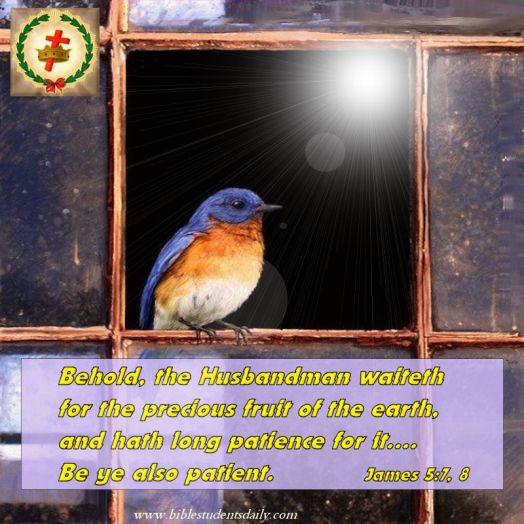
JAMES 5, 7-8.jpg

There is a saying “take time to smell the roses.”

And in the same way let’s remember to take time to hear God-Jehovah speak…
digest it…
absorb it…
and grow from it…

The Apostle suggests that if he had mountain-moving faith, if his knowledge of Divine mysteries were very great, superior to those of all other men, and even if in his zeal for man or for God he should become a martyr and permit his body to be burned, yet, notwithstanding all this, if the primary influence in these matters were not love, all the sacrifice, all the self-denials, all the labors, even the burning, would profit nothing.

Dear friends,

When we come to get the Divine standpoint of things we find indeed that we have a very high standard to achieve; and yet our judgment assures us that it is right, that it is just, that it is proper, that God should thus set the standard of love as the only standard by which we shall ultimately be measured. But whoever thinks to have this perfect love for God and for man and make no manifestations of it is equally mistaken.

Wherever love is in the heart … words, works, thoughts and looks will testify to it, so that he who loves much will serve much.

If we love the Lord we shall delight in His service regardless of failures, regardless of fame, regardless of any earthly consideration; yea, even though the service of the Lord should cause us the loss of human approbation, fellowship, etc…

Hence every true Christian may link the two words love and service, and be sure that his love will manifest itself in zeal. Similarly, love of the brethren will mean a desire to serve the brethren; love of the home and family will mean a desire to do good to them; love of our neighbor will signify a desire to do for his interests according to our knowledge and limitations.

THE RESTRAINTS OF LOVE

The Apostle points out some of the restraints of love.

It cannot be quick, irascible; for “love suffers long and is kind” (1 Corinthians 13:4).

  • He who is loving cannot be envious of others, nor covetous of the blessings and favors they are enjoying; for “love envieth not.”
  • He who is loving cannot be boastful and proud; for “love vaunteth not itself, is not puffed up.”
  • He who is controlled by the spirit of love will not be ungracious, unkind, rude; for “love doth not behave itself unseemly.”
  • He who is full of the spirit of love will not be selfish, grasping, neglectful of the interests of others; for “love does not seeks its own” (1 Corinthians 13:5).
  • The truly loving one will not be quickly angered, will not be easily offended; for “love is not easily provoked.”

“The one controlled by the spirit of love will not be imagining unkindness and rudeness nor seeking to interpret the words or conduct of others unkindly; for ‘love thinketh no evil’ “

(Pastor Russell’s Sermons, pages SM272-SM285).

What a beautiful example we see in our Master’s words to Simon:

“Simon, Simon, behold, Satan has demanded permission to sift you like wheat; but I have prayed for you, that your faith may not fail; and you, when once you have turned again, strengthen your brothers” (Luke 22:32).

Let us not neglect to pray for our fellow brethren in Christ, always while we are in this carnal abode.

“LOVE NEVER FAILS.”

(1 Corinthians 13:8)


The following is from “What Pastor Russell Said – Question Book”

QUESTION (1910) 1 At what point of character development can we say, the crown is ours, and that we are overcomers?

“ANSWER. — I think, dear friends, that the proper point at which we could say that, would be when we reach the mark of perfect love. For instance, you came to the Lord and made your consecration, you entered the School of Christ and began to learn of him. That was about the time you found out how short you were of the proper measure. Will the Lord ever be able to make anything out of me? Now the Lord is going to measure you according to your mind and is waiting for you to get to the mark of perfect love, which is the standard of a perfect character, for none will be worthy of a place in the kingdom or eternal life except those that reach this mark, either now or in the Millennial Age. God has nothing for anyone except those that reach that standard in his mind and heart. He may have weaknesses, etc., and you may speak things that you are sorry for, and must apologize for, but your heart is at the mark–perfect love—and that is the reason you want to apologize, because you have reached the mark of perfect love. You love God, and all mankind, and wish to do good to all, as you have an opportunity. After a person gets where he can love his enemies, he is at the mark of perfect love. He will not be perfect in flesh, for that will not be possible in this age. Many still have to put a bridle upon their tongues, etc., you must hold in the old nature. This I have often illustrated by a bad dog which would represent our old nature, and for which the new creature is responsible. We must hold him in. Our intentions are good, as is shown by the fact that when the heat or excitement of the moment is passed, then the heart goes back to the principles of righteousness, and asks for forgiveness from the Father. He will ask for forgiveness for anything he has done. You might say, it will be harder to rectify this, than not to have done it in the first place. Surely. But that is what you must do, if you want [Q51] to prove to the Lord that your heart is for righteousness, and whenever you find you have made a mistake, you must rectify it. Now, then, if you get to that place, you have gotten to the place where, to my understanding, you are at the mark of perfect love, toward God, men, etc. You desire good for all and injury toward none. From that moment, I understand, the Lord counts you as one having a crown apportioned to you. That is one thing, but seeing that no man take your crown is another thing. After granted to you it still remains that if you are moved from the mark, pressed aside by difficulties, you are not standing this test, and you will not be worthy of being an overcomer. So you see there is a mark of character, without which none will be acceptable in the kingdom, spiritual or earthly. Now we must demonstrate our love and devotion, that is what we live for today and tomorrow, and in all your Christian experience, from the time you enter the school of Christ, for you are to learn of him as quickly as possible and get to the mark of perfect love toward all.


The words below are from Reprint No. 4470 from “ZWT” (www.htdb.one).

STANDING AT THE MARK

WE HAVE heretofore suggested what we now wish to further, if possible, emphasize; namely, the fact that there is a Divine standard of holiness, of righteousness, which, if it be not attained, will mean our non-acceptance by the Lord as members of his Elect Church; and, more than this, our unfitness for eternal life upon any plane. This standard of character, or mark of perfection, as we have pointed out, is not a standard or mark of fleshly perfection, because the Lord accepts amongst his consecrated disciples those of various degrees of mental, moral and physical degeneracy. The justification which he provides makes up for the blemishes of each, for the more blemished as well as for the less blemished. The robe of his righteousness imputed is as necessary to the noblest as to the most degraded, and renders the latter as acceptable as the former.

From this standpoint it is recognized that the heart, the renewed mind, the renewed will, is the spirit-begotten New Creature which is on trial before God. It has professed a thorough consecration to righteousness and opposition to sin, a complete deadness to it, and a determination to mortify, to deaden, the will of the flesh to the extent of its ability. From the very start this condition is pleasing and acceptable to the Lord. Nevertheless, it is Scripturally represented at first as being merely a “babe” condition, according to one illustration, and according to another merely a “begotten” condition. Progress must be made, character must be developed, and then, further, it must be tested. “Not every one who saith, Lord, Lord, shall enter the Kingdom.” Not every one who professes consecration, and newness of life, and self-sacrifice in the interests of truth and righteousness, can be accepted as a joint-heir with Christ. Time must be given for development and for proving.

Love for God they have, from the very outset. But it is not love of the highest type. As already shown, it is largely, if not entirely, duty love. The “babe” in Christ must feed upon the sincere milk of the Word, that he may grow strong. As the spiritual food is appropriated, and spiritual exercise is taken, strength of character comes in, the eyes of our understanding open more widely, and lengths and breadths and heights and depths of the Divine character are discerned which were not visible at the first. This brings us to a higher type of love for God—a love for his glorious character.

Meantime, also, a sympathetic love for the world is gradually developing in the spiritual “babe.” As the principles of the Divine character are seen and appreciated, the New Creature begins to apply these to everything in life, and hence increases in sympathetic love toward man and beast, friend and foe. Another element of love is gradually attained also: At first the “babe” in Christ loves some of the brethren—the nobler, the gentler, the better educated ones, etc.; but gradually, as the Divine character is discerned, and the Divine love becomes shed abroad in the heart, this love broadens out so that it includes every member of the family of God and every member of the fallen race—yea, even enemies. With this development comes spiritual activity, called in the Scriptures quickening—”You hath he quickened.” This quickening implies activity in the service of God, and the service of the brethren, and if outside opportunity beyond this permit, it would mean an activity in the service of all needing assistance such as we could give.

The Christian life here illustrated, which began as a “babe in Christ,” has by this time reached the standard of manhood in Christ, and is at the Mark of Perfect Love—for God, for the brethren, for the neighbor and for the enemies. Not until this point shall have been reached could such a person be considered fit for heaven, or for eternal life on any plane.

We are to bear in mind that there is no development in heaven, and hence perfection of character must be attained by the saints before they die. And, similarly, the world during the Millennium must attain this perfect development before the close of the age in order to be fit for eternal life according to the Divine promise and standards.

Is it asked to what extent will this standard of perfect love in the heart manifest itself in the flesh? We answer, that during the Millennial Age it will manifest itself perfectly in the flesh, for the world then will be judged according to the actual attainments in their flesh, and perfection by restitution will be not only possible, but required. But as for us of the Gospel Age, we who are being judged not according to the flesh but according to the spirit, to what extent will the new mind, the new nature, when at the Mark of Perfect Love, be able to govern and control the flesh? Our answer is, that the degrees of control will vary much, according to the degrees of imperfection with which the mortal body is afflicted.

The only standard which we can set forth is that the new nature, new mind, new will, would be very regretful, very sorrowful, in respect to any laches, or errors, of its mortal body. The Lord would know (and perhaps the brethren also to some extent) of the New Creature’s endeavor to control the mortal body by the degree of its grief in connection with every error, and its continually renewed effort to bring every power of the body, and even every thought, into complete subjection to the will of God in Christ. Any sympathy with sin is an evidence that the New Creature is not at the Mark. And no sympathy with sin, but constant endeavor for righteousness, is evidence that it is at the Mark.

Some may be at this Mark for a longer and some for a shorter period. Our Lord was surely at it from the beginning of his ministry. He was tested there, while at the Mark of perfect love. All the besetments of the Adversary and of the world failed to move him from that position of perfect love. He laid down his life at this Mark. St. Paul was surely at this Mark for many years before his actual death. He was continually laying down his life for the brethren, continually serving his enemies and praying for them; and surely he was continually loving and serving the Lord with his every power and talent.

No Christian should be satisfied with a long delay in reaching the Mark. The milk of the Word should be received, its strength should be appropriated, spiritual sight and spiritual energy should quickly follow, and strong meat of Divine Truth should speedily bring to full maturity the Christian character. And once attained, it should be held at any cost through all the trials and difficulties which the Adversary, and the world, and the flesh, might be permitted to bring against us. The severest temptations come after we have reached the Mark—temptations to slackness in service of God; temptations to withhold parts of our sacrifice; temptations to deal unkindly, uncharitably, unlovingly with the brethren, or unjustly with our neighbor, or ungenerously with our enemies. All of these must be resisted as we prize our eternal life, as we prize the promise of joint-heirship and fellowship with our Redeemer in His Kingdom.

Whoever sees this subject clearly must realize that as a Christian he has to do with a great proposition which will thoroughly test his loyalty, his courage, his zeal, [R4470, page 271] his love. He will need to remember the Lord’s comforting assurances of grace to help in every time of need if he would come off a victor and not be dismayed, nor have his courage beaten down by the Adversary’s attacks.


References:

Br. Charles Russell. “Pastor Russell’s Sermons,” and “What Pastor Russell Said – Question Book.”

The Reprints of the Original Watchtower and Herald of Christ’s Presence. These Reprints can be accessed here: http://www.htdbv8.com

Suggested Further Reading

“Lovest Thou Me More Than These?”JOHN 21:15-22. Reprint 2806. The Reprints of the Original Watch Tower and Herald of Christ’s Kingdom.
http://www.htdbv8.com/1901/r2806.htm

A Practical Self-Examination On Love

A Practical Self-Examination on Love

Agape by Br. Mark Grillo
http://www.heraldmag.org/2012/12nd_11.htm

Brotherly Kindness by Br. Ed Byrd
http://www.heraldmag.org/2012/12nd_10.htm

Words for Love in the Bible, In the Hebrew, by Br. W.A. Eliason, The Herald of Christ’s Kingdom Magazine, Set/Oct. 1986.
http://www.heraldmag.org/archives/1986_5.htm#_Toc36907449


The URL of this post:
https://biblestudentsdaily.com/2016/03/20/what-is-love/?share=press-this&nb=1&sel=

Enter your email address to subscribe to this blog and receive notifications of new posts by email.

Save

Save

Gain The Lesson

GAIN THE LESSON

12241327_911738725547385_2377430335162085079_n.jpg

When our trials sore distress us,
Sickness, pain, and sorrow stress us,
‘Tis then we see our Father’s Face,
Feel the clasp of His embrace,
As He says in tenderness,
“This is for your blessedness;
Gain the lesson, precious child,
Gain the lesson!”
When trials blow like raging storm,
And many doubts and fears alarm;
When they drag on without an end,
Still He does this message send;
“All of this will work no ill
If, in faith, you trust Me still;
Gain the lesson, precious child,
Gain the lesson!”
Though trials linger, don’t despair,
We never are beyond His care.
He knows, He loves, He’ll understand,
For each experience is planned,
And each one holds its lesson clear,
“Just trust in Me, I’ll hold you near,
Gain the lesson, precious child,
Gain the lesson!”
Though hard your trials seem to be,
They’re designed to give you victory,
And teach you things you’ll need to know
As future ages onward go.
I say to you, “Press on, Rejoice,
As I urge with tender voice,
Gain the lesson, precious child,
Gain the lesson!”
-Margie Hagensick-