Why Eternal Life?

with address.jpg

Life eternal? For what reason
Will God grant it in His time?
He’s preparing in due season
Wondrous blessings, joy sublime!

Now He’s training caring teachers
To instruct in righteousness
Life and peace for all God’s creatures
He designs to guide and bless!

Soon Christ’s Kingdom will be bringing
Understanding of God’s Plan.
Then they’ll all His praise be singing,
As they see His love toward man.

Justice, Wisdom, Love and Power
Of God’s character the base;
Through all ages, like a flower
He’ll unfold His glorious grace.

Sr. Margie Hagensick

IMG_7152.JPG

THE LAMB’S WIFE

 Jesus, the Lamb of God, delighted to do His Father’s will. The course marked out for Him was a remarkable one. He “made Himself of no reputation, and took upon Him the form of a servant, and was made in the likeness of men: and being found in fashion as a man, He humbled Himself, and became obedient unto death, even the death of the cross. Wherefore God also hath highly exalted Him, and given Him a name which is above every name.” “Let this mind be in you, which was also in Christ Jesus,” for God has predestinated that the Bride of Christ must first be conformed to His image (Romans 8:29).

Those who demonstrate their loyalty to their heavenly Bridegroom under the various tests now upon us, filling up of the afflictions left behind of Christ for the Body’s sake will be counted worthy to form the Bride, the second Eve.

O glorious prospect drawing near—the Marriage of the Lamb!

“And while they went to buy, the bridegroom came; and they that were ready went in with him to the marriage: and the door was shut” (Matthew 25:10).

When the marriage is consummated, and the virgins, the Bride’s companions that follow her, are brought into the King’s palace, with gladness and rejoicing, then the regeneration of Adam’s race, for whom atonement will have been made, will begin, and “the fathers shall become the children” of the Bride and Bridegroom, and they shall be made princes in all the earth, as co-labourers in the glorious work—the restitution of all things made possible through the sacrifice of the man Christ Jesus.

Reference: “What Pastor Russell Taught”


The URL of this post:
https://biblestudentsdaily.com/2016/07/10/why-eternal-life/

Enter your email address to subscribe to this blog and receive notifications of new posts by email.

Save

Save

OUR BELIEFS – What Does The Bible Teach Us?

kangourous-australia website - WITH ADDRESS

To us, the Bible is the Word of GOD, the sole authority of Christian Doctrine and Practice. To us it clearly teaches that:

* JEHOVAH (Hebrew: YAHWEH) is THE ONE ALMIGHTY GOD, who is from “everlasting to everlasting” (Psalm 90:2).

* JESUS CHRIST, the Logos (Word), is GOD’S ONLY BEGOTTEN SON, the firstborn of every creature who was made flesh and by the grace of GOD gave himself a willing and voluntary RANSOM for ALL mankind, to be fully demonstrated in GOD’s due time, and His is the Light that enlightens all who come into the world. He is our Lord and Master and the Captain of our Faith, our Redeemer (John 3:16; John 5:28-29; John 14:16; Colossians 1:15-17; 1 Timothy 2:5-6; Hebrews 2:9).

* JESUS WAS RESURRECTED on the third day after his crucifixion (50 hours from the moment he went into the heart of the earth), Jesus was resurrected a Divine Celestial Being, Immortal, and will never come again in the flesh (Luke 24:1-7).

* ALL HAVE SINNED and come short of the Glory of GOD, and that the penalty for sin is death, extinction of life (Romans 3:23; Romans 6:23; Ecclesiastes 9:10).

* PERSONAL SALVATION is by faith in and the acceptance of Jesus Christ as a Savior and Lord, that there is no other name or way by which any can be saved (John 14:6; Acts 4:12; Acts 16:30-31).

* GOD IS CALLING OUT from those saved by faith now a “people for his name,” to be followers of Jesus Christ in full obedience to the divine will and to constitute His Body, the “Church.” These are also refer to as the “saints,” the “sanctified, the “bride” of Christ, the “wife of the Lamb,” “the 144,000” and the “little flock.” (Psalm 45:14-15; Matthew 16:24; Acts 15:14; Ephesians 1:22,23; Ephesians 5: 25-27, 32; 1 Corinthians 1:2; Revelation 21:9-10; Revelation 22:17; Revelation 7:4).

* THE HOLY SPIRIT is the character of the Heavenly Father Jehovah who is Love and Justice balanced by His awesome Wisdom, and His Great Power carries out His balance through actions and magnificent influence on ALL of His creation; and this power of His character is working in and through His called out people, to guide them into understanding of and conformity to His will. It is not a third person of a Godhead (Luke 11:13; John 16:13; Acts 1:8, Romans 8:14).

* Man IS A SOUL (Sentient being), but does not HAVE a “soul.”

* The wages of sin is DEATH and NOT TORMENT or some form of living separate from the Creator (Ezekiel 18:4; Romans 6:23).

* ALL MANKIND SHALL RESURRECT out of their graves and partake in the blessings and opportunities of Christ’s one thousand year kingdom which present conditions indicate is extremely close at hand (Luke 21:25-28, John 5:28, 29, Revelation 20:6).

* THE EARTH WILL NOT LITERALLY BE BURNED UP (but the systems of the world will be destroyed), but rather will become a paradise worldwide by the end of the Messianic Age, inhabited by the obedient regenerated race of Adam, when death will be destroyed forever (Ecclesiastes 1:4; Isaiah 25:8; 1 Corinthians 15:26; Revelation 21:4).

* THE CHURCH IS GOD’S TEMPLE which has been in preparation during this present GOSPEL AGE, at which, when complete, will be the means of GOD’S blessings coming to “all people” (Genesis 22:17-18; Isaiah 25:6; Matthew 19:28; 1 Corinthians 3:16,17; Ephesians 2:20-22).

* MEANTIME THE SHAPING AND POLISHING of individual Christians—“living stones”—has been in progress, and when all have been made ready, they will share in the “first resurrection” and the completed, glorified Temple will become the meeting place between GOD and mankind (1 Peter 2:5, 2 Peter 1:5-8, Revelation 20:6).

* THE HOPE OF THE CHURCH is to be like her Lord, to see Him as He is, to be partakers of the divine nature and to share in His glory in the divine realm as His joint-heirs helping the world of mankind come up the Highway of Holiness and come into harmony with GOD, so that GOD our Creator can be ALL IN ALL—which is the ETERNAL GOSPEL (Isaiah 35:8; 1 John 3:2, 2 Peter 1:4, Romans 8:16-17; Revelation 14:6).

* THE BLESSINGS OF GOD’S KINGDOM will include the return of GOD’S favour to Israel and the restoration of all things lost in Adam for all the willing and obedient in that time; that at the end of the thousand years Satan and all the willfully wicked will be destroyed (1 Corinthians 15:12-22, Romans 11:25,26, Acts 3:20,21).

*******

“For, behold, I create new heavens and a new earth: and the former shall not be remembered, nor come into mind. But be ye glad and rejoice forever in that which I create: for, behold, I create Jerusalem a rejoicing, and her people a joy. And I will rejoice in Jerusalem, and joy in my people: and the voice of weeping shall be no more heard in her, nor the voice of crying. There shall be no more thence an infant of days, nor an old man that hath not filled his days: for the child shall die an hundred years old; but the sinner being an hundred years old shall be accursed. And they shall build houses, and inhabit them; and they shall plant vineyards, and eat the fruit of them. They shall not build, and another inhabit; they shall not plant, and another eat: for as the days of a tree are the days of my people, and mine elect shall long enjoy the work of their hands. They shall not labour in vain, nor bring forth for trouble; for they are the seed of the blessed of the LORD, and their offspring with them. And it shall come to pass, that before they call, I will answer; and while they are yet speaking, I will hear. The wolf and the lamb shall feed together, and the lion shall eat straw like the bullock: and dust shall be the serpent’s meat. They shall not hurt nor destroy in my entire holy mountain, saith the LORD” (Isaiah 65:17-25, KJV).

*******

BIBLE-STUDENTS-DAILY.jpg

We Believe the Bible

The following is taken from The Watch Tower, January 15, 1912, pages 28,29; Reprints pages 4955, 4956:

THOSE WHO OPPOSE our teaching are given to misrepresenting it. They do not wish to speak untruthfully, but desire to hinder our work, which they fail to recognize as the Lord’s work.

It is difficult to answer the arguments of our opponents in a few words, when they misunderstand our presentations of more than three thousand pages. If they cannot understand a detailed account, we have no hope of making a brief one satisfactory to them. However, we give here a synopsis:—

I. We affirm the humanity of Jesus and the deity of Christ.

II. We acknowledge that the personality of the Holy Spirit is the Father and the Son; that the Holy Spirit proceeds from both, and in turn from all who are begotten by it.

III. We affirm the resurrection of Christ—that He was put to death in the flesh, but quickened in the Spirit. We deny that He was raised in the flesh, and challenge any statement to that effect as being unscriptural.

IV. We affirm, with the Scriptures, that God alone possessed immortality, “dwelling in the light which no man can approach unto.” We affirm that this Divine quality has already been granted to the Lord Jesus and is to be the portion of the elect Bride, the “Body of Christ.” As for mankind, we affirm the Divine provision for these [R4956 : page 29] and for angels to be everlasting life for the obedient. This, by many, is mistermed immortality. We follow the Scriptures strictly.

V. We hold that the entire race lost life with Father Adam, as a result of his failure in Eden; and that Christ died to secure a second chance for Adam and an individual chance for all of his race, who lost their first chance in Adam when he sinned. “As all in Adam die, even so all in Christ shall be made alive.” (1 Cor. 15:21,22.) A few of us, comparatively, having eyes of faith and ears of understanding, have had this second chance in the present life. Adam and the great mass of his posterity must get their second chance after being awakened from the tomb. But NOBODY IS TO GET A THIRD CHANCE!

VI. We believe that the soul was condemned to death. “The soul that sinneth it shall die.” We believe that this death would have been eternal, everlasting destruction, had it not been for God’s mercy in and through our Lord’s redemptive work. By reason of His death our souls do not die in this full sense of the word, but are Scripturally said to “fall asleep,” “asleep in Jesus.” The awakening will be in the resurrection morning; and the interim will be a period of unconsciousness, beautifully symbolized by a restful sleep.

VII. We believe in the “hell” of the Bible, sheol. This, the only word used for hell for four thousand years, is translated more than one-half the time grave in our Common Version, and should always be thus translated. “Hades,” in the New Testament, is its equivalent. “Gehenna fire,” of the New Testament, is a symbolical picture declared to signify the Second Death.

VIII. We believe that God is able to destroy “both soul and body” in Gehenna—the Second Death. We consider it much more sane to believe thus, as it is more Scriptural, than to believe that in creating man God did a work which He could not undo; much more reasonable also than to believe He prefers to have the incorrigible suffer eternally, when their sufferings could do neither themselves nor others any good.

IX. We believe that, like the Father and the holy angels, our Lord is a spirit being. We are convinced that “flesh and blood cannot inherit the Kingdom of God.” We do not believe that our Lord has a flesh and blood body, a “little lower than the angels,” and has thus been out of harmony with His heavenly environment for nearly two thousand years. We believe the Apostle’s statement, “Now the Lord is that Spirit.” This is the Jesus who will “so come, in like manner,” quietly and unknown to the world, as He went away. We do not affirm, dogmatically, that He came in 1874, but we say that to us it is the evident teaching of the Scriptures. Our Lord warned us not to expect Him in the flesh; that men might say “Lo, here” or “Lo, there.” The Harvest work in the universal Church Nominal, the Laodicean period of the Church, well corroborates our expectations of what His work will be, as outlined in His parables, etc.

====================

Suggested Further Reading

Who We Are
https://biblestudentsdaily.com/category/who-we-are/

Links and Bible Resources
https://biblestudentsdaily.com/category/links/

Our Purpose and Mission
https://biblestudentsdaily.com/category/our-purpose-mission-the-story-behind-bible-students-daily-2/

The BIBLE — The World’s Best Novel. Here is Why.

THE BIBLE – The World’s Best Novel. Here Is Why.

Here is the Book “The Bible Students in Australia” by David Simkin. Please click the image below for the PDF file of the book.

Pastor Russell Founded the Bible Students Not Jehovah’s Witnesses http://www.friendsofjehovahswitnesses.com/wp-content/uploads/Bible-Students-not-Jehovah-Witnesses2.pdf-final2.pdf

pastor-russell-founder-of-bible-students-not-jehovah's-witnesses


Did Russell Start The JWs?
http://rlctr.blogspot.com.au/2009/04/was-russell-founder-of-jws.html

Pastor Russell – Not the Founder of the Jehovah’s Witnesses
http://www.dawnbible.com/1940/4008-hl.htm


This post’s URL:
https://biblestudentsdaily.com/category/beliefs/

Enter your email address to subscribe to this blog and receive notifications of new posts by email.

Who is the World’s RANSOM and Why?

1 Timothy 2, 4-6 - with C & address

“Wherefore the law was our schoolmaster to bring us unto Christ, that we might be justified by faith” (Galatians 3:24).

On a hill far away stood an old rugged cross,
The emblem of suffering and shame.
And on that old cross the dearest and best,
For a world of lost sinners was slain.

It is a tragic picture to contemplate. A perfect man, so unjustly convicted, dying in the prime of life. But his greatest defeat was his greatest triumph. That was why he came. That was why he left the heavenly courts to become a man in the first place.

Note how obediently and willingly and humbly Jesus, the firstborn of all creation, the Bright Morning Star answered, when our Heavenly Father asked who should He send down to earth as the Redeemer, “Here am I, send me” (Isaiah 6:8). This is why the Son was the Almighty Heavenly Father’s delight.

Father Adam caused the death penalty to be imposed upon the whole human family, Christ’s willing sacrifice provided the value to redeem all mankind. Only a perfect being who was separate from God could accomplish the task of removing the death penalty upon Adam and his race, thus providing a way for mankind to be redeemed from the power of the grave.

Christ’s sacrifice provided a release from the curse, first for the Church class during the Gospel Age, and later for the World during the Millennial Age.

God loves mankind deeply (John 3:16). We cannot imagine the sorrow and pain that God experienced when Adam fell. We can only get some idea of this feeling when we observe the grief of parents when their children go astray.

God not only provided a mechanism to rescue His precious creation, but authorized His son to execute God’s plan for their redemption.

“By his knowledge the righteous one, my servant, will justify the many, as he will bear their iniquities” (Isaiah 53:11, NAS).

Not only did God provide the mechanism for mankind’s redemption, God also empowered this Righteous One, Jesus, to justify His chosen ones. “Wherefore Jesus, … that he might sanctify the people with his own blood, suffered without the gate” (Hebrews 13:12). Jesus was “delivered for our offences, and was raised again for our justification” (Romans 4:25). God has empowered His son to redeem us and justify us.

The death of our Savior, Jesus Christ, provided the price of our release from the curse. The scriptures speak of the life of Jesus, given for us, as a “ransom” for us. Today we think of a ransom as a price for the release of a hostage. The scriptural word “ransom” is from the Greek word “lutron,” which literally means a price of release (Matthew 20:28, Mark 10:45).

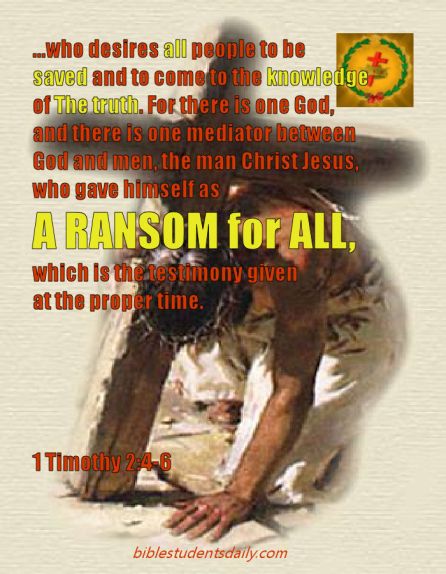
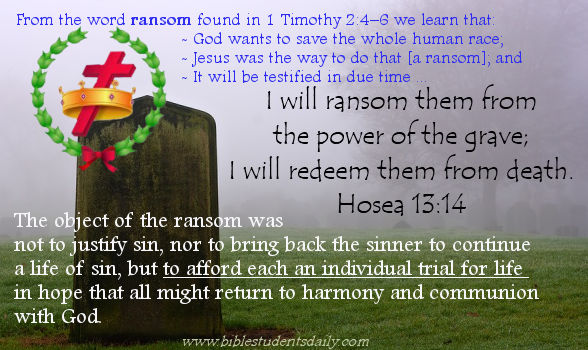
The word “ransom” also appears in 1 Timothy 2:4–6, from the Greek word “antilutron,” which means a corresponding price of release. This refers to the fact that the value of the life of Jesus, given for us corresponds to the price required. From the use of the word “ransom” we see that:

  • God wants to save the whole human race, and
  • Jesus provided the price necessary to release us from the death penalty imposed upon Adam and his race.

The PURPOSE of the Ransom

The object of the ransom was not to afford each individual a release from the original condemnation, in order to give them an opportunity to attain everlasting life. It allows mankind an opportunity to return to harmony and communion with God.

“I will ransom them from the power of the grave; I will redeem them from death: O death, I will be thy plagues; O grave, I will be thy destruction: repentance shall be hid from mine eyes” (Hosea 13:14).

HOSEA-13-14.jpg 
RANSOM STEPS

(1) Determine the Price — The price of release (the lutron or ransom) was the value of a human life. God established that the punishment for sin was death, and this was imposed upon Adam when he sinned. Adam passed his condemned life to all of the human race. In order to release mankind from this penalty, would require an obedient man to accept that punishment upon himself, so that it could be released from Adam and all those who received Adam’s life through procreation. Thus every person who descended from Adam — all humanity — will receive a release from death.

(2) Provide the Price — Jesus, as a perfect human being not subject to death, yielded his life in order to take upon himself, the penalty due us — so that we might be released. “By man came death, by man came also the resurrection of the dead. For as in Adam all die, even so in Christ shall all be made alive” (1 Corinthians 15:21, 22). Jesus’ life yielded, is the price for Adam’s life to be restored: Jesus for Adam, a perfect life for a perfect life. How beautifully they balance the scales of justice!

(3) Pay the Price — When Jesus died, he said “Father into thy hands I commend [deposit] my spirit” (Luke 23:46). The word “commend” is from the Greek word paratithemi, which means to deposit as a trust. In other words, Jesus committed to God the value of his life for later use, and all of Jesus’ interests for his future work in the Plan of God.

(4) Loosen the Captives The world has been under the penalty of death, but they will be loosed (“luo”) from this captivity in God’s due time, when Christ and his “bride” of 144,000 members rules with him to raise and bless mankind.

RELEASE FROM THE LAW

After Jesus was baptized, he meditated in the wilderness for 40 days. Part of this time he would have meditated on the Law of God, given to Israel through Moses at Mount Sinai. That law was perfect. Therefore, imperfect man could not keep it. As the Apostle Paul says in Romans 7:10, “The commandment, which was ordained to life, I found to be unto death.” For none of Adam’s imperfect race could perfectly keep the Law.

But Jesus did. By keeping a perfect law perfectly he demonstrated that he was a perfect man, and therefore that he could be a corresponding price for the only other perfect man in history, Adam. Like an index finger, the law pointed out the one person who could pay the ransom price.

Adam and Eve had no children until they left the garden of Eden. Therefore, all of their offspring inherited a condemned and imperfect life. Jesus, like Adam before he sinned, had the potential for a perfect human race in his loins. In this sense he was an appropriate value to redeem Adam and his race.

No wonder then we sing with rejoicing:

In the cross of Christ I glory,
Towering oer the wrecks of time.
So l’ll cherish the old rugged cross,
Till my trophies at last I lay down;
I will cling to that old rugged cross,
And exchange it some day for a crown.

As 1 Timothy 2:4-6 reads, God has willed or determined (rather than “desired”) that all mankind will:

  • Be saved from Adamic death, from the destruction of the grave, to be accomplished through the GREATEST MIRACLE the world will EVER experience: THE RESURRECTION!
  • Be saved from ignorance, blindness and deafness.
  • Come under a “new covenant” established by God, during the 1000 year Messianic Kingdom.
  • Be restored to perfection and an opportunity for eternal life.
  • Come to a knowledge of God, and thus secure a relationship with God forever.

The Ransom provides a salvation from the curse of death. It will be UNCONDITIONAL. It depends alone upon the will of God, and the price of release is the value of Jesus’ life, given for us all.

This Scriptural passage, 1 Timothy 2:4-6, speaks of a universal redemption. During the Millennium the curse will be remitted. Then each individual may begin walking up the “highway of holiness” toward everlasting life. Most of mankind will accept this free gift, and progress accordingly. Only a few will use their power of choice differently, and fail to attain everlasting life at the close of the Millennium (Revelation 20:7-9).

God will provide for the enlightenment of every individual when they awaken from the dead, so that everyone will have an accurate knowledge of God, His love, and His standards. The knowledge of Jehovah shall fill the earth (Isaiah 11:9). Mankind will have learned through experience the consequences of sin. During the Millennium, they will learn through experience the blessings of righteousness. All can then choose between the law of God which leads to life, and the law of sin which leads to death. Knowledge of truth is light, and Christ is “the true light, to lighten every man that cometh into the world” (John 1:9).

Jesus is an Advocate and helper presently to those who have consecrated their lives to follow in Jesus’ footsteps. They express this commitment by baptism, and rejoice in hope of resurrection glory with Christ in heaven. We suffer with Jesus in the present, by pursuing righteousness in world surrounded by sin. We will reign with Christ in glory, to assist him during the Millennium in drawing mankind back to God (Revelation 20:6).

During the Millennium, when God effects a new covenant for blessing Israel and the world (Jeremiah 31:31), Jesus will serve as Mediator, standing between God and men, in order to reconcile them by bringing mankind back to godliness. The saints who reign with Christ will be with Jesus in this mediatorial work of reclaiming mankind. Thus this work awaits the completion of the “Bride” class to be complete. Mediating for the world will then proceed. The saints will be associated with every feature of this work for the world, assisting them during the Millennium.

The word Mediator from the  Greek is mesite and means middle-man, reconciler, go-between. The Scriptures use the word respecting mediating a covenant between parties who are alienated. A mediator is one who interposes between persons who are at variance, with a view to reconciling them. Moses, as the Mediator of the Law Covenant, was a type of Jesus, the Mediator of the New Covenant.

At the close of the thousand years the Mediator will have completed its role. Thereafter God will stand before God, and demonstrate, during the “Little Season,” their condition of heart. Those who are obedient and godly, will receive everlasting life. Those who are disobedient and rebellious, will lose this privilege.

In 1 Timothy 2:5 we read about “The man Christ Jesus.” The Greek word for “man” is anthropos — human being. It refers to when Jesus when he was made flesh. Jesus “gave himself” as “the anointed” one (the word Christ signifies “the anointed”), who finished the giving of himself at Calvary. The name Jesus is but another form for Joshua, which signifies Deliverer. The name Christ is the Greek equivalent for the Hebrew word Messiah — The Anointed.

Jesus surrendered his perfect human life, that is, all of himself, his human rights and privileges — the full equivalent of Adam’s perfect life. By his willing sacrifice for men he secured the right to purchase Adam and the entire race. He has not applied this human life to Adam and his race. It remains a deposit, for use at the appropriate time to release mankind from the curse.

Christ was both Priest and Sacrifice. As a priest, he offered his sacrifice to God. As a Sacrifice, his human life was yielded up, given, for the benefit of mankind.

THOSE WHO ARE IN CHRIST PRESENTLY

As mentioned earlier, the ransom Jesus gave constitutes a price of release. Those who have come into Christ in the present time, accepting the value of his sacrifice by faith in him, are granted redemption presently. That is, God counts them as uncondemned, justified, by virtue of the value of Christ’s redeeming sacrifice (Romans 5:9). We then lay down this justified life in service and sacrifice with Jesus, as long as our days remain.

We thus give up our share in the earthly blessings awaiting mankind, in order to secure the higher, heavenly blessings offered during the present time.

The resurrection of Jesus was a testimony from God that Jesus performed his sacrifice correctly, and that all the blessings God has for us now — and the world later — are sure and established (Acts 17:31).

Another evidence of God’s acceptance of Jesus’ sacrifice was seen by sending the holy Spirit upon the saints on the day of Pentecost. There God’s anointing, the holy Spirit (symbolized in the Old Testament by the holy anointing oil), came upon the Church. It continues ever since on all the living members of the Church.

Jesus laid down his life as a sin-offering during the 3½ years, and Jesus applied the value of this for the Church class when he appeared in the presence of God for us. Jesus has not yet applied it for the whole world. That awaits the Millennium.

The ransom price that Jesus gave provides a release from condemnation, for us now, and for the world later. That was given on Calvary’s cross.

The sin offering that Jesus gave began at Jordan (when Jesus was 30 years of age), and continued through the 3½ years of Jesus’ ministry (until Jesus was 33 1/2 years old). Jesus was “made perfect,” or complete, in character, “by the things which he suffered” (Hebrews 5:8,9). Jesus was not imperfect at any time in the sense of being sinful (2 Corinthians 5:21, 1 John 3:5, 1 Peter 2:22). He was perfect, undefiled, in His glorious condition as the Logos, before He left the glory which He had with the Father and was made flesh. When born of Mary, the assurance given us is that He was still “holy, harmless, undefiled and separate from sinners” (Hebrews 7:26).  His sufferings, therefore, did not make Him perfect in the sense of making Him sinless, but rather, to prove his loyalty to the Father’s will, unto death, even the death of the cross. The promise of perfection on the highest plane — the promise of the Divine nature — was Christ’s reward for fulfilling his Covenant of Sacrifice faithfully and loyally. The beginning of that new nature was granted to Jesus at the time of his baptism, when he was begotten of the holy Spirit. But the new nature begotten there needed development, or perfecting; and it was for this purpose that the trials, difficulties and buffetings were permitted to come to Him (R5472). As our High Priest in glory, Christ — our Advocate (our personal “lawyer”), works with us through our experiences, to purge from us the propensity for sin.

The Church is not a part of the ransom price. However, we do have the privilege of suffering with Christ presently, and being raised in glory to be priests for the world during the Kingdom (Revelation 20:6). From that elevated standing, we will be able to assist Jesus in purging from mankind their propensity for sin. In this way we share with Christ in being an offering for sin.

The Church is not a part of the ransom price but does share in the sin-offering through grace. These two doctrines are inseparable. We could call them the TWIN DOCTRINES as they always work together in the process of salvation.

The ransom expresses God’s justice. For it shows that a payment for sin is necessary, in order to release mankind from the curse justly imposed upon our father Adam in Eden. But as steadfast as the penalty has been — so God’s commitment to release mankind from the curse, now that a payment has been made, is equally sure.

Christ has already redeemed mankind in the sense that he has laid down the ransom price. But he has not yet rescued mankind and applied to them the value of the ransom price provided. That awaits the Millennial Kingdom. In the meantime, God is selecting from among mankind people of faith, to be developed in the pattern established by Jesus, in order to assist Jesus in the world of lifting the world from their plight during the Millennium.

Then God will apply the price of release for Israel and the world. Then a New Covenant will be established for blessing of all who come under its blessings. When the Millennial age shall have been finished its work, and all are restored to harmony with God, then our heavenly Father will be ALL in ALL (1 Corinthians 15:28).

Suggested Further Reading

The Ransom. Faithbuilders Fellowship.

Click to access 02_ma_07.pdf

MATTHEW 26:27-29 — Drinking From Christ’s One Cuphttps://biblestudentsdaily.com/2018/03/19/matthew-2627-29-drinking-from-christs-one-cup/

JESUS — The Namehttps://biblestudentsdaily.com/2017/07/05/jesus-the-name/


The URL of this post:

Who is the World’s RANSOM and Why?

Enter your email address to subscribe to this blog and receive notifications of new posts by email.

What is Love?

1 JOHN 4, 8.jpg

Love is …

perfection of character.

“So we have come to know and to believe the love that God has for us. God is love, and whoever abides in love abides in God, and God abides in him” (1 John 4:16).

The love that our heavenly Father seeks to have us develop is a love which is in full harmony and in total surrender to God’s will. When we please our Divine Father of Life, He will bless with eternal life.

“To those who by patience in well-doing seek for glory and honor an immortality, he will give eternal life” (Romans 2:7).

You therefore must be perfect, as your heavenly Father is perfect” (Matthew 5:48).

One element of Love is MEEKNESS.

Meekness does not mean weakness.

Consider Moses. He was a meek man and did he have a weak character? Not at all. He was humble-minded, not boastful, not proud or haughty.

“Now the man Moses was very meek, above all the men who were upon the face of the earth” (Numbers 12:3).

So the New Creatures in Christ, must develop and maintain this quality of meekness, from the divine standpoint.

Another element of love is GENTLENESS.

Does this signify weakness or fear? No.

Gentleness is part of a character of love.

Jesus said, “take my yoke upon you, and learn of me; for I am meek and lowly in heart: and ye shall find rest unto your souls” (Matthew 11:29).

In Galatians 5:22, 23, the Apostle Paul writes, that the fruit of the Spirit is love, joy, peace, forbearance, kindness, goodness, faithfulness, gentleness and self-control. Against such things there is no law.”

To the Ephesians, the Apostle Paul writes, ” (1) I urge you to live a life worthy of the calling you have received. (2) Be completely humble and gentle; be patient, bearing with one another in love. (3) Make every effort to keep the unity of the Spirit through the bond of peace. (4) There is one body and one Spirit, just as you were called to one hope when you were called; (5) one Lord, one faith, one baptism; (6) one God and Father of all, who is over all and through all and in all” (Ephesians 4:1-6).

“Let your moderation be known unto all men” (Philippians 4:5).

“Moderation”reasonableness, gentleness—the spirit of a sound mind, of gentleness, meekness.

This attitude of mind comes in large measure as a result of knowledge of God and his plans (R5840). Surely there never was a time when this counsel was so much needed as now!

Let the fact that we know only in part and understand only in part keep us humble and moderate in word and deed and thought (R5249).

Temperance, self-control—let men see by our thoughtful (not rash and hasty), careful and considerate demeanor in every affair of life, that we honor our profession (R4809, R2460).

Here is a practical example:

If we feel the leader of a meeting is not following the best Scriptural course, we must show moderation in our approach—approving what we can, objecting in kindness, meekness, and brotherly love (R3866). The Greek seems to carry the thought of reasonableness, of not exacting our rights too rigorouslymercy and leniency (R3128:2). Keep yourselves well in hand, subject and obedient to the will of God.

In 2 Timothy 3:2-5, the Apostle Paul warns against those “in the last days” (today) who he describes as “(2) lovers of themselves, lovers of money, boastful, proud, abusive, disobedient to their parents, ungrateful, unholy, (3) without love, unforgiving, slanderous, without self-control, brutal, not lovers of the good, (4) treacherous, rash, conceited, lovers of pleasure rather than lovers of God— (5) having a form of godliness but denying its power.” The Apostle Paul then states, “have nothing to do with such people.”

Even in discussing the time of trouble, emphasis should be laid upon the glorious Kingdom which will be inaugurated (R5716:4). We should be using the knowledge we possess, doing with our might what our hands find to do (R5249). Let us be specially on guard that the influence of every word and act should be in accord with law, order and peace—“live peaceably with all men.” (Romans 12:18).

Our gentleness toward all men would begin at home—more particularly in the Church—but should be manifested toward all with whom we have dealings (R5840).
Messiah’s Kingdom is shortly to be established—this should help the Lord’s people in living an exemplary life (R5840). This clause implies the exhortation belongs specially to the closing of this Gospel age—thus, to this time period we are currently living in.

We are expecting great changes soon and can well afford to be generous and liberal in our sentiments toward others (R3128:3).

PATIENCE is another element of love and a part of the true Christian character.

“With all lowliness and meekness, with long-suffering, forbearing one another in love” (Ephesians 4:2).

Patience is an element of character. We read in Revelation 3:10,

Because thou hast kept the word of my patience I will also keep thee from the hour of temptation which shall come upon all the world to try them that dwell upon the earth.”

When examining the word “patience” we find that two quite distinct words in the Greek are translated by our English word patience in the New Testament:

  • hupomoneethis is used in the Revelation text quoted above which has a much deeper and fuller significance than attaches to our English word patience. It signifies rather constancy,—the thought being an endurance of evil in a cheerful, willing, patient manner. It represents, therefore, an element of character, and not merely a temporary condition or restraint of feeling or action.

For instance, a worldly man might have a great deal of patience in connection with the running of his business;—he might be very attentive to his customers, very obliging, very painstaking, and show no dissatisfaction in connection with the inconsiderateness of his customers; and “patience,” in its ordinary sense, might be ascribed to his conduct.

But the word in the Revelation text rendered patience” signifies such a development of heart and character as manifests itself in an endurance of wrong or affliction with contentment, without rebellion of will, with full acquiescence in the divine wisdom and love.

In Luke 8:15, in the parable of the sower, we read:

“That [sown] on the good ground are they which in an honest and good heart, having heard the word, keep it, and bring forth fruit with patience [with cheerful endurance, constancy].”

The thought here is that in order to be of the fruit-bearing class which the Lord will approve and accept to his Kingdom, it is necessary to do more than to receive the word of his testimony, even thou we receive it with joy—for that class in the parable is represented by the stony ground, which at first gave evidence of great fruitfulness and vigor, but which, when the sun of persecution arose, withered, because of lack of depth of soil. That stony, shallow soil represents, the Lord explains, a class of hearers who rejoice greatly in the truth, but do not endure, such as cannot withstand persecution or opposition, but wither under it, become discouraged. Such cannot be of the Kingdom class, all of whom must be overcomers.

In this parable our Lord shows us that patient endurance, constancy, is the final test, following after the readiness of preparation to receive the seed; following after the seed has been received and has sprouted; following after love and hope and joy and faith have caused it to spring forth and to give fruitage (R2791).

Patient endurance, then, is necessary, in order that the grain may be developed and thoroughly ripened, and made fit for the garner.

Ah! how important patient endurance seems to be, in the light of this our Lord’s word—cheerful endurance; for we cannot suppose that he who judges the thoughts and intents of the heart would be pleased with his children, even if he saw them enduring much for his sake, if they endured in an impatient or dissatisfied or unhappy frame of mind. They would not, in that event, be copies of God’s dear Son, our Lord, whose sentiment is expressed in the words,

“I delight to do thy will, O God!” (Psalm 40:8)

All of the Royal Priesthood are sacrificers, as was the Chief Priest, our Redeemer and example, who offered up himself: we, as the under priests, have also presented our bodies living sacrifices, and are to lay down our lives for the brethren—in the service of the truth. And God, who accepts these sacrifices through the merit of Christ, informs us that he appreciates or loves the cheerful giver, those who perform their sacrifices of a willing heart, cheerfully.

The other instance in which our Lord used the word “patience” during his ministry is recorded in Luke 21:19. He had just been telling his followers what they must expect as the result of being his disciples during the present time, when sin abounds, and when Satan is the prince of this world—they must expect tribulation, opposition from various quarters; but he assures them that they would nevertheless be fully and completely under divine care and protection, even tho the persecutions would be permitted to reach and to affect them. Then follow the words,

“In your patience [patient endurance, cheerful constancy] possess ye your souls” (Luke 21:19).

BROTHERLY KINDNESS is another element of love.

“(5) And beside this, giving all diligence, add to your faith virtue; and to virtue knowledge; (6) And to knowledge temperance; and to temperance patience; and to patience godliness; (7) And to godliness brotherly kindness; and to brotherly kindness charity. (8) For if these things be in you, and abound, they make you that ye shall neither be barren nor unfruitful in the knowledge of our Lord Jesus Christ” (2 Peter 1:5-8).

The Greek word “Philadelpia” signifies brotherly love. “Phileo”—is duty love, a love which has a cause or demand upon it (R2807).

Phileo love is evidenced in the natural family relationship, and also in the spiritual family, the Church. We may not love our brethren’s peculiarities, their features, but we love them as brethren, whether black or white, bond or free, because they are brethren, comrades in the same race (Q449).

Phileo love means to make due allowance for inherited weaknesses and circumstantial misfortunes of others—to deal patiently and helpfully so far as wisdom may dictate, with a view to the correction of those faults, even at the expense of self-interest, if necessary and prudent (R4809, R1114).

Phileo love means to meekly bear reproof, determining to overcome deformities of character, and prove a help rather than a hindrance to others; no longer fostering old dispositions (R4809).

Phileo love allows one to exercise and manifest the principles of the divine character toward our fellow-men (R3090, R1628:2).

Phileo is a love for all who are brethren and yoke fellows in the cause of righteousness and truth, the cause of God (R2037).

Instead of disdaining those who are ignoble, instead of putting them away, treat them kindly (R448). This of necessity grows out of godliness. As god-likeness presupposes the other graces mentioned, so its development implies an enlargement of our hearts to all who are of the household of faith (R2155).

There is also “AGAPE” LOVE…

This is known as charity (R5693, R5208).

Greek, agape, is the higher grade of disinterested love; the broader, more comprehensive, or divine love (R3949; Q449).

Love as a general expression covers all the elements of character which are really parts of love (F186).

We might divide the race-course into four quarters:

(1) duty-love;

(2) love for the Lord because we see something of the glorious majesty of his character;

(3) love for the brethren;

(4) perfect love—for all, even our enemies (F187-189).

As we get agape love it means that we love all (Q449) We must reach this climax of love before we can be counted worthy of a place in the new creation (F190).

Agape Love:

  • Is deep, pure and true.
  • Thinketh no evil.
  • Does not puff itself up.
  • Is not easily offended;
  • Rejoiceth always in the truth and never in iniquity;
  • Is the climax of Christian attainment in the present life, the grace of all graces, which never fades, and which will be perfected when we receive the new resurrection body (R2037, R2155).
  • Is sincere love for the unrighteous and unlovely, as well as for the good and beautiful (R4809, R1114).
  • Is a love which is ever ready to manifest itself in wise and helpful activity for saint and sinner; and which pities, helps, comforts, cheers and blesses all within its reach—manifesting and cultivating the disposition which must be found in every member of the Christ company (R4809, R1114).
  • Is a broad, generous love, taking in the whole world, even our enemies (R5678, R5757, R5460).

We do not attain to the perfection of love at the beginning of our course, but it is the mark or standard which indicates the end of the course

(F186).

Love is the chief of all graces.

Acts of kindness will gradually lead to an attitude of love, even where the subject does not seem to deserve it (R1628).

Love is an experience, and includes in it an earnest desire for the well-being of the object loved (R78:5).

Love excels all the other virtues, because it is the most enduring (R4732).

True love on our part will manifest itself in obediencedisobedience is an evidence of the loss of love as viewed from the Lord’s standpoint

(R2466).

“WITHOUT LOVE I AM NOTHING”

If we could speak all the languages known amongst men and even the angelic tongue as well, and if we were to use these talents in preaching, if we were to preach without being inspired by love, it would be completely unprofitable.

God would esteem it no more than the sound proceeding from cymbals or any brass instrument. Does God want to give cymbals and brass horns glory, honor and immortality? Of course not!

If man were to preach the whole Truth in all its grandeur, and have the ability to comprehend it even through the holy Spirit yet if there be a weakness in character development of love towards the brethren, then we could not be fit enough for divine favor and a share in the Kingdom, just like that brass horn would not be.

What a glorious lesson as we attempt to sound forth the praises of Him who has called us from darkness to light! How necessary it is that we speak the Truth in the love of it, with hearts full of devotion and appreciation!

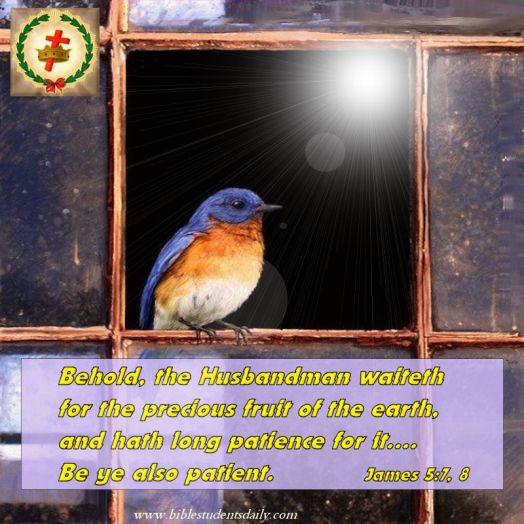
By quieting the mind… and heading to the voice of our Heavenly Father through the inspired words of God in Bible and through prayer, we may learn to absorb and appreciate each lesson step by step as God unfolds it to us. God is the ultimate example of patience, waiting perhaps billions of years before finally confronting the pain of watching His own firstborn Son being sacrificed on Calvary and be the ransom for all mankind.

And Jesus… has been waiting for the completion of His BrideHis Body members of 144,000 since AD 33!
JAMES 5, 7-8.jpg

There is a saying “take time to smell the roses.”

And in the same way let’s remember to take time to hear God-Jehovah speak…
digest it…
absorb it…
and grow from it…

The Apostle suggests that if he had mountain-moving faith, if his knowledge of Divine mysteries were very great, superior to those of all other men, and even if in his zeal for man or for God he should become a martyr and permit his body to be burned, yet, notwithstanding all this, if the primary influence in these matters were not love, all the sacrifice, all the self-denials, all the labors, even the burning, would profit nothing.

Dear friends,

When we come to get the Divine standpoint of things we find indeed that we have a very high standard to achieve; and yet our judgment assures us that it is right, that it is just, that it is proper, that God should thus set the standard of love as the only standard by which we shall ultimately be measured. But whoever thinks to have this perfect love for God and for man and make no manifestations of it is equally mistaken.

Wherever love is in the heart … words, works, thoughts and looks will testify to it, so that he who loves much will serve much.

If we love the Lord we shall delight in His service regardless of failures, regardless of fame, regardless of any earthly consideration; yea, even though the service of the Lord should cause us the loss of human approbation, fellowship, etc…

Hence every true Christian may link the two words love and service, and be sure that his love will manifest itself in zeal. Similarly, love of the brethren will mean a desire to serve the brethren; love of the home and family will mean a desire to do good to them; love of our neighbor will signify a desire to do for his interests according to our knowledge and limitations.

THE RESTRAINTS OF LOVE

The Apostle points out some of the restraints of love.

It cannot be quick, irascible; for “love suffers long and is kind” (1 Corinthians 13:4).

  • He who is loving cannot be envious of others, nor covetous of the blessings and favors they are enjoying; for “love envieth not.”
  • He who is loving cannot be boastful and proud; for “love vaunteth not itself, is not puffed up.”
  • He who is controlled by the spirit of love will not be ungracious, unkind, rude; for “love doth not behave itself unseemly.”
  • He who is full of the spirit of love will not be selfish, grasping, neglectful of the interests of others; for “love does not seeks its own” (1 Corinthians 13:5).
  • The truly loving one will not be quickly angered, will not be easily offended; for “love is not easily provoked.”

“The one controlled by the spirit of love will not be imagining unkindness and rudeness nor seeking to interpret the words or conduct of others unkindly; for ‘love thinketh no evil’ “

(Pastor Russell’s Sermons, pages SM272-SM285).

What a beautiful example we see in our Master’s words to Simon:

“Simon, Simon, behold, Satan has demanded permission to sift you like wheat; but I have prayed for you, that your faith may not fail; and you, when once you have turned again, strengthen your brothers” (Luke 22:32).

Let us not neglect to pray for our fellow brethren in Christ, always while we are in this carnal abode.

“LOVE NEVER FAILS.”

(1 Corinthians 13:8)


The following is from “What Pastor Russell Said – Question Book”

QUESTION (1910) 1 At what point of character development can we say, the crown is ours, and that we are overcomers?

“ANSWER. — I think, dear friends, that the proper point at which we could say that, would be when we reach the mark of perfect love. For instance, you came to the Lord and made your consecration, you entered the School of Christ and began to learn of him. That was about the time you found out how short you were of the proper measure. Will the Lord ever be able to make anything out of me? Now the Lord is going to measure you according to your mind and is waiting for you to get to the mark of perfect love, which is the standard of a perfect character, for none will be worthy of a place in the kingdom or eternal life except those that reach this mark, either now or in the Millennial Age. God has nothing for anyone except those that reach that standard in his mind and heart. He may have weaknesses, etc., and you may speak things that you are sorry for, and must apologize for, but your heart is at the mark–perfect love—and that is the reason you want to apologize, because you have reached the mark of perfect love. You love God, and all mankind, and wish to do good to all, as you have an opportunity. After a person gets where he can love his enemies, he is at the mark of perfect love. He will not be perfect in flesh, for that will not be possible in this age. Many still have to put a bridle upon their tongues, etc., you must hold in the old nature. This I have often illustrated by a bad dog which would represent our old nature, and for which the new creature is responsible. We must hold him in. Our intentions are good, as is shown by the fact that when the heat or excitement of the moment is passed, then the heart goes back to the principles of righteousness, and asks for forgiveness from the Father. He will ask for forgiveness for anything he has done. You might say, it will be harder to rectify this, than not to have done it in the first place. Surely. But that is what you must do, if you want [Q51] to prove to the Lord that your heart is for righteousness, and whenever you find you have made a mistake, you must rectify it. Now, then, if you get to that place, you have gotten to the place where, to my understanding, you are at the mark of perfect love, toward God, men, etc. You desire good for all and injury toward none. From that moment, I understand, the Lord counts you as one having a crown apportioned to you. That is one thing, but seeing that no man take your crown is another thing. After granted to you it still remains that if you are moved from the mark, pressed aside by difficulties, you are not standing this test, and you will not be worthy of being an overcomer. So you see there is a mark of character, without which none will be acceptable in the kingdom, spiritual or earthly. Now we must demonstrate our love and devotion, that is what we live for today and tomorrow, and in all your Christian experience, from the time you enter the school of Christ, for you are to learn of him as quickly as possible and get to the mark of perfect love toward all.


The words below are from Reprint No. 4470 from “ZWT” (www.htdb.one).

STANDING AT THE MARK

WE HAVE heretofore suggested what we now wish to further, if possible, emphasize; namely, the fact that there is a Divine standard of holiness, of righteousness, which, if it be not attained, will mean our non-acceptance by the Lord as members of his Elect Church; and, more than this, our unfitness for eternal life upon any plane. This standard of character, or mark of perfection, as we have pointed out, is not a standard or mark of fleshly perfection, because the Lord accepts amongst his consecrated disciples those of various degrees of mental, moral and physical degeneracy. The justification which he provides makes up for the blemishes of each, for the more blemished as well as for the less blemished. The robe of his righteousness imputed is as necessary to the noblest as to the most degraded, and renders the latter as acceptable as the former.

From this standpoint it is recognized that the heart, the renewed mind, the renewed will, is the spirit-begotten New Creature which is on trial before God. It has professed a thorough consecration to righteousness and opposition to sin, a complete deadness to it, and a determination to mortify, to deaden, the will of the flesh to the extent of its ability. From the very start this condition is pleasing and acceptable to the Lord. Nevertheless, it is Scripturally represented at first as being merely a “babe” condition, according to one illustration, and according to another merely a “begotten” condition. Progress must be made, character must be developed, and then, further, it must be tested. “Not every one who saith, Lord, Lord, shall enter the Kingdom.” Not every one who professes consecration, and newness of life, and self-sacrifice in the interests of truth and righteousness, can be accepted as a joint-heir with Christ. Time must be given for development and for proving.

Love for God they have, from the very outset. But it is not love of the highest type. As already shown, it is largely, if not entirely, duty love. The “babe” in Christ must feed upon the sincere milk of the Word, that he may grow strong. As the spiritual food is appropriated, and spiritual exercise is taken, strength of character comes in, the eyes of our understanding open more widely, and lengths and breadths and heights and depths of the Divine character are discerned which were not visible at the first. This brings us to a higher type of love for God—a love for his glorious character.

Meantime, also, a sympathetic love for the world is gradually developing in the spiritual “babe.” As the principles of the Divine character are seen and appreciated, the New Creature begins to apply these to everything in life, and hence increases in sympathetic love toward man and beast, friend and foe. Another element of love is gradually attained also: At first the “babe” in Christ loves some of the brethren—the nobler, the gentler, the better educated ones, etc.; but gradually, as the Divine character is discerned, and the Divine love becomes shed abroad in the heart, this love broadens out so that it includes every member of the family of God and every member of the fallen race—yea, even enemies. With this development comes spiritual activity, called in the Scriptures quickening—”You hath he quickened.” This quickening implies activity in the service of God, and the service of the brethren, and if outside opportunity beyond this permit, it would mean an activity in the service of all needing assistance such as we could give.

The Christian life here illustrated, which began as a “babe in Christ,” has by this time reached the standard of manhood in Christ, and is at the Mark of Perfect Love—for God, for the brethren, for the neighbor and for the enemies. Not until this point shall have been reached could such a person be considered fit for heaven, or for eternal life on any plane.

We are to bear in mind that there is no development in heaven, and hence perfection of character must be attained by the saints before they die. And, similarly, the world during the Millennium must attain this perfect development before the close of the age in order to be fit for eternal life according to the Divine promise and standards.

Is it asked to what extent will this standard of perfect love in the heart manifest itself in the flesh? We answer, that during the Millennial Age it will manifest itself perfectly in the flesh, for the world then will be judged according to the actual attainments in their flesh, and perfection by restitution will be not only possible, but required. But as for us of the Gospel Age, we who are being judged not according to the flesh but according to the spirit, to what extent will the new mind, the new nature, when at the Mark of Perfect Love, be able to govern and control the flesh? Our answer is, that the degrees of control will vary much, according to the degrees of imperfection with which the mortal body is afflicted.

The only standard which we can set forth is that the new nature, new mind, new will, would be very regretful, very sorrowful, in respect to any laches, or errors, of its mortal body. The Lord would know (and perhaps the brethren also to some extent) of the New Creature’s endeavor to control the mortal body by the degree of its grief in connection with every error, and its continually renewed effort to bring every power of the body, and even every thought, into complete subjection to the will of God in Christ. Any sympathy with sin is an evidence that the New Creature is not at the Mark. And no sympathy with sin, but constant endeavor for righteousness, is evidence that it is at the Mark.

Some may be at this Mark for a longer and some for a shorter period. Our Lord was surely at it from the beginning of his ministry. He was tested there, while at the Mark of perfect love. All the besetments of the Adversary and of the world failed to move him from that position of perfect love. He laid down his life at this Mark. St. Paul was surely at this Mark for many years before his actual death. He was continually laying down his life for the brethren, continually serving his enemies and praying for them; and surely he was continually loving and serving the Lord with his every power and talent.

No Christian should be satisfied with a long delay in reaching the Mark. The milk of the Word should be received, its strength should be appropriated, spiritual sight and spiritual energy should quickly follow, and strong meat of Divine Truth should speedily bring to full maturity the Christian character. And once attained, it should be held at any cost through all the trials and difficulties which the Adversary, and the world, and the flesh, might be permitted to bring against us. The severest temptations come after we have reached the Mark—temptations to slackness in service of God; temptations to withhold parts of our sacrifice; temptations to deal unkindly, uncharitably, unlovingly with the brethren, or unjustly with our neighbor, or ungenerously with our enemies. All of these must be resisted as we prize our eternal life, as we prize the promise of joint-heirship and fellowship with our Redeemer in His Kingdom.

Whoever sees this subject clearly must realize that as a Christian he has to do with a great proposition which will thoroughly test his loyalty, his courage, his zeal, [R4470, page 271] his love. He will need to remember the Lord’s comforting assurances of grace to help in every time of need if he would come off a victor and not be dismayed, nor have his courage beaten down by the Adversary’s attacks.


References:

Br. Charles Russell. “Pastor Russell’s Sermons,” and “What Pastor Russell Said – Question Book.”

The Reprints of the Original Watchtower and Herald of Christ’s Presence. These Reprints can be accessed here: http://www.htdbv8.com

Suggested Further Reading

“Lovest Thou Me More Than These?”JOHN 21:15-22. Reprint 2806. The Reprints of the Original Watch Tower and Herald of Christ’s Kingdom.
http://www.htdbv8.com/1901/r2806.htm

A Practical Self-Examination On Love

A Practical Self-Examination on Love

Agape by Br. Mark Grillo
http://www.heraldmag.org/2012/12nd_11.htm

Brotherly Kindness by Br. Ed Byrd
http://www.heraldmag.org/2012/12nd_10.htm

Words for Love in the Bible, In the Hebrew, by Br. W.A. Eliason, The Herald of Christ’s Kingdom Magazine, Set/Oct. 1986.
http://www.heraldmag.org/archives/1986_5.htm#_Toc36907449


The URL of this post:
https://biblestudentsdaily.com/2016/03/20/what-is-love/?share=press-this&nb=1&sel=

Enter your email address to subscribe to this blog and receive notifications of new posts by email.

Save

Save

The First Resurrection

1-thessalonians-4-16-17 - WITH CROSS.jpg

When we meet our LORD
with all the saints that are waiting
We will be overjoyed with gladness
Singing “all honor and praise to our GOD.”

Finally together,
Our Beloved Jesus and the saints shall be,
In glory… 
With Crowns of Victory.

No more separations; no more tears and no more sorrows;
No more misunderstanding; no more silence.
Eternal joy and gladness praising our Jehovah;
Eternal journeys with our Beloved Christ.

This life is just a short test of faith,
Learning to not give up,
But patiently enduring and persevering with JOY in the spirit.
Today’s discomforts of the flesh—are experiences worth more than gold.

It is through suffering, that our Beloved Jesus learned obedience. 
That same narrow path, we must follow too.
It is the only way to life immortal,
Learning to obey GODLY principles willingly and change into the likeness of our Lord, Jesus.

Delight thyself in the LORD,
HE SHALL give you the desires of your heart.
Seek the face of the LORD always,
Seek till you find… till you win the race of the High Calling.

As the hearts of men shall all seek to know and serve the LORD,
Precious promises shall be fulfilled.
Then the 144,000 Bride members of CHRIST—the “little flock,”
Shall be together with their King.

Tears of hope shall be no more,
As immortal and together the saints shall be— 
Dwelling for eternal eternities
In their perfect everlasting home—where there is glory, honor and immortality.

So continue on dearly Beloved Ones IN CHRIST,
Your fellow saints cheer you on through their private prayers,
We shall soon meet beyond the river, where our Bridegroom is waiting;
And I too hope to meet you there, when my sacrifice is complete. 


LUKE 12:31-38 (ESV)

(31) Instead, seek his kingdom, and these things will be added to you.

(32) Fear not, little flock, for it is your Father’s good pleasure to give you the kingdom.

(33) Sell your possessions, and give to the needy. Provide yourselves with moneybags that do not grow old, with a treasure in the heavens that does not fail, where no thief approaches and no moth destroys.

(34) For where your treasure is, there will your heart be also.

(35) Stay dressed for action and keep your lamps burning,

(36) and be like men who are waiting for their master to come home from the wedding feast, so that they may open the door to him at once when he comes and knocks.

(37) Blessed are those servants whom the master finds awake when he comes. Truly, I say to you, he will dress himself for service and have them recline at table, and he will come and serve them.

(38) If he comes in the second watch, or in the third, and finds them awake, blessed are those servants!


Further Suggested Reading:

A Special Calling by Br. David Rice. The Herald of Christ’s Kingdom. July /August 2016.
URL: https://herald-magazine.com/2016/07/01/the-bride-class/

Old Testament Portrayals of the Church by Br. Homer Montague. The Herald of Christ’s Kingdom. July/August 2004.
URL: http://www.heraldmag.org/2004/04ja_2.htm

The Song of Solomon by Br. Frank Shallieu. The Herald of Christ’s Kingdom. July/August 2004.
URL: http://www.heraldmag.org/2004/04ja_3.htm

The Bride and the Bridegroom by Br. Carl Hagensick. A Verse-by-verse Study of Psalm 45. The Herald of Christ’s Kingdom. July/August 2004.
URL: http://www.heraldmag.org/2004/04ja_4.htm

New Testament Portrayals of the Church by Br. Michael Nekora. A Precious Treasure. The Herald of Christ’s Kingdom. July/August 2004.
URL: http://www.heraldmag.org/2004/04ja_5.htm

A Chaste VirginThe Herald of Christ’s Kingdom. URL: http://www.heraldmag.org/literature/chliv_38.htm

The Truth About Hell. A Dawn Bible Association Publication. URL: http://www.dawnbible.com/booklets/hell.htm

Hope Beyond the Grace. A Dawn Bible Association Publication. URL: http://www.dawnbible.com/booklets/grave.htm

ACTS 23:6—HOPE & RESURRECTION. Part A: What Is Jesus All About?

ACTS 23:6 —HOPE & RESURRECTION. PART A: What is Jesus All About?

ACTS 23:6—HOPE & RESURRECTION. Part B: Will Mankind Resurrect With the Same Mind?

ACTS 23:6 —HOPE & RESURRECTION. PART B. Will Mankind Resurrect With the Same Mind?

ACTS 23:6—HOPE & RESURRECTION. Part C: The Order of the Resurrection Process.

ACTS 23:6 —HOPE & RESURRECTION. PART C: The Order of the Resurrection Process


URL of this post: https://biblestudentsdaily.com/2016/03/08/the-first-ressurection/


Enter your email address to subscribe to this blog and receive notifications of new posts by email.

Save

Save

Save

Save

Save