A Little Flock – Hymns of Dawn No. 6

A Little Flock – Hymns of Dawn No. 6

Bible Scriptures Associated With This Hymn

“29 And do not seek what you are to eat and what you are to drink, nor be worried. 30 For all the nations of the world seek after these things, and your Father knows that you need them. 31 Instead, seek his kingdom, and these things will be added to you. 32 ‘Fear not, little flock, for it is your Father’s good pleasure to give you the kingdom. 33 Sell your possessions, and give to the needy. Provide yourselves with moneybags that do not grow old, with a treasure in the heavens that does not fail, where no thief approaches and no moth destroys. 34 For where your treasure is, there will your heart be also.’

You Must Be Ready

35 ‘Stay dressed for action and keep your lamps burning, 36 and be like men who are waiting for their master to come home from the wedding feast, so that they may open the door to him at once when he comes and knocks. 37 Blessed are those servants whom the master finds awake when he comes. Truly, I say to you, he will dress himself for service and have them recline at table, and he will come and serve them'”
(Luke 12:29-37, ESV).

*******

“22 But you have come to Mount Zion and to the city of the living God, the heavenly Jerusalem, and to innumerable angels in festal gathering, 23 and to the assembly of the firstborn who are enrolled in heaven, and to God, the judge of all, and to the spirits of the righteous made perfect, 24 and to Jesus, the mediator of a new covenant, and to the sprinkled blood that speaks a better word than the blood of Abel” (Hebrews 12:22-24, ESV).

*******

Then came one of the seven angels who had the seven bowls full of the seven last plagues and spoke to me, saying, “Come, I will show you the Bride, the wife of the Lamb.” 10 And he carried me away in the Spirit to a great, high mountain, and showed me the holy city Jerusalem coming down out of heaven from God, 11 having the glory of God, its radiance like a most rare jewel, like a jasper, clear as crystal. (Revelation 21:9-11, ESV).

In relation to this hymn’s 3rd verse lyrics:

25 For the foolishness of God is wiser than men, and the weakness of God is stronger than men. 26 For consider your calling, brothers: not many of you were wise according to worldly standards, not many were powerful, not many were of noble birth. 27 But God chose what is foolish in the world to shame the wise; God chose what is weak in the world to shame the strong; 28 God chose what is low and despised in the world, even things that are not, to bring to nothing things that are, 29 so that no human being might boast in the presence of God. 30 And because of him you are in Christ Jesus, who became to us wisdom from God, righteousness and sanctification and redemption, 31 so that, as it is written, “Let the one who boasts, boast in the Lord” (1 Corinthians 1:25-31, ESV).

Lyrics

1.
A little flock, so calls he thee;
Who bought thee with his blood;
A little flock disowned of men,
But owned and loved of God.

2.
A little flock, so calls he thee;
Church of the Firstborn, hear!
Be not ashamed to own the name;
It is no name of fear.

3.
Not many rich or noble called,
Not many great or wise;
Those whom God makes his kings and priests
Are poor in human eyes.

4.
But the Chief Shepherd comes at length;
Her feeble days are o’er.
With glory crowned, and sceptre’s strength,
She reigns forevermore.

The History Of This Hymn

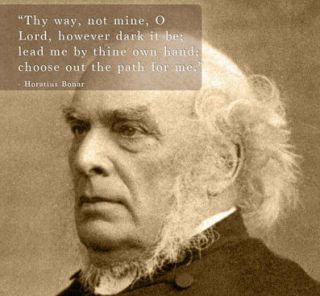
Author – Horatius Bonar (1808-1889)

Horatius-Bonar-hymns-of-dawn-no.-6A-A-Little-Flock-author.jpgBorn and raised in Edinburgh, Scotland, Horatius Bonar became a pastor at Kelso in 1837 and six years later joining the Free Church of Scotland. His reputation as a religious writer was first gained on the publication of the “Kelso Tracts,” of which he was the author, yet he is no less favorably known as a religious poet and hymn-writer.

He became editor of the Quarterly Journal of Prophecy in 1848, to which he contributed a hymn for each number and the number of hymns contributed thereto is 101.

One of several hymns’ lyrics written by Horatius Bonar, which are most widely known today, is found in the Hymns of Dawn, No. 108 – titled “I Came To Jesus” with the opening words of the first verse: “I heard the Voice of Jesus say, ‘Come unto me and rest.'”

Composer – No information found in relation to the music score in the Hymns of Dawn for this hymn.

Hymn Book Purchase

The Hymns Of Dawn (hymn book) can be purchased at:
The Chicago Bible Students Online Bookstore: https://chicagobible.org/product-category/books/page/4/
The Dawn Bible Students Association: http://www.dawnbible.com/dawnpub.htm

Acknowledgment & References

pastor-russell-in-his-study.jpg

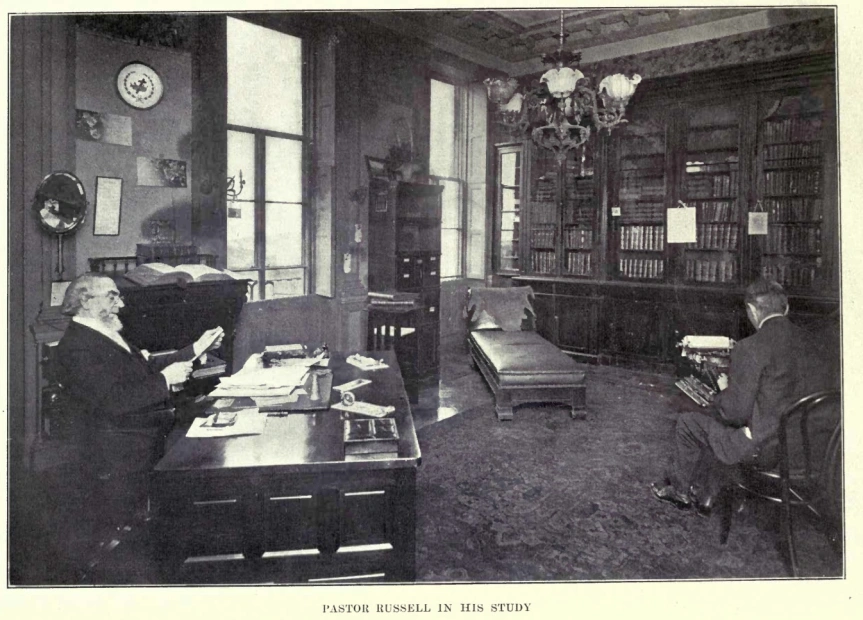
Br. Charles Russell—the founder of the Bible Students movement, who is the compiler of “Poems and Hymns of Millennial Dawn” which was published in Allegheny, Pa., in 1890. This Bible Students’ devotional originally contained a total of 151 poems and 333 hymns.

POEMS-AND-HYMNS-OF-MILLENNIAL-DAWN

Later on, the hymns from this book formed a basis for the hymnal titled ““Hymns of Dawn” which was published by the Dawn Bible Students Association in East Rutherford, New Jersey (USA) and the 1999 edition contains a total of 361 hymns.Hymns of Dawn.jpg

  • Hymnary.org.

Suggested Further Reading

A Special Calling by Br. David Rice. The Herald of Christ’s Kingdom. July /August 2016.
https://herald-magazine.com/2016/07/01/the-bride-class/

Old Testament Portrayals of the Church by Br. Homer Montague. The Herald of Christ’s Kingdom. July/August 2004.
http://www.heraldmag.org/2004/04ja_2.htm

The Song of Solomon by Br. Frank Shallieu. The Herald of Christ’s Kingdom. July/August 2004.
http://www.heraldmag.org/2004/04ja_3.htm

The Bride and the Bridegroom by Br. Carl Hagensick. A Verse-by-verse Study of Psalm 45. The Herald of Christ’s Kingdom. July/August 2004.
http://www.heraldmag.org/2004/04ja_4.htm

New Testament Portrayals of the Church by Br. Michael Nekora. A Precious Treasure. The Herald of Christ’s Kingdom. July/August 2004.
http://www.heraldmag.org/2004/04ja_5.htm

A Chaste VirginThe Herald of Christ’s Kingdom. URL: http://www.heraldmag.org/literature/chliv_38.htm

The Truth About Hell. A Dawn Bible Association Publication. http://www.dawnbible.com/booklets/hell.htm

Hope Beyond the Grace. A Dawn Bible Association Publication. http://www.dawnbible.com/booklets/grave.htm

Christ and His Bride. BIBLE Students DAILY.

Christ And His Bride

Links and Bible Resources – https://biblestudentsdaily.com/category/links/


The URL of this post:

A Little Flock – Hymns of Dawn No. 6

Enter your email address to subscribe to this blog and receive notifications of new posts by email.

DANIEL 3:17 – Our God Whom We Serve Is Able To Deliver Us

OLYMPUS DIGITAL CAMERA

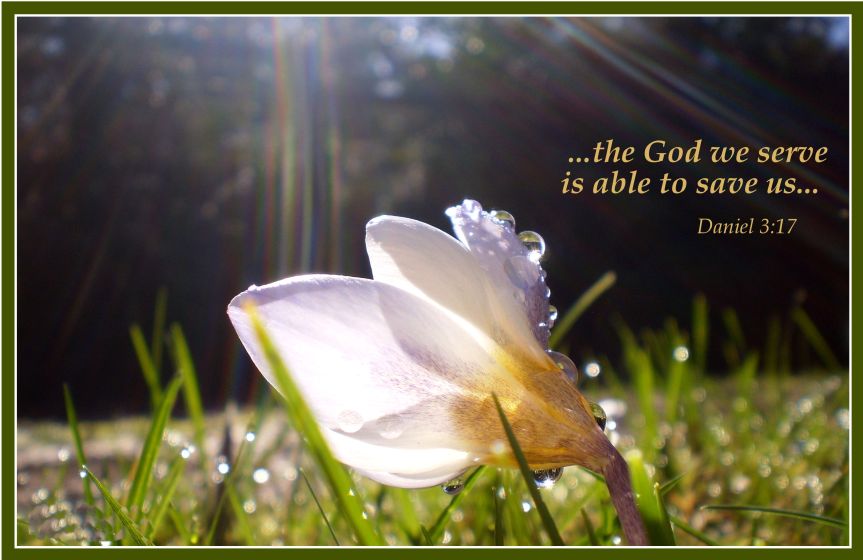
“Our God, whom we serve, is able to deliver us.” Daniel 3:17

The King of Babylon – King Nebuchadnezzar

Probably twenty years elapsed after Daniel and his companions reached Babylon in captivity before the scenes of the lesson in Daniel Chapter 3 were enacted. Meantime Daniel had been raised to a very high position in the empire, as the King’s counselor, while his three Jewish companions—Shadrach, Meshach and Abednegohad been made magistrates in the provinces of Babylon. We know that their prosperity did not tend to make them careless of their duties and responsibilities toward God, for otherwise they would not have been able to stand the severe test recounted in this lesson, and which proved a great blessing to them because of their fidelity to the Lord.

King Nebuchadnezzar just before this had won some great victories over surrounding nations—Egypt, Syria, etc.—as he had previously done with Judah, and as the Lord had predicted in the dream which Daniel had interpreted for the King, which showed the Babylonian Empire as the golden head of earthly dominion. His great success no doubt had tended to feelings of pride and a desire for display. Yet these were probably not the only motives which led to the program of the great festival in honor of his victories, and the erection of the great image which all were commanded to worship.

With a view to unifying the Babylonian empire by unifying the religious views and worship of the various peoples under his sway, Nebuchadnezzar had a great feast arranged, of which the very center of attraction was the great image that Nebuchadnezzar had set up.

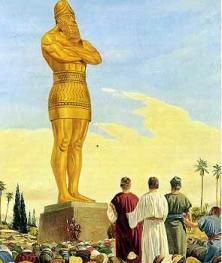
Nebuchadnezzar's image

In Daniel 3:1 we read that this image, with its pedestal, was sixty cubits high (approximately 27 metres or 8 storeys high) and six cubits wide (approximately 2.7 metres wide). It was of gold, probably either made hollow or on a base of clay cement. It was located in the Plain of Dura, about the centre of the walled enclosure twenty-four miles square, known as the city of Babylon. As it is a level country, and as the structures were comparatively low, the image could probably be seen from every part of the great city.

The Festival

The appointed time for the festival having come, leading representatives, judges, treasurers, governors, sheriffs, etc., from all the divisions of the empire, clad in the gorgeous garments of the East, were present. A great band had been prepared, composed of all the musical instruments popular at that period.

As the people stood before the image that Nebuchadnezzar had set up, the herald proclaimed aloud:

“‘You are commanded, O peoples, nations, and languages, that when you hear the sound of the horn, pipe, lyre, trigon, harp, bagpipe, and every kind of music, you are to fall down and worship the golden image that King Nebuchadnezzar has set up. And whoever does not fall down and worship shall immediately be cast into a burning fiery furnace'” (Daniel 3:4-6).

By falling down and worshiping the image, the people would thus be indicating their loyalty, not only to King Nebuchadnezzar, but also to his gods who he believed had given him the wonderful victories which they were celebrating.

This was a crucial test for Shadrach, Meshach and Abednego. They knew that the King’s powers were autocratic, and that to cross his will meant death in some form, yet they wanted to be true to God, whatever the cost. It might be that their refusal to prostrate themselves before the image would pass entirely unnoticed by others, or it might be that, even if noticed, the incident might never reach the ears of the King, but such circumstances could make no change in the matter of their duty; whatever others might do, they must not bow the knee to any but the true God. Daniel is omitted from mention here, possibly because, occupying a different position as one of the king’s personal staff and household, his conduct would not come so directly in contrast with the general conduct.

The Hour of Trial

Finally, the hour of trial came, when the great King of Babylon was recognized not only as civil but also as religious ruler, and the image which he had set up was worshiped by the various representatives of his empire—except Shadrach, Meshach and Abed-nego. Their neglect to bow was quickly brought to the attention of the King, for no doubt these, like all good men, had their enemies: some enemies through jealousy and rivalry for the King’s favor; other enemies because, perhaps, they had been interrupted or hindered in dishonest practices and contracts with the government. The matter seems to have astounded the king, and hence his inquiry, Is it true, can it be true? Surely, no sane men would be so foolhardy as to oppose my decree, and that in my very presence, and upon such a fete-day as this? Not waiting an answer as respects matters of the past, the king voluntarily proposed for them a fresh test of loyalty and submission.

Perhaps the king’s mind shot a glance backward fifteen years, to the time when the God of the Hebrews, through Daniel, had told and interpreted his dream, a matter which none of the other gods of his wise men could do; and as though he had this in mind, and wishing to impress the matter upon these three Hebrews who had dared to challenge his power, he made the boast, “Who is that God that shall deliver you out of my hands?” In his arrogance of mind and under the flush of his mighty victories over the greatest nations and mightiest kings, Nebuchadnezzar felt prepared to have a contest even with the unseen and to him unknown invisible powers. He would not be backed down in his own capital city; he would demonstrate his power to inflict a penalty, regardless of what any of the gods might do in retaliation.

The answer of the three Hebrews was a wise one; seeing from the king’s mood that the discussion of the subject would be useless, they did not attempt to retaliate by threatening him with divine vengeance; neither did they attempt to convert the King to Judaism, knowing well that the provisions of the Jewish covenant were not for Gentiles. They simply responded that they were not anxious to avail themselves of the opportunity to argue the matter with the King. They assured him of their full confidence that their God was able to deliver them from the fiery furnace, and out of the hand or power of even the greatest king of the earth; but they answered:

 “O Nebuchadnezzar, we have no need to answer you in this matter. 17 If this be so, our God whom we serve is able to deliver us from the burning fiery furnace, and he will deliver us out of your hand, O king. 18 But if not, be it known to you, O king, that we will not serve your gods or worship the golden image that you have set up” (Daniel 3:16-18).

Angered that his great festal day should be thus marred by even the slightest opposition to his will, the king did not wait to give another opportunity wherein the Hebrews might relent. He saw that it was useless, that they were men of character and determination, and he resolved that he would make an example of them before all the people. The form of his visage or his countenance changed toward these men; whereas once he had admired them, as amongst his ablest counselors and magistrates, and an honor to his empire, now he hated them, as opponents whose course, if not interrupted, might introduce disorder into his empire, and lead to more or less sedition, if copied by others. In his rage he commanded that the furnace be heated seven times, or to its utmost capacity. The furnace, already heated for the occasion, may have been the one used in melting the gold for the image, and must have been of immense size.

Probably as a mark of his great authority, and to show that even the very greatest of his subjects were subordinate to his supreme authority, the king commanded that these three recalcitrant officials be cast into the fiery furnace by prominent officers of his army—no doubt to teach a lesson respecting the power of the army, and the willingness of its chief representatives to serve the king, as against everybody else.

The Hebrews, bound in their official garb, were evidently cast into the furnace from the top, because it is stated that they fell down bound, while the heat was so intense that it even killed those who cast them into the furnace, possibly by the inhalation of the flames, which might kill them instantly.

The King seemed to be having matters his own way, as usual; even the mighty God of the Hebrews had not delivered these men from his power. And yet the King was solicitous and eyed the furnace, and to his surprise beheld those who had been cast into the furnace bound, walking about free in the flames—seemingly uninjured. More than this, he saw a fourth person there, of most remarkable appearance, which caused the King to think and speak of him as one of the gods. No wonder he was astonished; he was evidently contending with a God of whose powers he had been ignorant.

Nebuchadnezzar realized he had made a great mistake in attempting the destruction of three of his most eminent magistrates, and that he was thus defying the great God. He was prompt to make acknowledgement, and approached the furnace, calling out, “Shadrach, Meshach, and Abednego, servants of the Most High God, come out, and come here!” In the presence of the king’s courtiers they came forth, and all beheld them that the fire had done them no injury, not even having singed their clothes or their hair. This was indeed a stupendous miracle, and doubtless was valuable in its influence, not only upon the Gentiles, but also upon the Hebrews residing throughout Babylon, who would thus hear of the power of Jehovah in delivering those faithful to him.

Whether this had a bearing on the subject or not, we know well that, while idolatry had been one of the chief sins of the Israelites before this captivity, there was comparatively little of idolatry in its crude forms in that nation afterward.

Nebuchadnezzar’s acknowledgement of the God of the Hebrews, who sent his messenger and delivered his servants that trusted in him, is very simple and very beautiful. He rejoiced in the noble character of these men, and at once made a decree:

“Any people, nation, or language that speaks anything against the God of Shadrach, Meshach, and Abednego shall be torn limb from limb, and their houses laid in ruins, for there is no other god who is able to rescue in this way(Daniel 3:30).

And furthermore, he promoted these faithful men to still higher positions, for they had still more of his confidence respecting their integrity.

Men who would thus hazard their lives for conscience’ sake could be trusted in the most important positions.

Lessons From This Bible Account

The Lord’s people may find in this Biblical story many valuable lessons and suggestions. Not all of God’s people are in such prominent positions as were these Hebrews; and not many have testings of exactly the same kind as were theirs, with a literal fiery furnace before their eyes. Nevertheless, there are trials before the Lord’s people today that are fully as severe.

Babylon the literal was in ruins long before the Apostle John on the Isle of Patmos was shown in prophetic vision the mystic or symbolic Babylon “which reigneth over the kings of the earth” today. The provinces of Babylon today are the various civilized nations—really “kingdoms of this world;” but deluded into calling themselves and thinking themselves kingdoms of Christ—“Christendom.” And parallels to the King and the image are also presented in Revelation—they are religious systems symbolically described as “the beast [Papacy] and his image” (Revelation 13:15-18).

The worship of this symbolic beast and his image are to be the great test or trial upon professing Christians in every province of symbolic Babylon in the end of this age and indeed, the testing is even now in progress. Only those who refuse to render worship to those powerfully influential religious systems (symbolized by “the beast and his image”) will be counted by the Lord as “overcomers” and be made his joint-heirs as members of his elect Church (Revelation 20:4).

As already pointed out, the “beast” represents not Roman Catholics (the people) but the Roman Catholic system, as an institution: and the image represents not Protestants (the people) but the consolidation of Protestant systems, as an institution. Those who absolutely refuse to worship its images are already exposed to fiery trials;—social ostracism and financial boycotts. Prominent amongst these is:

The Roman Catholic idolthat church sets itself as the representative of God, and demands worship, obedience and contribution to its funds;

The Greek Catholic Church idol: the Anglican is another; and the Lutheran, Methodist, Presbyterian, etc.all similarly demand worship, obedience and revenue. They have “pooled their issues,” to a certain extent, so as not to war upon each other’s devotees, but they unite in warfare against all who do not bow the knee to some such idol (who reverence and worship only the Almighty God, and recognize his only begotten Son as the only Head and Lord of the true Church, whose names are only written in heaven—not on earthly rolls of membership (Hebrews 12:23).

In the “dark ages,” when Papacy had a monopoly of the “church” business, it meant torture and the stake, as well as social ostracism. Today, in many instances there are evidences that the same spirit prevails, merely restrained by changed circumstances and lack of power. Thousands today are worshiping at the various shrines of Christendom who in their hearts long to be free from the sectarian bondage of fear—who fain would serve the Lord God only, had they the courage. And there are some the world over who, with a courage not less than that of Shadrach, Meshach and Abednego, declare publicly that the Lord God alone shall have the worship and the service which they can render. None, perhaps, know better than the writer the various fiery experiences to which these faithful few are exposedboycotted socially, boycotted in business, slandered in every conceivable manner, and often by those of whom they had least expected it, who, according to the Lord’s declaration, say “all manner of evil against them falsely” (Matthew 5:11,12).

But with these, as with the three Hebrews of our lesson, the chief trial is in connection with their faith; after they have taken a firm stand for the Lord and his truth they may indeed be bound and have their liberties of speech and of effort restrained, and they may indeed be cast into the fiery furnace, but nothing more than these things can be done to them. As soon as they have demonstrated their fidelity to God to this extent, their trials and troubles are turned into blessings and joys. As the form of the Son of God was seen with the Hebrews in the fiery furnace, so unseen, the Lord is present with those who trust him and who, because of faithfulness to him and to his Word, come into tribulation. How beautifully this is expressed in the familiar hymn,

“When through fiery trials thy pathway shall lie,
My grace all sufficient shall be thy supply;
The flame shall not hurt thee, I only design
Thy dross to consume, and thy gold to refine.”

And sometimes even the worldly can realize that the Lord’s people in the furnace of affliction are receiving a blessing, and sometimes thus our Heavenly Father’s name is glorified in the world, as in Nebuchadnezzar’s experience.

Sometimes the Lord’s people who are bound, restrained of liberty to proclaim the truth, find, as did those Hebrews, that the fire burns the cords and sets them free, and really gives them larger opportunities to testify to the glory of our God than they could have had by any other course.

The Lord’s providences vary, and it is not for his people to decide when shall come remarkable deliverances, and when they shall apparently be left entirely to the will of their enemies without any manifestation of divine favor on their behalf.

Note, for instance, the fact that, while the Lord interposed to deliver these three Hebrews from the fiery furnace, he did not interpose to prevent the beheading of John the Baptist, although of the latter it is specifically declared, “There hath not arisen a greater prophet than John the Baptist.” We remember that, while Peter was delivered from prison by the angel of the Lord, James was not delivered, but was beheaded. We remember also that Paul’s life was miraculously preserved on several occasions, and that the Apostle John, according to tradition, was once cast into a cauldron of boiling oil, but escaped uninjured, while on other occasions dire disaster came upon the Lord’s faithful ones, and that quickly, as in the case of Stephen, who was stoned.

It is not, therefore, for us to predetermine what shall be the divine providence in respect to ourselves; we are to note the point of right and duty and to follow it regardless of consequences, trusting implicitly in the Lord. This lesson is most beautifully set forth in the language of the three Hebrews, who declared to King Nebuchadnezzar that their God was entirely capable of delivering them from his power, but that, whether he chose to do so or not, they would not violate their conscience.

It is just such characters that the Lord is seeking for, and it is in order to their development and testing that multiform evil is now permitted to have sway.

While such testings have been in progress to a considerable extent throughout this entire Gospel age, the Scriptures clearly indicate to us that in some special sense all of the Lord’s people will be tested in the “harvest” or closing time of this age. Our Lord speaks of it, likening our Christian faith to a house, and represents the trials in the end of this age as a great storm which will beat upon every house, with the result that all that are founded upon the rock will stand, and all founded upon the sand will collapse. The Apostle Peter speaks of this trial-time, saying:

“Think it not strange concerning the fiery trial which shall try you, as tho some strange thing happened unto you” (1 Peter 4:12).

We are to expect a testing in the end of this age, just as there was a testing of the Jewish nominal church in the end of its age. As in that testing there was a thorough, complete separating of the “wheat” from the “chaff,” so here the separating will be complete between the “wheat” and the “tares,” as our Lord declares (Matthew 13:24-30). Throughout the age the “wheat” and the “tares,” by divine arrangement, have been permitted to grow side by side; but in the “harvest” the separation must occur, that the “wheat” may be “garnered,” received to the Kingdom.

The Apostle Paul, also, speaks of this time of fiery trial, and, likening the faith and works of a zealous Christian to a house built of gold, silver and precious stones, he declares that the fire of this day, in the end of this age, shall try every man’s work of what sort it is, and shall consume all but the genuine faith and character structures (1 Corinthians 3:11-15). But we are to remember that such loyal characters grow not suddenly, in a few hours or days—mushroom-like,—but are progressive developments, fine-grained and strong like the olive tree.

We who have become “new creatures” reckonedly, in Christ, know that we are to be tested (if our testing has not already commenced), and should realize that only as we practice self-denials in the little things of life, and mortify (deaden) the natural cravings of our flesh in respect to food, clothing, conduct, etc., will we become strong spiritually and be able to “overcome.”

Many deal slackly with themselves in respect to little violations of their consecration vow, saying,—“What’s the use” of such carefulness and so different a life from that of the world in general? Ah! there is great use in it, for victories in little things prepare for greater victories and make them possible: and on the contrary, surrender to the will of the flesh in the little things means sure defeat in the warfare as a whole. Let us remember the maxim laid down by our Great Teacher—that he that is faithful in the things that are least will be faithful also in the things which are great. And this is the operation of a law, whose operations may be discerned in all the affairs of life.

Our Lord expresses the same thought, saying,—To him that hath (used) shall be given (more), and from him that hath not (used) shall be taken away that which he hath. If we start on a Christian life ever so weak in the flesh and weak in spirit, we will find that faithfulness in the little things will bring increasing strength in the Lord and in the power of his might. But it is in vain that we pray, “Lord, Lord,” and hope for great victories and the “crown of rejoicing,” if we fail to do our best to conquer in the little affairs of daily life. In other words, our testing is in progress from the moment of our consecration, and the little trials are but preparations for greater ones which, when faithfully attained, we will be able to reckon with the Apostle as light afflictions which are but for a moment, and which are working out for us a far more exceeding and eternal weight of glory (2 Corinthians 4:17).

The answer of the Hebrews to Nebuchadnezzar,—“Our God whom we serve,” is worthy of note. They not only acknowledged God and worshiped him, but they additionally served him, according as they had opportunity. And so it will be found today: those who have the necessary strength of character to refuse to worship human institutions and thereby to “suffer the loss of all things,” counting them but as loss and dross, that they may win Christ and be found finally complete in him, as members of his glorified body, and joint-heirs in his Kingdom, not only practice self-denials, but gladly serve and confess the Lord in their daily life. Rightly appreciated, a profession of love for the Lord would always be a profession of service to his cause. Whoever is not rendering some service to our King in the present time of multiplied opportunities has at very most the “lukewarm” love that is offensive to the Master (Revelation 2:4; 3:16).

Let us resolve, dear brethren, as did the three Hebrews of this lesson, that we will worship and serve only the Lord our Godthat we will neither worship nor serve sectarianism, in any of its many forms, nor mammon, with its many enticements and rewards, nor fame, nor friends, nor self. 

God “seeketh such to worship him as worship him in spirit and in truth,” is the declaration of our Lord and Head (John 4:23,24).

Acknowledgement

Br. Charles Taze Russell – The above content is based on Reprint 2494-2497 – from The Reprints of the Original Watchtower and Herald of Christ’s Presence.

Suggested Further Reading

Daniel The Beloved
http://www.heraldmag.org/literature/bio_3.htm

Daniel and the Lions

Click to access BOTMAY98.PDF

Daniel In Babylon
http://www.heraldmag.org/literature/proph_31.htm

Trials

Click to access BOTFEB98.PDF

Time and Prophecy 

Click to access timeandprophecy.pdf

The Doctrine of the Trinity – Mystery or Confusion
http://www.heraldmag.org/1999/99nd_3.htm

The Origin of the Trinity – From Paganism To Constantine
http://www.heraldmag.org/olb/Contents/doctrine/The%20Origin%20of%20the%20Trinity.htm

Facts About the Trinity http://www.heraldmag.org/olb/contents/doctrine/FACTS%20ABOUT%20THE%20TRINITY.htm

God and the Trinities
http://www.heraldmag.org/literature/doc_42.htm

Father, Son and Holy Spirit
https://biblestudentsdaily.com/2016/06/23/father-son-and-holy-spirit/

What Is the Heavenly Father’s Name
https://biblestudentsdaily.com/2017/06/27/gods-name-what-is-the-heavenly-fathers-name-that-we-are-to-hallow-and-why/

Jesus – The Name
https://biblestudentsdaily.com/2017/07/05/jesus-the-name/

The Doctrine of Christ – Booklet
http://www.biblestudents.com/docs/DoctrineChrist.pdf

Daniel the Beloved of Jehovah (paper back book) by R.E. Streeter –

Streeter-Daniel-Paperback_cropped_with_shadow-424x600

This book can be purchased through the Chicago Bible Students bookstore at the following link:

Daniel The Beloved of Jehovah (Streeter)


book-of-daniel-activity-book-biblestudentsdaily-com

The Book of Daniel- Children’s Activity Book – free online here for use in proclaiming the glorious Gospel message:

The Book of Daniel – Children’s Activity Book


The URL for this post: https://biblestudentsdaily.com/2017/10/14/daniel-317-our-god-whom-we-serve-is-able-to-deliver-us/

Enter your email address to subscribe to this blog and receive notifications of new posts by email.

Alas! And Did My Savior Bleed? – Hymns of Dawn No. 5

Alas! And Did My Savior Bleed?

Bible Scriptures Associated With This Hymn

“7 For one will scarcely die for a righteous person—though perhaps for a good person one would dare even to die— but God shows his love for us in that while we were still sinners, Christ died for us.Since, therefore, we have now been justified by his blood, much more shall we be saved by him from the wrath of God. 10 For if while we were enemies we were reconciled to God by the death of his Son, much more, now that we are reconciled, shall we be saved by his life. 11 More than that, we also rejoice in God through our Lord Jesus Christ, through whom we have now received reconciliation (Romans 5:7-8, ESV).

But I am a worm and not a man, scorned by mankind and despised by the people” (Psalm 22:6, ESV).

“44 It was now about the sixth hour [12 noon], and there was darkness over the whole land until the ninth hour [3 p.m.], 45 while the sun’s light failed. And the curtain of the temple was torn in two. 46 Then Jesus, calling out with a loud voice, said, ‘Father, into your hands I commit my spirit!’ And having said this he breathed his last. 47 Now when the centurion saw what had taken place, he praised God, saying, ‘Certainly this man was innocent!’ 48 And all the crowds that had assembled for this spectacle, when they saw what had taken place, returned home beating their breasts. 49 And all his acquaintances and the women who had followed him from Galilee stood at a distance watching these things” (Luke 23:44-49, ESV).

“12 ‘This is my commandment, that you love one another as I have loved you. 13 Greater love has no one than this, that someone lay down his life for his friends. 14 You are my friends if you do what I command you.15 No longer do I call you servants, for the servant does not know what his master is doing; but I have called you friends, for all that I have heard from my Father I have made known to you. 16 You did not choose me, but I chose you and appointed you that you should go and bear fruit and that your fruit should abide, so that whatever you ask the Father in my name, he may give it to you. 17 These things I command you, so that you will love one another.’ 18 ‘If the world hates you, know that it has hated me before it hated you.19 If you were of the world, the world would love you as its own; but because you are not of the world, but I chose you out of the world, therefore the world hates you. 20 Remember the word that I said to you: ‘A servant is not greater than his master.’ If they persecuted me, they will also persecute you. If they kept my word, they will also keep yours.21 But all these things they will do to you on account of my name, because they do not know him who sent me. 22 If I had not come and spoken to them, they would not have been guilty of sin, but now they have no excuse for their sin. 23 Whoever hates me hates my Father also.24 If I had not done among them the works that no one else did, they would not be guilty of sin, but now they have seen and hated both me and my Father. 25 But the word that is written in their Law must be fulfilled: ‘They hated me without a cause.’” (John 15:12-25, ESV).

“For as in Adam all die, so also in Christ shall all be made alive” (1 Corinthians 15:22).

Lyric

1.
Alas! and did my Saviour bleed?
And did my Sovereign die?
Would he devote that sacred head
For such a worm as I?

Chorus
Jesus died for you,
And Jesus died for me;
Yes, Jesus died for all mankind;
Bless God, Salvation’s free!

2.
It was because we were undone
He groaned upon the tree.
Amazing pity! grace unknown!
And love beyond degree.

3.
Well might the sun in darkness hide,
And shut his glories in,
When Jesus, God’s Anointed, died,
For man, undone by sin.

4.
Thus might I hide my blushing face,
While his dear cross appears;
Dissolve my heart in thankfulness
And melt mine eyes to tears.

5.
But drops of grief can ne’er repay
The debt of love I owe;
Here, Lord, I give myself away,
‘Tis all that I can do.

The History Of This Hymn –

Author – Isaac Watts (1674-1748)

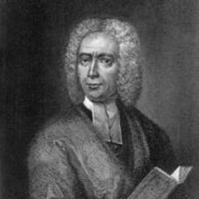
Isaac-Watts-hymn-author
The father of Isaac Watts was a respected Nonconformist, and at the birth of the child, and during his infancy, twice suffered imprisonment for his religious convictions.
Isaac was the eldest of his nine children, who’s taste for verse showed itself in early childhood and he was taught Greek, Latin, and Hebrew by Mr. Pinhorn, rector of All Saints, and headmaster of the Grammar School, in Southampton. At the age of 16, he went to London to study in the Academy of the Rev. Thomas Rowe, an Independent minister.
Leaving the Academy at the age of 20, he spent 2 years at home; and it was then that the bulk of the Hymns and Spiritual Songs (published 1707-9) were written, and sung from manuscripts in the Southampton Chapel. At the age of 24 years, he became assistant minister of an Independent Church in London, and 4 years later, he became pastor. In 1712, he accepted an invitation to visit Sir Thomas Abney, at his residence of Abney Park, and at Sir Thomas’ pressing request, made it his home for the remainder of his life. It was a residence most favourable for his health, and for the prosecution of his literary labours. He did not retire from ministerial duties, but preached as often as his delicate health would permit. The number of Watts’ publications is very large and embrace sermons, treatises, poems and hymns. His published hymns number more than 800. It is as a writer of psalms and hymns that he is everywhere known. Some of his hymns were written to be sung after his sermons, giving expression to the meaning of the text upon which he had preached. 

ComposerNo information found.

Hymn Book Purchase

The Hymns Of Dawn (hymn book) can be purchased here:

The Chicago Bible Students Online Bookstore: https://chicagobible.org/product-category/books/page/4/
The Dawn Bible Students Association: http://www.dawnbible.com/dawnpub.htm

Acknowledgment & References

Br. Charles Taze Russell

pastor-russell-in-his-study.jpg

Br. Charles Russell—the founder of the Bible Students movement, who is the compiler of “Poems and Hymns of Millennial Dawn” which was published in Allegheny, Pa., in 1890. This Bible Students’ devotional originally contained a total of 151 poems and 333 hymns.

POEMS-AND-HYMNS-OF-MILLENNIAL-DAWN

Later on, the hymns from this book formed a basis for the hymnal titled ““Hymns of Dawn” which was published by the Dawn Bible Students Association in East Rutherford, New Jersey (USA) and the 1999 edition contains a total of 361 hymns.

Hymns of Dawn.jpg

Hymnary.org.


The URL of this post: https://biblestudentsdaily.com/2017/10/11/alas-and-did-my-savior-bleed-hymns-of-dawn-no-5/

Enter your email address to subscribe to this blog and receive notifications of new posts by email.

My Goal Is Christ – Hymns of Dawn No. 4

My Goal Is Christ – Hymns of Dawn No. 4

“(13) Brothers, I do not consider that I have made it my own. But one thing I do: forgetting what lies behind and straining forward to what lies ahead, (14) I press on toward the goal for the prize of the upward call of God in Christ Jesus. (15) Let those of us who are mature think this way, and if in anything you think otherwise, God will reveal that also to you” (Philippians 3:13-15, ESV).

Lyrics

1.
Ah, tell me not of gold or treasure,
Of pomp and beauty here on earth!
There’s not a thing that gives me pleasure,
Of all this world displays for worth.

Each heart will seek and love its own;

Chorus
My goal is Christ and Christ alone,
My goal is Christ and Christ alone.

2.
The world and her pursuits will perish;
Her beauty’s fading like a flower;
The brightest schemes the earth can cherish
Are but the pastime of an hour.

Each heart will seek and love its own;

3.
Against this tower there’s no prevailing;
His Kingdom passes not away;
His throne abides, despite assailing,
From henceforth unto endless day.

Each heart will seek and love its own;

4.
And though a pilgrim I must wander,
Still absent from the One I love,
He soon will have me with him yonder
In his own glory-realms above.

Triumphantly I therefore own,

The History Of This Hymn

Author – William Hunter (1811-1877)

Hunter, William, D.D, son of John Hunter, was born near Ballymoney, County Antrim, Ireland, May 26, 1811. He removed to America in 1817, and entered Madison College in 1830. For some time he edited the Conference Journal, and the Christian Advocate. In 1855 he was appointed Professor of Hebrew in Alleghany College: and subsequently Minister of the Methodist Episcopal Church, at Alliance, Stark Country, Ohio. Over 125 hymns were written by William Hunter. Some of these have been translated into various Indian languages.

ComposerEdwin Othello Excell (1851 -1921)

Excell_EO - Hymns of Dawn No. 4 composer.jpgE. O. Excell, was a prominent American publisher, composer, song leader, and singer of music for church, Sunday school, and evangelistic meetings during the late nineteenth and early twentieth centuries.

His 1909 stanza selection and arrangement of “Amazing Grace” became the most widely used and familiar setting of that hymn by the second half of the twentieth century.

Excell compiled or contributed to about 90 secular and sacred song books and is estimated to have written, composed, or arranged more than 2,000 of the songs he published. The music publishing business he started in 1881 and that eventually bore his name was the highest volume producer of hymnbooks in America at the time of his death.

Excell was the son of German Reformed minister and self-published author J. J. Excell. He was born in Uniontown, Stark County, Ohio and attended public schools in Ohio and Pennsylvania. After marrying in 1871 near Brady’s Bend, Pennsylvania, he relocated to that state and supported his family for several years as a plasterer, bricklayer, and singing instructor.

Excell was the son of German Reformed minister and self-published author J. J. Excell. He was born in Uniontown, Stark County, Ohio and attended public schools in Ohio and Pennsylvania. After marrying in 1871 near Brady’s Bend, Pennsylvania, he relocated to that state and supported his family for several years as a plasterer, bricklayer, and singing instructor. His focus was turned to sacred music through his experience leading songs at revivals and worship services of Methodist Episcopal churches, first in East Brady and then, starting in 1881, Oil City, Pennsylvania. Between 1877 and 1883 he studied music formally at the Normal Musical Institutes of George F. Root where he also received vocal training under Root’s son, Frederick. He moved to Chicago, base of Root’s operations, in 1883 to pursue music publishing in earnest.

Excell was described as “a big, robust six-footer, with a six-in caliber voice” and extraordinary range that enabled him to solo as baritone or tenor. Publisher George H. Doran observed him leading songs at a revival and later noted that Excell “was a master of mass control; he might easily have become conductor of some mighty chorus”. These talents fostered his early success as a rural singing teacher in Pennsylvania and helped secure a position as church choirmaster for the two years preceding his move to Illinois.

Hymn Book Purchase

The Hymns Of Dawn (hymn book) can be purchased here:

The Chicago Bible Students Online Bookstore: https://chicagobible.org/product-category/books/page/4/
The Dawn Bible Students Association: http://www.dawnbible.com/dawnpub.htm

Acknowledgment & References

Br. Charles Taze Russell

pastor-russell-in-his-study.jpg

Br. Charles Russell—the founder of the Bible Students movement, who is the compiler of “Poems and Hymns of Millennial Dawn” which was published in Allegheny, Pa., in 1890. This Bible Students’ devotional originally contained a total of 151 poems and 333 hymns.

POEMS-AND-HYMNS-OF-MILLENNIAL-DAWN

Later on, the hymns from this book formed a basis for the hymnal titled ““Hymns of Dawn” which was published by the Dawn Bible Students Association in East Rutherford, New Jersey (USA) and the 1999 edition contains a total of 361 hymns.

Hymns of Dawn.jpg

The URL of this post: https://biblestudentsdaily.com/2017/10/03/my-goal-is-christ-hymns-of-dawn-no-4/

Enter your email address to subscribe to this blog and receive notifications of new posts by email.

Epoch Periods In God’s Plan

Hosea-6-1-2-bible-students-daily-website.jpg

The Light In The First Day

In Genesis 1:1‑5 (KJV) we are first introduced to the “light” of the sun.

“(1) In the beginning God created the heaven and the earth. (2) And the earth was without form, and void; and darkness was upon the face of the deep. And the Spirit of God moved upon the face of the waters. (3) And God said, Let there be light: and there was light. (4) And God saw the light, that it was good: and God divided the light from the darkness. (5) And God called the light Day, and the darkness he called Night. And the evening and the morning were the first day. 

The Sun

“Let there be light” (Genesis 1:3) evidently refers to the light of the sun, which was sufficient for general illumination, but not sufficient to break through the mists to become an identifiable object in the heavens, until the fourth day when it was “appointed” (as the word there can mean), together with the moon and stars (Genesis 1:16). Genesis 1:11 shows that there were already plants and trees on day three, which required sunlight to grow. The sun was in place and burning before the earth was suitable for life.

Genesis-1-11.jpg

The Length of Each Day of Creation

The days of creation recorded in Genesis chapters 1 and 2 were epoch days of creative activity, of undefined length.

The word “day” customarily describes a normal day of 24 hours, but very often has a broader usage for any defined period of whatever length. For example, Genesis 2:4 says “These are the generations of the heavens and of the earth when they were created, in the day that the LORD God made the earth and the heavens.” Here “day” is a period that includes all of the seven days reported earlier.

In Hebrews 3:8, Paul refers to the “provocation, in the day of temptation in the wilderness” — which refers to a period of years, not a single day.

When we speak of Jesus’ day, we mean a period of history long ago, not a single day.

The work involved in these “days” of creation required lengthy periods of time for the natural processes to reach maturity, or completion.

Zechariah 14:7-9 provides another example, this time from prophecy, of the greater use of the term “day.”

“(7) It shall be one day which shall be known to the LORD, not day, nor night: but it shall come to pass, that at evening time [at the close of the Millennial day that spans 1000 years] it shall be light. (8) And it shall be in that day, that living waters shall go out from Jerusalem; half of them toward the former sea, and half of them toward the hinder sea: in summer and in winter shall it be. (9) And the LORD shall be king over all the earth: in that day shall there be one LORD, and his name one.”

The metaphorical use of the word “day” is usually apparent from the context.

The Third Day

In John 2:19-22 we read about Jesus being raised on the literal third day:

“(19) Jesus answered and said unto them, Destroy this temple, and in three days I will raise it up. (20) Then said the Jews, Forty and six years was this temple in building, and wilt thou rear it up in three days? (21) But he spake of the temple of his body. (22) When therefore he was risen from the dead, his disciples remembered that he had said this unto them; and they believed the scripture, and the word which Jesus had said.”

However, if we take the above passage to refer to the metaphorical body of Christ, that is, the body of believers in Jesus, then it is apparent that any application of the three days would be on a larger time frame. In this case the saints are raised on the third millennium from the time of Christ.

In Hosea 6:1-3 (KJV) we read about this “third day.”

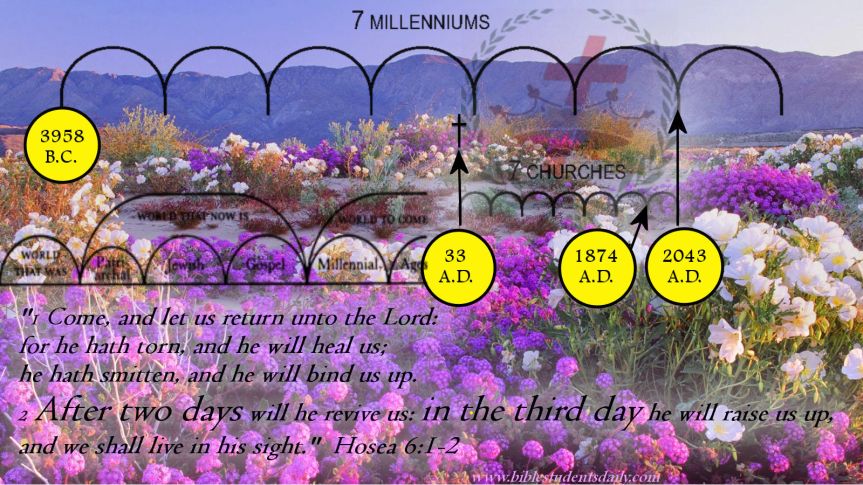
“(1) Come, and let us return unto the Lord: for he hath torn, and he will heal us; he hath smitten, and he will bind us up. (2) After two days will he revive us: in the third day he will raise us up, and we shall live in his sight. (3) Then shall we know, if we follow on to know the Lord: his going forth is prepared as the morning; and he shall come unto us as the rain, as the latter and former rain unto the earth.”

In both of these cases — John chapter two and Hosea chapter six — the three days involved are evidently millennial days 4, 5, and 6 as counted from Adam. On the sixth millennium, which includes our day, Israel has been under process of restoration. Jesus’ first advent was in the fourth Millennial day, counting from Adam. Here are those “days”

(1) 3958 B.C. to 2958 B.C.
(2) 2958 B.C. to 1958 B.C.
(3) 1958 B.C. to 958 B.C.
(4) 958 B.C. to 43 A.D.
(5) 43 A.D. to 1043 A.D.
(6) 1043 A.D. to 2043 A.D.

The words of Hosea 6:1-3 is thus about natural Israel (not about Spiritual Israel — the Bride of Christ) because in verse one, we read that God has “smitten” them. God has not smitten the Church. But Israel was “smitten” following their rejection of Christ. God did smite Israel during the Roman wars that closed the Jewish Age. They were cast off in 33 A.D., in day “four” from Adam. After the close of day four, and the close of day five, thus “after two days,” they began to be restored in 1878 and forward, on day “six” from Adam.

Hence Israel is now being restored — presently as a nation, and later, in the Kingdom, to individual life after they recognize Jesus as their Redeemer.

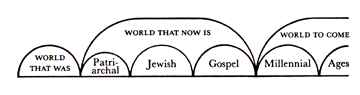
Three Dispensations in the Divine Plan

3 dispensations

There are three large periods of time in the Divine Plan. Sometimes these are termed “Dispensations,” because the administration of these three periods varied. Sometimes they are called three “worlds,” drawing from these three scriptures —

  • World that Was 2 Peter 3:6 — Whereby the world that then was, being overflowed with water [the Flood], perished.
  • Present Evil World Galatians 1:4 — “Who gave himself for our sins, that he might deliver us from this present evil world, according to the will of God and our Father.”
  • World to ComeHebrews 2:5 — “For unto the angels hath he not put in subjection the world to come, whereof we speak.”

Epoch 1 – The World That Was

This epoch lasted from the time of Adam and Eve until the flood. In this period some of the angels were allowed to exercise influence in a way that was later restrained. It was not subdivided into ages because God’s method of dealing with men did not vary from Adam’s fall to the flood. God had given man his law, the law of conscience written into his nature. However, after he sinned God left him measurably to his own downward course, that man might learn through experience the wisdom of God in requiring obedience. The disastrous effects of sin were manifested showing that the tendency of sin is downward to greater degradation and misery, showing the necessity of Jehovah’s interposition, if the recovery of “that which was lost” — man’s first estate — would ever be accomplished.

Epoch 2 – The Present Evil World

The second great epoch (Galatians 1:4, 2 Peter 3:7) spans from the flood to the establishment of the kingdom of God. It is under the limited control of Satan, the usurper, “the prince of this world,” who has no interest in Christ’ followers except to oppose, tempt, annoy, and buffet them (John 14:30, 2 Corinthians 12:7, Malachi 3:15).

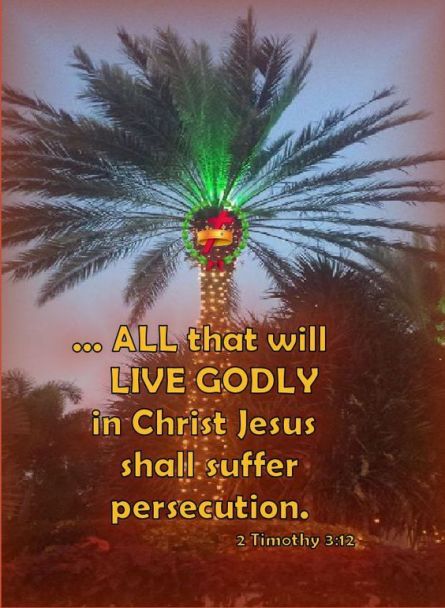
In this present evil world, or epoch, whoever will live godly shall suffer persecution, while the wicked flourish like a green bay tree (2 Timothy 3:12, Psalm 37:35).

Jesus said, “My kingdom is not of this world,” and until the era or “world to come” does come, Christ’s kingdom will not control the earth. For this we are taught to hope and pray, “Thy kingdom come, thy will be done on earth.” Satan is the “ruler of the darkness of this world,” and therefore “darkness covers the earth and gross darkness the people.” Satan now rules and works in the hearts of the children of disobedience (Ephesians 2:2, 6:12).

The current epoch is divided into three “ages.”

(a) The Patriarchal Age. God’s dealings and favors were with various patriarchs, such as Noah, Abraham, Isaac, and Jacob. At Jacob’s death his descendants were called “the twelve tribes of Israel.” They were together recognized of God as his “peculiar people,” and through typical sacrifices they were typically “a holy nation,” separated from other nations for a particular purpose, and therefore to enjoy certain special favors.

(b) The Jewish Age (or the Law dispensation). God specially blessed the nation of Israel during this age from Jacob’s death until Christ’s death, as evidenced in the following:

  • Giving the Israelites His law,
  • Making a special covenant with them,
  • Giving them the Tabernacle, whose shekinah glory in the Most Holy represented Jehovah’s presence with them as their Leader and King,
  • Sending them prophets,
  • Sending them His Son, Jesus, who performed his miracles and taught in their midst. Jesus ministered to the Israelites, and instructed his disciples the same during the time that he was with them. “Go not into the way of the Gentiles, and into any city of the Samaritans enter ye not; but go rather to the lost sheep of the house of Israel” (Matthew 10:5,6). Jesus explained, “I am not sent but unto the lost sheep of the house of Israel” (Matthew 15:24).

This national favor ended with their rejection and crucifixion of Jesus, as shown by Jesus’ words five days before his crucifixion, “Your house is left unto you desolate” (Matthew 23:38).

(c) The Gospel Age. From Jesus’ death, the good tidings of justification have been heralded for nearly 2000 years not only to the Jewish people, but to all nations; for Jesus Christ, by the grace of God, tasted death for every man. During this Gospel age there is a class called to special favor, to whom special promises are made. Namely, to those who by faith accept Christ Jesus as their Redeemer and Lord and follow in his footsteps.

The aim of this age is not to convert nations, but to call out a “little flock” as Jesus foretold (Luke 12:32), to whom it is the Father’s good pleasure to give the Kingdom in an age to follow this.

Epoch 3 – The World to Come

The third epoch is to be a “world without end” (Isaiah 45:17) under divine administration, the kingdom of God. It is called “The World to Come, wherein dwelleth righteousness,” and during this period, all the families of the earth shall be blessed (Hebrews 2:5, 2 Peter 3:13, 2 Corinthians 12:2‑4, Revelation 21:1).

The thousand years of Christ’s reign is the first age in the “world to come” (Revelation 20:4). During the Millennial age, there will be a restoration of all things lost by the fall of Adam (Acts 3:19‑21). Then, all tears, sorrow, pain, and death resulting from the fall of Adam in Eden shall have been wiped away (Revelation 21:4). Following this 1000 year Millennium, there will be “a little season” of final testing time for the world of mankind (Revelation 20:3,7-10).

Revelation 11:15 says that when the seventh angel sounds his trumpet, “the kingdom of this world has become the kingdom of our Lord [Jehovah] and His Christ [Jesus].” Thereafter our Lord Jesus exercises his power to remove present powers, and establish his Millennial Kingdom in order to bless the world in righteousness.

There are seven trumpet periods in Revelation. The seventh of these commenced in 1874 with the return of Christ and his subsequent parousia, or presence. Acts 3:21 connects this to the beginning of the “times of restoration.” There the process of restoring Israel commenced.

At the end of the Millennium will come the close of the seventh millennial “day,” introducing day number eight. At this time there will be “a little season” for the testing of mankind. Those found unfaithful and rebellious, disobedient to God and His principles, will not continue further. Thus the world is cleansed, purged, “circumcised” as it were, on the eighth day — evidently represented by circumcision of old being on the eighth day (Genesis 17:12).

Revelation 11:18, part of the description of the seventh trumpet, refer to the raising of the sleeping saints. “The time … that thou shouldest give reward unto thy servants the prophets [Jesus’ New Testament spokesmen, compare Ephesians 3:5], and to the saints [holy ones of the Gospel Age].” The Millennium will be introduced subsequent, at the close of 6000 years, which we anticipate about a generation future, with the year 2043.

When that kingdom is established, all of the Bride class will have been gathered to glory, ready to serve as priests and kings with Christ to uplift the world (Revelation 20:6). Gradually all will be raised to life again, and have an opportunity to gain life everlasting.

Revelation 11:18,19 shows that the transition period into the Kingdom involves a general time of trouble. Evidently this commenced in 1914 with World War I. Jesus said, “No man can enter into a strong man’s house and spoil [plunder] his goods, except he will first bind the strong man, and then he will spoil his house” (Mark 3:22‑27). Jesus has entered the house of the strong man, Satan, and is in process of disrupting his affairs, incident to removing the influence of Satan altogether.

Satan is the “strong man” of the Present Evil World. The disruption of his “house,” and the binding of that strong usurper, is the necessary predicate for the establishment of the Millennial Kingdom. Satan will remain bound for “a thousand years,” allowing the world to grow and learn without the adversary’s deceptions.

We read of this in Revelation 20:2,3

“2 And he seized the dragon, that ancient serpent, who is the devil and Satan, and bound him for a thousand years, and threw him into the pit, and shut it and sealed it over him, so that he might not deceive the nations any longer, until the thousand years were ended. After that he must be released for a little while.”

The blotting out of evil will be gradual, requiring all of the first thousand years. Evil will not rule then. It will not prosper; it will no longer be the wicked that will flourish; but “the righteous shall flourish” (Psalm 72:7). Then the obedient shall eat the good of the land” (Isaiah 1:19), and “the evil doer shall be cut off” (Psalm 37:9).

Heavens and Earth – Not Literally Destroyed

This earth is the basis of all these “worlds” and dispensations. Though ages pass and dispensations change, still the earth continues “The earth abideth forever (Ecclesiastes 1:4).

In 2 Peter 3:12, Peter refers to the dissolution of the present heavens and earth. “Looking for and hasting unto the coming of the day of God, wherein the heavens being on fire shall be dissolved, and the elements shall melt with fervent heat.” Here “the heavens” symbolize the higher or spiritual controlling powers, and “earth” (verse 10) symbolizes human government and social arrangements.

The first heavens and earth, or social arrangement, ended at the flood, “being overflowed with water” (2 Peter 3:6). “But the heavens and the earth, which are now, by the same word are kept in store, reserved unto fire against the day of judgment and perdition of ungodly men” (2 Peter 3:7). The order and arrangement of things then existing ended at the flood. But the physical heavens (sky and atmosphere), and the physical earth, did not pass away.

Likewise, the present social structure, political and ecclesiastical, will pass away in deference to the Kingdom of Christ. The beginning of this work occurs in the “Day of the Lord” which “shall burn as an oven” (Malachi 4:1). But the complete integration of mankind into the new arrangement, the “new heavens” and “new earth” (2 Peter 3:13) will require time, as the work of the Kingdom proceeds.

Society will become reorganized in harmony with earth’s new Prince, Christ Jesus. Righteousness, peace, and love will rule among men when present arrangements give place to the new and better kingdom, based on justice and equity. The more we examine God’s plan of the Ages, the more we will find in it perfect harmony, beauty and order.

“Each age has its part to accomplish, necessary to the complete development of God’s plan as a whole. The plan is a progressive one, gradually unfolding from age to age, upward and onward to the grand consummation of the original design of the Divine Architect, “who worketh all things after the counsel of his own will” (Ephesians 1:11). Not one of these great periods is an hour too long or too short for the accomplishment of its object. God is a wise economist of both time and means, though his resources are infinite; and no power, however malicious, for a moment retards or thwarts his purposes. All things, evil as well as good, under divine supervision and overruling, are working together for the accomplishment of his will” (Br. Charles T. Russell, The Divine Plan of the Ages, page 74).

Acknowledgement

Br. Charles Russell — for content shared from his book titled “The Divine Plan of the Ages,” which is Volume One (of six) of “Studies in the Scriptures.” This can be read from the Harvest Truth Data Base website. Here is the direct link: http://www.htdb.one

Br. David Rice — for content & editing assistance.

Further Suggested Reading

The Stream of Time by Br. David Rice. http://2043ad.com/streamoftime.PDF

Booklet titled: “I Will Come Again – John 14:3”

Click to access I-WILL-COME-AGAIN.pdf

God’s Millennium. A Dawn Bible Students Association Publication (booklet).
http://www.dawnbible.com/booklets/Gods1k.htm

Israel in History and Prophecyhttp://www.dawnbible.com/booklets/israel_hp.htm

The Approaching End of The Harvest

The Approaching End of the Harvest

1 CORINTHIANS 15:45 – How Long Until the Millennial Reign of the ‘Last Adam’?

1 CORINTHIANS 15:45 – How Long Until the Millennial Reign of the “Last Adam”?

The Book of Revelation: A 2016 Perspective

The Book of Revelation: A 2016 Perspective


The URL for this post:

Epoch Periods In God’s Plan

Enter your email address to subscribe to this blog and receive notifications of new posts by email.

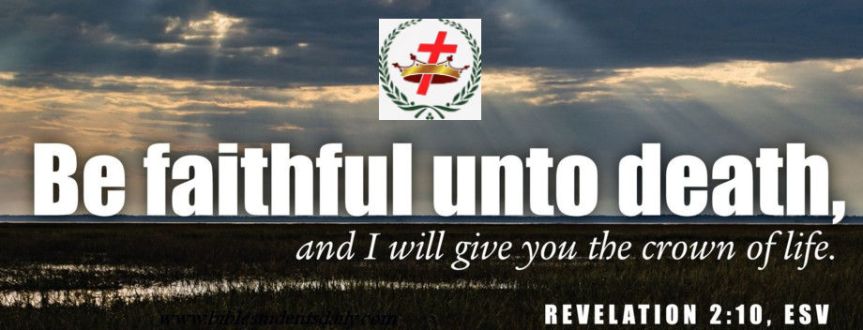
“Be Thou Faithful Unto Death”

REVELATION-2-10.jpg

FAITHFUL when with tears thine eyes are dim,
Faithful when Joy’s cup o’erflows its brim;
Faithful when God seems to veil His face,
Faithful when He crowns thy work with grace.
Faithful, though thy loved ones turn aside,
Lips that praised thee once, in harshness chide;
Faithful, though success enwreathe thy brow,
Faithful, should the world before thee bow.
Faithful till hath fled life’s fleeting breath,
Eager hands lie folded still in death.

“Faithful unto death!” Lord, day by day,
Help me thus to keep the narrow way!
Strengthen me to bear the scorn and shame –
Portion of all those who take Thy name.
“Faithful unto death!” When all is done,
Cross is changed to Crown, the victory won,
Let me hear Thee say, O blessed Lord,
“Child, come enter into thy reward!
Faithful thou hast been, come share with Me
Glory, Honor, Immortality!”

Gertrude W. Seibert

REVELATION-14-12.jpg

Here is an excerpt from “Harvest Gleaning II” by Br. Charles T. Russell, page 121-124—

FAITHFUL UNTO DEATH
“Be thou faithful unto death, and I will give thee a crown of life.”

It will not be very long, dear fellow soldiers of the cross, until the battle will be over, the victory won; for the “King’s own” are called to victory and not to defeat. Our enlistment is in accord with the great plan of the ages which our Father previously mapped out, and we know that all His purposes shall be accomplished, that His Word which went forth for the calling of this little flock to joint-heirship with Jesus in the kingdom which is promised to be established and to bless all the families of the earth —that word cannot be broken, its fulfillment is sure. Yea, its fulfillment is nigh, even at the door.

Though we are in the world, but not of the world, we, nevertheless, are more or less affected by every matter which affects our neighbors; and hence in the great battle that is now impending between truth and error, between princes and people, between money and labor, and with more or less of right and wrong on both sides of all questions, the “King’s own,” the soldiers of the cross, will have some very trying experiences. It is the present time that the apostle emphasizes as “that evil day” — the period of special trial in the end of this age, saying, “Take unto you the whole armor of God, that ye may be able to stand in that evil day, and, having done all, to stand.” Analyzing these words, we see them to signify that in the end of this age there would be special trials of severe testing; but the apostle’s language also implies that the Lord will make special provision for the protection of His faithful ones, and that this will be an armor of truth, of knowledge, of information granted to them from the great armory, His Word, the Bible. The exhortation that we should take it implies that the Lord will not force it upon any, but to those who are in the right attitude of heart the doors of the armory will be open, and the proper armor supplied in due season, and that they must demonstrate their loyalty and obedience to the Captain by seeking this armor and putting it on. Those who do not thus yield obedience to the Captain’s word will not have the protection necessary for this time, and, as intimated in the text by the apostle, they will not be able to stand in this evil day.

Soldiers of the cross in previous times had not so much of the armor supplied, neither did they need the special armor that is needed now. They did not live in “this evil day.” The head knowledge that our grandfathers had respecting the divine plan will surely prove insufficient in this day of so-called higher criticism of the scriptures, evolution theories, theosophy and Christian Science. Whoever has not the proper armor necessary for the present time will be pretty sure to fall in this evil day, this day of special trial and testing; but he who puts on the armor of God, he who possesses the fruits of the Spirit, the Apostle Paul assures us shall never fall, but so doing an entrance shall be abundantly administered unto him into the everlasting kingdom of our Lord and Saviour, Jesus Christ.

Many of the tests of this evil day are already upon us, and, as the prophets have foretold, “A thousand shall fall at thy side, and ten thousand at thy right hand.” (Psa. 91:7) These are falling away from the faith because in many instances they were not spiritual Israelites indeed, but as the Lord declares through the prophet, “Wherefore, because this people draw nigh to me with their lips while their hearts are far from me.” The Lord wants as members of the “King’s own” those who are at heart loyal to Him, loyal to all who have His Spirit and loyal to righteousness and truth. If we are ashamed of Him, ashamed of His brethren, or ashamed of His Word, we are not of the kind that He is seeking now. Those who are to be with Him, to share His throne and glory and to join with Him in the great work of emancipating the world from the power of sin and death during the millennium, must all be loyal at heart, to the core, and the various trials and testings now permitted will demonstrate the degree of loyalty. Let us, dear brethren, be loyal; and even if the time should come when we shall be misunderstood by our neighbors and friends, the children of this world, let us put our confidence in the Lord; let us fight the good fight of faith against sin and error and selfishness within and without, and thus doing lay hold upon eternal life.

* * * *

There is never a path so hidden,
But God will show us the way,
If we seek for the Spirit’s guidance,
And patiently wait and pray.


Suggested Further Reading

The Letter To Smyrna by Br. David Skein. The Beauties of the Truth. February 2007. Volume 18. No. 1. http://www.beautiesofthetruth.org/Archive/Library/Doctrine/Mags/Bot/90s/BOTFEB07.PDF

A Special Calling by Br. David Rice. The Herald of Christ’s Kingdom. July /August 2016. https://herald-magazine.com/2016/07/01/the-bride-class/

Old Testament Portrayals of the Church by Br. Homer Montague. The Herald of Christ’s Kingdom. July/August 2004. http://www.heraldmag.org/2004/04ja_2.htm

The Song of Solomon by Br. Frank Shallieu. The Herald of Christ’s Kingdom. July/August 2004. http://www.heraldmag.org/2004/04ja_3.htm

The Bride and the Bridegroom by Br. Carl Hagensick. A Verse-by-verse Study of Psalm 45. The Herald of Christ’s Kingdom. July/August 2004. http://www.heraldmag.org/2004/04ja_4.htm

New Testament Portrayals of the Church by Br. Michael Nekora. A Precious Treasure. The Herald of Christ’s Kingdom. July/August 2004. http://www.heraldmag.org/2004/04ja_5.htm

A Chaste VirginThe Herald of Christ’s Kingdom. URL: http://www.heraldmag.org/literature/chliv_38.htm


The URL for this post is: https://biblestudentsdaily.com/2017/08/10/be-thou-faithful-unto-death/

Enter your email address to subscribe to this blog and receive notifications of new posts by email.

2 TIMOTHY 3:12 – Godliness Attracts Persecution

2-timothy-3-12.jpg

“But even if you should suffer for righteousness’ sake, you will be blessed. Have no fear of them, nor be troubled, 15 but in your hearts honor Christ the Lord as holy, always being prepared to make a defense to anyone who asks you for a reason for the hope that is in you; yet do it with gentleness and respect, 16 having a good conscience, so that, when you are slandered, those who revile your good behavior in Christ may be put to shame. 17 For it is better to suffer for doing good, if that should be God’s will, than for doing evil.” (1 Peter 3:14-17, ESV).

What is Godliness?

Here are some words of the Psalmist David in Psalm 15:1-5.

“(1) O LORD, who shall sojourn in your tent? Who shall dwell on your holy hill? He who walks blamelessly and does what is right and speaks truth in his heart; (3) who does not slander with his tongue and does no evil to his neighbor, nor takes up a reproach against his friend; (4) in whose eyes a vile person is despised, but who honors those who fear the LORD; who swears to his own hurt and does not change; (5) who does not put out his money at interest and does not take a bribe against the innocent. He who does these things shall never be moved.”

GODLINESS is:

  • the condition of righteousness (Matthew 5:10, 1 Timothy 6:11, Matthew 6:33, Proverbs 10:2, Proverbs 11:18, Psalm 34:15, Matthew 5:6, Psalm 34:19, Romans 1:17, 2 Corinthians 6:14, 1 Peter 2:24, 1 Peter 3:12, Romans 1:17, 5:19, 6:13);
  • an opposition to sin—as God is opposed to sin (Psalm 1:1, Psalm 37:28);
  • a condition in harmony with justice—as God is just (Micah 6:8, Romans 2:1, Isaiah 1:17, Isaiah 30:18, Psalm 33:5, Zechariah 7:9-10);
  • generosity and kindness and love—as God is generous and kind and loving (1 Thessalonians 5:15, Psalm 37:21);

There are kind, generous and noble characters in the world who are not Christians. These may have more or less of opposition from others who are evilly disposed—as darkness always opposes light; yet these noble people exercise moderation in their righteousness—they are not righteous overmuch. These fine characters might occasionally get some persecution, politically or otherwise; but even the enemies of such would have respect for them.

Living godly versus living godly in Christ Jesus

Because of their special relationship to Christ Jesus, God’s people:

  • have a special enlightenment.
  • see more clearly the principles of God’s Justice.
  • have a more exacting rule by which their lives are governed.
  • have an intelligent knowledge that they have entered into a Covenant of Sacrifice. 
  • realize that they are not to compromise their religion in any way; not to compromise with sin or with the world.
  • uphold the principles of righteousness, even to the detriment of their own earthly interests.
  • consecrate all of their time, talent, influence, money to the Lord’s service, and in relation to the use of their blessings from God, they ask themselves:

     “What is the Lord’s will, the Lord’s way?”

    How would the Heavenly Father want me to use my time, talents, influence, money etc… in His service, in the cause of Christ?

God’s people would wish to use their money for the preaching of the Gospel and the publishing of it in various ways. They would reason:  There are many opportunities for people to get education along earthly lines, and I believe the Lord would have me as His child to use His money to help people get spiritual education.

The godly who are not in Christ Jesus—those who have a measure of Godlikeness:

  • do not see these deeper things of the Divine Plan and the special arrangement God has made with the Church.
  • may indulge in a great many things that would not be wrong for the world—not sinful, not immoral, not unkind.
  • might feel perfectly free to give of their money for various causes and purposes, that would be reasonable and proper in themselves— such as attending a football match or a theatre production; spend a certain amount each season on the opera; be patrons of art and music and literature—adopting a course that will win the approval of society; or spend a thousand dollars—or ten thousand dollars—on a single painting, because he wants art to flourish. Or he might buy a fine piece of sculpture to adorn his home, but this is not the course for true Christians, who must consider the Lord’s will for them as His servants.

The Christian has limitations which the worldly do not have. 

But we are glad! 

  • Glad for all good men and good women, who can be good and noble even though not in Christ Jesus.
  • Glad to esteem them.

There are noble people in the world. There are some godly ones (to a certain degree) outside the Church, and they are likely to come to see something of the Truth, if they are really noble characters.

The godly of this world will get a blessing in the Restitution time. Every godly thing that they have done, every act of generosity, will get its reward. By cultivating their higher sentiments, they will have fewer steps to retrace.

Specially GODLY are Specially PERSECUTED

The persecutions which come to the godly in Christ Jesus are special persecutions. We are not to expect much of this from the Body of Christ. 

Persecution is not merely one act or one word—it is a succession of unkind words and acts with a view to punishing some one for adhering to an opinion or course of conduct.

Persecution comes from a certain class called by Jesus the world. But the class that Jesus called the world are those who had form of godliness, but did not have the power  thereof. The Apostle speaks of a class who would take the name of the Lord upon them and misuse that name. There are people in the world today who do not know nor want to know the difference between Truth and error—and who keep out of the way of being told. They somehow know that there would come a certain measure of condemnation to themselves if they recognized the real facts and did not act in accordance with them.

They are not all bad people by any means. There are very many good people among the tares; but there is no real wheat among the tares—no real nutriment.

These tares pose as the Church of Christ; the tare systems pose as Christianity. And from this class usually come the persecutions. They try to crowd out the wheat, or to choke it and make it unfruitful. It was so in our Lord’s day. Those to whom the Lord referred as persecutors were not the Gentile world of His day, but the worldly ones of the Jews—those who were not fully consecrated to the Lord, but who thought they were.

Nicodemus was a fine character, and Gamaliel was a fine character—and so were a great many who did not become Christ’s disciples at all but were seeking after righteousness; as, for instance, the young man who came to the Lord and asked Him, “Good Master, what shall I do that I may inherit eternal life?” The Lord answered, “Thou knowest the commandments.” The young man said, “Master, all these have I observed from my youth up.” He was a noble character, and Jesus looking on him loved him, even though he was not a disciple. And Jesus said to him. “One thing thou lackest; go thy way, sell whatsoever thou hast, and give to the poor, and thou shalt have treasure in Heaven; and come, take up thy cross, and follow Me.” But he went away sorrowful. He did not want to become a member in Christ Jesus.

He did not want to give everything to the Lord.

He was very rich—“had great possessions,” and he preferred to hold on to his wealth.—Mark 10:17-22.

There were others who went through many of the forms and ceremonies, and who kept the various admonitions of the Law, and its feasts and fasts; but they were not the “Israelites indeed in whom was no guile.” And later they became the persecutors of Christ and those who walk in His steps of sacrifice.

Professed Christian Persecutors

And so those who live godly in Christ Jesus have their persecutions, not so much from the worldly class as from professing Christians. There is a class in Churchianity today that has a great deal of pride and self-satisfaction.

Some say respecting those who proclaim Present Truth and who live saintly lives as followers of Jesus Christ:

If we let these people alone and let them teach these things, all that we have been upholding for centuries will crumble.

Did not Luther hand down Truth to us?

Did not Calvin give the Church Truth?

Have we not the teachings of Wesley?

No, no; we will not have these “new doctrines”!

But we see that these people are persecuting the Truth and its representatives because of misunderstanding.

We should have a great deal of sympathy and not feel specially angry with them.

This does not mean that we should be glad of persecution—no persecution “for the present seemeth joyous, but grievous.” (Hebrews 12:11.) But if we know that we are suffering for righteousness’ sake, then we know the Spirit of God rests upon us. It is those who know that they suffer for Christ’s sake, and who take it gladly because it is the will of God, that may rejoice, because the persecution is working out in them blessed effects. Let us then

“Be still beneath His tender care,
For He will make the tempest cease;
And bring from out the anguish here,
The afterward of peace.”

“The Lord Your God Doth Prove You”

WHY does God permit His people to suffer?

WHY does God not shield those who are His from suffering, just as a loving parent would shield a child?

The Scriptures reply that it is because God is working out a great Plan that will eventually bring blessings to all who will do righteously. God wishes to show the evil effects of sin and the deteriorating effects of Adamic disobedience. God’s purpose is that after the Six Days of Sin and Death are ended, in the Seventh Day there shall be a blessing for the whole groaning creation. “Jehovah God will wipe away tears from off all faces.”Isaiah 25:8.

And there is a particular reason why God should permit persecution to come upon His consecrated ones. “The Lord your God doth prove you,” test you. Why? What is He proving? 

We profess to be His loyal children. We profess to be laying down all that we have. And now “the Lord your God doth prove you, to know whether ye love the Lord your God with ALL your heart and with ALL your soul.Deuteronomy 8:213:3.

How much will you endure? 

How patiently will you endure? 

To what extent will you endure? 

Those who will endure most, and endure most patiently, will give evidence of the best character.  And those who demonstrate the best character will have the highest positions in the Kingdom. Each will get a position according to his faithfulness. But as star differeth from star in glory, so it will be in the Kingdom.


He who fights

the greatest fight against his own nature

and demonstrates most the love and zeal of his heart,

such is the one who will have a high place.


The Solitary Way

Alas! How few may know the grace it takes
To tread the solitary way. Alone!
Ah, yes, alone! No other human heart
Can understand the nameless sorrows there—
The nights in weeping spent, and yet, when dawns
The day, to greet the world with radiant smile,
And scatter sunshine while you whisper low
To your poor heart, “Canst bear a little more?”

Alone! Poor heart, and dost thou question, Why?
Dost think it strange that thou must walk this way?
Ah, no! Thou dost but follow in His steps
Who went before, and of the people there
Was none with Him! Alone? Yet not alone
Hath not thy blessed Lord and Master said,
“My presence shall go with thee”? Ah, my soul,
No longer, then a solitary way!

G. W. Seibert

Acknowledgment

Br. Charles Taze Russell. The content of this post is based on Reprint 5394-5 from the Reprints of the Original Watch Tower and Herald of Christ’s Presence.

Br. Allen Springer—for the Harvest Truth Data Base website from which all the Reprints of the Original Watch Tower and Herald of Christ’s Presence can be accessed electronically.


The URL for this post: https://biblestudentsdaily.com/2017/07/14/2-timothy-312-godliness-attracts-persecution/

Enter your email address to subscribe to this blog and receive notifications of new posts by email.


IN THE WILDERNESS


Psalm 121-1-3-bsd.jpg

BE still, and murmur not, poor heart,
When God shall lead thee to a “desert place,”
And bid thee dwell apart;
If ravens in the wilderness
Did feed the servant of the Lord, will He
For thee, His child, do less? 

Nor fear, sad heart, its loneliness, –
Hath He not said, “I never will forsake
Nor leave thee comfortless?”
Have faith, thy Master may design
To fit thee thus for Kingdom work and bliss, –
And wilt thou then repine? 

Be patient, let His will be done;
Be calm, be strong, that He may finish there
The work He hath begun.
“A little while,” He soon will come,
And say to thee, “It is enough, my child,
My faithful one, come home!”


Psalm 121
A Song of the Ascents.
(1) I raise my eyes to the mountains. From where will my help come? 
(2) My help comes from Jehovah, The Maker of heaven and earth.
(3) He will never allow your foot to slip. The One guarding you will never be drowsy. 
(4) Look! He will never be drowsy nor go to sleep,The One guarding Israel.
(5) Jehovah is guarding you. Jehovah is the shade at your right hand. 
(6) By day the sun will not strike you, Nor the moon by night.
(7) Jehovah will guard you against all harm. He will guard your life. 
(8) Jehovah will guard you in all you do From now on and forever.


HELP FROM THE LORD

(Reference of words below: Reprint 4311)

The Lord’s dear people never needed help more than at the present time. The difficulty with some, however, is that they do not realize their need.

  • “Therefore I take pleasure in infirmities, in reproaches, in necessities, in persecutions, in distresses for Christ’s sake: for when I am weak, then am I strong” (2 Corinthians 12:10).
  • “Wherefore let him that thinketh he standeth take heed lest he fall” (1 Corinthians 10:12).
  • “Let us fear, lest a promise being left of entering into his rest, any of you should seem to come short of it” (Hebrews 4:1).

Those who need help and who realize it, should:

Look to the LORD GOD for it—not relying upon their own strength or wisdom nor upon the assistance of their fellows.

We are not to despise assistance from any quarter, but our chief reason for receiving any assistance should be our conviction that it has come from the Lord, whether through the ear or through the eye and the printed page or however.

We are to remember that we are contending against a great Adversary and wily foe, and that we are not sufficient of ourselves to conquer, but that our only HOPE is in abiding in the Lord’s love, by seeking to do those things which are pleasing to him and heeding the counsel of his Word and the leadings of his providence.

A little carelessness along these lines, and the Adversary might readily entrap us and ensnare us and then lead us captive at his will. Ah, yes! we have the assurance of the Lord that there is but one place of safety at this time—into which more and more deeply we penetrate day by day. This place of safety is under the shadow of the Almighty, which figuratively signifies very close to the Lord.

“No harm can come nigh that dwelling place,” so far as the New Creature is concerned. Trials, tribulations, slanders may be exercised against us according to the flesh, but these cannot harm us as New Creatures, nor even disturb our peace of soul, while we are close to the Lord.

WE ARE NOT IGNORANT OF SATAN’S DEVICES

Recently we called attention to the fact that the evil spirits, the fallen angels, are to be permitted special liberties in this “evil day”; and that we might expect from them intrusions and deceptions from materializations. But while guarding that point we omitted to note another, perhaps equally dangerous, or more so, because more subtle. This we must consider now. Undoubtedly the fallen angels have had more or less power throughout the past, not merely to obsess or physically possess those who yield their wills, but power to measurably influence the minds of those who would resist them, and always by putting darkness for light. As a notable illustration of this, remember Judas, who, after brooding over the fact that our Lord’s cause was not bringing him great honor and wealth, premeditated shaking matters up, incidentally gaining thirty pieces of silver and arousing our Lord to practically assert himself and take a stand, in harmony with his power.

It was after this brooding that he was still further offended, while he ate at the Lord’s table and said, “Is it I?” And when the Lord had intimated that it was he who would betray him, he became more determined to do so. We read, “Satan entered into him.” His does not seem to be the case of obsession, but rather of domination of the mind. Satan, who had been striving to gain control, got the mastery when Judas was angry with the Lord’s reference to him as a traitor.

Our thought is that the evil spirits have been restrained in considerable measure from intruding upon the minds of men. Otherwise the world would have become Bedlam long ago. But our thought now is that their liberties with the saints will be increased, with a view to the closing test or decision in respect to character, which is now due.

“Judgment must begin at the house of God,” but it is to extend in this hour of temptation or trial to “all them that dwell upon the face of the whole earth.” That which will begin with the Church will end with the world, producing the most awful state of affairs imaginable, “A time of trouble such as never was since there was a nation.” (Daniel 12:1.) This power of intrusion will contain, we believe, evil suggestions, promoting slanders and back-biting and temporarily, at least, derange the judgment and lead to violences of various kinds, of which the same person, under other circumstances and conditions would not have thought. In a word, the difficulty will be a dementia of passion, strife, hatred and unreason.

We see evidences along this line at the present time and it is our duty to sound the warning for the benefit of those not already so twisted as to be unable to appreciate the situation. Such manifestations of evil spirits—malice, hatred, envy, strife, evil-speaking, back-biting, slanders, etc., circle around the VOW and those who have taken it, with violence and opposition for which we cannot otherwise account. Those under this influence seem impervious to argument, to reason, but open to every imaginable suggestion of evil. They seem to lose entirely the spirit of love, the spirit of Truth, the spirit of a sound mind… It bids us have sympathy for the deluded ones and be on guard for ourselves.

Summary of further points in Reprint article 4311…

  • Desiring God’s rule more and more in our own heart, and asking God to keep us humble and in reverential fear to His will lest we should attempt to grasp something which the Lord had not put into our hands.
  • More carefully than ever, guard every thought and word and deed to avoid every high imagination and to keep us from saying or writing unkind words.
  • Strive to daily remember the harvest laborers and to consider our privileges in the harvest work by filling our mind and hands with the work the Lord had already committed to us.
  • Be on guard against Spiritism and Occultism in every form.

“Our urgency on this subject is similar to that of the Apostle, when he says, “I beseech you therefore, brethren, by the mercies of God, that ye present your bodies a living sacrifice, holy acceptable to God, which is your reasonable service” (Romans 12:1). And “Make straight paths for your feet, lest that which is lame be turned out of the way.”

After what we have witnessed of the power of evil operating in the minds of some and producing characteristics which the Apostle denominates “Works of the flesh and the devil,” we can scarcely be surprised at anything which the Adversary might accomplish along these lines. But while we fear lest we should come under any such influence ourselves, and while we watch and pray lest we enter into temptation, we should not be cast down, nor hindered in any measure or degree, in respect to the service of our King.

“He is able and willing to keep in perfect peace those who are trusting him, those who are following his leadings and coming close to him, even ‘under the shadow of the Almighty.”

So then, while still expecting the attacks of the Adversary along the lines of materialization, hypnotism and occultism in general, we perceive that from inoculation of our minds with evil surmisings, saints have probably the most to dread.

How can we be on guard against this insidious snare? 

The reply is:

By keeping very close to the Lord. 

The least deviation from the principles of righteousness in our thoughts, the least violation of justice or love in our thoughts, would open the way for the enemy to inject poison, leaven, malice, envy, hatred and strife.

Let us remember Psalm 121 and lean on the Precious Promises striving to continually “think on things above” and rest in the shelter of the Most High.

the lord will keep you from all harm.jpg


Acknowledgment

Br. Charles Taze Russell—Reprints of the Original Watchtower and Herald of Christ’s Presence.

The Harvest Truth Data Base: http://www.htdb.one

Suggested Further Reading

Patient Endurance. Faithbuilders Fellowship” Journal, March/April 2009.http://2043ad.com/journal/2009/2009b.pdf

In The Secret of His Presence. “BIBLE Students DAILY.”

In the secret of His presence

URL of this post: https://biblestudentsdaily.com/2017/07/11/in-the-wilderness/

Enter your email address to subscribe to this blog and receive notifications of new posts by email.


GOD’S NAME – What Is The Heavenly Father’s Name That We Are To “Hallow” And Why?

MATTHEW-6-9-Rotherham.jpg

In Psalm 148:13 (KJV) the Psalmist David wrote, “Let them praise the name of the LORD: for his name alone is excellent; his glory is above the earth and heaven.”

But what is God’s actual name?

In this study we discuss the various names mentioned for God in the Old Testament Hebrew. Each of our Heavenly Father’s names describe different shades of His magnificent character, being, and personality, allowing us to know our Father better and learn what God wishes us to develop in our character, in order to bring joy, honor, glory, and praise to the Creator of all.

Almighty God—”El Shaddai”

The basic form for the Hebrew name of God is “El.” The word “El” means “might, strength, power.” The Schofield Reference Bible states that God (El) signifies the “Strong One.”

The word “Shaddai” is formed from the Hebrew words shadthe breast—and shadahto shed, to pour out. Thus, El Shaddai is “the God who pours out blessings, who gives them richly, abundantly, continually” (Adam Clark’s Commentary, Genesis 17:1). God is “Shaddai” because He is the nourisher, the strength‑giver, and thus the satisfier, who pours Himself into believing lives.

The primary translations of this root in the scriptures are “god” (for pagan or false gods), and “God” (for the true God of Israel). However, in Strong’s Concordance “El Shaddai” is not found under the English words “God” or “Lord,” but rather “Almighty” (Strong’s 7706). “All‑sufficient” would express the Almighty God (El Shaddai) for He not only enriches, but also makes fruitful. This is nowhere better illustrated than in the first occurrence of the name “El Shaddai” in the Bible, in Genesis 17:1.

“(1) And it came to pass that, when Abram was ninety and nine years old [being “as good as dead,” Hebrews 11:12] Yahweh appeared unto Abram, and said unto him, I, am GOD Almighty,—Walk, thou before me and become thou blameless: (2) That I may set my covenant betwixt me and thee, And may multiply thee, exceedingly. (3) And Abram fell on his face,—and God spake with him, saying: (4) As for me, lo! my covenant is with thee,—So shalt thou become—father of a multitude of nations; (5) And thy name shall no more be called Abram,—but thy name shall become Abraham, for father of a multitude of nations, have I appointed thee” (Genesis 17:1‑5, Rotherham).

All‑Powerful and All‑Sufficient

We can now best understand God’s character when combining these two named attributes of God’s being: All‑Powerful (“El“) and All‑Sufficient (“El Shaddai“).

Genesis 17:1 is a beautifully clear and direct statement from God of His unlimited, supreme, divine power and this quality of God can be best described in one word as God’s OMNIPOTENCE. Even simply because of God’s omnipotence, we should focus on being “blameless” through Christ. That is, through a firm belief (based on testing/studying the Scriptures, Romans 10:17, 1 Thessalonians 5:21), and thus from a steadfast faith (1 Corinthians 15:58, Hebrews 6:19) in Christ as a ransom for our sins (and for the whole world, 1 Corinthians 15:21), we are redeemed and reckoned as righteous children of God (Romans 8).

Our Heavenly Father is able to meet every need (Philippians 4:19) and protect us from any danger to our spiritual lives (Jude 1:24).

Our faith and trust in El Shaddai can turn any temporal difficulty into a spiritual blessing for our eternal interests (Romans 8:28). Our responsibility is to manifest complete faith and trust in God (Isaiah 40:28‑31, 41:10, Jeremiah 17:5, Exodus 15:2, 1 Chronicles 16:11, Luke 12:8‑10, John 12:37‑43, 2 Kings 5:13‑15, Genesis 15:6‑10). Then we can have perfect peace of mind in His all‑sufficient grace (Isaiah 26:3, 2 Corinthians 12:9).

“We must supply our best effort, which will always be too weak and insufficient to overcome all of our imperfections, but El Shaddai will supply whatever is needed to make up for our shortcomings. God’s name, El Shaddai, describes not only what God is, but also what He does for us. El Shaddai sustains us, nourishes us, comforts us, and provides everything we need. This should make us more grateful, more peaceful; and make us feel our complete dependence upon Him. Knowing God as El Shaddai helps us more readily to praise Jehovah, our Heavenly Father, in all the experiences of life” (Br. Allan Ross, “El Shaddai,” Beauties of the Truth, November 2014).

The Patriarchs were close to El Shaddai, our Heavenly Father. They depended on Him for everything in normal life. They were a pastoral people and depended on their crops and herds for food. If there was a drought, or a disease in their herds, they could starve. They did not have unemployment benefits or retirement plans through difficult times. They had El Shaddai and that was all they needed.

The Name “Jehovah”

Jehovahthe “Self Existing One,” “The Eternal One”—is God’s primary name. It is a translation of what is known as the Tetragrammaton. The Greek word “Tetragrammaton” means “four (tetra) letters (gramma)” because “Jehovah” comes from four Hebrew letters יהוה‎ (yod, he, waw, he)—transliterated into English as “JHWH” sometimes written as “YHWH.” Some Bible translations do render the Tetragrammaton as Jehovah, just as it occurs in the Hebrew Old Testament, such as The American Standard Version 1901 edition (in 6,823 places) and The Emphatic Diaglott (in 18 places.)

“Jehovah” is the name that God gave to himself in Exodus 3:13‑15.

“(13) Moses said unto God, Behold, when I come unto the children of Israel, and shall say unto them, The God of your fathers hath sent me unto you; and they shall say to me, what is his name? What shall I say unto them? (14) And God [elohiym, Strongs 430] said unto Moses, I AM [hayah, Strongs 1961] THAT I AM [hayah]: and he said, Thus shalt thou say unto the children of Israel, I AM [Jehovah] hath sent me unto you. (15) And God said moreover unto Moses, Thus shalt thou say unto the children of Israel, Jehovah God of your fathers, the God of Abraham, the God of Isaac, and the God of Jacob, hath sent me unto you: this is my name for ever, and this is my memorial unto all generations.”

The RVIC Bible (by Br. Jim Parkinson) has footnotes for Genesis 3:14‑15 which read:

“(14) Or, I AM BECAUSE I AM. or, I AM WHO AM. or, I WILL BE WHAT I WILL TO BE. or, I CONTINUE TO BE THE ONE CONTINUING EVERMORE. (15) Hb. Ehyeh — future tense (all three times). From the same root as Jehovah or Yahweh.”

Similarly Br. Ronald Day explains in his website study titled “The Divine Name” the following: “Yahweh [Jehovah] is the third person singular of the Hebrew verb hayah (to be or become). In Exodus 3:14 Jehovah gives Moses a different variation of his name in the first person: ‘I will be what I will be (Ehyeh’ asher’ ehyeh’).’ (Revised Standard Version – footnote) Many translations render this ‘I AM THAT I AM.’ However, according some authorities, the Hebrew word hayah, as used in this verse, means more than just to exist. It also carries with it the thought of coming into existence, or causing to exist. Thus the third person would mean: ‘He will cause to be,’ or ‘He causes to be.’

In relation to Exodus 3:14, the Catholic Encyclopedia, 1967, vol. 14, page 1065, states that in this particular verse “a merely folk etymology of the name, based on the qal form of the verb ‘to be,’ is given.” “Grammatically, because of its vocalization, yahweh can only be a … causative form of this verb, with the meaning ‘He causes to be, He brings into being.’ Probably, therefore, Yahweh is an abbreviated form of the longer, yahweh aser yihweh, ‘He brings into being whatever exists.’ The name, therefore, describes the God of Israel as the Creator of the universe.” (Ronald Day, “The Divine Name”.) That this meaning is correct can be seen by observing the indicated meaning of Jehovah in Exodus 6:2,3 – which is discussed further in this study.

Today you will not find the divine name “Jehovah” (English) (nor “Yahweh”) in the New American Standard Bible, not even in the four places that were in the original AKJV (i.e. Exodus 6:3, Psalms 83:18, Isaiah 12:2, Isaiah 26:4).

The name was removed quite simply because there was many thousands of years ago a Usurper to the throne of God, the great liar, the Adversary. His first act of rebellion was to accuse Jehovah of lying to Adam and Eve about the tree of knowledge telling Eve that if she ate of the fruit she would become like God knowing all things and that she would not die. Ever since, Satan has opposed the Most High and His Son as well as all faithful followers of God’s Word. Thus, by having the divine name removed and substituted with “Lord” it made it so much easier to introduce the false doctrine of the Trinity whereas both the Heavenly Father and His firstborn son, Jesus Christ, the Logos, are called “Lord,” and the word is interchangeable to mean that both are coeternal and equal which is not true. The Heavenly Father had no beginning and no end, while Jesus had a beginning, and was God’s firstborn son (Br. Richard Tazzyman, 2017 Discourse: “I Am”).

“For He rescued us from the domain of darkness, and transferred us to the kingdom of His beloved Son, (14) in whom we have redemption, the forgiveness of sins. (15) He is the image of the invisible God, the firstborn of all creation” (Colossians 1:13‑15).

This change of removing the name “Jehovah” stems from the 1880s when the council of the church of England recommended to the British Crown that a revision of the AKJV be produced, and at the same time a group of translators from the United States of America were invited to collaborate with the translators of the RV of the AKJV Bible to produce a version of the Bible in American English. Thus, the American Standard Version of 1901 was created. Br. Richard Tazzyman comments in his discourse “I AM” about how the original committee felt towards the importance of the divine name, in the Foreword of the 1901 ASV Bible.

“The change first proposed in the Appendix, that which substitutes JEHOVAH for LORD or GOD, is one which will be unwelcome to many, because of the frequency and familiarity of the terms displaced, but the American Revisers after a careful consideration were brought to the unanimous conviction that a Jewish substitution which regarded the divine name as too sacred to be uttered, ought no longer to dominate in the English or any other version of the old Testament.”

Here are two other texts with God’s name as “Jehovah.”

“I am Jehovah; this is my name, and my glory will I not give to another” (Isaiah 42:8).

“That men may know that thou whose name alone is Jehovah, art El Elyon, the Most High over all the earth” (Psalms 83:18).

[Note: the difference between the name “Jehovah” and “Yahweh” is that “Jehovah” is the English word that represents the name of God, just as Jesus is the English word that represents the name of our Savior. When one uses a name in one language, it is often not the same pronunciation or form as the name in the original language. For example, with the name “Joshua” — as there was no “J” in English for some centuries, it is evident that this name that we all know as a familiar English language name today sounded different before, and as to its actual pronunciation in Hebrew, who would recognize it if we tried to simulate Hebrew in the English language. Jesus is surely not the sound his contemporaries used when they called his name. But it is our English name for him. In the same way, we know the name of God as Jehovah. Yahweh is a closer sound alike to the Hebrew, perhaps — at least some seem to think so — but even that presumably is different than a real Hebrew speaker of antiquity would have pronounced the name. There is no necessity to modify the word that English speakers know the name as. It is Jehovah. When we use that name, we are communicating. If we all began to use some other pronunciation, most people may get the point, but there would be some confusion. However, whether one prefers “Yahweh,” or the more familiar “Jehovah,” may the name of God be “hallowed.”]

By What Name Was God Known to the Patriarchs?

The name “Jehovah” appears in Exodus 3:15.

“And God said moreover unto Moses, Thus shalt thou say to the children of Israel, The Lord [Jehovah] God of your fathers, the God of Abraham, the God of Isaac, and the God of Jacob, hath sent me to you: this is my name for ever, and this is my memorial unto all generations.”

Only three chapters onward, we read of “El Shaddai” and “Jehovah” both being mentioned in Exodus 6:2,3.

“God spake unto Moses, and said unto him, I am Jehovah; And I appeared unto Abraham, unto Isaac, and unto Jacob, by the name of El Shaddai [The All Mighty, All Sufficient God], but by my name JEHOVAH [“The Self Existing, Eternal One”] was I not known to them.”

This verse could not mean that up until the time of Exodus 6 no one knew God by the name of “Jehovah.” For even Adam knew God by the name of Jehovah as confirmed in Genesis 4:25,26.

“Adam knew his wife again; and she bare a son, and called his name Seth: For God, said she, hath appointed me another seed instead of Abel, whom Cain slew. And to Seth, to him also there was born a son; and he called his name Enos: then began men to call upon the name of Jehovah.” Adam lived 700 years after Seth begat Enos. Thus he would have been one of those that knew Jehovah by name.

In Genesis 15:2, God revealed himself to Abraham by this very name: “And he said unto him, I am JEHOVAH, that brought thee out of Ur of the Chaldees.”

From the very beginning the Patriarchs knew the name JEHOVAH El‑Shaddai, God All‑sufficient, since they recognized God’s continual provision made for them and the constant protection that God afforded them. However, the name “Jehovah” refers particularly to the accomplishment of promises already made; to giving them a being, and thus bringing them into existence, which could not have been done in the order of His providence sooner than until the deliverance from Egypt and the settlement in the promised land. Then the usage of “El Shaddai” became infrequent after the Law Covenant was established.

Hence in the earlier scripture mentioned — Exodus 6:2,3 — Jehovah had to be referring to the meaning of his name (as the one who causes) rather just to the word used to designate his name. In verse four Jehovah calls attention to the covenant he had made with Abraham, Isaac, and Jacob, to give them the land of Canaan. They never saw Jehovah cause the fulfillment of that promise. It is in this respect that Jehovah says that He did not make his name known to them. However, now, Jehovah is saying that he is going to cause a fulfillment of that promise. He will bring the Israelites out of Egypt into the land that he had promised to Abraham, Isaac, and Jacob (Exodus 6:6-8).

Thus the name Jehovah signifies the one who accomplishes what he desires and we can fully trust that His magnificent plan for man will be completely accomplished (Isaiah 55:11, 45:21).

El-Shaddai—An All-Sufficient, Covenant-Keeping God

When the patriarchs wanted to give the strongest assurance to those that were going on a dangerous mission, they used the divine name El Shaddai.

Genesis 28:1‑4—Isaac called Jacob, and blessed him, and charged him, and said unto him, Thou shalt not take a wife of the daughters of Canaan. Arise, go to Padan‑aram, to the house of Bethuel thy mother’s father; and take thee a wife from thence of the daughters of Laban thy mother’s brother. And El Shaddai bless thee, and make thee fruitful, and multiply thee, that thou mayest be a multitude of people; And give thee the blessing of Abraham, to thee, and to thy seed with thee; that thou mayest inherit the land wherein thou art a stranger, which God gave unto Abraham.”

“As Abraham had sent Eliezer to find a covenant wife for Isaac, so Isaac sent Jacob to find a covenant wife—not from the Canaanites, but from Abraham’s extended family. The patriarchs Abraham, Isaac, and Jacob, were all under the Abrahamic Covenant, a Covenant of Grace. As consecrated Christians, we also are under a Grace Covenant. Like Jacob, who here typified the New Creation, we have been sent on a journey and blessed by the antitypical Isaac, our Lord Jesus. So we can repeat this blessing, transferring the thought from the type to the antitype as coming from our Lord Jesus to us: ‘May El Shaddai bless thee’ (verses 3,4).

“That helps to reinforce the thought that our Savior assures us that El Shaddai, the Almighty, All sufficient One, will be with us all the way in our dangerous journey through life. He is always near, always sufficient for any contingency. In the Promised Land, the Patriarchs had complete trust in El Shaddai. If we can completely trust Him now, then we can rest in full assurance of faith in our spiritual inheritance in the Promised Land.”

“Genesis 35:9‑12—Here God confirmed His Covenant to Jacob and changed Jacob’s name to Israel.

‘God appeared unto Jacob again, when he came out of Padan‑aram, and blessed him. And God said unto him, Thy name is Jacob: thy name shall not be called any more Jacob, but Israel shall be thy name: and he called his name Israel. And God said unto him, I am El Shaddai: be fruitful and multiply; a nation and a company of nations shall be of thee, and kings shall come out of thy loins; And the land which I gave Abraham and Isaac, to thee I will give it, and to thy seed after thee will I give the land.’

“After this confirmation, Jacob journeyed to Bethlehem. There his wife, Rachel, died giving birth to Benjamin. Then Jacob travelled to Hebron where his father, Isaac, had died. Thus this revelation to Jacob of El Shaddai as his All Mighty, All Sufficient God was a specially needed blessing. It was a reassurance to Jacob to have the covenant confirmed to him, and to know that El Shaddai would be with him throughout his walk.

“Genesis 37:35—This text speaks of the time Joseph had been sold into Egypt, and Jacob was told that Joseph was dead.

‘All his sons and all his daughters rose up to comfort him; but he refused to be comforted; and he said, For I will go down into the grave unto my son mourning. Thus his father wept for him.’

“Though Rachel, Isaac, and Joseph—the three people that Jacob loved the most—were gone, and no one on earth could comfort him, El Shaddai comforted Jacob. There was nothing that he and El Shaddai could not handle together.

“Genesis 43:14—Later, Judah promised Jacob that he would return to Egypt as surety for Benjamin. But before sending Judah, Jacob asked the blessing of El Shaddai upon him in.

‘And El Shaddai give you mercy before the man, that he may send away your other brother, and Benjamin. If I be bereaved of my children, I am bereaved.’

“Genesis 48:3,4—Years later, when Jacob was on his death bed, Joseph brought his sons, Manasseh and Ephraim, to be blessed.

‘Jacob said unto Joseph, El Shaddai appeared unto me at Luz in the land of Canaan, and blessed me, And said unto me, Behold, I will make thee fruitful, and multiply thee, and I will make of thee a multitude of people; and will give this land to thy seed after thee for an everlasting possession.’

“Genesis 49:25—Jacob gave a final blessing to each of his sons just before he passed away.

‘Even by the God of thy father, who shall help thee; and by El Shaddai, who shall bless thee with blessings of heaven above, blessings of the deep that lieth under, blessings of the breasts, and of the womb.’ ” (Br. Allan Ross, “El Shaddai”).

EL SHADDAI in the Book of Ruth

By considering the usage of El Shaddai in the Book of Ruth and the Book of Job, we understand an additional aspect of what God does for His people, that He permits short‑term pain for long‑term blessings. God’s people do not always understand His Grace when they are in the midst of a painful experience. But we must fully trust our All‑Powerful, All‑Sufficient, God. El Shaddai only allows experiences that bless us, if we take them in the right way.

In the Book of Ruth, Naomi, her husband Elimelech, and their two sons left Bethlehem‑Judah because of a famine and travelled to Moab. Within ten years of entering Moab, Naomi’s husband and two sons died. Naomi was downcast and confused. If God was All‑Mighty, All‑Sufficient, why would he allow her husband and her sons to die so quickly? To answer this, we have to look at the big picture, the long‑term view. El Shaddai takes the long view.

Should Elimelech have taken Naomi and his sons and left Bethlehem to go to Moab in the first place?

No, since El Shaddai is All‑Sufficient, He would have cared for them IN the Promised Land. If Elimelech had a stronger faith, he would have kept his family in Judah and waited for El Shaddai to bless his faithfulness.

Short‑term satisfaction
of fleshly desires
will NOT bring
long‑term happiness.

As in Naomi’s case, God may allow afflictions to come so that we will return to Him. 

God took away what was keeping Naomi from being close to Him!

If Naomi had stayed in Moab we never would have heard of Naomi or Ruth. There would not be a Book of Ruth in the Bible. It was the return to El Shaddai that allowed El Shaddai to abundantly bless both Naomi and her daughter-in-law Ruth (who chose to return with Naomi to the Promised Land).

One of the guiding principles of this lesson is stated in James 4:8: “Draw near to God and he will draw near to you.”

Because Naomi and Ruth returned to the Promised Land, Ruth married Boaz. As King David’s great grandmother, Ruth became identified through the lineage of Mary with David’s greatest Son and Lord, our Lord Jesus.

Because Ruth drew near to God in devotion, she received eternal blessings.

EL SHADDAI in the Book of Job

The first use of the word “El Shaddai” in the Book of Job is in Job 5:17,18, where we read the words of Eliphaz to Job.

“Behold, happy is the man whom Eloah [Strongs 433, the Majestic God] correcteth: therefore despise not thou the chastening of El Shaddai [Strongs 7706, the All Sufficient God]: For he maketh sore, and bindeth up: he woundeth, and his hands make whole.”

The last use of “El Shaddai” in the Book of Job appears in Job 40:1,2.

“Moreover Jehovah [Strongs 3068, the Eternal One, the Existing One] answered Job, and said, Shall he that contendeth with El Shaddai [Strongs 7706, the All‑Mighty, All‑Sufficient One] instruct him? He that reproveth El‑oah [the Majestic God], let him answer it.”

New Testament References

In the New Testament, Jesus begins to refer to God as “Our Father” when he gives us the model prayer of Matthew 6:9: “After this manner therefore pray ye: Our Father which art in heaven, Hallowed be thy name.”

Jesus is the first person in Scripture to begin referring to God as my heavenly Father,” and our and your heavenly Father.” Jesus only used these terms in the presence of his disciples; they were not applied to others who were not yet prospective sons. Jesus was the first son of God, who opened up a “new and living way” gives us the opportunity to also become sons of God (John 1:141 John 3:1,2).

Revelation 15:3—refers to Jehovah as Almighty.

“They sing the song of Moses the servant of God, and the song of the Lamb, saying, Great and marvelous are thy works, Lord God Almighty; just and true are thy ways, thou King of saints.”

We also have scriptures that declare the almighty power of our Heavenly Father.

Psalm 77:10‑15—“I said, This is my infirmity: but I will remember the years of the right hand of the most High [El Elyon, The Supreme God]. I will remember the works of Jehovah [the Eternal One]: surely I will remember thy wonders of old. I will meditate also of all thy work, and talk of thy doings. Thy way, O God, is in the sanctuary: who is so great a God as our God? Thou art the God that doest wonders: thou hast declared thy strength among the people. Thou hast with thine arm [our Lord Jesus] redeemed thy people, the sons of Jacob and Joseph.”

Psalms 91:1‑3—In these verses David represents our Lord Jesus addressing his Church.

“He that dwelleth in the secret place of the most High [El Elyon, The Supreme God] shall abide under the shadow of El Shaddai [the All‑Sufficient One]. I will say of Jehovah [the Self‑Existing One], He is my refuge and my fortress: my [Elohiym] Supreme God; in him will I trust. Surely he shall deliver thee from the snare of the fowler, and from the noisome pestilence.”

Jesus is telling his Church that we, who abide in the Secret Place of consecration in the antitypical Tabernacle, close to Jehovah, have nothing to fear despite the dangers that surround us because our God will protect us. Thus in the above passage of Scripture, four of God’s names are invoked to emphasize this—El Elyon, El Shaddai, Elohiym and Jehovah.

God Has Many Names

As the various verses shared highlight, God has used many different names to describe Himself indicating to us, that one name is not sufficient to describe the Heavenly Father. If God wanted to have only one descriptive name for Himself, He could have had the Bible written that way. But instead God has been described as “Eternal (Ezekiel 1:24)”, “Majestic,” “All‑Mighty,” and “All‑Sufficient (Ezekiel 10:4,5).”

It would be unfortunate to always read these descriptive names generically as “God” or “Lord.” So when we read Scriptures, let us consider referring to the Rotherham’s version or RVIC for a more exact translation of the original biblical manuscripts. Then there is no confusion between whether the verse refers to our Heavenly Father, or if the verse(s) refer to Jesus, Jehovah’s firstborn creation and the world’s Redeemer.

Based on the understandings shared here about the breadth of God’s being and character through an examination of the Heavenly Father’s names, we conclude with these thoughts about our God, “Whose—

  • Memory never fails,
  • Judgment is never inaccurate,
  • Plans for eternity are without any possibility of even the minutest failure,
  • Timing of His Divine plans of eternity are with unerring precision,
  • Grandest, most mighty power and skill can harness even every opposing element, animate or inanimate, making them all work together for the accomplishment of his grand designs,
  • Tireless vigilance never ceases, nor seeks relief from the pressing cares of universal dominion,
  • Eye never sleeps, whose ear is ever open, and who is ever cognizant of all the necessities, and active in all the interests, of his broad domains.”

To answer our opening question—Jehovah occupies the highest position of authority and glory in the universe. We hallow our Heavenly Father’s authority and bow in reverent and humble submission before Him in ALL His glorious attire of royal grandeur.

 

PSALM-31-23-24.jpg


References:

Br. Allan Ross, “El Shaddai,” Beauties of the Truth, November 2014.

Br. Charles T. Russell. “Reprints of the Original Watch Tower and Herald of Christ’s Presence.

Br. Richard Tazzyman, 2017 Discourse: “I Am,” Australia. (Br Tazzyman’s discourse is to be given at the Bible Students Convention in England this year in July 2017.)

Br. Ronald Day. John 10:30 – The Oneness of Jesus and His God
http://jesusnotyhwh.blogspot.com.au/2016/10/john10-30.html

Br. W.J. Siekman. “One Lord and His Name One,” The Herald of Christ’s Kingdom, May-June 1986

Vines Expository Dictionary of OT and NT Words, page 161.

Br. Jim Parkinson’s RVIC BIBLE – The Revised Version (American Edition) Improved and Corrected from manuscripts discovered and published to A.D. 1999


Acknowledgement

The authors of the above references for their content utilized for the above written work.

Br. David Rice, editing.

Enter your email address to subscribe to this blog and receive notifications of new posts by email.