2. Eating At the Table of the Lord

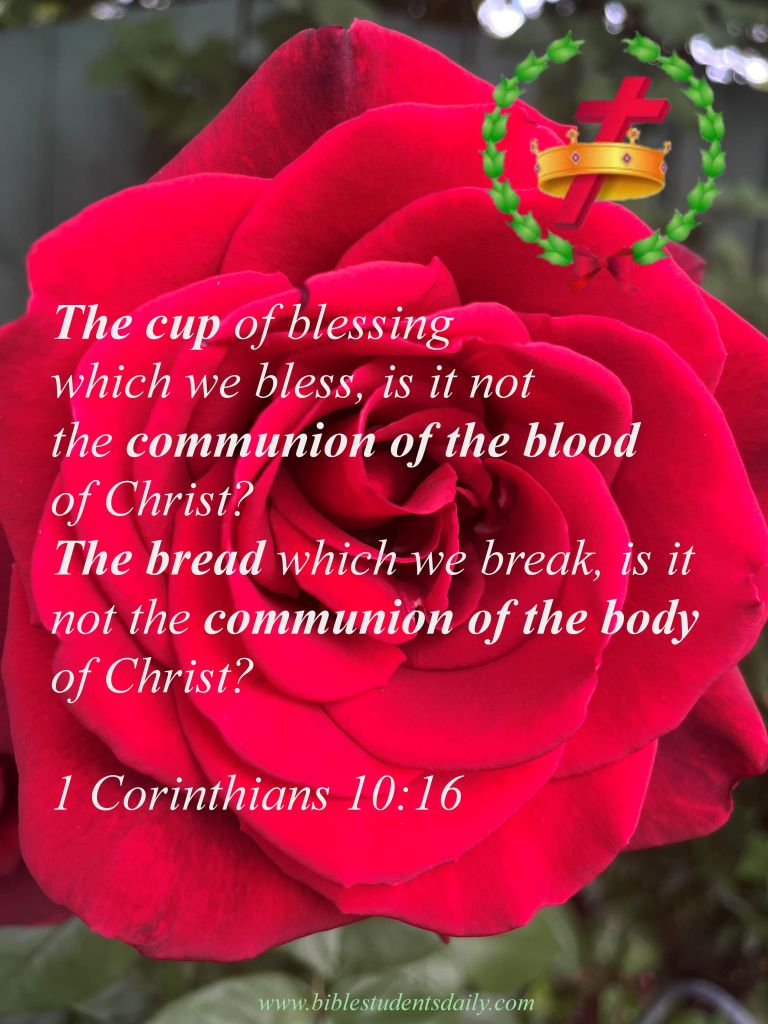
“The cup of blessing which we bless, is it not the communion of the blood of Christ? The bread which we break, is it not the communion of the body of Christ?” (1 Corinthians 10:16)

What does the Apostle Paul mean by the “communion of the blood and body of Christ”?

“You cannot drink the cup of the Lord and the cup of demons; you cannot partake of the Lord’s table and of the table of demons” (1 Corinthians 10:21).

In Chapter 10 of the first epistle to the Corinthian church, the Apostle Paul illuminates and puts in context his reference to our communion in partaking of the memorial emblems of the cup and bread.

What Pastor Charles Russell Taught

Pastor Charles Russell quoted 1 Corinthians 10:2 in The Reprints of the Original Watchtower and Herald of Christ’s Presence and taught that there was a secondary meaning to the bread and wine emblems: that the (1) “broken loaf” represents the breaking of all his mystical members” and “communion of the blood of Christ” means a “participation in the sufferings and death of Jesus.” R3364.

He based this teaching of a secondary meaning on the word “communion” in Corinthians 10:2 and that since the word “communion” comes from the ancient Greek word koinonia; which in its basic sense means a common union with someone in a shared experience, he thought that the shared experience is “the sufferings and death” and that the common union was with Jesus.

Let us now consider the 1 Corinthian Chapter 10 context, in order to understand the Apostle Paul’s teachings in this section, and thereby specifically examine whether this proposed secondary meaning is actually what the Apostle Paul was teaching or not.

The Context:

i) The Immediate Context: 1 Corinthians 10:1-22

The verses that define the immediate context for understanding the communion verse [16] are found in 1 Corinthians 10:1-22.

Moreover, brethren, I do not want you to be unaware that all our fathers were under the cloud, all passed through the sea” (1 Corinthians 10:1, NKJV).

δέ de; a primitive word; but, and, now

We notice that verse 1 uses the conjunction δέ, meaning but, and, now here, the NKJV translates δέ as “moreover.” This tells us that this section is also linked to what came before and therefore that there is a wider context to consider also.

ii) The Wider Context: It is Possible to Lose the Imperishable Crown

“… I have become all things to all men, that I might by all means save some” (1 Corinthians 9:22).

In the previous few Chapters in 1 Corinthians, the Apostle Paul outlines his determination to put nothing in the way of the Gospel and to be “all things to all men” in order to “save some.”

“And everyone who competes for the prize is temperate in all things. Now they do it to obtain a perishable crown, but we for an imperishable crown. 26 Therefore I run thus: not with uncertainty. Thus I fight: not as one who beats the air. 27 But I discipline my body and bring it into subjection, lest, when I have preached to others, I myself should become disqualified(1 Corinthians 9:25–27).

The paragraph immediately prior to Chapter 10, the Apostle Paul outlines the possibility that it is possible to be disqualified from gaining the imperishable crown if we do not run in the race with temperance and discipline, and therefore we can expect that what follows will be practical advice and warnings, as well as bringing to mind relevant aspects of our faith to give us strength and determination in order to gain the prize of that imperishable crown.

iii) The Immediate Context: Warnings Against the Conscious Pursuit of Evil Things

“Now these things became our examples, to the intent that we should not lust after evil things as they also lusted” (1 Corinthians 10:6).

The immediate context to the communion verse is that of the Apostle Paul’s warnings against the conscious pursuit of evil things because the end result of doing so is the loss of God’s favour and disqualification from the race for the prize of the high calling in Christ Jesus.

“No temptation has overtaken you except such as is common to man; but God is faithful, who will not allow you to be tempted beyond what you are able, but with the temptation will also make the way of escape, that you may be able to bear it” (1 Corinthians 10:13).

The Apostle Paul outlines that even though God will give us the means to escape these temptations, we have an important role in the matter; actively and consciously exercising temperance and discipline.

iii) The Apostle Uses Two Devices in His Warnings:

The Apostle Paul uses two didactic devices to highlight the danger and seriousness of consciously pursuing temptations: firstly, he uses the example of natural Israel during their wanderings in the desert; and secondly, he reminds us of the underlying meaning and significance of partaking of the cup and the bread at the memorial.

The Apostle Paul’s points and logic here have the purpose of ensuring that his fellow Christians are not disqualified from gaining the prize by pursuing evil things.

The Example of “Israel after the Flesh”

“Observe Israel after the flesh: Are not those who eat of the sacrifices partakers of the altar?” (1 Corinthians 10:18).

“Now all these things happened to them as examples, and they were written for our admonition, upon whom the ends of the ages have come” (1 Corinthians 10:11).

Here the Apostle Paul uses the experiences in the wilderness of natural Israel as a type to illustrate important lessons for spiritual Israel.

1) Idolatry,

2) Sexual immorality,

3) Testing of the Lord, and

4) Murmuring or complaining

The Apostle Paul specifically mentions four evil things “Israel after the flesh” engaged in:  idolatry, sexual immorality, testing of the Lord, and murmuring or complaining

“But with most of them God was not well pleased, for their bodies were scattered in the wilderness” (1 Corinthians 10:5).

Because of this, God was not pleased with them and their bodies He scattered in the wilderness. By outlining these experiences as examples for our instruction, Paul is warning that we face the same dangers – particularly if we become complacent; as he points out in 1 Corinthians 10:12 Therefore let him who thinks he stands take heed lest he fall.”

In the Apostle Paul’s references to “Israel after the flesh” here, he introduces the concept of natural Israel partaking of spiritual nourishment in the wilderness from God by way of our Lord Jesus Christ- for they all “drank of that spiritual Rock that followed them, and that Rock was Christ” (1 Corinthians 10:3-4).

“Our fathers ate the manna in the desert; as it is written, ‘He gave them bread from heaven to eat’” (John 6:31).

“Then Moses lifted his hand and struck the rock twice with his rod; and water came out abundantly, and the congregation and their animals drank” (Numbers 20:11).

God miraculously provided Israel with literal food and drink during their desert wanderings, but this is not what Paul is focusing on here. He is referring to spiritual food and drink.

The miraculous manna given to natural Israel was, of course, a great blessing but as Deuteronomy 8:3 tells us, it was intended to teach them the lesson that man lives – in the greater sense, by feeding on “every word that proceeds from the mouth of the Lord” – this is the real spiritual food. The word of God was imparted to them through Moses, so that they were guided and protected by God in their wanderings. God spoke to them through their covenant relationship, and through the many wonderful promises given to them, as well as their miraculous liberation from Egypt.

“They all ate the same spiritual food, and all drank the same spiritual drink…”(1 Corinthians 10: 3–4).

In this way, Israel after the flesh ate at the Lord’s table, for they all ate the same spiritual food and drank the same spiritual drink.

The Apostle Paul makes clear that it was all of natural Israel that ate at the Lord’s table and he mentions the all twice, probably to make this abundantly clear.

Crucially, we see that the benefits of the spiritual drink and the spiritual food flows from our Lord Jesus to all of the Israelites. It is clear that Jesus did not eat or drink this spiritual food or drink.

In summary: a commonality was established amongst the individual Israelites through all partaking of the same spiritual food and drink – the source of which was our Lord Jesus.

Paul is laying the ground work in his lead up to the important lesson that like Israel after the flesh, Israel after the spirit also eats and drinks at the table of the Lord – gaining far greater blessings but at the same time conferring important responsibilities.

All of Fleshly Israel Partakes, All of Spiritual Israel Partakes

“The cup of blessing which we bless, is it not the communion of the blood of Christ? The bread which we break, is it not the communion of the body of Christ?” (1 Corinthians 10:16)

In 1 Corinthians 10:16 the Apostle Paul reminds his fellow Christians that the literal partaking of the cup and bread is not a meaningless ritual. Rather, by partaking of the cup emblem we show that we are spiritually feeding on the blood of Jesus by gaining justification through faith. Also, by partaking of the bread emblem, we show that we are being spiritually nourished by appropriating the benefits of Jesus’ sacrificed body.

What Does Partaking of the Emblems (the cup and the bread) Show?

It shows that we are eating/drinking at the Table of the Lord with fellow believers; the communion, leading to eternal life.

“Whoever feeds on my flesh and drinks my blood has eternal life, and I will raise him up on the last day” (John 6:54).

i) Partaking of the Cup [drinking of the blood of Jesus] shows:

1) The New Covenant is Ratified and Operative for the Church by the Blood of Jesus, enabling:

– Learning of God

– Having God’s law written on our hearts

2) Believers have True Forgiveness of sins by faith through application of the blood of Jesus as the antitypical sin-offering under the administration of the better sacrifices

3) Believers are Reconciled to God [achieving atonement with God – from1)+2)]

4) Have Received The Promise of the holy spirit

5) Believers are Cleansed from ongoing inadvertent sin [purification through the antitypical ashes of the red heifer – depicted in Jesus washing of the disciples’ feet]

ii) Partaking of the Bread [eating of the flesh of Jesus] shows:

1) Believers Receive and Understand Jesus’ words of truth [through the holy spirit]

2) Have ongoing spiritual nutrition for spiritual growth of the new creature through the indwelling of the holy spirit given at baptism into Christ

– Growing in grace and knowledge

– Learning of God

– Having God’s law written on our hearts

“Then Jesus said to them, ‘Most assuredly, I say to you, unless you eat the flesh of the Son of Man and drink His blood, you have no life in you’” (John 6:53).

All of Jesus’ followers must eat his flesh and drink his blood.

The spiritual drink and spiritual food that we partake of leads to eternal life which is provided for us by the sacrifice of Jesus, by the grace of God.

** We notice in John 6:53 that Jesus is addressing his followers – unless you eat and drink, you have no life in you – plainly Jesus is not including himself here.

1 Corinthians 10:3–4 (NKJV) — all ate the same spiritual food, 4 and all drank the same spiritual drink. For they drank of that spiritual Rock that followed them, and that Rock was Christ.”

We notice again that the same relationship exists in spiritual Israel as it did in fleshly Israel. All the natural Israelites ate the spiritual food and drank the spiritual drink. There is no suggestion that Jesus somehow also ate and drank of the same spiritual food and drink as fleshly Israel.

“Then He took the cup, and gave thanks, and gave it to them, saying, “Drink from it, all of you” (Matthew 26:27).

Jesus did not say “let us all drink of it”, rather he said “drink from it, all of you.

Also, Jesus’ instructions were to do this “in remembrance of me not in remembrance of us.

“He who eats My flesh and drinks My blood abides in Me, and I in him. 57 As the living Father sent Me, and I live because of the Father, so he who feeds on Me will live because of Me. 58 This is the bread which came down from heaven—not as your fathers ate the manna, and are dead. He who eats this bread will live forever (John 6:56–58).

Israel after the flesh ate the manna, died

Spiritual Israel eat/drink of Jesus flesh/blood, live forever

Note how this parallels the type which emphasises its importance in understanding the communion relationship. The Apostle John, in John 6:58, beautifully links the type and the antitype for us: “This is the bread which came down from heaven—not as your fathers ate the manna, and are dead. He who eats this bread will live forever.”

“This is my blood of the covenant, which is poured out for many for the forgiveness of sins (Matthew 26:28).

“In the same way, after the supper he took the cup, saying, ‘This cup is the new covenant in my blood, which is poured out for you’” (Luke 22:20).

Jesus’ blood, through which we have forgiveness of sins, was poured out for us — that is for spiritual Israel. It is clear that Jesus could not eat of his flesh or drink his own blood as he was sinless and undefiled and hence did not require forgiveness. Moreover, if he had any sin, he would not have been able to provide life through his sacrifice. This shows the flow of the blessings of forgiveness of sins, from Jesus by virtue of his sacrificed flesh and poured out blood, is to us.

There is no indication that those feeding and drinking are contributing to the food and drink.

Sacrificial Nourishment for the Levites/Firstborn

“The priests, the Levites—all the tribe of Levi—shall have no part nor inheritance with Israel; they shall eat the offerings of the Lord made by fire, and His portion” (Deuteronomy 18:1).

Observe Israel after the flesh: Are not those who eat of the sacrifices partakers of the altar?”  (1 Corinthians 10:18).

The Apostle Paul then goes even further, and makes the illustration from the type even more specific in order to further illuminate the communion relationship and the significance of our partaking of the cup and bread memorial emblems. He does this by referring to the priests and Levites that did partake of the sacrifices from the altar in the tabernacle. The tribe of Levi had no inheritance in the Land of Israel and so they lived off the offerings made to the Lord. The offerings from the altar in the tabernacle were therefore their source of food.

This illustration is more specific to Christians and is introduced immediately after the communion verses to make clear the significance and nature of the communion relationship and he links the two situations by the word “observe.”

In the tabernacle picture, as with the firstborn of the Passover, the tribe of Levi represented the household of faith — which only has a heavenly inheritance. The tribe of Levi had no land of their own, picturing this heavenly inheritance of the Church of firstborns.

The priests and Levites ate of the sacrifices, indicating that they internalised the nutritional benefits to themselves. Again, there is no suggestion here that by eating of these sacrifices they were sharing in or contributing to the actual sacrifice. Rather, the benefit of the nutritional elements flowed in one direction and one direction only — from the altar to the priest or Levite. In the antitype this translates directly to the flow of spiritual benefits from the altar of God by way of Jesus’ sacrifice to the household of faith, which the Priests and Levites represented.

In this more specific typical picture, the Apostle Paul introduces the important principle that the altar from which the sacrificed food comes, identifies the source of the food. The priests and Levites ate of the sacrifices from the altar in the court of the tabernacle, thus identifying the source of the food as God.

Therefore, my beloved, flee from idolatry. 15 I speak as to wise men; judge for yourselves what I say. 16 The cup of blessing which we bless, is it not the communion of the blood of Christ? The bread which we break, is it not the communion of the body of Christ? 17 For we, though many, are one bread and one body; for we all partake of that one bread” (1 Corinthians 10:14–17).

The communion verses come immediately after the Apostle Paul’s admonition to flee from idolatry; which was a particular problem in the Corinthian church. The Corinthian church consisted of many Christians of Gentile background and these brethren were accustomed to eating food from the markets and in houses of unbelievers that had been sacrificed on pagan altars to pagan gods. The Apostle Paul’s aim here is to illustrate the dangers of continuing to eat these pagan sacrifices by pointing out the crucial significance of the altar from which the sacrifices come. Here he is teaching that those that partake of these sacrifices in the type, are commonly joined to one another by participating of the altar and what it represents, from which the sacrifice comes. In the same way, those that eat of pagan sacrifices are commonly joined by participating in eating from them.  

Partaking of pagan sacrifices means partaking of the table of demons.

“What am I saying then? That an idol is anything, or what is offered to idols is anything? 20 Rather, that the things which the Gentiles sacrifice they sacrifice to demons and not to God, and I do not want you to have fellowship with demons” (1 Corinthians 10:19–20).

Even though, as the Apostle Paul points out, idols are nothing in themselves, in reality the altar is demonic, so that by partaking of the pagan sacrifice, one is not only joining oneself in fellowship with those pagans that eat the sacrificed food, but is also partaking of the table of demons.

“You cannot drink the cup of the Lord and the cup of demons; you cannot partake of the Lord’s table and of the table of demons” (1 Corinthians 10:21).

And for a Christian to partake of the table of the Lord is incompatible with partaking of the table of demons.

Or do we provoke the Lord to jealousy? Are we stronger than He?” (1 Corinthians 10:22).

By partaking of these pagan sacrifices, Christians risk provoking the Lord to jealousy.

“You shall not bow down to them nor serve them. For I, the Lord your God, am a jealous God, …” (Exodus 20:5).

For our God is a jealous God and He will not tolerate other gods, for all other gods are no gods. So that the worship of anything but God is not only false but is also of Satan — for he is the great usurper, for he wanted to be as the Most High. Worship of anything else but God usurps the authority of God and displaces the true worship reserved only for God.

And this principle is embodied in the first and greatest commandment – “You shall love the Lord your God with all your heart, with all your soul, and with all your mind” (Matthew 22:37).

So, to summarize, it is evident that the food provided at these altars is not shared in the sense of being contributed to by the partaker. The flow of nutrition, whether typical or spiritual or idolatrous, flows from the altar to the recipient, for the benefit (or detriment) of the partaker.

The modern-day gods that we are in danger of worshipping tend to be more subtle and insidious.

“For many walk, of whom I have told you often, and now tell you even weeping, that they are the enemies of the cross of Christ: 19 whose end is destruction, whose god is their belly, and whose glory is in their shame— who set their mind on earthly things. 20 For our citizenship is in heaven, from which we also eagerly wait for the Savior, the Lord Jesus Christ…” (Philippians 3:18–20).

In our modern society we find people pursuing such things as knowledge, health, physical beauty, money, material things, status and respect. Even though most of these have benefits in moderation, when one is consumed by their pursuit it becomes a false god. Therefore, anything that takes our minds and desires from the heavenly things, anything that supplants the true and appropriate worship of our heavenly Father is a false god and amounts to idolatry when pursued to an excessive extent.

A particular danger for the household of faith is the supplanting, consciously or subconsciously, of the authority of the word of God with the words of any imperfect human being. Our faith must be based on the word of God, not on the words of a man. All teachings must be tested thoroughly against scripture.

KOINONIA

“The cup of blessing which we bless, is it not the communion (koinonia) of the blood of Christ? The bread which we break, is it not the communion (koinonia) of the body of Christ?” (1 Corinthians 10:16).

Koinonia is part of the koin- root word group which has the fundamental meaning of sharing in something (indicated by the genitive case) with someone (indicated by the dative case); or the simple cases may be replaced by a prepositional phrase.

“By which have been given to us exceedingly great and precious promises, that through these you may be partakers (koin-) of the divine nature (genitive case), having escaped the corruption that is in the world through lust” (2 Peter 1:4).

“Therefore, if there is any consolation in Christ, if any comfort of love, if any fellowship  (koin-) of the Spirit (genitive case), if any affection and mercy…” (Philippians 2:1).

Another example of the koin- root word group occurs in Philippians 2 verse 1. Paul is talking about the fellowship of the holy spirit – it is evident that each individual of the household of faith has a share in the holy spirit with all other believers. Spirit is in the genitive case indicating what they commonly share in. Importantly the sharing is in the holy spirit not with the holy spirit.

“And so also were James and John, the sons of Zebedee, who were partners (koin-) with Simon (dative case). And Jesus said to Simon, ‘Do not be afraid. From now on you will catch men.’” (Luke 5:10).

So, the word “koinonia” in 1 Corinthians 10:16 means that the household of faith share-the shared experience, in the drinking of the blood of Jesus and eating of his flesh with one another.

In our 1 Corinthians 10:14–22 context, we have the koin- root word used four times.

If drinking of the cup of the Lord meant sharing in the sufferings of the Lord, then those drinking of the cup of demons would have to mean sharing in the sufferings of demons — which evidently is not the case.

Here the Apostle Paul also uses the koin- root word with respect to the Levites being common sharers of the brazen altar and what it represents. Altar here is in the genitive case making clear what the Levites are participating in. It is clear from the actual type and the underlying grammar that the meaning of the koin- root word here does not mean a sharing with the altar and the sacrifices that come from it. The Levites did not contribute to the sacrifices or their suffering in any way — they ate of them and thereby benefitted from them.

By eating of the bread, and drinking of the cup introduced by Jesus at the memorial, we show that we are commonly – with one another, sharing in the eating of the flesh of Jesus and drinking of his blood. Thereby we receive the spiritual nutrition essential and indispensable for our salvation.

Although sharing in the sufferings and death of Jesus is clearly taught in the scriptures, Paul is not teaching this here in the communion verse.

“Is it Not”: Indicates a Reminder of Something Already Taught Not Something New

“The cup of blessing which we bless, is it not the communion of the blood of Christ? The bread which we break, is it not the communion of the body of Christ? 17 For we, though many, are one bread and one body; for we all partake of that one bread” (1 Corinthians 10:16–17).

That the Apostle Paul is bringing to mind something familiar rather than a new teaching [like a secondary meaning] is indicated by his use of the phrase “is it not”, twice in the communion verses.

Technically, “is it not” is a figure of speech referred to as “interrogation”; this occurs when a question is asked without waiting for the answer. There are different forms of interrogation and here it is called “interrogation in negative affirmation“; this occurs when the question is put in the negative, and the answer must be in the affirmative, and very emphatically so – indicating that the point made is or should be known already by those to whom the question is addressed.

Let us look at other instances of use of this figure of speech.

“Therefore, I say to you, do not worry about your life, what you will eat or what you will drink; nor about your body, what you will put on. Is not life more than food and the body more than clothing?” (Matthew 6:25).

We find it is used in Matthew 6:25 by Jesus to show that indeed life is more than food and the body more than clothing. The important point to glean here is that the “is not” did not introduce something they did not already know.

“So all bore witness to Him, and marveled at the gracious words which proceeded out of His mouth. And they said, ‘Is this not Joseph’s son?’” (Luke 4:22)

We find another example of this interrogative figure of speech in Luke 4 verse 22.  Because of the gracious words that proceeded out of Jesus’ mouth, the people assumed that he was a sage from a far-off land with new found wisdom, and yet the interrogation in negative affirmation “is not” emphasises the fact that Jesus and his family were well known to them.

Therefore, the use of this “is not” figure of speech suggests that the communion verses are a reminder or an emphasis of something that was clear and known, rather than introducing a new truth.

Partaking of the Memorial Emblems Shows That We are Eating and Drinking at the Table of the Lord.

The memorial truth that the Apostle Paul is reminding us of is that eating of the bread and the drinking of the cup emblems indicates that we are together figuratively partaking of the sacrificed body and shed blood of Jesus – and thereby we are eating and drinking at the table of the Lord.

Sharing in the Sufferings of Jesus an Important Teaching – But Not Shown in Partaking of the Memorial Emblems

Let us be clear that we are not saying that faithful followers of Jesus do not share in his sufferings and death – for this is taught clearly in the word of God. Philippians 3:10 is a case in point:

“that I may know Him and the power of His resurrection, and the fellowship of His sufferings, being conformed to His death…” (Philippians 3:10).

But this is not Paul’s teaching in his reference to our partaking of the memorial emblems in 1 Corinthians 10:16.

Fixing KJV 1 Corinthians 10:17

The Rendering of 1 Corinthians 10:17 in the KJV, NKJV and even the RVIC2016 is faulty.

“For we, though many, are one bread and one body; for we all partake of that one bread” (1 Corinthians 10:17, NKJV).

 104 seeing that we the many are one bread, one body: for we all partake.” (1 Corinthians 10:17, (RVIC2016).

When we read 1 Corinthians 10:17 in the KJV, NKJV and even the RVIC2016, we are left with the thought that by partaking of the bread emblem the followers of Jesus become that bread. Ostensibly this does not seem to make sense, but does seem to give credence to the thought that the Church becomes part of the sacrifice from which it benefits.

1 Corinthians 10:17 should read – seeing that there is one bread, we, who are many, are one body”

The Church is referred to as “one body” but never as “the/one bread.” Only Jesus is referred to as “the bread.”

The more modern translations, including the Diaglott, show that the greater number of modern translators overwhelmingly favour the alternate rendering – seeing that there is one bread, we, who are many, are one body. The“we” belongs with the many and one body, not the bread – for as the verse makes clear we are one body because we partake of that bread.

We Need to Keep Eating at the Table of the Lord in Order to Gain the Imperishable Crown

As followers of Jesus, we need to keep spiritually feeding on his flesh and drink his blood to continue to receive these incredibly gracious benefits during this age of darkness. We remind ourselves of these spiritual benefits flowing from God to us based on Jesus’ shed blood and sacrificed body, particularly at memorial time.

What a privilege it is to eat and drink at the table of the Lord; for it leads to eternal life. But doing so also carries all important responsibilities. We have to avoid all forms of idolatry, particularly the subtle forms, for truly we are on trial for life, now.

“Now the just shall live by faith; But if anyone draws back, My soul has no pleasure in him.” 39 But we are not of those who draw back to perdition, but of those who believe to the saving of the soul(Hebrews 10:38–39).

But if we are careful and listen to God’s word, for Jesus speaks to us through it, we will not be of those that draw back to destruction, but rather we will be of those that are faithful, temperate and disciplined, leading to eternal life – to the glory of our Heavenly Father.

“Thou preparest a table before me in the presence of mine enemies: Thou anointest my head with oil; my cup runneth over” (Psalm 23:5).

Amen.

“Until the Full Number of the Gentiles Has Come In”

Romans 11:25 reads: “I do not want you to be ignorant of this mystery, brothers and sisters, so that you may not be conceited: Israel has experienced a hardening in part until the full number of the Gentiles has come in…”

Many Bible Students believe this means that the Jews will open their hearts to God once the 144,000 Bride of Christ are complete beyond the vail, and have made their “calling and election sure” (2 Peter 1:10) and when the 1000-year Millennial Age begins. But then what about those of Jewish faith in the Gospel Age who have consecrate their lives to follow Jesus? Hence, can Romans 11:25 relate to the Gospel Age now and how?

“And so all Israel will be saved, as it is written: “The Deliverer will come out of Zion, And He will turn away ungodliness from Jacob” (Romans 11:26).

Moreover, the next verse refers to “all Israel” being saved. Much has been written about what these two verses mean.

Two Traditional Interpretations of “All Israel”

Traditionally there have been two views concerning what “all Israel” means.

The first interpretation says, with variations, that the Apostle Paul is speaking prophetically of a corporate salvation of the Jewish people (natural Israel) at the end of the Gospel age – this is sometimes called the Dispensational view and this was taught by Pastor Charles Russell.

The second interpretation, again with variations, says that the Apostle Paul is speaking of the salvation of all of God’s people of faith (spiritual Israel) during this Gospel age, whether they are of Jewish or Gentile background.

The first interpretation seems clearly incorrect, as it is based on a faulty understanding/translation of “kai hautos” in Romans 11:26 (discussed further below), moreover it is inconsistent with the immediate context of Romans Chapter 11 and the larger context of the unfolding lessons in the epistle of Romans.

The second interpretation seems closer to the correct view in that it pertains to the call of the faithful during the Gospel Age; which is consistent with the context, but is not fully correct as it does not explain the Apostle Paul’s immediate point and warning to the Roman Gentiles of their “conceit” (Romans 11:25). Also, it does not take into account the Apostle Paul’s aim of saving some (more) of his fellow Jews (Romans 11:14) who can be grafted back in again if they continue not in unbelief (Romans 11:23). The Roman Gentile believers became conceited as they thought all Jews were forever cast away from the call of God to be of the Abrahamic seed of blessing. Paul’s immediate argument is that this is not correct because they can be grafted back in again by God if they continue not in unbelief. The “blindness in part” of natural Israel (Romans 11:25) was not irrevocable, and some would be grafted back in so that “all” of the [believing] remnant of natural Israel would be saved.

“All Israel”

Here it is suggested that “all Israel” actually refers to the total remnant of believing natural Jews – the “fulness” of Israel (Romans 11:12). And this total remnant has two parts:

  1. The initial believing Jews (like the Apostles, and the other disciples) when the call was exclusive to natural Israel.

“God, having raised up his servant, sent him to you first, to bless you by turning every one of you from your wickedness” (Acts 3:26).

2. The later believing Jews that would be “provoked to jealousy” (Romans 11:14) once the “fullness” of the Gentiles believers came in, resulting in them being grafted back in again (Romans 11:23).

“if by any means I may provoke to jealousy those who are my flesh and save some of them” (Romans 11:14).

“And they also, if they do not continue in unbelief, will be grafted in, for God is able to graft them in again” (Romans 11:23).

It may seem odd to suggest that the “all” does not refer to all of natural Israel, but rather to all of Israel that find salvation through justification by faith in Jesus during the present Gospel Age – the remnant that the Apostle Paul talks about in Romans 9:27 and Romans 11:5.

“For if their rejection means the reconciliation of the world, what will their acceptance mean but life from the dead?” Romans 11:15

We note how this “all” of the believing remnant of Israel is consistent with the way the Apostle refers to the Gentile world in Romans 11:15, where he says “For if their [Israel as a nation] rejection means the reconciliation of the world” – clearly, he does not mean reconciliation of all Gentiles but only those of faith.

Both references to “Israel” in Romans 11:25-26 indicate natural Israel [although not all Israelites].

Romans 11:30–31 – “Just as (1) you were once disobedient to God but have now received mercy because of (2) their disobedience, 31 so they have now been disobedient in order that, by the mercy shown to you, (3) they too may now receive mercy.”

(1) = Gentile believers

(2) = natural Israel as a nation

(3) = the later part of the remnant of believing Jews

Romans 11:32 – “For God has consigned all to disobedience, that he may have mercy on all (Gentile believers and Jewish believers [initial + later]”).

Initially small number of Jews “came in” who believed first in Jesus and turned from their sins (Acts 3:26) – i.e. the Apostles, and the other disciples when the call was exclusive to natural Israel. Then, when the nation of Israel as a whole rejected Jesus and the call went to the Gentiles, the “fullness” of Gentiles came in. Once the “fullness” of Gentiles came in (and were grafted in) more natural Jews were “provoked to jealousy” and come to believe in Jesus and were thereby grafted back in again, and also be saved.

Important considerations:

In order to explain Romans 11:25-26 correctly and coherently, it seems important to consider the following:

i) The Apostle Paul’s immediate points concerning the “conceit” of some of the Gentile brethren in the Roman church (Romans 11:25).

In Romans 11:25 the Apostle Paul says that they [the Roman brethren – largely Gentile believers] should not be conceited [“wise in your own opinion”] and be not ignorant of this mystery [something previously unknown or hidden] viz blindness (unbelief) has happened in part to natural Israel until the “fullness” of the Gentiles come in, then by implication the rest of the believing remnant would have its blindness lifted [having been provoked to jealousy] resulting in Israel’s “fulness” (Romans 11:12) of the Abrahamic promise [like the fulness of the Gentiles in Romans 11:25].

ii) The Apostle Paul’s immediate aim to save some (more) of his fellow Jews (Romans 11:14) by “provoked them to jealousy” (Romans 11:11,14) and being grafted back into the Abrahamic Olive tree of promise (Romans 11:23).

iii) The immediate context of Romans Chapter 11.

The immediately preceding verses tell us how unbelieving Jews were broken off from the Israelite Abrahamic olive tree of promise and believing wild olive (Gentile) branches were grafted in. But the Apostle Paul’s main point is that the engrafted Gentile branches should not “boast” (Romans 11:18) and not to be “haughty” (Romans 11:20) because if the broken off natural branches (unbelieving Jews) continue not in unbelief they can be grafted back in again by God (Romans 11:23.) This is a continuation of the Apostle’s main aim stated in Romans11:11,14; that despite his commission to the Gentiles, he is seeking by any means to “provoke to jealousy” his fellow Jews and save some [more] of them.

iv) The wider context of the Apostle Paul’s logical and unfolding message in the epistle of Romans:

Especially that the inheritance of the eagerly sought Abrahamic promise [to be his seed that will bless all the families of the earth] is based solely on faith in Jesus – whether of Jewish background or Gentile background (Romans 4:16).

v) The underlying ancient Greek:

26 καὶ οὕτως πᾶς Ἰσραὴλ σωθήσεται, καθὼς γέγραπται… NA27

“kai hautos” at the beginning of Romans 11:26 does not mean “and then” in terms of time; it means “in this way.” Unfortunately, “kai hautos” has been mistranslated in Wilson’s Diaglott [which Pastor Russell based his understanding on] as “and then”  – and this mistranslation suggests that something new in time happens after the call of the seed is complete – it does not.

“In this way” all Israel (the initial and later parts of the believing remnant of natural Israel) would be saved – meaning that more natural Jews would come to believe, having been “provoked to jealousy” by faithful Gentiles and be grafted back into the Abrahamic olive tree of promise [the seed].

“kai hautos” – “In this way” refers to what Paul has said before, in verse 25. And therefore, what is said in Romans 11:25 shows how all Israel (the whole believing remnant of natural Israel – the initial and the later parts = the fulness of Israel [Romans 11:12]) gains salvation.

This explains the Apostle Paul’s warning of conceit to the Roman Gentile brethren in Romans 11:25 – some more Jews would be provoked to jealousy and believe and thereby be grafted back in. Just as God showed mercy to the Gentiles through Israel’s disobedience, mercy would be shown to Israel thereby there would be a “fulness of Israel” (Romans 11:12) also.

What Does “The Deliverer will Come out of Zion, and Banish Ungodliness from Jacob” Mean and When Did This Begin?

“And so all Israel will be saved, as it is written: “The Deliverer will come out of Zion, And He will turn away ungodliness from Jacob” (Romans 11:26).  

In Romans 11:26, the Apostle Paul refers to a prophetic quote to substantiate his point. He quotes from Isaiah 59:20, 21

“‘The Redeemer will come to Zion, And to those who turn from transgression in Jacob,’ Says the Lord” (Isaiah 59:20).

We note that the Isaiah verse says the Deliverer will come to Zion, not from Zion as in Romans 11:26. This means that the Apostle Paul has changed it – and probably for good reason.

“To you first, God, having raised up His Servant Jesus, sent Him to bless you, in turning away every one of you from your iniquities” (Acts 3:26).

“’The Redeemer will come to Zion, to those in Jacob who repent of their sins,’ declares the LORD” (Isaiah 59:20).

Also, Isaiah 59 gives us more information about what “banishing ungodliness from Jacob” actually means – the Deliverer comes to those (of Jacob – natural Israel) that turn from their transgression (sins). Now we outlined above (in the Acts 3 verses) that there were only a few [the initial part of the believing remnant] Jews who believed and turned away from their sins, and when they did, they had their sins forgiven. This all began to occur at and shortly after Pentecost not at the end of the Gospel Age.

That it is talking about the initial part of the believing remnant of natural Israel is shown in Acts 3 when it says “to you first” i.e. before the call went to the Gentiles – before the later part of the believing remnant of natural Israel would be provoked to jealousy and believe in Jesus.

Also, this time point tells us why the Apostle Paul changed the quote to “the Deliverer shall come from Zion” rather than to Zion,” as in Isaiah 59:20. And this is because in a typical way, Jesus had already come to Zion. When he came to Jerusalem on a foal triumphantly and hailed as king, the first thing he did was to go to the temple (which was situated on Mt Zion in Jerusalem) and overturned the money changers table – which showed in a literal way that he had already come to Zion and began the process of banishing ungodliness from Jacob, so that now [when the Apostle Paul was writing] after having come to Zion he came from Zion to (after His sacrifice) give to those few believing Jews that turned from the sins permanent and true forgiveness of sins.

“4 As you come to him, a living stone rejected by men but in the sight of God chosen and precious, 5 you yourselves like living stones are being built up as a spiritual house, to be a holy priesthood, to offer spiritual sacrifices acceptable to God through Jesus Christ. For it stands in Scripture: “Behold, I am laying in Zion a stone, a cornerstone chosen and precious, and whoever believes in him will not be put to shame” (1 Peter 2:4–6).

“God, having raised up his servant, sent him to you first, to bless you by turning every one of you from your wickedness” (Acts 3:26)

That Jesus came to Zion and laid the cornerstone on which the Church (the temple of God) would be built, occurred at his first Advent is made clear in 1 Peter 2: 4-6. The Church is being built now during the Gospel age. When Jesus laid that cornerstone, he was able to then first go to the house of Israel and begin banishing ungodliness from Jacob (the initial part of the remnant) Romans 11:26, Acts 3:26.

All of the (Natural) Israelite Remnant

“Isaiah cries out concerning Israel: ‘Though the number of the Israelites be like the sand by the sea, only the remnant will be saved’” (Romans 9:27).

That “all Israel” refers to all the remnant of natural Israel should not come as a surprise, for in Romans 9:27 the Apostle Paul has made it clear that only a remnant of Israel would be saved.

“Again I ask: Did they stumble so as to fall beyond recovery? Not at all! Rather, because of their transgression, salvation has come to the Gentiles to make Israel envious”  (Romans 11:11).

This “restricted” sense of the salvation of all of the natural Israel remnant also should not be surprising, since this is the same sense used in regards to the Apostle’s phrase “salvation has come to the Gentiles” in Romans 11:11. Salvation did not come to all Gentiles – only to some, and only to those of faith. Moreover, in the same verse it is very likely that not all Israel became envious — again suggesting that “to make Israel envious” means “to make some of Israel envious”.

Another reason for believing that “all Israel” means “all” of the [believing] remnant of natural Israel is that the Old Testament promise in Isaiah 59:20 in regards to the deliverer banishing ungodliness from Jacob, was made to natural Israel. The context of the promise in Isaiah suggests that we would expect a fulfilment in regards to natural Israel. These verses pointed to a time when ungodliness would be banished from natural Israel despite their stubbornness and faithlessness to God. But the added information from the Isaiah verse shows the Deliverer would only come to those that “repent of their sins.” Importantly this already occurred at the first advent of Jesus. Moreover, this suggests that the “all Israel” will be restricted to those that “repent of their sins (Isaiah 59:20).

“This is he who was spoken of through the prophet Isaiah: A voice of one calling in the wilderness, ‘Prepare the way for the Lord, make straight paths for him’”  (Matthew 3:3).

John the Baptist prepared the way for the Lord, he preached a Baptism of repentance from sins and thus made it easier for Jesus to identify those ready for faith in him. Importantly it is restricted to only those of natural Israel that repented of their sins and were therefore ready for faith in Jesus.

“For this reason Christ is the mediator of a new covenant, that those who are called may receive the promised eternal inheritance—now that he has died as a ransom to set them free from the sins committed under the first covenant.” Hebrews 9:15

This was a work which started at the beginning of the Gospel Age not at its end. Those of the remnant of Israel were set on the path to life by faith in Jesus. Only through deliverance from Adamic sins could they become the promised children of Abraham and inherit the eternal promise and eternal life. Through this new arrangement faithful Jews were able to be set free from the sins made manifest by the previous law covenant.

“If you belong to Christ, then you are Abraham’s seed, and heirs according to the promise” (Galatians 3:29).

For it is only those that belong to Christ that are the true seed of Abraham and heirs according to the promise (Galatians 3:29).

“You are sons of the prophets, and of the covenant which God made with our fathers, saying to Abraham, ‘And in your seed all the families of the earth shall be blessed.’ 26 To you first, God, having raised up His Servant Jesus, sent Him to bless you, in turning away every one of you from your iniquities.” Acts 3:25,26

In the same way the promise of the seed which would “bless all the families of the earth (Genesis 28:14)” had its first [partial] fulfilment at the first advent. Here the seed was Jesus. He was sent first to the house of Israel to bless them by turning them from their sins.

Subsequently, the blessing, in this restrictive sense went to the Gentiles, i.e. the rest of the nations of the earth. But again, we note that every person was not blessed – only those that turned from sin and looked to Jesus by faith would be blessed.

“If you belong to Christ, then you are Abraham’s seed, and heirs according to the promise” (Galatians 3:29).

But the ultimate [full] fulfilment, with which we are most familiar, will occur in the Millennium Age – the 1000-year Kingdom of God. Here the seed will be Jesus and his 144,000 body members. Note that this is not an extension of the same fulfilment. In the first, Jesus is the seed that blesses the prospective body members. These in turn with Jesus become the seed that will bless all the nations in the kingdom – making it a separate fulfilment.

We also note that because of the grammatical structure in relation to houtos and kathos, “all Israel will be saved” is correlative to “The deliverer will come from Zion; he will turn godlessness away from Jacob.” This means the “salvation of all Israel” occurs because the Deliverer shall banish ungodliness. The Deliverer banishing of ungodliness to those that repent of their sins in Jacob, makes clear that “all Israel will be saved” and it means deliverance from Adamic sin and eternal life rather than just a lifting of blindness, and this began to be fulfilled at the beginning of the Gospel Age, not when it ends.

Amen.

This post’s URL is: https://biblestudentsdaily.com/2024/11/18/until-the-full-number-of-the-gentiles-has-come-in/

All For Jesus – Hymns of Dawn No. 8

All For Jesus – Hymns of Dawn No. 8

Bible Scriptures Associated With This Hymn

Romans 12:1-2 (KJV)

“(1) I appeal to you therefore, brothers, by the mercies of God, to present your bodies as a living sacrifice, holy and acceptable to God, which is your spiritual worship. (2) Do not be conformed to this world, but be transformed by the renewal of your mind, that by testing you may discern what is the will of God, what is good and acceptable and perfect” (Romans 12:1, 2, ESV).

1 Corinthians 6:20 (KJV)

“For you were bought with a price. So glorify God in your body” (1 Corinthians 6:20, ESV).

Philippians 3:7-11 (KJV)

“(7) But whatever gain I had, I counted as loss for the sake of Christ. (8) Indeed, I count everything as loss because of the surpassing worth of knowing Christ Jesus my Lord. For his sake I have suffered the loss of all things and count them as rubbish, in order that I may gain Christ (9) and be found in him, not having a righteousness of my own that comes from the law, but that which comes through faith in Christ, the righteousness from God that depends on faith— (10) that I may know him and the power of his resurrection, and may share his sufferings, becoming like him in his death, (11) that by any means possible I may attain the resurrection from the dead (Philippians 3:7-11, ESV).

*******

There are many names and titles of Jesus found in the Bible, and each of them contains a description or illustration of his life and work. Here is a post which examines some of those names in order to gain the lessons found in the deeper meanings in Jesus’ name: JESUS — The Namehttps://biblestudentsdaily.com/2017/07/05/jesus-the-name/

Jesus is the world’s ransom — The following two references explain how and why:

(1) Who is the World’s Ransom and Why — https://biblestudentsdaily.com/2016/03/29/who-is-the-worlds-ransom-and-why/

(2) The Ransom” —
http://www.2043ad.com/journal/2007/02_ma_07.pdf%5D in Faithbuilders Fellowship (“Journal” section) March-April 2007.

Here is some brief content from the latter referenced article above (“The Ransom”) concerning the two applications of Christ’s blood:

1.  The first application — is for the consecrated class, those who accept Christ now, and accept Jesus’ invitation to self-denial and cross bearing (Hebrews 9:24).

2. The second application — the one for all the remainder of Israel, shows that after this age for the consecrated, another age of redemption follows. This will be for the remainder of the world those who will be blessed by the saints when, as a class, they are complete in glory with Christ.

Now we see that Jesus’ death, by itself, did not automatically bring release from the curse. Jesus was raised from the dead with the value of the Ransom price he provided, and by God’s design Jesus himself is the one who applies the value of the Ransom. He applies it first to us who consecrate our lives now, and later to the world during the Millennium. Jesus died for our offences to provide the Ransom value and was raised again for our justification to apply the Ransom (Romans 4:25).

********

HOSEA-13-14

Lyrics

1.
All for Jesus! all for Jesus!
All my being’s ransomed pow’rs;
All my thoughts and words and doings,
All my days and all my hours.
All for Jesus! all for Jesus!
All my days and all my hours.

2.
Let my hands perform his bidding;
Let my feet run in his ways;
Let my eyes see Jesus only;
Let my lips speak forth his praise.
All for Jesus! all for Jesus!
Let my lips speak forth his praise.

3.
Since my eyes were fixed on Jesus,
I’ve lost sight of all beside—
So enchained my spirit’s vision,
Looking at the crucified.
All for Jesus! all for Jesus!
All for Jesus crucified.

The History Of This Hymn

Author – Mary D. James (1810-1883)

MARY-D-JAMES-ALL-FOR-JESUS

When Mary D. James was 13 years old, she began teaching Sunday school in the Methodist Episcopal church. She became a prominent figure in the Wesleyan Holiness movement, assisting Phoebe Palmer, and often leading meetings at Ocean Grove, New Jersey, and elsewhere. She wrote about 50 hymns, and articles by her appeared in various journals and newspapers.


Composer – Asa Hull (1828 – ?)

Asa-Hull-All-For-Jesus-All-For-Jesus

As of 1895, Hull was a music publisher in New York City; his company was still operating as of 1910.

Suggested Further Reading

Here are some free online articles in relation to the Heavenly Father—Jehovah and his Son—Christ Jesus—“a ransom FOR ALL… to be testified in due time” (1 Timothy 2:6), as well as, about the holy Spirit (the understanding of God) with clear explanations about why the anti-Christ teaching of “the trinity”—introduced by the Roman Catholic Church system (the “Beast” in the Book of Revelation) is not what the Bible teaches. The Bible Students Movement does not support the teaching of purgatory nor does it support the Roman Catholic System’s teaching about people being sent to a place where they burning up forever which certainly does not reflect the perfect love of God — the Almighty Creator of all things.

For the interested Reader, we urge you to consider the following articles and posts:

The Doctrine of the Trinity – Mystery or Confusion by Br. David Rice.
http://www.heraldmag.org/1999/99nd_3.htm

The Origin of the Trinity – From Paganism To Constantine by Sr. Cher-El L. Hagensick.
http://www.heraldmag.org/olb/Contents/doctrine/The%20Origin%20of%20the%20Trinity.htm

Facts About the Trinity
http://www.heraldmag.org/olb/contents/doctrine/FACTS%20ABOUT%20THE%20TRINITY.htm

God and the Trinities
http://www.heraldmag.org/literature/doc_42.htm

Development of the “Trinity Doctrine” by Br. Tom Gilbert.
http://www.beautiesofthetruth.org/Archive/Library/Doctrine/Mags/Bot/90s/2010d.pdf

Understanding John 1:1 by Br. Richard Doctor.
http://www.beautiesofthetruth.org/Archive/Library/Doctrine/Mags/Bot/90s/2010d.pdf

Father, Son and Holy Spirit
https://biblestudentsdaily.com/2016/06/23/father-son-and-holy-spirit/

What Is the Heavenly Father’s Name
https://biblestudentsdaily.com/2017/06/27/gods-name-what-is-the-heavenly-fathers-name-that-we-are-to-hallow-and-why/

Jesus – The Name
https://biblestudentsdaily.com/2017/07/05/jesus-the-name/

The Doctrine of Christ – Booklet
http://www.biblestudents.com/docs/DoctrineChrist.pdf

Hymn Book Purchase

The Hymns Of Dawn (hymn book) can be purchased at:

The Chicago Bible Students Online Bookstore: https://chicagobible.org/product-category/books/page/4/
The Dawn Bible Students Association: http://www.dawnbible.com/dawnpub.htm

Acknowledgment & References

  • Br. Charles Taze Russell (1852-1916)

2.jpg

Br. Charles Russell — the founder of the Bible Students movement, who is the compiler of “Poems and Hymns of Millennial Dawn.”  With the assistance of Maria Frances Russell (1850 – 1938) — the former Maria Frances Ackley (whom Russell had married in 1879) — this Bible Students’ devotional was published in Allegheny, Pennsylvania (USA) in 1890. It originally contained a total of 151 poems and 333 hymns.


POEMS-AND-HYMNS-OF-MILLENNIAL-DAWN

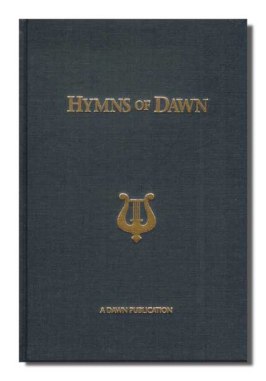
Later on, the hymns from this book formed a basis for the hymnal titled “Hymns of Dawn” which was published by the Dawn Bible Students Association in East Rutherford, New Jersey (USA) and the 1999 edition contains a total of 361 hymns.
Hymns of Dawn.jpg

  •  Br. David Rice — For the article “The Ransom.” Faithbuilders Fellowship (“Journal” section) March-April 2007. http://www.2043ad.com/journal/2007/02_ma_07.pdf
  • “Hymnary.org” and “Wikipedia” — hymn history content.

——-

Links and Bible Resources. BIBLE Students DAILY.
https://biblestudentsdaily.com/category/links/

Beliefs. Bible Students DAILY.
https://biblestudentsdaily.com/category/beliefs/


The URL of this post:
https://biblestudentsdaily.com/2017/11/19/all-for-jesus-hymns-of-dawn-no-8/

Enter your email address to subscribe to this blog and receive notifications of new posts by email.

Tears of Joy – A Thanksgiving Offering To God

(7) In the days of his flesh, Jesus offered up prayers and supplications, with loud cries and tears, to him who was able to save him from death, and he was heard because of his reverence. (8) Although he was a son, he learned obedience through what he suffered. (9) And being made perfect, he became the source of eternal salvation to all who obey him, 10 being designated by God a high priest after the order of Melchizedek” (Hebrews 5:7-9, ESV).

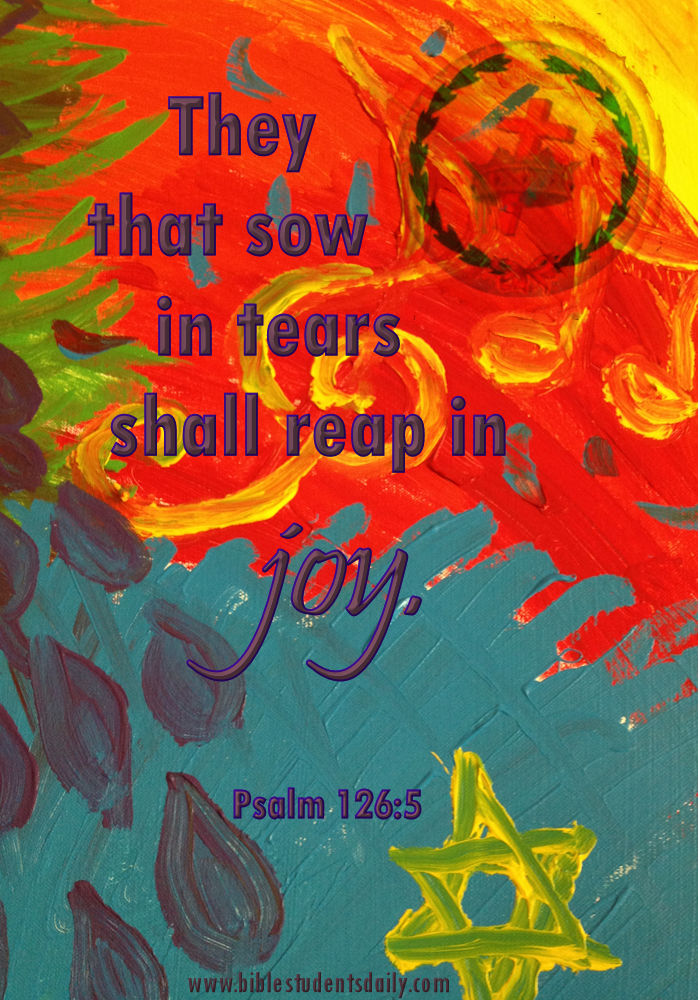
psalm-126-5-biblestudentsdaily2.jpg

Beloved Brethren, dear friends:

This testimony sonnet is for you written,
For praise to God, through Christ who was smitten,
To comfort those mourning for righteousness sake—
Suffer for Christ, your election sure to make!

Some still remain who need to hear,
For ’tis not too late with Christ to share.
With fortitude and strength divine from above,
Present on the altar every labour of love.

Let us, begotten of Him, overcome the world,
Layer upon layer of character, impearled.
Should this cause many a tear to flow,
It will be mingled with Christ-like joys, we know.

Often, when the head is bowed low,
And tears in anguish like a waterfall flow,
With no courage in self, nothing good within,
“Depend on God for mercy and grace,” we sing.

Dead to the world, we feed the New Mind,
Sharing God’s precious Truth with various kind.
Could we keep the promises of the glorious Word,
Only for self? Letting God’s Plan be unheard?

As we trumpet Christ’s Millennium soon to come,
As ambassadors, sharing the hope now to some,
Opposing us the world, flesh, and devil, these three,
From these tempters let our conduct be free.

If told to stop sharing the Kingdom to come,
Booklets or tracts dust-binned by some,
Rejoice, dear pilgrim, keep carrying your cross,
Even if those served count your words as but dross.

Why should we flee, terrified of man, when reviled?
Is not this a test for those reconciled?
All previous instruction through God’s Holy Scriptures,
Helps us in such moments to be counted as victors!

Are not these trials the opportunities prayed for,
Without them, what testimony of sonship, and more?
The answer may follow through unbidden tears.
How God’s mercy does strengthen us through these carnal years.

Are not tribulations what our Lord has forewarned?
It would cost, the consecrated, all that we owned!
To be worthy of belonging to Christ alone,
Means sharing his sufferings, to the world unknown.

God understands the sum of your tears perfectly,
Each drop in a jar labelled “shame,” mournfully,
Others fallen to one labelled “ridicule and scorn,”
But Christ’s name on our foreheads, will forever be worn!

Those who sow in tears for righteousness now,
Shall reap fullness of joy when fulfilled is our vow.
When, later, the Truth floods each heart and mind,
Then your clay jar of tears, will Christ to them remind.

If your tears have been your meat, both day and night,
Rejoice in afflictions, walking in Christ’s light.
They prepare you for glory beyond all comparison,
Patiently accept them, kindly, like a good Samaritan.

As we continue for Jesus, representing his cause,
Man cannot stop us declaring, even through closed doors.
As martyred for Truth’s sake were the apostles, but John,
Through tears may your trumpeting “ALL FOR JESUS” go on!

Put your trust in Jehovah to overcome all fears,
Our Master in Gethsemane, offered loud cries and tears!
Jesus was heard for his reverence, by One above who all sees,
Things misinterpreted by man — so please be at ease.

It is our Heavenly Father whom we are to please,
If dimly considered by even friends, and trustees,
Job’s friends gave him scorn, while he “poureth out … unto God,”
So you, put your confidence, in the power of His rod.

Aaron’s rod reminds us, antitypical under-priests,
Of our privilege of service, which our heavenly joys increase.
Be productive, put on the fruits of Christ-likeness,
To become heavenly “stars” in Christ’s brightness.

Recognizing in each experience a divine appointment,
Changing from glory to glory since our sanctified anointment.
Each labour to deaden all of self-will,
Leads the heaven-bound follower, God’s will to fulfil.

Now hidden in a jar, our tears soon will be no more,
When in glory and immortal, we are united with Christ.
When the Day of Sacrifice soon is complete,
Beyond the vail then gathered, all the Gospel’s true wheat.

Whom they once pierced, Israel shall finally recognize,
Accepting Christ as Messiah, no more false surmise,
Tears then of joy will stream down their face,
For God’s Spirit shall be poured upon all by His grace.

Then God shall wipe away tears from all eyes,
No longer Adamic sin will cause all to die.
With minds then brightened with Godly righteousness,
Mankind will learn, and then show, their own faithfulness.

When tears shall turn into JOY FOR ALL,
Then tears no more shall ever again fall.
Jehovah’s Universe shall eternally stand,
God’s glory will then forever expand!

*******

The below words are from “Pilgrim Echoes” (page 326-328) by Br. Benjamin Barton:

Blessed are they that mourn; for they shall be comforted.” Jesus did not mean, Blessed are those that mourn from the worldly standpoint, any more than he meant, Blessed are those that are poor in spirit from a worldly standpoint. There are two ways of being poor in spirit; there is the world’s way and God’s way. For instance, somebody mistreats you and you do not stand up for your rights; the world says, That man is poor in spirit. But Jesus did not mean it that way. And so the same way with this word “mourning.”

Our Redeemer did not mean, Blessed are those that mourn because they cannot own a finer house. Blessed are those who mourn because they cannot buy an automobile. Blessed are those who mourn because they cannot buy the diamond they saw in the jeweler’s window. Blessed are they that mourn because their head aches so badly. No, no, He meant, blessed are those who mourned like He mourned. How different His mourning was from that of other people.

There was something so unselfish about His mourning. You remember when He went to the tomb of Lazarus it was not for himself He was weeping. When He wept over Jerusalem He was not mourning for himself but for them. He wept as He thought how unwilling they were to praise and glorify God as they should, and what they were bringing on themselves because of their disobedience.

Then there was another occasion when He mourned in the garden of Gethsemane. You remember His tears, His strong crying. There again there was something unselfish; it was not because He had to die that He wept; He came into the world for that very purpose. He wept because of that cup He was drinking then. What was that? The cup of expectation of death? No. The Lord Jesus was so desirous that the Father should be pleased in every little point, and He realized that His ability to accomplish the work the Father entrusted to Him, the redemption of the race, depended upon His actual perfection; He realized there was no advocate to make up for His deficiencies; and it was along this line He mourned. There was nothing selfish about it.

So we way, Blessed are we if we mourn like Jesus mourned, if our mourning is unselfish. Do you mourn because you want the Lord glorified to a larger degree than people seem to want you to glorify Him? Do you mourn because you want more of the joy and peace which comes from a closer acquaintance with God and a better understanding of His Plan? Oh, that is the right mourning!

I remember a good brother in the northeast said this to me a year or so ago: Many years ago I lost a child and I thought I never would

PE327 get over it. I cried and cried until I thought I would not have any sight left; and when it was all over I made up my mind I would never cry again. Another child died, but I did not weep. My wife died but I never cried. I had a great deal of trouble on various lines and I have always been able to restrain my feelings so it was not shown outwardly. But, he said, I go to bed at night and as I think of all my weaknesses and imperfections and my inability to serve God better that I do, I cry and cry until the pillow is wet with my tears.

Oh, that was mourning like Jesus wanted us to mourn. That is the right kind of mourning. That is more in imitation of Jesus. If you mourn because you say so many things you don’t want to say, you mourn like Him. If you mourn because your hands do so many things you do not want them to do, you mourn like Jesus. If you mourn because your feet go so many places you don’t want them to go, you are mourning like Jesus. That is the way with Him. He mourned as His tongue and lips said so many things He did not want them to say.

He mourned as His hands would engage in so many works He did not want them to do. He mourned as His feet would go so many places He did not want them to go. Yes, dear friends, Jesus was continually mourning because of those things.

Why, you say, that astounds me! Do you mean to tell me that Jesus was imperfect? I thought He was perfect, I thought He was holy, harmless, undefiled, and separate from sinners. I thought He never did anything wrong, and now you say His lips said so many things they ought not to have said, and His hands did so many things they ought not to have done, and His feet went so many places they ought not to have gone. Is that really so? Yes, friends, it is so. But Jesus was perfect in spite of all this. He was holy, harmless, undefiled, separate from sinners. He never sinned.

Then how do you account for that seemingly inconsistent statement you have made?

Well, here it is. You know we have trouble with our lips, hands and feet, but in our case it is with our physical members in this physical body. Jesus did not have any trouble with the physical members in His physical body, but it was with His spiritual members in His mystical body. These were the members that gave Him trouble. You remember that while the Body of Christ was not organized in a certain sense until the day of Pentecost, yet in a rather preparatory sense we might speak of the apostles as composing the Body of Christ during even our Lord’s lifetime. How much these members of His Body tried the Lord Jesus! You and I have only one tongue to give us trouble, and He used to have twelve tongues that gave him trouble. There was James’, and then Peter’s,

PE328 and Judas’, and then Andrew’s tongue—Oh, how much trouble He had with His twelve tongues! It is bad enough for us to have the one. We know how much trouble it gives us. I have sometimes thought of a verse that says, “O, for a thousand tongues, to sing my great Redeemer’s praise.!” I am so thankful in God’s providence He has not inflicted a thousand tongues on me; yet if they would all sing my great Redeemer’s praise it would be all right. I would not mind it; but I am afraid that while about three of them would be singing the praise, the other nine hundred and ninety-seven would be in some kind of mischief. But we see Jesus had twelve tongues to give Him trouble, and those twelve pairs of hands that would not always do His will, and those twelve pairs of feet that wandered so frequently.

Think what that must have meant to Him. You see in a certain sense He had a similar experience to ours, only with Him it was with members of His mystical body.

But we see this must be the character of our mourning. How are we mourning? Look back over your life. You made a consecration of yourself to the Lord and what worries you to the largest degree? Is it because you are not able to buy that new piece of furniture? Or is it because you cannot be more patient under the test? Are you troubled to a larger degree because you are not able to do financially what some other people can do from the worldly standpoint? Or is your greatest trouble because you want to glorify God better? If you can answer that and say, I know it is a thousand times easier for me to bear the ordinary trials of life from a natural standpoint, it is a thousand time easier for me to miss a natural meal than to have to miss a spiritual meal; it is a great deal easier for me to be deprived of some little worldly advantage than some spiritual advantage, then you have another one of the marks of the Lord Jesus, another one of the evidences that you are one of His bond slaves. “Blessed are they that mourn.”


Here is an extract from an article titled “The Power of the Gospel of Christ” in The Herald of Christ’s Kingdom Magazine June 1927 :-

St. Paul’s Tears of Joy and Sadness

O, how the Apostle bore the burden of the Church’s peace and tranquillity upon his heart as he languished in dungeon dampness, or spent the days in weary toil, making tents that he might continue spending and being spent in the service of the Church he loved so intensely, until he had been literally poured out as an offering on the sacrificial altar of devotion to them! And how sympathetically we may enter into his disappointments and anxieties as again and again he is reminded of the immaturity, carnality and contentiousness of so many for whom he would willingly die, as we see those burning tears of affection blinding his afflicted eyes as he laboriously pens his fervent entreaties to these bickering, factional brethren! Our tears must flow in unison with his and for the same reason that today as in his day the unity of the faith is so often marred or disrupted by the same things.

But there were bright and happy experiences mingled with St. Paul’s frequent  disappointments, oases in the way, where the seeds of truth had fallen and germinated, producing the luxuriant greenness that shone out in pleasing contrast to all the barrenness around, where the Gospel of Christ had been permitted to exercise its grace and power and make manifest its sanctifying, ennobling, maturing effects. If in writing to the Corinthians he must reprove and lament and deplore much of what he found there, not so in writing to the Thessalonian brethren. To these dear brethren he could write with the strains of our text as a sweet melody in his heart, “I am not ashamed of the Gospel of Christ; for it is the power of God unto salvation to every one that believeth.” He could point to these faithful brethren who had always been loyal, responsive, and reciprocative as a living testimony of the Gospel’s fruitage. We may again share with him his joy as he remembers the operations of grace in his own life, of all that “seeing Jesus” had meant to him personally, and of his energetic enthusiasm to make Him known to others; and we can enter into his joy as he writes these precious sentiments of commendation and love, “And you followed the pattern set you by us and by the Master, after you had received the message amid severe persecution, and yet with the joy which the Holy Spirit gives, so that you became a pattern to all the believers throughout Macedonia and Greece. For it was not only from you that the Master’s message sounded forth through Macedonia and Greece; but everywhere your faith in God has become known so that it is unnecessary for us to say anything about it” (1 Thessalonians 1:6-8, Weymouth). “Remembering without ceasing your work of faith, and labor of love, and patience of hope in our Lord Jesus Christ, in the sight of God and our Father” (Verse 3).

“For what is our hope, or joy, or crown of rejoicing? Are not even ye in the presence of our Lord Jesus Christ at His coming? For ye are our glory and joy” (1 Thessalonians 2:19, 20).

“We are bound to thank God always for you, brethren, as it is meet, because that your faith groweth exceedingly, and the love of every one of you all toward each other aboundeth; so that we ourselves glory in you in the churches of God, for your patience and faith in all your persecutions and tribulations that ye endure” (2 Thessalonians 1:3, 4).

*******

“These prospective kings and priests are urged to look away from the afflictions and persecutions incidental to their sacrifice and loyalty to Christ; that they look to Jesus, the author of their faith, who is also to be its finisher; that they remember his example and what he endured and that everyone whom the Father accepts into the house of sons under this call must expect to have chastisings, disciplines and various testings of faith and obedience for the development and crystallization of character.”
(Reprints of the Original Watchtower and Herald of Christ’s Presence, R4513).


This post’s URL:

Tears of Joy – A Thanksgiving Offering To God

Enter your email address to subscribe to this blog and receive notifications of new posts by email.


Abide, Sweet Spirit – Hymns of Dawn No. 1

Abide, Sweet Spirit – Hymns of Dawn No. 1

Lyrics

1.
Abide, sweet Spirit, heav’nly Dove,
With light and comfort from above;
Be thou our guardian, thou our guide;
O’er ev’ry thought and step preside.

2.
To us the light of truth display,
And make us know and choose thy way;
Plant holy fear in ev’ry heart,
That we from God may ne’er depart.

3.
Lead us in holiness, the road
Which we must keep to dwell with God;
Lead us in Christ, the living way;
Nor let us from his pastures stray.

4.
Teach us in watchfulness and prayer
To wait for thine appointed hour;
And fit us by thy grace to share
The triumphs of thy conq’ring pow’r.

Doxology
Praise God from whom all blessings flow;
Praise Him all creatures here below;
Praise Him aloud with heart and voice,
And always in His Son rejoice.

Hymn Book Purchase

The Hymns Of Dawn (hymn book) can be purchased here:

The Dawn Bible Students Association: http://www.dawnbible.com/dawnpub.htm
The Chicago Bible Students Online Bookstore: https://chicagobible.org/product-category/books/page/4/

Acknowledgment & References

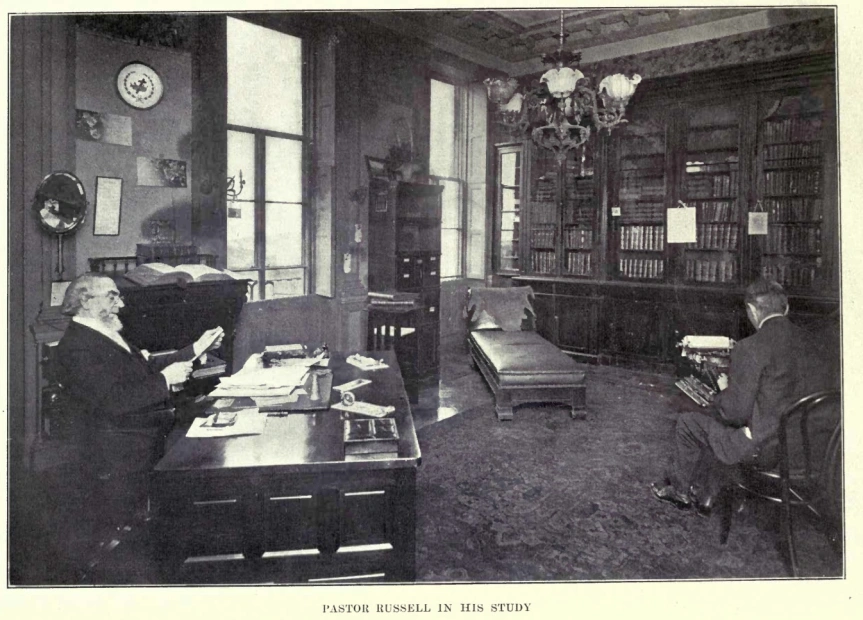
Br. Charles Taze Russell

pastor-russell-in-his-study.jpg

Br. Charles Russell—the founder of the Bible Students movement, who is the compiler of “Poems and Hymns of Millennial Dawn” which was published in Allegheny, Pa., in 1890. This Bible Students’ devotional originally contained a total of 151 poems and 333 hymns.

POEMS-AND-HYMNS-OF-MILLENNIAL-DAWN

Later on, the hymns from this book formed a basis for the hymnal titled ““Hymns of Dawn” which was published by the Dawn Bible Students Association in East Rutherford, New Jersey (USA) and the 1999 edition contains a total of 361 hymns.

Hymns of Dawn.jpg


The URL of this post: https://biblestudentsdaily.com/2017/09/06/abide-sweet-spirit-hymns-of-dawn-no-1/

Enter your email address to subscribe to this blog and receive notifications of new posts by email.


JESUS – The Name

Psalm-34-8-1.jpg

There are many names and titles of Jesus found in the Bible, and each of them contains a description or illustration of his life and work. Let us examine some of those names, and gain the lessons to be found in the deeper meanings in Jesus’ name.

Jesus

First, let us look at the most familiar name, Jesus. Matthew 1:18‑23 tells about the angel of the Lord appearing to Joseph in a dream explaining to him to call the boy who would be born to Mary “JESUS: for he shall save his people from their sins.”

“Now all this was done, that it might be fulfilled which was spoken of the Lord by the prophet, saying, Behold, a virgin shall be with child, and shall bring forth a son, and they shall call his name Immanuel, which being interpreted is, God with us.” These words directly reference the words of Isaiah 7:14.

Bible dictionaries tell us that Jesus is the Greek form of the Hebrew name Joshua and both these names are English adaptations of these respective forms of the word just as Elisheba (the wife of Aaron, Exodus 6:23) is a Hebrew form, and Elisabeth (mother of John the Baptist, Luke 1:5) is a grecianized form, but both of these names also are English adaptations. The full form of the name Joshua has two parts—Jeho‑shua, or Jehovah‑shua, meaning Jehovah saves. Later, this name assumed the form Jeshua (sometimes pronounced Yeshua), from which came the Greek form Jesus. But the Hebrew origin of the Greek name Jesus literally means Jehovah saves, or, God saves, and that name was given to our Lord to describe the mission of his life, to save the people from their sins, as we just read in Matthew 1:21.

Why did not Joseph call Jesus’ name Immanuel, like Isaiah prophesied? Here’s where understanding the meaning of names makes everything clear.

The word El means might, strength, power. The Schofield Reference Bible states that God (El) signifies the Strong One. In the Old Testament El refers not only to God, but also to mighty men of earth. The word El was often made part of peoples’ names to include a reference to God. For example, the name Elijah, or El‑i‑Jah, begins with El and means Jehovah is God. The name Daniel, or Dan‑i‑El ends with El and means God is my judge.

Here is a list of text containing the Hebrew word El for your consideration with a link for each from the Strongs Concordance: Genesis 31:29, Deuteronomy 28:32, Psalm 36:6, Proverbs 3:27, Isaiah 45:20, Psalm 89:6, Psalm 82:1, Exodus 15:11, Psalm 29:1, Psalm 50:1.

“Notice the above texts carefully and critically and all will agree that the context in every case shows the meaning of the Hebrew word El to be powerful one. How clearly it is stated in the last three quotations that JEHOVAH is the chief “el” and ruleth over all other el—powerful ones. And it should be known to all, that JEHOVAH is the name applied to none other than the Supreme Being—our Father, and him whom Jesus called Father and God. (John 20:17.) The meaning then of the words ‘Mighty God’ in our text, is,—He shall be called the mighty powerful. And so he is, for to him the Father has given all power in earth and heaven—(Matt. 28:19, and 11:27.) ‘He is Lord of all’next to the Father for “The head of Christ is God.” (1 Cor. 11:3.) They are one in mind, purpose, etc., because Jesus gave up his own will and took the Father’s (John 5:30) just as we must give up our will, mind, spirit and receive the Father’s if we would be made heirs of God, joint-heirs with Jesus Christ our Lord. Does any one ask further proof of a distinction of persons? If so we request such to read Matt. 22:44—Jesus’ application to himself of Psa. 110:1, remembering that the words used by David, translated Lord [Master] are totally distinct and entirely different words, the first one being Jehovah, and the other adon. We give Young’s translation of this verse—’The affirmation of Jehovah to my Lord—sit at my right hand, till I make thine enemies thy footstool.’(Reprint 296, Watch Tower and Herald of Christ’s Presence)

Immanuel

In the name Immanuel, the suffix ‑El is at the end, which tells us that the word God is part of that name. Bible dictionaries say that the first part of that name, Immanu, means with us. Thus, the entire name means God is with us. Indeed, God was with mankind in that He turned His favor toward mankind when he gave us his only begotten son to be Jesus—the savior of the world.

Since both names, Jesus and Immanuel, convey the thought of God sending his son Jesus to be the savior of the world, what is the deeper meaning of the name Jesus—which the son of man was to be named by Joseph?

It is salvation! But what does “being saved” mean?

Let us first explain what the Bible says is the punishment for sin.

Is it Hell?

No. It is simply death.

The Bible answers in Romans 6:23: “For the wages of sin is death.” God’s punishment upon Adam in the Garden of Eden extends to all of Adam’s progeny, the entire world of mankind, as explained in the following three Scriptures.

“And the LORD God commanded the man, saying, Of every tree of the garden thou mayest freely eat: But of the tree of the knowledge of good and evil, thou shalt not eat of it: for in the day that thou eatest thereof thou shalt surely die” (Genesis 2:16,17).

“Wherefore, as by one man [Adam] sin entered into the world, and death by sin; and so death passed upon all men, for that all have sinned” (Romans 5:12).

“Behold, I was shapen in iniquity; and in sin did my mother conceive me” (Psalms 51:5).

This scripture explains to us that death is unescapable. Right from birth, humans inherited the penalty God imposed upon Adam, and that is why everyone dies.

The good news of salvation is all about being saved from death.

What are we saved to, and how? The Bible answers in the following way.

“(3) For this is good and acceptable in the sight of God our Saviour; (4) Who will have all men to be saved, and to come unto the knowledge of the truth. (5) For there is one God, and one mediator between God and men, the man Christ Jesus; (6) Who gave himself a ransom for all, to be testified in due time” (1 Timothy 2:3‑6).

“(21) For since by man came death, by man came also the resurrection of the dead. (22) For as in Adam all die, even so in Christ shall all be made alive” (1 Corinthians 15:21, 22).

The word ransom means a price of release. As by one man’s (Adam’s) sin of disobedience, death came upon him and all mankind, so too, by one man, Jesus, mankind is saved from the just penalty of death. Jesus’ willing sacrifice of his life on the cross provided a ransom, a price of release for Adam and all mankind. The scales of God’s justice remain balanced, yet mankind is allowed relief from the penalty of death. They can be freed from condemnation because Jesus provided the price of release by accepting the penalty upon himself. Mankind may thus be freed from condemnation, and released from death in a resurrection.

Those who come into Christ presently are released from condemnation now. Romans 8:33,34, “Who shall lay any thing to the charge of God’s elect? It is God that justifieth. (34) Who is he that condemneth? It is Christ that died, yea rather, that is risen again, who is even at the right hand of God, who also maketh intercession for us.” Others will have their condemnation lifted during the Kingdom (Revelation 22:3).

Now the deeper meaning of the name Jesus is clear: we have the whole picture of salvation, and its two main features—the ransom and the resurrection. Jesus is the savior of the world because by his ransom sacrifice he saved mankind from death, to a resurrection to life. We also gain a correct understanding of the nature of man, specifically that he is mortal human flesh, and does not have an immortal soul. For if man had an immortal soul that could not die, then there would be no need for the resurrection of the dead, which is so clearly taught in the Bible.

And he is the propitiation for our sins: and not for ours only, but also for the sins of the whole world” (1 John 2:2).

Wonderful, Counsellor, Mighty God, Everlasting Father, Prince of Peace

What will this resurrection be like, and when? Let us answer that question by considering the five names of Jesus found in Isaiah 9:6,7 (a prophecy of Jesus’ birth, and a scripture we often hear read or even sung in Handel’s Messiah).

“(6) For unto us a child is born, unto us a son is given: and the government shall be upon his shoulder: and his name shall be called Wonderful, Counsellor, The Mighty God, The Everlasting Father, The Prince of Peace.

(7) Of the increase of his government and peace there shall be no end, upon the throne of David, and upon his kingdom, to order it, and to establish it with judgment and with justice from henceforth even for ever.”

The first few words of Verse 6 refer to Jesus’ birth in Bethlehem over 2000 years ago. The rest of these two verses fast‑forward to a time yet future, as the tense changes from present tense (“unto us a child is born”) to future tense (“and the government shall be”). It is apparent that Jesus’ government, Jesus’ kingdom of peace, is not yet established with judgment and justice. When it is, all mankind will say, this is the government we have always wanted, but never had. This promised government, this kingdom, was the most frequent topic Jesus preached about, during his three and a half year ministry on earth. When Jesus taught his disciples, and us, how to pray in the model prayer, He included these words.

“Thy kingdom come. Thy will be done on earth, as it is in heaven” (Matthew 6:10).

In Isaiah 11:9 we read, “They shall not hurt nor destroy in all my holy mountain: for the earth shall be full of the knowledge of the LORD, as the waters cover the sea.”

Mountain is used as another word for kingdom or government. The earth will be full of the knowledge of the Lord, just as the Apostle Paul wrote in that scripture we read earlier, “God wills that all men will come into a knowledge of the Truth” (1 Timothy 2:4). Jesus will be mankind’s Counselor, or teacher, in that Kingdom.

When will Christ’s kingdom be established “on earth as it is in heaven” (Matthew 6:10)? Examining John 18:36 sheds light on the answer to this question. In the context, Jesus stood before Pontius Pilate to answer the charge that claimed Jesus had committed treason against Caesar by claiming to be King of the Jews, which if true would be punishable by death, hence why Pilate put the question directly to Jesus in John 18:33. “Art thou the King of the Jews?”

Jesus answered, “My kingdom is not of this world: if my kingdom were of this world, then would my servants fight, that I should not be delivered to the Jews: but now is my kingdom not from hence” (John 18:36).

At first reading, it might be thought that Jesus is saying, I am indeed a king, but my kingdom is not of this world, this planet, this earth; my kingdom is in heaven. But that is not what Jesus is saying. A closer examination of the names of Jesus helps us gain a deeper understanding of his life and work. The word world in Jesus’ reply is kosmos in Greek and it means order. When Jesus said, my kingdom is not of this kosmos, he was as if saying, I am not establishing my kingdom now; it is not of this present order, but there is a new world order coming. And when it does, that new world order, that new social order, that new kosmos, will be my kingdom, here on earth.

In relation to the resurrection to life in God’s Kingdom on earth, some sincere Christians believe that this world will be destroyed by literal fire (based on Scriptures such as 2 Peter 3:12) and that only the true followers of Jesus who have done their best to live a righteous life will be saved from destruction by being taken up to heaven.

That is not what this means.

In fact, Ecclesiastes 1:4 says the opposite: “One generation passeth away, and another generation cometh: but the earth abideth for ever.”

How do we harmonize these two seemingly contradictory scriptures?

We do so by recognizing that 2 Peter 3:12 is symbolic. Here the Greek word for elements is stoicheion, which, like that other Greek word, kosmos, means an orderly arrangement. It is describing the end of the old social order of things in this present evil world, not the end of the planet.

In Ecclesiastes 1:4, the Hebrew word for earth, means the dirt, the planet—these will never pass away.

Coming back to the names of Jesus in Isaiah 9:6,7

Jesus will be the world’s Counselor, instructor, teacher, and guide to give assistance and direction, whereby the billions of resurrected people will return to harmony with Jehovah and to the enjoyment of the blessings provided through the ransom.

His name, The Mighty God, or Mighty, Mighty One, will be recognized then, on earth, as well as in Heaven. As the Heavenly, Divine Being he became after his own resurrection, he will have all the power necessary not only to resurrect mankind, but also to bring to pass justice and righteousness for everyone.

The name, The Everlasting Father, will apply to him as the Life‑Giver of the world, during the thousand years of his reign. In all that time he will be giving “life more abundant” to mankind—everlasting life to all who will obey him—therefore his title, The Everlasting Father, or the Father who will give everlasting life to humanity, is a fitting one. All the world of mankind, resurrected on the human plane, will obtain their right to everlasting life as human beings in an earthly Paradise from their Redeemer, who will then be their King.

His name, The Prince of Peace, will not apply to Him at the beginning of His reign when He will be tearing down the old order of this Present Evil World. However, true peace will speedily be established and he shall be known as The Prince of Peace, whose reign will be undisputed and uncontested. “Of the increase of his government and of peace there shall be no end,” there will be no rebellion, and his kingdom will not pass away.

Combining all these names and the future works they reveal to us, his name will be Wonderful—the one who will be recognized by all as the embodiment, the expression, of Divine Justice, Love, Wisdom, and Power. That will be the Kingdom on earth for which Jesus taught us to pray, “Thy Kingdom come, thy will be done, on earth.”

King of Kings and Lord of Lords

Another name or title of Jesus mentioned in 1 Timothy 6:15: “Which in his times he shall shew, who is the blessed and only Potentate, the King of kings, and Lord of lords.

The meaning of this title is fairly straightforward, and this scripture also tells us what the other Scriptures have been telling us about Christ’s kingdom, namely, that it is not yet fully established, but will be, in his times, and we believe that time is soon as we will examine a little later.

Christ

A Bible dictionary gives the following definition for the name Christ:

(1) Jesus of Nazareth (Jesus Christ), regarded by Christians as fulfilling Old Testament prophecies of the Messiah,
(2) The Messiah or anointed one of God as the subject of Old Testament prophecies.

An ordinary dictionary says that Christ comes from the Latin Christus, which in turn comes from the Greek Khristos, which means anointed. Thus, the name Christ carries the thought of, anointed. We can understand that because we have a few English words derived from Christ which convey the idea of anointing. We speak of babies and even ships being christened, with some ceremonious application of a liquid in the manner of anointing.

So when we say the compound name “Jesus Christ,” we are saying, Jesus Anointed, or Jesus, the Anointed one.

What, then, is the deeper significance of this name of Jesus, Anointed, or the Anointed One?

In Old Testament times, a special anointing oil was prepared according to a formula given by God Himself in Exodus chapter 30. It was to be used only to anoint the persons who were to serve as Israel’s priests, as well as the furniture and utensils used in the sacrifices God commanded the nation of Israel to offer on various occasions. This anointing signified that the ones being anointed were authorized to serve as priests. This holy anointing oil was so restricted in its usage, that if anyone used the holy anointing oil for any other purpose, or if anyone concocted an oil like the holy anointing oil, they were to be put to death (Exodus 30:32‑33).

A different oil was also used to anoint Israel’s kings, in a type of inauguration ceremony, to signify the authority of the one being anointed to legitimately assume the office of King. The one doing the anointing was often a prophet whom the people recognized as God’s spokesperson; authorized by God to anoint a king to his office.

We can think of these words anointing, or anointed, as an Old Testament equivalent of what we commonly see today when a president, or governor, or other high official, is sworn into office by placing his hand on a Bible and taking the oath of office administered by a judge or other official.

We now see that this term, Christ, defined as anointed, has a deeper meaning of authorized by God Himself to serve in the capacity or office given to them.

Messiah

anointed.png

The word “Messiah” comes from a Hebrew term meaning “to smear or anoint.” When grease or oil was applied to objects by Israelites, the commonly used term was “anoint.” However, the name “Messiah” is used in reference only to persons, rather than to “anointed” objects. As mentioned before while discussing the name Christ, persons who were anointed had been appointed and given authority for specific offices and tasks given to them. So, then, “Messiah” is the Hebrew equivalent of the Greek name, “Christ.”

Since Old Testament times, Jews have been looking for the Messiah to come and fulfill all the prophecies that foretold his work of delivering Israel from their oppression as a people, and their scattering as a nation. Even today, religious and even non‑religious Jews will say something like, “When Messiah comes, Israel will prosper and the world will be a better place.” So the name Messiah has a connotation of deliverer to the Jews. This matches nicely with the equivalent name Christ, because ever since Jesus died and was resurrected, Christians have been looking forward to his return, or coming again, as mankind’s deliverer. Thus the name Messiah is associated with Jesus’ return. Jews in general do not believe that Jesus Christ is their long awaited Messiah. But when they see the establishment of his kingdom and how it meets and exceeds their grandest expectations, they will.

Acts-3-20-21.png

The restitution, or restoration, of all things means to restore mankind, and the earth, to the perfection Adam and Eve enjoyed in the Garden of Eden.

The spiritual part of the restitution phase has begun since our Lord’s second presence (invisible to the world, but visible by the eyes of understanding to the spirit begotten of the Gospel Age).

The presence of Christ is referred to by the word parousia in the New Testament, in scriptures such as Matthew 24:3 (where the word “coming” is properly translated “presence”).

NOTE: See booklet titled : “I WILL COME AGAIN”

i-will-come-again.png


When mankind is restored to perfection, then they will be tested individually, as Adam was.

If they are obedient they will live—if they are disobedient they will not.

In that future test, mankind will have the enormous advantage of their past experience with sin and its consequences, that will enable them to

choose life through obedience, and pass the test.

This doctrine of Restitution now gives us the third “R” in a trio of precious truths concerning salvation:

RRR.jpg      

Christ, Revisited

Let us now consider our key scripture, Colossians 1:26,27.

“(26) Even the mystery which hath been hid from ages and from generations, but now is made manifest to his saints: (27) To whom God would make known what is the riches of the glory of this mystery among the Gentiles; which is, Christ in you, the hope of glory.”

Remembering that the anointing represents authorization to a work or office, like the priests and the kings of Israel, this passage tells us that Jesus’ close, footstep followers, can be, like he was, anointed or authorized to join him in his kingdom work.

Is not this thought incredible!

The following Scriptures support this:

  • “If we suffer (with him), we shall also reign with him: if we deny him, he also will deny us” (2 Timothy 2:12).


  • “To them who by patient continuance in well doing seek for glory and honour and immortality, eternal life” (Romans 2:7).


  • “For this corruptible must put on incorruption, and this mortal must put on immortality” (1 Corinthians 15:53).


  • “Blessed and holy is he that hath part in the first resurrection: on such the second death hath no power, but they shall be priests of God and of Christ, and shall reign with him a thousand years” (Revelation 20:6).

This means that there are actually two resurrections, and therefore, two salvations (See the HOPE & RESURRECTION posts: PART A, PART B, and PART C).

There is a first resurrection, now during the Gospel Age (from Christ’s ascension until the end of the age of the High Calling, ending six millenniums of the permission of evil), to a salvation of glory, honor, and immortality in heaven (Romans 2:7). This is for the very few who share in Christ’s sufferings by living their lives as peculiar people, a Royal Priesthood (1 Peter 2:9), following in Jesus’ footsteps.

Then there will also be a general resurrection in the future, on a perfect earth, of the rest of mankind, to a salvation in God’s kingdom.

Why is it taking so long for the Kingdom Jesus taught us to pray for, to come?

Why is it taking Jesus so long to establish his kingdom and do all the things his names imply?

Here is the answer:

Before the general resurrection and earthly salvation can begin, the first resurrection to the heavenly salvation must be complete. Romans 8:19 explains:

“The earnest expectation of the creature [all mankind] waiteth for the manifestation of the sons of God [the completion of the Bride class].”

All this truth is embodied in the name Christ—Jesus, the anointed redeemer, and the anointed class, his footstep followers, who will reign with him as kings and priests in his kingdom.

Summary

By examining the several names and titles of Jesus and their meaning, deeper illustrations of our Savior’s teachings, life, and work can be learned.

  •  In the name Jesus we see his work of salvation, from death to life, which the doctrine of the Ransom teaches us about.


  • In the names Wonderful, Counselor, the Mighty God, the Everlasting father, the Prince of Peace, we see when that due time when that Ransom will have its fullest effect. It will be in the coming Kingdom on earth for which Jesus taught us to pray, “Thy Kingdom come.” In that Kingdom the resurrection will take place. Everyone who has ever lived since Adam and Eve were created will be raised from death to life by the Everlasting father or life‑giver and taught by that Counselor in the peaceful kingdom where none will hurt anyone else.


  • In the name Messiah we see the return of Jesus when the spiritual phase of the restitution period begins, after which time shall commence the process of resurrecting, teaching, and guiding mankind back to the perfection enjoyed by Adam and Eve before sin entered the world. Since restitution means to restore to a previous state or condition, here mankind shall be restored to perfect bodies, perfect minds, and perfect characters. After that restitution work is complete, everyone in that kingdom will be equipped and ready to pass the test that Adam failed: obey and live, disobey and die. But this time mankind will have the enormous advantage of experience with sin and its consequences, which will enable them to choose life through obedience, and live.


  • In the name Christ, which means anointed and is the New Testament equivalent of the Old Testament word Messiah, we see Jesus, authorized by God to be our Savior and to accomplish all things required for the salvation of mankind. More than this, the scriptures tell us that there is also an anointed class of Jesus’ true footstep followers who are also called to be assistants in Jesus’ work for mankind in the kingdom. These footstep followers will have a first resurrection in heaven, following which will come a resurrection for the remainder of mankind on earth. This is the key doctrine of the two salvations.


In learning about Jesus’ life and work, we have gained some key insights into commonly held misconceptions that are not supported by the scriptures. We have seen that there is no Hell of torment, and that man does not have an immortal soul.

Matthew-20-26-28-crossandcrown.jpg

[NOTE: The word “many” in the above Matthew 20:28 verse reaffirms that many are involved in being freed from the sentence of death. Thus similarly, in Romans 5:19—many were constitutes sinners but really, ALL of us were (Ecclesiastes 7:20, Romans 3:10, 1 John 1:8).]

Hymns of Millennial Dawn No. 96

AUDIO [Hymn 96] – The Name of Jesus

In Jesus' Name - Hymn.png

It makes the wounded spirit whole
And calms the troubled breast;
‘Tis manna to the hungry soul,
And to the weary, rest.

Dear name! the rock on which we build,
Our shield and hiding place;
Our neverfailing treasure, filled
With boundless stores of grace!

Jesus, our Shepherd, Saviour, Friend,
Our Prophet, Priest, and King,
Our hearts in gratitude ascend;
Accept the praise we bring.

We would thy boundless love proclaim
With ev’ry fleeting breath;
And sound the music of thy name
Abroad through all the earth.

References:

“In Jesus Name”—Public Lecture by Br. Joe Megacz December 2016.
URL: https://chicagobible.org/public‑lecture‑in‑jesus‑name/

In Jesus' Name.png


Reprint 296-297 from The Reprints of the Original Watch Tower and Herald of  Christ’s Presence. The Everlasting Father.
URL: http://www.htdbv8.com/1881/r296.htm

Hymns of Millennial Dawn—URL: http://www.htdbv8.com/indexhd.html

Further Suggested Bible Study Material:

“The Ransom” video power point presentation discourse by Br. David Rice
URL: http://bibleresources.info/ransom‑david‑rice/

Soul and Spirit. Faithbuilders Fellowship. January 2006.
URL: http://2043ad.com/journal/2006/01_jan_06.pdf

Free Booklet titled: “I Will Come Again – John 14:3”
URL: https://chicagobible.org/wp-content/uploads/2015/05/I-WILL-COME-AGAIN.pdf

Immortality and the Human Soul. The Dawn Magazine. 1959
URL: http://www.dawnbible.com/1959/5904tbs1.htm

The Doctrine of Christ—Booklet.
URL: http://www.biblestudents.com/docs/DoctrineChrist.pdf

How Does “the Son of Man” Title, Speak Volumes About Jesus?
URL: https://biblestudentsdaily.com/2016/06/10/how-does-the-son-of-man-title-speak-volumes-about-jesus/

Acts 23:6—HOPE & RESURRECTION. PART A: What Is Jesus All About?
URL: https://biblestudentsdaily.com/2016/11/03/acts-236-hope-resurrection-part-a-what-is-jesus-all-about/

Acts 23:6—HOPE & RESURRECTION. PART B: Will Mankind Resurrection With The Same Mind?
URL: https://biblestudentsdaily.com/2016/11/05/acts-236-hope-resurrection-part-b-will-mankind-resurrect-with-the-same-mind/

Acts 23:6—HOPE & RESURRECTION. PART C: The Order Of The Resurrection Process.
URL: https://biblestudentsdaily.com/2016/11/11/acts-236-hope-resurrection-part-c-the-order-of-the-resurrection-process/

God’s Name—What Is The Heavenly Father’s Name That We Are To Hallow And Why?
URL: https://biblestudentsdaily.com/2017/06/27/gods-name-what-is-the-heavenly-fathers-name-that-we-are-to-hallow-and-why/

Acknowledgment:

  • Br Joe Megacz—content of this post.
  • Br David Rice—editing assistance.

The URL of this post: https://biblestudentsdaily.com/2017/07/05/jesus-the-name/

Enter your email address to subscribe to this blog and receive notifications of new posts by email.

GOD’S NAME – What Is The Heavenly Father’s Name That We Are To “Hallow” And Why?

MATTHEW-6-9-Rotherham.jpg

In Psalm 148:13 (KJV) the Psalmist David wrote, “Let them praise the name of the LORD: for his name alone is excellent; his glory is above the earth and heaven.”

But what is God’s actual name?

In this study we discuss the various names mentioned for God in the Old Testament Hebrew. Each of our Heavenly Father’s names describe different shades of His magnificent character, being, and personality, allowing us to know our Father better and learn what God wishes us to develop in our character, in order to bring joy, honor, glory, and praise to the Creator of all.

Almighty God—”El Shaddai”

The basic form for the Hebrew name of God is “El.” The word “El” means “might, strength, power.” The Schofield Reference Bible states that God (El) signifies the “Strong One.”

The word “Shaddai” is formed from the Hebrew words shadthe breast—and shadahto shed, to pour out. Thus, El Shaddai is “the God who pours out blessings, who gives them richly, abundantly, continually” (Adam Clark’s Commentary, Genesis 17:1). God is “Shaddai” because He is the nourisher, the strength‑giver, and thus the satisfier, who pours Himself into believing lives.

The primary translations of this root in the scriptures are “god” (for pagan or false gods), and “God” (for the true God of Israel). However, in Strong’s Concordance “El Shaddai” is not found under the English words “God” or “Lord,” but rather “Almighty” (Strong’s 7706). “All‑sufficient” would express the Almighty God (El Shaddai) for He not only enriches, but also makes fruitful. This is nowhere better illustrated than in the first occurrence of the name “El Shaddai” in the Bible, in Genesis 17:1.

“(1) And it came to pass that, when Abram was ninety and nine years old [being “as good as dead,” Hebrews 11:12] Yahweh appeared unto Abram, and said unto him, I, am GOD Almighty,—Walk, thou before me and become thou blameless: (2) That I may set my covenant betwixt me and thee, And may multiply thee, exceedingly. (3) And Abram fell on his face,—and God spake with him, saying: (4) As for me, lo! my covenant is with thee,—So shalt thou become—father of a multitude of nations; (5) And thy name shall no more be called Abram,—but thy name shall become Abraham, for father of a multitude of nations, have I appointed thee” (Genesis 17:1‑5, Rotherham).

All‑Powerful and All‑Sufficient

We can now best understand God’s character when combining these two named attributes of God’s being: All‑Powerful (“El“) and All‑Sufficient (“El Shaddai“).

Genesis 17:1 is a beautifully clear and direct statement from God of His unlimited, supreme, divine power and this quality of God can be best described in one word as God’s OMNIPOTENCE. Even simply because of God’s omnipotence, we should focus on being “blameless” through Christ. That is, through a firm belief (based on testing/studying the Scriptures, Romans 10:17, 1 Thessalonians 5:21), and thus from a steadfast faith (1 Corinthians 15:58, Hebrews 6:19) in Christ as a ransom for our sins (and for the whole world, 1 Corinthians 15:21), we are redeemed and reckoned as righteous children of God (Romans 8).

Our Heavenly Father is able to meet every need (Philippians 4:19) and protect us from any danger to our spiritual lives (Jude 1:24).

Our faith and trust in El Shaddai can turn any temporal difficulty into a spiritual blessing for our eternal interests (Romans 8:28). Our responsibility is to manifest complete faith and trust in God (Isaiah 40:28‑31, 41:10, Jeremiah 17:5, Exodus 15:2, 1 Chronicles 16:11, Luke 12:8‑10, John 12:37‑43, 2 Kings 5:13‑15, Genesis 15:6‑10). Then we can have perfect peace of mind in His all‑sufficient grace (Isaiah 26:3, 2 Corinthians 12:9).

“We must supply our best effort, which will always be too weak and insufficient to overcome all of our imperfections, but El Shaddai will supply whatever is needed to make up for our shortcomings. God’s name, El Shaddai, describes not only what God is, but also what He does for us. El Shaddai sustains us, nourishes us, comforts us, and provides everything we need. This should make us more grateful, more peaceful; and make us feel our complete dependence upon Him. Knowing God as El Shaddai helps us more readily to praise Jehovah, our Heavenly Father, in all the experiences of life” (Br. Allan Ross, “El Shaddai,” Beauties of the Truth, November 2014).

The Patriarchs were close to El Shaddai, our Heavenly Father. They depended on Him for everything in normal life. They were a pastoral people and depended on their crops and herds for food. If there was a drought, or a disease in their herds, they could starve. They did not have unemployment benefits or retirement plans through difficult times. They had El Shaddai and that was all they needed.

The Name “Jehovah”

Jehovahthe “Self Existing One,” “The Eternal One”—is God’s primary name. It is a translation of what is known as the Tetragrammaton. The Greek word “Tetragrammaton” means “four (tetra) letters (gramma)” because “Jehovah” comes from four Hebrew letters יהוה‎ (yod, he, waw, he)—transliterated into English as “JHWH” sometimes written as “YHWH.” Some Bible translations do render the Tetragrammaton as Jehovah, just as it occurs in the Hebrew Old Testament, such as The American Standard Version 1901 edition (in 6,823 places) and The Emphatic Diaglott (in 18 places.)

“Jehovah” is the name that God gave to himself in Exodus 3:13‑15.

“(13) Moses said unto God, Behold, when I come unto the children of Israel, and shall say unto them, The God of your fathers hath sent me unto you; and they shall say to me, what is his name? What shall I say unto them? (14) And God [elohiym, Strongs 430] said unto Moses, I AM [hayah, Strongs 1961] THAT I AM [hayah]: and he said, Thus shalt thou say unto the children of Israel, I AM [Jehovah] hath sent me unto you. (15) And God said moreover unto Moses, Thus shalt thou say unto the children of Israel, Jehovah God of your fathers, the God of Abraham, the God of Isaac, and the God of Jacob, hath sent me unto you: this is my name for ever, and this is my memorial unto all generations.”

The RVIC Bible (by Br. Jim Parkinson) has footnotes for Genesis 3:14‑15 which read:

“(14) Or, I AM BECAUSE I AM. or, I AM WHO AM. or, I WILL BE WHAT I WILL TO BE. or, I CONTINUE TO BE THE ONE CONTINUING EVERMORE. (15) Hb. Ehyeh — future tense (all three times). From the same root as Jehovah or Yahweh.”

Similarly Br. Ronald Day explains in his website study titled “The Divine Name” the following: “Yahweh [Jehovah] is the third person singular of the Hebrew verb hayah (to be or become). In Exodus 3:14 Jehovah gives Moses a different variation of his name in the first person: ‘I will be what I will be (Ehyeh’ asher’ ehyeh’).’ (Revised Standard Version – footnote) Many translations render this ‘I AM THAT I AM.’ However, according some authorities, the Hebrew word hayah, as used in this verse, means more than just to exist. It also carries with it the thought of coming into existence, or causing to exist. Thus the third person would mean: ‘He will cause to be,’ or ‘He causes to be.’

In relation to Exodus 3:14, the Catholic Encyclopedia, 1967, vol. 14, page 1065, states that in this particular verse “a merely folk etymology of the name, based on the qal form of the verb ‘to be,’ is given.” “Grammatically, because of its vocalization, yahweh can only be a … causative form of this verb, with the meaning ‘He causes to be, He brings into being.’ Probably, therefore, Yahweh is an abbreviated form of the longer, yahweh aser yihweh, ‘He brings into being whatever exists.’ The name, therefore, describes the God of Israel as the Creator of the universe.” (Ronald Day, “The Divine Name”.) That this meaning is correct can be seen by observing the indicated meaning of Jehovah in Exodus 6:2,3 – which is discussed further in this study.

Today you will not find the divine name “Jehovah” (English) (nor “Yahweh”) in the New American Standard Bible, not even in the four places that were in the original AKJV (i.e. Exodus 6:3, Psalms 83:18, Isaiah 12:2, Isaiah 26:4).

The name was removed quite simply because there was many thousands of years ago a Usurper to the throne of God, the great liar, the Adversary. His first act of rebellion was to accuse Jehovah of lying to Adam and Eve about the tree of knowledge telling Eve that if she ate of the fruit she would become like God knowing all things and that she would not die. Ever since, Satan has opposed the Most High and His Son as well as all faithful followers of God’s Word. Thus, by having the divine name removed and substituted with “Lord” it made it so much easier to introduce the false doctrine of the Trinity whereas both the Heavenly Father and His firstborn son, Jesus Christ, the Logos, are called “Lord,” and the word is interchangeable to mean that both are coeternal and equal which is not true. The Heavenly Father had no beginning and no end, while Jesus had a beginning, and was God’s firstborn son (Br. Richard Tazzyman, 2017 Discourse: “I Am”).

“For He rescued us from the domain of darkness, and transferred us to the kingdom of His beloved Son, (14) in whom we have redemption, the forgiveness of sins. (15) He is the image of the invisible God, the firstborn of all creation” (Colossians 1:13‑15).

This change of removing the name “Jehovah” stems from the 1880s when the council of the church of England recommended to the British Crown that a revision of the AKJV be produced, and at the same time a group of translators from the United States of America were invited to collaborate with the translators of the RV of the AKJV Bible to produce a version of the Bible in American English. Thus, the American Standard Version of 1901 was created. Br. Richard Tazzyman comments in his discourse “I AM” about how the original committee felt towards the importance of the divine name, in the Foreword of the 1901 ASV Bible.

“The change first proposed in the Appendix, that which substitutes JEHOVAH for LORD or GOD, is one which will be unwelcome to many, because of the frequency and familiarity of the terms displaced, but the American Revisers after a careful consideration were brought to the unanimous conviction that a Jewish substitution which regarded the divine name as too sacred to be uttered, ought no longer to dominate in the English or any other version of the old Testament.”

Here are two other texts with God’s name as “Jehovah.”

“I am Jehovah; this is my name, and my glory will I not give to another” (Isaiah 42:8).

“That men may know that thou whose name alone is Jehovah, art El Elyon, the Most High over all the earth” (Psalms 83:18).

[Note: the difference between the name “Jehovah” and “Yahweh” is that “Jehovah” is the English word that represents the name of God, just as Jesus is the English word that represents the name of our Savior. When one uses a name in one language, it is often not the same pronunciation or form as the name in the original language. For example, with the name “Joshua” — as there was no “J” in English for some centuries, it is evident that this name that we all know as a familiar English language name today sounded different before, and as to its actual pronunciation in Hebrew, who would recognize it if we tried to simulate Hebrew in the English language. Jesus is surely not the sound his contemporaries used when they called his name. But it is our English name for him. In the same way, we know the name of God as Jehovah. Yahweh is a closer sound alike to the Hebrew, perhaps — at least some seem to think so — but even that presumably is different than a real Hebrew speaker of antiquity would have pronounced the name. There is no necessity to modify the word that English speakers know the name as. It is Jehovah. When we use that name, we are communicating. If we all began to use some other pronunciation, most people may get the point, but there would be some confusion. However, whether one prefers “Yahweh,” or the more familiar “Jehovah,” may the name of God be “hallowed.”]

By What Name Was God Known to the Patriarchs?

The name “Jehovah” appears in Exodus 3:15.

“And God said moreover unto Moses, Thus shalt thou say to the children of Israel, The Lord [Jehovah] God of your fathers, the God of Abraham, the God of Isaac, and the God of Jacob, hath sent me to you: this is my name for ever, and this is my memorial unto all generations.”

Only three chapters onward, we read of “El Shaddai” and “Jehovah” both being mentioned in Exodus 6:2,3.

“God spake unto Moses, and said unto him, I am Jehovah; And I appeared unto Abraham, unto Isaac, and unto Jacob, by the name of El Shaddai [The All Mighty, All Sufficient God], but by my name JEHOVAH [“The Self Existing, Eternal One”] was I not known to them.”

This verse could not mean that up until the time of Exodus 6 no one knew God by the name of “Jehovah.” For even Adam knew God by the name of Jehovah as confirmed in Genesis 4:25,26.

“Adam knew his wife again; and she bare a son, and called his name Seth: For God, said she, hath appointed me another seed instead of Abel, whom Cain slew. And to Seth, to him also there was born a son; and he called his name Enos: then began men to call upon the name of Jehovah.” Adam lived 700 years after Seth begat Enos. Thus he would have been one of those that knew Jehovah by name.

In Genesis 15:2, God revealed himself to Abraham by this very name: “And he said unto him, I am JEHOVAH, that brought thee out of Ur of the Chaldees.”

From the very beginning the Patriarchs knew the name JEHOVAH El‑Shaddai, God All‑sufficient, since they recognized God’s continual provision made for them and the constant protection that God afforded them. However, the name “Jehovah” refers particularly to the accomplishment of promises already made; to giving them a being, and thus bringing them into existence, which could not have been done in the order of His providence sooner than until the deliverance from Egypt and the settlement in the promised land. Then the usage of “El Shaddai” became infrequent after the Law Covenant was established.

Hence in the earlier scripture mentioned — Exodus 6:2,3 — Jehovah had to be referring to the meaning of his name (as the one who causes) rather just to the word used to designate his name. In verse four Jehovah calls attention to the covenant he had made with Abraham, Isaac, and Jacob, to give them the land of Canaan. They never saw Jehovah cause the fulfillment of that promise. It is in this respect that Jehovah says that He did not make his name known to them. However, now, Jehovah is saying that he is going to cause a fulfillment of that promise. He will bring the Israelites out of Egypt into the land that he had promised to Abraham, Isaac, and Jacob (Exodus 6:6-8).

Thus the name Jehovah signifies the one who accomplishes what he desires and we can fully trust that His magnificent plan for man will be completely accomplished (Isaiah 55:11, 45:21).

El-Shaddai—An All-Sufficient, Covenant-Keeping God

When the patriarchs wanted to give the strongest assurance to those that were going on a dangerous mission, they used the divine name El Shaddai.

Genesis 28:1‑4—Isaac called Jacob, and blessed him, and charged him, and said unto him, Thou shalt not take a wife of the daughters of Canaan. Arise, go to Padan‑aram, to the house of Bethuel thy mother’s father; and take thee a wife from thence of the daughters of Laban thy mother’s brother. And El Shaddai bless thee, and make thee fruitful, and multiply thee, that thou mayest be a multitude of people; And give thee the blessing of Abraham, to thee, and to thy seed with thee; that thou mayest inherit the land wherein thou art a stranger, which God gave unto Abraham.”

“As Abraham had sent Eliezer to find a covenant wife for Isaac, so Isaac sent Jacob to find a covenant wife—not from the Canaanites, but from Abraham’s extended family. The patriarchs Abraham, Isaac, and Jacob, were all under the Abrahamic Covenant, a Covenant of Grace. As consecrated Christians, we also are under a Grace Covenant. Like Jacob, who here typified the New Creation, we have been sent on a journey and blessed by the antitypical Isaac, our Lord Jesus. So we can repeat this blessing, transferring the thought from the type to the antitype as coming from our Lord Jesus to us: ‘May El Shaddai bless thee’ (verses 3,4).

“That helps to reinforce the thought that our Savior assures us that El Shaddai, the Almighty, All sufficient One, will be with us all the way in our dangerous journey through life. He is always near, always sufficient for any contingency. In the Promised Land, the Patriarchs had complete trust in El Shaddai. If we can completely trust Him now, then we can rest in full assurance of faith in our spiritual inheritance in the Promised Land.”

“Genesis 35:9‑12—Here God confirmed His Covenant to Jacob and changed Jacob’s name to Israel.

‘God appeared unto Jacob again, when he came out of Padan‑aram, and blessed him. And God said unto him, Thy name is Jacob: thy name shall not be called any more Jacob, but Israel shall be thy name: and he called his name Israel. And God said unto him, I am El Shaddai: be fruitful and multiply; a nation and a company of nations shall be of thee, and kings shall come out of thy loins; And the land which I gave Abraham and Isaac, to thee I will give it, and to thy seed after thee will I give the land.’

“After this confirmation, Jacob journeyed to Bethlehem. There his wife, Rachel, died giving birth to Benjamin. Then Jacob travelled to Hebron where his father, Isaac, had died. Thus this revelation to Jacob of El Shaddai as his All Mighty, All Sufficient God was a specially needed blessing. It was a reassurance to Jacob to have the covenant confirmed to him, and to know that El Shaddai would be with him throughout his walk.

“Genesis 37:35—This text speaks of the time Joseph had been sold into Egypt, and Jacob was told that Joseph was dead.

‘All his sons and all his daughters rose up to comfort him; but he refused to be comforted; and he said, For I will go down into the grave unto my son mourning. Thus his father wept for him.’

“Though Rachel, Isaac, and Joseph—the three people that Jacob loved the most—were gone, and no one on earth could comfort him, El Shaddai comforted Jacob. There was nothing that he and El Shaddai could not handle together.

“Genesis 43:14—Later, Judah promised Jacob that he would return to Egypt as surety for Benjamin. But before sending Judah, Jacob asked the blessing of El Shaddai upon him in.

‘And El Shaddai give you mercy before the man, that he may send away your other brother, and Benjamin. If I be bereaved of my children, I am bereaved.’

“Genesis 48:3,4—Years later, when Jacob was on his death bed, Joseph brought his sons, Manasseh and Ephraim, to be blessed.

‘Jacob said unto Joseph, El Shaddai appeared unto me at Luz in the land of Canaan, and blessed me, And said unto me, Behold, I will make thee fruitful, and multiply thee, and I will make of thee a multitude of people; and will give this land to thy seed after thee for an everlasting possession.’

“Genesis 49:25—Jacob gave a final blessing to each of his sons just before he passed away.

‘Even by the God of thy father, who shall help thee; and by El Shaddai, who shall bless thee with blessings of heaven above, blessings of the deep that lieth under, blessings of the breasts, and of the womb.’ ” (Br. Allan Ross, “El Shaddai”).

EL SHADDAI in the Book of Ruth

By considering the usage of El Shaddai in the Book of Ruth and the Book of Job, we understand an additional aspect of what God does for His people, that He permits short‑term pain for long‑term blessings. God’s people do not always understand His Grace when they are in the midst of a painful experience. But we must fully trust our All‑Powerful, All‑Sufficient, God. El Shaddai only allows experiences that bless us, if we take them in the right way.

In the Book of Ruth, Naomi, her husband Elimelech, and their two sons left Bethlehem‑Judah because of a famine and travelled to Moab. Within ten years of entering Moab, Naomi’s husband and two sons died. Naomi was downcast and confused. If God was All‑Mighty, All‑Sufficient, why would he allow her husband and her sons to die so quickly? To answer this, we have to look at the big picture, the long‑term view. El Shaddai takes the long view.

Should Elimelech have taken Naomi and his sons and left Bethlehem to go to Moab in the first place?

No, since El Shaddai is All‑Sufficient, He would have cared for them IN the Promised Land. If Elimelech had a stronger faith, he would have kept his family in Judah and waited for El Shaddai to bless his faithfulness.

Short‑term satisfaction
of fleshly desires
will NOT bring
long‑term happiness.

As in Naomi’s case, God may allow afflictions to come so that we will return to Him. 

God took away what was keeping Naomi from being close to Him!

If Naomi had stayed in Moab we never would have heard of Naomi or Ruth. There would not be a Book of Ruth in the Bible. It was the return to El Shaddai that allowed El Shaddai to abundantly bless both Naomi and her daughter-in-law Ruth (who chose to return with Naomi to the Promised Land).

One of the guiding principles of this lesson is stated in James 4:8: “Draw near to God and he will draw near to you.”

Because Naomi and Ruth returned to the Promised Land, Ruth married Boaz. As King David’s great grandmother, Ruth became identified through the lineage of Mary with David’s greatest Son and Lord, our Lord Jesus.

Because Ruth drew near to God in devotion, she received eternal blessings.

EL SHADDAI in the Book of Job

The first use of the word “El Shaddai” in the Book of Job is in Job 5:17,18, where we read the words of Eliphaz to Job.

“Behold, happy is the man whom Eloah [Strongs 433, the Majestic God] correcteth: therefore despise not thou the chastening of El Shaddai [Strongs 7706, the All Sufficient God]: For he maketh sore, and bindeth up: he woundeth, and his hands make whole.”

The last use of “El Shaddai” in the Book of Job appears in Job 40:1,2.

“Moreover Jehovah [Strongs 3068, the Eternal One, the Existing One] answered Job, and said, Shall he that contendeth with El Shaddai [Strongs 7706, the All‑Mighty, All‑Sufficient One] instruct him? He that reproveth El‑oah [the Majestic God], let him answer it.”

New Testament References

In the New Testament, Jesus begins to refer to God as “Our Father” when he gives us the model prayer of Matthew 6:9: “After this manner therefore pray ye: Our Father which art in heaven, Hallowed be thy name.”

Jesus is the first person in Scripture to begin referring to God as my heavenly Father,” and our and your heavenly Father.” Jesus only used these terms in the presence of his disciples; they were not applied to others who were not yet prospective sons. Jesus was the first son of God, who opened up a “new and living way” gives us the opportunity to also become sons of God (John 1:141 John 3:1,2).

Revelation 15:3—refers to Jehovah as Almighty.

“They sing the song of Moses the servant of God, and the song of the Lamb, saying, Great and marvelous are thy works, Lord God Almighty; just and true are thy ways, thou King of saints.”

We also have scriptures that declare the almighty power of our Heavenly Father.

Psalm 77:10‑15—“I said, This is my infirmity: but I will remember the years of the right hand of the most High [El Elyon, The Supreme God]. I will remember the works of Jehovah [the Eternal One]: surely I will remember thy wonders of old. I will meditate also of all thy work, and talk of thy doings. Thy way, O God, is in the sanctuary: who is so great a God as our God? Thou art the God that doest wonders: thou hast declared thy strength among the people. Thou hast with thine arm [our Lord Jesus] redeemed thy people, the sons of Jacob and Joseph.”

Psalms 91:1‑3—In these verses David represents our Lord Jesus addressing his Church.

“He that dwelleth in the secret place of the most High [El Elyon, The Supreme God] shall abide under the shadow of El Shaddai [the All‑Sufficient One]. I will say of Jehovah [the Self‑Existing One], He is my refuge and my fortress: my [Elohiym] Supreme God; in him will I trust. Surely he shall deliver thee from the snare of the fowler, and from the noisome pestilence.”

Jesus is telling his Church that we, who abide in the Secret Place of consecration in the antitypical Tabernacle, close to Jehovah, have nothing to fear despite the dangers that surround us because our God will protect us. Thus in the above passage of Scripture, four of God’s names are invoked to emphasize this—El Elyon, El Shaddai, Elohiym and Jehovah.

God Has Many Names

As the various verses shared highlight, God has used many different names to describe Himself indicating to us, that one name is not sufficient to describe the Heavenly Father. If God wanted to have only one descriptive name for Himself, He could have had the Bible written that way. But instead God has been described as “Eternal (Ezekiel 1:24)”, “Majestic,” “All‑Mighty,” and “All‑Sufficient (Ezekiel 10:4,5).”

It would be unfortunate to always read these descriptive names generically as “God” or “Lord.” So when we read Scriptures, let us consider referring to the Rotherham’s version or RVIC for a more exact translation of the original biblical manuscripts. Then there is no confusion between whether the verse refers to our Heavenly Father, or if the verse(s) refer to Jesus, Jehovah’s firstborn creation and the world’s Redeemer.

Based on the understandings shared here about the breadth of God’s being and character through an examination of the Heavenly Father’s names, we conclude with these thoughts about our God, “Whose—

  • Memory never fails,
  • Judgment is never inaccurate,
  • Plans for eternity are without any possibility of even the minutest failure,
  • Timing of His Divine plans of eternity are with unerring precision,
  • Grandest, most mighty power and skill can harness even every opposing element, animate or inanimate, making them all work together for the accomplishment of his grand designs,
  • Tireless vigilance never ceases, nor seeks relief from the pressing cares of universal dominion,
  • Eye never sleeps, whose ear is ever open, and who is ever cognizant of all the necessities, and active in all the interests, of his broad domains.”

To answer our opening question—Jehovah occupies the highest position of authority and glory in the universe. We hallow our Heavenly Father’s authority and bow in reverent and humble submission before Him in ALL His glorious attire of royal grandeur.


PSALM-31-23-24.jpg


References:

Br. Allan Ross, “El Shaddai,” Beauties of the Truth, November 2014.

Br. Charles T. Russell. “Reprints of the Original Watch Tower and Herald of Christ’s Presence.

Br. Richard Tazzyman, 2017 Discourse: “I Am,” Australia. (Br Tazzyman’s discourse is to be given at the Bible Students Convention in England this year in July 2017.)

Br. Ronald Day. John 10:30 – The Oneness of Jesus and His God
http://jesusnotyhwh.blogspot.com.au/2016/10/john10-30.html

Br. W.J. Siekman. “One Lord and His Name One,” The Herald of Christ’s Kingdom, May-June 1986

Vines Expository Dictionary of OT and NT Words, page 161.

Br. Jim Parkinson’s RVIC BIBLE – The Revised Version (American Edition) Improved and Corrected from manuscripts discovered and published to A.D. 1999


Acknowledgement

The authors of the above references for their content utilized for the above written work.

Br. David Rice, editing.

Enter your email address to subscribe to this blog and receive notifications of new posts by email.


Why & How to OBEY GOD

Obedience to God- biblestudentsdaily.jpg

What is the Purpose of OBEDIENCE in our life?

Our OBEDIENCE to God YHWH is an indicator of our heart attitude.

In John 14:15 we read, “If you love me you will keep my commandments.”

So, obedience demonstrates our thankfulness, our appreciation, our devotion, our reverence for God and our praise.

“Faith by itself, if it does not have works, is dead.” (James 2:17, ESV)

—◊—◊—◊—◊—◊—◊—◊—◊—◊—◊—◊—◊—◊—◊—◊

HOW do we become OBEDIENT? Is there a method to it?

Here are some suggested steps to learning OBEDIENCE in order to please our Heavenly Father:-

Step 1: Reading the scriptures daily to know God’s will

The first step to doing God’s will is to actually know what it is, and learn about what pleases our Heavenly Father by reading His holy words in the Bible (2 Timothy 3:16).

And it [the Word of God] shall be with him, and he shall read therein all the days of his life: that he may learn to fear [reverence] the LORD his God, to keep all the words of this law and these statutes, to do them.” (Deuteronomy 17:19)

Proverbs 8:34 reads, “Blessed is the man that heareth me, watching daily at my gates.”

Why did the Apostle Paul describe the Brethren from Berea as “more noble” in character than the Thessalonians?

Acts 17:11 (ESV) tells us why. It is because “they received the word with all eagerness, examining the Scriptures daily to see if these things were so.”

It is a lot easier to deal with the issues of life, the trials, difficulties and testings that come to us, if we have daily input from the scriptures. It produces in our heart an overriding confidence and peace that “transcends all understanding” (Philippians 4:7), helping us “do ALL things through Christ” who strengthens us. (Philippians 4:13)

—◊—◊—◊—◊—◊—◊—◊—◊—◊—◊—◊—◊—◊—◊—◊

Step 2: Developing the will to do God’s will:

As we learn about the Heavenly Father’s will and what God wants us to do, we experience the “old man” (Ephesians 4:22-24, Romans 6:6-23), that is, the fallen nature appearing on the scene, that wishes to slow things down in our progress of maturity in Christ.

Fighting against the tendencies of the flesh, which we wish to put to “death” from moment to moment, IS THE BATTLE against sin!

How zealously and diligently with GREAT DISCIPLINE over our thoughts, words and actions do we barricade the fleshly interests… the fleshly wants… the fleshly tendencies in order to let the New Creature in us grow?

You see, the “Old Man” and the “New Creature [in Christ]” are AT WAR with each other! (2 Corinthians 5:17)

If the “old man” gains strength, the “New Creature” in Christ, weakens.


In Galatians 6:17-27 we read,

“17 For the desires of the flesh are against the Spirit, and the desires of the Spirit are against the flesh, for these are opposed to each other, to keep you from doing the things you want to do. 18 But if you are led by the Spirit, you are not under the law. 19 Now the works of the flesh are evident: sexual immorality, impurity, sensuality, 20 idolatry, sorcery, enmity, strife, jealousy, fits of anger, rivalries, dissensions, divisions, 21 envy, drunkenness, orgies, and things like these. I warn you, as I warned you before, that those who do such things will not inherit the kingdom of God. 22 But the fruit of the Spirit is love, joy, peace, patience, kindness, goodness, faithfulness, 23 gentleness, self-control; against such things there is no law. 24 And those who belong to Christ Jesus have crucified the flesh with its passions and desires. 25 If we live by the Spirit, let us also keep in step with the Spirit. 26 Let us not become conceited, provoking one another, envying one another. 27 Brothers, if anyone is caught in any transgression, you who are spiritual should restore him in a spirit of gentleness. Keep watch on yourself, lest you too be tempted.


  • Which one are we choosing to feed right NOW?
  • Which one will we choose to feed after we read this post?
  • Which one will choose to feed for the remainder of today?
  • How about tonight?
  • How about tomorrow and then for the remainder of this week and this month and year and until the day we die?

Are we consuming more spiritual food than earthly food?

Let’s say we eat breakfast, lunch and dinner with a few snacks in between, well, then that would mean the spiritual food would require to be served seven or more times a day or else the flesh will receive the growth and not the spiritual mind!

Better still, we shall like to feast on the spiritual ALL DAY as it is this kind of “food” that has no side effects but only most righteous and richest benefits (John 17:3, 1 John 2:25). Consuming spiritual food means feasting with Jesus and the spiritual “eagles” (Matthew 24:28; John 6:53-56, Isaiah 40:31).

In 2 Corinthians 5:15-18 the Apostle Paul well explains how all the “New Creatures” in Christ, should treat each other :


“14 For the love of Christ urges us on, because we are convinced that one has died for all; therefore all have died. 15 And he died for all, so that those who live might live no longer for themselves, but for him who died and was raised for them.

16 From now on, therefore, we regard no one [who is “in Christ”] from a human point of view; even though we once knew Christ from a human point of view, we know him no longer in that way.

17 So if anyone is in Christ, there is a new creation: everything old has passed away; see, everything has become new!

18 All this is from God, who reconciled us to himself through Christ, and has given us the ministry of reconciliation; 19 that is, in Christ God was reconciling the world to himself, not counting their trespasses against them, and entrusting the message of reconciliation to us. 20 So we are ambassadors for Christ, since God is making his appeal through us; we entreat you on behalf of Christ, be reconciled to God. 21 For our sake he made him to be sin who knew no sin, so that in him we might become the righteousness of God.”


May we find time each day to read a psalm and read or sing a hymnrecall and share some biblical verses with whomever we can edify along our day’s pilgrimage. Let us pray on our knees if we can, like the prophet Daniel did (Daniel 6:10)… like the Apostle Paul did (Ephesians 3:14), and above all, like our Lord Jesus did (Mark 1:35, Matthew 6:9-13, Matthew 14:23, Luke 6:12, Luke 22:32, 41-44, Luke 23:34, John 11:41-42, John 12:27-28, John 17:1-26, Hebrews 5:7). By being able to come boldly before the throne of Heavenly grace through our Advocate, Christ Jesus, we are able to keep on the right track, asking for our Father to mercifully show us His will EVER STEP of the narrow way. 

Do we with great joy in the hope set before us, thank our Heavenly Father even when severe stormy experiences come our way?

How much effort do we put in to represent our titles of members of “a royal priesthood”… the “peculiar people”“God’s special possession” (1 Peter 2:9)?

Brethren, how much do we strive to live in the world as citizens of heaven but NOT be “of the world”?

Do we long for earthly friendship OR are our minds consumed by the joys of our friendship with Jesus, whom we are training to be like in character-likeness?

Are we consumed by the friendship we have also in the Apostles and Ancient Worthies whom we are all getting to know actually RIGHT NOW?! The Bible is like a Reading Manual for our preliminary “Orientation” Program given to us by God’s grace, whereby we look forward to working with these whom proved faithful unto death.

The Apostle Paul explains that learning God’s will and wanting to do God’s will is a matter of development in our lives.


For it is God that worketh in you both to will and to do of his good pleasure.” (Philippians 2:13)


This means that we not only just learn to desire doing God’s will, but that we actually DO do it to the best of our abilities. These experiences and training in the school of Christ, involve TIME and we DO it with GREAT JOY being motivated by “the precious and very great promises” of God which in turn, gives us HOPE.

“And hope does not disappoint, because the love of God has been poured out within our hearts through the holy Spirit who was given to us” (Romans 5:3-5).

The Apostle Peter explains about these precious promises in 2 Peter 1:2-14 (ESV), which  reads:


“2 May grace and peace be multiplied to you in the knowledge of God and of Jesus our Lord. His divine power has granted to us all things that pertain to life and godliness, through the knowledge of him who called us to his own glory and excellence,by which he has granted to us his precious and very great promises, so that through them you may become partakers of the divine nature, having escaped from the corruption that is in the world because of sinful desire.

For this very reason, make every effort to supplement your faith with virtue, and virtue with knowledge, and knowledge with self-control, and self-control with steadfastness, and steadfastness with godliness, and godliness with brotherly affection, and brotherly affection with love. For if these qualities are yours and are increasing, they keep you from being ineffective or unfruitful in the knowledge of our Lord Jesus Christ.For whoever lacks these qualities is so nearsighted that he is blind, having forgotten that he was cleansed from his former sins. 10 Therefore, brothers, be all the more diligent to confirm your calling and election, for if you practice these qualities you will never fall. 11 For in this way there will be richly provided for you an entrance into the eternal kingdom of our Lord and Savior Jesus Christ.

12 Therefore I intend always to remind you of these qualities, though you know them and are established in the truth that you have. 13 I think it right, as long as I am in this body, to stir you up by way of reminder, 14 since I know that the putting off of my body will be soon, as our Lord Jesus Christ made clear to me. 15 And I will make every effort so that after my departure you may be able at any time to recall these things.”


By clinging onto the Divine gifts from God founded upon His word, the new mind in Christ, by God’s grace and mercy, is able to overtake or over-weigh the “old mind” of the flesh, growing into maturity in Christ through the tests of faith, to prove worthy as sharers in the grandest prize of all—belonging to Jesus’ body, bring the Heavenly Father greatest possible joy and being granted the privilege to bring the world of mankind into harmony with GOD during the 1000 year Millennial Kingdom Age.

We come to delight in God’s will and delight in doing it when the desire to do so is continuously presented before God.

If we do our part,
God will do HIS part in our lives
and IMMEASURABLY MORE!

(Ephesians 3:20)


1384059_with address

There is a wise saying:

“God helps those
who help themselves.”

Expecting miracles without asking, seeking and knocking is perhaps how this can be understood based on what we read in Matthew 7:7-11,

“Ask, and it will be given to you; seek, and you will find; knock, and it will be opened to you. For everyone who asks receives, and the one who seeks finds, and to the one who knocks it will be opened. Or which one of you, if his son asks him for bread, will give him a stone? 10 Or if he asks for a fish, will give him a serpent? 11 If you then, who are evil, know how to give good gifts to your children, how much more will your Father who is in heaven give good things to those who ask him!”


In Philippians 4:6, we are reminds:

DO NOT BE ANXIOUS ABOUT ANYTHING,
but IN EVERYTHING
by prayer and supplication with thanksgiving
let your requests be made known to God.”


In Isaiah 26:9 we read,

“With my soul have I desired thee in the night;
yea, with my spirit within me will I seek thee early.


A Desire to Serve God

One of the ways that God brings us to the point where we desire to serve Him is by showing us His Divine Plan of Salvation that we can truly love and respect now “early” before the resurrection of the world—who will all desire God and turn to Him in the Millennium when all shall be taught to walk up the Highway of Holiness in order to gain eternal life, and most will seek life. For is not God’s love better than life itself.

PSALM 63, 3 - c&a

Let us think back in our lives to a time where we have studied scripture, or attended a convention, or had special fellowship with brethren or in some way come to a special appreciation of God’s character. For instance, when examining some glorious beauties of the Truth and recognizing the perfect harmonious relationship between the Scriptural types and anti-types. Perhaps it was that “eureka” moment of enlightenment upon some glorious gem of God’s Divine Truth that had never been realized before (Daniel 12:10, Proverbs 2:4-6).  Here we were left with a stronger desire and eagerness to seek and do God’s will since. We continuously learn that GOD is more perfect than any other living being that we have ever know.

The Heavenly Father’s love, is the TRUEST, MOST LOYAL LOVE because it is PERFECT LOVE—a love that is balanced perfectly with PERFECT JUSTICE, PERFECT WISDOM, PERFECT POWER and PERFECT STRENGTH (Ephesians 3:14-19).


“This God—his way is perfect; the word of the LORD proves true; he is a shield for all those who take refuge in him” (Psalm 18:30).


Jehovah’s love is reflected in Jesus—God’s only begotten Son (John 3:16).

When disappointment and discouragement comes with trials, testings and failures and the realisation of the emptiness of what the world has to offer, we know then that there is no real choice between serving God and serving the flesh/the world. This is another way God’s power works in our lives, guiding us through those experiences and teaching us things.

Perhaps the most painful experiences to the flesh are actually the GREATEST BLESSINGS to the New Creature’s development, for perhaps these are the moments of existence when the SURRENDERING up of self-will occurs fastest or with the best results. When we “let go” of the pain and not fight against the experience, we learn not to attach feeling or any label to the “what is” experiences of the flesh, trusting that “all things work out for good to those who love God” (Romans 8:28). By numbing the flesh in this way, one can concentrate on feeding the Spiritual Mind and take care to develop joy in the hope given to God’s people through the marvelous precious promises in the Bible.

The Bible is flooded with precious promises and we know they are true because already so many have prophecies have been fulfilled with the Nation of Israel as promised long ago, by the mouth of the holy prophets. For instance, what was once a valley of dry bones, is now an independent country which has gained not only “tendons” and “ligaments”, but “muscles” and soon “the bones” will live again and all things shall be renewed in the approaching millennial reign of Christ with his bride of 144,000 members. (Ezekiel 37, Revelation 7)

—◊—◊—◊—◊—◊—◊—◊—◊—◊—◊—◊—◊—◊—◊—◊


Step 3: Incorporating God’s will into our lifestyle:

We have responsibilities at work and with our families, entertainment, school, neighbours, activities with brethren etc., but how many opportunities do you think you have for obedience in any particular day?

Well, nearly everything we do is an opportunity for obedience.
Every time we interact with people is an opportunity.

A lot of the commandments in the Old Testament apply to us as well as in the New Testament. Let’s consider a few:

  • 2 Timothy 4:2: “Be instant in season and out of season.”

That’s about teaching the word, but really it can apply to us in every regard.

  • Hebrews 13:16: “Forget not to do good and communicate, for with such sacrifices God is well pleased.”

This is talking about an entire lifestyle, being connected with your brethren, being aware of what type of things they’re going through; because if you are, you will have no lack of opportunity to do good.

  • James 1:27: “Pure religion before God and the Father is this, to visit the fatherless and widows in their affliction and to keep himself unspotted from the world.”

That’s a commandment and a perfect balance between commitment to brethren and personal caring.

There are other things in the Old and New Testament about how to relate to other people, but there are other commandments that also tell us how to act when not with other people, even when we are by ourselves.

  • Philippians 4:8: “Finally brethren, whatsoever things are true, honest, just, pure, lovely and of good report; if there be any virtue and if there be any praise, think on these things. Also, Pray without ceasing.”
  • 1 Timothy 4:15: “Meditate upon these things: give yourself wholly to them, that your profiting may appear to all.”

This instructs us to take the necessary time to think about what we do in the eyes of God and respect it, so that we may stand in awe of the grandeur of the high standard of being Christ-like, and thus pleasing to our Heavenly Father as His Sons and Daughters.

  • Psalms 4: 4: “Stand in awe, and sin not; commune with your own heart upon your bed, and be still.”
  • In Hebrews 12:12  we read, “Wherefore lift up the hands which hang down, and the feeble knees.”


In other words, let us be a strengthening influence upon the brethren around us. Let us seek out those hands that hang down and lift them up. Remember Moses, when his hands were up the children of Israel would win and when down they would lose, so it was important for his hands to be held up. We have the same opportunity with our brethren.


  • Hebrews 12:13 “And make straight paths for your own feet lest that which is lame be turned out of the way; but rather let it be healed. Follow peace with all men, and holiness, without which no man shall see the Lord.” 

By striving to BE RIGHTEOUS IN THE EYES OF GOD—that is by being amongst the company of the the Bible characters during our daily meditations of the Word, we can be saturated with Godly thoughts… Godly words—which result in Godly actions. We can BE GOOD examples to others, someone others can look to for encouragement.


EPHES. 3, 20-21 esv.jpg

Acknowledgment:

This post was inspired by the content of an excerpt from a talk by Br. Tim Alexander titled “Five steps Towards Obedience.”

URL: https://biblestudentsdaily.com/2017/05/11/why-how-to-obey-god/

Enter your email address to subscribe to this blog and receive notifications of new posts by email.

Gethsemane

GETHSEMANE - Matthew 26, 36-39

GETHSEMANE! The Garden’s lonely shade the world’s
Redeemer sought that night. He went alone to pray
For grace and strength to drink the last drop in His Cup.
Great souls crave solitude in sorrow’s hour. Not e’en
His well-beloved three might share the sacredness
Of that deep woe, – He bade them tarry, while He went
A little farther on, and fell upon His face.

Gethsemane! A solitary place, apart,
No mortal feet may press in sympathy that dark,
Encrimsoned earth. No human hand the fevered brow
May cool, no other heart can share its agony,
No voice but God’s may break the solemn silence there, –
A place where every soul must drink alone the Cup
The Father’s hand hath poured, and given to His child.

Gethsemane! A desert place, alone, apart?
Ah, no! The anguished heart doth never cry in vain
To Him who marks the smallest sparrow when it falls,
For He shall send His Angel with the message, “Fear
Thou not, for I am with thee! I will ne’er forsake,
Nor let thee fail! My right hand shall uphold, My love,
My power shall keep thee, even to the bitter end!

Gertrude W. Seibert

Matthew 26:36-46 KJV

“36 Then cometh Jesus with them unto a place called Gethsemane, and saith unto the disciples, Sit ye here, while I go and pray yonder.

37 And he took with him Peter and the two sons of Zebedee, and began to be sorrowful and very heavy.

38 Then saith he unto them, My soul is exceeding sorrowful, even unto death: tarry ye here, and watch with me.

39 And he went a little farther, and fell on his face, and prayed, saying, O my Father, if it be possible, let this cup pass from me: nevertheless not as I will, but as thou wilt.

40 And he cometh unto the disciples, and findeth them asleep, and saith unto Peter, What, could ye not watch with me one hour?

41 Watch and pray, that ye enter not into temptation: the spirit indeed is willing, but the flesh is weak.

42 He went away again the second time, and prayed, saying, O my Father, if this cup may not pass away from me, except I drink it, thy will be done.

43 And he came and found them asleep again: for their eyes were heavy.

44 And he left them, and went away again, and prayed the third time, saying the same words.

45 Then cometh he to his disciples, and saith unto them, Sleep on now, and take your rest: behold, the hour is at hand, and the Son of man is betrayed into the hands of sinners.

46 Rise, let us be going: behold, he is at hand that doth betray me.”

SWEET HOUR OF PRAYER

https://www.youtube.com/watch?v=-feujfKXA_Q


This post’s URL is:
https://biblestudentsdaily.com/2017/04/09/gethsemane/

Enter your email address to subscribe to this blog and receive notifications of new posts by email.

Save

Save

Save

Save

Like Doves Dwelling in Rocks

Psalm 27, 5.jpg

“Leave the cities, and dwell in the rock, O inhabitants of Moab! Be like the dove that nests in the sides of the mouth of a gorge.Jeremiah 48:28

When the days are cold and drear,
To the Lord, we can draw near;
Like the doves, who seek their nests,
We fly back home to peace and rest.

Underneath our Father’s wings,
We serve the Master, King of Kings;
Sweet solace for our hearts we find,
Away from joys of earthly kind.

Though the road may seem long and dark,
But like the doves, inside the ark;
We know, one day, we shall fly free,
Away from all the carnal troubles that around us we see.

Faint not, dear hearts, but do be still,
And LOOK TO THE HEAVENLY FATHER-your needs to fill;
For human minds do not aspire,
To that plane—the highest one there is …

Higher than all earthly love,
The JOY that comes from up above;
When we seek to only know and do
Our Heavenly Father will, as He carries us faithfully through.

Almighty Heavenly Father be near,
When others mock, the little doves, inside the rocks.
May our Beloved brethren in CHRIST
Patiently endure all, cheerfully, like our Beloved Jesus who so willingly sacrificed.

Based on Sr. Rosemary Page’s original poem titled “Like the Dove (That Dwells in the Rock)”

ROCK OF AGES  – sung in this video by the Antrim Menninite Choir

Suggested Further Reading

Br. Anton Frey, “Notes on the Song of Solomon.” These study notes are from the “BIBLE STUDY LIBRARY” CD which can be purchased from The Herald of Christ’s Kingdom Bookstore at the following link: https://herald-magazine.com/bookstore-2/

Br. Frank Shallieu, “Notes on the Song of Solomon.” These study notes are also from the “BIBLE STUDY LIBRARY” CD. (Same link as above.) Here is also a direct link to these “Notes” — https://www.revelation-research.org/pdf/Song%20of%20Solomon.pdf

F. A. Shuttleworth, Scot., “The Song of Songs A short series of devotional meditations – No. 1, The Herald of Christ’s Kingdom, April 1958. Here is the direct link: http://www.heraldmag.org/archives/1958_4.htm#_Toc36391359

Br. David Rice, “The Song of Solomon,” The Beauties of the Truth Periodical http://www.beautiesofthetruth.org/Archive/Library/Doctrine/Mags/Bot/90s/BOTMAY02.PDF

“I Am My Beloved’s, and My Beloved Is Mine.” The Dawn Magazine, Sept. 1989, in the Christian Life and Doctrine section.
http://www.dawnbible.com/1989/8909cl-4.htm

In relation to Psalm 27:5 – Br. Charles T. Russell, The Permission of Evil and Its Relation to God’s Plan


This post’s URL:
https://biblestudentsdaily.com/2017/03/10/like-doves-dwelling-in-rocks/


Enter your email address to subscribe to this blog and receive notifications of new posts by email.

Save

Save