1 Corinthians 16:13-14 (NRSV) —“(13) Keep alert, stand firm in your faith, be courageous, be strong. (14) Let all that you do be done in love.”
1 Peter 5:4 (KJV) —“And when the chief Shepherd shall appear, ye shall receive a crown of glory that fadeth not away.”
2 Timothy Chapter 2 (NKJV) —
(1) You therefore, my son, be strong in the grace that is in Christ Jesus.
(2) And the things that you have heard from me among many witnesses, commit these to faithful men who will be able to teach others also.
(3) You therefore mustendure hardshipas a good soldier of Jesus Christ.
(4) No one engaged in warfare entangles himself with the affairs of this life, that he may please him who enlisted him as a soldier.
(5) And also if anyone competes in athletics, he is not crowned unless he competes according to the rules.
(6) The hardworking farmer must be first to partake of the crops.
(7) Consider what I say, and may the Lord give you understanding in all things.
(8) Remember that Jesus Christ, of the seed of David, was raised from the dead according to my gospel,
(9) for which I suffer trouble as an evildoer, even to the point of chains; but the word of God is not chained.
(10) Therefore I endure all things for the sake of the elect,that they also may obtain the salvation which is in Christ Jesus with eternal glory.
(11) This is a faithful saying: For if we died with Him, we shall also live with Him.
(12) If we endure, we shall also reign with Him. If we deny Him, He also will deny us.
(13) If we are faithless, He remains faithful; He cannot deny Himself.
(14) Remind them of these things, charging them before the Lord not to strive about words to no profit, to the ruin of the hearers.
(15) Be diligent to present yourself approved to God, a worker who does not need to be ashamed, rightly dividing the word of truth.
(16) But shun profane and idle babblings, for they will increase to more ungodliness.
(17) And their message will spread like cancer. Hymenaeus and Philetus are of this sort,
(18) Who have strayed concerning the truth, saying that the resurrection is already past; and they overthrow the faith of some.
(19) Nevertheless the solid foundation of God stands, having this seal: “The Lord knows those who are His,” and, “Let everyone who names the name of Christ depart from iniquity.”
(20) But in a great house there are not only vessels of gold and silver, but also of wood and clay, some for honor and some for dishonor.
(21) Therefore if anyone cleanses himself from the latter, he will be a vessel for honor, sanctified and useful for the Master, prepared for every good work.
(22) Flee also youthful lusts; but pursue righteousness, faith, love, peace with those who call on the Lord out of a pure heart.
(23) But avoid foolish and ignorant disputes, knowing that they generate strife.
(24) And a servant of the Lord must not quarrel but be gentle to all, able to teach, patient,
(25) in humility correcting those who are in opposition, if God perhaps will grant them repentance, so that they may know the truth,
(26) and that they may come to their senses and escape the snare of the devil, having been taken captive by him to do his will.
*******
The following words are from a “Reprint” (No. 5403-5404) from “The Original Watch Tower and Herald of Christ’s Presence:”
ENDURING HARDNESS AS GOOD SOLDIERS
“Thou, therefore, endure hardness as a good soldier of Jesus Christ.”— 2 Tim. 2:3.
THERE are many illustrations used in the Bible, and all of them very forceful. The one which represents the Christian as a soldier, has a great deal of meaning. We are not to suppose that the angels in Heaven are soldiers, nor that that term would be applicable to them. There is no war going on in Heaven, but there is a war going on here on earth.
Six thousand years ago our first parents became entrapped, and the whole race was sold under Sin—became the servants of Sin and Satan. More and more this influence has prevailed—not that all willingly surrender to Satan, but that he puts darkness for light and light for darkness, and thus deceives mankind and leads them captive at his will.
All who desire to be in harmony with God would be out of harmony with Satan and Sin. And they might at times have resisted these, and have tried to do God’s will. But there was no organized undertaking for the overthrow of Sin until Jesus came. His mission was to overcome Satan, overcome Sin, and to bring everything into full harmony with God’s arrangement. Earth, this province of God’s great Empire, being in a rebellious state, needed to be conquered and restored, and Jesus undertook the work, with Divine backing.
The first step was laying down His own life as a Ransom-price for the sin of the whole world, and thus making good for the original transgression. But before taking His power and exercising it in the overthrow of Satan and Sin, Jesus, according to the Father’s will, began theselection of a Church class, variously styled members of His Body, His Bride, His companions and brethren in the Kingdom, His Royal Priesthood, under Himself as the great Royal High Priest. All those who have heard the Message, and whose hearts have been responsive, who have recognized the wrong conditions here prevailing, and who have felt sympathy for the race that is here sold as slaves of Sin and Death—all these have been invitedto become members of this select class.
TERMS OF WARFARE STATED AT BEGINNING
These were informed at the very beginning that it would be necessary for them to fight a good fight. They were invited to enlist in the army to battle against Satan, and instructed that they should have full confidencethat ultimately faith would have its victory. They were also told that they must suffer, laying down their lives as their Head and Forerunner laid down His life—not living for the world, but contrariwise, accepting His arrangement and living altogether for the purpose of carrying out their consecration with Him.
The final honor to which God has invited them is to ashare in His great Kingdom, with His Son. This implies a change of nature to all who have become soldiers of the Cross, followers of the Lamb; for “flesh and blood cannot inherit the Kingdom of God.” These are called to forego the rights and privileges of the present time, and by their lives to leave their mark, for a testimony to the world, for the benefit of mankind, and especially for the glory of God and for the calling out of others who might desire similarly to walk in the narrow way.
The warfare that these are called upon to wage is a warfare against sin and the powers of darkness. (Eph. 6:11.) They are pledged to the Lord for right, for truth, for goodness. They are thus to fight the good fight.
These soldiers will find, too, that some of their greatest difficulties are right in their own person.
They have tendencies toward sin, because of being members of the human family, children of wrath, of sin, even as others. Their relationship to the Lord is as New Creatures.
SELF OUR SPECIAL FOE
The New Creature is obliged to fight against and to control the flesh.
This is a great battle which each fights for himself.
Each soldier may more or less assist and set an example to the other soldiers, but the chief battle is with himself. It is a hand-to-hand conflict. Although he is expected at all times to be on the alert against the wiles of Satan and the world, yet his special fight is with the enemies in his own flesh. St. Paul himself had taken the shield of faith—wherewith to quench the fiery darts of the wicked—and the helmet of salvation, and the Sword of the Spirit, which is the Word of God. Timothy was a young soldier, and the Apostle was encouraging him with advice. He had already come into the Lord’s company, under the Lord’s standard.
THE QUALITIES OF A GOOD SOLDIER
St. Paul intimates that any one of us may be a good soldier, or contrariwise, a bad soldier, a poor soldier. We can imagine some soldiers who would be very disregardful of orders, not prompt to obey the command of the Leader. We can see that a good soldier is:
(1) one who is very muchin sympathy with the Captain of his Salvation. He is an intelligent soldier, and sees that he has onthe proper armor, that he wears it properly and that he gets the very best possible use out of this armor. He sees that in his walk he has a soldierly bearing [behave like a good or brave soldier], as a proper representative of the King, and of the great Kingdom so near at hand.
(2) He is not ashamed of hisflag, nor of the garment of Christ’s righteousness. He is to lift up the standard of righteousness everywhere. He enlists in this warfare, knowing that it means his death—the death of the flesh, of the human nature. He is to be a good soldier—not merely outwardly loyal, merely wearing the uniform, but having the full spirit of the Cause.
This means that whatever experiences come to him he is to receive these thankfully, and be glad to have the privilege of enduring somethingfor His Captain and in the interests of the Kingdom to which he has sworn allegiance.
The thought which the Apostle is impressing is that all good soldiers should endure hardness—hard, distressing conditions, circumstances that are quite unpleasant,difficult. Earthly soldiers are obliged to tramp through water and mud, enduring long, wearisome marches. Sometimes they are short of rations, sometimes obliged to sleep on the ground. Sometimes their battles are waged in the face of great opposition.
So the soldier of Christ is to endure whatever experiences may come to him, under the guidance of his Captain, not only willingly, but gladly, rejoicingthat he has been permitted to enter this army of the Lord, knowing that these experiences are working out for him “a far more exceeding and eternal weight of glory.” These various hard experiences of the Christian are designed to work out for his good, that he may “lay hold on eternal life,” and gain a share in the Kingdom with his Redeemer.
Br. Charles Russell—the founder of the Bible Students movement, who is the compiler of“Poems and Hymns of Millennial Dawn” which was published in Allegheny, Pa., in 1890. This Bible Students’ devotional originally contained a total of 151 poems and 333 hymns.
Later on, the hymns from this book formed a basis for the hymnal titled “Hymns of Dawn” which was published by the Dawn Bible Students Association in East Rutherford, New Jersey (USA) and the 1999 edition contains a total of 361 hymns.
“For if we live, we live to the Lord, and if we die, we die to the Lord. So then, whether we live or whether we die, we are the Lord’s” (Romans 14:8, ESV).
“For the Lamb in the midst of the throne will be their shepherd,and he will guide them to springs of living water, and God will wipe away every tear from their eyes” (Revelation 7:17, ESV).
“But if we walk in the light, as he is in the light, we have fellowship with one another, and the blood of Jesus his Son cleanses us from all sin” (1 John 1:7, ESV).
“(16) Now may our Lord Jesus Christ himself, and God our Father, who loved us and gave us eternal comfort and good hope through grace (17) comfort your hearts and establish them in every good work and word”(2 Thessalonians 2:16-17, ESV).
“and you belong to Christ; and Christ belongs to God” (1 Corinthians 3:23, NAS).
“To them who by patient continuance in well doing seek for glory and honour and immortality, eternal life” (Romans 2:7, KJV).
“And we know that all things work together for good to them that love God, to them who are the called according to his purpose” (Romans 8:28, KJV).
“For thou, Lord, art good, and ready to forgive; and plenteous in mercy unto all them that call upon thee”(Psalm 86:5, KJV).
Lyric
1.
All the way my Saviour leads me;
What have I to ask beside?
Can I doubt his tender mercy,
Who through life has been my guide?
Heav’nly peace, divinest comfort,
Here by faith in him to dwell!
Chorus
For I know whate’er befall me,
Jesus doeth all things well,
For I know, whate’er befall me,
Jesus doeth all things well.
2.
All the way my Saviour leads me;
Cheers each winding path I tread;
Gives me grace for ev’ry trial,
Feeds me with the living bread;
Though my weary steps may falter,
And my soul athirst may be,
Chorus
Gushing from the Rock before me,
Lo! a spring of joy I see.
Gushing from the Rock before me,
Lo! a spring of joy I see.
3.
All the way my Saviour leads me;
Oh, the fulness of his love!
Perfect rest to me is promised
In my Father’s house above;
When my spirit, clothed immortal,
Wings its flight to realms of day,
Chorus
This my song through endless ages—
Jesus led me all the way.
This my song through endless ages—
Jesus led me all the way.
The History Of This Hymn
Author – Frances Jane van Alstyne (perhaps best known as “Fanny Jane Crosby,” 1820-1915). At 6 weeks old, she lost her sight due to a traveling doctor instructing her parents to apply hot mustard poultices to treat an eye infection, which burnt her corneas.
Just a year after she was blinded, her father caught a chill while working in the cold November rain, and died soon after. Twenty-one-year-old Mercy Crosby (her mother) was left to provide for herself and her daughter. This she did by seeking employment as a maid. Fanny’s grandmother (Eunice Crosby) cared for her during the day, and the two became very close.
Around the age of 15 years, she entered the New York City Institution for the Blind. On completing her training she became a teacher therein from 1847 to 1858. In 1858 she married (one of her students) Alexander Van Alstyne, a musician, eleven years her junior, who was also blind. Her first poem was published in 1831.
Fanny loved her work, and was happy in it. It is contentmentthat Fanny Crosby said “has been the motto of my life,”she says. Amongst her earliest composition (aged eight) she wrote:
“O what a happy soul am I! Although I cannot see, I am resolved that in this world Contented I will be;”
She maintained this positive outlook all her life and considered her blindness a blessing, not the curse many would be tempted to call it. As she once stated:
“It seemed intended by the blessed providence of God that I should be blind all my life, and I thank him for the dispensation. If perfect earthly sight were offered me tomorrow I would not accept it. I might not have sung hymns to the praise of Godif I had been distracted by the beautiful and interesting things about me.”
Her grandparents spent many hours reading the Bible to Fanny and teaching her the importance of prayer and a close relationship with God. They quickly discovered that Fanny had an amazing capacity for memorization and encouraged her to learn large passages of scripture by heart, which Fanny did — memorizing several chapters each week and she could quote the Gospels, Proverbs, Song of Solomon, and many of the Psalms.
When Fanny was five, her mother got another job far away and they were forced to say goodbye to her grandparents.
“Whatever your affliction is, you can bear it cheerfully. That’s because God is using it to lead you to something even better.” ~ Grandmother Eunice Crosby
Fanny Crosby began her hymn writing (of around 9,000 hymns) in her forties. Publisher and hymn writer William B. Bradbury hired her to write hymns for his company, telling her, “While I have a publishing house, you will always have work!” Fanny knew she needed God’s help in this new endeavor, and once described her hymn writing process this way:
“It may seem a little old-fashioned, always to begin one’s work with prayer, but I never undertake a hymn without first asking the good Lord to be my inspiration.”
Some of Crosby’s best-known songs are found in the Bible Students’ Hymnal “Hymns of Dawn,”which include: “Blessed Assurance” (Hymns of Dawn — No. 342), and “To God Be the Glory” (Hymns of Dawn — No. 360). Some publishers were hesitant to have so many hymns by one person in their hymnals, so Crosby used nearly 200 different pseudonyms during her career.
One day in the fall of 1874, Fanny did not have enough money to pay the rent and no way to get it. As was her custom, she prayed in earnest that God would supply her need. Not long after she finished praying, there was a knock at the door. There at the door stood a complete stranger who spoke not a word, but handed Fanny a folded piece of paper, and then turned and left. It was the five dollars needed for the rent,the exact amount neededto stay in her flat for another month.
“I have no way of accounting for this,” she later said, “except to believe that God put into the heart of this good man to bring the money. My first thought was that it is so wonderful the way that the Lord leads me. I immediately wrote the poem, and Dr. Robert Lowry set it to music” and it is this very hymn — “ALL THE WAY MY SAVIOR LEADS ME.” ~ Fanny Crosby
Although Fanny was only paid a dollar or two for each of her hymns, she and Van could have lived comfortably on this income yet Fanny’s priority was to give away anything that was not necessary to their daily survival. Hence, the Van Alstines lived in a small, cramped apartment in Manhattan’s Lower East Side, near one of Manhattan’s worst slums, just a few blocks from the notorious Bowery, a well-known “haunt for hopeless alcoholics and the main artery of a thriving red light district and pornographic center.” Because of her proximity to this needy area, Fanny became zealous in her efforts to help the people around her. She became a great fan of Jerry McAuley, a former convict who was converted after hearing the testimony of a friend. Jerry founded the Water Street Mission, America’s first rescue mission, to minister to those enslaved to alcohol and violence as he once had been. She often mingled with McAuley’s audiences, conversing and counseling with those she met. She did not believe in pointing out people’s faults to them.
“You can’t save a man by telling him of his sins.He knows them already.Tell him there is pardon and love waiting for him. Win his confidence and make him understand that you believe in him, and never give him up!” ~ Fanny Crosby
Fanny Crosby refused to let the trials and tribulations of life get her down.
“One of the easiest resolves that I formed in my young and joyous heart was to leave all care to yesterdayand to believe that the morning would bring forth its own peculiar joy.” ~ Fanny Crosby
The life of Fanny Crosby is an excellent example of how God uses trials and tribulations to refine us, to teach us to depend on Him, and to equip us for the calling He has placed on our lives.
Composer – Robert Lowry (March 12, 1826 – November 25, 1899) was an American professor of literature, a Baptist minister and composer of gospel hymns.
The words below, are from the Reprints (R5653) of the OriginalWatch Tower and Herald of Christ’s Presence,with the insertion of words in brackets from R3268 —
IT IS safe to say that no other collection of poems has accomplished as much good as the Book of Psalms. Its sentiments seem to touch the soul at every turn — in joy, in sorrow…
THE GREAT SHEPHERD AND HIS FLOCK
All the features of the Psalm are applicable to our Redeemer Himself as well as to His followers, whom He styles the sheep of His flock. To His Church He is the Representative of the Father, so fully, so completely, that He could say truthfully, “He that hath seen Me hath seen the Father.” No human being could see the Heavenly Father and live, as the Scriptures declare; and those who saw and understood Jesus to be the Son of God, caught the best possible glimpse of the Heavenly Father.
And so we all see Jesus as the Representative of the Father, the Son of the great King, the Son of the great Shepherd, Jehovah.
Jesus and His Church are more particularly the sheep of Jehovah’s flock than were the Israelites of the Jewish Age; for the relationship of the Jews was through Moses, while the relationship of the Church is through Christ and the superior Covenant which centers in Him… Jesus declared that there is only one way of entering the sheepfold; namely, through the door. And He declared Himself to be the Door.
HOW TO BECOME A TRUE SHEEP
By nature we are sinners under Jehovah’s sentence of death, and not His sheep. He has purposed a great Plan for the world in general, which will begin to operate as soon as Messiah’s Kingdom is established. However, in the interim He is receiving special sheep — during this Gospel Age; and Jesus tells how, saying, “If any man will come after Me [be My disciple, My follower, My sheep], let him deny himself, and take up his cross and follow Me.”
Self-denial is the first step — self-renunciation, giving up of the will to God. The Covenant reads, “Gather My saints together unto Me; those who have made a Covenant with Me by sacrifice.” All who would be the Lord’s sheep must make this Covenant of Sacrifice; it is the condition under which they may be accepted.
Moreover, as the Jews could come only through their appointed mediator, Moses, so we can come into this higher sheepfold only under the antitypical, greater Moses, Christ. There is none other name given. Once having taken this step, once having come into the sheepfold by the Door — in the approved manner — we have the Message of God, saying, “All things are yours; for ye are Christ’s and Christ is God’s.” What this means is described in this Psalm (1 Corinthians 3:22,23).
ALL WANTS ABUNDANTLY SUPPLIED
The Lord’s sheep, abiding in perfection of relationship with Him, will lack nothing. Their every need will be supplied. This may not mean greater earthly wealth or name or fame or luxury.
The Lord’s sheep are New Creatures, spirit beings, who are temporarily dwelling in the flesh like other people, but who really are waiting for their change, to be completed by a share in the First Resurrection.
The Lord’s blessings to Natural Israel were earthly blessings, supplying their every earthly need; but His blessings to Spiritual Israel are spiritualfavors. “No good thing will He withhold” from these — yea, even chastisements and sorrowful experiencesthat may be necessary for their spiritual development.
Green Pastures
The Psalm assures us that, as the Lord’s sheep, we shall be provided with green pasturesand the cool, refreshing waters of Truth. Moreover, while thus being spiritually fed and refreshed, we shall have the peace of God, as is implied in the suggestion that the sheep will lie down in the green pastures — to such an extent that the Lord’s sheep may truthfully say that they have “the peace of God which passeth all understanding” ruling in their hearts, notwithstanding outward trials, difficulties, perplexities and adversities.
[“Which of the Lord’s sheep has not found such green pasturageof spiritual refreshment in his private devotions and studiesof divine things? Which of them has not experienced similar refreshment and rest and nourishment from the Master’s provision that his sheep shall not forsake the assembling of themselves together as the manner of some is — for the study of the Word, for prayer, for testimonies of the Lord’s goodness and mercy? All these opportunities and privileges, whether personally experienced or whether they are yet only in the mind through the medium of the printed page, are provisions made for the sheep by the great Shepherd. Those sheep which find no enjoymentin such privileges and blessings and refreshmentshave reason to question their faithfulness in following the lead of the Shepherd. And those sheep which, findingsuch opportunities,decline to use them, thus give evidence of lack of harmonywith the Shepherd’s gracious intentions and wisdom (R3268).”]
They [the Lord’s people] in their hearts rejoice in the sentiment expressed by the poet, “Jesus has satisfied, Jesus is mine” (Matthew 6:32).
But alas! Not all of the sheep have full confidence in the Shepherd and are fully resigned to have no will but His. Some are continually getting into difficulty, because they neglect the green pastures and cool, refreshing waters of Truth found in the Word of God — because,goat-like, they sometimes wander off into the desert, straying far from the Shepherd and attempting to feed themselves on the indigestible things of the present life, on which no spiritual nature can thrive.
Rod and Staff
Yet even such straying sheep the Shepherd will not leave, if they have become truly His. He goes after them, as the Psalm represents. His rodandHis staffare their comfort; [it is a rod of help, defense and chastisement].
With the rod —he beats off their enemies, the wolves that would injure;
With the crook of His staff — He wisely and carefully assists the entangled sheep out of its difficulties — out from amongst the cares of this life, the entanglements and deceitfulness of riches, and the besetments of sin and of Satan.
Many of the sheep of the Lord’s flock thus can sing, “He restoreth my soul”—
He brings me back to Himself;
He makes me again to know, to appreciate, to enjoy His provision for me and to see how much better it is than anything I could have provided for myself.
[“The prophet does not refer to a restoration of body or of physical health, but a restoration of soul, being. Some of the Lord’s most precious saints have been weary and faint and troubled—even the dear Redeemer fainted under his cross, and was neither kept whole or made whole miraculously on the occasion. The application of the Prophet’s words to the Christian experience would make these experiences, called restoring of soul or being, to correspond with our justification to life. All our lives were forfeited under the divine sentence, and by faith a complete restitution or restoration of soul is granted to the believer, that he might have something to offer in sacrifice to the Lord, “holy, acceptable” (Rom. 12:1), and that in this sacrifice service he may walk in the footsteps of the great Shepherd who lay down his life for the sheep. Thus are the true sheep led in right paths, in proper paths, advantageous to their spiritual development, though frequently trying and difficult to them according to the flesh. This favor and blessing and opportunity comes to them not for their own sakes or worthiness but through the Lord’s grace —‘for his name’s sake’” (R3268)].
A further experience is next brought to our view — the Shepherd’s leading.
“He leadeth me in the paths of righteousness.” He causes me, even bymy own stumblings and difficulties, to learn to appreciate the desirableness of His ways and the undesirableness of every other way. All His ways are perfect, are righteous. He leads us not contrary to our wills, but in harmony therewith, to prove what is the good, next the acceptable, and finally the perfect will of God (Romans 12:2).
THE VALLEY OF DEATH’S SHADOW
All of our lives we have been in the shadow of this great Valley of Death. Only father Adam was ever on the mountain-tops of life. He lost his footing there, and descended gradually the slopes into this Valley of the Shadow of Death. We, his children, were all born here. We are dying daily; we are surrounded by dying conditions. We have merely the hope that the Lord will lead His sheep back to the heights of life.
He is now leading His sheep of this Gospel Age — the Church, the Body of Christ.
By and by He will lead the world, during His Millennial Kingdom; as He declared, “Other sheep I have, that are not of this fold; them also must I bring,… and there shall be one fold and one Shepherd” (John 10:16).
“Oh, sometimes the shadows are deep, And rough seems the path to the goal!”
The end of this Valley of Shadow is near, not merely in the sense that we shall soon reach the end of life’s journey, but especially in the sense that the New Day is about to dawn, of which the Lord, our Shepherd, declared the result: “The Sun of Righteousness shall arise with healing in His beams” (Malachi 4:2). The final result will be that there shall be no more sighing, no more crying, no more dying; but the whole world will begin to emerge from the Valley of the Shadow of Death. For a thousand years they will be rising again to the glorious heights of human perfection from which Adam fell, and the right to return to which is secured for all by the death of Jesus, “the Just for the unjust.”
[“The sheep of the little flock fear no evil because of the Lord’s favor, because he is with them, on their side, and has shown his favor in the redemption price already paid. He is with them, too, in his word of promise — his assurance that death shall not mean extinction of life, but merely, until the resurrection, an undisturbed sleep in Jesus. What wonder that these can walk through the valley of the shadow of death singing and making melody in their hearts to the Lord, calling upon their souls with all that is within them to praise and laud and magnify his great and holy name, who loved us and bought us with his precious blood, and has called us to joint-heirship with our dear Redeemer (R 3268).]
THE CHURCH’S BETTER TABLE
The Lord’s people of the present time have an especially prepared table, where they may partake even in the presence of their enemies. That will not be true in the future; for no enemies nor anything to hurt or injure shall then be permitted (Isaiah 11:9.)
The Lord’s consecrated people, even when misunderstood, misrepresented, defamed and opposed, are still privileged to feast at the Lord’s Table!
The table — represents God’s provision for their needs — the promises of God, the assurances of His favor, etc.
Another evidence that the Psalm belongs especially to the Church of this Age is the statement, “Thou anointest my Head with oil.” Jesus, the Head of the Church, was anointed with the oil of gladness above His fellows. That holy anointing oil used on the priests and kings of Israel typified the Holy Spirit, which came upon the Church representatively in Jesus. And this same anointing oil has come down over all the members of the Church, which is the Body of Christ, as we read in Psalm 133:2.
THE CUP BOTH SWEET AND BITTER
“My cup runneth over.” The word cup is used in the Scriptures to represent a draft, sometimes sweet, sometimes bitter, sometimes both. The intimation is that the Lord’s Cup signifies bitter experiences and trials in the present time; as Jesus said, “The Cup which My Father hath poured for Me, shall I not drink it?” And this was the Cup — His Cup—which He offered to His disciples and which we, in becoming His disciples, propose to share with Him, and which is symbolically represented in the Communion Cup (1 Corinthians 10:15-17).
It is sweet and precious, in many senses of the word to be privileged to participate in the sufferings of Christ, in any sacrifices or servicesfor the Lord and His Cause.
The sweet mingles freely with the bitter. But the Lord promises that in the future the Cup of new wine in the Kingdom shall more than compensate for any bitterness of the present time.
Our Cup is full,
but we would not wish it one drop less.
[“He who would partake of the joys of the Lord must also partake of his cup of suffering; we must suffer with him if we would reign with him. But we count the sufferings of this present time as not worthy to be compared with the glories that shall be revealed in us, and hence we are enabled to rejoice in tribulation, so that as the tribulations will overflow the rejoicing likewise overflows, and with the Apostle we can say, Rejoice, and again I say rejoice!” (R3268)]
“Surely goodness and mercy shall follow me all the days of my life.”
How precious the thought — God’s goodness, God’s mercy, with all those who are truly His in Christ — following us day by day, moment by moment, and according to the Scriptures making all things work together for our good! Then the grand finale is signified, “I shall dwell in the House of the Lord forever” — in the Heavenly House, of which the Redeemer said, “In My Father’s House are many mansions;…I go to prepare a place for you,” and “I will come again and receive you unto Myself.” Then, at His Second Coming, with our glorious change, we shall enter the Father’s House in the fullest sense of the word, on the spirit plane, which flesh and blood does not inherit.
This shall be the everlasting portion of God’s Elect — the Church. The great blessings subsequently to come to the world — earthly blessings — will in no sense interfere with, but enhance, the glory of the Church; for she will be engaged with her Lord in dispensing blessings to the earthly sheep (Galatians 3:29).
*******
“My Saviour” — Christ Jesus
Here are some free online articles in relation to the Heavenly Father — Jehovah, and his Son — Christ Jesus — “a ransom FOR ALL … to be testified in due time” (1 Timothy 2:6), as well as, about the holy Spirit (the invisible power and influence of God) with clear explanations about why the anti-Christ teaching of “the trinity” — introduced by the Roman Catholic Church system (the “Beast” in the Book of Revelation) — is not what the Bible teaches. The Bible Student Movement does not support the teaching of purgatory nor does it support the Roman Catholic System’s teaching about people being sent to a place where they burn up forever, which certainly does not reflect the perfect love of God — the Almighty Creator of all things.
Hence, for the interested Reader, we urge you to consider the following articles and posts:
Br. Charles Russell—the founder of the Bible Students movement, who is the compiler of“Poems and Hymns of Millennial Dawn” which was published in Allegheny, Pa., in 1890. This Bible Students’ devotional originally contained a total of 151 poems and 333 hymns.
Later on, the hymns from this book formed a basis for the hymnal titled “Hymns of Dawn” which was published by the Dawn Bible Students Association in East Rutherford, New Jersey (USA) and the 1999 edition contains a total of 361 hymns.
His Steadfast Love Endures Forever – A Psalm for giving thanks.
“(1) Make a joyful noise to the Lord, all the earth!
(2) Serve the Lord with gladness! Come into his presence with singing!
(3) Know that the Lord, he is God! It is he who made us, and we are his; we are his people, and the sheep of his pasture.
(4) Enter his gates with thanksgiving, and his courts with praise! Give thanks to him; bless his name!
(5) For the Lord is good; his steadfast love endures forever, and his faithfulness to all generations.”
Lyric
1.
All people that on earth do dwell;
Sing to the Lord with cheerful voice;
Him serve with fear, His praise forth tell,
Come ye before Him and rejoice.
2.
The Lord ye know is God indeed;
Without our aid He did us make;
We are His flock, He doth us feed,
And for His sheep He doth us take.
3.
O! enter then His gates with praise,
Approach with joy His courts unto:
Praise, laud, and bless His name always;
For it is seemly so to do.
4.
For why? The Lord our God is good,
His mercy is forever sure;
His truth at all times firmly stood,
And shall from age to age endure.
The following is excerpted from an article from the Reprints of the Original Watch Tower and Herald of Christ’s Presence (R3053-3054).
ISRAEL’S TYPICAL TABERNACLE
“Enter into his gates with thanksgiving, and into his courts with praise.” — Psalm 100:4.
Only the one priestly family, consisting at first of the five persons, Aaron and his four sons, were permitted to enter the Tabernacle proper, whose curtains … were kept down … [that others] might not seek to look in when the officiating priests lifted the curtain and passed under it, a divine law was promulgated forbidding them to look, and prescribing a penalty of death for disobedience. — Numbers 4:19,20.
All of this has a deep significance in connection with the proper understanding of the meaning of these types. As the Court represented the condition of justification through faith in the sacrifice for sins in the atonement accomplished by the high-priest, so its brazen altar represented primarily the perfection of the man Christ Jesus, upon which his offering was accepted of God, as our sin-atonement, sanctifying in turn any offering of others that might be presented upon it. Likewise the laver taught in type a cleansing of the flesh, and a putting away, so far as possible, of all filthiness of the flesh and spirit on the part of those in the justified condition as preparatory to their entering the Tabernacle itself. As only the priests were permitted to enter the Tabernacle, or even to see its glories and beauties, the teaching is that as the Court represents one condition, the “Holy” represents another, and the “Most Holy” still another condition. As the priests, before being consecrated to the priestly office, must be Levites, so those who would be of the Royal Priesthood must previously have been justified believers, otherwise they would not be acceptable as members of the Royal Priesthood. Their entrance as priests into the Holy symbolizes theirchange of nature — from justified human nature to that of “new creatures,” begotten of the spirit.The Holy represents the state or condition of these new creatures in this present life, while still in the flesh, and only reckonedly new creatures, while the Most Holy represents their future state or condition, in which they will be perfected as new creatures by participation in the first resurrection — beyond the “Vail.”
Our Forerunner, the “High Priest of our profession,” or order, passed through the Court condition as the perfect man, presenting himself in consecration when thirty years of age; and then passed from the Court condition into the Holy, the sanctified or new creature condition, when begotten of the holy spirit. The three and a half years of our Lord’s ministry are represented in the Holy of the Tabernacle; and as the first veil represented his consecration to death, so the second veil represented his actual death, beyond which he arose in the perfect spiritual condition — the Most Holy. In all this he was the Forerunner of those who will constitute the Royal Priesthood, his house, the members of his “Body.” We by nature are sinners, and hence must enter the Court condition of justification through faith in our Lord’s sacrifice; we must be cleansed from the defilements of the flesh, so far as possible, through the word spoken unto us, represented in the washing at the Laver; and then we must make our consecration full and complete,represented by the veil at the door, if we would enter thus into the Holy, enjoy the privileges typically represented in the light of the Golden Candlestick and the Shewbread and the Incense Altar, which signify the light, the truth, and the spiritual privileges, praises, prayers and communion which we have with the Lord as members of the body of Christ, this side the second veil. And for all who shall finish their course faithfully and joyfully, there remains beyond the second veil of actual death a glorious share in our Lord’s resurrection to perfect spiritual conditions, to be partakers of the divine nature and to behold his glory in the first resurrection.
The natural man, even though justified … cannot see into, cannot discern, cannot appreciate, cannot enjoy, the privileges of the consecrated. He can hear through the priests some description of the glorious things beyond, but he cannot fully comprehendthem or see their beauty — except by becoming a priest — by consecration, by self-sacrifice to the Lord. …
Although many others of the ministers of the nominal church, as well as of the laity, have reached the position of justification through faith in the Lord’s redemptive work, and although some of them have washed at the brazen laver, purifying their lives through the Word of truth, yet comparatively few have gone on to take the step offull consecrationnecessary to their becoming members of the Royal Priesthood — necessary to their having the right to enter into the Holy, to discern the glorious truths represented therein, “the deep things of God,” which can be seen only in the light coming from the Golden Candlestick, symbolizing the enlightenment of the holy spirit. But if the word “ministers” be used in the Scriptural sense, as signifying servants — persons devoted to the service of God, consecrated to do His will even unto death, then the term “minister” will be applicable, not only to those of this class who do public preaching, but to those of this class also who with different talents are serving the Lord and laying down their lives for the brethren in other ways public and private.
Human systems, misnamed churches of Christ, have raised false standards on the subjects of the priesthood, and have separated God’s people contrary to his arrangement, into “clergy” and “laity.” Very shortly now the Lord will show how different is the divine standard of measurement; for surely then will be demonstrated what our Lord and the apostles explicitly declared, that “not many wise men after the flesh, not many mighty, not many noble, are called” and accepted into his priesthood; but chiefly “the poor of this world, rich in faith, to be heirs of the Kingdom.” — 1 Corinthians 1:26, James 2:5.
Amongst the Lord’s priests will be found some very lightly esteemed amongst men, some who have been mechanics or farmers or laborers or housekeepers, but whose hearts were fully devoted to the Lord, and whose ministry consisted in doing with their might whatsoever their hands found to do, as unto the Lord — doing good unto all men as they had opportunity, especially to the household of faith — laying down their lives for the brethren. When the lists shall be proclaimed doubtless the names of many highly esteemed amongst men, the names of many great and noble and wise and learned, honored of men and expected to be honored of the Lord, may be found wanting; because, in their love for the approval of men they sought not exclusively the honor which cometh from God only — because either of their failure in not exercising the proper faith in the ransom, or because of their failure to exercise the proper consecration — devotion of their lives to the Lord’s service.
It is to this priestly class that the Golden Text is applicable. Their thankfulness to the Lord for his mercies and blessings leads them to count not their lives dear unto themselves, but to lay down their lives willingly in his service. Their hearts are filled with praise, because, having made consecration of themselves, and having entered thus the courts of the Lord to be seated with Christ in heavenly conditions, the heavenly light and food supplied them enables them to rejoice exceedingly even in tribulation, even in matters which otherwise, according to the flesh, without the strength and enlightenment of the truth, would discourage them and cause them fear. Because they have entered into this fellowship with the Lord in his sufferings, with his spirit of appreciation, therefore they may be joyful even in the house of their pilgrimage — and when the pilgrimage of the present life is ended, and as new creatures they shall pass beyond the vail, there shall be fulness of joy for them as they enter into the joys of their Lord in the full and complete sense — made like him, seeing him as he is, and sharing his glory.
The History Of This Hymn
Tune/Music – (OLD HUNDREDTH): by Louis Bourgeois, Genevan Psalter, 1551.
Author – William Kethe (d.1594) — st. 1-4, 1561.
A 5th verse was added by Thomas Ken in 1674 which is not included in the Bible Student’s Hymns of Dawn hymnal due to its reference to the trinity in the words “praise Father, Son and Holy Ghost” – which is not a Bible Truth, asJehovah Godthe Almighty Father is ONE,Jesus is Jehovah God’s firstborn Son, and the holy spiritis the invisible power and influence of God — which each begotten child of God is blessed by God’s grace and mercy to develop within themselves through studying the Scriptures, prayer and effort —putting theory into practice in each waking and conscious moment of each waking and conscious moment of while here on earth so that the “fruits of the Spirit” can be manifested in those who earnestly seek to belong to the body of Christ and inherit immortality and incorruptibility and Divine nature in the first resurrection.
The “fruits of the Spirit” are listed in Galatians 5:22-23:
“But the fruit of the Spirit is love, joy, peace, patience, kindness, goodness, faithfulness, gentleness, self-control; against such things there is no law.”
Here are some free online articles in relation to the Heavenly Father — Jehovah, and his Son — Christ Jesus — “a ransom FOR ALL … to be testified in due time” (1 Timothy 2:6), as well as, about the holy Spirit(the invisible power and influence of God) with clear explanations about why the anti-Christ teaching of “the trinity” — introduced by the Roman Catholic Church system (the “Beast” in the Book of Revelation) — is not what the Bible teaches. The Bible Student Movement does not support the teaching of purgatory nor does it support the Roman Catholic System’s teaching about people being sent to a place where they burn up forever, which certainly does not reflect the perfect love of God — the Almighty Creator of all things.
Hence, for the interested Reader, we urge you to consider the following articles and posts:
Br. Charles Russell—the founder of the Bible Students movement, who is the compiler of“Poems and Hymns of Millennial Dawn” which was published in Allegheny, Pa., in 1890. This Bible Students’ devotional originally contained a total of 151 poems and 333 hymns.
Later on, the hymns from this book formed a basis for the hymnal titled ““Hymns of Dawn” which was published by the Dawn Bible Students Association in East Rutherford, New Jersey (USA) and the 1999 edition contains a total of 361 hymns.
“(5) Have this mind among yourselves, which is yours in Christ Jesus, (6) who, though he was in the form of God, did not count equality with God a thing to be grasped, (7) but emptied himself, by taking the form of a servant, being born in the likeness of men. (8) And being found in human form, he humbled himself by becoming obedient to the point of death, even death on a cross. (9) Therefore God has highly exalted him and bestowed on him the name that is above every name, (10) so that at the name of Jesus every knee should bow, in heaven and on earth and under the earth, (11) and every tongue confess that Jesus Christ is Lord, to the glory of God the Father” (Philippians 2:5-11, ESV).
Lyrics
1.
All hail the pow’r of Jesus’ name!
Let angels prostrate fall;
Bring forth the royal diadem,
And crown him Lord of all.
Bring forth the royal diadem,
And crown him Lord of all.
2.
Ye chosen seed of Israel’s race,
Ye ransomed from the fall.
Hail him who saves you by his grace,
And crown him Lord of all.
Hail him who saves you by his grace,
And crown him Lord of all.
3.
Ye saints, whose love can ne’er forget
The wormwood and the gall,
Go spread your trophies at his feet,
And crown him Lord of all.
Go spread your trophies at his feet,
And crown him Lord of all.
4.
Let ev’ry kindred, ev’ry tribe,
On this terrestrial ball,
To him all majesty ascribe,
And crown him Lord of all.
To him all majesty ascribe,
And crown him Lord of all.
EVERY KNEE SHALL BOW
This article is from the Reprints of the Original Watchtower and Herald of Christ’s Presence, R1057-1058.
“He must reign till he hath put all enemies under his feet.” …”And he shall rule them with a rod of iron.”…”God hath highly exalted him, and given him a name which is above every name, that at the name of Jesus every knee should bow…and every tongue should confess that Jesus Christ is Lord, to the glory of God the Father.”—1 Cor. 15:25; Rev. 2:27; Phil. 2:9,11.
Christ’s Millennial work will not consist simply in drawing men’s hearts by love, through a knowledge of the truth; it will be more than that: it will be a ruling with an iron rod—with unbending justice, as well, over any disposed to be rebellious against the rules of righteousness then in force. Such will be forced to comply with law and order. The perverse and obstinate will be roughly handled if they attempt resistance. Nothing will be permitted to hinder the divine plan for growth in grace, knowledge and love, and advancement toward perfection under earth’s new government. But this forced submission, in which every knee will be forced to bow, and every tongue be forced to confess, will be very different from the drawing of men’s hearts which will be progressing at the same time. Hearts are not forced—they cannot be: God has made them free, in his own image. While the whole world will be compelled to render outward obedience to the laws of Christ’s Kingdom, those only will be approved of God who do so willingly and from the heart. And only such as submit to the drawing influence of the truth, and render willing obedience from the heart,—who hate sin and love truth and righteousness, will be admitted to the everlasting life beyond the Millennium. It is this class which in the close of the Millennial reign will be addressed in the words of our Lord as foretold: “Come ye blessed of my Father, inherit the kingdom [of earth] prepared for you from the foundation of the world.”—Matt. 25:34.
That there will be some who after being forced to bow in submission will remain enemies at heart and require finally to be destroyed, is evident from the words, “He must reign until he hath put all enemies under his feet.” That the significance of this expression is not conversion, but destruction, see Rom. 16:20. The same lesson, that all who will not conform willingly, to the law of love to God and man, during that age of fullest knowledge and ability, and help, will be counted enemies against God, and against the law of his empire, and no longer coerced, but destroyed, is taught in the symbolism of Rev. 20:10 heretofore explained (March ’88 TOWER) and also in the sentence of the “goats” (“enemies”) in Matt. 25:41,46;—expounded in our June issue.
Thus we see clearly the meaning of those passages of Scripture which teach that force will be employed during the Millennium. And we can see that the force will not in the slightest sense interfere with man’s God-like quality of free will, with which God endowed him, and which he has always recognized in dealing with him.
How many will then choose life, by choosing and loving righteousness and obedience to God, we cannot judge from the conduct of the majority now, who love sin rather than righteousness. We should remember that they do not now know God, not yet having seen the height and depth, and length and breadth of his loving plan for human salvation, as we do,—as it will be finally wrought out through Christ. They are blinded by the misrepresentations of Satan, and prejudiced by their perverted judgments and tastes which often make good to appear undesirable and evil to appear desirable.
When in the Millennial age, the whole truth regarding the pleasures of sin and its consequences, and concerning the joys of righteousness and its results, are fully understood by all, and when all are granted a choice, each will decide for himself which is his choice; and though the Judge can read their hearts and know their choice and could decide thus, their future fitness or unfitness to pass beyond the Millennium, through the portals into the everlasting and perfect state, yet he will make a test so searching and thorough as to prove and make manifest the hearts of all to all, as shown in Rev. 20:7-10.
At first thought we might be inclined to judge all others by our own feelings and preferences. If we have accepted Christ and his rules of righteousness with joy, we are apt to feel as some one has expressed it, that,—
“If all the world our Saviour knew,
Then all the world would love him too.”
But we must remember that the saints are not samples representative of the whole race, but of those only who do love and obey, and rejoice in righteousness. Our feelings represent those of the “sheep” of the next age, and not at all those of the “goats.” Love of sin, while largely attributable to ignorance and weakness, as we have shown, is not always the result of these conditions. One notable illustration of love of sin, even while possessing full knowledge and power, is seen in Satan. With full knowledge he has not only sinned himself, but has spread sin among others; even lying and deceiving so as to get some into sin who do not prefer it; and with the full power of his unimpaired organism, after thousands of years of experience, he still prefers and clings to sin; and when granted liberty at the close of the Millennium, he will, as God has shown in Scripture, be of the same mind—preferring sin to righteousness; until finally, having served God’s purpose even while fighting against God and righteousness, he shall be cut off, annihilated, with all who similarly love error and sin more than truth and righteousness.
To us who love righteousness, it seems reasonable to suppose that a large majority, when granted full knowledge and ability for choice, would choose and love righteousness; but we know of nothing in Scripture which would serve to show the proportionate numbers of the righteousness-lovers and the sin-lovers, except one item in the parable of Matthew 25:33;—the likening of the two classes to sheep and goats. The fact that the sheep are more numerous than goats, and that these were used by our Lord to represent the two classes among men in the next age, seems to teach, in agreement with our judgment, that the obedient will out-number the disobedient in the close of the Millennium.
Even if the number then accepted by the Judge, as worthy of everlasting life, should be less than one half of all the children of Adam, it could be no reflection against the wisdom, or love, or power, or justice of that one whom God has appointed the Judge of all,—to any who have the proper Scriptural view of the case.
The supposition of some, that human salvation is a matter of contest between God and the devil, as to which shall get the majority on his side, much like the contests between ward-politicians seeking for votes, is a miserable misconception, born of old-time errors; and its fallacy we trust is clearly discerned by our readers. So far as God is concerned, there is no contest,—there has been none, and will be none. So far as Satan is concerned he may, and no doubt does, consider it a contest; an opposition and defiance of God; but like that of Pharaoh, the result will prove that his temporary success was permitted only because the divine plans could thereby be forwarded.
In creating our race, God was seeking such creatures, and only such, as would love his law of righteousness, and delight to serve and obey so great and grand and infallible a law-giver. In order that their service and love should be voluntary, they must be created free to obey or disobey; as free to love sin as to love righteousness; and they were so made in his own likeness; and their love of, and obedience to, righteousness must in the end be the results of preference for the tendencies and fruits of right doing, as we may presume it is with God. The condemnation of all mankind to death, by the failure of the first man Adam, left room for mercy, and they were redeemed without cost to them—at the cost of another, who willingly paid their debt and became Judge of all in the new trial, which his sacrifice (in accordance with God’s plan), provided for all.
The trial of the world, during the Millennium will not be a trial of strength, or a struggle for mastery, between God and the devil; on the contrary, the devil will be bound, so that there could be no such competition. God does not compete with any one; if it were a competition of power, who could withstand Jehovah’s power? The binding of Satan shows that in such a matter competition would be out of the question.
But it is not God that is to be on trial during the Millennium—to test his power, whether he could coerce man’s will. Jehovah did not appoint our Lord Jesus as Judge to try Him (Acts 17:31). Quite the contrary: God’s course, in condemning man as unworthy of life, is already justified (Rom. 3:19); it is man that will be on trial—the race, every member of which has been condemned once, as sinners worthy of death. It is a new trial granted to these through their Redeemer—to test how many of them, when granted full opportunity (with the advantage of full knowledge and experience), would prove their love of God’s law by their willing obedience; in order that such, and such only, be they few or many, might enjoy forever the blessings which God provided for such only;—for such as love him and rejoice in his laws.
Full of pain and sorrow, though it often is, the few years of dying which we sometimes call the present life, is really a boon, a favor from our Creator; even if he had made no provision for us in the future. This is evident from the effort with which every animal creature, as well as man, clings to the brittle thread of vitality. And the fact that in great mercy God has provided an everlasting future for a class of humanity who when “drawn” shall willingly come into full harmony with him and his righteous laws, is certainly not a proper ground-work for reasoning that it would be a slur against God’s wisdom and power, that all will not receive his gift of everlasting life upon his reasonable and gracious terms.
Nor should the fact that God has provided, through an all-sufficient ransom price, for a full and impartial offer to all of this gift, upon his terms, be construed as in any sense obligating him for the failure of those unwilling to accept his gift upon his terms. God’s wisdom and foreknowledge enabled him to foresee that all will not accept everlasting life on his terms; and this fact he has pointed out to us in the Bible.
The wisdom of God assures us, not only of the final destruction of all willful sin-lovers, but also that his original plan of peopling the earth, with human beings in harmony with himself, will be accomplished,—however many or few may be the “vessels of wrath fitted for destruction,” who shall be “castaways” in the selection of the worthy and desired “vessels unto honor.”
Acknowledgment & References
Br. Charles Taze Russell
The article above can be found here: Harvest Truth Data Base, http://www.htdbv8.com.
Br. Charles Russell—the founder of the Bible Students movement, who is the compiler of“Poems and Hymns of Millennial Dawn” which was published in Allegheny, Pa., in 1890. This Bible Students’ devotional originally contained a total of 151 poems and 333 hymns.
Later on, the hymns from this book formed a basis for the hymnal titled ““Hymns of Dawn” which was published by the Dawn Bible Students Association in East Rutherford, New Jersey (USA) and the 1999 edition contains a total of 361 hymns.
“But if we walk in the light, as he is in the light, we have fellowship with one another, andthe blood of Jesus his Son cleanses us from all sin” (1 John 1:7).
“And there is salvation in no one else, for there is no other name under heaven given among men by which we must be saved” (Acts 4:12).
“(18) … you were ransomed from the futile ways inherited from your forefathers, not with perishable things such as silver or gold, (19) but with the precious blood of Christ, like that of a lamb without blemish or spot” (1 Peter 1:18-19).
“And such were some of you. But you were washed, you were sanctified, you were justified in the name of the Lord Jesus Christ and by the Spirit of our God” (1 Corinthians 6:11).
“And everyone who calls on the name of the Lord will be saved” (Acts 2:21).
“For if while we were enemies we were reconciled to God by the death of his Son, much more, now that we are reconciled, shall we be savedby his life” (Romans 5:10).
“For with the heart one believes and is justified, and with the mouth one confesses and is saved” (Romans 10:10).
“For by grace are ye saved through faith; and that not of yourselves: it is the gift of God” (Ephesians 2:8, KJV).
Lyrics
1.
All glory to Jesus be giv’n,
That life and salvation are free,
And all may be wash’d and forgiv’n;
Yes, Jesus has sav’d even me.
Chorus
Christ Jesus is mighty to save,
And all his salvation may know
On his merit I lean, and his blood makes me clean,
Yes, his blood has wash’d whiter than snow.
2.
From the darkness of sin and despair,
Out into the light of his love,
He has bro’t me and made me an heir
To kingdoms and mansions above.
3.
O! the rapturous heights of his love,
The measureless depths of his grace.
My soul all his fulness would prove,
And live in his loving embrace.
4.
In him all my wants are supplied,
His love starts my heaven below,
And freely his blood is applied,
His blood that makes whiter than snow.
THE PRECIOUS BLOOD OF CHRIST
(An article from “Reprints of the Original Watchtower and Herald of Christ’s Presence,” R1229 – R1231.)
All of God’s dear children trust in the precious blood of the Lamb of God, which taketh away the sin of the world. They know, … that the blood of Christ is the principal topic of God’s revelation, and the foundation of his great plan of salvation. They know that the expression, “blood of Christ,” somehow stands for sacrifice of Christ, though they are sadly confused by false ideas on the so-called “trinity,” and consequently upon what our Lord Jesus gave as the sacrifice for sins.
In this “evil day” the great Adversary of God and his truth is taking advantage of this confusion, this lack of clearness of understanding, to overthrow faith in the ransom, the foundation doctrine of Christianity. The process is, to scoff at the idea of blood cleansing from sin, and to insinuate that most Christians believe in having literal blood sprinkled on their hearts, or that they are cleansed from sin by plunging into a literal fountain filled with blood drawn from Immanuel’s veins. Thus the idea of blood-cleansing is scouted as being on a par with the doctrineof everlasting torment, and belonging to the savage minds of the “dark ages.”
As a matter of fact, no sane Christian people have ever held this literal and absurd view of the meaning of the blood of Christ. It has always been recognized as synonymous with sacrifice. Any fair-minded person can readily see this to be true as well of the use of the word blood by the Apostles, as in the hymns of all denominations of Christian people. Take that grand old hymn—
“There is a fountain filled with blood
Drawn from Immanuel’s veins,
And sinners, plunged beneath that flood,
Lose all their guilty stains.”
What could more clearly express the very essence of the Bible doctrine; and how absurd for any to try to make out that those who thus express their sentiments believe in a river of literal blood. The hymn expresses well and beautifully the very thought of the Prophet (Zech. 13:1), “In that day there shall be a fountain opened to the house of David for sin and for uncleanness.”
There is surely an object in this misrepresentation of the general views of Christian people. Is it to confuse the mind, excite disgust at the thought of blood, and swimming in rivers of blood, etc., and then under the warmth of the denial: “Such is not my belief even if my fathers did believe it,” to point out to the confused one a theory which it is desired to impress? It looks very much that way. The theory then advanced is, that when Christ’s blood is mentioned, the word blood stands for carnal nature, and the understanding should be—Christ slew HIS carnal nature, as an example of how all his followers and the world in general should slay their carnal natures.
Ah! no wonder that, with such a theory to advance, the great Adversary first tried to excite disgust for any and every thing connected with “the blood.” He well knew that, unless disgust for “the blood” should be aroused and form a barrier of mental prejudice, some of God’s children would be sure to examine the forty-three places where the Scriptures mention the blood of Christ, and the many more where they mention the blood of animals which typified his blood. And if they would but investigate, they would find that which would prove fatal to the theory he wished to establish as new light.
The few who look to God’s word for instruction find that in these forty-three times that the blood of Christ is mentioned, neither our Lord nor the apostles once hint that the blood of Jesus represented the slaying of his carnal nature, nor that he had in or about him anything evil that required to be destroyed. They find, on the contrary, that there was no cause of death found in him except in the sight of the hypocritical Pharisees. And they find that, to the contrary of the theory we are criticizing, these forty-three inspired testimonies on the subject declare unitedly, not that our Lord shed his blood for himself and as an example to all men to shed their blood for themselves and thus reach perfection, but that, whatever blood symbolizes, it is his blood that cleanseth us from all sin.
Yes, his blood became the basis for the forgiveness of our sins, made peace for us, opened up the way to reconciliation, and transferred us from the domain of sentenced culprits, back to sonship in the family of God. So says the great Apostle Paul—Col. 1:20; Heb. 9:12; 10:19; 13:12; Rom. 3:25; 5:9; Eph. 1:7; 2:13; Col. 1:14 and Acts 20:28-31. So declares the great Apostle Peter—1 Pet. 1:2,19. So testifies the beloved Apostle John—1 John 1:7; Rev. 1:5; 5:9; 7:14.
Truly the Word of God is sufficient that the man of God may be thoroughly furnished against all the wiles, glosses and sophistries of Satan. Even those who do not see clearly what the blood does signify or symbolize, can, without aid, quickly see that it means nothing at all like what this erroneous view would set forth. The idea of the blood of Christ signifying the slaying by him of his carnal nature is as far from the testimony of the above passages of God’s Word as the East is from the West.
But what is the true significance of theblood of Christ when used in reference to our cleansing from sin, as in the above citations? If it does not mean literal blood, what does it mean?
We answer by giving God’s definition of what blood represents or symbolizes. The blood is the life. (Gen. 9:4-6.) “For the life of the flesh is in the blood; and I have appointed it to you upon the altar to make an atonement for your souls [lives, beings]: for it is the blood [sacrificed life] that maketh atonement for the soul [or being].”—Lev. 17:11,14.
By accepting God’s definition of what blood signified, in all the sacrifices, as well as in the case of the “one sacrifice for all” which our Lord Jesus presented, all confusion disappears.
As blood represents the life, the shedding of blood represents the loss of life—death.
So then, the expressions—the Lamb slain, the cleansing blood of the Lamb, the precious blood of Christ, no more refer to literal blood than to a literal lamb, but to the deathof Christ. True, our Lord’s side was actually pierced and blood flowed out, but the expression, “He hath redeemed us by his blood” (by his death), would have been equally true and proper, if not a drop of his literal blood had passed from his veins; for it merely signifies that he redeemed us by his death—by the sacrifice or loss ofhis life. Thus it is written, “He poured out his soul [being—life] unto death;” and again that he made “his soul [being—life] an offering for sin.”—Isa. 53:12,10.
So then, God’s people have always had the pith of the truth on this subject, when believing that the “blood of Christ” meant the sacrifice of Christ. That is the correct thought. Their difficulty is, that when they come in contact with errors their lack of a clear understanding of whatsacrifice Christ did make for the sins of the world, combined with erroneous ideas of a trinity, make them liable to be led astray from the foundation doctrine of Christianity—”that Christ died for oursins according to the Scriptures.” Finding that they cannot clearly analyze their own views, they are very susceptible to the false view we criticize, which first ridicules the idea which no one holds, that it is the literal blood of Christ which washes away our sins, and then offers the proposition, that Christ’s blood, when referred to in Scriptures, represents his slaying of his own carnal nature and desires, as an example to men, how they must each slay his own carnal nature and desires. According to this unscriptural theory each man would be his own Savior. And not only so, but if each would be a great Savior in proportion to the work accomplished, then the Lord Jesus would be the least of all; because, even those who claim that he had a carnal nature to crucify or slay cannot dispute that many men have far more of evil and sin working in their members to overcome than our Lord had. And if each slays sin in himself, the more degraded the man the greater the salvation, and the greater he is as his own Savior.
But let each compare this view briefly with the view presented in the above cited statements of the apostles respecting the blood of Christ—the life which he laid down on our behalf.
The life of the world in general was gone—forfeited in father Adam’s failure when on trial—all not absolutely dead were dying. They were under the execution of the just sentence of God, “Dust thou art and unto dust shalt thou return.” God had decreed a sentence which would most fully manifest the law of the universe—that no sinner shall live—and one which at the same time furnished an opportunity for revealing to angels and to men his unswerving justice, his great love, and his boundless wisdom and power. When God decreed death as the penalty for sin, so that a ransom (a corresponding price—a just one to die for [or instead of] the unjust one—Rom. 5:17) would be necessary to the release of mankind from the sentence, he did so in full view of the course he would pursue. His wisdom foresaw the results of leaving Adam to his own free will—that in his inexperience he would not submit his will to the will of his creator and would therefore get into sin and under the sentence of death—extinction. And his wisdom also foresaw how his love could work out a plan for the salvation of his creatures. And he foresaw that the well beloved and only begotten Son would humbly consent to carry out the divine plan—to leave the glory and honor of the heavenly nature, and as the man Christ Jesus give himself a ransom for Adam and his race.—Phil. 2:7,8; 1 Tim. 2:5,6.
Since the penalty was death,the ransom necessary to release the dead and dying world from the sentence under which all were, and to secure them restitution—resurrection—and an individual trial for everlasting life, was the death of this perfectman whom God thus provided. And this simple and easily comprehended plan was carried out. The man Christ Jesus gave himself a ransom for all;—he died, the just for the unjust;—he died for our sins. The dying on the cross, the drops of bloody sweat in Gethsemane, the pierced hands and side and flowing blood were not necessary to our ransom. None of these things were the penalties of sin. God’s sentence against Adam—”dying thou shalt die”—did not specify what manner of death, nor what amount of suffering should be connected with it.
Death alone was the penalty, and had God’s will been such, for our Lord to have met death in any other form than crucifixion would have been equally our ransom price.
Many do not see that in our Lord two things were being accomplished at once. [1] Our ransom was being provided, and [2] our Lord’s extreme fidelity to the Heavenly Father was being tested and proved in the same sacrifice. As our ransom, death in any form would do; but as an unbounded proof of his humility and obedience to the Father’s plan, the shame of the cross was added.—Phil. 2:7,8.
The result of his death as it affects himself is that he is now highly exalted and made partaker of the divine nature, that all men should honor the Son even as they honor the Father.—Phil. 2:8,9; John 5:23.
The result of his death as it affects mankind is that it places the world in his hands as the purchaser, to the intent that, without violating the law and sentence of God (which he satisfied with his own [life] blood), he may restoremen to perfection and offer everlasting life to all who will come into harmony with God’s perfect law through him—under his direction and assistance.
THIS IS JUSTIFICATION
(An article from “Reprints of the Original Watchtower and Herald of Christ’s Presence,” R1231.)
Thus we are justified by his blood [by the life which he laid down for us]: our sins and imperfections are passed over, forgiven, covered by the merit of the ransom which he gave.
Not only sins past and present, but also all future sins—all that are directly or indirectly the results of Adam’s transgression—all that are not our own, that our wills do not approve of, are not reckoned any longer to those who are in Christ Jesus.
No wonder these have joy and peace as they realize that there is now no longer any condemnation against them.—Rom. 5:1; 8:1.
Here begins the work of sacrifice and crucifixion with Christ to which many are invited, but to which few respond. It is a mistake, however, to consider this sacrificing as a slaughter of our sins or as having anything to do with the “slaying of the enmity” mentioned by the Apostle. On the contrary (under the Law, which was typical), no sacrifice could be offered unto the Lord that had any blemish or imperfection—blemishes representing sin. So it is that no one is ever invited to become a sacrificer with Christ until he has first been justified from all things—cleansed from all sins—by the precious blood [sacrificed life] of Christ. And if these who are cleansed from sins—justified from all things—are told that they may present their bodies [“holy and acceptable unto God” through Jesus Christ] as living sacrifices, it must be their justifiedselves and not their sins that they present, and that the Lord proposes to accept.
The “enmity” which the Apostle declares Christ abolished (Eph. 2:15) was not sin in himself, nor anything in himself; but in or by the sacrifice of his flesh, the man Christ Jesus abolished the enmity or opposition of the Jewish Law Covenant, under which fleshly Israel labored. When that Covenant which they could not keep was fulfilled by our Lord Jesus and passed away (Col. 2:14), all who had been under it were released from its requirements of absolute perfection which opposed and condemned them all, that they might receive through Christ forgiveness of sins—through faith in his blood.
The privilege of becoming joint-sacrifices with Christ is limited, as truly as is the privilege of becoming joint-heirs with him. “Now is the acceptable time.” Both the privilege and the reward of sacrifice will end with this age. Now is the time when God will accept the living sacrifices of all who (after being justified from all sin by the blood of Christ) come unto God through him.
Such are not invited to sacrifice for their own sins, then, for their sins must be canceled before any sacrifice would be acceptable. But they are invited to sacrifice time, talent, influence, self-ease, and lawful self-gratification, in the service of the truth—in the general cause of God against the great enemy, Sin, and for the recovery of sinners out of it through Christ Jesus.
The sufferings of Christ, to a share in which all believers cleansed by his blood were invited during the Gospel age, will soon end. They will be filled up or completed. (Col. 1:24.) Then the glory will follow—the glory of Christ Jesus and also of all the members of his body, the church, those who suffered for the truth (not for their sins), sacrificing their justified selves with him and in the cause of God. Then the reign of righteousness will begin and none will have occasion to lay down his life for the truth’s sake thereafter.
Many have believed in the precious blood and have had joy and peace in believing and then heard the call to the privilege of self-sacrifice with Christ; but few have responded, and hence few are chosen to be with him and behold and share his glory and his throne, and his new nature—the divine nature—far above both the human and the angelic natures, even in their grandest perfections. Let us, acceptable to God through the precious blood, make our calling and election sure.Let us lay aside every weight and hindrance and run with patience the race of self-denial to the end—looking unto Jesus, the author of our faith, to finish it by receiving us to the heavenly mansion.
Suggested Further Reading
Here are some free ONLINE reading articles in relation to the Heavenly Father—Jehovah, his Son—Christ Jesus—“a ransom FOR ALL… to be testified in due time” (1 Timothy 2:6), and about the holy Spirit (the understanding of God), with clear explanations about why the anti-Christ teaching of “the trinity”—introduced by the Roman Catholic Church system (the “Beast” in the Book of Revelation)—is not what the Bible teaches. The Bible Students Movement also does not support the false teaching about purgatory nor does it support the Roman Catholic System’s false teaching about people being sent to a place where they burning up forever as this certaining does not reflect Jehovah’s divine, perfect love, justice, power and wisdom … “who is merciful and gracious, slow to anger and abounding in steadfast love” (Psalm 103:8). For the interested Reader, we urge you to consider the following articles and posts:
Br. Charles Taze Russell — the founder of the Bible Students movement, who is the compiler of“Poems and Hymns of Millennial Dawn” which was published in Allegheny, Pa., in 1890. This Bible Students’ devotional originally contained a total of 151 poems and 333 hymns.
Later on, the hymns from this book formed a basis for the hymnal titled ““Hymns of Dawn” which was published by the Dawn Bible Students Association in East Rutherford, New Jersey (USA) and the 1999 edition contains a total of 361 hymns.
“(1) I appeal to you therefore, brothers, by the mercies of God, to present your bodies as a living sacrifice, holy and acceptable to God, which is your spiritual worship.(2) Do not be conformed to this world, but be transformed by the renewal of your mind, that by testing you may discern what is the will of God, what is good and acceptable and perfect” (Romans 12:1, 2, ESV).
“(7) But whatever gain I had, I counted as loss for the sake of Christ. (8) Indeed, I count everything as loss because of the surpassing worth of knowing Christ Jesus my Lord. For his sake I have suffered the loss of all things and count them as rubbish, in order that I may gain Christ (9) and be found in him, not having a righteousness of my own that comes from the law, but that which comes through faith in Christ, the righteousness from God that depends on faith— (10)that I may know him and the power of his resurrection, and may share his sufferings, becoming like him in his death,(11) that by any means possible I may attain the resurrection from the dead“ (Philippians 3:7-11, ESV).
*******
There are many names and titles of Jesus found in the Bible, and each of them contains a description or illustration of his life and work. Here is a post which examines some of those names in order to gain the lessons found in the deeper meanings in Jesus’ name: JESUS — The Name — https://biblestudentsdaily.com/2017/07/05/jesus-the-name/
Here is some brief content from the latter referenced article above (“The Ransom”) concerning the two applications of Christ’s blood:
1. The first application — is for the consecrated class, those who accept Christ now, and accept Jesus’ invitation to self-denial and cross bearing (Hebrews 9:24).
2. The second application — the one for all the remainder of Israel, shows that after this age for the consecrated, another age of redemption follows. This will be for the remainder of the world those who will be blessed by the saints when, as a class, they are complete in glory with Christ.
Now we see that Jesus’ death, by itself, did not automatically bring release from the curse. Jesus was raised from the dead with the value of the Ransom price he provided, and by God’s design Jesus himself is the one who applies the value of the Ransom. He applies it first to us who consecrate our lives now, and later to the world during the Millennium. Jesus died for our offences to provide the Ransom value and was raised again for our justification to apply the Ransom (Romans 4:25).
********
Lyrics
1.
All for Jesus! all for Jesus!
All my being’s ransomed pow’rs;
All my thoughts and words and doings,
All my days and all my hours.
All for Jesus! all for Jesus!
All my days and all my hours.
2.
Let my hands perform his bidding;
Let my feet run in his ways;
Let my eyes see Jesus only;
Let my lips speak forth his praise.
All for Jesus! all for Jesus!
Let my lips speak forth his praise.
3.
Since my eyes were fixed on Jesus,
I’ve lost sight of all beside—
So enchained my spirit’s vision,
Looking at the crucified.
All for Jesus! all for Jesus!
All for Jesus crucified.
The History Of This Hymn
Author – Mary D. James (1810-1883)
When Mary D. James was 13 years old, she began teaching Sunday school in the Methodist Episcopal church. She became a prominent figure in the Wesleyan Holiness movement, assisting Phoebe Palmer, and often leading meetings at Ocean Grove, New Jersey, and elsewhere. She wrote about 50 hymns, and articles by her appeared in various journals and newspapers.
Composer – Asa Hull (1828 – ?)
As of 1895, Hull was a music publisher in New York City; his company was still operating as of 1910.
Suggested Further Reading
Here are some free online articles in relation to the Heavenly Father—Jehovah and his Son—Christ Jesus—“a ransom FOR ALL… to be testified in due time” (1 Timothy 2:6), as well as, about the holy Spirit (the understanding of God) with clear explanations about why the anti-Christ teaching of “the trinity”—introduced by the Roman Catholic Church system (the “Beast” in the Book of Revelation) —is not what the Bible teaches. The Bible Students Movement does not support the teaching of purgatory nor does it support the Roman Catholic System’s teaching about people being sent to a place where they burning up forever which certainly does not reflect the perfect love of God — the Almighty Creator of all things.
For the interested Reader, we urge you to consider the following articles and posts:
Br. Charles Russell — the founder of the Bible Students movement, who is the compiler of“Poems and Hymns of Millennial Dawn.” With the assistance of Maria Frances Russell (1850 – 1938) — the former Maria Frances Ackley (whom Russell had married in 1879) — this Bible Students’ devotional was published in Allegheny, Pennsylvania (USA) in 1890. It originally contained a total of 151 poems and 333 hymns.
Later on, the hymns from this book formed a basis for the hymnal titled “Hymns of Dawn” which was published by the Dawn Bible Students Association in East Rutherford, New Jersey (USA) and the 1999 edition contains a total of 361 hymns.
Br. David Rice — For the article “The Ransom.” Faithbuilders Fellowship (“Journal” section) March-April 2007. http://www.2043ad.com/journal/2007/02_ma_07.pdf
“Hymnary.org” and “Wikipedia” — hymn history content.
“A little while;” now he has come;
The hour draws on apace—
The blessed hour, the glorious morn,
When we shall see his face.
How light our trials then will seem!
How short our pilgrim way!
The life of earth a fitful dream,
Dispelled by dawning day!
Chorus
Then, O Lord Jesus, quickly show
Thy glory and thy light,
And take God’s longing children home,
And end earth’s weary night.
A little while; with patience, Lord,
I fain would ask, “How long?”
For how can I, with such a hope
Of glory and of home,
With such a joy awaiting me,
Not wish the hour were come?
How can I keep the longing back,
And how suppress the groan?
Yet peace, my heart! and hush, my tongue!
Be calm my troubled breast!
Each passing hour prepares thee more
For everlasting rest.
Thou knowest well, the time thy God
Appoints for thee is best.
The morning star already shines;
The glow is in the east.
Bible Scriptures Associated With This Hymn
1 Corinthians 13:12-13 (ESV) —
“12 For now we see in a mirror dimly, but then face to face. Now I know in part; then I shall know fully, even as I have been fully known. 13 So now faith, hope, and love abide, these three; but the greatest of these is love.”
1 Corinthians 15:50-58 (RVIC) —
“(50) Now this I say, brethren, that flesh and blood cannot inherit the kingdom of God; neither doth corruption inherit incorruption. (51) Behold, I tell you a mystery: We shall all fall asleep, but we shall not all be changed (52) in a moment, in the twinkling of an eye, in the last trump: for the trumpet shall sound, and the dead shall be raised incorruptible, and we shall be changed. (53) For this corruptible must put on incorruption, and this mortal must put on immortality. (54) But when this corruptible shall have put on incorruption, and this mortal shall have put on immortality, then shall come to pass the saying that is written, Death was swallowed up in victory. (55) O death, where is thy victory? O death, where is thy sting? (56) But the sting of death is sin; and the power of sin is the law: (57) but thanks be to God, who giveth us the victory through our Lord Jesus Christ. (58) Wherefore, my beloved brethren, be ye stedfast, unmovable, always abounding in the work of the Lord, forasmuch as ye know that your labor is not vain in the Lord” (1 Corinthians 15:50-58, RVIC – The American Revised Version Improved and Corrected, 2000).
Song of Songs (“Canticles”) 8:14 (NAS) —
“Hurry, my beloved, And be like a gazelle or a young stag On the mountains of spices.”
The comments below, are a direct quote from “Notes on The Song of Solomon” by Anton Frey in the Bible Student Library CD:
Solomon, expecting to be gone from her immediate presence, though within hearing and speaking range, admonishes her to remain in the beautiful and fragrant gardens. It would be from these that she should be able to maintain communications with him, though not able to actually see him. He went to make the final preparations for the taking of her to her new home; there, to make her his bride, his wife! Already, some of her belongings have been transported to the Palace—the treasures, which she wishes to keep with her, forever and a day! As she now waves to him, she says, very earnestly, “Make haste, my dearly beloved, be like the roe, or the young hart upon the mountains of spices”—return speedily for me, for I can scarcely wait!
The words of the “espoused virgin” at this time, are not any different from those she has uttered to her beloved “Solomon,” from the very beginning of the Gospel age; for they do most beautifully express her hopes—“Come quickly, Lord.” She would have Him be swift, like the roe, or the young hart. She has already told him that she would eagerly be awaiting him—his return to take her to her heavenly home, where he will make of her, his bride, the Lamb’s wife! How she does look forward to the day when he shall change her name to his—“Jehovah Tsidkenu”—the Righteousness of Jehovah (Jeremiah 33:16; 23:6). Her bridal garments are all in readiness (Psalm 45:13, 14) and, already, some of her treasures (tokens of his love given to her during their period of courtship) have been transported to the Royal Palace! Is this not also, the significance of the Master’s words, “I go to prepare a place for you”? (John 14:2) “Come quickly, Lord,” she says… He responds, “I (shall indeed) come quickly” (Rev. 3:11, 22:7); and to which, her final salutation is, “Even so, come, Lord Jesus.”
Let us strive to be worthy of a love so great and tender as His [Christ’s]. Let us seek ever and always to glorify Him before others; and, never, no, never, prove ourselves unworthy! Contemplate… the transcendency of His love; think upon what He has declared He thinks of His beloved: then, endeavor, more and more, to grow into the image and likeness—His “Ideal”!
Hebrews 10:35-39 —
“35 Cast not away therefore your confidence, which hath great recompence of reward. 36 For ye have need of patience, that, after ye have done the will of God, ye might receive the promise. 37 For yet a little while, and he that shall come will come, and will not tarry. 38 Now the just shall live by faith: but if any man draw back, my soul shall have no pleasure in him. 39 But we are not of them who draw back unto perdition; but of them that believe to the saving of the soul.”
2 Peter 1:12 —
“Wherefore I will not be negligent to put you always in remembrance of these things, though ye know them, and be established in the present truth.”
The three “stepping stones” to understanding Christ’s invisible presence and “parousia” which IS (part of) “the present truth” which the Apostle Peter was talking about in 2 Peter 1:12 are: 1260, 1290, and 1335 and these numbers are prophetic markers all found in both the Book of Revelation and the Book of Daniel.
Br. Charles Russell—the founder of the Bible Students movement, who is the compiler of “Poems and Hymns of Millennial Dawn” which was published in Allegheny, Pa., in 1890. This Bible Students’ devotional originally contained a total of 151 poems and 333 hymns.
Later on, the hymns from this book formed a basis for the hymnal titled ““Hymns of Dawn” which was published by the Dawn Bible Students Association in East Rutherford, New Jersey (USA) and the 1999 edition contains a total of 361 hymns.
Suggested Further Reading —
Click on the links below for the specified article/content matter.
“The Harvest — The End of the Age” by Br. Carl Hagensick. The Herald of Christ’s Kingdom Magazine, Nov-Dec. 2003 issue. http://www.heraldmag.org/2003/03nd_2.htm
“Times and Seasons — The Seventh Trumpet” by Br. Michael Brann. The Herald of Christ’s Kingdom Magazine, Nov-Dec. 2003 issue. http://www.heraldmag.org/2003/03nd_3.htm
“29 And do not seek what you are to eat and what you are to drink, nor be worried.30 For all the nations of the world seek after these things, and your Father knows that you need them.31 Instead, seek his kingdom, and these things will be added to you. 32 ‘Fear not, little flock, for it is your Father’s good pleasure to give you the kingdom.33 Sell your possessions, and give to the needy. Provide yourselves with moneybags that do not grow old, with a treasure in the heavens that does not fail, where no thief approaches and no moth destroys.34 For where your treasure is, there will your heart be also.’
You Must Be Ready
35 ‘Stay dressed for action and keep your lamps burning,36 and be like men who are waiting for their master to come home from the wedding feast, so that they may open the door to him at once when he comes and knocks.37 Blessed are those servants whom the master finds awake when he comes. Truly, I say to you, he will dress himself for service and have them recline at table, and he will come and serve them'” (Luke 12:29-37, ESV).
*******
“22 But you have come to Mount Zion and to the city of the living God, the heavenly Jerusalem, and to innumerable angels in festal gathering,23 and to the assembly of the firstborn who are enrolled in heaven, and to God, the judge of all, and to the spirits of the righteous made perfect,24 and to Jesus, the mediator of a new covenant, and to the sprinkled blood that speaks a better word than the blood of Abel” (Hebrews 12:22-24, ESV).
*******
“9 Then came one of the seven angels who had the seven bowls full of the seven last plagues and spoke to me, saying, “Come, I will show you the Bride, the wife of the Lamb.”10 And he carried me away in the Spirit to a great, high mountain, and showed me the holy city Jerusalem coming down out of heaven from God,11 having the glory of God, its radiance like a most rare jewel, like a jasper, clear as crystal.” (Revelation 21:9-11, ESV).
In relation to this hymn’s 3rd verse lyrics:
“25 For the foolishness of God is wiser than men, and the weakness of God is stronger than men. 26 For consider your calling, brothers: not many of you were wise according to worldly standards, not many were powerful, not many were of noble birth.27 But God chose what is foolish in the world to shame the wise; God chose what is weak in the world to shame the strong;28 God chose what is low and despised in the world, even things that are not, to bring to nothing things that are,29 so that no human being might boast in the presence of God.30 And because of him you are in Christ Jesus, who became to us wisdom from God, righteousness and sanctification and redemption,31 so that, as it is written, “Let the one who boasts, boast in the Lord” (1 Corinthians 1:25-31, ESV).
Lyrics
1.
A little flock, so calls he thee;
Who bought thee with his blood;
A little flock disowned of men,
But owned and loved of God.
2.
A little flock, so calls he thee;
Church of the Firstborn, hear!
Be not ashamed to own the name;
It is no name of fear.
3.
Not many rich or noble called,
Not many great or wise;
Those whom God makes his kings and priests
Are poor in human eyes.
4.
But the Chief Shepherd comes at length;
Her feeble days are o’er.
With glory crowned, and sceptre’s strength,
She reigns forevermore.
The History Of This Hymn
Author – Horatius Bonar (1808-1889)
Born and raised in Edinburgh, Scotland, Horatius Bonar became a pastor at Kelso in 1837 and six years later joining the Free Church of Scotland. His reputation as a religious writer was first gained on the publication of the “Kelso Tracts,” of which he was the author, yet he is no less favorably known as a religious poet and hymn-writer.
He became editor of the Quarterly Journal of Prophecy in 1848, to which he contributed a hymn for each number and the number of hymns contributed thereto is 101.
One of several hymns’ lyrics written by Horatius Bonar, which are most widely known today, is found in the Hymns of Dawn, No. 108 – titled “I Came To Jesus” with the opening words of the first verse: “I heard the Voice of Jesus say, ‘Come unto me and rest.'”
Composer – No information found in relation to the music score in the Hymns of Dawn for this hymn.
Br. Charles Russell—the founder of the Bible Students movement, who is the compiler of“Poems and Hymns of Millennial Dawn” which was published in Allegheny, Pa., in 1890. This Bible Students’ devotional originally contained a total of 151 poems and 333 hymns.
Later on, the hymns from this book formed a basis for the hymnal titled ““Hymns of Dawn” which was published by the Dawn Bible Students Association in East Rutherford, New Jersey (USA) and the 1999 edition contains a total of 361 hymns.
The Bride and the Bridegroom by Br. Carl Hagensick. A Verse-by-verse Study of Psalm 45. The Herald of Christ’s Kingdom. July/August 2004. http://www.heraldmag.org/2004/04ja_4.htm
New Testament Portrayals of the Church by Br. Michael Nekora. A Precious Treasure. The Herald of Christ’s Kingdom. July/August 2004. http://www.heraldmag.org/2004/04ja_5.htm
A Chaste Virgin. The Herald of Christ’s Kingdom. URL: http://www.heraldmag.org/literature/chliv_38.htm
“7 For one will scarcely die for a righteous person—though perhaps for a good person one would dare even to die—8 but God shows his love for us in that while we were still sinners, Christ died for us.9 Since, therefore, we have now beenjustified by his blood, much more shall we be saved by him from the wrath of God.10 For if while we were enemies we were reconciled to God by the death of his Son, much more, now that we are reconciled, shall we be saved by his life.11 More than that, we also rejoice in God through our Lord Jesus Christ, through whom we have now received reconciliation“ (Romans 5:7-8, ESV).
“But I am a worm and not a man, scorned by mankind and despised by the people” (Psalm 22:6, ESV).
“44 It was now about the sixth hour [12 noon], and there was darkness over the whole land until the ninth hour [3 p.m.],45 while the sun’s light failed. And the curtain of the temple was torn in two.46 Then Jesus, calling out with a loud voice, said, ‘Father, into your hands I commit my spirit!’ And having said this he breathed his last.47 Now when the centurion saw what had taken place, he praised God, saying, ‘Certainly this man was innocent!’48 And all the crowds that had assembled for this spectacle, when they saw what had taken place, returned home beating their breasts.49 And all his acquaintances and the women who had followed him from Galilee stood at a distance watching these things” (Luke 23:44-49, ESV).
“12 ‘This is my commandment, that you love one anotheras I have loved you.13 Greater love has no one than this, that someone lay down his life for his friends.14 You are my friends if you do what I command you.15 No longer do I call you servants, for the servant does not know what his master is doing; but I have called you friends, for all that I have heard from my Father I have made known to you.16 You did not choose me, but I chose you and appointed you that you should go and bear fruit and that your fruit should abide, so that whatever you ask the Father in my name, he may give it to you.17 These things I command you, so that you will love one another.’ 18 ‘If the world hates you, know that it has hated me before it hated you.19 If you were of the world, the world would love you as its own; but because you are not of the world, but I chose you out of the world, therefore the world hates you.20 Remember the word that I said to you: ‘A servant is not greater than his master.’ If they persecuted me, they will also persecute you. If they kept my word, they will also keep yours.21 But all these things they will do to you on account of my name, because they do not know him who sent me.22 If I had not come and spoken to them, they would not have been guilty of sin, but now they have no excusefor their sin.23 Whoever hates me hates my Father also.24 If I had not done among them the works that no one else did, they would not be guilty of sin, but now they have seen and hated both me and my Father.25 But the word that is written in their Law must be fulfilled: ‘They hated me without a cause.’”(John 15:12-25, ESV).
“For as in Adam all die, so also in Christ shall all be made alive” (1 Corinthians 15:22).
Lyric
1.
Alas! and did my Saviour bleed?
And did my Sovereign die?
Would he devote that sacred head
For such a worm as I?
Chorus
Jesus died for you,
And Jesus died for me;
Yes, Jesus died for all mankind;
Bless God, Salvation’s free!
2.
It was because we were undone
He groaned upon the tree.
Amazing pity! grace unknown!
And love beyond degree.
3.
Well might the sun in darkness hide,
And shut his glories in,
When Jesus, God’s Anointed, died,
For man, undone by sin.
4.
Thus might I hide my blushing face,
While his dear cross appears;
Dissolve my heart in thankfulness
And melt mine eyes to tears.
5.
But drops of grief can ne’er repay
The debt of love I owe;
Here, Lord, I give myself away,
‘Tis all that I can do.
The History Of This Hymn –
Author – Isaac Watts (1674-1748)
The father of Isaac Watts was a respected Nonconformist, and at the birth of the child, and during his infancy, twice suffered imprisonment for his religious convictions.
Isaac was the eldest of his nine children, who’s taste for verse showed itself in early childhood and he was taught Greek, Latin, and Hebrew by Mr. Pinhorn, rector of All Saints, and headmaster of the Grammar School, in Southampton. At the age of 16, he went to London to study in the Academy of the Rev. Thomas Rowe, an Independent minister.
Leaving the Academy at the age of 20, he spent 2 years at home; and it was then that the bulk of the Hymns and Spiritual Songs (published 1707-9) were written, and sung from manuscripts in the Southampton Chapel. At the age of 24 years, he became assistant minister of an Independent Church in London, and 4 years later, he became pastor. In 1712, he accepted an invitation to visit Sir Thomas Abney, at his residence of Abney Park, and at Sir Thomas’ pressing request, made it his home for the remainder of his life. It was a residence most favourable for his health, and for the prosecution of his literary labours. He did not retire from ministerial duties, but preached as often as his delicate health would permit. The number of Watts’ publications is very large and embrace sermons, treatises, poems and hymns. His published hymns number more than 800. It is as a writer of psalms and hymns that he is everywhere known. Some of his hymns were written to be sung after his sermons, giving expression to the meaning of the text upon which he had preached.
Composer – No information found.
Hymn Book Purchase
The Hymns Of Dawn(hymn book) can be purchased here:
Br. Charles Russell—the founder of the Bible Students movement, who is the compiler of“Poems and Hymns of Millennial Dawn” which was published in Allegheny, Pa., in 1890. This Bible Students’ devotional originally contained a total of 151 poems and 333 hymns.
Later on, the hymns from this book formed a basis for the hymnal titled ““Hymns of Dawn” which was published by the Dawn Bible Students Association in East Rutherford, New Jersey (USA) and the 1999 edition contains a total of 361 hymns.
“(13) Brothers, I do not consider that I have made it my own. But one thing I do: forgetting what lies behind and straining forward to what lies ahead, (14) I press on toward the goal for the prize of the upward call of God in Christ Jesus. (15) Let those of us who are mature think this way, and if in anything you think otherwise, God will reveal that also to you” (Philippians 3:13-15, ESV).
Lyrics
1.
Ah, tell me not of gold or treasure,
Of pomp and beauty here on earth!
There’s not a thing that gives me pleasure,
Of all this world displays for worth.
Each heart will seek and love its own;
Chorus
My goal is Christ and Christ alone,
My goal is Christ and Christ alone.
2.
The world and her pursuits will perish;
Her beauty’s fading like a flower;
The brightest schemes the earth can cherish
Are but the pastime of an hour.
Each heart will seek and love its own;
3.
Against this tower there’s no prevailing;
His Kingdom passes not away;
His throne abides, despite assailing,
From henceforth unto endless day.
Each heart will seek and love its own;
4.
And though a pilgrim I must wander,
Still absent from the One I love,
He soon will have me with him yonder
In his own glory-realms above.
Triumphantly I therefore own,
The History Of This Hymn
Author – William Hunter (1811-1877)
Hunter, William, D.D, son of John Hunter, was born near Ballymoney, County Antrim, Ireland, May 26, 1811. He removed to America in 1817, and entered Madison College in 1830. For some time he edited the Conference Journal, and theChristian Advocate. In 1855 he was appointed Professor of Hebrew in Alleghany College: and subsequently Minister of the Methodist Episcopal Church, at Alliance, Stark Country, Ohio. Over 125 hymns were written by William Hunter. Some of these have been translated into various Indian languages.
Composer – Edwin Othello Excell (1851 -1921)
E. O. Excell, was a prominent American publisher, composer, song leader, and singer of music for church, Sunday school, and evangelistic meetings during the late nineteenth and early twentieth centuries.
His 1909 stanza selection and arrangement of “Amazing Grace” became the most widely used and familiar setting of that hymn by the second half of the twentieth century.
Excell compiled or contributed to about 90 secular and sacred song books and is estimated to have written, composed, or arranged more than 2,000 of the songs he published. The music publishing business he started in 1881 and that eventually bore his name was the highest volume producer of hymnbooks in America at the time of his death.
Excell was the son of German Reformed minister and self-published author J. J. Excell. He was born in Uniontown, Stark County, Ohio and attended public schools in Ohio and Pennsylvania. After marrying in 1871 near Brady’s Bend, Pennsylvania, he relocated to that state and supported his family for several years as a plasterer, bricklayer, and singing instructor.
Excell was the son of German Reformed minister and self-published author J. J. Excell. He was born in Uniontown, Stark County, Ohio and attended public schools in Ohio and Pennsylvania. After marrying in 1871 near Brady’s Bend, Pennsylvania, he relocated to that state and supported his family for several years as a plasterer, bricklayer, and singing instructor. His focus was turned to sacred music through his experience leading songs at revivals and worship services of Methodist Episcopal churches, first in East Brady and then, starting in 1881, Oil City, Pennsylvania. Between 1877 and 1883 he studied music formally at the Normal Musical Institutes of George F. Root where he also received vocal training under Root’s son, Frederick. He moved to Chicago, base of Root’s operations, in 1883 to pursue music publishing in earnest.
Excell was described as “a big, robust six-footer, with a six-in caliber voice” and extraordinary range that enabled him to solo as baritone or tenor. Publisher George H. Doran observed him leading songs at a revival and later noted that Excell “was a master of mass control; he might easily have become conductor of some mighty chorus”. These talents fostered his early success as a rural singing teacher in Pennsylvania and helped secure a position as church choirmaster for the two years preceding his move to Illinois.
Hymn Book Purchase
The Hymns Of Dawn(hymn book) can be purchased here:
Br. Charles Russell—the founder of the Bible Students movement, who is the compiler of“Poems and Hymns of Millennial Dawn” which was published in Allegheny, Pa., in 1890. This Bible Students’ devotional originally contained a total of 151 poems and 333 hymns.
Later on, the hymns from this book formed a basis for the hymnal titled ““Hymns of Dawn” which was published by the Dawn Bible Students Association in East Rutherford, New Jersey (USA) and the 1999 edition contains a total of 361 hymns.


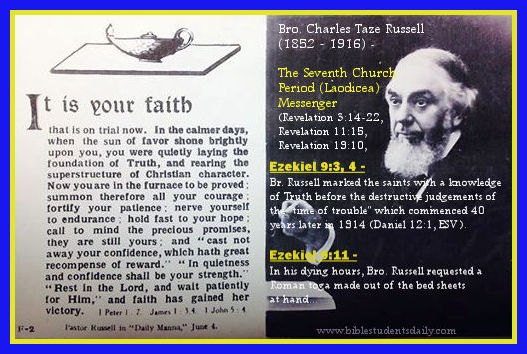







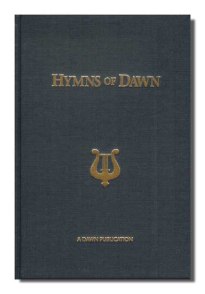

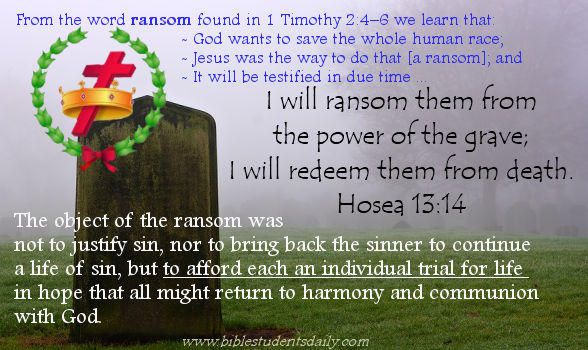
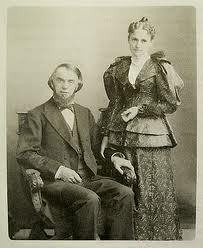
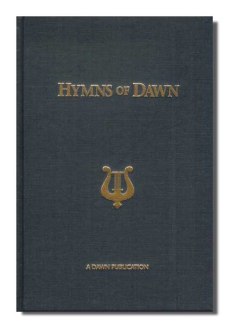

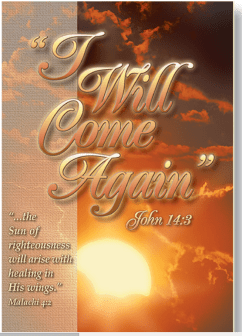
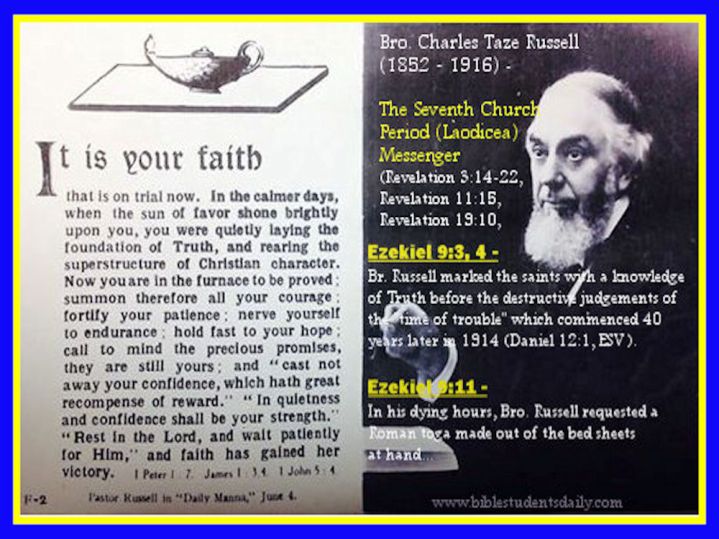

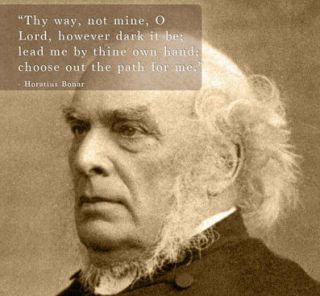 Born and raised in Edinburgh, Scotland, Horatius Bonar became a pastor at Kelso in 1837 and six years later joining the Free Church of Scotland. His reputation as a religious writer was first gained on the publication of the “Kelso Tracts,” of which he was the author, yet he is no less favorably known as a religious poet and hymn-writer.
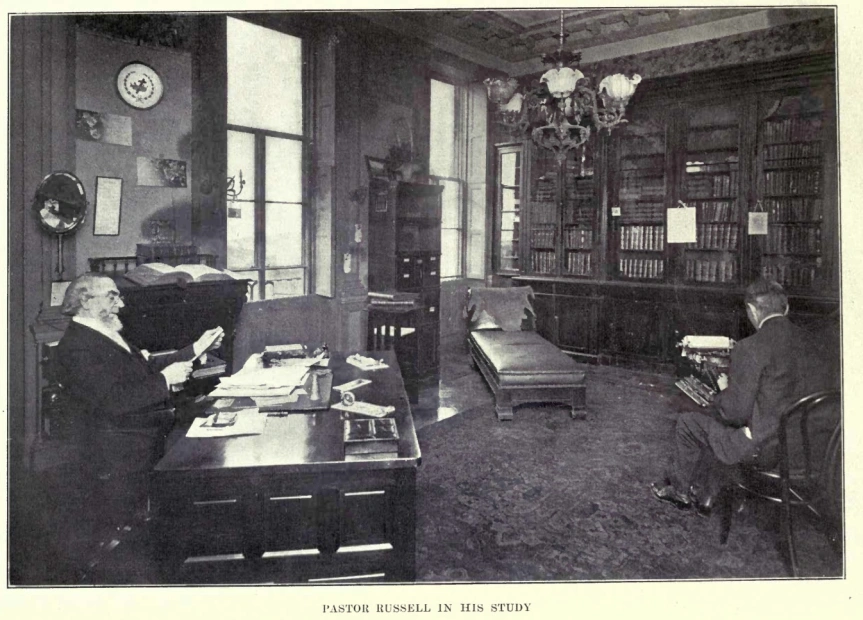

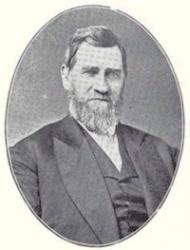
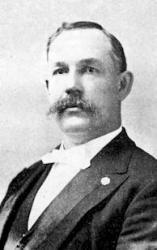 E. O. Excell, was a prominent American publisher, composer, song leader, and singer of music for church, Sunday school, and evangelistic meetings during the late nineteenth and early twentieth centuries.
 BIBLE Students DAILY