Father, Son, and Holy Spirit

father son and holy spirit - NO ADDRESS.jpg

ALL are born with an inherent tendency to worship a higher power—a Supreme Being. Some have tried to dismiss the idea of GOD, and to get along without religion, but sooner or later come back to the worship of some kind of a higher power. Others, in their anxiety not to overlook any advantage that might accrue to them from allegiance to deity, have had a multiplicity of gods. The Athenians of old even went so far as to erect an idol to the “unknown God” (Acts 17:23).

The true Deity of the Bible has been an “unknown God” to most people in all ages, and is even today.

The Bible tells is that there is one GOD, whose name is Jehovah, Yahweh who is addressed by Christians as their Heavenly Father.

The Bible also tells us of the “Son of GOD,” who is our Lord Jesus Christ, the Redeemer and Savior of the world. The first chapter of the Gospel according to St. John states that Jesus, in his prehuman existence was known as the Logos,” that is, the “Word,” or mouthpiece of Jehovah, the Creator. In his relationship to mankind, as Savior and Redeemer, Jesus is prophetically spoken of as the “Prince of Peace”; the “Mighty God”; “Emmanuel”; “Michael”; “King of kings”; “Mediator”; etc. These various titles do not describe different gods, but various characteristics of this one Son of GOD, whom the Father has commanded shall be honored even as he himself is honored (Isaiah 9:6, Matthew 1:23, Daniel 12:1, Revelation 19:16, 1 Timothy 2:5).

The Bible also speaks of the “Holy Spirit.” Through a misunderstanding the Holy Spirit has been construed to be a personality, a third mighty being, equal in power and glory to the Father and Son, yet in some mysterious way, one in substance with them. But this view is not scriptural, as we shall see. Rather, the Holy Spirit mentioned so prominently in the Scriptures is the holy power or influence of GOD—a power which operates for the accomplishment of the Divine purposes wherever and whatever they may be. This fact will become readily apparent as we examine the Bible scriptures.

1. JEHOVAH –  a GOD of Love

In a more or less widespread misconception of Jehovah, he is thought of as being austere and unsympathetic, demanding cruel punishment for all who deviate from the doing of his will. In this view, Jesus is looked upon as the loving GOD of the Bible, the One who stepped between the stern Creator and man as a Redeemer and Savior of the human race.

In our search of the Scriptures to find what they say about the “GOD of love and mercy,” it is important, first of all, to note that Jehovah himself, as well as Jesus, is clearly shown to possess the quality of love. In Titus 3:4, in fact, He is spoken of as our “Savior,” and is there said to be kind and loving. This, the scriptural view of Jehovah, reveals Him as being the Author of the plan of salvation, and Jesus as heartily co-operating.

“God so loved the world, that he gave his only begotten Son, that whosoever believeth in him should not perish, but have everlasting life” (John 3:16; 1 John 4:9,10; Hebrews 10:5-7).

The name Jehovah means the Self-existent, or Eternal One. (Dr. James Strong) In the Bible it is applied exclusively to the Creator, the great First Cause of everything.

“From everlasting to everlasting,” is one of the scriptural expressions used by the Holy Spirit to emphasize that Jehovah is not a created being, but the Creator of all things (Psalm 90:2).

The name Jehovah is never applied to Jesus.

The name Jehovah is, of course, an Old Testament word. It is not used by the New Testament writers, evidently for the reason that they considered it too sacred a name to translate into another language, or, perhaps because there was no suitable Greek word to use in translating it. But this does not mean that Jehovah is merely a tribal god of the Jews, as some would try to make us believe. He is the one true GOD, the Creator of the universe, and the one in whom all animate creation lives and moves and has its being (Acts 17:24-28).

Other Gods in the Old Testament

There are other Hebrew words in the Old Testament translated Lord and God. These, while sometimes applied to Jehovah, are also sometimes prophetically applied to Jesus; sometimes to one or more of the angels; and sometimes even to heathen rulers, and heathen gods. There are three of these Hebrew words—adon, Adonai, and elohim.

  • The most frequent application of adon is to great and mighty ones of the earth.
  • Adonai is always applied to deity, but not always to Jehovah. E.g. Psalm 110:5, the Lord at thy right hand shall strike through kings in the day of his wrath.” Here the name Lord is a translation of the Hebrew word Adonai, and refers to Christ, while the pronoun “thy” refers to Jehovah.
  • The Hebrew word elohim in the Old Testament is a plural form most frequently translated “God” and “Gods,” and is sometimes used with reference to Jehovah, sometimes prophetically of Christ, occasionally, by way of deference, to magistrates, sometimes to angels, and sometimes to false gods. We mention the use of these various Hebrew words translated Lord and God in order to emphasize the fact that Jehovah is the one and only Almighty GOD, who is “from everlasting to everlasting.” There are other lords and other gods referred to in the Scriptures, but Jehovah, even when mentioned as Adonai, or Elohim, is The Adonai, and The Elohim.

Attributes of Jehovah’s Character

Jehovah has been belittled in the minds of many by a traditional misconception of his personality that has been handed down to us from the Dark Ages, in which he was depicted as an old man with a beard. The Bible does not attempt to give us a description of the bodily appearance of the great Eternal One, because our finite minds could not conceive of his glory even though it were described to us.

The Bible does, however, reveal a great deal concerning the outstanding attributes of the Divine character. It tells us of his infinite wisdom, justice, love, and power. These attributes of Jehovah’s character are in perfect balance; and by their manifestation through his dealings with the human race, his glory is revealed. However, it is largely to the degree that we understand the Divine plan for the human race, that we can appreciate the beauty of the Divine character.

While the Bible, of course, does say that GOD is love, that he is just, and wise and powerful, yet it is only as we see the outworking of these glorious attributes in the Creator’s designs toward the children of men that they become truly meaningful to us. While we can, it is true, behold the power of Jehovah in the works of creation with which we are surrounded, yet God’s plan for a resurrection of the dead; and especially his resurrection of Jesus, is a display of his power surpassing even that of his creative work (Ephesians 1:19,20).

Without a knowledge of God’s plan as a whole, one might wonder why he does not use his power to put an immediate stop to human suffering, especially in view of the fact that he is reputed to be loving as well as powerful. But we must remember that GOD is just and wise, as well as powerful and loving. Everything he does must be fully in harmony with all these attributes of his character (Psalm 89:14).

If GOD was only loving and merciful he would not have condemned our first parents to death, although he had told them if they sinned they would die. One of the fundamentals of GOD’s law is that the “wages of sin is death” (Romans 6:23). His justice, therefore, demanded that our first parents pay the penalty of their sin.

Some may argue that GOD’s plan to raise the dead is, in effect, a setting aside of GOD’s justice in demanding the death sentence for the violation of his law. But that is where GOD’s wisdom and love can be seen. If only justice alone had been considered, no provision would have been made to set aside that original sentence of death; but divine wisdom and love found a way whereby God could be just, yet use his power to restore the dead to life. This way is through Christ, the Redeemer. Jesus was the world’s “ransom,” which means a corresponding price. It was Divine love that allowed for this, for the Scriptures say that “God so loved the world, that he gave his only begotten Son, that whosoever believeth in him should not perish, but have everlasting life” (John 3:16, Hebrews 2:9).

Jehovah has changed his mind concerning the “wages of sin.” GOD’s Divine wisdom saw that it would be highly desirable that man obtain a thorough knowledge of sin and its disasterous consequences so that all men can learn obedience to GOD’s standard principle = RIGHTEOUSNESS, which shall be the ultimate result in due time.

GOD could have created enough human beings to fill the whole earth, and thus have the planet populated without the process of procreation. This would have meant that each one would have been individually on trial for life. In this case, if those who transgressed were to be redeemed from death, it would have required a separate Redeemer for each one of them. Hence, we can see the wisdom in the divine arrangement whereby Adam was held the responsible head of the entire human race. Thus his sin not only brought condemnation upon all, in that from the very start they were born imperfect, but it also made possible the redemption of all through the death of but one Redeemer (Romans 5:12).

SO all the human race has been receiving an experimental knowledge of sin and its results, and then they have been passes away temporarily in the sleep of death, to be restored during the coming kingdom period when their present experience will be a most valuable asset to them in weighing the advantages of obedience to the divine law then in force.

By this infinitely wise arrangement every child of Adam will be given an experimental knowledge of both good and evil, and thus will be equipped to choose intelligently between the two. Those who choose the good, and accept of GOD’s grace through Christ, the Redeemer, will then live forever.

GOD’s Diversified Wisdom

In Ephesians 3:10, Paul speaks of the “manifold” wisdom of GOD. The Emphatic Diaglott translation of this text uses the word “diversified.” The apostle also shows that this “diversified” wisdom of GOD is being manifested even to the angelic beings in the universe, being revealed to them specially through GOD’s dealings with the church (the 144,000 Elect and the Great Company – as explained in the Book of Revelation) of this age.

In the selection and preparation of the Church to co-operate with Jesus in the future kingdom work of rehabilitating the lost race, there is a still further manifestation of Divine wisdom. How wise that representatives of the fallen race should be chosen, tested, and then equipped to deal with and bless their fellows in the mediatorial arrangements of the new age soon to begin.

And the qualification test placed upon these is that they love GOD’s will supremely and their fellow men so unselfishly that they gladly lay down their lives in service now—imperfect though that service may be—in order that they may be exalted to a glorious future service which will actually give life to all mankind. It is this that Apostle Paul refers to as a baptism for the dead (1 Corinthians 15:29).

Yes, those who will follow in Jesus’ footsteps now, will reign with him in his thousand-year kingdom.

The purpose of that kingdom is the restoration of the entire human race to the lost earthly paradise. During those thousand years Christ and the church will serve as a mediatorial board to instruct and bless the world; and finally, to restore the people to atonement with the Creator (Revelation 20:4, Acts 3:20,21, Acts 15:16,17).

2. JESUS

Jehovah of the Old Testament Scriptures is the Heavenly Father of the New Testament.

Thus, Jesus taught his disciples to pray, “Our Father which art in heaven.”

Jesus is the Son of GOD, this being the relationship he has always enjoyed with Jehovah, the Creator. The Scriptures make it plain that Jesus had been actively associated with his Father since the earliest dawn of creation. They tell us, in fact, that he was the “beginning of the creation of GOD” (Revelation 3:14), and also, “the firstborn of every creature” (Colossians 1:15).

These passages indicate that Jesus was the direct creation of the Father, and therefore properly spoken of as his only begotten Son.” The apostle also tells us that Jesus was the active agent of Jehovah in all the creative work. He says: “For by him were all things created, that are in heaven, and that are in earth, visible, and invisible, whether they be thrones, or dominions, or principalities, or powers: all things were created by him” (Colossians 1:16, Hebrew 1:2, John 1:3, Ephesians 3:9).

In John 1:14, Jesus in his prehuman existence is referred to as the “Word” of GOD. Verse 14 says that the “Word was made flesh, and dwelt among us.” The term “Word” here used is a translation of the Greek word Logos. Ancient kings when addressing their people, customarily sat behind a lattice in front of which stood a representative who proclaimed the king’s message to the people. The representative was styled the logos—the king’s word, or mouthpiece.

God’s Son, as the Logos, has always been the active agent of Jehovah, and the Bible assures us that he always will be. Not only in the work of creation, but in the call and preparation of the church in this age, and also in the gigantic task of restitution scheduled for the approaching 1000 years of Mediatorial Reign, this beloved Son of GOD acts for the Father, expressing his will, and doing his work. In the millennial age Christ with his church, will speak peace to all the nations, and they will beat their swords into plowshares, and their spears into pruninghooks (Micah 4:3, Psalm 46:9).

The Apostle Paul explains in 2 Corinthians 15:25-28, “He must REIGN, till he hath put ALL enemies under his feet. The last enemy that shall be destroyed is death. For He [Jehovah] hath put all things under his [Jesus’] feet. But when he saith, all things are put under him [Jesus], it is manifest that he [Jehovah] is excepted, which did put all things under him [Jesus]. And when all things shall be subdued unto him, then shall the Son also himself be subject unto him [Jehovah] that put all things under him, that God [Jehovah] may be all in all.

Considerable confusion has resulted from an inaccurate translation of John 1:1,2, where the King James Version makes it appear that the “Word,” or Logos, is the same personality as GOD. The “Word was God,” is the way this faulty translation puts it. But in the original Greek text the matter is made clear. There a distinction is made between the Logos, who was “a” God, and the Father, who is referred to as “The” GOD. The translation should read, “In the beginning was the Logos, and the Logos was a God. The same was in the beginning with The God.”

The Greek word Theos is the one in this text that is translated God. Theos simply means a mighty one, and it must be determined from the text in which it is used, whether the reference is to Jehovah, the Great and Almighty One, or to His Son, Christ Jesus, formerly the Logos, who is “a” mighty One. As a matter of fact, this same word Theos is used in 2 Corinthians 4:4, where the reference is to Satan, the “god [theos] of this world.” However, in the Greek text, the definite article “The,” makes it clear who is meant.

Thus we see that it was the Logos, as “a” God, the one who was the active agent of Jehovah in the creative work, who was “made flesh.” It is interesting to note, in this connection, the form of expression used in the Genesis account of creation, where we read, “Let US make man in OUR image,” etc. Here Jehovah is speaking to the Logos, outlining and directing the work in hand (Genesis 1:26).

And, in keeping with this spirit of oneness and co-operation, when the time came for fallen man to be redeemed, the Logos “humbled himself,” becoming a servant in lowly form, for the suffering of death upon the cross. (Philippians 2:7,8) During the whole period of his earthly ministry Jesus remained humble, always reminding those to whom he ministered that the words which he spoke, and the works which he did, were not his own, but those of the Heavenly Father. This was in full keeping with his plain assertion, “My Father is greater than I” (John 14:28).

Jesus’ Oneness with the Father

Jesus declared to his disciples, “I and my Father are one.” (John 10:30) This statement has been misused in an effort to prove that Jesus and his Father were one and the same Person. But all will concede, we believe, that there are forms of oneness other than that of a similarity of being. In John chapter 17, Jesus is quoted as praying for the oneness of his church. In this prayer he asks his Father to bring about the same kind of oneness between his church and himself as existed between himself and his Father. This, obviously, is a oneness of will and purpose.

During Jesus’s ministry, he emphasized over and over that he came not to do his own will, but the will of the Heavenly Father who sent him. When Jesus was facing mockery, ignominy, and death, he asked the Father to let this cup pass from him if it were possible. “Nevertheless,” he said, “not my will, but thine, be done.” (Luke 22:42; Matt. 26:39; John 5:30; 6:38) The Heavenly Father’s will was ever paramount in the Master’s life, hence he could truly say, “I and my Father are one.”

This is also the reason Jesus could truthfully say, “He who hath seen me hath seen the Father.” (John 14:9) This statement of Jesus does not mean that in seeing him one actually saw Jehovah, as throughout the Bible we have statements to the effect that no one can look upon GOD and live. (Exod. 33:20; I Tim. 6:16; 1:17; John 1:18) If those who looked upon Jesus in the flesh thereby actually saw GOD, it would mean that GOD, the creator of the universe, is a human being. What Jesus meant was that his life and ministry served to reveal the Father to those who had “eyes to see.”

And besides, it should be remembered that Jesus in the flesh was an exact counterpart of father Adam, of whom it is said, that he was created in the “image of God.” This, of course, refers to a moral image, not a physical likeness. It means that Adam was capable of discerning between right and wrong, as those principles were enunciated in the law of his Creator. This is the reason he was held responsible for his sin.

Jesus, like Adam before the fall, was also in the image of God—a perfect, sinless human being. It was necessary that Jesus be thus, else he could not have redeemed Adam and his race from death. He came to earth as a representative of the Heavenly Father, and everything he did and said was just what the Father would have done and said had he personally visited the earth. Thus it was true that, in a very wonderful way, those who saw him saw the Father. It was the only way that a fallen human being could I see GOD and live.

We should honor the Son even as we honor the Father. (John 5:23) God so highly regarded and honored the Son that he even commanded the angels to worship him, (Heb. 1:6,7) If we take the view that Jesus was GOD himself, then we have the inconsistency of the Master praying to himself, as well as other incongruities in connection with his earthly life and ministry.

Jesus Now Highly Exalted

The Bible shows that in carrying out the Divine plan of redemption for the human race, the only begotten Son of GOD has experienced two changes of nature. Before his human existence, he was a glorious spirit being, next in honor and authority to the Heavenly Father himself. Jesus referred to his prehuman glory, when he prayed, “O Father, glorify thou me with thine own self with the glory which I had with thee before the world was.” (John 17:5) That glory was laid aside when the Logos was “made flesh.” Jesus was made flesh, the apostle explains, “for the suffering of death.” (Heb. 2:9,14) As a spirit being he could not give himself as a corresponding price for father Adam and his race, so he humbled himself that he might die as a ransom to save the human race from eternal destruction.—Phil. 2:7, 8; I Tim. 2:5,6

In raising the Master from the dead the Father did more than restore his Son to his former position of glory in the heavenly realm. He highly exalted him to a place next to himself on the throne of the universe. GOD exalted him to the Divine nature, also, so that now he is truly the Divine Christ—the “express image of the Father’s person.” (Ps. 110:1; Acts 2:34,36; Phil. 2:9-11; Heb. 1:3,13) Hallelujah, what a Savior!

3. THE HOLY SPIRIT

Through mistranslation and otherwise, many have been led erroneously to believe that the Holy spirit is a person, the third person of a trinity God; but the Scriptures, when properly understood, do not warrant this thought. One of the mistranslations contributing to this misunderstanding is where the Greek word pneuma is rendered by the English word “ghost.” This makes the holy Spirit to be a holy “Ghost.”

But this is a gross mistranslation, and so recognized by the American Revision Committee who translated the Revised Version. In a number of instances, both the British and American Revisers corrected “Ghost” to “Spirit.” The American Revisers use the word “Spirit” where the King James Version reads “Ghost.”

The King James Version was translated at a time when superstition was rife, hence the word “Ghost” would command a great deal more respect and reverence than it does today. Back in the days when the KJV Bible was written, ghosts were very real in the minds of most people, yet very mysterious. They were always associated with the thought of personality, and the translators, believing in a personal holy Spirit, conceived the idea of calling it a holy “Ghost.”

In the Old Testament the word “spirit” is a translation of the Hebrew word ruach. The primary significance of this word is wind. We do not mean to imply by this, however, that the holy Spirit is a holy wind. This is merely the root meaning of the word. Wind is both invisible and powerful, hence the ancients applied this word to various invisible and powerful influences. Since Divine power is exercised through channels and by agencies beyond human sight and understanding, this word ruach came to be applied more and more to all of GOD’s dealings.

The word ruach, in addition to being translated “Spirit,” is also translated in the Old Testament by the English words “blast,” “breath,” “tempest,” “mind,” “smell,” “wind,” and “windy.” It will be seen that in each of these translations the thought behind the word is that of invisible power, or influence. There is power in the mind, for example, but it is a power that is invisible, and its operation but little understood.

As already noted, in the New Testament the Greek word translated “Spirit,” or “Ghost,” in the expressions holy Spirit or holy “Ghost,” is pneuma. The primary meaning of this word is also wind, or air. It is the word from which our English word pneumatic is derived. In addition to being translated Spirit and Ghost, it is also translated in the New ‘testament by the words “life,” “spiritual,” and sometimes “wind.” In Revelation 13:15 it is translated life, and here the reference is to life that is given to the image of the beast.”

The holy Spirit then is the invisible power of GOD, a power that is manifested in a great variety of ways. Speaking of GOD’s creative power we read that his “Spirit moved upon the face of the waters.” (Genesis 1:2) That was a life-giving Power.

The influence of the holy Spirit in our lives as Christians is primarily that of GOD’s mind—the power of his expressed will for us.

Various manifestations of the holy Spirit are referred to as “The Spirit of Christ,” the “Spirit of holiness,” the “Spirit of truth,” the “Holy Spirit of promise,” the “Spirit of meekness,” the “Spirit of grace,” the “Spirit of prophecy.”

The various manifestations of the spirit of Satan are described as the “spirit of fear,” the “spirit of bondage,” the “spirit of the world,” the “spirit of error,” the “spirit of divination,” the “spirit of antichrist,” and the “spirit of slumber.” No one would conclude that because the word spirit is thus used to describe the various manifestations of Satan’s influence in the world, that there is a personal unholy spirit, that is one in substance with the Devil.

Born of the Spirit

There are a number of expressions used in the Scriptures to describe the work of the holy Spirit in the hearts and lives of Christians. One of these is “born.” This is a word which suggests the coming into existence of a new life, and this is one of the things accomplished by the Power of the holy Spirit. This new life, when it conics fully to birth, will be so different from the human life that concerning it Jesus said, “The wind bloweth where it listeth, and thou hearest the sound thereof, but canal not tell whence it cometh and whither it goeth: so is every one that is born of the Spirit” (John 3:8).

The Greek word in the Bible translated “born” is also correctly translated “begotten”. When one comes to GOD in repentance and, through faith in Christ as his Redeemer, surrenders himself in full consecration to do GOD’s will, what occurs is properly described as a “begetting” of the Spirit of GOD. In other words, a new life is then begun.

But this new life, to continue the symbolism, is merely an embryo. It needs to be nourished by the Word of GOD, and thus to develop, growing strong in the Lord and in the power of his night. It is not until the resurrection that this new life comes to the birth. Not until then is one truly born of the Spirit. Not until then are the words of Jesus true that one thus born is able to go and come invisibly as the wind.

Baptism of the Spirit

The Scriptures also speak of the “baptism” of the Spirit. The word baptize means to bury, and to be baptized by the Spirit of GOD simply means to be so fully surrendered to the doing of GOD’s will that one comes fully under its control, having no will of one’s own.

The Apostle Paul wrote, “For by one Spirit are we all baptized,” and he explains that for the individual this baptism occurs when one comes into the body of Christ (1 Corinthians 12:13). It is a burial of our wills into the will of God as expressed through Christ, the Head of the “body.”

When we understand what to expect as a result of placing ourselves under the influence of the Holy Spirit, we will not be wondering why we cannot speak with tongues as did the disciples at Pentecost and for a short time thereafter. Speaking with tongues as practiced by the early Church was a necessity at that time. At Pentecost, for example, Jews were gathered at Jerusalem from all parts of the known world. They spoke various languages, yet it was the Lord’s will that they should receive a witness of the truth as proclaimed by the apostles. In order for this to be accomplished, the disciples were miraculously empowered to speak in these various languages. As the church grew, and conversions were made among these various language groups, the need for speaking with tongues no longer existed, for there were disciples among all the various groups capable of witnessing to the Gospel in their native tongues.

Filled with the Spirit

The Scriptures declare, “Be ye filled with the Spirit.” (Ephesians 5:18) How void of meaning would this expression be if the Holy Spirit were a person! But when we recognize that it is simply the power, or influence, of GOD, exercised in the Christian life largely through his written Word, then we can understand how it is possible to have either more or less of the Spirit influencing our lives.

To be filled with the Spirit calls for an emptying of self and self-will, and a diligent application of ourselves to the study of GOD’s Word and to putting into practice all of its righteous precepts.

In the Scriptures, Christians are also said to be “sealed” by the “holy Spirit of promise.” (Ephesians 1:13) GOD’s Spirit directed the minds of the prophets in writing the Old Testament in which are recorded many promises vouchsafing GOD’s blessing upon His faithful people. The New Testament was also written under the direct inspiration of the Spirit, or power of GOD, and it contains additional promises by which GOD guarantees victory through Christ for every faithful follower of the Master. Thus He “seals” us by His promises; that is, He assures us that if we are faithful to Him He will give us Grace to help in every time of need, and in the resurrection will give us a crown of life.

All Flesh to be Blessed

GOD’s Spirit will be poured out in various ways for the blessing of mankind during the 1000 Year Messianic Reign of CHRIST and His Bride, the 144,000 Elect.. He will cause the knowledge of his glory to fill the whole earth as the waters cover the sea. (Isa. 11:9) His power will also operate to restore the dead to life, for the promise is that there “shall be a resurrection of the dead, both of the just and the unjust” (Acts 24:15).

In a promise of a New Covenant which the Lord will make, first with the house of Israel, and then with the whole world, the statement is made that the Lord will write His law in the hearts of the people. (Jeremiah 31:31-34) This, too, will result from the operation of His Holy Spirit in the lives of those who obey the laws of Christ’s kingdom.

During this 1000 year Mediatorial Reign,  Satan and all his army of evil angels will be bound, thus his spirit will not be influencing people to do wrong. Instead, every condition of the new social order will be favorable to the doing of GOD’s righteous will. Love will take the place of selfishness as a motivating power in all human activity. The people will learn that the greatest and only enduring joy comes from DOING RIGHTEOUSLY to others rather than from selfishly seeking always to take care of one’s own interests first.

Thus the whole outlook of the human race gradually will be changed as a result of the outpouring of GOD’s Spirit upon all flesh.

How glad we should be that the power of GOD is thus to be manifested for solving the problems of a distressed and dying race! When the blessings accruing from this outpouring of the holy Spirit will be recognized as coming from the great and true GOD of the universe, the Creator of heaven an d earth, the people will be glad to give glory to him, for they will then know that he is truly a GOD of PERFECT AGAPE LOVE -what more could one ask for then this level of PURE LOVE?

Acknowledgment

The Dawn Bible Students Association for content from the Booklet, “Father, Son, Holy Spirit.”

Suggested Further Reading

The Doctrine of the Trinity – Mystery or Confusion
http://www.heraldmag.org/1999/99nd_3.htm

The Origin of the Trinity – From Paganism To Constantine
http://www.heraldmag.org/olb/Contents/doctrine/The%20Origin%20of%20the%20Trinity.htm

Facts About the Trinity
http://www.heraldmag.org/olb/contents/doctrine/FACTS%20ABOUT%20THE%20TRINITY.htm

God and the Trinities
http://www.heraldmag.org/literature/doc_42.htm

What Is The Heavenly Father’s Name

GOD’S NAME – What Is The Heavenly Father’s Name That We Are To “Hallow” And Why?

Jesus – The Name

JESUS – The Name

The Doctrine of Christ – Booklet

Click to access DoctrineChrist.pdf

The Truth About Hell

What Does the Word “HELL” Really Mean?

What Does It Mean To Be Baptized Into Christ?

What Does It Mean To Be Baptized Into Christ?

Is Mere Faith In God Enough?

2 PETER 1:5-11 – Is Mere FAITH IN GOD Enough?


The URL of this post:
Father, Son, and Holy Spirit

Enter your email address to subscribe to this blog and receive notifications of new posts by email.

BIBLE CHRONOLOGY & TIME PROPHECY in 2016- A 6 Part Seminar by David Rice

6000 years -  FINAL

Dear friends,

Our intention is that this post with the 6 videos included not only increase our thanks to our Heavenly Father, but that it will increase our devotion and reverence to HIM, from whom ALL blessings flow.

Thank YOU for taking the time to consider our opinion… well not just ours, but the study conclusions from Scripture. The content in the video seminars very concisely and clearly (with the use of charted visual overheads) explain what to expect to see from here going forward, if our expectations are about in the right direction.

We believe the present generation will not pass before the body of Christ is completed. Specifically,
evidence is here presented that 6000 years of man’s history, from Adam forward, will close about the year 2043 AD, and presumably the grand Seventh Millennium will then commence. This does not mean we know the date when the last saints will pass beyond the veil to their reward. We do not. But it does seem to give us an upper bound.

‘Revelation 20:4 – The reign of the saints cannot be properly said to begin before all the “jewels” have been gathered ‘ 

Reprints of the Original Watchtower and Herald of Christ’s Presence 2739-2740

Revelation 20:4  – And I saw thrones, and they sat upon them, and judgment was given unto them: and I saw the souls of them that were beheaded for the witness of Jesus, and for the word of God, and which had not worshipped the beast, neither his image, neither had received his mark upon their foreheads, or in their hands; and they lived and reigned with Christ a thousand years.

In an attempt to learn/experience everything  our Divine Father would wish us to and learn about His glorious Plan of Salvation in our desires to have ready characters when called to our Divine home  if faithful in RIGHTEOUSNESS (GOD’s standard of acceptance) until death (2 Cor 11:2; 2 Cor. 4:14; Ephes. 5:26-27; Rev. 14:4), we may find the discussion about Biblical chronology in the spirit of brotherly agape and sweet fellowship greatly encouraging in better recognizing the glorious harmony in GOD’s perfect symmetry of HIS DIVINE PLAN for all mankind.

If we be anywhere in error of our Heavenly Father’s way, we TRUST and PRAY, our GOD shall make clear the path in HIS due time.

“Let us press on toward the goal to win the prize of God’s heavenly calling in Christ Jesus. All of us who are mature should embrace this point of view.

And if you think differently about some issue GOD will reveal this to you as well” – Philippians 3:14-15 (Berean Study Bible)

Above all, we believe the most important date is “Be thou faithful unto death.” Revelation 2:10

Just one final comment about dates – some of us may believe the thousand year reign of Christ began in 1874 whereas others of us may believe it is a future occurrence; some brethren believe the period of mediation must be 1000 years and others believe it is less than 1000 years and on, and on, and on.
 
We believe all of us know in part (1 Cor. 13:9) while we are on this side of the veil, and if we are faithful, we may be very surprised to realize what we didn’t know once we get beyond.
If the Heavenly Father was judging us on how much we knew rather than whether our characters are crystallized, getting all the facts straight in our heads about chronology would be of prime importance and besides that, no two brethren in Christ see eye to eye on every point if we are actually thinking for ourselves.

Please note: Then the content of the Biblical and chronological discussions below, can be accessed in a concise written format here: 2043ad.com

*Dear friends, to watch each of the recorded sessions below, please click on either the underlined titles or the arrows.

Part 1 – Bible Chronology Seminar, David Rice

Part 2 – Bible Chronology Seminar, David Rice

Part 3 – Bible Chronology Seminar, David Rice

Part 4 – Bible Chronology Seminar, David Rice

Part 5 – Bible Chronology Seminar, David Rice

Part 6 – Bible Chronology Seminar, David Rice

Here is a PDF version of all the slides used in the above 6 session Chronology and Time Prophecy Seminar :- All Slides – Chronology & Time Prophecy

Acknowledgement:

Bro. David Rice – Thank you for sharing the knowledge about God and our LORD Jesus Christ with great Joy and Humble Confidence in the LORD to shed light on the Beauties of Truth, and by so doing, encourage others to likewise examine everything carefully; hold fast to that which is good; and thus be the more to make our calling and election sure. 1 Thessalonians 2:20; Mark 16:15

The friends in Christ from Montana, USA – who immediately alarmed us about this post’s initial video glitch issues – thank you for your loyalty in letting us know straight away – how very kind and considerate. Mark 9:41

URL: https://biblestudentsdaily.com/2016/06/20/bible-chronology-time-prophecy-in-2016-a-6-part-seminar-by-david-rice/

Enter your email address to subscribe to this blog and receive notifications of new posts by email.

Save

Save

Save

Save

Save

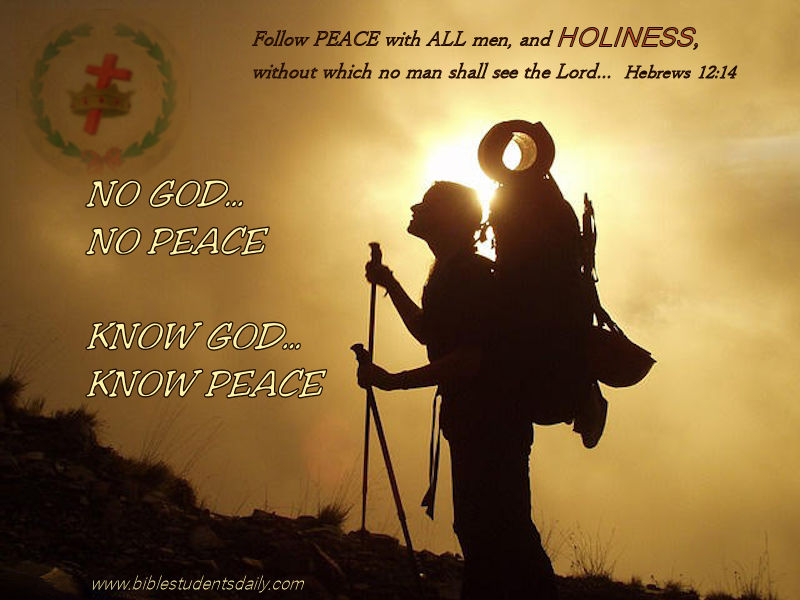
No GOD No Peace, Know GOD Know Peace

mountain-climbing-trekking-photo- plus verse.jpg

Let us go on a journey where we shall find PERFECT PEACE. Are you ready?

Our destiny is the mountain top of serene peace and joy, with hope driving our heart towards faith in receiving what one seeks to find.

Let us stick together, with the good things seeping in and immediately clearing our mind of any negative thoughts before our first step upward and onward till we reach our destination.

As we begin our climb, we “breathe in” some thoughts about heavenly peace, quizzing our mind with questions that arise:

WHERE can perfect peace be found? WHO is actually perfect? HOW can we understand God-Jehovah’s perfection?

Here are some answers:

“As for GOD, his way is perfect: the word of the LORD is tried: he is a buckler to all those that trust in him” (Psalm 18:30).

“The Rock! His work is perfect, For all His ways are just; A GOD of faithfulness and without injustice, Righteous and upright is He” (Deuteronomy 32:4).

“The law of the LORD is perfect, restoring the soul; The testimony of the LORD is sure, making wise the simple” (Psalm 19:7).

The LORD is righteous in all His ways And kind in all His deeds” (Psalm 145:17).

“As for GOD, His way is blameless; The word of the LORD is tested; He is a shield to all who take refuge in Him” (2 Samuel 22:31).

Your word is very pure: therefore your servant loves it” (Psalm 119:140).

Every word of GOD is pure: he is a shield to them that put their trust in him” (Proverbs 30:5).

The above responses from the Bible writers, whose words were all divinely inspired by God, are all about God-Jehovah.

Now what about Jesus? Is God’s only begotten and firstborn son Jesus—the Messiah—also perfect, and was Jesus perfect when the Heavenly Father, Jehovah, sent him to redeem mankind from the sentence of Adamic death by paying the exact ransom (corresponding price) to be fulfilled in due time?

Here are some quotes from the Bible where we may find answers to these questions:

“Who committed no sin, nor was any deceit found in his mouth” (1 Peter 2:22).

“For we do not have a high priest who cannot sympathize with our weaknesses, but One who has been tempted in all things as we are, yet without sin (Hebrews 4:15).

“You know that He appeared in order to take away sins; and in Him there is no sin(1 John 3:5).

“When Pilate saw that he was accomplishing nothing, but rather that a riot was starting, he took water and washed his hands in front of the crowd, saying, ‘I am innocent of this Man’s blood; see to that yourselves’(Matthew 27:24).

Why did Pilate say this?

Here is why:

“Pilate came out again and said to them, ‘Behold, I am bringing Him out to you so that you may know that I find no guilt in him’” (John 19:4).

Jesus said: “And He who sent me is with me; He has not left me alone, for I always do the things that are pleasing to Him (John 8:29).

About Jesus, it is written: “His grave was assigned with wicked men, Yet he was with a rich man in his death, because he had done no violence, nor was there any deceit in his mouth.(Isaiah 53:9).

In 1 Peter 1:18-19, Jesus is described as “unblemished” and “spotless”: “We knowing that you were not redeemed with perishable things like silver or gold from your futile way of life inherited from your forefathers, but with precious blood, as of a lamb unblemished and spotless, the blood of Christ.”

The Apostle Paul explains, He made him who knew no sin to be sin on our behalf, so that we might become the righteousness of God in Him” (2 Corinthians 5:21).

What do the words to be sin on our behalf” mean?

The Apostle Peter explains what it means: that Jesus “himself bore our sins in His body on the cross, so that we might die to sin and live to righteousness; for by His wounds you were healed” (1 Peter 2:24).

How then can we as humans have peace if we are not perfect? Are we perfect in some way or another?

Jesus taught usBe ye therefore perfect, even as your Father which is in heaven is perfect” (Matthew 5:48).

How then, can we “be… perfect,” if we were already born in sin?

From the second a human is born, we have the curse of Adamitis on us, which is the death sentence. A baby who is even a few seconds old, can die. If we were perfect, death could not touch any human and everyone could live forever as their perfect life would allow no disease nor any harm to take their life. Thus, if we are already born imperfect, how can we find perfect peace?

Let us explain.

We might not of course be able to achieve perfect peace all the time in the current imperfect bodies we have, yet we are to “be perfect” in intentions, as all fully consecrated Spirit begotten individuals are reckoned in God’s eyes as perfect, through faith in the precious blood of Christ’s righteousness and through showing God-Jehovah through one’s thoughts, words and actions just how much there is a desire to DO what is good, righteous, perfect, pure and blameless in God’s sight, to please the Heavenly Father.

It is one’s faith in believing that God can do the impossible—that He could even move an entire mountain, and trusting in God’s perfect love, justice, power and wisdom implicitly.

This isn’t just blind faith.

This isn’t just following tradition.

This isn’t an unwilling, forced upon believing for self-gain or professing faith in God to just to please someone.

In Romans 10:17, the Apostle Paul explains that faith in God and faith in all that is Godly and righteous and pure and perfect, comes from “hearing the word of God,” and once we hear it, then we are instructed to actually examine and study it (1 Thessalonians 5:21). By studying the inspired words of God in the Bible (2 Timothy 2:15) handed down through God’s holy Prophets of old and the Apostles of the first Church (after Pentecost), and by praying to the Heavenly Father with thanksgiving and earnestness of the heart (Hebrews 5:7, Matthew 6:4-6, James 5:16), striving to please God by doing His will (Romans 12:2), then maturity in the faith can be attained and maintained.

“But solid food is for the mature, for those who have their powers of discernment trained by constant practice to distinguish good from evil” (Hebrews 5:14).

What do the Scriptures say about the faith of some?

In Romans 4:3,5 we read,

“(3) Abraham believed God, and it was counted to him as righteousness. (5) And to the one who does not work but believes in him who justifies the ungodly, his faith is counted as righteousness.”

Now back to our question: Can we as mortals be classified as perfect and hence even qualify to receive perfect peace?

Here are some answers from the Bible:

“Therefore, beloved, since we have these promises, let us cleanse ourselves from everything that defiles body and spirit, perfecting holiness in the fear of God” (2 Corinthians 7:1).

“Be imitators of God, therefore, as beloved children” (Ephesians 5:1).

How are we doing on our climb? Let us continue taking refreshing sips of pure “water” from the purifying Word of God (Matthew 5:6) for by thinking on “whatever is true… honorable… just… pure… lovely… commendable, if there is any excellence, if there is anything worthy of praise” (Philippians 4:8) we can take captive every thought to make it obedient to Christ” (2 Corinthians 10:5).

As we ascend, step by step, going from strength to strength (Psalm 84:7), we look ahead to what is before us (Proverbs 4:25,26, Hebrews 12:2) and patiently (Romans 12:12) with joy, press forward, towards our destination. We are reminded of the words of the Apostle Paul in Philippians 3:13-21:-

(13) Brethren, I count not myself to have apprehended: but this one thing I do, forgetting those things which are behind, and reaching forth unto those things which are before,

(14) I press toward the mark for the prize of the high calling of God in Christ Jesus.

(15) Let us therefore, as many as be perfect, be thus minded: and if in any thing ye be otherwise minded, God shall reveal even this unto you.

(16) Nevertheless, whereto we have already attained, let us walk by the same rule, let us mind the same thing.

(17) Brethren, be followers together of me, and mark them which walk so as ye have us for an ensample.

(18) For many walk, of whom I have told you often, and now tell you even weeping, that they are the enemies of the cross of Christ:

(19) Whose end is destruction, whose God is their belly, and whose glory is in their shame, who mind earthly things.)

(20) For our conversation is in heaven; from whence also we look for the Saviour, the Lord Jesus Christ:

(21) Who shall change our vile body, that it may be fashioned like unto his glorious body, according to the working whereby he is able even to subdue all things unto himself.

Let us get to the point of our original question. Where can we find perfect peace in a world surrounded by pain, sickness, tragedy and death?

The short answer is: We can find perfect peace when we stick to the path set out by God—walking in accordance to God’s rule.

What is God’s rule?

It is the commandment that Jesus taught—as a summary of all 10 commandments under the Old Law given to the nation of Israel via Moses in the Old Testament—recorded in the Gospel of John 13:34. Here Jesus said:

“(34) A new commandment I give unto you, That ye love [Strongs #25, agapao] one another; as I have loved [Strongs #25, agapao] you, that ye also love [Strongs #25, agapao] one another. (35) By this shall all men know that ye are my disciples, if ye have love  [Strongs #26, agape] one to another.”

There are three different types of “love” in the world around us and in the Greek language, they are described as: agape, phileo and eros.

The word “love” here in John 13:34, 35, is translated from the Greek word “agape, which is an unconditional goodwill towards all men; love, benevolence, and feeling sincere kindness and good will towards our enemies and those who do harm to us, whether we classify this harm as from ignorance or not.

Agape love, thinks of others as better than one’s own self (Philippians 2:3).

In 1 John 3:15 we are explained that “Whosoever hateth his brother is a murderer: and ye know that no murderer hath eternal life abiding in him.”

What a pleasure it is to be in the midst of such who speak kindly to and about others. These are described in Psalm 92 who “flourish like the palm tree” …. whostill bring forth fruit in old age.

In Titus 3:2 we are reminded, “to speak evil of no one, to avoid quarreling, to be gentle, and to show perfect courtesy toward all people.”

Here we are taught to rather hate the sin and AGAPE our brother and sister in Christ,  since we do not have a perfect mind in the same sense that our Beloved, Christ Jesus had when he was in the flesh during his human existence.

Through meditation upon the word of God, unceasing prayer and praise to the Heavenly Father, as well as through the experiences of life, we have a privilege to learn, by God’s grace and mercy, to speak the pure language of God. The Apostle Paul exhorts us in Colossians 4:6, “Let your speech always be gracious, seasoned with salt, so that you may know how you ought to answer each person.” “Not only should our speech be liberal [i.e. free from prejudice, tolerant], temperate [marked by self-control], courteous [i.e. polite, respectful towards and considerate of others], but it should also be seasoned with salt. Salt is a figure for truth. Truth, like salt, has the power of preserving from decay that which is good and pure.We should, therefore, be well established in the truth of God’s Word, that we may be able to answer every one, giving a good Scriptural reason for both our faith and our practice” (Br. Charles T. Russell, R756).

There is a saying: “Positive begets positive.” Let positivity rule our mind by feasting on the beauties of divine Truth in the Bible— keeping our hope in Christ.

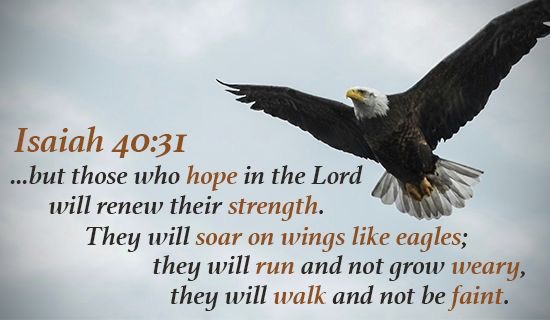
ISA. 40, 31- 1.jpg

Positivity is a quality possessed in kings. How can a king rule without a vision? (Proverbs 29:18). A king has a vision and such a vision must be possessed by those developing in the School of Christ to be faithful unto death—a vision that sees the positive (Titus 1:15). We have many gloriously positive things to look forward to, which the Bible outlines: no more oppression; no more money issues in the future to cause jealousy or the need to have power; no more killing; no more struggles for food or a shelter or to feel safe or perfectly understood and loved; no more pain or sickness and no more death!

The Heavenly Father has promised a glorious future to ALL mankind as we are told in Revelation 21:4, (4) And God shall wipe away all tears from their eyes, and there shall be no more death, neither sorrow, nor crying, neither shall there be any more pain; for the former things are passed away.”

There are passages of holy Scripture that talk about the necessity of words of warning. Here are some good examples:

“Now we exhort you, brethren, warn them [Strongs #3560, noutheteō—to caution or warn gently] that are unruly [“idle” (ESV), “lazy” (NLT), “undisciplined” (NET), “idle” and “disruptive” (NIV), “disorderly” (Rotherham’s)] comfort the feebleminded, support the weak, be patient toward all men (1 Thessalonians 5:14).

“So watch yourselves. If your brother sins, rebuke him, and if he repents, forgive him” (Luke 17:3).

We are taught in Scripture to recognize who is a True Christian by their “fruits” of character (Matthew 7:16).

The more one sees their own failures and mistakes of actions, the more one can have compassion, we hope, towards others, realizing that often the more we (agape) love, the more we share in the sufferings of Christ… and this makes the heart long more for that which the Bible promises: the day of perfection in all things when God shall be ALL in ALL and all pain, sorrow and misunderstanding shall be no more.

The Apostle Paul speaks of this time in 1 Corinthians 15:28, “And when all things shall be subdued unto him, then shall the Son also himself be subject unto him that put all things under him, that God may be all in all.”

How do we agape others and ourselves ?

HERE is where the hardest (upon the flesh) but most glorious (for the New mind in Christ) challenges lie. It is the HARDEST part of our climb up this mountain (1 Timothy 6:12)

It requires our dependency on God’s help through Christ, “and we know that in all things God works for the good of those who love him, who have been called according to his purpose” (Philippians 4:13, Romans 8:28).

A righteous love towards all men is developed from learning to love the Heavenly Father supremely as manifested in the surrendering of one’s life rights and the acquiescence and obedience to God’s will. Obedience is learnt by fixing our eyes on Christ Jesus (Hebrews 12:2)—God’s only begotten, firstborn, perfect son, who died as a ransom for ALL humanity to pay the corresponding perfect price for Adam’s sin and all of Adam’s progeny (1 Corinthians 15:22). If we compare our trials as mortals to our Lord Jesus’ trials—who was sinless yet suffered the harshest mental and physical ignomy and pain—then one’s own experiences seem trivial.

Love (agape) towards our neighbour is all about loving our brethren in Christ as if they were our own body (Romans 12:5). These are the ones who are now in training to be part of the body of Christ—the footstep followers of Christ, and members of the 144,000 and Elect Bride of CHRIST (Revelation 7:4).

If we say that we have no sin, we deceive ourselves, and the truth is not in us (1 John 1:8).

May we seek to have a character like our Lord Jesus; to have a CHRIST JESUS’ ATTITUDE.

In 1 John 2:6 we read, “The one who says he resides in God ought himself to walk just as Jesus walked.”

The Apostle Paul describes numerous Christ-like qualities of character in Philippians 2:1-11:-

“(1) Therefore if there is any encouragement in Christ, if there is any consolation of love, if there is any fellowship of the Spirit, if any affection and compassion,

(2) make my joy complete by being of the same mind, maintaining the same (agape) love, united in spirit, intent on one purpose.

(3) Do nothing from selfishness or empty conceit, but with humility of mind regard one another as more important than yourselves;

(4) do not merely look out for your own personal interests, but also for the interests of others.

(5) Have this attitude in yourselves which was also in Christ Jesus,

(6) who, although He existed in the form of God, did not regard equality with God a thing to be grasped,

(7) but emptied Himself, taking the form of a bond-servant, and being made in the likeness of men.

(8) Being found in appearance as a man, He humbled Himself by becoming obedient to the point of death, even death on a cross.

(9) For this reason also, God highly exalted Him, and bestowed on Him the name which is above every name,

(10) so that at the name of Jesus every knee will bow, of those who are in heaven and on earth and under the earth 

(11) and that every tongue will confess that Jesus Christ is Lord, to the glory of God the Father.”

The above words are also beautifully summarized in Galatians 5:22-23“But the fruit of the Spirit is love, joy, peace, longsuffering, gentleness, goodness, faith, meekness, temperance: against such there is no law.”

We are finally approaching our destination, so let us cheer each other onward and upward as to our goal we proceed with great joy and full faith, that we shall see with our eyes what we have longed to see! (1 John 3:2,3, 1 Corinthians 13:12, 13)

In Galatians 6:16 we are told, And as many as walk according to this rule, peace be on them and mercy.”

Again we ask, what “rule” is the Apostle Paul talking about, which he teaches us, may give us perfect peaceand not only peace but also mercy form God?

It is the rule of a new mind… a “new creature” in Christ mentioned in the preceding verse“For in Christ Jesus neither circumcision availeth anything, nor uncircumcision, but a new creature.

You see forms and ceremonies (just following blindly a religious ritual or offering sacrifices year after year, or week after week) are not the rule, but the new life in Christ, the new creature filled with the holy spirit of God and led of the spirit.

The rule is to “walk in the spirit,” says the Apostle, “and ye shall not fulfil the lust of the flesh; for the flesh lusteth against the spirit, and the spirit against the flesh: and these are contrary the one to the other” (Galatians 5:16,17).

Those who walk by this rule are promised peace (Philippians 4:7) and mercy. Our best efforts to walk after the leading of the holy Spirit will be imperfect in the flesh but God who judges our heart’s, desires, and efforts is merciful and will not allow us to experience one second more than what we’re able to bear (Romans 8:28).

Now if any man be in Christ, a new creature, he has put away the old man—the carnal nature, which is enmity against God and is not subject to the law of God, neither indeed can be—with all his evil deeds, which the apostle thus enumerates in Galatians 5:19-21,

“Now the works of the flesh [the carnal nature] are manifest, which are these: adultery, fornication, uncleanness, idolatry, witchcraft, hatred, variance, emulations, wrath, strife, seditions, heresies, envyings, murders, drunkenness, revellings and such like, of the which I tell you before, as I have also told you in time past, that they which do such things shall not inherit the kingdom of God.”

The Apostle gives fair warning that those who do such things, no matter how loud may be their professions, have no inheritance in the Kingdom of God; and therefore they have no right to the fellowship of the saints upon whom, and the cause of Christ in general, they bring only DIS-grace.

They that are Christ’s have crucified the flesh with the affections and desires.

If we are living according to the rule of the new nature, following the leading of the spirit of God, then we must have these fruits in some measure, even from the very start of our Christian experience; and if we are following on to know the Lord and to walk in the spirit, these fruits are surely growing and becoming more and more manifest to all with whom we are associated.

If those who are in Christ would observe this principle, and deal with each other as new creatures, much discord would be avoided; for the motives and endeavors of the “new creature” would be considered, and not the frailties or mistakes of the “earthen vessel.” (Reprints of the Original Watchtower 1840)

Reaching the Summit!

Friends, here we are at last! Here is the spectacular panoramic view from the summit top! Like an eagle (Isaiah 40:31) majestically soaring the lofy heights of grandeur that surround, so too, the fully consecrated of the Lord “soar” above the storms of life… their resting place is in the shelter of the Most High—God’s “throne of grace” which is approached with confidence to receive mercy and find grace to help in time of need (Hebrews 4:16).

“And this is the confidence that we have toward him, that if we ask anything according to his will he hears us” (1 John 5:14).

God’s perfect peace comes from sweet communion with the Heavenly Father and His Son, Christ Jesus.

PSALM 119,165.jpg

The peace of God that surpasses all understanding is a truly blessed gift from God which stems from an appreciation of God’s character and striving to copy these same qualities of character and dispositions of mind and heart, in order to gain God’s approval.

It is true to say that all men have lost much of the original likeness of God, but this does not alter the fact that they still crave the happiness and peace which can never be found except under the natural, original relations to his Creator.

Dear friends,

No matter how deep we may sink in sin …
No matter how far we may stray from the path of rectitude…
No matter how low and vile we may have become…

We still need to remember that we are all members of that noble though fallen human race and that God-Jehovah created us in His own likeness, and God knows and feels our degradation. He knows that He made us for higher and nobler ends than those toward which He is ever tending.

1384059_with address .jpg

In this painful realization of the absence of true happiness and peace of mind and heart, we humans tend to seek happiness and peace in ways in harmony with the more or less depraved tendencies of the fallen nature—in the poor substitutes which pride, ambition, strife, rivalry, wealth, fame, power, etc., have to offer; but we find that the happiness in these is only delusive, and at most VERY SHORT-LIVED!

The bubble of success may burst in an instant, and the peace and happiness built upon it be utterly wrecked.

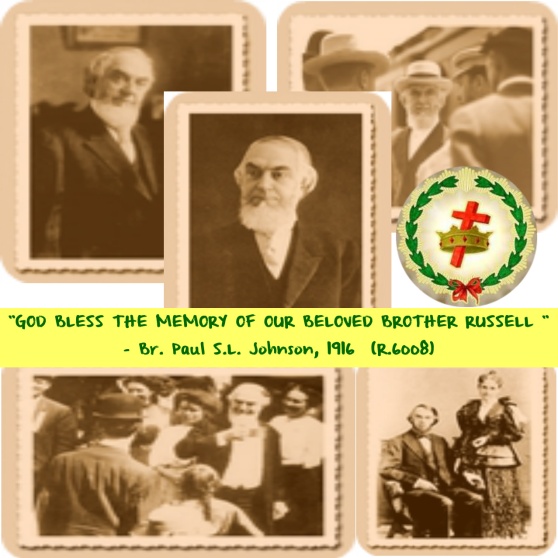
“There is no peace, therefore, to any man except in the reestablished relationship between himself and his God. And since this relationship of sons can ONLY be reestablished through Christ, there is no peace to any man out of Christ. ”

Pastor Charles Taze Russell.

“There is no peace, saith the Lord, to the wicked” (Isaiah 48:22).

“Let us follow the things that make for peace.”

(Romans 14:19)

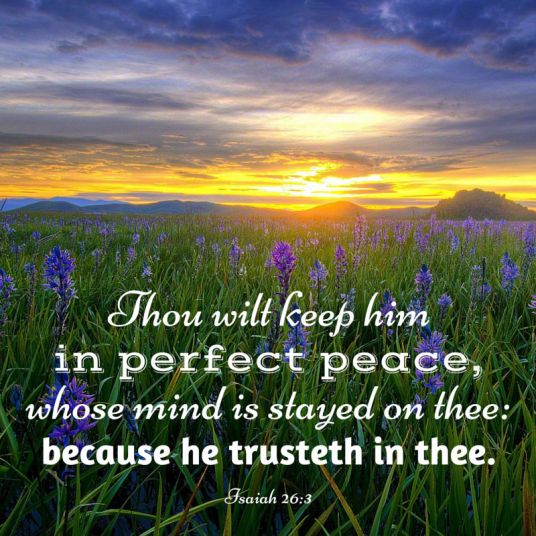
Isaiah 26.3


Acknowledgment

Br Charles T. Russell, Reprint 1840

Suggested Further Reading

What is LOVE?https://biblestudentsdaily.com/2016/03/20/what-is-love/

THE BIBLE – The World’s Best Novel. Here is Why.https://biblestudentsdaily.com/2017/07/26/the-bible-the-worlds-best-novel-here-is-why/

His Loving Kindness https://biblestudentsdaily.com/2018/06/19/his-loving-kindness-hymns-of-dawn-no-19/

HAGGAI 2:7—The Desire of All Nations Shall Comehttps://biblestudentsdaily.com/2017/08/29/haggai-27-the-desire-of-all-nations-shall-come/


This post’s URL:
https://biblestudentsdaily.com/2016/06/16/let-us-go-on-a-journey-where-we-shall-find-perfect-peace-are-you-ready/

Enter your email address to subscribe to this blog and receive notifications of new posts by email.

Save

Save

Save

Save

THANK YOU GOD

THANKS BE TO GOD WHO GIVES US THE VICTORY!

Hence, let’s rejoice, as our labours are not in vain IN THE LORD!

The words “thank you” are two words that mean so much for the giver and the receiver…

The video identifies some absolutely wonderful lessons all about thankfulness and it focuses on not trusting ourselves, as self-confidence leads to pride, but rather humbling ourselves under the mighty hand of God. Humility helps the heart be grateful.

Let us submit our entire will to the will of God, always remembering to ask our Divine Father for HIS help as we proceed to “make our calling and election sure” (2 Peter 1:10).

Here are several beautiful verses to consider:

Philippians 1:3-6 (KJV)

“3 I thank my God upon every remembrance of you,

Always in every prayer of mine for you all making request with joy,

For your fellowship in the gospel from the first day until now;

Being confident of this very thing, that he which hath begun a good work in you will perform it until the day of Jesus Christ.”

—————

Luke 17:11-19 (KJV)

 “11 And it came to pass, as he went to Jerusalem, that he passed through the midst of Samaria and Galilee.

12 And as he entered into a certain village, there met him ten men that were lepers, which stood afar off:

13 And they lifted up their voices, and said, Jesus, Master, have mercy on us.

14 And when he saw them, he said unto them, Go shew yourselves unto the priests. And it came to pass, that, as they went, they were cleansed.

15 And one of them, when he saw that he was healed, turned back, and with a loud voice glorified God,

16 And fell down on his face at his feet, giving him thanks: and he was a Samaritan.

17 And Jesus answering said, Were there not ten cleansed? but where are the nine?

18 There are not found that returned to give glory to God, save this stranger.

19 And he said unto him, Arise, go thy way: thy faith hath made thee whole.”

—————

philippians-4-vs-6-7.jpg

—————

1 Chronicles 16:7-12 (NKJV)

David’s Song of Thanksgiving

“7 On that day David first delivered this psalm into the hand of Asaph and his brethren, to thank the LordOh, give thanks to the LordCall upon His name; Make known His deeds among the peoples! Sing to Him, sing psalms to Him; Talk of all His wondrous works! 10 Glory in His holy name; Let the hearts of those rejoice who seek the Lord11 Seek the Lord and His strength; Seek His face evermore! 12 Remember His marvelous works which He has done, His wonders, and the judgments of His mouth…

—————

THANK YOU ALMIGHTY HEAVENLY FATHER FOR YOUR PERFECT LOVE which we can feel through the eyes of faith through studying about the character of Jesus—our Master and our King.

Thank you Father God Almighty M, that we can draw near to the throne of God with confidence that we may receive mercy and find grace to help in time of need (Hebrews 4:16).

The URL for this post: https://biblestudentsdaily.com/2016/06/11/thank-you-god/

Enter your email address to subscribe to this blog and receive notifications of new posts by email.

How Does “the Son of Man” Title, Speak Volumes About Jesus?

sun on hand gesture

What better name to talk about, then that of JESUS whom we wish to become a copy of in character likeness.

If our goal in life is to BECOME LIKE Jesus and to SUFFER with Jesus so we can reign with him and bring joy to our Heavenly Father, helping all mankind walk up the highway of holiness in the Messianic Kingdom soon to begin, then this involves to “see him” (Hebrews 2:9) through study and reflection upon the Divine words of God in the Bible so we can understand and appreciate our Lord and Master’s character and in this way, develop into Christ.

Jesus had many titles throughout the Bible, such as: High Priest, Lamb, Bridegroom, Lord, Christ, Captain of our Salvation, Everlasting Father, Prince of Peace, Redeemer, Savior etc. Each title gives us a little different dimension of the character of our Lord Jesus—his attributes and his accomplishments.

The title “the Son of Man” is not used just by the prophets, or by God, or by many others… but, Jesus uses it many times in reference to himself, and it appears nearly 200 times in the King James Version of the Bible, and in 14 different Books of the Bible from Numbers to Revelation. Almost half of these instances are in the 4 Gospels and the other half, in the Book of Ezekiel.

“So Jesus said to them, ‘Truly, truly, I say to you, unless you eat the flesh of the Son (STRONGS # 5207 – ‘huios’) of Man (STRONGS #444 – ‘anthropos’) and drink his blood, you have no life in you’ “ (John 6:53).

Why is this title so profusely used?

Because God doesn’t want us to miss the important significance and meaning of this very special title.

1. WHAT DOES THIS TITLE “THE SON OF MAN” MEAN?

“How much less man, (STRONGS #H582 enowsh’) that is a worm? and the son (STRONGS #1121 ‘ben’) of man, (STRONGS #120 ‘adam’) which is a worm?” (Job 25:6).

Two different men being contrasted in this verse are:

  • the first “man” mentioned is Adam—the fallen man and his progeny;
  • the second “man” mentioned is Jesus—the Son of Man.

The word “son” here comes from a Hebrew word that means a builder of the family.

The second “man” word mentioned is the word Adam and it means a human being.

This teaches us that the son of man (Jesus) is a relative of Adam and is a builder of the human family.

Let us contrast this now with the New Testament scripture in John 6:53. Here the word “son” simply denotes “kingship.” The word “man” here, comes from the Greek word “anthropos”—from which our English word “anthropology” comes from which denotes a human being.

So we are taught here that the son of man is related to the human family.

As we examine things further, we see far greater beautiful lessons beyond just the word study basics in this title “the Son of Man.”

2. TO WHOM DOES THIS TITLE “THE SON OF MAN” APPLY?

It applies of course to Jesus. BUT, to which phase of Jesus’s existence, as Jesus has 4 phases of existence:

  1. The Prehuman Logos—before he was born of a woman on earth as a perfect human?
  2. The man Christ Jesus?
  3. The man in the grave Jesus?
  4. The exalted Divine Immortal Jesus?

Let us look at all four phases of Jesus’s life for the answers.

A cautionary note: not all verses in the Bible that talk about the son of man refer to Jesus, hence the context of the scripture(s) must be examined to determine who is being referred to.

E.g. “Put not your trust in princes, in a son of man, in whom there is no salvation” (Psalm 146:3).

Obviously this is not referring to Jesus but rather to ordinary lowly man; an ordinary member of the human family. The Psalmist here is not teaching us about Jesus, but teaching us to put our TRUST IN GOD in contrast to ordinary man.

Let us begin by considering some verses that deal with the SECOND phase of Jesus’ life.

PHASE 2 of Jesus’ life: THE MAN CHRIST JESUS

In the Book of Ezekiel the term “the son of man” appears 93 times in the King James Version of the Bible.

Why is this title used so many times here in this Book?

Well, in Ezekiel, God frequently refers to the man and prophet himself, Ezekiel, as “the son of man.”

E.g. When God first called Ezekiel to be a prophet for Israel, he labelled him, or called him “Son of man.”

“And he said unto me, Son of man, stand upon thy feet, and I will speak unto thee” (Ezekiel 2:1).

In many instances in the Book of Ezekiel, there is a striking parallel between the prophet Ezekiel and the man Jesus.

Let’s look at some of these “connectors” between the man Jesus and the man Ezekiel:-

  • Ezekiel’s name means “the strength of Jehovah.” Jesus is prophetically referred to as ‘the strength or the arm of Jehovah’ E.g. Psalm 98.
  • There is a striking resemblance between the Book of Ezekiel and the Book of Revelation. The Book of Ezekiel is full of symbolism (often labelled as the Apokalypse of the Old Testament), just as the Book of Revelation is full of symbolism too.
  • Ezekiel’s prophetic work overshadowed the prophetic work of Jesus’ ministry.
  • God sent Ezekiel to prophecy amongst a rebellious people. God sent Jesus to minister amongst a rebellious and stiff-necked generation.
  • God instructed Ezekiel to speak in symbols or parables as we read in Ezekiel 17. Jesus was directed to speak in parables.
  • God instructed Ezekiel to prophecy against the selfish leaders of the nation of Israel. God directed Jesus to condemn Israel’s selfish leaders.
  • Ezekiel foretold the restoration of Israel and the times of restitution. Jesus likewise taught restitution and he taught that he came to save that which was lost.

So as pointed out, many of the Old Testament scriptures in the Book of Ezekiel apply to Ezekiel but also apply to Jesus. In one sense we might think of Jesus as being “The Greater Ezekiel” just like Jesus is referred to as “The Greater than Jonah.”

Let us now look at some scriptures referring to Jesus as the son of man.

What is man that You take thought of him, and the son of man that You care for him? Yet You have made him a little lower than God, and You crown him with glory and majesty!” (Psalm 8:4-5)

The “man” in this prophecy is the first man Adam, who was created perfect.

“The son of man” here refers to Adam’s posterity, and God’s intended design for them, but, this term is also connected to Jesus as the Apostle Paul quotes this exact verse in Hebrews 2:9:

 “But we see him who for a little while was made lower than the angels, namely Jesus, crowned with glory and honor because of the suffering of death, so that by the grace of God he might taste death for everyone.”

God created Adam one step below the angels, and perfect. God gave Adam to be King of the Earth, so long as he obeyed God. Adam was to be the supreme Earthly ruler over the Creatures of the land, air, and water. He was crowned. Similarly when Jesus became a man, God created him one step below the angels. God intended that the Son of Man would purchase the right to be earth’s supreme leader and be the king over the creatures of the air, land and water.

But “the Son of Man” title means more than gaining the legal right to be king over all the earth. In Hebrews 2:9, the Apostle Paul explains, that “the Son of Man” title means that Jesus was destined to suffer death.

This leads us to the next scripture that talks about the son of man referring to Jesus.

“And whosoever will be chief among you, let him be your servant: 28 Even as the Son of Man came not to be ministered unto, but to minister, and to give his life a ransom for many” (Matthew 20:27-28).

In this text Jesus describes himself but tells us two more things about “the Son of Man”:-

  1. That he would give his lifehis death would not be an ordinary death but a unique, “one of a kind” death and Jesus gives this death a name. He calls it a RANSOM death. This idea of the ransom means a corresponding/purchase price that would be used to buy out everything that Adam and his progeny lost, this includes Adam’s crown. The son of man’s sacrificed life would be substituted for Adam’s forfeited life. This transfers the death sentence from the man Adam to the man Jesus. So the son of man’s death creates the redemptive price to free every human being from the curse of death.
  2. The Son of Man would be humble… and he would humble himself to the very MAXIMUM…to death on a cross.

Yet another text referring to Jesus as “the son of man” is in John 3:14-15:

“And as Moses lifted up the serpent in the wilderness, even so must the Son of man be lifted up:  That whosoever believeth in him should not perish, but have eternal life.”

Jesus here reflects back to Ancient Israel. We can see this if we look at the Holy words of the Bible, in the Book of Numbers 21:8:-

“And the LORD said unto Moses, Make thee a fiery serpent, and set it upon a pole: and it shall come to pass, that every one that is bitten, when he looketh upon it, shall live.”

Similarly in John 3, Jesus is telling us that he is the anti-typical copper serpent. And anyone believing that the son of man is the great antidote for sin, will be healed.

The pole represents the crucifixthe pole on which our Lord Jesus died. It was an extremely painful death. So not only was the Son of man destined to die, but was to do so in the most painful way.

The sufferings of the Son of man are directly related to the eradication of sin.

What is the connection between the sufferings and the healings?

The Apostle Paul answers this in Hebrews 2:10, where he explains that the son of man’s sacrificial sufferings and painful experiences perfected him as a New Creature.

Our beloved Master and King Jesus and the world’s Saviour suffered throughout his ministry. He was was abused, neglected, opposed, betrayed, humiliated, accused, exhausted and the list goes on!

All of our beloved Lord’s sufferings were part of the great Son of Man’s offering for sin. We are sure of this, as we are explained of it, in Isaiah 53:10.

“Yet it was the will of the LORD to crush him; he has put him to grief; when his soul makes an offering for guilt, he shall see his offspring; he shall prolong his days; the will of the LORD shall prosper in his hand.”

All of Jesus’s sufferings are what qualified our Lord the MEDIATOR for sin. It was part of the “SIN OFFERING PROGRAM” which develops the Mediator (headChrist Jesus, and his body—the 144,000 Bride of Christ; the Elect members), and the Mediator eradicates sin through the future, soon to begin, New (Law) Covenant “Program” which will be inaugurated once the 144,000 Bride is complete and the wedding of the Lamb has taken place, when the Mediatorial Kingdom shall commence and this New Covenant will begin with natural Israel being ministered to by the Ancient Worthies (i.e. the Prophets of Old from Esau right up to John the Baptist) who will be the first to bring peace on earth after their resurrection and during the end of Armageddon / Jacob’s Trouble (Micah 5:5).

In future when humanity shall look upon Jesus CHRIST (complete)the copper servantand follow and obeythey shall be healed.

PHASE 3 of Jesus’ life: JESUS IN THE GRAVE

In Matthew 12:40 we read, “For as Jonas was three days and three nights in the whale’s belly; so shall the Son of Man be three days and three nights in the heart of the earth.”

The scribes and the Pharisees told Jesus they wanted a sign from him and not just wanted his teaching and miracles. So Jesus identified himself as “the greater Jonah.”

The prophet Jonah’s incarceration in the great fish pictured Jesus’ 3 day death. For parts of 3 days (50 hours), our Lord Jesus was in oblivionhe did not exist for parts of 3 days because that is what death means.

“Sheoul” (in Hebrew) and hades” (in Greek) means oblivion or death.

Jesus was faithful to the very end of his life, and when he drew his last earthly breath he was still faithful…

Jesus did not make any mistakes …

Jesus did not sin …

Jesus did not go astray …

Jesus did nothing wrong …

And at the moment of Jesus, death, he had irreversibly secured the title “the Son of Man” and all of the rights and privileges that were destined to be a part of that.

Jesus dies an unjust death.

Jesus died a perfect man, who’s life was taken from him.

And even though the son of man was dead, he still held the LEGAL RIGHT TO BE ALIVE. So, it would be entirely right to refer to Jesus even when he was in oblivion (death) as still the Son of man.

PHASE 4 of Jesus’ life: THE RESURRECTED & EXALTED JESUS

“And as they came down from the mountain, Jesus charged them, saying, Tell the vision to no man, until the Son of Man be risen from the dead” (Matthew 17:9).

Jesus here makes the point that the son of man would be RAISED after his death. But raised to what? Not raised to manhood, as Jesus came to forever sacrifice his humanity.

When Jesus was raised he was immediately rewarded with the Divine nature. We are sure of this, when we read in John 5:26, “For as the Father hath life in himself; so hath he given to the Son to have life in himself…”

God did not give the Logos immortality.

God did not give the man Jesus immortality.

God gave the resurrected Jesus immortality.

Yet, even though Jesus was given Divine nature, he still said he would be the “Son of Man;” he did not renounce his title upon his resurrection.

Let’s look at Daniel 7:13-14:

“I kept looking in the night visions, and behold, with the clouds of heaven one like a son of man was coming, and He came up to the ancient of days and was presented before him. And to him was given dominion, glory and a kingdom, that all the peoples, nations and men of every language might serve him. His dominion is an everlasting dominion which will not pass away; and his kingdom is one which will not be destroyed.”

As we consider all of Daniel chapter 7, we recall God gave Daniel a huge vision of 5 universal empires and at the end of his vision, he sees one likened to “a son of man”–the Divine Jesus.

At his resurrection, God gave Jesus ALL power.

“And Jesus came and spake unto them, saying, All power is given unto me in heaven and in earth” (Matthew 28:18).

So how do we harmonize Matthew 28:18 with Daniel 7:13-14?

Daniel’s vision teaches us when Jesus would begin to exercise his power (and not just when he would acquire his power) over the kingdoms of this world at his return (invisible presence—parousia,” in 1874) during the time of trouble (as represented in the clouds.)

In Matthew 24:30 Jesus confirms that after being rewarded with Divinity, he was still rightly called “the Son of Man” upon his “parousia” since 1874:-

“And then shall appear the sign of the Son of Man in heaven: and then shall all the tribes of the earth mourn, and they shall see the Son of man coming in the clouds of heaven with power and great glory.”

PHASE 1 of Jesus’ life: JESUS AS THE LOGOS

In John 3:13 (Diaglott) we read,  “And no one has ascended into heaven except the Son of Man who descended from heaven.”

Here Jesus is recalling his prehuman existence with the Heavenly Father, and as the Logos.

How could Jesus be called the son of man BEFORE he became a man?

Well because the man Jesus is the same personality as the Logos.

The Logos did not die when his spirit nature was exchange for his human nature.

Rather we believe that the life principle (that was infused in the Logos, whereby the Logos was begotten of the Father) was transferred to the womb of Mary and put into the foetus of Jesus. It was a transfer of the life principle not a death. Hence the LOGOS DID NOT DIE. Proof of this is in John 1:14: “And the Word (Logos) was made flesh…” There is nothing here that talks about a death, but rather there was a transfer of life.

3. WHAT IS THE REAL SIGNIFICANCE OF THIS TITLE?

In some ways it seems like this title “the Son of Man” is meagre…insignificant… inconsequential… just an ordinary title… one that merely refers to the fact that Jesus was human… there would perhaps seem other far greater titles to use, such as “Son of God” or “Christ–the Anointed.”

So why did Jesus use “the Son of Man” title (in reference to himself) over 85 times in the KJV?  Here are 2 possible suggestions why:-

Firstly, the Logos held a position of very high honour and dignityabove the angels and above all other spirit beings. He was God’s only firstborn, begotten Son (John 1:14). God appointed the Logos as His master craftsman (Proverbs 8:30). And Jesus made a contract with our heavenly Father to give up the second highest place in creation! He humbled himself to manhood, and not just manhood but to the poorest level of manhood and to temporal deprivation. As we read in Matthew 8:20, the Son of man did not even have a place to lay his head. Jesus was definitely no home ownerwhich we all today may take for granted.

Besides giving up his glorious celestial nature and his position next to our Divine Father’s place in heaven, Jesus voluntarily attached himself to the dying human race, to the diseased and degenerate human race.

Would we attach ourselves to such an undesirable situation?

Jesus humbled himself to abuse…

Jesus humbled himself to misrepresentation…

Jesus humbled himself to pain…

Jesus humbled himself to opposition…

Jesus humbled himself to accept death… to accept crucifixion (the worst death sentence humanly possible).

Nobody ever humbled himself more than our beloved Jesus,
and nobody ever will.

Jesus’ humility was not just an exercise, like a “see if he could do it” kind of thing. It created the ultimate purchase price that Jesus would not use to buy a single thing for himself – not one thing!… and it was Jesus’ humility that fully developed him as a New Creature.

So Jesus stressed this title ‘the son of man’ as in it, is embedded unsurpassed and incomparable humility.

Secondly, in this title is the answer to God’s universal rule for advancement and promotion, as brought to our attention in Luke 14:11 :

images.jpg


Because Jesus exercised incomparable HUMILITY and ABASEMENT, God gave him an incomparable name (and position) above any other name that is named (Philippians 2:9).
Jesus’ exalted name is not just an honorary title, but one of full of meaning and action. It means OVERCOMING… it means VICTORY over Adamic death. Jesus was given all power over heaven and earth to rebuild everything that he bought and to re-install God-likeness in everything in heaven and on earth, including the earth itself.

Jesus will use his incomparable power (not as a great leader to oppress but) to liberateto buy back Adam’s lost possessions—happiness, life, health, kingship over the earth, which Adam was meant to get at the beginning, but had lost.

Jesus does not buy one of these things back for himself but buys them back to give then away… to give them back to Adam and his progeny.

Our Lord Jesus’ HUMILITY qualified him to be the chief part of the Mediator of the New Law Covenant.

The son of man title speaks volumes about Jesus.

It speaks volumes about his incomparable humility and his incomparable exaltation.

It speak volumes about every aspect of Jesus’ life and about his sacrifice; about his sufferings; about his generosity; about his willingness; about his faithfulness; about his loyalty; about his purpose; about everything Jesus has already accomplished and everything he will yet accomplish; they are all contained in this “son of man” title.

Perhaps this title “the Son of Man” speaks more about Jesus than any other single title we know. Why?

Because perhaps we could say that the most important character quality we must possess is HUMILITYthat allows one to OBEY Godly principles with patient cheerful endurance.

HUMILITY IS THE ANTIDOTE to the most dangerous and most poisonous character failure of all: Pride.

It was PRIDE that caused Lucifer to disobey, rebel and eventually be destroyed forever.

The opposite of pride is HUMILITY.

It is HUMILITY that will allow one to be more than an overcomers, by surrendering one’s entire will to doing what our Heavenly Father would indicate is HIS will and doing so moment by moment, surrendering up that that which would feed the flesh, and rather feeding  the spiritual mind in Christ so that the embryonic New Creature can develop in maturity into the likeness of our Bridegroom who is the love of our life and our EVERYTHING.

——- “Humble yourselves before the Lord, and he will exalt you” (James 4:10). ——-

Acknowledgement:

The following post was created from the words of a discourse by Br. Wes Cramer about the SON OF MAN.

The URL for this post: https://biblestudentsdaily.com/2016/06/10/how-does-the-son-of-man-title-speak-volumes-about-jesus/

Enter your email address to subscribe to this blog and receive notifications of new posts by email.

Save

Save

Save

Let us Help Others Hear the Knock

PASTOR CHARLES RUSSELL’S DREAM – Sunrise Prayer and Praise Meeting –

Br Charles Russell (3)

WHEN we entered the hall at 5:15 A.M., there were fully 100 persons present. Promptly at 5:30 Bro. Russell stepped upon the platform and there were by that time 225 present; before the meeting closed there were over 400. The service opened by singing No. 19, “Awake My Soul to Joyful Lays.” This was followed with prayer by Bro. LaFerrey. Then we sang hymn No. 206, “O, How Happy Are We Who in Jesus Agree.”

Bro. Russell: Dear brothers and sisters, I am very glad to greet so many of you this morning and to see that so many of you enjoy the prospect of an early morning prayer meeting. As I saw a number of you headed this way as I was coming to this meeting, it made me think of some of the reasons that draw us together….

So, one reason we like to meet together in conventions and on every occasion is because the Lord seems to give us something special to eat where we are in fellowship, where two and three are gathered together, etc., so when two or three of us meet in His name, we may be sure of His blessing and a refreshment of spirit. In this morning time, more than at any other time, though it has been true throughout all the ages where His people met, but now early in the new morning, when, the new day, the grand Millennial Day, He is inviting us together; He tells us that there will be a great gathering, all the wheat from the tares, all the sons of God, that glorious gathering, which will mean the establishment of the Kingdom of God, out of which will flow all the blessings of God to all the families of the earth. So we have many reasons for thankfulness this morning as we think of the blessed scripture references to this morning time in which we are living such as, “God will help her right early in the morning.”

You remember a picture in the 91st and 45th Psalm, and how the Lord in the 45th Psalm tells of the time of trouble. As we see that day gathering all about us, we hear the Lord’s word coming to us with special emphasis and we will not fear though the earth be removed, though society be shaken and the Kingdoms be carried into the midst of the sea, because we have made the Lord our habitation. In this connection the Lord tells us He will help her, the church right early in the morning. How precious the thought that we are in the early morning, when the shadows are fleeing and we can see more clearly than they could in the centuries past. It was not the Father’s purpose that the special light should shine then, they had all they needed as saints of God that they might be separate from things of this world, but it was not the time to give the glorious sunlight of truth as now.

Thus, dear brothers and sisters, if any fail to get that thought, they fail to get one of the most inspiring thoughts of our time, namely: that the light of the truth which you and I are now seeing is not that you and I are brighter than other men to see it, but it is God’s due time–it is morning time. Why can you see brighter than you could an hour or two ago? Because the great sun has begun to shine upon the earth. Is that all we shall have? Oh, no, that is only the early light. Bye and bye the great sun of righteousness with full power, strength and light will fill the whole earth with the Glory of the Lord. How glad we are that the blessed day is already dawning, what a blessing it has brought into our hearts; we cannot feast on that thought too much.

I might tell you without any injury to any of you about a dream that I had some years ago that had great influence upon my life. Now do not misunderstand me, I do not wish to commend dreams, I think many are nonsensical dreams. I have had many myself, probably from indigestion. I know of a great many people who lay too much stress upon dreams. I pay very little attention to dreams, only so much attention as would be in harmony with God’s word, so as to feel sure the dream came from neither a piece of pie nor inspired by the adversary and I think a great many dreams are inspired by the adversary. I think a safe course is to let no dream have any influence upon our minds except as we can prove them by the word of God. That is our standard. If it agrees not with the word it is because there is no light in it.

But this dream that I will tell you about may help some of you.

I might remark that at the time I had this dream, I was giving attention to the Lord’s work to some extent, I was publishing the Truth and some thought I was neglecting my business. I had five stores at that time, and people would say I guess Mr. Russell is fanatical on the subject of religion. I knew I was not, so was in no danger.

I thought I was not giving enough time, that I ought to give all my time, and this dream helped me.

I dreamed that I was in an attic room, the front looking to the east, and the ceiling was sloping and I thereby knew it was a top room in a house. All around the room was a platform raised about ten inches and on it were mattresses strewn and upon them bed coverings of various kinds; some had been occupied and were vacant and others were occupied by sleepers, and I was in one corner. Over yonder was a door on the right.

I heard a knock that awakened me and I remember how sleepy I felt, I could hardly get my eyes open.

There I saw a servant, one that I never saw or knew, he said they are waiting for you for breakfast and they sent me up to see if you were coming.

Oh! my, it is late, I have overslept myself. Tell them not to wait for me.

With that I thought to get up, but as I started to rise, I was heavy with sleep and my foot caught in the arm of the man sleeping next to me and I went sprawling. I thought well, what will he do? But he was sound asleep, my falling over him had not awakened him.

Something in my dream told me that it was Sunday morning, with that I awakened.

What did it mean?

Well I might take a meaning out of it, that might be in full accord with the truth. I said first of all, this is an upper room and the Lord speaks of housetop saints. Well, then I am glad. Seemingly I was amongst the housetop saints, I was glad that I was not down in the basement.

Then it was Sabbath morning, early in the morning. The sunlight was coming in, all that fits well, the sun is coming in and it is time I was thoroughly awake. Then the empty beds around us, yes, yes, so far as we know, most of the housetop saints have gone in, here a few of us still sleeping; in a dozing way over-charged with the cares of this life. Well, you remember how tired and sleepy you feel almost as if you had been intoxicated. Yes, well that is a good deal the spirit of the world. You are glad you got awake, you felt so stupid, but still next to you was one still more so, and even your falling over him does not awaken him. You are glad you are awake and did not need a knock.

What was that you told the servant?

Have me excused, tell them not to wait for me. Our dear Lord has provided a bridal feast, not a supper or a dinner but a breakfast. So I knelt down and asked the Lord to wait on me for a little;

I determined to be more earnest and diligent in His service.

So I say that while I do not attach much weight to dreams and consider most of them fleshly and of the adversary, but if we think upon them and the words of the Lord, and accept nothing but what will agree with the Scriptures, we may get a good lesson from it.

Well, we are house-top Christians; we have heard the knock informing us that it was morning, that it was the time of the feast and informing us that there is but little time to get ready.

We have heard the knock and how glad we are.

Yet we find some here and there who are still asleep.

Let us help them also to hear the knock that it may go to all parts of the world and let it not be said that there were some in some parts of the world to whom you failed to give the knock.

Jesus-Knocking-At-The-Door-Picture-Revelation-3-20

So we have heard the knock and already on this side of the veil we have entered in and are getting some of the food and refreshment- how glad we are.

The whole world, a greater part of it, as we came here, are still asleep. Some others are awake besides ourselves; you saw the butcher and the baker and the milkman and others all busily engaged looking after their dollars and cents and that was proper in its way.

We also have a business, we have left the world behind, we have become new creatures in Christ Jesus and we must be about our Father’s business.

A principle proper to apply, how energetic have you and I ever been in the affairs of earth in our scramble for dollars and cents? In that proportion let the Lord see that you will be no less energetic in the Spiritual.

Some say Brother Russell, you work late and early; well I used to work late and early for selfish interests, I now have something I love far better, why not work late and early in the Lord’s cause as well as in the early interests?

If the Lord should find that I was careless of His interests in comparison of my previous experience in life, what would He say? It would indicate that I would love the earthly more than the Heavenly.

We do not want Him to say that we ever loved earthly things more than the Heavenly. We are not children of the night, but of the day, let us walk in the light. Ye brethren are not in darkness that that day should come upon you as a thief, but it shall come as a thief and a snare upon the whole world and they shall not escape. Ye brethren are not to fear or measure yourselves from a worldly standpoint. They have no hope such as we have.

Surely, very few persons hope as we do.

What manner of persons ought we to be, said the Apostle, in all manner of conversation, etc., hastening to that glorious time which shall be ushered in by the great time of trouble, the time of refreshing from the Lord, because the times of restitution shall then be near.

I am glad that we have this blessed privilege of meeting this morning.

———-

BE VIGILANT

UP then, and linger not, thou saint of God,

Fling from thy shoulders each impeding load;

Be BRAVE and WISE, SHAKE OFF earth’s soil and SIN,

That with the Bridegroom thou mayst enter in.

O watch and pray!

====================

wallpaper1371_1280x1024

Romans 13:8-14

Fulfilling the Law Through Love

Owe no one anything, except to love each other, for the one who loves another has fulfilled the law. For the commandments, “You shall not commit adultery, You shall not murder, You shall not steal, You shall not covet,” and any other commandment, are summed up in this word: “You shall love your neighbor as yourself.” 10 Love does no wrong to a neighbor; therefore love is the fulfilling of the law.

11 Besides this you know the time, that the hour has come for you to wake from sleep. For salvation is nearer to us now than when we first believed. 12 The night is far gone; the day is at hand. So then let us cast off the works of darkness and put on the armor of light. 13 Let us walk properly as in the daytime, not in orgies and drunkenness, not in sexual immorality and sensuality, not in quarreling and jealousy. 14 But put on the Lord Jesus Christ, and make no provision for the flesh, to gratify its desires.

Reference :

1907 Part II Bible Students Convention Report, Sunrise Prayer and Praise Meeting – Tues Sept 3rd 1907

URL: https://biblestudentsdaily.com/2016/06/08/let-us-help-others-hear-the-knock/

Enter your email address to subscribe to this blog and receive notifications of new posts by email.

Save

Save

Understanding Psalm 50 — “Gather My saints together unto Me”

Psalm 50, 1.jpgThis Psalm is a Psalm of judgment. It opens with a proclamation.
VERSE 1: “The Mighty One, God, Jehovah, hath spoken, and called the earth from the rising of the sun unto the going down thereof.”

The various names of God here are impressive. He is called “Yaweh El Elohim,” or Jehovah the mighty one of mighty ones, or Yaweh, the God of Gods. Clearly, we understand the powerful God we are dealing with here.

The Psalm proclaims that this mighty One “hath spoken.” How does Jehovah speak?

The answer is, almost always through intermediaries.

“God, who at sundry times and in divers manners spake in time past unto the fathers by the prophets, Hath in these last days spoken unto us by his Son, whom he hath appointed heir of all things, by whom also he made the worlds [ages]” (Hebrews 1:1,2).

Paul explains here that in the times before Christ the mighty Jehovah spoke by the prophets, but in the first century, he spoke by His Son, Jesus.

This first verse reports Jehovah calling the “earth from the rising of the sun unto the going down thereof.” This interesting expression is used to mark the beginning of the Millennial Age. It occurs twice in Malachi.

“For from the rising of the sun even unto the going down of the same my name shall be great among the Gentiles; and in every place incense shall be offered unto my name, and a pure offering: for my name shall be great among the heathen, saith the LORD of hosts (Malachi 1:11).

This is a clear reference to the Millennial Kingdom. Only in that Kingdom will the name of Jehovah be “great among the Gentiles,” and only in that Kingdom will incense be offered “in every place.”

With healing in his wings; and ye shall go forth, and grow up as calves of the stall (Malachi 4:2).

Who would deny that this beautiful metaphor is a reference to Jesus himself?

Our Lord Jesus, with Kingly power and love, will heal the nations in the Millennium.

A text in Psalms speaks of the same thing. Note the link between “sun” and “bridegroom.”

“Their line is gone out through all the earth, and their words to the end of the world. In them hath he set a tabernacle for the sun, Which is as a bridegroom coming out of his chamber, and rejoiceth as a strong man to run a race” (Psalms 19:4,5).

Here the line or rule of God’s glory goes out through all the earth. This describes the sun in a tent which is opening up, and compares it to a bridegroom coming out of his chamber.

The work of the Mediatorial Kingdom is to raise mankind to perfection… to re-stand them where Adam once stood… to resurrect them!

Having achieved that and put down all enemies, Jesus surrenders his oversight back to the heavenly Father.

“When all things shall be subdued unto him, then shall the Son also himself be subject unto him that put all things under him, that God may be all in all” (1 Corinthians 15:28).

This idea is further advanced with an observation about Hebrews 7:17, “He testifieth, Thou art a priest for ever after the order of Melchisedec.”

The word “forever” is from the Greek eis ton aiona (Strong’s #165). It means “for the age” (“unto the age” in Marshall’s Interlinear). In other words, Jesus functions as a Priest for the world only during the Millennium. Once mankind is made perfect, they need no intercessory Priest, they need no Mediator. They can stand holy and pure before God without fear.

Zion, the Perfection of Beauty

Verse 2: “Out of Zion, the perfection of beauty, God hath shined forth.”

The literal location of “Zion” was in Jerusalem. It was the location of David’s throne. Looking in God’s word for uses of this word, “Zion,” we find several references to the heavenly government of Christ, the heavenly phase of the Kingdom. Here are a few:

  • “Yet have I set my king upon my holy hill of Zion” (Psalms 2:6). The second Psalm is prophetic of the conflict in the earth when the Kingdom is being set up. Jehovah himself installs Jesus as King, “upon my holy hill of Zion.” The heavenly Kingdom—God’s holy hill—is said to be of Zion.
  • Similarly, “Great is the LORD, and greatly to be praised in the city of our God, in the mountain of his holiness. Beautiful for situation, the joy of the whole earth, is mount Zion, on the sides of the north, the city of the great King (Psalms 48:1, 2).
  • “The LORD loveth the gates of Zion more than all the dwellings of Jacob. Glorious things are spoken of thee, O city of God. Selah…Of Zion it shall be said, This and that man was born in her: and the highest himself shall establish her” (Psalms 87:2-3; 5). Verse 5 refers to the faithful followers of Jesus, who, like Jesus, will be born in Zion and comprise part of that Heavenly government.
  • The Apostle John refers to this same class in the book of Revelation. “And I John saw the holy city, new Jerusalem, coming down from God out of heaven, prepared as a bride adorned for her husband” (Revelation 21:2).
  • They are mentioned again with emphasis in chapter 14: “And I looked, and, lo, a Lamb stood on the mount Sion [Zion], and with him 144,000, having his Father’s name written in their foreheads” (Revelation 14:1). The light of God shines forth out through this government, and this shining is done through Christ and his completed Bride.

Verse 3: “Our God cometh, and doth not keep silence: A fire devoureth before him, And it is very tempestuous round about him.”

This “fire” reminds one of Sinai where the Law was given. Fire also is a general symbol of discerning judgment and purification.

God has kept silence during the permission of evil. It is necessary for man to learn about the exceeding sinfulness of sin. But the time for judgment eventually comes. The symbol of fire is often connected with judgment, both positive and negative. When Israel came to Mount Sinai to receive the Law, Jehovah “came down” upon the mountain. Fire is included in the manifestations of the presence of the Lawgiver (Exodus 19:18).

The picture of Israel receiving the Law and standing before the great Judge foreshadows the same activity for the world at the setting up of the Kingdom. But in this period of judgment, the judgment begins with the house of God (1 Peter 4:17).

Malachi provides a positive example where judgment begins with the servants of God.

“Who may abide the day of his coming? and who shall stand when he appeareth? for he is like refiner’s fire, and like fullers’ soap: And he shall sit as a refiner and purifier of silver: and he shall purify the sons of Levi … as gold and silver, that they may offer unto the LORD an offering in righteousness” (Malachi 3:2-3).

The fire of judgment reveals the true character of each one.

Paul used a similar expression. “Every man’s work shall be made manifest … the day shall declare it … it shall be revealed by fire; and the fire shall try every man’s work of what sort it is. If any man’s work abide which he hath built thereupon, he shall receive a reward. If any man’s work shall be burned, he shall suffer loss: but he himself shall be saved; yet so as by fire (1 Corinthians 3:13-15).

Gathering of the Saints

Verse 4: “He calleth to the heavens above, and to the earth, that he may judge people.”

The twin symbols of “heavens” and “earth” often refer to the religious and civil powers in the world during the reign of sin and death.

This judgment is of God’s true and professed people, both. Christendom at this time comes under intense judgment revealing their true nature. Recall that the tares of Jesus’ parable are burned (Matthew 13:40).

The individuals who are the tares are not necessarily destroyed; their professions are exposed as false. Following this begins the process of making the new heavens and new earth.

“And I saw a new heaven and a new earth: for the first heaven and the first earth were passed away (Revelation 21:1).

Through this judgment comes what is the hope and joy of all of the consecrated at the end of the age, namely, their gathering to Christ (2 Thessalonians 2:1).

Verse 5: “Gather my saints together unto me, Those that have made a covenant with me by sacrifice.” This gathering occurs simultaneously on two fronts.

  1. The gathering of the saints out of Christendom during the Harvest (Mark 13:27; Luke 17:30, 37; Revelation 3:20).

Even our conversations are being gathered and recorded. This evidence is compiled to determine who will eventually make up the Kingdom, the “jewels” of Jehovah.

  1. The gathering of the saints beyond the veil to their heavenly home (1 Thessalonians 4:15-17).

This is the gathering in glory, the ultimate recognition and reward for faithfulness and willing cheerful (in the spirit) sacrifice.

“Present your bodies a living sacrifice, holy, acceptable unto God, which is your reasonable service” (Romans 12:1).

Presenting ourselves in sacrifice is our vow or covenant of consecration until death which we can do only thanks to the gift of justification by the blood of Jesus which makes us acceptable and holy in the eyes of God. This verb “present” is a specific act, as indicated by its use in Luke 2:22. There, the baby Jesus is presented before the high priest, as prescribed in Leviticus 12:1-4,6: And when the days of her purification according to the law of Moses were accomplished, they brought him to Jerusalem, to present him to the Lord.”

That our “covenant by sacrifice” is a sacrificial death of the flesh is seen in Romans 6:3-6:

“So many of us as were baptized into Jesus Christ were baptized into his death … we are buried with him by baptism into death … If we have been planted together in the likeness of his death, we shall be also in the likeness of his resurrection: Knowing this, that our old man is crucified with him, that the body of sin might be destroyed, that henceforth we should not serve sin.” Note the following parallels that Paul makes:

Verse 6: “The heavens shall declare his righteousness; For God is judge himself. Selah.”

These heavens are the new heavens, for the old heavens seldom honored God for His righteousness.

Distinctions in the Service of God

Verse 7: “Hear, O my people, and I will speak; O Israel, and I will testify against thee: I am God, even thy God.”

Remembering that the Psalm is about judgment, we see in this verse a return of attention to nominally Christian organizations for judgment, just as in ancient times. The testimony now is against those who claim to be God’s people but do not behave accordingly, as seen the texts above.

Jesus said there would be true, devoted, faithful followers, as well as nominal followers for whom Christianity exerted no real power in their lives. We also have those among the truly spirit begotten that lose their way and lose their focus. These, while accepted of God, nevertheless fail as respects that HIGHEST reward due to a dilution of their consecrations.

In this regard, we might enumerate the classes of Christians that exist during the Gospel Age:

  • The Little Flock, faithful and zealous to the end (Luke 12:32).
  • The Great Company, ultimately faithful, but lost focus and zeal during their walk (Revelation 7:9-17).
  • The Second Death Class (Hebrews 10:26-30).
  • Nominal Christians, Christians in name only. They believe they have some sort of relationship with Christ, but have nothing of the sort in reality (Matthew 7:21-23).

God, through Christ, deals with all of these classes in one way or another.

Verse 8: “I will not reprove thee for thy sacrifices or thy burnt offerings, to have been continually before me.”

Burnt offerings bring to mind the law for free-will offerings (Leviticus 22:18-21).

God does not criticize or “reprove” free-will offerings, that is, good works. But “good works” are not sufficient in the Day of Judgment. Many nominal Christians view their service to God as if it were a monetary exchange, where God owes them something for their good works to Him. But God does not. He sees no obligation when an offering is made. The next two verses make this clear.

Verses 9-11: “I will take no bullock out of thy house nor he goats out of thy folds. For every beast of the forest is mine, and the cattle upon a thousand hills. I know all the fowls … and the wild beasts of the field are mine.”

God is not interested merely in things. Anything that they design to give Him, He already owns! All of the animals offered on the altars of ancient Israel were the property of Jehovah–the assets of God!

In addition, when someone makes an offering to God with the expectation of reward, they exhibit an ignorance of what God really looks for. This can be tragic.

“Many will say to me in that day, Lord, Lord, have we not prophesied in thy name? and in thy name have cast out devils? and in thy name done many wonderful works? And then will I profess unto them, I never knew you: depart from me, ye that work iniquity” (Matthew 7:22,23).

Is this not sad? How careful we must be not to imbibe of the spirit of nominalism.

God owes us nothing. He blesses us out of His own love. We are creatures OF GRACE who have the PRIVILEGE of knowing him and worshiping him.

Verses 12, 13: “If I were hungry, I would not tell thee: for the world is mine, and the fullness thereof. Will I eat the flesh of bulls, or drink the blood of goats?”

Recall that this Psalm began with a majestic introduction of God—El Elohim, Yahweh! This is the Grand Creator, the source of all energy and life. God is not intimate with any nominal believer. He does not share with such His needs for they have no resource to meet His requirements. On the contrary, it is their needs that require God’s resources!

Our Thanksgiving to God

Verse 14: “Offer unto God thanksgiving; and pay thy vows unto the most High.”

Those who worship God with “spirit and truth” (John 4:23) must offer “thanksgiving” and pay their “vows.”

The Hebrew word for “thanksgiving” is todah (Strong’s #8426) and it means “a thank offering or praise.” It is interesting to see the various meal offerings that were to be offered with “thank-offerings.”

“If he offer it for a thanksgiving, then he shall offer with the sacrifice … unleavened cakes mingled with oil, and unleavened wafers anointed with oil, and cakes mingled with oil, of fine flour, fried. Besides the cakes, he shall offer for his offering leavened bread with the sacrifice of thanksgiving” (Leviticus 7:12,13).

Four types of bread were to be provided with a “thank-offering”:

  1. Unleavened cakes mingled with oil — Our Justification and Sanctification. Unleavened bread is a symbol of purity, of sinlessness, and brings our minds to the state of justification, being declared righteous through the blood of Christ. The mingling with oil brings to mind our spirit begettal, as olive oil is often used to signify the holy Spirit, as in the holy anointing oil.
  1. Unleavened wafers anointed with oil — Our hope of glorification: A wafer is translucent. Light passes through it but not with clarity, though one can discern shadows and shapes. This suggests our hope of glory. It is not yet seen clearly, but it is an anchor for the soul which purifies us (1 John 3:2,3, 1 Corinthians 13:12, Hebrews 6:19).
  1. Fried cakes mingled with oil— Our Fiery Experiences. The church must be severely tried. Without such experiences, no one can expect to receive the divine nature. As Jesus had to endure, so must each one of his followers. These trials are like refining fire. They purge and purify!
  1. Leavened bread — Thankfulness in spite of our sinful flesh. God justifies us, but does not make our flesh perfect. We must serve under difficult conditions of sin in our flesh and in the world. We must not allow these conditions to break our thankfulness! They are important in our development and allow us to show how much we love our God.

The second key Hebrew word in verse 14 is “vows.” It is from the Hebrew word nedar (Strong’s #5088) and it simply means vow. Vows under the law were associated with blood sacrifices (Leviticus 22:18-21).

A true consecration during the Gospel age involves vows unto death and “dying daily” (1 Corinthians 15:31). This association with sacrificial death is even stronger in Psalm 116:14-18,

“I will pay my vows unto the LORD now in the presence of all his people. Precious in the sight of the LORD is the death of his saints. O LORD, truly I am thy servant … thou hast loosed my bonds. I will offer to thee the sacrifice of thanksgiving, and will call upon the name of the LORD. I will pay my vows unto the LORD now in the presence of all his people.”

Nested between the two references to paying vows is the thought that “Precious in the sight of the LORD is the death of his saints.” Also notice the particular details mentioned in these verses:

  • “In the presence of all his people” — this is a public display of loyalty and faithfulness!
  • “Precious” — this is how God values our consecrations. From a study of what is precious to Jehovah, here are five items:

– Psalm 49:8; 72:14 — The Ransom Price.

– Psalm 116:15 — The Death of his Saints.

– Psalm 126:6 — Seed, representing the freeing of captivity.

– Psalm 133:2 — Ointment, representing the Holy Spirit.

– Psalm 139:17 — The thoughts of God.

  • “Death of his saints” — death in the service of God is the fate of the consecrated, the called ones, the “saints.”

Final Deliverance and Blessings

Verse 15: “And call upon me in the day of trouble: I will deliver thee, and thou shalt glorify me.”

Making vows unto God and giving him daily thanksgiving will often result in persecution. Our loving heavenly Father promises deliverance from these. He is with the Church at all times and will strengthen us in times of trouble. Although the deliverance may be through death, there will be a final deliverance and blessings. What a deliverance that will be!

“Unto him that is able to keep you from falling, and to present you faultless before the presence of his glory with exceeding joy” (Jude 24).

We may only come into “the presence of his glory” through death. But awakening in the first resurrection will certainly be with exceeding joy!

In verses 16 through 22, the Psalmist considers those who do not have the spirit of consecrated sacrifice unto death. As mentioned earlier, this is a judgment Psalm, and the judgment against the wicked and those who falsely take on the mantle of God’s servants is severe. Particularly, Christians who are but nominally so need to take heed. Their pretensions will be unmasked in the sight of all.

Verse 23: “Whoso offereth praise glorifieth me: and to him that ordereth his conversation aright will I shew the salvation of God.” This final verse shows the value of praising God.

It is not that Jehovah needs our praise. Rather, our God understands from our makeup that praising Him will not only bring us the greatest joy in life, but will also develop an attitude and character that will preserve us for all eternity. Praising God is good for us!

The word “conversation” here is from the Hebrew derek (Strong’s #1870). It means “way, journey, habit, course of life.” This verse speaks of our conduct as worshippers of God. We must “order” our lives to be in harmony with the Divine will. Doing so will bring us to “the salvation of God.”

Among the many lessons from this Psalm we may make three important observations:

  • The 50th Psalm is a prophetic Psalm that shows the judgments of God and the setting up of Christ’s Kingdom.
  • We must make sure that our “covenant by sacrifice” defines our lives so that we may be gathered with the saints to our heavenly home.
  • We must not fail to pay our vows and we must die a precious death.


Acknowledgement: Br. David Stein

This post’s URL: https://biblestudentsdaily.com/2016/05/31/understanding-psalm-50-gather-my-saints-together-unto-me/

Save

How Can we Handle Our Sufferings in Christ, in a Jesus Way?

Romans-5-3-5-_-suffering - with addres.jpg

Let us begin with a zap of JOY … that Jesus kind of joy that a child of God can feel from the words of Hebrews 12:11, which provide great reassurance that any painful experience allowed by God (which may include the pain endured from the sufferings in Christ), will actually NOT HARM the New Creature in Christ begotten within us, but rather, it will work out something wonderfully beneficial to the Old Mind (i.e. it will destroy it even more) and to the New Mind it will actually be a stepping stone to maturity and growth in Christ.

So here are the apostle Paul’s edifying words to us from Hebrew 12:11:

For the moment all discipline seems painful rather than pleasant, but later it yields the peaceful fruit of righteousness to those who have been trained by it.”

How positively encouraging!

Do we suffer for preaching about Christ’s Gospel?

Are we ridiculed at work for speaking up for the Truth?

Perhaps we have lost our job because of it?

Do we fear standing up for Jesus?

Do we fear being ridiculed by what others think of our interpretation of Bible Scriptures, hence we remain the quiet ones to keep in a comfort zone?

Are we embarrassed to be seen by all as Christ’s representatives?

Are we laughed at and labelled as “crazy” or “brainwashed” or “unbalanced” when we speak of the Gospel of Christ?

Or perhaps we are labelled by names from our past failures which we later recognized, grew from and changed our course of behaviour?

Do we fear being passionate about the Truth because of feeling we won’t cope when told we are going overboard or that we spend too much time on studying the Bible?

Do we too, not experience attacks from the Adversary? 

Do we not all experience the works of ignorance. Because of our imperfections of the flesh, we are not able to perfectly understand nor perfectly be understood.

Would you all not agree, that if we could read the hearts of each other, much unkind judgment would be prevented.

Since we cannot read the heart, it is good to err on the side of love between our brethren and pray (even more perhaps than use words) about the details which only the Heavenly Father perfectly understand and will never distort.

God is the perfect judge as we are not perfect yet in the full sense of the word “perfect;” only “reckoned” as righteous through Christ’s robe of imputed righteousness (Romans 4:22, 23).

Often the scripture is quoted “you will recognize them by their fruit” (Matthew 7:16), but have you experienced a situation where we in all sincerity of heart, give a testimony about the Gospel of Christ, yet it would seem that one, perhaps in an ecclesia meeting cannot see the fruits of God’s character in us and we are told to stop speaking?

If we prayerfully and patiently endure with a sincere purity of heart intention, in seeking for righteous communication and to share the joys of the gospel, then GOD OPENS A DOOR OF BLESSINGS TOO NUMEROUS TO COUNT, (even if the flesh does experience sufferings for righteousness sake) from which the new mind in Christ rejoices in, thanking the Heavenly Father for each test of our faith, obedience and loyalty to Him.

In Hebrews 5:7-10 we read,

In the days of his flesh, Jesus offered up prayers and supplications, with loud cries and tears, to him who was able to save him from death, and he was heard because of his reverence. Although he was a son, he learned obedience through what he suffered. And being made perfect, he became the source of eternal salvation to all who obey him, 10 being designated by God a high priest after the order of Melchizedek.”

Let us not think that the comments of others are to intentionally harm us.

It is good to remember that WE HAVE ALL SINNED (Romans 3:23) and to remove first the plank in our own eyes before we try to remove it in our brothers.

“If we say we have no sin, we deceive ourselves, and the truth is not in us” (1 John 1:8).

“Surely there is not a righteous man on earth who does good and never sins” (Ecclesiastes 7:20).

If we feel wronged by our brother’s words, let us not retaliate with words of defense, but after taking it to our Heavenly Father in prayer, silently watch our Heavenly Father work things out PERFECTLY, praying for their victory and ours, in Christ—since we each have professed to belong ONLY to Christ, and wish ONLY THE BEST towards all our brethren in Christ, knowing that each of our beloved brethren struggle in their own unique ways to more than overcome the flesh, the world, and the adversary.

GOD is our best defender who can read the hearts of all, and allows each experience to work out perfectly what He so desires, in us.

The apostle Paul encourages our thoughts to be on “whatever is TRUE, whatever is HONORABLE, whatever is JUST, whatever is PURE, whatever is LOVELY, whatever is COMMENDABLE, on that which is EXCELLENT and on anything WORTHY OF PRAISE” (Philippians 4:8).

The above verse is a wonderfully perfect tool to remember using to clean out our minds from any negative thoughts!

Something about Fault-Finders

Are we fault finders?

In Titus 1:15,16 we are given a description of such.

“Unto the pure all things are pure; but unto them that are defiled and unfaithful is nothing pure; but both their mind and conscience are defiled. They profess to have known God, but by their works they renounce Him, being abominable and disobedient, and to every good work worthless” (Titus 1:15,16).

The “pure” can see the true, pure hearts of God’s sincere “little ones,” in spite of the weaknesses of the fallen flesh. They can see righteousness in the Divine law and arrangement. While “the defiled” may identify with the cause of God, but whose doctrines and manner of life are in conflict with the gospel because they are fault-finders and unbelieving — “and unfaithful” (Diaglott).

Can we ever fall into a fault-finder category and be labelled as unfaithful too?

We sure can, IF our consciences become perverted, where we end up being unable to see anything or anybody in a proper light. This leads to losing the spirit of love which thinketh no evil!

In Reprint 5746 of “The Original Watchtower and Herald of Christ’s Presence,” Brother Charles Taze Russell describes these fault-finders in the following words:

They could find fault with everything–nobody could do anything just right, no doctrines were right. We have all met people of this character—people who see nothing pure, nothing good, anywhere, and who are denouncing others all the time and this is how their consciences become defiled. At first the conscience of such would to some extent reprove them. But gradually, if they yield to this wrong heart attitude, their consciences become corrupt and hardened, so that they do not realize that they are prevaricating, misjudging, do not see how unjust, impure and blind they have become. “They profess to have known God,” says the Apostle—knowing something in an intellectual way about His Plan and Word—”but by their works they deny Him.” Their works are contrary to God’s Word, which instructs that all should seek to do all the good they can, to see all the good they can, and to give generous judgment to others.

The Apostle is not saying here that such have necessarily become immoral and vile in that they have become delvers into all kinds of sin and vice. We are not to read into his words anything that is not there. But he does say that so far as any good work is concerned they will defile it, injure it. Better would it be that they keep away from the Lord’s work entirely. They have allowed the bitter spirit to work in them until everything takes on the color of their own minds. They do not recognize to what an extent they are unjust, unrighteous, in their thoughts, their words, their conduct. They are injurious to every good work.

There are lessons of warning here for all of us, lest we should be led astray by the spirit of the Wicked One and become mere fault-finders, accusers of the brethren—not giving our time, our hands, our feet, our tongues, to doing good, to blessing and UPBUILDING the brethren, but rather to tearing down. In proportion as any one does this, he is worthless, yea, worse than worthless, to the Lord and to His Cause!”

The above words by Pastor Charles Russell are truly a GREAT WAKE UP CALL to every true Christian. They are humbling thoughts and truths to apply to each of us as we ALL fall into the trap at one time or another with thoughts that should rather be positive towards all our brethren in Christ, but which the flesh often prefers to ignore.

Here is also a lovely verse about our beloved Elders in Christ :-

“Let the elders who rule well be considered worthy of double honor, especially those who labour in preaching and teaching(1 Timothy 5:17).

Here are a list of suggestions in preventing and overcoming the evil surrounding fault-finding:

1. Thank our Heavenly Father for the experience as it is the “fiery trials” that test our loyalty to God best and develop AGAPE love most. (See text for “Songs in the Night,” March 12th.)

2. Focus on the Christ-like qualities we see in our brethren, just like we would wish others to focus on the Christ-likeness they see in us (Philippians 2:3; 4:8).

3. ListenJesus also remained silent when Pilate questioned him (Matthew 26:63).

4. Continually ask God for His help (Psalm 121).

5. Wait for God. Trust in God to deliver and bring justice (Exodus 14:14; 2 Chronicles 20:17).

6. If God inspires the conscience to do so, reply using gentle, kind words (Isaiah 30:21).

“Speak evil of no one, to avoid quarreling, to be gentle, and to show perfect courtesy toward all people” (Titus 3:2).

A beneficial reply to criticism:

“Thank you Sister/ Brother. Please pray for me.”

This statement shows not only our appreciation for our fellow brethren in Christ communicating their best interests for our highest spiritual welfare, it also reflects our faith in God’s power through prayer as well our joy and gratefulness in the sacrificial offerings of our fellow yoke-bearers in Christ, keeping them also in our fervent prayer (1 Peter 3:17).

7. Let us ask ourselves what would bring our Heavenly Father grandest JOY? What words and what actions would best represent our Head–the Captain of our Salvation? (Hebrews 12:2).

8. Saturate our mind with spiritually edifying and positive Scriptures, which are filled with the precious promises of God so that we continuously seek the highest welfare of our co-laborers in the Vineyard of our Master and Head, our Lord Jesus. Some wonderfully beneficial Holy Scriptures to meditate upon, include:

  • “Love your neighbour as yourself” (Mark 12:31).
  • “Think of others as better than yourself” (Philippians 2:3).
  • “Let no one seek his own good, but the good of his neighbor” (1 Corinthians 10:24).
  • “Pray for those who persecute you” (Matthew 5:44).

9. Consider our Brethren in Christ as are “our joy”, “our crown” and “our hope” as did the apostle Paul (1 Thessalonians 2:19).

10. Realize our own shortcomings (Matthew 7:1-5), and copy the forgiveness that our Lord, Jesus Christ had towards all (Ephesians 4:32).

We “ALL fall short of the glory of God” (Romans 3:23).

May we rest in the assurance that if we do our very best to keep a pure conscience before God and seek to only do what is righteous and pure and loving and just, GOD will deliver us in due time.

It is far better to boast about one’s own weaknesses (2 Corinthians 11:30) and make the strengths in our brethren shine out gloriously if in their presence.

With kind and gentle words, prayers, patience and even at times silence towards those who may attack us for Truth sake, let our confidence be in our trust in the LORD’s strength which HE DOES gives us, and let us defend the Truth where it warrants this, just like Christ Jesus did.

May we not let our hearts turn bitter or cold.

“A soft [gentle] answer turns away wrath, but a harsh word stirs up anger” (Proverbs 15:1).

The fallen angels know if they cannot harm us by using those in the world, they surely will try to plant discord amongst our closest within the Church. Our prayers for each other is so important.

Having agape love towards all our brethren in Christ is necessary to be of the body of Christ. Our Lord Jesus is the best example of this, laying down his life as a ransom for ALL; being crucified by the ignorant actions of his very own (John 1:11).

We all need encouragement from each other.

“Therefore encourage one another and build one another up, just as you are doing” (1 Thessalonians 5:11).

By asking God to daily show us His will, we may be lead to glorious faith-building and faith strengthening experiences. Here are some examples of how we may edify each other:

  • Share Scriptures from the Word of God with those in your own home;
  • Send an email or card sharing some of the precious promises of God in it from Scripture;
  • Volunteer your time in the gospel witnessing work;
  • Write a poem and share it at the next Testimony Meeting in your ecclesia to edify those present;
  • Go to the local supermarket and hand out some tracts or booklets sharing the Good News about the Kingdom and God’s divine plan for mankind;
  • Be a Daniel. Dare to stand alone. Dare to start a project and finish it which would be spiritually edifying those who have a listening ear to the Word of God.

All for Jesus! The time is short!

The more tests that are overcome now, the grander the shine! To become the shiniest diamonds in character then the tests of character development in Christ are to be passed in often unfavourable conditions for the flesh. The members of the high calling are in training to be kings and priests who belong to their head—Christ Jesus, and they will help the world of mankind up the highway of holiness so each lesson learned now and each experience that is overcome now, is a lesson that will be most beneficial for the future.

May our presence have a most pleasantly refreshing, calm, soothing effect on all in Christ who would be in our midst so that Jesus’ presence may be what is felt by all.

Suffering – Learning from our Savior

Since Christ suffered for us (1 Peter 2:18-25), the saints are also exhorted to suffer and accept trials with the same spirit as did Jesus. Our Lord, who committed no sin, was in all respects perfectly holy. He was entirely innocent and suffered without having committed any crime. As Jesus suffered unjustly, his body members should regard it as being no strange thing when they too undergo similar sufferings and persecutions.

The scriptures tell us that there was no guile, deceit, hypocrisy or insincerity found in Jesus’ mouth, for he was in all respects what he professed to be. Though he was condemned as an impostor, that charge was wholly untrue. Jesus was reviled and spoken of as a deceiver, charged with being in league with Beelzebub, “the prince of devils,” and accused as a blasphemer against God (Luke 11:15). Although he was falsely accused by his malefactors, Jesus did not revile those who reproached him.

Jesus seldom used harsh language and showed no anger. He calmly stood and bore it all, for he came to endure all kinds of sufferings in order that he might set an example for us and make an atonement for our sins. Such should be our course as well when faced with similar attacks.

The words in 1 Peter 2:25“Ye were as sheep going astray,” alludes us to the words in Isaiah 53:6, “All we like sheep have gone astray; we have turned everyone to his own way; and the LORD hath laid on him the iniquity of us all.” This thought in a broader sense expresses the condition of the human race before God recovers them through the plan of salvation. A flock wandering without a shepherd or guide is in a pathetic condition, and so was it for the prospective body of Christ before being sought out and brought into the true fold by accepting the value of the shed blood of the Good Shepherd.
In 1 Peter 4:12-17, the apostle warned his readers about the coming of a more intense period of persecution, stressing the importance of patience and mental readiness.

Peter intimates that the Church should not regard it as being strange or unusual for the people of God to suffer as did Christ, because later they will be glorified together with him in God’s coming kingdom. He also admonishes the Church not to become perturbed concerning matters unrelated to Christ, but to rejoice in their afflictions, knowing they will be counted as a blessing.

The people of God should always place their lives completely in God’s hand, believing that because God is their Creator, He will be their preserver.

God withholds no good thing from those who love Him and walk uprightly. He who is employed in God’s service will always have God’s protection.

This post’s URL: https://biblestudentsdaily.com/2016/05/30/how-do-we-handle-sufferings-in-christ-in-a-jesus-way/

TIS SO SWEET TO TRUST IN JESUS

Enter your email address to subscribe to this blog and receive notifications of new posts by email.

Save

Save

VICTORY Over Self

14. VICTORY.jpg

Let us firstly begin with a poem by Benjamin Barton (1874-1916):

VICTORY

When I am neglected or forgotten, or purposely set at naught, and I smile inwardly, glorying in the insult, that is VICTORY.

When my good is evil spoken of, my wishes are crossed, my taste offended, my advice ridiculed, and I take it all in patient, loving, silence, that is VICTORY.

When I am content with simple raiment, plain food, any climate, any solitude, any interruption, that is VICTORY.

When I can stand face to face with folly, extravagance, spiritual insensibility, contradiction of sinners, persecution, and endure it as Jesus endured it, that is VICTORY.

When I never care to refer to myself in conversation, nor seek commendation, when I can truly love to be unknown, that is VICTORY.

Now let’s examine 7 points concerning Victory over Self:

POINT 1

When you never care to refer to yourself in conversation or to record your own good works or seek commendation; when you can truly love to be unknown … that is victory over self.

POINT 2

When your good is evil spoken of; when your wishes are crossed; your advice disregarded; your opinions ridiculed and you refuse to let anger rise in your heart and you refuse to even defend yourself but take it all in patient loving silence … this is victory over self.

POINT 3

When you are content with any food, any offering, any kind of clothing, any confinement, any society, any solitude, any interruption by the will of GOD… that is victory over self.

Do we find ourselves wanting: more? … something different? … a better house? a better car? … better experiences?

Some have no running water. Electricity is only available three hours a day. Water has to be warmed up on the stove. Children get to school without any heat there whatsoever. They wear six layers for clothing. Many brethren are not paid for six months of the year and eat only what’s in their own gardens. I’m sure if we saw their living conditions we would learn contentment.

  • Proverbs 37:16 — “Better is the little that the righteous has than the abundance of many wicked.”
  • Proverbs 15:15 — “All the days of the afflicted are evil, but the cheerful of heart has a continual feast.”
  • 1 Tim 6:6 — “But godliness with contentment is great gain.”
  • Hebrews 13:5 — “Keep your life free from love of money, and be content with what you have, for he has said, ‘I will never leave you nor forsake you.’”
  • Philippians 4:11-13 — “Not that I am speaking of being in need, for I have learned in whatever situation I am to be content. 12 I know how to be brought low, and I know how to abound. In any and every circumstance, I have learned the secret of facing plenty and hunger, abundance and need. 13 I can do all things through him who strengthens me.”

When you are content with any food, any clothing, any climate—this is victory over self.

Are you content with any climate: snow, cold, sun, heat?

Are you content with any interruption?

How annoyed do you get if things in the day interrupt our plans for the day?

When the day has been done, and you have done your best, WAIT for the results IN PEACE.

Really, all the LORD expects of us, is to do the best that we can each day. When our head touches the pillow at night and if we were not able to accomplish all we wanted—still, BE AT PEACE and leave the results with our heavenly Father.

POINT 4

When you lovingly and patiently bare any disorder, any irregularity,  any impunctuality, or any annoyance… when you can stand face to face with waste, folly, extravagance, spiritual insensibility and endure it, as Jesus endured it— that is victory over self.

We realize that often at times we allow ourselves to get overly upset to that which is absolutely insignificant in the light of eternity the event may be next to nothing but the consequences to how we react day by day could literally effect our eternal destiny.

We have many Scriptural admonitions to help us realize the importance that our heavenly Father places on the development of complete patience and acquiescence to whatever the Lord’s providence may permit.

  • 1 Corinthians 13 — Agape love is PATIENT. It endureth ALL things…
  • 1 Thessalonians 5:14 — “Be patient towards all men.”
  • 1 Thessalonians 5:15 — “See that no one repays anyone evil for evil, but always seek to do good to one another and to everyone.”
  • Hebrews 10:36 — “For ye have need of patience, that, having done the will of God, ye may receive the promise.”
  • James 1:3-4 — “For you know that the testing of your faith produces steadfastness. And let steadfastness have its full effect, that you may be perfect and complete, lacking in nothing.”

The VERY REASON OF ALL TRIALS, IS TO DEVELOP PATIENCE.

  • Luke 21:19 — “By your endurance you will gain your lives.”
  • Romans 2:7 — “To those who by patience in well-doing seek for glory and honor and immortality, he will give eternal life.”
  • Romans 5:3-5 — “Not only that, but we rejoice in our sufferings, knowing that suffering produces endurance, and endurance produces character, and character produces hope, and hope does not put us to shame, because God’s love has been poured into our hearts through the Holy Spirit who has been given to us.”

How did we endure in the little annoying disturbances of life? 

How did we endure that which is beyond our control?

God permits it for the crystallization of our characters.
POINT 5

When you can receive correction and reproof from one of less stature than yourself and can humbly submit inwardly as well as outwardly finding no rebellion or resentment rising up within your heart—that is victory over self.

Seeing our own weaknesses is very difficult. It’s ten times easier to see everyone else’s! Our flesh can rationalize and feel ourselves thinking, “oh, we’re doing great all the time … and that we’ve got a few shortcomings but, oh, they’re only very minor”… but when someone out of love pulls to our attention an area that would be kind of good to correct or look into, well, at first, it may hurt us! Our flesh may have a tendency to react and think it’s unjustified; it wants to go on the defensive and try to look at the other person and find faults in them thinking who are they that they should be correcting me! Our Heavenly Father knows our flesh has this tendency but how important it is, when someone suggests how to correct us. Our Heavenly Father relies on others in what He wants to correct in us.

  • Proverbs 15:32 — “He who neglects discipline despises himself, But he who listens to reproof acquires understanding.”
  • Psalm 141:5 — “Let a righteous man strike me—it is a kindness; let him rebuke me—it is oil for my head; let my head not refuse it. Yet my prayer is continually against their evil deeds.”
  • Proverbs 25: 12 — “Like a gold ring or an ornament of gold is a wise reprover to a listening ear.”
  • Hebrews 12:6 — “For the Lord disciplines the one he loves, and chastises every son whom he receives.”

May we strive to not go immediately on the defensive but go on our knees and see if it is what is true. If we find it is a valid truth—to pray for God to help us accomplish correction.

POINT 6

When you can see your brother prosper and see his needs met and can honestly rejoice with him in spirit and feel no envy nor question God while your own needs are far greater and in desperate circumstances—that is victory over self.

There may be times in our lives, that financially we may be in despair and envy may be in our hearts when we see others prosper by the popularity of others or with their talents or by their position in ecclesias or that they have so few trials, or are able to do what we can not or have what we want but cannot have. Here are some brilliant texts of scripture to rid our hearts of this condition of thinking:

  • 1 Corinthians 13 — “Love does not envy; it does not boast…”
  • Proverbs 14:30 — “A tranquil heart gives life to the flesh, but envy makes the bones rot.”
  • Romans 13:13 — “Let us walk properly as in the daytime, not in orgies and drunkenness, not in sexual immorality and sensuality, not in quarreling and jealousy.”
  • 1 Corinthians 3:3 — “for you are still of the flesh. For while there is jealousy and strife among you, are you not of the flesh and behaving only in a human way?”
  • James 3:14 — “But if you have bitter jealousy and selfish ambition in your hearts, do not boast and be false to the truth.”
  • Galatians 5:24-26 — “And those who belong to Christ Jesus have crucified the flesh with its passions and desires. If we live by the Spirit, let us also keep in step with the Spirit. Let us not become conceited, provoking one another, envying one another.”

If there is envy, then pride enters the picture, and we think we deserve better…”if they have it, then we should have it too.”

  • Proverbs 25:27 — “It is not good to eat much honey, nor is it glorious to seek one’s own glory.”
  • Philippians 2:3 — “Do nothing from selfish ambition or conceit, but in humility count others more significant than yourselves.”
  • 2 Corinthians 12:7 — “even though I have received such wonderful revelations from God. So to keep me from becoming proud, I was given a thorn in my flesh, a messenger from Satan to torment me and keep me from becoming proud.”

Apostle Paul realized when he was weakest, that is when he was closest to the Lord and was dependent on him during his loneliness.

Let us gain complete victory over self image!

The sentiments of these verses I am sure we are all striving to accomplish. But knowing the qualities of our fallen human nature we realize that it’s most difficult to achieve perfectly.

They all involve the putting down of the tendencies of being overly concerned with the thoughts of self and our image and how its looked with and perceived by others.

It jars us to look inward and see how each of these phrases applies to ourselves. Is it true of me that I never care to refer to myself in conversation or like to mention my good works.

Our flesh is so successful in calling attention to ourselves in such subtle ways. If we analyse ourselves carefully perhaps we realize we have. Often we do it subconsciously and we may not even be aware of it. E.g. we may be telling of someone’s trials or victories in conversation or perhaps in a testimony meeting and then perhaps just somewhat in passing our flesh weaves in mention of self in the story and leaving our somewhat favourite impression of our involvement it seems that our flesh almost desperately wants to be liked and well thought of by others and feels that it is fulfilling our consecration vows really well.

Do I never have a longing for approval from others?
Who doesn’t like to hear a compliment? I know I do. We all do.

The aim of this discussion is to:

  1. Reflect inward. How much am I concerned about self image and how others view me So many scriptures show us how GOD hates pride.
  1. To decrease our concern of how others think of us but be more concerned how does God think of us and are we bringing praise and honor to our heavenly Father? Our Father has given us Scriptures:
  • Proverbs 16:5 — “Everyone who is arrogant in heart is an abomination to the LORD; be assured, he will not go unpunished.”
  • Proverbs 19:11 — “A man’s discretion makes him slow to anger, And it is his glory to overlook a transgression.”
  • Proverbs 15:1 — “A gentle answer turns away wrath, But a harsh word stirs up anger.”
  • Psalm 37:8 — “Cease from anger and forsake wrath; Do not fret; it leads only to evildoing.”
  • 1 Corinthians 4:12, 13 — “and we labor, working with our own hands. When reviled, we bless; when persecuted, we endure; when slandered, we entreat. We have become, and are still, like the scum of the world, the refuse of all things.”
  • 1 Peter 2:20 — “For what credit is it if, when you sin and are beaten for it, you endure? But if when you do good and suffer for it you endure, this is a gracious thing in the sight of God.”

View every experience our Father permits to come to us as for our good in gaining victory over self.

POINT 7

When you are forgotten or neglected or purposefully said at nought and you do not sting or hurt with the insult or the oversight but your heart is happy being counted worthy to suffer for CHRIST—that is victory over self.

When we take all of these seven points discussed in all LOVING PATIENT SILENCE and BARE IT ALL and ENDURE LIKE JESUS ENDURED IT, humbly submitting inwardly and outwardly without any anger and rejoice in spirit when other brethren prosper and when we are forgotten, neglected yet we do not sting back but our heart is happy being counted worthy of suffering with Christ, and when we realize we will never do it all perfectly, let us strive more to achieve more perfectly and let us HELP EACH OTHER and NOT BE A HINDERANCE.

Amen.

Acknowledgment: Bro. George Tabac

This post’s URL: https://biblestudentsdaily.com/2016/05/25/victory-over-self/

Enter your email address to subscribe to this blog and receive notifications of new posts by email.

Save

OUR BELIEFS – What Does The Bible Teach Us?

kangourous-australia website - WITH ADDRESS

To us, the Bible is the Word of GOD, the sole authority of Christian Doctrine and Practice. To us it clearly teaches that:

* JEHOVAH (Hebrew: YAHWEH) is THE ONE ALMIGHTY GOD, who is from “everlasting to everlasting” (Psalm 90:2).

* JESUS CHRIST, the Logos (Word), is GOD’S ONLY BEGOTTEN SON, the firstborn of every creature who was made flesh and by the grace of GOD gave himself a willing and voluntary RANSOM for ALL mankind, to be fully demonstrated in GOD’s due time, and His is the Light that enlightens all who come into the world. He is our Lord and Master and the Captain of our Faith, our Redeemer (John 3:16; John 5:28-29; John 14:16; Colossians 1:15-17; 1 Timothy 2:5-6; Hebrews 2:9).

* JESUS WAS RESURRECTED on the third day after his crucifixion (50 hours from the moment he went into the heart of the earth), Jesus was resurrected a Divine Celestial Being, Immortal, and will never come again in the flesh (Luke 24:1-7).

* ALL HAVE SINNED and come short of the Glory of GOD, and that the penalty for sin is death, extinction of life (Romans 3:23; Romans 6:23; Ecclesiastes 9:10).

* PERSONAL SALVATION is by faith in and the acceptance of Jesus Christ as a Savior and Lord, that there is no other name or way by which any can be saved (John 14:6; Acts 4:12; Acts 16:30-31).

* GOD IS CALLING OUT from those saved by faith now a “people for his name,” to be followers of Jesus Christ in full obedience to the divine will and to constitute His Body, the “Church.” These are also refer to as the “saints,” the “sanctified, the “bride” of Christ, the “wife of the Lamb,” “the 144,000” and the “little flock.” (Psalm 45:14-15; Matthew 16:24; Acts 15:14; Ephesians 1:22,23; Ephesians 5: 25-27, 32; 1 Corinthians 1:2; Revelation 21:9-10; Revelation 22:17; Revelation 7:4).

* THE HOLY SPIRIT is the character of the Heavenly Father Jehovah who is Love and Justice balanced by His awesome Wisdom, and His Great Power carries out His balance through actions and magnificent influence on ALL of His creation; and this power of His character is working in and through His called out people, to guide them into understanding of and conformity to His will. It is not a third person of a Godhead (Luke 11:13; John 16:13; Acts 1:8, Romans 8:14).

* Man IS A SOUL (Sentient being), but does not HAVE a “soul.”

* The wages of sin is DEATH and NOT TORMENT or some form of living separate from the Creator (Ezekiel 18:4; Romans 6:23).

* ALL MANKIND SHALL RESURRECT out of their graves and partake in the blessings and opportunities of Christ’s one thousand year kingdom which present conditions indicate is extremely close at hand (Luke 21:25-28, John 5:28, 29, Revelation 20:6).

* THE EARTH WILL NOT LITERALLY BE BURNED UP (but the systems of the world will be destroyed), but rather will become a paradise worldwide by the end of the Messianic Age, inhabited by the obedient regenerated race of Adam, when death will be destroyed forever (Ecclesiastes 1:4; Isaiah 25:8; 1 Corinthians 15:26; Revelation 21:4).

* THE CHURCH IS GOD’S TEMPLE which has been in preparation during this present GOSPEL AGE, at which, when complete, will be the means of GOD’S blessings coming to “all people” (Genesis 22:17-18; Isaiah 25:6; Matthew 19:28; 1 Corinthians 3:16,17; Ephesians 2:20-22).

* MEANTIME THE SHAPING AND POLISHING of individual Christians—“living stones”—has been in progress, and when all have been made ready, they will share in the “first resurrection” and the completed, glorified Temple will become the meeting place between GOD and mankind (1 Peter 2:5, 2 Peter 1:5-8, Revelation 20:6).

* THE HOPE OF THE CHURCH is to be like her Lord, to see Him as He is, to be partakers of the divine nature and to share in His glory in the divine realm as His joint-heirs helping the world of mankind come up the Highway of Holiness and come into harmony with GOD, so that GOD our Creator can be ALL IN ALL—which is the ETERNAL GOSPEL (Isaiah 35:8; 1 John 3:2, 2 Peter 1:4, Romans 8:16-17; Revelation 14:6).

* THE BLESSINGS OF GOD’S KINGDOM will include the return of GOD’S favour to Israel and the restoration of all things lost in Adam for all the willing and obedient in that time; that at the end of the thousand years Satan and all the willfully wicked will be destroyed (1 Corinthians 15:12-22, Romans 11:25,26, Acts 3:20,21).

*******

“For, behold, I create new heavens and a new earth: and the former shall not be remembered, nor come into mind. But be ye glad and rejoice forever in that which I create: for, behold, I create Jerusalem a rejoicing, and her people a joy. And I will rejoice in Jerusalem, and joy in my people: and the voice of weeping shall be no more heard in her, nor the voice of crying. There shall be no more thence an infant of days, nor an old man that hath not filled his days: for the child shall die an hundred years old; but the sinner being an hundred years old shall be accursed. And they shall build houses, and inhabit them; and they shall plant vineyards, and eat the fruit of them. They shall not build, and another inhabit; they shall not plant, and another eat: for as the days of a tree are the days of my people, and mine elect shall long enjoy the work of their hands. They shall not labour in vain, nor bring forth for trouble; for they are the seed of the blessed of the LORD, and their offspring with them. And it shall come to pass, that before they call, I will answer; and while they are yet speaking, I will hear. The wolf and the lamb shall feed together, and the lion shall eat straw like the bullock: and dust shall be the serpent’s meat. They shall not hurt nor destroy in my entire holy mountain, saith the LORD” (Isaiah 65:17-25, KJV).

*******

BIBLE-STUDENTS-DAILY.jpg

We Believe the Bible

The following is taken from The Watch Tower, January 15, 1912, pages 28,29; Reprints pages 4955, 4956:

THOSE WHO OPPOSE our teaching are given to misrepresenting it. They do not wish to speak untruthfully, but desire to hinder our work, which they fail to recognize as the Lord’s work.

It is difficult to answer the arguments of our opponents in a few words, when they misunderstand our presentations of more than three thousand pages. If they cannot understand a detailed account, we have no hope of making a brief one satisfactory to them. However, we give here a synopsis:—

I. We affirm the humanity of Jesus and the deity of Christ.

II. We acknowledge that the personality of the Holy Spirit is the Father and the Son; that the Holy Spirit proceeds from both, and in turn from all who are begotten by it.

III. We affirm the resurrection of Christ—that He was put to death in the flesh, but quickened in the Spirit. We deny that He was raised in the flesh, and challenge any statement to that effect as being unscriptural.

IV. We affirm, with the Scriptures, that God alone possessed immortality, “dwelling in the light which no man can approach unto.” We affirm that this Divine quality has already been granted to the Lord Jesus and is to be the portion of the elect Bride, the “Body of Christ.” As for mankind, we affirm the Divine provision for these [R4956 : page 29] and for angels to be everlasting life for the obedient. This, by many, is mistermed immortality. We follow the Scriptures strictly.

V. We hold that the entire race lost life with Father Adam, as a result of his failure in Eden; and that Christ died to secure a second chance for Adam and an individual chance for all of his race, who lost their first chance in Adam when he sinned. “As all in Adam die, even so all in Christ shall be made alive.” (1 Cor. 15:21,22.) A few of us, comparatively, having eyes of faith and ears of understanding, have had this second chance in the present life. Adam and the great mass of his posterity must get their second chance after being awakened from the tomb. But NOBODY IS TO GET A THIRD CHANCE!

VI. We believe that the soul was condemned to death. “The soul that sinneth it shall die.” We believe that this death would have been eternal, everlasting destruction, had it not been for God’s mercy in and through our Lord’s redemptive work. By reason of His death our souls do not die in this full sense of the word, but are Scripturally said to “fall asleep,” “asleep in Jesus.” The awakening will be in the resurrection morning; and the interim will be a period of unconsciousness, beautifully symbolized by a restful sleep.

VII. We believe in the “hell” of the Bible, sheol. This, the only word used for hell for four thousand years, is translated more than one-half the time grave in our Common Version, and should always be thus translated. “Hades,” in the New Testament, is its equivalent. “Gehenna fire,” of the New Testament, is a symbolical picture declared to signify the Second Death.

VIII. We believe that God is able to destroy “both soul and body” in Gehenna—the Second Death. We consider it much more sane to believe thus, as it is more Scriptural, than to believe that in creating man God did a work which He could not undo; much more reasonable also than to believe He prefers to have the incorrigible suffer eternally, when their sufferings could do neither themselves nor others any good.

IX. We believe that, like the Father and the holy angels, our Lord is a spirit being. We are convinced that “flesh and blood cannot inherit the Kingdom of God.” We do not believe that our Lord has a flesh and blood body, a “little lower than the angels,” and has thus been out of harmony with His heavenly environment for nearly two thousand years. We believe the Apostle’s statement, “Now the Lord is that Spirit.” This is the Jesus who will “so come, in like manner,” quietly and unknown to the world, as He went away. We do not affirm, dogmatically, that He came in 1874, but we say that to us it is the evident teaching of the Scriptures. Our Lord warned us not to expect Him in the flesh; that men might say “Lo, here” or “Lo, there.” The Harvest work in the universal Church Nominal, the Laodicean period of the Church, well corroborates our expectations of what His work will be, as outlined in His parables, etc.

====================

Suggested Further Reading

Who We Are
https://biblestudentsdaily.com/category/who-we-are/

Links and Bible Resources
https://biblestudentsdaily.com/category/links/

Our Purpose and Mission
https://biblestudentsdaily.com/category/our-purpose-mission-the-story-behind-bible-students-daily-2/

The BIBLE — The World’s Best Novel. Here is Why.

THE BIBLE – The World’s Best Novel. Here Is Why.

Here is the Book “The Bible Students in Australia” by David Simkin. Please click the image below for the PDF file of the book.

Pastor Russell Founded the Bible Students Not Jehovah’s Witnesses http://www.friendsofjehovahswitnesses.com/wp-content/uploads/Bible-Students-not-Jehovah-Witnesses2.pdf-final2.pdf

pastor-russell-founder-of-bible-students-not-jehovah's-witnesses


Did Russell Start The JWs?
http://rlctr.blogspot.com.au/2009/04/was-russell-founder-of-jws.html

Pastor Russell – Not the Founder of the Jehovah’s Witnesses
http://www.dawnbible.com/1940/4008-hl.htm


This post’s URL:
https://biblestudentsdaily.com/category/beliefs/

Enter your email address to subscribe to this blog and receive notifications of new posts by email.