How Can we Handle Our Sufferings in Christ, in a Jesus Way?

Romans-5-3-5-_-suffering - with addres.jpg

Let us begin with a zap of JOY … that Jesus kind of joy that a child of God can feel from the words of Hebrews 12:11, which provide great reassurance that any painful experience allowed by God (which may include the pain endured from the sufferings in Christ), will actually NOT HARM the New Creature in Christ begotten within us, but rather, it will work out something wonderfully beneficial to the Old Mind (i.e. it will destroy it even more) and to the New Mind it will actually be a stepping stone to maturity and growth in Christ.

So here are the apostle Paul’s edifying words to us from Hebrew 12:11:

For the moment all discipline seems painful rather than pleasant, but later it yields the peaceful fruit of righteousness to those who have been trained by it.”

How positively encouraging!

Do we suffer for preaching about Christ’s Gospel?

Are we ridiculed at work for speaking up for the Truth?

Perhaps we have lost our job because of it?

Do we fear standing up for Jesus?

Do we fear being ridiculed by what others think of our interpretation of Bible Scriptures, hence we remain the quiet ones to keep in a comfort zone?

Are we embarrassed to be seen by all as Christ’s representatives?

Are we laughed at and labelled as “crazy” or “brainwashed” or “unbalanced” when we speak of the Gospel of Christ?

Or perhaps we are labelled by names from our past failures which we later recognized, grew from and changed our course of behaviour?

Do we fear being passionate about the Truth because of feeling we won’t cope when told we are going overboard or that we spend too much time on studying the Bible?

Do we too, not experience attacks from the Adversary? 

Do we not all experience the works of ignorance. Because of our imperfections of the flesh, we are not able to perfectly understand nor perfectly be understood.

Would you all not agree, that if we could read the hearts of each other, much unkind judgment would be prevented.

Since we cannot read the heart, it is good to err on the side of love between our brethren and pray (even more perhaps than use words) about the details which only the Heavenly Father perfectly understand and will never distort.

God is the perfect judge as we are not perfect yet in the full sense of the word “perfect;” only “reckoned” as righteous through Christ’s robe of imputed righteousness (Romans 4:22, 23).

Often the scripture is quoted “you will recognize them by their fruit” (Matthew 7:16), but have you experienced a situation where we in all sincerity of heart, give a testimony about the Gospel of Christ, yet it would seem that one, perhaps in an ecclesia meeting cannot see the fruits of God’s character in us and we are told to stop speaking?

If we prayerfully and patiently endure with a sincere purity of heart intention, in seeking for righteous communication and to share the joys of the gospel, then GOD OPENS A DOOR OF BLESSINGS TOO NUMEROUS TO COUNT, (even if the flesh does experience sufferings for righteousness sake) from which the new mind in Christ rejoices in, thanking the Heavenly Father for each test of our faith, obedience and loyalty to Him.

In Hebrews 5:7-10 we read,

In the days of his flesh, Jesus offered up prayers and supplications, with loud cries and tears, to him who was able to save him from death, and he was heard because of his reverence. Although he was a son, he learned obedience through what he suffered. And being made perfect, he became the source of eternal salvation to all who obey him, 10 being designated by God a high priest after the order of Melchizedek.”

Let us not think that the comments of others are to intentionally harm us.

It is good to remember that WE HAVE ALL SINNED (Romans 3:23) and to remove first the plank in our own eyes before we try to remove it in our brothers.

“If we say we have no sin, we deceive ourselves, and the truth is not in us” (1 John 1:8).

“Surely there is not a righteous man on earth who does good and never sins” (Ecclesiastes 7:20).

If we feel wronged by our brother’s words, let us not retaliate with words of defense, but after taking it to our Heavenly Father in prayer, silently watch our Heavenly Father work things out PERFECTLY, praying for their victory and ours, in Christ—since we each have professed to belong ONLY to Christ, and wish ONLY THE BEST towards all our brethren in Christ, knowing that each of our beloved brethren struggle in their own unique ways to more than overcome the flesh, the world, and the adversary.

GOD is our best defender who can read the hearts of all, and allows each experience to work out perfectly what He so desires, in us.

The apostle Paul encourages our thoughts to be on “whatever is TRUE, whatever is HONORABLE, whatever is JUST, whatever is PURE, whatever is LOVELY, whatever is COMMENDABLE, on that which is EXCELLENT and on anything WORTHY OF PRAISE” (Philippians 4:8).

The above verse is a wonderfully perfect tool to remember using to clean out our minds from any negative thoughts!

Something about Fault-Finders

Are we fault finders?

In Titus 1:15,16 we are given a description of such.

“Unto the pure all things are pure; but unto them that are defiled and unfaithful is nothing pure; but both their mind and conscience are defiled. They profess to have known God, but by their works they renounce Him, being abominable and disobedient, and to every good work worthless” (Titus 1:15,16).

The “pure” can see the true, pure hearts of God’s sincere “little ones,” in spite of the weaknesses of the fallen flesh. They can see righteousness in the Divine law and arrangement. While “the defiled” may identify with the cause of God, but whose doctrines and manner of life are in conflict with the gospel because they are fault-finders and unbelieving — “and unfaithful” (Diaglott).

Can we ever fall into a fault-finder category and be labelled as unfaithful too?

We sure can, IF our consciences become perverted, where we end up being unable to see anything or anybody in a proper light. This leads to losing the spirit of love which thinketh no evil!

In Reprint 5746 of “The Original Watchtower and Herald of Christ’s Presence,” Brother Charles Taze Russell describes these fault-finders in the following words:

They could find fault with everything–nobody could do anything just right, no doctrines were right. We have all met people of this character—people who see nothing pure, nothing good, anywhere, and who are denouncing others all the time and this is how their consciences become defiled. At first the conscience of such would to some extent reprove them. But gradually, if they yield to this wrong heart attitude, their consciences become corrupt and hardened, so that they do not realize that they are prevaricating, misjudging, do not see how unjust, impure and blind they have become. “They profess to have known God,” says the Apostle—knowing something in an intellectual way about His Plan and Word—”but by their works they deny Him.” Their works are contrary to God’s Word, which instructs that all should seek to do all the good they can, to see all the good they can, and to give generous judgment to others.

The Apostle is not saying here that such have necessarily become immoral and vile in that they have become delvers into all kinds of sin and vice. We are not to read into his words anything that is not there. But he does say that so far as any good work is concerned they will defile it, injure it. Better would it be that they keep away from the Lord’s work entirely. They have allowed the bitter spirit to work in them until everything takes on the color of their own minds. They do not recognize to what an extent they are unjust, unrighteous, in their thoughts, their words, their conduct. They are injurious to every good work.

There are lessons of warning here for all of us, lest we should be led astray by the spirit of the Wicked One and become mere fault-finders, accusers of the brethren—not giving our time, our hands, our feet, our tongues, to doing good, to blessing and UPBUILDING the brethren, but rather to tearing down. In proportion as any one does this, he is worthless, yea, worse than worthless, to the Lord and to His Cause!”

The above words by Pastor Charles Russell are truly a GREAT WAKE UP CALL to every true Christian. They are humbling thoughts and truths to apply to each of us as we ALL fall into the trap at one time or another with thoughts that should rather be positive towards all our brethren in Christ, but which the flesh often prefers to ignore.

Here is also a lovely verse about our beloved Elders in Christ :-

“Let the elders who rule well be considered worthy of double honor, especially those who labour in preaching and teaching(1 Timothy 5:17).

Here are a list of suggestions in preventing and overcoming the evil surrounding fault-finding:

1. Thank our Heavenly Father for the experience as it is the “fiery trials” that test our loyalty to God best and develop AGAPE love most. (See text for “Songs in the Night,” March 12th.)

2. Focus on the Christ-like qualities we see in our brethren, just like we would wish others to focus on the Christ-likeness they see in us (Philippians 2:3; 4:8).

3. ListenJesus also remained silent when Pilate questioned him (Matthew 26:63).

4. Continually ask God for His help (Psalm 121).

5. Wait for God. Trust in God to deliver and bring justice (Exodus 14:14; 2 Chronicles 20:17).

6. If God inspires the conscience to do so, reply using gentle, kind words (Isaiah 30:21).

“Speak evil of no one, to avoid quarreling, to be gentle, and to show perfect courtesy toward all people” (Titus 3:2).

A beneficial reply to criticism:

“Thank you Sister/ Brother. Please pray for me.”

This statement shows not only our appreciation for our fellow brethren in Christ communicating their best interests for our highest spiritual welfare, it also reflects our faith in God’s power through prayer as well our joy and gratefulness in the sacrificial offerings of our fellow yoke-bearers in Christ, keeping them also in our fervent prayer (1 Peter 3:17).

7. Let us ask ourselves what would bring our Heavenly Father grandest JOY? What words and what actions would best represent our Head–the Captain of our Salvation? (Hebrews 12:2).

8. Saturate our mind with spiritually edifying and positive Scriptures, which are filled with the precious promises of God so that we continuously seek the highest welfare of our co-laborers in the Vineyard of our Master and Head, our Lord Jesus. Some wonderfully beneficial Holy Scriptures to meditate upon, include:

  • “Love your neighbour as yourself” (Mark 12:31).
  • “Think of others as better than yourself” (Philippians 2:3).
  • “Let no one seek his own good, but the good of his neighbor” (1 Corinthians 10:24).
  • “Pray for those who persecute you” (Matthew 5:44).

9. Consider our Brethren in Christ as are “our joy”, “our crown” and “our hope” as did the apostle Paul (1 Thessalonians 2:19).

10. Realize our own shortcomings (Matthew 7:1-5), and copy the forgiveness that our Lord, Jesus Christ had towards all (Ephesians 4:32).

We “ALL fall short of the glory of God” (Romans 3:23).

May we rest in the assurance that if we do our very best to keep a pure conscience before God and seek to only do what is righteous and pure and loving and just, GOD will deliver us in due time.

It is far better to boast about one’s own weaknesses (2 Corinthians 11:30) and make the strengths in our brethren shine out gloriously if in their presence.

With kind and gentle words, prayers, patience and even at times silence towards those who may attack us for Truth sake, let our confidence be in our trust in the LORD’s strength which HE DOES gives us, and let us defend the Truth where it warrants this, just like Christ Jesus did.

May we not let our hearts turn bitter or cold.

“A soft [gentle] answer turns away wrath, but a harsh word stirs up anger” (Proverbs 15:1).

The fallen angels know if they cannot harm us by using those in the world, they surely will try to plant discord amongst our closest within the Church. Our prayers for each other is so important.

Having agape love towards all our brethren in Christ is necessary to be of the body of Christ. Our Lord Jesus is the best example of this, laying down his life as a ransom for ALL; being crucified by the ignorant actions of his very own (John 1:11).

We all need encouragement from each other.

“Therefore encourage one another and build one another up, just as you are doing” (1 Thessalonians 5:11).

By asking God to daily show us His will, we may be lead to glorious faith-building and faith strengthening experiences. Here are some examples of how we may edify each other:

  • Share Scriptures from the Word of God with those in your own home;
  • Send an email or card sharing some of the precious promises of God in it from Scripture;
  • Volunteer your time in the gospel witnessing work;
  • Write a poem and share it at the next Testimony Meeting in your ecclesia to edify those present;
  • Go to the local supermarket and hand out some tracts or booklets sharing the Good News about the Kingdom and God’s divine plan for mankind;
  • Be a Daniel. Dare to stand alone. Dare to start a project and finish it which would be spiritually edifying those who have a listening ear to the Word of God.

All for Jesus! The time is short!

The more tests that are overcome now, the grander the shine! To become the shiniest diamonds in character then the tests of character development in Christ are to be passed in often unfavourable conditions for the flesh. The members of the high calling are in training to be kings and priests who belong to their head—Christ Jesus, and they will help the world of mankind up the highway of holiness so each lesson learned now and each experience that is overcome now, is a lesson that will be most beneficial for the future.

May our presence have a most pleasantly refreshing, calm, soothing effect on all in Christ who would be in our midst so that Jesus’ presence may be what is felt by all.

Suffering – Learning from our Savior

Since Christ suffered for us (1 Peter 2:18-25), the saints are also exhorted to suffer and accept trials with the same spirit as did Jesus. Our Lord, who committed no sin, was in all respects perfectly holy. He was entirely innocent and suffered without having committed any crime. As Jesus suffered unjustly, his body members should regard it as being no strange thing when they too undergo similar sufferings and persecutions.

The scriptures tell us that there was no guile, deceit, hypocrisy or insincerity found in Jesus’ mouth, for he was in all respects what he professed to be. Though he was condemned as an impostor, that charge was wholly untrue. Jesus was reviled and spoken of as a deceiver, charged with being in league with Beelzebub, “the prince of devils,” and accused as a blasphemer against God (Luke 11:15). Although he was falsely accused by his malefactors, Jesus did not revile those who reproached him.

Jesus seldom used harsh language and showed no anger. He calmly stood and bore it all, for he came to endure all kinds of sufferings in order that he might set an example for us and make an atonement for our sins. Such should be our course as well when faced with similar attacks.

The words in 1 Peter 2:25“Ye were as sheep going astray,” alludes us to the words in Isaiah 53:6, “All we like sheep have gone astray; we have turned everyone to his own way; and the LORD hath laid on him the iniquity of us all.” This thought in a broader sense expresses the condition of the human race before God recovers them through the plan of salvation. A flock wandering without a shepherd or guide is in a pathetic condition, and so was it for the prospective body of Christ before being sought out and brought into the true fold by accepting the value of the shed blood of the Good Shepherd.
In 1 Peter 4:12-17, the apostle warned his readers about the coming of a more intense period of persecution, stressing the importance of patience and mental readiness.

Peter intimates that the Church should not regard it as being strange or unusual for the people of God to suffer as did Christ, because later they will be glorified together with him in God’s coming kingdom. He also admonishes the Church not to become perturbed concerning matters unrelated to Christ, but to rejoice in their afflictions, knowing they will be counted as a blessing.

The people of God should always place their lives completely in God’s hand, believing that because God is their Creator, He will be their preserver.

God withholds no good thing from those who love Him and walk uprightly. He who is employed in God’s service will always have God’s protection.

This post’s URL: https://biblestudentsdaily.com/2016/05/30/how-do-we-handle-sufferings-in-christ-in-a-jesus-way/

TIS SO SWEET TO TRUST IN JESUS

Enter your email address to subscribe to this blog and receive notifications of new posts by email.

Save

Save

VICTORY Over Self

14. VICTORY.jpg

Let us firstly begin with a poem by Benjamin Barton (1874-1916):

VICTORY

When I am neglected or forgotten, or purposely set at naught, and I smile inwardly, glorying in the insult, that is VICTORY.

When my good is evil spoken of, my wishes are crossed, my taste offended, my advice ridiculed, and I take it all in patient, loving, silence, that is VICTORY.

When I am content with simple raiment, plain food, any climate, any solitude, any interruption, that is VICTORY.

When I can stand face to face with folly, extravagance, spiritual insensibility, contradiction of sinners, persecution, and endure it as Jesus endured it, that is VICTORY.

When I never care to refer to myself in conversation, nor seek commendation, when I can truly love to be unknown, that is VICTORY.

Now let’s examine 7 points concerning Victory over Self:

POINT 1

When you never care to refer to yourself in conversation or to record your own good works or seek commendation; when you can truly love to be unknown … that is victory over self.

POINT 2

When your good is evil spoken of; when your wishes are crossed; your advice disregarded; your opinions ridiculed and you refuse to let anger rise in your heart and you refuse to even defend yourself but take it all in patient loving silence … this is victory over self.

POINT 3

When you are content with any food, any offering, any kind of clothing, any confinement, any society, any solitude, any interruption by the will of GOD… that is victory over self.

Do we find ourselves wanting: more? … something different? … a better house? a better car? … better experiences?

Some have no running water. Electricity is only available three hours a day. Water has to be warmed up on the stove. Children get to school without any heat there whatsoever. They wear six layers for clothing. Many brethren are not paid for six months of the year and eat only what’s in their own gardens. I’m sure if we saw their living conditions we would learn contentment.

  • Proverbs 37:16 — “Better is the little that the righteous has than the abundance of many wicked.”
  • Proverbs 15:15 — “All the days of the afflicted are evil, but the cheerful of heart has a continual feast.”
  • 1 Tim 6:6 — “But godliness with contentment is great gain.”
  • Hebrews 13:5 — “Keep your life free from love of money, and be content with what you have, for he has said, ‘I will never leave you nor forsake you.’”
  • Philippians 4:11-13 — “Not that I am speaking of being in need, for I have learned in whatever situation I am to be content. 12 I know how to be brought low, and I know how to abound. In any and every circumstance, I have learned the secret of facing plenty and hunger, abundance and need. 13 I can do all things through him who strengthens me.”

When you are content with any food, any clothing, any climate—this is victory over self.

Are you content with any climate: snow, cold, sun, heat?

Are you content with any interruption?

How annoyed do you get if things in the day interrupt our plans for the day?

When the day has been done, and you have done your best, WAIT for the results IN PEACE.

Really, all the LORD expects of us, is to do the best that we can each day. When our head touches the pillow at night and if we were not able to accomplish all we wanted—still, BE AT PEACE and leave the results with our heavenly Father.

POINT 4

When you lovingly and patiently bare any disorder, any irregularity,  any impunctuality, or any annoyance… when you can stand face to face with waste, folly, extravagance, spiritual insensibility and endure it, as Jesus endured it— that is victory over self.

We realize that often at times we allow ourselves to get overly upset to that which is absolutely insignificant in the light of eternity the event may be next to nothing but the consequences to how we react day by day could literally effect our eternal destiny.

We have many Scriptural admonitions to help us realize the importance that our heavenly Father places on the development of complete patience and acquiescence to whatever the Lord’s providence may permit.

  • 1 Corinthians 13 — Agape love is PATIENT. It endureth ALL things…
  • 1 Thessalonians 5:14 — “Be patient towards all men.”
  • 1 Thessalonians 5:15 — “See that no one repays anyone evil for evil, but always seek to do good to one another and to everyone.”
  • Hebrews 10:36 — “For ye have need of patience, that, having done the will of God, ye may receive the promise.”
  • James 1:3-4 — “For you know that the testing of your faith produces steadfastness. And let steadfastness have its full effect, that you may be perfect and complete, lacking in nothing.”

The VERY REASON OF ALL TRIALS, IS TO DEVELOP PATIENCE.

  • Luke 21:19 — “By your endurance you will gain your lives.”
  • Romans 2:7 — “To those who by patience in well-doing seek for glory and honor and immortality, he will give eternal life.”
  • Romans 5:3-5 — “Not only that, but we rejoice in our sufferings, knowing that suffering produces endurance, and endurance produces character, and character produces hope, and hope does not put us to shame, because God’s love has been poured into our hearts through the Holy Spirit who has been given to us.”

How did we endure in the little annoying disturbances of life? 

How did we endure that which is beyond our control?

God permits it for the crystallization of our characters.
POINT 5

When you can receive correction and reproof from one of less stature than yourself and can humbly submit inwardly as well as outwardly finding no rebellion or resentment rising up within your heart—that is victory over self.

Seeing our own weaknesses is very difficult. It’s ten times easier to see everyone else’s! Our flesh can rationalize and feel ourselves thinking, “oh, we’re doing great all the time … and that we’ve got a few shortcomings but, oh, they’re only very minor”… but when someone out of love pulls to our attention an area that would be kind of good to correct or look into, well, at first, it may hurt us! Our flesh may have a tendency to react and think it’s unjustified; it wants to go on the defensive and try to look at the other person and find faults in them thinking who are they that they should be correcting me! Our Heavenly Father knows our flesh has this tendency but how important it is, when someone suggests how to correct us. Our Heavenly Father relies on others in what He wants to correct in us.

  • Proverbs 15:32 — “He who neglects discipline despises himself, But he who listens to reproof acquires understanding.”
  • Psalm 141:5 — “Let a righteous man strike me—it is a kindness; let him rebuke me—it is oil for my head; let my head not refuse it. Yet my prayer is continually against their evil deeds.”
  • Proverbs 25: 12 — “Like a gold ring or an ornament of gold is a wise reprover to a listening ear.”
  • Hebrews 12:6 — “For the Lord disciplines the one he loves, and chastises every son whom he receives.”

May we strive to not go immediately on the defensive but go on our knees and see if it is what is true. If we find it is a valid truth—to pray for God to help us accomplish correction.

POINT 6

When you can see your brother prosper and see his needs met and can honestly rejoice with him in spirit and feel no envy nor question God while your own needs are far greater and in desperate circumstances—that is victory over self.

There may be times in our lives, that financially we may be in despair and envy may be in our hearts when we see others prosper by the popularity of others or with their talents or by their position in ecclesias or that they have so few trials, or are able to do what we can not or have what we want but cannot have. Here are some brilliant texts of scripture to rid our hearts of this condition of thinking:

  • 1 Corinthians 13 — “Love does not envy; it does not boast…”
  • Proverbs 14:30 — “A tranquil heart gives life to the flesh, but envy makes the bones rot.”
  • Romans 13:13 — “Let us walk properly as in the daytime, not in orgies and drunkenness, not in sexual immorality and sensuality, not in quarreling and jealousy.”
  • 1 Corinthians 3:3 — “for you are still of the flesh. For while there is jealousy and strife among you, are you not of the flesh and behaving only in a human way?”
  • James 3:14 — “But if you have bitter jealousy and selfish ambition in your hearts, do not boast and be false to the truth.”
  • Galatians 5:24-26 — “And those who belong to Christ Jesus have crucified the flesh with its passions and desires. If we live by the Spirit, let us also keep in step with the Spirit. Let us not become conceited, provoking one another, envying one another.”

If there is envy, then pride enters the picture, and we think we deserve better…”if they have it, then we should have it too.”

  • Proverbs 25:27 — “It is not good to eat much honey, nor is it glorious to seek one’s own glory.”
  • Philippians 2:3 — “Do nothing from selfish ambition or conceit, but in humility count others more significant than yourselves.”
  • 2 Corinthians 12:7 — “even though I have received such wonderful revelations from God. So to keep me from becoming proud, I was given a thorn in my flesh, a messenger from Satan to torment me and keep me from becoming proud.”

Apostle Paul realized when he was weakest, that is when he was closest to the Lord and was dependent on him during his loneliness.

Let us gain complete victory over self image!

The sentiments of these verses I am sure we are all striving to accomplish. But knowing the qualities of our fallen human nature we realize that it’s most difficult to achieve perfectly.

They all involve the putting down of the tendencies of being overly concerned with the thoughts of self and our image and how its looked with and perceived by others.

It jars us to look inward and see how each of these phrases applies to ourselves. Is it true of me that I never care to refer to myself in conversation or like to mention my good works.

Our flesh is so successful in calling attention to ourselves in such subtle ways. If we analyse ourselves carefully perhaps we realize we have. Often we do it subconsciously and we may not even be aware of it. E.g. we may be telling of someone’s trials or victories in conversation or perhaps in a testimony meeting and then perhaps just somewhat in passing our flesh weaves in mention of self in the story and leaving our somewhat favourite impression of our involvement it seems that our flesh almost desperately wants to be liked and well thought of by others and feels that it is fulfilling our consecration vows really well.

Do I never have a longing for approval from others?
Who doesn’t like to hear a compliment? I know I do. We all do.

The aim of this discussion is to:

  1. Reflect inward. How much am I concerned about self image and how others view me So many scriptures show us how GOD hates pride.
  1. To decrease our concern of how others think of us but be more concerned how does God think of us and are we bringing praise and honor to our heavenly Father? Our Father has given us Scriptures:
  • Proverbs 16:5 — “Everyone who is arrogant in heart is an abomination to the LORD; be assured, he will not go unpunished.”
  • Proverbs 19:11 — “A man’s discretion makes him slow to anger, And it is his glory to overlook a transgression.”
  • Proverbs 15:1 — “A gentle answer turns away wrath, But a harsh word stirs up anger.”
  • Psalm 37:8 — “Cease from anger and forsake wrath; Do not fret; it leads only to evildoing.”
  • 1 Corinthians 4:12, 13 — “and we labor, working with our own hands. When reviled, we bless; when persecuted, we endure; when slandered, we entreat. We have become, and are still, like the scum of the world, the refuse of all things.”
  • 1 Peter 2:20 — “For what credit is it if, when you sin and are beaten for it, you endure? But if when you do good and suffer for it you endure, this is a gracious thing in the sight of God.”

View every experience our Father permits to come to us as for our good in gaining victory over self.

POINT 7

When you are forgotten or neglected or purposefully said at nought and you do not sting or hurt with the insult or the oversight but your heart is happy being counted worthy to suffer for CHRIST—that is victory over self.

When we take all of these seven points discussed in all LOVING PATIENT SILENCE and BARE IT ALL and ENDURE LIKE JESUS ENDURED IT, humbly submitting inwardly and outwardly without any anger and rejoice in spirit when other brethren prosper and when we are forgotten, neglected yet we do not sting back but our heart is happy being counted worthy of suffering with Christ, and when we realize we will never do it all perfectly, let us strive more to achieve more perfectly and let us HELP EACH OTHER and NOT BE A HINDERANCE.

Amen.

Acknowledgment: Bro. George Tabac

This post’s URL: https://biblestudentsdaily.com/2016/05/25/victory-over-self/

Enter your email address to subscribe to this blog and receive notifications of new posts by email.

Save

OUR BELIEFS – What Does The Bible Teach Us?

kangourous-australia website - WITH ADDRESS

To us, the Bible is the Word of GOD, the sole authority of Christian Doctrine and Practice. To us it clearly teaches that:

* JEHOVAH (Hebrew: YAHWEH) is THE ONE ALMIGHTY GOD, who is from “everlasting to everlasting” (Psalm 90:2).

* JESUS CHRIST, the Logos (Word), is GOD’S ONLY BEGOTTEN SON, the firstborn of every creature who was made flesh and by the grace of GOD gave himself a willing and voluntary RANSOM for ALL mankind, to be fully demonstrated in GOD’s due time, and His is the Light that enlightens all who come into the world. He is our Lord and Master and the Captain of our Faith, our Redeemer (John 3:16; John 5:28-29; John 14:16; Colossians 1:15-17; 1 Timothy 2:5-6; Hebrews 2:9).

* JESUS WAS RESURRECTED on the third day after his crucifixion (50 hours from the moment he went into the heart of the earth), Jesus was resurrected a Divine Celestial Being, Immortal, and will never come again in the flesh (Luke 24:1-7).

* ALL HAVE SINNED and come short of the Glory of GOD, and that the penalty for sin is death, extinction of life (Romans 3:23; Romans 6:23; Ecclesiastes 9:10).

* PERSONAL SALVATION is by faith in and the acceptance of Jesus Christ as a Savior and Lord, that there is no other name or way by which any can be saved (John 14:6; Acts 4:12; Acts 16:30-31).

* GOD IS CALLING OUT from those saved by faith now a “people for his name,” to be followers of Jesus Christ in full obedience to the divine will and to constitute His Body, the “Church.” These are also refer to as the “saints,” the “sanctified, the “bride” of Christ, the “wife of the Lamb,” “the 144,000” and the “little flock.” (Psalm 45:14-15; Matthew 16:24; Acts 15:14; Ephesians 1:22,23; Ephesians 5: 25-27, 32; 1 Corinthians 1:2; Revelation 21:9-10; Revelation 22:17; Revelation 7:4).

* THE HOLY SPIRIT is the character of the Heavenly Father Jehovah who is Love and Justice balanced by His awesome Wisdom, and His Great Power carries out His balance through actions and magnificent influence on ALL of His creation; and this power of His character is working in and through His called out people, to guide them into understanding of and conformity to His will. It is not a third person of a Godhead (Luke 11:13; John 16:13; Acts 1:8, Romans 8:14).

* Man IS A SOUL (Sentient being), but does not HAVE a “soul.”

* The wages of sin is DEATH and NOT TORMENT or some form of living separate from the Creator (Ezekiel 18:4; Romans 6:23).

* ALL MANKIND SHALL RESURRECT out of their graves and partake in the blessings and opportunities of Christ’s one thousand year kingdom which present conditions indicate is extremely close at hand (Luke 21:25-28, John 5:28, 29, Revelation 20:6).

* THE EARTH WILL NOT LITERALLY BE BURNED UP (but the systems of the world will be destroyed), but rather will become a paradise worldwide by the end of the Messianic Age, inhabited by the obedient regenerated race of Adam, when death will be destroyed forever (Ecclesiastes 1:4; Isaiah 25:8; 1 Corinthians 15:26; Revelation 21:4).

* THE CHURCH IS GOD’S TEMPLE which has been in preparation during this present GOSPEL AGE, at which, when complete, will be the means of GOD’S blessings coming to “all people” (Genesis 22:17-18; Isaiah 25:6; Matthew 19:28; 1 Corinthians 3:16,17; Ephesians 2:20-22).

* MEANTIME THE SHAPING AND POLISHING of individual Christians—“living stones”—has been in progress, and when all have been made ready, they will share in the “first resurrection” and the completed, glorified Temple will become the meeting place between GOD and mankind (1 Peter 2:5, 2 Peter 1:5-8, Revelation 20:6).

* THE HOPE OF THE CHURCH is to be like her Lord, to see Him as He is, to be partakers of the divine nature and to share in His glory in the divine realm as His joint-heirs helping the world of mankind come up the Highway of Holiness and come into harmony with GOD, so that GOD our Creator can be ALL IN ALL—which is the ETERNAL GOSPEL (Isaiah 35:8; 1 John 3:2, 2 Peter 1:4, Romans 8:16-17; Revelation 14:6).

* THE BLESSINGS OF GOD’S KINGDOM will include the return of GOD’S favour to Israel and the restoration of all things lost in Adam for all the willing and obedient in that time; that at the end of the thousand years Satan and all the willfully wicked will be destroyed (1 Corinthians 15:12-22, Romans 11:25,26, Acts 3:20,21).

*******

“For, behold, I create new heavens and a new earth: and the former shall not be remembered, nor come into mind. But be ye glad and rejoice forever in that which I create: for, behold, I create Jerusalem a rejoicing, and her people a joy. And I will rejoice in Jerusalem, and joy in my people: and the voice of weeping shall be no more heard in her, nor the voice of crying. There shall be no more thence an infant of days, nor an old man that hath not filled his days: for the child shall die an hundred years old; but the sinner being an hundred years old shall be accursed. And they shall build houses, and inhabit them; and they shall plant vineyards, and eat the fruit of them. They shall not build, and another inhabit; they shall not plant, and another eat: for as the days of a tree are the days of my people, and mine elect shall long enjoy the work of their hands. They shall not labour in vain, nor bring forth for trouble; for they are the seed of the blessed of the LORD, and their offspring with them. And it shall come to pass, that before they call, I will answer; and while they are yet speaking, I will hear. The wolf and the lamb shall feed together, and the lion shall eat straw like the bullock: and dust shall be the serpent’s meat. They shall not hurt nor destroy in my entire holy mountain, saith the LORD” (Isaiah 65:17-25, KJV).

*******

BIBLE-STUDENTS-DAILY.jpg

We Believe the Bible

The following is taken from The Watch Tower, January 15, 1912, pages 28,29; Reprints pages 4955, 4956:

THOSE WHO OPPOSE our teaching are given to misrepresenting it. They do not wish to speak untruthfully, but desire to hinder our work, which they fail to recognize as the Lord’s work.

It is difficult to answer the arguments of our opponents in a few words, when they misunderstand our presentations of more than three thousand pages. If they cannot understand a detailed account, we have no hope of making a brief one satisfactory to them. However, we give here a synopsis:—

I. We affirm the humanity of Jesus and the deity of Christ.

II. We acknowledge that the personality of the Holy Spirit is the Father and the Son; that the Holy Spirit proceeds from both, and in turn from all who are begotten by it.

III. We affirm the resurrection of Christ—that He was put to death in the flesh, but quickened in the Spirit. We deny that He was raised in the flesh, and challenge any statement to that effect as being unscriptural.

IV. We affirm, with the Scriptures, that God alone possessed immortality, “dwelling in the light which no man can approach unto.” We affirm that this Divine quality has already been granted to the Lord Jesus and is to be the portion of the elect Bride, the “Body of Christ.” As for mankind, we affirm the Divine provision for these [R4956 : page 29] and for angels to be everlasting life for the obedient. This, by many, is mistermed immortality. We follow the Scriptures strictly.

V. We hold that the entire race lost life with Father Adam, as a result of his failure in Eden; and that Christ died to secure a second chance for Adam and an individual chance for all of his race, who lost their first chance in Adam when he sinned. “As all in Adam die, even so all in Christ shall be made alive.” (1 Cor. 15:21,22.) A few of us, comparatively, having eyes of faith and ears of understanding, have had this second chance in the present life. Adam and the great mass of his posterity must get their second chance after being awakened from the tomb. But NOBODY IS TO GET A THIRD CHANCE!

VI. We believe that the soul was condemned to death. “The soul that sinneth it shall die.” We believe that this death would have been eternal, everlasting destruction, had it not been for God’s mercy in and through our Lord’s redemptive work. By reason of His death our souls do not die in this full sense of the word, but are Scripturally said to “fall asleep,” “asleep in Jesus.” The awakening will be in the resurrection morning; and the interim will be a period of unconsciousness, beautifully symbolized by a restful sleep.

VII. We believe in the “hell” of the Bible, sheol. This, the only word used for hell for four thousand years, is translated more than one-half the time grave in our Common Version, and should always be thus translated. “Hades,” in the New Testament, is its equivalent. “Gehenna fire,” of the New Testament, is a symbolical picture declared to signify the Second Death.

VIII. We believe that God is able to destroy “both soul and body” in Gehenna—the Second Death. We consider it much more sane to believe thus, as it is more Scriptural, than to believe that in creating man God did a work which He could not undo; much more reasonable also than to believe He prefers to have the incorrigible suffer eternally, when their sufferings could do neither themselves nor others any good.

IX. We believe that, like the Father and the holy angels, our Lord is a spirit being. We are convinced that “flesh and blood cannot inherit the Kingdom of God.” We do not believe that our Lord has a flesh and blood body, a “little lower than the angels,” and has thus been out of harmony with His heavenly environment for nearly two thousand years. We believe the Apostle’s statement, “Now the Lord is that Spirit.” This is the Jesus who will “so come, in like manner,” quietly and unknown to the world, as He went away. We do not affirm, dogmatically, that He came in 1874, but we say that to us it is the evident teaching of the Scriptures. Our Lord warned us not to expect Him in the flesh; that men might say “Lo, here” or “Lo, there.” The Harvest work in the universal Church Nominal, the Laodicean period of the Church, well corroborates our expectations of what His work will be, as outlined in His parables, etc.

====================

Suggested Further Reading

Who We Are
https://biblestudentsdaily.com/category/who-we-are/

Links and Bible Resources
https://biblestudentsdaily.com/category/links/

Our Purpose and Mission
https://biblestudentsdaily.com/category/our-purpose-mission-the-story-behind-bible-students-daily-2/

The BIBLE — The World’s Best Novel. Here is Why.

THE BIBLE – The World’s Best Novel. Here Is Why.

Here is the Book “The Bible Students in Australia” by David Simkin. Please click the image below for the PDF file of the book.

Pastor Russell Founded the Bible Students Not Jehovah’s Witnesses http://www.friendsofjehovahswitnesses.com/wp-content/uploads/Bible-Students-not-Jehovah-Witnesses2.pdf-final2.pdf

pastor-russell-founder-of-bible-students-not-jehovah's-witnesses


Did Russell Start The JWs?
http://rlctr.blogspot.com.au/2009/04/was-russell-founder-of-jws.html

Pastor Russell – Not the Founder of the Jehovah’s Witnesses
http://www.dawnbible.com/1940/4008-hl.htm


This post’s URL:
https://biblestudentsdaily.com/category/beliefs/

Enter your email address to subscribe to this blog and receive notifications of new posts by email.

Worthy to Be Praised

Psalm 63,3 -with cross

Let us begin with the words from the Reprints of the Original Watchtower and Herald of Christ’s Presence, reprint 5802, entitled “The Ministry of Sorrow” which reads in part as follows:

“In every experience of sorrow and distress, and when the strain of the jarring discords and the stinging vexations, and wounds that make the heart bleed, threaten to overwhelm the spirit, let the child of God remember that “He knows, and loves, and cares,” and that His ministering angel is ever near us, and that no trial will be permitted to be too severe. The dear Master is standing by the crucible, and the furnace heat will never be permitted to grow so intense that the precious gold of our characters shall be destroyed, or even injured. Ah, no! If by His grace the experiences may not work for our good, they will be turned aside. He loves us too well to permit any needless sorrow, any needless suffering.”

Our Heavenly Father is the God of all comfort and whatever difficulties His children encounter, because we are under His peculiar care, His compassion and watch care are ever present and he is most worthy of our praise.

Psalm 63:3 reads: Because thy lovingkindness is better than life, my lips shall praise thee.”

What are some of the means God uses to comfort us?

Here are several, including: conventions, the ecclesia arrangement, prayer communication, God’s overruling providence, Hymns and Psalms, Scriptures that provide doctrinal instructions, scriptures that contain precious promises for our meditation, guardian angels that intervene on our behalf when necessary and of course the Holy Spirit which enables us to appreciate and comprehend the Father’s tender mercies.

Ultimately, praise also will be an integral part of the human family’s make up, when they realize in the Kingdom the scope of what the Heavenly Father has done for them through the magnificent sacrifice of Jesus as well as the part we the body of Christ will have to play in helping to restore mankind back into heart harmony with God during that glorious Millennial reign.

We would like to suggest the 24th Chapter of Isaiah speaks of the judgments that will end this present evil order and then comment on what follows in Isaiah 25:1-9 which we feel pictures the expressions of humanity as a result of that glorious Kingdom in operation and mankind progresses up the Highway of holiness. So we will read each of these verses followed by a brief comment as to how we view these matters. 

Isaiah 25:1 — O Lord, thou art my GOD; I will exalt thee, I will praise thy name; for thou hast done wonderful things; thy counsels of old are faithfulness and truth.”

Here we would suggest Israel would desire to praise Jehovah especially for bringing them through Jacob’s trouble and ending the oppression they have endured at the hand of others. Similarly, others who fear God and recognize the restraint of evil and the opportunity for blessings will echo heartfelt worship to the Almighty and his Christ as they recognize the reign of righteousness that has commenced.

“2For thou hast made of a city an heap; of a defenced city a ruin: a palace of strangers to be no city; it shall never be built.”

The may well refer to the destruction of Mystic Babylon. Those who were once blinded under the influence of the adversary and the dogmas that vilified God’s character will worship the God of love and demonstrate a similar attitude towards their fellow creatures.

“3Therefore shall the strong people glorify thee, the city of the terrible nations shall fear thee.”

The iron rule that will be in force.

Every knee must bow and every tongue must confess and accept the gracious provision on their behalf made possible through the redemptive merit of Christ in order to gain everlasting life.

“4For thou hast been a strength to the poor, a strength to the needy in his distress, a refuge from the storm, a shadow from the heat, when the blast of the terrible ones is as a storm against the wall.”

This might refer to the downtrodden in this present life who were insignificant nobodies, but when Christ reigns in equity and justice, when the Spirit and the Bride say “come” all who have been athirst will be able to partake of the water of life freely.

“5Thou shalt bring down the noise of strangers, as the heat in a dry place; even the heat with the shadow of a cloud: the branch of the terrible ones shall be brought low.”

“6And in this mountain shall the LORD of hosts make unto all people a feast of fat things, a feast of wines on the lees, of fat things full of marrow, of wines on the lees well refined.”

Throughout the reign of sin and death the human family has been starving for blessings and a ray of hope that things might be better for them. What joy they will have as they see the work of restitution in progress. The wine of pure doctrine will bless them abundantly.

“7And he will destroy in this mountain the face of the covering cast over all people, and the vail that is spread over all nations.”

This seems to speak about the eradication of the death sentence and the removal of the blindness that has covered the eyes of the human family, thus preventing them from seeing the glory and goodness of the Father.

“8He will swallow up death in victory; and the Lord God will wipe away tears from off all faces; and the rebuke of his people shall he take away from off all the earth: for the LORD hath spoken it.”

This would be a fulfilment of Revelation 21:4,9 — And God shall wipe away all tears from their eyes; and there shall be no more death, neither sorrow, nor crying, neither shall there be any more pain: for the former things are passed away.”

“9And it shall be said in that day, Lo, this is our God; we have waited for him, and he will save us: this is the LORD; we have waited for him, we will be glad and rejoice in his salvation.”

When the kingdom is established the human family will begin to comprehend his attributes and as they prosper under that arrangement how much they too will increase in their ability and desire to praise our Creator.

We have attempted to describe why the church now and the world during the Kingdom reign will have much reason to praise our Heavenly Father.

I would like to conclude with something that appeals to me by sharing the following concerning a well-known hymn — “All The Way My Saviour Leads Me.”

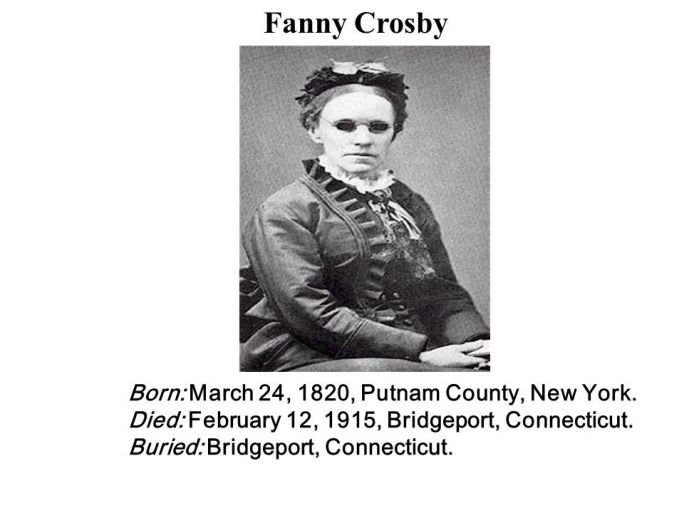
This great hymn was written by Fanny Crosby (1820–1915).

slide_21

When Fanny was 6 weeks old, she caught a slight cold & had inflamed eyes. The family physician was away. Another country doctor was called in to treat her. He prescribed hot mustard poultices to be applied to her eyes, which destroyed her sight completely! It was later learned that the man was not even qualified to practice medicine. Fanny never felt any resentment against him, but believed it was permitted by the Lord to fulfill His plan for her life.

This is what Fanny Crosby said to her mother one day:

“Mother, if I had a choice, I would still choose to remain blind … for when I die; the first face I will ever see will be the face of my blessed Saviour.”

And another of Ms Crosby’s quotes:

It seemed in­tend­ed by the bless­ed prov­i­dence of God that I should be blind all my life, and I thank him for the dis­pen­sa­tion. If per­fect earth­ly sight were of­fered me to­mor­row I would not ac­cept it. I might not have sung hymns to the praise of God if I had been dis­tract­ed by the beau­ti­ful and in­ter­est­ing things about me.

Fanny’s spiritual development came from her grandmother who cared for her while her mother worked as a maid. A landlady, Mrs. Hawley, helped Fanny memorize the Bible. Often she learned 5 chapters a week!  She entered the New York City Institution for the Blind around 1835, completed training, and taught there from 1847 to 1858. In 1858 she married a musician, Alexander Van Alstyne, who was also blind.

415904470

Under her own name, as well as under a curious assortment of initials and pen names, she wrote over 8,000 hymns, including: “I Am Thine, O Lord,” “Praise Him, Praise Him,” “Sweet Hour of Prayer,” “Blessed Assurance,” “Safe In The Arms Of Jesus,” “To God Be the Glory.”

Fanny needed five dollars one day and she just knelt down and told the Lord about it. Soon after a stranger knocked at her door as he just wanted to meet her. As he left, he pressed a five dollar bill into her hand. “I have no way of accounting for this” she said, “except to believe that GOD put it into the heart of this good man to bring the money”. “My first thought was that it is so wonderful the way the Lord leads me, and I immediately wrote the poem”.

In 1874, Fanny Crosby wrote the hymn “All The Way My Savior Leads Me”.

All the way my Savior leads me;
What have I to ask beside?
Can I doubt His tender mercy,
Who through life has been my Guide?
Heav’nly peace, divinest comfort,
Here by faith in Him to dwell!
For I know, whate’er befall me,
Jesus doeth all things well;
For I know, whate’er befall me,
Jesus doeth all things well.

I do not know whether Fanny Crosby was a spirit begotten child of God, but as I reflect upon her life, I can only hope that each of us will be more appreciative of the blessings we have today in Christ and will desire to live a life of praise daily for all our Heavenly Father has done for us. AMEN.

ALL THE WAY MY SAVIOUR LEADS ME


This post’s URL:
https://biblestudentsdaily.com/2016/05/15/worthy-to-be-praised/

Enter your email address to subscribe to this blog and receive notifications of new posts by email.

Save

The Praise Belongs To Him

6. ALL PRAISE BELONGS TO HIM.jpg

I know if I am chosen to joint-heirship with my Lord,
To reign with Him in glory, to receive that great reward;

If after all my weaknesses a crown for me He’ll claim,
I know that choice will surely bring great glory to GOD’s name.

If I had been more worthy, and my stumblings had been few,
When men gave GOD the glory, they’d have praised my virtue, too;

If I’d ne’er lost a battle, or had never missed the mark,
As they talked about HIS goodness, mine, also, they’d remark.

But my being SO deficient, in thought and word and deed,
Means HE’LL get all the glory—HE deserves it all, indeed.

When they see this weak mortal raised to such immortal heights,
What praise will rise to HIM who in such nothingness delights!

I know that when my Savior did return to heaven above,
And was crowned with wondrous glory, it did prove His Father’s love;

But thinking of Christ’s merit, and His sinless life of grace,
‘Twas no wonder that Jehovah chose Him for such a place.

With me it is so different; I have not one thing to plead,
That I should be more honored than another bruised reed;

And truly there’s no reason to give me a mite of praise;
To HIM belongs all glory for the joys which crown my days.

If you knew all my failings, and my blemishes so vile,
And saw the loving patience my Father shows the while,

T’would amaze you beyond measure to think HE could or would
Make me an able servant who should do HIS people good.

But if to HIM such praise is due because of what I am—
Because of such a weakling HE has made a stronger man,

Then what will be HIS glory when HE’s raised me higher still,
And crowned me with His choicest on the top of Zion’s Hill?

That all these years of striving find me so imperfect still,
Does not speak much to my credit nor give a happy thrill;

Where I appear as worthy ’tis because HIS grace is there,
And in the praise and glory I deserve no part, no share.

I HATE my faults and failings, and I FIGHT them day by day,
But from self with all its weaknesses I cannot get away;

Despite this fact, HE uses me—beyond is still more grace—
And hosts will tell HIS glory—HIS who found poor me a place.

BENJAMIN H. BARTON.


The URL of this post:
https://biblestudentsdaily.com/2016/05/14/the-praise-belongs-to-him/

Enter your email address to subscribe to this blog and receive notifications of new posts by email.


Save

Will ALL Mankind Need To Become “ISRAELITES INDEED”?

8. final with address

Dear friends, we have produced this post as a reply to a comment received to an earlier post in regards to the term  “Israelite indeed.”

The Bible explains that ALL in the future 1000 year Mediatorial Reign of Christ with His Church (the “Bride of Christ” of 144,000 members, see Revelation 7 & 14) will be required to willingly choose to follow righteous ways of GOD and adhere to GODLY principles or else they will not be permitted to have life, let alone, eternal life which shall be granted to all who choose to walk up the Highway of Holiness. (Isaiah 35:8, Psalm 37:9).

Where does the term “ISRAELITE INDEED” come from?

The answer may be found in the first chapter of the Gospel of John, which is the account of Jesus calling out Philip and Nathanael, as the next of the 12 Apostles:

John 1:43-51 reads (Amplified Bible),

“43 The next day Jesus desired and decided to go into Galilee; and He found Philip and said to him, Join Me as My attendant and follow Me.

44 Now Philip was from Bethsaida, of the same city as Andrew and Peter.

45 Philip sought and found Nathanael and told him, We have found (discovered) the One Moses in the Law and also the Prophets wrote about—Jesus from Nazareth, the [legal] son of Joseph!

46 Nathanael answered him, [Nazareth!] Can anything good come out of Nazareth? Philip replied, Come and see!

47 Jesus saw Nathanael coming toward Him and said concerning him, See! Here is an Israelite indeed [a true descendant of Jacob], in whom there is no guile nor deceit nor falsehood nor duplicity!

48 Nathanael said to Jesus, How do You know me? [How is it that You know these things about me?] Jesus answered him, Before [ever] Philip called you, when you were still under the fig tree, I saw you.

49 Nathanael answered, Teacher, You are the Son of GOD! You are the King of Israel!

50 Jesus replied, Because I said to you, I saw you beneath the fig tree, do you believe in and rely on and trust in Me? You shall see greater things than this!

51 Then He said to him, I assure you, most solemnly I tell you all, you shall see heaven opened, and the angels of GOD ascending and descending upon the Son of Man!”

VERSE 46 : Nathanael said to him, “Can anything good come out of Nazareth?”

Why did Nathanael seem to think so lowly of Nazareth by asking Philip as if a rhetorical question “can anything good come out of Nazareth?”

The following comment from Reprint 4117 of “The Original Watchtower and Herald of Christ’s Presence” provides a good explanation:-

“Philip himself had come within the charmed circle of our Lord’s influence, and had realized that it was a blessed privilege to become his disciple and that he must be indeed the long-looked-for Messiah. Full of this confidence he looked for his friend Nathanael, whom he recognized as being of one mind and heart with himself in the desire to serve the Lord and to be ready for Messiah’s Kingdom. Finding him his salutation was, ‘We have found him of whom Moses in the Law and the Prophets did write – Jesus of Nazareth, [adopted] son of Joseph.’ Nathanael was apparently a man of keen intellectual power. He felt that his friend Philip had accepted something too hastily, and that he was being deceived by a pretender, and his prompt objection was, “Can any good thing come out of Nazareth?” As though he had said, ‘That is a mean city of itself; no great people of any reputation would ever come from thence; no prophecies, so far as we know, make any reference to that city. What you tell me of your Messiah rather tends to prejudice my mind against him.’ “

Additionally, the prophecy concerning the coming Messiah found in Micah 5:2 identifies the Messiah coming from Bethlehem of Judea which is where Jesus was born but since Mary had moved to Nazareth, Nathaniel might not have know that.

In Micah 5:2 we read, 2But you, O Bethlehem Ephrathah, who are too little to be among the clans of Judah, from you shall come forth for me one who is to be ruler in Israel, whose coming forth is from of old, from ancient days.”

Some say that “Nazareth” is derived from one of the Hebrew words for “branch,” namely ne·ṣer, נֵ֫צֶר, and alludes to the prophetic words in the Book of Isaiah 11:1, “from (Jesse’s) roots a Branch (netzer) will bear fruit.” Another opinion is that the name may derive from the verb na·ṣar, נָצַר, “watch, guard, keep” (Strong’s #G3478) and understood either in the sense of “watchtower” or “guard place,” implying the early town was perched on or near the brow of the hill, or, in the passive sense as “preserved”, “protected” in reference to its secluded position.

Nazareth was considered a lowly town away from the main urban centers, so Nathanael may have been surprised that some famous person (let alone the Messiah himself) would have their background there.

Nazareth was an obscure village tucked away in the hills of Galilee. Every country and state and province has a place like Nazareth. It’s a place so remote that nothing ever happens there, no one of distinction lives there, and no one of importance comes from there.

Nathanael thought that it seemed highly unlike that the Messiah would come from a place like that. One might think that if you were looking for the one the prophets talked about, you should rather go to big city like Jerusalem, a capital city, a place of sophistication, where there is a large population.

Here is the irony of it all, both then and now. For every Jerusalem, there are a hundred places like Nazareth. The world is filled with unlikely places where nothing much ever seems to happen, where there is no great university, little towns without much commerce, places off the beaten path, tiny villages where few people live.

Dear brethren and friends, does this “big city” attitude prevail in our heart?

Does GOD call the ones with great worldly education, or only the learned about earthly sciences, or only the rich in earthly possessions, or only the ones with great outward beauty, or the ones with kingly speech or those who did in the eyes of all, what is considered the vilest crimes prior to GOD enlightening then how wrong they were in thinking they are doing right…or who come from a rich ‘Bible Student’ heritage or those who do not daily and perhaps hourly some days fight with inherited sins whether that be mental or physical ones? No.

GOD calls
ANYONE FROM ANY background at all
who’s hearts are humble
and with whom He can work with and use for
His grand and gloriously perfect Divine works.

What a humbling thought and what humbling lessons to each of us who have been CALLED OUT of the world into HIS marvelous light of eternal Truths! It is only because of the GRACE of GOD that HE first called us, and ONLY because of GOD’s Mercy in recognizing our contrite and always repenting hearts and truly changing attitudes and actions, the more you are enlightened into GOD’s Truths as we draw closer to GOD with thanks, praise, repentance and a dependency on Him and his Son Jesus more than on any other human here on earth, that has allowed us any relationship with GOD as His Sons and Daughters.

Let’s look at our KING Jesus’ most humble character – how he was not ashamed to come from such a humble, hidden, quiet little place in Nazareth, in order to fulfil the requirements of his humbling mission on Earth as the Ransom of ALL men (Philippians 2:8).

GOD has mercy on whom He wants to as He sees in the heart who has the right character for His works to reach his desired fulfillment perfectly, which in this Age, is to select a Bride for His beloved firstborn Son Jesus Christ. (Romans 9:14-25)

Dear friends, until the High Calling ends, GOD can call out anyone in whom He recognizes a humble heart, and use them for great and glorious purposes in elevated future glory!

If Stephen from the Book of Acts lived no more than approximately 12 months from the time of his baptism until the day he was martyred as the first Christian martyr, then dear friends, we just don’t know who amongst us may even require a short span of time to fulfill GOD’s requirements to be granted a place in the Spiritual Elect class. You see, according to  historians, the stoning that took place to Stephen as written about in the Book of Acts, chapter 7, took place around 34-35 A.D., thus, only approx. 12 months since Stephen received the holy Spirit – which was only first given 50 days after Jesus’s crucifixion in 33A.D. when the door was first opened to the High Calling.

Many may indeed be surprised who shall attain to the position of the 144,000 as man’s interpretation of the heart is not GOD’s interpretation. GOD looks at the heart as that is where the cleanest and purest of all Truth’s lies, as often the outward conduct may not clearly reflect the purity of intention of the heart to show just how hard one may be fighting against inherited weaknesses of the flesh to fight the good fight of faith and be a MORE than overcomer and most pleasing to GOD, above all.

Thus let us speak evil of NO MAN, especially not of our brethren. This does not mean we should not HATE the sin. We should AGAPE the sinner – the one who has professed the name of JESUS CHRIST as GOD’s firstborn Son who is the RANSOM for all mankind. Jesus taught us in John 17 to pray for such as these.

1 Samuel 16:7 – “But the LORD said to Samuel, ‘Do not look on his appearance or on the height of his stature, because I have rejected him. For the LORD sees not as man sees: man looks on the outward appearance, but the LORD looks on the heart.’ ”

What incredibly comforting words dear friends that the most important thing we are to strive for is to BE RIGHT in the eyes of GOD as humans cannot read what is hidden to their eyes, which often reflects the real TRUTH of any matter.

VERSE 47: “Behold, an Israelite indeed”

When Jesus referred to Nathanael as an Israelite indeed we may understand that he meant one who had the spirit of the principles that the Law was intended to inculcate – DEVOTION and LOVE FOR GOD FIRST, and KINDNESS TO OTHERS also. Jesus was commending the faith of Nathanael, and his good spirit.

Jesus’ description of Nathanael indicated that an “Israelite indeed” is one not merely a natural descendant of Jacob, who was later named Israel as indicated by the words of our Lord Jesus in Matthew 22:37-40 – which teach us, that it is not the Old Law that we are to be under, but a New Commandment that is a summary of all the ten Commandments given initially to only the Israelites under the Old Law, and now include ALL, whether Jew or Gentile , to adhere to.

So can the term “Israelite indeed” be used in reference to the world of mankind during the 1000 year Mediatorial reign of Christ with His Bride or does this term only apply to the spiritually begotten classes comprising the Church of the Firstborn (i.e. The Elect, and the Great Company, Heb. 12:23) ?

There is consensus of opinion among brethren we consulted, that this term can be used for mankind in the future because ultimately an Israelite indeed would refer to one whose heart was circumcised (See Romans 2: 28, 29) which all during Christ’s Mediatorial reign, will need to become, symbolically.

Hence, the world when developed, will be “Israelites indeed” in the sense of devotion to the principles of Godliness that will be installed in the world through Spiritual Israel, the Heavenly Jerusalem. (Hebrews 12:22; Rev. 21:1) All the world will need to attain to that condition of faith and good spirit. And we will propose and explain the words from Holy Scriptures that explain this after a little further explanation of the Nathanael account in reference to our topic under consideration.

Under the terms of the New Covenant all mankind who will receive life, will have to develop heart appreciation for GOD’s laws and adhere to His righteous perfect principles, worshiping Jehovah GOD Yahweh in spirit and truth. Any who will not do this will be cut off as Acts 3: 22-23 states:

“For Moses said, ‘The Lord your GOD will raise up for you a prophet like me from among your brothers. You must listen to Him in everything He tells you. Everyone who does not heed His words will be completely cut off from among the people.’

This text concerns the “times of restitution of all things” talked about by Apostle Paul in the previous verses (Acts 3:20-21), which refers to the time where “heavens will retain” THE CHRIST (head and body- the 144,000- complete) until the times of refreshing will come. This “building up” stage of our Lord’s Parousia (invisible, 2nd presence) will begin with Jesus and the completed 144,000 Bride of Christ members when the 1000 year Mediatorial Reign stage of the Kingdom shall soon begin, once the nation of Israel recognizes Jesus as the Messiah. (Zechariah 12:10, John 19:37)

VERSE 47: …In whom there is no guile nor deceit nor falsehood nor duplicity!”

What did our Lord and Master mean through the above words to Nathanael?

We believe these words of Jesus, were in reference to Nathanael’s character, his spirit, his sincerity. We would suggest our Lord’s experiences with the Jewish leaders, especially the Scribes and Pharisees, was that they were largely hypocrites. (See Matthew Chapter 23). Nathaniel was able to declare that Christ was GOD’s Son. (John 1:49) Those who were hypocrites denied this fact, even when Jesus performed miracles to prove that he was the Christ.

It was Nathanael’s honesty and sincerity of heart that made Jesus select him as one of the twelve worthy ones to become one of the twelve pillars of the Church of the Firstborn in Jesus Christ. Of course this was to some extent miraculous—but at least in part by observing Nathanael’s humble prayer under the branches of the fig tree.

Perhaps these words spoken about Nathanael would serve as an encouragement for Nathaniel to follow Christ since Jesus was able to know about the type of individual Nathaniel was even before their encounter.

What lessons can be drawn from Jesus’s comment to Nathanael?

Perhaps it may be entirely right for us today, to also express at proper times, our confidence in the religious character of those with whom we are conversing with, and not doubt the sincerity of any person even if they are not fully with us in every point of faith and doctrine.

Jesus saw in Nathanael a pureness in heart and pureness in motive. And in the same way, our Heavenly Father reads our hearts which man cannot do and so often misinterprets being blinded to the “fruits” of good character which we are to firstly seek out in our brethren, praising our Father and praying over all the LORD’s dear saints to be more than overcomers and for none of them to fall away, as well as pray like Jesus (as documented in John 17) for those who will believe, that they may be ONE as Jesus is now since his ascension  with the Father physically and spiritually together in the Divine Realms.

VERSE 49: Nathanael answered him, ‘Rabbi, you are the Son of God!’ “

The reason why Nathanael answers Jesus by saying “Rabbi (Teacher), you are the Son of GOD! You are the King of Israel!” is because he knew Jesus had referred to his very prayer, of which not a soul in the world had knowledge, and that Jesus had thus, supervised in the matter and had full knowledge of all his affairs.  Nathanael knew that one who could know about his prayer and could thus answer it and reveal himself must indeed be superhuman—all that he claimed; the Messiah.

VERSE 50:  “I saw you under the fig tree”

We are not told what took place under the fig tree, but we imagine that Nathanael there prayed to the heavenly Father for wisdom, guidance, instruction and protection from deception. Doubtless he went to the fig tree as a closet for prayer, for the fig tree has foliage which hangs low and would constitute quite an arbor or shelter and a very suitable place for privacy and prayer.

In Jesus’ words to Nathanael “I saw you”—we recognize Jesus’ power of discerning spirits, that is, that Jesus was able to read the thoughts and intents of the hearts, which no human can do (as we have said), as Jesus was the only perfect human in whom was no sin (1 Peter 2:22) hence he could perfectly feel and interpret what he saw perfectly, and the ability to work miracles was granted to him from YAHWEH JEHOVAH. Later the same gifts were granted to the apostles, and for the same purposes.

VERSE 51: ” ‘…You will see heaven opened, and the angels of GOD ascending and descending on the Son of Man.’ “

By telling Nathanael that he “will see heaven opened, and the angels of GOD ascending and descending on the Son of Man…” Jesus was explaining that messengers of GOD, the “Princes of the new dispensation, that is, the Ancient Worthies (The “Heros of Faith”—some of whom are mentioned in Hebrews chapter 11) will be the channels of easy and direct Divine communication between the two phases of the Kingdom; between the Heavenly Kingdom (governed by Spiritual Jerusalem) and the terrestrial world (governed by Natural Israel, i.e. the Ancient Worthies working together with the Holy Remnants of Israel).  Jesus’ words, call attention to Jacob and the vision which he had at Bethel of a ladder (Genesis 28:10-12), illustrating the methods of Divine grace. Our Lord himself was the ladder upon which communication between heaven and earth would be re-established.  Jacob’s dream of the ladder between heaven and earth, and the passing to and fro of the messengers was a prophecy as well as a dream, foreshadowing this communication to soon begin, we believe, during the end period of Jacob’s Trouble just as the 1000 year reign of Christ Jesus with His Bride is to begin.

ALL Mankind to Become True “Israelites Indeed”

By the end of the Mediatorial Reign of Christ, all the world of mankind will need to become “Israelites indeed”. Let us consider some Holy Scriptures to explain this :-

(1) Jeremiah 31:31-34 (AMPC)“But this is the covenant which I will make with the house of Israel: After those days, says the Lord, I will put My law within them, and on their hearts will I write it; and I will be their God, and they will be My people. 34 And they will no more teach each man his neighbor and each man his brother, saying, Know the Lord, for they will all know Me [recognize, understand, and be acquainted with Me], from the least of them to the greatest, says the Lord. For I will forgive their iniquity, and I will [seriously] remember their sin no more.

These glorious verse of Holy Scripture explain the time when the New Covenant will first begin with the Nation of Israel (and anyone else who recognizes Jesus then, as the Ransom and Savior of mankind, and Son of GOD Yahweh JEHOVAH.

(2) Isaiah 11:9 (ESV)“They shall not hurt or destroy in all my holy mountain; for the earth shall be full of the knowledge of the Lord as the waters cover the sea.”

(3) 2 Peter 3:7“But by His word the present heavens and earth are being reserved for fire, kept for the day of judgment and destruction of ungodly men.”

The word “judgment” in the above verse implies, not merely a sentence, but also a trial.

GOD’s justice, indignation, will burn against everyone who is wicked, and this fire will go on all through the Millennial age, which is the age where soon Jesus CHRIST with His Bride (the saints who have passed their tests of loyalty to our Father’s righteous principles living and suffered in CHRIST faithfully with patient, cheerful in the spirit endurance. (Revelation 2:10)

(4) Isaiah 26:9“The judgments of the Lord will be abroad in the earth and the inhabitants of the world will learn righteousness.”

The Millennial-Reign-of-Christ Age, will provide an opportunity to rise out of sinful and fallen conditions, to full harmony with GOD. GOD has elected kings, priests, and judges to rule, bless, instruct and judge mankind in general. (Revelation 20:6)

If the thought be kept in mind that the world’s day of judgment is a thousand years long, the character of the judging then to be done will the more readily be discerned. A sentence upon each individual of the human family would be impossible within a 24-hour day under any imaginable conditions, reasonable or unreasonable.

(5) Proverbs 2:21-22 – “21 For the upright shall dwell in the land, and the perfect shall remain in it. 22 But the wicked shall be cut off from the earth, and the transgressors shall be rooted out of it.”

(6) Psalm 37:38 – “But transgressors will be altogether destroyed; The posterity of the wicked will be cut off.”

In conclusion, we hope we have clearly explained about how our Heavenly Father’s intention is for all to learn GOD’s principles of righteousness in the Messianic Age, whereas now, during the “High Calling” Age (known as the Gospel Age), “many are called and few are chosen”(Matt. 22:14).

Holy Scripture does so beautifully teach, that all mankind will eventually have a relationship with GOD through the Mediators (Christ Jesus and His Bride) under the New Covenant which Apostle Paul talks about in the Book of Hebrews.

GOD wishes that all humanity on the terrestrial plane eventually will inherit eternal life only because they will have learned to OBEY GOD WHOLEHEARTEDLY and WILLINGLY by learning to surrender their wills to the will of GOD during their judgment period of a thousand years. Then, they will learn to LOVE RIGHTEOUSNESS and ever human heart that beats, will be fully devoted to GOD.

Death will be no more!

This is the ETERNAL GOSPEL, that by the 50,000th year of Creation, known as the Grand Jubilee, GOD SHALL BE ALL IN ALL. (1 Corinthians 15:28, Revelation 14:6)

May GOD’s Name be praised for eternal eternities through Jesus Christ,

Amen.

Save

Encouragement to SHARE & SHINE

SHINE AND SHARE -WITH ADDRESS

With a hope that this blog post will motivate our readers in wanting to dedicate as much time as they can in studying God’s character and His Divine Principles and Plan, to better be enabled to glorify and praise  our Creator, Jehovah, through His Son Jesus–our Beloved Master and Conquering King, let us begin with a beautiful Scripture from Isaiah 58:7 (ESV),

“Is it not to share your bread with the hungry and bring the homeless poor into your house; when you see the naked, to cover him, and not to hide yourself from your own flesh?”

The primitive Church did show an active concern for the poor and needy in their midst and brethren laid aside portions of money and supplies for those less fortunate financially. An example of this can be seen in the collections for the brethren in Jerusalem (1 Corinthians 16:1-4) and the support of Paul by the brethren in Thessalonica.

“But whoso hath this world’s goods, and seeth his brother have need, and shutteth up his bowels of compassion from him, how dwelleth the love of God in him?” (1 John 3:17)

Now let us examine the term “sharing” in regards to the spiritual food, that is, our sharing with others the understanding of the Word of Truth, and the ministering to others about God’s Divine Plan and His beauties of Truth.

We are not only instructed to preach the Gospel message of hope to the world (Mark 16:15), but we are to let the word of Christ dwell in us richly by “teaching and admonishing one another in all wisdom, singing psalms and hymns and spiritual songs, with thankfulness” in our hearts to God (Colossians 3:16).

If God has called us into his marvelous light of Truth, then one is sure to learn about the disastrous effects of evil, so as to realize that disobedience to righteous Godly principles has led to only pain, misery and despair, which results in HOPE-LESS-ness.

By gaining an exposure to such experiences, one gains a priceless understanding of what the Heavenly Father requires to please Him and thus how to strive towards developing into the likeness of Christ.

By experiencing pain and sorrow, we then truly feel how horrifically unpleasant and torturous it’s effects are, and governed by the wisdom of God (1 Corinthians 2:14; 3:19) we desire to obey God in every single aspect of existence, realizing this is the ONLY way that humanity in the future will gain eternal life after the resurrection during the period of Christ’s reign with his body members of 144,000 (see Revelation chapter 7 & 14.)

“He has told you, O man, what is good; and what does the LORD require of you but to do justice, and to love kindness, and to walk humbly with your God?” (Micah 6:8)

Dear friends, what abundant blessings are gained by striving to adhere perfectly to Godly and righteous principles. The fully consecrated to God are not only to strive for this perfection in Christ (2 Corinthians 13:11) but actually BE perfect (Matthew 5:48).

How is it possible to BE PERFECT if we still live in carnal imperfect bodies? We realize that if we were perfect, we would never die as the death penalty is a consequence of Adam’s sin and thus all the world of mankind has inherited Adamic sin (Genesis 2:17).

We answer:

We can be reckoned as perfect in God’s eyes, thanks to the robe of Christ’s righteousness covering our sins, hence our intentions can be reckoned as perfect due to OUR FAITH. In Romans chapter 4 the Apostle Paul here writes about what Godly faith actually is and how it is developed and maintained.

The faith talked about in the Bible does not mean having a BLIND FAITH–believing in the words of another without testing it against what the Word of God says on the subject at hand. 

In the Book of Romans, the Apostle Paul does explain that faith can only be true Godly faith if one hears the message, “and the message is heard through the word of Christ” (Romans 10:17).

The true faith we are talking about that ALL eventually will HAVE to have by the end of the “little season” (Revelation 20:3) of the Millennial Reign of Christ with his completed Bride– is faith that is based on God’s wisdom and not man’s wisdom.

This is what the Apostle Paul means by saying to the Corinthian brethren in 1 Corinthians 2:5, that their “faith might not rest in the wisdom of men but in the power of God.”

We are to TEST the Scriptures by studying the Words of God documented to us by the prophets in the Old Testament and by the Apostles and Jesus’s disciples in the New Testament, and study to show ourselves approved unto God, a workman that needeth not to be ashamed, rightly dividing the word of truth (2 Timothy 2:15).

We cannot expect someone to understand or even know who God is simply by reading the Bible like a story book as “the Spirit searches all things, even the deep things of God” (1 Corinthians 2:9). 

We must scrutinize every word that we read if we do not understand it’s glorious meaning. The Prophet Isaiah writes, Truly, You are a God who hides Himself, O God of Israel, Savior! (Isaiah 45:15) WHY does God hide himself? In the following post are some suggested Scriptural thoughts on this: Isaiah 45:15 – A GOD Who Hides Himself”

Understanding God’s Word

Here is an extract from Reprint of the Original Watchtower and Herald of Christ’s Presence (R5982) about the subject matter concerning understanding God’s word:

“Our ability to understand spiritual things depends, not only upon our study of the
Scriptures, which are able to make us wise, but also upon the measure of the Holy Spirit which we possess. Hence the Apostle’s exhortation, “Be ye filled with the Spirit!” — Ephesians 5:18.

This means that only the spirit-begotten may understand the deep things of God at all; and that their understanding would be in proportion as they attain more and more a filling, a saturation with the spirit of holiness, the spirit of God, the spirit of Christ, the spirit of Truth.

Every Bible Student should realize that if, as a New Creature, he walks after the flesh and not after the Spirit, his mind will become more or less darkened, and not only will his ability to understand the deep things of God decrease, but even his recollection of the Lord’s Word will decrease; and that, on the contrary, when he is living near to the Lord–walking after the Spirit and not after the flesh–his memory of the Divine Word and his ability to appreciate its Spirit are increased.

Additionally, let us remember that a correct understanding of the Lord’s Word is not enjoyed by all the educated and talented, but comes to those who are of a meek and teachable heart, who study the Lord’s Word and who live it and absorb its spirit. Thus we have illustrated to us the Divine declaration, “Not by might [greatness], nor by power, but by My Spirit, saith the Lord of Hosts” — Zechariah 4:6.”

————

During this Gospel Age, the called out of Babylon have the privilege to learn obedience to God and this involves developing the highest form of love, agape–towards our brethren in Christ. The Lord’s people have the privilege of learning now the lessons of forgiveness like God forgives us. God has such GREAT PERFECT mercy and love towards the fallen race, and the Apostle John in 3 John 3:16 tells us that God sent his firstborn of all Creation, His most Beloved Son, Jesus– the Logos– down to a terrestrial plan of existence (earth) (Hebrews 2:7-9) to redeem mankind and pay the ransom price to free ALL humanity from the sentence of Adamic death.

God’s divine plan encompasses the process of restoring all of humanity to perfection during the millennial reign of Christ with his Bride members (Revelation 7:14), known as the “elect” (Matthew 24: 22; Romans 11:7) and the “little flock” (Luke 12:32).

We have a responsibility to let our lights (the CHRIST-LIKENESS character) shine (Matthew 5:16).

But what’s the point of others seeing what WE DO? AH… the sentence follows with other words giving the correct answer.

In the kingdom when evil shall be restrained for 1000 years,  righteousness shall be the only standard by which all will have to adhere to, to gain eternal life and pure, perfect everlasting JOY will be the blessed result for everyone who chooses to obey God.

If indeed we have received the light and have consecrated ourselves fully to God, then let us ask ourselves, WHAT AM I DOING to show others the goodness of God? WHAT AM I DOING to proclaim the virtues and excellencies of Jehovah, who CALLED ME out of darkness?

Am I going forth with these tidings to my neighbors near and far?

Can I truly affirm that I am:–

“All for Jesus, all for Jesus–
All my being’s ransomed powers;
All my thoughts, and words, and doings,
All my days and all my hours?”

In 1 Peter 2:9 we are told,Ye are a chosen generation, a royal priesthood, an holy nation, a peculiar people; that ye should show forth the praises of Him who hath called you out of darkness into His marvelous light.”

It is God who calls one out of darkness. So no one can force anyone to believe how they do.

God does not call families. God calls individuals into the Truth of His Holy Word.

What is the Purpose of the Gospel Age?
The purpose of this Gospel Age is to “call out” a BRIDE FOR CHRIST, a group of 144,000 body of Christ members who can soon begin their Mediatorial Reign in bringing the world of mankind into harmony with God. This is only understood by those who have a discerning heart who God has decided to choose to understand His mysteries, which is:

Christ in youthe hope of glory” 

(Colossians 1:27).

The partakers of the High Calling have a desire to please God in all they do. As they commune with God, their minds are fixed on Christ and to be like him in character-likeness and thus, strive to do the Father’s will and be partakers in “the first resurrection.” (Revelation 20:6) (A 3 part series of posts on the RESURRECTION can be read here: Part A, Part B, Part C).

God’s fully consecrated children share closest communion with The Heavenly Father and His son Jesus (Psalm 118:8), and long for a heavenly inheritance, as their minds are set on “things above”  (Colossians 3:2).

True Christians feels they are called by the situations that each of the fully consecrated believers in Christ experience during their earthly testing and preparation time, realizing how the Lord is drawing them to desire to give up ALL their human life rights to themselves; to their body, to their time, to their health, to their reputation, to their talents, or to anything that belongs to them confessing themselves as belonging to Jesus their Redeemer, and they dedicate to serve, love and trust Jesus as their life and their salvation to their last moment of life on this carnal earth.

Fully consecrated believers in Christ seek divine nature— to be where the Heavenly Father and His Son, Christ Jesus reside.

So what is our HOPE?

The Bible is jam-packed with precious promises.

Just flip open any page of the New Testament, and start reading. What is the first precious promise you read? It will surely not take you more than a minute to find, and it will surely inspire you, unlike any 10 minutes of watch the News on T.V. will do! Go try it!

In Colossians 1:27, we have the answer to what our HOPE is. (We have also referred to this text earlier in this post.)

It is a LIVING hope, for as stated in 1 Peter 1:3, “Praise be to the God and Father of our Lord Jesus Christ! In his great mercy he has given us new birth into a living hope through the resurrection of Jesus Christ from the dead.”

What does a LIVING HOPE mean?

It means having a HOPE OF LIFE and not one of burning eternal torment which falsely the worldly institution of Papacy have darkened the minds of the world to believe in order to have power and prevent the light of Truth from illuminating the minds and hearts of mankind due to the influence of the Adversary who’s corrupt and wicked army of angels do still control— yet, they will all be bound during the Millennial reign of Christ period when God shall provide mankind with the opportunity to learn righteousness and be blessed by so doing (Isaiah 26:9).

After Armageddon, all will need to become true Israelites indeed. [see post: “Will ALL Mankind Need To Become ‘ISRAELITES INDEED’?”]

The rule then in the 1000 year Messianic Kingdom will be:

OBEY GOD and LIVE or DISOBEY GOD and die (without a possibility to resurrect ever again).

Those who have done wrong in this life, will have more re-learning to do, so the faster their minds choose to follow God’s ways, the sooner they will see and feel the immense blessing of JOY and satisfaction that they will gain from walking up the HIGHWAY OF HOLINESS (Isaiah 35:8).

It was Jesus’ obedience to the Heavenly Father— dying as the ransom for our justification— that has opened up the door for God’s children to have this living hope and it is not only a hope for such now justified, but it includes a hope of perfecting in future the now still ignorant, sinful and unjustified world of mankind, and bringing them into harmony with the Heavenly Father, so that God may be all in all. And this is “the eternal gospel”— that the Creator (who has no beginning and no end) will be finally ALL IN ALL (Revelation 14:6).

Just as the hopes of the apostles had withered at the time of the crucifixion but were revived at Jesus’ resurrection, so too, we have the assurance through Jesus’ resurrection that our final triumph is through our Lord and King, Jesus, who is currently standing at the Heavenly Father’s throne after having sat earlier at the right hand of God after his ascension to the divine realm (Mark 16:19). We are told of Jesus standing up since his parousia (invisible presence, that is often in English, incorrectly translated as Christ’s “coming” in Scripture).

In Daniel 12:1 we read, “At that time shall arise Michael, the great prince who has charge of your people. And there shall be a time of trouble, such as never has been since there was a nation till that time. But at that time your people shall be delivered, everyone whose name shall be found written in the book.”

When the last members of the Bride of Christ shall have gone “beyond the second veil” (died in the flesh), then Jesus shall sit with them on his own throne. We are told of this in Matthew 25:31:- “When the Son of Man comes in his glory, and all the angels with him, then he will sit on his glorious throne.”

May the Heavenly Father be praised forevermore as we await our transformation into glory!

“Finally, brothers, rejoice. Aim for restoration, comfort one another, agree with one another, live in peace; and the God of love and peace will be with you” (2 Corinthians 13:11, ESV).

This post’s URL: https://biblestudentsdaily.com/2016/05/03/share-shine/

Enter your email address to subscribe to this blog and receive notifications of new posts by email.

Save

Save

Save

What is Love?

1 JOHN 4, 8.jpg

Love is …

perfection of character.

“So we have come to know and to believe the love that God has for us. God is love, and whoever abides in love abides in God, and God abides in him” (1 John 4:16).

The love that our heavenly Father seeks to have us develop is a love which is in full harmony and in total surrender to God’s will. When we please our Divine Father of Life, He will bless with eternal life.

“To those who by patience in well-doing seek for glory and honor an immortality, he will give eternal life” (Romans 2:7).

You therefore must be perfect, as your heavenly Father is perfect” (Matthew 5:48).

One element of Love is MEEKNESS.

Meekness does not mean weakness.

Consider Moses. He was a meek man and did he have a weak character? Not at all. He was humble-minded, not boastful, not proud or haughty.

“Now the man Moses was very meek, above all the men who were upon the face of the earth” (Numbers 12:3).

So the New Creatures in Christ, must develop and maintain this quality of meekness, from the divine standpoint.

Another element of love is GENTLENESS.

Does this signify weakness or fear? No.

Gentleness is part of a character of love.

Jesus said, “take my yoke upon you, and learn of me; for I am meek and lowly in heart: and ye shall find rest unto your souls” (Matthew 11:29).

In Galatians 5:22, 23, the Apostle Paul writes, that the fruit of the Spirit is love, joy, peace, forbearance, kindness, goodness, faithfulness, gentleness and self-control. Against such things there is no law.”

To the Ephesians, the Apostle Paul writes, ” (1) I urge you to live a life worthy of the calling you have received. (2) Be completely humble and gentle; be patient, bearing with one another in love. (3) Make every effort to keep the unity of the Spirit through the bond of peace. (4) There is one body and one Spirit, just as you were called to one hope when you were called; (5) one Lord, one faith, one baptism; (6) one God and Father of all, who is over all and through all and in all” (Ephesians 4:1-6).

“Let your moderation be known unto all men” (Philippians 4:5).

“Moderation”reasonableness, gentleness—the spirit of a sound mind, of gentleness, meekness.

This attitude of mind comes in large measure as a result of knowledge of God and his plans (R5840). Surely there never was a time when this counsel was so much needed as now!

Let the fact that we know only in part and understand only in part keep us humble and moderate in word and deed and thought (R5249).

Temperance, self-control—let men see by our thoughtful (not rash and hasty), careful and considerate demeanor in every affair of life, that we honor our profession (R4809, R2460).

Here is a practical example:

If we feel the leader of a meeting is not following the best Scriptural course, we must show moderation in our approach—approving what we can, objecting in kindness, meekness, and brotherly love (R3866). The Greek seems to carry the thought of reasonableness, of not exacting our rights too rigorouslymercy and leniency (R3128:2). Keep yourselves well in hand, subject and obedient to the will of God.

In 2 Timothy 3:2-5, the Apostle Paul warns against those “in the last days” (today) who he describes as “(2) lovers of themselves, lovers of money, boastful, proud, abusive, disobedient to their parents, ungrateful, unholy, (3) without love, unforgiving, slanderous, without self-control, brutal, not lovers of the good, (4) treacherous, rash, conceited, lovers of pleasure rather than lovers of God— (5) having a form of godliness but denying its power.” The Apostle Paul then states, “have nothing to do with such people.”

Even in discussing the time of trouble, emphasis should be laid upon the glorious Kingdom which will be inaugurated (R5716:4). We should be using the knowledge we possess, doing with our might what our hands find to do (R5249). Let us be specially on guard that the influence of every word and act should be in accord with law, order and peace—“live peaceably with all men.” (Romans 12:18).

Our gentleness toward all men would begin at home—more particularly in the Church—but should be manifested toward all with whom we have dealings (R5840).
Messiah’s Kingdom is shortly to be established—this should help the Lord’s people in living an exemplary life (R5840). This clause implies the exhortation belongs specially to the closing of this Gospel age—thus, to this time period we are currently living in.

We are expecting great changes soon and can well afford to be generous and liberal in our sentiments toward others (R3128:3).

PATIENCE is another element of love and a part of the true Christian character.

“With all lowliness and meekness, with long-suffering, forbearing one another in love” (Ephesians 4:2).

Patience is an element of character. We read in Revelation 3:10,

Because thou hast kept the word of my patience I will also keep thee from the hour of temptation which shall come upon all the world to try them that dwell upon the earth.”

When examining the word “patience” we find that two quite distinct words in the Greek are translated by our English word patience in the New Testament:

  • hupomoneethis is used in the Revelation text quoted above which has a much deeper and fuller significance than attaches to our English word patience. It signifies rather constancy,—the thought being an endurance of evil in a cheerful, willing, patient manner. It represents, therefore, an element of character, and not merely a temporary condition or restraint of feeling or action.

For instance, a worldly man might have a great deal of patience in connection with the running of his business;—he might be very attentive to his customers, very obliging, very painstaking, and show no dissatisfaction in connection with the inconsiderateness of his customers; and “patience,” in its ordinary sense, might be ascribed to his conduct.

But the word in the Revelation text rendered patience” signifies such a development of heart and character as manifests itself in an endurance of wrong or affliction with contentment, without rebellion of will, with full acquiescence in the divine wisdom and love.

In Luke 8:15, in the parable of the sower, we read:

“That [sown] on the good ground are they which in an honest and good heart, having heard the word, keep it, and bring forth fruit with patience [with cheerful endurance, constancy].”

The thought here is that in order to be of the fruit-bearing class which the Lord will approve and accept to his Kingdom, it is necessary to do more than to receive the word of his testimony, even thou we receive it with joy—for that class in the parable is represented by the stony ground, which at first gave evidence of great fruitfulness and vigor, but which, when the sun of persecution arose, withered, because of lack of depth of soil. That stony, shallow soil represents, the Lord explains, a class of hearers who rejoice greatly in the truth, but do not endure, such as cannot withstand persecution or opposition, but wither under it, become discouraged. Such cannot be of the Kingdom class, all of whom must be overcomers.

In this parable our Lord shows us that patient endurance, constancy, is the final test, following after the readiness of preparation to receive the seed; following after the seed has been received and has sprouted; following after love and hope and joy and faith have caused it to spring forth and to give fruitage (R2791).

Patient endurance, then, is necessary, in order that the grain may be developed and thoroughly ripened, and made fit for the garner.

Ah! how important patient endurance seems to be, in the light of this our Lord’s word—cheerful endurance; for we cannot suppose that he who judges the thoughts and intents of the heart would be pleased with his children, even if he saw them enduring much for his sake, if they endured in an impatient or dissatisfied or unhappy frame of mind. They would not, in that event, be copies of God’s dear Son, our Lord, whose sentiment is expressed in the words,

“I delight to do thy will, O God!” (Psalm 40:8)

All of the Royal Priesthood are sacrificers, as was the Chief Priest, our Redeemer and example, who offered up himself: we, as the under priests, have also presented our bodies living sacrifices, and are to lay down our lives for the brethren—in the service of the truth. And God, who accepts these sacrifices through the merit of Christ, informs us that he appreciates or loves the cheerful giver, those who perform their sacrifices of a willing heart, cheerfully.

The other instance in which our Lord used the word “patience” during his ministry is recorded in Luke 21:19. He had just been telling his followers what they must expect as the result of being his disciples during the present time, when sin abounds, and when Satan is the prince of this world—they must expect tribulation, opposition from various quarters; but he assures them that they would nevertheless be fully and completely under divine care and protection, even tho the persecutions would be permitted to reach and to affect them. Then follow the words,

“In your patience [patient endurance, cheerful constancy] possess ye your souls” (Luke 21:19).

BROTHERLY KINDNESS is another element of love.

“(5) And beside this, giving all diligence, add to your faith virtue; and to virtue knowledge; (6) And to knowledge temperance; and to temperance patience; and to patience godliness; (7) And to godliness brotherly kindness; and to brotherly kindness charity. (8) For if these things be in you, and abound, they make you that ye shall neither be barren nor unfruitful in the knowledge of our Lord Jesus Christ” (2 Peter 1:5-8).

The Greek word “Philadelpia” signifies brotherly love. “Phileo”—is duty love, a love which has a cause or demand upon it (R2807).

Phileo love is evidenced in the natural family relationship, and also in the spiritual family, the Church. We may not love our brethren’s peculiarities, their features, but we love them as brethren, whether black or white, bond or free, because they are brethren, comrades in the same race (Q449).

Phileo love means to make due allowance for inherited weaknesses and circumstantial misfortunes of others—to deal patiently and helpfully so far as wisdom may dictate, with a view to the correction of those faults, even at the expense of self-interest, if necessary and prudent (R4809, R1114).

Phileo love means to meekly bear reproof, determining to overcome deformities of character, and prove a help rather than a hindrance to others; no longer fostering old dispositions (R4809).

Phileo love allows one to exercise and manifest the principles of the divine character toward our fellow-men (R3090, R1628:2).

Phileo is a love for all who are brethren and yoke fellows in the cause of righteousness and truth, the cause of God (R2037).

Instead of disdaining those who are ignoble, instead of putting them away, treat them kindly (R448). This of necessity grows out of godliness. As god-likeness presupposes the other graces mentioned, so its development implies an enlargement of our hearts to all who are of the household of faith (R2155).

There is also “AGAPE” LOVE…

This is known as charity (R5693, R5208).

Greek, agape, is the higher grade of disinterested love; the broader, more comprehensive, or divine love (R3949; Q449).

Love as a general expression covers all the elements of character which are really parts of love (F186).

We might divide the race-course into four quarters:

(1) duty-love;

(2) love for the Lord because we see something of the glorious majesty of his character;

(3) love for the brethren;

(4) perfect love—for all, even our enemies (F187-189).

As we get agape love it means that we love all (Q449) We must reach this climax of love before we can be counted worthy of a place in the new creation (F190).

Agape Love:

  • Is deep, pure and true.
  • Thinketh no evil.
  • Does not puff itself up.
  • Is not easily offended;
  • Rejoiceth always in the truth and never in iniquity;
  • Is the climax of Christian attainment in the present life, the grace of all graces, which never fades, and which will be perfected when we receive the new resurrection body (R2037, R2155).
  • Is sincere love for the unrighteous and unlovely, as well as for the good and beautiful (R4809, R1114).
  • Is a love which is ever ready to manifest itself in wise and helpful activity for saint and sinner; and which pities, helps, comforts, cheers and blesses all within its reach—manifesting and cultivating the disposition which must be found in every member of the Christ company (R4809, R1114).
  • Is a broad, generous love, taking in the whole world, even our enemies (R5678, R5757, R5460).

We do not attain to the perfection of love at the beginning of our course, but it is the mark or standard which indicates the end of the course

(F186).

Love is the chief of all graces.

Acts of kindness will gradually lead to an attitude of love, even where the subject does not seem to deserve it (R1628).

Love is an experience, and includes in it an earnest desire for the well-being of the object loved (R78:5).

Love excels all the other virtues, because it is the most enduring (R4732).

True love on our part will manifest itself in obediencedisobedience is an evidence of the loss of love as viewed from the Lord’s standpoint

(R2466).

“WITHOUT LOVE I AM NOTHING”

If we could speak all the languages known amongst men and even the angelic tongue as well, and if we were to use these talents in preaching, if we were to preach without being inspired by love, it would be completely unprofitable.

God would esteem it no more than the sound proceeding from cymbals or any brass instrument. Does God want to give cymbals and brass horns glory, honor and immortality? Of course not!

If man were to preach the whole Truth in all its grandeur, and have the ability to comprehend it even through the holy Spirit yet if there be a weakness in character development of love towards the brethren, then we could not be fit enough for divine favor and a share in the Kingdom, just like that brass horn would not be.

What a glorious lesson as we attempt to sound forth the praises of Him who has called us from darkness to light! How necessary it is that we speak the Truth in the love of it, with hearts full of devotion and appreciation!

By quieting the mind… and heading to the voice of our Heavenly Father through the inspired words of God in Bible and through prayer, we may learn to absorb and appreciate each lesson step by step as God unfolds it to us. God is the ultimate example of patience, waiting perhaps billions of years before finally confronting the pain of watching His own firstborn Son being sacrificed on Calvary and be the ransom for all mankind.

And Jesus… has been waiting for the completion of His BrideHis Body members of 144,000 since AD 33!

JAMES 5, 7-8.jpg

There is a saying “take time to smell the roses.”

And in the same way let’s remember to take time to hear God-Jehovah speak…
digest it…
absorb it…
and grow from it…

The Apostle suggests that if he had mountain-moving faith, if his knowledge of Divine mysteries were very great, superior to those of all other men, and even if in his zeal for man or for God he should become a martyr and permit his body to be burned, yet, notwithstanding all this, if the primary influence in these matters were not love, all the sacrifice, all the self-denials, all the labors, even the burning, would profit nothing.

Dear friends,

When we come to get the Divine standpoint of things we find indeed that we have a very high standard to achieve; and yet our judgment assures us that it is right, that it is just, that it is proper, that God should thus set the standard of love as the only standard by which we shall ultimately be measured. But whoever thinks to have this perfect love for God and for man and make no manifestations of it is equally mistaken.

Wherever love is in the heart … words, works, thoughts and looks will testify to it, so that he who loves much will serve much.

If we love the Lord we shall delight in His service regardless of failures, regardless of fame, regardless of any earthly consideration; yea, even though the service of the Lord should cause us the loss of human approbation, fellowship, etc…

Hence every true Christian may link the two words love and service, and be sure that his love will manifest itself in zeal. Similarly, love of the brethren will mean a desire to serve the brethren; love of the home and family will mean a desire to do good to them; love of our neighbor will signify a desire to do for his interests according to our knowledge and limitations.

THE RESTRAINTS OF LOVE

The Apostle points out some of the restraints of love.

It cannot be quick, irascible; for “love suffers long and is kind” (1 Corinthians 13:4).

  • He who is loving cannot be envious of others, nor covetous of the blessings and favors they are enjoying; for “love envieth not.”
  • He who is loving cannot be boastful and proud; for “love vaunteth not itself, is not puffed up.”
  • He who is controlled by the spirit of love will not be ungracious, unkind, rude; for “love doth not behave itself unseemly.”
  • He who is full of the spirit of love will not be selfish, grasping, neglectful of the interests of others; for “love does not seeks its own” (1 Corinthians 13:5).
  • The truly loving one will not be quickly angered, will not be easily offended; for “love is not easily provoked.”

“The one controlled by the spirit of love will not be imagining unkindness and rudeness nor seeking to interpret the words or conduct of others unkindly; for ‘love thinketh no evil’ “

(Pastor Russell’s Sermons, pages SM272-SM285).

What a beautiful example we see in our Master’s words to Simon:

“Simon, Simon, behold, Satan has demanded permission to sift you like wheat; but I have prayed for you, that your faith may not fail; and you, when once you have turned again, strengthen your brothers” (Luke 22:32).

Let us not neglect to pray for our fellow brethren in Christ, always while we are in this carnal abode.

“LOVE NEVER FAILS.”

(1 Corinthians 13:8)


The following is from “What Pastor Russell Said – Question Book”

QUESTION (1910) 1 At what point of character development can we say, the crown is ours, and that we are overcomers?

“ANSWER. — I think, dear friends, that the proper point at which we could say that, would be when we reach the mark of perfect love. For instance, you came to the Lord and made your consecration, you entered the School of Christ and began to learn of him. That was about the time you found out how short you were of the proper measure. Will the Lord ever be able to make anything out of me? Now the Lord is going to measure you according to your mind and is waiting for you to get to the mark of perfect love, which is the standard of a perfect character, for none will be worthy of a place in the kingdom or eternal life except those that reach this mark, either now or in the Millennial Age. God has nothing for anyone except those that reach that standard in his mind and heart. He may have weaknesses, etc., and you may speak things that you are sorry for, and must apologize for, but your heart is at the mark–perfect love—and that is the reason you want to apologize, because you have reached the mark of perfect love. You love God, and all mankind, and wish to do good to all, as you have an opportunity. After a person gets where he can love his enemies, he is at the mark of perfect love. He will not be perfect in flesh, for that will not be possible in this age. Many still have to put a bridle upon their tongues, etc., you must hold in the old nature. This I have often illustrated by a bad dog which would represent our old nature, and for which the new creature is responsible. We must hold him in. Our intentions are good, as is shown by the fact that when the heat or excitement of the moment is passed, then the heart goes back to the principles of righteousness, and asks for forgiveness from the Father. He will ask for forgiveness for anything he has done. You might say, it will be harder to rectify this, than not to have done it in the first place. Surely. But that is what you must do, if you want [Q51] to prove to the Lord that your heart is for righteousness, and whenever you find you have made a mistake, you must rectify it. Now, then, if you get to that place, you have gotten to the place where, to my understanding, you are at the mark of perfect love, toward God, men, etc. You desire good for all and injury toward none. From that moment, I understand, the Lord counts you as one having a crown apportioned to you. That is one thing, but seeing that no man take your crown is another thing. After granted to you it still remains that if you are moved from the mark, pressed aside by difficulties, you are not standing this test, and you will not be worthy of being an overcomer. So you see there is a mark of character, without which none will be acceptable in the kingdom, spiritual or earthly. Now we must demonstrate our love and devotion, that is what we live for today and tomorrow, and in all your Christian experience, from the time you enter the school of Christ, for you are to learn of him as quickly as possible and get to the mark of perfect love toward all.


The words below are from Reprint No. 4470 from “ZWT” (www.htdb.one).

STANDING AT THE MARK

WE HAVE heretofore suggested what we now wish to further, if possible, emphasize; namely, the fact that there is a Divine standard of holiness, of righteousness, which, if it be not attained, will mean our non-acceptance by the Lord as members of his Elect Church; and, more than this, our unfitness for eternal life upon any plane. This standard of character, or mark of perfection, as we have pointed out, is not a standard or mark of fleshly perfection, because the Lord accepts amongst his consecrated disciples those of various degrees of mental, moral and physical degeneracy. The justification which he provides makes up for the blemishes of each, for the more blemished as well as for the less blemished. The robe of his righteousness imputed is as necessary to the noblest as to the most degraded, and renders the latter as acceptable as the former.

From this standpoint it is recognized that the heart, the renewed mind, the renewed will, is the spirit-begotten New Creature which is on trial before God. It has professed a thorough consecration to righteousness and opposition to sin, a complete deadness to it, and a determination to mortify, to deaden, the will of the flesh to the extent of its ability. From the very start this condition is pleasing and acceptable to the Lord. Nevertheless, it is Scripturally represented at first as being merely a “babe” condition, according to one illustration, and according to another merely a “begotten” condition. Progress must be made, character must be developed, and then, further, it must be tested. “Not every one who saith, Lord, Lord, shall enter the Kingdom.” Not every one who professes consecration, and newness of life, and self-sacrifice in the interests of truth and righteousness, can be accepted as a joint-heir with Christ. Time must be given for development and for proving.

Love for God they have, from the very outset. But it is not love of the highest type. As already shown, it is largely, if not entirely, duty love. The “babe” in Christ must feed upon the sincere milk of the Word, that he may grow strong. As the spiritual food is appropriated, and spiritual exercise is taken, strength of character comes in, the eyes of our understanding open more widely, and lengths and breadths and heights and depths of the Divine character are discerned which were not visible at the first. This brings us to a higher type of love for God—a love for his glorious character.

Meantime, also, a sympathetic love for the world is gradually developing in the spiritual “babe.” As the principles of the Divine character are seen and appreciated, the New Creature begins to apply these to everything in life, and hence increases in sympathetic love toward man and beast, friend and foe. Another element of love is gradually attained also: At first the “babe” in Christ loves some of the brethren—the nobler, the gentler, the better educated ones, etc.; but gradually, as the Divine character is discerned, and the Divine love becomes shed abroad in the heart, this love broadens out so that it includes every member of the family of God and every member of the fallen race—yea, even enemies. With this development comes spiritual activity, called in the Scriptures quickening—”You hath he quickened.” This quickening implies activity in the service of God, and the service of the brethren, and if outside opportunity beyond this permit, it would mean an activity in the service of all needing assistance such as we could give.

The Christian life here illustrated, which began as a “babe in Christ,” has by this time reached the standard of manhood in Christ, and is at the Mark of Perfect Love—for God, for the brethren, for the neighbor and for the enemies. Not until this point shall have been reached could such a person be considered fit for heaven, or for eternal life on any plane.

We are to bear in mind that there is no development in heaven, and hence perfection of character must be attained by the saints before they die. And, similarly, the world during the Millennium must attain this perfect development before the close of the age in order to be fit for eternal life according to the Divine promise and standards.

Is it asked to what extent will this standard of perfect love in the heart manifest itself in the flesh? We answer, that during the Millennial Age it will manifest itself perfectly in the flesh, for the world then will be judged according to the actual attainments in their flesh, and perfection by restitution will be not only possible, but required. But as for us of the Gospel Age, we who are being judged not according to the flesh but according to the spirit, to what extent will the new mind, the new nature, when at the Mark of Perfect Love, be able to govern and control the flesh? Our answer is, that the degrees of control will vary much, according to the degrees of imperfection with which the mortal body is afflicted.

The only standard which we can set forth is that the new nature, new mind, new will, would be very regretful, very sorrowful, in respect to any laches, or errors, of its mortal body. The Lord would know (and perhaps the brethren also to some extent) of the New Creature’s endeavor to control the mortal body by the degree of its grief in connection with every error, and its continually renewed effort to bring every power of the body, and even every thought, into complete subjection to the will of God in Christ. Any sympathy with sin is an evidence that the New Creature is not at the Mark. And no sympathy with sin, but constant endeavor for righteousness, is evidence that it is at the Mark.

Some may be at this Mark for a longer and some for a shorter period. Our Lord was surely at it from the beginning of his ministry. He was tested there, while at the Mark of perfect love. All the besetments of the Adversary and of the world failed to move him from that position of perfect love. He laid down his life at this Mark. St. Paul was surely at this Mark for many years before his actual death. He was continually laying down his life for the brethren, continually serving his enemies and praying for them; and surely he was continually loving and serving the Lord with his every power and talent.

No Christian should be satisfied with a long delay in reaching the Mark. The milk of the Word should be received, its strength should be appropriated, spiritual sight and spiritual energy should quickly follow, and strong meat of Divine Truth should speedily bring to full maturity the Christian character. And once attained, it should be held at any cost through all the trials and difficulties which the Adversary, and the world, and the flesh, might be permitted to bring against us. The severest temptations come after we have reached the Mark—temptations to slackness in service of God; temptations to withhold parts of our sacrifice; temptations to deal unkindly, uncharitably, unlovingly with the brethren, or unjustly with our neighbor, or ungenerously with our enemies. All of these must be resisted as we prize our eternal life, as we prize the promise of joint-heirship and fellowship with our Redeemer in His Kingdom.

Whoever sees this subject clearly must realize that as a Christian he has to do with a great proposition which will thoroughly test his loyalty, his courage, his zeal, [R4470, page 271] his love. He will need to remember the Lord’s comforting assurances of grace to help in every time of need if he would come off a victor and not be dismayed, nor have his courage beaten down by the Adversary’s attacks.


References:

Br. Charles Russell. “Pastor Russell’s Sermons,” and “What Pastor Russell Said – Question Book.”

The Reprints of the Original Watchtower and Herald of Christ’s Presence. These Reprints can be accessed here: http://www.htdbv8.com

Suggested Further Reading

“Lovest Thou Me More Than These?”JOHN 21:15-22. Reprint 2806. The Reprints of the Original Watch Tower and Herald of Christ’s Kingdom.
http://www.htdbv8.com/1901/r2806.htm

A Practical Self-Examination On Love

A Practical Self-Examination on Love

Agape by Br. Mark Grillo
http://www.heraldmag.org/2012/12nd_11.htm

Brotherly Kindness by Br. Ed Byrd
http://www.heraldmag.org/2012/12nd_10.htm

Words for Love in the Bible, In the Hebrew, by Br. W.A. Eliason, The Herald of Christ’s Kingdom Magazine, Set/Oct. 1986.
http://www.heraldmag.org/archives/1986_5.htm#_Toc36907449


The URL of this post:
https://biblestudentsdaily.com/2016/03/20/what-is-love/?share=press-this&nb=1&sel=

Enter your email address to subscribe to this blog and receive notifications of new posts by email.

Save

Save

The Approaching End of the Harvest

David Rice - End of Harvest - verse- borderDear Bible Student and/or interested Truth Seeker …

Are you even vaguely interested in hearing answers to the following questions?:

When does the Millennial Reign of CHRIST begin? How can we prove this in Scripture?

When does the 6000 years for the permission of evil end?

How long is the GOSPEL AGE meant to go on for— 2000 years? Does this mean from AD 33 since Jesus ascended up to the Divine Realms ? Why ? and why not longer or shorter?

What does “midnight” in the Bible represent? Is it a moment in time or a period of time? Why do we need to know about it?

What is so significant about the year 2043? How does it harmonize with Scriptural texts and events?

What is the significance of certain symmetrical time periods mentioned in the Bible?

When will the Bride (144,000 members) of Christ be complete? When will the “Elect” Bride of Christ inherit glory, honor and immortality? Will the Great Multitude still be on earth during Armageddon? How do we know?

What do I need to know about jubilee cycles and why?

What is significant about the 40 years of the prophet Jeremiah’s reign in comparison to Brother Charles Taze Russell’s 40 years of harvest witnessing of Truth work?

How do these dates help us understand where we are now? :

A Count of Years From Adam

1656 years — Adam to the end of the Flood (Genesis 5, 8:13).

427 years — to God’s Covenant with Abraham (Genesis 11, 12).

430 years — to the Exodus (Galatians 3:17).

479 years — to the Foundation of Solomon’s Temple.
————–
2992 years

If you are interested to:

— read about the beauties of Truth found in God’s marvelous plan through the studying of Bible chronology supported by Scriptural explanations,

— recognize Biblical symmetry in relation to Bible chronology,

— learn about both the typical and antitypical meanings of things within holy Scriptures,

— learn where we are in the stream of time now,

— recognize the awesome harmony of  our Heavenly Father’s wise plan of the Ages and lots more …

Then why not check out the latest study by Bro. David Rice titled ‘The Approaching End of the Harvest’. Here is a direct link to the PDF file for your consideration and study:

http://2043ad.com/6000years/6000years.htm

For the most concise and clearly explained unfolding of these insights, that are so faith building and truly spiritual enlightening to the reader who seeks to understand GOD’s Divine Plan and Words to be better enabled to divide the word of Truth and make it one’s own coming to a clearer understanding of GOD’s character, then please feel free to contact David Rice  at davrice@aol.com for any direct questions regarding his books and studies (several of which are provided in the above link) or any questions pertaining to BIBLICAL CHRONOLOGY AND OUR PART IN IT, as the ‘watchmen’ of unfolding Bible prophecy.

This post’s URL: https://biblestudentsdaily.com/2016/03/19/the-approaching-end-of-the-harvest/?share=press-this&nb=1

Enter your email address to subscribe to this blog and receive notifications of new posts by email.

Save

What is the Purpose and Intent of Prayer; What are its Privileges and its Limits?

12042803_10206878583955130_8742014298779339433_n

The following words are from an article in Zion’s Watch Tower titled “The Province of Prayer” (R797). Some subheadings and scriptural citations have been inserted.

The Privilege of Prayer

“The privilege of praying to God, of holding communion with Him, is a great privilege and an evidence of His favor. God permits and arranged to grant us this privilege, not that he might be informed of our desires, for we being imperfect our desires are not perfect, so that “we know not what things to ask for as we ought,” and he does for us better than we know how to ask or think. Nor does God permit us to pray to Him that we may inform Him regarding matters here; for He knoweth the end from the beginning as well as every intervening step. But He has instituted prayer for our benefit and comfort and instruction.

The Object of Prayer

“The OBJECT of prayer is to bring the heart and mind of the child of God, whether in joy or sorrow, into contact with the heart of God, that He may be enabled thus, most fully to realize the fatherhood of God, His love and care and His deep interest in every item of our welfare; that in deep affliction we may unburden our hearts to God and thus have forcibly brought to our attention His love and care and wisdom—for our encouragement, not His; for our strengthening, not His, and for our joy. This opportunity is not for us to instruct Jehovah how to arrange matters for the best, but it is to bring our hearts to realize Him as the centre of wisdom and power, that having unburdened our hearts, we may be prepared to listen for His answer and advice through His word. And he whose knowledge of prayer is confined to the meagre information he has imparted to God with “much speaking,” and who has never learned to listen for the answer to his prayer at the word of God, has as yet measurably failed to appreciate the object of prayer.

“Earnestness in God’s service will bring His children to Him frequently, to realize at His feet His sympathy with them in the difficulties, discouragements and trials of life, as well as to ask His guidance and overruling of every affair of life, through His word, and to hearken to His wisdom, which will enable us to serve Him acceptably.

What To Pray About and What Not To Pray About

“The PROVINCE of prayer is to ask for such, and only such things, as God has already declared himself well pleased to grant. And while we may freely speak to Him as a Father, and tell Him how we understand His word, and the confidence and trust we have in its ultimate fulfilment, yet we must not only avoid telling the Lord of our will and our plan, and what we would like; but we must avoid and put far from us any such spirit, and must recognize and bring ourselves into full accord with His will and His plan of accomplishing it. If this thought were appreciated, it would cut short some of the “long prayers,” “much speaking,” and “vain repetitions” by which some endeavor to instruct the Lord in their wishes regarding every matter under heaven. It would send them speedily to the word of God to search diligently the plan of God that they might labor as well as pray in harmony with it. While assuring us that the Father careth for us, and is well pleased to have us come to him with sincere hearts, the Master informs us of the conditions upon which we may expect an answer. He says: “If ye abide in me, and my words abide in you, ye shall ask what ye will and it shall be done unto you” (John 15:7). These are the conditions for sure answers to our prayers. What is it to abide in Christ? It implies first that our WILL has been wholly consecratedswallowed up in the will of Christ. And more, that the will is in this condition at the time of the prayer, abiding in Christ. And if the suppliant’s own will is gone and he is now controlled entirely by the will of Christ, he surely would consult the words of Christ and there seek information as to what His will is before framing a petition to the Father in Christ’s name. And if this be his case, if the will of Christ is governing him, and the words of Christ are abiding in him, such an one is prepared to ask any and everything he may WILL to ask.

“His requests would probably be as simple as was the Master’s petition when he prayed, “Not my will, but thine be done” (Luke 22:42). In such a condition prayers are always answered; but in such a condition the prayers would be very modest. Our prayers under such circumstances would be more a thanksgiving for our blessings, an expression of confidence and trust, and the committal of our way unto the Lord, confidently realizing the promise that to us under such conditions, ALL THINGS [even seeming disasters and troubles] shall work together FOR GOOD. Hence whatever came, such an one could realize his prayer answered. He could rejoice evermore because he is prepared to rejoice in tribulation as well as in prosperity, in the path of service.

He has no will to oppose whatever God permits, knowing that it will work out good.

“Such could not pray for anything of their own will, for they have no will except God’s; then abiding in Christ, and his words in them, would prevent any other petition. They could not pray for the immediate conversion of the world, for though they know that “God will have all men to be saved and to come to a knowledge of the truth,” they also know that the present age is not in God’s plan devoted to this work, but solely to the selection, under SEVERER trial, of those who shall be God’s instruments for blessing all the families of the earth in God’s arranged time.

“We cannot single out an ungodly friend and request God to work a miracle on him, and bring him into the “Church of the first-born” (Hebrews 12:23), though we may pray for wisdom to “rightly divide the word of truth” (2 Timothy 2:15), that if possible the light of the knowledge of the glory of God might thus shine into the understanding of that friend. This would be in harmony with the Word. Jesus said, “Be ye wise as serpents, and harmless as doves” (Matthew 10:16), and instructs that “If any man lack wisdom, let him ask [it] of God, who giveth liberally and upbraideth not” (James 1:5).

“We may not ask for riches and honor; nor for fine food and fine clothing. To seek or pray for these is contrary to the Spirit of the Master. But we may ask, “Give us this day our daily BREAD” (Matthew 6:11), assured that the Father knoweth best what kind is best, and what things are needful to us as seen from His standpoint which embraces our interests spiritual as well as temporal, future as well as present.

“We may not pray for the increase in numbers of any of the many sects of today, well knowing that Jesus would not approve of thus fettering with human tradition those whom He calls to liberty; and that He does not approve, but would condemn the sects of today as He did those of eighteen centuries ago, saying, “Beware of the leaven of the Pharisees and of the Sadducees” (Mark 8:15), and declaring to them, “Ye do make void [useless and ineffective] the law of God by your traditions” (Mark 7:13).

“We can neither labor nor pray for the advancement and growth in power, wealth, influence and numbers of any of these sects, knowing their very existence to be contrary to God’s Word, and their advancement a hindrance to the light of truth.

“Nor can we today either labor or pray for the perpetuation of the governments of this world, for the word of Christ abides in us, and we are therefore not in darkness, but we know that “the times of the Gentiles” (Luke 21:24) are about fulfilled; and the time for the establishment of God’s kingdom is at hand. For that new kingdom we may pray, “Thy kingdom come, thy will be done on earth” (Matthew 6:10) patiently awaiting the fullness of God’s due time. So surely as we are children of the light, not left in darkness that that day should come upon us unawares, we know that the success of the heavenly kingdom for which we pray, means the destruction of all these kingdoms of earth (Daniel 2:44).

“We cannot pray our Father to grant abundant harvests, send rains, prevent famines, drouths, wars and pestilences, for we find no example in the Master of such presumption, and realize from his words (Luke 21:9) that God will permit these things until the reign of Christ is inaugurated. And further, we are informed by the Master that the present day will be one of trouble caused by the new Prince binding the strong ruler of earth and spoiling his house (Matthew 12:29). Hence we pray for none of these things, but with trust and peace look with patience into the future, praying, “Our Father—thy kingdom come, thy will be done on earth as in heaven” (Matthew 6:10). In all things “Thy will be done,”—and even in the midst of the present necessary unrest and trouble we rejoice in confident hope, knowing that all things are so overruled as to work out the accomplishment of our Father’s grand designs, revealed to us in his Word.

“Instructed by the abiding words of Christ, and realizing the covenant of sacrifice to be even unto death we cannot ask release from pain and trouble and death, but with Jesus we can only ask that if it be possible, the cup of shame and misrepresentation might pass, that we suffer not as evil doers; and yet with him we must say: “Not my will but thine be done!” (Luke 22:42“Father, glorify thy name!” (John 12:28)

“These may pray for the healing of others, but not for themselves. It was truly said of the Master, that he saved others, but he could not save himself and be a sacrifice too. Yet, in requests for the healing of others we must remember that the time for full restitution of life and health to the world has not yet fully come. Jesus did not heal all the blind and impotent in Judea, and what healing he did was merely to show forth the glorious power and blessing of his coming glorious reign which has not yet fully dawned. Hence our prayers for the sick should be with full confidence in God’s ability to heal, yet not demanding it, always letting the words of our Lord abide in us—“Thy will be done.”

“To pray in other than this spirit is to “ask amiss,” to ask for things to be consumed upon our own lusts [desires] (James 4:3). Desires for ease, for earthly prosperity, for a sect and its growth and honor; all these are earthly lusts contrary to the Spirit and Word of Christ. Thus the word lusts is used by the Apostle in the above instance. Most prayers seemingly are of this sort, and therefore amiss.

“Those who abide in Christ, and in whom his word abides, can pray for their enemies and those who despitefully use and persecute them, though they cannot pray God to open their blinded eyes at once, or in their way; but realizing from the indwelling word of God’s promise, that the blinded eyes shall all be opened to the truth, they can abide His time, but going to God in prayer they may express their forgiveness of the persecutor, their interest in him, and their patient waiting for the day when “the knowledge of the Lord shall fill the whole earth,” and His will be done on earth (Habakkuk 2:14).

“When in harmony with Paul’s exhortation (1 Timothy 2:1,2) these pray—“For all men; for kings and all that are in authority,” their prayers will not be that those kings may be continued in power and control; for they well know that this would be in direct opposition to God’s expressed plan, which is to break in pieces and consume all these.

“And though these may labor toward it they cannot expect and pray for the conversion of “all men,” “kings,” etc., well remembering the Master’s prayer—“I pray not for the world but for THEM which thou hast given me,…that they all may be one, that [then] the world may believe” in its due season (John 17:9,21). In none of Jesus’ prayers did he ever pray for Caesar, or Pilate, or Herod; nor did he make any special effort to reach these, with the gospel message, remembering how it was written, “The Spirit of the Lord God is upon me because the Lord hath anointed me to preach good tidings unto the MEEK (Isaiah 61:1 and Luke 4:18). And when he gave the disciples a formula of prayer it contained no prayer for kings and rulers of this age, nor for “all men” except as this is implied in the expressions of forgiveness of debtors, and the prayer for the coming kingdom which will bless all men.

What then could we pray for “as we ought,” and not ask “amiss,” for all men and for kings? Very little, indeed, other than the prayer for the blessing of allimplied, when we pray, “Thy kingdom come.” Our prayer to God for kings, etc., must be merely that he would so overrule and direct by raising up or casting down among the nations, as would be most in harmony with his wise plans, for the blessing and development of the Church now being selected. For though God has given over the world to the rule of the Prince of this world and His faithful agents until the full end of Gentile Times, when He shall come whose right the dominion is and shall take the dominion under the whole heaven, associating with Him His faithful followers according to His many promises (Daniel 7:14,18,22), YET God has not given present rulers unlimited power. He will suffer them to take their course only so far as it does not interfere with His plans—there it must stop. The wrath of man shall not work ruin to the plan of God, for God will cause the wrath of man to work to His praise, and all that will not so work He will restrain (Psalm 76:10). And this is what the Apostle has in view: Pray God’s guidance and direction over all the affairs of life and over rulers TO THE END THAT the piety and sobriety and growth of the Church may be conserved. Verse 2.

“Thus considered, not merely as a begging arrangement, nor yet as an occasion for instructing the Lord as to our wills; but considered as a season of union and communion of heart with our Father in which we may relieve our burdened or perplexed hearts by there realizing divine sympathy, calling to mind divine promises, reviewing divine care, and expressing our confidence in God’s many promises, thus bringing those promises afresh and closely to our hearts, as though God now audibly uttered them in our hearing—thus considered, how proper, yea, how necessary, is prayer to the true child of God. He cannot live without it. To break off this communion would be like stripping a tree of its leaves: it would stunt and hinder its development.

“But to suppose that Christian life depends solely upon prayer without earnest study of God’s word, is like supposing that a tree could flourish from its leaves only, without roots and soil. Both are needful: good soil and roots will produce leaves and fruitage, and, likewise, the promises of God’s word absorbed by us will naturally lead to good works and to communion with God in prayer, without which our fruits would soon wither and disappear.

“No wonder, then, that Jesus both by precept and example said, ‘Watch and pray’ (Matt. 26:41), uniting the two conditions needful in our development. Some pray and neglect to watch; others watch and neglect to pray; both these errors are serious, and it is not possible for us to decide which is the most serious neglect, since either would work disastrous loss of the great prize for which we are running.

Prayer Not a Ceremony

“No where is prayer defined as a duty, though its necessity is stated. The Father desireth such to worship Him as worship in spirit and in truth (John 4:23); and it would be contrary to this principle to define prayer as a duty, and stipulate a set time or place or formal manner. The earnestness of the service and the peculiarity of the circumstance, will regulate the frequency and the matter.

“But though “Family Prayer,” “Morning Prayer,” “Evening Prayer,” nor any other stated time of praying is not specified in Scripture, who among God’s children has not experienced the blessedness of communion with the Lord in the morning of each day asking His guidance of its affairs, and realizing and expressing to Him our confidence in and reliance upon His promises. This does not remind the Lord of his obligation contained in these promises, but it does remind us of those promises and thus strengthen and prepare us for the events of the day. Likewise, how impossible it is for a child of God, remembering and impressed by the events of the day, as to the Lord’s wisdom and care and the surety that all things shall work for good—how impossible, we say, for such an one to retire to rest without thankfulness of heart to Him upon whose power and promises they have leaned throughout the day: and how appropriate to bow the knee as well as the heart to render homage as well as thanks.

“Hence no form of prayer is furnished in the Scripture. Even the Master, when asked by the disciples for instruction on this subject, gave them not a form to repeat, but merely an idea or example of how to arrange their prayers to God. He did not say, Pray this prayer; but “after this manner pray ye” (Matthew 6:9). Our prayers, then, should be after this manner—not an assortment of extravagant demands, but the simple expression of the earnest heart.

[1] First acknowledging and paying homage to God as our Father the Almighty and hallowed One.

[2] Secondly, expressing our expectations and trust that His kingdom according to promise is coming, and our eagerness for it, and the time when His will shall be done as in heaven.

[3] Thirdly, our reliance upon Him, for “daily bread,” which He has promised us.

[4] Fourthly our acknowledgment that our ways are not perfect and our reliance upon his favor [granted through Christ Jesus] for forgiveness; and our willingness to exercise forgiveness toward our debtors.

Family Prayer

“Though not enjoined specifically, how appropriate that husband and wife should blend their hearts and bow their knees in divine worship, and in submission to the divine will. How much this must tend to unify those hearts and lives. How blessed must such an example be to the children. How appropriate that the little “olive branches” be trained to look to their Creator in the days of their youth, not with formal and long prayers, but with the evidence before them of parental trust in and love for the giver of every good, as expressed in a simple, earnest, trustful prayer after the MANNER of the Lord’s illustration. As children see their parents recognizing and bowing to the superior will and wisdom of their heavenly Father, they learn from the example the lesson of obedience and submission to parental authority while learning to know and reverence their Creator.

“As soon as children come to reasoning age, their attention to the daily family prayer, whether it be morning or evening, should be placed on the same plane that God places it before us: not of CONSTRAINT, but of a willing mind, out of thankful and loving hearts. Such an influence and example will make home and parents and sacred things dear to children in after life. The true worship of God is profitable both for the present and future life.

Unceasing Prayer

“With the climax of Christian growth, the climax of worship is reached, and the earnest child of God will presently experience the meaning of the Apostle’s words: “Pray without ceasing. In everything give thanks” (1 Thessalonians 5:17, 18). Communion with God and the feeling of continual trust in His goodness and care, will become interwoven with all the affairs of life, so that to thus pray without ceasing, and be continually thankful, will become as natural as breathing. But this continual prayer and thanksgiving can never take the place of the formal recognition of worship of God, either to our own hearts or to our families.

Prayer in the Church

What is true of our families is not less true of God’s family, of which we are members—the body of Christ. To bind us together in love, God has arranged to make the various members more or less dependent on each other for the blessings He is willing and ready to bestow. Thus He would unify the body of Christ in His method of providing spiritual food, as the human body is dependent as a whole upon its various members for the natural “daily bread” which God thus supplies.

This being true, we should not only neglect not the assembling of ourselves with those of like precious faith, personally when we can; and at least through the medium of the printed page, but when assembled how sweet and refreshing, and how appropriate, to ask our Father’s blessing upon the meeting; that the spirit of love may pervade the members of Christ’s body there assembled, and that the truth might be discerned by sincere and truth-hungry souls, so that all might be more and more filled with the self-sacrificing spirit of that truth, and thus be built up in the most holy faith and love, and made meet for the Master’s service both now and hereafter. Can it be doubted that to the extent that such prayer is the expression of the sentiment of all, it will bring an answer at the moment of its utterance, by impressing upon all solemnly the object of the meeting and the blessings to be expected and enjoyed? It is ever thus; as we draw nigh to God in prayer we bring the blessings promised nigh to ourselves by bringing our hearts into a condition of readiness to enjoy the blessings promised the seeker.

While the offered prayer is to God it should not be forgotten that in harmony with the foregoing statement (that the prayer influences of all who join in it) that Jesus and the Apostle indicate that it should be uttered in such a voice and manner as to enable those about to appreciate and intelligently join it. Jesus said, in connection with one of the few of his recorded sayings, “Because of them that stood by I said it” (John 11:42). Paul exhorts those who lead the company in prayer to seek to do so in such a manner that all may be able to hear and acquiesce in it (1 Corinthians 14:14-17). And in all things whatsoever ye do, do all to the glory of God.

The URL for this post:
https://biblestudentsdaily.com/2016/03/15/what-is-the-purpose-and-intent-of-prayer-what-are-its-privileges-and-its-limits/

Enter your email address to subscribe to this blog and receive notifications of new posts by email.