LUKE 22:17-20 – The Two Cups

MATTHEW 26, 27-29, NASB.jpg

The Two Cups

Introduction

The Memorial is a special time of the year, a time when we refocus on the basis for our Christian existence and hope; by remembering the sacrifice Jesus made for us and thereby reconciled us to God.

On the night he was betrayed, at the beginning of the 14th of Nisan, Jesus instituted the emblems of the bread and wine after the last supper he had with his disciples. He gave us both to partake of, which simply but powerfully reminds us that only in him we have true life through forgiveness of sins.

That each Gospel account gives us additional details of the events, and from a slightly different perspective and approach, suggests that all of the accounts need to be taken together as a whole in order to get the most complete picture of those final moments of our Redeemer’s life. The Apostle Matthew arranges his Gospel more thematically whereas Luke arranges the events more chronologically.

Here we will focus on clarifying what the cup Jesus instituted means.

The Gospel of Matthew Account

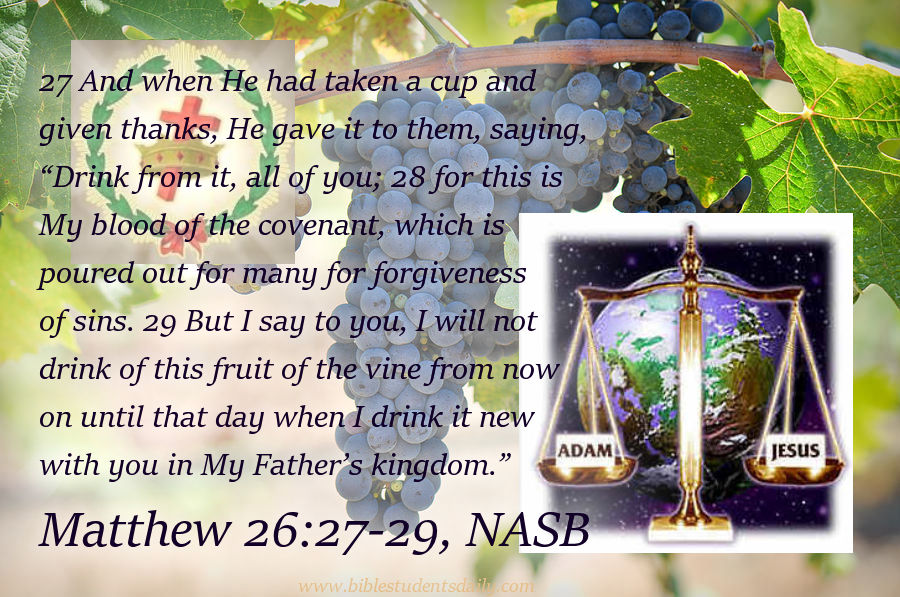
Matthew 26:27–29 (ESV) And he took a cup, and when he had given thanks he gave it to them, saying, “Drink of it, all of you, 28 for this is my blood of the covenant, which is poured out for many for the forgiveness of sins. 29 I tell you I will not drink again of this fruit of the vine until that day when I drink it new with you in my Father’s kingdom.”

In the Matthew account in Chapter 26 verses 27–29, it appears that there is one cup, and that Jesus refers to it both as “my blood of the covenant, which is poured out for many for the forgiveness of sins” in verse 28 and as “this fruit of the vine” in verse 29. If we just take Matthew’s account as the basis for Jesus’ institution of the memorial cup emblem, we might get the impression that not only there was one cup, but that Jesus did drink of this cup – for he says according to the ESV in verse 29 “I will not drink again,” suggesting that he had already drank of it. And some suggest that this therefore shows that the disciples – and by implication all consecrated believers, share with Jesus in his sufferings – after all, like Jesus, we are told to present ourselves a living sacrifice in Romans 12:1.

If Jesus did drink of the memorial cup, what Jesus described as “this fruit of the vine” would seemingly and straightforwardly refer to wine consumed during a supper. The “vine” referring to a grapevine and its fruit as consumed and referred to at the time meant wine, i.e. fermented grape juice – for this was a way of preserving it. Grape juice would of course be an acceptable substitute for those inclined to do so. That Jesus does not refer to the contents according to the normal, commonly used ancient Greek word for wine, oinos, may be significant.

But if the cup was also “my blood of the covenant, which is poured out for many for the forgiveness of sins” – as Jesus states, and if Jesus also drank of it, then we are left with the uncomfortable suggestion that Jesus needed forgiveness of sins provided by his own sacrifice – which of course does not make sense as Jesus was sinless, and no sinner can redeem their own sin.

One solution to this problem seems to be that Jesus did not in fact drink of this cup. And this does seem to be supported by the questionable translation of the Greek preposition “apo” and adverb “arti” in the ESV as “again” in some Bibles. These two ancient Greek words literally mean “from now.” About 10 Bibles translate them as “again”, but at least 15 translate them as “from now” or “henceforth”, and the RVIC2016 as well as Wilson’s Diaglott translate them as “henceforth.” Importantly, the better translations of “henceforth” and “from now” are ambiguous in indicating whether Jesus did in fact drink of the cup or not.

The Gospel of Matthew Account

The Gospel of Mark account is much more succinct in general and here in regards to the institution of the memorial cup, is very similar to Matthew’s.

Luke 1:3 (ESV) “it seemed good to me also, having followed all things closely for some time past, to write an orderly account for you, most excellent Theophilus.”

The Gospel of Luke account of these events is however fuller, and as mentioned, Luke the physician, paid particularly attention to the sequence of events, and he states so in Luke 1:3, he says “having followed all things closely for some time past, to write an orderly account for you, most excellent Theophilus.” When he addresses the reader as “Theophilus” he means “lover of God”, which is what the word means in ancient Greek. That Luke wrote his account with particular attention to the sequence of events is important for us.

Luke 22:17–20 (ESV) And he took a cup, and when he had given thanks he said, “Take this, and divide it among yourselves. 18 For I tell you that from now on I will not drink of the fruit of the vine until the kingdom of God comes.” 19 And he took bread, and when he had given thanks, he broke it and gave it to them, saying, “This is my body, which is given for you. Do this in remembrance of me.” 20 And likewise the cup after they had eaten, saying, “This cup that is poured out for you is the new covenant in my blood.

Luke distinguishes between the cup of “the fruit of the vine” and the cup “that is poured out for you is the new covenant in my blood,” as partaking of the bread emblem occurred in between.

Two cups:

  • The “fruit of the vine” cup
  • The “new covenant in my blood, for the forgiveness of sins, poured out for you” cup

This is important information, for it tells us that there were, in fact, two cups – not one; firstly, the “fruit of the vine” cup and secondly – combining the Matthew and Luke accounts, of “the new covenant in my blood, for the forgiveness of sins, poured out for you.”

1 Corinthians 11:25 (ESV) In the same way also he took the cup, after supper, saying, “This cup is the new covenant in my blood. Do this, as often as you drink it, in remembrance of me.”

The first cup was seemingly partaken of during the last supper, as the second cup, the memorial cup was instituted by Jesus after supper – as the Apostle Paul tells us in 1 Corinthians 11:25.

An important question to ask at this point is, is this important? – one, two cups, what is the difference?

If they are the same cup and if Jesus did partake of it does affect what the cup means, and also what our relationship to Jesus in regards to the cup actually is. As mentioned, some suggest that by drinking of the cup shows that we share in “the sufferings of Christ” with Jesus. So, the implications of whether there are one or two cups is not insignificant.

The “Fruit of the Vine” Cup

If there are two cups, they are different. Does that mean that they signify different things, or anything at all beyond the literal contents of wine?

It seems that that both signify different things.

Both cups literally contained “fruit of the vine” – almost certainly wine. That the 2nd cup, the memorial cup meant more than the literal wine it contained may suggest that Jesus also meant more than the literal wine in the first cup. This seems to be supported by Jesus’ use of the unusual phrase “fruit of the vine” for the wine, as this phrase is only found 3 times in the New Testament and only in the Gospel accounts in relation to the memorial cup. No where else in the Scriptures is the phrase “fruit of the vine” used to refer to wine. The normal word for wine, oinos, is however widely and commonly used in the New Testament, some 34 times.

Luke 7:33–34 (NKJV) For John the Baptist came neither eating bread nor drinking wine, and you say, ‘He has a demon.’ 34 The Son of Man has come eating and drinking, and you say, ‘Look, a glutton and a winebibber, a friend of tax collectors and sinners!’

As an example, in Luke 7:33–34 we have the word oinos used twice in relation to John the Baptist and Jesus when the Pharisees criticized both – John for not eating bread and drinking wine saying he had a demon, and Jesus for eating bread and drinking wine saying he was a glutton and drunkard. If therefore the word for wine, oinos was commonly used, but that Jesus did not use it for the contents of the first cup but instead used the unusual phrase “fruit of the vine” suggests Jesus may have had a deeper meaning in mind.

John 6:48 (ESV) I am the bread of life.

John 15:5 (ESV) I am the vine; you are the branches. Whoever abides in me and I in him, he it is that bears much fruit, for apart from me you can do nothing.

Just as the memorial emblem of the bread that they all ate of indicates that Jesus “is the bread of life” – as Jesus explicitly states in John 6:48, the “fruit of the vine” reference may point to Jesus’ statement in John 15:5 that he is “the vine” and that his disciples are the branches – just as all consecrated Christians are. But if it is not literal, what is the metaphorical “fruit of the vine?” This would seem to be the fruits of the spirit that all those in Christ develop. And the full fruitage of the vine will not be evident till the body of Christ is completed at the end of the harvest period when the kingdom of God is established.

Galatians 5:22–23 (ESV) But the fruit of the Spirit is love, joy, peace, patience, kindness, goodness, faithfulness, 23 gentleness, self-control; against such things there is no law.

Here the “fruit of the vine” therefore seems to refer to the fruits of the holy spirit evident in all true consecrated believers in Jesus – love, joy, peace, patience, kindness, goodness, faithfulness, gentleness, and self-control. This would be consistent with Jesus’ statement that he would not drink of this 1st cup till the kingdom of God comes, or in other words that the full fruitage of the vine would not be evident till the kingdom.

What does it mean then if Jesus drank of this cup? If Jesus did drink of this cup, because he also received the holy spirit, he would also be a first fruit of the holy spirit – and so appropriately drink of the same cup.

Luke 22:16 (ESV) For I tell you I will not eat it until it is fulfilled in the kingdom of God.”

This would also seem to be consistent with Jesus’ statement that he would not eat of the Passover till it is fulfilled in the kingdom of God. This statement is also somewhat enigmatic and unlikely to be fulfilled literally in the future, but it does show that the antitype of the Passover is also still not fulfilled. When we examine the details of the Passover, we understand that Israel as a nation was a type for the world in general. The Passover ultimately led to the liberation from the Pharaoh and Egypt, but in the antitype, this has not occurred yet – the world in general has not yet been liberated from the Adversary and his kingdom. In the same way, the “fruitage of the vine” will not be completed and will not be able to be drank of by Jesus and his consecrated followers, till the church is complete and the marriage of the Lamb occurs.

The “New Covenant in My blood, for the forgiveness of sins, poured out for you” Cup

What then, does the second cup mean and indicate? This seems more self-explanatory – for Jesus actually tells us. Jesus says that the cup depicts “the new covenant in my blood, poured out for you, for the forgiveness of sins.” Jesus’s words seem plain and straightforward enough. Some have suggested that they do not apply to us [believers in the Gospel Age], and that the new covenant will only be inaugurated in the kingdom period. That Jesus says that his “blood, [is] poured out for you,” seems to unequivocally apply it to his consecrated followers now during the Gospel Age, not the kingdom age. When Jesus says “for you,” he means his disciples, and by extension us consecrated believers also.

1 Corinthians 15:19 (ESV) If in Christ we have hope in this life only, we are of all people most to be pitied.

Moreover, that Jesus’ blood provides forgiveness of sins – the prime requirement for reconciliation with God means that if we do not have forgiveness of sins in Christ, then we are still in our sins and most pitiable of men. Let us be clear, if the new covenant, which is the only means by which we can receive forgiveness of sins is not in operation, then how can we be reconciled to God by our faith?

That Jesus did not drink of this 2nd memorial cup, because it is a different cup, makes much better sense – for to partake of it would suggest that he needed forgiveness of sins; which of course he did not – for he was sinless.

That only all of the disciples did drink of this cup, showed that they were the recipients of the benefits of his sacrifice – for the forgiveness of their sins. We note what Jesus said when he gave them [and by extension us] to drink of the cup, he said “Drink of it, all of you” – he did not say let “us” drink of this cup.

Partaking of the cup did not indicate a sharing in the sufferings of Christ. Not that we do not partake in the sufferings of Christ – for the scriptures indicate that we do, but the memorial cup does not indicate this. It indicates that we together have in common that we are all dependent on the sacrifice of Jesus for our reconciliation with God through forgiveness of sins.

The Common Union of the Blood of Christ

1 Corinthians 10:16 (NKJV) The cup of blessing which we bless, is it not the communion of the blood of Christ? The bread which we break, is it not the communion of the body of Christ?

But what about 1 Corinthians 10:16, does this not indicate that we share in the sufferings of Christ, when the apostle Paul says “is not the cup we bless the communion in the blood of Christ?” It has been assumed that the common union in the blood of Christ here is a common union with Jesus, but the context and the grammatical usage here of “koinonia” [translated communion] indicate that the common union is with one another – a common participation of the blood of Jesus showing that we all receive forgiveness of sins through Jesus’ sacrifice.

Here in 1 Corinthians Chapter 10, the Apostle Paul outlines that “the cup we bless” – the memorial cup we ask a blessing for, is not an empty ritual but shows that we are eating at the table of the Lord – we are appropriating the merit of Jesus’ sacrifice to ourselves. And that eating at the table of the Lord is incompatible with eating at the table of demons – which eating of the sacrifices to idols then essentially was. The Apostle warns us to flee from idolatry. There is no suggestion here that we contribute to the food at the table of the Lord. The idolatry we face is much more subtle; it can be the pursuit of wealth, fame, respect, or even a sense of belonging at the expense of the truth but also includes anything that supplants the authority of God’s word.

John 6:54 (NKJV) Whoever eats My flesh and drinks My blood has eternal life, and I will raise him up at the last day.

Jeremiah 31:33–34 (NKJV) But this is the covenant that I will make with the house of Israel after those days, says the LORD: 1) I will put My law in their minds, and write it on their hearts; and I will be their God, and they shall be My people. 34 2) No more shall every man teach his neighbor, and every man his brother, saying, ‘Know the LORD,’ for they all shall know Me, from the least of them to the greatest of them, says the LORD. For 1) I will forgive their iniquity, and their sin I will remember no more.”

Jesus said, whoever drinks of my blood has eternal life…as John 6:54 says.

Faith in Jesus provides us with 1) forgiveness of sins, and thereby reconciliation with God, in order that we may, through baptism, receive of His holy spirit and be developed as new creatures, as 2) the holy spirit teaches us all things of God [rather than any man], even the deep things, and it writes 3) His royal law of agape love on our hearts – these are all functions of the holy spirit through the new covenant as outlined in Jeremiah 31; that we may be born on the spirit plane in the image of Jesus – when we will see the Passover fulfilled, when the fruit of the vine is complete through commonly with one another, partaking of the blood of Jesus shown in the memorial cup Jesus instituted – if we patiently endure to the end.

In Conclusion

In conclusion, it seems then that when Matthew talks about the cup of “the fruit of the vine” and the cup of Jesus’ “blood of the new covenant, for the forgiveness of sins, poured out for you” that they are in fact two separate cups – according to the Gospel of Luke. Jesus may have drank of the former – as the “fruit of the vine” seems to refer to the first fruits of the holy spirit – and which will not be evident till the marriage of the lamb, the seed of blessing is complete. The second cup is separate, a cup that Jesus did not drink of – but of which Jesus said they should all drink of, indicating their, and by extension, our dependence on the sacrifice of Jesus for forgiveness of sins and reconciliation to God. Without it God could not give us of His holy spirit in order to develop us as new creatures and be born on the spirit plane in the likeness of Jesus.

Hallelujah, O what a prospect! Praise be to our Heavenly Father and to His son Jesus.

Suggested Further Reading:

Eating at the Table of the Lord


ROMANS 8, 18 - ad..jpg

Sea-of-Galilee-Mount-of-Beatitudes.jpg

Suggested Further Reading

“Are We Actual Or Reckoned New Creatures?” The Reprints (No. 5325) of the Original Watch Tower and Herald of Christ Second Presence.

“The Ransom.” by Br. David Rice. Faithbuilders Fellowship Journal.
http://www.2043ad.com/journal/2007/02_ma_07.pdf

“Bread and Cup” by Br. James Parkinson. The Herald of Christ’s Kingdom Magazine, March-April 2018.

“Jesus The Name.”
https://biblestudentsdaily.com/2017/07/05/jesus-the-name/

“Who Is the World’s Ransom and Why?”
https://biblestudentsdaily.com/2016/03/29/who-is-the-worlds-ransom-and-why/?share=press-this&nb=1

“Nehemiah 8:10 — The Joy of the Lord Is Your Strength.”
https://biblestudentsdaily.com/2016/12/20/nehemiah-810-the-joy-of-the-lord-is-your-strength/


This post’s URL:
https://biblestudentsdaily.com/2018/03/19/matthew-2627-29-drinking-from-christs-one-cup/

Enter your email address to subscribe to this blog and receive notifications of new posts by email.


A Little While – Hymns of Dawn No. 7

A Little While – Hymns of Dawn No. 7

Lyrics

“A little while;” now he has come;
The hour draws on apace—
The blessed hour, the glorious morn,
When we shall see his face.
How light our trials then will seem!
How short our pilgrim way!
The life of earth a fitful dream,
Dispelled by dawning day!

Chorus

Then, O Lord Jesus, quickly show
Thy glory and thy light,
And take God’s longing children home,
And end earth’s weary night.

A little while; with patience, Lord,
I fain would ask, “How long?”
For how can I, with such a hope
Of glory and of home,
With such a joy awaiting me,
Not wish the hour were come?
How can I keep the longing back,
And how suppress the groan?

Yet peace, my heart! and hush, my tongue!
Be calm my troubled breast!
Each passing hour prepares thee more
For everlasting rest.
Thou knowest well, the time thy God
Appoints for thee is best.
The morning star already shines;
The glow is in the east.

Bible Scriptures Associated With This Hymn

  • 1 Corinthians 13:12-13 (ESV) —

“12 For now we see in a mirror dimly, but then face to face. Now I know in part; then I shall know fully, even as I have been fully known. 13 So now faith, hope, and love abide, these three; but the greatest of these is love.”

  • 1 Corinthians 15:50-58 (RVIC) —

“(50) Now this I say, brethren, that flesh and blood cannot inherit the kingdom of God; neither doth corruption inherit incorruption. (51) Behold, I tell you a mystery: We shall all fall asleep, but we shall not all be changed (52) in a moment, in the twinkling of an eye, in the last trump: for the trumpet shall sound, and the dead shall be raised incorruptible, and we shall be changed. (53) For this corruptible must put on incorruption, and this mortal must put on immortality. (54) But when this corruptible shall have put on incorruption, and this mortal shall have put on immortality, then shall come to pass the saying that is written, Death was swallowed up in victory. (55) O death, where is thy victory? O death, where is thy sting? (56) But the sting of death is sin; and the power of sin is the law: (57) but thanks be to God, who giveth us the victory through our Lord Jesus Christ. (58) Wherefore, my beloved brethren, be ye stedfast, unmovable, always abounding in the work of the Lord, forasmuch as ye know that your labor is not vain in the Lord” (1 Corinthians 15:50-58, RVIC – The American Revised Version Improved and Corrected, 2000).

  • Song of Songs (“Canticles”) 8:14 (NAS) —

“Hurry, my beloved, And be like a gazelle or a young stag On the mountains of spices.”

The comments below, are a direct quote from “Notes on The Song of Solomon” by Anton Frey in the Bible Student Library CD:

Solomon, expecting to be gone from her immediate presence, though within hearing and speaking range, admonishes her to remain in the beautiful and fragrant gardens. It would be from these that she should be able to maintain communications with him, though not able to actually see him. He went to make the final preparations for the taking of her to her new home; there, to make her his bride, his wife! Already, some of her belongings have been transported to the Palace—the treasures, which she wishes to keep with her, forever and a day! As she now waves to him, she says, very earnestly, “Make haste, my dearly beloved, be like the roe, or the young hart upon the mountains of spices”—return speedily for me, for I can scarcely wait!

The words of the “espoused virgin” at this time, are not any different from those she has uttered to her beloved “Solomon,” from the very beginning of the Gospel age; for they do most beautifully express her hopes—“Come quickly, Lord.” She would have Him be swift, like the roe, or the young hart. She has already told him that she would eagerly be awaiting him—his return to take her to her heavenly home, where he will make of her, his bride, the Lamb’s wife! How she does look forward to the day when he shall change her name to his—“Jehovah Tsidkenu”—the Righteousness of Jehovah (Jeremiah 33:16; 23:6). Her bridal garments are all in readiness (Psalm 45:13, 14) and, already, some of her treasures (tokens of his love given to her during their period of courtship) have been transported to the Royal Palace! Is this not also, the significance of the Master’s words, “I go to prepare a place for you”? (John 14:2) “Come quickly, Lord,” she says… He responds, “I (shall indeed) come quickly” (Rev. 3:11, 22:7); and to which, her final salutation is, “Even so, come, Lord Jesus.”

Let us strive to be worthy of a love so great and tender as His [Christ’s]. Let us seek ever and always to glorify Him before others; and, never, no, never, prove ourselves unworthy! Contemplate… the transcendency of His love; think upon what He has declared He thinks of His beloved: then, endeavor, more and more, to grow into the image and likeness—His “Ideal”!

  • Hebrews 10:35-39 —

“35 Cast not away therefore your confidence, which hath great recompence of reward. 36 For ye have need of patience, that, after ye have done the will of God, ye might receive the promise. 37 For yet a little while, and he that shall come will come, and will not tarry. 38 Now the just shall live by faith: but if any man draw back, my soul shall have no pleasure in him. 39 But we are not of them who draw back unto perdition; but of them that believe to the saving of the soul.”

  • 2 Peter 1:12 —

“Wherefore I will not be negligent to put you always in remembrance of these things, though ye know them, and be established in the present truth.”

The three “stepping stones” to understanding Christ’s invisible presence and “parousia” which IS (part of) “the present truth” which the Apostle Peter was talking about in 2 Peter 1:12 are: 1260, 1290, and 1335 and these numbers are prophetic markers all found in both the Book of Revelation and the Book of Daniel.

For further reading about Christ’s Presence please go to the following post: “Christ’s Parousia (Second Presence) In 1874” [URL: https://biblestudentsdaily.com/2017/11/10/christs-parousia-second-presence-in-1874/%5D.

More about CHRIST’s PAROUSIA (presence) can be read about here:

i-will-come-again

Hymn Book Purchase

The Hymns Of Dawn (hymn book) can be purchased at:

Acknowledgment & References

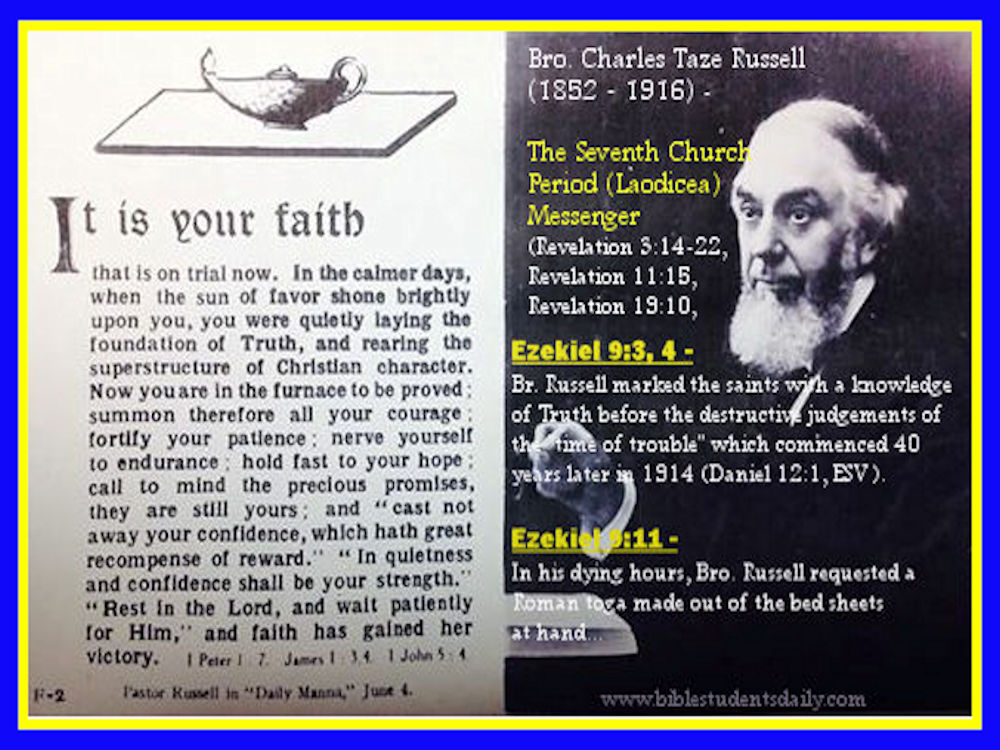
Br. Charles Taze Russell

Charles-Taze-Russell-Laodicean-Messenger7.jpg

Br. Charles Russell—the founder of the Bible Students movement, who is the compiler of “Poems and Hymns of Millennial Dawn” which was published in Allegheny, Pa., in 1890. This Bible Students’ devotional originally contained a total of 151 poems and 333 hymns.

Later on, the hymns from this book formed a basis for the hymnal titled ““Hymns of Dawn” which was published by the Dawn Bible Students Association in East Rutherford, New Jersey (USA) and the 1999 edition contains a total of 361 hymns.

Suggested Further Reading

Click on the links below for the specified article/content matter.

“Daniel: Conclusion” by Br. David Rice. Faithbuilders Fellowship — “Journal” section, May-June 2009 edition (at 2043ad.com / button “Journal.”) Here is the direct link to this article:
http://2043ad.com/journal/2009/2009c.pdf

“The Prophetic Date – 1874”. The Herald of Christ’s Kingdom Magazine, Nov-Dec. 2003 issue.
http://www.heraldmag.org/2003/03nd_5.htm

“Coming Blessings” by Br. David Rice (www2043ad.com). The Herald of Christ’s Kingdom Magazine, Sept-Oct. 2012 issue.
http://www.heraldmag.org/2012/12so_9.htm

“An Important Greek Word – Parousia” by Br. David Rice. The Herald of Christ’s Kingdom Magazine, Nov-Dec. 2003 issue.
http://www.heraldmag.org/2003/03nd_8.htm

“Every Eye Shall See Him” by Br. Gilbert Rice. The Herald of Christ’s Kingdom Magazine, Nov-Dec. 2003 issue.
http://www.heraldmag.org/2003/03nd_4.htm

“The Harvest — The End of the Age” by Br. Carl Hagensick. The Herald of Christ’s Kingdom Magazine, Nov-Dec. 2003 issue.
http://www.heraldmag.org/2003/03nd_2.htm

“A Secret Coming – A Thief In the Night.” The Herald of Christ’s Kingdom Magazine, Nov-Dec. 2003 issue.
http://www.heraldmag.org/2003/03nd_9.htm

“Times and Seasons — The Seventh Trumpet” by Br. Michael Brann. The Herald of Christ’s Kingdom Magazine, Nov-Dec. 2003 issue.
http://www.heraldmag.org/2003/03nd_3.htm

“Chronos and Kairos – Times and Seasons.” The Herald of Christ’s Kingdom Magazine, Nov-Dec. 2003 issue.
http://www.heraldmag.org/2003/03nd_7.htm

Epoch Periods In God’s Plan. BIBLE Students DAILY.
https://biblestudentsdaily.com/2017/08/16/epoch-periods-in-gods-plan/

Is the “Sabbath Day” a Saturday, Sunday or any Day of the Week? BIBLE Students DAILY.
https://biblestudentsdaily.com/2017/10/19/is-the-sabbath-day-a-saturday-sunday-or-any-day-of-the-week/

Only A Little While
https://biblestudentsdaily.com/2017/01/24/only-a-little-while/

The Time Is Short
https://biblestudentsdaily.com/2016/03/08/the-time-is-short-surrender-all/

ACTS 23:6 – The Resurrection Process – Part (A), (B), and (C):

(A) https://biblestudentsdaily.com/2016/11/03/acts-236-hope-resurrection-part-a-what-is-jesus-all-about/

(B) https://biblestudentsdaily.com/2016/11/05/acts-236-hope-resurrection-part-b-will-mankind-resurrect-with-the-same-mind/

(C) https://biblestudentsdaily.com/2016/11/11/acts-236-hope-resurrection-part-c-the-order-of-the-resurrection-process/

Wait O Thou Weary One A Little Longer https://biblestudentsdaily.com/2016/11/19/wait-o-thou-weary-one-a-little-longer/

Links and Bible Resources. BIBLE Students DAILY.
https://biblestudentsdaily.com/category/links/


The URL of this post:

A Little While – Hymns of Dawn No. 7

Enter your email address to subscribe to this blog and receive notifications of new posts by email.


Where Does “Christmas” Originate From?

Where Does CHRISTMAS ORIGINATE from.jpg

The Christmas season is the most enjoyable time of the year for many who think upon the events surrounding the gift of Jehovah to the world—his firstborn Son, our Lord Jesus as a special gift to the human family, but is the redemptive work of Jesus Christ, truly appreciated in its full sense?

You see, the true reason for Jesus’ birth was that he would give his life as a ransom price for the sins of every single human that has lived.

The apostle Paul wrote to Timothy, “I exhort therefore, that, first of all, supplications, prayers, intercessions, and giving of thanks, be made for all men; For kings, and for all that are in authority; that we may lead a quiet and peaceable life in all godliness and honesty. For this is good and acceptable in the sight of God our Saviour; Who will have all men to be saved, and to come unto the knowledge of the truth. For there is one God, and one mediator between God and men, the man Christ Jesus; Who gave himself a ransom for all, to be testified in due time” (1 Timothy 2:1-6).

In John 3:16 we read that “God so loved the world, that he gave his only begotten Son, that whosoever believeth in him should not perish, but have everlasting life.”

The Greatest Message of Joy

The angel in Luke 2:10-14 was announcing God’s greatest gift to his poor, sin-sick and dying human creation: A SAVIOR… The “ransom for ALL to be testified in due time” when Christ’s future kingdom of righteousness will soon be established on earth, and when “God’s sons” (the Bride of CHRIST—the 144,000, shall be all beyond the vail and “revealed.” (1 Timothy 2:6, Romans 8:19)

The birth of Jesus had been foretold by the Prophet Isaiah:

“Unto us a child is born, unto us a son is given: and the government shall be upon his shoulder: and his name shall be called Wonderful, Counsellor, The mighty God, The everlasting Father, The Prince of Peace. Of the increase of his government and peace there shall be no end, upon the throne of David, and upon his kingdom, to order it, and to establish it with judgment and with justice from henceforth even for ever. The zeal of the Lord of hosts will perform this” (Isaiah 9:6,7).

Isaiah’s prophecy speaks of Jesus as the antitypical King David, and that he would in due time assume the several and distinct offices of his yet future kingdom as outlined in the prophecy.

At that future time, our loving Heavenly Father would entrust the glorified Jesus to exercise the great power and authority that would be given him to bless all the families of the earth as promised to the true and faithful “seed” of Abraham (Genesis 22:15-18; Acts 17:31).

At Christmas when the world’s attention is drawn to the birth of our dear Lord Jesus, we must acknowledge that he left us with no instructions to celebrate his birth date.

However, Jesus did give us instructions to memorialize his deathinviting us to partake of the emblems and to remember his death. (Matthew 26:26-30; Mark 14:22-26, 1 Corinthians 11:17-34).

In the Book of Luke, Jesus’ words spoken to his followers at the last supper on Nisan 14th (the day of unleavened bread when the Passover lamb was to be sacrificed) are as follows:

“(17)And he took the cup, and gave thanks, and said, Take this, and divide it among yourselves: (18) For I say unto you, I will not drink of the fruit of the vine, until the kingdom of God shall come. (19) And he took bread, and gave thanks, and brake it, and gave unto them, saying, This is my body which is given for you: this do in remembrance of me. (20) Likewise also the cup after supper, saying, This cup is the new testament in my blood, which is shed for you” (Luke 22:17-19).

An Ancient Holiday Season

Although many Christian people continue to observe December 25th as the date of Jesus’ birth, there is no scriptural evidence for this date. Many students of the Bible have come to the conclusion that the blessed event took place around the beginning of October, as we have explained in the post titled Calculating the Date of Jesus’ Birth.

The Winter Solstice

Many ancient cultures chose the Winter Solstice as a special time for celebrating Christmas—which was the terminal point between the darkest days of the year, and the time when the sunlight would begin to increase. That is, when the path of the sun has reached its furthest southern position. The word “solstice” literally means “the sun stands still.”

The time of the Winter Solstice was determined using very primitive and imprecise methods—measuring the length of the shadow created by a stick or a standing stone, which in turn, was dependent on clear weather to create a shadow and to make their calculations as accurate as possible.

In pagan times, the Winter Solstice was seen as part of an annual cycle of the earth’s seasons known as “the wheel of the year.” They celebrated eight festivals including the spring, midsummer, fall, and Yule seasons. Four others were spaced midway between each of them. These festivals have origins in Germanic and Celtic pre-Christian feasts.

Yuletide Celebrations

The Yuletide festival was one of the ancient traditions that was observed in many areas of Europe, the British Isles, and elsewhere. The word Yule relates to the Christmas season and the time when the sun reverses its downward path and begins to shine longer each day.

The actual time may vary a few days over the course of years, but usually occurs sometime between December 21st – 23rd.

Fathers and sons would bring home large logs, which they would set on fire. The people would feast until the log burned out, which could take as many as 12 days. The Norse believed that each spark from the fire represented a new pig or calf that would be born during the coming year. The log was believed to bring good luck to the occupants of the dwelling. Ashes from the log were placed in wells to keep the water pure and they were also placed at the roots of fruit trees and vines to help them bear an abundant harvest during the following year.

The end of December was also when most cattle were slaughtered, thus, the only time of year when they had a supply of fresh meat and most wine and beer made during the year was finally fermented and ready for drinking.

In Germany, people honoured the pagan god Oden during the mid-winter holiday who they were terrified of, as they believed he made nocturnal flights through the sky to observe his people, and then decide who would prosper or perish. Because of his presence, many people chose to stay inside.

Saturnalia

In Rome, where winters were not as harsh as those in the far north, Saturnalia—a holiday in honour of Saturn, the god of agriculture—was celebrated. Beginning in the week leading up to the winter solstice and continuing for a full month, Saturnalia was a hedonistic time, when food and drink were plentiful, when slaves would become masters for this month and when peasants were in command of the city. Business and schools were closed so that everyone could partake of this pagan “fun.”

Mithraism

Another of the Winter Solstice festivals was the celebration of Mithra—annually observed by the people of ancient Persia in honour of the Persian god Mithra who was considered the deity of light, wisdom, and moral purity. For some Romans, Mithra’s birthday was the most sacred day of the year and celebrated on December 25th.

The celebration of Mithra was later introduced into Europe and other areas of Asia Minor after the conquests of Alexander the Great (in early 300 BC) but it began to lose much of its influence by the end of the fourth century. With the rise of Constantine the Great in the fourth century, Christianity was then elevated to the prominent position as the official religion of the Roman Empire. Therefore, the ancient traditions and various observances of the old pre-Christian era gave way to the new Christian religion and its festivals.

The Christian Era

Who Established the Christmas December 25th Date?  

In the early years of Christianity, Easter was the main holiday; the birth of Jesus was not celebrated. During the early centuries of the Christian era, religious leaders wanted to establish a fixed date to celebrate the mass of Christ, which was called Christmas.

It is commonly believed that the church (that is, Pope Julius I—a bishop of Rome from AD 337 to his death in AD 352) chose this date in an effort to adopt and absorb the traditions of the pagan Saturnalia festival.

First called the Feast of the Nativity, the custom spread to Egypt by AD 432 and to England by the end of the sixth century. By the end of the eighth century, the celebration of Christmas had spread all the way to Scandinavia. Today, in the Greek and Russian orthodox churches, Christmas is celebrated 13 days after the 25th, which is also referred to as the Epiphany or Three Kings Day.

By holding Christmas at the same time as traditional winter solstice festivals, church leaders increased the chances that Christmas would be popularly embraced, but gave up the ability to dictate how it was celebrated.

By the Middle Ages, on Christmas believers attended church and afterwards celebrated raucously in a drunken, carnival-like atmosphere. Christmas became the time of year when the upper classes could repay their real or imagined “debt” to society by entertaining less fortunate citizens.

Christmas is Outlawed In the Early 17th Century

In 1645, Oliver Cromwell and his Puritan forces took over England and they vowed to rid England of decadence and, thus Christmas was cancelled through these efforts, even being known to be outlawed (from 1659-1681) in Boston. However, by popular demand, Charles II was restored to the throne and, with him, came the return of the popular holiday.

In fact, Christmas wasn’t declared a federal holiday until June 26, 1870.

The Christmas Tree – A Pagan Custom Brought to Christianity

Long before Christ, evergreen trees and plants have been used to celebrate winter festivals.

Early Romans used evergreens to decorate their temples at the New Year’s celebration of the Saturnalia festival, and exchanged branches and twigs of evergreens as a good luck blessing.

The ancient Egyptians used green palm rushes as part of their worship of the god Ra.

Pagans in Europe believed that because the evergreen tree stayed green throughout the year and could withstand the rigors of an extreme winter, they had magical abilities to ward off the life-threatening powers of darkness and cold. Thus they were considered to possess powers over evil spirits, which some ancient pagan civilizations of northern Europe believed stalked the eerie shadows of the wintertime forests.

During the winter months, evergreen wreaths and other forms of greenery were hung over doors and windows and brought inside the house to protect one from the darkness and evil spirits. The incense from burnt needles and cones as well as the scent from this greenery would freshen the dark and dismal dwellings from the otherwise stagnant odour of thresh and straw and was considered a means of blessing the occupants of the home.

The evergreens served as a reminder that the rigors of winter would pass, and that the land would once again be fruitful.

Many historians believe that the pagan people of Scandinavia were among the first to actually bring evergreen trees indoors, which served as a mid-winter symbol of the promise of the coming warmth of spring.

German Saxons are believed to have been the first to light their trees with candles, and to adorn them with decorations and trinkets for good fortune. The tradition of the indoor evergreen tree became popular in Germany, and it is believed that the first use of Christmas trees by Christians was developed in that part of Europe. Some historians have suggested that its origin may reach back as far as the eighth century.

In England, the first recorded Christmas tree was in 1841. At that time, Queen Victoria was married to Prince Albert of Germany, and he brought the tradition with him and set up the first Christmas tree in Windsor Castle.

German immigrants to America also brought the tradition with them and were celebrating Christmas with evergreen trees as early as the 1830s. The custom took several decades to catch on in the United States. During that period of time, most religious people correctly assumed that it had pagan origins. However, by the 1890s the indoor decorated Christmas tree had become popular in the majority of homes in America.

The Truth behind the Word “CHRISTMAS”

The word “CHRISTMAS” is based upon an impure doctrinal foundation: THE ROMAN CATHOLIC PAPAL SYSTEM—the ANTICHRIST of the Bible—was identified by the Reformers of the Early Church, such as Martin Luther.

The Papal system fit the description found in 2 Thessalonians 2:4:

“…who opposeth and exalteth himself above all that is called God, or that is worshipped; so that he as God sitteth in the temple of God, showing himself that he is God…”

The evidence to the Reformers in confirming the identity of Antichrist was the doctrine of the Mass. The ritual of the Mass claims to recreate and sacrifice over and over Christ’s actual flesh (bread) and blood (wine). Known as the Eucharist, it became a requirement that each believer must receive this fresh sacrifice of Christ to cover his daily sins. Daniel 11:31 refers to this as “the abomination that maketh desolate.”

The Mass makes desolate or negates the full merit of Christ’s blood which was shed once for all.” (Hebrews 7:27; 10:10)

It is important to note that the Protestant Reformers were careful not to condemn any individual Catholic believer as Antichrist—recognizing that no man is The Antichrist. Popes, bishops, priests and others have been only parts of, and, possibly, innocent members of the corrupt Antichrist system.

Jesus Christ’s Commission On Earth

At the age of maturity (30 years), the perfect man Jesus presented himself to his Heavenly Father in total consecration and obedience to do his will.

Jesus fulfilled the words that the Psalmist David had written concerning him:

“Then said I, Lo, I come: in the volume of the book it is written of me, I delight to do thy will, O my God: yea, thy law is within my heart. I have preached righteousness in the great congregation: lo, I have not refrained my lips, O Lord, thou knowest. I have not hid thy righteousness within my heart; I have declared thy faithfulness and thy salvation: I have not concealed thy lovingkindness and thy truth from the great congregation. Withhold not thou thy tender mercies from me, O Lord: let thy lovingkindness and thy truth continually preserve me” (Psalm 40:7-11).

In Luke 4:18-19, Jesus explains to us his commission:

 “The Spirit of the Lord is upon me, because he hath anointed me to preach the gospel to the poor; he hath sent me to heal the brokenhearted, to preach deliverance to the captives, and recovering of sight to the blind, to set at liberty them that are bruised, To preach the acceptable year of the Lord.”

“To the poor”—In his sermon on the mount, Jesus said, “Blessed are the poor in spirit: for theirs is the kingdom of heaven” (Matthew 5:3).

“Heal the brokenhearted—Jesus was to heal the brokenhearted, and he said, “Come unto me, all ye that labour and are heavy laden, and I will give you rest” (Luke 11:28).

“Preach deliverance to the captives”—Isaiah’s account reads, “To proclaim liberty to the captives, and the opening of the prison to them that are bound” (Isaiah 61:1).

When Jesus quoted Isaiah’s prophecy, he used the word “bruised” which means to crush, as in death. The reference to “captives” points to the prison house of death. In his sermon on the resurrection of the dead, he said, “The hour is coming, and now is, when the dead shall hear the voice of the Son of God: and they that hear shall live” (John 5:25).

“To preach the acceptable year of the Lord”—speaks of the special invitation which has been extended to the called by God during this present Gospel Age who are laying their lives down in sacrifice which is acceptable to God (Romans 12:1,2).

What is our Commission?—see post titled Jesus’ Commission: Make Disciples. Baptize. Teach.

We, too, are commissioned to preach the Gospel to the poor, groaning creation. If we are faithful unto death, we will have the great privilege to share with our glorified Lord in his future kingdom of righteousness over all the people of earth. Let us renew our efforts to serve him as we approach another new year.

May we continue to give thanks to our loving Heavenly Father for his gift of Jesus, in whom the whole human family will be blessed under the provisions of his future kingdom of life and righteousness.

Should Christians Celebrate Christmas?

“Let us remember: Jesus did not tell his disciples to celebrate his birth. Therefore, it is not important when we choose to remember this wonderful event. Because love and appreciation for our Savior abound in people’s hearts on December 25th, we may join in their attitude of glad remembrance. And the habit of giving gifts to one another seems especially appropriate. God is the giver of every good and perfect gift. Certainly, amongst all His gifts, the one of greatest important to us is the gift of His Son to be our Redeemer” (Chicago Bible Students Website, Questions and Answers).

Reference:

The Dawn Magazine, December 2005, “The Birth of a Savior: Tidings of Great Joy.”
The Dawn Magazine, December 2011, “The Yuletide Traditions: and the Winter Solstice.”
The End Times, Fall 2005, Issue No. 34 – “Anti-Christ – the Counterfeit Heavens.”
Chicago Bible Students Website: Questions and Answers (www.chicagobible.org)

The URL for this post:
https://biblestudentsdaily.com/2016/12/23/where-does-christmas-originate-from/

Enter your email address to subscribe to this blog and receive notifications of new posts by email.

Save

OUR BELIEFS – What Does The Bible Teach Us?

kangourous-australia website - WITH ADDRESS

To us, the Bible is the Word of GOD, the sole authority of Christian Doctrine and Practice. To us it clearly teaches that:

* JEHOVAH (Hebrew: YAHWEH) is THE ONE ALMIGHTY GOD, who is from “everlasting to everlasting” (Psalm 90:2).

* JESUS CHRIST, the Logos (Word), is GOD’S ONLY BEGOTTEN SON, the firstborn of every creature who was made flesh and by the grace of GOD gave himself a willing and voluntary RANSOM for ALL mankind, to be fully demonstrated in GOD’s due time, and His is the Light that enlightens all who come into the world. He is our Lord and Master and the Captain of our Faith, our Redeemer (John 3:16; John 5:28-29; John 14:16; Colossians 1:15-17; 1 Timothy 2:5-6; Hebrews 2:9).

* JESUS WAS RESURRECTED on the third day after his crucifixion (50 hours from the moment he went into the heart of the earth), Jesus was resurrected a Divine Celestial Being, Immortal, and will never come again in the flesh (Luke 24:1-7).

* ALL HAVE SINNED and come short of the Glory of GOD, and that the penalty for sin is death, extinction of life (Romans 3:23; Romans 6:23; Ecclesiastes 9:10).

* PERSONAL SALVATION is by faith in and the acceptance of Jesus Christ as a Savior and Lord, that there is no other name or way by which any can be saved (John 14:6; Acts 4:12; Acts 16:30-31).

* GOD IS CALLING OUT from those saved by faith now a “people for his name,” to be followers of Jesus Christ in full obedience to the divine will and to constitute His Body, the “Church.” These are also refer to as the “saints,” the “sanctified, the “bride” of Christ, the “wife of the Lamb,” “the 144,000” and the “little flock.” (Psalm 45:14-15; Matthew 16:24; Acts 15:14; Ephesians 1:22,23; Ephesians 5: 25-27, 32; 1 Corinthians 1:2; Revelation 21:9-10; Revelation 22:17; Revelation 7:4).

* THE HOLY SPIRIT is the character of the Heavenly Father Jehovah who is Love and Justice balanced by His awesome Wisdom, and His Great Power carries out His balance through actions and magnificent influence on ALL of His creation; and this power of His character is working in and through His called out people, to guide them into understanding of and conformity to His will. It is not a third person of a Godhead (Luke 11:13; John 16:13; Acts 1:8, Romans 8:14).

* Man IS A SOUL (Sentient being), but does not HAVE a “soul.”

* The wages of sin is DEATH and NOT TORMENT or some form of living separate from the Creator (Ezekiel 18:4; Romans 6:23).

* ALL MANKIND SHALL RESURRECT out of their graves and partake in the blessings and opportunities of Christ’s one thousand year kingdom which present conditions indicate is extremely close at hand (Luke 21:25-28, John 5:28, 29, Revelation 20:6).

* THE EARTH WILL NOT LITERALLY BE BURNED UP (but the systems of the world will be destroyed), but rather will become a paradise worldwide by the end of the Messianic Age, inhabited by the obedient regenerated race of Adam, when death will be destroyed forever (Ecclesiastes 1:4; Isaiah 25:8; 1 Corinthians 15:26; Revelation 21:4).

* THE CHURCH IS GOD’S TEMPLE which has been in preparation during this present GOSPEL AGE, at which, when complete, will be the means of GOD’S blessings coming to “all people” (Genesis 22:17-18; Isaiah 25:6; Matthew 19:28; 1 Corinthians 3:16,17; Ephesians 2:20-22).

* MEANTIME THE SHAPING AND POLISHING of individual Christians—“living stones”—has been in progress, and when all have been made ready, they will share in the “first resurrection” and the completed, glorified Temple will become the meeting place between GOD and mankind (1 Peter 2:5, 2 Peter 1:5-8, Revelation 20:6).

* THE HOPE OF THE CHURCH is to be like her Lord, to see Him as He is, to be partakers of the divine nature and to share in His glory in the divine realm as His joint-heirs helping the world of mankind come up the Highway of Holiness and come into harmony with GOD, so that GOD our Creator can be ALL IN ALL—which is the ETERNAL GOSPEL (Isaiah 35:8; 1 John 3:2, 2 Peter 1:4, Romans 8:16-17; Revelation 14:6).

* THE BLESSINGS OF GOD’S KINGDOM will include the return of GOD’S favour to Israel and the restoration of all things lost in Adam for all the willing and obedient in that time; that at the end of the thousand years Satan and all the willfully wicked will be destroyed (1 Corinthians 15:12-22, Romans 11:25,26, Acts 3:20,21).

*******

“For, behold, I create new heavens and a new earth: and the former shall not be remembered, nor come into mind. But be ye glad and rejoice forever in that which I create: for, behold, I create Jerusalem a rejoicing, and her people a joy. And I will rejoice in Jerusalem, and joy in my people: and the voice of weeping shall be no more heard in her, nor the voice of crying. There shall be no more thence an infant of days, nor an old man that hath not filled his days: for the child shall die an hundred years old; but the sinner being an hundred years old shall be accursed. And they shall build houses, and inhabit them; and they shall plant vineyards, and eat the fruit of them. They shall not build, and another inhabit; they shall not plant, and another eat: for as the days of a tree are the days of my people, and mine elect shall long enjoy the work of their hands. They shall not labour in vain, nor bring forth for trouble; for they are the seed of the blessed of the LORD, and their offspring with them. And it shall come to pass, that before they call, I will answer; and while they are yet speaking, I will hear. The wolf and the lamb shall feed together, and the lion shall eat straw like the bullock: and dust shall be the serpent’s meat. They shall not hurt nor destroy in my entire holy mountain, saith the LORD” (Isaiah 65:17-25, KJV).

*******

BIBLE-STUDENTS-DAILY.jpg

We Believe the Bible

The following is taken from The Watch Tower, January 15, 1912, pages 28,29; Reprints pages 4955, 4956:

THOSE WHO OPPOSE our teaching are given to misrepresenting it. They do not wish to speak untruthfully, but desire to hinder our work, which they fail to recognize as the Lord’s work.

It is difficult to answer the arguments of our opponents in a few words, when they misunderstand our presentations of more than three thousand pages. If they cannot understand a detailed account, we have no hope of making a brief one satisfactory to them. However, we give here a synopsis:—

I. We affirm the humanity of Jesus and the deity of Christ.

II. We acknowledge that the personality of the Holy Spirit is the Father and the Son; that the Holy Spirit proceeds from both, and in turn from all who are begotten by it.

III. We affirm the resurrection of Christ—that He was put to death in the flesh, but quickened in the Spirit. We deny that He was raised in the flesh, and challenge any statement to that effect as being unscriptural.

IV. We affirm, with the Scriptures, that God alone possessed immortality, “dwelling in the light which no man can approach unto.” We affirm that this Divine quality has already been granted to the Lord Jesus and is to be the portion of the elect Bride, the “Body of Christ.” As for mankind, we affirm the Divine provision for these [R4956 : page 29] and for angels to be everlasting life for the obedient. This, by many, is mistermed immortality. We follow the Scriptures strictly.

V. We hold that the entire race lost life with Father Adam, as a result of his failure in Eden; and that Christ died to secure a second chance for Adam and an individual chance for all of his race, who lost their first chance in Adam when he sinned. “As all in Adam die, even so all in Christ shall be made alive.” (1 Cor. 15:21,22.) A few of us, comparatively, having eyes of faith and ears of understanding, have had this second chance in the present life. Adam and the great mass of his posterity must get their second chance after being awakened from the tomb. But NOBODY IS TO GET A THIRD CHANCE!

VI. We believe that the soul was condemned to death. “The soul that sinneth it shall die.” We believe that this death would have been eternal, everlasting destruction, had it not been for God’s mercy in and through our Lord’s redemptive work. By reason of His death our souls do not die in this full sense of the word, but are Scripturally said to “fall asleep,” “asleep in Jesus.” The awakening will be in the resurrection morning; and the interim will be a period of unconsciousness, beautifully symbolized by a restful sleep.

VII. We believe in the “hell” of the Bible, sheol. This, the only word used for hell for four thousand years, is translated more than one-half the time grave in our Common Version, and should always be thus translated. “Hades,” in the New Testament, is its equivalent. “Gehenna fire,” of the New Testament, is a symbolical picture declared to signify the Second Death.

VIII. We believe that God is able to destroy “both soul and body” in Gehenna—the Second Death. We consider it much more sane to believe thus, as it is more Scriptural, than to believe that in creating man God did a work which He could not undo; much more reasonable also than to believe He prefers to have the incorrigible suffer eternally, when their sufferings could do neither themselves nor others any good.

IX. We believe that, like the Father and the holy angels, our Lord is a spirit being. We are convinced that “flesh and blood cannot inherit the Kingdom of God.” We do not believe that our Lord has a flesh and blood body, a “little lower than the angels,” and has thus been out of harmony with His heavenly environment for nearly two thousand years. We believe the Apostle’s statement, “Now the Lord is that Spirit.” This is the Jesus who will “so come, in like manner,” quietly and unknown to the world, as He went away. We do not affirm, dogmatically, that He came in 1874, but we say that to us it is the evident teaching of the Scriptures. Our Lord warned us not to expect Him in the flesh; that men might say “Lo, here” or “Lo, there.” The Harvest work in the universal Church Nominal, the Laodicean period of the Church, well corroborates our expectations of what His work will be, as outlined in His parables, etc.

====================

Suggested Further Reading

Who We Are
https://biblestudentsdaily.com/category/who-we-are/

Links and Bible Resources
https://biblestudentsdaily.com/category/links/

Our Purpose and Mission
https://biblestudentsdaily.com/category/our-purpose-mission-the-story-behind-bible-students-daily-2/

The BIBLE — The World’s Best Novel. Here is Why.

THE BIBLE – The World’s Best Novel. Here Is Why.

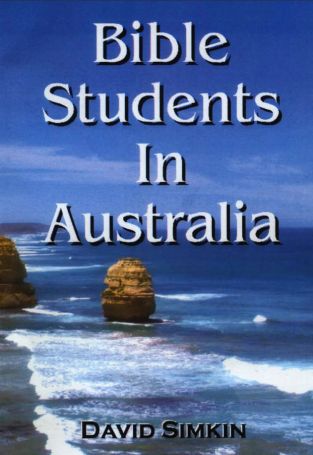
Here is the Book “The Bible Students in Australia” by David Simkin. Please click the image below for the PDF file of the book.

Pastor Russell Founded the Bible Students Not Jehovah’s Witnesses http://www.friendsofjehovahswitnesses.com/wp-content/uploads/Bible-Students-not-Jehovah-Witnesses2.pdf-final2.pdf

pastor-russell-founder-of-bible-students-not-jehovah's-witnesses


Did Russell Start The JWs?
http://rlctr.blogspot.com.au/2009/04/was-russell-founder-of-jws.html

Pastor Russell – Not the Founder of the Jehovah’s Witnesses
http://www.dawnbible.com/1940/4008-hl.htm


This post’s URL:
https://biblestudentsdaily.com/category/beliefs/

Enter your email address to subscribe to this blog and receive notifications of new posts by email.

The First Resurrection

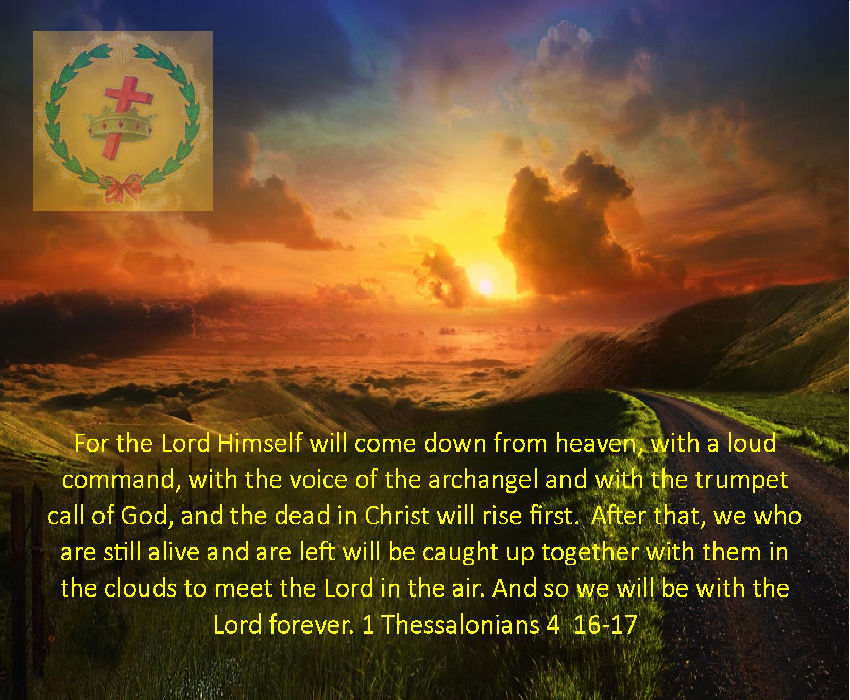
1-thessalonians-4-16-17 - WITH CROSS.jpg

When we meet our LORD
with all the saints that are waiting
We will be overjoyed with gladness
Singing “all honor and praise to our GOD.”

Finally together,
Our Beloved Jesus and the saints shall be,
In glory… 
With Crowns of Victory.

No more separations; no more tears and no more sorrows;
No more misunderstanding; no more silence.
Eternal joy and gladness praising our Jehovah;
Eternal journeys with our Beloved Christ.

This life is just a short test of faith,
Learning to not give up,
But patiently enduring and persevering with JOY in the spirit.
Today’s discomforts of the flesh—are experiences worth more than gold.

It is through suffering, that our Beloved Jesus learned obedience. 
That same narrow path, we must follow too.
It is the only way to life immortal,
Learning to obey GODLY principles willingly and change into the likeness of our Lord, Jesus.

Delight thyself in the LORD,
HE SHALL give you the desires of your heart.
Seek the face of the LORD always,
Seek till you find… till you win the race of the High Calling.

As the hearts of men shall all seek to know and serve the LORD,
Precious promises shall be fulfilled.
Then the 144,000 Bride members of CHRIST—the “little flock,”
Shall be together with their King.

Tears of hope shall be no more,
As immortal and together the saints shall be— 
Dwelling for eternal eternities
In their perfect everlasting home—where there is glory, honor and immortality.

So continue on dearly Beloved Ones IN CHRIST,
Your fellow saints cheer you on through their private prayers,
We shall soon meet beyond the river, where our Bridegroom is waiting;
And I too hope to meet you there, when my sacrifice is complete. 


LUKE 12:31-38 (ESV)

(31) Instead, seek his kingdom, and these things will be added to you.

(32) Fear not, little flock, for it is your Father’s good pleasure to give you the kingdom.

(33) Sell your possessions, and give to the needy. Provide yourselves with moneybags that do not grow old, with a treasure in the heavens that does not fail, where no thief approaches and no moth destroys.

(34) For where your treasure is, there will your heart be also.

(35) Stay dressed for action and keep your lamps burning,

(36) and be like men who are waiting for their master to come home from the wedding feast, so that they may open the door to him at once when he comes and knocks.

(37) Blessed are those servants whom the master finds awake when he comes. Truly, I say to you, he will dress himself for service and have them recline at table, and he will come and serve them.

(38) If he comes in the second watch, or in the third, and finds them awake, blessed are those servants!


Further Suggested Reading:

A Special Calling by Br. David Rice. The Herald of Christ’s Kingdom. July /August 2016.
URL: https://herald-magazine.com/2016/07/01/the-bride-class/

Old Testament Portrayals of the Church by Br. Homer Montague. The Herald of Christ’s Kingdom. July/August 2004.
URL: http://www.heraldmag.org/2004/04ja_2.htm

The Song of Solomon by Br. Frank Shallieu. The Herald of Christ’s Kingdom. July/August 2004.
URL: http://www.heraldmag.org/2004/04ja_3.htm

The Bride and the Bridegroom by Br. Carl Hagensick. A Verse-by-verse Study of Psalm 45. The Herald of Christ’s Kingdom. July/August 2004.
URL: http://www.heraldmag.org/2004/04ja_4.htm

New Testament Portrayals of the Church by Br. Michael Nekora. A Precious Treasure. The Herald of Christ’s Kingdom. July/August 2004.
URL: http://www.heraldmag.org/2004/04ja_5.htm

A Chaste VirginThe Herald of Christ’s Kingdom. URL: http://www.heraldmag.org/literature/chliv_38.htm

The Truth About Hell. A Dawn Bible Association Publication. URL: http://www.dawnbible.com/booklets/hell.htm

Hope Beyond the Grace. A Dawn Bible Association Publication. URL: http://www.dawnbible.com/booklets/grave.htm

ACTS 23:6—HOPE & RESURRECTION. Part A: What Is Jesus All About?

ACTS 23:6 —HOPE & RESURRECTION. PART A: What is Jesus All About?

ACTS 23:6—HOPE & RESURRECTION. Part B: Will Mankind Resurrect With the Same Mind?

ACTS 23:6 —HOPE & RESURRECTION. PART B. Will Mankind Resurrect With the Same Mind?

ACTS 23:6—HOPE & RESURRECTION. Part C: The Order of the Resurrection Process.

ACTS 23:6 —HOPE & RESURRECTION. PART C: The Order of the Resurrection Process


URL of this post: https://biblestudentsdaily.com/2016/03/08/the-first-ressurection/


Enter your email address to subscribe to this blog and receive notifications of new posts by email.

Save

Save

Save

Save

Save

John 14:3 – A Precious Promise

I will come again and receive you unto myself; that where I am, there ye may be also. John 14:3

JOHN 14, 3 - with address.jpg

What joyful hopes, what exuberant anticipations, cluster around this promise, in the hearts of the Lord’s faithful! In a few words it sums up all the good things that God hath in reservation for them that love Him….To the extent that the testimony of God’s Word dwells in us rightly, and enables us to recognize the lengths and breadths of Divine love and compassion covering unintentional shortcomings—to this extent the Lord’s faithful ones are able to rejoice in this promise, and to look forward with joy not only to the meeting with the Lord, but also to their abiding everlastingly in His presence and companionship. But to all others…to all who are not seeking to walk circumspectly in the footsteps of Jesus, the words of the text come bringing only a measure of joy, a measure of hope, and not an exuberant overflow. R3191,c1,p5,6