Understanding Psalm 50 — “Gather My saints together unto Me”

Psalm 50, 1.jpgThis Psalm is a Psalm of judgment. It opens with a proclamation.

VERSE 1: “The Mighty One, God, Jehovah, hath spoken, and called the earth from the rising of the sun unto the going down thereof.”

The various names of God here are impressive. He is called “Yaweh El Elohim,” or Jehovah the mighty one of mighty ones, or Yaweh, the God of Gods. Clearly, we understand the powerful God we are dealing with here.

The Psalm proclaims that this mighty One “hath spoken.” How does Jehovah speak?

The answer is, almost always through intermediaries.

“God, who at sundry times and in divers manners spake in time past unto the fathers by the prophets, Hath in these last days spoken unto us by his Son, whom he hath appointed heir of all things, by whom also he made the worlds [ages]” (Hebrews 1:1,2).

Paul explains here that in the times before Christ the mighty Jehovah spoke by the prophets, but in the first century, he spoke by His Son, Jesus.

This first verse reports Jehovah calling the “earth from the rising of the sun unto the going down thereof.” This interesting expression is used to mark the beginning of the Millennial Age. It occurs twice in Malachi.

“For from the rising of the sun even unto the going down of the same my name shall be great among the Gentiles; and in every place incense shall be offered unto my name, and a pure offering: for my name shall be great among the heathen, saith the LORD of hosts (Malachi 1:11).

This is a clear reference to the Millennial Kingdom. Only in that Kingdom will the name of Jehovah be “great among the Gentiles,” and only in that Kingdom will incense be offered “in every place.”

With healing in his wings; and ye shall go forth, and grow up as calves of the stall (Malachi 4:2).

Who would deny that this beautiful metaphor is a reference to Jesus himself?

Our Lord Jesus, with Kingly power and love, will heal the nations in the Millennium.

A text in Psalms speaks of the same thing. Note the link between “sun” and “bridegroom.”

“Their line is gone out through all the earth, and their words to the end of the world. In them hath he set a tabernacle for the sun, Which is as a bridegroom coming out of his chamber, and rejoiceth as a strong man to run a race” (Psalms 19:4,5).

Here the line or rule of God’s glory goes out through all the earth. This describes the sun in a tent which is opening up, and compares it to a bridegroom coming out of his chamber.

The work of the Mediatorial Kingdom is to raise mankind to perfection… to re-stand them where Adam once stood… to resurrect them!

Having achieved that and put down all enemies, Jesus surrenders his oversight back to the heavenly Father.

“When all things shall be subdued unto him, then shall the Son also himself be subject unto him that put all things under him, that God may be all in all” (1 Corinthians 15:28).

This idea is further advanced with an observation about Hebrews 7:17, “He testifieth, Thou art a priest for ever after the order of Melchisedec.”

The word “forever” is from the Greek eis ton aiona (Strong’s #165). It means “for the age” (“unto the age” in Marshall’s Interlinear). In other words, Jesus functions as a Priest for the world only during the Millennium. Once mankind is made perfect, they need no intercessory Priest, they need no Mediator. They can stand holy and pure before God without fear.

Zion, the Perfection of Beauty

Verse 2: “Out of Zion, the perfection of beauty, God hath shined forth.”

The literal location of “Zion” was in Jerusalem. It was the location of David’s throne. Looking in God’s word for uses of this word, “Zion,” we find several references to the heavenly government of Christ, the heavenly phase of the Kingdom. Here are a few:

  • “Yet have I set my king upon my holy hill of Zion” (Psalms 2:6). The second Psalm is prophetic of the conflict in the earth when the Kingdom is being set up. Jehovah himself installs Jesus as King, “upon my holy hill of Zion.” The heavenly Kingdom—God’s holy hill—is said to be of Zion.
  • Similarly, “Great is the LORD, and greatly to be praised in the city of our God, in the mountain of his holiness. Beautiful for situation, the joy of the whole earth, is mount Zion, on the sides of the north, the city of the great King (Psalms 48:1, 2).
  • “The LORD loveth the gates of Zion more than all the dwellings of Jacob. Glorious things are spoken of thee, O city of God. Selah…Of Zion it shall be said, This and that man was born in her: and the highest himself shall establish her” (Psalms 87:2-3; 5). Verse 5 refers to the faithful followers of Jesus, who, like Jesus, will be born in Zion and comprise part of that Heavenly government.
  • The Apostle John refers to this same class in the book of Revelation. “And I John saw the holy city, new Jerusalem, coming down from God out of heaven, prepared as a bride adorned for her husband” (Revelation 21:2).
  • They are mentioned again with emphasis in chapter 14: “And I looked, and, lo, a Lamb stood on the mount Sion [Zion], and with him 144,000, having his Father’s name written in their foreheads” (Revelation 14:1). The light of God shines forth out through this government, and this shining is done through Christ and his completed Bride.

Verse 3: “Our God cometh, and doth not keep silence: A fire devoureth before him, And it is very tempestuous round about him.”

This “fire” reminds one of Sinai where the Law was given. Fire also is a general symbol of discerning judgment and purification.

God has kept silence during the permission of evil. It is necessary for man to learn about the exceeding sinfulness of sin. But the time for judgment eventually comes. The symbol of fire is often connected with judgment, both positive and negative. When Israel came to Mount Sinai to receive the Law, Jehovah “came down” upon the mountain. Fire is included in the manifestations of the presence of the Lawgiver (Exodus 19:18).

The picture of Israel receiving the Law and standing before the great Judge foreshadows the same activity for the world at the setting up of the Kingdom. But in this period of judgment, the judgment begins with the house of God (1 Peter 4:17).

Malachi provides a positive example where judgment begins with the servants of God.

“Who may abide the day of his coming? and who shall stand when he appeareth? for he is like refiner’s fire, and like fullers’ soap: And he shall sit as a refiner and purifier of silver: and he shall purify the sons of Levi … as gold and silver, that they may offer unto the LORD an offering in righteousness” (Malachi 3:2-3).

The fire of judgment reveals the true character of each one.

Paul used a similar expression. “Every man’s work shall be made manifest … the day shall declare it … it shall be revealed by fire; and the fire shall try every man’s work of what sort it is. If any man’s work abide which he hath built thereupon, he shall receive a reward. If any man’s work shall be burned, he shall suffer loss: but he himself shall be saved; yet so as by fire (1 Corinthians 3:13-15).

Gathering of the Saints

Verse 4: “He calleth to the heavens above, and to the earth, that he may judge people.”

The twin symbols of “heavens” and “earth” often refer to the religious and civil powers in the world during the reign of sin and death.

This judgment is of God’s true and professed people, both. Christendom at this time comes under intense judgment revealing their true nature. Recall that the tares of Jesus’ parable are burned (Matthew 13:40).

The individuals who are the tares are not necessarily destroyed; their professions are exposed as false. Following this begins the process of making the new heavens and new earth.

“And I saw a new heaven and a new earth: for the first heaven and the first earth were passed away (Revelation 21:1).

Through this judgment comes what is the hope and joy of all of the consecrated at the end of the age, namely, their gathering to Christ (2 Thessalonians 2:1).

Verse 5: “Gather my saints together unto me, Those that have made a covenant with me by sacrifice.” This gathering occurs simultaneously on two fronts.

  1. The gathering of the saints out of Christendom during the Harvest (Mark 13:27; Luke 17:30, 37; Revelation 3:20).

Even our conversations are being gathered and recorded. This evidence is compiled to determine who will eventually make up the Kingdom, the “jewels” of Jehovah.

  1. The gathering of the saints beyond the veil to their heavenly home (1 Thessalonians 4:15-17).

This is the gathering in glory, the ultimate recognition and reward for faithfulness and willing cheerful (in the spirit) sacrifice.

“Present your bodies a living sacrifice, holy, acceptable unto God, which is your reasonable service” (Romans 12:1).

Presenting ourselves in sacrifice is our vow or covenant of consecration until death which we can do only thanks to the gift of justification by the blood of Jesus which makes us acceptable and holy in the eyes of God. This verb “present” is a specific act, as indicated by its use in Luke 2:22. There, the baby Jesus is presented before the high priest, as prescribed in Leviticus 12:1-4,6: And when the days of her purification according to the law of Moses were accomplished, they brought him to Jerusalem, to present him to the Lord.”

That our “covenant by sacrifice” is a sacrificial death of the flesh is seen in Romans 6:3-6:

“So many of us as were baptized into Jesus Christ were baptized into his death … we are buried with him by baptism into death … If we have been planted together in the likeness of his death, we shall be also in the likeness of his resurrection: Knowing this, that our old man is crucified with him, that the body of sin might be destroyed, that henceforth we should not serve sin.” Note the following parallels that Paul makes:

Verse 6: “The heavens shall declare his righteousness; For God is judge himself. Selah.”

These heavens are the new heavens, for the old heavens seldom honored God for His righteousness.

Distinctions in the Service of God

Verse 7: “Hear, O my people, and I will speak; O Israel, and I will testify against thee: I am God, even thy God.”

Remembering that the Psalm is about judgment, we see in this verse a return of attention to nominally Christian organizations for judgment, just as in ancient times. The testimony now is against those who claim to be God’s people but do not behave accordingly, as seen the texts above.

Jesus said there would be true, devoted, faithful followers, as well as nominal followers for whom Christianity exerted no real power in their lives. We also have those among the truly spirit begotten that lose their way and lose their focus. These, while accepted of God, nevertheless fail as respects that HIGHEST reward due to a dilution of their consecrations.

In this regard, we might enumerate the classes of Christians that exist during the Gospel Age:

  • The Little Flock, faithful and zealous to the end (Luke 12:32).
  • The Great Company, ultimately faithful, but lost focus and zeal during their walk (Revelation 7:9-17).
  • The Second Death Class (Hebrews 10:26-30).
  • Nominal Christians, Christians in name only. They believe they have some sort of relationship with Christ, but have nothing of the sort in reality (Matthew 7:21-23).

God, through Christ, deals with all of these classes in one way or another.

Verse 8: “I will not reprove thee for thy sacrifices or thy burnt offerings, to have been continually before me.”

Burnt offerings bring to mind the law for free-will offerings (Leviticus 22:18-21).

God does not criticize or “reprove” free-will offerings, that is, good works. But “good works” are not sufficient in the Day of Judgment. Many nominal Christians view their service to God as if it were a monetary exchange, where God owes them something for their good works to Him. But God does not. He sees no obligation when an offering is made. The next two verses make this clear.

Verses 9-11: “I will take no bullock out of thy house nor he goats out of thy folds. For every beast of the forest is mine, and the cattle upon a thousand hills. I know all the fowls … and the wild beasts of the field are mine.”

God is not interested merely in things. Anything that they design to give Him, He already owns! All of the animals offered on the altars of ancient Israel were the property of Jehovah–the assets of God!

In addition, when someone makes an offering to God with the expectation of reward, they exhibit an ignorance of what God really looks for. This can be tragic.

“Many will say to me in that day, Lord, Lord, have we not prophesied in thy name? and in thy name have cast out devils? and in thy name done many wonderful works? And then will I profess unto them, I never knew you: depart from me, ye that work iniquity” (Matthew 7:22,23).

Is this not sad? How careful we must be not to imbibe of the spirit of nominalism.

God owes us nothing. He blesses us out of His own love. We are creatures OF GRACE who have the PRIVILEGE of knowing him and worshiping him.

Verses 12, 13: “If I were hungry, I would not tell thee: for the world is mine, and the fullness thereof. Will I eat the flesh of bulls, or drink the blood of goats?”

Recall that this Psalm began with a majestic introduction of God—El Elohim, Yahweh! This is the Grand Creator, the source of all energy and life. God is not intimate with any nominal believer. He does not share with such His needs for they have no resource to meet His requirements. On the contrary, it is their needs that require God’s resources!

Our Thanksgiving to God

Verse 14: “Offer unto God thanksgiving; and pay thy vows unto the most High.”

Those who worship God with “spirit and truth” (John 4:23) must offer “thanksgiving” and pay their “vows.”

The Hebrew word for “thanksgiving” is todah (Strong’s #8426) and it means “a thank offering or praise.” It is interesting to see the various meal offerings that were to be offered with “thank-offerings.”

“If he offer it for a thanksgiving, then he shall offer with the sacrifice … unleavened cakes mingled with oil, and unleavened wafers anointed with oil, and cakes mingled with oil, of fine flour, fried. Besides the cakes, he shall offer for his offering leavened bread with the sacrifice of thanksgiving” (Leviticus 7:12,13).

Four types of bread were to be provided with a “thank-offering”:

  1. Unleavened cakes mingled with oil — Our Justification and Sanctification. Unleavened bread is a symbol of purity, of sinlessness, and brings our minds to the state of justification, being declared righteous through the blood of Christ. The mingling with oil brings to mind our spirit begettal, as olive oil is often used to signify the holy Spirit, as in the holy anointing oil.
  1. Unleavened wafers anointed with oil — Our hope of glorification: A wafer is translucent. Light passes through it but not with clarity, though one can discern shadows and shapes. This suggests our hope of glory. It is not yet seen clearly, but it is an anchor for the soul which purifies us (1 John 3:2,3, 1 Corinthians 13:12, Hebrews 6:19).
  1. Fried cakes mingled with oil— Our Fiery Experiences. The church must be severely tried. Without such experiences, no one can expect to receive the divine nature. As Jesus had to endure, so must each one of his followers. These trials are like refining fire. They purge and purify!
  1. Leavened bread — Thankfulness in spite of our sinful flesh. God justifies us, but does not make our flesh perfect. We must serve under difficult conditions of sin in our flesh and in the world. We must not allow these conditions to break our thankfulness! They are important in our development and allow us to show how much we love our God.

The second key Hebrew word in verse 14 is “vows.” It is from the Hebrew word nedar (Strong’s #5088) and it simply means vow. Vows under the law were associated with blood sacrifices (Leviticus 22:18-21).

A true consecration during the Gospel age involves vows unto death and “dying daily” (1 Corinthians 15:31). This association with sacrificial death is even stronger in Psalm 116:14-18,

“I will pay my vows unto the LORD now in the presence of all his people. Precious in the sight of the LORD is the death of his saints. O LORD, truly I am thy servant … thou hast loosed my bonds. I will offer to thee the sacrifice of thanksgiving, and will call upon the name of the LORD. I will pay my vows unto the LORD now in the presence of all his people.”

Nested between the two references to paying vows is the thought that “Precious in the sight of the LORD is the death of his saints.” Also notice the particular details mentioned in these verses:

  • “In the presence of all his people” — this is a public display of loyalty and faithfulness!
  • “Precious” — this is how God values our consecrations. From a study of what is precious to Jehovah, here are five items:

– Psalm 49:8; 72:14 — The Ransom Price.

– Psalm 116:15 — The Death of his Saints.

– Psalm 126:6 — Seed, representing the freeing of captivity.

– Psalm 133:2 — Ointment, representing the Holy Spirit.

– Psalm 139:17 — The thoughts of God.

  • “Death of his saints” — death in the service of God is the fate of the consecrated, the called ones, the “saints.”

Final Deliverance and Blessings

Verse 15: “And call upon me in the day of trouble: I will deliver thee, and thou shalt glorify me.”

Making vows unto God and giving him daily thanksgiving will often result in persecution. Our loving heavenly Father promises deliverance from these. He is with the Church at all times and will strengthen us in times of trouble. Although the deliverance may be through death, there will be a final deliverance and blessings. What a deliverance that will be!

“Unto him that is able to keep you from falling, and to present you faultless before the presence of his glory with exceeding joy” (Jude 24).

We may only come into “the presence of his glory” through death. But awakening in the first resurrection will certainly be with exceeding joy!

In verses 16 through 22, the Psalmist considers those who do not have the spirit of consecrated sacrifice unto death. As mentioned earlier, this is a judgment Psalm, and the judgment against the wicked and those who falsely take on the mantle of God’s servants is severe. Particularly, Christians who are but nominally so need to take heed. Their pretensions will be unmasked in the sight of all.

Verse 23: “Whoso offereth praise glorifieth me: and to him that ordereth his conversation aright will I shew the salvation of God.” This final verse shows the value of praising God.

It is not that Jehovah needs our praise. Rather, our God understands from our makeup that praising Him will not only bring us the greatest joy in life, but will also develop an attitude and character that will preserve us for all eternity. Praising God is good for us!

The word “conversation” here is from the Hebrew derek (Strong’s #1870). It means “way, journey, habit, course of life.” This verse speaks of our conduct as worshippers of God. We must “order” our lives to be in harmony with the Divine will. Doing so will bring us to “the salvation of God.”

Among the many lessons from this Psalm we may make three important observations:

  • The 50th Psalm is a prophetic Psalm that shows the judgments of God and the setting up of Christ’s Kingdom.
  • We must make sure that our “covenant by sacrifice” defines our lives so that we may be gathered with the saints to our heavenly home.
  • We must not fail to pay our vows and we must die a precious death.


Acknowledgement: Br. David Stein

This post’s URL: https://biblestudentsdaily.com/2016/05/31/understanding-psalm-50-gather-my-saints-together-unto-me/

Save

OUR BELIEFS – What Does The Bible Teach Us?

kangourous-australia website - WITH ADDRESS

To us, the Bible is the Word of GOD, the sole authority of Christian Doctrine and Practice. To us it clearly teaches that:

* JEHOVAH (Hebrew: YAHWEH) is THE ONE ALMIGHTY GOD, who is from “everlasting to everlasting” (Psalm 90:2).

* JESUS CHRIST, the Logos (Word), is GOD’S ONLY BEGOTTEN SON, the firstborn of every creature who was made flesh and by the grace of GOD gave himself a willing and voluntary RANSOM for ALL mankind, to be fully demonstrated in GOD’s due time, and His is the Light that enlightens all who come into the world. He is our Lord and Master and the Captain of our Faith, our Redeemer (John 3:16; John 5:28-29; John 14:16; Colossians 1:15-17; 1 Timothy 2:5-6; Hebrews 2:9).

* JESUS WAS RESURRECTED on the third day after his crucifixion (50 hours from the moment he went into the heart of the earth), Jesus was resurrected a Divine Celestial Being, Immortal, and will never come again in the flesh (Luke 24:1-7).

* ALL HAVE SINNED and come short of the Glory of GOD, and that the penalty for sin is death, extinction of life (Romans 3:23; Romans 6:23; Ecclesiastes 9:10).

* PERSONAL SALVATION is by faith in and the acceptance of Jesus Christ as a Savior and Lord, that there is no other name or way by which any can be saved (John 14:6; Acts 4:12; Acts 16:30-31).

* GOD IS CALLING OUT from those saved by faith now a “people for his name,” to be followers of Jesus Christ in full obedience to the divine will and to constitute His Body, the “Church.” These are also refer to as the “saints,” the “sanctified, the “bride” of Christ, the “wife of the Lamb,” “the 144,000” and the “little flock.” (Psalm 45:14-15; Matthew 16:24; Acts 15:14; Ephesians 1:22,23; Ephesians 5: 25-27, 32; 1 Corinthians 1:2; Revelation 21:9-10; Revelation 22:17; Revelation 7:4).

* THE HOLY SPIRIT is the character of the Heavenly Father Jehovah who is Love and Justice balanced by His awesome Wisdom, and His Great Power carries out His balance through actions and magnificent influence on ALL of His creation; and this power of His character is working in and through His called out people, to guide them into understanding of and conformity to His will. It is not a third person of a Godhead (Luke 11:13; John 16:13; Acts 1:8, Romans 8:14).

* Man IS A SOUL (Sentient being), but does not HAVE a “soul.”

* The wages of sin is DEATH and NOT TORMENT or some form of living separate from the Creator (Ezekiel 18:4; Romans 6:23).

* ALL MANKIND SHALL RESURRECT out of their graves and partake in the blessings and opportunities of Christ’s one thousand year kingdom which present conditions indicate is extremely close at hand (Luke 21:25-28, John 5:28, 29, Revelation 20:6).

* THE EARTH WILL NOT LITERALLY BE BURNED UP (but the systems of the world will be destroyed), but rather will become a paradise worldwide by the end of the Messianic Age, inhabited by the obedient regenerated race of Adam, when death will be destroyed forever (Ecclesiastes 1:4; Isaiah 25:8; 1 Corinthians 15:26; Revelation 21:4).

* THE CHURCH IS GOD’S TEMPLE which has been in preparation during this present GOSPEL AGE, at which, when complete, will be the means of GOD’S blessings coming to “all people” (Genesis 22:17-18; Isaiah 25:6; Matthew 19:28; 1 Corinthians 3:16,17; Ephesians 2:20-22).

* MEANTIME THE SHAPING AND POLISHING of individual Christians—“living stones”—has been in progress, and when all have been made ready, they will share in the “first resurrection” and the completed, glorified Temple will become the meeting place between GOD and mankind (1 Peter 2:5, 2 Peter 1:5-8, Revelation 20:6).

* THE HOPE OF THE CHURCH is to be like her Lord, to see Him as He is, to be partakers of the divine nature and to share in His glory in the divine realm as His joint-heirs helping the world of mankind come up the Highway of Holiness and come into harmony with GOD, so that GOD our Creator can be ALL IN ALL—which is the ETERNAL GOSPEL (Isaiah 35:8; 1 John 3:2, 2 Peter 1:4, Romans 8:16-17; Revelation 14:6).

* THE BLESSINGS OF GOD’S KINGDOM will include the return of GOD’S favour to Israel and the restoration of all things lost in Adam for all the willing and obedient in that time; that at the end of the thousand years Satan and all the willfully wicked will be destroyed (1 Corinthians 15:12-22, Romans 11:25,26, Acts 3:20,21).

*******

“For, behold, I create new heavens and a new earth: and the former shall not be remembered, nor come into mind. But be ye glad and rejoice forever in that which I create: for, behold, I create Jerusalem a rejoicing, and her people a joy. And I will rejoice in Jerusalem, and joy in my people: and the voice of weeping shall be no more heard in her, nor the voice of crying. There shall be no more thence an infant of days, nor an old man that hath not filled his days: for the child shall die an hundred years old; but the sinner being an hundred years old shall be accursed. And they shall build houses, and inhabit them; and they shall plant vineyards, and eat the fruit of them. They shall not build, and another inhabit; they shall not plant, and another eat: for as the days of a tree are the days of my people, and mine elect shall long enjoy the work of their hands. They shall not labour in vain, nor bring forth for trouble; for they are the seed of the blessed of the LORD, and their offspring with them. And it shall come to pass, that before they call, I will answer; and while they are yet speaking, I will hear. The wolf and the lamb shall feed together, and the lion shall eat straw like the bullock: and dust shall be the serpent’s meat. They shall not hurt nor destroy in my entire holy mountain, saith the LORD” (Isaiah 65:17-25, KJV).

*******

BIBLE-STUDENTS-DAILY.jpg

We Believe the Bible

The following is taken from The Watch Tower, January 15, 1912, pages 28,29; Reprints pages 4955, 4956:

THOSE WHO OPPOSE our teaching are given to misrepresenting it. They do not wish to speak untruthfully, but desire to hinder our work, which they fail to recognize as the Lord’s work.

It is difficult to answer the arguments of our opponents in a few words, when they misunderstand our presentations of more than three thousand pages. If they cannot understand a detailed account, we have no hope of making a brief one satisfactory to them. However, we give here a synopsis:—

I. We affirm the humanity of Jesus and the deity of Christ.

II. We acknowledge that the personality of the Holy Spirit is the Father and the Son; that the Holy Spirit proceeds from both, and in turn from all who are begotten by it.

III. We affirm the resurrection of Christ—that He was put to death in the flesh, but quickened in the Spirit. We deny that He was raised in the flesh, and challenge any statement to that effect as being unscriptural.

IV. We affirm, with the Scriptures, that God alone possessed immortality, “dwelling in the light which no man can approach unto.” We affirm that this Divine quality has already been granted to the Lord Jesus and is to be the portion of the elect Bride, the “Body of Christ.” As for mankind, we affirm the Divine provision for these [R4956 : page 29] and for angels to be everlasting life for the obedient. This, by many, is mistermed immortality. We follow the Scriptures strictly.

V. We hold that the entire race lost life with Father Adam, as a result of his failure in Eden; and that Christ died to secure a second chance for Adam and an individual chance for all of his race, who lost their first chance in Adam when he sinned. “As all in Adam die, even so all in Christ shall be made alive.” (1 Cor. 15:21,22.) A few of us, comparatively, having eyes of faith and ears of understanding, have had this second chance in the present life. Adam and the great mass of his posterity must get their second chance after being awakened from the tomb. But NOBODY IS TO GET A THIRD CHANCE!

VI. We believe that the soul was condemned to death. “The soul that sinneth it shall die.” We believe that this death would have been eternal, everlasting destruction, had it not been for God’s mercy in and through our Lord’s redemptive work. By reason of His death our souls do not die in this full sense of the word, but are Scripturally said to “fall asleep,” “asleep in Jesus.” The awakening will be in the resurrection morning; and the interim will be a period of unconsciousness, beautifully symbolized by a restful sleep.

VII. We believe in the “hell” of the Bible, sheol. This, the only word used for hell for four thousand years, is translated more than one-half the time grave in our Common Version, and should always be thus translated. “Hades,” in the New Testament, is its equivalent. “Gehenna fire,” of the New Testament, is a symbolical picture declared to signify the Second Death.

VIII. We believe that God is able to destroy “both soul and body” in Gehenna—the Second Death. We consider it much more sane to believe thus, as it is more Scriptural, than to believe that in creating man God did a work which He could not undo; much more reasonable also than to believe He prefers to have the incorrigible suffer eternally, when their sufferings could do neither themselves nor others any good.

IX. We believe that, like the Father and the holy angels, our Lord is a spirit being. We are convinced that “flesh and blood cannot inherit the Kingdom of God.” We do not believe that our Lord has a flesh and blood body, a “little lower than the angels,” and has thus been out of harmony with His heavenly environment for nearly two thousand years. We believe the Apostle’s statement, “Now the Lord is that Spirit.” This is the Jesus who will “so come, in like manner,” quietly and unknown to the world, as He went away. We do not affirm, dogmatically, that He came in 1874, but we say that to us it is the evident teaching of the Scriptures. Our Lord warned us not to expect Him in the flesh; that men might say “Lo, here” or “Lo, there.” The Harvest work in the universal Church Nominal, the Laodicean period of the Church, well corroborates our expectations of what His work will be, as outlined in His parables, etc.

====================

Suggested Further Reading

Who We Are
https://biblestudentsdaily.com/category/who-we-are/

Links and Bible Resources
https://biblestudentsdaily.com/category/links/

Our Purpose and Mission
https://biblestudentsdaily.com/category/our-purpose-mission-the-story-behind-bible-students-daily-2/

The BIBLE — The World’s Best Novel. Here is Why.

THE BIBLE – The World’s Best Novel. Here Is Why.

Here is the Book “The Bible Students in Australia” by David Simkin. Please click the image below for the PDF file of the book.

Pastor Russell Founded the Bible Students Not Jehovah’s Witnesses http://www.friendsofjehovahswitnesses.com/wp-content/uploads/Bible-Students-not-Jehovah-Witnesses2.pdf-final2.pdf

pastor-russell-founder-of-bible-students-not-jehovah's-witnesses


Did Russell Start The JWs?
http://rlctr.blogspot.com.au/2009/04/was-russell-founder-of-jws.html

Pastor Russell – Not the Founder of the Jehovah’s Witnesses
http://www.dawnbible.com/1940/4008-hl.htm


This post’s URL:
https://biblestudentsdaily.com/category/beliefs/

Enter your email address to subscribe to this blog and receive notifications of new posts by email.

Worthy to Be Praised

Psalm 63,3 -with cross

Let us begin with the words from the Reprints of the Original Watchtower and Herald of Christ’s Presence, reprint 5802, entitled “The Ministry of Sorrow” which reads in part as follows:

“In every experience of sorrow and distress, and when the strain of the jarring discords and the stinging vexations, and wounds that make the heart bleed, threaten to overwhelm the spirit, let the child of God remember that “He knows, and loves, and cares,” and that His ministering angel is ever near us, and that no trial will be permitted to be too severe. The dear Master is standing by the crucible, and the furnace heat will never be permitted to grow so intense that the precious gold of our characters shall be destroyed, or even injured. Ah, no! If by His grace the experiences may not work for our good, they will be turned aside. He loves us too well to permit any needless sorrow, any needless suffering.”

Our Heavenly Father is the God of all comfort and whatever difficulties His children encounter, because we are under His peculiar care, His compassion and watch care are ever present and he is most worthy of our praise.

Psalm 63:3 reads: Because thy lovingkindness is better than life, my lips shall praise thee.”

What are some of the means God uses to comfort us?

Here are several, including: conventions, the ecclesia arrangement, prayer communication, God’s overruling providence, Hymns and Psalms, Scriptures that provide doctrinal instructions, scriptures that contain precious promises for our meditation, guardian angels that intervene on our behalf when necessary and of course the Holy Spirit which enables us to appreciate and comprehend the Father’s tender mercies.

Ultimately, praise also will be an integral part of the human family’s make up, when they realize in the Kingdom the scope of what the Heavenly Father has done for them through the magnificent sacrifice of Jesus as well as the part we the body of Christ will have to play in helping to restore mankind back into heart harmony with God during that glorious Millennial reign.

We would like to suggest the 24th Chapter of Isaiah speaks of the judgments that will end this present evil order and then comment on what follows in Isaiah 25:1-9 which we feel pictures the expressions of humanity as a result of that glorious Kingdom in operation and mankind progresses up the Highway of holiness. So we will read each of these verses followed by a brief comment as to how we view these matters. 

Isaiah 25:1 — O Lord, thou art my GOD; I will exalt thee, I will praise thy name; for thou hast done wonderful things; thy counsels of old are faithfulness and truth.”

Here we would suggest Israel would desire to praise Jehovah especially for bringing them through Jacob’s trouble and ending the oppression they have endured at the hand of others. Similarly, others who fear God and recognize the restraint of evil and the opportunity for blessings will echo heartfelt worship to the Almighty and his Christ as they recognize the reign of righteousness that has commenced.

“2For thou hast made of a city an heap; of a defenced city a ruin: a palace of strangers to be no city; it shall never be built.”

The may well refer to the destruction of Mystic Babylon. Those who were once blinded under the influence of the adversary and the dogmas that vilified God’s character will worship the God of love and demonstrate a similar attitude towards their fellow creatures.

“3Therefore shall the strong people glorify thee, the city of the terrible nations shall fear thee.”

The iron rule that will be in force.

Every knee must bow and every tongue must confess and accept the gracious provision on their behalf made possible through the redemptive merit of Christ in order to gain everlasting life.

“4For thou hast been a strength to the poor, a strength to the needy in his distress, a refuge from the storm, a shadow from the heat, when the blast of the terrible ones is as a storm against the wall.”

This might refer to the downtrodden in this present life who were insignificant nobodies, but when Christ reigns in equity and justice, when the Spirit and the Bride say “come” all who have been athirst will be able to partake of the water of life freely.

“5Thou shalt bring down the noise of strangers, as the heat in a dry place; even the heat with the shadow of a cloud: the branch of the terrible ones shall be brought low.”

“6And in this mountain shall the LORD of hosts make unto all people a feast of fat things, a feast of wines on the lees, of fat things full of marrow, of wines on the lees well refined.”

Throughout the reign of sin and death the human family has been starving for blessings and a ray of hope that things might be better for them. What joy they will have as they see the work of restitution in progress. The wine of pure doctrine will bless them abundantly.

“7And he will destroy in this mountain the face of the covering cast over all people, and the vail that is spread over all nations.”

This seems to speak about the eradication of the death sentence and the removal of the blindness that has covered the eyes of the human family, thus preventing them from seeing the glory and goodness of the Father.

“8He will swallow up death in victory; and the Lord God will wipe away tears from off all faces; and the rebuke of his people shall he take away from off all the earth: for the LORD hath spoken it.”

This would be a fulfilment of Revelation 21:4,9 — And God shall wipe away all tears from their eyes; and there shall be no more death, neither sorrow, nor crying, neither shall there be any more pain: for the former things are passed away.”

“9And it shall be said in that day, Lo, this is our God; we have waited for him, and he will save us: this is the LORD; we have waited for him, we will be glad and rejoice in his salvation.”

When the kingdom is established the human family will begin to comprehend his attributes and as they prosper under that arrangement how much they too will increase in their ability and desire to praise our Creator.

We have attempted to describe why the church now and the world during the Kingdom reign will have much reason to praise our Heavenly Father.

I would like to conclude with something that appeals to me by sharing the following concerning a well-known hymn — “All The Way My Saviour Leads Me.”

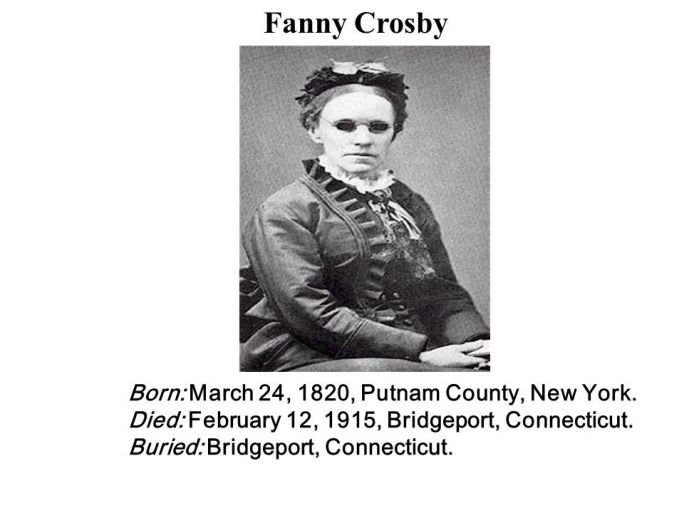
This great hymn was written by Fanny Crosby (1820–1915).

slide_21

When Fanny was 6 weeks old, she caught a slight cold & had inflamed eyes. The family physician was away. Another country doctor was called in to treat her. He prescribed hot mustard poultices to be applied to her eyes, which destroyed her sight completely! It was later learned that the man was not even qualified to practice medicine. Fanny never felt any resentment against him, but believed it was permitted by the Lord to fulfill His plan for her life.

This is what Fanny Crosby said to her mother one day:

“Mother, if I had a choice, I would still choose to remain blind … for when I die; the first face I will ever see will be the face of my blessed Saviour.”

And another of Ms Crosby’s quotes:

It seemed in­tend­ed by the bless­ed prov­i­dence of God that I should be blind all my life, and I thank him for the dis­pen­sa­tion. If per­fect earth­ly sight were of­fered me to­mor­row I would not ac­cept it. I might not have sung hymns to the praise of God if I had been dis­tract­ed by the beau­ti­ful and in­ter­est­ing things about me.

Fanny’s spiritual development came from her grandmother who cared for her while her mother worked as a maid. A landlady, Mrs. Hawley, helped Fanny memorize the Bible. Often she learned 5 chapters a week!  She entered the New York City Institution for the Blind around 1835, completed training, and taught there from 1847 to 1858. In 1858 she married a musician, Alexander Van Alstyne, who was also blind.

415904470

Under her own name, as well as under a curious assortment of initials and pen names, she wrote over 8,000 hymns, including: “I Am Thine, O Lord,” “Praise Him, Praise Him,” “Sweet Hour of Prayer,” “Blessed Assurance,” “Safe In The Arms Of Jesus,” “To God Be the Glory.”

Fanny needed five dollars one day and she just knelt down and told the Lord about it. Soon after a stranger knocked at her door as he just wanted to meet her. As he left, he pressed a five dollar bill into her hand. “I have no way of accounting for this” she said, “except to believe that GOD put it into the heart of this good man to bring the money”. “My first thought was that it is so wonderful the way the Lord leads me, and I immediately wrote the poem”.

In 1874, Fanny Crosby wrote the hymn “All The Way My Savior Leads Me”.

All the way my Savior leads me;
What have I to ask beside?
Can I doubt His tender mercy,
Who through life has been my Guide?
Heav’nly peace, divinest comfort,
Here by faith in Him to dwell!
For I know, whate’er befall me,
Jesus doeth all things well;
For I know, whate’er befall me,
Jesus doeth all things well.

I do not know whether Fanny Crosby was a spirit begotten child of God, but as I reflect upon her life, I can only hope that each of us will be more appreciative of the blessings we have today in Christ and will desire to live a life of praise daily for all our Heavenly Father has done for us. AMEN.

ALL THE WAY MY SAVIOUR LEADS ME


This post’s URL:
https://biblestudentsdaily.com/2016/05/15/worthy-to-be-praised/

Enter your email address to subscribe to this blog and receive notifications of new posts by email.

Save

What is Love?

1 JOHN 4, 8.jpg

Love is …

perfection of character.

“So we have come to know and to believe the love that God has for us. God is love, and whoever abides in love abides in God, and God abides in him” (1 John 4:16).

The love that our heavenly Father seeks to have us develop is a love which is in full harmony and in total surrender to God’s will. When we please our Divine Father of Life, He will bless with eternal life.

“To those who by patience in well-doing seek for glory and honor an immortality, he will give eternal life” (Romans 2:7).

You therefore must be perfect, as your heavenly Father is perfect” (Matthew 5:48).

One element of Love is MEEKNESS.

Meekness does not mean weakness.

Consider Moses. He was a meek man and did he have a weak character? Not at all. He was humble-minded, not boastful, not proud or haughty.

“Now the man Moses was very meek, above all the men who were upon the face of the earth” (Numbers 12:3).

So the New Creatures in Christ, must develop and maintain this quality of meekness, from the divine standpoint.

Another element of love is GENTLENESS.

Does this signify weakness or fear? No.

Gentleness is part of a character of love.

Jesus said, “take my yoke upon you, and learn of me; for I am meek and lowly in heart: and ye shall find rest unto your souls” (Matthew 11:29).

In Galatians 5:22, 23, the Apostle Paul writes, that the fruit of the Spirit is love, joy, peace, forbearance, kindness, goodness, faithfulness, gentleness and self-control. Against such things there is no law.”

To the Ephesians, the Apostle Paul writes, ” (1) I urge you to live a life worthy of the calling you have received. (2) Be completely humble and gentle; be patient, bearing with one another in love. (3) Make every effort to keep the unity of the Spirit through the bond of peace. (4) There is one body and one Spirit, just as you were called to one hope when you were called; (5) one Lord, one faith, one baptism; (6) one God and Father of all, who is over all and through all and in all” (Ephesians 4:1-6).

“Let your moderation be known unto all men” (Philippians 4:5).

“Moderation”reasonableness, gentleness—the spirit of a sound mind, of gentleness, meekness.

This attitude of mind comes in large measure as a result of knowledge of God and his plans (R5840). Surely there never was a time when this counsel was so much needed as now!

Let the fact that we know only in part and understand only in part keep us humble and moderate in word and deed and thought (R5249).

Temperance, self-control—let men see by our thoughtful (not rash and hasty), careful and considerate demeanor in every affair of life, that we honor our profession (R4809, R2460).

Here is a practical example:

If we feel the leader of a meeting is not following the best Scriptural course, we must show moderation in our approach—approving what we can, objecting in kindness, meekness, and brotherly love (R3866). The Greek seems to carry the thought of reasonableness, of not exacting our rights too rigorouslymercy and leniency (R3128:2). Keep yourselves well in hand, subject and obedient to the will of God.

In 2 Timothy 3:2-5, the Apostle Paul warns against those “in the last days” (today) who he describes as “(2) lovers of themselves, lovers of money, boastful, proud, abusive, disobedient to their parents, ungrateful, unholy, (3) without love, unforgiving, slanderous, without self-control, brutal, not lovers of the good, (4) treacherous, rash, conceited, lovers of pleasure rather than lovers of God— (5) having a form of godliness but denying its power.” The Apostle Paul then states, “have nothing to do with such people.”

Even in discussing the time of trouble, emphasis should be laid upon the glorious Kingdom which will be inaugurated (R5716:4). We should be using the knowledge we possess, doing with our might what our hands find to do (R5249). Let us be specially on guard that the influence of every word and act should be in accord with law, order and peace—“live peaceably with all men.” (Romans 12:18).

Our gentleness toward all men would begin at home—more particularly in the Church—but should be manifested toward all with whom we have dealings (R5840).
Messiah’s Kingdom is shortly to be established—this should help the Lord’s people in living an exemplary life (R5840). This clause implies the exhortation belongs specially to the closing of this Gospel age—thus, to this time period we are currently living in.

We are expecting great changes soon and can well afford to be generous and liberal in our sentiments toward others (R3128:3).

PATIENCE is another element of love and a part of the true Christian character.

“With all lowliness and meekness, with long-suffering, forbearing one another in love” (Ephesians 4:2).

Patience is an element of character. We read in Revelation 3:10,

Because thou hast kept the word of my patience I will also keep thee from the hour of temptation which shall come upon all the world to try them that dwell upon the earth.”

When examining the word “patience” we find that two quite distinct words in the Greek are translated by our English word patience in the New Testament:

  • hupomoneethis is used in the Revelation text quoted above which has a much deeper and fuller significance than attaches to our English word patience. It signifies rather constancy,—the thought being an endurance of evil in a cheerful, willing, patient manner. It represents, therefore, an element of character, and not merely a temporary condition or restraint of feeling or action.

For instance, a worldly man might have a great deal of patience in connection with the running of his business;—he might be very attentive to his customers, very obliging, very painstaking, and show no dissatisfaction in connection with the inconsiderateness of his customers; and “patience,” in its ordinary sense, might be ascribed to his conduct.

But the word in the Revelation text rendered patience” signifies such a development of heart and character as manifests itself in an endurance of wrong or affliction with contentment, without rebellion of will, with full acquiescence in the divine wisdom and love.

In Luke 8:15, in the parable of the sower, we read:

“That [sown] on the good ground are they which in an honest and good heart, having heard the word, keep it, and bring forth fruit with patience [with cheerful endurance, constancy].”

The thought here is that in order to be of the fruit-bearing class which the Lord will approve and accept to his Kingdom, it is necessary to do more than to receive the word of his testimony, even thou we receive it with joy—for that class in the parable is represented by the stony ground, which at first gave evidence of great fruitfulness and vigor, but which, when the sun of persecution arose, withered, because of lack of depth of soil. That stony, shallow soil represents, the Lord explains, a class of hearers who rejoice greatly in the truth, but do not endure, such as cannot withstand persecution or opposition, but wither under it, become discouraged. Such cannot be of the Kingdom class, all of whom must be overcomers.

In this parable our Lord shows us that patient endurance, constancy, is the final test, following after the readiness of preparation to receive the seed; following after the seed has been received and has sprouted; following after love and hope and joy and faith have caused it to spring forth and to give fruitage (R2791).

Patient endurance, then, is necessary, in order that the grain may be developed and thoroughly ripened, and made fit for the garner.

Ah! how important patient endurance seems to be, in the light of this our Lord’s word—cheerful endurance; for we cannot suppose that he who judges the thoughts and intents of the heart would be pleased with his children, even if he saw them enduring much for his sake, if they endured in an impatient or dissatisfied or unhappy frame of mind. They would not, in that event, be copies of God’s dear Son, our Lord, whose sentiment is expressed in the words,

“I delight to do thy will, O God!” (Psalm 40:8)

All of the Royal Priesthood are sacrificers, as was the Chief Priest, our Redeemer and example, who offered up himself: we, as the under priests, have also presented our bodies living sacrifices, and are to lay down our lives for the brethren—in the service of the truth. And God, who accepts these sacrifices through the merit of Christ, informs us that he appreciates or loves the cheerful giver, those who perform their sacrifices of a willing heart, cheerfully.

The other instance in which our Lord used the word “patience” during his ministry is recorded in Luke 21:19. He had just been telling his followers what they must expect as the result of being his disciples during the present time, when sin abounds, and when Satan is the prince of this world—they must expect tribulation, opposition from various quarters; but he assures them that they would nevertheless be fully and completely under divine care and protection, even tho the persecutions would be permitted to reach and to affect them. Then follow the words,

“In your patience [patient endurance, cheerful constancy] possess ye your souls” (Luke 21:19).

BROTHERLY KINDNESS is another element of love.

“(5) And beside this, giving all diligence, add to your faith virtue; and to virtue knowledge; (6) And to knowledge temperance; and to temperance patience; and to patience godliness; (7) And to godliness brotherly kindness; and to brotherly kindness charity. (8) For if these things be in you, and abound, they make you that ye shall neither be barren nor unfruitful in the knowledge of our Lord Jesus Christ” (2 Peter 1:5-8).

The Greek word “Philadelpia” signifies brotherly love. “Phileo”—is duty love, a love which has a cause or demand upon it (R2807).

Phileo love is evidenced in the natural family relationship, and also in the spiritual family, the Church. We may not love our brethren’s peculiarities, their features, but we love them as brethren, whether black or white, bond or free, because they are brethren, comrades in the same race (Q449).

Phileo love means to make due allowance for inherited weaknesses and circumstantial misfortunes of others—to deal patiently and helpfully so far as wisdom may dictate, with a view to the correction of those faults, even at the expense of self-interest, if necessary and prudent (R4809, R1114).

Phileo love means to meekly bear reproof, determining to overcome deformities of character, and prove a help rather than a hindrance to others; no longer fostering old dispositions (R4809).

Phileo love allows one to exercise and manifest the principles of the divine character toward our fellow-men (R3090, R1628:2).

Phileo is a love for all who are brethren and yoke fellows in the cause of righteousness and truth, the cause of God (R2037).

Instead of disdaining those who are ignoble, instead of putting them away, treat them kindly (R448). This of necessity grows out of godliness. As god-likeness presupposes the other graces mentioned, so its development implies an enlargement of our hearts to all who are of the household of faith (R2155).

There is also “AGAPE” LOVE…

This is known as charity (R5693, R5208).

Greek, agape, is the higher grade of disinterested love; the broader, more comprehensive, or divine love (R3949; Q449).

Love as a general expression covers all the elements of character which are really parts of love (F186).

We might divide the race-course into four quarters:

(1) duty-love;

(2) love for the Lord because we see something of the glorious majesty of his character;

(3) love for the brethren;

(4) perfect love—for all, even our enemies (F187-189).

As we get agape love it means that we love all (Q449) We must reach this climax of love before we can be counted worthy of a place in the new creation (F190).

Agape Love:

  • Is deep, pure and true.
  • Thinketh no evil.
  • Does not puff itself up.
  • Is not easily offended;
  • Rejoiceth always in the truth and never in iniquity;
  • Is the climax of Christian attainment in the present life, the grace of all graces, which never fades, and which will be perfected when we receive the new resurrection body (R2037, R2155).
  • Is sincere love for the unrighteous and unlovely, as well as for the good and beautiful (R4809, R1114).
  • Is a love which is ever ready to manifest itself in wise and helpful activity for saint and sinner; and which pities, helps, comforts, cheers and blesses all within its reach—manifesting and cultivating the disposition which must be found in every member of the Christ company (R4809, R1114).
  • Is a broad, generous love, taking in the whole world, even our enemies (R5678, R5757, R5460).

We do not attain to the perfection of love at the beginning of our course, but it is the mark or standard which indicates the end of the course

(F186).

Love is the chief of all graces.

Acts of kindness will gradually lead to an attitude of love, even where the subject does not seem to deserve it (R1628).

Love is an experience, and includes in it an earnest desire for the well-being of the object loved (R78:5).

Love excels all the other virtues, because it is the most enduring (R4732).

True love on our part will manifest itself in obediencedisobedience is an evidence of the loss of love as viewed from the Lord’s standpoint

(R2466).

“WITHOUT LOVE I AM NOTHING”

If we could speak all the languages known amongst men and even the angelic tongue as well, and if we were to use these talents in preaching, if we were to preach without being inspired by love, it would be completely unprofitable.

God would esteem it no more than the sound proceeding from cymbals or any brass instrument. Does God want to give cymbals and brass horns glory, honor and immortality? Of course not!

If man were to preach the whole Truth in all its grandeur, and have the ability to comprehend it even through the holy Spirit yet if there be a weakness in character development of love towards the brethren, then we could not be fit enough for divine favor and a share in the Kingdom, just like that brass horn would not be.

What a glorious lesson as we attempt to sound forth the praises of Him who has called us from darkness to light! How necessary it is that we speak the Truth in the love of it, with hearts full of devotion and appreciation!

By quieting the mind… and heading to the voice of our Heavenly Father through the inspired words of God in Bible and through prayer, we may learn to absorb and appreciate each lesson step by step as God unfolds it to us. God is the ultimate example of patience, waiting perhaps billions of years before finally confronting the pain of watching His own firstborn Son being sacrificed on Calvary and be the ransom for all mankind.

And Jesus… has been waiting for the completion of His BrideHis Body members of 144,000 since AD 33!

JAMES 5, 7-8.jpg

There is a saying “take time to smell the roses.”

And in the same way let’s remember to take time to hear God-Jehovah speak…
digest it…
absorb it…
and grow from it…

The Apostle suggests that if he had mountain-moving faith, if his knowledge of Divine mysteries were very great, superior to those of all other men, and even if in his zeal for man or for God he should become a martyr and permit his body to be burned, yet, notwithstanding all this, if the primary influence in these matters were not love, all the sacrifice, all the self-denials, all the labors, even the burning, would profit nothing.

Dear friends,

When we come to get the Divine standpoint of things we find indeed that we have a very high standard to achieve; and yet our judgment assures us that it is right, that it is just, that it is proper, that God should thus set the standard of love as the only standard by which we shall ultimately be measured. But whoever thinks to have this perfect love for God and for man and make no manifestations of it is equally mistaken.

Wherever love is in the heart … words, works, thoughts and looks will testify to it, so that he who loves much will serve much.

If we love the Lord we shall delight in His service regardless of failures, regardless of fame, regardless of any earthly consideration; yea, even though the service of the Lord should cause us the loss of human approbation, fellowship, etc…

Hence every true Christian may link the two words love and service, and be sure that his love will manifest itself in zeal. Similarly, love of the brethren will mean a desire to serve the brethren; love of the home and family will mean a desire to do good to them; love of our neighbor will signify a desire to do for his interests according to our knowledge and limitations.

THE RESTRAINTS OF LOVE

The Apostle points out some of the restraints of love.

It cannot be quick, irascible; for “love suffers long and is kind” (1 Corinthians 13:4).

  • He who is loving cannot be envious of others, nor covetous of the blessings and favors they are enjoying; for “love envieth not.”
  • He who is loving cannot be boastful and proud; for “love vaunteth not itself, is not puffed up.”
  • He who is controlled by the spirit of love will not be ungracious, unkind, rude; for “love doth not behave itself unseemly.”
  • He who is full of the spirit of love will not be selfish, grasping, neglectful of the interests of others; for “love does not seeks its own” (1 Corinthians 13:5).
  • The truly loving one will not be quickly angered, will not be easily offended; for “love is not easily provoked.”

“The one controlled by the spirit of love will not be imagining unkindness and rudeness nor seeking to interpret the words or conduct of others unkindly; for ‘love thinketh no evil’ “

(Pastor Russell’s Sermons, pages SM272-SM285).

What a beautiful example we see in our Master’s words to Simon:

“Simon, Simon, behold, Satan has demanded permission to sift you like wheat; but I have prayed for you, that your faith may not fail; and you, when once you have turned again, strengthen your brothers” (Luke 22:32).

Let us not neglect to pray for our fellow brethren in Christ, always while we are in this carnal abode.

“LOVE NEVER FAILS.”

(1 Corinthians 13:8)


The following is from “What Pastor Russell Said – Question Book”

QUESTION (1910) 1 At what point of character development can we say, the crown is ours, and that we are overcomers?

“ANSWER. — I think, dear friends, that the proper point at which we could say that, would be when we reach the mark of perfect love. For instance, you came to the Lord and made your consecration, you entered the School of Christ and began to learn of him. That was about the time you found out how short you were of the proper measure. Will the Lord ever be able to make anything out of me? Now the Lord is going to measure you according to your mind and is waiting for you to get to the mark of perfect love, which is the standard of a perfect character, for none will be worthy of a place in the kingdom or eternal life except those that reach this mark, either now or in the Millennial Age. God has nothing for anyone except those that reach that standard in his mind and heart. He may have weaknesses, etc., and you may speak things that you are sorry for, and must apologize for, but your heart is at the mark–perfect love—and that is the reason you want to apologize, because you have reached the mark of perfect love. You love God, and all mankind, and wish to do good to all, as you have an opportunity. After a person gets where he can love his enemies, he is at the mark of perfect love. He will not be perfect in flesh, for that will not be possible in this age. Many still have to put a bridle upon their tongues, etc., you must hold in the old nature. This I have often illustrated by a bad dog which would represent our old nature, and for which the new creature is responsible. We must hold him in. Our intentions are good, as is shown by the fact that when the heat or excitement of the moment is passed, then the heart goes back to the principles of righteousness, and asks for forgiveness from the Father. He will ask for forgiveness for anything he has done. You might say, it will be harder to rectify this, than not to have done it in the first place. Surely. But that is what you must do, if you want [Q51] to prove to the Lord that your heart is for righteousness, and whenever you find you have made a mistake, you must rectify it. Now, then, if you get to that place, you have gotten to the place where, to my understanding, you are at the mark of perfect love, toward God, men, etc. You desire good for all and injury toward none. From that moment, I understand, the Lord counts you as one having a crown apportioned to you. That is one thing, but seeing that no man take your crown is another thing. After granted to you it still remains that if you are moved from the mark, pressed aside by difficulties, you are not standing this test, and you will not be worthy of being an overcomer. So you see there is a mark of character, without which none will be acceptable in the kingdom, spiritual or earthly. Now we must demonstrate our love and devotion, that is what we live for today and tomorrow, and in all your Christian experience, from the time you enter the school of Christ, for you are to learn of him as quickly as possible and get to the mark of perfect love toward all.


The words below are from Reprint No. 4470 from “ZWT” (www.htdb.one).

STANDING AT THE MARK

WE HAVE heretofore suggested what we now wish to further, if possible, emphasize; namely, the fact that there is a Divine standard of holiness, of righteousness, which, if it be not attained, will mean our non-acceptance by the Lord as members of his Elect Church; and, more than this, our unfitness for eternal life upon any plane. This standard of character, or mark of perfection, as we have pointed out, is not a standard or mark of fleshly perfection, because the Lord accepts amongst his consecrated disciples those of various degrees of mental, moral and physical degeneracy. The justification which he provides makes up for the blemishes of each, for the more blemished as well as for the less blemished. The robe of his righteousness imputed is as necessary to the noblest as to the most degraded, and renders the latter as acceptable as the former.

From this standpoint it is recognized that the heart, the renewed mind, the renewed will, is the spirit-begotten New Creature which is on trial before God. It has professed a thorough consecration to righteousness and opposition to sin, a complete deadness to it, and a determination to mortify, to deaden, the will of the flesh to the extent of its ability. From the very start this condition is pleasing and acceptable to the Lord. Nevertheless, it is Scripturally represented at first as being merely a “babe” condition, according to one illustration, and according to another merely a “begotten” condition. Progress must be made, character must be developed, and then, further, it must be tested. “Not every one who saith, Lord, Lord, shall enter the Kingdom.” Not every one who professes consecration, and newness of life, and self-sacrifice in the interests of truth and righteousness, can be accepted as a joint-heir with Christ. Time must be given for development and for proving.

Love for God they have, from the very outset. But it is not love of the highest type. As already shown, it is largely, if not entirely, duty love. The “babe” in Christ must feed upon the sincere milk of the Word, that he may grow strong. As the spiritual food is appropriated, and spiritual exercise is taken, strength of character comes in, the eyes of our understanding open more widely, and lengths and breadths and heights and depths of the Divine character are discerned which were not visible at the first. This brings us to a higher type of love for God—a love for his glorious character.

Meantime, also, a sympathetic love for the world is gradually developing in the spiritual “babe.” As the principles of the Divine character are seen and appreciated, the New Creature begins to apply these to everything in life, and hence increases in sympathetic love toward man and beast, friend and foe. Another element of love is gradually attained also: At first the “babe” in Christ loves some of the brethren—the nobler, the gentler, the better educated ones, etc.; but gradually, as the Divine character is discerned, and the Divine love becomes shed abroad in the heart, this love broadens out so that it includes every member of the family of God and every member of the fallen race—yea, even enemies. With this development comes spiritual activity, called in the Scriptures quickening—”You hath he quickened.” This quickening implies activity in the service of God, and the service of the brethren, and if outside opportunity beyond this permit, it would mean an activity in the service of all needing assistance such as we could give.

The Christian life here illustrated, which began as a “babe in Christ,” has by this time reached the standard of manhood in Christ, and is at the Mark of Perfect Love—for God, for the brethren, for the neighbor and for the enemies. Not until this point shall have been reached could such a person be considered fit for heaven, or for eternal life on any plane.

We are to bear in mind that there is no development in heaven, and hence perfection of character must be attained by the saints before they die. And, similarly, the world during the Millennium must attain this perfect development before the close of the age in order to be fit for eternal life according to the Divine promise and standards.

Is it asked to what extent will this standard of perfect love in the heart manifest itself in the flesh? We answer, that during the Millennial Age it will manifest itself perfectly in the flesh, for the world then will be judged according to the actual attainments in their flesh, and perfection by restitution will be not only possible, but required. But as for us of the Gospel Age, we who are being judged not according to the flesh but according to the spirit, to what extent will the new mind, the new nature, when at the Mark of Perfect Love, be able to govern and control the flesh? Our answer is, that the degrees of control will vary much, according to the degrees of imperfection with which the mortal body is afflicted.

The only standard which we can set forth is that the new nature, new mind, new will, would be very regretful, very sorrowful, in respect to any laches, or errors, of its mortal body. The Lord would know (and perhaps the brethren also to some extent) of the New Creature’s endeavor to control the mortal body by the degree of its grief in connection with every error, and its continually renewed effort to bring every power of the body, and even every thought, into complete subjection to the will of God in Christ. Any sympathy with sin is an evidence that the New Creature is not at the Mark. And no sympathy with sin, but constant endeavor for righteousness, is evidence that it is at the Mark.

Some may be at this Mark for a longer and some for a shorter period. Our Lord was surely at it from the beginning of his ministry. He was tested there, while at the Mark of perfect love. All the besetments of the Adversary and of the world failed to move him from that position of perfect love. He laid down his life at this Mark. St. Paul was surely at this Mark for many years before his actual death. He was continually laying down his life for the brethren, continually serving his enemies and praying for them; and surely he was continually loving and serving the Lord with his every power and talent.

No Christian should be satisfied with a long delay in reaching the Mark. The milk of the Word should be received, its strength should be appropriated, spiritual sight and spiritual energy should quickly follow, and strong meat of Divine Truth should speedily bring to full maturity the Christian character. And once attained, it should be held at any cost through all the trials and difficulties which the Adversary, and the world, and the flesh, might be permitted to bring against us. The severest temptations come after we have reached the Mark—temptations to slackness in service of God; temptations to withhold parts of our sacrifice; temptations to deal unkindly, uncharitably, unlovingly with the brethren, or unjustly with our neighbor, or ungenerously with our enemies. All of these must be resisted as we prize our eternal life, as we prize the promise of joint-heirship and fellowship with our Redeemer in His Kingdom.

Whoever sees this subject clearly must realize that as a Christian he has to do with a great proposition which will thoroughly test his loyalty, his courage, his zeal, [R4470, page 271] his love. He will need to remember the Lord’s comforting assurances of grace to help in every time of need if he would come off a victor and not be dismayed, nor have his courage beaten down by the Adversary’s attacks.


References:

Br. Charles Russell. “Pastor Russell’s Sermons,” and “What Pastor Russell Said – Question Book.”

The Reprints of the Original Watchtower and Herald of Christ’s Presence. These Reprints can be accessed here: http://www.htdbv8.com

Suggested Further Reading

“Lovest Thou Me More Than These?”JOHN 21:15-22. Reprint 2806. The Reprints of the Original Watch Tower and Herald of Christ’s Kingdom.
http://www.htdbv8.com/1901/r2806.htm

A Practical Self-Examination On Love

A Practical Self-Examination on Love

Agape by Br. Mark Grillo
http://www.heraldmag.org/2012/12nd_11.htm

Brotherly Kindness by Br. Ed Byrd
http://www.heraldmag.org/2012/12nd_10.htm

Words for Love in the Bible, In the Hebrew, by Br. W.A. Eliason, The Herald of Christ’s Kingdom Magazine, Set/Oct. 1986.
http://www.heraldmag.org/archives/1986_5.htm#_Toc36907449


The URL of this post:
https://biblestudentsdaily.com/2016/03/20/what-is-love/?share=press-this&nb=1&sel=

Enter your email address to subscribe to this blog and receive notifications of new posts by email.

Save

Save

What is the Purpose and Intent of Prayer; What are its Privileges and its Limits?

12042803_10206878583955130_8742014298779339433_n

The following words are from an article in Zion’s Watch Tower titled “The Province of Prayer” (R797). Some subheadings and scriptural citations have been inserted.

The Privilege of Prayer

“The privilege of praying to God, of holding communion with Him, is a great privilege and an evidence of His favor. God permits and arranged to grant us this privilege, not that he might be informed of our desires, for we being imperfect our desires are not perfect, so that “we know not what things to ask for as we ought,” and he does for us better than we know how to ask or think. Nor does God permit us to pray to Him that we may inform Him regarding matters here; for He knoweth the end from the beginning as well as every intervening step. But He has instituted prayer for our benefit and comfort and instruction.

The Object of Prayer

“The OBJECT of prayer is to bring the heart and mind of the child of God, whether in joy or sorrow, into contact with the heart of God, that He may be enabled thus, most fully to realize the fatherhood of God, His love and care and His deep interest in every item of our welfare; that in deep affliction we may unburden our hearts to God and thus have forcibly brought to our attention His love and care and wisdom—for our encouragement, not His; for our strengthening, not His, and for our joy. This opportunity is not for us to instruct Jehovah how to arrange matters for the best, but it is to bring our hearts to realize Him as the centre of wisdom and power, that having unburdened our hearts, we may be prepared to listen for His answer and advice through His word. And he whose knowledge of prayer is confined to the meagre information he has imparted to God with “much speaking,” and who has never learned to listen for the answer to his prayer at the word of God, has as yet measurably failed to appreciate the object of prayer.

“Earnestness in God’s service will bring His children to Him frequently, to realize at His feet His sympathy with them in the difficulties, discouragements and trials of life, as well as to ask His guidance and overruling of every affair of life, through His word, and to hearken to His wisdom, which will enable us to serve Him acceptably.

What To Pray About and What Not To Pray About

“The PROVINCE of prayer is to ask for such, and only such things, as God has already declared himself well pleased to grant. And while we may freely speak to Him as a Father, and tell Him how we understand His word, and the confidence and trust we have in its ultimate fulfilment, yet we must not only avoid telling the Lord of our will and our plan, and what we would like; but we must avoid and put far from us any such spirit, and must recognize and bring ourselves into full accord with His will and His plan of accomplishing it. If this thought were appreciated, it would cut short some of the “long prayers,” “much speaking,” and “vain repetitions” by which some endeavor to instruct the Lord in their wishes regarding every matter under heaven. It would send them speedily to the word of God to search diligently the plan of God that they might labor as well as pray in harmony with it. While assuring us that the Father careth for us, and is well pleased to have us come to him with sincere hearts, the Master informs us of the conditions upon which we may expect an answer. He says: “If ye abide in me, and my words abide in you, ye shall ask what ye will and it shall be done unto you” (John 15:7). These are the conditions for sure answers to our prayers. What is it to abide in Christ? It implies first that our WILL has been wholly consecratedswallowed up in the will of Christ. And more, that the will is in this condition at the time of the prayer, abiding in Christ. And if the suppliant’s own will is gone and he is now controlled entirely by the will of Christ, he surely would consult the words of Christ and there seek information as to what His will is before framing a petition to the Father in Christ’s name. And if this be his case, if the will of Christ is governing him, and the words of Christ are abiding in him, such an one is prepared to ask any and everything he may WILL to ask.

“His requests would probably be as simple as was the Master’s petition when he prayed, “Not my will, but thine be done” (Luke 22:42). In such a condition prayers are always answered; but in such a condition the prayers would be very modest. Our prayers under such circumstances would be more a thanksgiving for our blessings, an expression of confidence and trust, and the committal of our way unto the Lord, confidently realizing the promise that to us under such conditions, ALL THINGS [even seeming disasters and troubles] shall work together FOR GOOD. Hence whatever came, such an one could realize his prayer answered. He could rejoice evermore because he is prepared to rejoice in tribulation as well as in prosperity, in the path of service.

He has no will to oppose whatever God permits, knowing that it will work out good.

“Such could not pray for anything of their own will, for they have no will except God’s; then abiding in Christ, and his words in them, would prevent any other petition. They could not pray for the immediate conversion of the world, for though they know that “God will have all men to be saved and to come to a knowledge of the truth,” they also know that the present age is not in God’s plan devoted to this work, but solely to the selection, under SEVERER trial, of those who shall be God’s instruments for blessing all the families of the earth in God’s arranged time.

“We cannot single out an ungodly friend and request God to work a miracle on him, and bring him into the “Church of the first-born” (Hebrews 12:23), though we may pray for wisdom to “rightly divide the word of truth” (2 Timothy 2:15), that if possible the light of the knowledge of the glory of God might thus shine into the understanding of that friend. This would be in harmony with the Word. Jesus said, “Be ye wise as serpents, and harmless as doves” (Matthew 10:16), and instructs that “If any man lack wisdom, let him ask [it] of God, who giveth liberally and upbraideth not” (James 1:5).

“We may not ask for riches and honor; nor for fine food and fine clothing. To seek or pray for these is contrary to the Spirit of the Master. But we may ask, “Give us this day our daily BREAD” (Matthew 6:11), assured that the Father knoweth best what kind is best, and what things are needful to us as seen from His standpoint which embraces our interests spiritual as well as temporal, future as well as present.

“We may not pray for the increase in numbers of any of the many sects of today, well knowing that Jesus would not approve of thus fettering with human tradition those whom He calls to liberty; and that He does not approve, but would condemn the sects of today as He did those of eighteen centuries ago, saying, “Beware of the leaven of the Pharisees and of the Sadducees” (Mark 8:15), and declaring to them, “Ye do make void [useless and ineffective] the law of God by your traditions” (Mark 7:13).

“We can neither labor nor pray for the advancement and growth in power, wealth, influence and numbers of any of these sects, knowing their very existence to be contrary to God’s Word, and their advancement a hindrance to the light of truth.

“Nor can we today either labor or pray for the perpetuation of the governments of this world, for the word of Christ abides in us, and we are therefore not in darkness, but we know that “the times of the Gentiles” (Luke 21:24) are about fulfilled; and the time for the establishment of God’s kingdom is at hand. For that new kingdom we may pray, “Thy kingdom come, thy will be done on earth” (Matthew 6:10) patiently awaiting the fullness of God’s due time. So surely as we are children of the light, not left in darkness that that day should come upon us unawares, we know that the success of the heavenly kingdom for which we pray, means the destruction of all these kingdoms of earth (Daniel 2:44).

“We cannot pray our Father to grant abundant harvests, send rains, prevent famines, drouths, wars and pestilences, for we find no example in the Master of such presumption, and realize from his words (Luke 21:9) that God will permit these things until the reign of Christ is inaugurated. And further, we are informed by the Master that the present day will be one of trouble caused by the new Prince binding the strong ruler of earth and spoiling his house (Matthew 12:29). Hence we pray for none of these things, but with trust and peace look with patience into the future, praying, “Our Father—thy kingdom come, thy will be done on earth as in heaven” (Matthew 6:10). In all things “Thy will be done,”—and even in the midst of the present necessary unrest and trouble we rejoice in confident hope, knowing that all things are so overruled as to work out the accomplishment of our Father’s grand designs, revealed to us in his Word.

“Instructed by the abiding words of Christ, and realizing the covenant of sacrifice to be even unto death we cannot ask release from pain and trouble and death, but with Jesus we can only ask that if it be possible, the cup of shame and misrepresentation might pass, that we suffer not as evil doers; and yet with him we must say: “Not my will but thine be done!” (Luke 22:42“Father, glorify thy name!” (John 12:28)

“These may pray for the healing of others, but not for themselves. It was truly said of the Master, that he saved others, but he could not save himself and be a sacrifice too. Yet, in requests for the healing of others we must remember that the time for full restitution of life and health to the world has not yet fully come. Jesus did not heal all the blind and impotent in Judea, and what healing he did was merely to show forth the glorious power and blessing of his coming glorious reign which has not yet fully dawned. Hence our prayers for the sick should be with full confidence in God’s ability to heal, yet not demanding it, always letting the words of our Lord abide in us—“Thy will be done.”

“To pray in other than this spirit is to “ask amiss,” to ask for things to be consumed upon our own lusts [desires] (James 4:3). Desires for ease, for earthly prosperity, for a sect and its growth and honor; all these are earthly lusts contrary to the Spirit and Word of Christ. Thus the word lusts is used by the Apostle in the above instance. Most prayers seemingly are of this sort, and therefore amiss.

“Those who abide in Christ, and in whom his word abides, can pray for their enemies and those who despitefully use and persecute them, though they cannot pray God to open their blinded eyes at once, or in their way; but realizing from the indwelling word of God’s promise, that the blinded eyes shall all be opened to the truth, they can abide His time, but going to God in prayer they may express their forgiveness of the persecutor, their interest in him, and their patient waiting for the day when “the knowledge of the Lord shall fill the whole earth,” and His will be done on earth (Habakkuk 2:14).

“When in harmony with Paul’s exhortation (1 Timothy 2:1,2) these pray—“For all men; for kings and all that are in authority,” their prayers will not be that those kings may be continued in power and control; for they well know that this would be in direct opposition to God’s expressed plan, which is to break in pieces and consume all these.

“And though these may labor toward it they cannot expect and pray for the conversion of “all men,” “kings,” etc., well remembering the Master’s prayer—“I pray not for the world but for THEM which thou hast given me,…that they all may be one, that [then] the world may believe” in its due season (John 17:9,21). In none of Jesus’ prayers did he ever pray for Caesar, or Pilate, or Herod; nor did he make any special effort to reach these, with the gospel message, remembering how it was written, “The Spirit of the Lord God is upon me because the Lord hath anointed me to preach good tidings unto the MEEK (Isaiah 61:1 and Luke 4:18). And when he gave the disciples a formula of prayer it contained no prayer for kings and rulers of this age, nor for “all men” except as this is implied in the expressions of forgiveness of debtors, and the prayer for the coming kingdom which will bless all men.

What then could we pray for “as we ought,” and not ask “amiss,” for all men and for kings? Very little, indeed, other than the prayer for the blessing of allimplied, when we pray, “Thy kingdom come.” Our prayer to God for kings, etc., must be merely that he would so overrule and direct by raising up or casting down among the nations, as would be most in harmony with his wise plans, for the blessing and development of the Church now being selected. For though God has given over the world to the rule of the Prince of this world and His faithful agents until the full end of Gentile Times, when He shall come whose right the dominion is and shall take the dominion under the whole heaven, associating with Him His faithful followers according to His many promises (Daniel 7:14,18,22), YET God has not given present rulers unlimited power. He will suffer them to take their course only so far as it does not interfere with His plans—there it must stop. The wrath of man shall not work ruin to the plan of God, for God will cause the wrath of man to work to His praise, and all that will not so work He will restrain (Psalm 76:10). And this is what the Apostle has in view: Pray God’s guidance and direction over all the affairs of life and over rulers TO THE END THAT the piety and sobriety and growth of the Church may be conserved. Verse 2.

“Thus considered, not merely as a begging arrangement, nor yet as an occasion for instructing the Lord as to our wills; but considered as a season of union and communion of heart with our Father in which we may relieve our burdened or perplexed hearts by there realizing divine sympathy, calling to mind divine promises, reviewing divine care, and expressing our confidence in God’s many promises, thus bringing those promises afresh and closely to our hearts, as though God now audibly uttered them in our hearing—thus considered, how proper, yea, how necessary, is prayer to the true child of God. He cannot live without it. To break off this communion would be like stripping a tree of its leaves: it would stunt and hinder its development.

“But to suppose that Christian life depends solely upon prayer without earnest study of God’s word, is like supposing that a tree could flourish from its leaves only, without roots and soil. Both are needful: good soil and roots will produce leaves and fruitage, and, likewise, the promises of God’s word absorbed by us will naturally lead to good works and to communion with God in prayer, without which our fruits would soon wither and disappear.

“No wonder, then, that Jesus both by precept and example said, ‘Watch and pray’ (Matt. 26:41), uniting the two conditions needful in our development. Some pray and neglect to watch; others watch and neglect to pray; both these errors are serious, and it is not possible for us to decide which is the most serious neglect, since either would work disastrous loss of the great prize for which we are running.

Prayer Not a Ceremony

“No where is prayer defined as a duty, though its necessity is stated. The Father desireth such to worship Him as worship in spirit and in truth (John 4:23); and it would be contrary to this principle to define prayer as a duty, and stipulate a set time or place or formal manner. The earnestness of the service and the peculiarity of the circumstance, will regulate the frequency and the matter.

“But though “Family Prayer,” “Morning Prayer,” “Evening Prayer,” nor any other stated time of praying is not specified in Scripture, who among God’s children has not experienced the blessedness of communion with the Lord in the morning of each day asking His guidance of its affairs, and realizing and expressing to Him our confidence in and reliance upon His promises. This does not remind the Lord of his obligation contained in these promises, but it does remind us of those promises and thus strengthen and prepare us for the events of the day. Likewise, how impossible it is for a child of God, remembering and impressed by the events of the day, as to the Lord’s wisdom and care and the surety that all things shall work for good—how impossible, we say, for such an one to retire to rest without thankfulness of heart to Him upon whose power and promises they have leaned throughout the day: and how appropriate to bow the knee as well as the heart to render homage as well as thanks.

“Hence no form of prayer is furnished in the Scripture. Even the Master, when asked by the disciples for instruction on this subject, gave them not a form to repeat, but merely an idea or example of how to arrange their prayers to God. He did not say, Pray this prayer; but “after this manner pray ye” (Matthew 6:9). Our prayers, then, should be after this manner—not an assortment of extravagant demands, but the simple expression of the earnest heart.

[1] First acknowledging and paying homage to God as our Father the Almighty and hallowed One.

[2] Secondly, expressing our expectations and trust that His kingdom according to promise is coming, and our eagerness for it, and the time when His will shall be done as in heaven.

[3] Thirdly, our reliance upon Him, for “daily bread,” which He has promised us.

[4] Fourthly our acknowledgment that our ways are not perfect and our reliance upon his favor [granted through Christ Jesus] for forgiveness; and our willingness to exercise forgiveness toward our debtors.

Family Prayer

“Though not enjoined specifically, how appropriate that husband and wife should blend their hearts and bow their knees in divine worship, and in submission to the divine will. How much this must tend to unify those hearts and lives. How blessed must such an example be to the children. How appropriate that the little “olive branches” be trained to look to their Creator in the days of their youth, not with formal and long prayers, but with the evidence before them of parental trust in and love for the giver of every good, as expressed in a simple, earnest, trustful prayer after the MANNER of the Lord’s illustration. As children see their parents recognizing and bowing to the superior will and wisdom of their heavenly Father, they learn from the example the lesson of obedience and submission to parental authority while learning to know and reverence their Creator.

“As soon as children come to reasoning age, their attention to the daily family prayer, whether it be morning or evening, should be placed on the same plane that God places it before us: not of CONSTRAINT, but of a willing mind, out of thankful and loving hearts. Such an influence and example will make home and parents and sacred things dear to children in after life. The true worship of God is profitable both for the present and future life.

Unceasing Prayer

“With the climax of Christian growth, the climax of worship is reached, and the earnest child of God will presently experience the meaning of the Apostle’s words: “Pray without ceasing. In everything give thanks” (1 Thessalonians 5:17, 18). Communion with God and the feeling of continual trust in His goodness and care, will become interwoven with all the affairs of life, so that to thus pray without ceasing, and be continually thankful, will become as natural as breathing. But this continual prayer and thanksgiving can never take the place of the formal recognition of worship of God, either to our own hearts or to our families.

Prayer in the Church

What is true of our families is not less true of God’s family, of which we are members—the body of Christ. To bind us together in love, God has arranged to make the various members more or less dependent on each other for the blessings He is willing and ready to bestow. Thus He would unify the body of Christ in His method of providing spiritual food, as the human body is dependent as a whole upon its various members for the natural “daily bread” which God thus supplies.

This being true, we should not only neglect not the assembling of ourselves with those of like precious faith, personally when we can; and at least through the medium of the printed page, but when assembled how sweet and refreshing, and how appropriate, to ask our Father’s blessing upon the meeting; that the spirit of love may pervade the members of Christ’s body there assembled, and that the truth might be discerned by sincere and truth-hungry souls, so that all might be more and more filled with the self-sacrificing spirit of that truth, and thus be built up in the most holy faith and love, and made meet for the Master’s service both now and hereafter. Can it be doubted that to the extent that such prayer is the expression of the sentiment of all, it will bring an answer at the moment of its utterance, by impressing upon all solemnly the object of the meeting and the blessings to be expected and enjoyed? It is ever thus; as we draw nigh to God in prayer we bring the blessings promised nigh to ourselves by bringing our hearts into a condition of readiness to enjoy the blessings promised the seeker.

While the offered prayer is to God it should not be forgotten that in harmony with the foregoing statement (that the prayer influences of all who join in it) that Jesus and the Apostle indicate that it should be uttered in such a voice and manner as to enable those about to appreciate and intelligently join it. Jesus said, in connection with one of the few of his recorded sayings, “Because of them that stood by I said it” (John 11:42). Paul exhorts those who lead the company in prayer to seek to do so in such a manner that all may be able to hear and acquiesce in it (1 Corinthians 14:14-17). And in all things whatsoever ye do, do all to the glory of God.

The URL for this post:
https://biblestudentsdaily.com/2016/03/15/what-is-the-purpose-and-intent-of-prayer-what-are-its-privileges-and-its-limits/

Enter your email address to subscribe to this blog and receive notifications of new posts by email.


What Is the Bible?

Image result for 2 timothy 3: 16 images

“The prophecy came not in old time by the will of man: but holy men of God spake as they were moved by the Holy Spirit.”  (2 Peter 1:21)

As the words in 2 Peter 1:21 state, the prophecies were not originated by the speakers, but rather the speakers were moved by the holy Spirit to speak God’s thoughts. We find that the Bible for the most part is a record of God’s thoughts, recorded by prophets and other special servants of God.

The Apostle Peter in 1 Peter 1:10-12 states, “Of which salvation the prophets have inquired and searched diligently, who prophesied of the grace that should come unto you: searching what, or what manner of time the Spirit of Christ which was in them did signify, when it testified beforehand the sufferings of Christ, and the glory that should follow. Unto whom it was revealed, that not unto themselves, but unto us they did minister the things, which are now reported unto you by them that have preached the Gospel unto you with the Holy Spirit sent down from heaven; which things the angels desire to look into.”

The Apostle Peter in Acts 3:20,21 gives us an additional clue as to what the prophets were prophesying about and what they desired to look into:

“And he shall send Jesus Christ, which before was preached unto you: whom the heaven must receive until the times of restitution of all things, which God hath spoken by the mouth of all his holy prophets since the world began.”

The two things of which all the prophets spoke were the coming Messiah, who would be the great Deliverer, and his kingdom, which would be the means of bringing blessings not only to Israel, but to the whole world of mankind.

The golden thread of the Bible from Genesis to Revelation is the promise of the Savior and his kingdom.

The Apostle Peter, in Acts 3:22,23, quotes one of the first of these prophecies (Deuteronomy 18:17-19):

“And the Lord said unto me [Moses], They have well spoken that which they have spoken. I will raise them up a Prophet [Jesus] from among their brethren, like unto thee, and will put my words in his mouth; and he shall speak unto them all that I shall command him. And it shall come to pass, that whosoever will not hearken unto my words which he shall speak in my name, I will require it of him.”

The account in Acts 3 continues:

“Ye [the Jews of Peter’s day] are the children of the prophets, and of the covenant which God made with our fathers, saying unto Abraham, And in thy seed shall all the kindreds of the earth be blessed. Unto you first God, having raised up his Son Jesus, sent him to bless you, in turning away every one of you from his iniquities.”

Then in Acts 4:1,2 we read of the reaction to Peter’s interpretation of this scripture:

“The Sadducees came upon them, being grieved that they taught the people, and preached through Jesus the resurrection from the dead” (Acts 3:25-26).

The Prophet Isaiah in Isaiah 9:6,7 states, “For unto us a child is born, unto us a son is given: and the government shall be upon his shoulder: and his name shall be called Wonderful Counselor, The mighty God, The everlasting Father, The Prince of Peace. Of the increase of his government and peace there shall be no end, upon the throne of David, and upon his kingdom, to order it, and to establish it with judgment and with justice from henceforth even for ever. The zeal of the Lord of hosts will perform this.”

These are but two of the beautiful promises that are a part of the continuous theme of the Bible. Some others are as follows: Isaiah 40:5; Revelation 15:4; Jeremiah 31:33,34; Philippians 2:10,11; Numbers 14:21; Zephaniah 3:9; Isaiah 52:10; Genesis 22:18; Galatians 3:8,16,29; Isaiah 35:8-10; Isaiah 65:21-24; Revelation 20:1-3; Psalm 98:9; Isaiah 26:9; Isaiah 2:4; 1 Chronicles 16:31-34.

We find that the Bible is the inspired Word of God, a record in which he reveals his thoughts to us; and we find, as we would expect if God is the Author, that the account is beautiful, consistent, and not contradictory.

Acknowledgement: 

The above content is from http://www.dawnbible.com

The Booklet “How To Study the Bible And Have It Make Sense” can be read here: 

Booklet 05 – How to Study the Bible and Have It Make Sense

p-1078-ffa2d1309cb440311cbdcf6aa52f3c70.jpg

Enter your email address to subscribe to this blog and receive notifications of new posts by email.

Save

Gain The Lesson

GAIN THE LESSON

12241327_911738725547385_2377430335162085079_n.jpg

When our trials sore distress us,
Sickness, pain, and sorrow stress us,
‘Tis then we see our Father’s Face,
Feel the clasp of His embrace,
As He says in tenderness,
“This is for your blessedness;
Gain the lesson, precious child,
Gain the lesson!”
When trials blow like raging storm,
And many doubts and fears alarm;
When they drag on without an end,
Still He does this message send;
“All of this will work no ill
If, in faith, you trust Me still;
Gain the lesson, precious child,
Gain the lesson!”
Though trials linger, don’t despair,
We never are beyond His care.
He knows, He loves, He’ll understand,
For each experience is planned,
And each one holds its lesson clear,
“Just trust in Me, I’ll hold you near,
Gain the lesson, precious child,
Gain the lesson!”
Though hard your trials seem to be,
They’re designed to give you victory,
And teach you things you’ll need to know
As future ages onward go.
I say to you, “Press on, Rejoice,
As I urge with tender voice,
Gain the lesson, precious child,
Gain the lesson!”
-Margie Hagensick-

In the secret of His presence

psalm 91,1 - LinkedIn

“How great is Your goodness, Which You have stored up for those who fear You, Which You have wrought for those who take refuge in You, Before the sons of men! You hide them in the secret place of Your presence from the conspiracies of man; You keep them secretly in a shelter from the strife of tongues” (Psalm 31:19-20).

The search for happiness is a quest by every human. Would you not agree?

Some people seem to find happiness in just the everyday kind of stuff… you know… the daily routine kind of activities and that which is temporarypertaining only to the now… to this human life.

Then there are those, who surrender to the God, the Creator. These have their minds focused on things above and not on the cares of this world. They have a peace about them that surpasses ALL understanding (Philippians 4:7).

You know, it’s this sense of a deeper connection with God that has been an inner yearning in us since time began. I know it has been for me.

I often think about friends or people I come across, who carry a presence within themselves… who handle obstacles with poise and grace. Those people I call the tangible ones… the “There’s-Something-About-Them” kind of people. The one’s you could label as surrounded by divinity. These seem to all have one thing in common: they pursue a renewing of the mind within an intimate relationship with God in secret.

In Romans 12:2 we are told, “Don’t copy the behavior and customs of this world, but let God transform you into a new person by changing the way you think. Then you will learn to know God’s will for you, which is good and pleasing and perfect.”

When I think about these secret hiding places of those from the Bible, I think of our passionately devoted to God, King David, who’s love for the LORD and regret for wrong made his heart so humbly revert to our Heavenly Father, and perhaps it was the greatest driving force behind him producing all those 150 Psalms. It was our Psalmist David’s secret placethat hidden private place of meditation and communication with God, that made him King.

How bout Gideon? He had that incredible courage and was able to retain Jesus’ ability to keep loving amongst adversity, right?

I recently enjoyed reading one Christian’s definition of her secret place; that it is that place where she directs her heart, and when she arrives there, she has the most wonderful exchange of love and adoration. God hands to her strength hope, delight and encouragement, and she gives back to Him her thankful thoughts, her honest questions, her silent dreams and her forever devotion.

It is that secret place with God, that holds the most intimate of conversations.
Have you ever heard people say to you “oh gee, you’ve really changed since when I once knew you”… “You’re so different now”… “You’re so Godly” or even “what’s happened to you? Is everything O.k ?

I assure you, I so often feel like I fight with most probably more demons within than most of all the Christians I know put together! I fight minutely at times. But, you know, if you want something in life, you don’t just sit on your backside expecting miracles to happen…

Even if you got no other option (due to perhaps ill health, chronic pain, immobility, poverty, other circumstances where one must lay low and hibernate)… there is always a most blessed thing called PRAYER!

Prayer is a work that is invaluable for the New Creature mind. Praying for another may even be one of the greatest gifts one can give another.

Pray produces more satisfying joy and blessed outcomes than anything else in a follower of Christ’s life because it connects us with our Creator and our Beloved Jesus, our Lord and Saviour, our Bridegroom and what more valuable in our lives, than spending time communicating with our Creator and His Son, who are both PERFECT in ever sense of the word and UNDERSTAND us, which, no human on earth can.

Following Jesus doesn’t just happen over night…

CHRIST-likeness is a bi-product of a relationship with God. It’s the best relationship you can and will ever have!

Your hunger for God will determine the extent to which you lay down your life, heart and mind and daily surrender not just MORE of self, but ALL of self for ALL OF THEEthe LORD GOD.

It’s in that quiet place where you will meet revelation for those you love as much as comfort in your grief.

One’s relationship with God is the ultimate intimate, best, most safest, happiest relationship I think anyone could ever have. It’s a connection so tight that none of one’s thoughts would wish to be not of GOD if that were humanly possible. Here there is a withdrawal of self-ego, self-indulgence, the laying out of mess, the exuberant gratitude, the processing of hurts, where a child of God can come into the presence of Godkneel before him and talk… talk for as long as needed, and knowing that GOD hears us.

In 1 John chapter 5 we read,

“10 Whoever believes in the Son of God accepts this testimony. Whoever does not believe God has made him out to be a liar, because they have not believed the testimony God has given about his Son.

11 And this is the testimony: God has given us eternal life, and this life is in his Son.

12 Whoever has the Son has life; whoever does not have the Son of God does not have life.

13 I write these things to you who believe in the name of the Son of God so that you may know that you have eternal life.

14 This is the confidence we have in approaching God: that if we ask anything according to his will, he hears us.

15 And if we know that he hears us — whatever we ask — we know that we have what we asked of him.”

You know, when we do something that shows God how much we adore our own Creator, the day becomes kaleidoscopic in colour.

It’s only when we make time for our Heavenly Father, that we discover what treasures unfold from within that secret place with Him.

God draws closer to those who show they NEED HIM THE MOST.  In James 4:8 it says,

“Draw near to God, and He will draw near to you.”

Silence is a gateway to the soul and the soul a gateway to God.

Go to your secret place before you go to anyone else.

My tiny pea brain could never summarize the greatness or mystery of God, so that secret place is the proper place to ask Him questions (Psalm 147:5).

“He that dwelleth in the secret place of the Most High shall abide under the shadow of the Almighty” (Psalm 91:1).

WE ARE living in a terrible time, and yet a wonderful time. It is a terrible time because we see before our very eyes a world collapsing and disintegrating. It is a wonderful time because we are on the very threshold of the mediatorial kingdom of God when all nations shall be blessed. It is a time tersely described in Haggai:

“For thus saith the Lord of Hosts: Yet once, it is a little while, and I will shake the heavens, and the earth, and the sea, and dry land; and I will shake all nations, and the desire of all nations shall come” (Haggai 2:6,7).

It is indeed ironic that at the time of the greatest increase of knowledge, when giant strides have been made in the arts of medicine, science of all kinds, rapid travel, instant communication, psychology, human relations and statesmanship skills which one would think would knit the nations closer together it is ironic that this time of man’s greatest attainment, which normally should result in his greatest security, should precisely be the time of greatest insecurity and fear! Nothing seems to be working right for the leaders of the world. Old formulae no longer seem to apply. Painstaking plans, based upon the experience of centuries, no longer work as intended but often have the opposite effect.

All the nations will soon realize that things are as they are because the Lord’s hand is in it, that his voice is being heard (See Jeremiah 25:30-32).

When fear and terror are felt, the first human impulse is to flee, to get away, to find a secure place and hide from the danger. As the time of trouble, which has already started, starts to escalate, the fulfillment of more and more prophecies of the Bible will occur. In Isaiah 2:19-21, symbolic language is used to describe how men will try to find shelter and security in various human cooperative schemes. Mountains are governments; hills are lesser worldly organizations of various kinds (R592, R267, R716, R511). Hosea says, “They shall say to the mountains, Cover us, and to the hills, Fall on us [or over us](Hosea 10:8). Jesus repeated this prophecy when he referred to these last days: “Then shall they begin to say to the mountains, fall on us; and to the hills, cover us” (Luke 23:30; Revelation 6:15).

Will there be an escape for mankind when the times of trouble reach a climax? Will they find refuge from the Lord’s wrath? Jeremiah answers:

“Can any hide himself in secret places, that I shall not see him? saith the Lord. Do I not fill heaven and earth? saith the Lord” (Jeremiah 23:24).

No, they will not escape. But we know it is all for a benevolent purpose. All selfish human schemes must be discredited and eliminated to make way for the full establishment of God’s glorious kingdom on earth.

The scriptures indicate that the final and most severe phase of the time of trouble will not come until the body of Christ is complete. This is brought out in Revelation:

“And after these things I saw four angels standing on the four corners of the earth, holding the four winds of the earth, that the wind should not blow on the earth, nor on the sea, nor on any tree. And I saw another angel ascending from the east, having the seal of the living God, and he cried with a loud voice to the four angels to whom it was given to hurt the earth and the sea, saying, Hurt not the earth, neither the sea, nor the trees, till we have sealed the servants of our God in their foreheads. And I heard the number of them which were sealed; and there were sealed an hundred and forty and four thousand” (Revelation 7:1-4).

So does this mean that we will escape the entire time of trouble?

Well, we are in it now since 1914 (see Daniel chapter 12) and it is worsening every day. But unlike the world, we are not afraid, we are not terror-stricken because we have a refuge the world does not know about, a safe and secure hiding place which the Lord has provided for us. He invites us to enter into it, particularly at the present time when the old world is being removed to make way for the new, when governments are being shaken and overthrown, when mankind is getting restless and rebellious. Having entered in, we have no fear of what is going on about us.

“God is our refuge and strength, a very present help in trouble. Therefore we will not fear, though the earth be removed, and though the mountains be carried into the midst of the sea; Though the waters thereof roar and be troubled, though the mountains shake with the swelling thereof”(Psalm 46:1-3).

Doesn’t that describe the present time precisely?

Psalm 32 describes our God:

“Thou art my hiding place. Thou shalt preserve me from trouble. Thou shalt compass me about with songs of deliverance” (Psalm 32:7).

Does this mean that we will be miraculously preserved from every physical aspect of the time of trouble? If there are food shortages, will we have an abundance? If war decrees the restraining of human liberties, will we remain free? If the atmosphere is polluted with atomic and other poisons, will we breathe pure air?

Of course not! These things, affecting only the fleshly body, are comparatively inconsequential. It is in the things that really matter that we will be preserved. Even in famine there will continue to be an abundance of spiritual food. It will not be rationed. We will continue to “stand fast … in the liberty wherewith Christ hath made us free”-free from human creeds and concepts (Galatians 5:1).

Even in a disordered and disintegrating world, even in lawlessness and anarchy, nothing will be permitted to happen to the “called out” of this world (1 Peter 2:9) that is not for their highest spiritual welfare. Although we walk about and intermingle with our neighbours, sharing their hardships, in reality we will be segregated, in a secret place where no real harm can befall us, where everything we really need is supplied. (Psalm 91)

Where is this wonderful “secret place”?

It is not a locality, but a condition. It is a relationship, a standing before the Lord, a condition of consecration and acceptance, a condition of justification and spirit-begettal, it is a living with the Lord. Jesus described this condition:

“If a man love me, he will keep my words; and my Father will love him, and we will come unto him, and make our abode with him” (John 14:23).

It doesn’t make any difference where we live, or where we go; we can still be in that “secret place.” David sang of it in Psalm 139:7-10:

“Whither shall I go from thy spirit? or whither shall I flee from thy presence? If I ascend up into heaven, thou art there: if I make my bed in the grave, behold, thou art there. If I take the wings of the morning, and dwell in the uttermost parts of the sea; even there shall thy hand lead me, and thy right hand shall hold me.”

No matter where we are physically or geographically, we can still be safe and secure “in the secret place of the Most High.” What a great and unusual privilege this is!

“O how great is thy goodness which thou hast laid up for them that fear thee; which thou hast wrought for them that trust in thee before the sons of men! Thou shalt hide them in the secret of thy presence from the pride of man. Thou shalt keep them secretly in a pavilion from the strife of tongues” (Psalms 31:19,20).

“One thing have I desired of the Lord, that will I seek after; that I may dwell in the house of the Lord all the days of my life; to behold the beauty of the Lord, and to inquire in his temple. For in the time of trouble he shall hide me in his pavilion; in the secret of his
tabernacle shall he hide me. He shall set me up upon a rock” (Psalms 27:4,5).

This seems contradictory. It seems to say that we are hidden from view in a secret place and yet set up, in full view, upon a rock. But it is all beautifully harmonious to those who understand the symbols.

We are members of God’s household, of those who are justified and spirit-begotten. This precious relationship is firmly based upon the rock, Christ Jesus. This stone and its power to protect and preserve is referred to as: “Elect, precious; and he that believeth on him should not be confounded” (1 Peter 2:6).

It is through Jesus the world’s ransom and saviour and the Church’s advocate that a relationship with God is established and maintained. This is how we come into and remain in the secret of God’s Tabernacle. There is no other sure refuge or defense at this time.

“My soul, wait thou only upon God; for my expectation is from him. He only is my rock, and my salvation; he is my defense; I shall not be moved. In God is my salvation, and my glory; the rock of my strength, and my refuge is in God” (Psalm 62:5-8).

“The Lord is my rock, and my fortress, and my deliverer; the Lord is my rock; in him will I trust. He is my shield, and the horn of my salvation; my high tower, and my refuge; my saviour. Thou savest me from violence” (2 Samuel 22:2,3).

Compared with the frantic scurrying of the world to find peace and safety, how wonderfully blessed we are. We are safe and secure in the secret place of the Most High.

Value your secret place as if it’s your ONLY POSSESSION worth fighting for and dying for. That relationship with God and Jesus cannot be taught, it must be hungered for.

It’s all about giving our TIME time to God.

God wants to spend time with us. He longs to hear what is on our hearts; sharing our hearts with HIM is the foundation of intimacy. As we do that, our Heavenly Father shares HIS WILL and HIS DESIRES for us, with us.

Listen out for God’s every word…

“Blessed [is] the man that heareth me, watching daily at my gates, waiting at the posts of my doors, For whoso findeth me findeth life, and shall obtain favour of the LORD (Proverbs 8:34-35).

Living in God’s presence is where the mind is basically consumed with thinking about God and about His Son Jesus and wanting to do anything and everything to be like His Son Jesus, in order to make God well pleased.

Pleasing God by striving to obeying God in all things, in our way of showing appreciation for HIS PERFECT LOVE which really, is the foundation for existence!

In Psalms 61 and Psalm 57 the Psalmist David mentions about our refuge being under “the shadow of God’s wings” in God’s Tabernacle.

These beautiful illustrations of assurance, encourage us to enter and dwell in the secret place of the Most High, separating ourselves from and rising above the turmoil that is on every side. The Lord invites us to do this:

“Come, my people, enter thou into thy chambers, and shut thy doors about thee. Hide thyself, as it were, for a little moment until the indignation be overpast” (Isaiah 26:20).

This wonderful condition is a real and tangible thing. We are totally and entirely surrounded by the power of God in this “secret place of the Most High. “Behind and before hast thou hedged me in, and thou placest upon me, thy hand” (Psalm 139:5, Leeser).

Sometimes we tend to forget that we are in this secret place and become frightened at the uncertain conditions of the world about us. We become panicky like Peter, seeking to walk on the water, who, when he saw the boisterous, wind-tossed sea, began to sink, crying, “Lord save me!” (Matthew 14:30)

When this happens to us there IS a door we can use to again enter our secret place.

“But thou, when thou prayest, enter into thy closet [or private room], and when thou hast shut thy door, pray to thy Father who seeth in secret, and thy Father, who seeth in secret shall reward thee openly” (Matthew 6:6).

This is like the frightened child who runs to its mother to be enfolded safely in her arms: “The eternal God is thy refuge, and underneath are the everlasting arms” (Deuteronomy 33:27).

OK so now it’s time to go talk to God… really talk without any rehersal script… no performed worship thing, just taking ourselves onto our knees (if possible), and  somewhere where we can be in quiet stillness with our mind, escaping to the throne room of our Heavenly Father in the Divine Realm place, and there, “be still” (Psalm 46:10).

be-still-and-know-that-i-am-god-beach-20-verses-of-rest-and-peace-640x405

“He reveals deep and hidden things; he knows what lies in darkness, and light dwells with him” (Daniel 2:22) .

Here is a beautiful hymn I recently discovered. The lyrics are by Ellen Lakshmi Goreh (1853-1937). Goreh, Ellen Lakshmi was the daughter of the Rev. Nehemiah Goreh, a Christian convert who was born. at Benares, Sept. 11, 1853. Her mother died the same year, and the child was adopted first by a Mr. Smailes. Through the Mutiny in 1857 Mr. Smailes lost his property, and the child was then taken into the family of the Rev. W. T. Storrs and brought to England, where she was educated, and resided until 1880, when she returned to India to take up mission work with her own countrywomen where she published “From India’s Coral Strand: Hymns of Christian Faith [1883].” The best known of these hymns is In the Secret of His Presence :

In the secret of His presence
How my soul delights to hide!
Oh, how precious are the lessons
Which I learn at Jesus’ side!

Earthly cares can never vex me,
’Neath the shadow of His wing
There is cool and pleasant shelter,
And a fresh and crystal spring;

And my Savior rests beside me,
As we hold communion sweet;
If I tried, I could not utter
What He says when thus we meet.

Only this I know: I tell Him
All my doubts and griefs and fears;
Oh, how patiently He listens!
And my drooping soul He cheers;

Do you think He ne’er reproves me?
What a false friend He would be,
If He never, never told me
Of the sins which He must see.

Would you like to know that sweetness
Of the secret of the Lord?
Go and hide beneath His shadow;
This shall then be your reward;

And whene’er you leave the silence
Of that happy meeting-place,
By the Spirit bear the image
Of the Master in your face.

(Repeat the last line of each stanza)

photo312

 HIS SECRET PLACE–sung by Chelsea Moon and the Franz Brothers.

URL: https://biblestudentsdaily.com/2016/03/05/in-the-secret-of-his-presence/

Enter your email address to subscribe to this blog and receive notifications of new posts by email.

Save

Save

Matthew 28:20 – I am with you always…

Lo, I am with you always, even unto the end of the world. Matthew 28:20
THIS text contains a precious thought—that the Lord has been with his representatives in all their labors of love and self-denial, throughout the entire age, noting their efforts, assisting, encouraging, sustaining them, and surely watering and refreshing all who are making his service their special object in life—ministering his grace to others, watering and feeding them. And if this has been true in the past, all through the age, how specially true we may realize it to be now, in the end of the age, in the time of harvest, in the time of our Lord’s second presence! How we may realize that he is with us, in sympathy, in co-operation, in assistance, in sustaining grace, able and willing to make all of our experiences profitable to us, and to use us abundantly in showing forth the praises of him who has called us out of darkness into his marvelous light! Z’03-91 R3166:6 (Hymn 226)

Hymn 226   –  Delight In Thy Presence

O thou, in whose presence my soul takes delight,
On whom in affliction I call,
My comfort by day, and my song in the night,
My hope, my salvation, my all!

Where dost thou, at noontide, resort with thy sheep,
To feed in the pasture of love?
For why in the valley of death should I weep,
Or alone in the wilderness rove?

No longer I wander an alien from thee,
Or cry in the desert for bread;
My table is furnished with bounties so free,
My soul on thy Word is well fed.


John 14:3 – A Precious Promise

I will come again and receive you unto myself; that where I am, there ye may be also. John 14:3

JOHN 14, 3 - with address.jpg

What joyful hopes, what exuberant anticipations, cluster around this promise, in the hearts of the Lord’s faithful! In a few words it sums up all the good things that God hath in reservation for them that love Him….To the extent that the testimony of God’s Word dwells in us rightly, and enables us to recognize the lengths and breadths of Divine love and compassion covering unintentional shortcomings—to this extent the Lord’s faithful ones are able to rejoice in this promise, and to look forward with joy not only to the meeting with the Lord, but also to their abiding everlastingly in His presence and companionship. But to all others…to all who are not seeking to walk circumspectly in the footsteps of Jesus, the words of the text come bringing only a measure of joy, a measure of hope, and not an exuberant overflow. R3191,c1,p5,6