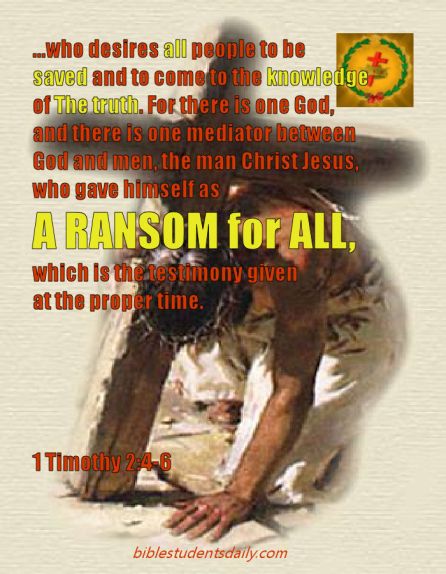
“Wherefore the law was our schoolmaster to bring us unto Christ, that we might be justified by faith” (Galatians 3:24).
On a hill far away stood an old rugged cross,
The emblem of suffering and shame.
And on that old cross the dearest and best,
For a world of lost sinners was slain.
It is a tragic picture to contemplate. A perfect man, so unjustly convicted, dying in the prime of life. But his greatest defeat was his greatest triumph. That was why he came. That was why he left the heavenly courts to become a man in the first place.
Note how obediently and willingly and humbly Jesus, the firstborn of all creation, the Bright Morning Star answered, when our Heavenly Father asked who should He send down to earth as the Redeemer, “Here am I, send me” (Isaiah 6:8). This is why the Son was the Almighty Heavenly Father’s delight.
Father Adam caused the death penalty to be imposed upon the whole human family, Christ’s willing sacrifice provided the value to redeem all mankind. Only a perfect being who was separate from God could accomplish the task of removing the death penalty upon Adam and his race, thus providing a way for mankind to be redeemed from the power of the grave.
Christ’s sacrifice provided a release from the curse, first for the Church class during the Gospel Age, and later for the World during the Millennial Age.
God loves mankind deeply (John 3:16). We cannot imagine the sorrow and pain that God experienced when Adam fell. We can only get some idea of this feeling when we observe the grief of parents when their children go astray.
God not only provided a mechanism to rescue His precious creation, but authorized His son to execute God’s plan for their redemption.
“By his knowledge the righteous one, my servant, will justify the many, as he will bear their iniquities” (Isaiah 53:11, NAS).
Not only did God provide the mechanism for mankind’s redemption, God also empowered this Righteous One, Jesus, to justify His chosen ones. “Wherefore Jesus, … that he might sanctify the people with his own blood, suffered without the gate” (Hebrews 13:12). Jesus was “delivered for our offences, and was raised again for our justification” (Romans 4:25). God has empowered His son to redeem us and justify us.
The death of our Savior, Jesus Christ, provided the price of our release from the curse. The scriptures speak of the life of Jesus, given for us, as a “ransom” for us. Today we think of a ransom as a price for the release of a hostage. The scriptural word “ransom” is from the Greek word “lutron,” which literally means a price of release (Matthew 20:28, Mark 10:45).
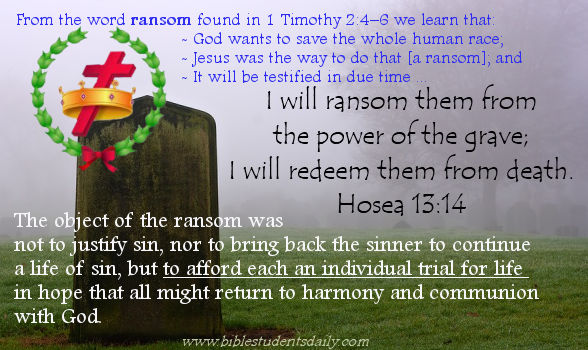
The word “ransom” also appears in 1 Timothy 2:4–6, from the Greek word “antilutron,” which means a corresponding price of release. This refers to the fact that the value of the life of Jesus, given for us corresponds to the price required. From the use of the word “ransom” we see that:
- God wants to save the whole human race, and
- Jesus provided the price necessary to release us from the death penalty imposed upon Adam and his race.
The PURPOSE of the Ransom
The object of the ransom was not to afford each individual a release from the original condemnation, in order to give them an opportunity to attain everlasting life. It allows mankind an opportunity to return to harmony and communion with God.
“I will ransom them from the power of the grave; I will redeem them from death: O death, I will be thy plagues; O grave, I will be thy destruction: repentance shall be hid from mine eyes” (Hosea 13:14).
RANSOM STEPS
(1) Determine the Price — The price of release (the lutron or ransom) was the value of a human life. God established that the punishment for sin was death, and this was imposed upon Adam when he sinned. Adam passed his condemned life to all of the human race. In order to release mankind from this penalty, would require an obedient man to accept that punishment upon himself, so that it could be released from Adam and all those who received Adam’s life through procreation. Thus every person who descended from Adam — all humanity — will receive a release from death.
(2) Provide the Price — Jesus, as a perfect human being not subject to death, yielded his life in order to take upon himself, the penalty due us — so that we might be released. “By man came death, by man came also the resurrection of the dead. For as in Adam all die, even so in Christ shall all be made alive” (1 Corinthians 15:21, 22). Jesus’ life yielded, is the price for Adam’s life to be restored: Jesus for Adam, a perfect life for a perfect life. How beautifully they balance the scales of justice!
(3) Pay the Price — When Jesus died, he said “Father into thy hands I commend [deposit] my spirit” (Luke 23:46). The word “commend” is from the Greek word paratithemi, which means to deposit as a trust. In other words, Jesus committed to God the value of his life for later use, and all of Jesus’ interests for his future work in the Plan of God.
(4) Loosen the Captives — The world has been under the penalty of death, but they will be loosed (“luo”) from this captivity in God’s due time, when Christ and his “bride” of 144,000 members rules with him to raise and bless mankind.
RELEASE FROM THE LAW
After Jesus was baptized, he meditated in the wilderness for 40 days. Part of this time he would have meditated on the Law of God, given to Israel through Moses at Mount Sinai. That law was perfect. Therefore, imperfect man could not keep it. As the Apostle Paul says in Romans 7:10, “The commandment, which was ordained to life, I found to be unto death.” For none of Adam’s imperfect race could perfectly keep the Law.
But Jesus did. By keeping a perfect law perfectly he demonstrated that he was a perfect man, and therefore that he could be a corresponding price for the only other perfect man in history, Adam. Like an index finger, the law pointed out the one person who could pay the ransom price.
Adam and Eve had no children until they left the garden of Eden. Therefore, all of their offspring inherited a condemned and imperfect life. Jesus, like Adam before he sinned, had the potential for a perfect human race in his loins. In this sense he was an appropriate value to redeem Adam and his race.
No wonder then we sing with rejoicing:
In the cross of Christ I glory,
Towering oer the wrecks of time.
So l’ll cherish the old rugged cross,
Till my trophies at last I lay down;
I will cling to that old rugged cross,
And exchange it some day for a crown.
As 1 Timothy 2:4-6 reads, God has willed or determined (rather than “desired”) that all mankind will:
- Be saved from Adamic death, from the destruction of the grave, to be accomplished through the GREATEST MIRACLE the world will EVER experience: THE RESURRECTION!
- Be saved from ignorance, blindness and deafness.
- Come under a “new covenant” established by God, during the 1000 year Messianic Kingdom.
- Be restored to perfection and an opportunity for eternal life.
- Come to a knowledge of God, and thus secure a relationship with God forever.
The Ransom provides a salvation from the curse of death. It will be UNCONDITIONAL. It depends alone upon the will of God, and the price of release is the value of Jesus’ life, given for us all.
This Scriptural passage, 1 Timothy 2:4-6, speaks of a universal redemption. During the Millennium the curse will be remitted. Then each individual may begin walking up the “highway of holiness” toward everlasting life. Most of mankind will accept this free gift, and progress accordingly. Only a few will use their power of choice differently, and fail to attain everlasting life at the close of the Millennium (Revelation 20:7-9).
God will provide for the enlightenment of every individual when they awaken from the dead, so that everyone will have an accurate knowledge of God, His love, and His standards. The knowledge of Jehovah shall fill the earth (Isaiah 11:9). Mankind will have learned through experience the consequences of sin. During the Millennium, they will learn through experience the blessings of righteousness. All can then choose between the law of God which leads to life, and the law of sin which leads to death. Knowledge of truth is light, and Christ is “the true light, to lighten every man that cometh into the world” (John 1:9).
Jesus is an Advocate and helper presently to those who have consecrated their lives to follow in Jesus’ footsteps. They express this commitment by baptism, and rejoice in hope of resurrection glory with Christ in heaven. We suffer with Jesus in the present, by pursuing righteousness in world surrounded by sin. We will reign with Christ in glory, to assist him during the Millennium in drawing mankind back to God (Revelation 20:6).
During the Millennium, when God effects a new covenant for blessing Israel and the world (Jeremiah 31:31), Jesus will serve as Mediator, standing between God and men, in order to reconcile them by bringing mankind back to godliness. The saints who reign with Christ will be with Jesus in this mediatorial work of reclaiming mankind. Thus this work awaits the completion of the “Bride” class to be complete. Mediating for the world will then proceed. The saints will be associated with every feature of this work for the world, assisting them during the Millennium.
The word Mediator from the Greek is mesite and means middle-man, reconciler, go-between. The Scriptures use the word respecting mediating a covenant between parties who are alienated. A mediator is one who interposes between persons who are at variance, with a view to reconciling them. Moses, as the Mediator of the Law Covenant, was a type of Jesus, the Mediator of the New Covenant.
At the close of the thousand years the Mediator will have completed its role. Thereafter God will stand before God, and demonstrate, during the “Little Season,” their condition of heart. Those who are obedient and godly, will receive everlasting life. Those who are disobedient and rebellious, will lose this privilege.
In 1 Timothy 2:5 we read about “The man Christ Jesus.” The Greek word for “man” is anthropos — human being. It refers to when Jesus when he was made flesh. Jesus “gave himself” as “the anointed” one (the word Christ signifies “the anointed”), who finished the giving of himself at Calvary. The name Jesus is but another form for Joshua, which signifies Deliverer. The name Christ is the Greek equivalent for the Hebrew word Messiah — The Anointed.
Jesus surrendered his perfect human life, that is, all of himself, his human rights and privileges — the full equivalent of Adam’s perfect life. By his willing sacrifice for men he secured the right to purchase Adam and the entire race. He has not applied this human life to Adam and his race. It remains a deposit, for use at the appropriate time to release mankind from the curse.
Christ was both Priest and Sacrifice. As a priest, he offered his sacrifice to God. As a Sacrifice, his human life was yielded up, given, for the benefit of mankind.
THOSE WHO ARE IN CHRIST PRESENTLY
As mentioned earlier, the ransom Jesus gave constitutes a price of release. Those who have come into Christ in the present time, accepting the value of his sacrifice by faith in him, are granted redemption presently. That is, God counts them as uncondemned, justified, by virtue of the value of Christ’s redeeming sacrifice (Romans 5:9). We then lay down this justified life in service and sacrifice with Jesus, as long as our days remain.
We thus give up our share in the earthly blessings awaiting mankind, in order to secure the higher, heavenly blessings offered during the present time.
The resurrection of Jesus was a testimony from God that Jesus performed his sacrifice correctly, and that all the blessings God has for us now — and the world later — are sure and established (Acts 17:31).
Another evidence of God’s acceptance of Jesus’ sacrifice was seen by sending the holy Spirit upon the saints on the day of Pentecost. There God’s anointing, the holy Spirit (symbolized in the Old Testament by the holy anointing oil), came upon the Church. It continues ever since on all the living members of the Church.
Jesus laid down his life as a sin-offering during the 3½ years, and Jesus applied the value of this for the Church class when he appeared in the presence of God for us. Jesus has not yet applied it for the whole world. That awaits the Millennium.
The ransom price that Jesus gave provides a release from condemnation, for us now, and for the world later. That was given on Calvary’s cross.
The sin offering that Jesus gave began at Jordan (when Jesus was 30 years of age), and continued through the 3½ years of Jesus’ ministry (until Jesus was 33 1/2 years old). Jesus was “made perfect,” or complete, in character, “by the things which he suffered” (Hebrews 5:8,9). Jesus was not imperfect at any time in the sense of being sinful (2 Corinthians 5:21, 1 John 3:5, 1 Peter 2:22). He was perfect, undefiled, in His glorious condition as the Logos, before He left the glory which He had with the Father and was made flesh. When born of Mary, the assurance given us is that He was still “holy, harmless, undefiled and separate from sinners” (Hebrews 7:26). His sufferings, therefore, did not make Him perfect in the sense of making Him sinless, but rather, to prove his loyalty to the Father’s will, unto death, even the death of the cross. The promise of perfection on the highest plane — the promise of the Divine nature — was Christ’s reward for fulfilling his Covenant of Sacrifice faithfully and loyally. The beginning of that new nature was granted to Jesus at the time of his baptism, when he was begotten of the holy Spirit. But the new nature begotten there needed development, or perfecting; and it was for this purpose that the trials, difficulties and buffetings were permitted to come to Him (R5472). As our High Priest in glory, Christ — our Advocate (our personal “lawyer”), works with us through our experiences, to purge from us the propensity for sin.
The Church is not a part of the ransom price. However, we do have the privilege of suffering with Christ presently, and being raised in glory to be priests for the world during the Kingdom (Revelation 20:6). From that elevated standing, we will be able to assist Jesus in purging from mankind their propensity for sin. In this way we share with Christ in being an offering for sin.
The Church is not a part of the ransom price but does share in the sin-offering through grace. These two doctrines are inseparable. We could call them the TWIN DOCTRINES as they always work together in the process of salvation.
The ransom expresses God’s justice. For it shows that a payment for sin is necessary, in order to release mankind from the curse justly imposed upon our father Adam in Eden. But as steadfast as the penalty has been — so God’s commitment to release mankind from the curse, now that a payment has been made, is equally sure.
Christ has already redeemed mankind in the sense that he has laid down the ransom price. But he has not yet rescued mankind and applied to them the value of the ransom price provided. That awaits the Millennial Kingdom. In the meantime, God is selecting from among mankind people of faith, to be developed in the pattern established by Jesus, in order to assist Jesus in the world of lifting the world from their plight during the Millennium.
Then God will apply the price of release for Israel and the world. Then a New Covenant will be established for blessing of all who come under its blessings. When the Millennial age shall have been finished its work, and all are restored to harmony with God, then our heavenly Father will be ALL in ALL (1 Corinthians 15:28).
Suggested Further Reading
The Ransom. Faithbuilders Fellowship.
Click to access 02_ma_07.pdf
MATTHEW 26:27-29 — Drinking From Christ’s One Cuphttps://biblestudentsdaily.com/2018/03/19/matthew-2627-29-drinking-from-christs-one-cup/
JESUS — The Name — https://biblestudentsdaily.com/2017/07/05/jesus-the-name/
The URL of this post:
Who is the World’s RANSOM and Why?








 BIBLE Students DAILY