Gethsemane

GETHSEMANE - Matthew 26, 36-39

GETHSEMANE! The Garden’s lonely shade the world’s
Redeemer sought that night. He went alone to pray
For grace and strength to drink the last drop in His Cup.
Great souls crave solitude in sorrow’s hour. Not e’en
His well-beloved three might share the sacredness
Of that deep woe, – He bade them tarry, while He went
A little farther on, and fell upon His face.

Gethsemane! A solitary place, apart,
No mortal feet may press in sympathy that dark,
Encrimsoned earth. No human hand the fevered brow
May cool, no other heart can share its agony,
No voice but God’s may break the solemn silence there, –
A place where every soul must drink alone the Cup
The Father’s hand hath poured, and given to His child.

Gethsemane! A desert place, alone, apart?
Ah, no! The anguished heart doth never cry in vain
To Him who marks the smallest sparrow when it falls,
For He shall send His Angel with the message, “Fear
Thou not, for I am with thee! I will ne’er forsake,
Nor let thee fail! My right hand shall uphold, My love,
My power shall keep thee, even to the bitter end!

Gertrude W. Seibert

Matthew 26:36-46 KJV

“36 Then cometh Jesus with them unto a place called Gethsemane, and saith unto the disciples, Sit ye here, while I go and pray yonder.

37 And he took with him Peter and the two sons of Zebedee, and began to be sorrowful and very heavy.

38 Then saith he unto them, My soul is exceeding sorrowful, even unto death: tarry ye here, and watch with me.

39 And he went a little farther, and fell on his face, and prayed, saying, O my Father, if it be possible, let this cup pass from me: nevertheless not as I will, but as thou wilt.

40 And he cometh unto the disciples, and findeth them asleep, and saith unto Peter, What, could ye not watch with me one hour?

41 Watch and pray, that ye enter not into temptation: the spirit indeed is willing, but the flesh is weak.

42 He went away again the second time, and prayed, saying, O my Father, if this cup may not pass away from me, except I drink it, thy will be done.

43 And he came and found them asleep again: for their eyes were heavy.

44 And he left them, and went away again, and prayed the third time, saying the same words.

45 Then cometh he to his disciples, and saith unto them, Sleep on now, and take your rest: behold, the hour is at hand, and the Son of man is betrayed into the hands of sinners.

46 Rise, let us be going: behold, he is at hand that doth betray me.”

SWEET HOUR OF PRAYER

https://www.youtube.com/watch?v=-feujfKXA_Q


This post’s URL is:
https://biblestudentsdaily.com/2017/04/09/gethsemane/

Enter your email address to subscribe to this blog and receive notifications of new posts by email.

Save

Save

Save

Save

The Origin and Meaning of Easter & Lent

Apostle Peter in prison-BSD.jpg

The Word Easter in the Bible

The only place in the Bible where the word “Easter” is found is in Acts 12:4, yet it is a mistranslation of the Greek word pascha. The word pascha should properly have been translated “Passover” (Strong’s G3957, “pascha, the Passover”). It has been correctly translated Passover in most modern translations. The corresponding word in the Hebrew Old Testament is Strong’s H6453, pecach, also defined as Passover.

Acts 12:4 describes events that took place in the springtime when the Apostle Peter’s apprehension and imprisonment by King Herod coincided with the Jewish festival of Passover, after Herod had earlier arrested and killed the Apostle James, brother of the Apostle John. In respect of Jewish religious custom, Herod waited till after Passover to act on Peter’s fate, planning to kill Peter as he had James. God did not allow this, and sent an angel to free Peter. Soon after, Herod himself was struck dead of a ghastly disease (Acts 12:23).

The “four quaternions (“squads”—in the NIV) of soldiers” (Acts 12:4) refers to four groups of four soldiers each, perhaps each group of four serving in rotation through the 24 hour day, at Jerusalem. During each period four soldiers guarded one prisoner as indicated in Acts 12:6—Peter was chained to one soldier on either side, with two guarding at the doorway.

A Real Angel, A Real Deliverer

During the festive week of Passover and Unleavened Bread, God’s mighty power delivered Peter from prison and death in a miraculous manner.

“The angel said unto him, Gird thyself, and bind on thy sandals. And so he did. And he saith unto him, Cast thy garment about thee, and follow me. (9) And he went out, and followed him; and wist not that it was true which was done by the angel; but thought he saw a vision. (10) When they were past the first and the second ward, they came unto the iron gate that leadeth unto the city; which opened to them of his own accord: and they went out, and passed on through one street; and forthwith the angel departed from him” (Acts 12:8-10).

“It is worthy of notice that the miracles performed here were only such as were beyond Peter’s natural power. Whatever he could do he was required to do, namely, putting on of his sandals and his cloak, and following the angel. He could have been transported. His own sandals or other sandals could have been fastened to his feet. A new coat might have been provided. But the lesson is a more profitable one as it was given. Similarly in the Lord’s dealings with us today, we should remember that it is ours to do everything within our power, and the Lord’s to overrule all things for our good, and to supply our deficiencies from his abundance. Thus still he gives us day by day our daily bread, in the rain and the sunshine and the seed; but he expects us to labor for it, to plow the ground, to sow the seed, to harrow it, to thrash it, grind it and bake it.

” ‘When Peter was come to himself,’ when he realized the facts in the case, that he was free, he said, ‘Now I know of a surety that the Lord hath sent his angel and delivered me out of the hand of Herod and … of the Jews.’ St. Peter’s faith was strengthened. Willing to die, he found that the Lord was willing that he should live and labor and endure, and he was equally pleased, rejoicing, we may be sure, for the privilege of further service, even though it would mean further sacrifices and sufferings for the Lord’s sake and for the sake of his people” (Charles T. Russell, R4347).

From this account in Acts chapter 12, we are assured that “the Heavenly Father himself loves us and that all the heavenly powers are pledged to those whom he has accepted in Christ Jesus, and these unitedly guarantee blessings to all those who abide in God’s love. This means to abide in faith in the Redeemer. It means to abide loyal to our consecration, to do the Father’s will to the extent of our ability. That will is declared to be, that we shall love the Lord supremely, our neighbor as ourselves, and all the members of the household of faith, as Christ loved us” (Charles T. Russell, R4347).

Why Easter Sunday?

Dear friends, have you ever wondered WHY Easter Sunday is one of the most sacred Christian holidays?

It is because Christian churches have generally adopted Easter Sunday as the resurrection day and the proper time to celebrate the raising of Jesus Christ from the grave, which occurred on the third day after Jesus’ crucifixion. Jesus died on Nisan 14th  (Friday, about 3 pm, 33 AD), and was raised the following Sunday morning, Nisan 16th. This was the “third day” counting inclusively—Friday, Saturday, Sunday (Matthew 28:1, Mark 16:1‑2, John 20:1, Luke 24:1,24, 1 Corinthians 15:4).

Later on, it was determined in the Christian world to celebrate the resurrection of Jesus always on a Sunday, and remember the death of Christ by Good Friday, irrespective of whether Nisan 14th and 16th on the Jewish calendar actually falls on Friday or Sunday in a given year. Among brethren of the Bible Student fellowship, it is different. Jesus sat with his disciples for his “Last Supper” (Luke 22:20) on the evening that had just begun the calendar day Nisan 14th, and there instituted a memorial of his approaching death. We customarily observe our Memorial accordingly—on the night following Nisan 13th—that is, the night which technically begins the calendar day Nisan 14th. This year, in 2017, that means a Sunday night (April 9th) memorial of Jesus’ death, but the day of the week varies year by year.

Further in this post we shall explain why “Good Friday” is not celebrated by the Christian world closest to the exact day of our Lord’s commemorated day of death. But in brief, here, it is because of the decision made by the Papal Anti-Christ church (lead by Constantine as we explain later) and they were not concerned about the Jewish date of Jesus’ death. Their new rule (established in 325 A.D.) fixed it relative to the equinox rather than relative to the Jewish calendar. The truth of the matter is, that it is Nisan 14th which the Bible explains is the date when the memorial of our Lord’s death is to be annually commemorated—not the nearest Sunday to this or any other date.

Pagan Influences Came in Later

Today, in our memorial supper, we recognize the influence of the Hebrew traditions by observing it according to the days of the Jewish calendar. The celebration is not of the Jewish Passover, however, but of the sacrificial death of our redeemer, Jesus, the antitypical Passover Lamb. Subsequently, however, pagan influences also blended with popular Christian observances.

(a) The name “Easter” is from Ishtar—who was the Babylonian and Assyrian goddess of love and fertility. The Phoenicians called her Astarte (a sister and consort of Baal,) a god worshipped in many parts of the eastern world. Some of the ancient Hebrews also worshipped Baal.

(b) In Europe, Eostre (with variations in spelling) became the Anglo‑Saxon goddess of spring, emphasizing fertility and the rising sun. The month of April was dedicated to her, and the Old English word for Easter was “Eastre” which refers to Eostre. The festival of Eostre was celebrated at the vernal equinox, when day and night receive an equal share of light and darkness.

(c) During the early Middle Ages, Christian missionaries seeking to convert the barbaric tribes of northern Europe realized that the time of Jesus’ death and resurrection also coincided with the Teutonic springtime celebrations. The Teutonic goddess of fertility, Ostare, derives her name from the ancient word for spring. As the days of approaching spring grew longer, celebrations coinciding with the spring equinox emphasized the end of winter and a rebirth of nature, triumphing life over death. The Christian missionaries taught that this time also pointed to the resurrection of Jesus.

Easter Eggs and Bunnies

Eggs symbolize birth, fertility, and new life in many cultures. The ancient Egyptians and Persians would hand out coloured eggs as gifts during their springtime festivals.

Europeans during the Middle Ages, collected eggs of different colours from the nests of various birds, using them as charms to avert evil and bring good fortune.

The Easter egg hunt custom was gradually phased out by the more popular egg painting custom where colourful eggs were hidden and children as well as others would search for them. Eggs were painted in bright colours to resemble the sun, the arrival of spring, and fertility, while Easter baskets, holding the collected eggs, were intended to resemble bird’s nests. Polish people today still decorate their eggs with many traditional symbols for Easter, many of them with religious representations.

Rabbits have also served as fertility symbols in some ancient cultures. Legends from ancient Egypt connected the rabbit with the moon because of their nocturnal feeding habits. This association with the moon is also thought to have originated with those who watched the cycles of the moon to determine the precise date of the approaching change of season, and the accompanying celebration. This event took place on the first Sunday after the first full moon following the spring equinox.

The first documented use of hares for the Easter festival was in Germany during the 1500’s. Later, edible Easter bunnies were prepared with pastry and sugar. These traditions made their way to America during the 1700’s by the Pennsylvania Dutch who had emigrated from Germany. During the years following the American Civil War, handcrafted chocolate Easter eggs and rabbits became increasingly popular.

Hot Cross Buns

Australians also celebrate Easter with hot cross buns, a spiced sweet bun made with currants or raisins and marked with a cross on the top. The first recorded use of the term “hot cross bun” was around 1733. They are traditionally eaten on “Good Friday” in the United Kingdom, Ireland, Australia, New Zealand, South Africa, Canada, and India. The cross on the bun represents the crucifixion of Jesus and the spices inside are meant to remind Christians “of the spices put on the body of Jesus” (See Mark 16:1, Luke 23:54‑56, Luke 24:1).

John 19:39 says that Nicodemus also brought a mixture of myrrh and aloes, “about an hundred pound weight,” for the burial of Jesus. The number 100 is used for Jesus in the Tabernacle, as the square measure of the gate, door, and vail, representing that Jesus is the “way, the truth, and the life” for those who follow him (John 14:6). Also, there were 100 sockets of silver as a foundation for the Tabernacle, coming from the Ransom money of the Israelites, representing Jesus as the Ransom and foundation for God’s Plan of Atonement (Exodus 38:25-27).

Myrrh, a bitter herb, represents suffering, and aloes is used for healing. Thus these two elements represent the suffering of Jesus, from which comes the healing from sin and death from Jesus’ death. When Jesus is depicted as a king in glory, his “garments smell of myrrh, and aloes”these very two fragrances (Psalm 45:8). For Christ in his resurrection glory has achieved a death of suffering that brings healing for the world.

Lent

Does the Bible teach us to celebrate or commemorate Lent?

The following is an extract from a website by the Uniting Methodist Church explaining what “Lent” is about—a practice not observed within the Bible Student Movement:

“Lent is a season of forty days, not counting Sundays, which begins on Ash Wednesday and ends on Holy Saturday. Lent comes from the Anglo Saxon word lencten, which means ‘spring.’ The forty days represents the time Jesus spent in the wilderness, enduring the temptation of Satan and preparing to begin his ministry.

“Lent is a time of repentance, fasting and preparation for the coming of Easter. It is a time of self‑examination and reflection. In the early church, Lent was a time to prepare new converts for baptism. Today, Christians focus on their relationship with God, often choosing to give up something or to volunteer and give of themselves for others.

“Sundays in Lent are not counted in the forty days because each Sunday represents a ‘mini‑Easter’ and the reverent spirit of Lent is tempered with joyful anticipation of the Resurrection.”

There is no direct reference of this practice, of Lent, in the Scriptures. However, this pleasant custom probably has benefited various ones who applied themselves to it through the centuries, if it focused their minds and hearts on proper spiritual values. However, if afterward its observers supposed they were free at other times to practice worldly principles, then they would have missed the true value. A consecrated believer should remember that their life of service here first of all involves purity of heart and mind, always (James 3:17).

The Catholic Church believes that “Lent” is a time of repentance, fasting, and preparation for the coming of Easter. It is a time of self‑examination and reflection. This may have useful benefits. However, for the true Christian, their entire consecrated life should be one of devotion.

“If anyone would come after me, let him deny himself and take up his cross daily and follow me” (Luke 9:23 ESV).

Fasting can be a good practice at any time of the year, both for our physical benefit, and for mortifying the things of the flesh, to focus on things of the Spirit. Sometimes eating less can cause the mind to sharpen. We are to be continuously humble and lowly of heart, as was Jesus (Matthew 11:29, Luke 2:37). Weaning away from earthly attractions, it can help us also to be satisfied with whatever God permits us to have in other temporal commodities also—food, housing, car, or job. God gives us what we need. If we experience some discomfort for the flesh, it can augment our hope for and appreciation of the spiritual values, and spiritual promises, that exceed anything Earth can provide.

Regarding the practice of baptism at Lent season—perhaps this custom also had some beneficial results. However, it is not something mentioned in the New Testament, and baptism is appropriate at any time of year, when the believer determines to proceed in full commitment to God, with a personal consecration of themselves and their life to Him. Thus it is not reserved for a particular month of the year. See the post titled: What Does It Mean To Be Baptized Into Christ? and What Does Being Consecrated To The Lord Mean?

Pastor Charles Russell’s Comments about Lent

The following is an extract from Reprint 3170.

“Our best wish for all the people of New York and of the whole world would be that all or at least some of them, may observe Lent and join in such petitions heartily: if but one in a hundred of those who will observe the Lenten season will do so, it will surely mean a great revival in their own hearts.

“To us who observe the Memorial Supper on its anniversary only, the occasion is one of the greater solemnity, and may well be approached with the greater reverence. We commend to all of ‘this way’ (Acts 9:2) that the interim between now and the Memorial (April 10th) be specially a season of prayer and fasting—drawing near to the Lord (1 Corinthians 7:5). True, the Lord’s consecrated people are continually to live as separate from sin and from the mind of the flesh as possible, and are to “pray without ceasing”; but, as the Apostle intimates, there may profitably be special seasons of this kind; and surely none more appropriate than this Memorial season. The fasting which we urge may or may not affect the food and drink, according to the judgment of each, respecting what diet will best enable him to glorify God and to keep his “body under.” We refer specially to abstention from all “fleshly lusts which war against the soul”; these appetites always under restraint with the saints, may well be specially mortified at this time.”

However as the Apostle Paul explains in 1 Corinthians 7:29‑31, our “fasting” or “mortification” should be a daily act moment by moment to those who have fully enlisted in the Priesthood of complete consecration in the “School of Christ” as far as it be reasonably possible and all depends on one’s level of maturity in Christ:

” (29) This is what I mean, brothers: the appointed time has grown very short. From now on, let those who have wives live as though they had none, (30) and those who mourn as though they were not mourning, and those who rejoice as though they were not rejoicing, and those who buy as though they had no goods, (31) and those who deal with the world as though they had no dealings with it. For the present form of this world is passing away” (1 Corinthians 7:29‑31).

Hebrew Customs

Concerning our opening text (Acts 12:4), let us consider the relationship between the Easter festival and the Hebrew Passover.

Passover is the oldest and most revered festival in Judaism. It is observed in the spring, in the month Nisan, the first month of the Jewish religious new year (Exodus 12:2). As Jewish months began with a new moon, the timing of Passover about halfway through the month puts it about the time of full moon. The afternoon that Jesus died was the time a full moon, and this represented that Israel’s favor was full—but because of their rejection of Christ, their favor would wane and diminish.

The Jewish Passover, under the administration of Moses, commemorated Israel’s deliverance from centuries of Egyptian bondage. The firstborn among the Israelites where passed over by the angel of death during the final plague suffered by Egypt. That tenth plague forced Pharaoh to release the Israelites from a life of compulsory servitude.

The Passover is celebrated on an annual basis in accordance with the instructions that were given by God to Moses:

“The Lord spake unto Moses in the wilderness of Sinai, in the first month of the second year after they were come out of the land of Egypt, saying, Let the children of Israel also keep the passover at his appointed season. In the fourteenth day of this month, at even, ye shall keep it in his appointed season: according to all the rites of it, and according to all the ceremonies thereof, shall ye keep it. And Moses spake unto the children of Israel, that they should keep the passover” (Numbers 9:1‑4).

Our Lord Jesus became the antitypical Passover Lamb (John 1:29) when he gave his life as a sacrifice for the sins of the world, during the time of the Jewish Passover.

Christian Traditions

Though the Easter festival became well‑established and accepted by Christians by the second century after Jesus’ death, there had been considerable debate between the Eastern and Western divisions of the Church over the exact date the event should be celebrated.

The Eastern Church preferred to not hold it as an annual Sunday event, but rather to observe it on whatever day Nisan 14 fell. These early Christians wanted to time the observance according to the timing of the Hebrew type. The Western Church, on the other hand, wanted to remember the resurrection of Jesus always on a Sunday—Easter Sunday—regardless of the day of the week indicated by the Jewish calendar (Exodus 12).

Emperor Constantine wished to resolve this issue at the Council of Nicea in A.D. 325. The question of the Easter date was one of the main issues of concern. After lengthy dispute, the council was unanimous in its decision that Easter should always fall on the Sunday following the first full moon after the vernal equinox. After further discussion, it was decided that March 21st was to be the date for the spring equinox. This dating process has been the general guideline for most of Christendom ever since.

In Remembrance of Me

Students of the Bible stand free from many of the long‑standing traditions that have been passed down to us from the past. Their faith is based on the meaning and partaking of the symbolic emblems that represent our Lord Jesus’ sacrificial death. Jesus’ request given to his disciples that night in the upper room were, “This do in remembrance of me” (Luke 22:19).

Every consecrated child of God joyfully accepts the privilege of partaking of the bread, representing Jesus’ flesh, and drinking of the cup, representing Jesus’ shed blood. This is the true meaning and purpose of observing this most important occasion each year on the 14th day of the first month Nisan.

Church of the Firstborn

In his letter to the Hebrew brethren, the Apostle Paul speaks of the “church of the firstborn” whose names are “written in heaven” (Hebrews 12:23). Elsewhere, he explains that they are walking with our Lord in “newness of life” (Romans 6:4). They also remember his death, and solemnly renew their consecration to God annually by partaking of the meaningful symbols, bread and wine.

In keeping the type of Exodus 12, the blood of each lamb that was slain in Egypt that night was sprinkled on the doorposts and lintels of the houses of Israel.

  • Each Jewish household represents the Household of faith, that is, all believers in Christ. This includes both spirit begotten and non‑spirit begotten, both fully consecrated and not yet consecrated, both the baptized into Christ and not‑yet baptized into Christ, who believe in the blood of Christ as the redemptive value that saves us from the curse of Adamic death. On that night, however, only the firstborn were under jeopardy, as only the firstborn has a spiritual life that could be lost.
  • That all believers benefit from the Passover sacrifice is reflected in the deliverance of all the Israelites through the Red Sea, subsequent to the Passover night. (1 Corinthians 15:22).

Here are some lovely words by Br. Charles Russell on the Household of Faith, from Reprint 5457. “These words “Household of Faith”—are broad enough to include not only those who are fully in the way, but also those who have made more or less of an approach unto the Lord and the Truth. The very fact that any one is drawing near to the antitypical Tabernacle is a strong reason why we should wish to encourage him to press on. He has come a part of the way, even if he has not made a consecration.

In a strict sense, the Household of Faith, of course, includes only those who are consecrated. But the words of the Apostle justify us in believing that those who are considering the matter, counting the cost, would in a broad sense be counted as of the Household of Faith. And we are to give these special assistance—all in whom we see any prospect of consecration. Our constant desire and effort should be to point men directly or indirectly to the Lord. Thus we shall be showing ‘forth the praises of Him who hath called us out of darkness into His marvelous light.’ ”

  • Each slain lamb—represents the antitypical Lamb of God: Christ Jesus.
  • The firstborn Israelites in each familyillustrate the Christ, head and body, the “church of the firstborn.”
  • The bitter herbs that were eaten with the lamb (Exodus 12:8)—illustrate the trials and afflictions that are experienced by the Lord’s people during the present Gospel Age.
  • The unleavened bread eaten with the lamb (Exodus 12:8)—represents our wish to be purged from the leaven of sin, as we feast upon the merits of our Lord’s sacrifice for us (1 Corinthians 5:7).
  • The household joining eating the Passover lambrepresents our common participation, our sharing together, of the merits of Christ (1 Corinthians 10:16,17).

Those who are faithful to their High Calling will be privileged to share in the deliverance of the poor groaning creation during Christ’s future kingdom, as proclaimed by the Apostle Paul (Romans 8:22, 23).

Christ our Passover Lamb

The Apostle Paul directs our attention to the significance of the Passover type and our need to purge out all unrighteousness and sin (pictured by leaven). He wrote to the Corinthians brethren,

Purge out therefore the old leaven, that ye may be a new lump, as ye are unleavened. For even Christ our passover is sacrificed for us: Therefore let us keep the feast, not with old leaven, neither with the leaven of malice and wickedness; but with the unleavened bread of sincerity and truth (1 Corinthians 5:7,8).

The Jewish people were to slay their Passover lambs on the 14th day of the first month (Nisan) of the Jewish New Year. This was the exact time many centuries later when our Lord Jesus, as the antitypical Passover Lamb, died for the sins of the whole world of mankind.

All who recognize Jesus as the true Passover Lamb and have accepted the merit of his shed blood on their behalf, may appropriate the merit of that blood by purifying their hearts from a consciousness of evil. Because of their faith in the blood of Jesus, they are privileged to enjoy a new relationship and standing before God.

The Lamb of God

When John saw Jesus coming toward him, he proclaimed, “Behold the Lamb of God, which taketh away the sin of the world” (John 1:29).

Later, the Apostle Peter, when comparing earthly riches with the true value of our redemption (1 Peter 1:18), speaks of the exceeding value of Jesus’ blood of sacrifice, as “The precious blood of Christ, as of a lamb without blemish and without spot (verse 19).

God’s wonderful plan of reconciliation for the sins of the whole world will become manifest to all during the Millennial Kingdom soon to be established. The meaning of “Christ our Passover” takes on a deeper significance when we look forward to the time when the entire human family will praise God for the gift of his beloved Son, the “Lamb of God,” that takes away the sins of the world.


Acknowledgment:

The Dawn Bible Students’ Magazine—Article from the Highlights of Dawn, April 2006. “Easter—It’s Pagan Origins and True Meaning,” used to present this post.

Br. Charles T. Russell, The Reprints of the Original Watchtower and Herald of Christ’s Presence.

Br. David Rice—editing assistance.

The Uniting Methodist Church website—for references cited from “What Is Lent and why does it last 40 days?”


The URL of this post:

The Origin and Meaning of Easter & Lent

Enter your email address to subscribe to this blog and receive notifications of new posts by email.

Save

Save

Save

Save

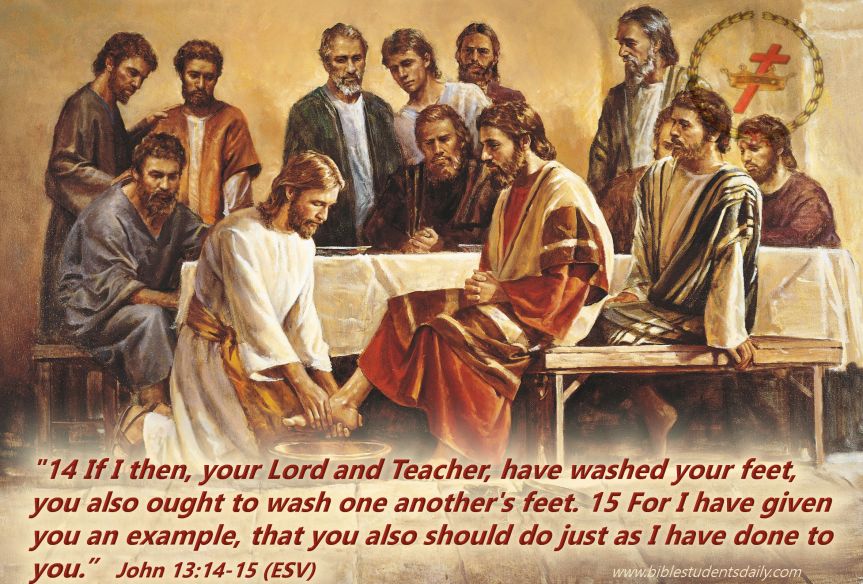
JOHN 13:14-15 – Washing One Another’s Feet – A Privilege

jesus-washing-apostles-feetJohn13,14-15.jpg

During Bible times, frequent washing of the feet was necessary as the Israelites wore sandals instead of shoes, and often went barefoot in the house. Thus, among the Israelites, it was the first duty of a host to give his guest water for washing his feet. To omit this was a sign of marked unfriendliness. According to the Jewish Encyclopedia, “it was also customary to wash the feet before meals and before going to bed (compare Cant. 5:3).” Abstaining for a long time from washing them was a sign of mourning (2 Samuel 19:24).

The priests had laws about this practice (Exodus 30:18-21). Here it is explained that a copper laver was placed in the court, between the Tabernacle and the altar of burnt offering, in which the priests had to wash their hands and feet before entering the Tabernacle or approaching the altar of burnt offerings, hence before all their priestly functions. As no one is allowed to approach a king or prince without due preparation, which includes the washing of the hands and feet, so the Israelite, and especially the priest, is forbidden in his unclean condition to approach God, for if such a one came defiled, he was subject to die.

Feet Washing in the Old Testament

The practice of providing water for guests to wash their feet is illustrated on the occasion of a mysterious visit by “three men” to Abraham.

In Genesis 18:24 we read: “And he lift up his eyes and looked, and, lo, three men stood by him: and when he saw them, he ran to meet them from the tent door, and bowed himself toward the ground, and said, My Lord, if now I have found favor in thy sight, pass not away, I pray thee, from thy servant: Let a little water, I pray you, be fetched, and wash your feet, and rest yourselves under the tree.”

Later, Abraham’s nephew (Genesis 11:27), Lot, made a similar offer to two angels who came to the city of Sodom where he and his family lived, to destroy the city because their immorality has become “so great before the LORD that the LORD has sent” angels to destroy it (verse 13).

“(1) Now the two angels came to Sodom in the evening as Lot was sitting in the gate of Sodom. When Lot saw them, he rose to meet them and bowed down with his face to the ground. (2) And he said, ‘Now behold, my lords, please turn aside into your servant’s house, and spend the night, and wash your feet; then you may rise early and go on your way.’ They said however, ‘No, but we shall spend the night in the square.’ (3) Yet he urged them strongly, so they turned aside to him and entered his house; and he prepared a feast for them, and baked unleavened bread, and they ate” (Genesis 19:13).

(See also Judges 19:20, 21. To understand the context here, starting from verse 1 may be good).

The act of feet washing in the above cases reflects a spirit of LOVE, SERVICE and HUMILITY = WILLING SACRIFICE TO PLEASE THE HEAVENLY FATHER, who reads the heart of men.

Feet Washing – In the New Testament

The Woman’s Tears and Perfume

those who are forgiven much love much

Feet washing in the New Testament is found in Luke 7:36-50. It is six days before the Passover (Luke 12:1) a Pharisee named Simon invited Jesus to his home for a meal. While he was seated at the table, a woman “who had lived a sinful life in that town” came to the Master with an alabaster jar of costly perfume.

“(38) and standing behind him [Jesus] at his feet, weeping, she began to wet his feet with her tears, and kept wiping them with the hair of her head, and kissing his feet and anointing them with the perfume. (39) Now when the Pharisee who had invited him saw this, he said to himself, ‘If this man were a prophet he would know who and what sort of person this woman is who is touching him, that she is a sinner.’

(40) And Jesus answered him, ‘Simon, I have something to say to you.’ And he replied, ‘Say it, Teacher.’ (41) ‘A moneylender had two debtors: one owed five hundred denarii, and the other fifty.

(42) When they were unable to repay, he graciously forgave them both.

So which of them will love him more?’

(43) Simon answered and said, ‘I suppose the one whom he forgave more.‘ 

And He said to him, ‘You have judged correctly.’

(44) Turning toward the woman, he said to Simon, ‘Do you see this woman? I entered your house; you gave me no water for my feet, but she has wet my feet with her tears and wiped them with her hair.

(45) You gave me no kiss; but she, since the time I came in, has not ceased to kiss my feet.

(46) You did not anoint my head with oil, but she anointed My feet with perfume.

(47) For this reason I say to you, her sins, which are many, have been forgiven, for she loved much; but he who is forgiven little, loves little.’

(48) Then he said to her, ‘Your sins have been forgiven.’ (49) Those who were reclining at the table with him began to say to themselves, ‘Who is this man who even forgives sins?’ (50) And he said to the woman, ‘Your faith has saved you; go in peace‘” (Luke 7:38-50 NASB).

Dear friends, what can WE do as did this woman?

In the Mark account of another occasion, Mary, the sister of Lazarus, even poured the perfume on Jesus’ head (Mark 14:3).

How can we anoint the minds of our brethren, as suggested by the head?

Perhaps by praying for our brethren’s strength, that they might endure all for CHRIST.

This is so important, as would we not ourselves wish others to pray for us to more than overcome, which is the desire of our entire existence—to bring JOY to the Father by pleasing Him more? What more than to feel his Perfect Loving counsel moment by moment?

Perhaps anointing the head of our brethren can also mean sharing spiritually edifying thoughts and asking faith-building questions as well as letting the subject matter discussed or studied, be one that feeds the New Creation in Christ so as to encourage fellow consecrated believers to be fully consumed in their thought processes upon heavenly things since “a mind set on the flesh is hostile toward God; for it does not subject itself to the law of God, for it is not even able to do so, and those who are in the flesh cannot please God. However, you are not in the flesh but in the Spirit, if indeed the Spirit of God dwells in you” (Romans 8:7-9).

How can we wash each other’s feet as this woman did for Jesus?
How can we show true hospitality likewise to our fellow brethren in Christ?

The specific and precise answer for each consecrated child of God may be unique and personal, just as each has been given by God uniquely specific talents to use in His service in the body of Christ. But how can we make sure our talents in God’s service are not buried? Perhaps by COURAGE IN CHRIST and by asking our Heavenly Father to eradicate FEAR of man from our lives while holding on to the REVERENTIAL FEAR of GOD—the fear of doing wrong in the eyes of God alone. See post titled: A Proper Fear

Does FEAR OF MAN … fear of past mistakes (as with the Apostle Paul before he became fully enlightened) … fear of being misunderstood and thus misrepresented and shunned or separated from the general assembly, or labelled “crazy” or “a missfit,” “the radical one,” stop us from BEING as CHRISTLIKE as we can and striving to moment by moment develop into the likeness of Christ by getting outside of the CARNAL COMFORT ZONE? Let it not!

This means, going BEYOND the PAIN BARRIER!

If you are not suffering for righteousness sake in some way, shape, or form, it means YOU ARE NOT working to your full potential in CHRIST.

“Indeed, all who desire to live godly in Christ Jesus will be persecuted.” (2 Timothy 3:12)

“For you have been called for this purpose, since Christ also suffered for you, leaving you an example for you to follow in His steps…” (1 Peter 2:21)

The consecrated until death “stars of heaven” class are the “heirs according to the promise” (Galatians 3:29) and coheirs of Christ (Romans 8:17). But such will be heirs only if they display the forgiving, repenting, and humble spirit among men, as we find in the weeping woman who washed Jesus’ feet with her tears of remorse and reverential thankfulness in being worthy of but touching the hem of the garments of Jesus. (Matthew 6:15) She had heard among the crowds that his kingdom was not of this world, and now she was able to SERVE him and be CLEANSED from her sins by him—because of her desire to have her sins forgiven. Later, if she continued on, she would be washed in this antitypical lamb’s blood. Her REVERENTIAL FEAR wished only to do right in God’s sight, recognizing her need for a redeemer.

Since Simon was a Pharisee, he may have considered himself to be rather important and may have felt he had bestowed an honor to Jesus by inviting him to dinner.

Was Simon embarrassed or afraid of what others would think of him if he showed Jesus hospitality? This Jesus who had allowed the woman considered in the public eye as inferior, to come near him?

Do you think Simon’s attitude was one of self-righteousness? Self-importance?
Do we ever allow this feeling to creep into us like LEAVEN?

To rid our minds of any such poison to the New Creation in CHRIST, let us focus our thoughts upon the Son of God who humbled himself even to the death of the cross (Philippians 2:8).

Anointing the Feet

In John 12:13 Mary anointed Jesus’ feet with costly ointment of spikenard six days before the Passover, when Jesus came to Bethany. [Note: this would be Nisan 10th after 6pm and an appropriate time for anointing the Passover lamb—whom Jesus himself was, symbolically.] Mary displayed her loving devotion to the Master by using her hair to wipe Jesus’ feet.

Although Judas’ perhaps insincere words highlight his dissatisfaction with Mary’s use of this expensive perfume (“worth a year’s wages”), Jesus said that she should be let alone, because she did what she could.

In fact, Jesus commended Mary’s actions, in Matthew 26:11-13: “(11) For you always have the poor with you, but you will not always have me. (12) In pouring this ointment on my body, she has done it to prepare me for burial. (13) Truly, I say to you, wherever this gospel is proclaimed in the whole world, what she has done will also be told in memory of her.”

What a beautiful illustration how true Christians should treat their most valuable assets on earth—the feet members of Christ that remain. In these we see Christ. They profess consecration, and evidence this with acts of true loving kindness, and manifestations of concern, gentleness, patience, assistance, and sympathy. They strive to bless others as Mary did with Jesus, lavishing costly, symbolic perfume upon the body of Christ, the Church.

As the washing of another’s feet is not a glamorous work, and considering the imperfections that each of us have, it takes a large measure of love, phileo and AGAPE love, and humility, to press forward in striving to serve our brethren.

Let us not allow differences along one line or another, nor misunderstandings, hinder us from seeking to do good unto all that we have opportunity, especially the household of faith. (Galatians 6:10, 1 Peter 3:11, Psalm 34:14, Micah 6:8)

Washing the Disciples’ Feet

One of the marks of female saintship in the early church was, “if she have washed the saints’ feet” (1 Timothy 5:10). Feetwashing being necessary at that time, became a synonym of service and kind hospitality. To illustrate this same principle of service and humility, Jesus used this same custom on the night of the Last Supper:

At the end of Jesus’ ministry and “just before the Passover Feast,” and when “the evening meal was being served,” Jesus washed his disciples’ feet. The disciples must have been shocked and silent that the Great Teacher, their Lord, would do such a thing. Simon Peter did not want Jesus to wash his feet at first, until the Master said that unless he washed Peter’s feet, he could have no part with him in the kingdom. Then Peter was willing to have his whole body washed, yet Jesus pointed out that he who is clean needs only to wash his feet. Jesus pointed out that not all of them were clean, the reference obviously being made to Judas.

Jesus admonished the disciples: “(14) If I then, your Lord and Teacher, have washed your feet, you also ought to wash one another’s feet. (15) For I have given you an example, that you also should do just as I have done to you” (John 13:14-15).

Jesus’ act was intended as an example in humility and a lesson to the apostles who seem still to have had a spirit of rivalry for preeminence. To our understanding, the lesson was that our Lord’s followers were not to shun any service, however menial, that would enable them to assist or comfort one another.

Jesus’ lesson is amplified by his words in John 13:34, 35: “A new commandment I give unto you, That ye love one another; as I have loved you, that ye also love one another. By this shall all men know that ye are my disciples, if ye have love one to another.”

Not until they had received the holy Spirit on the day of Pentecost, were the disciples of Christ able to manifest their determination to serve Christ in a way that would enable them to become pillars of the Church (Acts 2:24, 16-18, 33, 38).

Feet Washing – TODAY

When it comes to helping brethren, let us gladly do the work of feet washing, illustrated for us by the Master himself who taught the disciplines the lesson of HUMILITY, “that they should love one another to such an extent that they would consider no service too great nor too degrading which would minister to each other’s comfort” (Br. Charles T. Russell, Biblical Expository 1).

Here are some encouraging words of Br. Oscar Magnuson from a 1932 Bible Students Reunion Convention Report:

“If we place a limit on what we are willing to do and to bear for the Lord, the Lord might find it necessary to give us a body with limited capacities in the resurrection. In that case a divine body would not suit us, for such a body is unlimited in bodily capacities.”

There are hundreds of opportunities of showing the meek, lowly, and loving spirit of our Master. As God’s stewards and servants, it is not self that we are to minister and serve and pamper, but it is our mission to “do good unto all men as we have opportunity, especially to the household of faith,” remembering that we are to walk in his footsteps who “came not to be ministered unto [served], but to minister [serve] and to give his life a ransom for many” (Mark 10:45, Matthew 20:28).

In Reprint 1101, Br Russell writes that “the entertainment of any of the household of faith, is really the fulfillment of our Lord’s injunction, ‘See that ye wash one another’s feet.’ But none should be permitted to overdo themselves in this blessed service, nor to deprive themselves of the spiritual communion of the meetings. To this end all have been urged to make only very simple arrangements, that both visitors and entertainers may have their principal feast upon the spiritual meat. Come, then, expecting a warm welcome to such plain things as we have ourselves.”

In our sympathetic desire to help others be more than overcomers, a reciprocal washing of one another’s feet can include:

  • Desiring and maintaining loving fellowship with the members of Christ’s body as did Jesus spend in that upper room SERVING his disciples;
  • Praying for each other, as our Lord Jesus taught in his prayer in John 17.
  • Encouraging each other to fight the good fight of faith and become transformed in newness of life by renewing the mind when we dwell on things that are above. For example, “Speaking to yourselves in psalms and hymns and spiritual songs, singing and making melody in your heart to the Lord” (Ephesians 5:19).
  • Within the ecclesia and among those with whom we have frequent fellowship, if we are actively engaged in promoting one another’s spiritual growth and development, we should be able to appreciate that all of our brethren have certain qualities, graces, or attributes that can benefit us; and we, likewise, should be on the alert as to how we can be of help to them.
  • Volunteering for ecclesia projects.
  • Entertaining visitors with an offer of a booklet or Divine Plan Book.
  • Witnessing to all humans at every single chat we have with another.

2..jpg

  • Providing transportation.
  • Sending messages of comfort to all who write messages on the Old Ron email list.
  • Sharing tapes or truth literature.
  • Typing, proofreading.
  • Testifying at Testimony meetings.
  • Sharing hymns, psalms, and Bible Scriptures over the phone or conference calls etc.
  • Sharing bible study magazine articles or poems written.
  • Sending little “keep pressing onward and upward” parcels of spiritual items to edify.
  • Sending item of use to our brethren worldwide E.g. Africa, Philippines…
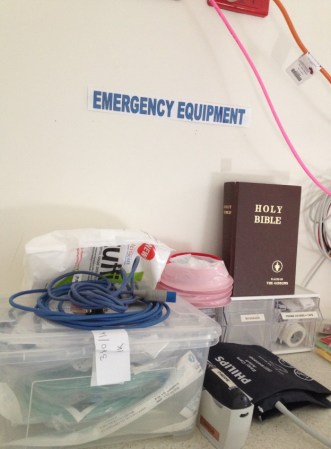
  • Visiting the ill, hospitalized or isolated.

hospitalization.jpg

  • Reading the Scriptures morning and evening  with your own children/family.
  • If you have a garden: sharing some of your garden’s edible produce with brethren and friends.
  • Creating a one or 2 page witnessing ad/flier and distributing amongst the public as a family activity.
  • Helping your children leave fliers on the tables and seats at shopping centres and at supermarkets.
  • Sending in bill payments with a booklet inserted inside them letting someone know about GOD’s GLORIOUS KINGDOM to come to give the world HOPE!
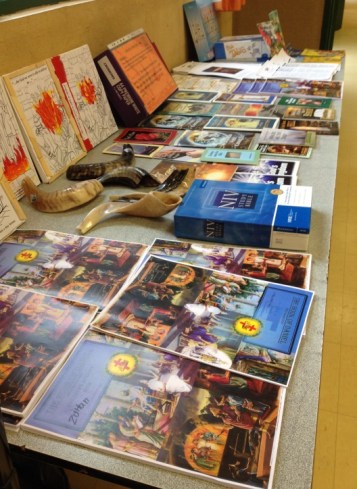
  • Offering to set up Convention/Camp Book Tables.

book table.jpg

  • Coordinating a class choir.
  • Opening up your home for a weekday Bible Study.
  • Having an email sign-off Scripture “logo” — let CHRIST be what others remember you by.
  • Asking the brethren who have websites how you can contribute your skills to aid in the witnessing efforts.
  • Asking your Elders how you could help lighten their load by supporting them in their preparations for the Ecclesia.
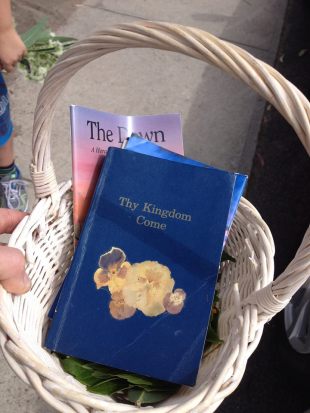
  • Making bookmarks from pressed leaves to sell to raise money for some Truth related cause or to give out as gifts and reminder of Scriptural words of encouragement.
  • Offering your time for Sunday School teaching and Children’s Camp /Convention lessons.
  • Sitting next to someone different during ecclesia meeting intermissions at ecclesia and share Scriptures and Scriptural thoughts.
  • Coming prepared to class studies.
  • Finding an Elder who you can be your mentor and have Bible studies, Question and Answer email studies etc.
  • Take the kids on “witnessing bike trips.”

boy.jpgesther witnessing.jpg

Each of us should realize that we have something to give for the edification of the body. We should be faithful in contributing to our ecclesia studies, praying for others, and being a model of someone whose life is undergoing the transformation process; being, therefore, an example of a believer.

Let us be faithful in washing one another’s feet!

2c9752511c569e1794549fdcca7c8aa6.jpg

Acknowledgement

  • Br. Homer Montague, for source material from his article in the Herald of Christ’s Kingdom (March/April 1998), titled “The Privilege of Feet Washing.”
  • Br. Charles T. Russell, Biblical Expository 1
  • Br. Oscar Magnuson for source material from a 1932 Bible Students Reunion Convention Report.


This post’s URL is:
https://biblestudentsdaily.com/2017/03/27/washing-one-anothers-feet-a-privilege/

Enter your email address to subscribe to this blog and receive notifications of new posts by email.

Save

Save

Save

A Proper Fear

ISA. 40, 31.jpg

After the Jewish high priest had crumbled the sweet incense upon the fire of the golden altar, after its fragrance had penetrated beyond the second veil and had covered the Ark of the Covenant and the Mercy Seat, he then himself passed beneath the veil. Every time the high priest raised the veil thus to pass under it he probably feared; for in case he had failed in any particular to carry out his sacrificial work acceptably he would have died as he passed under the veil.

So our Lord Jesus knew that His work must be acceptable in the most absolute sense, else He would forever forfeit His existence. He would become as though He had not been; He would lose all.

There was no earthly being to give our Lord encouragement along this line.

There was no one to say, You have done everything perfectly; you could not have done better.

So the Master went alone to the Father for this assurance and for strength and courage.

LUKE 22, 42.jpg

In Luke 22:42-39 we read:

39 And He came out and proceeded as was His custom to the Mount of Olives; and the disciples also followed Him. 40 When He arrived at the place, He said to them, Pray that you may not enter into temptation. 41 And He withdrew from them about a stone’s throw, and He knelt down and began to pray, 42 saying, “Father, if You are willing, remove this cup from Me; yet not My will, but Yours be done.” 43 Now an angel from heaven appeared to Him, strengthening Him. 44 And being in agony He was praying very fervently; and His sweat became like drops of blood, falling down upon the ground.

The Heavenly Father heard His prayer and gave Him the needed assurance and strength.

He was heard in respect to that which He feared; and during all that night and the following day, up to the hour of His crucifixion, He was calm and courageous.

So the Lord’s people should have a proper fear.

Proper fear is good for them.

But it should not proceed to the point of hindering their efforts and dissipating their courage.

They should have the fear enjoined by St. Paul when he said, “Let us fear, lest a promise being left us of entering into His rest, any of us should seem to come short of it.” (Hebrews 4:1.)

This proper fear the Master had.

He never became discouraged, never held back from the work which the Father had given Him to do.

His fear was a filial one, which engendered a watchfulness and care, a circumspection of walk and of life, that He might be wholly pleasing to the Father. This all Christians should have. We should watch lest we neglect some privilege or duty.

This proper fear will lead us to careful inspection of ourselves.

We should ask ourselves, “What do I believe? Why do I believe it? We should go over the ground again. We should again go over in our minds the proofs of the correctness of our Faith. By so doing, the Lord will strengthen us in the Faith, He will strengthen our heart.

 If any hope in themselves, and lean upon their own strength mainly, it will be to their advantage that the Lord shall allow them to come to the point of discouragement, that they may become more timid, may lose all self-assurance, may realize their utter helplessness and weakness and their need of leaning wholly upon the Lord, of looking constantly to Him for guidance and support.

As the Lord’s children thus learn to wait upon Him, to them is fulfilled the promise, “They that wait upon the Lord shall renew their strength; they shall mount up with wings as eagles; they shall run and not be weary; they shall walk and not faint.”—Isaiah 40:31.

Acknowledgment

Br. Charles T. Russell – The above post is mostly a citation from a Reprint article from “The Original Watchtowers and Herald of Christ’s Presence.” – R.5711

URL: https://biblestudentsdaily.com/2017/03/27/a-proper-fear/

Enter your email address to subscribe to this blog and receive notifications of new posts by email.

Save

Doing and Saying the Kindest Thing in the Kindest Way

1 PETER 3, 9 - DOING & SAYING THE KINDEST THING IN THE KINDEST WAY

What is the SPIRIT OF HELPFULNESS all about?

“Let every one of us please his neighbour for his good to edification(Romans 15:2).

In Romans 15:2, the Apostle Paul is not saying, let the younger ones please their neighbour, nor does he say, let the older ones please their neighbour; but he says,

 “Let EVERY ONE of us please his neighbour.”  

All of the Lord’s people should have such an interest in one another and in the Lord’s cause, and should have so much of the spirit of the Master, that they would seek rather to sacrifice themselves than to gratify self, especially at the expense of others.

If we have the spirit of Christ, we shall find various ways in which we will sacrifice self without waiting for specific directions.

The Law of Love will incite us to act contrary to our own natural preferences, if by so doing we shall help one another in the good way.

In his letter to the Corinthian Church the apostle illustrates this principle by a practical application regarding the Greek custom of offering their meat in their temples. After having been thus offered to the idols, the meat was considered to be especially sacred. Nearly all of the meat available was offered to idols, so that whenever one wished to have meat he could find none that had not been thus offered.

Those who had come out of idolatry into Christianity, knew that the worship of idols was wrong; for they had learned that there is only the one true God.

The apostle declares that he would abstain altogether from eating meat rather than risk stumbling a brother who could not take the broader, truer view. To stumble such a one, might be to throw him out of the right way entirely.

Responsibility For Our Influence

The apostle Paul did not say that it is not right to eat meat; but rather, that he was willing to forego his rights and privileges in order to edify another.

These others of whom the apostle Paul had spoke had not come to appreciate fully the fact that meat offered to idols had not suffered any ill effect or been changed in any way from having had this done. To set meat before a piece of stone would not injure it; and so to set it before an idol would not cause it any ill effects.

But Paul so self-sacrificially, preferred to give up eating meat altogether rather than to stumble any brother or sister in Christ.

What a glorious lesson for us dear friends!

Let us ask our self the follow questions:

When necessary, do I willing deny myself some of my privileges and rights in striving to be of any assistance to my brethren in Christ and in avoiding to stumble them?

Some of the Lord’s people have very sensitive consciences, others are less sensitive.

The longer one has been in the “School of Christ” and/or the more ability one may have, the more easily should one be able to discern what would be pleasing to the Lord we would hope based on each individual’s uniquely permitted experiences, of course that only the Heavenly Father and His son Jesus perfectly understand best, as they are Divine beings.

As a Christian, one would not want to do anything to offend the Lord, even if he were to go without meat for the remainder of his life.

Another introspective question for Christ-like development may be perhaps this one:

Would I, even if it be for the remainder of this carnal life, prefer to deny myself of something (that of course would not harm the New Creation of Christ within self,) that would be for the best interests of another beloved one in Christ so as not to stumble a weaker one in faith or one who may have their conscience violated by doing so?

This involves walking and talking with the Heavenly Father moment to moment to discern God’s will—who mercifully gives wisdom and provides us with His answers to all who ask, seek, and knock to Jehovah for help (Matthew 7:7).

These may be very personal items of decision-making here under consideration, yet how reassured we are through the words of the Prophet Isaiah,

“And your ears shall hear a word behind you, saying, ‘This is the way, walk in it,’ when you turn to the right or when you turn to the left” (Isaiah 30:21).

The Heavenly Father makes clear one’s path through an exercised conscience—that is, a conscience that is disciplined and trained in seeking after that which is righteous in the eyes of the divine perfect God of the universe (Matthew 5:6).

Another introspective question for Christ-like development may be:

Would I wish to lose all my influence for the good of my fellow brother and sister in Christ?

The apostle answers this suggestion in the negative; he says, “…(12) when ye sin so against the brethren, and wound their weak conscience, ye sin against Christ. (13) Wherefore, if meat make my brother to offend, I will eat no flesh while the world standeth, lest I make my brother to offend” (1 Corinthians 8:1-13).

Let us consider some practical “life” scenarios.

Example 1: Regarding clothing…

Perhaps you attend an ecclesia where consecrated sisters in Christ wear head coverings and believe that dressing modestly means to wear skirts and dresses below the knee and which cover the shoulders and not to wear pants (considering that to be a traditional male item of clothing and relying on the words of 1 Corinthians 11:4-16 and Deuteronomy 22:5 for their convictions of belief). After examining the Scriptures on these topics one may realize that wearing a head covering and wearing a modest dress or skirt does not seem in any way to violate the laws of God, and hence will see no reason why not to do so, in order to help create peace around and least offend in any way any dear member in the ecclesia attended. Yet if this does cause contention then considering it a suffering for Christ, may each be humbled—recognizing even more, one’s own ignorance or errors of self for as the words of Philippians 2:3 teach us:

“Let nothing be done through strife or vainglory; but in lowliness of mind let each esteem other better than themselves.”

As the apostle Paul stated best in regards to the above issue about clothing or hair apparel:

“But if any man seem to be contentious, we have no such custom, neither the churches of God” (1 Corinthians 11:16).

Probably the NAS Bible gives the sense better, “But if one is inclined to be contentious, we have no other practice, nor have the churches of God.”

Example 2: Our words or actions…

Perhaps at a testimony meeting in your ecclesia, one would share something that they believe would be of great edification to all, yet something in one’s conduct or words has caused offense in another—perhaps due to language or cultural barriers or perhaps a result of another mis-hearing correctly yet the results of each one’s intentions and conduct involved in such a situation shall be best understood and credited to each involved by the Heavenly Father who sees each heart and each motive. Again, we are ALL ignorant each moment of each day no matter how great or small the issue at hand—which depends on one’s closeness with the Heavenly Father—and thus, how in tune to the Father’s will each dear child of God is to be, being reassured that God through Christ, shall “reward each according to what they have done” (Romans 2:6).

“For we must all appear before the judgment seat of Christ; that every one may receive the things done in his body, according to that he hath done, whether it be good or bad” (2 Corinthians 5:10).

“Not rendering evil for evil, or railing for railing: but contrariwise blessing; knowing that ye are thereunto called, that ye should inherit a blessing” (1 Peter 3:9).

Would one not rather suffer any unkind effects towards us from our words or actions in having done what an educated conscience before the Father believes was done seeking towards righteousness rather than suffering the outcomes of results and the self-inflicted cross of guilt for knowing we had not done how Christ Jesus our Head, would wish us to?

Example 3: Sunday observance…

Applying the above principle—our responsibility for our influence—to Sunday observance, we are not to feel a bondage under the Old Law, during the Sabbath day. However we should avoid what would be considered by others as not observing the Sabbath.

To our understanding EVERY day is a part of the great Sabbath into which we have entered—rest in Christ.

We have a greater liberty. But we are not to use this liberty to the injury of others.

Many people think that any kind of labor is a violation of the Fourth Commandment.

From our viewpoint we know that the Sabbath of the Jew was typical; and we see what the antitype is. We are enjoying the antitype of that Sabbath.

But while we might have liberty to work on Sunday, our so doing might stumble our neighbour. We would not be violating any principle in not observing Sunday; but for the sake of not stumbling our neighbour we are glad to rest from our work and to give ourselves to the study of God’s Word.

Sunday should be a day that is quiet and reverential in every way, and devoted specially to the service of God—a day in which business is restricted, and as far as possible eliminated. But for the interests of the Lord’s work to forbid refraining from the use of today’s transportation blessings such as cars or trains and trams on Sunday would not apply to today’s world as once it may have been the case. Each place… each time period… each culture… each community even… have certain ways of functioning and by best striving to not offend anyone, but with gentleness of mind and being lowly of heart as Christ was, let us strive to represent Christ as best we can now, knowing that where we fall short after doing our best, Christ’s robe of righteousness covers all the failures that surround us.

Sabbath signifies rest, as the Apostle used it (Hebrews 4:9, margin), we can see that the Church of Christ keeps the Sabbath, or rest, every day, and recognizes God’s arrangement in connection with this matter. Those who keep every seventh day as a Sabbath, but who fail to enter into and keep the rest of faith, are not keeping the true Sabbath, but keeping another, so far as the Church is concerned.

The Sabbath arrangement was for the Jews. We have the better arrangement under our Covenant.

We enter into rest, our Sabbath, EVERY day; and we are hoping that soon we will enter into the still Greater Sabbath.

In that Sabbath, the Millennium, we shall have not only rest of heart, but also perfection, no longer to be challenged by trials and difficulties of life.

During His ministry Jesus chose the Sabbath day in which to perform miracles and heal the sick, that He might show forth the kind of works which He will perform during the Great Sabbath Day, the seventh-thousand-year day—the Millennium.

Helping, Not Hindering Our Neighbours

We can apply this principle in a general way. We can apply it to our conversation with Christian people.

There is a way of taunting people on their ignorance, etc. This is not love.

LOVE does not delight to expose another’s weaknesses.

The more careful we become in our words and our actions, the more polite we shall be, the more helpful.

Politeness is :

to do and say the kindest thing in the kindest way.

One may be polite for the sake of policy or for the sake of principle.

E.g. You have a business and you are polite to your clients or else you will not have any to buy from you, and in turn, no income to live from.

Our pleasing of our neighbours should be for their edification.

We should be glad to do ALL that we can for their assistance, their edification, their uplift, their upbuilding.

If we can speak a pleasant word, a kind word, it would be for upbuilding and have in mind primarily the upbuilding of the Lord’s people in spiritual things. As the apostle Paul says, we are “to provoke one another.”

In the ISV translation Hebrews 10:24 reads:

And let us continue to consider how to MOTIVATE one another
to love and good deeds…

What the apostle had in mind here was the reverse of provoking to anger, hatred and strife.

Brother Charles Russell comments in Reprints of the Original Watchtower (R.5413):

 “Some of the dear brethren who are evidently very sincere have not caught the spirit of the Truth on this subject; and wherever they go, they are apt to stir up the evil mind of others, instead of stirring up their good mind and provoking to love and good works.”

We are to please our neighbors so far as it would be for their good, and according to right principles. But to upbuild one in injustice would not be right.

Now here are our final questions to put theory into practice:

For our Australian friends: Would we think it right to let our neighbour’s emus run all over our front driveway?

emus.jpg

For our local and international friends: Would we think it right to let our neighbour’s dogs run all over our front lawn?

6a00d83451c9f669e20167678794a1970b-400wi

Take a moment or two to think of what you would do.

We believe here is a most lovingly wise, compassionate and merciful response to such a question … (but in regards to chickens) by Pastor Charles Russell:

“We think that he [his neighbor] would thus be more edified by our firm stand for right. But we must not tell him how to manage his chickens. We must do our best to keep his chickens off our place; but we would make a mistake if we were to go in and order our neighbor’s chickens, house and children.  To do so would be busybodying. We shall have enough to do to look after the weaknesses of our own family.”

Further Reading:

Bible verses for consideration:

Is the Sabbath Day a Saturday, Sunday, or any day of the Week?
https://biblestudentsdaily.com/2017/10/19/is-the-sabbath-day-a-saturday-sunday-or-any-day-of-the-week/

Acknowledgment & Reference:

Br Charles Russell—R.5413. Reprints of the Original Watch Tower & Herald of Christ’s Presence.

The URL of this post:
https://biblestudentsdaily.com/2017/03/18/doing-and-saying-the-kindest-thing-in-the-kindest-way/

Enter your email address to subscribe to this blog and receive notifications of new posts by email.


Save

Save

Like Doves Dwelling in Rocks

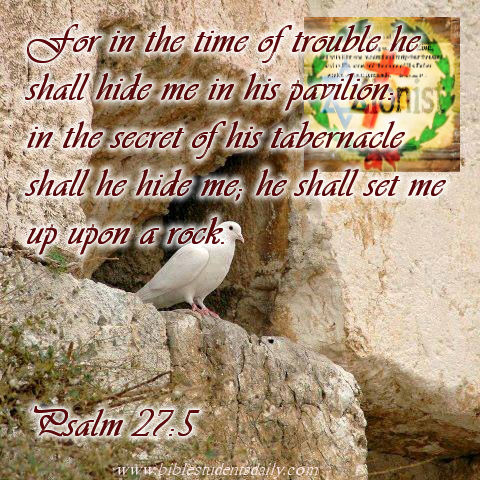
Psalm 27, 5.jpg

“Leave the cities, and dwell in the rock, O inhabitants of Moab! Be like the dove that nests in the sides of the mouth of a gorge.Jeremiah 48:28

When the days are cold and drear,
To the Lord, we can draw near;
Like the doves, who seek their nests,
We fly back home to peace and rest.

Underneath our Father’s wings,
We serve the Master, King of Kings;
Sweet solace for our hearts we find,
Away from joys of earthly kind.

Though the road may seem long and dark,
But like the doves, inside the ark;
We know, one day, we shall fly free,
Away from all the carnal troubles that around us we see.

Faint not, dear hearts, but do be still,
And LOOK TO THE HEAVENLY FATHER-your needs to fill;
For human minds do not aspire,
To that plane—the highest one there is …

Higher than all earthly love,
The JOY that comes from up above;
When we seek to only know and do
Our Heavenly Father will, as He carries us faithfully through.

Almighty Heavenly Father be near,
When others mock, the little doves, inside the rocks.
May our Beloved brethren in CHRIST
Patiently endure all, cheerfully, like our Beloved Jesus who so willingly sacrificed.

Based on Sr. Rosemary Page’s original poem titled “Like the Dove (That Dwells in the Rock)”

ROCK OF AGES  – sung in this video by the Antrim Menninite Choir

Suggested Further Reading

Br. Anton Frey, “Notes on the Song of Solomon.” These study notes are from the “BIBLE STUDY LIBRARY” CD which can be purchased from The Herald of Christ’s Kingdom Bookstore at the following link: https://herald-magazine.com/bookstore-2/

Br. Frank Shallieu, “Notes on the Song of Solomon.” These study notes are also from the “BIBLE STUDY LIBRARY” CD. (Same link as above.) Here is also a direct link to these “Notes” — https://www.revelation-research.org/pdf/Song%20of%20Solomon.pdf

F. A. Shuttleworth, Scot., “The Song of Songs A short series of devotional meditations – No. 1, The Herald of Christ’s Kingdom, April 1958. Here is the direct link: http://www.heraldmag.org/archives/1958_4.htm#_Toc36391359

Br. David Rice, “The Song of Solomon,” The Beauties of the Truth Periodical http://www.beautiesofthetruth.org/Archive/Library/Doctrine/Mags/Bot/90s/BOTMAY02.PDF

“I Am My Beloved’s, and My Beloved Is Mine.” The Dawn Magazine, Sept. 1989, in the Christian Life and Doctrine section.
http://www.dawnbible.com/1989/8909cl-4.htm

In relation to Psalm 27:5 – Br. Charles T. Russell, The Permission of Evil and Its Relation to God’s Plan


This post’s URL:
https://biblestudentsdaily.com/2017/03/10/like-doves-dwelling-in-rocks/


Enter your email address to subscribe to this blog and receive notifications of new posts by email.

Save

Save

STUDY 9: The Gate. The Door. The Vail.

THE GATE. THE DOOR. THE VAIL..jpg

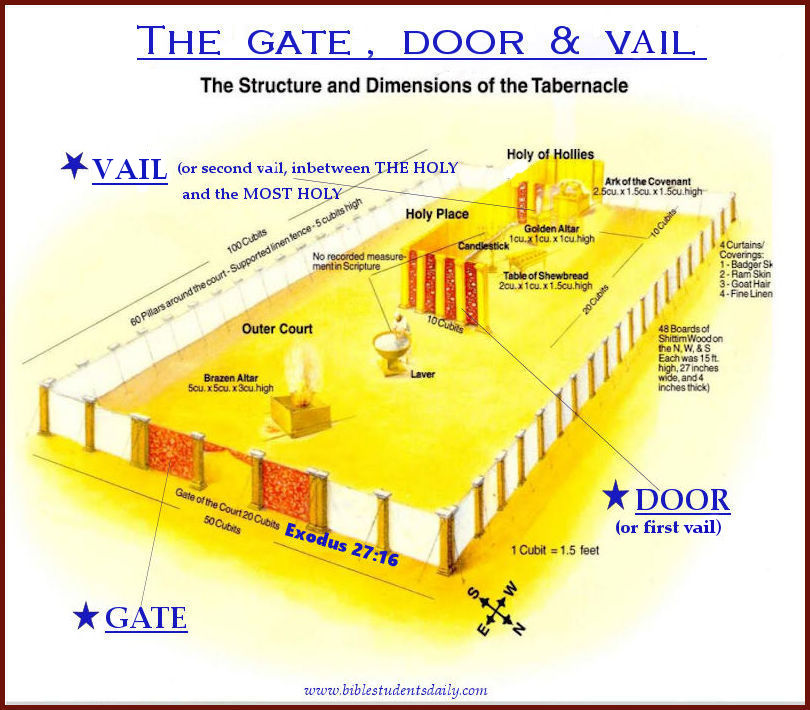
There were three entrances in the Tabernacle arrangement which include:-

  1. the “gate” to the “outer court” (Exodus 27:16-19).
  2. the “door” to the “holy place” (Exodus 26:36-37; 36:37-38).
  3. the “vail” to the “holy of holies.” (i.e. “Most Holy”) (Exodus 26:31-33).

All three entrances were made of the same material: a fine white woven linen with blue, purple and scarlet threads running through the material (Exodus 38:18).

All three entrances had the the same dimensions as regards their area, that is, they were all 100 square cubits a number representing Christ Jesus:

  • The gate was 20 cubits long x 5 cubits high (Exodus 38:18);
  • The door and the veil were 10 x 10 cubits — SQUARE — a symbol of PERFECTION (equality on every side)!

NOTE: For the door, we do not have an explicit text for its measurements however the boards were 10 cubits high (Exodus 26:16). As to the width, we infer from the 20 cubits of Solomon’s Temple that the Tabernacle was half the size (1 Kings 6:2) — thus, 10 cubits wide. The back of the Tabernacle was defined by 6 board of a cubit and a half, so 9 cubits interior — the two sides, if each 1/2 cubit thick, would constitute 10 cubits outside dimension of the Tabernacle. If the door was sufficient to cover this, then it was 10 cubits wide.

This teaches us that the same truth seems therefore to be embodied in each of these typical curtains. The same Jesus is portrayed in each. There could be no access to God, of any kind, whether of comparatively distant worship, or of closest intimacy, but through the one door, the Lord Jesus. “I am the door” (John 10:7).

The value of 100 also “beautifully correlates to the “redemption price” of the “firstborns” which was five shekels at 20 gerahs per shekel: 100 gerahs (also representing Christ Jesus)! (Numbers 3:46,47; 18:15,16)” (Notes on the Tabernacle, page 100).

Jesus is our entry into:

  • justification (the gate into the court),
  • sanctification (the door into the Holy) and
  • glorification (the vail into the Most Holy).

(1) THE GATE
the-gate-beauties-of-the-tabernacle

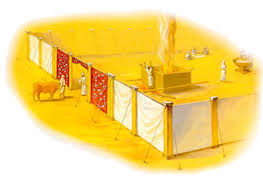
The gate was the only way into the court and represents our Lord Jesus who said of himself, “I am the door. Whoever enters through me, will be saved” (John 10:9, NIV).

“I am the way, the truth and the life. No one comes to the Father except through me” (John 14:6, NIV).

By faith in Christ’s ransom sacrifice, represented in the Brazen altar, we enter the ‘gate’ to the ‘Court’ — the vail of unbelief and sin is passed” (Tabernacle Shadows, page 22).

The gate was wider than any of the other entrances, enabling all Israelites to enter the court. The width of the entrance shows that God makes grace available to many for “many are called but few are chosen(Matthew 22:14).

In Exodus 40:33 we read, And he erected the court around the tabernacle and the altar, and set up the screen of the gate of the court. So Moses finished the work.”

The root word of “gate” from Exodus 40:33 is shâʻar, shaw-ar’ and means, to split or open, reason out, estimate… and the Gesenius’ Hebrew-Chaldee Lexicon writes: “to set free… to set a price” and Jesus most certainly did “set free” every human from the curse of sin.

The gate, (as also the door and the vail) was really a “hanging.” (See Exodus 27:9, 16; 26:31,32, 36).

All three entrances were suspended by way of metal (silver or gold) hooks from the pillars which supported them (Exodus 38:19; 26:32,37). (See Study 4 of “Beauties of the Tabernacle.”) There were no curtain rods nor any other device by way of which these “hangings” could be raised up or pulled to one side.

To enter the court, and thus, in order to pass “beneath” the “hangings,” one had to lift the bottom of the curtain and stoop down and go under the curtain. This bowing to enter shows a right attitude of heart, for when we come to Christ we come humbly in need of a Saviour. The man who will not bow his knee and his heart to Christ, cannot enter in (Psalm 99:5, Ephesians 3:14, Matthew 19:24).

We can only approach Jehovah God, by recognizing Jesus’ merit and through the eyes of a New Creation mind — the mind that was also in our Lord Jesus.

There were no cherubim interwoven into this outdoor screen surrounding the court area and the gate, unlike that of the vail. (We discuss about the cherubim a little later in this Study.)

The tribe of Judah, the kingly tribe, camped outside the Eastern Gate. The name Judah means “praise,” and Jesus was descended from this tribe (Hebrews 7:14).

The Four Posts at the Gate

There were FOUR posts at the Gate (Exodus 27:16-19).

Perhaps FOUR here, could represent the four authors of the Gospels of Jesus (Matthew, Mark, Luke, John) who most conspicuously held up Christ’s character before the world and who are the instruments used to build our faith into Christ — by studying about Jesus and getting to know who he is and thus how to become like him, and learning about what he taught to likewise follow his teachings and spread the lessons to all who have a listening ear.

(2) THE DOOR
the-five-posts-at-the-door-of-the-tabernacle

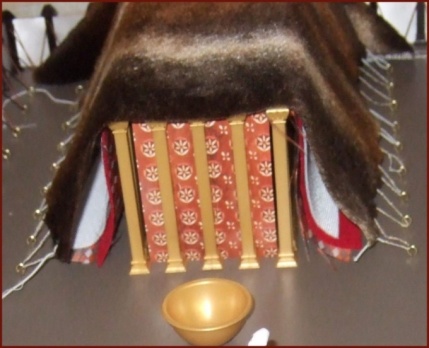
The “door” was the one entrance into the Holy (which represents the spirit begotten condition of the “little flock” class — see Study 3 of the “Beauties of the Tabernacle” series of posts on this website).

The door of the Tabernacle is of finely twisted linen (Exodus 26:36) because Jesus has completely satisfied the justice of God.

It is white to express the purity and righteousness of Jesus’ character. Jesus was the one without sin and without stain or blemish (1 Peter 1:19).

As was the gate and veil, this door was made of “blue, purple, and scarlet yarn and finely twisted linen—the work of an embroiderer” (Exodus 36:37).

The door would have been thick enough to block light and it was in the Holy Place where the golden lampstand was (which stood directly opposite the table on the south side) and it was to burn continuously both night and day (Exodus 27:20-21).

The Materials Used for the Fabric of the Sanctuary

Flax and goat’s hair were the materials used for the fabrics of the sanctuary. According to Ellicott’s Commentary for English Readers, “the flax was dyed before it was spun into thread.”
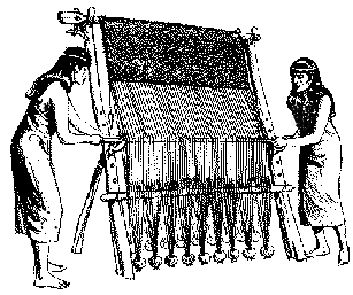
weavers.jpgHere is an image of two Israelite women moving the “weavers beam” forward on a large vertical loom as they make fine twisted linen.

In Exodus 35:25 we read, “And all the women that were wise hearted did spin with their hands, and brought that which they had spun, both of blue, and of purple, and of scarlet, and of fine linen. 26 And all the women whose heart stirred them up in wisdom spun goats’ hair.

In the above verse, “wise-hearted” women refers to all who had sufficient skill. Although both men and women of ancient Egypt spun thread, spinning seems to have been done primarily by the Hebrew women. It was effected in early times by means of a wheel and spindle, with or without a distaff. (Reference: http://wol.jw.org/en/wol/d/r1/lp-e/1200000994).

Jesus Christ referred to spinning when he urged his disciples, not to be unduly anxious about clothing, but to trust in God to clothe them. Jesus said: “Mark well how the lilies grow; they neither toil nor spin; but I tell you, Not even Solomon in all his glory was arrayed as one of these.” (Luke 12:27, 28; Matthew 6:28-30).

“Of fine linen” — Rather, of white. Most of the Egyptian linen is of a yellowish white, being made from flax imperfectly blanched.

Note: It is described in the English version as the linen being wrought with the needle, or embroidered; but the word rendered “needle-work” is now believed to denote a striped or checked pattern produced by the loom. Hence the curtain of the gate and door had a blue, scarlet and purple colour appear in them in stripes or checks, instead of being wrought into figures of cherubs, as on the curtain of the vail.

The Colours of the Linen Curtains

colours-of-the-tabernacle

  • White

White linen was used for garments for royalty and persons of rank and has been found in the tombs of the Pharaohs. White linen always speaks of purity and righteousness:

Revelation 15:6 —And out of the temple came the seven angels having the seven plagues, clothed in pure bright linen, and having their chests girded with golden bands.

Revelation 3:5  “He who overcomes shall be clothed in white garments, and I will not blot out his name from the Book of Life; but I will confess his name before My Father and before His angels.”

Revelation 19:14  “And the armies in heaven, clothed in fine linen, white and clean, followed Him on white horses.”

The fine-twined, white linen speaks of righteousness and typifies Jesus, the Son of Man, spotless, pure, and sinless.

1 John 3:3-5 — “And everyone who has this hope in Him purifies himself, just as He is pure…and you know that He was manifested to take away our sins, and in Him there is no sin.”

  • Blue

The interwoven thread of blue seems to speak the fact that Jesus remained completely loyal and true to his heavenly Father; that he faithfully maintained his righteousness and purity at all costs.

Blue is the colour of the sky without clouds and so it is also known to be a symbol of what is heavenly.

Blue is also the colour of nobility. We recognize those qualities in our Lord Jesus. He came from heaven, he then returned there as a divine soul. “He was foreknown before the foundation of the world but was made manifest in the last times for the sake of you” (1 Peter 1:20, ESV).

We read that Jesus came and being found in the appearance of a man humbled himself and became obedient unto death, even death on a cross (Philippians 2:5-11).

  • Scarlet

Scarlet represents Christ’s blood shed for all — his sufferings and death on the cross. Our Lord’s loyalty and faithfulness were put to the severest tests, tests in which obedience to the will of God resulted in his sacrificial death on Calvary’s cross.

The Apostle Peter captures the thought here in saying “it was not with …. silver and gold you were redeemed… but with the precious blood of Christ (1 Peter 1:17-23).

It is Christ’s blood which gives life and purifies.

  • Purple

Purple represents Jesus’ royalty; he was of the royal line of David, Lord of the earth, and the inheritor of all the promises of God.  Our Lord Jesus became King of kings and Lord of lords since Jesus said, “All authority in heaven and on earth has been given to me” (Matthew 28:18, NIV).

Jesus is king of a kingdom not of this world (John 18:33-39).

Because of Christ’s faithfulness unto death, God indeed did highly exalt him to the royalty of the kingdom, as was prophesied many centuries in advance:

“Therefore will I divide him a portion with the great, and he shall divide the spoil with the strong; because he hath poured out his soul unto death; and he was numbered with the transgressors; and he bare the sin of many, and made intercession for the transgressors” (Isaiah 53:12).

The Five Posts at the Door

There were FIVE posts (pillars) that supported the first vail (the door) of the Holy (Exodus 26:37; Exodus 36:38). The number 5 in the Bible represents the New Creature in Christ. (See Study 3 of “Beauties of the Tabernacle”.)

These posts were constructed of shittim wood overlaid with gold, and they were set in sockets of copper — representing perfect (or justified) human nature, and therefore, the spirit-begotten condition of the church. How beautifully this reflects that the saints still in the flesh (in the Holy — representative of the “in part” condition (1 Corinthians 13:9) have their “treasure” of the Spirit (gold) in “earthen vessels” (copper) as we read of in 2 Corinthians 4:7 (ASV):

 “But we have this treasure in earthen vessels, that the exceeding greatness of the power may be of God, and not from ourselves.”

(3) THE VAIL
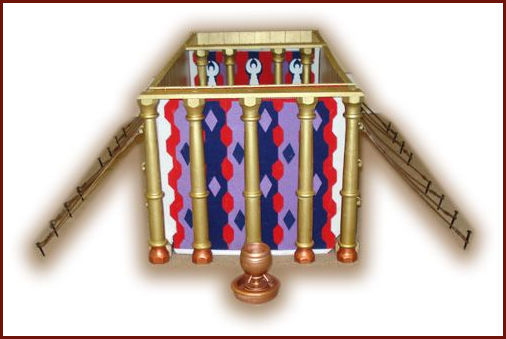
the-vail-of-the-tabernacle

The entrance to the Most Holy is called “the vail” (or in Hebrew, paroketh) of the Tabernacle and which the Apostle Paul in the New Testament designates “the second vail” (Hebrew 9:3).

It was only through the vail (which represents Christ’s flesh, R.4746) that one could enter into the Most Holy — the spirit-born condition of glory, honor and immortality to which the faithful over-comers of this age became heirs. (See Study 3 of “Beauties of the Tabernacle.)

For a certain period of time the door to the High Calling of the Church stands ajar during the 6000 years of permission of evil which has been allowed since 33 AD. Jesus opened up this new way of life through the veil; that is to say, his flesh—his sacrifice.

“Having therefore, brethren, boldness to enter into the holiest by the blood of Jesus, by a new and living way, which he hath consecrated for us, through the vail, that is to say, his flesh (Hebrews 10:19, 20).

The Rending of the Vail

The rending of the Temple vail (in Jerusalem) took place at the same time as the earthquake at the moment of our Lord’s death — his crucifixion — which we read about, in Matthew 27:51 and Luke 23:45.

Interestingly, this great vail was torn, not from the bottom toward the top, as would be the expectation if it were the result of wear, but from the top to the bottom, as indicating it was a manifestation of divine power.

The rending of this curtain represents symbolically the opening of the narrow entrance way into the High Calling — an opening between heaven itself and the heavenly condition of those living in the Gospel Age (now spanning nearly 2000 years since 33 AD) by Christ through the sacrifice of his flesh.

Through that rent vail we may see into the things beyond and be ready to pass into the Most Holy (R.4746).

Passing through this second vail into the Most Holy, involves “the death of the HUMAN body” (Tabernacle Shadows, page 22).

Both the fleshly mind and fleshly body must be left behind before we can enter into the “holiest of all.” We will then be in the spirit realm, for flesh and blood cannot inherit the Kingdom of God (1 Corinthians 15:50).

True believers are represented as being associated with Jesus as priests in the Holy, (the outer apartment of the two) where they have fellowship with God through the light of the golden candlestick, through the bread of the golden table, and through the incense that we are permitted to offer on the golden altar. It is from this standpoint we can now by faith see beyond the vail — catch glimpses at least of the heavenly estate which God hath in reservation for them who love him, for the called ones according to his purpose, for the Christ, head and body (R.3371:2).

The Cherubim

Unlike the curtain for the gate and the door, the linen curtain of the vail was embroidered with cherubim, (as were the walls of the Tabernacle proper — due to cherubim embroidered on the first of the Tabernacle’s coverings). Any cherubim in the vail would presumably have been depicted in a different way than the two golden cherubim over the ark of the covenant — these being described in Exodus 25:20:-

“And the cherubims shall stretch forth their wings on high, covering the mercy seat with their wings, and their faces shall look one to another; toward the mercy seat shall the faces of the cherubims be.”

Here is one artist’s impression of what the vail pattern may have resembled:

artist's impression of vail pattern .jpgCherubim being heavenly (angelic) creatures suggests that those passing beyond this vail enter into the heavenly condition — life on the spirit plane — partakers of the Divine Nature.

The ancient Jews said this later veil of the temple was as wide as four fingers, so that no one could possibly see into the Most Holy place (David Guzik).

The vail divided the Tabernacle into two, the Holy place at the front — 20 x10 cubits — and the Most Holy place that became a room 10 cubits long x 10 cubits wide x 10 cubits high.
Only the high priest was permitted to go beyond the vail. This occurred once a year, on the Day of Atonement.

When it came to moving from place to place, the vail was taken down from its hanging position and draped over the ark of the covenant (in which case, there was no “most holy” at that point, the vail defining the most holy having been taken down).

“(5) And when the camp setteth forward, Aaron shall come, and his sons, and they shall take down the covering vail, and cover the ark of testimony with it: (6) And shall put thereon the covering of badgers’ skins, and shall spread over it a cloth wholly of blue, and shall put in the staves thereof” (Numbers 4:5-6).

Hence there was sufficient means by which the Levitical priests could carry out God’s requirements of not entering the most holy nor seeing the ark of the covenant exposed and thus not inflicting death on themselves or others. For whomever would touch the ark of the covenant (other than the High Priest on the Day of Atonement) would die, such as in the case of Uzzah (Exodus 25:14-15).

Is this not a wonderful reassurance that a consecrated child of God should not fear failing in their vows of consecration until death or fear second death! Why? Because the Heavenly Father provides enough immunity against the evils that surround when, one’s fear of reverence to the Father through Christ (Proverbs 1:7) helps one seek for God’s wisdom, help and comfort in every time of need and trial (Psalm 46:1). This reverential fear of doing wrong in the eyes of God is a blessing in disguise! — helping the consecrated Christian overcome (Romans 8:37) all the testings and temptations as did our Lord Jesus when he was on earth.

“There hath no temptation taken you but such as is common to man: but God is faithful, who will not suffer you to be tempted above that ye are able; but will with the temptation also make a way to escape, that ye may be able to bear it (1 Corinthians 10:13).

The vail (“katapetasma”) means “to hide or conceal”, hide from view the “ark of the covenant” and the “mercy seat.”

It also acted as a barrier between God and man because while we are in the flesh, in the Holy condition as the developing embryonic New Creations in Christ, God is in the Most Holy, thus the vail separates the two of us.

The FOUR POSTS at the VAIL
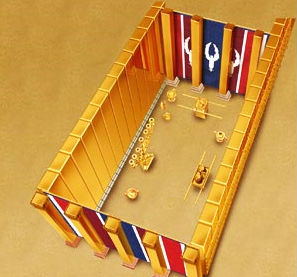
4-posts-at-the-vail

The FOUR posts (Exodus 26:32; 36:36) supporting the vail into the Most Holy are set in sockets of silver.

Silver is a general symbol of Truth — the knowledge of which the justified believer holds on to the righteousness of Christ. (See Study 4  of the “Beauties of the Tabernacle” Series of posts on this website, regarding details about silver.)

The posts here, represent the spirit-birth (gold) condition as an actuality (silver), where one’s treasure is obtained in the fullest sense by carrying out one’s sacrifice willingly and with great joy in the Spirit, unto death.  Thus, the posts into the Most Holy no longer had sockets of copper as in at the gate and door entrance ways and this signifies that those entering the Most Holy place (Divine Realm) are no longer in the flesh.

The vail was hung from golden hooks from off the 4 posts (not from the 50 golden clasps which joined the two parts of the linen covering, although, the vail was located approximately under these clasps.) Refer to Study 8 of “Beauties of the Tabernacle.” It was probably a unified drapery on the backside of the posts.

As were the golden hooks and covering of the pillars of the holy and most holy — so are our hopes, aspirations, and calling — these all concern with things divine (Exodus 26:32-37).

The Number FOUR — In the Bible

The number four in the Bible refers to the concept of trial, testing, probation, judgment.

Thus here at the entrance of the most holy of the Tabernacle, the time of judgment of the church may be reflected in the four posts.

Here are some other examples of four in the Bible (as explained in an article titled “Symbolic Numbers” by Br. David Rice in The Herald of Christ’s Kingdom Magazine, Nov./Dec. 2004):

  • At the second feeding of the multitudes by Jesus — representing the time of harvest and judgment closing the Gospel age, the number reported was four thousand.
  • The forty years in the wilderness (Numbers 32:13) — representing the Gospel age period of testing, trial, development.
  • The same is represented in the four hundred years of Genesis 15:13 — which describes the period of the affliction of the seed of Abraham, beginning with the mocking of Isaac, at the age of five, by Ishmael — a picture of the early affliction of the Church by the Jewish authorities and ends at the Exodus — a picture of the deliverance of God’s chosen at the end of the Gospel Age.

When multiplying these 400 years by the 360 days in a prophetic year, we yield 144,000, the number of the church in Revelation — showing the fruitage to be developed during the testing period of the Gospel age.

The different orders of magnitude of the number four (i.e. 4, 40, 400 and 4,000) also expressing the symbol.

[It is interesting to also note: “Of the dated visions of Jeremiah in chapters 25, 26, 27, 28, 29, and 36, three are dated in the fourth year of Jehoiakim, and three in the fourth year of Zedekiah — all six judgments are in a year four.

When the seven times of punishment on Israel was represented in Nebuchadnezzar’s dream, the expression “seven times” appeared four times in the narrative, and four times in the warning by Moses (Daniel 4; Leviticus 26).

These judgments were fulfilled by four Gentile kingdoms dominating Israel during the 2,520 years of their national punishment.] (Symbolic Numbers, The Herald of Christ’s Kingdom, Nov./Dec. 2004)

The colours embroidered on the white linen of the vail are the same here as for the entrance into the Holy. The presence of these three colours on the white linen vail is echoed in Revelation:

“Be thou faithful (blue) unto death (scarlet) and I will give thee a crown (purple) of life” (Revelation 2:10).

Psalm 100:2-5 (NLT)

Worship the Lord with gladness.
Come before him, singing with joy.
Acknowledge that the Lord is God!
He made us, and we are his.
We are his people, the sheep of his pasture.
Enter his gates with thanksgiving;
go into his courts with praise.

Give thanks to him and praise his name.
For the Lord is good.
His unfailing love continues forever,
and his faithfulness continues to each generation.

References

[R= Reprints of the Original Watchtower and Herald of Christ’s Presence – Charles Russell]

Acknowledgment

Content assisted by Br. George Tabac.

Suggested Further Reading

STUDY 1: An Introduction To The Tabernacle And It’s Purpose
URL: https://biblestudentsdaily.com/2016/09/02/study-1-an-introduction-to-the-tabernacle-and-its-purpose/

STUDY 2: The Pillar of Cloud By Day And The Pillar of Smoke By Night  https://biblestudentsdaily.com/2016/09/09/study-2-the-pillar-of-cloud-by-day-and-the-pillar-of-smoke-by-night/

STUDY 3: The Tabernacle Construction: The Holy and The Most Holy   https://biblestudentsdaily.com/2016/09/14/study-3-the-tabernacle-construction-the-holy-the-most-holy/

STUDY 4: The Court (“Holy Place”)
https://biblestudentsdaily.com/2016/09/20/study-4-the-court-holy-place/

STUDY 5: The Camp. The Israelites.
https://biblestudentsdaily.com/2016/10/28/study-5-the-camp-the-israelites/

STUDY 6: The Levites
https://biblestudentsdaily.com/2016/11/18/study-6-the-levites/

STUDY 7: The Priests. The Day of Atonement.
https://biblestudentsdaily.com/2016/12/10/study-7-the-priests-the-day-of-atonement/

STUDY 8: The Tabernacle Coverings
https://biblestudentsdaily.com/2017/01/02/study-8-the-tabernacle-coverings/

The URL for this post:

STUDY 9: The Gate. The Door. The Vail.


Enter your email address to subscribe to this blog and receive notifications of new posts by email.


Save

Save

Save

Save
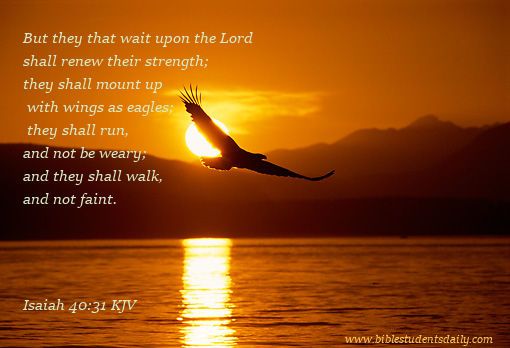
100 Pages of BIBLE STUDY WORKSHEETS for children – based on the book “Adam to Zion”

ADAM TO ZION WORKBOOK FOR CHILDREN.jpg

Dear Parent(s),

Christian greetings in the name of our Heavenly Father and his Son, Jesus Christ.

This 100 page PDF file of the Worksheets, are based on the 93 Lessons in the book Adam To Zion. Please click here (or on the image of the workbook cover, above) to download the PDF of these ADAM TO ZION WORKSHEETS

[NOTE: The book Adam to Zion  is a 187 page paperback book for children which can be purchased directly from the Chicago Bible Students Bookstore: https://chicagobible.org/product/adam-to-zion-2/]

A CD of these Worksheets can also be obtained for FREE by contacting the Berean Bible Institute: enquiryBBI@gmail.com

This makes a great gift and inspires young minds towards focusing on that which is heaven-ward using a fun and challenging method of teaching incorporated in this valuable bible study resource.

Most of the information required to answer the questions in each worksheet is in its corresponding lesson in the book; some questions require direct reference to the scriptures.

  • All scriptures are cited from the New International Version of the Bible.
  • The Worksheets are aimed at the 8-13 age group.
  • Each lesson should be read and understood before the Worksheet questions are attempted.
  • It is suggested that younger children discuss the content with a parent or teacher.
  • Several exercises require material other than writing material. Bible study teachers should check each lesson in advance.We share this book, praying that the Almighty Heavenly Father will enable each of us in our parental/teaching roles to instil those spiritual ideas and goals which are so meaningful in our own lives.


Acknowledgement

  • Beverly Christiansen (USA) – for writing the Book “Adam to Zion.”
  • Dawn Smith (Australia) – for writing the corresponding Worksheets to each lesson for the Book “Adam to Zion.”
  • The Berean Bible Institute Inc. (www.bbi.org.au) – for allowing the above content to be shared on BIBLEStudentsDAILY.com

https://biblestudentsdaily.com/2017/02/14/93-worksheets-based-on-the-book-adam-to-zion/

Enter your email address to subscribe to this blog and receive notifications of new posts by email.

Save

Save

Save

Save

Save

Save

The Book of Daniel – Children’s Activity Book

book-of-daniel-activity-book-biblestudentsdaily-com

Dear Brethren and friends in Christ,

Please feel free to make use of this 52 page Children’s Activity Book on the BOOK OF DANIEL: book-of-daniel-childrens-activity-book-bible-students-daily

Should you require this activity book in any different format, please write to us at biblestudentsdaily@gmail.com (Po Box 80, Ashburton 3147 Victoria, AUSTRALIA)

Perhaps you may wish to print out and bind each workbook prior to sharing with your ecclesia members, friends and family, or with any who have a hearing ear.

We have targeted the age range here as: 6 to 12 years of age—which was roughly the age range of our Bible Study Children’s Group that this was initially produced for, at a Summer Bible Students’ Camp this year in Wilson’s Promontory, Victoria, Australia.

Perhaps 2 or 3 more advanced pages have been incorporated within this Activity book to expose the children to prophetic Truths in the Bible in relation to the four world empires as reflected in the image in King Nebuchadnezzar’s dream (Daniel 2) and Daniel’s dream of the four beasts (Daniel 7) as well as Daniel’s vision of a two-horned ram and a goat (Daniel 8), hence the reason for a page within, such as this one:

FourWorldEMPIRESofDaniel2&7.jpg

Wishing all our Brethren and friends in Christ and their children, an abundance of blessings from the sharing of Truths about the BOOK OF DANIEL as we seek to study the Word of God and share the glorious GOSPEL message with the dear young ones:

Deuteronomy 11:8-21 – Fix these words of mine in your hearts and minds; tie them as symbols on your hands and bind them on your foreheads. 19 Teach them to your children, talking about them when you sit at home and when you walk along the road, when you lie down and when you get up. 20 Write them on the doorframes of your houses and on your gates, 21 so that your days and the days of your children may be many in the land the Lord swore to give your ancestors, as many as the days that the heavens are above the earth.” (Also Deuteronomy 6:7)

Proverbs 22:6 “Train up a child in the way he should go: and when he is old, he will not depart from it.

Suggested Further Reading:

Wonderful studies for Children’s Study leaders concerning the understanding of prophetic fulfillments in the Book of Daniel, can be found at Faithbuilders Fellowship: http://www.2043ad.com/journal/pastissues.htm

DANIEL 3:17 – Our God Whom We Serve Is Able To Deliver Us.

DANIEL 3:17 – Our God Whom We Serve Is Able To Deliver Us

Daniel The Beloved 
http://www.heraldmag.org/literature/bio_3.htm

Daniel and the Lions
http://www.beautiesofthetruth.org/Archive/Library/Doctrine/Mags/Bot/90s/BOTMAY98.PDF

Daniel In Babylon
http://www.heraldmag.org/literature/proph_31.htm

Trials
http://www.beautiesofthetruth.org/Archive/Library/Doctrine/Mags/Bot/90s/BOTFEB98.PDF

Time and Prophecy 
http://2043ad.com/timeandprophecy.pdf

The URL for this post is: https://biblestudentsdaily.com/2017/02/05/the-book-of-daniel-childrens-activity-book/

Enter your email address to subscribe to this blog and receive notifications of new posts by email.


I See Jesus In You …

I see Jesus In You & b.jpg

“Just as water reflects the face, so the heart reflects the person.”  Proverbs 27:19

My children … there are precious jewels of GOD that surround us still,
Converse with them while as through their efforts they do the Father’s will.
Be close to those who now live in Christ,
As where the carcass of GODly righteous Truth lies,
Here you will be fed with the waters of eternal life.

The ministers of the Lord do proclaim
That Christ’s mediatorial kingdom reign, is on its way.
The mystery about the selection of the 144,000—Bride of Christ members
Is understood by the called ones of GOD who trumpet the message of the Divine Gospel.
They seek to encourage the feet members of Christ that remain—who are their glory and crown and gain.

Like Jesus’ disciples who wanted to understand the Divine Truths of Jehovah,
So the Lord’s “peculiar people”—“a Royal Priesthood”—who are still present, here on earth,
Seek out every moment that remains in this flesh,
To daily learn the lessons, and become Christ’s in thought, word and action.
They hope for and await the Heavenly Father’s “well done, good and faithful servant” reaction.

While remaining united in the spirit of Christ,
With the spiritual “eagles” that do tarry onward and upward on this side of the veil,
They find comfort from feasting on the carcass of GOD’s Truth.
Encouraged by prayers and supplications of their brethren in Christ and strengthened by the holy Spirit—a gift of GOD’s grace.
Thankful in all, they remain as palm trees “tall”—in steadfastness and patient endurance until death.

Why pray for them that belong to Christ?
Because prayers of the righteous avail much.
Prayers unite us with our fellow yoke bearers with whom we suffer in Christ;
Theirs is the highest joy attainable in this life from seeking the will of the Heavenly Father,
Conforming to the standards of GODly righteousness—seeking to sacrifice in all and do what is good, true, and right.

Oh! how blessed and comforted we remain,
When close to the fully consecrated in Christ we keep near.
Whether it be in prayer, sharing a word of cheer, studying the Bible together or singing a hymn,
Let us keep close in the spirit of Christ together.
Between some, this may mean silence now—but only for a while.

Dear brethren in Christ—you are our joy and crown because you seek to please our Almighty
EL SHADDAI most, as HIS name you boast.
Like wellsprings of water in a desert land,
Please keep feeding the remaining few, for this is the commission in Christ—yours to do.
Your offerings of joyful willing sacrifice, like the priests did present in Israel’s Tabernacle of old—
Have a sanctifying effect on the consecrated unto the Lord, and upon all who have an ear to hear the wonderful words of life.

Beloved in the Lord, may He be ever-so near you here on earth,
As with longing hearts we await our eternal home,
Striving to be loyal to our covenant of sacrifice and to Christ forever belong.
May your hearts continue reflecting the brightness of the sun,
For we see Jesus in you—your knowledge of the Truth shared and your kindness and hospitality towards all, done.

“Endure everything for the sake of the Elect, that they too may obtain the salvation that is in Christ Jesus, with eternal glory.
If we died with him, we will also live with him;
If we endure, we will also reign with him.
If we disown him, he will also disown us;
If we are faithless, he remains faithful, for he cannot disown himself.”  (2 Timothy 2:10-13)


Further Reading Suggestions: (click on the direct links below):

What Does Being Consecrated to the Lord Mean?
URL: https://biblestudentsdaily.com/2017/01/01/romans-121-what-does-being-consecrated-to-the-lord-mean/

Father, Son and Holy Spirit
URL: https://biblestudentsdaily.com/category/father-son-holy-spirit/

Cheerfully Doing God’s Will
URL: https://biblestudentsdaily.com/2016/09/23/willingly-cheerfully-doing-gods-will-why-when-how/

What Can A Man Believe?
URL: http://www.dawnbible.com/booklets/believe.htm


URL for this post: https://biblestudentsdaily.com/2017/02/03/i-see-jesus-in-you/

Enter your email address to subscribe to this blog and receive notifications of new posts by email.

Save

Save

Save

Save