“Be Thou Faithful Unto Death”

REVELATION-2-10.jpg

FAITHFUL when with tears thine eyes are dim,
Faithful when Joy’s cup o’erflows its brim;
Faithful when God seems to veil His face,
Faithful when He crowns thy work with grace.
Faithful, though thy loved ones turn aside,
Lips that praised thee once, in harshness chide;
Faithful, though success enwreathe thy brow,
Faithful, should the world before thee bow.
Faithful till hath fled life’s fleeting breath,
Eager hands lie folded still in death.

“Faithful unto death!” Lord, day by day,
Help me thus to keep the narrow way!
Strengthen me to bear the scorn and shame –
Portion of all those who take Thy name.
“Faithful unto death!” When all is done,
Cross is changed to Crown, the victory won,
Let me hear Thee say, O blessed Lord,
“Child, come enter into thy reward!
Faithful thou hast been, come share with Me
Glory, Honor, Immortality!”

Gertrude W. Seibert

REVELATION-14-12.jpg

Here is an excerpt from “Harvest Gleaning II” by Br. Charles T. Russell, page 121-124—

FAITHFUL UNTO DEATH
“Be thou faithful unto death, and I will give thee a crown of life.”

It will not be very long, dear fellow soldiers of the cross, until the battle will be over, the victory won; for the “King’s own” are called to victory and not to defeat. Our enlistment is in accord with the great plan of the ages which our Father previously mapped out, and we know that all His purposes shall be accomplished, that His Word which went forth for the calling of this little flock to joint-heirship with Jesus in the kingdom which is promised to be established and to bless all the families of the earth —that word cannot be broken, its fulfillment is sure. Yea, its fulfillment is nigh, even at the door.

Though we are in the world, but not of the world, we, nevertheless, are more or less affected by every matter which affects our neighbors; and hence in the great battle that is now impending between truth and error, between princes and people, between money and labor, and with more or less of right and wrong on both sides of all questions, the “King’s own,” the soldiers of the cross, will have some very trying experiences. It is the present time that the apostle emphasizes as “that evil day” — the period of special trial in the end of this age, saying, “Take unto you the whole armor of God, that ye may be able to stand in that evil day, and, having done all, to stand.” Analyzing these words, we see them to signify that in the end of this age there would be special trials of severe testing; but the apostle’s language also implies that the Lord will make special provision for the protection of His faithful ones, and that this will be an armor of truth, of knowledge, of information granted to them from the great armory, His Word, the Bible. The exhortation that we should take it implies that the Lord will not force it upon any, but to those who are in the right attitude of heart the doors of the armory will be open, and the proper armor supplied in due season, and that they must demonstrate their loyalty and obedience to the Captain by seeking this armor and putting it on. Those who do not thus yield obedience to the Captain’s word will not have the protection necessary for this time, and, as intimated in the text by the apostle, they will not be able to stand in this evil day.

Soldiers of the cross in previous times had not so much of the armor supplied, neither did they need the special armor that is needed now. They did not live in “this evil day.” The head knowledge that our grandfathers had respecting the divine plan will surely prove insufficient in this day of so-called higher criticism of the scriptures, evolution theories, theosophy and Christian Science. Whoever has not the proper armor necessary for the present time will be pretty sure to fall in this evil day, this day of special trial and testing; but he who puts on the armor of God, he who possesses the fruits of the Spirit, the Apostle Paul assures us shall never fall, but so doing an entrance shall be abundantly administered unto him into the everlasting kingdom of our Lord and Saviour, Jesus Christ.

Many of the tests of this evil day are already upon us, and, as the prophets have foretold, “A thousand shall fall at thy side, and ten thousand at thy right hand.” (Psa. 91:7) These are falling away from the faith because in many instances they were not spiritual Israelites indeed, but as the Lord declares through the prophet, “Wherefore, because this people draw nigh to me with their lips while their hearts are far from me.” The Lord wants as members of the “King’s own” those who are at heart loyal to Him, loyal to all who have His Spirit and loyal to righteousness and truth. If we are ashamed of Him, ashamed of His brethren, or ashamed of His Word, we are not of the kind that He is seeking now. Those who are to be with Him, to share His throne and glory and to join with Him in the great work of emancipating the world from the power of sin and death during the millennium, must all be loyal at heart, to the core, and the various trials and testings now permitted will demonstrate the degree of loyalty. Let us, dear brethren, be loyal; and even if the time should come when we shall be misunderstood by our neighbors and friends, the children of this world, let us put our confidence in the Lord; let us fight the good fight of faith against sin and error and selfishness within and without, and thus doing lay hold upon eternal life.

* * * *

There is never a path so hidden,
But God will show us the way,
If we seek for the Spirit’s guidance,
And patiently wait and pray.


Suggested Further Reading

The Letter To Smyrna by Br. David Skein. The Beauties of the Truth. February 2007. Volume 18. No. 1. http://www.beautiesofthetruth.org/Archive/Library/Doctrine/Mags/Bot/90s/BOTFEB07.PDF

A Special Calling by Br. David Rice. The Herald of Christ’s Kingdom. July /August 2016. https://herald-magazine.com/2016/07/01/the-bride-class/

Old Testament Portrayals of the Church by Br. Homer Montague. The Herald of Christ’s Kingdom. July/August 2004. http://www.heraldmag.org/2004/04ja_2.htm

The Song of Solomon by Br. Frank Shallieu. The Herald of Christ’s Kingdom. July/August 2004. http://www.heraldmag.org/2004/04ja_3.htm

The Bride and the Bridegroom by Br. Carl Hagensick. A Verse-by-verse Study of Psalm 45. The Herald of Christ’s Kingdom. July/August 2004. http://www.heraldmag.org/2004/04ja_4.htm

New Testament Portrayals of the Church by Br. Michael Nekora. A Precious Treasure. The Herald of Christ’s Kingdom. July/August 2004. http://www.heraldmag.org/2004/04ja_5.htm

A Chaste VirginThe Herald of Christ’s Kingdom. URL: http://www.heraldmag.org/literature/chliv_38.htm


The URL for this post is: https://biblestudentsdaily.com/2017/08/10/be-thou-faithful-unto-death/

Enter your email address to subscribe to this blog and receive notifications of new posts by email.

ACTS 3:19-21 – The Restitution of All Things

ACTS-3-19-21.jpg

The King of kings has come! We are even now in the parousia (presence) of the Son of Man! Soon the last members of his “elect” body, the Bride of Christ, will be gathered to him—glorified and invisible to men,—and then he will begin the rule of the iron rod which shall break the world’s vaunted institutions as potters’ vessels (Revelation 2:27).

He declares, I will “gather the nations, that I may assemble the kingdoms, to pour upon them mine indignation, even all my fierce anger: for all the earth shall be devoured with the fire of my jealousy. And then will I turn unto the people a pure language, that they may all call upon the name of the Lord, to serve him with one consent” (Zephaniah 3:8,9).

This symbolic burning and breaking will be the new missionary method, by which the glorified Bride of Christ and Church, will, after 2043, under and with her glorious Head, “bring in everlasting righteousness.”

“When the judgments of the Lord are abroad in the earth, the inhabitants of the world will learn righteousness” (Isaiah 26:9).

“The glory [majesty] of the Lord will be revealed, and all flesh shall see it together” (Isaiah 40:5).

Through the words of the Apostle Paul in Acts 3:19-21, Christ Jesus, intended his disciples to understand that for some purpose, in some manner, and at some time, he would return. True, Jesus said, “Lo, I am with you alway, even unto the end of the age” (Matthew 28:20), and by his spirit and by his Word he has been with the Church continually, guiding, directing, comforting and sustaining his saints, and cheering them in the midst of all their afflictions. But though the Church has been blessedly conscious of the Lord’s knowledge of all her ways and of his constant care and love, yet she longs for his promised personal return; for, when he said, “If I go, I will come again” (John 14:3), he certainly referred to a second personal coming.

Some think he referred to the descent of the holy Spirit at Pentecost; others, to the destruction of Jerusalem, etc.; but these apparently overlook the fact that in the last book of the Bible, in the Book of Revelation—written by the Apostle John some sixty years after Pentecost, and twenty-six years after Jerusalem’s destruction, he that was dead and is alive speaks of the event as yet future, saying:

“Behold, I come quickly, and my reward is with me.” And the inspired John replies, “Even so, come, Lord Jesus” (Revelation 22:12,20).

Quite a number think that when sinners are converted that forms a part of the coming of Christ, and that so he will continue coming until all the world is converted. Then, say they, he will have fully come.

These evidently forget the testimony of the Scriptures on the subject, which declares the reverse of their expectation: that at the time of our Lord’s second coming the world will be far from converted to God; that “In the last days perilous times shall come, for men shall be lovers of pleasure more than lovers of God” (2 Timothy 3:1-4); that “Evil men and seducers shall wax worse and worse, deceiving, and being deceived” (Verse 13). They forget the Master’s special warning to his little flock:

“Take heed to yourselves lest that day come upon you unawares, for as a snare shall it come on all them [not taking heed] that dwell on the face of the whole earth” (Luke 21:34,35).

When it is said, “All kindreds of the earth shall wail because of him,” when they see him coming (Revelation 1:7), no reference is made to the conversion of sinners.

Do all men wail because of the conversion of sinners?

On the contrary, if this passage refers, as almost all admit, to Christ’s presence on earth, it teaches that all on earth will not love his appearing, as they certainly would do if all were converted.

Some expect an actual coming and presence of the Lord in the future, claiming that through the efforts of the Church in its present condition the world must be converted, and thus the Millennial age be introduced. They claim that when the world has been converted, and Satan bound, and the knowledge of the Lord caused to fill the whole earth, and when the nations learn war no more, then the work of the Church in her present condition will be ended; and that when she has accomplished this great and difficult task, the Lord will come to wind up earthly affairs, reward believers and condemn sinners.

However, when God’s Word and plan are viewed as a whole, we learn that Christ comes before the conversion of the world, and reigns for the purpose of converting the world; that the Church is now being tried, and that the reward promised the overcomers is that after being glorified they shall share with the Lord Jesus in that reign, which is God’s appointed means of blessing the world and causing the knowledge of the Lord to come to every creature. The Lord’s special promises include:

  • “To him that overcometh will I grant to sit with me in my throne” (Revelation 3:21).
  • “And they lived and reigned with Christ a thousand years” (Revelation 20:4).

There are two texts chiefly relied upon by those who claim that the Lord will not come until after the Millennium (the 1000 years of Christ’s reign with his 144,000 Bride “body” members):

1. “This gospel of the Kingdom shall be preached in all the world for a witness unto all nations; and then shall the end come” (Matthew 24:14).

They claim this as having reference to the conversion of the world before the end of the Gospel age (the 6000 years of permission of evil). But witnessing to the world does not imply the conversion of the world. 

The Apostle (Acts 15:14) tells that the main object during the gospel age is “to take out a people” for Christ’s name—”the Church of the firstborn” (Hebrews 12:23) which, at his second advent, will be united to him and receive his name. The witnessing to the world during this age is a secondary object.

2. “Sit thou at my right hand, until I make thine enemies thy footstool.” (Psalm 110:1)

The vague, indefinite idea regarding this text seems to be that Christ sits on a material throne somewhere in the heavens until the work of subduing all things is accomplished for him through the Church, and that then he comes to reign. This is misconception. The throne of God referred to is not a material one, but refers to his supreme authority and rulership; and the Lord Jesus has been exalted to a share in that rulership.

Paul declares, “God [Jehovah] hath highly exalted him [Jesus] and given him a name above every name.” He hath given him authority above every other, next to the Father.

If Christ sits upon a material throne until his enemies are made his footstool [all subdued], then of course he cannot come until all things are subdued. But if “right hand” in this text refers, not to a fixed locality and bench, but, as we claim, to power, authority, rulership, it follows that the text under consideration would in no wise conflict with the other scripture which teaches that he comes to “subdue all things unto himself” (Philippians 3:21), by virtue of the power vested in him.

Right hand—signifies the chief place, position of excellence or favor, next to the chief ruler. Thus Joseph was at the right hand of Pharaoh in the kingdom of Egypt—not literally, but after the customary figure of speech. Jesus’ words to Caiaphas agree with this thought: “Hereafter shall ye see the Son of Man sitting on the right hand of power, and coming in the clouds of heaven.” (Matthew 26:64) He will be on the right hand when coming, and will remain on the right hand during the Millennial age, and forever.

The specific work of :

(a) the first adventwas to redeem men. In Hosea 6:3, this period is referred to as the time of the “former rain.”

(b) the second advent—is to restore, bless, and liberate the redeemed. In Hosea 6:3, this period is referred to as the “latter” rain. Having given his life a ransom FOR ALL (1 Timothy 2:6), our Savior ascended to present that sacrifice to the Father, thus making reconciliation for man’s iniquity. He tarries and permits “the prince of this world” to continue the rule of evil, until after the selection of “the Bride, the Lamb’s wife,” who, to be accounted worthy of such honor, must overcome the influences of the present evil world. Then the work of giving to the world of mankind the great blessings secured to them by his sacrifice will be due to commence, and he will come forth to bless all the families of the earth.

True, the restoring and blessing could have commenced at once, when the ransom price was paid by the Redeemer, and then the coming of Messiah would have been but one event, the reign and blessing beginning at once, as the apostles at first expected (Acts 1:6). But God had provided “some better thing for us”—the Christian Church (Hebrews 11:40); hence it is in our interest that the reign of Christ is separated from the sufferings of the Head by this 2000 years of waiting since Christ’s sacrifice on Calvary in 33 A.D.

The period between the first and second advents, between the ransom for all and the blessing of all, is for the trial and selection of the Church, which is the body of Christ; the “little flock” and “joint-heirs”; otherwise there would have been only the one advent, and the work which will be done during the period of his second presence, in the Millennium, would have followed the resurrection of Jesus. God has designed the permission of evil for six thousand years, as well as that the cleansing and restitution of all shall be accomplished during the seventh thousand.

Jesus has been absent from earth—in the heaven—during all the intervening time from his ascension to the beginning of the times of restitution—”whom the heaven must retain until the times of restitution of all things” (Acts 3:21).

We find the Scriptures teaching a further step in the divine plan—a RESTITUTION for the world, to be accomplished through the elect Church, when completed and glorified. The “little flock,” the overcomers, of this Gospel age, are only the body of “The Seed” (Galatians 3:16, Romans 4:13) in or by whom all the families of the earth are to be blessed. The fact that the world has not yet been converted, and that the knowledge of the Lord has not yet filled the earth, is a proof that it has not yet been sent on that mission.

Election and Free Grace 

While an election has been in progress during the present and past ages, what is by way of distinction designated free grace is God’s gracious provision for the world in general during the Millennial age.

Election—as taught in the Bible, is not the arbitrary coercion, or fatalism, but a selection according to fitness and adaptability to the end God has in view, during the Gospel Age.

God’s grace or favor in Christ is ever free, in the sense of being unmerited; but since the fall of man into sin, to the present time, certain of God’s favors have been restricted to special individuals, nations and classes, while in the next age all the world will be invited to share the favors then offered, on the conditions then made known to all, and whosoever will may come and drink at life’s fountain freely (Revelation 22:17).

Glancing backward, we notice the selection or election of Abraham and certain of his offspring as the channels through which the promised Seed, should come (Galatians 3:29).

The selection of Israel from among all nations, as the one in whom, typically, God illustrated how the great work for the world should be accomplished—their deliverance from Egypt, their Canaan, their covenants, their laws, their sacrifices for sins, for the blotting out of guilt and for the sprinkling of the people, and their priesthood for the accomplishment of all this, being a miniature and typical representation of the real priesthood and sacrifices for the purifying of the world of mankind.

God, speaking to the people, said, “You only have I known of all the families of the earth” (Amos 3:2).

This people alone was recognized until Christ came.

Afterwards, Christ’s ministry was confined to the Jewish people, and he would not permit his disciples to go to others—saying, as he sent them out, “Go not into the way of the Gentiles, and into any city of the Samaritans enter ye not.”

Why so, Lord?

Because, he explains, “I am not sent but to the lost sheep of the house of Israel (Matthew 10:5,6; 15:24).

All his time was devoted to them until his death, and there was done his first work for the world, the first display of his free and all-abounding grace, which in “due time” shall indeed be a blessing to all. However, God’s grandest gift was not limited to nation or class. It was not for Israel only, but for all the world; for Jesus Christ, by the grace of God, tasted death for every man (Hebrews 2:9).

When the called-out company (called to be sons of God, heirs of God, and joint-heirs with Jesus Christ our Lord—who have made their calling and election sure) is complete, then the plan of God for the world’s salvation, will be only beginning.

Not until it is selected, developed, and exalted to power, will the Seed (Christ—”head” and “body” in glory) bruise the serpent’s head (Romans 16:20Genesis 3:15). The Gospel age makes ready the chaste virgin, the faithful Church, for the coming Bridegroom.

In the end of the age—when she is made “ready” (Revelation 19:7), the Bridegroom comes, and they that are ready go in with him to the marriage—the second Adam and the second Eve become one, and then the glorious work of restitution begins.

In the next dispensation—the new heaven and the new earth, “the Spirit and the Bride say, Come! And let him that heareth say, Come! And let him that is athirst come. And whosoever will, let him take the water of life freely” (Revelation 22:17).

For this promised and coming blessing, the whole creation groaneth and travaileth in pain together until now, waiting for “the manifestation of the sons of God” (Romans 8:22,19).

Thus, free grace in fullest measure, not merely for the living but for those who have died as well, is provided in our Father’s plan as the blessed opportunity of the coming age because Jesus died for all. 

The United Nations expects the global population to reach 9 billion in the year 2043. (www.thoughtco.com/most-populous-countries-in-2050-1435117) What then will happen to the vast multitude who have not heard about nor accepted Jesus as their personal savior and redeemer? Did God make a wretched and merciless provision for their hopeless, eternal torment, as many of his children claim? Not at all. The opposite is true. God has yet in store for mankind an opportunity for all to come to the knowledge of that only name, and, by becoming obedient to the conditions, to enjoy everlasting life. When the Bride class is complete, then they, together with Jesus Christ, will regenerate the world.

Satan will be bound so that he cannot intrude his deceptions upon mankind.

In Revelation 20:1-3 (ESV) we read,

(1) Then I saw an angel coming down from heaven, holding in his hand the key to the bottomless pit and a great chain. (2) And he seized the dragon, that ancient serpent, who is the devil and Satan, and bound him for a thousand years, (3) and threw him into the pit, and shut it and sealed it over him, so that he might not deceive the nations any longer, until the thousand years were ended. After that he must be released for a little while.

The saints will reign with Christ for a thousand years, as priests, to bring mankind back to God (Revelation 20:6). The whole creation “shall be delivered from the bondage of corruption into the glorious liberty of the children of God” (Romans 8:21). “They shall not hurt nor destroy in all my holy mountain: for the earth shall be full of the knowledge of the LORD, as the waters cover the sea” (Isaiah 11:9).

To Be Testified In Due Time

For those who will be of the “Church of the firstborn,” the bride of Christ, and share the kingdom honors, the present is the “due time” to hear; and whosoever now has an ear to hear, let him hear and heed, and he will be blessed accordingly. Though Jesus paid our ransom before we were born, it was not our “due time” to hear of it for long years afterward, and only the appreciation of it brought responsibility; and this, only to the extent of our ability and appreciation. The same principle applies to all: in God’s due time it will be testified to all, and all will then have opportunity to believe and to be blessed by it.

Since God does not propose to save men on account of ignorance,  but “will have all men to come unto the knowledge of the truth” (1 Timothy 2:4); and since the masses of mankind have died in ignorance; and since “there is no work, nor device, nor knowledge, nor wisdom, in the grave” (Ecclesiastes 9:10); therefore God has prepared for the awakening of the dead, in order to knowledge, faith and salvation. Hence God’s plan is, that “as all in Adam die, even so all in Christ shall be made alive, but each one in his own order”—the Gospel Church, the Bride, the body of Christ, first; afterward, during the Millennial age, all who shall follow Godly righteousness during that thousand years of Christ’s reign with his Bride.

Everything and Everyone To Be Restored To Perfection

As death came by the first Adam, so life comes by Christ, the second Adam. Everything that mankind lost through being in the first Adam is to be restored to those who believe into the second Adam. When awakened, with the advantage of experience with evil, which Adam lacked, those who thankfully accept the redemption as God’s gift may continue to live everlastingly on the original condition of perfect obedience, and the perfect ability to obey will be given under the righteous reign of the Prince of Peace (Pastor Charles Russell, Volume 1 of “Studies In The Scriptures”, p.107).

All mankind shall be fully released from the slavery of sin, and the corruption of death, into the glorious liberty of children of God. But attainment to all these blessings will depend upon hearty compliance with the laws of Christ’s Kingdomthe rapidity of the attainment to perfection indicating the degree of love for the King and for his law of love. If any, enlightened by the Truth, and brought to a knowledge of the love of God, and restored (either actually or reckonedly) to human perfection, become “fearful,” and “draw back” (Hebrews 10:38,39), they, with the unbelievers (Revelation 21:8), will be destroyed from among the people (Acts 3:23). This is the second death.

Restitution Concerning Typical and Antitypical ISRAEL

Peter tells us that this restitution is spoken of by the mouth of all the holy prophets (Acts 3:19-21). They do all teach it. Ezekiel says of the valley of dry bones, “These bones are the whole house of Israel.”

And God says to Israel, “Behold, O my people, I will open your graves, and cause you to come up out of your graves, and bring you into the land of Israel. And ye shall know that I am the Lord, when I …shall put my spirit in you, and I shall place you in your own land; then shall ye know that I the Lord have spoken it, and performed it, saith the Lord” (Ezekiel 37:11-14).

To this Paul’s words agree (Romans 11:25,26)—”Blindness in part is happened to Israel until the fulness of the Gentiles [the elect company, the bride of Christ] be come in; and so all Israel shall be saved,” or brought back from their cast-off condition; for “God hath not cast away his people which he foreknew” (Verse 2). They were cast off from his favor while the bride of Christ was being selected, but will be reinstated when that work is accomplished (Verses 28-33).

The prophets are full of statements of how God will plant Israel again, and they shall be no more plucked up (Jeremiah 24:5-7; 31:28; Jeremiah 32:40-42; 33:6-16).

“In those days, they shall say no more, The fathers have eaten a sour grape, and the children’s teeth are set on edge, but every one [who dies] shall die for his own iniquity” (Jeremiah 31:29,30).

This is not the case now. Each does not now die for his own sin, but for Adam’s sin—”In Adam all die.” The day in which “every man [who dies] shall die for his own sin,” only, is the Millennial or Restitution day.

While Israel as a nation was typical of the whole world, its priesthood was typical of the elect “little flock,” the head and body of Christ, the “Royal Priesthood”; and the sacrifices, cleansings and atonements made for Israel typified the “better sacrifices,” fuller cleansings and real atonement “for the sins of the whole world,” of which they are sharers in, by God’s grace.

After comparing Israel with Sodom and Samaria, and pronouncing Israel the most blameworthy (Ezekiel 16:48-54), the Lord says, “When I shall bring again their captivity, the captivity of Sodom and her daughters, and the captivity of Samaria and her daughters, then will I bring again the captivity of thy captives in the midst of them.” In death all are captives; and Christ comes to open the doors of the grave, and to set at liberty the captives. (Isaiah 61:1Zechariah 9:11) In verse 55 this is called a “return to their former estate”a restitution, when Jehovah says to Israel:

“(60) I will remember my covenant with thee in the days of thy youth, and I will establish unto thee an everlasting covenant. (61) Then, thou shalt remember thy ways and be ashamed, when thou shalt receive thy sisters…. (62) And I will establish my covenant with thee, and thou shalt know that I am the Lord; (63) that thou mayest remember and be confounded, and never open thy mouth any more because of thy shame, when I am pacified toward thee for all that thou hast done, SAITH THE LORD GOD” (Ezekiel 16:60-63).

To this Paul adds his testimony, saying, “And so all Israel [living and dead] shall be saved [recovered from blindness], as it is written, ‘There shall come out of Zion the Deliverer, and shall turn away ungodliness from Jacob. For this is my covenant unto them when I shall take away their sins.’…They are beloved for the fathers’ sakes; because the gracious gifts and callings of God are not things to be repented of” (Romans 11:26-29).

A Summarized Explanation of Acts 3:19-21

Acts 3:19speaks of the “refreshing” that comes from the face of Jehovah (“presence” is not the Greek word parousia here, but prosopon, Strongs 4383) whenever they would convert and come to Jesus.

Acts 3:20The sending mentioned in verse 20 means sending Jesus not at his second advent, but sending him to bless them in their repentance. (As in verse 26, “Unto you first God, having raised up his son Jesus [by the resurrection] sent him to bless you [early Gospel Age work, not the second advent], in turning away every one of you from his iniquities.”)

Acts 3:21This verse explains that Jesus will remain in heaven until the times of
restoration, and then he will return. We understand those times of restoration have begun as evidenced in the restoration of Israel, which is what these Jewish hearers of Peter were interested in. Since Christ’s second presence (“parousia”), the saints here who are still living, continue on here for some time, before their service here is complete as we read about in Luke 12:36-37. Here it speaks of a time when Jesus returns, knocks, and asks those saints the living to “open unto him.”  Further explanation about the Second Presence of Christ is provided in the “Further Reading” links, below.

As we continue to work out our salvation with fear and trembling (Philippians 2:12), may we rejoice in knowing that “great joy shall be TO ALL people” (Luke 2:10“in due time.”

Acknowledgement

Br. Charles Taze Russell. The above post was based on content from Study 6 of Volume 1 of “Studies In the Scriptures.” The series of six volumes by Br. Russell can be read at http://www.htdbv8.com

Br. David Rice. Editing and content.

Further Reading

Christ’s Parousia (Second Presence) In 1874.
https://biblestudentsdaily.com/2017/11/10/christs-parousia-second-presence-in-1874/

“Where Is The Promise Of His Advent. The Herald of Christ’s Kingdom Magazine. Sept/Oct. 2014 issue.
URL: https://herald-magazine.com/2014/09/01/where-is-the-promise-of-his-presence/

The Prophetic Date, 1874. The Herald of Christ’s Kingdom Magazine. March/April 2003 issue.
URL: http://www.heraldmag.org/2003/03nd_5.htm

Signs of Christ’s Presence. Beauties of the Truth. Volume 3, Number 1, February 1992
URL: http://www.beautiesofthetruth.org/Archive/Library/Doctrine/Mags/Bot/90s/BOTFEB92.PDF

A chapter by chapter studies of the Book of Daniel in the “Journal” section at www.2043ad.com

Free Booklet titled: “I Will Come Again – John 14:3”

Click to access I-WILL-COME-AGAIN.pdf

Jesus – The Name. BIBLE Students DAILY website.
https://biblestudentsdaily.com/2017/07/05/jesus-the-name/

Time and Prophecy by Br. David Rice.

Click to access timeandprophecy.pdf


This post’s URL:
https://biblestudentsdaily.com/2017/08/02/acts-319-21-the-restitution-of-all-things/

Enter your email address to subscribe to this blog and receive notifications of new posts by email.

THE BIBLE – The World’s Best Novel. Here Is Why.

MATTHEW-4-4

 “The more we feed our mind with anything in one direction, the more it will wander there. Let us feed our mind with good spiritual food and have it wander in the right direction” (Pastor Charles T. Russell, “What Pastor Russell Said,” page 159).

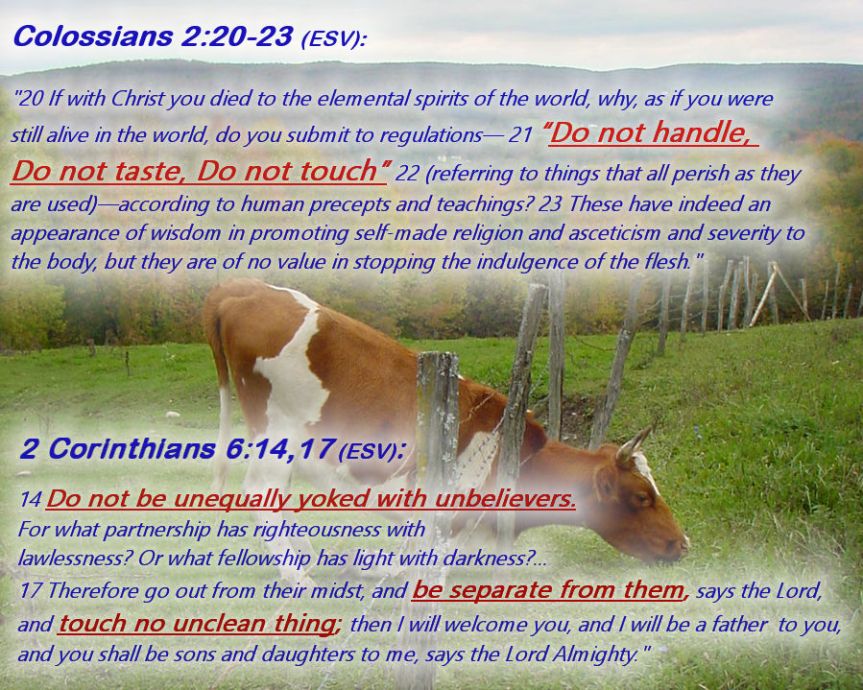
There is a saying “the grass is always greener on the other side.” It is like this with our natural dispositions—that whatever is “a little piece off” from us we are inclined to want, perhaps like a cow in a paddock who is fed the best grass in her own barn, but when beside the neighbour’s fence, she will try to break through the fence to get to the neighbour’s paddock of grass! But what happens then?!  Let the following picture and the Scriptural admonitions on it do the explaining!

Colossians-2-20-23.jpg

Dear friends, we want to fence ourselves off from the world that we will no longer desire those things, and as the Apostle says, “set our affection on things above and not on things beneath” (Colossians 3:2).

This word “set” suggests a continual setting. Set it today, and tomorrow morning set it early, and if it slips off, set it back again. If it slips off set it back again, and by and by we will be too busy to have time to wander.

Let us not become overcharged with the affairs of this life by very trifling things, things that are not worthy of our attention at all, but foolishness. Let us not give our mind to what another person imagines and made a story about, such as secular entertainment often is. In the Bible we have the most wonderful story, the most wonderful drama that was ever known.

The Bible could be said to have the best plot that any novel ever had or will have. It goes all the way back to the beginning of Creation and shows the garden of Eden in all its beauty and grandeur, then the coming in of the serpent and the temptation of our first parents. Mother Eve was deceived and father Adam, being perplexed, gave his very life for his wife, because he thought he could never live without her. Thus he proceeded against God’s command. He ate fruit from the tree of the knowledge of good and evil in the midst of the Garden of Eden (Genesis 2:9, 17).

A river watering the garden flowed from Eden, a name that means “pleasure” (Strong’s 5730), and separated upstream into four contributing headwaters (Genesis 2:10-14):

  • Pishon—meaning “increase” (Strongs 6376);
  • Gihon—meaning “bursting forth” (Strongs 1521);
  • Tigris (or Hidekel)—meaning “rapid” (Strongs 2313);
  • Euphrates—meaning “fruitful” (Strongs 6578).


This river of Eden may represent the “river of water of life” that flows from the throne of God to bless mankind (Revelation 22:1). That river of life is the Gospel, or good news, of salvation through Christ. The life and work of Christ comes to us in four Gospel Accounts, that may be represented by the four headwaters contributing to the river of Eden.

Perhaps also, the four headwaters may somewhat reflect the four categories of humanity during the 1000 year millennial reign of Christ as is reflected in the four divisions of the Levitical priesthood, (explained in the post titled: “Study 6: The Levites”) whereby:

  • The Pishon river that flowed around the whole land of Havilah, where there is gold (Genesis 2:11) reflects the Amram Levites, who were situated on the eastern side of the Tabernacle and may represent the antitypical “Little Flock” and BRIDE OF CHRIST.


  • The Gihon river reflects the Merari Levites who were situated on the northern side of the tabernacle who “burst forth” in service to the Heavenly Father. The Gihon river flows through south-eastern Mesopotamia into Ethiopia – which from time immemorial has been a symbol of servitude so would represent the SERVANTS class before the throne in heaven, the palm-bearers of Revelation who were also of the spirit-begotten class and “called out of Babylon” class—the “great multitude” class. These do not qualify as the Bride of Christ yet are a heavenly class “before the throne” (Revelation 7:15) who “burst forth” with joy in serving the Heavenly Father and The Christ—head and body, who shall then be complete in full glory.


  • The Tigris (Hidekel) River means “rapid” and it may reflect the Kohathite Levites who represent the Ancient Worthies who will be the “princes on earth” helping humanity make rapid progress by their work on earth to “rapidly” spread the Truth about righteousness and the need to obey God’s law of love in order to inherit eternal life.


  • The Euphrates River – reflects the world of mankind in the kingdom as reflected in the typical picture of the Gershom Levites on the Western side of the Tabernacle arrangement of Israel in the wilderness, who shall be fruitful in the 1000-year Millennium as they walk up the “highway of holiness” to gain eternal life choosing obedience to Godly principles.


The Plot Thickens

Then we learn about what disastrous effects of sin have come into the world as the result of Adamic disobedience. We could not have any deeper plot than to think how the Adversary and the fallen angels have conspired to blind and delude men and women from Eden to now.

The picture then reveals our great Creator looking down from His holy habitation, beholding our condition in sin and degradation, hearing the groaning of the prisoners, all going down to the prison house of death.

Can we find any novel more engaging than that?

Only God can help man out of his trouble. No power but God’s can open the bars of the prison‑house of death and bring the prisoners out. Only by choosing to obey God will life eternal, and eternal happiness, result.

God’s eye pitied us, and He extended his Arm to help us, in the person of his son, Jesus, who as our redeemer gave his life a RANSOM FOR ALL.

We read about Jesus redemptive gift toward every single human that ever lived, in 1 Timothy 2:6,

“Who gave himself a ransom for all, to be testified in due time.”

Jesus Christ died the just for the unjust and thus satisfies justice. When the proper time comes for the Millennial Reign of Christ with his Bride class, then mankind will be released from the curse. This will occur, by God’s grace, after the sharers in the anti-typical “sin offering” shall have fulfilled their covenant of sacrifice until death and become the completed Bride of Christ united with their Head, Christ Jesus. Thereafter, the living among mankind who embrace the Kingdom can begin walking up the Highway of Holiness, without passing through the death experience. For the curse will be abated. Subsequently, those raised from the dead will also be invited to walk up that Highway to perfection, if they will (Isaiah chapter 35).

This grand novel provides still more!

What kind of Bride will the Heavenly Father have his Son to possess? She has only the filthy rags of sin and imperfection, yet she desires to be in harmony with God’s will. So Christ, her Bridegroom, provides for her purification, cleansing, and justification. He even provides her a wedding garment.

Is this not a great plot?

Now, what must the Bride do? She must receive this robe of Christ’s righteousness which is to be the wedding garment. A marriage is preparing, and the bride must get ready by getting a robe from the bridegroom.

Then what shall the Bride do with this robe?

She must embroider it. She gets the robe for nothing and has the stamped pattern given to her.

What pattern?

Christ is the pattern and she must do the embroidery work herself. She must work out her own salvation “with fear and trembling” (Philippians 2:12), seeing carefully that every stitch on the robe shall conform to the pattern the Lord has given her.

What does the embroidery represent?

It represents the fruits and graces of the holy Spirit. We know that unless we have those fruits and graces, we will never be counted worthy to be a joint‑heir in the Kingdom.

What are the fruits and graces of the holy Spirit?

“The fruit of the Spirit is love, joy, peace, patience, kindness, goodness, faithfulness, gentleness, self‑control; against such things there is no law” (Galatians 5:22‑23).

How long does it take to embroider these?

It takes longer with some and shorter with others. Some can get their hearts fixed on this glorious pattern (Hebrews 12:2) and so appreciate it that it is the great desire of their lives to cultivate these graces of the holy Spirit. As they go to the Lord, the first thing in the morning they say, Lord help me to cultivate the fruits of Thy spirit today.

Why?

Because I want to be pleasing to the Bridegroom, and be ready when he claims his Bride, that I may be counted worthy to enter in as a member of that Bride class (2 Thessalonians 1:4-5). Then all the trials and difficulties we are obliged to pass through, will be finished. He allows us to be tempted in all points like He was tempted.

“14 Since then we have a great high priest who has passed through the heavens, Jesus, the Son of God, let us hold fast our confession. 15 For we do not have a high priest who is unable to sympathize with our weaknesses, but one who in every respect has been tempted as we are, yet without sin. 16 Let us then with confidence draw near to the throne of grace, that we may receive mercy and find grace to help in time of need” (Hebrews 4:14-16).

Why?

Because He wants to have a Bride class who can endure temptation, endure hardness, show loyalty, and manifest that they are not merely so‑so Christians, but really overcomers, seeking to know and to do God’s will. He wants them to love righteousness and truth so that they would lay down their lives in this service, rather than receive the pleasures of sin for a time. He has taken nearly 2000 years so far, for this purpose.

God knew there would not be very many who would love Christ sufficiently to lay down their life in sacrifice with Christ, in difficult circumstances, and thus receive the reward of incorruption and immortality with Christ. Every one of the Bride members will be approved of the Father. Christ will present them blameless and unreprovable before God in love, after they have had all of the necessary trials that permit their share in the blessings (which come from the sufferings for righteousness sake) of Christ.


The invitation

Christ invites whom he will, and marks them with the holy Spirit of God. This mark indicates who has been invited to run in the race “toward the mark for the prize of the high calling of God in Christ Jesus” (Philippians 3:14). They are called out of Babylon (Revelation 18:4) and enlisted in a “beauty contest,” like Queen Esther.

It is a beauty contest pertaining to one’s Christlikeness. The criteria are based upon a character of godliness and righteous conduct, reflecting loyalty, trustworthiness, and obedience to God’s will. The overcomers will constitute a loyal Bride of Christ forever.

This “calling out” or “marking” with the holy Spirit of God allows them to understand His Divine plan and character. This is part of the betrothal process. We are engaged to Christ now and everything depends upon our developing proper Christian character, upon wearing our robe, and upon showing our love and zeal by the embroidering our robe with the fruits and graces of the spirit.

Then what?

Then comes the marriage of the Lamb when the Bride has made herself ready.

What is the marriage all about between Christ and His “little flock”?

The marriage will be our collective union with the Lord.

How will it be brought about?

By the change from imperfect human nature to Divine nature—“changed in a moment, in the twinkling of an eye” (1 Corinthians 15:52). Then we are to be forever with the Lord.

And is there a supper, or something?

Yes, or we might call it a breakfast, as it is in the morning. The word “supper” comes from the terms “to sup.” You may sup in the morning, noon or evening. It means to eat. This supper is to be the first great banquet that we will have on the other side of the vail.

Who could ever imagine that such a most wonderful drama is found in the Bible?

And what next?

Well, before the supper begins they will wait a little while for the Bridesmaids, comprising a secondary company. They were part of the church at one time; they made a consecration and were begotten of the holy Spirit, just the same as the Bride class, but they failed to make their calling and election sure to the high position to which they were invited. They were not sufficiently zealous and loyal.

Were they disloyal?

Oh, No! No disloyal ones will be given anything at God’s hands. By and by they will come up through great tribulation and wash their robes and make them white in the blood of the Lamb, and be before the throne instead of on the throne. They will have palms of victory instead of crowns of glory.

So we read in Psalms that after Jesus, the King, shall introduce the Bride before the Father, then the virgins, her companions that followed after her, shall also be brought into the presence of the King (Psalms 45:14). Oh, there is a grand drama there in all that Bible picture!

Then have we anything more? Yes, the King and Queen are going to reign for a thousand years, and everybody is going to be blessed. In all that empire there will be no attempt to take from the people their rights, and make everything subservient to the King, and the people poor. The very reverse of this. The King will take delight in lifting the people up, refreshing them, and bringing them to perfection. Then, by the end of the thousand years, when all the unfit ones are destroyed from amongst the people, all of these grand beings will show forth the praises of God.

Is there anything more?

Astronomers tell us that numerous stars are suns like our sun, with planets around them as the planets around our own sun. Are these worlds yet to be inhabited? If God formed the earth to be inhabited, might other planets someday be inhabited? We think so.

Then who is to do that great work?

God says that Christ shall be first in all things, so that will put Him first in that great work. Who will come next in God’s arrangement? The Lord says that the church shall be next to him. Now we have Christ and the Church and a great work for them for all eternity in peopling millions of worlds.

Can anyone make a greater drama than this?

My heart rejoices and overflows with gratitude to God for the privilege now of having a chance to become an heir of God and a joint‑heir with Jesus Christ, my Savior.

We have all been called in one hope of our calling (Ephesians 4:4), and this is the hope of our calling. Is it sufficiently grand for you? Do you know of any other kind of business in which you could become so rich as that?

The Scriptures are indeed right when they tell us about the riches of God’s grace, and when Jesus tells us of the pearl of great price, it is a valuable pearl indeed. If any man once gets his eyes on it, and appreciates the value of our heavenly calling, then let him dispose of everything he has in order to win that prize. So let us do, dear friends.

1-corinthians-9-24

Acknowledgement

Br. Charles Russell. The content of the above post is based on the written content of Br. Charles Russell in “What Pastor Russell Said” (page 159), titled “CONSECRATION‑Proper Use of Time,” Question 158:1 (1913), Should Christians spend their time reading worldly magazines and newspapers?

Br. David Rice—Editing.

Suggested Further Reading

How To Study The Bible And Have It Make Sense.

Click to access HOW%20TO%20STUDY%20THE%20BIBLE.PDF

p-1078-ffa2d1309cb440311cbdcf6aa52f3c70-242x300@2x

This post’s URL:

THE BIBLE – The World’s Best Novel. Here Is Why.

Enter your email address to subscribe to this blog and receive notifications of new posts by email.


“Are You Able?”

 PSALM-17-5.jpg

ARE ye able to walk in the narrow, strait way,
With no friend by your side, and no arm for your stay?
Can ye bravely go on through the darkening night?
Can ye patiently wait till the Lord sends the Light? 

Are ye able to crush your soul’s longing for Love,
Will ye seek for no friendship save that from above?
Can ye pass through this world, lone, unnoticed, unknown,
While your faith faintly whispers, “He knoweth His own?” 

Where the feet of the Blessed One stood, can ye stand?
Can ye follow His steps to a wilderness land?
Are ye able to cast aside pleasure and fame?
Can ye live but to glorify His precious name?

Can ye smile as His dear voice says tenderly “No,
When “the field is so white,” and your heart yearns to go?
Can ye rest then in silence, contented and still,
Till your Lord, the Chief Reaper, revealeth His will?

Are ye able to lay on the altar’s pure flame
That most treasured possession, your priceless good name?
Can ye ask of your Father a blessing for those,
Who see naught in your life but to scorn and oppose?

When the conflict twixt Error and Truth fiercer grows,
Can ye wield the strong “Sword” against unnumbered foes?
Can ye lift up the “Standard” e’en higher and higher,
While His praises ye sing in the midst of the fire?

When ye see the Lord’s cause going down to defeat,
Will your courage endure in the seven-fold heat?
Will your faith keep you steadfast, though heart and flesh fail,
As the New Creature passes beneath the last “Veil?”

Ah, if thus ye can drink of the Cup He shall pour,
And if never the Banner of Truth ye would lower,
His Beloved ye are, and His crown ye shall wear,
In His Throne ye shall sit, and His Glory shall share!  – Gertrude W. Seibert

Consecration

Here is an extract from an article titled “Present Truth” by Bro. Carl Hagensick in the Nov. /Dec. 1998 issue of “The Herald of Christ’s Kingdom” Magazine.

The acceptance of Christ as a personal Savior and a dedication to the principles of
righteousness are seen by nearly all Christians as an essential to salvation. For many,
however, this means no more than a simple belief: “Believe on the Lord Jesus Christ and thou shalt be saved” (Acts 16:3; 8:3,7). Many Christians connect this with the concept that once one has been saved there is no chance of losing that salvation: “once in grace, always in grace.”

Quite to the contrary, the Bible’s view of belief is not mere passive acceptance. It
includes an active commitment to the service of God, a complete consecration of one’s
life to doing God’s will (Psalm 40:8). Consecration is seen as a voluntary surrender of one’s benefits under the ransom, the prospects of an earthly resurrection; thus one is in “jeopardy” of losing life forever if unfaithful to one’s consecration vows (1 Corinthians 15:30).

Even Paul did not “consider to have made it his own” (Philippians 3:13 RSV), but feared that he himself might become a “castaway” (1 Corinthians 9:27). It is little wonder that the Christian is admonished to be faithful “unto death” (Revelation 2:10).

The Christian commitment is not only to faithfulness but to learning from each of life’s
experiences those lessons which will be helpful to him in his future work of blessing the
human race. They are assured that they will have no temptation “but such as are common to man” (1 Corinthians 10:13). Commonality of temptation with their fellow men’ will qualify them to work side by side with their Master in his kingdom, for he has become a sympathetic high priest by the experiences he shared with his fellow man (Hebrews 2:17, 18; 4:15, 16).

Suggested Further Reading

Be Strong And of A Good Courage.  The Herald of Christ’s Kingdom. Reprinted from February 1961 HERALD, article by Br. John Ensoll, England.
http://www.heraldmag.org/literature/chliv_17.htm

Teachableness by Br. Richard Suraci. The Herald of Christ’s Kingdom. May-June 2002.
http://www.heraldmag.org/2002/02mj_4.htm

The King and His Kingdom. The Herald of Christ’s Kingdom. Jan-Feb. 2005.
http://www.heraldmag.org/2005/05jf_2.htm

A Christian’s Privilege of Fellowship. “Fellowship with Jesus by being His yoke fellow.” The Herald of Christ’s Kingdom. August 1931. 
http://www.heraldmag.org/archives/1931_8.htm#_Toc23239886


The URL for this post:
https://biblestudentsdaily.com/2017/07/04/are-you-able/

Enter your email address to subscribe to this blog and receive notifications of new posts by email.


1 CORINTHIANS 15:45 – How Long Until the Millennial Reign of the “Last Adam”?

1 Corinthians 15-45 -3.jpg

“Thus it is written, ‘The first man Adam became a living being’; the last Adam became a life‑giving spirit” (1 Corinthians 15:45).

Of the two natures, human nature and spirit nature, Br. Charles T. Russell wrote in R1259:5: “As surely as there are natural, human or earthly bodies, so surely also there is such a thing as a heavenly or spirit body.”

Adam was the first human man and all the peoples of the earth are descended from Adam, no matter how different in color, stature, intelligence, etc. they may now be (R2344:6). Adam generated no children until first Eve had been taken from his side (R4556:2). The first Adam is the sample of what an earthly body will attain to in the resurrection. (R1855:2, R3564:3).

The Apostle Paul in this statement from 1 Corinthians 15:45 does not contrast Adam and Jesus, but speaks of the “first Adam” and the “last Adam.” Christ is very unlike Adam. Jesus was obedient. However, Adam and Eve in some respects foreshadowed Christ and the Church in the sense that Christ will be the Great Life‑giver, or Father of mankind, while the Church (Hebrews 12:23, 2 Timothy 2:10) will be the mother or caretaker of the regenerated hosts (R5141:5, 777:1).

Jesus as the “Last Adam”

Jesus, as a “last Adam,” presently lifts us from condemnation and restores us to the fellowship of God through redemption. The saints have been regenerated by our Lord from heaven, but rather than grow to human perfection, they sacrifice their justified bodies in the service of Christ for a higher calling, theHigh calling of God in Christ Jesus” (Philippians 3:14). These, if faithful to their calling, will become, symbolically, a spiritual “bride” for Christ (Revelation 21:2). Then Christ and the Church will together restore and uplift the world, and bring them back to perfection during the Millennium. In this way Christ will be a “second Adam” or life giver to the world, and the Church will be a second “Eve” to nurture and assist them.

Adam was made a living soul since he was given a natural body, which is earthly. The “last Adam,” or life‑giving being, is Jesus, who from his resurrection forward is a glorious spirit being of highest magnitude.

“Who being the brightness of [his] glory, and the express image of his person, and upholding all things by the word of his power, when he had by himself purged our sins, sat down on the right hand of the Majesty on high” (Hebrews 1:3, KJV).

Eve was drawn from Adam when his side was opened up after he passed into a deep sleep. She was formed from a rib of Adam, “bone of my bones” (Genesis 2:23). Jesus also was caused to pass into a deep sleep, the sleep of death, and then his side was opened up by the spear of the soldier at the cross (John 19:34). From this came blood and water, which represents redemption and the water of the Spirit, by which the Church class is developed.

The Church class are “bone” of Jesus’ bones, in the sense that bones represent one’s hopes for the future. We share the same hopes for glory in the service of God, as our Lord Jesus had. Of Jesus it was said that “A bone of him shall not be broken” (John 19:36). That means that despite the tortuous trials and treatment suffered by Jesus, not one of his prospects for the future was in the least damaged. Those same prospects are sure for his bride also, “bone” of his bones.

The Bride of Christ shall be made Christ’s joint‑heir and help mate in the Kingdom who’s role will be to nourish and instruct all the willing and obedient back into harmony with God during the Millennial age (R4556:2, R5967).

“The plan of God proposes that the second Adam shall in relation to Adam take his place as the life‑giver to a race who shall possess the earth and enjoy it… as Father to our race does our Lord correspond to Adam—as the second Adam” (R4556:2). He is called the second Adam, in that he takes the place of the first Adam—undertakes to be the Father and life‑giver to Adam and every member of his race” (Expanded Biblical Comments). Upon condition of their obedience to him, they may then obtain everlasting life.

Our Redeemer presently enlivens us, in the respect that our old nature has been lifted from condemnation. This allows us to present ourselves in devotion and service to God, in order that we may grow a new life, a spiritual life, a heavenly life, to be secured in the first resurrection. Of that life God is Father, our “Heavenly Father.” “In accepting Christ as Redeemer, the believing one is reckoned no longer as a dying son of the dead Adam, but as a living son of the ‘last Adam,’ having a new life in Christ” (R1438:1). Our renewed standing is then laid down in sacrifice to God for the prospect of a heavenly life above. Our higher prospect is mentioned in Ephesians 2:6, NIV, “God raised us up with Christ and seated us with him in the heavenly realms in Christ Jesus.”

How Long from the Creation of Adam to the Millennial Reign of the “Last Adam”?

The period in question, judging by the Hebrew Scriptures, was on the order of 4000 years. As we are now on the order of 2000 years further, brethren of our fellowship recognize that it is now timely for the blessed Kingdom of God to become established on Earth. For there is a long standing view, held even by Jewish Sages in pre‑Christian times, that God intended a millennium of blessing for the world following six millenniums of sin and death.

The Holy Scriptures refer to a “day” with God as a thousand years:

“A thousand years in your sight are but as yesterday [one day] when it is past, or as a watch in the night” (Psalm 90:4).

“With the Lord one day is as a thousand years, and a thousand years as one day” (2 Peter 3:8).

By this measure, the six days of labor in the Jewish economy represent 6000 years of sin and death, and the sabbath of rest represents the 1000 year Millennium of restoration (Revelation 20:1‑6).

Ezekiel 46:1 (ESV) expresses this concept symbolically. “Thus says the Lord GOD: The gate of the inner court that faces east shall be shut on the six working days, but on the Sabbath day [the 7th day, which represents the Millennial Age of Revelation 20:4‑6] it shall be opened, and on the day of the new moon [when a new covenant will be inaugurated with Israel] it shall be opened.”

With this hope in mind, Christians throughout history have endeavoured to estimate when the close of 6000 years may come.

 A Historical Perspective

In the days of William Miller and the early Adventist Movement, they supposed 6000 years were drawing to a close in the mid 1800s. In fact, William Miller concluded that Christ would return in 1843, assuming that 6000 years would end then. When Christ did not return as expected, some brethren gave up their faith but others simply recognized that they needed to keep looking. Br. Nelson Barbour was among those. He came to believe that Jesus would return in 1873. Therefore, he assumed that 6000 years would end about that time. He went looking, and found in EB Elliott’s work, “Horae Apocalypticae,” written in the early 1800s, a version of Bible chronology suggested there that shows how 6000 years might conclude somewhere near the year 1872.

Br. Barbour was a younger associate of Br. Miller, so he followed Br. Miller’s assumption that 6000 years would approximately mark the return of Christ. As far as we know, Br. Barbour did not consider another option—namely that 6000 years would take us to the completion of the Church, rather than simply to the return of Christ.

Br. Russell met Br. Barbour in Philadelphia in 1876, and accepted the prophetic package, as it seemed reasonable. At the time they anticipated that the Church would be complete in 1878, after that they supposed it would be in 1881, and subsequently the expectation was reset to 1914. But concerns persisted. It seemed that a seventh “day” had commenced, and yet the “thousand years” of Revelation 20:4,6, was deferred. How could this be explained?

Some of the dear brethren seem unaware of the perplexity expressed on this issue by Pastor Russell himself. However, his words are clear and to the point about the uncertainty. It thus surprises us that even some who honor and revere his service bypass the important and specific points he advised brethren of, respecting this. However, the issue did not escape the attention of brethren in Pastor Russell’s own day. Thus, near the end of the year 1900, the following specific question was submitted to Pastor Russell.

“I understand from Revelation 20:4-6 that Christ will reign one thousand years, and from verses 2 and 7 that Satan will be bound during that period. If Christ began to reign in 1878, and Satan will not be bound until 1915, the two periods do not seem to synchronize; and … both extend beyond the seventh-thousand year period which … began in the Autumn of 1872. … Can you assist me?” (R2739

Pastor Russell’s answer is very different from what some appear to suppose it should have been.

Some today appear to suppose that the right answer would have been, “The reign, the binding of Satan, and the 1000 years all began in 1874.”

But not a word of this in Pastor Russell’s actual reply.

Instead, he refers to the “obscurity” of the issue as “an open question” that, at the time, was “not now ‘meat in due season for the household of faith.’ ” However, Pastor Russell did affirm the following part of the answer.

“The Scripture declaration respecting the saints, the ‘overcomers’ is, ‘They lived and reigned a thousand years.’ The reign of the saints cannot be properly said [R2740: page 368] to begin before all the ‘jewels’ have been gathered, nor before ‘the times of the Gentiles’ end, in 1914.”

It is clear from this direct answer to the brother’s question—on an issue that was declared as of then unresolved—that the 1000 years of Revelation 20:6 would not begin until the Church was complete. It was not apparent how this synchronized with the then-current view that 6000 years had been completed.

Pastor Charles Russell continued to affirm his view that the 1000 years of Revelation 20 would not commence until the Church was completed. Nor does he express any view other than this, respecting Revelation 20 directly. In R3460 (Diagram 3), you will find a diagram showing 1000 years beginning in 1914, when he supposed the Church to be complete. He later supplemented this with the following comments in later years.

R5115“The Church shall have passed into glory … Messiah will then reign for a thousand years.”

R5604 “The great Battle of Armageddon … will precede … Messiah’s glorious rule of a thousand years … (Revelation 20:6).”

R5692“Messiah’s kingdom shall be fully inaugurated. Then these shall … reign with Christ a thousand years (Revelation 20:4.)

R5919The Kingdom cannot come until the Royal Family is ready to take the Throne. Jesus, indeed, has long been ready; but in harmony with the Father’s Plan He has waited and has been doing a work in the preparation of the Church, His brethren, who are to be His joint-heirs in the Kingdom—otherwise styled ‘the Bride, the Lamb’s Wife.’ (Romans 8:17; Revelation 21:9,10.) Then for a thousand years the Restitution privileges will be open to the whole world of mankind. It will no longer be necessary to preach; for all will know the Lord, from the least unto the greatest, and unto Him every knee shall bow and every tongue confess. (Jeremiah 31:34; Philippians 2:9-11.)”

There is more. Sometime late in the year 1913, Br. Russell changed the chart to accord with the expression cited just above. Early on, the period from the parousia of Christ forward was labeled “Millennial Age.” But late in 1913, Pastor Russell changed the designation to the broad Messianic Age.”

Why this change?

The reason seems apparent. Strictly speaking, the 1000 years of Revelation 20:4-6 would not begin until the end of the Harvest. Thus, if one begins a period incipiently from the parousia forward, better to give it a more general designation, “Messianic Age,” to avoid the inference that the 1000 years proper, of Revelation 20:4-6, had commenced.

A perceptive awareness of these points is the foundation for a recent presentation by Br. George Tabac, “Harvest Timing Clarifications (2016),” which explains these points in remarkable detail. This presentation is specially excellent for brethren with high regard for the teaching of Pastor Russell.

What is the Answer?

What, then, is the answer to the question that has spurred so much discussion during the Harvest period? Namely—how does one reconcile the end of 6000 years early in the harvest of the Gospel Age, with the fact that the thousand years of Revelation 20:4-6 begins at the close of the harvest?

The answer is now at hand.

In the century and a half since the harvest began, and decades after Pastor Russell completed his course, the history of the Old Testament has clarified. 

Not because of the wisdom of men, but because it was God’s due time for greater clarity, to direct the Church to the approaching climax of their hopes.

The timeline from the Hebrew scriptures directly, respecting the synchronisms of the kings of Israel and Judah, shows that some of the kings of Judah (and of Israel) overlapped one another, in periods of coregencies. The testimony of these facts comes from the scriptures directly. However, the issues had not been solved while Pastor Russell lived. It was premature. “We may see some day just how [these synchronisms in the Hebrew Scriptures] can be harmonized, but at present we do not” (Question Book, page 42).

The overlapping of Judean kings, testified to in the Old Testament Scriptures, reduces the period of Kings from 513 years to 463 years. Affixing the end of this period to the firm date of the reign of Nebuchadnezzar, king of Babylon, establishes the year in which Israel’s last king, Zedekiah, lost his throne, was in 587 bc.

This means that we can now date the spring of Solomon’s fourth year to 966 bc, at which time was founded (but not yet operational) “Solomon’s Temple,” referred to in 1 Kings 6:1. From that text we can then place the Exodus at 1445 bc. (Note: 1445 bc is discussed in the following post: STUDY 2: The Pillar of Cloud by Day and The Pillar of Smoke by Night.)

As detailed in Volume Two of Studies in the Scriptures—“The Time is at Hand,” by Br. Charles Russell (page 43-47)—the time from Adam to the Exodus is widely agreed among brethren to be 2513 years. That is:

From Adam to the Flood

From the Covenant with Abraham to the giving of the law.jpg

If we now count from the Exodus date of 1445 bc, a period of 2513 years backward to Adam, the result is the date 3958 bc for the creation of Adam. Six thousand years forward from there will be the year 2043 ad—thus the date opening the Seventh Millennium, which apparently is the same as the 1000 year Millennium of Revelation chapter 20.

Now the answer to the conundrum that Pastor Russell said was an “open question” in his day, can be resolved—for it is timely, inasmuch as the end of the harvest approaches. The resolution is straight forward. The end of 6000 years of permission of evil synchronizes with the close of the harvest, rather than with the opening of the harvest. With this key, all is harmonious.


Acknowledgements


This post’s URL:
https://biblestudentsdaily.com/2017/06/06/1-corinthians-1545-how-long-until-the-millennial-reign-of-the-last-adam/

Enter your email address to subscribe to this blog and receive notifications of new posts by email.


WHO WE ARE

WHO ARE THE BIBLE STUDENTS?

• We are a body of religious believers who follow in the faith and character of the early Christian Church.

• Each congregation is called an “ecclesia” (the New Testament word for Church). Our members are called Brother or Sister.

• The elders and deacons of our Church are elected from within our local fellowship. (1 Timothy 3:1-13, Titus 1:6-9)

• Members of our congregation contribute their time and energy voluntarily in service to God.

• We accept the Bible as the inspired Word of God; and study both the Old and New Testaments. (2 Timothy 2:15)

• We are a non-denominational independent Church group that recognizes Jesus as our only head and enjoy a worldwide fellowship. (Colossians 1:18)

• There is no organization to join and no creed to affirm. (Colossians 3:15)


“BIBLE STUDENTS DAILY” WEBSITE

Through the BIBLE Students DAILY website our desire is to spiritually edify the Household of Faith and help build faith in Christ in ALL whom the Heavenly Father wishes us to serve, as if serving Christ himself (Colossians 3:23, 24), as well as share words of comfort and cheer as we strive to please the Heavenly Father and make our “calling and election sure” (2 Peter 1:10).

Feel free to add your email address on the link found below each of the BIBLE Students DAILY posts in order to receive all new future posts at the time of their publishing here.

For all other Bible study related questions or inquiries feel free to write to us at biblestudentsdaily@gmail.com


WHERE DO WE MEET?

The co-ordinators of BIBLE Students DAILY meet regularly for Bible Study with other Bible Students in Melbourne, Victoria—Australia.

For information concerning the bible study meetings available, the weekday and weekend bible study programs and times, and the Bible Students Conventions in Australia, please address your inquiries to biblestudentsdaily@gmail.com

“10 Therefore, brethren, be all the more diligent to make certain about His calling and choosing you; for as long as you practice these things, you will never stumble; 11 for in this way the entrance into the eternal kingdom of our Lord and Savior Jesus Christ will be abundantly supplied to you. 12 Therefore, I will always be ready to remind you of these things, even though you already know them, and have been established in the truth which is present with you. 13 I consider it right, as long as I am in this earthly dwelling, to stir you up by way of reminder.” 2 Peter 1:10-13

Internal Peace, External Unity

SUGGESTED FURTHER READING

Beliefs
https://biblestudentsdaily.com/category/beliefs/

Links and Bible Resources
https://biblestudentsdaily.com/category/links/

Our Purpose and Mission
https://biblestudentsdaily.com/category/our-purpose-mission-the-story-behind-bible-students-daily-2/

Here is the Book “The Bible Students in Australia” by Br. David Simkin. Please click the image below for the PDF file of the book.

Pastor Russell Founded the Bible Students Not Jehovah’s Witnesses http://www.friendsofjehovahswitnesses.com/wp-content/uploads/Bible-Students-not-Jehovah-Witnesses2.pdf-final2.pdf

pastor-russell-founder-of-bible-students-not-jehovah's-witnesses

Did Russell Start The JWs?
http://rlctr.blogspot.com.au/2009/04/was-russell-founder-of-jws.html

Pastor Russell – Not the Founder of the Jehovah’s Witnesses
http://www.dawnbible.com/1940/4008-hl.htm

Charles-Taze-Russell-Laodicean-Messenger7

This post’s URL:
https://biblestudentsdaily.com/category/who-we-are/


Enter your email address to subscribe to this blog and receive notifications of new posts by email.


What Does the Word “HELL” Really Mean?

Truth About Hell

The Hebrew word for HELL in the Bible is “sheol” = a state of rest… unconsciousness… sleep… not some burning forever place of torture which the Papal (anti-Christ) System developed!

In Job 14:13-15 (ESV) we read:

“13 Oh that you would hide me in (the grave) Sheol, that you would conceal me until your wrath be past, that you would appoint me a set time, and remember me! 14 If a man dies, shall he live again? All the days of my service I would wait, till my renewal[a] should come. 15 You would call, and I would answer you; you would long for the work of your hands.”

Was the prophet Job here praying to go to a place he would burn in pain for eternally?

No, certainly not! How could people ever get such an idea?! Back in Constantine’s day, Church leaders wanted to keep the people in the churches through the fear of hell doctrine! For many centuries people thus, have gone to Church for fear of this doctrine. But what does the BIBLE really say in the original Greek and Hebrew? The video and the content of each of the booklets share below, explains this well.

Job was praying to go to a place of rest where he would be out of pain until GOD would raise up everyone in the resurrection.

[Note: See Posts about the Resurrection here:

Throughout the ages Satan has convinced people of lies! Hell is one such doctrine he has blinded the masses of humanity on. His first lie about death was already in Genesis 3:4,

“But the serpent said to the woman, ‘You will not surely die.'”

Since Adam and Eve’s disobedience, is mankind dying? Yes!

The Bible explains that eventually the condition of death itself will be destroyed forever.

Please consider the following video explaining all about HELL. We hope and trust you will receive much blessings from the words of Br. Michael Nekora as we refresh the mind upon Divine Words of Scripture.

“The last enemy to be destroyed is death.” – 1 Corinthians 15:26

When the thousand years of Christ’s reign with the His “bride” shall be completed and after the final battle of Gog and Magog (Revelation 20:7-15) and after all evil is destroyed there shall finally come the glorious time when the tabernacle of God is among men, and He will dwell among them, and they shall be His people, and God Himself will be among them, and He will wipe away every tear from their eyes; and there will no longer be any death; there will no longer be any mourning, or crying, or pain; the first things have passed away” (Revelation 21:3-4). 

The Truth About Hell Video


Recommended Further Reading: 

  • The Truth About Hell booklet, the Dawn Bible Association.

http://www.dawnbible.com/booklets/hell.htm

  • When A Man Dies booklet, the Dawn Bible Association.

http://www.dawnbible.com/booklets/dies.htm

  • What Everyone Should Know About Being Saved booklet, the Chicago Bible Students.

http://www.heraldmag.org/bookstore/booklet_saved.htm

  • What Say the Scriptures About Hell, The Herald of Christ’s Kingdom Magazine.

http://www.heraldmag.org/literature/doc_16.htm


“If anyone’s will is to do God’s will, he will know whether the teaching is from God or whether I am speaking on my own authority.”John 7:17


This post’s URL:

What Does the Word “HELL” Really Mean?

Enter your email address to subscribe to this blog and receive notifications of new posts by email.

PROVERBS 22:6 – Train Up A Child In The Way He Should Go

 IMG_7787 - with address

“He that spareth his rod, hateth his son.” (Prov. 13:24) “What son is he whom the Father chasteneth not?” “If ye be without chastisement…then are ye…not sons.” Hebrews 12:7

The content for this post comes from the 6th Volume written by Pastor Charles T. Russell and the topics discussed include:

  1. Order in the Home
  2. Rewards & Punishments
  3. Parental Discipline – Helps to Develop Character
  4. The Golden Rule
  5. The Atmosphere of the Home
  6. A Home in Which the Lord’s Spirit is not Manifested
  7. When a Child Reaches Manhood or Womanhood
  8. The Proper Amount of Education
  9. Our Children in the Time of Trouble
  10. Proper Amusements

Order in the Home

Nothing is further from our intention than to urge indiscriminate and frequent use of the rod in the training of children. We have cited these scriptures, however, to show the mistaken position of those who hold that corporal chastisement by parents, even when necessary, is wrong.

The home that is ruled with the rod must of necessity be an unhappy home.

The homes of the New Creatures should be ruled by love not by the rod. The rod is to be kept merely as an occasional necessity for enforcing the rules of love; and when it is administered it is to be wielded by the hand of love and never by the hand of anger.

The New Creatures, governed by the spirit of a sound mind, learn gradually that order is one of heaven’s first laws, and hence that it should be one of the first elements and characteristics of the homes of the New Creatures.

Order, however, does not of necessity mean absolute quiet, else the wilderness and the silent cities of the dead would be the only places where order would rule.

Order may mean joy as well as peace, happiness as well as rest, liberty as well as law. Order means law—with New Creatures the Golden Rule and the Law of Love governing the head of the house and his helpmate, as well as governing the children, making of the parents ensamples to the children in all the Christian graces. Law, even the Law of Love, means rewards and punishments, and in the family the parents have the dispensing of these.

According to their realized weaknesses they, in turn, need direction from the Heavenly Father that they may glorify him not only in their own hea

rts and wills, but that their homes shall be earthly ensamples of the homes of the righteous, the homes of those who have the mind of Christ.

Rewards & Punishments

Their rewards for their children should be in the provision of such comforts and blessings as circumstances, under control of a recognized pro
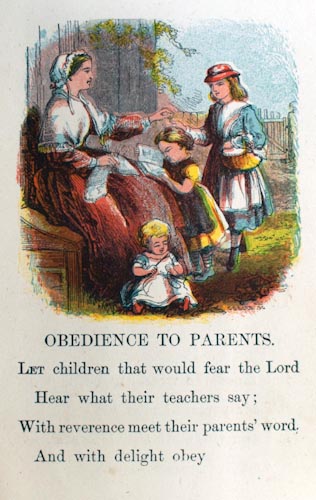
obedience to parents.jpg

vidence, may permit.

Their punishments may be more or less severe according to the wilfulness of the child, but never according to the standard of justice, never in the atte

mpt to mete out to the child the full measure of what its conduct might justly demand—because we are not under ju

stice ourselves, but under mercy, under love, and are to show mercy, not only in our dealings with others, but specially in our dealings with our

own children, whose imperfections and blemishes are, doubtless, traceable in a greater or less degree to ourselves and our forebears.

Love may sometimes punish by the refusal of a kiss, as it may sometimes reward by the giving of a kiss; it may sometimes for a season banish the unruly one from the company of the obedient and from the pleasures provided for them.

The Law of Love may sometimes even exercise the rod of discipline to the extent of denying supper or of giving merely the necessities, bread and water, and withholding some of the additional comforts and luxuries; or may sometimes wield the literal rod of chastisement to enforce obedience, and thus preserve the order and blessings of the home, not only for the obedient children, but also for the chastised one, whom it hopes thus to bless and bring into full accord.

It is scarcely necessary to admonish the New Creation that they should not use angry or harsh words to their children; for such know that language of that kind is improper to any one under any circumstances. On the contrary, their “speech should be with grace,” with love, with kindness, even when reproving.

Nor is it necessary to suggest to the class we are addressing the impropriety of a hasty blow, which might do injury to the child not only physically—perhaps permanently injuring its hearing—but also wound its affections, develop in it a fear of the parent instead of love, which should be considered the only proper groundwork on which the obedience and order of the home are built.

Furthermore, the hasty blow or cutting remark would be wrong, would indicate a wrong condition of mind on the part of the parent—a condition unfavorable to a proper, just decision of the matter along the lines of the Law of Love.

The parent owes it to himself as a part of his own discipline, as well as to his child, that he shall never inflict a punishment which he has not sufficiently considered, and coolly and dispassionately found to be not more, but less, than justice might properly demand.

He owes it to himself also that the child shall fully understand the situation, the necessity for the preservation of order in the home, that the happiness of the home may continue to the blessing of all its inmates; that the child understand thoroughly also that the parent has no anger toward him, no malice, no hatred, nothing but sympathy and love and the desire to do him good.

Christian parents have—if they will use it—an immense leverage of advantage in dealing with their children. They should read to their children, from the Word, the divine sanction of parental authority—the divine requirement that a parent shall train up a child in the way he should go; and additionally he should point out the necessity for this—because we all are fallen and unable to come up to the divine standard, etc.; that all these means and corrections are necessary as helps to the counteraction of evil tendencies under which we have been born.

Parental Discipline – Helps to Develop Character

Many parents forget to look backward and to note at how early an age they themselves learned to appreciate principles of righteousness—to appreciate the parental care which neglected not to reprove, to correct, and even to chastise as seemed necessary. Let us recall, too, how keen was our sense of justice when we were children—how we mentally approved parental discipline when we understood its motive to be for the development of character, but how we resented it if we did not see a principle of justice, if we were reproved or otherwise punished for things of which we were not guilty, or if we were punished beyond a reasonable chastisement comporting with the offense.

Not only is it the best and surest way of controlling a child thus to direct its mind along the lines of right and wrong, truth and falsehood, justice and injustice, but this constitutes also a training of the child in character, when it is most susceptible to parental influence. It is character-building at a time when the conscience and judgment of the child are in their formative condition, and when it properly recognizes the parent as its sole lawgiver. If this work of character-building be ignored in infancy, the work is many times more difficult in future years, besides the disadvantages that will accrue both to parent and child and neighbors and friends in the interim.

It is all-important, then, to notice that the training of a child does not consist solely in teaching it respecting its outward deportment in politeness, cleanliness, obedience, etc., but further, and indeed chiefly, in the establishment of right principles in the heart—proper recognition there of the mind of the Lord as being the only standard of living, both for old and young.

The Golden Rule

The Golden Rule, the Law of Love, of generosity, meekness, patience, gentleness, forbearance, should be inculcated as respects the child’s relationship to other members of the family, to playmates, etc.

The child that is taught to be selfish, or one whose natural selfishness is not brought kindly to his attention (though not in the presence of others) and lovingly reproved and corrected, is missing a most important lesson at the most opportune moment.

The parent who neglects such an opportunity for giving instructions and corrections of the mind and judgment, as well as of outward conduct, is not only missing the most favorable opportunity in respect to his child, but is allowing weeds to grow in the heart garden where only the graces of the spirit should grow; and is thus laying up more or less of trouble for himself in dealing with that child throughout future years.

Many of the heartaches and tears of well-intentioned parents over the waywardness, wilfulness, selfishness and “wild oats” of their children might have been spared them had they done their duty by those children in infancy. Furthermore, such parents lose a great blessing in their own experiences; for it is undoubtedly true that the parent who is properly training his child in unselfishness, love, obedience, reverence to God, helpfulness to his fellow-creatures, etc., etc., will be getting valuable experiences for himself—growing in grace, growing in knowledge and growing in love, while endeavoring to teach these principles to his child.

He will learn, too, that the child will expect to find him illustrating in his daily conduct and in his relationship to God and to the members of his family, and to his fellowmen, the principles he seeks to inculcate in others.

This will make him the more careful of his own words, his own conduct; and such carefulness, such circumspection of all the little affairs of life, public and private, will assuredly develop in such a parent more and more of the graces of the Lord’s Spirit, thus making him more and more acceptable to the Lord, and preparing and perfecting him for the Kingdom.

The Atmosphere of the Home

The atmosphere of the home, however poor, should be one of purity.

Absolute purity in thought, word and deed we know to be impossible in our present conditions, just as material purity is absolutely impossible where the air is full of soot and dust.

But every Christian home should be as nearly absolutely clean as possible—as free from the outward soil and filth as circumstances will permit, and as free from moral obliquity and defilement as the imperfect earthen vessels can be made.

Every child should be able to look back upon its home, however humble, however scantily furnished, as a clean place, a house of God, a holy place.

He should be able to look back and in memory recall the voice of prayer at the family altar, the kind words of father or mother on various occasions, and the general spirit of peace and restfulness through contentment and submission to the divine providence. He should be able to sense the sweet odor of love pervading the home and associated with every member of it, manifesting itself in meekness, gentleness, kindness, helpfulness.

A child bred to and reared in such an atmosphere of love may be expected to desire to please the Lord and to obey him from the earliest moments of his consciousness; and from the time he reaches ten to twelve years of age he should be encouraged to consider the propriety of a full consecration to the Lord—to remember that his standing before the Lord during the period of immaturity of judgment is through the parent, but that in proportion as maturity of mind is reached the Lord expects a personal consecration.

Should such a child thus trained, neglect or refuse to make consecration to the Lord, we may be sure that the home influences would still continue, although when years of maturity had been reached and no covenant with the Lord had been made, such an one may properly hesitate to approach the throne of grace—hesitate to claim of the Lord the blessing he has promised to those who are his, because he has refused to become his. Nevertheless, to such there will still cling a precious memory of the seasons of approach to the throne of grace and of divine watchcare over the home of infancy and over themselves, and there will continually be a longing for the divine protection and for the privilege of approaching the Creator with the cry, “Abba, Father,” and the realization of relationship to him.

Should such an one become a parent, he will instinctively feel a desire to train his children as he was trained, and all these influences will gradually draw more and more upon his heart, and the strong probabilities are that at least by that time he will consecrate. In any event, the influences of a godly home will have been with him, a holy protection from many of the excesses under which otherwise he might have fallen.

A Home in Which the Lord’s Spirit is not Manifested

Contrast such a home, with its sweet odor of love, kindness, patience, gentleness, with the home in which the Lord’s Spirit is not manifestedthe home in which selfishness is the law, in which the child notes the quarrels between the parents, and how each seeks his own at the expense of the other, in which the child hears little but chiding, complaining, faultfinding, angry words, harsh sounds, etc. These become contagious amongst the children, and they in turn quarrel over their little affairs, speak angrily to each other, and keep the household in perpetual turmoil. The continued practice of selfishness in the home develops this organ in the mind and in the conduct of the child.

If in an angry voice the parent calls it “a little rascal,” and the feelings of the child, at first hurt by such reflections against its character, become toughened, it gradually learns to glory in being a little rascal. When first it hears the angry and impatient mother exclaim, “I’ll thrash you within an inch of your life!” or “I’ll break your back!” no doubt there is a measure of terror conveyed by the words to the heart of the child, but it is not long in learning that these are idle threats, from which it has comparatively little to fear; and gradually as it learns that the civil laws of the land would not permit the parent to do it serious violence, the childish mind concludes that the parent had the will to do it evil, but simply lacked the liberty. From such a little mind much of the original instinct of love is driven out. It finds its parent equally untruthful in respect to promises—that the promises are frequently given without the slightest intention of their fulfilment. Thus the child is taught to lie, to threaten, to promise, to deceive others in respect to its real intentions.

Is there any wonder that such a child grows up a hard character?

The wonder, rather, is that between the bad training, the indifferent training and no training at all the civilized world is not a great deal worse than it is.

Children Born in Justification

In all these matters the New Creature has a decided advantage over all others in respect to his children. They should, to begin with, be better born, better endowed at birth. And this prenatal endowment should be fostered from the very earliest moments of infancy.

The babe of a few days is pretty sure to be nervous and irritable and distressed if the mother is so; an influence goes to the child, not only through the mother’s milk, but telepathically, electrically, from her person to the child.

What a general advantage, then, the New Creature has in the indwelling of the Spirit of the Lord, with its peace, love and joy; and how favored is the infant under such care!

Humanly speaking, how great are its possibilities as compared with the possibilities of others in respect to noble manhood and womanhood; and, speaking from the standpoint of the Lord’s Word, how great is its advantage when we remember that the children of the Lord’s consecrated people, like themselves, are under the supervision of divine providence in respect to all of their affairs; that the children of believers, too, come under the terms of the promise that “all things shall work together for good” to them!

It is not difficult to see that the children of New Creatures have a tentatively justified standing with God, in virtue of the relationship of their parents to him and to them.

As the disobedience and alienation of Adam and Eve from the heavenly Father brought alienation to all their offspring, so, too, the reconciliation of the Lord’s people, through the merits of the great atonement, not only brings them back to harmony with God, but their children as well are counted justified through their parents, and on account of their parents, up to such a time as the child shall have an intelligence and will of his own.

The question is more complex, however, when one parent is the Lord’s and the other is a stranger and alien from him; but the Apostle assures us that in such a case God counts the child as his, through whichever one of its parents is the Lord’s disciple. The influence of the believing parent, the consecrated parent, is counted as offsetting and overruling the influence of the unconsecrated parent, so far as the child is concerned. On this subject the Apostle says: “Else Were Your Children Unholy [Sinful, Condemned].”

“The unbelieving husband is sanctified by the [believing] wife, and the unbelieving wife is sanctified by the [believing] husband [in respect to the subject under consideration, viz., the offspring of their wedlock]; else were your children unholy [sinners under condemnation, unjustified, unrelated to God, aliens from his care and blessing]; but now [in view of this provision of divine grace] are they holy [that is, in a tentatively justified state with God, through which he may treat them, not as enemies].” 1 Corinthians 7:14

The question of the proper training of children may be a difficult one, but not too difficult for the Lord to manage; and, hence, the parent who has become a Christian may expect the Lord’s grace proportionately to abound in respect to his affairs, and should seek the more earnestly for the wisdom and help that come from above, that he may be rightly able to discharge his duties under the most trying circumstances. The Lord’s grace is sufficient for us in every condition.

The fact of the one being a New Creature, and the other an unbeliever, or unconsecrated, does not alter the divine arrangement in respect to the headship of the family. This still devolves upon the husband, and if a New Creature he must direct in respect to the affairs of his family as best he is able under the circumstances, and guided by the promised wisdom from on high.

If the wife be the New Creature, her soundness of mind, devotion to principles of righteousness, her gentleness, meekness, thoughtfulness, carefulness, should make her such a jewel in the family, should cause her light so to shine before her husband, that he might take pleasure in giving her practically the full control of the children, for which he would discern her to be specially adapted. Any rule or authority she should exercise, however, would be delegated by her husband, who, whether saint or sinner, is the responsible head of his family.

Likewise the husband, letting his light shine, should expect that ere long his wife, as well as his children, would discern his difference from irreligious men, his spirit of love, his gentleness and helpfulness, and spirit of a sound mind.

Nevertheless, if these results, which ought to be expected, do not come—if the greater the faithfulness the worse the treatment from the unbelieving partnereven to the extent that a separation might be necessary, let us remember that the Lord’s counsel forewarned us that such might be our experience; saying, “Think it not strange concerning the fiery trial which shall try you”; and again, “A man’s foes shall be they of his own household.” And again, “I have not come to send peace on the earth but a sword.”

My message, although it is a message of peace and blessing in the present time, frequently results in strife, because the children of darkness hate the light, and because many of them, under the deception of the Adversary and the weaknesses of their [F534] own fallen nature, will wage a continual warfare against it.

Think it not strange, consider it a part of your trial, endure it as a part of the divine will, until the Lord shall open up a door of escape.

How to Rectify Wrong Child-raising Practices

The Lord, undoubtedly, will be pleased to find us regretful for having failed of duty in the past, and he no doubt will be pleased to have us ask his forgiveness for such shortcomings, and to have us promise greater faithfulness henceforth in seeking for and pursuing our obligations toward those dependent upon us. He would surely be pleased to have us take present experiences with unruly children with patience, with forebearance, as a part of that chastisement for sins of omission or of commission in respect to their training; and thus received, these trials may serve for our polishing and preparation for the Kingdom.

As for the duty of such a parent toward such children, it would unquestionably be to begin by teaching them the lessons they should have been taught in infancy, concerning responsibility toward the Lord, the principles of right, of justice, of love toward each other and toward all.

And this instruction should be given with great love and forebearance and patience, which would be a notable lesson to the child of the power of grace in the parent’s heart.

According to the age of the child and other related circumstances—the extent to which wrong principles had become rooted, etc.—results should be waited for with patience; and such restrictions as seemed absolutely necessary should be applied with gentleness and consideration and explanations.

Parental authority should be established kindly, not rudely.

Children who have been in the habit of ruling the household should not be expected to become good and obedient children instantaneously.

Wisdom from on high should be sought in respect to the details of the home arrangements and government, for no outsider is competent [F536] to understand thoroughly all the affairs of the family of another, nor to give specific directions respecting its proper government.

Two principles should guide:

  1. Love for the Lord and for the children—This love should be guided and directed by the Word of God;
  2. The Word of God, as the source of authority and instruction, should be continually appealed to.

Furthermore, all parents should learn to treat children with consideration. Whether they be children properly trained or otherwise, they should realize that the parent respects their consciences and their judgments, and endeavors to deal with them in harmony with these elements of character.

When a Child Reaches Manhood or Womanhood

Especially as the child reaches a condition of manhood or womanhood should his or her reason be appealed to, and in the same proportion force and corporal chastisement should be abandoned.

The principle of justice, to which we have already referred, is to be found to some extent in almost every human being, and especially if the sense of justice is found to cooperate with selfishness.

Thus, when the age of manhood or womanhood is reached the child instinctively feels that he has passed a line, and:

  • should no longer be treated as a child, but as a companion;
  • should no longer be commanded in anything, but requested;
  • should no longer be required to give a strict account in detail of all moneys earned, but should be permitted a larger discretion and personality than previously.

Wise, just, loving parents should not attempt a violation of these rights of maturity; but rather seek from that period onward to deal with the child as with a younger brother or sister—as adviser and best friend.

While, prior to maturity, the parent had full control, after maturity the child has a personality and individuality which should be recognized and appealed to. It is the duty of the child to make provision for the parent, but properly appealed to, the provision should be the more promptly and lovingly made. The obligation of the child to aged parents for their support corresponds exactly with the responsibility of the parent for the care and reasonable support of the child in infancy and immaturity.

The parent who has done justly and lovingly by his child will surely rarely be left to want while that child shall have strength to provide.

The Proper Amount of Education

We are of those who appreciate highly the value of an education; and yet we believe that great wisdom should be exercised in respect to what constitutes an education.

Education is like polish. Almost any stone may be made to look beautiful by careful polishing, but careful polishing is not alike valuable or helpful to all stones. In the case of a diamond or a ruby or other precious stone, polishing is absolutely necessary to the development of the latent qualities [F538] of the stone; without the facets, the glories and brilliancies of the stone could not be appreciated nor shed their luster.

But the same polishing bestowed upon a cobblestone from the street would be a waste of energy; worse than that, it would make the cobblestone too valuable, too nice, for use as a cobblestone. Moreover, it would be less fit for its duties as a cobblestone after being faced than if it had been let alone, or merely chipped in a general way, to make it fit its place.

And so we perceive it is in respect to education, the polishing of the mind with a “classical course” in college. Some would be benefited by such a course, while others would be injured. Who has not seen men so educated that they could not occupy the place in life for which their natural talents fitted them? They were over-educated, and, like the man in the parable, they could yet dig, and to beg they were ashamed, and for anything else unfit.

If in the Lord’s providence the parents found that they had a child of very brilliant mind, and if that providence guided their affairs so that financial and other considerations opened the way for a collegiate course to such a child, they might well consider whether or not these indications were the Lord’s direction in respect to their duty to the child, and should follow their convictions.

Nevertheless, in sending him to college at the present time they should feel a great trepidation, a great fear, lest this outward polish in the wisdom of this world should efface all the polish of faith and character and heart which they as the parents and proper instructors of the child had been bestowing upon it from infancy and before.

The Lord’s people of the New Creation should learn to appreciate the education of heart and character and faith in God as a superior education in every respect to anything that could be attained in the schools of this world—that the “wisdom from above, first pure, then peaceable, easy of entreatment, full of mercy and good works,” is more to be desired than all the wisdom of earth. They should consider well whether their child was so thoroughly rooted and [F539] grounded in character, in principle, in loyalty to the Lord and his Word, that the infidel tendencies of the schools of our day, and their rationalistic teachings called Higher Criticism, Evolution, etc., could never displace the well-grounded faith in the Lord and in his Word.

We write with full consciousness that to the worldly minded this advice is foolishness or worse.

Nevertheless, we have learned to view matters from what we believe to be the divine standpoint, and recommend that all of the Lord’s consecrated people shall endeavor in this and in all matters to seek this standpoint—the Lord’s view of this matter.

Relaxation & Recreation

Relaxation and recreation should be secured chiefly through change of occupation, rather than through idleness or useless exercise.

The little girl takes pleasure in dressing her doll and caring for it, and “playing house.” The little boy “plays shop,” and with sand, etc., as substitutes, he makes imaginary dealings in tea and coffee and sugar and potatoes; or he “plays horse,” teamster, or imagines himself a preacher or a missionary or a schoolteacher or a doctor. All such plays are in the right direction, and should be encouraged in the little ones.

As they grow older they should be drawn from these to consider it as a part of their recreation to help keep the home in order or to assist in the real store or shop with their parents or guardians or others.

If they be taught to take pleasure in usefulness, helpfulness to others, financially or otherwise; if they be taught that idleness is a sin and a shame, a discredit to any person and a waste of valuable opportunities, they will be in a proper attitude to face the duties of life with pleasure, and not to envy those who waste both time and money in looking at a ball game, or in participating in something equally foolish and profitless.

Economy of time as well as of means should be inculcated from infancy—not with a view to cultivating selfishness, but an economy in accord with the divine will that nothing be wasted.

The Master, after feeding the multitude, commanded that the fragments be gathered and not wasted, thus indicating his mind in respect to all affairs, that there be no wastefulness; that we recognize a responsibility [F541] toward him for every moment, every dollar, every day; not a responsibility which would keep us in fear, but a responsibility which delights to note the divine will, to be as fully in accord with it as possible, and which realizes that such a course is pleasing to the Lord, and, therefore, may be thoroughly enjoyed.

The Proper Exercise of the Child-Mind

As the child grows and realizes how much there is in the world to learn, he should be encouraged to read, but from the first he should be taught to discriminate wisely between the “chips” of fiction and the “apples” of knowledge.

He should be shown that every chip stored away in his mind is worse than valueless, an injury or encumbrance, besides having cost valuable time, which might have been used to advantage in storing up knowledge, shortly so necessary in the proper discharge of the duties of life. He should be encouraged to read such books as would give information, and not novels. He should know considerable respecting the history of his native land, and have a reasonable knowledge of the remainder of the world. He can secure these through histories: we do not mean merely the histories which give the order of kingdoms and battles and generals but more particularly such works as show the social, moral and intellectual development of the ages past, and of the world as it is today. In a pleasant and kindly manner the child should be shown the importance of such information as a feature of education for his future—his reason and judgment should be appealed to, and thus his will enlisted in favor of such educative reading, and in opposition to all weedy, trashy, dreamy literature, that will do him harm and leave him unprepared for the duties of life.

The Confidence of Children

If the confidence of the child in the parent have its roots in a recognition of the fact that the parent is a member of [F548] the Royal Priesthood, a child of God, and that the parent has fellowship with God through prayer and is instructed by God through his Word—ministers being merely assistants in the understanding of the Word, etc.—and if additionally, the spirit of love and its various graces of meekness and patience and kindness pervade the home and flow through its various channels, and if the parents seek and exercise the wisdom that cometh from above, pure, peaceable, merciful, the child’s confidence will naturally rest in that parent in respect to all of life’s affairs. Then the many questions naturally presenting themselves to the opening mind—religious, moral, secular, social and physical—will all be carried most naturally to such a parent.

Such questions should be expected and invited, and should be given wise and respectful answers, according to the age of the child.

Confidential questions should never be treated lightly nor confidences broken.

Many a parent forfeits the future confidence of his child by making light of its sentiments or secrets.

We do not mean that all questions should be answered in full (regardless of age); a very partial answer may be wisest sometimes, with the suggestion that a full explanation of the matter will be given later—perhaps setting a date—as for instance, “I will explain the matter to you fully when you are thirteen years of age if your mind and character then seem to be sufficiently developed to make this the proper course. You may come to me with the question then, and in the meantime should dismiss it entirely from your mind.”

To the rightly trained child this course will at once commend itself, and in any event it should understand that the parent’s word is positive, that it had not been given without mature consideration, and that once given it must stand, until some further information on the subject should alter the judgment of the parent.

A proper observance of the Lord’s words, “Let your yea by yea, and your nay, nay,” would save many parents much trouble, and greatly promote the general peace and order of the household.

From [F549] earliest infancy the child should learn obedience, and that without a repetition of the command. But this in turn implies a recognition on the part of the parent of his responsibilities, and a desire on his part to grant all the reasonable requests of his children, so far as his circumstances will permit. Love, wisdom, and justice must combine in the parent in order to make his power and authority valuable to the home and all of its members.

The Power of Suggestion in Child Training

The Bible is full of suggestion—all proper preaching is in the nature of suggestion—that selfish and sinful thoughts and acts bring divine disfavor and react to our disadvantage; but that loving thoughts, words and deeds yield blessed fruits to others as well as to ourselves for the future as well as for the present.

Mark how the Apostle, after pointing out the results of wilful sinning to be Second Death, turns and declares suggestively, and therefore helpfully to many: “But we are not of them that draw back, but of those who believe to the saving of their souls.” (Heb. 10:39)

The mother who every morning greets her child with a cheery face and voice, gives her child a happy suggestion, good for it both mentally and physically. While dressing it, her little talk about the pretty wee birdies and about the big sun looking in at the window and calling all to get up and be good and happy, and learn more lessons about God, and to be helpful to each other, are additional profitable suggestions; whereas a complaint about “another scorching day” would be a suggestion of heat, discomfort and discontent, breeding unhappiness.

If, instead of sunshine, there is rain and a gloomy outlook, it will only make matters worse to think of the day gloomily and to suggest gloomy thoughts to others. Rainy days have their blessings for us as well as for others, and our minds should be quick to note these and to pass them along by suggestion to companions.

The mother should anticipate the child’s disappointment by calling its attention to the beautiful rain which God has provided for giving the flowers and trees and grass a drink and a bath to refresh them, that they may be bright and cheerful to us and yield their increase; and provided also for the cattle and for us to drink and bathe and be clean and happy, and praise him and love him and serve him.

Another helpful suggestion can perhaps there be introduced, viz., that this will be an opportunity [F551] for wearing storm cloak and heavy boots, and how thankful we should be that we have these and a rainproof home and school.

Or the suggestion can be given that, “My little boy and girl must take good care to avoid mud and water puddles, so as always to look neat and tidy, and neither track mud into the schoolhouse nor into the home. Pigs like the mud and have little sense about anything, and therefore must be kept in a pen; but God gives us reason and power to appreciate the beautiful and the clean. Therefore to copy after pigs and lower animals in uncleanness, etc., is to dishonor ourselves and our Creator and tends to degradation. It is honorable for anyone to get dirty in some useful and necessary employment, but no one should get dirtier than necessary nor take rest or ease until he had cleaned up.”

Discontent, one of the serious evils of our day, would find little to stimulate its growth in a family in which all were intent on giving happifying suggestions to themselves and each other.

The parent who thus greets his or her little child must of course have first cultivated happy suggestions in his own heart; and this being true, it follows that such good and happifying suggestions will not be confined to the children, but will likewise flow out to the wife, husband, neighbors, employees, etc.; and even the animals will be blessed by it.

The same method should be adopted in the guidance of the child’s dietary in sickness or health. Never should the child have aches or pains suggested, for the mind will almost certainly fasten upon these and tend to aggravate any weakness or pain, nor should aches and ailments be made the topic of conversation—especially not at table, where every thought and influence should be cheerful, healthful. [F552]

The good suggestion should be given early and be oft repeated:
“Is my little boy feeling happy this morning?
Does he love papa and mamma and sister and brother and doggie? Yes, that’s right—I thought so!
Is he hungry for some nice breakfast?—some nice porridge with sugar and milk and cracker and bread and butter and jam?
Now we must remember not to eat any unripe apples; these give my little boy the stomachache. Instead we will have something else for him specially good for him.

Won’t that be nice? There will be corn on the table today, but that would not be good for my little man, and so when the dish passes he will say, ‘No, thank you!’ He wants to be well and strong as God wants him to be and as papa and mamma desire to see him. That will be a good lesson in self-denial, too, and papa and mamma will take pleasure in seeing their little boy (or girl) learning this great lesson, so necessary to true manhood and womanhood. God wants all Christians to practice self-denial in respect to sins and in respect to everything which would hinder his cause in any degree. And even worldly people all recognize that the person who is a slave to his appetites is pitiably weak and unmanly or unwomanly. Now papa and mamma will be watching to see how strong is the will power of their little boy and we feel sure he will succeed bravely.” How highly God appreciates self-control is shown by the Scripture statement, “Better is he that ruleth his own spirit [will] than he that taketh a city.” Prov. 16:32

The child-mind, taught early and persistently to admire the noble and the true, has a bulwark reared in his mind against mean and dishonorable conduct in general. If never sanctified by the Truth, if never begotten of the Spirit, he has deeply laid the character needful to noble manhood or womanhood, and if sanctified and begotten of the Spirit, he or she will have the larger opportunities for successful service, both in the present and the future life.

In the event of the child’s disobedience and hence its need for reproof or correction, it should be admonished from the standpoint of sympathy and confidence in its good intentions.

“I know that my little girl whom I love so much and endeavor continually to make happy, and to train as the Lord would approve, did not willingly disobey me. I am sure this disobedience was rather the result of following the example of others and not sufficiently exerting her will to do as mamma told her to do. I believe that this time I shall forgive you and not punish you at all, except that tonight I will give you no good night kiss—just to impress the matter upon your mind, my dear. Now you’ll try still harder next time to exercise self-control and do as I direct—won’t you, dear? I am sure you will!”

Next time take the matter still more seriously, but never question the child’s proper desires or intentions.

“I am so sorry that my little daughter failed again. I do not doubt your good intentions, dear, but I am sorry to see that you do not exercise your will power in the matter as I am sure you could do, and as I earnestly hope you will do in the future. It is necessary, my child, that I do my duty toward you and punish you, though it would be far more to my pleasure to commend you. I trust I may soon be enabled to rejoice with you in your victory over this besetment. The matter affects far more than is directly involved in the disobedience; it affects your entire future, for if you do not now learn to say ‘No’ to temptation you will fail also in the more important and weighty questions of life as they present themselves in the future. But I am confident that my love and confidence and instructions will yet bear fruit. And remember, my child, that our very defeats, as in [F554] this case of yours, may become helps to us, if we but set our wills the more firmly for the right. We learn to be specially on guard at points where we find by experience that we are weak. Let us bow before the Lord and ask his blessing, that this failure may be a profitable lesson, and ask his assistance in laying it to heart, that your conduct may be more pleasing to him when next you are assailed by temptation.

All suggestions should take into consideration the Lord—


“The fear [reverence] of the Lord is the beginning of wisdom.”


Scripture text cards in every room in the house should continually remind parents and children and visiting friends that the Lord’s will is the only standard recognized, that the Lord is cognizant of all our doings and affairs, and that God is “for us,” his newly begotten ones, and for all who are seeking righteousness in humility.

Our Children in the Time of Trouble

When the time shall come that men shall cast their gold and silver into the streets, and they shall not be able to deliver them (Ezek. 7:19; Zeph. 1:18), gold and silver, bank notes and bonds evidently will be of little value, and will fail to procure either protection or comforts or luxuries. If we look away, then, to country places, where we [F555] might suppose that food at least would be obtainable, we have the intimation of the Scriptures that the distress of those days will affect the country places as well as the cities: “There shall be no peace to him that goeth out nor to him that cometh in, for I have set every man against his neighbor.” Zech. 8:10

There is just one promise which seems to hold during that time of trouble, and it appears to be a general one, applicable to all who are meek and lovers of righteousness. This class should include all mature children of the consecrated ones, who have been rightly taught in the precepts of the Lord, rightly instructed out of his Word.

The promise reads, “Seek meekness, seek righteousness; it may be that ye shall be hid in the day of the Lord’s anger.” Zeph. 2:3

Christian parents sometimes feel loath to leave their dear ones, even though full of confidence that they themselves would be with the Lord immediately they should pass through the veil—that they would be changed and partake of the powers of the First Resurrection, and be with the Lord and all his holy ones and share his glory. The new mind is sometimes thus hindered, and made anxious in respect to the members of the family left behind—desirous of continuing with them for their counsel, assistance and guidance.

Such should realize that having given their all to the Lord, in accepting them the Lord accepted all of their proper interests; and that they may wisely commit to his loving care every earthly concern.

As they more and more learn of the lengths and breadths and heights and depths of love divine, and how ultimately the benefits of the great redemption shall extend to every member of Adam’s race, they will gain the greater confidence and trust in the Lord in respect to their dear ones.

Additionally, such should remember that they themselves, on the other side the veil, will have still as good an opportunity of watching over the interests of their loved ones as they now have, and a much better opportunity than now to exercise a protecting care over them—a providential guidance in their affairs under [F556] divine wisdom, with which they will then concur absolutely.

What, then, is the best provision possible for the New Creation to make for their children according to the flesh? We answer that the best provision is in their proper training. This, as already shown, would include a reasonable education in the common branches, and a particular training and instruction in matters pertaining to God—in reverence for him and his Word, in faith in his promises, and in the cultivation of those characteristics pointed out in the Scriptures as the divine will, the Golden Rule.

Such children, if left without one dollar of earthly wealth, are rich; because they have in heart and in head and in molded character a kind of riches which neither moth nor rust nor anarchy nor any other thing in the world can take from them. They will be rich toward God, as the Apostle expresses it, and as again he declares, “Godliness with contentment is great gain,” great riches.

Earnestly striving by the grace of God to thus properly equip and qualify their children for every emergency—both for the life that now is and that which is to come—the New Creatures may feel comparatively free from all concern respecting temporal interests, remembering that the same Lord who has provided things needful and expedient in the past is both able and willing to continue his supervision and provision, adapted to all the circumstances and conditions of that time as well as this—for those who love and trust him.

Proper Amusements

Mirth and humor are elements of our human nature, too often educated out of all proportion to the more serious and useful qualities. Babies are spoiled by being kept in a constant excitement of amusement until their contentment is destroyed and they will cry for amusement. This thought of amusement continues during childhood, when the child should be entertaining itself investigating the affairs of life and asking explanations of its parents or of books. Desire to be amused thus cultivated, in due time craves the theater [F557] and the nonsense of the clown.

Members of the New Creation should from first to last train their offspring along opposite lines—to be actors in the great drama of life, to deprecate shams, and to seek to perform as great acts of usefulness and benevolence on the world-stage as their talents and opportunities will permit.

Reference:

Br. Charles T. Russell – Volume 6, p.525-557 ( Note: some passages were omitted from the original text referenced.)


https://biblestudentsdaily.com/2017/04/23/proverbs-226-train-up-a-child-in-the-way-he-should-go/

Enter your email address to subscribe to this blog and receive notifications of new posts by email.


Save

A Proper Fear

ISA. 40, 31.jpg

After the Jewish high priest had crumbled the sweet incense upon the fire of the golden altar, after its fragrance had penetrated beyond the second veil and had covered the Ark of the Covenant and the Mercy Seat, he then himself passed beneath the veil. Every time the high priest raised the veil thus to pass under it he probably feared; for in case he had failed in any particular to carry out his sacrificial work acceptably he would have died as he passed under the veil.

So our Lord Jesus knew that His work must be acceptable in the most absolute sense, else He would forever forfeit His existence. He would become as though He had not been; He would lose all.

There was no earthly being to give our Lord encouragement along this line.

There was no one to say, You have done everything perfectly; you could not have done better.

So the Master went alone to the Father for this assurance and for strength and courage.

LUKE 22, 42.jpg

In Luke 22:42-39 we read:

39 And He came out and proceeded as was His custom to the Mount of Olives; and the disciples also followed Him. 40 When He arrived at the place, He said to them, Pray that you may not enter into temptation. 41 And He withdrew from them about a stone’s throw, and He knelt down and began to pray, 42 saying, “Father, if You are willing, remove this cup from Me; yet not My will, but Yours be done.” 43 Now an angel from heaven appeared to Him, strengthening Him. 44 And being in agony He was praying very fervently; and His sweat became like drops of blood, falling down upon the ground.

The Heavenly Father heard His prayer and gave Him the needed assurance and strength.

He was heard in respect to that which He feared; and during all that night and the following day, up to the hour of His crucifixion, He was calm and courageous.

So the Lord’s people should have a proper fear.

Proper fear is good for them.

But it should not proceed to the point of hindering their efforts and dissipating their courage.

They should have the fear enjoined by St. Paul when he said, “Let us fear, lest a promise being left us of entering into His rest, any of us should seem to come short of it.” (Hebrews 4:1.)

This proper fear the Master had.

He never became discouraged, never held back from the work which the Father had given Him to do.

His fear was a filial one, which engendered a watchfulness and care, a circumspection of walk and of life, that He might be wholly pleasing to the Father. This all Christians should have. We should watch lest we neglect some privilege or duty.

This proper fear will lead us to careful inspection of ourselves.

We should ask ourselves, “What do I believe? Why do I believe it? We should go over the ground again. We should again go over in our minds the proofs of the correctness of our Faith. By so doing, the Lord will strengthen us in the Faith, He will strengthen our heart.

 If any hope in themselves, and lean upon their own strength mainly, it will be to their advantage that the Lord shall allow them to come to the point of discouragement, that they may become more timid, may lose all self-assurance, may realize their utter helplessness and weakness and their need of leaning wholly upon the Lord, of looking constantly to Him for guidance and support.

As the Lord’s children thus learn to wait upon Him, to them is fulfilled the promise, “They that wait upon the Lord shall renew their strength; they shall mount up with wings as eagles; they shall run and not be weary; they shall walk and not faint.”—Isaiah 40:31.

Acknowledgment

Br. Charles T. Russell – The above post is mostly a citation from a Reprint article from “The Original Watchtowers and Herald of Christ’s Presence.” – R.5711

URL: https://biblestudentsdaily.com/2017/03/27/a-proper-fear/

Enter your email address to subscribe to this blog and receive notifications of new posts by email.

Save