LUKE 22:17-20 – The Two Cups

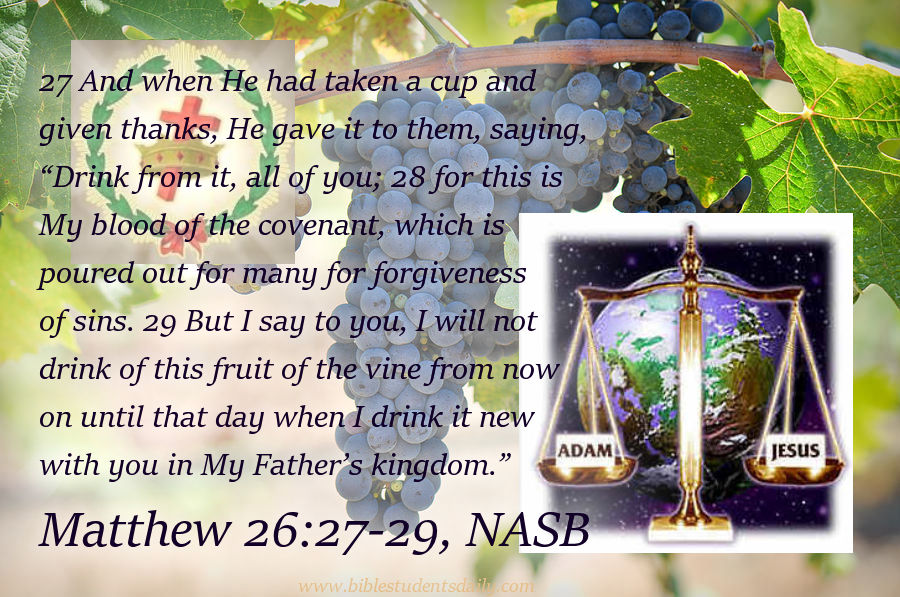
MATTHEW 26, 27-29, NASB.jpg

The Two Cups

Introduction

The Memorial is a special time of the year, a time when we refocus on the basis for our Christian existence and hope; by remembering the sacrifice Jesus made for us and thereby reconciled us to God.

On the night he was betrayed, at the beginning of the 14th of Nisan, Jesus instituted the emblems of the bread and wine after the last supper he had with his disciples. He gave us both to partake of, which simply but powerfully reminds us that only in him we have true life through forgiveness of sins.

That each Gospel account gives us additional details of the events, and from a slightly different perspective and approach, suggests that all of the accounts need to be taken together as a whole in order to get the most complete picture of those final moments of our Redeemer’s life. The Apostle Matthew arranges his Gospel more thematically whereas Luke arranges the events more chronologically.

Here we will focus on clarifying what the cup Jesus instituted means.

The Gospel of Matthew Account

Matthew 26:27–29 (ESV) And he took a cup, and when he had given thanks he gave it to them, saying, “Drink of it, all of you, 28 for this is my blood of the covenant, which is poured out for many for the forgiveness of sins. 29 I tell you I will not drink again of this fruit of the vine until that day when I drink it new with you in my Father’s kingdom.”

In the Matthew account in Chapter 26 verses 27–29, it appears that there is one cup, and that Jesus refers to it both as “my blood of the covenant, which is poured out for many for the forgiveness of sins” in verse 28 and as “this fruit of the vine” in verse 29. If we just take Matthew’s account as the basis for Jesus’ institution of the memorial cup emblem, we might get the impression that not only there was one cup, but that Jesus did drink of this cup – for he says according to the ESV in verse 29 “I will not drink again,” suggesting that he had already drank of it. And some suggest that this therefore shows that the disciples – and by implication all consecrated believers, share with Jesus in his sufferings – after all, like Jesus, we are told to present ourselves a living sacrifice in Romans 12:1.

If Jesus did drink of the memorial cup, what Jesus described as “this fruit of the vine” would seemingly and straightforwardly refer to wine consumed during a supper. The “vine” referring to a grapevine and its fruit as consumed and referred to at the time meant wine, i.e. fermented grape juice – for this was a way of preserving it. Grape juice would of course be an acceptable substitute for those inclined to do so. That Jesus does not refer to the contents according to the normal, commonly used ancient Greek word for wine, oinos, may be significant.

But if the cup was also “my blood of the covenant, which is poured out for many for the forgiveness of sins” – as Jesus states, and if Jesus also drank of it, then we are left with the uncomfortable suggestion that Jesus needed forgiveness of sins provided by his own sacrifice – which of course does not make sense as Jesus was sinless, and no sinner can redeem their own sin.

One solution to this problem seems to be that Jesus did not in fact drink of this cup. And this does seem to be supported by the questionable translation of the Greek preposition “apo” and adverb “arti” in the ESV as “again” in some Bibles. These two ancient Greek words literally mean “from now.” About 10 Bibles translate them as “again”, but at least 15 translate them as “from now” or “henceforth”, and the RVIC2016 as well as Wilson’s Diaglott translate them as “henceforth.” Importantly, the better translations of “henceforth” and “from now” are ambiguous in indicating whether Jesus did in fact drink of the cup or not.

The Gospel of Matthew Account

The Gospel of Mark account is much more succinct in general and here in regards to the institution of the memorial cup, is very similar to Matthew’s.

Luke 1:3 (ESV) “it seemed good to me also, having followed all things closely for some time past, to write an orderly account for you, most excellent Theophilus.”

The Gospel of Luke account of these events is however fuller, and as mentioned, Luke the physician, paid particularly attention to the sequence of events, and he states so in Luke 1:3, he says “having followed all things closely for some time past, to write an orderly account for you, most excellent Theophilus.” When he addresses the reader as “Theophilus” he means “lover of God”, which is what the word means in ancient Greek. That Luke wrote his account with particular attention to the sequence of events is important for us.

Luke 22:17–20 (ESV) And he took a cup, and when he had given thanks he said, “Take this, and divide it among yourselves. 18 For I tell you that from now on I will not drink of the fruit of the vine until the kingdom of God comes.” 19 And he took bread, and when he had given thanks, he broke it and gave it to them, saying, “This is my body, which is given for you. Do this in remembrance of me.” 20 And likewise the cup after they had eaten, saying, “This cup that is poured out for you is the new covenant in my blood.

Luke distinguishes between the cup of “the fruit of the vine” and the cup “that is poured out for you is the new covenant in my blood,” as partaking of the bread emblem occurred in between.

Two cups:

  • The “fruit of the vine” cup
  • The “new covenant in my blood, for the forgiveness of sins, poured out for you” cup

This is important information, for it tells us that there were, in fact, two cups – not one; firstly, the “fruit of the vine” cup and secondly – combining the Matthew and Luke accounts, of “the new covenant in my blood, for the forgiveness of sins, poured out for you.”

1 Corinthians 11:25 (ESV) In the same way also he took the cup, after supper, saying, “This cup is the new covenant in my blood. Do this, as often as you drink it, in remembrance of me.”

The first cup was seemingly partaken of during the last supper, as the second cup, the memorial cup was instituted by Jesus after supper – as the Apostle Paul tells us in 1 Corinthians 11:25.

An important question to ask at this point is, is this important? – one, two cups, what is the difference?

If they are the same cup and if Jesus did partake of it does affect what the cup means, and also what our relationship to Jesus in regards to the cup actually is. As mentioned, some suggest that by drinking of the cup shows that we share in “the sufferings of Christ” with Jesus. So, the implications of whether there are one or two cups is not insignificant.

The “Fruit of the Vine” Cup

If there are two cups, they are different. Does that mean that they signify different things, or anything at all beyond the literal contents of wine?

It seems that that both signify different things.

Both cups literally contained “fruit of the vine” – almost certainly wine. That the 2nd cup, the memorial cup meant more than the literal wine it contained may suggest that Jesus also meant more than the literal wine in the first cup. This seems to be supported by Jesus’ use of the unusual phrase “fruit of the vine” for the wine, as this phrase is only found 3 times in the New Testament and only in the Gospel accounts in relation to the memorial cup. No where else in the Scriptures is the phrase “fruit of the vine” used to refer to wine. The normal word for wine, oinos, is however widely and commonly used in the New Testament, some 34 times.

Luke 7:33–34 (NKJV) For John the Baptist came neither eating bread nor drinking wine, and you say, ‘He has a demon.’ 34 The Son of Man has come eating and drinking, and you say, ‘Look, a glutton and a winebibber, a friend of tax collectors and sinners!’

As an example, in Luke 7:33–34 we have the word oinos used twice in relation to John the Baptist and Jesus when the Pharisees criticized both – John for not eating bread and drinking wine saying he had a demon, and Jesus for eating bread and drinking wine saying he was a glutton and drunkard. If therefore the word for wine, oinos was commonly used, but that Jesus did not use it for the contents of the first cup but instead used the unusual phrase “fruit of the vine” suggests Jesus may have had a deeper meaning in mind.

John 6:48 (ESV) I am the bread of life.

John 15:5 (ESV) I am the vine; you are the branches. Whoever abides in me and I in him, he it is that bears much fruit, for apart from me you can do nothing.

Just as the memorial emblem of the bread that they all ate of indicates that Jesus “is the bread of life” – as Jesus explicitly states in John 6:48, the “fruit of the vine” reference may point to Jesus’ statement in John 15:5 that he is “the vine” and that his disciples are the branches – just as all consecrated Christians are. But if it is not literal, what is the metaphorical “fruit of the vine?” This would seem to be the fruits of the spirit that all those in Christ develop. And the full fruitage of the vine will not be evident till the body of Christ is completed at the end of the harvest period when the kingdom of God is established.

Galatians 5:22–23 (ESV) But the fruit of the Spirit is love, joy, peace, patience, kindness, goodness, faithfulness, 23 gentleness, self-control; against such things there is no law.

Here the “fruit of the vine” therefore seems to refer to the fruits of the holy spirit evident in all true consecrated believers in Jesus – love, joy, peace, patience, kindness, goodness, faithfulness, gentleness, and self-control. This would be consistent with Jesus’ statement that he would not drink of this 1st cup till the kingdom of God comes, or in other words that the full fruitage of the vine would not be evident till the kingdom.

What does it mean then if Jesus drank of this cup? If Jesus did drink of this cup, because he also received the holy spirit, he would also be a first fruit of the holy spirit – and so appropriately drink of the same cup.

Luke 22:16 (ESV) For I tell you I will not eat it until it is fulfilled in the kingdom of God.”

This would also seem to be consistent with Jesus’ statement that he would not eat of the Passover till it is fulfilled in the kingdom of God. This statement is also somewhat enigmatic and unlikely to be fulfilled literally in the future, but it does show that the antitype of the Passover is also still not fulfilled. When we examine the details of the Passover, we understand that Israel as a nation was a type for the world in general. The Passover ultimately led to the liberation from the Pharaoh and Egypt, but in the antitype, this has not occurred yet – the world in general has not yet been liberated from the Adversary and his kingdom. In the same way, the “fruitage of the vine” will not be completed and will not be able to be drank of by Jesus and his consecrated followers, till the church is complete and the marriage of the Lamb occurs.

The “New Covenant in My blood, for the forgiveness of sins, poured out for you” Cup

What then, does the second cup mean and indicate? This seems more self-explanatory – for Jesus actually tells us. Jesus says that the cup depicts “the new covenant in my blood, poured out for you, for the forgiveness of sins.” Jesus’s words seem plain and straightforward enough. Some have suggested that they do not apply to us [believers in the Gospel Age], and that the new covenant will only be inaugurated in the kingdom period. That Jesus says that his “blood, [is] poured out for you,” seems to unequivocally apply it to his consecrated followers now during the Gospel Age, not the kingdom age. When Jesus says “for you,” he means his disciples, and by extension us consecrated believers also.

1 Corinthians 15:19 (ESV) If in Christ we have hope in this life only, we are of all people most to be pitied.

Moreover, that Jesus’ blood provides forgiveness of sins – the prime requirement for reconciliation with God means that if we do not have forgiveness of sins in Christ, then we are still in our sins and most pitiable of men. Let us be clear, if the new covenant, which is the only means by which we can receive forgiveness of sins is not in operation, then how can we be reconciled to God by our faith?

That Jesus did not drink of this 2nd memorial cup, because it is a different cup, makes much better sense – for to partake of it would suggest that he needed forgiveness of sins; which of course he did not – for he was sinless.

That only all of the disciples did drink of this cup, showed that they were the recipients of the benefits of his sacrifice – for the forgiveness of their sins. We note what Jesus said when he gave them [and by extension us] to drink of the cup, he said “Drink of it, all of you” – he did not say let “us” drink of this cup.

Partaking of the cup did not indicate a sharing in the sufferings of Christ. Not that we do not partake in the sufferings of Christ – for the scriptures indicate that we do, but the memorial cup does not indicate this. It indicates that we together have in common that we are all dependent on the sacrifice of Jesus for our reconciliation with God through forgiveness of sins.

The Common Union of the Blood of Christ

1 Corinthians 10:16 (NKJV) The cup of blessing which we bless, is it not the communion of the blood of Christ? The bread which we break, is it not the communion of the body of Christ?

But what about 1 Corinthians 10:16, does this not indicate that we share in the sufferings of Christ, when the apostle Paul says “is not the cup we bless the communion in the blood of Christ?” It has been assumed that the common union in the blood of Christ here is a common union with Jesus, but the context and the grammatical usage here of “koinonia” [translated communion] indicate that the common union is with one another – a common participation of the blood of Jesus showing that we all receive forgiveness of sins through Jesus’ sacrifice.

Here in 1 Corinthians Chapter 10, the Apostle Paul outlines that “the cup we bless” – the memorial cup we ask a blessing for, is not an empty ritual but shows that we are eating at the table of the Lord – we are appropriating the merit of Jesus’ sacrifice to ourselves. And that eating at the table of the Lord is incompatible with eating at the table of demons – which eating of the sacrifices to idols then essentially was. The Apostle warns us to flee from idolatry. There is no suggestion here that we contribute to the food at the table of the Lord. The idolatry we face is much more subtle; it can be the pursuit of wealth, fame, respect, or even a sense of belonging at the expense of the truth but also includes anything that supplants the authority of God’s word.

John 6:54 (NKJV) Whoever eats My flesh and drinks My blood has eternal life, and I will raise him up at the last day.

Jeremiah 31:33–34 (NKJV) But this is the covenant that I will make with the house of Israel after those days, says the LORD: 1) I will put My law in their minds, and write it on their hearts; and I will be their God, and they shall be My people. 34 2) No more shall every man teach his neighbor, and every man his brother, saying, ‘Know the LORD,’ for they all shall know Me, from the least of them to the greatest of them, says the LORD. For 1) I will forgive their iniquity, and their sin I will remember no more.”

Jesus said, whoever drinks of my blood has eternal life…as John 6:54 says.

Faith in Jesus provides us with 1) forgiveness of sins, and thereby reconciliation with God, in order that we may, through baptism, receive of His holy spirit and be developed as new creatures, as 2) the holy spirit teaches us all things of God [rather than any man], even the deep things, and it writes 3) His royal law of agape love on our hearts – these are all functions of the holy spirit through the new covenant as outlined in Jeremiah 31; that we may be born on the spirit plane in the image of Jesus – when we will see the Passover fulfilled, when the fruit of the vine is complete through commonly with one another, partaking of the blood of Jesus shown in the memorial cup Jesus instituted – if we patiently endure to the end.

In Conclusion

In conclusion, it seems then that when Matthew talks about the cup of “the fruit of the vine” and the cup of Jesus’ “blood of the new covenant, for the forgiveness of sins, poured out for you” that they are in fact two separate cups – according to the Gospel of Luke. Jesus may have drank of the former – as the “fruit of the vine” seems to refer to the first fruits of the holy spirit – and which will not be evident till the marriage of the lamb, the seed of blessing is complete. The second cup is separate, a cup that Jesus did not drink of – but of which Jesus said they should all drink of, indicating their, and by extension, our dependence on the sacrifice of Jesus for forgiveness of sins and reconciliation to God. Without it God could not give us of His holy spirit in order to develop us as new creatures and be born on the spirit plane in the likeness of Jesus.

Hallelujah, O what a prospect! Praise be to our Heavenly Father and to His son Jesus.

Suggested Further Reading:

Eating at the Table of the Lord


ROMANS 8, 18 - ad..jpg

Sea-of-Galilee-Mount-of-Beatitudes.jpg

Suggested Further Reading

“Are We Actual Or Reckoned New Creatures?” The Reprints (No. 5325) of the Original Watch Tower and Herald of Christ Second Presence.

“The Ransom.” by Br. David Rice. Faithbuilders Fellowship Journal.
http://www.2043ad.com/journal/2007/02_ma_07.pdf

“Bread and Cup” by Br. James Parkinson. The Herald of Christ’s Kingdom Magazine, March-April 2018.

“Jesus The Name.”
https://biblestudentsdaily.com/2017/07/05/jesus-the-name/

“Who Is the World’s Ransom and Why?”
https://biblestudentsdaily.com/2016/03/29/who-is-the-worlds-ransom-and-why/?share=press-this&nb=1

“Nehemiah 8:10 — The Joy of the Lord Is Your Strength.”
https://biblestudentsdaily.com/2016/12/20/nehemiah-810-the-joy-of-the-lord-is-your-strength/


This post’s URL:
https://biblestudentsdaily.com/2018/03/19/matthew-2627-29-drinking-from-christs-one-cup/


Enter your email address to subscribe to this blog and receive notifications of new posts by email.


A Little While – Hymns of Dawn No. 7

A Little While – Hymns of Dawn No. 7

Lyrics

“A little while;” now he has come;
The hour draws on apace—
The blessed hour, the glorious morn,
When we shall see his face.
How light our trials then will seem!
How short our pilgrim way!
The life of earth a fitful dream,
Dispelled by dawning day!

Chorus

Then, O Lord Jesus, quickly show
Thy glory and thy light,
And take God’s longing children home,
And end earth’s weary night.

A little while; with patience, Lord,
I fain would ask, “How long?”
For how can I, with such a hope
Of glory and of home,
With such a joy awaiting me,
Not wish the hour were come?
How can I keep the longing back,
And how suppress the groan?

Yet peace, my heart! and hush, my tongue!
Be calm my troubled breast!
Each passing hour prepares thee more
For everlasting rest.
Thou knowest well, the time thy God
Appoints for thee is best.
The morning star already shines;
The glow is in the east.

Bible Scriptures Associated With This Hymn

  • 1 Corinthians 13:12-13 (ESV) —

“12 For now we see in a mirror dimly, but then face to face. Now I know in part; then I shall know fully, even as I have been fully known. 13 So now faith, hope, and love abide, these three; but the greatest of these is love.”

  • 1 Corinthians 15:50-58 (RVIC) —

“(50) Now this I say, brethren, that flesh and blood cannot inherit the kingdom of God; neither doth corruption inherit incorruption. (51) Behold, I tell you a mystery: We shall all fall asleep, but we shall not all be changed (52) in a moment, in the twinkling of an eye, in the last trump: for the trumpet shall sound, and the dead shall be raised incorruptible, and we shall be changed. (53) For this corruptible must put on incorruption, and this mortal must put on immortality. (54) But when this corruptible shall have put on incorruption, and this mortal shall have put on immortality, then shall come to pass the saying that is written, Death was swallowed up in victory. (55) O death, where is thy victory? O death, where is thy sting? (56) But the sting of death is sin; and the power of sin is the law: (57) but thanks be to God, who giveth us the victory through our Lord Jesus Christ. (58) Wherefore, my beloved brethren, be ye stedfast, unmovable, always abounding in the work of the Lord, forasmuch as ye know that your labor is not vain in the Lord” (1 Corinthians 15:50-58, RVIC – The American Revised Version Improved and Corrected, 2000).

  • Song of Songs (“Canticles”) 8:14 (NAS) —

“Hurry, my beloved, And be like a gazelle or a young stag On the mountains of spices.”

The comments below, are a direct quote from “Notes on The Song of Solomon” by Anton Frey in the Bible Student Library CD:

Solomon, expecting to be gone from her immediate presence, though within hearing and speaking range, admonishes her to remain in the beautiful and fragrant gardens. It would be from these that she should be able to maintain communications with him, though not able to actually see him. He went to make the final preparations for the taking of her to her new home; there, to make her his bride, his wife! Already, some of her belongings have been transported to the Palace—the treasures, which she wishes to keep with her, forever and a day! As she now waves to him, she says, very earnestly, “Make haste, my dearly beloved, be like the roe, or the young hart upon the mountains of spices”—return speedily for me, for I can scarcely wait!

The words of the “espoused virgin” at this time, are not any different from those she has uttered to her beloved “Solomon,” from the very beginning of the Gospel age; for they do most beautifully express her hopes—“Come quickly, Lord.” She would have Him be swift, like the roe, or the young hart. She has already told him that she would eagerly be awaiting him—his return to take her to her heavenly home, where he will make of her, his bride, the Lamb’s wife! How she does look forward to the day when he shall change her name to his—“Jehovah Tsidkenu”—the Righteousness of Jehovah (Jeremiah 33:16; 23:6). Her bridal garments are all in readiness (Psalm 45:13, 14) and, already, some of her treasures (tokens of his love given to her during their period of courtship) have been transported to the Royal Palace! Is this not also, the significance of the Master’s words, “I go to prepare a place for you”? (John 14:2) “Come quickly, Lord,” she says… He responds, “I (shall indeed) come quickly” (Rev. 3:11, 22:7); and to which, her final salutation is, “Even so, come, Lord Jesus.”

Let us strive to be worthy of a love so great and tender as His [Christ’s]. Let us seek ever and always to glorify Him before others; and, never, no, never, prove ourselves unworthy! Contemplate… the transcendency of His love; think upon what He has declared He thinks of His beloved: then, endeavor, more and more, to grow into the image and likeness—His “Ideal”!

  • Hebrews 10:35-39 —

“35 Cast not away therefore your confidence, which hath great recompence of reward. 36 For ye have need of patience, that, after ye have done the will of God, ye might receive the promise. 37 For yet a little while, and he that shall come will come, and will not tarry. 38 Now the just shall live by faith: but if any man draw back, my soul shall have no pleasure in him. 39 But we are not of them who draw back unto perdition; but of them that believe to the saving of the soul.”

  • 2 Peter 1:12 —

“Wherefore I will not be negligent to put you always in remembrance of these things, though ye know them, and be established in the present truth.”

The three “stepping stones” to understanding Christ’s invisible presence and “parousia” which IS (part of) “the present truth” which the Apostle Peter was talking about in 2 Peter 1:12 are: 1260, 1290, and 1335 and these numbers are prophetic markers all found in both the Book of Revelation and the Book of Daniel.

For further reading about Christ’s Presence please go to the following post: “Christ’s Parousia (Second Presence) In 1874” [URL: https://biblestudentsdaily.com/2017/11/10/christs-parousia-second-presence-in-1874/%5D.

More about CHRIST’s PAROUSIA (presence) can be read about here:

i-will-come-again

Hymn Book Purchase

The Hymns Of Dawn (hymn book) can be purchased at:

Acknowledgment & References

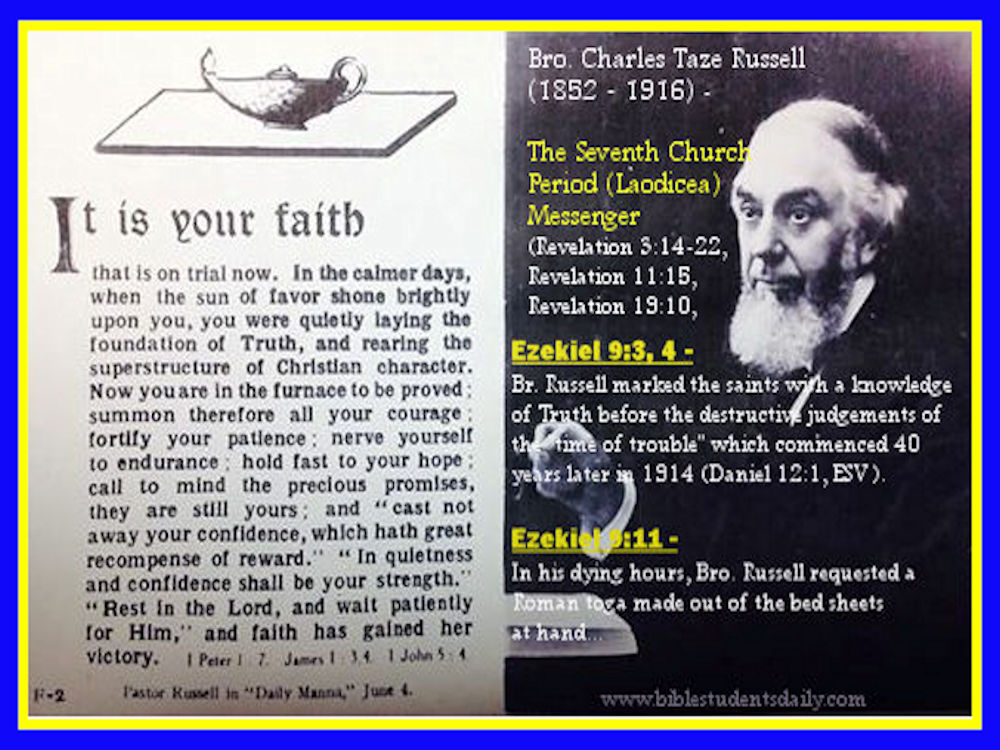
Br. Charles Taze Russell

Charles-Taze-Russell-Laodicean-Messenger7.jpg

Br. Charles Russell—the founder of the Bible Students movement, who is the compiler of “Poems and Hymns of Millennial Dawn” which was published in Allegheny, Pa., in 1890. This Bible Students’ devotional originally contained a total of 151 poems and 333 hymns.

Later on, the hymns from this book formed a basis for the hymnal titled ““Hymns of Dawn” which was published by the Dawn Bible Students Association in East Rutherford, New Jersey (USA) and the 1999 edition contains a total of 361 hymns.

Suggested Further Reading

Click on the links below for the specified article/content matter.

“Daniel: Conclusion” by Br. David Rice. Faithbuilders Fellowship — “Journal” section, May-June 2009 edition (at 2043ad.com / button “Journal.”) Here is the direct link to this article:
http://2043ad.com/journal/2009/2009c.pdf

“The Prophetic Date – 1874”. The Herald of Christ’s Kingdom Magazine, Nov-Dec. 2003 issue.
http://www.heraldmag.org/2003/03nd_5.htm

“Coming Blessings” by Br. David Rice (www2043ad.com). The Herald of Christ’s Kingdom Magazine, Sept-Oct. 2012 issue.
http://www.heraldmag.org/2012/12so_9.htm

“An Important Greek Word – Parousia” by Br. David Rice. The Herald of Christ’s Kingdom Magazine, Nov-Dec. 2003 issue.
http://www.heraldmag.org/2003/03nd_8.htm

“Every Eye Shall See Him” by Br. Gilbert Rice. The Herald of Christ’s Kingdom Magazine, Nov-Dec. 2003 issue.
http://www.heraldmag.org/2003/03nd_4.htm

“The Harvest — The End of the Age” by Br. Carl Hagensick. The Herald of Christ’s Kingdom Magazine, Nov-Dec. 2003 issue.
http://www.heraldmag.org/2003/03nd_2.htm

“A Secret Coming – A Thief In the Night.” The Herald of Christ’s Kingdom Magazine, Nov-Dec. 2003 issue.
http://www.heraldmag.org/2003/03nd_9.htm

“Times and Seasons — The Seventh Trumpet” by Br. Michael Brann. The Herald of Christ’s Kingdom Magazine, Nov-Dec. 2003 issue.
http://www.heraldmag.org/2003/03nd_3.htm

“Chronos and Kairos – Times and Seasons.” The Herald of Christ’s Kingdom Magazine, Nov-Dec. 2003 issue.
http://www.heraldmag.org/2003/03nd_7.htm

Epoch Periods In God’s Plan. BIBLE Students DAILY.
https://biblestudentsdaily.com/2017/08/16/epoch-periods-in-gods-plan/

Is the “Sabbath Day” a Saturday, Sunday or any Day of the Week? BIBLE Students DAILY.
https://biblestudentsdaily.com/2017/10/19/is-the-sabbath-day-a-saturday-sunday-or-any-day-of-the-week/

Only A Little While
https://biblestudentsdaily.com/2017/01/24/only-a-little-while/

The Time Is Short
https://biblestudentsdaily.com/2016/03/08/the-time-is-short-surrender-all/

ACTS 23:6 – The Resurrection Process – Part (A), (B), and (C):

(A) https://biblestudentsdaily.com/2016/11/03/acts-236-hope-resurrection-part-a-what-is-jesus-all-about/

(B) https://biblestudentsdaily.com/2016/11/05/acts-236-hope-resurrection-part-b-will-mankind-resurrect-with-the-same-mind/

(C) https://biblestudentsdaily.com/2016/11/11/acts-236-hope-resurrection-part-c-the-order-of-the-resurrection-process/

Wait O Thou Weary One A Little Longer https://biblestudentsdaily.com/2016/11/19/wait-o-thou-weary-one-a-little-longer/

Links and Bible Resources. BIBLE Students DAILY.
https://biblestudentsdaily.com/category/links/


The URL of this post:

A Little While – Hymns of Dawn No. 7

Enter your email address to subscribe to this blog and receive notifications of new posts by email.


ACTS 23:6 —HOPE & RESURRECTION. PART C: The Order of the Resurrection Process

john-5-28-29-two-salvations-two-resurrections

According to Christian beliefs, you can only get to heaven and God through Jesus. How did people get to heaven before Jesus came on the scene?

Answer: They didn’t.

Jesus opened up the “New and Living Way”—that is, he opened up the heavenly calling.

The rest of mankind from Adam until now who have not come in through Christ will get a resurrection on the earth. You are familiar with the Lord’s prayer, “Thy Kingdom come, Thy will be done on the earth as it is in heaven…”

The faithful Christian is part of the “first resurrection.” If there is a first then there is at least one more. They are the resurrection of the “just” or justified, and the rest of the world is the “unjust” or unjustified by Christ. Their resurrection is not to condemnation as some translation say, but to judgement—that is the Millennium is a period of trial for all of mankind. Not a sentencing, but trial. They come back and will “know the Lord from the least unto the greatest”—they get an opportunity not afforded them in this life.

Two Salvations and Two Resurrections

Here are some texts that explain that there is one Ransom but two salvations and two resurrections.

  • “For Christ also suffered once for sins, the just for the unjust, that He might bring us to God” (1 Peter 3:18).
  • “…There will be a resurrection of the dead, both of the just [the spiritual classes: Bride of Christ & Church, and the earthly class: the Ancient Worthies] and the unjust (the world of mankind)” (Acts 24:15).
  • “(28) Do not marvel at this; for an hour is coming, in which all who are in the tombs will hear His voice, (29) and will come forth; those who did the good deeds to a resurrection of life (Heavenly Salvation), those who committed the evil deeds to a resurrection of judgment (Earthly)” (John 5:28-29, NAS).

The Overcomers in the 1st Resurrection

In John 16:33 Jesus said “I have told you these things, so that in me you may have peace. In this world you will have trouble. But take heart! I have overcome the world.”

We read in 1 John 5:4 that “everyone born of God overcomes the world. This is the victory that has overcome the world, even our faith.”

These “overcomers” or “more than conquerors” (Romans 8:37) have been redeemed from Adamic condemnation (Romans 8:1), and committed their earthly life to be a “living sacrifice” in the present time (Romans 12:1). They have become begotten to a new life, a spiritual life, and thus are on trial for their spiritual life presently. These are the Church members. The Apostle Paul states in 1 Corinthians 15:51-52, RVIC: “(51) Behold, I tell you a mystery: We shall all fall asleep [Acts 7:60- also says “fell asleep”], but we shall not all be changed (52) in a moment, in the twinkling of an eye, in the last trump: for the trumpet shall sound, and the dead shall be raised incorruptible, and we shall be changed.”

[NOTE: RVIC – THE REVISED VERSION (AMERICAN EDITION) IMPROVED & CORRECTED BIBLE – is the most accurate up to date English version of the Holy Scriptures available, compiled from manuscripts discovered and published to AD 1999.]

The ones who died long ago were “raised” to life at the Lord’s return in 1874, at the sound of the last, or seventh, trumpet. Those who die within the present harvest period of the Gospel Age are “changed” at the moment of death.

Overcomers in the 1st resurrection.jpg

The ORDER of the Resurrection Process

1st ­– Christ, “the firstfruits” (1 Corinthians 15:23)—Christ has inherited DIVINE NATURE = IMMORTAL LIFE.

2nd – The Sleeping Saints—these are the OVERCOMERS and they that are Christ’s at his coming i.e. the Bride of Christ—the Elect, 144,000 members of Christ’s “body”.

3rd – The Harvest Saints—these are also the OVERCOMERS—the Bride of Christ, the 144,000 raised “in the twinkling of an eye” in new, spiritual bodies and inherit IMMORTAL LIFE since 1874 until the completion of the Bride of Christ.

“God having provided some better thing for us, that they without us should not be made perfect” (Hebrews 11:40). This talks about the necessity of the Church to be a part of blessing all the families of the world.

What is meant by “a better resurrection” in Hebrews 11:35?

This refers to the resurrection of the Ancient Worthies, the “Heros of Faith.” Some of the Ancient Worthies are described in Hebrews chapter 11. In Hebrews 11:39 and 35 we read, “… these all, having obtained a good report through faith, received not the promise… (35) Women received their dead raised to life again: and others were tortured, not accepting deliverance; that they might obtain a better resurrection.

It is understood that Apostle Paul meant that the ancient worthies receive a better resurrection (i.e. eternal life) than those received who were revived temporarily in the Old Testament (which is the subject of Hebrews 11:35).

The Ancient Worthies will be the first humans resurrected onto the earth in the Kingdom. They will be raised perfect, as they already were justified by their faith. They will lead mankind on earth. Psalms 45:16 refers to them as “princes in all the earth.”

4th – The Great Multitude & Ancient Worthies

The Great Multitude:

The Great Multitude will be resurrected after the GREAT TRIBULATION (Armageddon, Battle of Gog and Magog) starts, as indicated in the following passages of Scripture in the Bible:-

  • Genesis 19:23 – “The sun was risen upon the earth when Lot entered into Zoar.”

Zoar was the city, not “the mountain.” The mountain, to which Lot fled subsequently, represents the heavenly realm where Lot later went to dwell (Genesis 19:30). Lot is often seen as a picture of the Great Company, who lingers through the severe troubles that close the present Harvest period.

  • Matthew 25:1-13 – the five wise and the five foolish virgins.
  • Micah 7:1-7 – here the Great Multitude realize that the Bride of Christ is taken and there is a time of God’s wrath when deplorable and fearsome conditions on earth remain and all faithful men have perished and there is no one upright on earth – yet in verse 7, God delivers them as they “watch in hope”.
  • Revelation 7:14 – “And I said unto him, Sir, thou knowest. And he said to me, These are they which came out of great tribulation, and have washed their robes, and made them white in the blood of the Lamb.”

Members of the Great Company class have received purging experiences whenever they may have lived during the Gospel Age (since AD 33). However, Revelation 7:14 speaks in particular of members of the Great Company who are living during the Harvest and pass through the “four winds” that close the harvest. In the Revelation 7:3-4, the 144,000 class are “sealed” before the four winds blow which may signify that they are taken to glory—but the Great Company class linger and pass through the experience.

The Ancient Worthies:

  • The Ancient Worthies—it is possible that these faithful ones of old will be resurrected towards the end of Armageddon to bring peace during the 7th (last) plague described in Revelation chapter 16. That seventh plague includes a battle, an earthquake, and a plague of hail.
  • The Ancient Worthies, or at least some of them, evidently will be raised in the midst of the crisis of Israel invaded by the coalition of Gog and his allies. This is suggested by Micah 5:5, and 2 Kings 3:10,11, and context.

“And this man shall be the peace, when the Assyrian shall come into our land: and when he shall tread in our palaces, then shall we raise against him seven shepherds, and eight principal men” (Micah 5:5).

Assyriarepresents Gog with his invading hosts, thus Russia, together with their allies.

——-[NOTE: The battle at Israel when God fights for them is described also in Ezekiel chapters 38 to 39. Here we again see that the coalition that comes against Israel includes:

  • Gog (Russia) which is part of Old Christendom
  • Persia (Iran)
  • Cush (perhaps Muslim black Africa),
  • Libya (Libya, perhaps North central Africa, not including Egypt)
  • Gomer (perhaps Western Europe),
  • Togarmah (Turkey).

Except perhaps for Gomer, the identification made here are customary, not unusual, they are however interpretive, so let us “watch and pray”.

On the other side, in the author’s understanding (and this is interpretive), is (according to what we read in Ezekiel 38:13):

  • Sheba and Dedan (Saudi Arabia, always against Iran),
  • the Merchants of Tarshish (England), and
  • the young lions thereof (American, Canada, Australia). They are part of newer Christendom, and not part of the alliance of the sixth plague whose representative governments fall at Israel. The victory at Israel is orchestrated by God, using the forces of the Israelis assisted by God’s overruling power.]——-

Seven shepherds—represents the Church completed beyond the vail. The word “shepherd” was a way of referring to kings in the language of the day. (For as a shepherd has control of his flock, so a king has control of his people.)

Eight principal men—Eight “princes” of men, as contrasted to the seven kings (shepherds). Thus those who will be “princes in all the earth” (who are the Ancient Worthies.) The number seven is about the Church because of the seven stages of the Church—the period following the Gospel Age is then period “eight,” and that is when the Ancient Worthies come back. Thus the number “eight” is associated with them.

In Micah 5:6 we read, “And they shall waste the land of Assyria with the sword, and the land of Nimrod in the entrances thereof: thus shall he deliver us from the Assyrian, when he cometh into our land, and when he treadeth within our borders.”

Here it is explained that Israel, under the hand of the completed heavenly Church above and the advice of the Ancient Worthies among them, will have a dramatic
military victory.

The land of Nimrod is the land of Assyria, perhaps because Asshur who came from the land of Nimrod (Shinar) built the initial area of Asshur (Genesis 10:10-12).

Our second lot of verses quoted above is from 2 Kings 3:10-11:

“10 And the king of Israel said, Alas! that the Lord hath called these three kings together, to deliver them into the hand of Moab! 11 But Jehoshaphat said, Is there not here a prophet of the Lord, that we may enquire of the Lord by him? And one of the king of Israel’s servants answered and said, Here is Elisha the son of Shaphat, which poured water on the hands of Elijah.”

Elisha represents the Ancient Worthies, raised at a point of crisis in Israel. Some of the Great Company class may linger to see the intervention of God on behalf of Israel. This may be what precipitates their expressions as prophesied in Jeremiah 8:20, “The harvest is past, the summer is ended, and we are not saved.”

[NOTE: Elisha does represent the Great Company class when they are separated from Elijah (the Church) by the whirlwind. When Elisha then crosses the Jordan from east to west, after the taking of Elijah, Elisha thereafter is a picture of the Ancient Worthies in their experiences during the Millennium. Refer to 2 Kings chapter 2.]

5th – The Remainder of Mankind

All will have an adequate opportunity to be on trial for life in the Kingdom before judgement is received. (Isaiah 65:20)

The “Highway of Holiness” operating during the Millennium will lead people from ungodliness, to holiness as we read in Isaiah 35:8,

“And an highway shall be there, and a way, and it shall be called The way of holiness; the unclean shall not pass over it; but it shall be for those: the wayfaring men, though fools, shall not err therein.”

John 5:28-29 refers to the resurrection of judgment, which will be the point of decision between self will and God’s will:

28 Marvel not at this: for the hour is coming, in the which all that are in the graves shall hear his voice, 29 And shall come forth; they that have done good, unto the resurrection of life; and they that have done evil, unto the resurrection of damnation (judgment).”

All mankind will be raised by Christ and the Church. They will be raised as human beings, and during the Millennium they will be developed and prepared to receive everlasting life in the judgment following the Millennium. The world will be natural being, fleshly beings, as at present. “There is a natural body (human) and there is a spiritual body” (spirit beings) (1 Corinthians 15:44). The world will be natural, fleshly, human beings.

When is the Resurrection Complete?

The resurrection will be complete when all who have died are raised again. The curse will be lifted at the beginning of the age, by the application of the Ransom for the world of mankind, in order to allow the resurrection of the dead.

The resurrection is the only hope for the dead. Let us conclude with John 11:23-26—

“23Jesus said to her, ‘Your brother will rise again.’

24Martha said to Him, ‘I know that he will rise again in the resurrection at the last day.’

25Jesus said to her, ‘I am the resurrection and the life. He who believes in Me, though he may die, he shall live. 26And whoever lives and believes in Me shall never die. Do you believe this?’”

The resurrection is our ONLY HOPE and an integral part of God’s Divine Plan!

How thankful we are to our Heavenly Father for such a Perfect Plan that will result in eternal life for all.

Romans 11, 36 - from him and through him... to GOD be the glory.jpg

References

Some source material was used from the power point presentation (a BibleTruth411 Video) titled “The Hope and Resurrection of the Dead.

Suggested Further Reading

ACTS 23:6 —HOPE & RESURRECTION. PART A: What is Jesus All About?
https://biblestudentsdaily.com/2016/11/03/acts-236-hope-resurrection-part-a-what-is-jesus-all-about/

ACTS 23:6 —HOPE & RESURRECTION. PART B. Will Mankind Resurrect With the Same Mind?
https://biblestudentsdaily.com/2016/11/05/acts-236-hope-resurrection-part-b-will-mankind-resurrect-with-the-same-mind/

ACTS 3:19-21 – The Restitution of All Things
https://biblestudentsdaily.com/2017/08/02/acts-319-21-the-restitution-of-all-things/

Epoch Periods In God’s Plan
https://biblestudentsdaily.com/2017/08/16/epoch-periods-in-gods-plan/

The Resurrection of the Dead. Faithbuilders Fellowship, Nov. – Dec. 2008 (Journal Section). http://www.2043ad.com/journal/2008/06_nd_08.pdf

In the First Resurrection. The Herald of Christ’s Kingdom, March/April 1987 Magazine
http://www.heraldmag.org/archives/1987_2.htm#_Toc36954777

Life After Death. Dawn Bible Students Association.
http://www.dawnbible.com/booklets/life.htm


This post’s URL:
https://biblestudentsdaily.com/2016/11/11/acts-236-hope-resurrection-part-c-the-order-of-the-resurrection-process/

Enter your email address to subscribe to this blog and receive notifications of new posts by email.

Save

What Does It Mean To Be Baptized Into Christ?

matt-16-25

What types of baptism are practiced in the Churches?

There is more than one type of baptism practiced in the Christian world. There is:

  • Sprinkling or Pouring on the Head
  • Infant Baptism
  • Submersion under water.

Sprinkling or pouring water on the head

There are no Scriptures in the Bible that describe baptism as the sprinkling or pouring of water on the head.

The first instances in the Bible where individuals were baptized was accomplished by John the Baptist.

Did John the Baptist sprinkle water or submerse the person under water?

“Now John also was baptizing in Aenon near Salim, because there was much water there. And they came and were baptized” (John 3:23, NKJ).

And He [Jesus] went away again beyond the Jordan to the place where John was baptizing at first” (John 10:40, NKJ).

If all John was doing was sprinkling water to baptize, he did not need to worry about being near the “much water” of the Jordan River. Clearly, John was doing more than just sprinkling those he baptized.

Infant Baptism

Is infant baptism scriptural?

Nowhere in the Bible do we find infant baptism mentioned. Although at times the Scriptures do mention the baptism of households, they never specifically mention children or infants.

For example, in Acts 8, Philip preached to the people of Samaria.

“But when they believed Philip as he preached the things concerning the kingdom of God and the name of Jesus Christ, both men and women were baptized” (Acts 8:12, NKJ).

Notice, there is no mention of Philip baptizing infants in Samaria; just men and women.

In Mark 16:16, Jesus said, “He who believes and is baptized will be saved.”

It would not be possible for a newborn infant to understand who Christ is, let alone believe in him.

Remember the question Jesus asked James and John in Mark 10:38,

Are you able to be baptized with the baptism I am baptized with?”

A newborn infant would not be capable of answering Jesus’ question, let alone responsibly making such a commitment.

Submersion (Dunking) into Water

Now we do find examples in the New Testament of adult baptism and in every case we believe the baptism was a submersion into water. For example:

“When He [John] had been baptized, Jesus came up immediately from the water; and behold, the heavens were opened to Him, and He saw the Spirit of God descending like a dove and alighting upon Him” (Matthew 3:16).

” (38) So he [Philip] commanded the chariot to stand still. And both Philip and the eunuch went down into the water, and he baptized him. (39) Now when they came up out of the water, the Spirit of the LORD caught Philip away, so that the eunuch saw him no more; and he went on his way rejoicing” (Acts 8:38-39).

The only way Jesus and the Ethiopian eunuch could have “come up” out of the water is if they have been submersed under it.

Greek Definition Of Baptism:

In support of this conclusion that baptism is submersion, let us looks at some definitions.

STRONGS: 907 baptizo (bap-tid’-zo); to immerse, submerge; to make overwhelmed (i.e. fully wet).

VINES: baptism, baptist, baptize.

A. Nouns.

1. baptisma (908), “baptism,” consisting of the processes of immersion, submersion and emergence (from bapto, “to dip”).

B. Verb.

baptizo (907), “to baptize,” primarily a frequentative form of bapto, “to dip,” was used among the Greeks to signify the dyeing of a garment, or the drawing of water by dipping a vessel into another.

So this word has the meaning of complete submersion under water. Certainly when dying, the garment must be totally submerged in the dye.

There is a variation of this word.

2. baptismos (909), as distinct from baptisma (the ordinance), is used of the “ceremonial washing of articles,” in some texts; once in a general sense.

This word is only found four times in the New Testament and refers to ceremonial washings.

John’s Baptism & Its Purpose

Let us talk about John’s (the Baptist’s) baptism. John’s work was not for the Gentiles. His work of baptism was intended to reveal Jesus to the Israelites only, but John did not baptize believers into Christ. That would come later, after Pentecost. His work was not for the Gentiles.

In John 1:29-31 we read, “(29) The next day John saw Jesus coming toward him, and said, ‘Behold! The Lamb of God who takes away the sin of the world! (30) This is He of whom I said, After me comes a Man who is preferred before me, for He was before me. (31) I did not know Him; but that He should be revealed to Israel, therefore I came baptizing with water.‘”

So John the Baptist was baptizing in order to reveal Jesus to Israel only, not yet to the Gentiles.

Bearing fruit was an evidence of those who had sincerely baptized. As John the Baptist said, “Therefore bear fruits worthy of repentance” (Matthew 3:8, NKJ).

John’s baptism required a personal confession of sins. “And all the land of Judea, and those from Jerusalem, went out to him and were all baptized by him in the Jordan River, confessing their sins” (Mark 1:5, NKJ).

Repentance and typical cleansing restored repentant Jews back to the condition of harmony with God as enjoyed under the Law Covenant and through the tabernacle arrangement.

“John came baptizing in the wilderness and preaching a baptism of repentance for the remission of sins” (Mark 1:4, NKJ).

The Jews had not previously practiced individual baptism. The whole nation was recognized as “baptized into Moses in the sea and in the cloud” (1 Corinthians 10:1-2).

In what sense were the Israelites “baptized into Moses in the sea and in the cloud”? 
We answer: When the Israelites passed through the Red Sea they were surrounded by water, and Paul mentions that this is a picture of them being baptized. The cloud is mentioned in Exodus 13:22, “He took not away the pillar of the cloud by day, nor the pillar of fire by night, from before the people.” We think that that was the cloud Paul referred to as over the Israelites — so that in that sense they were surrounded from above by water as well.

The Jews were already children of God and heirs of the covenants and promises, and their washing away of their sins meant their coming near again to God, and into closer touch with all the promises and the blessings thereof (Harvest Gleanings I, 1HG255).

John the Baptist’s baptism, was “for the remission of avoidable sins, gross sins. The godly Jews were not intended, nor expected, to come to John to be baptized. He said, ‘Now come, if you want to get ready for Messiah’s kingdom, and try to keep the law the best you are able and take this water immersion, accepting this as a sign of your putting away sin and starting a new course of life.’ This is all that baptism meant to the Jews. That was not a regular institution. It was a peculiar thing that belonged just to the end of the [Jewish] age, and John tried there to especially prepare a people by this preaching of holiness and putting away of sin for the Messiah; for the testimony is that if they had believed John they would have believed Jesus. If they disbelieved John and disregarded what he said, and were not careful to come back into harmony with God, and become as holy as they were able to do, then they were not in a condition to receive the message God had to give” (What Pastor Russell Said – Question Book, Q34:3).

This typical cleansing available to the Jews is discussed in Leviticus & Hebrews.

“For on that day [of Atonement] the priest shall make atonement for you, to cleanse you, that you may be clean from all your sins before the LORD” (Leviticus 16:30).

“And every priest stands ministering daily and offering repeatedly the same sacrifices, which can never take away sins” (Hebrews 10:11).

So John baptized the Jews for repentance and remission of sins similar to the typical cleansing as was accomplished in the tabernacle by the sacrifice of bulls and goats on the Day of Atonement. Every Jew under the Law Covenant was a member of the house of Moses (Hebrews 3:5). As mentioned above, the Jews were baptized unto Moses in the sea and in the cloud (1 Corinthians 10:12). As natural branches of the olive tree the Jews did not need en-grafting into Christ (Romans 11:16-21). John could not baptize Gentiles since they could not by repentance be restored back to a position they had never occupied.

After Pentecost, John’s baptism was replaced by Christian baptism into Christ.

In the book of Acts we have an incident where some of John’s disciples, after hearing the gospel, were baptized again, this time into Christ; after which they received the holy Spirit.

Acts 19:1-6 – “(1)… Paul, having passed through the upper regions, came to Ephesus. And finding some disciples (2) he said to them, ‘Did you receive the holy Spirit when you believed?’ So they said to him, ‘We have not so much as heard whether there is a holy Spirit.’ (3) And he said to them, ‘Into what then were you baptized?’ So they said, ‘Into John’s baptism.’ (4) Then Paul said, ‘John indeed baptized with a baptism of repentance, saying to the people that they should believe on Him who would come after him, that is, on Christ Jesus.’ (5) When they heard this, they were baptized in the name of the Lord Jesus. (6) And when Paul had laid hands on them, the holy Spirit came upon them, and they spoke with tongues and prophesied. (7) Now the men were about twelve in all.”

These disciples were baptized twice (John’s & Christ’s). Bro. Charles T. Russell teaches, “The Apostle instructed them more fully, assuring them that John’s baptism was all right in its time and place, but that they should be baptized in the name of Jesus, baptized into Christ” (Harvest Gleanings I, HG732:6).

In Acts 2:41 three thousand people were baptized and among these, there may have also been some that had been baptized by John earlier.

‘Never is it said of any Gentile that he was baptized unto repentance and remission of sins, that he got back into Moses and in accord with the law. On the contrary, the apostle shows that we and all spiritual Israelites coming from among the Gentiles, come into Christ in a different way from that in which the Jews became related to him. I call your attention to the apostle’s argument in Rom. 11:17-24, where he uses an olive-tree as a symbol or picture. He tells us that that olive-tree was primarily the Jewish nation; that its root was the Abrahamic promise; its branches were the individual Jews. It was to those branches that John preached the baptism of repentance. Many of them were defiled, living in sin, and he urged them to repent and be washed, cleansed; that otherwise they would be broken off. And so it was when Messiah was manifest; the prepared ones, Israelites indeed, in whom was no guile, were ready for him, received him and he received them, and they continued to be branches of that olive, tree. But the great mass of the branches, as the apostle goes on to explain, were broken off because they did not receive our Lord, because they were not in the right condition of heart, not “Israelites indeed, without guile” (Harvest Gleanings I, HG).

Christian Baptism and Its Meaning

Christian baptism has many elements that are similar to John’s baptism and some elements that are different. As with the Jews baptized by John’s baptism, Christians are to confess and repent from their sins.

“And many who had believed came confessing and telling their deeds” (Acts 19:18).

“(46) Then he said to them, ‘Thus it is written, and thus it was necessary for the Christ to suffer and to rise from the dead the third day, (47) and that repentance and remission of sins should be preached in His name to all nations, beginning at Jerusalem'” (Luke 24:46-47).

“Then Peter said to them, ‘Repent, and let every one of you be baptized in the name of Jesus Christ for the remission of sins; and you shall receive the gift of the Holy Spirit'” (Acts 2:38).

Br. Charles Russell teaches, “This baptism was for Jews only, who had already been baptized into Moses in the sea and the cloud. Sins thus figuratively washed away did not include original sin, but merely minor transgressions against the Mosaic law.” (Reprints of the Original Watchtower 4308:5, 6th Volume of Studies in the Scriptures p.428, Harvest Gleanings I, 600:1,2)

John the Baptist could only provide typical remission. The Christian receives a real remission of sins through actual justification by Jesus’ blood.

John’s baptism pointed the Jews to Christ, but the Christian is to actually believe in Christ and accept Him as their Savior. Let’s see how this is shown in the Scriptures.

“(36) Now as they went down the road, they came to some water. And the eunuch said, ‘See, here is water. What hinders me from being baptized?’ (37) Then Philip said, ‘If you believe with all your heart, you may.’ And he answered and said, ‘I believe that Jesus Christ is the Son of God’” (Acts 8:36-37).

Then Crispus, the ruler of the synagogue, believed on the Lord with all his household. And many of the Corinthians, hearing, believed and were baptized” (Acts 18:8).

So faith in Jesus Christ is a requirement for the Christian baptism.

Baptism Into Christ – Not Into An Organization

Although those baptized into John’s baptism were to bear fruit, the Christian’s death to sin, walking in newness of life and drinking of the cup is a far deeper action. Christian baptism is more than the pursuit of righteousness. It is the total death of self will and a total commitment to sacrifice ALL — one’s time, talent and possessions to the Lord, often at the cost of suffering and persecution.

“Yes, and all who desire to live godly in Christ Jesus will suffer persecution” (2 Timothy 3:12).

“(3) Or do you not know that as many of us as were baptized into Christ Jesus were baptized into His death? (4) Therefore we were buried with Him through baptism into death, that just as Christ was raised from the dead by the glory of the Father, even so we also should walk in newness of life. (11) Likewise you also, reckon yourselves to be dead indeed to sin, but alive to God in Christ Jesus our Lord. (12) Therefore do not let sin reign in your mortal body, that you should obey it in its lusts. (13) And do not present your members as instruments of unrighteousness to sin, but present yourselves to God as being alive from the dead, and your members as instruments of righteousness to God” (Romans 6:3-13).

So we see from the 6th chapter of Romans and lowering the candidate into the water represents the death of the Old Man with his sinful ways and the raising up of the candidate shows our walk in newness of life as New Creatures in Christ Jesus. Notice how Romans 6:3 teaches that we are baptized into Christ’s death.

No scripture talks about being baptized into Jehovah’s organization. Also see how the following text show we are actually baptized into Christ.

For all of you who were baptized into Christ have clothed yourselves with Christ” (Galatians 3:27, NASV).

“Peter said to them, ‘Repent, and each of you be baptized in the name of Jesus Christ for the forgiveness of your sins; and you will receive the gift of the Holy Spirit'” (Acts 2:38, NASV).

Ultimate Purpose of Baptism

What is the ultimate purpose of Christian baptism? Certainly to lay down our lives in the Lord’s service is purpose enough, but the Bible shows a purpose even beyond that.

Just as going to medical school is of no benefit to humanity unless the student becomes a practicing doctor, so it is with the Christian.

Context:

“And the Scripture, foreseeing that God would justify the Gentiles by faith, preached the gospel to Abraham beforehand, saying, ‘In you all the nations shall be blessed'” (Galatians 3:8, NKJ).

“In your seed all the nations of the earth shall be blessed, because you have obeyed My voice” (Genesis 22:18).

“(27) For as many of you as were baptized into Christ have PUT ON Christ… (29) And if you are Christ’s, then you are Abraham’s seed, and heirs according to the promise” (Galatians 3:27,29).

Those who are baptized are Abraham’s seed through whom God’s purpose is to bless all the families of the earth. This is the ultimate purpose of baptism.

The same point is expressed in 1 Corinthians 15:29.

“Otherwise, what will they do who are baptized for the dead, if the dead do not rise at all? Why then are they baptized for the dead?”

This passage says that we are baptized for the dead,” not “into death.” The ultimate purpose of baptism is to bless all the families of the earth.

Many translations agree with this wording, “baptized for the dead.” The translators do not believe this. They would rather not translate this text. Peter puts it this way:

“receiving the end of your faith—the salvation of your souls” (1 Peter 1:9, NKJ).

The word “your” is in italics. The thought is that the outcome of our faith, THE ULTIMATE PURPOSE, will be the salvation of mankind.

Does water baptism cancel sins? 

The traditional view among Catholic and many Protestant denominations is that baptism is necessary for salvation, forgiveness and the cancellation of sins. Not only do they believe it necessary, but some feel it must be performed in a prescribed fashion in order to secure salvation.  Some of their supposed proof texts are:

“Then Peter said to them, ‘Repent, and let every one of you be baptized in the name of Jesus Christ for the remission of sins; and you shall receive the gift of the Holy Spirit’ ” (Acts 2:38).

“He who believes and is baptized will be saved; but he who does not believe will be condemned” (Mark 16:16).

“And now why are you waiting? Arise and be baptized, and wash away your sins, calling on the name of the Lord” (Acts 22:16).

“There is also an antitype which now saves us — baptism” (1 Peter 3:21).

These texts are telling us that those who are baptized will be saved and receive a remission or washing away, of sins. So are the Catholics and many Protestants correct in believing that the act of baptism is necessary for salvation?

No. Where these Christians are wrong is that it is NOT “water baptism” that saves us.  Rather, the true baptism saves us, that is, consecration and the resultant justification by Christ’s blood. Water baptism cannot save.  It is merely a symbol of the true baptism and the resultant justification that can save us.

Baptism is the outward sign of an invisible grace from our Heavenly Father through Jesus Christ.

“Since, therefore, we have now been justified by his blood, much more shall we be saved by him from the wrath of God” (Romans 5:9, ESV). 

We are saved by Jesus’ act of justification, not by our symbolic act of water baptism.

Water Baptism Is Symbolic

Many Scriptures establish that water baptism itself is merely a symbol and that it does not have intrinsic atoning qualities.

Luke 12:50 – “But I have a baptism to be baptized with, and how distressed I am till it is accomplished!”

Jesus had already received water baptism by John, so in this case the word “baptism” must be symbolic of more than the literal water baptism. This is also borne out in Mark 10:38-39 (see also Matthew 20:22-23):

“(38) Jesus said to them, ‘You do not know what you ask. Can you drink the cup that I drink, and be baptized with the baptism that I am baptized with?’ (39) They said to Him, ‘We are able.’ So Jesus said to them, ‘You will indeed drink the cup that I drink, and with the baptism I am baptized with you will be baptized.'” 

More evidence of the symbolic nature of water baptism is found in Colossians 2:11-12 (ESV):

“(11) In him also you were circumcised with a circumcision made without hands, by putting off the body of the flesh, by the circumcision of Christ, (12) having been buried with him in baptism, in which you were also raised with him through faith in the powerful working of God, who raised him from the dead.

Notice here that both circumcision & water baptism are symbolic of putting away sin.  Obviously “circumcision” here is not literal. The Christian is not literally required to be circumcised as were the Jews under the Law. This is the symbolic circumcision of the heart. So, just like circumcision is symbolic, likewise, water baptism here is also symbolic.

Next is another symbolic usage of baptism, although a much different one.

“(11) I baptize you with water for repentance, but he who is coming after me is mightier than I, whose sandals I am not worthy to carry. He will baptize you with the Holy Spirit and fire. (12) His winnowing fork is in his hand, and he will clear his threshing floor and gather his wheat into the barn, but the chaff he will burn with unquenchable fire” (Matthew 3:11-12, ESV). 

The baptism by “fire” is symbolic of the judgment and destruction upon the nation of Israel as stated in verse 12, “He will burn up the chaff with unquenchable fire.”

Just as the baptism by fire is symbolic, so is water baptism.

We are not saved by the symbol “water baptism,” but by the reality of it, the meaning of which we will get to shortly.

Born of Water – Spirit Begettal

Many believe John 3:5 teaches that unless you are baptized in water you cannot enter the kingdom of heaven. It says, “Jesus answered, ‘Most assuredly, I say to you, unless one is born of water and the Spirit, he cannot enter the kingdom of God.'”

The word “baptism” is no where to be found in this context. “Water here is symbolic of the Word of Truth. Without the Bible we would not have the necessary knowledge to grow in Christ and enter God’s Kingdom.

Our growth in Christ through his Word (the Holy Scriptures) is illustrated by the Greek word genno, that is Strongs #1080. Vines defines it as:

BEGET, BEAR (OF BEGETTING), BORN

gennao —“to beget,” in the passive voice, “to be born,” is chiefly used of men “begetting” children; more rarely of women “begetting” children (Vine’s Expository Dictionary of Biblical Words, 1985).

So in John 3:5 we are “begotten of water.” This means that we are spiritually begotten by Truth.

Br. Charles Russell writes “We see that symbolical water represents truth, and that our begetting of the holy Spirit is said to be also a begetting ‘through the Word of truth’” (James 1:18). (Reprints of the Original Watchtower: R.4124:6, R.3600:6, R.2422:1.)

In support of this we will quote four scriptures which relate begettal to the Word of God.

“Of his own will begat He us with the word of truth, that we should be a kind of firstfruits of his creatures” (James 1:18, KJV).

“For though you might have ten thousand instructors in Christ, yet you do not have many fathers; for in Christ Jesus I have begotten you through the gospel” (1 Corinthians 4:15, NKJ).

“…having been born again, not of corruptible seed but incorruptible, through the word of GOD which lives and abides forever” (1 Peter 1:23).

“…that He might sanctify and cleanse her with the washing of water by the word” (Ephesians 5:26).

So we see that John 3:5 does not teach that unless you are baptized in water you cannot enter the kingdom of heaven. It actually teaches that we are begotten as New Creatures in Christ by the Truth of God’s word. It is the guidance from God’s Word that develops the embryo New Creature in Christian growth, preparing us for our ultimate Spiritual birth, after the first resurrection.

Saved By Belief, Grace & Justification, Not Saved By Baptism

There are many more Scriptures that talk about us as being saved, but it’s not by water baptism, it is by belief in Jesus Christ and the resultant grace of God and justification to life.

“And it shall come to pass that whoever calls on the name of the Lord shall be saved” (Acts 2:21).

“Whoever calls on the name of the Lord shall be saved” (Romans 10:13).

“(30) And he [the jailer] brought them [Paul & Silas] out and said, ‘Sirs, what must I do to be saved?’ (31) So they said, ‘Believe on the Lord Jesus Christ, and you will be saved, you and your household'” (Acts 16:30-31).

“…that if you confess with your mouth the Lord Jesus and believe in your heart that God has raised Him from the dead, you will be saved” (Romans 10:9).

“Much more then, having now been justified by his blood, we shall be saved from wrath through him” (Romans 5:9).

“If anyone’s work is burned, he will suffer loss; but he himself will be saved, yet so as through fire” (1 Corinthians 3:15).

“(1) Moreover, brethren, I declare to you the gospel which I preached to you, which also you received and in which you stand, (2) by which also you are saved, if you hold fast that word which I preached to you– unless you believed in vain” (1 Corinthians 15:1-2).

“Even when we were dead in trespasses, made us alive together with Christ (by grace you have been saved.)” (Ephesians 2:5).

“For by grace you have been saved through faith, and that not of yourselves; it is the gift of God” (Ephesians 2:8).

The Jerusalem Counsel never addressed the issue of baptism when presenting minimum requirements expected of the Gentile brothers.

“(28) For it seemed good to the holy Spirit, and to us, to lay upon you no greater burden than these necessary things: (29) that you abstain from things offered to idols, from blood, from things strangled, and from sexual immorality. If you keep yourselves from these, you will do well. Farewell” (Acts 15:28-29).

Where is water baptism on this list? If it were necessary for salvation, certainly the Apostles would have required it of the Gentile brethren.

“And certain men came down from Judea and taught the brethren, ‘Unless you are circumcised according to the custom of Moses, you cannot be saved'” (Acts 15:1).

Some Christians today take the same approach with baptism as these Jews took of circumcision, that it is a requirement for salvation.

Saved By Baptism?

In 1 Peter we find scriptures used by many Christians to again attempt to prove that water baptism is necessary for salvation.

“(19) by whom also He [Jesus] went and preached to the spirits in prison, (20) who formerly were disobedient, when once the Divine long suffering waited in the days of Noah, while the ark was being prepared, in which a few, that is, eight souls, were saved through water. (21) There is also an antitype which now saves us—baptism (not the removal of the filth of the flesh, but the answer of a good conscience toward God), through the resurrection of Jesus Christ” (1 Peter 3:19-22).

Does this passage prove we are saved by literal water baptism? The simple answer here is that Peter is not talking about literal water baptism. In verse 21, He describes “baptism” as “a good conscience toward God.”  That word “conscience” is also used in the prior chapter.

“For this is thankworthy, if a man for conscience toward God endure grief, suffering wrongfully” (1 Peter 2:19, KJV).

So the word “conscience” connected with the word “baptism” refers to suffering for righteousness sake. Hence, the word “baptism” is talking about living our consecration.  Our consecration results in justification by the ransom to life. That is what saves us.

It is interesting to note from verse 21 that we are not saved by the “removal of the filth of the flesh,” that is, we are not saved simply by John’s baptism, the repentance from sin. But we must go beyond that to consecration INTO Christ’s death and this involves cheerful in the spirit, willing patient endurance and sacrifice of self-will and self-interest.

“I have been crucified with Christ. It is no longer I who live, but Christ who lives in me. And the life I now live in the flesh I live by faith in the Son of God, who loved me and gave himself for me” (Galatians 2:20).

Baptized In Who’s Name?

In whose name is the Christian baptized? Many quote the great commission of Matthew 28:19 to prove we are baptized into the Trinity, not into Jesus Christ alone.

“Go therefore and make disciples of all the nations, baptizing them in the name of the Father and of the Son and of the holy Spirit” (Matthew 28:19).

If we accept the translation as is, it does not prove that we are baptized into the Trinity, but merely the desperation of those who strive in vain to find support for this false doctrine, in Scripture. This passage does not state that these three are one person, nor anything of the kind.

In conflict with this, six other Scriptures refer baptism in the name of Jesus, not baptism in the name of the Father, Son and Holy Spirit of Matthew 28:19.

Let us look at these Scriptures that contradict Matthew 28:29. Notice that in none of these texts was anyone baptized in the name of the Father, Son and holy Spirit.

“Then Peter said to them, ‘Repent, and let every one of you be baptized in the name of Jesus Christ for the remission of sins; and you shall receive the gift of the Holy Spirit'” (Acts 2:38).

“But when they believed Philip as he preached the things concerning the kingdom of GOD and the name of Jesus Christ, both men and women were baptized” (Acts 8:12).

“For as yet He had fallen upon none of them. They had only been baptized in the name of the Lord Jesus(Acts 8:16).

“And he commanded them to be baptized in the name of the Lord. Then they asked him to stay a few days” (Acts 10:48).

“When they heard this, they were baptized in the name of the Lord Jesus” (Acts 19:5).

“Or do you not know that as many of us as were baptized into Christ Jesus were baptized into HIS DEATH ?” (Romans 6:3).

*******

How else are we “baptized into Christ’s death?

We need to surrender our wills to God, as Jesus did. He said, “Lo I come…to do thy will, O God. I delight to do thy will, O my God; thy law is written in my heart” (Psalm 40:7, 8; Hebrews 10:7).

We dedicate or consecrate our all to follow and obey the Lord with our minds, hearts, and our whole beings. This is a total dedication of service to do God’s will. When consecrated, we walk “in newness of life,” having a new, different direction or purpose. We pattern our lives after our dear Redeemer.

A few days before his crucifixion, Jesus stated, “But I have a baptism to undergo, and how distressed I am until it is accomplished!” (Luke 12:50) This shows that in Jesus’ baptism, water was a symbol of his real baptism in death. It was about to be accomplished at Calvary. Like Christ, we who dedicate our lives to the Lord make ourselves “dead” to the world’s pursuits. Instead, we pursue heavenly things, studying the scriptures to find out what God’s will is for us. Our desire is to prove faithful unto death and be resurrected with Christ in a divine and immortal body (Philippians 3:10, 11; Romans 2:7, Revelation 2:10).

Water baptism is a witness to others of what has taken place in our hearts with the Lord and our commitment to Him, as well as symbolizing that life of baptism. The individual places himself in the arms of another, and being fully immersed in the water, is dependent on that person to help him up. He comes out of the water into “newness of life.” This is the new life to which he has committed himself until he dies. Hence, we believe water baptism is necessary, not for salvation, but for a witness of that life of commitment.

SO WHAT NOW?

Are you interested to GIVE UP your life rights on earth to inherit what eye has not seen nor ear heard … to inherit a life with Jesus and those who have now given up the pride of life and disclaim all rights to themselves, to their soul, to their body, to their time, to their health, to their reputation, to their talents or to anything that they own?

 If you confess to be the property of Jesus Christ your Redeemer, then:

  DEDICATE YOURSELF

to belong entirely to Jesus now,

to serve, love and trust him as your life and salvation until your life’s end and show this through baptism.

“Present your bodies a living sacrifice, holy, acceptable unto God, which is your reasonable service” (Romans 12:1).

God is now selecting men and women of faith for special honors during the Millennium. Namely, to reign with Christ in heaven as spiritual rulers of the world, to lead the world to righteousness, godliness, and truth and raise all the dead of past Ages. Satan’s demons now lead the world into sin and ignorance. Then, Christ and his saints will lead the world into obedience and understanding (Revelation 20:1-6).

High Standards

When we understand the high honor to which the saints are called, we better appreciate the high standards that are expected of them.

(1) Godly conduct
(2) Character Development
(3) Study of the Truth
(4) Service and Sacrifice.

Consecration

We enter the race for the “prize of the High Calling of God in Christ Jesus” (Philippians 3:14) by consecrating our life to GOD.

This we do in personal prayer to God, committing our life and service and interests to God hereafter.

If this step is taken, then it is proper to symbolize that decision with water baptism, as a testimony to others.

(11) The saying is trustworthy, for: If we have died with him, we will also live with him; (12) if we endure, we will also reign with him; if we deny him, he also will deny us” (2 Timothy 2:11-12, ESV).

If you have not considered the matter of consecration, take time to do so.

Read our Lord’s words about this decision, thoughtfully, in Luke 14:27‑35.
Remember the blessings promised, and the conditions for them:

“by patient continuance in well doing seek for glory, honor, and immortality” (Romans 2:7).

Remember the privilege of being with Christ, in heaven, to bless “all the families of the earth” during the Millennium. God wishes us to respond favorably. “This is the will of God, even your sanctification” (1 Thessalonians 4:3).

So dear brethren, let us pursue our consecration with determination and great zeal, so that we may please our Father and be prepared for our future mission.

Click here to watch a baptism service video

References and Acknowledgement:

Br. Peter Karavas & our brethren in Christ at http://www.friendsofjehovahswitnesses.com/

Br. Charles Taze Russell: What Pastor Russell Said – Question Book, Q34:3; Harvest Gleanings I; Reprints of the Original Watch Tower and Herald of Christ’s Presence, Studies in the Scriptures – Volume 6.

Vine’s Expository Dictionary of Biblical Words, 1985.

STRONG’S Concordance.

This post’s URL:

What Does It Mean To Be Baptized Into Christ?

Enter your email address to subscribe to this blog and receive notifications of new posts by email.

Save

Save

Save