


Let us go on a journey where we shall find PERFECT PEACE. Are you ready?
Our destiny is the mountain top of serene peace and joy, with hope driving our heart towards faith in receiving what one seeks to find.
Let us stick together, with the good things seeping in and immediately clearing our mind of any negative thoughts before our first step upward and onward till we reach our destination.
As we begin our climb, we “breathe in” some thoughts about heavenly peace, quizzing our mind with questions that arise:
WHERE can perfect peace be found? WHO is actually perfect? HOW can we understand God-Jehovah’s perfection?
Here are some answers:
“As for GOD, his way is perfect: the word of the LORD is tried: he is a buckler to all those that trust in him” (Psalm 18:30).
“The Rock! His work is perfect, For all His ways are just; A GOD of faithfulness and without injustice, Righteous and upright is He” (Deuteronomy 32:4).
“The law of the LORD is perfect, restoring the soul; The testimony of the LORD is sure, making wise the simple” (Psalm 19:7).
“The LORD is righteous in all His ways And kind in all His deeds” (Psalm 145:17).
“As for GOD, His way is blameless; The word of the LORD is tested; He is a shield to all who take refuge in Him” (2 Samuel 22:31).
“Your word is very pure: therefore your servant loves it” (Psalm 119:140).
“Every word of GOD is pure: he is a shield to them that put their trust in him” (Proverbs 30:5).
The above responses from the Bible writers, whose words were all divinely inspired by God, are all about God-Jehovah.
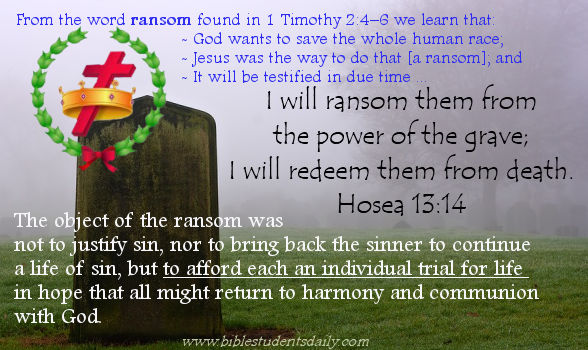
Now what about Jesus? Is God’s only begotten and firstborn son Jesus—the Messiah—also perfect, and was Jesus perfect when the Heavenly Father, Jehovah, sent him to redeem mankind from the sentence of Adamic death by paying the exact ransom (corresponding price) to be fulfilled in due time?
Here are some quotes from the Bible where we may find answers to these questions:
“Who committed no sin, nor was any deceit found in his mouth” (1 Peter 2:22).
“For we do not have a high priest who cannot sympathize with our weaknesses, but One who has been tempted in all things as we are, yet without sin“ (Hebrews 4:15).
“You know that He appeared in order to take away sins; and in Him there is no sin” (1 John 3:5).
“When Pilate saw that he was accomplishing nothing, but rather that a riot was starting, he took water and washed his hands in front of the crowd, saying, ‘I am innocent of this Man’s blood; see to that yourselves’” (Matthew 27:24).
Why did Pilate say this?
Here is why:
“Pilate came out again and said to them, ‘Behold, I am bringing Him out to you so that you may know that I find no guilt in him’” (John 19:4).
Jesus said: “And He who sent me is with me; He has not left me alone, for I always do the things that are pleasing to Him“ (John 8:29).
About Jesus, it is written: “His grave was assigned with wicked men, Yet he was with a rich man in his death, because he had done no violence, nor was there any deceit in his mouth.(Isaiah 53:9).
In 1 Peter 1:18-19, Jesus is described as “unblemished” and “spotless”: “We knowing that you were not redeemed with perishable things like silver or gold from your futile way of life inherited from your forefathers, but with precious blood, as of a lamb unblemished and spotless, the blood of Christ.”
The Apostle Paul explains, “He made him who knew no sin to be sin on our behalf, so that we might become the righteousness of God in Him” (2 Corinthians 5:21).
What do the words “to be sin on our behalf” mean?
The Apostle Peter explains what it means: that Jesus “himself bore our sins in His body on the cross, so that we might die to sin and live to righteousness; for by His wounds you were healed” (1 Peter 2:24).
How then can we as humans have peace if we are not perfect? Are we perfect in some way or another?
Jesus taught us “Be ye therefore perfect, even as your Father which is in heaven is perfect” (Matthew 5:48).
How then, can we “be… perfect,” if we were already born in sin?
From the second a human is born, we have the curse of Adamitis on us, which is the death sentence. A baby who is even a few seconds old, can die. If we were perfect, death could not touch any human and everyone could live forever as their perfect life would allow no disease nor any harm to take their life. Thus, if we are already born imperfect, how can we find perfect peace?
Let us explain.
We might not of course be able to achieve perfect peace all the time in the current imperfect bodies we have, yet we are to “be perfect” in intentions, as all fully consecrated Spirit begotten individuals are reckoned in God’s eyes as perfect, through faith in the precious blood of Christ’s righteousness and through showing God-Jehovah through one’s thoughts, words and actions just how much there is a desire to DO what is good, righteous, perfect, pure and blameless in God’s sight, to please the Heavenly Father.
It is one’s faith in believing that God can do the impossible—that He could even move an entire mountain, and trusting in God’s perfect love, justice, power and wisdom implicitly.
This isn’t just blind faith.
This isn’t just following tradition.
This isn’t an unwilling, forced upon believing for self-gain or professing faith in God to just to please someone.
In Romans 10:17, the Apostle Paul explains that faith in God and faith in all that is Godly and righteous and pure and perfect, comes from “hearing the word of God,” and once we hear it, then we are instructed to actually examine and study it (1 Thessalonians 5:21). By studying the inspired words of God in the Bible (2 Timothy 2:15) handed down through God’s holy Prophets of old and the Apostles of the first Church (after Pentecost), and by praying to the Heavenly Father with thanksgiving and earnestness of the heart (Hebrews 5:7, Matthew 6:4-6, James 5:16), striving to please God by doing His will (Romans 12:2), then maturity in the faith can be attained and maintained.
“But solid food is for the mature, for those who have their powers of discernment trained by constant practice to distinguish good from evil” (Hebrews 5:14).
What do the Scriptures say about the faith of some?
In Romans 4:3,5 we read,
“(3) Abraham believed God, and it was counted to him as righteousness. (5) And to the one who does not work but believes in him who justifies the ungodly, his faith is counted as righteousness.”
Now back to our question: Can we as mortals be classified as perfect and hence even qualify to receive perfect peace?
Here are some answers from the Bible:
“Therefore, beloved, since we have these promises, let us cleanse ourselves from everything that defiles body and spirit, perfecting holiness in the fear of God” (2 Corinthians 7:1).
“Be imitators of God, therefore, as beloved children” (Ephesians 5:1).
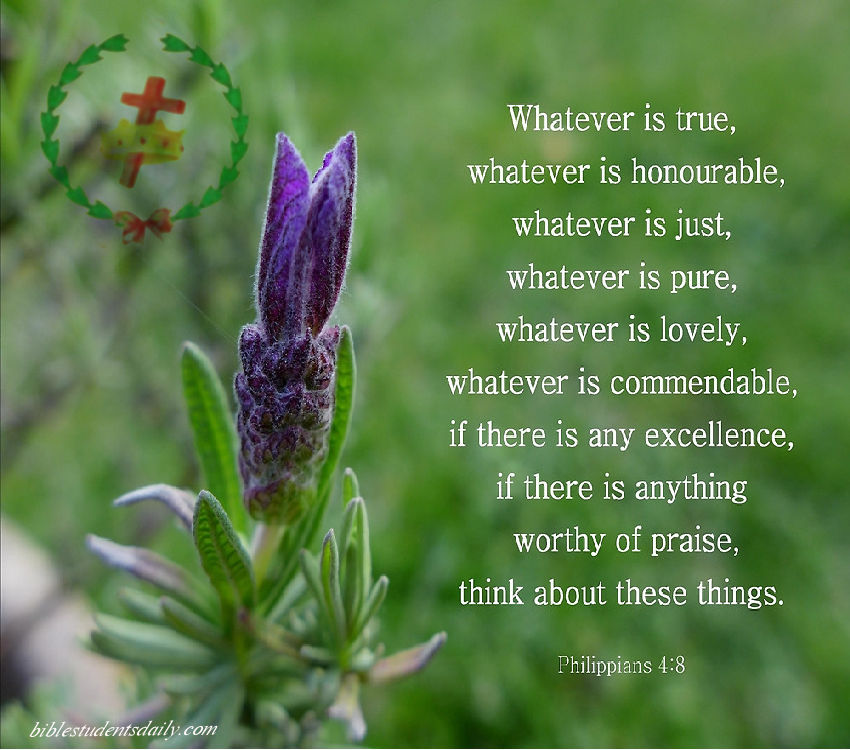
How are we doing on our climb? Let us continue taking refreshing sips of pure “water” from the purifying Word of God (Matthew 5:6) for by thinking on “whatever is true… honorable… just… pure… lovely… commendable, if there is any excellence, if there is anything worthy of praise” (Philippians 4:8) we can “take captive every thought to make it obedient to Christ” (2 Corinthians 10:5).
As we ascend, step by step, going from strength to strength (Psalm 84:7), we look ahead to what is before us (Proverbs 4:25,26, Hebrews 12:2) and patiently (Romans 12:12) with joy, press forward, towards our destination. We are reminded of the words of the Apostle Paul in Philippians 3:13-21:-
(13) Brethren, I count not myself to have apprehended: but this one thing I do, forgetting those things which are behind, and reaching forth unto those things which are before,
(14) I press toward the mark for the prize of the high calling of God in Christ Jesus.
(15) Let us therefore, as many as be perfect, be thus minded: and if in any thing ye be otherwise minded, God shall reveal even this unto you.
(16) Nevertheless, whereto we have already attained, let us walk by the same rule, let us mind the same thing.
(17) Brethren, be followers together of me, and mark them which walk so as ye have us for an ensample.
(18) For many walk, of whom I have told you often, and now tell you even weeping, that they are the enemies of the cross of Christ:
(19) Whose end is destruction, whose God is their belly, and whose glory is in their shame, who mind earthly things.)
(20) For our conversation is in heaven; from whence also we look for the Saviour, the Lord Jesus Christ:
(21) Who shall change our vile body, that it may be fashioned like unto his glorious body, according to the working whereby he is able even to subdue all things unto himself.
Let us get to the point of our original question. Where can we find perfect peace in a world surrounded by pain, sickness, tragedy and death?
The short answer is: We can find perfect peace when we stick to the path set out by God—walking in accordance to God’s rule.
What is God’s rule?
It is the commandment that Jesus taught—as a summary of all 10 commandments under the Old Law given to the nation of Israel via Moses in the Old Testament—recorded in the Gospel of John 13:34. Here Jesus said:
“(34) A new commandment I give unto you, That ye love [Strongs #25, agapao] one another; as I have loved [Strongs #25, agapao] you, that ye also love [Strongs #25, agapao] one another. (35) By this shall all men know that ye are my disciples, if ye have love [Strongs #26, agape] one to another.”
There are three different types of “love” in the world around us and in the Greek language, they are described as: agape, phileo and eros.
The word “love” here in John 13:34, 35, is translated from the Greek word “agape,“ which is an unconditional goodwill towards all men; love, benevolence, and feeling sincere kindness and good will towards our enemies and those who do harm to us, whether we classify this harm as from ignorance or not.
Agape love, thinks of others as better than one’s own self (Philippians 2:3).
In 1 John 3:15 we are explained that “Whosoever hateth his brother is a murderer: and ye know that no murderer hath eternal life abiding in him.”
What a pleasure it is to be in the midst of such who speak kindly to and about others. These are described in Psalm 92 who “flourish like the palm tree” …. who “still bring forth fruit in old age.“
In Titus 3:2 we are reminded, “to speak evil of no one, to avoid quarreling, to be gentle, and to show perfect courtesy toward all people.”
Here we are taught to rather hate the sin and AGAPE our brother and sister in Christ, since we do not have a perfect mind in the same sense that our Beloved, Christ Jesus had when he was in the flesh during his human existence.
Through meditation upon the word of God, unceasing prayer and praise to the Heavenly Father, as well as through the experiences of life, we have a privilege to learn, by God’s grace and mercy, to speak the pure language of God. The Apostle Paul exhorts us in Colossians 4:6, “Let your speech always be gracious, seasoned with salt, so that you may know how you ought to answer each person.” “Not only should our speech be liberal [i.e. free from prejudice, tolerant], temperate [marked by self-control], courteous [i.e. polite, respectful towards and considerate of others], but it should also be seasoned with salt. Salt is a figure for truth. Truth, like salt, has the power of preserving from decay that which is good and pure.We should, therefore, be well established in the truth of God’s Word, that we may be able to answer every one, giving a good Scriptural reason for both our faith and our practice” (Br. Charles T. Russell, R756).
There is a saying: “Positive begets positive.” Let positivity rule our mind by feasting on the beauties of divine Truth in the Bible— keeping our hope in Christ.

Positivity is a quality possessed in kings. How can a king rule without a vision? (Proverbs 29:18). A king has a vision and such a vision must be possessed by those developing in the School of Christ to be faithful unto death—a vision that sees the positive (Titus 1:15). We have many gloriously positive things to look forward to, which the Bible outlines: no more oppression; no more money issues in the future to cause jealousy or the need to have power; no more killing; no more struggles for food or a shelter or to feel safe or perfectly understood and loved; no more pain or sickness and no more death!
The Heavenly Father has promised a glorious future to ALL mankind as we are told in Revelation 21:4, “(4) And God shall wipe away all tears from their eyes, and there shall be no more death, neither sorrow, nor crying, neither shall there be any more pain; for the former things are passed away.”
There are passages of holy Scripture that talk about the necessity of words of warning. Here are some good examples:
“Now we exhort you, brethren, warn them [Strongs #3560, noutheteō—to caution or warn gently] that are unruly [“idle” (ESV), “lazy” (NLT), “undisciplined” (NET), “idle” and “disruptive” (NIV), “disorderly” (Rotherham’s)] comfort the feebleminded, support the weak, be patient toward all men (1 Thessalonians 5:14).
“So watch yourselves. If your brother sins, rebuke him, and if he repents, forgive him” (Luke 17:3).
We are taught in Scripture to recognize who is a True Christian by their “fruits” of character (Matthew 7:16).
The more one sees their own failures and mistakes of actions, the more one can have compassion, we hope, towards others, realizing that often the more we (agape) love, the more we share in the sufferings of Christ… and this makes the heart long more for that which the Bible promises: the day of perfection in all things when God shall be ALL in ALL and all pain, sorrow and misunderstanding shall be no more.
The Apostle Paul speaks of this time in 1 Corinthians 15:28, “And when all things shall be subdued unto him, then shall the Son also himself be subject unto him that put all things under him, that God may be all in all.”
How do we agape others and ourselves ?
HERE is where the hardest (upon the flesh) but most glorious (for the New mind in Christ) challenges lie. It is the HARDEST part of our climb up this mountain (1 Timothy 6:12)
It requires our dependency on God’s help through Christ, “and we know that in all things God works for the good of those who love him, who have been called according to his purpose” (Philippians 4:13, Romans 8:28).
A righteous love towards all men is developed from learning to love the Heavenly Father supremely as manifested in the surrendering of one’s life rights and the acquiescence and obedience to God’s will. Obedience is learnt by fixing our eyes on Christ Jesus (Hebrews 12:2)—God’s only begotten, firstborn, perfect son, who died as a ransom for ALL humanity to pay the corresponding perfect price for Adam’s sin and all of Adam’s progeny (1 Corinthians 15:22). If we compare our trials as mortals to our Lord Jesus’ trials—who was sinless yet suffered the harshest mental and physical ignomy and pain—then one’s own experiences seem trivial.
Love (agape) towards our neighbour is all about loving our brethren in Christ as if they were our own body (Romans 12:5). These are the ones who are now in training to be part of the body of Christ—the footstep followers of Christ, and members of the 144,000 and Elect Bride of CHRIST (Revelation 7:4).
If we say that we have no sin, we deceive ourselves, and the truth is not in us (1 John 1:8).
May we seek to have a character like our Lord Jesus; to have a CHRIST JESUS’ ATTITUDE.
In 1 John 2:6 we read, “The one who says he resides in God ought himself to walk just as Jesus walked.”
The Apostle Paul describes numerous Christ-like qualities of character in Philippians 2:1-11:-
“(1) Therefore if there is any encouragement in Christ, if there is any consolation of love, if there is any fellowship of the Spirit, if any affection and compassion,
(2) make my joy complete by being of the same mind, maintaining the same (agape) love, united in spirit, intent on one purpose.
(3) Do nothing from selfishness or empty conceit, but with humility of mind regard one another as more important than yourselves;
(4) do not merely look out for your own personal interests, but also for the interests of others.
(5) Have this attitude in yourselves which was also in Christ Jesus,
(6) who, although He existed in the form of God, did not regard equality with God a thing to be grasped,
(7) but emptied Himself, taking the form of a bond-servant, and being made in the likeness of men.
(8) Being found in appearance as a man, He humbled Himself by becoming obedient to the point of death, even death on a cross.
(9) For this reason also, God highly exalted Him, and bestowed on Him the name which is above every name,
(10) so that at the name of Jesus every knee will bow, of those who are in heaven and on earth and under the earth
(11) and that every tongue will confess that Jesus Christ is Lord, to the glory of God the Father.”
The above words are also beautifully summarized in Galatians 5:22-23, “But the fruit of the Spirit is love, joy, peace, longsuffering, gentleness, goodness, faith, meekness, temperance: against such there is no law.”
We are finally approaching our destination, so let us cheer each other onward and upward as to our goal we proceed with great joy and full faith, that we shall see with our eyes what we have longed to see! (1 John 3:2,3, 1 Corinthians 13:12, 13)
In Galatians 6:16 we are told, “And as many as walk according to this rule, peace be on them and mercy.”
Again we ask, what “rule” is the Apostle Paul talking about, which he teaches us, may give us perfect peace… and not only peace but also mercy form God?
It is the rule of a new mind… a “new creature” in Christ mentioned in the preceding verse—“For in Christ Jesus neither circumcision availeth anything, nor uncircumcision, but a new creature.“
You see forms and ceremonies (just following blindly a religious ritual or offering sacrifices year after year, or week after week) are not the rule, but the new life in Christ, the new creature filled with the holy spirit of God and led of the spirit.
The rule is to “walk in the spirit,” says the Apostle, “and ye shall not fulfil the lust of the flesh; for the flesh lusteth against the spirit, and the spirit against the flesh: and these are contrary the one to the other” (Galatians 5:16,17).
Those who walk by this rule are promised peace (Philippians 4:7) and mercy. Our best efforts to walk after the leading of the holy Spirit will be imperfect in the flesh but God who judges our heart’s, desires, and efforts is merciful and will not allow us to experience one second more than what we’re able to bear (Romans 8:28).
Now if any man be in Christ, a new creature, he has put away the old man—the carnal nature, which is enmity against God and is not subject to the law of God, neither indeed can be—with all his evil deeds, which the apostle thus enumerates in Galatians 5:19-21,
“Now the works of the flesh [the carnal nature] are manifest, which are these: adultery, fornication, uncleanness, idolatry, witchcraft, hatred, variance, emulations, wrath, strife, seditions, heresies, envyings, murders, drunkenness, revellings and such like, of the which I tell you before, as I have also told you in time past, that they which do such things shall not inherit the kingdom of God.”
The Apostle gives fair warning that those who do such things, no matter how loud may be their professions, have no inheritance in the Kingdom of God; and therefore they have no right to the fellowship of the saints upon whom, and the cause of Christ in general, they bring only DIS-grace.
They that are Christ’s have crucified the flesh with the affections and desires.
If we are living according to the rule of the new nature, following the leading of the spirit of God, then we must have these fruits in some measure, even from the very start of our Christian experience; and if we are following on to know the Lord and to walk in the spirit, these fruits are surely growing and becoming more and more manifest to all with whom we are associated.
If those who are in Christ would observe this principle, and deal with each other as new creatures, much discord would be avoided; for the motives and endeavors of the “new creature” would be considered, and not the frailties or mistakes of the “earthen vessel.” (Reprints of the Original Watchtower 1840)
Reaching the Summit!
Friends, here we are at last! Here is the spectacular panoramic view from the summit top! Like an eagle (Isaiah 40:31) majestically soaring the lofy heights of grandeur that surround, so too, the fully consecrated of the Lord “soar” above the storms of life… their resting place is in the shelter of the Most High—God’s “throne of grace” which is approached with confidence to receive mercy and find grace to help in time of need (Hebrews 4:16).
“And this is the confidence that we have toward him, that if we ask anything according to his will he hears us” (1 John 5:14).
God’s perfect peace comes from sweet communion with the Heavenly Father and His Son, Christ Jesus.

The peace of God that surpasses all understanding is a truly blessed gift from God which stems from an appreciation of God’s character and striving to copy these same qualities of character and dispositions of mind and heart, in order to gain God’s approval.
It is true to say that all men have lost much of the original likeness of God, but this does not alter the fact that they still crave the happiness and peace which can never be found except under the natural, original relations to his Creator.
Dear friends,
No matter how deep we may sink in sin …
No matter how far we may stray from the path of rectitude…
No matter how low and vile we may have become…
We still need to remember that we are all members of that noble though fallen human race and that God-Jehovah created us in His own likeness, and God knows and feels our degradation. He knows that He made us for higher and nobler ends than those toward which He is ever tending.

In this painful realization of the absence of true happiness and peace of mind and heart, we humans tend to seek happiness and peace in ways in harmony with the more or less depraved tendencies of the fallen nature—in the poor substitutes which pride, ambition, strife, rivalry, wealth, fame, power, etc., have to offer; but we find that the happiness in these is only delusive, and at most VERY SHORT-LIVED!
The bubble of success may burst in an instant, and the peace and happiness built upon it be utterly wrecked.
“There is no peace, therefore, to any man except in the reestablished relationship between himself and his God. And since this relationship of sons can ONLY be reestablished through Christ, there is no peace to any man out of Christ. ”
Pastor Charles Taze Russell.
“There is no peace, saith the Lord, to the wicked” (Isaiah 48:22).
“Let us follow the things that make for peace.”

Acknowledgment
Br Charles T. Russell, Reprint 1840
Suggested Further Reading
What is LOVE?https://biblestudentsdaily.com/2016/03/20/what-is-love/
THE BIBLE – The World’s Best Novel. Here is Why.https://biblestudentsdaily.com/2017/07/26/the-bible-the-worlds-best-novel-here-is-why/
His Loving Kindness https://biblestudentsdaily.com/2018/06/19/his-loving-kindness-hymns-of-dawn-no-19/
HAGGAI 2:7—The Desire of All Nations Shall Comehttps://biblestudentsdaily.com/2017/08/29/haggai-27-the-desire-of-all-nations-shall-come/
This post’s URL:
https://biblestudentsdaily.com/2016/06/16/let-us-go-on-a-journey-where-we-shall-find-perfect-peace-are-you-ready/




 BIBLE Students DAILY