Two Canary & Sparrow Stories

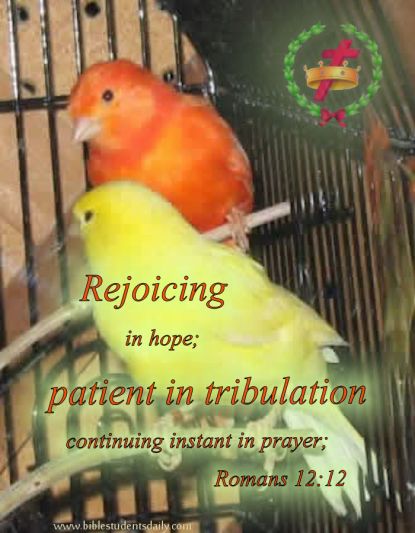
Romans 12, 12 with address.jpg

Story 1: The Canary and the Sparrows

A story is told of a gentleman who had a beautiful singing canary. A friend wanted to try if he could teach his sparrows to sing by keeping the canary with them. He borrowed it, and placed it in the cage with his sparrows.

Instead, however, of teaching them to sing, the poor bird got so timid among the strange birds that it stopped singing altogether, and did nothing but chirp like the sparrows. The owner then took it back; but still it would not sing.

It then occurred to him to put it beside another canary, which sang well. This had the desired effect, and, regaining the old note, it sang as beautifully as ever.

Many Christians go, like the canary, into the strange company and atmosphere of the worldlings, and consequently they not only do not teach the world to sing their happy, glorious note of praise, but they cannot sing the old songs of praise in a strange land themselves, and soon they learn the sorrowful note of the world.

The best thing for such is to go back again into the more friendly, warm, encouraging and spiritually edifying society of happy, rejoicing Christian saints, among whom they will soon learn to sing the glorious notes of praise again, making melody in their hearts. 

“For where two or three are gathered together in my name, there am I in the midst of them” (Matthew 18:20, KJV).

Other Bible Texts to consider:

  • Bad company corrupts good character” (1 Corinthians 15:33, NIV).
  • 15 Be very careful, then, how you live–not as unwise but as wise, 16 making the most of every opportunity, because the days are evil. 17 Therefore do not be foolish, but understand what the Lord’s will is. 18 Do not get drunk on wine, which leads to debauchery. Instead, be filled with the Spirit, 19 speaking to one another with psalms, hymns, and songs from the Spirit. Sing and make music from your heart to the Lord, 20 always giving thanks to God the Father for everything, in the name of our Lord Jesus Christ” (Ephesians 5:15-20, NIV).
  • 24 And let us consider one another to provoke unto love and to good works: 25 Not forsaking the assembling of ourselves together, as the manner of some is; but exhorting one another: and so much the more, as ye see the day approaching” (Hebrews 10:24-25, KJV).
  • Finally, brethren, whatsoever things are true, whatsoever things are honest, whatsoever things are just, whatsoever things are pure, whatsoever things are lovely, whatsoever things are of good report; if there be any virtue, and if there be any praise, think on these things” (Philippians 4:8, KJV).
  • “Therefore encourage one another and build one another up, just as you are doing” (1 Thessalonians 5:11, ESV).
  • “Let the word of Christ dwell in you richly, teaching and admonishing one another in all wisdom, singing psalms and hymns and spiritual songs, with thankfulness in your hearts to God” (Colossians 3:16, ESV). 

110321.jpg

Are two canaries always content being together? We would hope so.

Are we content with the circumstances in our lives? 

Let our answer be YES as we daily surrender the fleshly preferences and exchange them for seeking and doing our Heavenly Father’s will, being living sacrifices “holy and acceptable to God” (Romans 12:1).

What if there be misunderstandings between our brothers and sisters in Christ?

As we are on trial for glory, honor and immortality, our test is to overcome our weaknesses of character and rather, to develop agape love towards our brethren, TRUST and reliance on God and patient cheerful endurance, learning to do the will of the Heavenly Father who knows best what we each need to develop in our characters, so that we can become “more precious than gold” to our Heavenly Father, and be heirs of God and fellow heirs with Christ, provided we suffer with him in order that we may also be glorified with him” (Romans 8:17).

IMG_7671

NO TRIAL OR TEST IS FOREVER. 

It is your faith that is on trial now.

In the calmer days, when the sun of favor shone brightly upon you, you were quietly laying the foundation of a knowledge of the Truth, and rearing the superstructure of Christian character.

Now you are in the furnace to be proved…

Summon therefore ALL your courage; fortify your patience; nerve yourself to endurance; hold fast to your hope; call to mind the promises, they are still yours; and “cast not away your confidence, which hath great recompense of reward” (Hebrews 10:35).

“In quietness and confidence shall be your strength” (Isaiah 30:15).

“Rest in the Lord, and wait patiently for Him” (Psalm 37:7) and faith has gained her victory.

 “57 But thanks be to God, which giveth us the victory through our Lord Jesus Christ. 58 Therefore, my beloved brethren, be ye stedfast, unmoveable, always abounding in the work of the Lord, forasmuch as ye know that your labour is not in vain in the Lord” (1 Corinthians 15:57-58, KJV).

“37 Nay, in all these things we are more than conquerors through him that loved us(Romans 8:37, KJV). 

*****

Story 2 – The Canary and the Sparrow

There once was a canary who would sing the most beautiful song during the day. This was so because he lived in a beautiful cage. His master brought him fresh water to drink and bathe in every morning. On top of this, he was fed the finest food. His house was set by the window with the best view and when the weather was pleasant, he would be refreshed by the fragrant breeze of the open window.

On a certain sunny day, a stray sparrow flew up to the window sill. He heard the song of the canary and then listened for a time. After a while he spoke and said, “Why are you singing so cheerfully since you are such a poor bird?” “What do you mean?” demanded the canary. “You live a confined life where your world is so small without any freedom,” answered the sparrow. “Your prison is so restricted, you can’t even try out your wings. Whereas, look at me… I can fly freely around” and then the sparrow flew up to the top of the neighbor’s house and back again, adding, “You surely are a poor bird.” Then the sparrow flew off without looking back.

After watching him fly off, the canary then looked at the bars on his cage. They wouldn’t move and he yearned to see a little more of the world around him very much. He started thinking more and more about his limited life, and soon became sad.

Before long, he lost his song. The next morning, his master brought him fresh, clean water for both drinking from and bathing in, but the bright yellow canary paid no attention. He stopped eating any of the delicious food prepared just for him and as the days went on, his head begun to hang down lower and lower and not one chirp or whistle came out of him.

The once happy canary had now become worse and not better and was truly a poor bird.

Then one bright morning, the sparrow reappeared as suddenly as he disappeared. He stopped and looked at the canary for a while. However the yellow bird with his head bowed low and filled with sadness, took no notice. The sparrow finally broke the silence and said, “What is wrong with you?” But the canary would not answer.

The sparrow now spoke with contempt, “You are even a poorer bird than I first thought.” Then, just as he was about to say something else to insult the canary, a cat jumped up on the window sill and caught the sparrow. The sparrow cried out for help, but there was no one who could help him. Then right before the canary’s eyes, the cat dined on the sparrow for lunch. When the cat had finished eating, he tried to get the canary also, but the bright, gold bars on his cage wouldn’t let him through.

When the canary’s master then heard the commotion, he briskly chased the cruel cat away.

After everything settled down and peace was restored again, the canary began to consider what had happened.

His cage protected him from his enemies, while the sparrow had no protection and was now dead. The canary had a master who cared for his welfare, meeting all his needs. The canary looked at the bars around him… he viewed the clean water to drink and bathe in, and gazed at the most delicious food for him to eat… and after thinking a long time, he decided he wasn’t poor anymore, but rather the richest and happiest of all birds. Understanding such great truth, he raised his most beautiful, yellow head and began to sing the most beautiful song!

Let us consider how much our heavenly Father lovingly cares for us, meeting ALL OUR NEEDS for our highest spiritual welfare!(Philippians 4:19)

Like the canary, we are protected from the Adversary—who, like the cat in this story—“prowls around like a roaring lion, seeking someone to devour.”  The Apostle Peter warns the Christians of the early Church to “be of sober spirit [serious], be on the alert” (1 Peter 5:8).

Some may say we are confined and restricted because of our consecration vows unto the Lord in following Christ and because of our strict training & disciplinary lives as we fight the good fight of faith and run in the race of the High Calling in such a way as to win— be more than overcomers (1 Corinthians 9:25)

Perhaps one could say, this is the strictest training school ever in existence because it is one which guarantees the highest reward—it guarantees glory, honor and immortality for eternal eternities in the Divine Realm if one patiently endures faithfully unto death (Romans 2:7).

Should you ever want to be like the sparrow in this story—seeking for earthly comfort … Or if you ever feel “caged in” or think the grass is greener on the other side” then it will help to remember what happened to the sparrow—he was caught and devoured by his enemy!

In a similar way, the Adversary will not be content until you are completely destroyed and your life is ruined!

Let us remember that when Satan tells us, “You are truly the poorest person without any freedom, with the most severest experiences which you do not deserve … there is something better than this for you now to experience… this life is about being free and having lots of fun etc.,” he is a liar!

Let us obey God’s Divine Principle of RIGHTEOUSNESS and sing our song of greatest JOY IN THE LORD reminding others & ourselves that we are the richest of all children because God is our Almighty Father who gives us only that which will work out for good. 

Let us declare the praises of him who called us out of darkness into His marvelous light (1 Peter 2:9). 

The Heavenly Father through Christ has promised a crown of life to those who are faithful to Him until death (Revelation 2:10).

Since we have surrendered our entire will to do the heavenly  Father’s Divine will in all, we cannot bemoan or wish for anything other than what our heavenly Father’s Perfect will IS and whatever His overruling providence has permitted, knowing that GOD IS THE GIVER OF EVERYTHING THAT IS GOOD (James 1:17).

Let us end with the exhortation of the Apostle Peter in 2 Peter 1:3-15.

“3 His divine power has granted to us everything pertaining to life and godliness, through the true knowledge of Him who called us by His own glory and excellence. 4 For by these He has granted to us His precious and magnificent promises, so that by them you may become partakers of the divine nature, having escaped the corruption that is in the world by lust. 5 Now for this very reason also, applying all diligence, in your faith supply moral excellence, and in your moral excellence, knowledge, 6 and in your knowledge, self-control, and in your self-control, perseverance, and in your perseverance, godliness, 7 and in your godliness, brotherly kindness, and in your brotherly kindness, love. 8 For if these qualities are yours and are increasing, they render you neither useless nor unfruitful in the true knowledge of our Lord Jesus Christ. 9 For he who lacks these qualities is blind or short-sighted, having forgotten his purification from his former sins. 10 Therefore, brethren, be all the more diligent to make certain about His calling and choosing you; for as long as you practice these things, you will never stumble; 11 for in this way the entrance into the eternal kingdom of our Lord and Savior Jesus Christ will be abundantly supplied to you. 12 Therefore, I will always be ready to remind you of these things, even though you already know them, and have been established in the truth which is present with you. 13 I consider it right, as long as I am in this earthly dwelling, to stir you up by way of reminder, 14 knowing that the laying aside of my earthly dwelling is imminent, as also our Lord Jesus Christ has made clear to me. And I will also be diligent that at any time after my departure you will be able to call these things to mind.”

His Eye is On the Sparrow

References:

Story 1 – R.878 (Reprints of the Original Watchtower and Herald of Christ’s presence); Bible Students Daily Heavenly Manna Book – June 4th

The URL for this post: https://biblestudentsdaily.com/2016/07/21/the-canary-and-the-sparrows/

Enter your email address to subscribe to this blog and receive notifications of new posts by email.


Save

Save

Save

Save
Isaiah 45:15 – A GOD Who Hides Himself

ISA. 45, 15.jpg

Have you ever thought that God has withdrawn his favor from you?

Have you ever questioned… Is God really still dealing with me on a personal level, like His daughter/son?

We think to ourselves, could I really be in such a bad spiritually state?

We question ourselves:

Why could God be hiding from me?

In Isaiah 45:15 (NASV) we read, Truly, You are a God who hides Himself, O God of Israel, Savior!”

Here we note that hiding from man, is one of God’s attributes. Is it because we have done something to displease the Lord, and where God disapproves of our actions? Perhaps in such a situation, we find we don’t have the prayer life anymore or one that we would wish to have where there is ease of communication without guilt or feeling unworthy. Or, we may be saying to ourselves “my life is no different than that of the world around me.”

So when we can’t distinguish any difference in our life then in the life of a person who has not given himself to the Lord then we say “there is no specific purpose to my individual experiences compared to another person in the world.”

Or, perhaps our experiences feel like they no longer have any spiritual meaning when we can’t identify what the experiences are for, and we get into a rut; when our experiences mean I am merely just existing or surviving this experience and I know I am just existing because I experience, but I cannot identify with me this experience spiritually.

Maybe we recognize that for most of us, when we grasped the Truth, we had a great outburst of emotion for it — we loved it; we were enthused about it; we talked about it; we were excited about it and when we heard a discourse we would get goose bumps from joy! And all of a sudden we come to a place where that is no longer true. We just go to meeting because it’s a habit and we expose ourselves to creation experiences which we are sort of glad about having, but beyond that, there is no quickening of the heart beat.

Here are some possible reasons WHY we may experience that God has hidden himself from us:-

(A) God wishes to AWAKE US TO RIGHTEOUSNESS

It is good to remember that when it comes to God’s dealing with anyone, they are never intended to be a harsh, burdensome experience but God’s aim of  allowing certain trying experiences in our lives, is for the purpose of CORRECTING a situation…. correction of action … and ultimately to correct our character so that we may learn to be perfect  (Matthew 5:48) – that is, “reckoned as righteous” through our Faith (see Romans Chapter 4) and LOVE RIGHTEOUSNESS (Hebrews 1:9) so that we can be used in His future kingdom as administrators of the blessings to all the world of mankind – teaching mankind how to walk up the Highway of Holiness, having attained to the highest levels while going through the experiences of the Gospel Age now, while the permission of evil abounds.

In Hebrews 12:6, Apostle Paul writes, “For the Lord disciplines the one he loves, and chastises every son whom he receives.”

The chastenings of the Lord are not necessarily designed for punishment, but rather for discipline. They are necessary as a part of our training, and to test our humility before the Lord, and our loyalty to him. Peter wrote, “Humble yourselves therefore under the mighty hand of God, that he may exalt you in due time” (1 Peter 5:6). This is what it means to be “patient in tribulation” (Rom.12:12); and if we are thus patient we will rejoice in a hope which “maketh not ashamed.”

In Ephesians 6:4 (ESV) we read, Fathers, do not provoke your children to anger, but bring them up in the discipline and instruction of the Lord.”

Our Heavenly Father does not deal with all in this manner but only with some, His sons.

He thus dealt with our Lord Jesus — “the captain of our salvation” — as he lived in this world of sin and suffered the “contradiction of sinners against Himself.” For, “what son is he whom the Father chasteneth not?” (Hebrews 2:7).

 So the apostle admonishes that we “look unto Him” lest we become weary and faint in our minds (Hebrews 2:2,3). The rigors and the discipline to which a well-trained child is subjected by a loving father may at times seem irksome, unpleasant and painful, but it is for the ultimate good and development of the child in every sense. So it is in the life of the child of GOD but in a perfect manner.

The tests of faith, of fidelity, of love for God and righteousness, of obedience, of patient endurance and suffering wrongfully, the discipline of the Word under adversity, the submission in love to the Father’s will, and an awareness of the guidance of the Spirit, are some aspects of the Father’s discipline as He trains us for the purpose He has in view.

These are all tangible evidences of the heavenly Father’s love and concern. Like those to whom the apostle wrote, we also tend to forget this when the way is hard and difficult. Frustrations, pressures, and perplexities surround us. “Ye have forgotten” says the apostle, “the exhortation that speaketh unto you as unto sons” (Hebrews 2:5).

If we remember this always, we will rejoice even when all things seem to be against us as we earnestly seek to do His will, inasmuch as we know we are under His loving hand.

The life of the child of God, wholly surrendered to Him and to Christ, is an entirely new life, in and of Godly character, under the Father’s influence, control and leading, the Heavenly Father’s constant special and infinite care for our training in the principles of His laws, so that, we can be ministers of these laws and processes of training for all humanity.

We are “hid with Christ in God” (Romans 8:1-4; 8:14, 28; John 1:13; 16:27; Luke 12:4-7, 22-32; 1 Peter 5:6, 7; Colossians 3:1-4). Sometimes the Father withholds or hides Himself in order that the depth of our longing and love for Him and for Christ may be put to the test, that we may be conscious of a sense of loss, that me may yearn for Him and learn to fully depend on Him to reveal Himself more fully in all His love and tenderness.

God may withdraw His favor to awaken us to the situation that we have begun to slip or that we are near the point of slipping and that we need to reassert ourselves spiritually. The best example of this in the Bible, is when we look at the account of Queen Esther.

In the 4th chapter of the Book of Esther, we are told that Esther, (who had become the Queen of the Persian empire), had now an enemy against her uncle Mordecai and all the Jewish people (so this would include her, as she was Jewish). A man named Haman had become a chief counselor of the empire and had put into motion a plan that would mean the destruction of every Jew throughout the Medo-Persian empire. Mordecai realizes this; he tears his clothes; he puts on sack cloths and ashes, and he sits in mourning. Esther’s initial response is documented in Esther 4:4, “So Esther’s maids and her chamberlains came and told it her. Then was the queen exceedingly grieved; and she sent raiment to clothe Mordecai, and to take away his sackcloth from him: but he received it not.”

So we can see that Esther’s first response is “let us stop mourning; let us not face the reality of the problems that we have.” Esther’s initial reaction is not a good reaction. Her reaction is one of not comprehending the true danger of the situation. It is Mordecai who wakens her to the danger by mentioning one thing specifically and that is, that this is not a danger, remote to someone else; it is, that YOUR VERY LIFE IS AT STAKE! YOU TOO, won’t escape this! You too, are Jewish and so your in just as much danger of death as I am in and all the rest of our people, the Jews, are in. But then Esther experiences the alienation that she has already experiences from the King himself and this is noticed in Esther 4:11, where she is speaking to Hathach, one of the King’s eunuchs assigned to attend her, and instructs him to say to Mordecai.

“All the king’s servants and the people of the king’s provinces know that if any man or woman goes to the king inside the inner court without being called, there is but one law—to be put to death, except the one to whom the king holds out the golden scepter so that he may live. But as for me, I have not been called to come in to the king these thirty days” (Esther 4:11).

Esther realizes that she has become estranged from the King and notice, that she says, as if “I am free to go to him but if I go to him without being invited to, by him, then I am afraid my life may be at stake even earlier because I have been so presumptuous to come to him.”

We may experience this too, in our spiritual lives as consecrated. We may at some point in our spiritual walk feel like we do not feel free to go to our Heavenly Father. We feel “I am not bidden to come to God anymore or feel God is not communicating with me anymore; that God has hidden Himself from me (just like King Xerxes has from Esther), Jehovah God has hidden himself for the past perhaps 30 days too, and we don’t feel we can go and plead our cause.

And this is what Mordecai is bringing out to Esther — the reason for Him hiding. He is saying, “remember Esther … You’re life is at stake! You think you will die if you go to the King … I know you will die if you do not go!”

So in our lives God may bring us to this point in our lives to show us that if we don’t continuously communicate with Him, then we WILL DIE!

You know dear friends, there is a far greater then Haman out there looking to kill us … that is… a “Haman” who is called Satan. Satan wishes to kill our New Creature developing in us — the embryonic New Creation which is developing into maturity until the Jesus agape love in us, overflows towards our beloved brethren and our will becomes dead to self but alive in Christ — being crucified in ALL we think and do, having our minds super-glued on Christ Jesus no matter how ridiculous we sound to the world or how humiliated we are for striving to conform to the LIKENESS OF OUR LORD JESUS.

Dear brethren in Christ, as we are now on an arena and we are a spectacle unto angels and men, let us endure it with great Joy in our Hope that promised for the faithful unto death isn’t just eternal life in perfect conditions, but IMMORTAL life and those who suffer with CHRIST for doing good now, shall reign with CHRIST. They are those who grow into the maturity in Christ, learning and CUTTING OFF and TURN AWAY from sin -from mistakes made in blind ignorance according to any uniquely individual situation allowed by God, and turning completely away from past errors, learning to well appreciate the failings of all their brethren and the world through their own experiences of enduring the sacrificial experiences as prospective Bride of Christ members, and learning to only FULLY depend on and seek out their Heavenly Father’ will in ALL.

So this experience is to help bring us back to the place where we will come and pour out our hearts to our Heavenly Father, but in doing it, we face that one big emotional problem: that problem of … “well I can’t do this because I’ve gotten out of the habit … I don’t have that feeling anymore.” And that’s when we have to awaken to the righteousness that says, “even if I don’t feel comfortable in praying to God, if I don’t do it, the result is certainly DISASTROUS! If I do do this, then there is the ONE and the ONLY potential of overcoming in doing this and as we come to the remedies we’ll find that the first remedy, is the remedy suggested by the first cause, and that is PRAYER.

PRAYER is the beginning of the remedy even though it may be the very hardest to apply when we feel estranged from the Lord individually.

This situation of Queen Esther’s, may remind us of a certain class in the Bible; a class mentioned in the prophecy of Jeremiah 8; a class that ends up saying “the harvest has ended the summer is passed and we are not saved.” That class that speaks those words in Jeremiah 8:20, in Jeremiah 8:11 said that the reason for their punishment is because they said “they have healed the wound of my people lightly, saying, ‘Peace, peace,’ when there is no peace.”

Is this not the very thing that Esther was doing! Esther was telling Mordecai “your problem is you need to get out of your sack clothes … You need new clothes.” And Mordecai was telling her that’s like saying “peace, peace when there is no peace.” That is not the problem but rather is the symptom. The problem was that she needed to approach the King on behalf of Israel.

And so the alienation we sometimes feel is to awaken us to the deeper problems that lie there to bring us to the Lord not to solve the alienation but to solve a deeper problem; to find out what it is to not keep us away.

(B) God may hide himself from us, to teach us FAITH, TRUST and RELIANCE upon Him through Jesus Christ, our Master and King.

Sometimes our Heavenly Father teaches us that our life isn’t different from anybody else’s or to bring us to a place where we can’t see any purpose from an experience, He then says,

“That’s when YOU NEED TO TRUST IN ME when you can’t trace Me.” This is brought out beautifully in Job 23: 3-5,8,9,15 (NIV) and this pin-points the problem.

(3-5) If only I knew where to find Him; if only I could go to His dwelling! I would state my case before Him and fill my mouth with arguments. I would find out what He would answer me, and consider what He would say to me.”

(8-9) “But if I go to the east, He is not there; if I go to the west, I do not find Him. When He is at work in the north, I do not see Him; when he turns to the south, I catch no glimpse of Him.”

(11) “My feet have closely followed His steps; I have kept to His way without turning aside.”

This is a sad set of scriptures. Job looks everywhere for God, yet cannot find God to feel that He is with him in his experiences at a time of experiencing so much pain and misery. These experiences seem over his head and as a result, Job was beginning to sink in the experiences he had. It isn’t until later in the Book of Job, that Job starts swimming upward again and begins getting over these experiences.

In Job chapter 23: 3-5, Job wanted to find God to plead his case before God.

Let’s look at verse 6 & 7 to fill in some answers.

(6) “Would He vigorously oppose me? No, He would not press charges against me. (7) There the upright can establish their innocence before Him, and there I would be delivered forever from my judge.”

In verse 6, Job realizes if he could find God, he would find Him a Merciful God, who would give him strength.
In verse 7 is the realization that if we feel we have lost God, we firstly need to find our Advocate — the one who pleads on our behalf! We know it is our Beloved, Precious Jesus who is the Best Lawyer in the whole universe!

When we feel we have lost our ability to approach God then more than ever we feel “if only someone spoke God’s language and could get through to Him for me”, and that is exactly what Jesus does! And Job was as if saying, “if only Jesus would argue for me … if I could just enlist the upright one on my side, then he would deliver me from this judgement forever … Then I would be over this particular experience”.

So friends, IT IS FINDING THE UPRIGHT ONE, JESUS, IN OUR LIVES.

And Job says he can’t. He goes upward, downward, backward, front, and simply can’t find him. So now let’s look at verses 10 & 12:

(10) “But He knows the way that I take; when He has tested me, I will come forth as gold.”
(12) I have not departed from the commands of His lips; I have treasured the words of His mouth more than my daily bread.”

So just like Job highlights through these words of his, let us look for the realization that even though we feel God is hiding himself from us for a brief moment, He knows exactly where we are and has not departed from us, and it is HE who FIRST FOUND US, called out us of darkness into His marvelous light, and adopted us as we are told in Ephesians 1:5 (NLT). God decided in advance to adopt us into His own family by bringing us to Himself through Jesus Christ. This is what He wanted to do, and it gave Him great pleasure.”

God wishes for us to develop faith in Him, that He is taking charge in our life and to TRUST COMPLETELY in Him.

In verse 11 & 12, Job says what he felt he had done, and they are a stimulus to us about things WE MUST DO to feel this pull to our Heavenly Father. We must trust and be convinced that God will pull us through and make us more than gold IF:

1.      Our feet will hold to His steps;
2.      His way we keep and do not decline;
3.      We do not go back from the commandment of His lips;
4.      We esteem the words of His mouth more than necessary food.

It is at this point God is telling us we will be in a good place IF WE DO OUR PART. God is saying, “I’m putting you in a place where you can’t see Me, but if you just do your responsibilities then trust that then I will do what I promise to do and bring you closer to Me.”

And Job tells why he’s so confident in Job 23: 13-14. “But He stands alone, and who can oppose Him? He does whatever He pleases. He carries out His decree against me, and many such plans He still has in store.”

The Leeser’s Jewish Bible translation of Job 23:14 reads, He will bring to completion what is destined for me.”

Each one of the Church of the Body of Christ members (that’s you and me dear brethren) are being trained and fitted for a peculiar specific and each different part of the body that requires a different treatment. I can’t be treated in exactly the same way as Sister X, Y or Z or Brother A, B or C as we each need specific experiences and as we come into these experiences as their all different, we don’t see what the end result is, and God’s saying to us, “the reason I give you these experiences is because I want you to have confidence that I KNOW BEST what the end result should be and so I’m not going to let you see what this end result is, so that you will learn that my hand will lead you through this to safely overcome and develop a Christlike character that I require from you, so that I can present you to my Son when I’m through with you.”

It will take every inch of TRUST, of DISCIPLINE over the mind, and FAITH. It will require us to LAY DOWN OUR COMPLETE UTTER ALL for God to direct us now so we can prove to Him our LOYALTY to God’s PRINCIPLES OF RIGHTEOUSNESS so that we can receive the Highest possible reward because of proving to God that we please Him through overcoming the most unfavorable circumstances of the permission of evil.

And the end of this verse is saying that just like God has this kind of experience in store, so HE has other experiences for us also.

Now, the hiding of God’s face is only one tool in His tool box. 

The heavenly Father has tools of throwing His arms around us too!

At other times in our walk up towards spiritual Holy “Mount Zion”, God is showing us, that He really likes what we are doing.

God gives us His tools of directing us, just when we need that direction.
Our Divine Father testing us to the words we sing in that hymn,

“I’d rather walk in the dark with God,

than go alone in the light”. 

So would you really? That is what God is TESTING.

God is as if saying, “Are you willing to really walk in the dark with me when you can’t see the next step? Will you trust to take the steps in the dark and know that it will lead to gold? Would you really rather walk by Faith then walk by sight? Show me how”.

Let us look at one more thing here. Job’s attitude in Job 10:2. Even to day is my complaint bitter: my stroke is heavier than my groaning.”

This same word “bitter” is used in Deuteronomy 31:27. “For I know thy rebellion…?” The word “rebellion” here, is the same word as the one written as “bitter” in Job 23:2.

Job in verse 2 is saying, ” I just want to argue with God and show and explain to Him that this hiding from me just isn’t fair!”

This attitude is the one God is trying to correct, to bring us into a complacent one that Job shows and had in Job 23:10.

(C) God may hide himself to TEST THE SINCERITY OF OUR CONSECRATION.

How much easier it is to say “whatever your will God, I’ll do it!” but then when hammered down as life unfold, through the Christian pilgrimage to our heavenly home, how easy is it to accept our Heavenly Father’s will when we experience agonizing experiences of pain, sickness & disease, and death?

When we first made our consecration, it may have been far more easily said “God may it be your will”, yet we learn to understand what this means ONLY through the BIGGEST BLESSING OF ALL that follow: LIFE; EXPERIENCE; PHYSICAL and MENTAL PAIN, and /or SICKNESS, and SUFFERING.

We now see that being a soldier in the Lord’s army takes every inch of mental and physical energy that we have into the fight for the victory of being a member of the 144,000!

Never give up!

Never, never, never give up!

A martyr means “a witness” and to be a witness of CHRIST will cost us our ENTIRE ALL not just half of us… No way! God doesn’t want a lukewarm CHRISTIAN as a King to reign with His Son Jesus in future… God does not want a COLD Christian either who has a non- repentant or non-forgiving heart… God WANTS A ZEALOUS follower of Christ who shall defend JESUS and those who are His; who have professed consecrating into Christ, to the best of their human abilities -seeing them all as better than self (Phil. 2:3).

So our tools to overcoming is prayer and the studying of Holy Scriptures every day and immersing the mind into Scripture at every point you have even if it’s a few minutes here or there then do that! ALL our time is consecrated unto the Lord so we no longer even own it, as we lay down our ALL on the altar of sacrifice daily, and daily seek to fulfill our covenant sacrifice until death.

Never stop to rest from activity in the Lord’s service, even for one minute!

Don’t ever think the battle is won till faithful until death!

By hiding himself, God is in fact asking us “are you willing to take a path where you now can no longer identify with me, where you find your confused and say God how does this experience identify with me?”

This was the test our Lord Jesus experienced too. Remember when Jesus hung on the cross, for the first time he did not call God “Father but said:

 “Eli, Eli, lema sabachthani?”

that is,

“My God, my God, Why have you forsaken me?” (Matthew 27:46).

Jesus felt our Divine Father’s face hidden from him!

Look at the depth that Jesus felt this experience …

I mean here is a PERFECT human, the Son of the Almighty Jehovah God, who had had a prior relationship with the Father when he was the Logos in his pre-human existence. Jesus knew God intimately!

God was testing our Lord Jesus to the very depth of his consecration. Could he take that alienation? In Jesus case, the experience was very temporary. It had to be, as his life was very temporary; it was only a more few hours on the cross and so at last his life WAS RESTORED and Jesus’s last words (which were called out by him in a loud voice) were,

Father, into your hands I commit my spirit.” When he had said this, he breathed his last” (Luke 23:46).

God had tested Jesus to the point of seeing if Jesus would really take and accept any experience, even the experience of turning his back on Jesus, turning away from him so that he could not even see the Father’s face.

(D) God may hid himself from us to TEACH US leadership and principles.

Under the Old Law, the Israelites were told exactly how to order their life. They were given a set of Laws and were instructed by God how to follow these laws to inherit eternal life. Every experience of life related to what God did want or didn’t want.

But when it comes to the Church of the Firstborn, God says, “I’m not going to give you a whole set of Laws and tell you what to do and what not to do, but rather I want YOU TO THINK OF IT FOR YOURSELVES … I’ll give you the material to based your thoughts upon, (and that’s in the Bible) but YOU HAVE TO DETERMINE what I want you to do and what I don’t want you to do.” And that’s HARDER, as it’s no longer the case of reading what the law is, but trying to learn HOW GOD OPERATES. And as a result God gives us the Gospel, a broad sketch outlines of HIS will. He gives us a book full of biographies – of both Old and New Testament characters and God doesn’t tell us which experiences they did right and which they did wrong but gives us these experiences and tells us “now you decide which ones I approve of and which ones are right and which ones are wrong based on an EDUCATED CONSCIENCE that you’ll gain from works in developing your Faith in Me”. And in most cases, God doesn’t give us the answers in our own individual experiences but wants us to think on His principles to deal with our challenges of life.

God does not want us as His children to memorize rules, but HE wishes us to be like philosophers and reasoned upon and apply His Righteous Principles… to figure out what He would wish of us and this takes continual leaning on HIM and HIS word through prayer and study.

That is WHY our Father hides himself, so it is better for us to see the principles.

Let’s share a practical example.

You have a new employee and there is only so long you can stand over your new friend’s shoulder and say “do it this way, this way, this way and this way.” After a while, you need to tell the new employee, “this is the end result I want so do it the best way you can.” You LET THEM figure out the best way in realizing how to accomplish the job and the LORD is telling us the same thing. “I want your character like mine. I’m not going to show you every step. I want you to figure it out on your own based on the principles to develop leadership potential.
Why does God work like this? Because God’s training us!

For what? To be Kings who will reign with Christ.

And a King must learn to think.

A King must know what the principles are to actively apply them.

God is training us to be teachers. There are good teachers and bad teachers. One feature distinguishes the two:

A bad teacher — teaches merely facts. He tells you what is the answer. What it is.

A good teacher — teaches how to think and how to arrive at the facts. These students can surpass their teacher and then they become even better teachers.

God is a good teacher. God is saying “if you just look at Me you’ll never learn to teach others so I’m going to hide from you so you can figure out what I’m trying to accomplish in your life.

God teaches us that we must be governed in our life by PRINCIPLES, not by emotions.

The emotional response to Truth can sometimes be an asset but it can be out of balance in our lives because that’s the only response we look for, so God may withdraw the emotional response and withdrawn that which produces that emotional response to see if we’re really serving him out of the principles of righteousness.

(E ) God hides himself in order to STIMULATE STUDY. 

We learn to go back to our Father’s word to see why He is hiding His face.

It’s like God’s way of tapping us on the shoulder and saying, “Read 2 Timothy 2:15 again … ‘Study to shew thyself approved unto God, a workman that needeth not to be ashamed, rightly dividing the word of truth.'”

Just as one doesn’t study a verse of the Bible out of its context, so too we study the book of our lives IN THE CONTEXT OF OUR LIVES and we don’t take an experience all by itself and say why did GOD let this develop but we relate it to the context of our whole life.

When we go to school to be trained we relate what we study to the job we will do afterwards. So to, in the school of Christ, we are being trained for a particular job which includes many functions and let’s incorporate them into one job — Mediator.

What makes a good mediator?

The Vines Expository Dictionary definitions the word “mediator” in the following way:

“A mediator should himself possess the nature and attributes of him toward whom he acts (man) and should likewise participate in the nature of those for whom he acts (God). Only by being possessed of both deity and humanity can the mediator comprehend the claims of the one and the needs of the other.

And in the final analysis that is exactly the point. We will have the Divine nature (deity) if we are faithful unto death. Jesus got the Divine nature at death, when he was faithful. Only by having that, could he really understand what God required because then he shared the same requirements. Only by being with men and possessing their nature could he understand what they needed and he could then diagnose them. And so with us. Our experiences are to give us a common identity with the world. In fact that is why our life is no different from the world around us, and we’re told it wouldn’t be.

(F) God hides his face to BROADEN OUR BASE OF SYMPATHY

1 Corinthians 10:13 talks about what kind of experiences God gives us.

1 COR. 10, 13 -with cross

There is no experience we have that is different to man’s. So we look around and see that our experiences are no different to those we see around us and so therefore we say…”God is not with me”… It is just the opposite. BECAUSE YOUR LIFE IS NO DIFFERENT FROM THOSE AROUND YOU, GOD IS WITH YOU!

If we look for our lesson and apply ourselves in learning to trust God’s providential care and leading we will know how to endure the experience and use the strength God gives us to overcome any and every test of character development God allows to come our way.

Our Divine Father tells us, “I’m giving you these experiences because that’s what you are here for… to learn to be part of the Mediator.”

In the tabernacle picture, you had two animals making ONE SIN OFFERING. But there was a distinction between those two animals. One signified Christ; one signified the Church. They both died; both had the blood applied on the mercy seat. But the blood of the bullock was for Aaron the High priest and his house, the Levites. The blood of the goat was for the whole family of Israel.

Christ’s part in the sin offering is peculiarly and particularly for the Church and the Church’s part of the sin offering is peculiarity and particularly for mankind.

And we can substantiate this in Hebrews 2: 17-18, “Wherefore in all things it behoved him to be made like unto his brethren, that he might be a merciful and faithful high priest in things pertaining to God, to make reconciliation for the sins of the people. For in that he himself hath suffered being tempted, he is able to succour them that are tempted.”

For we have not an high priest which cannot be touched with the feeling of our infirmities; but was in all points tempted like as we are, yet without sin. Let us therefore come boldly unto the throne of grace, that we may obtain mercy, and find grace to help in time of need” (Hebrews 4:15,16).

So mankind will have the same experiences that the Church has because that is required in the body of experiences in the sin offering to most effectually help back the world of mankind in the kingdom that someone has gone through a life no different; that they have gone through the most common experience that mankind has had and that is universal and that is, that God is hiding his face from me.

So one of the most common experiences he must give us is that He hides His face from us so that we can learn to find it and so that, in turn, we can help mankind find God’s face again so that their lives are more meaningful even as we look to find God’s face in our experiences so that likewise the experiences can be more meaningful to us.
May the Lord add His bless.

Acknowledgment

Br. Carl Hagensick – words from his discourse titled “When God Hides Himself” have been used to create this post.


I KNOW NOT WHAT AWAITS ME

I know not what awaits me,
  God kindly veils my eyes,
And o’er each step of my onward way
  He makes new scenes to rise;
And every joy He sends me comes
  A sweet and glad surprise.

Where He may lead I’ll follow,
  My trust in Him repose;
And every hour in perfect peace,
  I’ll sing, “He knows, He knows“;
And every hour in perfect peace,
  I’ll sing, “He knows, He knows.”

One step I see before me,
  ’Tis all I need to see,
The light of heaven more brightly shines
  When earth’s illusions flee;
And sweetly through the silence comes,
  His loving, “Trust in Me!”

Oh, blissful lack of wisdom,
  ’Tis blessed not to know;
He holds me with His own right hand,
  And will not let me go,
And lulls my troubled soul to rest
  In Him who loves me so.

So on I go not knowing;
  I would not if I might;
I’d rather walk in the dark with God
  Than go alone in the light;
I’d rather walk by faith with Him
  Than go alone by sight.


This post’s URL:
https://biblestudentsdaily.com/2016/07/14/isaiah-4515-a-god-who-hides-himself/

Enter your email address to subscribe to this blog and receive notifications of new posts by email.

Save

Why Eternal Life?

with address.jpg

Life eternal? For what reason
Will God grant it in His time?
He’s preparing in due season
Wondrous blessings, joy sublime!

Now He’s training caring teachers
To instruct in righteousness
Life and peace for all God’s creatures
He designs to guide and bless!

Soon Christ’s Kingdom will be bringing
Understanding of God’s Plan.
Then they’ll all His praise be singing,
As they see His love toward man.

Justice, Wisdom, Love and Power
Of God’s character the base;
Through all ages, like a flower
He’ll unfold His glorious grace.

Sr. Margie Hagensick

IMG_7152.JPG

THE LAMB’S WIFE

 Jesus, the Lamb of God, delighted to do His Father’s will. The course marked out for Him was a remarkable one. He “made Himself of no reputation, and took upon Him the form of a servant, and was made in the likeness of men: and being found in fashion as a man, He humbled Himself, and became obedient unto death, even the death of the cross. Wherefore God also hath highly exalted Him, and given Him a name which is above every name.” “Let this mind be in you, which was also in Christ Jesus,” for God has predestinated that the Bride of Christ must first be conformed to His image (Romans 8:29).

Those who demonstrate their loyalty to their heavenly Bridegroom under the various tests now upon us, filling up of the afflictions left behind of Christ for the Body’s sake will be counted worthy to form the Bride, the second Eve.

O glorious prospect drawing near—the Marriage of the Lamb!

“And while they went to buy, the bridegroom came; and they that were ready went in with him to the marriage: and the door was shut” (Matthew 25:10).

When the marriage is consummated, and the virgins, the Bride’s companions that follow her, are brought into the King’s palace, with gladness and rejoicing, then the regeneration of Adam’s race, for whom atonement will have been made, will begin, and “the fathers shall become the children” of the Bride and Bridegroom, and they shall be made princes in all the earth, as co-labourers in the glorious work—the restitution of all things made possible through the sacrifice of the man Christ Jesus.

Reference: “What Pastor Russell Taught”


The URL of this post:
https://biblestudentsdaily.com/2016/07/10/why-eternal-life/

Enter your email address to subscribe to this blog and receive notifications of new posts by email.

Save

Save

Hebrews 10:25 – Not Forsaking the Assembling of Ourselves Together


Heb 10, 25 with address

Dear friends,

“Not forsaking the assembling of ourselves together as the manner of some is, but exhorting one another, and so much more as ye see the day approaching. For if ye sin willfully after ye have received a knowledge of the truth, there remaineth no more sacrifice for sin” (Hebrews 10:25-26).

It seems to me that there is a most astounding connection between those two verses, as though the Apostle were explaining that a time would come when communion and fellowship with the people of GOD would be more essential than it had been before, and if we would ignore and neglect that PRIVILEGE there would be great danger that the final results might be the loss of everything.

You will notice, too, the Apostle uses the word “forsake” here. He did not say, “Do not ignore the assembling of yourselves together.” If you and I have never met with the people of GOD, and knew nothing of the blessing and benefits of that fellowship, the Lord would never have made the statement quite so strong; and you and I would not be quite so well able to discern the necessity or value of meeting with the people of GOD. And, the thought is, if you have once tasted of this blessing, if you have once enjoyed this fellowship, if you have once participated in this communion, now do not forsake it; NEVER GIVE IT UP; forsake not the assembling of yourselves together as the manner of some is.

Why is this made such an important matter to not forsake the assembling together ?

Why does the Apostle lay such stress on it?

Why should you and I be so careful about meeting with the children of God?

Here are some reasons:

1.

You and I should do this thing on the basis of FAITH, because the Lord says so, even if we could not see one single benefit to be derived, even if we could not see one single advantage to be gained; the very fact the Lord said so ought to settle the whole matter, and we should say, “Lord, I respect your Word; you have said it, and I am going to abide by that.”

I think there is not the confident faith in many of the statements of the Word of GOD, even among some of his children, that there ought to be.

Do you remember the faith that Abraham had? Do you remember the time when GOD came to Abraham and said to him, “Abraham, leave thine own house, and thy father’s house and come out into this land that I will show you?” Do you remember how Abraham never stopped to question the wisdom of GOD’s advice? He did not say, “Well, LORD, your desire is clear to me, but I cannot see why you want me to go out there? Don’t you think, LORD, this is a pretty good place where I am living? Why cannot I stay here and serve you? How is that land that you want me to go out into? Is it a pretty good land for farming purposes? Do you think I would be able to raise a crop to support myself and my family?  Abraham did not say one word. GOD told Abraham to go, and he was ready to go. Even when he got there he found nothing but a barren wilderness. Dear friends, that was faith, and that is the faith that you and I want to have.

When we find the advice in the Word of GOD that we should not forsake the assembling of ourselves together, then when we find the people that have GOD’s spirit, when we find the people who give evidence of living close to the LORD, then, whether you find the measure of profit in associating with them you expect or not, you should meet with them, because GOD has said so.

Some might say, “Well, but do not situations alter the matter?” I am sure if there is no one in your neighborhood who does give evidence of having love for GOD and his Truth, then of course matters would be altered, but even in that case you would have to hold fellowship in your mind and heart with the people of GOD, even though visible fellowship was impossible. But if you are located where there is a company of GOD’s children, then your course is clear from that statement.

I am afraid that there are some of the Lord’s people who say, “Well, I know the Scriptures say we should not forsake the assembling of ourselves together, but I have some trials and some obstacles in the way, now don’t you think I am justified in not attending ecclesia meetings?

“Sister, the LORD said forsake not the assembling of yourselves together.”

“But now wait, I want to show you from this standpoint: I live quite a ways from the meeting, and I have not the very best of health. Now don’t you think I would be justified in staying home and not assembling with the LORD’s people?”

“The LORD has said, Sister, forsake not the assembling of yourselves together. It does not matter how you view it, the matter is settled. ”

Let us not be of that class that are seeking some excuse that they may not have to act on what GOD has advised, but let us be of the class that are determined to overcome every obstacle in order to adhere to the advice and abide by the suggestions GOD has made. I think it is a dangerous thing when we get into the position where we want some excuse for ignoring the Word of GOD. I believe that Satan realizes our weaknesses along that line and he knows how to take advantage of them. It seems as if the devil has a big excuse department, and if anybody wants any excuse for anything-anything that would be contrary to the Word of GOD, he will get the excuse up for them. All you have to do is to have a half a wish in your heart that you do not have to go to the bible study meeting tomorrow, and he will send you a box of excuses right away. If he finds in your heart or in my heart the least inclination to ignore the admonition of the LORD, he will find some way of taking advantage of that inclination, and you and I are going to be trapped.

2.

Where GOD’s people are gathered, there GOD is, and where the church is, there the head (Jesus) of the church is. The Savior himself says, “Where two or three are met together in my name there will I be” (Matthew 18:20).

It would be absurd for any of GOD’s children to gather together without the Lord being present if they really are his children. How absurd to think of someone coming to these meetings and leaving their head at home? Indeed if they come they have to bring their head with them. If you are one of the children of GOD, and if Jesus is your head, if you have given up your own head, your own will, to do the will of your Master, then wherever you go your Master goes; and you will say, “Where there is a company under the control of the Spirit of the Master there I want to be; I want to be where he is, and I know he is there in a special and peculiar sense over and above what he is with me when I am alone in connection with my daily employment.”

3.

When we meet with the LORD’s people, we realize that these are the people who love to talk about the things that we love to talk about; they love to dwell on the topics that are dearest to our hearts. If we are amongst the people of the world, and if all our interests and all our desires are along worldly lines, then we would rather go where our neighbors go-we would rather go to places of amusement, we would rather go to places that would to some degree benefit us along worldly lines; and if your heart has been given to the LORD you want to go to the place where these things are talked about that you are most deeply interested in, the things of the LORD, where his will is in control.

And yet this does not mean that when the people of GOD meet together they always do confine their discussions and conversations to the subject that means the most to them. Let us be careful all along that line.

When we meet with the LORD’s people let us keep our minds focused on the things of the Lord; let us keep our hearts centered upon spiritual matters. And you might misuse the LORD’s time in talking about the things that do not profit you as respects the edification of the new creature.

I think it is very much like the Jewish Tabernacle. You know how when you went into the Holy if you would look up there on that curtain overhead you could see all of those figures of cherubim wrought in needle work. To me that illustrates the way you and I, when we are in that condition, begotten of GOD’s holy Spirit, as we look up we see GOD’s providences, we see his wisdom, his love, his power and his justice, and by the eye of faith we behold the very angels as ministering spirits sent forth to minister to the people of GOD.

Do you remember when the high priest, or the under priests either, were in the Holy, if they looked up they could see these angels, these cherubim, everywhere on that curtain wrought with needle work? But suppose instead of looking up, the priest just looked down, and kept his eyes on the earth, what would he see? Nothing but dirt, just ground. You remember there was no special floor made in that Tabernacle, it just stood on the earth. This gives us the thought that even though you and I have been begotten of GOD’s Holy Spirit, even though we have been brought to the place where we are new creatures in Christ Jesus, yet we have to keep our eyes up, as it were-lift up our heads. On the contrary, if we are looking down in the worldly direction we will see earthly things; we will just see dirt, nothing but dirt.

4.

When we meet together with the LORD’s people, we talk about the things that will help them toward the kingdom, help them to make their calling and election sure, things that will give them an abundant entrance into the everlasting kingdom of GOD.

In the 3rd chapter of the Book of Philippians, we read “Forgetting the things that are behind.” We want to learn to set our affections on the things above and forget those things that are behind. We want to seek the things that will edify, and especially let us beware of boastfulness along these lines. I find so often we are inclined to cultivate a little boastful spirit, we like to talk about the different people we have engaged in conversation, and how we have downed them in our argument, and how they could not answer us, how we were able to cover them with confusion, etc. Dear friends, I think it would be well for us if we would not talk quite so much along those lines. We do not want to have that boastful spirit that will go around boasting of the victories gained, or anything of that kind. We do not want to merely pull the faith of others down. Rather we want to build their faith up in the right direction. So I would suggest that we talk more along the line that would draw us towards the Lord, and less along the lines that would draw us away from the Lord.

5.

In meeting with the people of God we will find grace and strength to prepare us for the hard experiences that are coming.

In 2 Corinthians 12:9, the LORD, through the Apostle Paul, uttered these words:

“My GRACE is sufficient for you.”

By these words, our LORD did not mean that we would always have grace sufficient for every trial. It may be possible some of the LORD’s people have found themselves in trials sometimes, and they have had to confess that they did not have grace enough. They said, “Oh, I know if I had sufficiency of grace I could bear this trial better than I do. There is something wrong; the LORD said his grace would be sufficient, but it is not.” Has the LORD broken the promise? Not at all. Here is the thought:

The LORD promised he will supply sufficient grace, but you and I, in order to make use of that supply, we will have to go to the source of supply in the right way, as it were. Perhaps in going to a particular Bible Student Convention or an ecclesia meeting, GOD has arranged that you will obtain grace to prepare you for trials you are going to have, in the nearest future.

Now suppose you say to yourself, “Well, I know the LORD has told me I should not forsake the assembling of myself with you people, but it is a long distance to the meeting place, and I do not like the brethren altogether there. I think some of them have very peculiar and eccentric ways about them, and I just think I will stay at home instead”…

What about going to BE A BLESSING? Or going for the sake of even that ONE who may benefit? Ill health or lack of money may be the case but if one prays in faith about it, then GOD does indicate His will and often what seems impossible GOD makes possible if the desire is to DO HIS WILL (Luke 18:27).

What is the result of not going to that convention or that ecclesia meeting?

You are not obtaining the grace that you needed for the trial when it comes and the consequence is when the trial arises, you will be lacking, but not because GOD failed in the keeping of his word; GOD has done his part, he is supplying the grace, but you just as much as told him, “LORD, I know there is grace at that meeting, but I do not want it that way; you have just got to inject the grace into me; that is the way I want it.”

Dear friends, we cannot afford to miss one single opportunity for service, or one single opportunity that is reasonable and proper for us to make use of in connection with associating with those who love the Lord, without it being to our detriment spiritually, so that some trial will come and we will be unprepared for that trial.

So I say, we want to be ready for those trials coming; we want to have that preparation of heart and mind that will enable us to pass through trials victoriously, and that is the reason why we do not wish to forsake the assembling of ourselves together.

6.

We also want to meet with the people of GOD because we recognize these are the people we are going to spend eternity with; we want to get acquainted beforehand. If you are one of the faithful followers of the Lord Jesus Christ, and if I am one of those who may prove true to him, then we will be among those who will have to be associated through all the boundless ages of the future. I feel, therefore, that if I am at all unwilling to associate with you today, if I feel that I would rather live without physically meeting with the people of GOD, that I would rather spend my time dealing with business associations or ways of worldly pleasure, the consequence of that would be that I would be unfit to spend those ages of eternity in your company, and in the company of others that are making their calling and election sure.

7.

In assembling with the people of GOD, they help us, and we are able to help them. Do they help us? They certainly do if our heart is in the right attitude.

In going to a convention or ecclesia meeting, is your attitude such that you think you will get no benefit from going because you feel there will not be anything said which you did not know and you think you are pretty well informed and well up on the Scripture?

If that was the spirit in which you go to meeting or to a convention, then to the extent you entertained that inclination, that spirit, to that extent you have lost a blessing; but if on the other hand you go in a teachable attitude, with a desire to learn-not merely to learn something new, but to learn something that will draw you closer to the Lord, then I know you will go away spiritually enriched, you will go away feeling as though you were nearer to our Lord than you ever have been before.

If we are in the attitude where we simply want to hear only something new, where we come to the conventions not to hear about brotherly love, and not to hear about patience, and not to have our spirit of zeal encouraged, and not to be impressed with the glories of the kingdom so much, but we come to hear only something new, something that has never been said before, something that will just make our blood tingle to hear, because of its novelty, then we realize that we will also go away to some extent disappointed, because that is not the LORD’s purpose. It is not GOD’s intention that His people should be built up and strengthened by the amount of new things that should be said, but on the other hand it is the frequent reiteration of the old things that is likely to strengthen us and to enable us to make our calling and election sure.

So now when you go to your little home bible study meetings and you find that the brother who took the leading part in that meeting never has anything very original to say, and you find that the other friends in the class seem to have very little novelty in their statements, then, dear friends, the fault is not with the class, the fault is with you; you are not in the proper attitude. Just think, if we are one of those faithful ones who will be united with our Lord in the ages to come, what is going to be your work and my work? Will we have all of that thousand years for something new to say to the world every day? I think not. It seems to me that when the world comes up from the tomb in the near future, if we are one of that honored company associated with our Lord Jesus, we will have to repeat the plan just so many times that if you do not love it very dearly you will get tired of it then; and that is why the Lord is not going to have one in that class who does not love the “old, old story” so dearly that he can sing it from the heart; and “those who know it best seem hungering and thirsting to hear it like the rest.”

I have come across brethren and sisters who sometimes go to a Berean study and they only half listen. Brother so and so says something, and they think of something else because they know that brother never says anything new… then another brother speaks up, and they pay a little attention to what he is saying, because they know already what he is going to say. And consequently when the meeting is over they think it is strange they do not get much benefit from the meeting. But the fact is, that if we had paid attention to what that brother said, instead of allowing the spirit of pride to make us feel we knew it already and did not have anything to learn from him, it would have done us good and been refreshing. Then we listened to the next brother, and he made a statement and we would probably see a connection between what he said and what that other brother said that was especially helpful; and the third brother would follow with a little statement, and there would be some helpful point in what he said that would fit in with the statement made by the other, and when the meeting was all over we would say, “Gee… that was such a profitable meeting we had today! Oh, how much benefit I received; how much help I derived from this little Berean study!” Let us remember that frequently it is pride that causes us to be inattentive when another is speaking.

What did Apostle Paul mean from the following words:

“For though ye have ten thousand instructors in Christ, yet have ye not many fathers: for in Christ Jesus I have begotten you through the gospel” (1 Corinthians 4:15).

Well, possibly at that time, there may have been about ten thousand consecrated believers, as far as the Apostle Paul would judge, and he wanted this number to realize that every consecrated child of GOD was in a position to some extent to be an instructor. I will have to say that I have gotten an indescribable measure of benefit from just observing the conduct, the speech and the deportment of those I come in contact with in my travels.

May I also suggest that we cannot only learn from others, and instruct others by the words that are spoken, but by our example, by the deeds we perform. I think a great many must fail to appreciate what examples we ought to be.

We often say, “Well, you must not take me for an example.” But, dear friends, if you claim to be a consecrated Christian you ought to be an example-you must be an example.

To be a Christian means to be an example; not an example of perfection, but an example of what the grace of GOD can do.

Do you mean to say you have been under the influence of GOD’s grace for five years or ten years or fifteen years, and yet the LORD has done nothing in your life that ought to be an example, a benefit, a blessing to those who come in contact with you?

It would be something to be very much ashamed of, if we would have to say that we have resisted the influences of GOD’s spirit to such a degree that we are not an example of what our Heavenly Father can do at all-even though the LORD has thus been dealing with us so long.

If we are living epistles, as we ought to be in our homes, we will be careful there just as truly as anywhere else. But sometimes even friends who are very careful how they act amongst others when they are in a public place, when it comes to their own home it is rather a matter of indifference to them. You cannot help but sometimes observe it.

I remember I was in one home where there was a little sister there who was in many respects a grand consecrated character. Her husband did not make very much religious profession at all, but I will never forget the impression made upon me. At the table, for instance, if I would ask for a thing that sister would go to any amount of trouble to have it at my plate right on the instant; if her husband asked for anything she did not seem to care whether she heard him or not; he would have to wait until the thing got around to him. If I asked a question, she would take ten minutes to explain and tell me all about how to get to the post office, or whatever it was; if her husband asked her a question she would cut him off in such a snappy sort of way that it made me wonder why he ever wanted to ask her anything much.

I could not help but realize that sister was not showing the spirit the Lord desired in his people, and I could not help but think if possibly I stayed at that home for six months she would not be quite so beautiful in her treatment of me as she had been in the few days I was there.

Now, dear friends, let us be careful along those lines. Let us remember that we can just put it on when we have company for a day or two, but what we really are, and what is actually in our hearts, manifests itself by the daily lives we live in our home, and amongst those with whom we are accustomed to associate day after day.

Also, we can set an example to others on very simple lines, in ordinary things, that will have an influence over them in very important matters.

E.g. Suppose in your ecclesia you find there is a lack of thoughtfulness; for instance when the song service is going on there is some brother or sister that has no song book; nobody ever seems to think of looking around to see whether others have hymn books or not; the rest of you sing and this one is allowed to sit there without an opportunity to look on a book at all. Now that would be an indication that there was a lack of consideration, and a measure of selfishness probably, amongst the friends. But if that is the case you ought to keep the thought in your mind that you are partly to blame for it, because if you set the proper example, it does not matter who you are, you might be a very unimportant personage apparently, and yet at the same time your influence in helping to overcome that condition would be valuable. So if you see a brother without a book, you would immediately hand your book to that one, and then let’s say… the next time you were at a meeting you did the same thing… well, the result would be that by and by the members of the class would notice those things, and they would begin to see the spirit of consideration in you, and you would begin to find them doing likewise; and soon, there would be such a spirit of considerate unselfishness in that class that it would do anybody’s heart good to meet with them. So then, if the little company with whom you meet is not in the condition you think it ought to be, do not blame them but begin to blame yourself, and think,

“Should not I set a different example?

Should not I have been showing a different spirit, and in doing so would it not be found a benefit to the other members of this class?”

Our influence will count most in proportion to the thorough spirit of humility we possess.

Whoever tries to be conspicuous, will injure their influence to that extent, I would say that especially with regard to the elders of the various classes. If a brother is permitted to occupy the position of an elder, it seems to me he ought to perform the duties that devolve on an elder in a spirit that is so permeated with humility that others would get a blessing from his service, and yet at the same time would hardly be aware of the fact that he was the elder of the class.

I remember one class where I went where they all seemed to be fairly humble, but there was one brother that I am afraid-well, wanted to be a little prominent, to be rather conspicuous, and I remember at first this brother went ahead and opened the meeting, and at the second meeting the same brother took charge of the meeting, and just before the third meeting began I said, “Brother, who will open the meeting this morning?”-Sunday morning it was.

He said, “I think I will, Brother Barton.”

“Well, are there any other elders in the class, brother?”

“Oh, yes, we have four elders.”

“Well,” I said, “suppose brother, you take your turns; I think it looks much nicer if all the elders take their turns in matters of this kind. Suppose you have one of the other brethren open the meeting this morning.”

“Well, Brother Barton, I know they will not want to do it; they put it off on me, and tell me I ought to do it; I know they will refuse.”

“Well,” I said, “you go and ask them anyhow.”

He went to one of the brothers and asked him if he would open the meeting. The brother apparently refused, and this brother came back to me and said, “He tells me he would rather I would open the meeting, he does not want to do it.”

I said, “Wait, I will go and speak to him.”

I said, “Brother, you are one of the elders of this class?”

“Yes.”

“Well now, could not you open the meeting this morning?”

“Well, but I think Brother So and So could probably do it much better.”

“Well, but brother, I think if the class elected you as one of the elders it would be proper for you to take your turn.”

“Well, if you think so, it will be all right.”

That brother opened the meeting, and I got another brother to open another meeting, and a third brother the next meeting, and I think if I am not mistaken possibly all the elders of the class had a turn in opening those meetings before the conclusion of our visit.

Now the thought is this: These brethren apparently had the spirit of humility, but there was one brother that was too willing that he should be prominent. He ought to have impressed on the minds of the others the fact that they had a work to do, too; they had an opportunity, according to the Lord’s voice as expressed through the class; and I would suggest that brethren who are elders of the classes be especially careful that they do not assume too much of the responsibilities and ignore the other elders in the class. And where there is only one elder, how careful that brother ought to be!

Another thing: the elder that exerts the greatest influence over the class is the elder who performs the duties developing upon him in such a way the others would hardly know he was an elder. He does not feel boastful about the matter, he does not have much inclination to put himself forward.

So, by not forsake the assembling of ourselves together, we get HUGE opportunities to assist in the building up of the Body of Christ.

8.

We find especially helpful opportunities for spiritual development which we do not find out in the world amongst those who do not profess Jesus Christ as the son of GOD Yahweh, Jehovah. Hence, when we come to the people of GOD, we do expect something better, and the consequence is, when we find that GOD’s people are imperfect, when we find that they sometimes do things we would rather they should not do or sometimes say things we would rather they should not say, it helps to develop in us a larger measure of spirituality, a larger measure of the graces of the Holy Spirit than would possibly have been developed in us if it had been a worldly person that had treated us that way.

I think we are all inclined to expect too much of the people of God. We realize we are in the flesh, and we know that as long as we are in the flesh we are imperfect, we all have our failings; but we are thankful that the failings and imperfections and blemishes are not of the new nature, but the old nature-not in the hearts but rather in the flesh. And I think if we would keep that in mind we would be ready to make greater allowances for those who we come in contact with; we would have great allowances for our dear brethren and sisters when they do something that is not altogether to our liking.

In the Book of Romans 15:24, the Apostle Paul writes:

“Whensoever I take my journey into Spain, I will come to you: for I trust to see you in my journey, and to be brought on my way thitherward by you, if first I be somewhat filled with your company.” 

Here the Apostle Paul told us about the journey he hoped to make to Spain, and he said he expected he would go by way of Rome, and he would stop and visit the Roman brethren for awhile, and he said he hoped that when he met those brethren in Rome he would be somewhat filled with them. Another translation  reads: he hoped he would be ‘partly satisfied’ with them. What? Why only ‘partly satisfied’ with the brethren at Rome? Did he not expect to be entirely satisfied? No. You see, if he was not entirely satisfied with himself, how could he be entirely satisfied with them?

I know I have been acquainted with myself a great deal longer than I have been acquainted with you, and I know I have had opportunities to understand my motives better than I could possibly understand your motives, because I can not read your hearts, and I know furthermore I have had plenty of time to get accustomed to my own peculiarities and idiosyncrasies, and so on, while I have not had much opportunity to get acquainted with yours. It must be so then, that if after all of these years I am not satisfied with myself, how can I possibly be satisfied with you? I know that in you there are things I do not like; if I do not know what they are it is simply because I have not been with you long enough. If you and I could live under the same roof for about six months probably I would know something about your weaknesses, and probably you would know something about mine; and therefore the thing for us to do is to not cultivate the spirit that would readily find fault because a brother is weak, but rather the spirit which seeks to be strengthened and benefited and helped by the weaknesses of the brethren.

How can these weaknesses help us?

By developing in us more of the spirit of patience, of compassion, etc.—the spirit that would make allowances for that brother.

Here is one illustration of this:

A certain brother in Christ who was on his way to one of the conventions; he got on the train; there was quite a company going to the convention, and he went through one of the coaches talking to a number of friends there, and he sat down beside another brother to talk to him, and he said he was one of the most disagreeable brethren he had ever met; he did not like his ways; he did not like his way of talking, he did not like some of his manners, etc., and the consequence was the brother terminated that conversation in a very short time and got up and said to himself, “Well, I feel so sorry for this poor brother, but I would not want to be with him during the convention.” And he said he had taken a few steps when the thought came to him, “Look here; that is the very brother that will give you an opportunity to humble yourself. Do you think the Lord has accepted him, and now you can turn your back on him? It is your duty to show a better spirit than that toward that brother.” He said he went back and sat down beside that brother and talked to him for quite a while.

In fact, when they got to the convention, they got a room together, and the greatest part of the convention to him was the communion with that disagreeable brother who was his greatest blessing during the time spent together.

Now, that is the way with us.

If we meet with those who seem to show some disagreeable traits, the thing is not to run away from them, but to look at the new nature; do not look at the old nature; we cannot see much of the new nature, but it is there. We have got to think of that one as walking after the Spirit rather than what we see of the flesh.

“Wherefore henceforth know we no man after the flesh: yea, though we have known Christ after the flesh, yet now henceforth know we him no more” (2 Corinthians 5:16).

Dear Friends, let us not then forsake the assembling of ourselves together. Let us be among those who appreciate fully this opportunity for communion.

May are ecclesias be strengthened and helped, not merely by what we are able to say, but by the spirit we show, the life we live; and if a Bible Study meeting or a Bible Student Convention has lifted us to a little higher plane than we had been on before, our suggestion is, stay on that plane; do not go back to the old plane-indeed, do not stay on that higher plane, but try to go to a still higher one, until by and by in GOD’s providence, having enjoyed the blessings of our meetings with the brethren, we may all be prepared and fitted for a place we hope to share with our Lord and master, Jesus Christ.

“Speaking the truth in (agape)love, we will grow to become in every respect the mature body of him who is the head, that is, Christ. From him the whole body, joined and held together by every supporting ligament, grows and builds itself up in love, as each part does its work” (Ephesians 4:15-16).

Acknowledgement:
Content from a discourse by Br. Benjamin Barton (in his book, “Pilgrim Echoes,”) has been used to create this post.

A Testimony
The reason behind the creation of this post was such, that it was a Sunday morning here in Australia, and the night before, an email had been sent to one of the Elder’s of the Ecclesia expressing a request to kindly have several answers emailed back after they were discussed at the Revelation Study on the Sunday and explaining that one’s presence will not be there due to some major “road blocks” … and the next morning a chapter from a book was opened up and begun to be read during the breakfast meal for the spiritual benefit of the listeners intended … but it actually turned out to be a personally “hand-delivered” GOD sent letter to the reader only thanks to divine providence—our Heavenly Father’s inspiration—which immediately changed the day’s decision, from one not going to ecclesia meeting, to one going. The words that were read that Sunday morning, were like blinding white lights from heaven with, as if a voice saying, “GO TO THE ECCLESIA MEETING… YOU ARE NOT TO STAY HOME WHATEVER THE EXCUSE!”… and the following thought immediately illuminated the mind like a most joyous revelation never thought of before…. that is, that let us just say one were faced with a life threatening situation (we are not saying this is the case here), then one should not think they are a burden to others and hence not want to go to meet with their Brothers and Sisters in Christ, but rather think:

Would it not be a grand privilege to be finally taken home by our Heavenly Father while in active service being BOTH PHYSICALLY and MENTALLY PRESENT amongst one’s brethren in Christ Jesus ?

YES—Of course it would!

The URL for this post:  https://biblestudentsdaily.com/2016/06/26/hebrews-1025/

Enter your email address to subscribe to this blog and receive notifications of new posts by email.


Save

Save

Save

Save

BIBLE CHRONOLOGY & TIME PROPHECY in 2016- A 6 Part Seminar by David Rice

6000 years -  FINAL

Dear friends,

Our intention is that this post with the 6 videos included not only increase our thanks to our Heavenly Father, but that it will increase our devotion and reverence to HIM, from whom ALL blessings flow.

Thank YOU for taking the time to consider our opinion… well not just ours, but the study conclusions from Scripture. The content in the video seminars very concisely and clearly (with the use of charted visual overheads) explain what to expect to see from here going forward, if our expectations are about in the right direction.

We believe the present generation will not pass before the body of Christ is completed. Specifically,
evidence is here presented that 6000 years of man’s history, from Adam forward, will close about the year 2043 AD, and presumably the grand Seventh Millennium will then commence. This does not mean we know the date when the last saints will pass beyond the veil to their reward. We do not. But it does seem to give us an upper bound.

‘Revelation 20:4 – The reign of the saints cannot be properly said to begin before all the “jewels” have been gathered ‘ 

Reprints of the Original Watchtower and Herald of Christ’s Presence 2739-2740

Revelation 20:4  – And I saw thrones, and they sat upon them, and judgment was given unto them: and I saw the souls of them that were beheaded for the witness of Jesus, and for the word of God, and which had not worshipped the beast, neither his image, neither had received his mark upon their foreheads, or in their hands; and they lived and reigned with Christ a thousand years.

In an attempt to learn/experience everything  our Divine Father would wish us to and learn about His glorious Plan of Salvation in our desires to have ready characters when called to our Divine home  if faithful in RIGHTEOUSNESS (GOD’s standard of acceptance) until death (2 Cor 11:2; 2 Cor. 4:14; Ephes. 5:26-27; Rev. 14:4), we may find the discussion about Biblical chronology in the spirit of brotherly agape and sweet fellowship greatly encouraging in better recognizing the glorious harmony in GOD’s perfect symmetry of HIS DIVINE PLAN for all mankind.

If we be anywhere in error of our Heavenly Father’s way, we TRUST and PRAY, our GOD shall make clear the path in HIS due time.

“Let us press on toward the goal to win the prize of God’s heavenly calling in Christ Jesus. All of us who are mature should embrace this point of view.

And if you think differently about some issue GOD will reveal this to you as well” – Philippians 3:14-15 (Berean Study Bible)

Above all, we believe the most important date is “Be thou faithful unto death.” Revelation 2:10

Just one final comment about dates – some of us may believe the thousand year reign of Christ began in 1874 whereas others of us may believe it is a future occurrence; some brethren believe the period of mediation must be 1000 years and others believe it is less than 1000 years and on, and on, and on.
 
We believe all of us know in part (1 Cor. 13:9) while we are on this side of the veil, and if we are faithful, we may be very surprised to realize what we didn’t know once we get beyond.
If the Heavenly Father was judging us on how much we knew rather than whether our characters are crystallized, getting all the facts straight in our heads about chronology would be of prime importance and besides that, no two brethren in Christ see eye to eye on every point if we are actually thinking for ourselves.

Please note: Then the content of the Biblical and chronological discussions below, can be accessed in a concise written format here: 2043ad.com

*Dear friends, to watch each of the recorded sessions below, please click on either the underlined titles or the arrows.

Part 1 – Bible Chronology Seminar, David Rice

Part 2 – Bible Chronology Seminar, David Rice

Part 3 – Bible Chronology Seminar, David Rice

Part 4 – Bible Chronology Seminar, David Rice

Part 5 – Bible Chronology Seminar, David Rice

Part 6 – Bible Chronology Seminar, David Rice

Here is a PDF version of all the slides used in the above 6 session Chronology and Time Prophecy Seminar :- All Slides – Chronology & Time Prophecy

Acknowledgement:

Bro. David Rice – Thank you for sharing the knowledge about God and our LORD Jesus Christ with great Joy and Humble Confidence in the LORD to shed light on the Beauties of Truth, and by so doing, encourage others to likewise examine everything carefully; hold fast to that which is good; and thus be the more to make our calling and election sure. 1 Thessalonians 2:20; Mark 16:15

The friends in Christ from Montana, USA – who immediately alarmed us about this post’s initial video glitch issues – thank you for your loyalty in letting us know straight away – how very kind and considerate. Mark 9:41

URL: https://biblestudentsdaily.com/2016/06/20/bible-chronology-time-prophecy-in-2016-a-6-part-seminar-by-david-rice/

Enter your email address to subscribe to this blog and receive notifications of new posts by email.

Save

Save

Save

Save
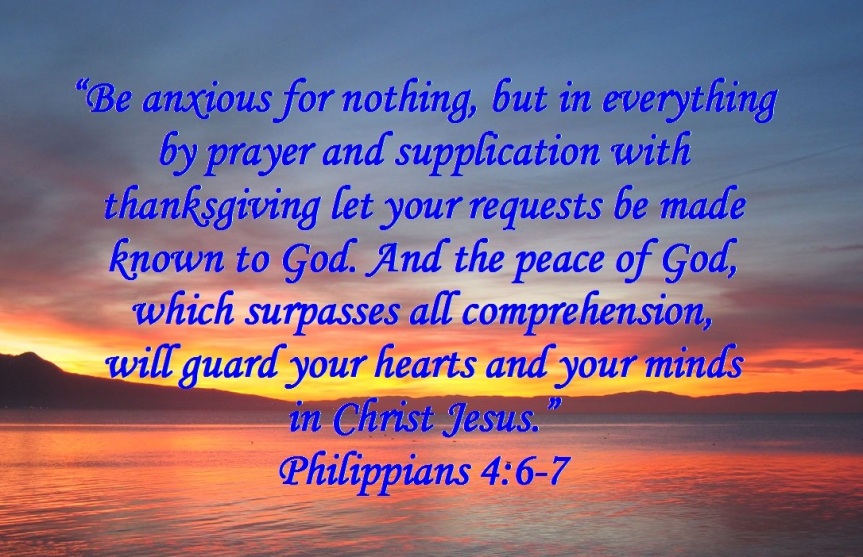
Save

No GOD No Peace, Know GOD Know Peace

mountain-climbing-trekking-photo- plus verse.jpg

Let us go on a journey where we shall find PERFECT PEACE. Are you ready?

Our destiny is the mountain top of serene peace and joy, with hope driving our heart towards faith in receiving what one seeks to find.

Let us stick together, with the good things seeping in and immediately clearing our mind of any negative thoughts before our first step upward and onward till we reach our destination.

As we begin our climb, we “breathe in” some thoughts about heavenly peace, quizzing our mind with questions that arise:

WHERE can perfect peace be found? WHO is actually perfect? HOW can we understand God-Jehovah’s perfection?

Here are some answers:

“As for GOD, his way is perfect: the word of the LORD is tried: he is a buckler to all those that trust in him” (Psalm 18:30).

“The Rock! His work is perfect, For all His ways are just; A GOD of faithfulness and without injustice, Righteous and upright is He” (Deuteronomy 32:4).

“The law of the LORD is perfect, restoring the soul; The testimony of the LORD is sure, making wise the simple” (Psalm 19:7).

The LORD is righteous in all His ways And kind in all His deeds” (Psalm 145:17).

“As for GOD, His way is blameless; The word of the LORD is tested; He is a shield to all who take refuge in Him” (2 Samuel 22:31).

Your word is very pure: therefore your servant loves it” (Psalm 119:140).

Every word of GOD is pure: he is a shield to them that put their trust in him” (Proverbs 30:5).

The above responses from the Bible writers, whose words were all divinely inspired by God, are all about God-Jehovah.

Now what about Jesus? Is God’s only begotten and firstborn son Jesus—the Messiah—also perfect, and was Jesus perfect when the Heavenly Father, Jehovah, sent him to redeem mankind from the sentence of Adamic death by paying the exact ransom (corresponding price) to be fulfilled in due time?

Here are some quotes from the Bible where we may find answers to these questions:

“Who committed no sin, nor was any deceit found in his mouth” (1 Peter 2:22).

“For we do not have a high priest who cannot sympathize with our weaknesses, but One who has been tempted in all things as we are, yet without sin (Hebrews 4:15).

“You know that He appeared in order to take away sins; and in Him there is no sin(1 John 3:5).

“When Pilate saw that he was accomplishing nothing, but rather that a riot was starting, he took water and washed his hands in front of the crowd, saying, ‘I am innocent of this Man’s blood; see to that yourselves’(Matthew 27:24).

Why did Pilate say this?

Here is why:

“Pilate came out again and said to them, ‘Behold, I am bringing Him out to you so that you may know that I find no guilt in him’” (John 19:4).

Jesus said: “And He who sent me is with me; He has not left me alone, for I always do the things that are pleasing to Him (John 8:29).

About Jesus, it is written: “His grave was assigned with wicked men, Yet he was with a rich man in his death, because he had done no violence, nor was there any deceit in his mouth.(Isaiah 53:9).

In 1 Peter 1:18-19, Jesus is described as “unblemished” and “spotless”: “We knowing that you were not redeemed with perishable things like silver or gold from your futile way of life inherited from your forefathers, but with precious blood, as of a lamb unblemished and spotless, the blood of Christ.”

The Apostle Paul explains, He made him who knew no sin to be sin on our behalf, so that we might become the righteousness of God in Him” (2 Corinthians 5:21).

What do the words to be sin on our behalf” mean?

The Apostle Peter explains what it means: that Jesus “himself bore our sins in His body on the cross, so that we might die to sin and live to righteousness; for by His wounds you were healed” (1 Peter 2:24).

How then can we as humans have peace if we are not perfect? Are we perfect in some way or another?

Jesus taught usBe ye therefore perfect, even as your Father which is in heaven is perfect” (Matthew 5:48).

How then, can we “be… perfect,” if we were already born in sin?

From the second a human is born, we have the curse of Adamitis on us, which is the death sentence. A baby who is even a few seconds old, can die. If we were perfect, death could not touch any human and everyone could live forever as their perfect life would allow no disease nor any harm to take their life. Thus, if we are already born imperfect, how can we find perfect peace?

Let us explain.

We might not of course be able to achieve perfect peace all the time in the current imperfect bodies we have, yet we are to “be perfect” in intentions, as all fully consecrated Spirit begotten individuals are reckoned in God’s eyes as perfect, through faith in the precious blood of Christ’s righteousness and through showing God-Jehovah through one’s thoughts, words and actions just how much there is a desire to DO what is good, righteous, perfect, pure and blameless in God’s sight, to please the Heavenly Father.

It is one’s faith in believing that God can do the impossible—that He could even move an entire mountain, and trusting in God’s perfect love, justice, power and wisdom implicitly.

This isn’t just blind faith.

This isn’t just following tradition.

This isn’t an unwilling, forced upon believing for self-gain or professing faith in God to just to please someone.

In Romans 10:17, the Apostle Paul explains that faith in God and faith in all that is Godly and righteous and pure and perfect, comes from “hearing the word of God,” and once we hear it, then we are instructed to actually examine and study it (1 Thessalonians 5:21). By studying the inspired words of God in the Bible (2 Timothy 2:15) handed down through God’s holy Prophets of old and the Apostles of the first Church (after Pentecost), and by praying to the Heavenly Father with thanksgiving and earnestness of the heart (Hebrews 5:7, Matthew 6:4-6, James 5:16), striving to please God by doing His will (Romans 12:2), then maturity in the faith can be attained and maintained.

“But solid food is for the mature, for those who have their powers of discernment trained by constant practice to distinguish good from evil” (Hebrews 5:14).

What do the Scriptures say about the faith of some?

In Romans 4:3,5 we read,

“(3) Abraham believed God, and it was counted to him as righteousness. (5) And to the one who does not work but believes in him who justifies the ungodly, his faith is counted as righteousness.”

Now back to our question: Can we as mortals be classified as perfect and hence even qualify to receive perfect peace?

Here are some answers from the Bible:

“Therefore, beloved, since we have these promises, let us cleanse ourselves from everything that defiles body and spirit, perfecting holiness in the fear of God” (2 Corinthians 7:1).

“Be imitators of God, therefore, as beloved children” (Ephesians 5:1).

How are we doing on our climb? Let us continue taking refreshing sips of pure “water” from the purifying Word of God (Matthew 5:6) for by thinking on “whatever is true… honorable… just… pure… lovely… commendable, if there is any excellence, if there is anything worthy of praise” (Philippians 4:8) we can take captive every thought to make it obedient to Christ” (2 Corinthians 10:5).

As we ascend, step by step, going from strength to strength (Psalm 84:7), we look ahead to what is before us (Proverbs 4:25,26, Hebrews 12:2) and patiently (Romans 12:12) with joy, press forward, towards our destination. We are reminded of the words of the Apostle Paul in Philippians 3:13-21:-

(13) Brethren, I count not myself to have apprehended: but this one thing I do, forgetting those things which are behind, and reaching forth unto those things which are before,

(14) I press toward the mark for the prize of the high calling of God in Christ Jesus.

(15) Let us therefore, as many as be perfect, be thus minded: and if in any thing ye be otherwise minded, God shall reveal even this unto you.

(16) Nevertheless, whereto we have already attained, let us walk by the same rule, let us mind the same thing.

(17) Brethren, be followers together of me, and mark them which walk so as ye have us for an ensample.

(18) For many walk, of whom I have told you often, and now tell you even weeping, that they are the enemies of the cross of Christ:

(19) Whose end is destruction, whose God is their belly, and whose glory is in their shame, who mind earthly things.)

(20) For our conversation is in heaven; from whence also we look for the Saviour, the Lord Jesus Christ:

(21) Who shall change our vile body, that it may be fashioned like unto his glorious body, according to the working whereby he is able even to subdue all things unto himself.

Let us get to the point of our original question. Where can we find perfect peace in a world surrounded by pain, sickness, tragedy and death?

The short answer is: We can find perfect peace when we stick to the path set out by God—walking in accordance to God’s rule.

What is God’s rule?

It is the commandment that Jesus taught—as a summary of all 10 commandments under the Old Law given to the nation of Israel via Moses in the Old Testament—recorded in the Gospel of John 13:34. Here Jesus said:

“(34) A new commandment I give unto you, That ye love [Strongs #25, agapao] one another; as I have loved [Strongs #25, agapao] you, that ye also love [Strongs #25, agapao] one another. (35) By this shall all men know that ye are my disciples, if ye have love  [Strongs #26, agape] one to another.”

There are three different types of “love” in the world around us and in the Greek language, they are described as: agape, phileo and eros.

The word “love” here in John 13:34, 35, is translated from the Greek word “agape, which is an unconditional goodwill towards all men; love, benevolence, and feeling sincere kindness and good will towards our enemies and those who do harm to us, whether we classify this harm as from ignorance or not.

Agape love, thinks of others as better than one’s own self (Philippians 2:3).

In 1 John 3:15 we are explained that “Whosoever hateth his brother is a murderer: and ye know that no murderer hath eternal life abiding in him.”

What a pleasure it is to be in the midst of such who speak kindly to and about others. These are described in Psalm 92 who “flourish like the palm tree” …. whostill bring forth fruit in old age.

In Titus 3:2 we are reminded, “to speak evil of no one, to avoid quarreling, to be gentle, and to show perfect courtesy toward all people.”

Here we are taught to rather hate the sin and AGAPE our brother and sister in Christ,  since we do not have a perfect mind in the same sense that our Beloved, Christ Jesus had when he was in the flesh during his human existence.

Through meditation upon the word of God, unceasing prayer and praise to the Heavenly Father, as well as through the experiences of life, we have a privilege to learn, by God’s grace and mercy, to speak the pure language of God. The Apostle Paul exhorts us in Colossians 4:6, “Let your speech always be gracious, seasoned with salt, so that you may know how you ought to answer each person.” “Not only should our speech be liberal [i.e. free from prejudice, tolerant], temperate [marked by self-control], courteous [i.e. polite, respectful towards and considerate of others], but it should also be seasoned with salt. Salt is a figure for truth. Truth, like salt, has the power of preserving from decay that which is good and pure.We should, therefore, be well established in the truth of God’s Word, that we may be able to answer every one, giving a good Scriptural reason for both our faith and our practice” (Br. Charles T. Russell, R756).

There is a saying: “Positive begets positive.” Let positivity rule our mind by feasting on the beauties of divine Truth in the Bible— keeping our hope in Christ.

ISA. 40, 31- 1.jpg

Positivity is a quality possessed in kings. How can a king rule without a vision? (Proverbs 29:18). A king has a vision and such a vision must be possessed by those developing in the School of Christ to be faithful unto death—a vision that sees the positive (Titus 1:15). We have many gloriously positive things to look forward to, which the Bible outlines: no more oppression; no more money issues in the future to cause jealousy or the need to have power; no more killing; no more struggles for food or a shelter or to feel safe or perfectly understood and loved; no more pain or sickness and no more death!

The Heavenly Father has promised a glorious future to ALL mankind as we are told in Revelation 21:4, (4) And God shall wipe away all tears from their eyes, and there shall be no more death, neither sorrow, nor crying, neither shall there be any more pain; for the former things are passed away.”

There are passages of holy Scripture that talk about the necessity of words of warning. Here are some good examples:

“Now we exhort you, brethren, warn them [Strongs #3560, noutheteō—to caution or warn gently] that are unruly [“idle” (ESV), “lazy” (NLT), “undisciplined” (NET), “idle” and “disruptive” (NIV), “disorderly” (Rotherham’s)] comfort the feebleminded, support the weak, be patient toward all men (1 Thessalonians 5:14).

“So watch yourselves. If your brother sins, rebuke him, and if he repents, forgive him” (Luke 17:3).

We are taught in Scripture to recognize who is a True Christian by their “fruits” of character (Matthew 7:16).

The more one sees their own failures and mistakes of actions, the more one can have compassion, we hope, towards others, realizing that often the more we (agape) love, the more we share in the sufferings of Christ… and this makes the heart long more for that which the Bible promises: the day of perfection in all things when God shall be ALL in ALL and all pain, sorrow and misunderstanding shall be no more.

The Apostle Paul speaks of this time in 1 Corinthians 15:28, “And when all things shall be subdued unto him, then shall the Son also himself be subject unto him that put all things under him, that God may be all in all.”

How do we agape others and ourselves ?

HERE is where the hardest (upon the flesh) but most glorious (for the New mind in Christ) challenges lie. It is the HARDEST part of our climb up this mountain (1 Timothy 6:12)

It requires our dependency on God’s help through Christ, “and we know that in all things God works for the good of those who love him, who have been called according to his purpose” (Philippians 4:13, Romans 8:28).

A righteous love towards all men is developed from learning to love the Heavenly Father supremely as manifested in the surrendering of one’s life rights and the acquiescence and obedience to God’s will. Obedience is learnt by fixing our eyes on Christ Jesus (Hebrews 12:2)—God’s only begotten, firstborn, perfect son, who died as a ransom for ALL humanity to pay the corresponding perfect price for Adam’s sin and all of Adam’s progeny (1 Corinthians 15:22). If we compare our trials as mortals to our Lord Jesus’ trials—who was sinless yet suffered the harshest mental and physical ignomy and pain—then one’s own experiences seem trivial.

Love (agape) towards our neighbour is all about loving our brethren in Christ as if they were our own body (Romans 12:5). These are the ones who are now in training to be part of the body of Christ—the footstep followers of Christ, and members of the 144,000 and Elect Bride of CHRIST (Revelation 7:4).

If we say that we have no sin, we deceive ourselves, and the truth is not in us (1 John 1:8).

May we seek to have a character like our Lord Jesus; to have a CHRIST JESUS’ ATTITUDE.

In 1 John 2:6 we read, “The one who says he resides in God ought himself to walk just as Jesus walked.”

The Apostle Paul describes numerous Christ-like qualities of character in Philippians 2:1-11:-

“(1) Therefore if there is any encouragement in Christ, if there is any consolation of love, if there is any fellowship of the Spirit, if any affection and compassion,

(2) make my joy complete by being of the same mind, maintaining the same (agape) love, united in spirit, intent on one purpose.

(3) Do nothing from selfishness or empty conceit, but with humility of mind regard one another as more important than yourselves;

(4) do not merely look out for your own personal interests, but also for the interests of others.

(5) Have this attitude in yourselves which was also in Christ Jesus,

(6) who, although He existed in the form of God, did not regard equality with God a thing to be grasped,

(7) but emptied Himself, taking the form of a bond-servant, and being made in the likeness of men.

(8) Being found in appearance as a man, He humbled Himself by becoming obedient to the point of death, even death on a cross.

(9) For this reason also, God highly exalted Him, and bestowed on Him the name which is above every name,

(10) so that at the name of Jesus every knee will bow, of those who are in heaven and on earth and under the earth 

(11) and that every tongue will confess that Jesus Christ is Lord, to the glory of God the Father.”

The above words are also beautifully summarized in Galatians 5:22-23“But the fruit of the Spirit is love, joy, peace, longsuffering, gentleness, goodness, faith, meekness, temperance: against such there is no law.”

We are finally approaching our destination, so let us cheer each other onward and upward as to our goal we proceed with great joy and full faith, that we shall see with our eyes what we have longed to see! (1 John 3:2,3, 1 Corinthians 13:12, 13)

In Galatians 6:16 we are told, And as many as walk according to this rule, peace be on them and mercy.”

Again we ask, what “rule” is the Apostle Paul talking about, which he teaches us, may give us perfect peaceand not only peace but also mercy form God?

It is the rule of a new mind… a “new creature” in Christ mentioned in the preceding verse“For in Christ Jesus neither circumcision availeth anything, nor uncircumcision, but a new creature.

You see forms and ceremonies (just following blindly a religious ritual or offering sacrifices year after year, or week after week) are not the rule, but the new life in Christ, the new creature filled with the holy spirit of God and led of the spirit.

The rule is to “walk in the spirit,” says the Apostle, “and ye shall not fulfil the lust of the flesh; for the flesh lusteth against the spirit, and the spirit against the flesh: and these are contrary the one to the other” (Galatians 5:16,17).

Those who walk by this rule are promised peace (Philippians 4:7) and mercy. Our best efforts to walk after the leading of the holy Spirit will be imperfect in the flesh but God who judges our heart’s, desires, and efforts is merciful and will not allow us to experience one second more than what we’re able to bear (Romans 8:28).

Now if any man be in Christ, a new creature, he has put away the old man—the carnal nature, which is enmity against God and is not subject to the law of God, neither indeed can be—with all his evil deeds, which the apostle thus enumerates in Galatians 5:19-21,

“Now the works of the flesh [the carnal nature] are manifest, which are these: adultery, fornication, uncleanness, idolatry, witchcraft, hatred, variance, emulations, wrath, strife, seditions, heresies, envyings, murders, drunkenness, revellings and such like, of the which I tell you before, as I have also told you in time past, that they which do such things shall not inherit the kingdom of God.”

The Apostle gives fair warning that those who do such things, no matter how loud may be their professions, have no inheritance in the Kingdom of God; and therefore they have no right to the fellowship of the saints upon whom, and the cause of Christ in general, they bring only DIS-grace.

They that are Christ’s have crucified the flesh with the affections and desires.

If we are living according to the rule of the new nature, following the leading of the spirit of God, then we must have these fruits in some measure, even from the very start of our Christian experience; and if we are following on to know the Lord and to walk in the spirit, these fruits are surely growing and becoming more and more manifest to all with whom we are associated.

If those who are in Christ would observe this principle, and deal with each other as new creatures, much discord would be avoided; for the motives and endeavors of the “new creature” would be considered, and not the frailties or mistakes of the “earthen vessel.” (Reprints of the Original Watchtower 1840)

Reaching the Summit!

Friends, here we are at last! Here is the spectacular panoramic view from the summit top! Like an eagle (Isaiah 40:31) majestically soaring the lofy heights of grandeur that surround, so too, the fully consecrated of the Lord “soar” above the storms of life… their resting place is in the shelter of the Most High—God’s “throne of grace” which is approached with confidence to receive mercy and find grace to help in time of need (Hebrews 4:16).

“And this is the confidence that we have toward him, that if we ask anything according to his will he hears us” (1 John 5:14).

God’s perfect peace comes from sweet communion with the Heavenly Father and His Son, Christ Jesus.

PSALM 119,165.jpg

The peace of God that surpasses all understanding is a truly blessed gift from God which stems from an appreciation of God’s character and striving to copy these same qualities of character and dispositions of mind and heart, in order to gain God’s approval.

It is true to say that all men have lost much of the original likeness of God, but this does not alter the fact that they still crave the happiness and peace which can never be found except under the natural, original relations to his Creator.

Dear friends,

No matter how deep we may sink in sin …
No matter how far we may stray from the path of rectitude…
No matter how low and vile we may have become…

We still need to remember that we are all members of that noble though fallen human race and that God-Jehovah created us in His own likeness, and God knows and feels our degradation. He knows that He made us for higher and nobler ends than those toward which He is ever tending.

1384059_with address .jpg

In this painful realization of the absence of true happiness and peace of mind and heart, we humans tend to seek happiness and peace in ways in harmony with the more or less depraved tendencies of the fallen nature—in the poor substitutes which pride, ambition, strife, rivalry, wealth, fame, power, etc., have to offer; but we find that the happiness in these is only delusive, and at most VERY SHORT-LIVED!

The bubble of success may burst in an instant, and the peace and happiness built upon it be utterly wrecked.

“There is no peace, therefore, to any man except in the reestablished relationship between himself and his God. And since this relationship of sons can ONLY be reestablished through Christ, there is no peace to any man out of Christ. ”

Pastor Charles Taze Russell.

“There is no peace, saith the Lord, to the wicked” (Isaiah 48:22).

“Let us follow the things that make for peace.”

(Romans 14:19)

Isaiah 26.3


Acknowledgment

Br Charles T. Russell, Reprint 1840

Suggested Further Reading

What is LOVE?https://biblestudentsdaily.com/2016/03/20/what-is-love/

THE BIBLE – The World’s Best Novel. Here is Why.https://biblestudentsdaily.com/2017/07/26/the-bible-the-worlds-best-novel-here-is-why/

His Loving Kindness https://biblestudentsdaily.com/2018/06/19/his-loving-kindness-hymns-of-dawn-no-19/

HAGGAI 2:7—The Desire of All Nations Shall Comehttps://biblestudentsdaily.com/2017/08/29/haggai-27-the-desire-of-all-nations-shall-come/


This post’s URL:
https://biblestudentsdaily.com/2016/06/16/let-us-go-on-a-journey-where-we-shall-find-perfect-peace-are-you-ready/

Enter your email address to subscribe to this blog and receive notifications of new posts by email.

Save

Save

Save

Save

THANK YOU GOD

THANKS BE TO GOD WHO GIVES US THE VICTORY!

Hence, let’s rejoice, as our labours are not in vain IN THE LORD!

The words “thank you” are two words that mean so much for the giver and the receiver…

The video identifies some absolutely wonderful lessons all about thankfulness and it focuses on not trusting ourselves, as self-confidence leads to pride, but rather humbling ourselves under the mighty hand of God. Humility helps the heart be grateful.

Let us submit our entire will to the will of God, always remembering to ask our Divine Father for HIS help as we proceed to “make our calling and election sure” (2 Peter 1:10).

Here are several beautiful verses to consider:

Philippians 1:3-6 (KJV)

“3 I thank my God upon every remembrance of you,

Always in every prayer of mine for you all making request with joy,

For your fellowship in the gospel from the first day until now;

Being confident of this very thing, that he which hath begun a good work in you will perform it until the day of Jesus Christ.”

—————

Luke 17:11-19 (KJV)

 “11 And it came to pass, as he went to Jerusalem, that he passed through the midst of Samaria and Galilee.

12 And as he entered into a certain village, there met him ten men that were lepers, which stood afar off:

13 And they lifted up their voices, and said, Jesus, Master, have mercy on us.

14 And when he saw them, he said unto them, Go shew yourselves unto the priests. And it came to pass, that, as they went, they were cleansed.

15 And one of them, when he saw that he was healed, turned back, and with a loud voice glorified God,

16 And fell down on his face at his feet, giving him thanks: and he was a Samaritan.

17 And Jesus answering said, Were there not ten cleansed? but where are the nine?

18 There are not found that returned to give glory to God, save this stranger.

19 And he said unto him, Arise, go thy way: thy faith hath made thee whole.”

—————

philippians-4-vs-6-7.jpg

—————

1 Chronicles 16:7-12 (NKJV)

David’s Song of Thanksgiving

“7 On that day David first delivered this psalm into the hand of Asaph and his brethren, to thank the LordOh, give thanks to the LordCall upon His name; Make known His deeds among the peoples! Sing to Him, sing psalms to Him; Talk of all His wondrous works! 10 Glory in His holy name; Let the hearts of those rejoice who seek the Lord11 Seek the Lord and His strength; Seek His face evermore! 12 Remember His marvelous works which He has done, His wonders, and the judgments of His mouth…

—————

THANK YOU ALMIGHTY HEAVENLY FATHER FOR YOUR PERFECT LOVE which we can feel through the eyes of faith through studying about the character of Jesus—our Master and our King.

Thank you Father God Almighty M, that we can draw near to the throne of God with confidence that we may receive mercy and find grace to help in time of need (Hebrews 4:16).

The URL for this post: https://biblestudentsdaily.com/2016/06/11/thank-you-god/

Enter your email address to subscribe to this blog and receive notifications of new posts by email.

How Does “the Son of Man” Title, Speak Volumes About Jesus?

sun on hand gesture

What better name to talk about, then that of JESUS whom we wish to become a copy of in character likeness.

If our goal in life is to BECOME LIKE Jesus and to SUFFER with Jesus so we can reign with him and bring joy to our Heavenly Father, helping all mankind walk up the highway of holiness in the Messianic Kingdom soon to begin, then this involves to “see him” (Hebrews 2:9) through study and reflection upon the Divine words of God in the Bible so we can understand and appreciate our Lord and Master’s character and in this way, develop into Christ.

Jesus had many titles throughout the Bible, such as: High Priest, Lamb, Bridegroom, Lord, Christ, Captain of our Salvation, Everlasting Father, Prince of Peace, Redeemer, Savior etc. Each title gives us a little different dimension of the character of our Lord Jesus—his attributes and his accomplishments.

The title “the Son of Man” is not used just by the prophets, or by God, or by many others… but, Jesus uses it many times in reference to himself, and it appears nearly 200 times in the King James Version of the Bible, and in 14 different Books of the Bible from Numbers to Revelation. Almost half of these instances are in the 4 Gospels and the other half, in the Book of Ezekiel.

“So Jesus said to them, ‘Truly, truly, I say to you, unless you eat the flesh of the Son (STRONGS # 5207 – ‘huios’) of Man (STRONGS #444 – ‘anthropos’) and drink his blood, you have no life in you’ “ (John 6:53).

Why is this title so profusely used?

Because God doesn’t want us to miss the important significance and meaning of this very special title.

1. WHAT DOES THIS TITLE “THE SON OF MAN” MEAN?

“How much less man, (STRONGS #H582 enowsh’) that is a worm? and the son (STRONGS #1121 ‘ben’) of man, (STRONGS #120 ‘adam’) which is a worm?” (Job 25:6).

Two different men being contrasted in this verse are:

  • the first “man” mentioned is Adam—the fallen man and his progeny;
  • the second “man” mentioned is Jesus—the Son of Man.

The word “son” here comes from a Hebrew word that means a builder of the family.

The second “man” word mentioned is the word Adam and it means a human being.

This teaches us that the son of man (Jesus) is a relative of Adam and is a builder of the human family.

Let us contrast this now with the New Testament scripture in John 6:53. Here the word “son” simply denotes “kingship.” The word “man” here, comes from the Greek word “anthropos”—from which our English word “anthropology” comes from which denotes a human being.

So we are taught here that the son of man is related to the human family.

As we examine things further, we see far greater beautiful lessons beyond just the word study basics in this title “the Son of Man.”

2. TO WHOM DOES THIS TITLE “THE SON OF MAN” APPLY?

It applies of course to Jesus. BUT, to which phase of Jesus’s existence, as Jesus has 4 phases of existence:

  1. The Prehuman Logos—before he was born of a woman on earth as a perfect human?
  2. The man Christ Jesus?
  3. The man in the grave Jesus?
  4. The exalted Divine Immortal Jesus?

Let us look at all four phases of Jesus’s life for the answers.

A cautionary note: not all verses in the Bible that talk about the son of man refer to Jesus, hence the context of the scripture(s) must be examined to determine who is being referred to.

E.g. “Put not your trust in princes, in a son of man, in whom there is no salvation” (Psalm 146:3).

Obviously this is not referring to Jesus but rather to ordinary lowly man; an ordinary member of the human family. The Psalmist here is not teaching us about Jesus, but teaching us to put our TRUST IN GOD in contrast to ordinary man.

Let us begin by considering some verses that deal with the SECOND phase of Jesus’ life.

PHASE 2 of Jesus’ life: THE MAN CHRIST JESUS

In the Book of Ezekiel the term “the son of man” appears 93 times in the King James Version of the Bible.

Why is this title used so many times here in this Book?

Well, in Ezekiel, God frequently refers to the man and prophet himself, Ezekiel, as “the son of man.”

E.g. When God first called Ezekiel to be a prophet for Israel, he labelled him, or called him “Son of man.”

“And he said unto me, Son of man, stand upon thy feet, and I will speak unto thee” (Ezekiel 2:1).

In many instances in the Book of Ezekiel, there is a striking parallel between the prophet Ezekiel and the man Jesus.

Let’s look at some of these “connectors” between the man Jesus and the man Ezekiel:-

  • Ezekiel’s name means “the strength of Jehovah.” Jesus is prophetically referred to as ‘the strength or the arm of Jehovah’ E.g. Psalm 98.
  • There is a striking resemblance between the Book of Ezekiel and the Book of Revelation. The Book of Ezekiel is full of symbolism (often labelled as the Apokalypse of the Old Testament), just as the Book of Revelation is full of symbolism too.
  • Ezekiel’s prophetic work overshadowed the prophetic work of Jesus’ ministry.
  • God sent Ezekiel to prophecy amongst a rebellious people. God sent Jesus to minister amongst a rebellious and stiff-necked generation.
  • God instructed Ezekiel to speak in symbols or parables as we read in Ezekiel 17. Jesus was directed to speak in parables.
  • God instructed Ezekiel to prophecy against the selfish leaders of the nation of Israel. God directed Jesus to condemn Israel’s selfish leaders.
  • Ezekiel foretold the restoration of Israel and the times of restitution. Jesus likewise taught restitution and he taught that he came to save that which was lost.

So as pointed out, many of the Old Testament scriptures in the Book of Ezekiel apply to Ezekiel but also apply to Jesus. In one sense we might think of Jesus as being “The Greater Ezekiel” just like Jesus is referred to as “The Greater than Jonah.”

Let us now look at some scriptures referring to Jesus as the son of man.

What is man that You take thought of him, and the son of man that You care for him? Yet You have made him a little lower than God, and You crown him with glory and majesty!” (Psalm 8:4-5)

The “man” in this prophecy is the first man Adam, who was created perfect.

“The son of man” here refers to Adam’s posterity, and God’s intended design for them, but, this term is also connected to Jesus as the Apostle Paul quotes this exact verse in Hebrews 2:9:

 “But we see him who for a little while was made lower than the angels, namely Jesus, crowned with glory and honor because of the suffering of death, so that by the grace of God he might taste death for everyone.”

God created Adam one step below the angels, and perfect. God gave Adam to be King of the Earth, so long as he obeyed God. Adam was to be the supreme Earthly ruler over the Creatures of the land, air, and water. He was crowned. Similarly when Jesus became a man, God created him one step below the angels. God intended that the Son of Man would purchase the right to be earth’s supreme leader and be the king over the creatures of the air, land and water.

But “the Son of Man” title means more than gaining the legal right to be king over all the earth. In Hebrews 2:9, the Apostle Paul explains, that “the Son of Man” title means that Jesus was destined to suffer death.

This leads us to the next scripture that talks about the son of man referring to Jesus.

“And whosoever will be chief among you, let him be your servant: 28 Even as the Son of Man came not to be ministered unto, but to minister, and to give his life a ransom for many” (Matthew 20:27-28).

In this text Jesus describes himself but tells us two more things about “the Son of Man”:-

  1. That he would give his lifehis death would not be an ordinary death but a unique, “one of a kind” death and Jesus gives this death a name. He calls it a RANSOM death. This idea of the ransom means a corresponding/purchase price that would be used to buy out everything that Adam and his progeny lost, this includes Adam’s crown. The son of man’s sacrificed life would be substituted for Adam’s forfeited life. This transfers the death sentence from the man Adam to the man Jesus. So the son of man’s death creates the redemptive price to free every human being from the curse of death.
  2. The Son of Man would be humble… and he would humble himself to the very MAXIMUM…to death on a cross.

Yet another text referring to Jesus as “the son of man” is in John 3:14-15:

“And as Moses lifted up the serpent in the wilderness, even so must the Son of man be lifted up:  That whosoever believeth in him should not perish, but have eternal life.”

Jesus here reflects back to Ancient Israel. We can see this if we look at the Holy words of the Bible, in the Book of Numbers 21:8:-

“And the LORD said unto Moses, Make thee a fiery serpent, and set it upon a pole: and it shall come to pass, that every one that is bitten, when he looketh upon it, shall live.”

Similarly in John 3, Jesus is telling us that he is the anti-typical copper serpent. And anyone believing that the son of man is the great antidote for sin, will be healed.

The pole represents the crucifixthe pole on which our Lord Jesus died. It was an extremely painful death. So not only was the Son of man destined to die, but was to do so in the most painful way.

The sufferings of the Son of man are directly related to the eradication of sin.

What is the connection between the sufferings and the healings?

The Apostle Paul answers this in Hebrews 2:10, where he explains that the son of man’s sacrificial sufferings and painful experiences perfected him as a New Creature.

Our beloved Master and King Jesus and the world’s Saviour suffered throughout his ministry. He was was abused, neglected, opposed, betrayed, humiliated, accused, exhausted and the list goes on!

All of our beloved Lord’s sufferings were part of the great Son of Man’s offering for sin. We are sure of this, as we are explained of it, in Isaiah 53:10.

“Yet it was the will of the LORD to crush him; he has put him to grief; when his soul makes an offering for guilt, he shall see his offspring; he shall prolong his days; the will of the LORD shall prosper in his hand.”

All of Jesus’s sufferings are what qualified our Lord the MEDIATOR for sin. It was part of the “SIN OFFERING PROGRAM” which develops the Mediator (headChrist Jesus, and his body—the 144,000 Bride of Christ; the Elect members), and the Mediator eradicates sin through the future, soon to begin, New (Law) Covenant “Program” which will be inaugurated once the 144,000 Bride is complete and the wedding of the Lamb has taken place, when the Mediatorial Kingdom shall commence and this New Covenant will begin with natural Israel being ministered to by the Ancient Worthies (i.e. the Prophets of Old from Esau right up to John the Baptist) who will be the first to bring peace on earth after their resurrection and during the end of Armageddon / Jacob’s Trouble (Micah 5:5).

In future when humanity shall look upon Jesus CHRIST (complete)the copper servantand follow and obeythey shall be healed.

PHASE 3 of Jesus’ life: JESUS IN THE GRAVE

In Matthew 12:40 we read, “For as Jonas was three days and three nights in the whale’s belly; so shall the Son of Man be three days and three nights in the heart of the earth.”

The scribes and the Pharisees told Jesus they wanted a sign from him and not just wanted his teaching and miracles. So Jesus identified himself as “the greater Jonah.”

The prophet Jonah’s incarceration in the great fish pictured Jesus’ 3 day death. For parts of 3 days (50 hours), our Lord Jesus was in oblivionhe did not exist for parts of 3 days because that is what death means.

“Sheoul” (in Hebrew) and hades” (in Greek) means oblivion or death.

Jesus was faithful to the very end of his life, and when he drew his last earthly breath he was still faithful…

Jesus did not make any mistakes …

Jesus did not sin …

Jesus did not go astray …

Jesus did nothing wrong …

And at the moment of Jesus, death, he had irreversibly secured the title “the Son of Man” and all of the rights and privileges that were destined to be a part of that.

Jesus dies an unjust death.

Jesus died a perfect man, who’s life was taken from him.

And even though the son of man was dead, he still held the LEGAL RIGHT TO BE ALIVE. So, it would be entirely right to refer to Jesus even when he was in oblivion (death) as still the Son of man.

PHASE 4 of Jesus’ life: THE RESURRECTED & EXALTED JESUS

“And as they came down from the mountain, Jesus charged them, saying, Tell the vision to no man, until the Son of Man be risen from the dead” (Matthew 17:9).

Jesus here makes the point that the son of man would be RAISED after his death. But raised to what? Not raised to manhood, as Jesus came to forever sacrifice his humanity.

When Jesus was raised he was immediately rewarded with the Divine nature. We are sure of this, when we read in John 5:26, “For as the Father hath life in himself; so hath he given to the Son to have life in himself…”

God did not give the Logos immortality.

God did not give the man Jesus immortality.

God gave the resurrected Jesus immortality.

Yet, even though Jesus was given Divine nature, he still said he would be the “Son of Man;” he did not renounce his title upon his resurrection.

Let’s look at Daniel 7:13-14:

“I kept looking in the night visions, and behold, with the clouds of heaven one like a son of man was coming, and He came up to the ancient of days and was presented before him. And to him was given dominion, glory and a kingdom, that all the peoples, nations and men of every language might serve him. His dominion is an everlasting dominion which will not pass away; and his kingdom is one which will not be destroyed.”

As we consider all of Daniel chapter 7, we recall God gave Daniel a huge vision of 5 universal empires and at the end of his vision, he sees one likened to “a son of man”–the Divine Jesus.

At his resurrection, God gave Jesus ALL power.

“And Jesus came and spake unto them, saying, All power is given unto me in heaven and in earth” (Matthew 28:18).

So how do we harmonize Matthew 28:18 with Daniel 7:13-14?

Daniel’s vision teaches us when Jesus would begin to exercise his power (and not just when he would acquire his power) over the kingdoms of this world at his return (invisible presence—parousia,” in 1874) during the time of trouble (as represented in the clouds.)

In Matthew 24:30 Jesus confirms that after being rewarded with Divinity, he was still rightly called “the Son of Man” upon his “parousia” since 1874:-

“And then shall appear the sign of the Son of Man in heaven: and then shall all the tribes of the earth mourn, and they shall see the Son of man coming in the clouds of heaven with power and great glory.”

PHASE 1 of Jesus’ life: JESUS AS THE LOGOS

In John 3:13 (Diaglott) we read,  “And no one has ascended into heaven except the Son of Man who descended from heaven.”

Here Jesus is recalling his prehuman existence with the Heavenly Father, and as the Logos.

How could Jesus be called the son of man BEFORE he became a man?

Well because the man Jesus is the same personality as the Logos.

The Logos did not die when his spirit nature was exchange for his human nature.

Rather we believe that the life principle (that was infused in the Logos, whereby the Logos was begotten of the Father) was transferred to the womb of Mary and put into the foetus of Jesus. It was a transfer of the life principle not a death. Hence the LOGOS DID NOT DIE. Proof of this is in John 1:14: “And the Word (Logos) was made flesh…” There is nothing here that talks about a death, but rather there was a transfer of life.

3. WHAT IS THE REAL SIGNIFICANCE OF THIS TITLE?

In some ways it seems like this title “the Son of Man” is meagre…insignificant… inconsequential… just an ordinary title… one that merely refers to the fact that Jesus was human… there would perhaps seem other far greater titles to use, such as “Son of God” or “Christ–the Anointed.”

So why did Jesus use “the Son of Man” title (in reference to himself) over 85 times in the KJV?  Here are 2 possible suggestions why:-

Firstly, the Logos held a position of very high honour and dignityabove the angels and above all other spirit beings. He was God’s only firstborn, begotten Son (John 1:14). God appointed the Logos as His master craftsman (Proverbs 8:30). And Jesus made a contract with our heavenly Father to give up the second highest place in creation! He humbled himself to manhood, and not just manhood but to the poorest level of manhood and to temporal deprivation. As we read in Matthew 8:20, the Son of man did not even have a place to lay his head. Jesus was definitely no home ownerwhich we all today may take for granted.

Besides giving up his glorious celestial nature and his position next to our Divine Father’s place in heaven, Jesus voluntarily attached himself to the dying human race, to the diseased and degenerate human race.

Would we attach ourselves to such an undesirable situation?

Jesus humbled himself to abuse…

Jesus humbled himself to misrepresentation…

Jesus humbled himself to pain…

Jesus humbled himself to opposition…

Jesus humbled himself to accept death… to accept crucifixion (the worst death sentence humanly possible).

Nobody ever humbled himself more than our beloved Jesus,
and nobody ever will.

Jesus’ humility was not just an exercise, like a “see if he could do it” kind of thing. It created the ultimate purchase price that Jesus would not use to buy a single thing for himself – not one thing!… and it was Jesus’ humility that fully developed him as a New Creature.

So Jesus stressed this title ‘the son of man’ as in it, is embedded unsurpassed and incomparable humility.

Secondly, in this title is the answer to God’s universal rule for advancement and promotion, as brought to our attention in Luke 14:11 :

images.jpg


Because Jesus exercised incomparable HUMILITY and ABASEMENT, God gave him an incomparable name (and position) above any other name that is named (Philippians 2:9).
Jesus’ exalted name is not just an honorary title, but one of full of meaning and action. It means OVERCOMING… it means VICTORY over Adamic death. Jesus was given all power over heaven and earth to rebuild everything that he bought and to re-install God-likeness in everything in heaven and on earth, including the earth itself.

Jesus will use his incomparable power (not as a great leader to oppress but) to liberateto buy back Adam’s lost possessions—happiness, life, health, kingship over the earth, which Adam was meant to get at the beginning, but had lost.

Jesus does not buy one of these things back for himself but buys them back to give then away… to give them back to Adam and his progeny.

Our Lord Jesus’ HUMILITY qualified him to be the chief part of the Mediator of the New Law Covenant.

The son of man title speaks volumes about Jesus.

It speaks volumes about his incomparable humility and his incomparable exaltation.

It speak volumes about every aspect of Jesus’ life and about his sacrifice; about his sufferings; about his generosity; about his willingness; about his faithfulness; about his loyalty; about his purpose; about everything Jesus has already accomplished and everything he will yet accomplish; they are all contained in this “son of man” title.

Perhaps this title “the Son of Man” speaks more about Jesus than any other single title we know. Why?

Because perhaps we could say that the most important character quality we must possess is HUMILITYthat allows one to OBEY Godly principles with patient cheerful endurance.

HUMILITY IS THE ANTIDOTE to the most dangerous and most poisonous character failure of all: Pride.

It was PRIDE that caused Lucifer to disobey, rebel and eventually be destroyed forever.

The opposite of pride is HUMILITY.

It is HUMILITY that will allow one to be more than an overcomers, by surrendering one’s entire will to doing what our Heavenly Father would indicate is HIS will and doing so moment by moment, surrendering up that that which would feed the flesh, and rather feeding  the spiritual mind in Christ so that the embryonic New Creature can develop in maturity into the likeness of our Bridegroom who is the love of our life and our EVERYTHING.

——- “Humble yourselves before the Lord, and he will exalt you” (James 4:10). ——-

Acknowledgement:

The following post was created from the words of a discourse by Br. Wes Cramer about the SON OF MAN.

The URL for this post: https://biblestudentsdaily.com/2016/06/10/how-does-the-son-of-man-title-speak-volumes-about-jesus/

Enter your email address to subscribe to this blog and receive notifications of new posts by email.

Save

Save

Save

Let us Help Others Hear the Knock

PASTOR CHARLES RUSSELL’S DREAM – Sunrise Prayer and Praise Meeting –

Br Charles Russell (3)

WHEN we entered the hall at 5:15 A.M., there were fully 100 persons present. Promptly at 5:30 Bro. Russell stepped upon the platform and there were by that time 225 present; before the meeting closed there were over 400. The service opened by singing No. 19, “Awake My Soul to Joyful Lays.” This was followed with prayer by Bro. LaFerrey. Then we sang hymn No. 206, “O, How Happy Are We Who in Jesus Agree.”

Bro. Russell: Dear brothers and sisters, I am very glad to greet so many of you this morning and to see that so many of you enjoy the prospect of an early morning prayer meeting. As I saw a number of you headed this way as I was coming to this meeting, it made me think of some of the reasons that draw us together….

So, one reason we like to meet together in conventions and on every occasion is because the Lord seems to give us something special to eat where we are in fellowship, where two and three are gathered together, etc., so when two or three of us meet in His name, we may be sure of His blessing and a refreshment of spirit. In this morning time, more than at any other time, though it has been true throughout all the ages where His people met, but now early in the new morning, when, the new day, the grand Millennial Day, He is inviting us together; He tells us that there will be a great gathering, all the wheat from the tares, all the sons of God, that glorious gathering, which will mean the establishment of the Kingdom of God, out of which will flow all the blessings of God to all the families of the earth. So we have many reasons for thankfulness this morning as we think of the blessed scripture references to this morning time in which we are living such as, “God will help her right early in the morning.”

You remember a picture in the 91st and 45th Psalm, and how the Lord in the 45th Psalm tells of the time of trouble. As we see that day gathering all about us, we hear the Lord’s word coming to us with special emphasis and we will not fear though the earth be removed, though society be shaken and the Kingdoms be carried into the midst of the sea, because we have made the Lord our habitation. In this connection the Lord tells us He will help her, the church right early in the morning. How precious the thought that we are in the early morning, when the shadows are fleeing and we can see more clearly than they could in the centuries past. It was not the Father’s purpose that the special light should shine then, they had all they needed as saints of God that they might be separate from things of this world, but it was not the time to give the glorious sunlight of truth as now.

Thus, dear brothers and sisters, if any fail to get that thought, they fail to get one of the most inspiring thoughts of our time, namely: that the light of the truth which you and I are now seeing is not that you and I are brighter than other men to see it, but it is God’s due time–it is morning time. Why can you see brighter than you could an hour or two ago? Because the great sun has begun to shine upon the earth. Is that all we shall have? Oh, no, that is only the early light. Bye and bye the great sun of righteousness with full power, strength and light will fill the whole earth with the Glory of the Lord. How glad we are that the blessed day is already dawning, what a blessing it has brought into our hearts; we cannot feast on that thought too much.

I might tell you without any injury to any of you about a dream that I had some years ago that had great influence upon my life. Now do not misunderstand me, I do not wish to commend dreams, I think many are nonsensical dreams. I have had many myself, probably from indigestion. I know of a great many people who lay too much stress upon dreams. I pay very little attention to dreams, only so much attention as would be in harmony with God’s word, so as to feel sure the dream came from neither a piece of pie nor inspired by the adversary and I think a great many dreams are inspired by the adversary. I think a safe course is to let no dream have any influence upon our minds except as we can prove them by the word of God. That is our standard. If it agrees not with the word it is because there is no light in it.

But this dream that I will tell you about may help some of you.

I might remark that at the time I had this dream, I was giving attention to the Lord’s work to some extent, I was publishing the Truth and some thought I was neglecting my business. I had five stores at that time, and people would say I guess Mr. Russell is fanatical on the subject of religion. I knew I was not, so was in no danger.

I thought I was not giving enough time, that I ought to give all my time, and this dream helped me.

I dreamed that I was in an attic room, the front looking to the east, and the ceiling was sloping and I thereby knew it was a top room in a house. All around the room was a platform raised about ten inches and on it were mattresses strewn and upon them bed coverings of various kinds; some had been occupied and were vacant and others were occupied by sleepers, and I was in one corner. Over yonder was a door on the right.

I heard a knock that awakened me and I remember how sleepy I felt, I could hardly get my eyes open.

There I saw a servant, one that I never saw or knew, he said they are waiting for you for breakfast and they sent me up to see if you were coming.

Oh! my, it is late, I have overslept myself. Tell them not to wait for me.

With that I thought to get up, but as I started to rise, I was heavy with sleep and my foot caught in the arm of the man sleeping next to me and I went sprawling. I thought well, what will he do? But he was sound asleep, my falling over him had not awakened him.

Something in my dream told me that it was Sunday morning, with that I awakened.

What did it mean?

Well I might take a meaning out of it, that might be in full accord with the truth. I said first of all, this is an upper room and the Lord speaks of housetop saints. Well, then I am glad. Seemingly I was amongst the housetop saints, I was glad that I was not down in the basement.

Then it was Sabbath morning, early in the morning. The sunlight was coming in, all that fits well, the sun is coming in and it is time I was thoroughly awake. Then the empty beds around us, yes, yes, so far as we know, most of the housetop saints have gone in, here a few of us still sleeping; in a dozing way over-charged with the cares of this life. Well, you remember how tired and sleepy you feel almost as if you had been intoxicated. Yes, well that is a good deal the spirit of the world. You are glad you got awake, you felt so stupid, but still next to you was one still more so, and even your falling over him does not awaken him. You are glad you are awake and did not need a knock.

What was that you told the servant?

Have me excused, tell them not to wait for me. Our dear Lord has provided a bridal feast, not a supper or a dinner but a breakfast. So I knelt down and asked the Lord to wait on me for a little;

I determined to be more earnest and diligent in His service.

So I say that while I do not attach much weight to dreams and consider most of them fleshly and of the adversary, but if we think upon them and the words of the Lord, and accept nothing but what will agree with the Scriptures, we may get a good lesson from it.

Well, we are house-top Christians; we have heard the knock informing us that it was morning, that it was the time of the feast and informing us that there is but little time to get ready.

We have heard the knock and how glad we are.

Yet we find some here and there who are still asleep.

Let us help them also to hear the knock that it may go to all parts of the world and let it not be said that there were some in some parts of the world to whom you failed to give the knock.

Jesus-Knocking-At-The-Door-Picture-Revelation-3-20

So we have heard the knock and already on this side of the veil we have entered in and are getting some of the food and refreshment- how glad we are.

The whole world, a greater part of it, as we came here, are still asleep. Some others are awake besides ourselves; you saw the butcher and the baker and the milkman and others all busily engaged looking after their dollars and cents and that was proper in its way.

We also have a business, we have left the world behind, we have become new creatures in Christ Jesus and we must be about our Father’s business.

A principle proper to apply, how energetic have you and I ever been in the affairs of earth in our scramble for dollars and cents? In that proportion let the Lord see that you will be no less energetic in the Spiritual.

Some say Brother Russell, you work late and early; well I used to work late and early for selfish interests, I now have something I love far better, why not work late and early in the Lord’s cause as well as in the early interests?

If the Lord should find that I was careless of His interests in comparison of my previous experience in life, what would He say? It would indicate that I would love the earthly more than the Heavenly.

We do not want Him to say that we ever loved earthly things more than the Heavenly. We are not children of the night, but of the day, let us walk in the light. Ye brethren are not in darkness that that day should come upon you as a thief, but it shall come as a thief and a snare upon the whole world and they shall not escape. Ye brethren are not to fear or measure yourselves from a worldly standpoint. They have no hope such as we have.

Surely, very few persons hope as we do.

What manner of persons ought we to be, said the Apostle, in all manner of conversation, etc., hastening to that glorious time which shall be ushered in by the great time of trouble, the time of refreshing from the Lord, because the times of restitution shall then be near.

I am glad that we have this blessed privilege of meeting this morning.

———-

BE VIGILANT

UP then, and linger not, thou saint of God,

Fling from thy shoulders each impeding load;

Be BRAVE and WISE, SHAKE OFF earth’s soil and SIN,

That with the Bridegroom thou mayst enter in.

O watch and pray!

====================

wallpaper1371_1280x1024

Romans 13:8-14

Fulfilling the Law Through Love

Owe no one anything, except to love each other, for the one who loves another has fulfilled the law. For the commandments, “You shall not commit adultery, You shall not murder, You shall not steal, You shall not covet,” and any other commandment, are summed up in this word: “You shall love your neighbor as yourself.” 10 Love does no wrong to a neighbor; therefore love is the fulfilling of the law.

11 Besides this you know the time, that the hour has come for you to wake from sleep. For salvation is nearer to us now than when we first believed. 12 The night is far gone; the day is at hand. So then let us cast off the works of darkness and put on the armor of light. 13 Let us walk properly as in the daytime, not in orgies and drunkenness, not in sexual immorality and sensuality, not in quarreling and jealousy. 14 But put on the Lord Jesus Christ, and make no provision for the flesh, to gratify its desires.

Reference :

1907 Part II Bible Students Convention Report, Sunrise Prayer and Praise Meeting – Tues Sept 3rd 1907

URL: https://biblestudentsdaily.com/2016/06/08/let-us-help-others-hear-the-knock/

Enter your email address to subscribe to this blog and receive notifications of new posts by email.

Save

Save

Understanding Psalm 50 — “Gather My saints together unto Me”

Psalm 50, 1.jpgThis Psalm is a Psalm of judgment. It opens with a proclamation.

VERSE 1: “The Mighty One, God, Jehovah, hath spoken, and called the earth from the rising of the sun unto the going down thereof.”

The various names of God here are impressive. He is called “Yaweh El Elohim,” or Jehovah the mighty one of mighty ones, or Yaweh, the God of Gods. Clearly, we understand the powerful God we are dealing with here.

The Psalm proclaims that this mighty One “hath spoken.” How does Jehovah speak?

The answer is, almost always through intermediaries.

“God, who at sundry times and in divers manners spake in time past unto the fathers by the prophets, Hath in these last days spoken unto us by his Son, whom he hath appointed heir of all things, by whom also he made the worlds [ages]” (Hebrews 1:1,2).

Paul explains here that in the times before Christ the mighty Jehovah spoke by the prophets, but in the first century, he spoke by His Son, Jesus.

This first verse reports Jehovah calling the “earth from the rising of the sun unto the going down thereof.” This interesting expression is used to mark the beginning of the Millennial Age. It occurs twice in Malachi.

“For from the rising of the sun even unto the going down of the same my name shall be great among the Gentiles; and in every place incense shall be offered unto my name, and a pure offering: for my name shall be great among the heathen, saith the LORD of hosts (Malachi 1:11).

This is a clear reference to the Millennial Kingdom. Only in that Kingdom will the name of Jehovah be “great among the Gentiles,” and only in that Kingdom will incense be offered “in every place.”

With healing in his wings; and ye shall go forth, and grow up as calves of the stall (Malachi 4:2).

Who would deny that this beautiful metaphor is a reference to Jesus himself?

Our Lord Jesus, with Kingly power and love, will heal the nations in the Millennium.

A text in Psalms speaks of the same thing. Note the link between “sun” and “bridegroom.”

“Their line is gone out through all the earth, and their words to the end of the world. In them hath he set a tabernacle for the sun, Which is as a bridegroom coming out of his chamber, and rejoiceth as a strong man to run a race” (Psalms 19:4,5).

Here the line or rule of God’s glory goes out through all the earth. This describes the sun in a tent which is opening up, and compares it to a bridegroom coming out of his chamber.

The work of the Mediatorial Kingdom is to raise mankind to perfection… to re-stand them where Adam once stood… to resurrect them!

Having achieved that and put down all enemies, Jesus surrenders his oversight back to the heavenly Father.

“When all things shall be subdued unto him, then shall the Son also himself be subject unto him that put all things under him, that God may be all in all” (1 Corinthians 15:28).

This idea is further advanced with an observation about Hebrews 7:17, “He testifieth, Thou art a priest for ever after the order of Melchisedec.”

The word “forever” is from the Greek eis ton aiona (Strong’s #165). It means “for the age” (“unto the age” in Marshall’s Interlinear). In other words, Jesus functions as a Priest for the world only during the Millennium. Once mankind is made perfect, they need no intercessory Priest, they need no Mediator. They can stand holy and pure before God without fear.

Zion, the Perfection of Beauty

Verse 2: “Out of Zion, the perfection of beauty, God hath shined forth.”

The literal location of “Zion” was in Jerusalem. It was the location of David’s throne. Looking in God’s word for uses of this word, “Zion,” we find several references to the heavenly government of Christ, the heavenly phase of the Kingdom. Here are a few:

  • “Yet have I set my king upon my holy hill of Zion” (Psalms 2:6). The second Psalm is prophetic of the conflict in the earth when the Kingdom is being set up. Jehovah himself installs Jesus as King, “upon my holy hill of Zion.” The heavenly Kingdom—God’s holy hill—is said to be of Zion.
  • Similarly, “Great is the LORD, and greatly to be praised in the city of our God, in the mountain of his holiness. Beautiful for situation, the joy of the whole earth, is mount Zion, on the sides of the north, the city of the great King (Psalms 48:1, 2).
  • “The LORD loveth the gates of Zion more than all the dwellings of Jacob. Glorious things are spoken of thee, O city of God. Selah…Of Zion it shall be said, This and that man was born in her: and the highest himself shall establish her” (Psalms 87:2-3; 5). Verse 5 refers to the faithful followers of Jesus, who, like Jesus, will be born in Zion and comprise part of that Heavenly government.
  • The Apostle John refers to this same class in the book of Revelation. “And I John saw the holy city, new Jerusalem, coming down from God out of heaven, prepared as a bride adorned for her husband” (Revelation 21:2).
  • They are mentioned again with emphasis in chapter 14: “And I looked, and, lo, a Lamb stood on the mount Sion [Zion], and with him 144,000, having his Father’s name written in their foreheads” (Revelation 14:1). The light of God shines forth out through this government, and this shining is done through Christ and his completed Bride.

Verse 3: “Our God cometh, and doth not keep silence: A fire devoureth before him, And it is very tempestuous round about him.”

This “fire” reminds one of Sinai where the Law was given. Fire also is a general symbol of discerning judgment and purification.

God has kept silence during the permission of evil. It is necessary for man to learn about the exceeding sinfulness of sin. But the time for judgment eventually comes. The symbol of fire is often connected with judgment, both positive and negative. When Israel came to Mount Sinai to receive the Law, Jehovah “came down” upon the mountain. Fire is included in the manifestations of the presence of the Lawgiver (Exodus 19:18).

The picture of Israel receiving the Law and standing before the great Judge foreshadows the same activity for the world at the setting up of the Kingdom. But in this period of judgment, the judgment begins with the house of God (1 Peter 4:17).

Malachi provides a positive example where judgment begins with the servants of God.

“Who may abide the day of his coming? and who shall stand when he appeareth? for he is like refiner’s fire, and like fullers’ soap: And he shall sit as a refiner and purifier of silver: and he shall purify the sons of Levi … as gold and silver, that they may offer unto the LORD an offering in righteousness” (Malachi 3:2-3).

The fire of judgment reveals the true character of each one.

Paul used a similar expression. “Every man’s work shall be made manifest … the day shall declare it … it shall be revealed by fire; and the fire shall try every man’s work of what sort it is. If any man’s work abide which he hath built thereupon, he shall receive a reward. If any man’s work shall be burned, he shall suffer loss: but he himself shall be saved; yet so as by fire (1 Corinthians 3:13-15).

Gathering of the Saints

Verse 4: “He calleth to the heavens above, and to the earth, that he may judge people.”

The twin symbols of “heavens” and “earth” often refer to the religious and civil powers in the world during the reign of sin and death.

This judgment is of God’s true and professed people, both. Christendom at this time comes under intense judgment revealing their true nature. Recall that the tares of Jesus’ parable are burned (Matthew 13:40).

The individuals who are the tares are not necessarily destroyed; their professions are exposed as false. Following this begins the process of making the new heavens and new earth.

“And I saw a new heaven and a new earth: for the first heaven and the first earth were passed away (Revelation 21:1).

Through this judgment comes what is the hope and joy of all of the consecrated at the end of the age, namely, their gathering to Christ (2 Thessalonians 2:1).

Verse 5: “Gather my saints together unto me, Those that have made a covenant with me by sacrifice.” This gathering occurs simultaneously on two fronts.

  1. The gathering of the saints out of Christendom during the Harvest (Mark 13:27; Luke 17:30, 37; Revelation 3:20).

Even our conversations are being gathered and recorded. This evidence is compiled to determine who will eventually make up the Kingdom, the “jewels” of Jehovah.

  1. The gathering of the saints beyond the veil to their heavenly home (1 Thessalonians 4:15-17).

This is the gathering in glory, the ultimate recognition and reward for faithfulness and willing cheerful (in the spirit) sacrifice.

“Present your bodies a living sacrifice, holy, acceptable unto God, which is your reasonable service” (Romans 12:1).

Presenting ourselves in sacrifice is our vow or covenant of consecration until death which we can do only thanks to the gift of justification by the blood of Jesus which makes us acceptable and holy in the eyes of God. This verb “present” is a specific act, as indicated by its use in Luke 2:22. There, the baby Jesus is presented before the high priest, as prescribed in Leviticus 12:1-4,6: And when the days of her purification according to the law of Moses were accomplished, they brought him to Jerusalem, to present him to the Lord.”

That our “covenant by sacrifice” is a sacrificial death of the flesh is seen in Romans 6:3-6:

“So many of us as were baptized into Jesus Christ were baptized into his death … we are buried with him by baptism into death … If we have been planted together in the likeness of his death, we shall be also in the likeness of his resurrection: Knowing this, that our old man is crucified with him, that the body of sin might be destroyed, that henceforth we should not serve sin.” Note the following parallels that Paul makes:

Verse 6: “The heavens shall declare his righteousness; For God is judge himself. Selah.”

These heavens are the new heavens, for the old heavens seldom honored God for His righteousness.

Distinctions in the Service of God

Verse 7: “Hear, O my people, and I will speak; O Israel, and I will testify against thee: I am God, even thy God.”

Remembering that the Psalm is about judgment, we see in this verse a return of attention to nominally Christian organizations for judgment, just as in ancient times. The testimony now is against those who claim to be God’s people but do not behave accordingly, as seen the texts above.

Jesus said there would be true, devoted, faithful followers, as well as nominal followers for whom Christianity exerted no real power in their lives. We also have those among the truly spirit begotten that lose their way and lose their focus. These, while accepted of God, nevertheless fail as respects that HIGHEST reward due to a dilution of their consecrations.

In this regard, we might enumerate the classes of Christians that exist during the Gospel Age:

  • The Little Flock, faithful and zealous to the end (Luke 12:32).
  • The Great Company, ultimately faithful, but lost focus and zeal during their walk (Revelation 7:9-17).
  • The Second Death Class (Hebrews 10:26-30).
  • Nominal Christians, Christians in name only. They believe they have some sort of relationship with Christ, but have nothing of the sort in reality (Matthew 7:21-23).

God, through Christ, deals with all of these classes in one way or another.

Verse 8: “I will not reprove thee for thy sacrifices or thy burnt offerings, to have been continually before me.”

Burnt offerings bring to mind the law for free-will offerings (Leviticus 22:18-21).

God does not criticize or “reprove” free-will offerings, that is, good works. But “good works” are not sufficient in the Day of Judgment. Many nominal Christians view their service to God as if it were a monetary exchange, where God owes them something for their good works to Him. But God does not. He sees no obligation when an offering is made. The next two verses make this clear.

Verses 9-11: “I will take no bullock out of thy house nor he goats out of thy folds. For every beast of the forest is mine, and the cattle upon a thousand hills. I know all the fowls … and the wild beasts of the field are mine.”

God is not interested merely in things. Anything that they design to give Him, He already owns! All of the animals offered on the altars of ancient Israel were the property of Jehovah–the assets of God!

In addition, when someone makes an offering to God with the expectation of reward, they exhibit an ignorance of what God really looks for. This can be tragic.

“Many will say to me in that day, Lord, Lord, have we not prophesied in thy name? and in thy name have cast out devils? and in thy name done many wonderful works? And then will I profess unto them, I never knew you: depart from me, ye that work iniquity” (Matthew 7:22,23).

Is this not sad? How careful we must be not to imbibe of the spirit of nominalism.

God owes us nothing. He blesses us out of His own love. We are creatures OF GRACE who have the PRIVILEGE of knowing him and worshiping him.

Verses 12, 13: “If I were hungry, I would not tell thee: for the world is mine, and the fullness thereof. Will I eat the flesh of bulls, or drink the blood of goats?”

Recall that this Psalm began with a majestic introduction of God—El Elohim, Yahweh! This is the Grand Creator, the source of all energy and life. God is not intimate with any nominal believer. He does not share with such His needs for they have no resource to meet His requirements. On the contrary, it is their needs that require God’s resources!

Our Thanksgiving to God

Verse 14: “Offer unto God thanksgiving; and pay thy vows unto the most High.”

Those who worship God with “spirit and truth” (John 4:23) must offer “thanksgiving” and pay their “vows.”

The Hebrew word for “thanksgiving” is todah (Strong’s #8426) and it means “a thank offering or praise.” It is interesting to see the various meal offerings that were to be offered with “thank-offerings.”

“If he offer it for a thanksgiving, then he shall offer with the sacrifice … unleavened cakes mingled with oil, and unleavened wafers anointed with oil, and cakes mingled with oil, of fine flour, fried. Besides the cakes, he shall offer for his offering leavened bread with the sacrifice of thanksgiving” (Leviticus 7:12,13).

Four types of bread were to be provided with a “thank-offering”:

  1. Unleavened cakes mingled with oil — Our Justification and Sanctification. Unleavened bread is a symbol of purity, of sinlessness, and brings our minds to the state of justification, being declared righteous through the blood of Christ. The mingling with oil brings to mind our spirit begettal, as olive oil is often used to signify the holy Spirit, as in the holy anointing oil.
  1. Unleavened wafers anointed with oil — Our hope of glorification: A wafer is translucent. Light passes through it but not with clarity, though one can discern shadows and shapes. This suggests our hope of glory. It is not yet seen clearly, but it is an anchor for the soul which purifies us (1 John 3:2,3, 1 Corinthians 13:12, Hebrews 6:19).
  1. Fried cakes mingled with oil— Our Fiery Experiences. The church must be severely tried. Without such experiences, no one can expect to receive the divine nature. As Jesus had to endure, so must each one of his followers. These trials are like refining fire. They purge and purify!
  1. Leavened bread — Thankfulness in spite of our sinful flesh. God justifies us, but does not make our flesh perfect. We must serve under difficult conditions of sin in our flesh and in the world. We must not allow these conditions to break our thankfulness! They are important in our development and allow us to show how much we love our God.

The second key Hebrew word in verse 14 is “vows.” It is from the Hebrew word nedar (Strong’s #5088) and it simply means vow. Vows under the law were associated with blood sacrifices (Leviticus 22:18-21).

A true consecration during the Gospel age involves vows unto death and “dying daily” (1 Corinthians 15:31). This association with sacrificial death is even stronger in Psalm 116:14-18,

“I will pay my vows unto the LORD now in the presence of all his people. Precious in the sight of the LORD is the death of his saints. O LORD, truly I am thy servant … thou hast loosed my bonds. I will offer to thee the sacrifice of thanksgiving, and will call upon the name of the LORD. I will pay my vows unto the LORD now in the presence of all his people.”

Nested between the two references to paying vows is the thought that “Precious in the sight of the LORD is the death of his saints.” Also notice the particular details mentioned in these verses:

  • “In the presence of all his people” — this is a public display of loyalty and faithfulness!
  • “Precious” — this is how God values our consecrations. From a study of what is precious to Jehovah, here are five items:

– Psalm 49:8; 72:14 — The Ransom Price.

– Psalm 116:15 — The Death of his Saints.

– Psalm 126:6 — Seed, representing the freeing of captivity.

– Psalm 133:2 — Ointment, representing the Holy Spirit.

– Psalm 139:17 — The thoughts of God.

  • “Death of his saints” — death in the service of God is the fate of the consecrated, the called ones, the “saints.”

Final Deliverance and Blessings

Verse 15: “And call upon me in the day of trouble: I will deliver thee, and thou shalt glorify me.”

Making vows unto God and giving him daily thanksgiving will often result in persecution. Our loving heavenly Father promises deliverance from these. He is with the Church at all times and will strengthen us in times of trouble. Although the deliverance may be through death, there will be a final deliverance and blessings. What a deliverance that will be!

“Unto him that is able to keep you from falling, and to present you faultless before the presence of his glory with exceeding joy” (Jude 24).

We may only come into “the presence of his glory” through death. But awakening in the first resurrection will certainly be with exceeding joy!

In verses 16 through 22, the Psalmist considers those who do not have the spirit of consecrated sacrifice unto death. As mentioned earlier, this is a judgment Psalm, and the judgment against the wicked and those who falsely take on the mantle of God’s servants is severe. Particularly, Christians who are but nominally so need to take heed. Their pretensions will be unmasked in the sight of all.

Verse 23: “Whoso offereth praise glorifieth me: and to him that ordereth his conversation aright will I shew the salvation of God.” This final verse shows the value of praising God.

It is not that Jehovah needs our praise. Rather, our God understands from our makeup that praising Him will not only bring us the greatest joy in life, but will also develop an attitude and character that will preserve us for all eternity. Praising God is good for us!

The word “conversation” here is from the Hebrew derek (Strong’s #1870). It means “way, journey, habit, course of life.” This verse speaks of our conduct as worshippers of God. We must “order” our lives to be in harmony with the Divine will. Doing so will bring us to “the salvation of God.”

Among the many lessons from this Psalm we may make three important observations:

  • The 50th Psalm is a prophetic Psalm that shows the judgments of God and the setting up of Christ’s Kingdom.
  • We must make sure that our “covenant by sacrifice” defines our lives so that we may be gathered with the saints to our heavenly home.
  • We must not fail to pay our vows and we must die a precious death.


Acknowledgement: Br. David Stein

This post’s URL: https://biblestudentsdaily.com/2016/05/31/understanding-psalm-50-gather-my-saints-together-unto-me/

Save