2. Eating At the Table of the Lord

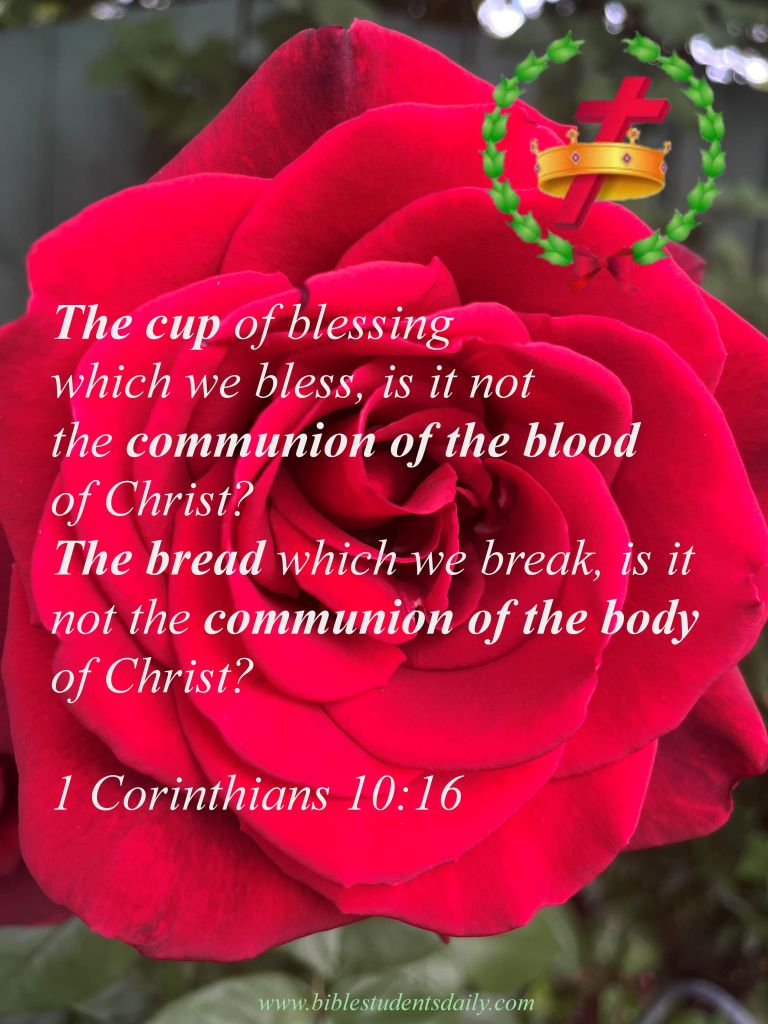
“The cup of blessing which we bless, is it not the communion of the blood of Christ? The bread which we break, is it not the communion of the body of Christ?” (1 Corinthians 10:16)

What does the Apostle Paul mean by the “communion of the blood and body of Christ”?

“You cannot drink the cup of the Lord and the cup of demons; you cannot partake of the Lord’s table and of the table of demons” (1 Corinthians 10:21).

In Chapter 10 of the first epistle to the Corinthian church, the Apostle Paul illuminates and puts in context his reference to our communion in partaking of the memorial emblems of the cup and bread.

What Pastor Charles Russell Taught

Pastor Charles Russell quoted 1 Corinthians 10:2 in The Reprints of the Original Watchtower and Herald of Christ’s Presence and taught that there was a secondary meaning to the bread and wine emblems: that the (1) “broken loaf” represents the breaking of all his mystical members” and “communion of the blood of Christ” means a “participation in the sufferings and death of Jesus.” R3364.

He based this teaching of a secondary meaning on the word “communion” in Corinthians 10:2 and that since the word “communion” comes from the ancient Greek word koinonia; which in its basic sense means a common union with someone in a shared experience, he thought that the shared experience is “the sufferings and death” and that the common union was with Jesus.

Let us now consider the 1 Corinthian Chapter 10 context, in order to understand the Apostle Paul’s teachings in this section, and thereby specifically examine whether this proposed secondary meaning is actually what the Apostle Paul was teaching or not.

The Context:

i) The Immediate Context: 1 Corinthians 10:1-22

The verses that define the immediate context for understanding the communion verse [16] are found in 1 Corinthians 10:1-22.

Moreover, brethren, I do not want you to be unaware that all our fathers were under the cloud, all passed through the sea” (1 Corinthians 10:1, NKJV).

δέ de; a primitive word; but, and, now

We notice that verse 1 uses the conjunction δέ, meaning but, and, now here, the NKJV translates δέ as “moreover.” This tells us that this section is also linked to what came before and therefore that there is a wider context to consider also.

ii) The Wider Context: It is Possible to Lose the Imperishable Crown

“… I have become all things to all men, that I might by all means save some” (1 Corinthians 9:22).

In the previous few Chapters in 1 Corinthians, the Apostle Paul outlines his determination to put nothing in the way of the Gospel and to be “all things to all men” in order to “save some.”

“And everyone who competes for the prize is temperate in all things. Now they do it to obtain a perishable crown, but we for an imperishable crown. 26 Therefore I run thus: not with uncertainty. Thus I fight: not as one who beats the air. 27 But I discipline my body and bring it into subjection, lest, when I have preached to others, I myself should become disqualified(1 Corinthians 9:25–27).

The paragraph immediately prior to Chapter 10, the Apostle Paul outlines the possibility that it is possible to be disqualified from gaining the imperishable crown if we do not run in the race with temperance and discipline, and therefore we can expect that what follows will be practical advice and warnings, as well as bringing to mind relevant aspects of our faith to give us strength and determination in order to gain the prize of that imperishable crown.

iii) The Immediate Context: Warnings Against the Conscious Pursuit of Evil Things

“Now these things became our examples, to the intent that we should not lust after evil things as they also lusted” (1 Corinthians 10:6).

The immediate context to the communion verse is that of the Apostle Paul’s warnings against the conscious pursuit of evil things because the end result of doing so is the loss of God’s favour and disqualification from the race for the prize of the high calling in Christ Jesus.

“No temptation has overtaken you except such as is common to man; but God is faithful, who will not allow you to be tempted beyond what you are able, but with the temptation will also make the way of escape, that you may be able to bear it” (1 Corinthians 10:13).

The Apostle Paul outlines that even though God will give us the means to escape these temptations, we have an important role in the matter; actively and consciously exercising temperance and discipline.

iii) The Apostle Uses Two Devices in His Warnings:

The Apostle Paul uses two didactic devices to highlight the danger and seriousness of consciously pursuing temptations: firstly, he uses the example of natural Israel during their wanderings in the desert; and secondly, he reminds us of the underlying meaning and significance of partaking of the cup and the bread at the memorial.

The Apostle Paul’s points and logic here have the purpose of ensuring that his fellow Christians are not disqualified from gaining the prize by pursuing evil things.

The Example of “Israel after the Flesh”

“Observe Israel after the flesh: Are not those who eat of the sacrifices partakers of the altar?” (1 Corinthians 10:18).

“Now all these things happened to them as examples, and they were written for our admonition, upon whom the ends of the ages have come” (1 Corinthians 10:11).

Here the Apostle Paul uses the experiences in the wilderness of natural Israel as a type to illustrate important lessons for spiritual Israel.

1) Idolatry,

2) Sexual immorality,

3) Testing of the Lord, and

4) Murmuring or complaining

The Apostle Paul specifically mentions four evil things “Israel after the flesh” engaged in:  idolatry, sexual immorality, testing of the Lord, and murmuring or complaining

“But with most of them God was not well pleased, for their bodies were scattered in the wilderness” (1 Corinthians 10:5).

Because of this, God was not pleased with them and their bodies He scattered in the wilderness. By outlining these experiences as examples for our instruction, Paul is warning that we face the same dangers – particularly if we become complacent; as he points out in 1 Corinthians 10:12 Therefore let him who thinks he stands take heed lest he fall.”

In the Apostle Paul’s references to “Israel after the flesh” here, he introduces the concept of natural Israel partaking of spiritual nourishment in the wilderness from God by way of our Lord Jesus Christ- for they all “drank of that spiritual Rock that followed them, and that Rock was Christ” (1 Corinthians 10:3-4).

“Our fathers ate the manna in the desert; as it is written, ‘He gave them bread from heaven to eat’” (John 6:31).

“Then Moses lifted his hand and struck the rock twice with his rod; and water came out abundantly, and the congregation and their animals drank” (Numbers 20:11).

God miraculously provided Israel with literal food and drink during their desert wanderings, but this is not what Paul is focusing on here. He is referring to spiritual food and drink.

The miraculous manna given to natural Israel was, of course, a great blessing but as Deuteronomy 8:3 tells us, it was intended to teach them the lesson that man lives – in the greater sense, by feeding on “every word that proceeds from the mouth of the Lord” – this is the real spiritual food. The word of God was imparted to them through Moses, so that they were guided and protected by God in their wanderings. God spoke to them through their covenant relationship, and through the many wonderful promises given to them, as well as their miraculous liberation from Egypt.

“They all ate the same spiritual food, and all drank the same spiritual drink…”(1 Corinthians 10: 3–4).

In this way, Israel after the flesh ate at the Lord’s table, for they all ate the same spiritual food and drank the same spiritual drink.

The Apostle Paul makes clear that it was all of natural Israel that ate at the Lord’s table and he mentions the all twice, probably to make this abundantly clear.

Crucially, we see that the benefits of the spiritual drink and the spiritual food flows from our Lord Jesus to all of the Israelites. It is clear that Jesus did not eat or drink this spiritual food or drink.

In summary: a commonality was established amongst the individual Israelites through all partaking of the same spiritual food and drink – the source of which was our Lord Jesus.

Paul is laying the ground work in his lead up to the important lesson that like Israel after the flesh, Israel after the spirit also eats and drinks at the table of the Lord – gaining far greater blessings but at the same time conferring important responsibilities.

All of Fleshly Israel Partakes, All of Spiritual Israel Partakes

“The cup of blessing which we bless, is it not the communion of the blood of Christ? The bread which we break, is it not the communion of the body of Christ?” (1 Corinthians 10:16)

In 1 Corinthians 10:16 the Apostle Paul reminds his fellow Christians that the literal partaking of the cup and bread is not a meaningless ritual. Rather, by partaking of the cup emblem we show that we are spiritually feeding on the blood of Jesus by gaining justification through faith. Also, by partaking of the bread emblem, we show that we are being spiritually nourished by appropriating the benefits of Jesus’ sacrificed body.

What Does Partaking of the Emblems (the cup and the bread) Show?

It shows that we are eating/drinking at the Table of the Lord with fellow believers; the communion, leading to eternal life.

“Whoever feeds on my flesh and drinks my blood has eternal life, and I will raise him up on the last day” (John 6:54).

i) Partaking of the Cup [drinking of the blood of Jesus] shows:

1) The New Covenant is Ratified and Operative for the Church by the Blood of Jesus, enabling:

– Learning of God

– Having God’s law written on our hearts

2) Believers have True Forgiveness of sins by faith through application of the blood of Jesus as the antitypical sin-offering under the administration of the better sacrifices

3) Believers are Reconciled to God [achieving atonement with God – from1)+2)]

4) Have Received The Promise of the holy spirit

5) Believers are Cleansed from ongoing inadvertent sin [purification through the antitypical ashes of the red heifer – depicted in Jesus washing of the disciples’ feet]

ii) Partaking of the Bread [eating of the flesh of Jesus] shows:

1) Believers Receive and Understand Jesus’ words of truth [through the holy spirit]

2) Have ongoing spiritual nutrition for spiritual growth of the new creature through the indwelling of the holy spirit given at baptism into Christ

– Growing in grace and knowledge

– Learning of God

– Having God’s law written on our hearts

“Then Jesus said to them, ‘Most assuredly, I say to you, unless you eat the flesh of the Son of Man and drink His blood, you have no life in you’” (John 6:53).

All of Jesus’ followers must eat his flesh and drink his blood.

The spiritual drink and spiritual food that we partake of leads to eternal life which is provided for us by the sacrifice of Jesus, by the grace of God.

** We notice in John 6:53 that Jesus is addressing his followers – unless you eat and drink, you have no life in you – plainly Jesus is not including himself here.

1 Corinthians 10:3–4 (NKJV) — all ate the same spiritual food, 4 and all drank the same spiritual drink. For they drank of that spiritual Rock that followed them, and that Rock was Christ.”

We notice again that the same relationship exists in spiritual Israel as it did in fleshly Israel. All the natural Israelites ate the spiritual food and drank the spiritual drink. There is no suggestion that Jesus somehow also ate and drank of the same spiritual food and drink as fleshly Israel.

“Then He took the cup, and gave thanks, and gave it to them, saying, “Drink from it, all of you” (Matthew 26:27).

Jesus did not say “let us all drink of it”, rather he said “drink from it, all of you.

Also, Jesus’ instructions were to do this “in remembrance of me not in remembrance of us.

“He who eats My flesh and drinks My blood abides in Me, and I in him. 57 As the living Father sent Me, and I live because of the Father, so he who feeds on Me will live because of Me. 58 This is the bread which came down from heaven—not as your fathers ate the manna, and are dead. He who eats this bread will live forever (John 6:56–58).

Israel after the flesh ate the manna, died

Spiritual Israel eat/drink of Jesus flesh/blood, live forever

Note how this parallels the type which emphasises its importance in understanding the communion relationship. The Apostle John, in John 6:58, beautifully links the type and the antitype for us: “This is the bread which came down from heaven—not as your fathers ate the manna, and are dead. He who eats this bread will live forever.”

“This is my blood of the covenant, which is poured out for many for the forgiveness of sins (Matthew 26:28).

“In the same way, after the supper he took the cup, saying, ‘This cup is the new covenant in my blood, which is poured out for you’” (Luke 22:20).

Jesus’ blood, through which we have forgiveness of sins, was poured out for us — that is for spiritual Israel. It is clear that Jesus could not eat of his flesh or drink his own blood as he was sinless and undefiled and hence did not require forgiveness. Moreover, if he had any sin, he would not have been able to provide life through his sacrifice. This shows the flow of the blessings of forgiveness of sins, from Jesus by virtue of his sacrificed flesh and poured out blood, is to us.

There is no indication that those feeding and drinking are contributing to the food and drink.

Sacrificial Nourishment for the Levites/Firstborn

“The priests, the Levites—all the tribe of Levi—shall have no part nor inheritance with Israel; they shall eat the offerings of the Lord made by fire, and His portion” (Deuteronomy 18:1).

Observe Israel after the flesh: Are not those who eat of the sacrifices partakers of the altar?”  (1 Corinthians 10:18).

The Apostle Paul then goes even further, and makes the illustration from the type even more specific in order to further illuminate the communion relationship and the significance of our partaking of the cup and bread memorial emblems. He does this by referring to the priests and Levites that did partake of the sacrifices from the altar in the tabernacle. The tribe of Levi had no inheritance in the Land of Israel and so they lived off the offerings made to the Lord. The offerings from the altar in the tabernacle were therefore their source of food.

This illustration is more specific to Christians and is introduced immediately after the communion verses to make clear the significance and nature of the communion relationship and he links the two situations by the word “observe.”

In the tabernacle picture, as with the firstborn of the Passover, the tribe of Levi represented the household of faith — which only has a heavenly inheritance. The tribe of Levi had no land of their own, picturing this heavenly inheritance of the Church of firstborns.

The priests and Levites ate of the sacrifices, indicating that they internalised the nutritional benefits to themselves. Again, there is no suggestion here that by eating of these sacrifices they were sharing in or contributing to the actual sacrifice. Rather, the benefit of the nutritional elements flowed in one direction and one direction only — from the altar to the priest or Levite. In the antitype this translates directly to the flow of spiritual benefits from the altar of God by way of Jesus’ sacrifice to the household of faith, which the Priests and Levites represented.

In this more specific typical picture, the Apostle Paul introduces the important principle that the altar from which the sacrificed food comes, identifies the source of the food. The priests and Levites ate of the sacrifices from the altar in the court of the tabernacle, thus identifying the source of the food as God.

Therefore, my beloved, flee from idolatry. 15 I speak as to wise men; judge for yourselves what I say. 16 The cup of blessing which we bless, is it not the communion of the blood of Christ? The bread which we break, is it not the communion of the body of Christ? 17 For we, though many, are one bread and one body; for we all partake of that one bread” (1 Corinthians 10:14–17).

The communion verses come immediately after the Apostle Paul’s admonition to flee from idolatry; which was a particular problem in the Corinthian church. The Corinthian church consisted of many Christians of Gentile background and these brethren were accustomed to eating food from the markets and in houses of unbelievers that had been sacrificed on pagan altars to pagan gods. The Apostle Paul’s aim here is to illustrate the dangers of continuing to eat these pagan sacrifices by pointing out the crucial significance of the altar from which the sacrifices come. Here he is teaching that those that partake of these sacrifices in the type, are commonly joined to one another by participating of the altar and what it represents, from which the sacrifice comes. In the same way, those that eat of pagan sacrifices are commonly joined by participating in eating from them.  

Partaking of pagan sacrifices means partaking of the table of demons.

“What am I saying then? That an idol is anything, or what is offered to idols is anything? 20 Rather, that the things which the Gentiles sacrifice they sacrifice to demons and not to God, and I do not want you to have fellowship with demons” (1 Corinthians 10:19–20).

Even though, as the Apostle Paul points out, idols are nothing in themselves, in reality the altar is demonic, so that by partaking of the pagan sacrifice, one is not only joining oneself in fellowship with those pagans that eat the sacrificed food, but is also partaking of the table of demons.

“You cannot drink the cup of the Lord and the cup of demons; you cannot partake of the Lord’s table and of the table of demons” (1 Corinthians 10:21).

And for a Christian to partake of the table of the Lord is incompatible with partaking of the table of demons.

Or do we provoke the Lord to jealousy? Are we stronger than He?” (1 Corinthians 10:22).

By partaking of these pagan sacrifices, Christians risk provoking the Lord to jealousy.

“You shall not bow down to them nor serve them. For I, the Lord your God, am a jealous God, …” (Exodus 20:5).

For our God is a jealous God and He will not tolerate other gods, for all other gods are no gods. So that the worship of anything but God is not only false but is also of Satan — for he is the great usurper, for he wanted to be as the Most High. Worship of anything else but God usurps the authority of God and displaces the true worship reserved only for God.

And this principle is embodied in the first and greatest commandment – “You shall love the Lord your God with all your heart, with all your soul, and with all your mind” (Matthew 22:37).

So, to summarize, it is evident that the food provided at these altars is not shared in the sense of being contributed to by the partaker. The flow of nutrition, whether typical or spiritual or idolatrous, flows from the altar to the recipient, for the benefit (or detriment) of the partaker.

The modern-day gods that we are in danger of worshipping tend to be more subtle and insidious.

“For many walk, of whom I have told you often, and now tell you even weeping, that they are the enemies of the cross of Christ: 19 whose end is destruction, whose god is their belly, and whose glory is in their shame— who set their mind on earthly things. 20 For our citizenship is in heaven, from which we also eagerly wait for the Savior, the Lord Jesus Christ…” (Philippians 3:18–20).

In our modern society we find people pursuing such things as knowledge, health, physical beauty, money, material things, status and respect. Even though most of these have benefits in moderation, when one is consumed by their pursuit it becomes a false god. Therefore, anything that takes our minds and desires from the heavenly things, anything that supplants the true and appropriate worship of our heavenly Father is a false god and amounts to idolatry when pursued to an excessive extent.

A particular danger for the household of faith is the supplanting, consciously or subconsciously, of the authority of the word of God with the words of any imperfect human being. Our faith must be based on the word of God, not on the words of a man. All teachings must be tested thoroughly against scripture.

KOINONIA

“The cup of blessing which we bless, is it not the communion (koinonia) of the blood of Christ? The bread which we break, is it not the communion (koinonia) of the body of Christ?” (1 Corinthians 10:16).

Koinonia is part of the koin- root word group which has the fundamental meaning of sharing in something (indicated by the genitive case) with someone (indicated by the dative case); or the simple cases may be replaced by a prepositional phrase.

“By which have been given to us exceedingly great and precious promises, that through these you may be partakers (koin-) of the divine nature (genitive case), having escaped the corruption that is in the world through lust” (2 Peter 1:4).

“Therefore, if there is any consolation in Christ, if any comfort of love, if any fellowship  (koin-) of the Spirit (genitive case), if any affection and mercy…” (Philippians 2:1).

Another example of the koin- root word group occurs in Philippians 2 verse 1. Paul is talking about the fellowship of the holy spirit – it is evident that each individual of the household of faith has a share in the holy spirit with all other believers. Spirit is in the genitive case indicating what they commonly share in. Importantly the sharing is in the holy spirit not with the holy spirit.

“And so also were James and John, the sons of Zebedee, who were partners (koin-) with Simon (dative case). And Jesus said to Simon, ‘Do not be afraid. From now on you will catch men.’” (Luke 5:10).

So, the word “koinonia” in 1 Corinthians 10:16 means that the household of faith share-the shared experience, in the drinking of the blood of Jesus and eating of his flesh with one another.

In our 1 Corinthians 10:14–22 context, we have the koin- root word used four times.

If drinking of the cup of the Lord meant sharing in the sufferings of the Lord, then those drinking of the cup of demons would have to mean sharing in the sufferings of demons — which evidently is not the case.

Here the Apostle Paul also uses the koin- root word with respect to the Levites being common sharers of the brazen altar and what it represents. Altar here is in the genitive case making clear what the Levites are participating in. It is clear from the actual type and the underlying grammar that the meaning of the koin- root word here does not mean a sharing with the altar and the sacrifices that come from it. The Levites did not contribute to the sacrifices or their suffering in any way — they ate of them and thereby benefitted from them.

By eating of the bread, and drinking of the cup introduced by Jesus at the memorial, we show that we are commonly – with one another, sharing in the eating of the flesh of Jesus and drinking of his blood. Thereby we receive the spiritual nutrition essential and indispensable for our salvation.

Although sharing in the sufferings and death of Jesus is clearly taught in the scriptures, Paul is not teaching this here in the communion verse.

“Is it Not”: Indicates a Reminder of Something Already Taught Not Something New

“The cup of blessing which we bless, is it not the communion of the blood of Christ? The bread which we break, is it not the communion of the body of Christ? 17 For we, though many, are one bread and one body; for we all partake of that one bread” (1 Corinthians 10:16–17).

That the Apostle Paul is bringing to mind something familiar rather than a new teaching [like a secondary meaning] is indicated by his use of the phrase “is it not”, twice in the communion verses.

Technically, “is it not” is a figure of speech referred to as “interrogation”; this occurs when a question is asked without waiting for the answer. There are different forms of interrogation and here it is called “interrogation in negative affirmation“; this occurs when the question is put in the negative, and the answer must be in the affirmative, and very emphatically so – indicating that the point made is or should be known already by those to whom the question is addressed.

Let us look at other instances of use of this figure of speech.

“Therefore, I say to you, do not worry about your life, what you will eat or what you will drink; nor about your body, what you will put on. Is not life more than food and the body more than clothing?” (Matthew 6:25).

We find it is used in Matthew 6:25 by Jesus to show that indeed life is more than food and the body more than clothing. The important point to glean here is that the “is not” did not introduce something they did not already know.

“So all bore witness to Him, and marveled at the gracious words which proceeded out of His mouth. And they said, ‘Is this not Joseph’s son?’” (Luke 4:22)

We find another example of this interrogative figure of speech in Luke 4 verse 22.  Because of the gracious words that proceeded out of Jesus’ mouth, the people assumed that he was a sage from a far-off land with new found wisdom, and yet the interrogation in negative affirmation “is not” emphasises the fact that Jesus and his family were well known to them.

Therefore, the use of this “is not” figure of speech suggests that the communion verses are a reminder or an emphasis of something that was clear and known, rather than introducing a new truth.

Partaking of the Memorial Emblems Shows That We are Eating and Drinking at the Table of the Lord.

The memorial truth that the Apostle Paul is reminding us of is that eating of the bread and the drinking of the cup emblems indicates that we are together figuratively partaking of the sacrificed body and shed blood of Jesus – and thereby we are eating and drinking at the table of the Lord.

Sharing in the Sufferings of Jesus an Important Teaching – But Not Shown in Partaking of the Memorial Emblems

Let us be clear that we are not saying that faithful followers of Jesus do not share in his sufferings and death – for this is taught clearly in the word of God. Philippians 3:10 is a case in point:

“that I may know Him and the power of His resurrection, and the fellowship of His sufferings, being conformed to His death…” (Philippians 3:10).

But this is not Paul’s teaching in his reference to our partaking of the memorial emblems in 1 Corinthians 10:16.

Fixing KJV 1 Corinthians 10:17

The Rendering of 1 Corinthians 10:17 in the KJV, NKJV and even the RVIC2016 is faulty.

“For we, though many, are one bread and one body; for we all partake of that one bread” (1 Corinthians 10:17, NKJV).

 104 seeing that we the many are one bread, one body: for we all partake.” (1 Corinthians 10:17, (RVIC2016).

When we read 1 Corinthians 10:17 in the KJV, NKJV and even the RVIC2016, we are left with the thought that by partaking of the bread emblem the followers of Jesus become that bread. Ostensibly this does not seem to make sense, but does seem to give credence to the thought that the Church becomes part of the sacrifice from which it benefits.

1 Corinthians 10:17 should read – seeing that there is one bread, we, who are many, are one body”

The Church is referred to as “one body” but never as “the/one bread.” Only Jesus is referred to as “the bread.”

The more modern translations, including the Diaglott, show that the greater number of modern translators overwhelmingly favour the alternate rendering – seeing that there is one bread, we, who are many, are one body. The“we” belongs with the many and one body, not the bread – for as the verse makes clear we are one body because we partake of that bread.

We Need to Keep Eating at the Table of the Lord in Order to Gain the Imperishable Crown

As followers of Jesus, we need to keep spiritually feeding on his flesh and drink his blood to continue to receive these incredibly gracious benefits during this age of darkness. We remind ourselves of these spiritual benefits flowing from God to us based on Jesus’ shed blood and sacrificed body, particularly at memorial time.

What a privilege it is to eat and drink at the table of the Lord; for it leads to eternal life. But doing so also carries all important responsibilities. We have to avoid all forms of idolatry, particularly the subtle forms, for truly we are on trial for life, now.

“Now the just shall live by faith; But if anyone draws back, My soul has no pleasure in him.” 39 But we are not of those who draw back to perdition, but of those who believe to the saving of the soul(Hebrews 10:38–39).

But if we are careful and listen to God’s word, for Jesus speaks to us through it, we will not be of those that draw back to destruction, but rather we will be of those that are faithful, temperate and disciplined, leading to eternal life – to the glory of our Heavenly Father.

“Thou preparest a table before me in the presence of mine enemies: Thou anointest my head with oil; my cup runneth over” (Psalm 23:5).

Amen.

All To Thee – Hymns of Dawn No. 28

All To Thee – Hymns of Dawn No. 28

“(1) Come, let us shout joyfully to Jehovah! Let us shout in triumph to our Rock of salvation. (2) Let us come into his presence with thanksgiving; Let us sing and shout in triumph to him” (Psalm 95:1,2).

“My mouth shall praise Thee with joyful lips” (Psalm 63:5).

“Until the day break, and the shadows flee away, I will get me to the mountain of myrrh, and to the hill of frankincense (Song of Solomon 4:6).

Note: “ Myrrh is bitter experience and the wisdom gained through such experience. Frankincense represents praise and thanksgiving. Hymns of praise often include the Christian’s gratitude for deliverance from suffering that is beyond human endurance. Such help usually evokes praise and thanksgiving. Of course pleasant experiences also bring forth praise, but the type of praise that arises from suffering is on a higher level than praise from pleasure. Verse 6 alludes to praise that arises from suffering.

‘Until … the shadows flee away.’ The shadows of the nighttime experience of the Church will ‘flee away’ when the Church is complete. These are the shadows of the gospel night, the Passover night. Why is myrrh a ‘mountain’ and frankincense a ‘hill’? Two different Hebrew words are used. Our praise can never reach the mark of perfection. What Jesus offered at Calvary far transcends anything we can offer” (Br. F. Shallieu, Notes on the Song of Solomon, pages 37-38).

Here is a recording of Hymn No. 28 from the “Hymns of Dawn” to aid God’s people in singing and making melody in their hearts unto God.

Lyrics

1.
Christ gave his life for me,
His precious blood he shed,
That I might ransomed be,
And quickened from the dead.
He gave, he gave his life for me;
How grateful I should be!
He gave, he gave his life for me;
How grateful I should be!

2.
His Father’s house of light,
His glory-circled throne,
He left for earthly night,
For wand’rings sad and lone;
He left, he left it all for me,
Have I left all for thee?
He left, he left it all for me,
Have I left all for thee?

3.
He suffered much for me,
More than I now can know,
Of bitt’rest agony;
He drained the cup of woe;
He bore, he bore it all for me,
What have I borne for thee?
He bore, he bore it all for me,
What have I borne for thee?

4.
He now has brought to me,
Down from his home above,
Salvation full and free,
Pardon and life and love.
He brings, he brings rich gifts to me,
Lord, I give all to thee.
He brings, he brings rich gifts to me,
Lord, I give all to thee.

*******

The History Of This Hymn

Author — Frances R. Havergal (1836-1879), the “daughter of the Rev. W. H. Havergal, was born at Astley, Worcestershire, Dec. 14, 1836. Five years later her father removed to the Rectory of

Havergal_Frances_Hymns_of_Dawn.jpg

St. Nicholas, Worcester. In August, 1850, she entered Mrs. Teed’s school, whose influence over her was most beneficial. In the following year she says, ‘I committed my soul to the Saviour, and earth and heaven seemed brighter from that moment.’ Simply and sweetly she sang the love of God, and His way of salvation. To this end, and for this object, her whole life and all her powers were consecrated. She lives and speaks in every line of her poetry. Her poems are permeated with the fragrance of her passionate love of Jesus.” (https://hymnary.org/person/Havergal_Frances)

ComposerNo information.

*******

Bible Scriptures Associated With This Hymn

Isaiah 53:3-12(3) He was despised and rejected by men, a man of sorrows and acquainted with grief; and as one from whom men hide their faces he was despised, and we esteemed him not.

(4) Surely he has borne our griefs and carried our sorrows; yet we esteemed him stricken, smitten by God, and afflicted.

(5) But he was pierced for our transgressions; he was crushed for our iniquities; upon him was the chastisement that brought us peace, and with his wounds we are healed.

(6) All we like sheep have gone astray; we have turned—every one—to his own way; and the Lord has laid on him the iniquity of us all.

(7) He was oppressed, and he was afflicted, yet he opened not his mouth; like a lamb that is led to the slaughter, and like a sheep that before its shearers is silent, so he opened not his mouth.

(8) By oppression and judgment he was taken away; and as for his generation, who considered that he was cut off out of the land of the living, stricken for the transgression of my people?

(9) And they made his grave with the wicked and with a rich man in his death, although he had done no violence, and there was no deceit in his mouth.

(10) Yet it was the will of the Lord to crush him; he has put him to grief; when his soul makes an offering for guilt, he shall see his offspring; he shall prolong his days; the will of the Lord shall prosper in his hand.

(11) Out of the anguish of his soul he shall see and be satisfied; by his knowledge shall the righteous one, my servant, make many to be accounted righteous, and he shall bear their iniquities.

(12) Therefore I will divide him a portion with the many, and he shall divide the spoil with the strong, because he poured out his soul to death and was numbered with the transgressors; yet he bore the sin of many, and makes intercession for the transgressors.

John 6:38 (ESV) — “For I have come down from heaven, not to do my own will but the will of him who sent me.”

Romans 6:10 (NAS)“For the death that He died, He died to sin once for all; but the life that He lives, He lives to God.”

1 Corinthians 15:3, 4, 22, 23 (KJV)“(3) For I delivered unto you first of all that which I also received, how that Christ died for our sins according to the scriptures; (4) And that he was buried, and that he rose again the third day according to the scriptures: (22) For as in Adam all die, even so in Christ shall all be made alive. (23) But every man in his own order: Christ the firstfruits; afterward they that are Christ’s at his coming.”

Ephesians 2:8, 9 (ESV)“(8) For by grace you have been saved through faith. And this is not your own doing; it is the gift of God, (9) not a result of works, so that no one may boast.

Philippians 2:7-8 (NRSV) “(7) but emptied himself, taking the form of a slave, being born in human likeness. And being found in human form, (8) he humbled himself and became obedient to the point of death—even death on a cross.

1 Timothy 2:5, 6 (KJV) — “(5) For there is one God, and one mediator between God and men, the man Christ Jesus; (6) Who gave himself a ransom for all, to be testified in due time.

Hebrews 12:2 (NASB)“fixing our eyes on Jesus, the author and perfecter of faith, who for the joy set before Him endured the cross, despising the shame, and has sat down at the right hand of the throne of God.

1 Peter 1:18-21 (NLT)“(18) For you know that God paid a ransom to save you from the empty life you inherited from your ancestors. And the ransom he paid was not mere gold or silver. (19) It was the precious blood of Christ, the sinless, spotless Lamb of God. (20) God chose him as your ransom long before the world began, but he has now revealed him to you in these last days. (21) Through Christ you have come to trust in God. And you have placed your faith and hope in God because he raised Christ from the dead and gave him great glory.”

1 Peter 3:18 (ESV)“For Christ also suffered once for sins, the righteous for the unrighteous, that he might bring us to God, being put to death in the flesh but made alive in the spirit.”

 *******

The words below are from Reprint No. 5972-5973, from the Original Zion’s Watch Tower and Herald of Christ’s Presence as documented on “Harvest Truth DataBase Version 9: http://www.htdb.one

THE RANSOM NOT THE SIN-OFFERING

====================

IT SEEMS difficult for some of our dear readers to distinguish clearly between the Ransom and the Sin-offering. Although we have repeatedly tried to make the subject clear, we will try again.

The word “ransom” in the Old Testament seems to be used less definitely than in the New Testament. In the Old Testament, the Hebrew word translated ransom is kopher, and signifies a covering, a protection, as when we read, “The wicked shall be a ransom for the righteous” (Proverbs 21:18)—their covering, their protection. The righteous are few and uninfluential in the world; and laws would not generally be made especially for their protection. The laws of society are made for the masses of the people—not for the saints; but those laws made for the people in general we—the Lord’s saints—have as a covering.

The Prophet David declares that no man can give a ransom for his brother. (Psalm 49:7.) That is to say, all mankind are imperfect through the Adamic fall. All are sinners; therefore none could stand before God in the sense of justifying themselves; and thus unable to justify themselves, they would be wholly unable to justify another—their brother. Here the thought is very similar to that attaching to the word “ransom” in the New Testament, showing that to be such a ransom, or covering, requires perfection, righteousness, which no man of all our race possessed, except the Man Christ Jesus, “holy, harmless, undefiled, separate from sinners,” who was therefore able and qualified to give Himself “a Ransom for all, to be testified in due time.”1 Timothy 2:6.

The word used in the New Testament Greek for “ransom” is very explicit; it signifies a price to correspond, or a corresponding price. The implication is that something was lost that needs to be re-purchased, redeemed, bought back; and the thing which is competent to purchase it back must be of equal value to the thing lost or forfeited—no more, no less—a “corresponding price.”

WHY A RANSOM WAS NECESSARY

The thing that was lost by Father Adam for himself and all of his family was the right to life. As the perfect man, God’s arrangement provided him with the privilege of living forever on condition that he would be obedient, loyal to his Creator. His sin was disloyalty, disobedience, and its penalty was death—the forfeiture of the right to live. Thus, because of Adam’s disobedience, he came under the death sentence, “Dying, thou shalt die.” (Genesis 2:17, margin.) Adam’s children were born to him after he had thus forfeited his life-rights, and he was unable to give them more than he possessed—a dying nature. Thus we read: “Wherefore, as by one man sin entered into the world, and death by sin, and so death passed upon all, for that all have sinned,” etc.—Rom. 5:12.

God reveals to us in His Word that while He wishes to be merciful and to receive back to Himself all the willing and obedient of the race, nevertheless He must maintain the dignity of His own Law and cannot set aside the death sentence except upon the conditions which He has arranged; viz., a Ransom. If Adam is ransomed from the sentence of death, Justice will have no further claim against his life, and the ransomer would have the right to restore Adam and his race. But no ransomer could be found amongst all the family of men; for all were sinners—none was perfect, all had inherited the blemishes of sin. Hence God’s arrangement—the sending of His Only Begotten Son to be the Redeemer, the Ransomer, of Adam and his family, and ultimately to be the Restorer of all that was lost.

To this service—to this carrying out of the Divine Program—God attached a very great reward of glory, honor and immortality. The Logos, “The beginning of the creation of God,” “the first born of every creature” (Revelation 3:14; Colossians 1:15), accepted the Divine arrangement gladly and humbled Himself. Leaving the honors and favors of His high position on the spirit plane, He was made flesh in order “that He by the grace of God, should taste death for every man (Hebrews 2:9) as the Ransomer of Adam. St. Paul tells us of Him as the One “who for the joy that was set before Him, endured the cross, despising the shame,” and now as a result, “is set down at the right hand of the Throne of God” (Hebrews 12:2), henceforth expecting, waiting, until the time shall come for Him to bless Adam and his race for whom He has already died—waiting that the Father in due time, after the selection of the Bride Class, may put all things in subjection under Him—under the Messiah—that He may reign a thousand years for the uplifting and blessing of those for whom He died.

That Ransom-price, that Corresponding-price for Adam, has already been placed in the hands of Justice. Jesus did this in His consecration at Jordan, in that He agreed to do the will of the Father even unto death; and on the Cross He declared, “Into Thy hands I commit My spirit”—the spirit of life, His right to life, which He had not forfeited, either by sin or otherwise. That Ransom-price, or Price sufficient to redeem Adam and all of his race, has been in the hands of Justice as a deposit ever since, and is there now—still unapplied. It cannot be applied piecemeal, a little to each one; when applied, it must be applied for all at the same moment.

Why must it be applied all at one moment? Because it is just the one life. It would require the entire merit of Christ’s sacrifice to recover Father Adam from his condemnation, and it would require the entire merit of that sacrifice for any one of the children of Adam. The Ransom cannot be divided up into millions of parts and a little piece given to each member of the race. The whole sacrifice of Christ was necessary for each one of the race, and is sufficient for the entire race, when it shall be so applied. It is to be applied for the entire race, but not until the Father’s time has come for turning over the race to the Redeemer—not until His appointed time for the Redeemer to take possession of the race as King of kings and Lord of lords, to establish over them His glorious Kingdom, to release them from the power of sin and death and to give them all the Restitution privileges which His Ransom-sacrifice makes possible.

THE SIN-OFFERING

In the meantime, another feature of the great Heavenly Father’s Plan is working out—an arrangement by which a certain number of the children of Adam may become associates with Jesus in the suffering of this present time and in the glory that is to follow. This feature of the Plan is not the providing of a Ransom; for that was already provided in the death of Jesus; but this plan is to provide an under-priesthood who are eventually to be kings with the Savior—a Royal Priesthood. Evidently therefore the Sin-offering must not be confused with the Ransom-price; for the Ransom-price is complete, and was complete before the Church was invited to come into this position of self-sacrifice.

The Jewish Day of Atonement pictured the entire work and operation of the Sin-offering, which began in the person of Jesus. The death of Jesus was typified by the killing of the bullock on the Day of Atonement. That was the great sacrifice for sins—a Sin-offering which was made by Jesus, who offered up Himself. He was both the anointed Priest of God and also the devoted Sacrifice. The merit of that Sacrifice might have been applicable to all the people; but if so, there would have been no room for the sacrifice of the Lord’s Goat Class, the sacrifices of the under-priests, who, if faithful, are by and by to be made the Royal Priesthood of the Millennium. In the type, the High Priest allows the merit of his sacrifice to be applied to himself and his house [his sons, the underpriests, Leviticus 16:6, 33] … representing the Household of Faith, the consecrated ones … [Galatians 6:10].

OFFERINGS MADE DURING THE GOSPEL AGE

This passing of the merit of Jesus’ Sacrifice, first of all, to and through His Church does not diminish the merit of that sacrifice nor its value, for every one who shares in that merit, participates on condition that he will surrender his earthly rights, following in the footsteps of Jesus. The priestly class includes those who keep their covenant arrangement, voluntarily and heartily lay down their lives in the Lord’s service. The Great Company Class is composed of those who have failed to fully surrender [R5973 : page 311] their earthly lives and rights, and will therefore have these earthly rights taken from them through great tribulation. Any others who receive of the Lord’s favor during this Age and fail to get into one or the other of those classes—if they fail to become members of either the Royal Priesthood or of the Levite-servant company—cannot retain any Restitution blessings or privileges, but will die the Second Death. Thus the entire merit of Jesus, designed for Adam and his race, merely passes through the Church Class, the consecrated ones, on its way to Adam and his race. The Church having the opportunity, by reason of this arrangement, to share with Jesus in suffering for righteousness’ sake—the great High Priest accepts our consecrated beings and makes them part of His sacrifice, and the full measure of His merit as the Ransom-price passes on to humanity to give Adam and his family Restitution privileges for a thousand years.

These are the better sacrifices and offerings for sin not made by us, but made by the great High Priest whom the Father has appointed for the purpose. This great High Priest has been completing His sacrifice for sins; first His own flesh, and then the flesh of all those who have come unto the Father through Him during the past nineteen centuries. He will soon complete His sacrificial work, and glorify with Himself those who suffer with Him—making of them His consorts in His Messianic Kingdom. Then He will apply on behalf of all mankind the merit of the sacrifice which He finished at Calvary and which He has merely loaned or imputed to the Church during this Gospel Age.

This Sacrifice will be given fully, completely, everlastingly, to Justice, appropriated as the full offset of Original Sin. Forthwith Adam and all of his children will be turned over by Justice into the hands of Jesus. Divine Justice will have no more to do with mankind. All will be under the administration of the Millennial Kingdom. For a thousand years the Redeemer, the Ransomer of the race, will teach, reward, punish, deal with humanity for their instruction in righteousness and their uplift from the sin and death condition, giving to every one a full opportunity for returning to perfection.

At the close of the thousand years, Messiah having accomplished everything possible for every member of the race, will turn over all to the Father and will say to the sheep class, “Come, ye blessed of My Father, inherit the [earthly] kingdom prepared for you from the foundation of the world.” (Matthew 25:34.) All others, found unworthy of everlasting life, will be destroyed in the Second Death, symbolically pictured as a devouring fire.

Thus we have striven to make plain the distinction between the Ransom-price and the application of the Ransom-price, and the Sin-offering and the blessings resulting to the Church from the privilege of participation in those sin-offerings—the sufferings of Christ.

INTERESTING QUESTIONS

We take occasion here to answer some related queries:

Question.Is it proper to say that we, the Church, receive by imputation “a certain portion” or “our share” of the merit of the Ransom now—during the Gospel Age?

Answer.The person using this language might have the proper thought, but would not be using the best words in which to express that thought to avoid being misunderstood. As above shown, all the merit of Christ is necessary to each member of the race. If we divided up the merit of Christ, nobody would have enough. If it were all given to one, the others would get none. God’s Plan, therefore, is to hold that Ransom-price in reserve until the due time for the inauguration of Messiah’s Kingdom, and then apply that price and transfer the whole race at one time to Jesus—to the Messianic Kingdom. Then during the Millennium, it might be proper to say that every one will be receiving the Restitution blessings as his share or participation in the Ransom merit; but strictly speaking, the whole blessing of the whole world is the ransom blessing.

Question.If the Ransom has not yet been applied, apportioned, credited, to the race on the Books of Justice, and if we who are of the Church are members of the world, how do we participate in the Ransom blessing?

Answer.The entire Ransom merit being in the hands of Justice, the one who owns that merit, Jesus—in harmony with the Father’s Plan—imputes it to the whole company who will accept the offer of this Gospel Age and surrender themselves sacrifices to walk in the Master’s footprints. There is quite a difference between giving and imputing, just as there would be a difference between giving a man a thousand dollars and imputing to him a thousand dollars by endorsing his note. Jesus, as [R5973 : page 312] our great Advocate, imputes to us, or endorses us to the full extent of our contract with the Father. Our contract is that, like Jesus, we will surrender our earthly rights.

The Heavenly Father could not recognize us as worthy of entering into such a contract, except as our great Advocate endorses for us, or guarantees us, in the matter. What does He guarantee? He guarantees that we shall lay down our lives—that our earthly lives shall be fully surrendered in due time.

As we have seen, there are three classes for whom Jesus becomes Surety, Guarantor. First are those who fully and completely carry out their contract both in letter and spirit, laying down their lives voluntarily, after the Master’s example. These will be the “more than conquerors,” the members of the Body of the Anointed. Next will come the Great Company class, who will eventually be conquerors, but not “more than conquerors.” Because conquerors, they will be granted everlasting life on the spirit plane; but because of lack of zeal and love, they will fail of the election as members of the Body of Christ.

Third, there are those who will be neither more than conquerors nor even conquerors, but failures—turning back to sin, like the sow to her wallowing in the mire. These will die the Second Death. In any event, our great Advocate, the High Priest, having endorsed for all of these, will thus be ultimately free from all liability for them in that they all will have died according to the flesh and none of them will receive or retain Restitution rights or privileges. Those Restitution blessings will be fully and completely released when the last member of the spirit-begotten shall have gone into death.

====================

Our Saviour — Christ Jesus

Here are some free online articles in relation to the Heavenly Father — Jehovah, and his Son — Christ Jesus — “a ransom FOR ALL … to be testified in due time” (1 Timothy 2:6), as well as, about the holy Spirit (the invisible power and influence of God) with clear explanations about why the anti-Christ teaching of “the trinity” — introduced by the Roman Catholic Church system (the “Beast” in the Book of Revelation) — is not what the Bible teaches. The Bible Student Movement does not support the teaching of purgatory nor does it support the Roman Catholic System’s teaching about people being sent to a place where they burn up forever, which certainly does not reflect the perfect love of God — the Almighty Creator of all things.

Hence, for the interested Reader, we urge you to consider the following articles and posts:

The Doctrine of the Trinity – Mystery or Confusion by Br. David Rice.
http://www.heraldmag.org/1999/99nd_3.htm

The Origin of the Trinity – From Paganism To Constantine by Sr. Cher-El L. Hagensick.
http://www.heraldmag.org/olb/Contents/doctrine/The%20Origin%20of%20the%20Trinity.htm

Facts About the Trinity
http://www.heraldmag.org/olb/contents/doctrine/FACTS%20ABOUT%20THE%20TRINITY.htm

God and the Trinities
http://www.heraldmag.org/literature/doc_42.htm

Development of the “Trinity Doctrine” by Br. Tom Gilbert.
http://www.beautiesofthetruth.org/Archive/Library/Doctrine/Mags/Bot/90s/2010d.pdf

Understanding John 1:1 by Br. Richard Doctor.
http://www.beautiesofthetruth.org/Archive/Library/Doctrine/Mags/Bot/90s/2010d.pdf

Father, Son and Holy Spirit
https://biblestudentsdaily.com/2016/06/23/father-son-and-holy-spirit/

What Is the Heavenly Father’s Name
https://biblestudentsdaily.com/2017/06/27/gods-name-what-is-the-heavenly-fathers-name-that-we-are-to-hallow-and-why/

Jesus – The Name
https://biblestudentsdaily.com/2017/07/05/jesus-the-name/

The Doctrine of Christ – Booklet
http://www.biblestudents.com/docs/DoctrineChrist.pdf

Hymn Book Purchase

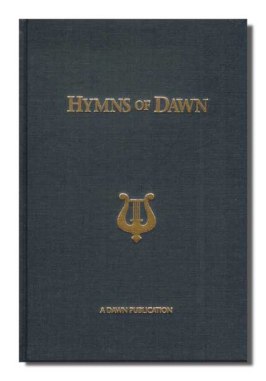
The Hymns Of Dawn (hymn book) can be purchased at:

The Chicago Bible Students Online Bookstore: https://chicagobible.org/product-category/books/page/4/

The Dawn Bible Students Association: http://www.dawnbible.com/dawnpub.htm

Acknowledgment & References

2

Br. Charles Russell—the founder of the Bible Students movement, who is the compiler of “Poems and Hymns of Millennial Dawn” which was published in Allegheny, Pa., in 1890. This Bible Students’ devotional originally contained a total of 151 poems and 333 hymns.

POEMS-AND-HYMNS-OF-MILLENNIAL-DAWN

The following prefatory to the 1905 publication of Hymns of Millennial Dawn may be of historical interest to many of our readers.

We published in 1890, with several more recent editions, a volume entitled “Poems and Hymns of Millennial Dawn” without music. The same collection of hymns with the music is now urgently needed, and therefore appears in this volume. The poems, although highly prized, are omitted for greater convenience in size. We have preserved the same alphabetical order, because so many of our readers have the older book; and where a different tune is given from that originally suggested the latter is indicated by Alt. for alternative tune, with the number where that tune can be found.

Both words and music are credited to the same class to whom the work is dedicated-to the Lord and His faithful people, “the Saints.” The authors of many of the best of them are unknown to us, and, besides, slight changes have been made in the phraseology and sentiment of quite a number, which we could not be sure their original authors would approve, and to give personal credit to less than one half would seem invidious. To all of these dear “Saints” of all ages we therefore give united and hearty thanks for the blessings which they, as the Lord’s servants and handmaidens, have bestowed upon their fellow-members of “the Church of the Firstborn, whose names are written in Heaven.” Most of them died long ago: their abundant reward will be of the Lord in the resurrection.

That the collection is thoroughly undenominational, unsectarian, will be manifest to those recognizing the fact that it includes the choicest old hymns and tunes used by all denominations.

Although we have gathered far and near and winnowed carefully we cannot hope to have gotten all the golden grains, though we do hope that no chaff can be found. The collection is for the Church, for “believers” “reconciled,” and hence contains none of the “sinners” hymns, such as “Come, ye sinners poor and needy,” because willful sinners are in no sense members of the “Body” of Christ, nor are those who have not yet accepted the Lord as their Savior.

Those who will feel the deepest interest in this collection, and whose sentiments will be most fully voiced in its verses, will undoubtedly be those in fullest degree of sympathy with the divine plan of the ages, as set forth in the several volumes of Millennial Dawn—the eyes of whose understanding have been opened to the clearer, purer light now shining from our great Redeemer’s cross, showing the fulness and the completeness of his salvation.

In fact, this volume, while not numbered as one of the volumes of the Millennial Dawn series, is designed to be a companion volume, a melodious accompaniment to the “new song,” “the song of Moses and the Lamb” (the grand harmony of the Law and the Gospel), as presented in the regular Dawn series.

Let the music of God’s good and great plan ring through your hearts and lives, dear fellow-pilgrims and fellow members of the “royal priesthood,” so that every day and every hour shall be filled with joy and praise and thankfulness! And that this little volume may assist in deepening the work of grace in your hearts is our hope and prayer.

– Watch Tower Bible and Tract Society, July, 1905, Allegheny, PA, USA

——-

Later on, the hymns from this book formed a basis for the hymnal titled “Hymns of Dawn” which was published by the Dawn Bible Students Association in East Rutherford, New Jersey (USA) and the 1999 edition contains a total of 361 hymns.

Hymns of Dawn.jpg

Suggested Further Reading

Who is the World’s RANSOM and Why?

Who is the World’s RANSOM and Why?

The Ransom. Faithbuilders Fellowship.

Click to access 02_ma_07.pdf

MATTHEW 26:27-29 — Drinking From Christ’s One Cup

MATTHEW 26:27-29 – Drinking from Christ’s One Cup

JESUS — The Name

JESUS – The Name

The Sacrifice

The Sacrifice

Hope Beyond the Grave. A Dawn Bible Association Publication. http://www.dawnbible.com/booklets/grave.htm

Who We Are. BIBLE Students DAILY – https://biblestudentsdaily.com/category/who-we-are/

Our Beliefs — What Does the Bible Teach Us?
https://biblestudentsdaily.com/category/beliefs/

Bible Students’ Links and Bible Study Resources
https://biblestudentsdaily.com/category/links/


This post’s URL:

All To Thee – Hymns of Dawn No. 28


Enter your email address to subscribe to this blog and receive notifications of new posts by email.


LUKE 22:17-20 – The Two Cups

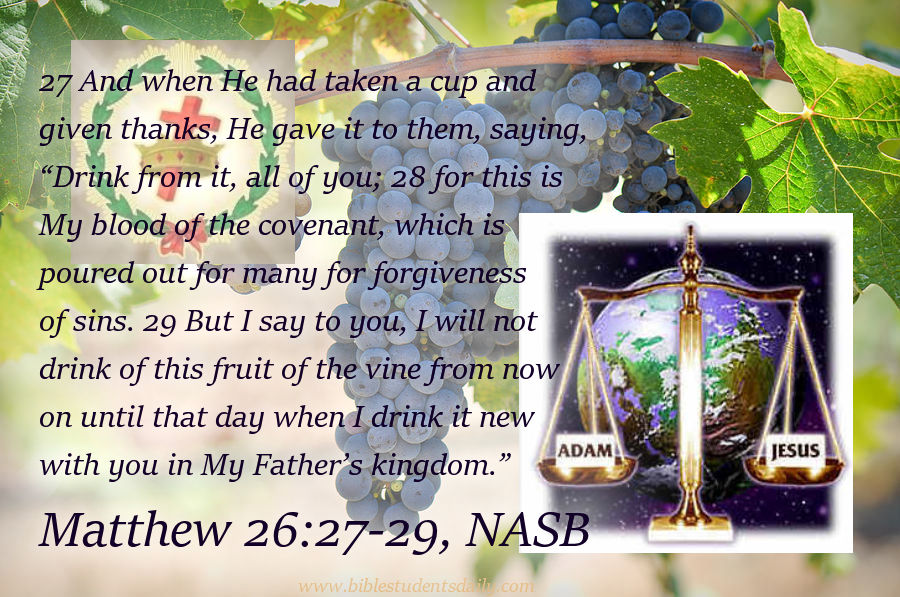
MATTHEW 26, 27-29, NASB.jpg

The Two Cups

Introduction

The Memorial is a special time of the year, a time when we refocus on the basis for our Christian existence and hope; by remembering the sacrifice Jesus made for us and thereby reconciled us to God.

On the night he was betrayed, at the beginning of the 14th of Nisan, Jesus instituted the emblems of the bread and wine after the last supper he had with his disciples. He gave us both to partake of, which simply but powerfully reminds us that only in him we have true life through forgiveness of sins.

That each Gospel account gives us additional details of the events, and from a slightly different perspective and approach, suggests that all of the accounts need to be taken together as a whole in order to get the most complete picture of those final moments of our Redeemer’s life. The Apostle Matthew arranges his Gospel more thematically whereas Luke arranges the events more chronologically.

Here we will focus on clarifying what the cup Jesus instituted means.

The Gospel of Matthew Account

Matthew 26:27–29 (ESV) And he took a cup, and when he had given thanks he gave it to them, saying, “Drink of it, all of you, 28 for this is my blood of the covenant, which is poured out for many for the forgiveness of sins. 29 I tell you I will not drink again of this fruit of the vine until that day when I drink it new with you in my Father’s kingdom.”

In the Matthew account in Chapter 26 verses 27–29, it appears that there is one cup, and that Jesus refers to it both as “my blood of the covenant, which is poured out for many for the forgiveness of sins” in verse 28 and as “this fruit of the vine” in verse 29. If we just take Matthew’s account as the basis for Jesus’ institution of the memorial cup emblem, we might get the impression that not only there was one cup, but that Jesus did drink of this cup – for he says according to the ESV in verse 29 “I will not drink again,” suggesting that he had already drank of it. And some suggest that this therefore shows that the disciples – and by implication all consecrated believers, share with Jesus in his sufferings – after all, like Jesus, we are told to present ourselves a living sacrifice in Romans 12:1.

If Jesus did drink of the memorial cup, what Jesus described as “this fruit of the vine” would seemingly and straightforwardly refer to wine consumed during a supper. The “vine” referring to a grapevine and its fruit as consumed and referred to at the time meant wine, i.e. fermented grape juice – for this was a way of preserving it. Grape juice would of course be an acceptable substitute for those inclined to do so. That Jesus does not refer to the contents according to the normal, commonly used ancient Greek word for wine, oinos, may be significant.

But if the cup was also “my blood of the covenant, which is poured out for many for the forgiveness of sins” – as Jesus states, and if Jesus also drank of it, then we are left with the uncomfortable suggestion that Jesus needed forgiveness of sins provided by his own sacrifice – which of course does not make sense as Jesus was sinless, and no sinner can redeem their own sin.

One solution to this problem seems to be that Jesus did not in fact drink of this cup. And this does seem to be supported by the questionable translation of the Greek preposition “apo” and adverb “arti” in the ESV as “again” in some Bibles. These two ancient Greek words literally mean “from now.” About 10 Bibles translate them as “again”, but at least 15 translate them as “from now” or “henceforth”, and the RVIC2016 as well as Wilson’s Diaglott translate them as “henceforth.” Importantly, the better translations of “henceforth” and “from now” are ambiguous in indicating whether Jesus did in fact drink of the cup or not.

The Gospel of Matthew Account

The Gospel of Mark account is much more succinct in general and here in regards to the institution of the memorial cup, is very similar to Matthew’s.

Luke 1:3 (ESV) “it seemed good to me also, having followed all things closely for some time past, to write an orderly account for you, most excellent Theophilus.”

The Gospel of Luke account of these events is however fuller, and as mentioned, Luke the physician, paid particularly attention to the sequence of events, and he states so in Luke 1:3, he says “having followed all things closely for some time past, to write an orderly account for you, most excellent Theophilus.” When he addresses the reader as “Theophilus” he means “lover of God”, which is what the word means in ancient Greek. That Luke wrote his account with particular attention to the sequence of events is important for us.

Luke 22:17–20 (ESV) And he took a cup, and when he had given thanks he said, “Take this, and divide it among yourselves. 18 For I tell you that from now on I will not drink of the fruit of the vine until the kingdom of God comes.” 19 And he took bread, and when he had given thanks, he broke it and gave it to them, saying, “This is my body, which is given for you. Do this in remembrance of me.” 20 And likewise the cup after they had eaten, saying, “This cup that is poured out for you is the new covenant in my blood.

Luke distinguishes between the cup of “the fruit of the vine” and the cup “that is poured out for you is the new covenant in my blood,” as partaking of the bread emblem occurred in between.

Two cups:

  • The “fruit of the vine” cup
  • The “new covenant in my blood, for the forgiveness of sins, poured out for you” cup

This is important information, for it tells us that there were, in fact, two cups – not one; firstly, the “fruit of the vine” cup and secondly – combining the Matthew and Luke accounts, of “the new covenant in my blood, for the forgiveness of sins, poured out for you.”

1 Corinthians 11:25 (ESV) In the same way also he took the cup, after supper, saying, “This cup is the new covenant in my blood. Do this, as often as you drink it, in remembrance of me.”

The first cup was seemingly partaken of during the last supper, as the second cup, the memorial cup was instituted by Jesus after supper – as the Apostle Paul tells us in 1 Corinthians 11:25.

An important question to ask at this point is, is this important? – one, two cups, what is the difference?

If they are the same cup and if Jesus did partake of it does affect what the cup means, and also what our relationship to Jesus in regards to the cup actually is. As mentioned, some suggest that by drinking of the cup shows that we share in “the sufferings of Christ” with Jesus. So, the implications of whether there are one or two cups is not insignificant.

The “Fruit of the Vine” Cup

If there are two cups, they are different. Does that mean that they signify different things, or anything at all beyond the literal contents of wine?

It seems that that both signify different things.

Both cups literally contained “fruit of the vine” – almost certainly wine. That the 2nd cup, the memorial cup meant more than the literal wine it contained may suggest that Jesus also meant more than the literal wine in the first cup. This seems to be supported by Jesus’ use of the unusual phrase “fruit of the vine” for the wine, as this phrase is only found 3 times in the New Testament and only in the Gospel accounts in relation to the memorial cup. No where else in the Scriptures is the phrase “fruit of the vine” used to refer to wine. The normal word for wine, oinos, is however widely and commonly used in the New Testament, some 34 times.

Luke 7:33–34 (NKJV) For John the Baptist came neither eating bread nor drinking wine, and you say, ‘He has a demon.’ 34 The Son of Man has come eating and drinking, and you say, ‘Look, a glutton and a winebibber, a friend of tax collectors and sinners!’

As an example, in Luke 7:33–34 we have the word oinos used twice in relation to John the Baptist and Jesus when the Pharisees criticized both – John for not eating bread and drinking wine saying he had a demon, and Jesus for eating bread and drinking wine saying he was a glutton and drunkard. If therefore the word for wine, oinos was commonly used, but that Jesus did not use it for the contents of the first cup but instead used the unusual phrase “fruit of the vine” suggests Jesus may have had a deeper meaning in mind.

John 6:48 (ESV) I am the bread of life.

John 15:5 (ESV) I am the vine; you are the branches. Whoever abides in me and I in him, he it is that bears much fruit, for apart from me you can do nothing.

Just as the memorial emblem of the bread that they all ate of indicates that Jesus “is the bread of life” – as Jesus explicitly states in John 6:48, the “fruit of the vine” reference may point to Jesus’ statement in John 15:5 that he is “the vine” and that his disciples are the branches – just as all consecrated Christians are. But if it is not literal, what is the metaphorical “fruit of the vine?” This would seem to be the fruits of the spirit that all those in Christ develop. And the full fruitage of the vine will not be evident till the body of Christ is completed at the end of the harvest period when the kingdom of God is established.

Galatians 5:22–23 (ESV) But the fruit of the Spirit is love, joy, peace, patience, kindness, goodness, faithfulness, 23 gentleness, self-control; against such things there is no law.

Here the “fruit of the vine” therefore seems to refer to the fruits of the holy spirit evident in all true consecrated believers in Jesus – love, joy, peace, patience, kindness, goodness, faithfulness, gentleness, and self-control. This would be consistent with Jesus’ statement that he would not drink of this 1st cup till the kingdom of God comes, or in other words that the full fruitage of the vine would not be evident till the kingdom.

What does it mean then if Jesus drank of this cup? If Jesus did drink of this cup, because he also received the holy spirit, he would also be a first fruit of the holy spirit – and so appropriately drink of the same cup.

Luke 22:16 (ESV) For I tell you I will not eat it until it is fulfilled in the kingdom of God.”

This would also seem to be consistent with Jesus’ statement that he would not eat of the Passover till it is fulfilled in the kingdom of God. This statement is also somewhat enigmatic and unlikely to be fulfilled literally in the future, but it does show that the antitype of the Passover is also still not fulfilled. When we examine the details of the Passover, we understand that Israel as a nation was a type for the world in general. The Passover ultimately led to the liberation from the Pharaoh and Egypt, but in the antitype, this has not occurred yet – the world in general has not yet been liberated from the Adversary and his kingdom. In the same way, the “fruitage of the vine” will not be completed and will not be able to be drank of by Jesus and his consecrated followers, till the church is complete and the marriage of the Lamb occurs.

The “New Covenant in My blood, for the forgiveness of sins, poured out for you” Cup

What then, does the second cup mean and indicate? This seems more self-explanatory – for Jesus actually tells us. Jesus says that the cup depicts “the new covenant in my blood, poured out for you, for the forgiveness of sins.” Jesus’s words seem plain and straightforward enough. Some have suggested that they do not apply to us [believers in the Gospel Age], and that the new covenant will only be inaugurated in the kingdom period. That Jesus says that his “blood, [is] poured out for you,” seems to unequivocally apply it to his consecrated followers now during the Gospel Age, not the kingdom age. When Jesus says “for you,” he means his disciples, and by extension us consecrated believers also.

1 Corinthians 15:19 (ESV) If in Christ we have hope in this life only, we are of all people most to be pitied.

Moreover, that Jesus’ blood provides forgiveness of sins – the prime requirement for reconciliation with God means that if we do not have forgiveness of sins in Christ, then we are still in our sins and most pitiable of men. Let us be clear, if the new covenant, which is the only means by which we can receive forgiveness of sins is not in operation, then how can we be reconciled to God by our faith?

That Jesus did not drink of this 2nd memorial cup, because it is a different cup, makes much better sense – for to partake of it would suggest that he needed forgiveness of sins; which of course he did not – for he was sinless.

That only all of the disciples did drink of this cup, showed that they were the recipients of the benefits of his sacrifice – for the forgiveness of their sins. We note what Jesus said when he gave them [and by extension us] to drink of the cup, he said “Drink of it, all of you” – he did not say let “us” drink of this cup.

Partaking of the cup did not indicate a sharing in the sufferings of Christ. Not that we do not partake in the sufferings of Christ – for the scriptures indicate that we do, but the memorial cup does not indicate this. It indicates that we together have in common that we are all dependent on the sacrifice of Jesus for our reconciliation with God through forgiveness of sins.

The Common Union of the Blood of Christ

1 Corinthians 10:16 (NKJV) The cup of blessing which we bless, is it not the communion of the blood of Christ? The bread which we break, is it not the communion of the body of Christ?

But what about 1 Corinthians 10:16, does this not indicate that we share in the sufferings of Christ, when the apostle Paul says “is not the cup we bless the communion in the blood of Christ?” It has been assumed that the common union in the blood of Christ here is a common union with Jesus, but the context and the grammatical usage here of “koinonia” [translated communion] indicate that the common union is with one another – a common participation of the blood of Jesus showing that we all receive forgiveness of sins through Jesus’ sacrifice.

Here in 1 Corinthians Chapter 10, the Apostle Paul outlines that “the cup we bless” – the memorial cup we ask a blessing for, is not an empty ritual but shows that we are eating at the table of the Lord – we are appropriating the merit of Jesus’ sacrifice to ourselves. And that eating at the table of the Lord is incompatible with eating at the table of demons – which eating of the sacrifices to idols then essentially was. The Apostle warns us to flee from idolatry. There is no suggestion here that we contribute to the food at the table of the Lord. The idolatry we face is much more subtle; it can be the pursuit of wealth, fame, respect, or even a sense of belonging at the expense of the truth but also includes anything that supplants the authority of God’s word.

John 6:54 (NKJV) Whoever eats My flesh and drinks My blood has eternal life, and I will raise him up at the last day.

Jeremiah 31:33–34 (NKJV) But this is the covenant that I will make with the house of Israel after those days, says the LORD: 1) I will put My law in their minds, and write it on their hearts; and I will be their God, and they shall be My people. 34 2) No more shall every man teach his neighbor, and every man his brother, saying, ‘Know the LORD,’ for they all shall know Me, from the least of them to the greatest of them, says the LORD. For 1) I will forgive their iniquity, and their sin I will remember no more.”

Jesus said, whoever drinks of my blood has eternal life…as John 6:54 says.

Faith in Jesus provides us with 1) forgiveness of sins, and thereby reconciliation with God, in order that we may, through baptism, receive of His holy spirit and be developed as new creatures, as 2) the holy spirit teaches us all things of God [rather than any man], even the deep things, and it writes 3) His royal law of agape love on our hearts – these are all functions of the holy spirit through the new covenant as outlined in Jeremiah 31; that we may be born on the spirit plane in the image of Jesus – when we will see the Passover fulfilled, when the fruit of the vine is complete through commonly with one another, partaking of the blood of Jesus shown in the memorial cup Jesus instituted – if we patiently endure to the end.

In Conclusion

In conclusion, it seems then that when Matthew talks about the cup of “the fruit of the vine” and the cup of Jesus’ “blood of the new covenant, for the forgiveness of sins, poured out for you” that they are in fact two separate cups – according to the Gospel of Luke. Jesus may have drank of the former – as the “fruit of the vine” seems to refer to the first fruits of the holy spirit – and which will not be evident till the marriage of the lamb, the seed of blessing is complete. The second cup is separate, a cup that Jesus did not drink of – but of which Jesus said they should all drink of, indicating their, and by extension, our dependence on the sacrifice of Jesus for forgiveness of sins and reconciliation to God. Without it God could not give us of His holy spirit in order to develop us as new creatures and be born on the spirit plane in the likeness of Jesus.

Hallelujah, O what a prospect! Praise be to our Heavenly Father and to His son Jesus.

Suggested Further Reading:

Eating at the Table of the Lord


ROMANS 8, 18 - ad..jpg

Sea-of-Galilee-Mount-of-Beatitudes.jpg

Suggested Further Reading

“Are We Actual Or Reckoned New Creatures?” The Reprints (No. 5325) of the Original Watch Tower and Herald of Christ Second Presence.

“The Ransom.” by Br. David Rice. Faithbuilders Fellowship Journal.
http://www.2043ad.com/journal/2007/02_ma_07.pdf

“Bread and Cup” by Br. James Parkinson. The Herald of Christ’s Kingdom Magazine, March-April 2018.

“Jesus The Name.”
https://biblestudentsdaily.com/2017/07/05/jesus-the-name/

“Who Is the World’s Ransom and Why?”
https://biblestudentsdaily.com/2016/03/29/who-is-the-worlds-ransom-and-why/?share=press-this&nb=1

“Nehemiah 8:10 — The Joy of the Lord Is Your Strength.”
https://biblestudentsdaily.com/2016/12/20/nehemiah-810-the-joy-of-the-lord-is-your-strength/


This post’s URL:
https://biblestudentsdaily.com/2018/03/19/matthew-2627-29-drinking-from-christs-one-cup/

Enter your email address to subscribe to this blog and receive notifications of new posts by email.


The Daily Cup

PSALM 116, 13.jpg

“I will take the Cup of Salvation” (Psalm 116:13).

With a tender smile on His loving face,
My Lord stood holding the Cup of Grace

“Wilt thou drink, dear one, today?”

O loving Bridegroom, I am so weak!
My enemies even now do seek
To cause me to shrink away.

Today the Cup seems a bitter draught
That cost Thee Thy life, as once Thou quaffed —

Increase my faith, I pray!

“My Dove, I will show thee the care I take
To guard the Cup for thy dear sake,
That thou mayst drink each day.”

Oh, wondrous vision my Lord revealed!
I saw my soul’s fierce battle-field,
And the enemies dreaded by me.

The World, the Flesh and Satan wise
Were all made plain in their evil guise,
Plotting adversity.

“I will fill the Cup with troubles sore,
Pour them in till they’re brimming o’er—
I’ll make it a Poison draught!

“So bitter ’twill be that its very breath
Will cause her to shrink from such a death!”—
Thus Satan in wickedness laughed.

And the World and the Flesh in blindness lent
Their aid to his wicked, fell intent:
My soul felt their power so dire.

Then I turned and looked at my Bridegroom’s face—
The glory from it filled all the place,
But His eyes were flames of fire.

BEGONE, ye enemies of My Bride!
The Cup is MINE!” He sternly cried;
“I guard this Cup each day.

“And nothing goes in it beyond the power
Of My Bride to bear in her weakest hour,
If she l

Then He turned to me with the tenderest mien–
“My Love, art thou strengthened by what thou hast seen?
Canst thou now the enemy face?”

Dear Lord, forgive me, I humbly cried,
That I should forget that He who died
To redeem my soul, is by my side
And holds the Cup in His hand.

Gladly I take the Loving-Cup,
Gladly I drink as Thou holdest it up;
To share it with Thee is grand!

And if it should be that this is the day
When the flesh, as I drink, shall pass for aye,
Then ’twill be the Cup of Joy.

Oh, wondrous miracle of grace!
The smile on my loving Bridegroom’s face

As I pressed my lips to the Cup,

Filled my soul o’erflowing with peace Divine!
And not alone did this peace I find,
But my heart with Joy welled up.

And so each day as I take the Cup
From my Best Beloved, I meekly look up
And whisper a prayer for grace.

And He gives me grace; and Peace Divine,
And Love and Faith and Joy are mine,
As I gaze upon His face.

My hope is in faith the Cup to drain
That I in His Kingdom with Him may reign;
The Cup of Joy I then will claim,
Triumphant by His Grace!

Lilla S. Ward.

 The above poem is from the “Reprints (No. 5868) of the Original Watch Tower and Herald of Christ’s Presence.”

——-

  • Romans 5:1-5(ESV)

Peace with God Through Faith

(1) Therefore, since we have been justified by faith, we have peace with God through our Lord Jesus Christ.(2) Through him we have also obtained access by faith into this grace in which we stand, and we rejoice in hope of the glory of God. (3) Not only that, but we rejoice in our sufferings, knowing that suffering produces endurance, (4) and endurance produces character, and character produces hope, (5) and hope does not put us to shame, because God’s love has been poured into our hearts through the Holy Spirit who has been given to us.

——-

  • Hebrews 13:20-21 (Weymouth New Testament)

“(20) Now may God who gives peace, and brought Jesus, our Lord, up again from among the dead — even Him who, by virtue of the blood of the eternal Covenant, is the great Shepherd of the sheep — (21) fully equip you with every grace that you may need for the doing of His will, producing in us that which will truly please Him through Jesus Christ. To Him be the glory to the Ages of the Ages! Amen.

Suggested Further Reading

The Ransom. Faithbuilders Fellowship “Journal.”
http://www.2043ad.com/journal/2007/02_ma_07.pdf

Who Is the World’s Ransom and Why
https://biblestudentsdaily.com/2016/03/29/who-is-the-worlds-ransom-and-why/

Beautiful Lessons From the Passover Type
https://biblestudentsdaily.com/2016/04/09/beautiful-lessons-from-the-passover-type/

JESUS — The Name
https://biblestudentsdaily.com/2017/07/05/jesus-the-name/

His Loving Kindness – Hymns of Dawn No. 19
https://biblestudentsdaily.com/2018/06/19/his-loving-kindness-hymns-of-dawn-no-19/

Awake My Soul — Hymns of Dawn No. 20
https://biblestudentsdaily.com/2018/06/27/awake-my-soul-hymns-of-dawn-no-20/

The Sacrifice
https://biblestudentsdaily.com/2017/01/05/the-sacrifice/


This post’s URL:
https://biblestudentsdaily.com/2018/02/28/the-daily-cup/

Enter your email address to subscribe to this blog and receive notifications of new posts by email.

The Mighty To Save – Hymns of Dawn No. 9

The Mighty To Save – Hymns of Dawn No. 9

Bible Scriptures Associated With This Hymn

But if we walk in the light, as he is in the light, we have fellowship with one another, and the blood of Jesus his Son cleanses us from all sin” (1 John 1:7).

“And there is salvation in no one else, for there is no other name under heaven given among men by which we must be saved” (Acts 4:12).

“(18) … you were ransomed from the futile ways inherited from your forefathers, not with perishable things such as silver or gold, (19) but with the precious blood of Christ, like that of a lamb without blemish or spot” (1 Peter 1:18-19).

“And such were some of you. But you were washed, you were sanctified, you were justified in the name of the Lord Jesus Christ and by the Spirit of our God” (1 Corinthians 6:11).

“And everyone who calls on the name of the Lord will be saved” (Acts 2:21).

“For if while we were enemies we were reconciled to God by the death of his Son, much more, now that we are reconciled, shall we be saved by his life” (Romans 5:10).

 For with the heart one believes and is justified, and with the mouth one confesses and is saved” (Romans 10:10).

“For by grace are ye saved through faith; and that not of yourselves: it is the gift of God” (Ephesians 2:8, KJV).

Lyrics

1.
All glory to Jesus be giv’n,
That life and salvation are free,
And all may be wash’d and forgiv’n;
Yes, Jesus has sav’d even me.

Chorus
Christ Jesus is mighty to save,
And all his salvation may know
On his merit I lean, and his blood makes me clean,
Yes, his blood has wash’d whiter than snow.

2.
From the darkness of sin and despair,
Out into the light of his love,
He has bro’t me and made me an heir
To kingdoms and mansions above.

3.
O! the rapturous heights of his love,
The measureless depths of his grace.
My soul all his fulness would prove,
And live in his loving embrace.

4.
In him all my wants are supplied,
His love starts my heaven below,
And freely his blood is applied,
His blood that makes whiter than snow.

THE PRECIOUS BLOOD OF CHRIST

(An article from “Reprints of the Original Watchtower and Herald of Christ’s Presence,” R1229 – R1231.)

All of God’s dear children trust in the precious blood of the Lamb of God, which taketh away the sin of the world. They know, … that the blood of Christ is the principal topic of God’s revelation, and the foundation of his great plan of salvation. They know that the expression, “blood of Christ,” somehow stands for sacrifice of Christ, though they are sadly confused by false ideas on the so-called “trinity,” and consequently upon what our Lord Jesus gave as the sacrifice for sins.

In this “evil day” the great Adversary of God and his truth is taking advantage of this confusion, this lack of clearness of understanding, to overthrow faith in the ransom, the foundation doctrine of Christianity. The process is, to scoff at the idea of blood cleansing from sin, and to insinuate that most Christians believe in having literal blood sprinkled on their hearts, or that they are cleansed from sin by plunging into a literal fountain filled with blood drawn from Immanuel’s veins. Thus the idea of blood-cleansing is scouted as being on a par with the doctrine of everlasting torment, and belonging to the savage minds of the “dark ages.”

As a matter of fact, no sane Christian people have ever held this literal and absurd view of the meaning of the blood of Christ. It has always been recognized as synonymous with sacrifice. Any fair-minded person can readily see this to be true as well of the use of the word blood by the Apostles, as in the hymns of all denominations of Christian people. Take that grand old hymn—

“There is a fountain filled with blood
Drawn from Immanuel’s veins,
And sinners, plunged beneath that flood,
Lose all their guilty stains.”

What could more clearly express the very essence of the Bible doctrine; and how absurd for any to try to make out that those who thus express their sentiments believe in a river of literal blood. The hymn expresses well and beautifully the very thought of the Prophet (Zech. 13:1), “In that day there shall be a fountain opened to the house of David for sin and for uncleanness.”

There is surely an object in this misrepresentation of the general views of Christian people. Is it to confuse the mind, excite disgust at the thought of blood, and swimming in rivers of blood, etc., and then under the warmth of the denial: “Such is not my belief even if my fathers did believe it,” to point out to the confused one a theory which it is desired to impress? It looks very much that way. The theory then advanced is, that when Christ’s blood is mentioned, the word blood stands for carnal nature, and the understanding should be—Christ slew HIS carnal nature, as an example of how all his followers and the world in general should slay their carnal natures.

Ah! no wonder that, with such a theory to advance, the great Adversary first tried to excite disgust for any and every thing connected with “the blood.” He well knew that, unless disgust for “the blood” should be aroused and form a barrier of mental prejudice, some of God’s children would be sure to examine the forty-three places where the Scriptures mention the blood of Christ, and the many more where they mention the blood of animals which typified his blood. And if they would but investigate, they would find that which would prove fatal to the theory he wished to establish as new light.

The few who look to God’s word for instruction find that in these forty-three times that the blood of Christ is mentioned, neither our Lord nor the apostles once hint that the blood of Jesus represented the slaying of his carnal nature, nor that he had in or about him anything evil that required to be destroyed. They find, on the contrary, that there was no cause of death found in him except in the sight of the hypocritical Pharisees. And they find that, to the contrary of the theory we are criticizing, these forty-three inspired testimonies on the subject declare unitedly, not that our Lord shed his blood for himself and as an example to all men to shed their blood for themselves and thus reach perfection, but that, whatever blood symbolizes, it is his blood that cleanseth us from all sin.

Yes, his blood became the basis for the forgiveness of our sins, made peace for us, opened up the way to reconciliation, and transferred us from the domain of sentenced culprits, back to sonship in the family of God. So says the great Apostle Paul—Col. 1:20Heb. 9:1210:1913:12Rom. 3:255:9Eph. 1:72:13Col. 1:14 and Acts 20:28-31. So declares the great Apostle Peter—1 Pet. 1:2,19. So testifies the beloved Apostle John—1 John 1:7Rev. 1:55:97:14.

Truly the Word of God is sufficient that the man of God may be thoroughly furnished against all the wiles, glosses and sophistries of Satan. Even those who do not see clearly what the blood does signify or symbolize, can, without aid, quickly see that it means nothing at all like what this erroneous view would set forth. The idea of the blood of Christ signifying the slaying by him of his carnal nature is as far from the testimony of the above passages of God’s Word as the East is from the West.

But what is the true significance of the blood of Christ when used in reference to our cleansing from sin, as in the above citations? If it does not mean literal blood, what does it mean?

We answer by giving God’s definition of what blood represents or symbolizes. The blood is the life. (Gen. 9:4-6.) “For the life of the flesh is in the blood; and I have appointed it to you upon the altar to make an atonement for your souls [lives, beings]: for it is the blood [sacrificed life] that maketh atonement for the soul [or being].”—Lev. 17:11,14.

By accepting God’s definition of what blood signified, in all the sacrifices, as well as in the case of the “one sacrifice for all” which our Lord Jesus presented, all confusion disappears.

As blood represents the life, the shedding of blood represents the loss of life—death

So then, the expressions—the Lamb slain, the cleansing blood of the Lamb, the precious blood of Christ, no more refer to literal blood than to a literal lamb, but to the death of Christ. True, our Lord’s side was actually pierced and blood flowed out, but the expression, “He hath redeemed us by his blood” (by his death), would have been equally true and proper, if not a drop of his literal blood had passed from his veins; for it merely signifies that he redeemed us by his death—by the sacrifice or loss of his life. Thus it is written, “He poured out his soul [being—life] unto death;” and again that he made “his soul [being—life] an offering for sin.”—Isa. 53:12,10.

So then, God’s people have always had the pith of the truth on this subject, when believing that the “blood of Christ” meant the sacrifice of Christ. That is the correct thought. Their difficulty is, that when they come in contact with errors their lack of a clear understanding of what sacrifice Christ did make for the sins of the world, combined with erroneous ideas of a trinity, make them liable to be led astray from the foundation doctrine of Christianity—”that Christ died for our sins according to the Scriptures.” Finding that they cannot clearly analyze their own views, they are very susceptible to the false view we criticize, which first ridicules the idea which no one holds, that it is the literal blood of Christ which washes away our sins, and then offers the proposition, that Christ’s blood, when referred to in Scriptures, represents his slaying of his own carnal nature and desires, as an example to men, how they must each slay his own carnal nature and desires. According to this unscriptural theory each man would be his own Savior. And not only so, but if each would be a great Savior in proportion to the work accomplished, then the Lord Jesus would be the least of all; because, even those who claim that he had a carnal nature to crucify or slay cannot dispute that many men have far more of evil and sin working in their members to overcome than our Lord had. And if each slays sin in himself, the more degraded the man the greater the salvation, and the greater he is as his own Savior.

But let each compare this view briefly with the view presented in the above cited statements of the apostles respecting the blood of Christ—the life which he laid down on our behalf.

The life of the world in general was gone—forfeited in father Adam’s failure when on trial—all not absolutely dead were dying. They were under the execution of the just sentence of God, “Dust thou art and unto dust shalt thou return.” God had decreed a sentence which would most fully manifest the law of the universe—that no sinner shall live—and one which at the same time furnished an opportunity for revealing to angels and to men his unswerving justice, his great love, and his boundless wisdom and power. When God decreed death as the penalty for sin, so that a ransom (a corresponding price—a just one to die for [or instead of] the unjust one—Rom. 5:17) would be necessary to the release of mankind from the sentence, he did so in full view of the course he would pursue. His wisdom foresaw the results of leaving Adam to his own free will—that in his inexperience he would not submit his will to the will of his creator and would therefore get into sin and under the sentence of death—extinction. And his wisdom also foresaw how his love could work out a plan for the salvation of his creatures. And he foresaw that the well beloved and only begotten Son would humbly consent to carry out the divine plan—to leave the glory and honor of the heavenly nature, and as the man Christ Jesus give himself a ransom for Adam and his race.—Phil. 2:7,81 Tim. 2:5,6.

Since the penalty was death, the ransom necessary to release the dead and dying world from the sentence under which all were, and to secure them restitution—resurrection—and an individual trial for everlasting life, was the death of this perfect man whom God thus provided. And this simple and easily comprehended plan was carried out. The man Christ Jesus gave himself a ransom for all;—he died, the just for the unjust;—he died for our sins. The dying on the cross, the drops of bloody sweat in Gethsemane, the pierced hands and side and flowing blood were not necessary to our ransom. None of these things were the penalties of sin. God’s sentence against Adam—”dying thou shalt die”—did not specify what manner of death, nor what amount of suffering should be connected with it.

Death alone was the penalty, and had God’s will been such, for our Lord to have met death in any other form than crucifixion would have been equally our ransom price.

Many do not see that in our Lord two things were being accomplished at once. [1] Our ransom was being provided, and [2] our Lord’s extreme fidelity to the Heavenly Father was being tested and proved in the same sacrifice. As our ransom, death in any form would do; but as an unbounded proof of his humility and obedience to the Father’s plan, the shame of the cross was added.—Phil. 2:7,8.

The result of his death as it affects himself is that he is now highly exalted and made partaker of the divine nature, that all men should honor the Son even as they honor the Father.—Phil. 2:8,9John 5:23.

The result of his death as it affects mankind is that it places the world in his hands as the purchaser, to the intent that, without violating the law and sentence of God (which he satisfied with his own [life] blood), he may restore men to perfection and offer everlasting life to all who will come into harmony with God’s perfect law through him—under his direction and assistance.

THIS IS JUSTIFICATION

(An article from “Reprints of the Original Watchtower and Herald of Christ’s Presence,”  R1231.)

Thus we are justified by his blood [by the life which he laid down for us]: our sins and imperfections are passed over, forgiven, covered by the merit of the ransom which he gave.

Not only sins past and present, but also all future sins—all that are directly or indirectly the results of Adam’s transgression—all that are not our own, that our wills do not approve of, are not reckoned any longer to those who are in Christ Jesus.

No wonder these have joy and peace as they realize that there is now no longer any condemnation against them.—Rom. 5:18:1.

Here begins the work of sacrifice and crucifixion with Christ to which many are invited, but to which few respond. It is a mistake, however, to consider this sacrificing as a slaughter of our sins or as having anything to do with the “slaying of the enmity” mentioned by the Apostle. On the contrary (under the Law, which was typical), no sacrifice could be offered unto the Lord that had any blemish or imperfection—blemishes representing sin. So it is that no one is ever invited to become a sacrificer with Christ until he has first been justified from all things—cleansed from all sins—by the precious blood [sacrificed life] of Christ. And if these who are cleansed from sins—justified from all things—are told that they may present their bodies [“holy and acceptable unto God” through Jesus Christ] as living sacrifices, it must be their justified selves and not their sins that they present, and that the Lord proposes to accept.

The “enmity” which the Apostle declares Christ abolished (Eph. 2:15) was not sin in himself, nor anything in himself; but in or by the sacrifice of his flesh, the man Christ Jesus abolished the enmity or opposition of the Jewish Law Covenant, under which fleshly Israel labored. When that Covenant which they could not keep was fulfilled by our Lord Jesus and passed away (Col. 2:14), all who had been under it were released from its requirements of absolute perfection which opposed and condemned them all, that they might receive through Christ forgiveness of sins—through faith in his blood.

The privilege of becoming joint-sacrifices with Christ is limited, as truly as is the privilege of becoming joint-heirs with him. “Now is the acceptable time.” Both the privilege and the reward of sacrifice will end with this ageNow is the time when God will accept the living sacrifices of all who (after being justified from all sin by the blood of Christ) come unto God through him.

Such are not invited to sacrifice for their own sins, then, for their sins must be canceled before any sacrifice would be acceptable. But they are invited to sacrifice time, talent, influence, self-ease, and lawful self-gratification, in the service of the truth—in the general cause of God against the great enemy, Sin, and for the recovery of sinners out of it through Christ Jesus.

The sufferings of Christ, to a share in which all believers cleansed by his blood were invited during the Gospel age, will soon end. They will be filled up or completed. (Col. 1:24.) Then the glory will follow—the glory of Christ Jesus and also of all the members of his body, the church, those who suffered for the truth (not for their sins), sacrificing their justified selves with him and in the cause of God. Then the reign of righteousness will begin and none will have occasion to lay down his life for the truth’s sake thereafter.

Many have believed in the precious blood and have had joy and peace in believing and then heard the call to the privilege of self-sacrifice with Christ; but few have responded, and hence few are chosen to be with him and behold and share his glory and his throne, and his new nature—the divine nature—far above both the human and the angelic natures, even in their grandest perfections. Let us, acceptable to God through the precious blood, make our calling and election sure.Let us lay aside every weight and hindrance and run with patience the race of self-denial to the end—looking unto Jesus, the author of our faith, to finish it by receiving us to the heavenly mansion.

Suggested Further Reading

Here are some free ONLINE reading articles in relation to the Heavenly Father—Jehovah, his Son—Christ Jesus—“a ransom FOR ALL… to be testified in due time” (1 Timothy 2:6), and about the holy Spirit (the understanding of God), with clear explanations about why the anti-Christ teaching of “the trinity”—introduced by the Roman Catholic Church system (the “Beast” in the Book of Revelation)—is not what the Bible teaches. The Bible Students Movement also does not support the false teaching about purgatory nor does it support the Roman Catholic System’s false teaching about people being sent to a place where they burning up forever as this certaining does not reflect Jehovah’s divine, perfect love, justice, power and wisdom … “who is merciful and gracious, slow to anger and abounding in steadfast love” (Psalm 103:8). For the interested Reader, we urge you to consider the following articles and posts:

The Doctrine of the Trinity – Mystery or Confusion by Br. David Rice.
http://www.heraldmag.org/1999/99nd_3.htm

The Origin of the Trinity – From Paganism To Constantine by Sr. Cher-El L. Hagensick.
http://www.heraldmag.org/olb/Contents/doctrine/The%20Origin%20of%20the%20Trinity.htm

Facts About the Trinity
http://www.heraldmag.org/olb/contents/doctrine/FACTS%20ABOUT%20THE%20TRINITY.htm

God and the Trinities
http://www.heraldmag.org/literature/doc_42.htm

Development of the “Trinity Doctrine” by Br. Tom Gilbert.
http://www.beautiesofthetruth.org/Archive/Library/Doctrine/Mags/Bot/90s/2010d.pdf

Understanding John 1:1 by Br. Richard Doctor.
http://www.beautiesofthetruth.org/Archive/Library/Doctrine/Mags/Bot/90s/2010d.pdf

Father, Son and Holy Spirit
https://biblestudentsdaily.com/2016/06/23/father-son-and-holy-spirit/

What Is the Heavenly Father’s Name
https://biblestudentsdaily.com/2017/06/27/gods-name-what-is-the-heavenly-fathers-name-that-we-are-to-hallow-and-why/

Jesus – The Name
https://biblestudentsdaily.com/2017/07/05/jesus-the-name/

The Doctrine of Christ – Booklet
http://www.biblestudents.com/docs/DoctrineChrist.pdf

Who Is the World’s RANSOM and Why?
https://biblestudentsdaily.com/2016/03/29/who-is-the-worlds-ransom-and-why/

Hymn Book Purchase

The Hymns Of Dawn (hymn book) can be purchased at:

The Chicago Bible Students Online Bookstore: https://chicagobible.org/product-category/books/page/4/

The Dawn Bible Students Association: http://www.dawnbible.com/dawnpub.htm

Acknowledgment & References

  • Br. Charles Taze Russell — the founder of the Bible Students movement, who is the compiler of “Poems and Hymns of Millennial Dawn” which was published in Allegheny, Pa., in 1890. This Bible Students’ devotional originally contained a total of 151 poems and 333 hymns.

POEMS-AND-HYMNS-OF-MILLENNIAL-DAWN

Later on, the hymns from this book formed a basis for the hymnal titled ““Hymns of Dawn” which was published by the Dawn Bible Students Association in East Rutherford, New Jersey (USA) and the 1999 edition contains a total of 361 hymns.

Hymns of Dawn.jpg

Links and Bible Resources
https://biblestudentsdaily.com/category/links/

Beliefs
https://biblestudentsdaily.com/category/beliefs/


This post’s URL:
https://biblestudentsdaily.com/2017/12/02/the-mighty-to-save-hymns-of-dawn-no-9/

Enter your email address to subscribe to this blog and receive notifications of new posts by email.


All For Jesus – Hymns of Dawn No. 8

All For Jesus – Hymns of Dawn No. 8

Bible Scriptures Associated With This Hymn

Romans 12:1-2 (KJV)

“(1) I appeal to you therefore, brothers, by the mercies of God, to present your bodies as a living sacrifice, holy and acceptable to God, which is your spiritual worship. (2) Do not be conformed to this world, but be transformed by the renewal of your mind, that by testing you may discern what is the will of God, what is good and acceptable and perfect” (Romans 12:1, 2, ESV).

1 Corinthians 6:20 (KJV)

“For you were bought with a price. So glorify God in your body” (1 Corinthians 6:20, ESV).

Philippians 3:7-11 (KJV)

“(7) But whatever gain I had, I counted as loss for the sake of Christ. (8) Indeed, I count everything as loss because of the surpassing worth of knowing Christ Jesus my Lord. For his sake I have suffered the loss of all things and count them as rubbish, in order that I may gain Christ (9) and be found in him, not having a righteousness of my own that comes from the law, but that which comes through faith in Christ, the righteousness from God that depends on faith— (10) that I may know him and the power of his resurrection, and may share his sufferings, becoming like him in his death, (11) that by any means possible I may attain the resurrection from the dead (Philippians 3:7-11, ESV).

*******

There are many names and titles of Jesus found in the Bible, and each of them contains a description or illustration of his life and work. Here is a post which examines some of those names in order to gain the lessons found in the deeper meanings in Jesus’ name: JESUS — The Namehttps://biblestudentsdaily.com/2017/07/05/jesus-the-name/

Jesus is the world’s ransom — The following two references explain how and why:

(1) Who is the World’s Ransom and Why — https://biblestudentsdaily.com/2016/03/29/who-is-the-worlds-ransom-and-why/

(2) The Ransom” —
http://www.2043ad.com/journal/2007/02_ma_07.pdf%5D in Faithbuilders Fellowship (“Journal” section) March-April 2007.

Here is some brief content from the latter referenced article above (“The Ransom”) concerning the two applications of Christ’s blood:

1.  The first application — is for the consecrated class, those who accept Christ now, and accept Jesus’ invitation to self-denial and cross bearing (Hebrews 9:24).

2. The second application — the one for all the remainder of Israel, shows that after this age for the consecrated, another age of redemption follows. This will be for the remainder of the world those who will be blessed by the saints when, as a class, they are complete in glory with Christ.

Now we see that Jesus’ death, by itself, did not automatically bring release from the curse. Jesus was raised from the dead with the value of the Ransom price he provided, and by God’s design Jesus himself is the one who applies the value of the Ransom. He applies it first to us who consecrate our lives now, and later to the world during the Millennium. Jesus died for our offences to provide the Ransom value and was raised again for our justification to apply the Ransom (Romans 4:25).

********

HOSEA-13-14

Lyrics

1.
All for Jesus! all for Jesus!
All my being’s ransomed pow’rs;
All my thoughts and words and doings,
All my days and all my hours.
All for Jesus! all for Jesus!
All my days and all my hours.

2.
Let my hands perform his bidding;
Let my feet run in his ways;
Let my eyes see Jesus only;
Let my lips speak forth his praise.
All for Jesus! all for Jesus!
Let my lips speak forth his praise.

3.
Since my eyes were fixed on Jesus,
I’ve lost sight of all beside—
So enchained my spirit’s vision,
Looking at the crucified.
All for Jesus! all for Jesus!
All for Jesus crucified.

The History Of This Hymn

Author – Mary D. James (1810-1883)

MARY-D-JAMES-ALL-FOR-JESUS

When Mary D. James was 13 years old, she began teaching Sunday school in the Methodist Episcopal church. She became a prominent figure in the Wesleyan Holiness movement, assisting Phoebe Palmer, and often leading meetings at Ocean Grove, New Jersey, and elsewhere. She wrote about 50 hymns, and articles by her appeared in various journals and newspapers.


Composer – Asa Hull (1828 – ?)

Asa-Hull-All-For-Jesus-All-For-Jesus

As of 1895, Hull was a music publisher in New York City; his company was still operating as of 1910.

Suggested Further Reading

Here are some free online articles in relation to the Heavenly Father—Jehovah and his Son—Christ Jesus—“a ransom FOR ALL… to be testified in due time” (1 Timothy 2:6), as well as, about the holy Spirit (the understanding of God) with clear explanations about why the anti-Christ teaching of “the trinity”—introduced by the Roman Catholic Church system (the “Beast” in the Book of Revelation) is not what the Bible teaches. The Bible Students Movement does not support the teaching of purgatory nor does it support the Roman Catholic System’s teaching about people being sent to a place where they burning up forever which certainly does not reflect the perfect love of God — the Almighty Creator of all things.

For the interested Reader, we urge you to consider the following articles and posts:

The Doctrine of the Trinity – Mystery or Confusion by Br. David Rice.
http://www.heraldmag.org/1999/99nd_3.htm

The Origin of the Trinity – From Paganism To Constantine by Sr. Cher-El L. Hagensick.
http://www.heraldmag.org/olb/Contents/doctrine/The%20Origin%20of%20the%20Trinity.htm

Facts About the Trinity
http://www.heraldmag.org/olb/contents/doctrine/FACTS%20ABOUT%20THE%20TRINITY.htm

God and the Trinities
http://www.heraldmag.org/literature/doc_42.htm

Development of the “Trinity Doctrine” by Br. Tom Gilbert.
http://www.beautiesofthetruth.org/Archive/Library/Doctrine/Mags/Bot/90s/2010d.pdf

Understanding John 1:1 by Br. Richard Doctor.
http://www.beautiesofthetruth.org/Archive/Library/Doctrine/Mags/Bot/90s/2010d.pdf

Father, Son and Holy Spirit
https://biblestudentsdaily.com/2016/06/23/father-son-and-holy-spirit/

What Is the Heavenly Father’s Name
https://biblestudentsdaily.com/2017/06/27/gods-name-what-is-the-heavenly-fathers-name-that-we-are-to-hallow-and-why/

Jesus – The Name
https://biblestudentsdaily.com/2017/07/05/jesus-the-name/

The Doctrine of Christ – Booklet
http://www.biblestudents.com/docs/DoctrineChrist.pdf

Hymn Book Purchase

The Hymns Of Dawn (hymn book) can be purchased at:

The Chicago Bible Students Online Bookstore: https://chicagobible.org/product-category/books/page/4/
The Dawn Bible Students Association: http://www.dawnbible.com/dawnpub.htm

Acknowledgment & References

  • Br. Charles Taze Russell (1852-1916)

2.jpg

Br. Charles Russell — the founder of the Bible Students movement, who is the compiler of “Poems and Hymns of Millennial Dawn.”  With the assistance of Maria Frances Russell (1850 – 1938) — the former Maria Frances Ackley (whom Russell had married in 1879) — this Bible Students’ devotional was published in Allegheny, Pennsylvania (USA) in 1890. It originally contained a total of 151 poems and 333 hymns.


POEMS-AND-HYMNS-OF-MILLENNIAL-DAWN

Later on, the hymns from this book formed a basis for the hymnal titled “Hymns of Dawn” which was published by the Dawn Bible Students Association in East Rutherford, New Jersey (USA) and the 1999 edition contains a total of 361 hymns.
Hymns of Dawn.jpg

  •  Br. David Rice — For the article “The Ransom.” Faithbuilders Fellowship (“Journal” section) March-April 2007. http://www.2043ad.com/journal/2007/02_ma_07.pdf
  • “Hymnary.org” and “Wikipedia” — hymn history content.

——-

Links and Bible Resources. BIBLE Students DAILY.
https://biblestudentsdaily.com/category/links/

Beliefs. Bible Students DAILY.
https://biblestudentsdaily.com/category/beliefs/


The URL of this post:
https://biblestudentsdaily.com/2017/11/19/all-for-jesus-hymns-of-dawn-no-8/

Enter your email address to subscribe to this blog and receive notifications of new posts by email.

What Does the Word “HELL” Really Mean?

Truth About Hell

The Hebrew word for HELL in the Bible is “sheol” = a state of rest… unconsciousness… sleep… not some burning forever place of torture which the Papal (anti-Christ) System developed!

In Job 14:13-15 (ESV) we read:

“13 Oh that you would hide me in (the grave) Sheol, that you would conceal me until your wrath be past, that you would appoint me a set time, and remember me! 14 If a man dies, shall he live again? All the days of my service I would wait, till my renewal[a] should come. 15 You would call, and I would answer you; you would long for the work of your hands.”

Was the prophet Job here praying to go to a place he would burn in pain for eternally?

No, certainly not! How could people ever get such an idea?! Back in Constantine’s day, Church leaders wanted to keep the people in the churches through the fear of hell doctrine! For many centuries people thus, have gone to Church for fear of this doctrine. But what does the BIBLE really say in the original Greek and Hebrew? The video and the content of each of the booklets share below, explains this well.

Job was praying to go to a place of rest where he would be out of pain until GOD would raise up everyone in the resurrection.

[Note: See Posts about the Resurrection here:

Throughout the ages Satan has convinced people of lies! Hell is one such doctrine he has blinded the masses of humanity on. His first lie about death was already in Genesis 3:4,

“But the serpent said to the woman, ‘You will not surely die.'”

Since Adam and Eve’s disobedience, is mankind dying? Yes!

The Bible explains that eventually the condition of death itself will be destroyed forever.

Please consider the following video explaining all about HELL. We hope and trust you will receive much blessings from the words of Br. Michael Nekora as we refresh the mind upon Divine Words of Scripture.

“The last enemy to be destroyed is death.” – 1 Corinthians 15:26

When the thousand years of Christ’s reign with the His “bride” shall be completed and after the final battle of Gog and Magog (Revelation 20:7-15) and after all evil is destroyed there shall finally come the glorious time when the tabernacle of God is among men, and He will dwell among them, and they shall be His people, and God Himself will be among them, and He will wipe away every tear from their eyes; and there will no longer be any death; there will no longer be any mourning, or crying, or pain; the first things have passed away” (Revelation 21:3-4). 

The Truth About Hell Video


Recommended Further Reading: 

  • The Truth About Hell booklet, the Dawn Bible Association.

http://www.dawnbible.com/booklets/hell.htm

  • When A Man Dies booklet, the Dawn Bible Association.

http://www.dawnbible.com/booklets/dies.htm

  • What Everyone Should Know About Being Saved booklet, the Chicago Bible Students.

http://www.heraldmag.org/bookstore/booklet_saved.htm

  • What Say the Scriptures About Hell, The Herald of Christ’s Kingdom Magazine.

http://www.heraldmag.org/literature/doc_16.htm


“If anyone’s will is to do God’s will, he will know whether the teaching is from God or whether I am speaking on my own authority.”John 7:17


This post’s URL:

What Does the Word “HELL” Really Mean?

Enter your email address to subscribe to this blog and receive notifications of new posts by email.

Where Does “Christmas” Originate From?

Where Does CHRISTMAS ORIGINATE from.jpg

The Christmas season is the most enjoyable time of the year for many who think upon the events surrounding the gift of Jehovah to the world—his firstborn Son, our Lord Jesus as a special gift to the human family, but is the redemptive work of Jesus Christ, truly appreciated in its full sense?

You see, the true reason for Jesus’ birth was that he would give his life as a ransom price for the sins of every single human that has lived.

The apostle Paul wrote to Timothy, “I exhort therefore, that, first of all, supplications, prayers, intercessions, and giving of thanks, be made for all men; For kings, and for all that are in authority; that we may lead a quiet and peaceable life in all godliness and honesty. For this is good and acceptable in the sight of God our Saviour; Who will have all men to be saved, and to come unto the knowledge of the truth. For there is one God, and one mediator between God and men, the man Christ Jesus; Who gave himself a ransom for all, to be testified in due time” (1 Timothy 2:1-6).

In John 3:16 we read that “God so loved the world, that he gave his only begotten Son, that whosoever believeth in him should not perish, but have everlasting life.”

The Greatest Message of Joy

The angel in Luke 2:10-14 was announcing God’s greatest gift to his poor, sin-sick and dying human creation: A SAVIOR… The “ransom for ALL to be testified in due time” when Christ’s future kingdom of righteousness will soon be established on earth, and when “God’s sons” (the Bride of CHRIST—the 144,000, shall be all beyond the vail and “revealed.” (1 Timothy 2:6, Romans 8:19)

The birth of Jesus had been foretold by the Prophet Isaiah:

“Unto us a child is born, unto us a son is given: and the government shall be upon his shoulder: and his name shall be called Wonderful, Counsellor, The mighty God, The everlasting Father, The Prince of Peace. Of the increase of his government and peace there shall be no end, upon the throne of David, and upon his kingdom, to order it, and to establish it with judgment and with justice from henceforth even for ever. The zeal of the Lord of hosts will perform this” (Isaiah 9:6,7).

Isaiah’s prophecy speaks of Jesus as the antitypical King David, and that he would in due time assume the several and distinct offices of his yet future kingdom as outlined in the prophecy.

At that future time, our loving Heavenly Father would entrust the glorified Jesus to exercise the great power and authority that would be given him to bless all the families of the earth as promised to the true and faithful “seed” of Abraham (Genesis 22:15-18; Acts 17:31).

At Christmas when the world’s attention is drawn to the birth of our dear Lord Jesus, we must acknowledge that he left us with no instructions to celebrate his birth date.

However, Jesus did give us instructions to memorialize his deathinviting us to partake of the emblems and to remember his death. (Matthew 26:26-30; Mark 14:22-26, 1 Corinthians 11:17-34).

In the Book of Luke, Jesus’ words spoken to his followers at the last supper on Nisan 14th (the day of unleavened bread when the Passover lamb was to be sacrificed) are as follows:

“(17)And he took the cup, and gave thanks, and said, Take this, and divide it among yourselves: (18) For I say unto you, I will not drink of the fruit of the vine, until the kingdom of God shall come. (19) And he took bread, and gave thanks, and brake it, and gave unto them, saying, This is my body which is given for you: this do in remembrance of me. (20) Likewise also the cup after supper, saying, This cup is the new testament in my blood, which is shed for you” (Luke 22:17-19).

An Ancient Holiday Season

Although many Christian people continue to observe December 25th as the date of Jesus’ birth, there is no scriptural evidence for this date. Many students of the Bible have come to the conclusion that the blessed event took place around the beginning of October, as we have explained in the post titled Calculating the Date of Jesus’ Birth.

The Winter Solstice

Many ancient cultures chose the Winter Solstice as a special time for celebrating Christmas—which was the terminal point between the darkest days of the year, and the time when the sunlight would begin to increase. That is, when the path of the sun has reached its furthest southern position. The word “solstice” literally means “the sun stands still.”

The time of the Winter Solstice was determined using very primitive and imprecise methods—measuring the length of the shadow created by a stick or a standing stone, which in turn, was dependent on clear weather to create a shadow and to make their calculations as accurate as possible.

In pagan times, the Winter Solstice was seen as part of an annual cycle of the earth’s seasons known as “the wheel of the year.” They celebrated eight festivals including the spring, midsummer, fall, and Yule seasons. Four others were spaced midway between each of them. These festivals have origins in Germanic and Celtic pre-Christian feasts.

Yuletide Celebrations

The Yuletide festival was one of the ancient traditions that was observed in many areas of Europe, the British Isles, and elsewhere. The word Yule relates to the Christmas season and the time when the sun reverses its downward path and begins to shine longer each day.

The actual time may vary a few days over the course of years, but usually occurs sometime between December 21st – 23rd.

Fathers and sons would bring home large logs, which they would set on fire. The people would feast until the log burned out, which could take as many as 12 days. The Norse believed that each spark from the fire represented a new pig or calf that would be born during the coming year. The log was believed to bring good luck to the occupants of the dwelling. Ashes from the log were placed in wells to keep the water pure and they were also placed at the roots of fruit trees and vines to help them bear an abundant harvest during the following year.

The end of December was also when most cattle were slaughtered, thus, the only time of year when they had a supply of fresh meat and most wine and beer made during the year was finally fermented and ready for drinking.

In Germany, people honoured the pagan god Oden during the mid-winter holiday who they were terrified of, as they believed he made nocturnal flights through the sky to observe his people, and then decide who would prosper or perish. Because of his presence, many people chose to stay inside.

Saturnalia

In Rome, where winters were not as harsh as those in the far north, Saturnalia—a holiday in honour of Saturn, the god of agriculture—was celebrated. Beginning in the week leading up to the winter solstice and continuing for a full month, Saturnalia was a hedonistic time, when food and drink were plentiful, when slaves would become masters for this month and when peasants were in command of the city. Business and schools were closed so that everyone could partake of this pagan “fun.”

Mithraism

Another of the Winter Solstice festivals was the celebration of Mithra—annually observed by the people of ancient Persia in honour of the Persian god Mithra who was considered the deity of light, wisdom, and moral purity. For some Romans, Mithra’s birthday was the most sacred day of the year and celebrated on December 25th.

The celebration of Mithra was later introduced into Europe and other areas of Asia Minor after the conquests of Alexander the Great (in early 300 BC) but it began to lose much of its influence by the end of the fourth century. With the rise of Constantine the Great in the fourth century, Christianity was then elevated to the prominent position as the official religion of the Roman Empire. Therefore, the ancient traditions and various observances of the old pre-Christian era gave way to the new Christian religion and its festivals.

The Christian Era

Who Established the Christmas December 25th Date?  

In the early years of Christianity, Easter was the main holiday; the birth of Jesus was not celebrated. During the early centuries of the Christian era, religious leaders wanted to establish a fixed date to celebrate the mass of Christ, which was called Christmas.

It is commonly believed that the church (that is, Pope Julius I—a bishop of Rome from AD 337 to his death in AD 352) chose this date in an effort to adopt and absorb the traditions of the pagan Saturnalia festival.

First called the Feast of the Nativity, the custom spread to Egypt by AD 432 and to England by the end of the sixth century. By the end of the eighth century, the celebration of Christmas had spread all the way to Scandinavia. Today, in the Greek and Russian orthodox churches, Christmas is celebrated 13 days after the 25th, which is also referred to as the Epiphany or Three Kings Day.

By holding Christmas at the same time as traditional winter solstice festivals, church leaders increased the chances that Christmas would be popularly embraced, but gave up the ability to dictate how it was celebrated.

By the Middle Ages, on Christmas believers attended church and afterwards celebrated raucously in a drunken, carnival-like atmosphere. Christmas became the time of year when the upper classes could repay their real or imagined “debt” to society by entertaining less fortunate citizens.

Christmas is Outlawed In the Early 17th Century

In 1645, Oliver Cromwell and his Puritan forces took over England and they vowed to rid England of decadence and, thus Christmas was cancelled through these efforts, even being known to be outlawed (from 1659-1681) in Boston. However, by popular demand, Charles II was restored to the throne and, with him, came the return of the popular holiday.

In fact, Christmas wasn’t declared a federal holiday until June 26, 1870.

The Christmas Tree – A Pagan Custom Brought to Christianity

Long before Christ, evergreen trees and plants have been used to celebrate winter festivals.

Early Romans used evergreens to decorate their temples at the New Year’s celebration of the Saturnalia festival, and exchanged branches and twigs of evergreens as a good luck blessing.

The ancient Egyptians used green palm rushes as part of their worship of the god Ra.

Pagans in Europe believed that because the evergreen tree stayed green throughout the year and could withstand the rigors of an extreme winter, they had magical abilities to ward off the life-threatening powers of darkness and cold. Thus they were considered to possess powers over evil spirits, which some ancient pagan civilizations of northern Europe believed stalked the eerie shadows of the wintertime forests.

During the winter months, evergreen wreaths and other forms of greenery were hung over doors and windows and brought inside the house to protect one from the darkness and evil spirits. The incense from burnt needles and cones as well as the scent from this greenery would freshen the dark and dismal dwellings from the otherwise stagnant odour of thresh and straw and was considered a means of blessing the occupants of the home.

The evergreens served as a reminder that the rigors of winter would pass, and that the land would once again be fruitful.

Many historians believe that the pagan people of Scandinavia were among the first to actually bring evergreen trees indoors, which served as a mid-winter symbol of the promise of the coming warmth of spring.

German Saxons are believed to have been the first to light their trees with candles, and to adorn them with decorations and trinkets for good fortune. The tradition of the indoor evergreen tree became popular in Germany, and it is believed that the first use of Christmas trees by Christians was developed in that part of Europe. Some historians have suggested that its origin may reach back as far as the eighth century.

In England, the first recorded Christmas tree was in 1841. At that time, Queen Victoria was married to Prince Albert of Germany, and he brought the tradition with him and set up the first Christmas tree in Windsor Castle.

German immigrants to America also brought the tradition with them and were celebrating Christmas with evergreen trees as early as the 1830s. The custom took several decades to catch on in the United States. During that period of time, most religious people correctly assumed that it had pagan origins. However, by the 1890s the indoor decorated Christmas tree had become popular in the majority of homes in America.

The Truth behind the Word “CHRISTMAS”

The word “CHRISTMAS” is based upon an impure doctrinal foundation: THE ROMAN CATHOLIC PAPAL SYSTEM—the ANTICHRIST of the Bible—was identified by the Reformers of the Early Church, such as Martin Luther.

The Papal system fit the description found in 2 Thessalonians 2:4:

“…who opposeth and exalteth himself above all that is called God, or that is worshipped; so that he as God sitteth in the temple of God, showing himself that he is God…”

The evidence to the Reformers in confirming the identity of Antichrist was the doctrine of the Mass. The ritual of the Mass claims to recreate and sacrifice over and over Christ’s actual flesh (bread) and blood (wine). Known as the Eucharist, it became a requirement that each believer must receive this fresh sacrifice of Christ to cover his daily sins. Daniel 11:31 refers to this as “the abomination that maketh desolate.”

The Mass makes desolate or negates the full merit of Christ’s blood which was shed once for all.” (Hebrews 7:27; 10:10)

It is important to note that the Protestant Reformers were careful not to condemn any individual Catholic believer as Antichrist—recognizing that no man is The Antichrist. Popes, bishops, priests and others have been only parts of, and, possibly, innocent members of the corrupt Antichrist system.

Jesus Christ’s Commission On Earth

At the age of maturity (30 years), the perfect man Jesus presented himself to his Heavenly Father in total consecration and obedience to do his will.

Jesus fulfilled the words that the Psalmist David had written concerning him:

“Then said I, Lo, I come: in the volume of the book it is written of me, I delight to do thy will, O my God: yea, thy law is within my heart. I have preached righteousness in the great congregation: lo, I have not refrained my lips, O Lord, thou knowest. I have not hid thy righteousness within my heart; I have declared thy faithfulness and thy salvation: I have not concealed thy lovingkindness and thy truth from the great congregation. Withhold not thou thy tender mercies from me, O Lord: let thy lovingkindness and thy truth continually preserve me” (Psalm 40:7-11).

In Luke 4:18-19, Jesus explains to us his commission:

 “The Spirit of the Lord is upon me, because he hath anointed me to preach the gospel to the poor; he hath sent me to heal the brokenhearted, to preach deliverance to the captives, and recovering of sight to the blind, to set at liberty them that are bruised, To preach the acceptable year of the Lord.”

“To the poor”—In his sermon on the mount, Jesus said, “Blessed are the poor in spirit: for theirs is the kingdom of heaven” (Matthew 5:3).

“Heal the brokenhearted—Jesus was to heal the brokenhearted, and he said, “Come unto me, all ye that labour and are heavy laden, and I will give you rest” (Luke 11:28).

“Preach deliverance to the captives”—Isaiah’s account reads, “To proclaim liberty to the captives, and the opening of the prison to them that are bound” (Isaiah 61:1).

When Jesus quoted Isaiah’s prophecy, he used the word “bruised” which means to crush, as in death. The reference to “captives” points to the prison house of death. In his sermon on the resurrection of the dead, he said, “The hour is coming, and now is, when the dead shall hear the voice of the Son of God: and they that hear shall live” (John 5:25).

“To preach the acceptable year of the Lord”—speaks of the special invitation which has been extended to the called by God during this present Gospel Age who are laying their lives down in sacrifice which is acceptable to God (Romans 12:1,2).

What is our Commission?—see post titled Jesus’ Commission: Make Disciples. Baptize. Teach.

We, too, are commissioned to preach the Gospel to the poor, groaning creation. If we are faithful unto death, we will have the great privilege to share with our glorified Lord in his future kingdom of righteousness over all the people of earth. Let us renew our efforts to serve him as we approach another new year.

May we continue to give thanks to our loving Heavenly Father for his gift of Jesus, in whom the whole human family will be blessed under the provisions of his future kingdom of life and righteousness.

Should Christians Celebrate Christmas?

“Let us remember: Jesus did not tell his disciples to celebrate his birth. Therefore, it is not important when we choose to remember this wonderful event. Because love and appreciation for our Savior abound in people’s hearts on December 25th, we may join in their attitude of glad remembrance. And the habit of giving gifts to one another seems especially appropriate. God is the giver of every good and perfect gift. Certainly, amongst all His gifts, the one of greatest important to us is the gift of His Son to be our Redeemer” (Chicago Bible Students Website, Questions and Answers).

Reference:

The Dawn Magazine, December 2005, “The Birth of a Savior: Tidings of Great Joy.”
The Dawn Magazine, December 2011, “The Yuletide Traditions: and the Winter Solstice.”
The End Times, Fall 2005, Issue No. 34 – “Anti-Christ – the Counterfeit Heavens.”
Chicago Bible Students Website: Questions and Answers (www.chicagobible.org)

The URL for this post:
https://biblestudentsdaily.com/2016/12/23/where-does-christmas-originate-from/

Enter your email address to subscribe to this blog and receive notifications of new posts by email.

Save

ACTS 23:6 —HOPE & RESURRECTION. PART B. Will Mankind Resurrect With the Same Mind?

1 SAMUEL 2, 6-8.jpg

Why is a Resurrection Necessary?

The Apostle Paul explains why a resurrection is necessary through stating a precious promise in 1 Corinthians 15:21-22, (21) For since by man came death, by man came also the resurrection of the dead. (22) For as in Adam ALL die, even so in Christ shall ALL be made alive.”

The resurrection is necessitated by the fall, if God is to recover the fallen human race.

The Greek word in the Bible used for “resurrection” is “anastasis”—(noun).
The “ana” means again, the “stasis” means a standing.
It has the connotation to be lifted up back to full and perfect manhood…. Back to perfection.

The Old Testament does not state this word “resurrection”; it is only found in the New Testament.

So can we find this term expressed anywhere in the Old Testament? Let’s take a look at some Old Testament scriptures.

“You turn people back to dust, saying, “Return to dust, you mortals” (Psalm 90:3, NIV).

“And the ransomed of the Lord shall return, and come to Zion with songs and everlasting joy upon their heads: they shall obtain joy and gladness, and sorrow and sighing shall flee away” (Isaiah 35:10)

“Therefore the redeemed of the LORD shall return, and come with singing unto Zion; and everlasting joy shall be upon their head: they shall obtain gladness and joy; and sorrow and mourning shall flee away” (Isaiah 51:11, NIV).

God doesn’t just want a blinded obedient creation
but one that will actually REJOICE after returning from death!

Men Sleeping in the Dust

Mankind isn’t just poor, but impoverished!

We read in Daniel 12:2, “And many of them that sleep in the dust of the earth shall awake, some to everlasting life, and some to shame and everlasting contempt.”

Job confirmed this expectation of a resurrection in Job 14:13-15, “(13) O that thou wouldest hide me in the grave, that thou wouldest keep me secret, until thy wrath be past, that thou wouldest appoint me a set time, and remember me! (14) If a man die, shall he live again?… (15) Thou shalt call, and I will answer thee: thou wilt have a desire to the work of thine hands.”

Job expected to be remembered and restored. Job believed he would be awoke so much, that he asked God to put him in the grave until all his trouble would pass!

So in the Old Testament there was the understanding of the concept of being re-awakened from the sleep of death.

Release from the Prison of Death

In Psalm 146:7 we read, “The Lord looseth the prisoners …”

When you are in prison you cannot get out. The whole purpose of the prison is to keep you in. Until the door of death is unlocked, there is no coming out.

“Looseth”—freed from death as until then, there is no coming out of this condition.

In Job 3:18 we read, “There the prisoners rest together; they hear not the voice of the oppressor.”

Death is oblivion—there is no consciousness there… resting not in the same place of course but meaning in the same condition.

In Isaiah 49:8-9 we read, “ (8) I heard thee, and in a day of salvation have I helped thee: and I will preserve thee, and give thee for a covenant of the people, to establish the earth, to cause to inherit the desolate heritages; (9) That thou mayest say to the prisoners, Go forth; to them that are in darkness, Shew yourselves.”

We see a glimpse of how this will be accomplished—Christ and his ‘body’ (the Elect)—through them the New Covenant will begin once they are complete.

GOD will unlock the prison house of the grave then!

I will ransom them from the power of the grave; I will redeem them from death: O death, I will be thy plagues; O grave, I will be thy destruction: repentance shall be hid from mine eyes” (Hosea 13:14).

“(54) …Death is swallowed up in victory. (55) O death, where is thy sting? O grave, where is thy victory? (56) The sting of death is sin; and the strength of sin is the law. (57) But thanks be to God, which giveth us the victory through our Lord Jesus Christ” (1 Corinthians 15: 54-57).

Will Mankind Resurrect With the Same Mind?

Yes. The mind you die with the mind you will come up with. If they were constantly thinking of evil or immoral… they will have to correct that!

Here are some verses to prove this:

“… if the tree fall toward the south, or toward the north, in the place where the tree falleth, there it shall be” (Ecclesiastes 11:3).

If they are earnestly seeking God they will have no problems in changing their characters.

As thou knowest not what is the way of the spirit, … even so thou knowest not the works of God who maketh all” (Ecclesiastes 11:5).

Then shall the dust return to the earth as it was: and the spirit shall return unto God who gave it” (Ecclesiastes 12:7).

In all the trials of life in the kingdom in perfect conditions wherein righteousness rules, mankind will have to make righteous choices to live forever.

JOB 4, 8.jpg
The principle in scripture is, described as the sowing and reaping one; that what we sow we will reap

It seems today in the world that the wicked prosper, right?
But there is no fooling God!

As the way they go down, so they will come up… it will catch up with them as they will have to unlearn the unrighteousness and to sanctify themselves.

“Be not deceived; God is not mocked: for whatsoever a man soweth, that shall he also reap” (Galatians 6:7).

You can fool the government …
You can fool the courts …
You can fool the majority of people …
But! You cannot fool God!

“The eyes of the LORD are in every place, observing both the evil and the good”  (Proverbs 15:3).

For God will bring every deed into judgment, with every secret thing, whether good or evil” (Ecclesiastes 12:14).

So, the character you go down with, will be the character that follows in the resurrection.

Wickedness and deceit will be their own punishment in the kingdom, so they will have much further to have to go, to change their characters.

But can God Restore a Mind? Yes!

“(29) Lo, all these things worketh God oftentimes with man, (30) to bring back his soul from the pit [“sheoul” = hell, pit, grave,] to be enlightened with the light of the living” (Job 33:29-30).

The light of the living concerns the mind, the intellect. Resurrected humanity on earth will “be enlightened” again with the light of life. Their resurrection from the dead will be clear and convincing evidence to them of God’s wonderful blessing on their behalf. This itself will provide an opportunity for them to begin anew on a better footing than before, with faith in God and appreciation for His kindness.

This favorable new beginning for mankind, each one individually, being raised again on earth during the Millennium, will come through the reign of Christ with his “Bride” (comprising 144,000 members, Revelation 7 and 14). Then evil will be restrained, rather than allowed to proceed, as at present. The Spirit of understanding from God will be poured out upon the hearts of humanity, starting with the nation of Israel (Zechariah 12:10).

The spirit of understanding will bring joy to mankind in doing what is pleasing to the Heavenly Father. They will seek after righteousness when they recognize the blessings that shall be gained in doing so. As Proverbs 21:21 says, “whoever pursues righteousness and kindness will find life, righteousness, and honor.”

In Jeremiah 31 we read about the Spirit of understanding coming to Israel when they finally recognize Jesus as the Messiah.

“(31) Behold, the days come, saith Jehovah, that I will make a new covenant with the house of Israel, and with the house of Judah … (33) This is the covenant that I will make with the house of Israel after those days, declares the Lord: I will put my law within them, and I will write it on their hearts. And I will be their God, and they shall be my people. (34) And no longer shall each one teach his neighbor and each his brother, saying, ‘Know the Lord,’ for they shall all know me, from the least of them to the greatest, declares the Lord. For I will forgive their iniquity, and I will remember their sin no more (Jeremiah 31:31-34).

After Israel has been inducted into this “new covenant,” at the beginning of Christ’s Millennial Reign, they will be used by God to extend the same blessings outward to the remainder of the world. Then all will be able to receive the spirit of understanding from God. “And they shall not teach every man his neighbour, and every man his brother, saying, Know the Lord: for all shall know me, from the least to the greatest” (Hebrews 8:11).

At the outset of the Millennial Age, the ransom will be applied for the world in order to remove the curse. The removal of the curse is the first necessary step in order to proceed with the resurrection. However, that does not mean the resurrected individuals are justified. They will be sinful people still (because they will return back with the same thoughts, as mentioned earlier in this post). Many of those raised will be without faith, and far short of good works. Teaching people about God and the standards of righteousness will take time. Individually, the blessed influences of the Kingdom will bring people to repentance, faith, and obedience. Ultimately they will be righteous and holy. As this process continues, they will be blessed also by physical blessings of health and vitality, returning to the perfection of being that Adam enjoyed in the garden before his sin.

The Basis of Our Hope

The basis of our hope IS the resurrection of the dead, and that ALL who die, shall come back alive.

“(20) But now is Christ risen from the dead, and become the firstfruits of them that slept. (21) For since by man came death, by man came also the resurrection of the dead. (22) For as in Adam all die, even so in Christ shall all be made alive. (23) But every man in his own order: Christ the firstfruits; afterward they that are Christ’s at his coming. (24) Then cometh the end, when he shall have delivered up the kingdom to God, even the Father; when he shall have put down all rule and all authority and power” (1 Corinthians 15:20-24).

All will be made alive. There is a hope to the resurrection.

SOME EVEN TODAY SAY— THERE IS NO RESURRECTION!

But the Bible clearly teaches us that our HOPE is based on the resurrection—the key to our faith!

Here is a beautiful explanation that there IS a resurrection:

(12) Now if Christ be preached that he rose from the dead, how say some among you that there is no resurrection of the dead? (13) But if there be no resurrection of the dead, then is Christ not risen: (14) And if Christ be not risen, then is our preaching vain, and your faith is also vain. (15) Yea, and we are found false witnesses of God; because we have testified of God that he raised up Christ: whom he raised not up, if so be that the dead rise not. (16) For if the dead rise not, then is not Christ raised: (17) And if Christ be not raised, your faith is vain; ye are yet in your sins. (18) Then they also which are fallen asleep in Christ are perished. (19) If in this life only we have hope in Christ, we are of all men most miserable” (1 Corinthians 15: 12-19).

The Apostle Paul is saying if your assumption is there is NO RESURRECTION, then you have NO HOPE!

The Apostle Paul is teaching us that the ONLY HOPE IS the resurrection!

The Church class (those running in the race of the High Calling) understand this and they understand that since Jesus did resurrect—this is our seal of approval that there IS a resurrection. The resurrection is really key to our faith.

Is the resurrection illustrated in the Scriptures?

Yes. Some temporary re-standings from the dead are illustrated in the Bible and as listed below, which demonstrated the capability of there being a permanent resurrection of all those in the grave:-

Resurrection Illustrated in the Bible.jpg

Remembering Those in the Grave

The hope of man is that they will be remembered by others. Yet are they?

In Psalm 6:5 we read, “in death there is no remembrance of thee: in the grave who shall give thee thanks?”

As generations pass, people are largely forgotten as explained in Psalm 102:11-12, “11My days are like a shadow that declineth; and I am withered like grass. 12 But thou, O Lord, shall endure for ever; and thy remembrance unto all generations.

Although mankind cannot remember people even 100 years ago, God can remember all generations and that too, means, that God CAN restore!

Can God Put a New Mind in an Old Body?

Of course God can!

In Acts 26:8 (NIV), the Apostle Paul explains to King Agrippa that it is because of this hope in the resurrection from the dead that the Jews are accusing him and states, “why should any of you consider it incredible that God raises the dead?”

If God has the ability to allow for the creation of 100 billion galaxies, then there is no doubt that God can restore all mankind in the soon to begin Kingdom!

Psalm 147, 4-5 - STARS AND GALAXIES.jpg

In Isaiah 40:28 (KJV) we read, “Hast thou not known? hast thou not heard, that the everlasting God, the LORD, the Creator of the ends of the earth, fainteth not, neither is weary? there is no searching of his understanding.”

Why Restore the Old Mind?

In Mark 12:27 we are told that our Heavenly Father “is not the God of the dead, but the God of the living…

The Bible explains that God has appointed a day, in which “He will judge the world in righteousness by that man whom he hath ordained; whereof he hath given assurance unto all men, in that he hath raised him from the dead” (Acts 17:31).

This necessitates the remembrance of the consequences of sin.

All mankind who resurrect on earth will have the chance to gain eternal life so that there is PERFECT JOY FOREVERMORE as it is disobedience to God’s commands that led to PAIN, SORROW, TEARS, SUFFERING and UNHAPPINESS… while OBEDIENCE to RIGHTEOUSNESS is what pleases the Creator of our Universe and adhering to this, will lead to ETERNAL JOY!

The Bible assures us that God will “swallow up death in victory; and the Lord God will wipe away tears from off all faces… for the Lord hath spoken it” (Isaiah 25:8).

Acknowledgement

Br. Bob Goodman — for source material from his power-point presentation (a “BibleTruth411” – YouTube Video) “The Hope and Resurrection of the Dead”.

Br. David Rice — assistance with content and editing.

Suggested Further Reading

ACTS 23:6 —HOPE & RESURRECTION. PART A: What is Jesus All About?
https://biblestudentsdaily.com/2016/11/03/acts-236-hope-resurrection-part-a-what-is-jesus-all-about/

ACTS 23:6 —HOPE & RESURRECTION. PART C. The Order of the Resurrection Process.https://biblestudentsdaily.com/2016/11/11/acts-236-hope-resurrection-part-c-the-order-of-the-resurrection-process/

ACTS 3:19-21 – The Restitution of All Things
https://biblestudentsdaily.com/2017/08/02/acts-319-21-the-restitution-of-all-things/

Epoch Periods In God’s Plan
https://biblestudentsdaily.com/2017/08/16/epoch-periods-in-gods-plan/

The Resurrection of the Dead. Faithbuilders Fellowship, Nov. – Dec. 2008 (Journal Section). http://www.2043ad.com/journal/2008/06_nd_08.pdf

Life After Death. Dawn Bible Students Association.
http://www.dawnbible.com/booklets/life.htm

This post’s URL:
https://biblestudentsdaily.com/2016/11/05/acts-236-hope-resurrection-part-b-will-mankind-resurrect-with-the-same-mind/

Enter your email address to subscribe to this blog and receive notifications of new posts by email.


ISAIAH 61:1 – The Opening of the Prison

ISAIAH 61, 1

Dear friends,

We are not writing this post in our own wisdom, nor in the wisdom of man, but rather we trust in that pure wisdom of which our Heavenly Father, YAHWEH, alone, is the author.

For as the Apostle Paul says in 1 Corinthians 1:18,

“The preaching of the cross is unto them that are perishing, foolishness; but unto us who are being saved it is the power of God.” 

I am sure that each one of us would be willing to be counted amongst the foolish if the preaching of the cross be foolishness.

Our Lord tells us through the prophet that the wisdom of man shall not stand.

“The wisdom of their wise men shall perish, and the understanding of their prudent men shall fail, because they have rejected the word of the Lord, and what wisdom is in then?” (Isaiah 29:14)

We invite your attention more particularly to the words of the Lord as recorded in Isaiah 61:1,

“The spirit of the Lord God is upon me, because he hath anointed me to preach the glad tidings to the meek; he hath sent me to bind up the brokenhearted; to proclaim liberty to the captives, and the opening of the prison to them that are bound.”

Are these words literal?

The words “the opening of the prison to them that are bound suggest to our minds at least 4 main thoughts:-

(1) A prison – a place or condition of bondage or confinement.

(2) Prisoners – those in such a condition of bondage or confinement.

(3) A prison keeper, or warden, or captor, one who has the immediate or present control of the prison house.

(4) A great deliverer who is here described as proclaiming liberty to the captives and opening the prison to them that are bound.

PRISON

We understand this to refer to the great prison house of death.

In Ezekiel 16:53 we read – “When I will bring again their captivity, the captivity of Sodom and her daughters, and the captivity of Samaria and her daughters. Then will I bring again the captivity of thy captives in the midst of them.”

We know that the captivity referred to in this case is the great captivity of death, for Sodom had long lain in ashes when these words were spoken and it could not therefore refer to any local captivity.

In John 5:28-29 we read, “All that are in their graves shall hear his voice and shall come forth.” This too here, cannot refer to a literal release from prison at the first advent because John the Baptist was not released. Jesus did not deliver death’s prisoners at the first advent.

The death state is a condition properly pictured by a prison, which of course represents bondage or restraint of our life, rights and privileges. Our Heavenly Father Himself tells us that the death sentence meant a returning unto the dust – a going into oblivion. (Genesis 3:19.)

In Ecclesiastes 9:5, 6, 10 we read, the “dead know not anything” that “their love also, and their hatred and their envy is perished,” that “there is neither work nor device, nor knowledge nor wisdom in the grave whither thou goest.”

The Psalmist says that “He returneth to his earth: in that very day his thoughts perish.” (Psalm 146:4.)

PRISONERS

Seeing what the prison is we can certainly appreciate who the prisoners are – the whole human family – “All in Adam die.” “Death has passed on all.”

PRISON KEEPER

Satan has opposed the best interests of the human family from Adam’s fall. Our Lord Jesus, calls him “the Prince of this World” (John 14:30), while the Apostle Paul similarly calls him “the God of this World.” (2 Colossians 4:4)

In Matthew 12:29, our Lord Jesus again refers to him in a little parable saying, “How can one enter into a strong man’s house and spoil his goods, except he first bind the strong man? and then he will spoil his house.”

The cause of Satan’s opposing attitude is declared to be PRIDE and the desire to be EQUAL TO or ABOVE GOD YAHWEH,  as we read in these next scriptures where the Prophet Isaiah in chapter 14 and verses 13 to 17:-

“For thou hast said in thine heart, I will ascend into heaven, I will exalt my throne above the stars of God; I will sit also upon the mount of the congregation in the sides of the north: I will ascend above the heights of the clouds; I will be like the Most High (YAHWEH). Yet thou shalt be brought down to hell, to the sides of the pit. They that see thee shall narrowly look upon thee and consider thee, saying, ‘is this the man that made the earth to tremble, that did shake the kingdoms; that made the world as a wilderness, and destroyed the cities thereof; that opened not the house of his prisoners?’ ”

Satan has not liberated any of his prisoners because he has not the power over death. That work is appointed to the Great Deliverer: our beloved King, Jesus Christ.

At the first of Jesus’ ministry, we read of Him, in Luke 14:

16 And he came to Nazareth, where he had been brought up. And as was his custom, he went to the synagogue on the Sabbath day, and he stood up to read. 17 And the scroll of the prophet Isaiah was given to him. He unrolled the scroll and found the place where it was written,

18 ‘The Spirit of the Lord is upon me, because he has anointed me to proclaim good news to the poor. He has sent me to proclaim liberty to the captives and recovering of sight to the blind, to set at liberty those who are oppressed, 19 to proclaim the year of the Lord’s favor.’

20 And he rolled up the scroll and gave it back to the attendant and sat down. And the eyes of all in the synagogue were fixed on him. 21 And he began to say to them, ‘Today this Scripture has been fulfilled in your hearing.’

22 And all spoke well of him and marvelled at the gracious words that were coming from his mouth.”

Then and there began in a public way, the carrying out of this glorious prophecy. The fulfillment of it all was invested in our Lord Jesus.

A question may arise in our minds from Isaiah 49: 24 – “Shall the prey (the human family) be taken from the mighty (Satan & his ‘army’) or the lawful captive be set free?”

How can the human family (“lawful captives”) ever be set free? That is, how can GOD continue to be just and ever be the justifier of anybody?

On examination we find that the sentence of death upon Adam was thoroughly lawful and just and right because Adam had the ability to resist the temptation and was forewarned and was not deceived.

Some may say…

O.K… I see easily enough how Adam got into prison and how that it was right with him, but I don’t understand then why was the WHOLE HUMAN FAMILY affected by ONE man’s fall and disobedience?

Well, the answer to this is a simple one but oh, so very painful in the results/consequences which we ALL now have experienced for nearly 6000 years in the ‘Permission of Evil’ period of time, thus far!

If Adam was placed in prison and had no posterity at the time of his imprisonment and if he ever had any children, since he has never been liberated, it necessarily follows that they must have been born in prison. That is why Apostle Paul in Romans 5:12, 18, 19 says,

“12 By one man sin entered into the world, and death by sin; and so death passed upon all men, for that all have sinned.”

“18 By the offence of one judgment came upon all men to condemnation.”

19“By one man’s disobedience many were made sinners.”

So we see that the prey” cannot liberate themselves from the mighty power of death for they are ALL in prison, and who can release himself and let the others out?

“None can by any means redeem his brother, nor give to God a ransom for him.” (Psalm 49:7.)

But
WHEN MAN CAN DO NOTHING,
that is when
GOD YAHWEH
CAN DO SOMETHING!!!

When all seems LOST…. Then GOD HAS the ability to change it all from IMPOSSIBLE to POSSIBLE!!!

Our Heavenly Father brought salvation to the sighing and groaning prisoners and our Father’s  determination to carry out this feature of HIS plan is expressed by the Prophet Hosea:

I will ransom them from the power of the grave: I will redeem them from death: 0, death, I will be thy plagues: O, grave. I will be thy destruction, repentance shall be hid from my eyes.” (Hosea 13:14)

In pursuance of this intention GOD sent forth His own Son into the world to die and redeem many.

The opening of the prison house refers to the RESURRECTION OF EVERY SINGLE HUMAN from the grave. The first to have resurrected in the 1st Resurrection is our Lord Jesus, and we read in 1 Corinthians 15: 20-22,

“But in fact Christ has been raised from the dead, the firstfruits of those who have fallen asleep. 21 For as by a man came death, by a man has come also the resurrection of the dead. 22 For as in Adam ALL die, so also in Christ shall ALL be made alive.”

Jesus says, “I have the keys of death.” (Rev. 1:18)

Christ is to deliver ALL death’s prisoners. He did not do so at his first advent, but will in due time set at liberty all the captives, opening the prison doors of hades (the tomb). They will all come forth to trial—not on Adam’s sin, nor on account of things done while under the Adamic penalty, but to a new trial for life on their own responsibility during the PERFECT earthly conditions given on earth during the (near approaching) Kingdom of GOD, where Jesus with his 144,000 Elect ‘Bride’ members shall reign with him for 1000 years when all shall learn to choose RIGHTEOUSNESS to gain life eternal.

Those who choose to persist in ungodliness, shall be destroyed with ‘second death’ yet if “God’s love is better than life” (Psalm 63:3) then it will seem unlikely to most to choose to not obey the only GODly standard that GOD accepts, which is RIGHTEOUSNESS IN ALL THINGS.

“We see Jesus, who was made a little lower than the angels for the suffering of death, crowned with glory and honor (in order) that he might taste death for EVERY man.” (Heb. 2:9)

If Lord has already done this then WHY has not the prison been opened wide and everyone delivered from the bondage of death?

Ah! Well, we learn that the prisoners are not going to be liberated without order, but that the Divine arrangement is to liberate those during the Gospel Age who desire to have freedom, who are “weary and heavy laden” (Matthew 11:28), and that these shall be taught of YAHWEH’s plans and purposes IN ADVANCE by a normal training, as it were, and prepared to act as teachers for the balance of mankind.

So the Gospel and Good News message of the Kingdom is in two parts: Of restitution, resurrection, as well as the great prize of the high calling.

“Unlike John the Baptist,
it is not the duty of the Lord’s people to go through the world rebuking sin,
but preaching the Gospel
(Reprints of the Original Watchtower, R.3326:2)

Psalm 25:9 says that GOD will guide in justice the MEEK, and the MEEK HE will teach His way. These, who seek to do GOD’s will, in order to do what is RIGHT by Divine Standards, are meek enough to receive instruction from God’s Divine Word – then meditate upon it – and pray. GOD sees that such persons are not satisfied with the things of this world. He guides their understanding.

Jesus’ teachings are only for the meek. They are “Lovers of righteousness.”

The truths of the new dispensation belong to the Christian first – they will be for the world later. The proud, arrogant, hard-hearted, profane, rebellious, or indifferent will not hear them. Therefore, if the person you speak with is not meek, it is timely to draw away. Do not antagonize him or her, or debate (Expanded Biblical Comments).

We are authorized to do the work of a good physician, to bind up the broken hearted!

Dear friends, if we have consecrated our lives, and FULLY ENROLLED IN THE SCHOOL OF OUR MASTER AND KING, our Beloved Jesus Christ, then we are NOW to study and practice wherever the opportunity permits, how to be HEALERS of OTHERS EMOTIONS.

Will we do this perfectly? Of course not! We are in imperfect bodies. But we should be, as the High Priests who wore the robe with the pomegranates alternating with bells around the rim of their robes. Pomegranates are known to have so many healing properties, from rejuvenating the skin to healing disease.

Those who have taken the vow of following Jesus, the Greatest Human healer that ever lived, must know how to be a patient first and then learn from the text book given by our Heavenly Father. We must also have practical lessons now, applying the theory, for thorough learning, in order to be prepared to bless the world.

This glorious happy day of Great Rejoicing that the world has not seen, IS COMING!

May this HOPE we have in the Precious Promises, makes us REJOICE as if it, this glad morn of the Messianic Age, were already here!

The broken hearts we find around us today, or may have caused in others in our ignorance at the time, need to be touched with the application of the healing balm of grace and truth. Let our touches be gentle ones.

If more breaking of the heart is necessary it is not for us to do. (R4131:2)

The message of the Lord’s lips at the present time are not arrows (Psalm 45:5), nor the sword – but an invitation to rest (Matthew 11:28-30).

Our mission is not to break hearts,
but to heal broken ones
delivering a message of DIVINE MERCY;
that the Kingdom will bring order, peace and joy. (R5449:1)

Sin breaks the hearts of thousands – through man’s disappointment in himself, his own ambitions, efforts, friends, business and pleasure. The Church’s special work in blessing and comforting the world will be in the Kingdom (R5537:1).

When this great work shall have been accomplished in us, ONLY THEN, shall the prison gates be opened for the world. They shall be brought forth “to their former estate” “unto the judgment resurrection,” to walk upon the highway of holiness (Isaiah 35) if they are appreciative of GOD YAHWEH’s grace bestowed upon them. Then he that leadeth into captivity (Satan) shall have gone into captivity and the blessed and holy influence of the glorified Christ shall be exercised to healing all the disease and blindness incurred by the long captivity.

There’s a wideness in GOD’s mercy,
Like the wideness of the sea;
There’s a kindness in His justice,
Though severe His judgments be.
For the love of GOD is broader
Than the measure of man’s mind,
And the heart of the Eternal
Is most wonderfully kind.

Acknowledgments: The content for this post was inspired from a 1909 Bible Student Convention Report- Synopsis of a Discourse by Pilgrim Brother F. H. Robison.

References: Reprints of the Original Watchtower and Herald of Christ’s Presence; The Expanded Biblical Comments.   http://www.htdb8.com

Enter your email address to subscribe to this blog and receive notifications of new posts by email.