The Agony In Gethsemane

Jesus in Gethsemane.jpg

As we consider the solemn scenes of this lesson, let it be with reverence and deep gratitude, remembering it was our load the Master bore, that it was the chastisement of our peace that was upon him, and that with his stripes we are healed.

The narrative, so familiar to every Christian, is one full of precious lessons, especially to those who, by his grace, are endeavoring to follow in the Lord’s footsteps.

We observe:

(1) that when the Master realized that his hour of betrayal and fierce temptation was close at hand, having first comforted, counselled, and prayed for and with his disciples, his next strong impulse was to seek a solitary place for prayer and communion with God, that he might find grace to help in time of need.

(2) We note also his love for his disciples, and his desire for their love and sympathy in return. “Having loved his own, he loved them to the end.” And because he loved them, and knew that they loved him, he permitted them to accompany him to the place of prayer, that they might watch and pray with him.

Leaving all but Peter and James and John at the entrance of the garden, as a sort of outer guard against the sudden intrusion of his betrayer upon his last hour of prayer, he advanced with the three—the three in whose ardent natures he seemed to find the most active and consoling sympathy—and, with an earnest appeal to them to watch and pray, he left them and went about a stone’s throw beyond.

Three times did he rise from prayer and return to them in anguish of soul to feel the touch of human sympathy, saying, “My soul is exceeding sorrowful, even unto death.” It was a sorrow, an agony, which, of itself, would have worn him out shortly—an intense mental and nervous strain which caused him to sweat great drops of blood.

It was no sign of weakness in the Master that he thus craved human sympathy. His was no coarse, stoical nature, insensible to pain and shame and loss; nor was it a proud, self-centered nature which stood aloof from human fellowship, although those with whom he associated were so far beneath his glorious perfection. Gracefully he condescended to men of low estate, and esteemed them brethren beloved, of whom he was not ashamed.  His was a refined nature, keenly appreciative of all that is lovely and pure and good, and correspondingly sensitive to pain from everything to the contrary of these.

Human degradation and human woe must continually have borne heavily upon him during all his earthly life. 

But in this awful hour all the griefs and burdens of the whole world were rolled upon his shoulders, and he was to suffer as though he himself were the sinner—to suffer death, extinction of being, trusting alone in the Father’s grace for a resurrection. 

Into this one hour were crowded, not only the mental realization of death and the physical agony and shame, the cruelty and torture of a horrible death, but also the sense of desolation to be experienced when even his beloved disciples, overcome by fear and dismay, should forsake him; and the sorrowful reflections upon the irretrievable loss of Judas, and upon the course of the Jewish nation—”his own” people, who despised him and were about to call down upon their own heads the vengeance of his blood, saying, “His blood be upon us and on our children” (Matthew 27:25). He foresaw the terrible calamities that in consequence must soon overwhelm them. Then the degradation of a whole guilty world, which must continue to groan and travail in pain until by his sacrifice he should gain deliverance for them from sin and death, caused him to feel the burden of responsibility to an extent which we can only approximate, but cannot fully comprehend.

And in addition to all this was his knowledge of the fact that every jot and tittle of the law with reference to the sacrifice must be perfectly fulfilled according to the pattern in the typical sacrifice of the day of atonement.

If he should fail in any part of the work, all would be lost, both for himself and for men.

And yet, though a perfect man, he realized that the flesh, however perfect, was unequal to the task.

How much depended upon our Lord’s fortitude in that awful hour, alone and defenceless in the darkness of overwhelming night, awaiting the certain arrival of his betrayer and the will of his persecutors maddened with hate and full of the energy of Satan!

Oh, how the destinies of the world and of himself seemed to tremble in the balances!

Even the perfect human nature was not equal to such an emergency without divine aid, therefore it was that he offered up prayers and supplications with strong crying and tears unto him who was able to save him from death, by a resurrection.

The necessary comfort was provided through the Prophet Isaiah (42:1,6), by whom Jehovah said,

“Behold my servant whom I uphold, mine elect, in whom my soul delighteth: …I, the Lord, have called thee in righteousness, and will hold thine hand, and will keep thee [from falling or failure], and give thee for a covenant of the people, for a light of the Gentiles… He shall not fail nor be discouraged.

When the fearful ordeal in Gethsemane strained the powers of endurance almost to their utmost tension his prayer was only, “If it be possible, let this cup pass from me: nevertheless, not my will, but thine be done.” Then, though the cup might not pass from him, an angel came and ministered to him.  Just how, we know not, but probably by refreshing his mind with the precious promises and prophetic pictures of the coming glory, which none of his disciples had sufficiently comprehended to thus comfort him in this hour when the gloom of thick darkness settled down upon his soul, crowding out hope and bringing a sorrow exceeding great, “even unto death.”  Ah, it was Jehovah’s hand upholding him, blessed by his holy name! according to his promise, that he might not fail nor be discouraged.

 The result of that blessed ministry was a reinforced courage which commands the deepest admiration.  It was not a courage born of stoical indifference to pain and shame and loss, but a courage born of that faith which is anchored fast within the vail of the divine promises and power. With his eye of faith upon the glorious victory of truth and righteousness, when he should see of the travail of his soul and be satisfied—satisfied with:

  • the eternal joy and blessedness of a redeemed world,
  • with the welcome and wealth of the Father’s blessing, and
  • the love and gratitude of every loyal creature in heaven and in earth—yes, comforted and encouraged thus with a realizing sense of the rewards of faith and faithful endurance to the end, he could now calmly and even courageously, go forth to meet the foe.

Yes, this was the victory by which he overcame, even his faith, and so we also are to overcome.

Now commenced the realization of the dreadful forebodings of Gethsemane.

Mark his calm, dignified fortitude, as he addresses Judas and the Roman soldiers, and its effect upon them. They were so overpowered with the grandeur and nobility of this wonderful man that they could not have taken him had he not voluntarily placed himself in their hand. Notice, too, his kind consideration for the bewildered and weary disciples, and his loving excuse for them, “The spirit truly is willing, but the flesh is weak,” and his request to the Roman soldiers at the time of his arrest that they might be permitted to go their way (John 18:8), that so they might escape sharing in his persecutions.

Through all the trial and mocking, and finally the crucifixion, his courage and solicitude for the welfare of others never failed.

 As we thus view our Lord under a trial so crucial, and mark how the hand of Jehovah upheld him, let it strengthen the faith of all who are endeavoring to walk in his footsteps, to whom he says,

Be of good cheer, I have overcome the world: and this is the victory that overcometh, even your faith (John 16:33; 1 John 5:4).

Has not the Lord, Jehovah, commissioned his angels also to bear up the “feet” of the body of Christ, lest at any time they be dashed against a stone (lest some overwhelming trial should prove too much for them)? (Psalm 91:11,12). Yes, as surely as his hand upheld the Head, our Lord Jesus, so surely will he bear up the feet. “Fear not, little flock: it is your Father’s good pleasure to give you the Kingdom,” though through much tribulation ye shall enter it.

The angels are all ministering spirits sent forth to minister for them who shall be heirs of salvation.  Though their ministry is unseen by us, it is not therefore unreal, but potent for good. Our fellow-members, too, in the body of Christ, are all the Lord’s active messengers to each other, thus in turn sharing the privilege of bearing up the feet.

But to have this help in time of need we must invoke it. 

Every day and every hour is indeed a time of need; hence our necessity of living in an atmosphere of prayer—to pray without ceasing. 

And if the Lord needed often to seek retirement from the busy scenes of his active life to be alone with God, to keep the close bond of loving sympathy established, surely we need to do so; and in so doing we shall always find grace to help in time of need.

In seasons of heavy trial the darkness may indeed so deepen upon the soul, as in our dear Lord’s case, as almost to shut out the stars of hope; yet if, like the Lord, we hold on to the omnipotent arm of Jehovah and meekly say,

“Nevertheless, not my will, but thine be done,”

His grace will always be sufficient; and with the Psalmist we can say, Though my flesh and my heart fail, yet God is the strength of my heart and my portion forever (Psalm 73:26); and, with the Lord, our hearts will respond—“The cup which my Father hath given me, shall I not drink it?”

Acknowledgment and References:

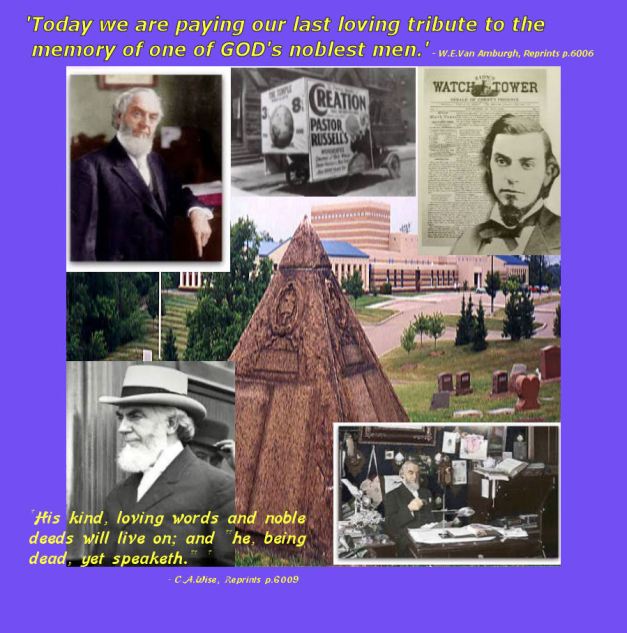
Br. Charles Taze Russell – “The Agony of Gethsemane” —from Reprints (R.1801) of the Original Watchtower and Herald of Christ’s Presence.

JUST AS I AM


[Note: the same melody of the above song “Just As I Am” (sung by Alan Jackson) is Hymns No. 64 in the Hymns of Dawn hymnal and titled “I Come To Thee.”

I Come To Thee

I come to thee, I come to thee,
Thou precious Lamb who died for me;
I rest confiding in thy Word,
And cast my burden on the Lord.

I come to thee with all my grief,
To find in thee a sweet relief;
Thy blessed name my only plea,
With this, O Lord, I come to thee.

I come to thee, whose sovereign pow’r
Can cheer me in the darkest hour;
I come to thee thru storm and shade,
Since thou hast said, “Be not afraid.”

I come to thee with all my tears,
My pain and sorrow, griefs and fears:
Thou precious Lamb who died for me,
I come to thee, I come to thee.

To thee my trembling spirit flies,
When faith seems weak and comfort dies;
I bow adoring at thy feet,
And hold with thee communion sweet.

O wondrous love! what joy is mine,
To feel that I am truly thine.
Thou precious Lamb who died for me,
I come to thee, I come to thee.


Suggested Further Reading:

Gethsemane
https://biblestudentsdaily.com/2017/04/09/gethsemane/


The URL of this post:
https://biblestudentsdaily.com/2017/04/09/the-agony-in-gethsemane/

Enter your email address to subscribe to this blog and receive notifications of new posts by email.

Save

The Origin and Meaning of Easter & Lent

Apostle Peter in prison-BSD.jpg

The Word Easter in the Bible

The only place in the Bible where the word “Easter” is found is in Acts 12:4, yet it is a mistranslation of the Greek word pascha. The word pascha should properly have been translated “Passover” (Strong’s G3957, “pascha, the Passover”). It has been correctly translated Passover in most modern translations. The corresponding word in the Hebrew Old Testament is Strong’s H6453, pecach, also defined as Passover.

Acts 12:4 describes events that took place in the springtime when the Apostle Peter’s apprehension and imprisonment by King Herod coincided with the Jewish festival of Passover, after Herod had earlier arrested and killed the Apostle James, brother of the Apostle John. In respect of Jewish religious custom, Herod waited till after Passover to act on Peter’s fate, planning to kill Peter as he had James. God did not allow this, and sent an angel to free Peter. Soon after, Herod himself was struck dead of a ghastly disease (Acts 12:23).

The “four quaternions (“squads”—in the NIV) of soldiers” (Acts 12:4) refers to four groups of four soldiers each, perhaps each group of four serving in rotation through the 24 hour day, at Jerusalem. During each period four soldiers guarded one prisoner as indicated in Acts 12:6—Peter was chained to one soldier on either side, with two guarding at the doorway.

A Real Angel, A Real Deliverer

During the festive week of Passover and Unleavened Bread, God’s mighty power delivered Peter from prison and death in a miraculous manner.

“The angel said unto him, Gird thyself, and bind on thy sandals. And so he did. And he saith unto him, Cast thy garment about thee, and follow me. (9) And he went out, and followed him; and wist not that it was true which was done by the angel; but thought he saw a vision. (10) When they were past the first and the second ward, they came unto the iron gate that leadeth unto the city; which opened to them of his own accord: and they went out, and passed on through one street; and forthwith the angel departed from him” (Acts 12:8-10).

“It is worthy of notice that the miracles performed here were only such as were beyond Peter’s natural power. Whatever he could do he was required to do, namely, putting on of his sandals and his cloak, and following the angel. He could have been transported. His own sandals or other sandals could have been fastened to his feet. A new coat might have been provided. But the lesson is a more profitable one as it was given. Similarly in the Lord’s dealings with us today, we should remember that it is ours to do everything within our power, and the Lord’s to overrule all things for our good, and to supply our deficiencies from his abundance. Thus still he gives us day by day our daily bread, in the rain and the sunshine and the seed; but he expects us to labor for it, to plow the ground, to sow the seed, to harrow it, to thrash it, grind it and bake it.

” ‘When Peter was come to himself,’ when he realized the facts in the case, that he was free, he said, ‘Now I know of a surety that the Lord hath sent his angel and delivered me out of the hand of Herod and … of the Jews.’ St. Peter’s faith was strengthened. Willing to die, he found that the Lord was willing that he should live and labor and endure, and he was equally pleased, rejoicing, we may be sure, for the privilege of further service, even though it would mean further sacrifices and sufferings for the Lord’s sake and for the sake of his people” (Charles T. Russell, R4347).

From this account in Acts chapter 12, we are assured that “the Heavenly Father himself loves us and that all the heavenly powers are pledged to those whom he has accepted in Christ Jesus, and these unitedly guarantee blessings to all those who abide in God’s love. This means to abide in faith in the Redeemer. It means to abide loyal to our consecration, to do the Father’s will to the extent of our ability. That will is declared to be, that we shall love the Lord supremely, our neighbor as ourselves, and all the members of the household of faith, as Christ loved us” (Charles T. Russell, R4347).

Why Easter Sunday?

Dear friends, have you ever wondered WHY Easter Sunday is one of the most sacred Christian holidays?

It is because Christian churches have generally adopted Easter Sunday as the resurrection day and the proper time to celebrate the raising of Jesus Christ from the grave, which occurred on the third day after Jesus’ crucifixion. Jesus died on Nisan 14th  (Friday, about 3 pm, 33 AD), and was raised the following Sunday morning, Nisan 16th. This was the “third day” counting inclusively—Friday, Saturday, Sunday (Matthew 28:1, Mark 16:1‑2, John 20:1, Luke 24:1,24, 1 Corinthians 15:4).

Later on, it was determined in the Christian world to celebrate the resurrection of Jesus always on a Sunday, and remember the death of Christ by Good Friday, irrespective of whether Nisan 14th and 16th on the Jewish calendar actually falls on Friday or Sunday in a given year. Among brethren of the Bible Student fellowship, it is different. Jesus sat with his disciples for his “Last Supper” (Luke 22:20) on the evening that had just begun the calendar day Nisan 14th, and there instituted a memorial of his approaching death. We customarily observe our Memorial accordingly—on the night following Nisan 13th—that is, the night which technically begins the calendar day Nisan 14th. This year, in 2017, that means a Sunday night (April 9th) memorial of Jesus’ death, but the day of the week varies year by year.

Further in this post we shall explain why “Good Friday” is not celebrated by the Christian world closest to the exact day of our Lord’s commemorated day of death. But in brief, here, it is because of the decision made by the Papal Anti-Christ church (lead by Constantine as we explain later) and they were not concerned about the Jewish date of Jesus’ death. Their new rule (established in 325 A.D.) fixed it relative to the equinox rather than relative to the Jewish calendar. The truth of the matter is, that it is Nisan 14th which the Bible explains is the date when the memorial of our Lord’s death is to be annually commemorated—not the nearest Sunday to this or any other date.

Pagan Influences Came in Later

Today, in our memorial supper, we recognize the influence of the Hebrew traditions by observing it according to the days of the Jewish calendar. The celebration is not of the Jewish Passover, however, but of the sacrificial death of our redeemer, Jesus, the antitypical Passover Lamb. Subsequently, however, pagan influences also blended with popular Christian observances.

(a) The name “Easter” is from Ishtar—who was the Babylonian and Assyrian goddess of love and fertility. The Phoenicians called her Astarte (a sister and consort of Baal,) a god worshipped in many parts of the eastern world. Some of the ancient Hebrews also worshipped Baal.

(b) In Europe, Eostre (with variations in spelling) became the Anglo‑Saxon goddess of spring, emphasizing fertility and the rising sun. The month of April was dedicated to her, and the Old English word for Easter was “Eastre” which refers to Eostre. The festival of Eostre was celebrated at the vernal equinox, when day and night receive an equal share of light and darkness.

(c) During the early Middle Ages, Christian missionaries seeking to convert the barbaric tribes of northern Europe realized that the time of Jesus’ death and resurrection also coincided with the Teutonic springtime celebrations. The Teutonic goddess of fertility, Ostare, derives her name from the ancient word for spring. As the days of approaching spring grew longer, celebrations coinciding with the spring equinox emphasized the end of winter and a rebirth of nature, triumphing life over death. The Christian missionaries taught that this time also pointed to the resurrection of Jesus.

Easter Eggs and Bunnies

Eggs symbolize birth, fertility, and new life in many cultures. The ancient Egyptians and Persians would hand out coloured eggs as gifts during their springtime festivals.

Europeans during the Middle Ages, collected eggs of different colours from the nests of various birds, using them as charms to avert evil and bring good fortune.

The Easter egg hunt custom was gradually phased out by the more popular egg painting custom where colourful eggs were hidden and children as well as others would search for them. Eggs were painted in bright colours to resemble the sun, the arrival of spring, and fertility, while Easter baskets, holding the collected eggs, were intended to resemble bird’s nests. Polish people today still decorate their eggs with many traditional symbols for Easter, many of them with religious representations.

Rabbits have also served as fertility symbols in some ancient cultures. Legends from ancient Egypt connected the rabbit with the moon because of their nocturnal feeding habits. This association with the moon is also thought to have originated with those who watched the cycles of the moon to determine the precise date of the approaching change of season, and the accompanying celebration. This event took place on the first Sunday after the first full moon following the spring equinox.

The first documented use of hares for the Easter festival was in Germany during the 1500’s. Later, edible Easter bunnies were prepared with pastry and sugar. These traditions made their way to America during the 1700’s by the Pennsylvania Dutch who had emigrated from Germany. During the years following the American Civil War, handcrafted chocolate Easter eggs and rabbits became increasingly popular.

Hot Cross Buns

Australians also celebrate Easter with hot cross buns, a spiced sweet bun made with currants or raisins and marked with a cross on the top. The first recorded use of the term “hot cross bun” was around 1733. They are traditionally eaten on “Good Friday” in the United Kingdom, Ireland, Australia, New Zealand, South Africa, Canada, and India. The cross on the bun represents the crucifixion of Jesus and the spices inside are meant to remind Christians “of the spices put on the body of Jesus” (See Mark 16:1, Luke 23:54‑56, Luke 24:1).

John 19:39 says that Nicodemus also brought a mixture of myrrh and aloes, “about an hundred pound weight,” for the burial of Jesus. The number 100 is used for Jesus in the Tabernacle, as the square measure of the gate, door, and vail, representing that Jesus is the “way, the truth, and the life” for those who follow him (John 14:6). Also, there were 100 sockets of silver as a foundation for the Tabernacle, coming from the Ransom money of the Israelites, representing Jesus as the Ransom and foundation for God’s Plan of Atonement (Exodus 38:25-27).

Myrrh, a bitter herb, represents suffering, and aloes is used for healing. Thus these two elements represent the suffering of Jesus, from which comes the healing from sin and death from Jesus’ death. When Jesus is depicted as a king in glory, his “garments smell of myrrh, and aloes”these very two fragrances (Psalm 45:8). For Christ in his resurrection glory has achieved a death of suffering that brings healing for the world.

Lent

Does the Bible teach us to celebrate or commemorate Lent?

The following is an extract from a website by the Uniting Methodist Church explaining what “Lent” is about—a practice not observed within the Bible Student Movement:

“Lent is a season of forty days, not counting Sundays, which begins on Ash Wednesday and ends on Holy Saturday. Lent comes from the Anglo Saxon word lencten, which means ‘spring.’ The forty days represents the time Jesus spent in the wilderness, enduring the temptation of Satan and preparing to begin his ministry.

“Lent is a time of repentance, fasting and preparation for the coming of Easter. It is a time of self‑examination and reflection. In the early church, Lent was a time to prepare new converts for baptism. Today, Christians focus on their relationship with God, often choosing to give up something or to volunteer and give of themselves for others.

“Sundays in Lent are not counted in the forty days because each Sunday represents a ‘mini‑Easter’ and the reverent spirit of Lent is tempered with joyful anticipation of the Resurrection.”

There is no direct reference of this practice, of Lent, in the Scriptures. However, this pleasant custom probably has benefited various ones who applied themselves to it through the centuries, if it focused their minds and hearts on proper spiritual values. However, if afterward its observers supposed they were free at other times to practice worldly principles, then they would have missed the true value. A consecrated believer should remember that their life of service here first of all involves purity of heart and mind, always (James 3:17).

The Catholic Church believes that “Lent” is a time of repentance, fasting, and preparation for the coming of Easter. It is a time of self‑examination and reflection. This may have useful benefits. However, for the true Christian, their entire consecrated life should be one of devotion.

“If anyone would come after me, let him deny himself and take up his cross daily and follow me” (Luke 9:23 ESV).

Fasting can be a good practice at any time of the year, both for our physical benefit, and for mortifying the things of the flesh, to focus on things of the Spirit. Sometimes eating less can cause the mind to sharpen. We are to be continuously humble and lowly of heart, as was Jesus (Matthew 11:29, Luke 2:37). Weaning away from earthly attractions, it can help us also to be satisfied with whatever God permits us to have in other temporal commodities also—food, housing, car, or job. God gives us what we need. If we experience some discomfort for the flesh, it can augment our hope for and appreciation of the spiritual values, and spiritual promises, that exceed anything Earth can provide.

Regarding the practice of baptism at Lent season—perhaps this custom also had some beneficial results. However, it is not something mentioned in the New Testament, and baptism is appropriate at any time of year, when the believer determines to proceed in full commitment to God, with a personal consecration of themselves and their life to Him. Thus it is not reserved for a particular month of the year. See the post titled: What Does It Mean To Be Baptized Into Christ? and What Does Being Consecrated To The Lord Mean?

Pastor Charles Russell’s Comments about Lent

The following is an extract from Reprint 3170.

“Our best wish for all the people of New York and of the whole world would be that all or at least some of them, may observe Lent and join in such petitions heartily: if but one in a hundred of those who will observe the Lenten season will do so, it will surely mean a great revival in their own hearts.

“To us who observe the Memorial Supper on its anniversary only, the occasion is one of the greater solemnity, and may well be approached with the greater reverence. We commend to all of ‘this way’ (Acts 9:2) that the interim between now and the Memorial (April 10th) be specially a season of prayer and fasting—drawing near to the Lord (1 Corinthians 7:5). True, the Lord’s consecrated people are continually to live as separate from sin and from the mind of the flesh as possible, and are to “pray without ceasing”; but, as the Apostle intimates, there may profitably be special seasons of this kind; and surely none more appropriate than this Memorial season. The fasting which we urge may or may not affect the food and drink, according to the judgment of each, respecting what diet will best enable him to glorify God and to keep his “body under.” We refer specially to abstention from all “fleshly lusts which war against the soul”; these appetites always under restraint with the saints, may well be specially mortified at this time.”

However as the Apostle Paul explains in 1 Corinthians 7:29‑31, our “fasting” or “mortification” should be a daily act moment by moment to those who have fully enlisted in the Priesthood of complete consecration in the “School of Christ” as far as it be reasonably possible and all depends on one’s level of maturity in Christ:

” (29) This is what I mean, brothers: the appointed time has grown very short. From now on, let those who have wives live as though they had none, (30) and those who mourn as though they were not mourning, and those who rejoice as though they were not rejoicing, and those who buy as though they had no goods, (31) and those who deal with the world as though they had no dealings with it. For the present form of this world is passing away” (1 Corinthians 7:29‑31).

Hebrew Customs

Concerning our opening text (Acts 12:4), let us consider the relationship between the Easter festival and the Hebrew Passover.

Passover is the oldest and most revered festival in Judaism. It is observed in the spring, in the month Nisan, the first month of the Jewish religious new year (Exodus 12:2). As Jewish months began with a new moon, the timing of Passover about halfway through the month puts it about the time of full moon. The afternoon that Jesus died was the time a full moon, and this represented that Israel’s favor was full—but because of their rejection of Christ, their favor would wane and diminish.

The Jewish Passover, under the administration of Moses, commemorated Israel’s deliverance from centuries of Egyptian bondage. The firstborn among the Israelites where passed over by the angel of death during the final plague suffered by Egypt. That tenth plague forced Pharaoh to release the Israelites from a life of compulsory servitude.

The Passover is celebrated on an annual basis in accordance with the instructions that were given by God to Moses:

“The Lord spake unto Moses in the wilderness of Sinai, in the first month of the second year after they were come out of the land of Egypt, saying, Let the children of Israel also keep the passover at his appointed season. In the fourteenth day of this month, at even, ye shall keep it in his appointed season: according to all the rites of it, and according to all the ceremonies thereof, shall ye keep it. And Moses spake unto the children of Israel, that they should keep the passover” (Numbers 9:1‑4).

Our Lord Jesus became the antitypical Passover Lamb (John 1:29) when he gave his life as a sacrifice for the sins of the world, during the time of the Jewish Passover.

Christian Traditions

Though the Easter festival became well‑established and accepted by Christians by the second century after Jesus’ death, there had been considerable debate between the Eastern and Western divisions of the Church over the exact date the event should be celebrated.

The Eastern Church preferred to not hold it as an annual Sunday event, but rather to observe it on whatever day Nisan 14 fell. These early Christians wanted to time the observance according to the timing of the Hebrew type. The Western Church, on the other hand, wanted to remember the resurrection of Jesus always on a Sunday—Easter Sunday—regardless of the day of the week indicated by the Jewish calendar (Exodus 12).

Emperor Constantine wished to resolve this issue at the Council of Nicea in A.D. 325. The question of the Easter date was one of the main issues of concern. After lengthy dispute, the council was unanimous in its decision that Easter should always fall on the Sunday following the first full moon after the vernal equinox. After further discussion, it was decided that March 21st was to be the date for the spring equinox. This dating process has been the general guideline for most of Christendom ever since.

In Remembrance of Me

Students of the Bible stand free from many of the long‑standing traditions that have been passed down to us from the past. Their faith is based on the meaning and partaking of the symbolic emblems that represent our Lord Jesus’ sacrificial death. Jesus’ request given to his disciples that night in the upper room were, “This do in remembrance of me” (Luke 22:19).

Every consecrated child of God joyfully accepts the privilege of partaking of the bread, representing Jesus’ flesh, and drinking of the cup, representing Jesus’ shed blood. This is the true meaning and purpose of observing this most important occasion each year on the 14th day of the first month Nisan.

Church of the Firstborn

In his letter to the Hebrew brethren, the Apostle Paul speaks of the “church of the firstborn” whose names are “written in heaven” (Hebrews 12:23). Elsewhere, he explains that they are walking with our Lord in “newness of life” (Romans 6:4). They also remember his death, and solemnly renew their consecration to God annually by partaking of the meaningful symbols, bread and wine.

In keeping the type of Exodus 12, the blood of each lamb that was slain in Egypt that night was sprinkled on the doorposts and lintels of the houses of Israel.

  • Each Jewish household represents the Household of faith, that is, all believers in Christ. This includes both spirit begotten and non‑spirit begotten, both fully consecrated and not yet consecrated, both the baptized into Christ and not‑yet baptized into Christ, who believe in the blood of Christ as the redemptive value that saves us from the curse of Adamic death. On that night, however, only the firstborn were under jeopardy, as only the firstborn has a spiritual life that could be lost.
  • That all believers benefit from the Passover sacrifice is reflected in the deliverance of all the Israelites through the Red Sea, subsequent to the Passover night. (1 Corinthians 15:22).

Here are some lovely words by Br. Charles Russell on the Household of Faith, from Reprint 5457. “These words “Household of Faith”—are broad enough to include not only those who are fully in the way, but also those who have made more or less of an approach unto the Lord and the Truth. The very fact that any one is drawing near to the antitypical Tabernacle is a strong reason why we should wish to encourage him to press on. He has come a part of the way, even if he has not made a consecration.

In a strict sense, the Household of Faith, of course, includes only those who are consecrated. But the words of the Apostle justify us in believing that those who are considering the matter, counting the cost, would in a broad sense be counted as of the Household of Faith. And we are to give these special assistance—all in whom we see any prospect of consecration. Our constant desire and effort should be to point men directly or indirectly to the Lord. Thus we shall be showing ‘forth the praises of Him who hath called us out of darkness into His marvelous light.’ ”

  • Each slain lamb—represents the antitypical Lamb of God: Christ Jesus.
  • The firstborn Israelites in each familyillustrate the Christ, head and body, the “church of the firstborn.”
  • The bitter herbs that were eaten with the lamb (Exodus 12:8)—illustrate the trials and afflictions that are experienced by the Lord’s people during the present Gospel Age.
  • The unleavened bread eaten with the lamb (Exodus 12:8)—represents our wish to be purged from the leaven of sin, as we feast upon the merits of our Lord’s sacrifice for us (1 Corinthians 5:7).
  • The household joining eating the Passover lambrepresents our common participation, our sharing together, of the merits of Christ (1 Corinthians 10:16,17).

Those who are faithful to their High Calling will be privileged to share in the deliverance of the poor groaning creation during Christ’s future kingdom, as proclaimed by the Apostle Paul (Romans 8:22, 23).

Christ our Passover Lamb

The Apostle Paul directs our attention to the significance of the Passover type and our need to purge out all unrighteousness and sin (pictured by leaven). He wrote to the Corinthians brethren,

Purge out therefore the old leaven, that ye may be a new lump, as ye are unleavened. For even Christ our passover is sacrificed for us: Therefore let us keep the feast, not with old leaven, neither with the leaven of malice and wickedness; but with the unleavened bread of sincerity and truth (1 Corinthians 5:7,8).

The Jewish people were to slay their Passover lambs on the 14th day of the first month (Nisan) of the Jewish New Year. This was the exact time many centuries later when our Lord Jesus, as the antitypical Passover Lamb, died for the sins of the whole world of mankind.

All who recognize Jesus as the true Passover Lamb and have accepted the merit of his shed blood on their behalf, may appropriate the merit of that blood by purifying their hearts from a consciousness of evil. Because of their faith in the blood of Jesus, they are privileged to enjoy a new relationship and standing before God.

The Lamb of God

When John saw Jesus coming toward him, he proclaimed, “Behold the Lamb of God, which taketh away the sin of the world” (John 1:29).

Later, the Apostle Peter, when comparing earthly riches with the true value of our redemption (1 Peter 1:18), speaks of the exceeding value of Jesus’ blood of sacrifice, as “The precious blood of Christ, as of a lamb without blemish and without spot (verse 19).

God’s wonderful plan of reconciliation for the sins of the whole world will become manifest to all during the Millennial Kingdom soon to be established. The meaning of “Christ our Passover” takes on a deeper significance when we look forward to the time when the entire human family will praise God for the gift of his beloved Son, the “Lamb of God,” that takes away the sins of the world.


Acknowledgment:

The Dawn Bible Students’ Magazine—Article from the Highlights of Dawn, April 2006. “Easter—It’s Pagan Origins and True Meaning,” used to present this post.

Br. Charles T. Russell, The Reprints of the Original Watchtower and Herald of Christ’s Presence.

Br. David Rice—editing assistance.

The Uniting Methodist Church website—for references cited from “What Is Lent and why does it last 40 days?”


The URL of this post:

The Origin and Meaning of Easter & Lent

Enter your email address to subscribe to this blog and receive notifications of new posts by email.

Save

Save

Save

Save

JOHN 13:14-15 – Washing One Another’s Feet – A Privilege

jesus-washing-apostles-feetJohn13,14-15.jpg

During Bible times, frequent washing of the feet was necessary as the Israelites wore sandals instead of shoes, and often went barefoot in the house. Thus, among the Israelites, it was the first duty of a host to give his guest water for washing his feet. To omit this was a sign of marked unfriendliness. According to the Jewish Encyclopedia, “it was also customary to wash the feet before meals and before going to bed (compare Cant. 5:3).” Abstaining for a long time from washing them was a sign of mourning (2 Samuel 19:24).

The priests had laws about this practice (Exodus 30:18-21). Here it is explained that a copper laver was placed in the court, between the Tabernacle and the altar of burnt offering, in which the priests had to wash their hands and feet before entering the Tabernacle or approaching the altar of burnt offerings, hence before all their priestly functions. As no one is allowed to approach a king or prince without due preparation, which includes the washing of the hands and feet, so the Israelite, and especially the priest, is forbidden in his unclean condition to approach God, for if such a one came defiled, he was subject to die.

Feet Washing in the Old Testament

The practice of providing water for guests to wash their feet is illustrated on the occasion of a mysterious visit by “three men” to Abraham.

In Genesis 18:24 we read: “And he lift up his eyes and looked, and, lo, three men stood by him: and when he saw them, he ran to meet them from the tent door, and bowed himself toward the ground, and said, My Lord, if now I have found favor in thy sight, pass not away, I pray thee, from thy servant: Let a little water, I pray you, be fetched, and wash your feet, and rest yourselves under the tree.”

Later, Abraham’s nephew (Genesis 11:27), Lot, made a similar offer to two angels who came to the city of Sodom where he and his family lived, to destroy the city because their immorality has become “so great before the LORD that the LORD has sent” angels to destroy it (verse 13).

“(1) Now the two angels came to Sodom in the evening as Lot was sitting in the gate of Sodom. When Lot saw them, he rose to meet them and bowed down with his face to the ground. (2) And he said, ‘Now behold, my lords, please turn aside into your servant’s house, and spend the night, and wash your feet; then you may rise early and go on your way.’ They said however, ‘No, but we shall spend the night in the square.’ (3) Yet he urged them strongly, so they turned aside to him and entered his house; and he prepared a feast for them, and baked unleavened bread, and they ate” (Genesis 19:13).

(See also Judges 19:20, 21. To understand the context here, starting from verse 1 may be good).

The act of feet washing in the above cases reflects a spirit of LOVE, SERVICE and HUMILITY = WILLING SACRIFICE TO PLEASE THE HEAVENLY FATHER, who reads the heart of men.

Feet Washing – In the New Testament

The Woman’s Tears and Perfume

those who are forgiven much love much

Feet washing in the New Testament is found in Luke 7:36-50. It is six days before the Passover (Luke 12:1) a Pharisee named Simon invited Jesus to his home for a meal. While he was seated at the table, a woman “who had lived a sinful life in that town” came to the Master with an alabaster jar of costly perfume.

“(38) and standing behind him [Jesus] at his feet, weeping, she began to wet his feet with her tears, and kept wiping them with the hair of her head, and kissing his feet and anointing them with the perfume. (39) Now when the Pharisee who had invited him saw this, he said to himself, ‘If this man were a prophet he would know who and what sort of person this woman is who is touching him, that she is a sinner.’

(40) And Jesus answered him, ‘Simon, I have something to say to you.’ And he replied, ‘Say it, Teacher.’ (41) ‘A moneylender had two debtors: one owed five hundred denarii, and the other fifty.

(42) When they were unable to repay, he graciously forgave them both.

So which of them will love him more?’

(43) Simon answered and said, ‘I suppose the one whom he forgave more.‘ 

And He said to him, ‘You have judged correctly.’

(44) Turning toward the woman, he said to Simon, ‘Do you see this woman? I entered your house; you gave me no water for my feet, but she has wet my feet with her tears and wiped them with her hair.

(45) You gave me no kiss; but she, since the time I came in, has not ceased to kiss my feet.

(46) You did not anoint my head with oil, but she anointed My feet with perfume.

(47) For this reason I say to you, her sins, which are many, have been forgiven, for she loved much; but he who is forgiven little, loves little.’

(48) Then he said to her, ‘Your sins have been forgiven.’ (49) Those who were reclining at the table with him began to say to themselves, ‘Who is this man who even forgives sins?’ (50) And he said to the woman, ‘Your faith has saved you; go in peace‘” (Luke 7:38-50 NASB).

Dear friends, what can WE do as did this woman?

In the Mark account of another occasion, Mary, the sister of Lazarus, even poured the perfume on Jesus’ head (Mark 14:3).

How can we anoint the minds of our brethren, as suggested by the head?

Perhaps by praying for our brethren’s strength, that they might endure all for CHRIST.

This is so important, as would we not ourselves wish others to pray for us to more than overcome, which is the desire of our entire existence—to bring JOY to the Father by pleasing Him more? What more than to feel his Perfect Loving counsel moment by moment?

Perhaps anointing the head of our brethren can also mean sharing spiritually edifying thoughts and asking faith-building questions as well as letting the subject matter discussed or studied, be one that feeds the New Creation in Christ so as to encourage fellow consecrated believers to be fully consumed in their thought processes upon heavenly things since “a mind set on the flesh is hostile toward God; for it does not subject itself to the law of God, for it is not even able to do so, and those who are in the flesh cannot please God. However, you are not in the flesh but in the Spirit, if indeed the Spirit of God dwells in you” (Romans 8:7-9).

How can we wash each other’s feet as this woman did for Jesus?
How can we show true hospitality likewise to our fellow brethren in Christ?

The specific and precise answer for each consecrated child of God may be unique and personal, just as each has been given by God uniquely specific talents to use in His service in the body of Christ. But how can we make sure our talents in God’s service are not buried? Perhaps by COURAGE IN CHRIST and by asking our Heavenly Father to eradicate FEAR of man from our lives while holding on to the REVERENTIAL FEAR of GOD—the fear of doing wrong in the eyes of God alone. See post titled: A Proper Fear

Does FEAR OF MAN … fear of past mistakes (as with the Apostle Paul before he became fully enlightened) … fear of being misunderstood and thus misrepresented and shunned or separated from the general assembly, or labelled “crazy” or “a missfit,” “the radical one,” stop us from BEING as CHRISTLIKE as we can and striving to moment by moment develop into the likeness of Christ by getting outside of the CARNAL COMFORT ZONE? Let it not!

This means, going BEYOND the PAIN BARRIER!

If you are not suffering for righteousness sake in some way, shape, or form, it means YOU ARE NOT working to your full potential in CHRIST.

“Indeed, all who desire to live godly in Christ Jesus will be persecuted.” (2 Timothy 3:12)

“For you have been called for this purpose, since Christ also suffered for you, leaving you an example for you to follow in His steps…” (1 Peter 2:21)

The consecrated until death “stars of heaven” class are the “heirs according to the promise” (Galatians 3:29) and coheirs of Christ (Romans 8:17). But such will be heirs only if they display the forgiving, repenting, and humble spirit among men, as we find in the weeping woman who washed Jesus’ feet with her tears of remorse and reverential thankfulness in being worthy of but touching the hem of the garments of Jesus. (Matthew 6:15) She had heard among the crowds that his kingdom was not of this world, and now she was able to SERVE him and be CLEANSED from her sins by him—because of her desire to have her sins forgiven. Later, if she continued on, she would be washed in this antitypical lamb’s blood. Her REVERENTIAL FEAR wished only to do right in God’s sight, recognizing her need for a redeemer.

Since Simon was a Pharisee, he may have considered himself to be rather important and may have felt he had bestowed an honor to Jesus by inviting him to dinner.

Was Simon embarrassed or afraid of what others would think of him if he showed Jesus hospitality? This Jesus who had allowed the woman considered in the public eye as inferior, to come near him?

Do you think Simon’s attitude was one of self-righteousness? Self-importance?
Do we ever allow this feeling to creep into us like LEAVEN?

To rid our minds of any such poison to the New Creation in CHRIST, let us focus our thoughts upon the Son of God who humbled himself even to the death of the cross (Philippians 2:8).

Anointing the Feet

In John 12:13 Mary anointed Jesus’ feet with costly ointment of spikenard six days before the Passover, when Jesus came to Bethany. [Note: this would be Nisan 10th after 6pm and an appropriate time for anointing the Passover lamb—whom Jesus himself was, symbolically.] Mary displayed her loving devotion to the Master by using her hair to wipe Jesus’ feet.

Although Judas’ perhaps insincere words highlight his dissatisfaction with Mary’s use of this expensive perfume (“worth a year’s wages”), Jesus said that she should be let alone, because she did what she could.

In fact, Jesus commended Mary’s actions, in Matthew 26:11-13: “(11) For you always have the poor with you, but you will not always have me. (12) In pouring this ointment on my body, she has done it to prepare me for burial. (13) Truly, I say to you, wherever this gospel is proclaimed in the whole world, what she has done will also be told in memory of her.”

What a beautiful illustration how true Christians should treat their most valuable assets on earth—the feet members of Christ that remain. In these we see Christ. They profess consecration, and evidence this with acts of true loving kindness, and manifestations of concern, gentleness, patience, assistance, and sympathy. They strive to bless others as Mary did with Jesus, lavishing costly, symbolic perfume upon the body of Christ, the Church.

As the washing of another’s feet is not a glamorous work, and considering the imperfections that each of us have, it takes a large measure of love, phileo and AGAPE love, and humility, to press forward in striving to serve our brethren.

Let us not allow differences along one line or another, nor misunderstandings, hinder us from seeking to do good unto all that we have opportunity, especially the household of faith. (Galatians 6:10, 1 Peter 3:11, Psalm 34:14, Micah 6:8)

Washing the Disciples’ Feet

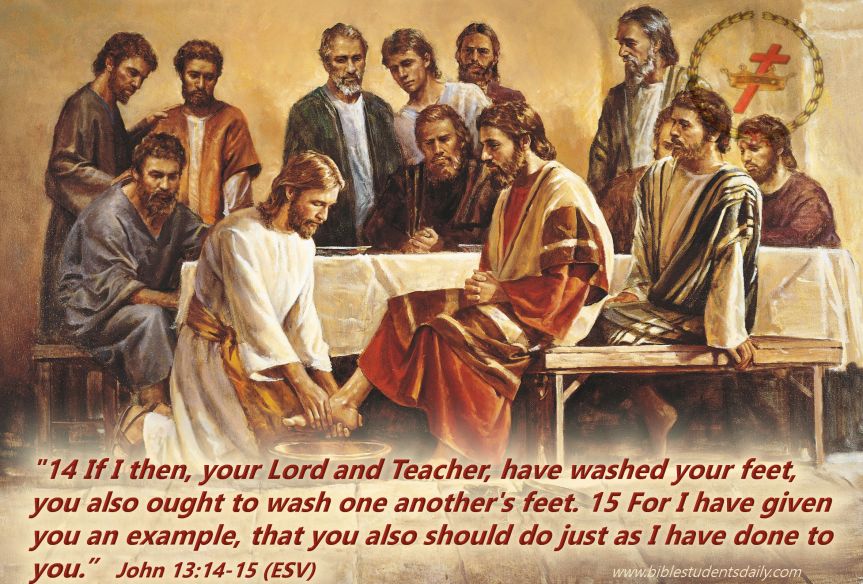
One of the marks of female saintship in the early church was, “if she have washed the saints’ feet” (1 Timothy 5:10). Feetwashing being necessary at that time, became a synonym of service and kind hospitality. To illustrate this same principle of service and humility, Jesus used this same custom on the night of the Last Supper:

At the end of Jesus’ ministry and “just before the Passover Feast,” and when “the evening meal was being served,” Jesus washed his disciples’ feet. The disciples must have been shocked and silent that the Great Teacher, their Lord, would do such a thing. Simon Peter did not want Jesus to wash his feet at first, until the Master said that unless he washed Peter’s feet, he could have no part with him in the kingdom. Then Peter was willing to have his whole body washed, yet Jesus pointed out that he who is clean needs only to wash his feet. Jesus pointed out that not all of them were clean, the reference obviously being made to Judas.

Jesus admonished the disciples: “(14) If I then, your Lord and Teacher, have washed your feet, you also ought to wash one another’s feet. (15) For I have given you an example, that you also should do just as I have done to you” (John 13:14-15).

Jesus’ act was intended as an example in humility and a lesson to the apostles who seem still to have had a spirit of rivalry for preeminence. To our understanding, the lesson was that our Lord’s followers were not to shun any service, however menial, that would enable them to assist or comfort one another.

Jesus’ lesson is amplified by his words in John 13:34, 35: “A new commandment I give unto you, That ye love one another; as I have loved you, that ye also love one another. By this shall all men know that ye are my disciples, if ye have love one to another.”

Not until they had received the holy Spirit on the day of Pentecost, were the disciples of Christ able to manifest their determination to serve Christ in a way that would enable them to become pillars of the Church (Acts 2:24, 16-18, 33, 38).

Feet Washing – TODAY

When it comes to helping brethren, let us gladly do the work of feet washing, illustrated for us by the Master himself who taught the disciplines the lesson of HUMILITY, “that they should love one another to such an extent that they would consider no service too great nor too degrading which would minister to each other’s comfort” (Br. Charles T. Russell, Biblical Expository 1).

Here are some encouraging words of Br. Oscar Magnuson from a 1932 Bible Students Reunion Convention Report:

“If we place a limit on what we are willing to do and to bear for the Lord, the Lord might find it necessary to give us a body with limited capacities in the resurrection. In that case a divine body would not suit us, for such a body is unlimited in bodily capacities.”

There are hundreds of opportunities of showing the meek, lowly, and loving spirit of our Master. As God’s stewards and servants, it is not self that we are to minister and serve and pamper, but it is our mission to “do good unto all men as we have opportunity, especially to the household of faith,” remembering that we are to walk in his footsteps who “came not to be ministered unto [served], but to minister [serve] and to give his life a ransom for many” (Mark 10:45, Matthew 20:28).

In Reprint 1101, Br Russell writes that “the entertainment of any of the household of faith, is really the fulfillment of our Lord’s injunction, ‘See that ye wash one another’s feet.’ But none should be permitted to overdo themselves in this blessed service, nor to deprive themselves of the spiritual communion of the meetings. To this end all have been urged to make only very simple arrangements, that both visitors and entertainers may have their principal feast upon the spiritual meat. Come, then, expecting a warm welcome to such plain things as we have ourselves.”

In our sympathetic desire to help others be more than overcomers, a reciprocal washing of one another’s feet can include:

  • Desiring and maintaining loving fellowship with the members of Christ’s body as did Jesus spend in that upper room SERVING his disciples;
  • Praying for each other, as our Lord Jesus taught in his prayer in John 17.
  • Encouraging each other to fight the good fight of faith and become transformed in newness of life by renewing the mind when we dwell on things that are above. For example, “Speaking to yourselves in psalms and hymns and spiritual songs, singing and making melody in your heart to the Lord” (Ephesians 5:19).
  • Within the ecclesia and among those with whom we have frequent fellowship, if we are actively engaged in promoting one another’s spiritual growth and development, we should be able to appreciate that all of our brethren have certain qualities, graces, or attributes that can benefit us; and we, likewise, should be on the alert as to how we can be of help to them.
  • Volunteering for ecclesia projects.
  • Entertaining visitors with an offer of a booklet or Divine Plan Book.
  • Witnessing to all humans at every single chat we have with another.

2..jpg

  • Providing transportation.
  • Sending messages of comfort to all who write messages on the Old Ron email list.
  • Sharing tapes or truth literature.
  • Typing, proofreading.
  • Testifying at Testimony meetings.
  • Sharing hymns, psalms, and Bible Scriptures over the phone or conference calls etc.
  • Sharing bible study magazine articles or poems written.
  • Sending little “keep pressing onward and upward” parcels of spiritual items to edify.
  • Sending item of use to our brethren worldwide E.g. Africa, Philippines…
  • Visiting the ill, hospitalized or isolated.

hospitalization.jpg

  • Reading the Scriptures morning and evening  with your own children/family.
  • If you have a garden: sharing some of your garden’s edible produce with brethren and friends.
  • Creating a one or 2 page witnessing ad/flier and distributing amongst the public as a family activity.
  • Helping your children leave fliers on the tables and seats at shopping centres and at supermarkets.
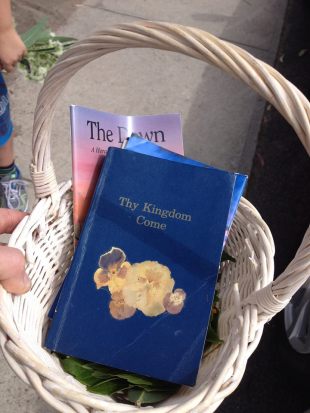
  • Sending in bill payments with a booklet inserted inside them letting someone know about GOD’s GLORIOUS KINGDOM to come to give the world HOPE!
  • Offering to set up Convention/Camp Book Tables.

book table.jpg

  • Coordinating a class choir.
  • Opening up your home for a weekday Bible Study.
  • Having an email sign-off Scripture “logo” — let CHRIST be what others remember you by.
  • Asking the brethren who have websites how you can contribute your skills to aid in the witnessing efforts.
  • Asking your Elders how you could help lighten their load by supporting them in their preparations for the Ecclesia.
  • Making bookmarks from pressed leaves to sell to raise money for some Truth related cause or to give out as gifts and reminder of Scriptural words of encouragement.
  • Offering your time for Sunday School teaching and Children’s Camp /Convention lessons.
  • Sitting next to someone different during ecclesia meeting intermissions at ecclesia and share Scriptures and Scriptural thoughts.
  • Coming prepared to class studies.
  • Finding an Elder who you can be your mentor and have Bible studies, Question and Answer email studies etc.
  • Take the kids on “witnessing bike trips.”

boy.jpgesther witnessing.jpg

Each of us should realize that we have something to give for the edification of the body. We should be faithful in contributing to our ecclesia studies, praying for others, and being a model of someone whose life is undergoing the transformation process; being, therefore, an example of a believer.

Let us be faithful in washing one another’s feet!

2c9752511c569e1794549fdcca7c8aa6.jpg

Acknowledgement

  • Br. Homer Montague, for source material from his article in the Herald of Christ’s Kingdom (March/April 1998), titled “The Privilege of Feet Washing.”
  • Br. Charles T. Russell, Biblical Expository 1
  • Br. Oscar Magnuson for source material from a 1932 Bible Students Reunion Convention Report.


This post’s URL is:
https://biblestudentsdaily.com/2017/03/27/washing-one-anothers-feet-a-privilege/

Enter your email address to subscribe to this blog and receive notifications of new posts by email.

Save

Save

Save

A Proper Fear

ISA. 40, 31.jpg

After the Jewish high priest had crumbled the sweet incense upon the fire of the golden altar, after its fragrance had penetrated beyond the second veil and had covered the Ark of the Covenant and the Mercy Seat, he then himself passed beneath the veil. Every time the high priest raised the veil thus to pass under it he probably feared; for in case he had failed in any particular to carry out his sacrificial work acceptably he would have died as he passed under the veil.

So our Lord Jesus knew that His work must be acceptable in the most absolute sense, else He would forever forfeit His existence. He would become as though He had not been; He would lose all.

There was no earthly being to give our Lord encouragement along this line.

There was no one to say, You have done everything perfectly; you could not have done better.

So the Master went alone to the Father for this assurance and for strength and courage.

LUKE 22, 42.jpg

In Luke 22:42-39 we read:

39 And He came out and proceeded as was His custom to the Mount of Olives; and the disciples also followed Him. 40 When He arrived at the place, He said to them, Pray that you may not enter into temptation. 41 And He withdrew from them about a stone’s throw, and He knelt down and began to pray, 42 saying, “Father, if You are willing, remove this cup from Me; yet not My will, but Yours be done.” 43 Now an angel from heaven appeared to Him, strengthening Him. 44 And being in agony He was praying very fervently; and His sweat became like drops of blood, falling down upon the ground.

The Heavenly Father heard His prayer and gave Him the needed assurance and strength.

He was heard in respect to that which He feared; and during all that night and the following day, up to the hour of His crucifixion, He was calm and courageous.

So the Lord’s people should have a proper fear.

Proper fear is good for them.

But it should not proceed to the point of hindering their efforts and dissipating their courage.

They should have the fear enjoined by St. Paul when he said, “Let us fear, lest a promise being left us of entering into His rest, any of us should seem to come short of it.” (Hebrews 4:1.)

This proper fear the Master had.

He never became discouraged, never held back from the work which the Father had given Him to do.

His fear was a filial one, which engendered a watchfulness and care, a circumspection of walk and of life, that He might be wholly pleasing to the Father. This all Christians should have. We should watch lest we neglect some privilege or duty.

This proper fear will lead us to careful inspection of ourselves.

We should ask ourselves, “What do I believe? Why do I believe it? We should go over the ground again. We should again go over in our minds the proofs of the correctness of our Faith. By so doing, the Lord will strengthen us in the Faith, He will strengthen our heart.

 If any hope in themselves, and lean upon their own strength mainly, it will be to their advantage that the Lord shall allow them to come to the point of discouragement, that they may become more timid, may lose all self-assurance, may realize their utter helplessness and weakness and their need of leaning wholly upon the Lord, of looking constantly to Him for guidance and support.

As the Lord’s children thus learn to wait upon Him, to them is fulfilled the promise, “They that wait upon the Lord shall renew their strength; they shall mount up with wings as eagles; they shall run and not be weary; they shall walk and not faint.”—Isaiah 40:31.

Acknowledgment

Br. Charles T. Russell – The above post is mostly a citation from a Reprint article from “The Original Watchtowers and Herald of Christ’s Presence.” – R.5711

URL: https://biblestudentsdaily.com/2017/03/27/a-proper-fear/

Enter your email address to subscribe to this blog and receive notifications of new posts by email.

Save

Doing and Saying the Kindest Thing in the Kindest Way

1 PETER 3, 9 - DOING & SAYING THE KINDEST THING IN THE KINDEST WAY

What is the SPIRIT OF HELPFULNESS all about?

“Let every one of us please his neighbour for his good to edification(Romans 15:2).

In Romans 15:2, the Apostle Paul is not saying, let the younger ones please their neighbour, nor does he say, let the older ones please their neighbour; but he says,

 “Let EVERY ONE of us please his neighbour.”  

All of the Lord’s people should have such an interest in one another and in the Lord’s cause, and should have so much of the spirit of the Master, that they would seek rather to sacrifice themselves than to gratify self, especially at the expense of others.

If we have the spirit of Christ, we shall find various ways in which we will sacrifice self without waiting for specific directions.

The Law of Love will incite us to act contrary to our own natural preferences, if by so doing we shall help one another in the good way.

In his letter to the Corinthian Church the apostle illustrates this principle by a practical application regarding the Greek custom of offering their meat in their temples. After having been thus offered to the idols, the meat was considered to be especially sacred. Nearly all of the meat available was offered to idols, so that whenever one wished to have meat he could find none that had not been thus offered.

Those who had come out of idolatry into Christianity, knew that the worship of idols was wrong; for they had learned that there is only the one true God.

The apostle declares that he would abstain altogether from eating meat rather than risk stumbling a brother who could not take the broader, truer view. To stumble such a one, might be to throw him out of the right way entirely.

Responsibility For Our Influence

The apostle Paul did not say that it is not right to eat meat; but rather, that he was willing to forego his rights and privileges in order to edify another.

These others of whom the apostle Paul had spoke had not come to appreciate fully the fact that meat offered to idols had not suffered any ill effect or been changed in any way from having had this done. To set meat before a piece of stone would not injure it; and so to set it before an idol would not cause it any ill effects.

But Paul so self-sacrificially, preferred to give up eating meat altogether rather than to stumble any brother or sister in Christ.

What a glorious lesson for us dear friends!

Let us ask our self the follow questions:

When necessary, do I willing deny myself some of my privileges and rights in striving to be of any assistance to my brethren in Christ and in avoiding to stumble them?

Some of the Lord’s people have very sensitive consciences, others are less sensitive.

The longer one has been in the “School of Christ” and/or the more ability one may have, the more easily should one be able to discern what would be pleasing to the Lord we would hope based on each individual’s uniquely permitted experiences, of course that only the Heavenly Father and His son Jesus perfectly understand best, as they are Divine beings.

As a Christian, one would not want to do anything to offend the Lord, even if he were to go without meat for the remainder of his life.

Another introspective question for Christ-like development may be perhaps this one:

Would I, even if it be for the remainder of this carnal life, prefer to deny myself of something (that of course would not harm the New Creation of Christ within self,) that would be for the best interests of another beloved one in Christ so as not to stumble a weaker one in faith or one who may have their conscience violated by doing so?

This involves walking and talking with the Heavenly Father moment to moment to discern God’s will—who mercifully gives wisdom and provides us with His answers to all who ask, seek, and knock to Jehovah for help (Matthew 7:7).

These may be very personal items of decision-making here under consideration, yet how reassured we are through the words of the Prophet Isaiah,

“And your ears shall hear a word behind you, saying, ‘This is the way, walk in it,’ when you turn to the right or when you turn to the left” (Isaiah 30:21).

The Heavenly Father makes clear one’s path through an exercised conscience—that is, a conscience that is disciplined and trained in seeking after that which is righteous in the eyes of the divine perfect God of the universe (Matthew 5:6).

Another introspective question for Christ-like development may be:

Would I wish to lose all my influence for the good of my fellow brother and sister in Christ?

The apostle answers this suggestion in the negative; he says, “…(12) when ye sin so against the brethren, and wound their weak conscience, ye sin against Christ. (13) Wherefore, if meat make my brother to offend, I will eat no flesh while the world standeth, lest I make my brother to offend” (1 Corinthians 8:1-13).

Let us consider some practical “life” scenarios.

Example 1: Regarding clothing…

Perhaps you attend an ecclesia where consecrated sisters in Christ wear head coverings and believe that dressing modestly means to wear skirts and dresses below the knee and which cover the shoulders and not to wear pants (considering that to be a traditional male item of clothing and relying on the words of 1 Corinthians 11:4-16 and Deuteronomy 22:5 for their convictions of belief). After examining the Scriptures on these topics one may realize that wearing a head covering and wearing a modest dress or skirt does not seem in any way to violate the laws of God, and hence will see no reason why not to do so, in order to help create peace around and least offend in any way any dear member in the ecclesia attended. Yet if this does cause contention then considering it a suffering for Christ, may each be humbled—recognizing even more, one’s own ignorance or errors of self for as the words of Philippians 2:3 teach us:

“Let nothing be done through strife or vainglory; but in lowliness of mind let each esteem other better than themselves.”

As the apostle Paul stated best in regards to the above issue about clothing or hair apparel:

“But if any man seem to be contentious, we have no such custom, neither the churches of God” (1 Corinthians 11:16).

Probably the NAS Bible gives the sense better, “But if one is inclined to be contentious, we have no other practice, nor have the churches of God.”

Example 2: Our words or actions…

Perhaps at a testimony meeting in your ecclesia, one would share something that they believe would be of great edification to all, yet something in one’s conduct or words has caused offense in another—perhaps due to language or cultural barriers or perhaps a result of another mis-hearing correctly yet the results of each one’s intentions and conduct involved in such a situation shall be best understood and credited to each involved by the Heavenly Father who sees each heart and each motive. Again, we are ALL ignorant each moment of each day no matter how great or small the issue at hand—which depends on one’s closeness with the Heavenly Father—and thus, how in tune to the Father’s will each dear child of God is to be, being reassured that God through Christ, shall “reward each according to what they have done” (Romans 2:6).

“For we must all appear before the judgment seat of Christ; that every one may receive the things done in his body, according to that he hath done, whether it be good or bad” (2 Corinthians 5:10).

“Not rendering evil for evil, or railing for railing: but contrariwise blessing; knowing that ye are thereunto called, that ye should inherit a blessing” (1 Peter 3:9).

Would one not rather suffer any unkind effects towards us from our words or actions in having done what an educated conscience before the Father believes was done seeking towards righteousness rather than suffering the outcomes of results and the self-inflicted cross of guilt for knowing we had not done how Christ Jesus our Head, would wish us to?

Example 3: Sunday observance…

Applying the above principle—our responsibility for our influence—to Sunday observance, we are not to feel a bondage under the Old Law, during the Sabbath day. However we should avoid what would be considered by others as not observing the Sabbath.

To our understanding EVERY day is a part of the great Sabbath into which we have entered—rest in Christ.

We have a greater liberty. But we are not to use this liberty to the injury of others.

Many people think that any kind of labor is a violation of the Fourth Commandment.

From our viewpoint we know that the Sabbath of the Jew was typical; and we see what the antitype is. We are enjoying the antitype of that Sabbath.

But while we might have liberty to work on Sunday, our so doing might stumble our neighbour. We would not be violating any principle in not observing Sunday; but for the sake of not stumbling our neighbour we are glad to rest from our work and to give ourselves to the study of God’s Word.

Sunday should be a day that is quiet and reverential in every way, and devoted specially to the service of God—a day in which business is restricted, and as far as possible eliminated. But for the interests of the Lord’s work to forbid refraining from the use of today’s transportation blessings such as cars or trains and trams on Sunday would not apply to today’s world as once it may have been the case. Each place… each time period… each culture… each community even… have certain ways of functioning and by best striving to not offend anyone, but with gentleness of mind and being lowly of heart as Christ was, let us strive to represent Christ as best we can now, knowing that where we fall short after doing our best, Christ’s robe of righteousness covers all the failures that surround us.

Sabbath signifies rest, as the Apostle used it (Hebrews 4:9, margin), we can see that the Church of Christ keeps the Sabbath, or rest, every day, and recognizes God’s arrangement in connection with this matter. Those who keep every seventh day as a Sabbath, but who fail to enter into and keep the rest of faith, are not keeping the true Sabbath, but keeping another, so far as the Church is concerned.

The Sabbath arrangement was for the Jews. We have the better arrangement under our Covenant.

We enter into rest, our Sabbath, EVERY day; and we are hoping that soon we will enter into the still Greater Sabbath.

In that Sabbath, the Millennium, we shall have not only rest of heart, but also perfection, no longer to be challenged by trials and difficulties of life.

During His ministry Jesus chose the Sabbath day in which to perform miracles and heal the sick, that He might show forth the kind of works which He will perform during the Great Sabbath Day, the seventh-thousand-year day—the Millennium.

Helping, Not Hindering Our Neighbours

We can apply this principle in a general way. We can apply it to our conversation with Christian people.

There is a way of taunting people on their ignorance, etc. This is not love.

LOVE does not delight to expose another’s weaknesses.

The more careful we become in our words and our actions, the more polite we shall be, the more helpful.

Politeness is :

to do and say the kindest thing in the kindest way.

One may be polite for the sake of policy or for the sake of principle.

E.g. You have a business and you are polite to your clients or else you will not have any to buy from you, and in turn, no income to live from.

Our pleasing of our neighbours should be for their edification.

We should be glad to do ALL that we can for their assistance, their edification, their uplift, their upbuilding.

If we can speak a pleasant word, a kind word, it would be for upbuilding and have in mind primarily the upbuilding of the Lord’s people in spiritual things. As the apostle Paul says, we are “to provoke one another.”

In the ISV translation Hebrews 10:24 reads:

And let us continue to consider how to MOTIVATE one another
to love and good deeds…

What the apostle had in mind here was the reverse of provoking to anger, hatred and strife.

Brother Charles Russell comments in Reprints of the Original Watchtower (R.5413):

 “Some of the dear brethren who are evidently very sincere have not caught the spirit of the Truth on this subject; and wherever they go, they are apt to stir up the evil mind of others, instead of stirring up their good mind and provoking to love and good works.”

We are to please our neighbors so far as it would be for their good, and according to right principles. But to upbuild one in injustice would not be right.

Now here are our final questions to put theory into practice:

For our Australian friends: Would we think it right to let our neighbour’s emus run all over our front driveway?

emus.jpg

For our local and international friends: Would we think it right to let our neighbour’s dogs run all over our front lawn?

6a00d83451c9f669e20167678794a1970b-400wi

Take a moment or two to think of what you would do.

We believe here is a most lovingly wise, compassionate and merciful response to such a question … (but in regards to chickens) by Pastor Charles Russell:

“We think that he [his neighbor] would thus be more edified by our firm stand for right. But we must not tell him how to manage his chickens. We must do our best to keep his chickens off our place; but we would make a mistake if we were to go in and order our neighbor’s chickens, house and children.  To do so would be busybodying. We shall have enough to do to look after the weaknesses of our own family.”

Further Reading:

Bible verses for consideration:

Is the Sabbath Day a Saturday, Sunday, or any day of the Week?
https://biblestudentsdaily.com/2017/10/19/is-the-sabbath-day-a-saturday-sunday-or-any-day-of-the-week/

Acknowledgment & Reference:

Br Charles Russell—R.5413. Reprints of the Original Watch Tower & Herald of Christ’s Presence.

The URL of this post:
https://biblestudentsdaily.com/2017/03/18/doing-and-saying-the-kindest-thing-in-the-kindest-way/

Enter your email address to subscribe to this blog and receive notifications of new posts by email.


Save

Save

Where Does “Christmas” Originate From?

Where Does CHRISTMAS ORIGINATE from.jpg

The Christmas season is the most enjoyable time of the year for many who think upon the events surrounding the gift of Jehovah to the world—his firstborn Son, our Lord Jesus as a special gift to the human family, but is the redemptive work of Jesus Christ, truly appreciated in its full sense?

You see, the true reason for Jesus’ birth was that he would give his life as a ransom price for the sins of every single human that has lived.

The apostle Paul wrote to Timothy, “I exhort therefore, that, first of all, supplications, prayers, intercessions, and giving of thanks, be made for all men; For kings, and for all that are in authority; that we may lead a quiet and peaceable life in all godliness and honesty. For this is good and acceptable in the sight of God our Saviour; Who will have all men to be saved, and to come unto the knowledge of the truth. For there is one God, and one mediator between God and men, the man Christ Jesus; Who gave himself a ransom for all, to be testified in due time” (1 Timothy 2:1-6).

In John 3:16 we read that “God so loved the world, that he gave his only begotten Son, that whosoever believeth in him should not perish, but have everlasting life.”

The Greatest Message of Joy

The angel in Luke 2:10-14 was announcing God’s greatest gift to his poor, sin-sick and dying human creation: A SAVIOR… The “ransom for ALL to be testified in due time” when Christ’s future kingdom of righteousness will soon be established on earth, and when “God’s sons” (the Bride of CHRIST—the 144,000, shall be all beyond the vail and “revealed.” (1 Timothy 2:6, Romans 8:19)

The birth of Jesus had been foretold by the Prophet Isaiah:

“Unto us a child is born, unto us a son is given: and the government shall be upon his shoulder: and his name shall be called Wonderful, Counsellor, The mighty God, The everlasting Father, The Prince of Peace. Of the increase of his government and peace there shall be no end, upon the throne of David, and upon his kingdom, to order it, and to establish it with judgment and with justice from henceforth even for ever. The zeal of the Lord of hosts will perform this” (Isaiah 9:6,7).

Isaiah’s prophecy speaks of Jesus as the antitypical King David, and that he would in due time assume the several and distinct offices of his yet future kingdom as outlined in the prophecy.

At that future time, our loving Heavenly Father would entrust the glorified Jesus to exercise the great power and authority that would be given him to bless all the families of the earth as promised to the true and faithful “seed” of Abraham (Genesis 22:15-18; Acts 17:31).

At Christmas when the world’s attention is drawn to the birth of our dear Lord Jesus, we must acknowledge that he left us with no instructions to celebrate his birth date.

However, Jesus did give us instructions to memorialize his deathinviting us to partake of the emblems and to remember his death. (Matthew 26:26-30; Mark 14:22-26, 1 Corinthians 11:17-34).

In the Book of Luke, Jesus’ words spoken to his followers at the last supper on Nisan 14th (the day of unleavened bread when the Passover lamb was to be sacrificed) are as follows:

“(17)And he took the cup, and gave thanks, and said, Take this, and divide it among yourselves: (18) For I say unto you, I will not drink of the fruit of the vine, until the kingdom of God shall come. (19) And he took bread, and gave thanks, and brake it, and gave unto them, saying, This is my body which is given for you: this do in remembrance of me. (20) Likewise also the cup after supper, saying, This cup is the new testament in my blood, which is shed for you” (Luke 22:17-19).

An Ancient Holiday Season

Although many Christian people continue to observe December 25th as the date of Jesus’ birth, there is no scriptural evidence for this date. Many students of the Bible have come to the conclusion that the blessed event took place around the beginning of October, as we have explained in the post titled Calculating the Date of Jesus’ Birth.

The Winter Solstice

Many ancient cultures chose the Winter Solstice as a special time for celebrating Christmas—which was the terminal point between the darkest days of the year, and the time when the sunlight would begin to increase. That is, when the path of the sun has reached its furthest southern position. The word “solstice” literally means “the sun stands still.”

The time of the Winter Solstice was determined using very primitive and imprecise methods—measuring the length of the shadow created by a stick or a standing stone, which in turn, was dependent on clear weather to create a shadow and to make their calculations as accurate as possible.

In pagan times, the Winter Solstice was seen as part of an annual cycle of the earth’s seasons known as “the wheel of the year.” They celebrated eight festivals including the spring, midsummer, fall, and Yule seasons. Four others were spaced midway between each of them. These festivals have origins in Germanic and Celtic pre-Christian feasts.

Yuletide Celebrations

The Yuletide festival was one of the ancient traditions that was observed in many areas of Europe, the British Isles, and elsewhere. The word Yule relates to the Christmas season and the time when the sun reverses its downward path and begins to shine longer each day.

The actual time may vary a few days over the course of years, but usually occurs sometime between December 21st – 23rd.

Fathers and sons would bring home large logs, which they would set on fire. The people would feast until the log burned out, which could take as many as 12 days. The Norse believed that each spark from the fire represented a new pig or calf that would be born during the coming year. The log was believed to bring good luck to the occupants of the dwelling. Ashes from the log were placed in wells to keep the water pure and they were also placed at the roots of fruit trees and vines to help them bear an abundant harvest during the following year.

The end of December was also when most cattle were slaughtered, thus, the only time of year when they had a supply of fresh meat and most wine and beer made during the year was finally fermented and ready for drinking.

In Germany, people honoured the pagan god Oden during the mid-winter holiday who they were terrified of, as they believed he made nocturnal flights through the sky to observe his people, and then decide who would prosper or perish. Because of his presence, many people chose to stay inside.

Saturnalia

In Rome, where winters were not as harsh as those in the far north, Saturnalia—a holiday in honour of Saturn, the god of agriculture—was celebrated. Beginning in the week leading up to the winter solstice and continuing for a full month, Saturnalia was a hedonistic time, when food and drink were plentiful, when slaves would become masters for this month and when peasants were in command of the city. Business and schools were closed so that everyone could partake of this pagan “fun.”

Mithraism

Another of the Winter Solstice festivals was the celebration of Mithra—annually observed by the people of ancient Persia in honour of the Persian god Mithra who was considered the deity of light, wisdom, and moral purity. For some Romans, Mithra’s birthday was the most sacred day of the year and celebrated on December 25th.

The celebration of Mithra was later introduced into Europe and other areas of Asia Minor after the conquests of Alexander the Great (in early 300 BC) but it began to lose much of its influence by the end of the fourth century. With the rise of Constantine the Great in the fourth century, Christianity was then elevated to the prominent position as the official religion of the Roman Empire. Therefore, the ancient traditions and various observances of the old pre-Christian era gave way to the new Christian religion and its festivals.

The Christian Era

Who Established the Christmas December 25th Date?  

In the early years of Christianity, Easter was the main holiday; the birth of Jesus was not celebrated. During the early centuries of the Christian era, religious leaders wanted to establish a fixed date to celebrate the mass of Christ, which was called Christmas.

It is commonly believed that the church (that is, Pope Julius I—a bishop of Rome from AD 337 to his death in AD 352) chose this date in an effort to adopt and absorb the traditions of the pagan Saturnalia festival.

First called the Feast of the Nativity, the custom spread to Egypt by AD 432 and to England by the end of the sixth century. By the end of the eighth century, the celebration of Christmas had spread all the way to Scandinavia. Today, in the Greek and Russian orthodox churches, Christmas is celebrated 13 days after the 25th, which is also referred to as the Epiphany or Three Kings Day.

By holding Christmas at the same time as traditional winter solstice festivals, church leaders increased the chances that Christmas would be popularly embraced, but gave up the ability to dictate how it was celebrated.

By the Middle Ages, on Christmas believers attended church and afterwards celebrated raucously in a drunken, carnival-like atmosphere. Christmas became the time of year when the upper classes could repay their real or imagined “debt” to society by entertaining less fortunate citizens.

Christmas is Outlawed In the Early 17th Century

In 1645, Oliver Cromwell and his Puritan forces took over England and they vowed to rid England of decadence and, thus Christmas was cancelled through these efforts, even being known to be outlawed (from 1659-1681) in Boston. However, by popular demand, Charles II was restored to the throne and, with him, came the return of the popular holiday.

In fact, Christmas wasn’t declared a federal holiday until June 26, 1870.

The Christmas Tree – A Pagan Custom Brought to Christianity

Long before Christ, evergreen trees and plants have been used to celebrate winter festivals.

Early Romans used evergreens to decorate their temples at the New Year’s celebration of the Saturnalia festival, and exchanged branches and twigs of evergreens as a good luck blessing.

The ancient Egyptians used green palm rushes as part of their worship of the god Ra.

Pagans in Europe believed that because the evergreen tree stayed green throughout the year and could withstand the rigors of an extreme winter, they had magical abilities to ward off the life-threatening powers of darkness and cold. Thus they were considered to possess powers over evil spirits, which some ancient pagan civilizations of northern Europe believed stalked the eerie shadows of the wintertime forests.

During the winter months, evergreen wreaths and other forms of greenery were hung over doors and windows and brought inside the house to protect one from the darkness and evil spirits. The incense from burnt needles and cones as well as the scent from this greenery would freshen the dark and dismal dwellings from the otherwise stagnant odour of thresh and straw and was considered a means of blessing the occupants of the home.

The evergreens served as a reminder that the rigors of winter would pass, and that the land would once again be fruitful.

Many historians believe that the pagan people of Scandinavia were among the first to actually bring evergreen trees indoors, which served as a mid-winter symbol of the promise of the coming warmth of spring.

German Saxons are believed to have been the first to light their trees with candles, and to adorn them with decorations and trinkets for good fortune. The tradition of the indoor evergreen tree became popular in Germany, and it is believed that the first use of Christmas trees by Christians was developed in that part of Europe. Some historians have suggested that its origin may reach back as far as the eighth century.

In England, the first recorded Christmas tree was in 1841. At that time, Queen Victoria was married to Prince Albert of Germany, and he brought the tradition with him and set up the first Christmas tree in Windsor Castle.

German immigrants to America also brought the tradition with them and were celebrating Christmas with evergreen trees as early as the 1830s. The custom took several decades to catch on in the United States. During that period of time, most religious people correctly assumed that it had pagan origins. However, by the 1890s the indoor decorated Christmas tree had become popular in the majority of homes in America.

The Truth behind the Word “CHRISTMAS”

The word “CHRISTMAS” is based upon an impure doctrinal foundation: THE ROMAN CATHOLIC PAPAL SYSTEM—the ANTICHRIST of the Bible—was identified by the Reformers of the Early Church, such as Martin Luther.

The Papal system fit the description found in 2 Thessalonians 2:4:

“…who opposeth and exalteth himself above all that is called God, or that is worshipped; so that he as God sitteth in the temple of God, showing himself that he is God…”

The evidence to the Reformers in confirming the identity of Antichrist was the doctrine of the Mass. The ritual of the Mass claims to recreate and sacrifice over and over Christ’s actual flesh (bread) and blood (wine). Known as the Eucharist, it became a requirement that each believer must receive this fresh sacrifice of Christ to cover his daily sins. Daniel 11:31 refers to this as “the abomination that maketh desolate.”

The Mass makes desolate or negates the full merit of Christ’s blood which was shed once for all.” (Hebrews 7:27; 10:10)

It is important to note that the Protestant Reformers were careful not to condemn any individual Catholic believer as Antichrist—recognizing that no man is The Antichrist. Popes, bishops, priests and others have been only parts of, and, possibly, innocent members of the corrupt Antichrist system.

Jesus Christ’s Commission On Earth

At the age of maturity (30 years), the perfect man Jesus presented himself to his Heavenly Father in total consecration and obedience to do his will.

Jesus fulfilled the words that the Psalmist David had written concerning him:

“Then said I, Lo, I come: in the volume of the book it is written of me, I delight to do thy will, O my God: yea, thy law is within my heart. I have preached righteousness in the great congregation: lo, I have not refrained my lips, O Lord, thou knowest. I have not hid thy righteousness within my heart; I have declared thy faithfulness and thy salvation: I have not concealed thy lovingkindness and thy truth from the great congregation. Withhold not thou thy tender mercies from me, O Lord: let thy lovingkindness and thy truth continually preserve me” (Psalm 40:7-11).

In Luke 4:18-19, Jesus explains to us his commission:

 “The Spirit of the Lord is upon me, because he hath anointed me to preach the gospel to the poor; he hath sent me to heal the brokenhearted, to preach deliverance to the captives, and recovering of sight to the blind, to set at liberty them that are bruised, To preach the acceptable year of the Lord.”

“To the poor”—In his sermon on the mount, Jesus said, “Blessed are the poor in spirit: for theirs is the kingdom of heaven” (Matthew 5:3).

“Heal the brokenhearted—Jesus was to heal the brokenhearted, and he said, “Come unto me, all ye that labour and are heavy laden, and I will give you rest” (Luke 11:28).

“Preach deliverance to the captives”—Isaiah’s account reads, “To proclaim liberty to the captives, and the opening of the prison to them that are bound” (Isaiah 61:1).

When Jesus quoted Isaiah’s prophecy, he used the word “bruised” which means to crush, as in death. The reference to “captives” points to the prison house of death. In his sermon on the resurrection of the dead, he said, “The hour is coming, and now is, when the dead shall hear the voice of the Son of God: and they that hear shall live” (John 5:25).

“To preach the acceptable year of the Lord”—speaks of the special invitation which has been extended to the called by God during this present Gospel Age who are laying their lives down in sacrifice which is acceptable to God (Romans 12:1,2).

What is our Commission?—see post titled Jesus’ Commission: Make Disciples. Baptize. Teach.

We, too, are commissioned to preach the Gospel to the poor, groaning creation. If we are faithful unto death, we will have the great privilege to share with our glorified Lord in his future kingdom of righteousness over all the people of earth. Let us renew our efforts to serve him as we approach another new year.

May we continue to give thanks to our loving Heavenly Father for his gift of Jesus, in whom the whole human family will be blessed under the provisions of his future kingdom of life and righteousness.

Should Christians Celebrate Christmas?

“Let us remember: Jesus did not tell his disciples to celebrate his birth. Therefore, it is not important when we choose to remember this wonderful event. Because love and appreciation for our Savior abound in people’s hearts on December 25th, we may join in their attitude of glad remembrance. And the habit of giving gifts to one another seems especially appropriate. God is the giver of every good and perfect gift. Certainly, amongst all His gifts, the one of greatest important to us is the gift of His Son to be our Redeemer” (Chicago Bible Students Website, Questions and Answers).

Reference:

The Dawn Magazine, December 2005, “The Birth of a Savior: Tidings of Great Joy.”
The Dawn Magazine, December 2011, “The Yuletide Traditions: and the Winter Solstice.”
The End Times, Fall 2005, Issue No. 34 – “Anti-Christ – the Counterfeit Heavens.”
Chicago Bible Students Website: Questions and Answers (www.chicagobible.org)

The URL for this post:
https://biblestudentsdaily.com/2016/12/23/where-does-christmas-originate-from/

Enter your email address to subscribe to this blog and receive notifications of new posts by email.

Save

Calculating the Date of Jesus’ Birth & the 70 week Prophecy of Daniel 9

calculating-the-date-of-jesus-birth

A good starting point for determining the date of Christ Jesus’ date of birth is to look at the dates we have in the Bible surrounding the life of John the Baptist, who was Jesus’s older cousin.

Jesus was 6 months younger than John the Baptist. We read about this in the first chapter of the Book of Luke.

“24 And after those days his wife Elisabeth conceived, and hid herself five months, saying, 25 Thus hath the Lord dealt with me in the days wherein he looked on me, to take away my reproach among men. 26 And in the sixth month the angel Gabriel was sent from God unto a city of Galilee, named Nazareth, 27 To a virgin espoused to a man whose name was Joseph, of the house of David; and the virgin’s name was Mary. 28 And the angel came in unto her, and said, Hail, thou that art highly favoured, the Lord is with thee: blessed art thou among women. 29 And when she saw him, she was troubled at his saying, and cast in her mind what manner of salutation this should be. 30 And the angel said unto her, Fear not, Mary: for thou hast found favour with God. 31 And, behold, thou shalt conceive in thy womb, and bring forth a son, and shalt call his name Jesus32 He shall be great, and shall be called the Son of the Highest: and the Lord God shall give unto him the throne of his father David: 33 And he shall reign over the house of Jacob for ever; and of his kingdom there shall be no end. 34 Then said Mary unto the angel, How shall this be, seeing I know not a man? 35 And the angel answered and said unto her, The holy Spirit shall come upon thee, and the power of the Highest shall overshadow thee: therefore also that holy thing which shall be born of thee shall be called the Son of God. 36 And, behold, thy cousin Elisabeth, she hath also conceived a son in her old age: and this is the sixth month with her, who was called barren. 37 For with God nothing shall be impossible” (Luke 1:24-37).

Another fact to consider in determining the date of Jesus’ birth, is the date of Tiberius Caesar’s 15th year of reign, which was AD 29. This is based on Luke 3:1-3 which reads,

“1 Now in the fifteenth year of the reign of Tiberius Caesar, Pontius Pilate being governor of Judaea, and Herod being tetrarch of Galilee, and his brother Philip tetrarch of Ituraea and of the region of Trachonitis, and Lysanias the tetrarch of Abilene, Annas and Caiaphas being the high priests, the word of God came unto John the son of Zacharias in the wilderness.” And he came into all the country about Jordan, preaching the baptism of repentance for the remission of sins.”

Tiberius received the throne in August of AD 14. If the remainder of that year was an accession year, then his first year would be in AD 15, his 12th when Pontius Pilate was appointed govenor of Judea would be AD 26, and his 15th when John the Baptist began his ministry would be AD 29.

Jesus was thirty years old when he was baptized by John the Baptist and started His ministry. We read of this in the third chapter of Luke:

“21 Now when all the people were baptized, it came to pass, that Jesus also being baptized, and praying, the heaven was opened, 22 And the Holy Ghost descended in a bodily shape like a dove upon him, and a voice came from heaven, which said, Thou art my beloved Son; in thee I am well pleased. 23 And Jesus himself began to be about thirty years of age, being (as was supposed) the son of Joseph, which was the son of Heli…” (Luke 3:21-23).

In the Gospel of Luke, we read that sheep and shepherds were out in the fields when Jesus was born. This highlights that it was the autumn season in Israel, and could not reflect the cold winter season, which the month of December falls into, in Israel.

“8 And there were in the same country shepherds abiding in the field, keeping watch over their flock by night. And, lo, the angel of the Lord came upon them, and the glory of the Lord shone round about them: and they were sore afraid. 10 And the angel said unto them, Fear not: for, behold, I bring you good tidings of great joy, which shall be to all people. 11 For unto you is born this day in the city of David a Saviour, which is Christ the Lord. 12 And this shall be a sign unto you; Ye shall find the babe wrapped in swaddling clothes, lying in a manger. 13 And suddenly there was with the angel a multitude of the heavenly host praising God, and saying, 14 Glory to God in the highest, and on earth peace, good will toward men. 15 And it came to pass, as the angels were gone away from them into heaven, the shepherds said one to another, Let us now go even unto Bethlehem, and see this thing which is come to pass, which the Lord hath made known unto us. 16 And they came with haste, and found Mary, and Joseph, and the babe lying in a manger” (Luke 2:8-16).

Now let us discuss the EXACT DAY of Jesus’ birth.

Some have thought that Jesus was born on September 29 on the Julian calendar, because that was celebrated as St. Michael’s day on the church calendar. This may be correct, but it is uncertain. The difference between lunar time, used by the Jews, and solar time, now in common use, involves some uncertainty also. However, autumn of 2 BC, is about correct.

Br. James Parkinson has an engaging analysis in “The Beauties of the Truth,” February 2011 issue, in the article “From Jordan to Golgotha.” “The single most-likely assumption is that Jesus was baptized on the first Sabbath after the Feast of Sukkoth, or Saturday, October 22. If so, then it follows that the number of days of Jesus’ spirit-begotten life to his crucifixion (?April 3, 33 AD) was … 1260 days.”

Nine months back of that date would bring us to the previous winter as the time at which our Lord laid aside the glory which he had with the Father before the world was [made] and the taking of or changing to human nature began. Possibly this is related to the celebration of December 25th as Christmas Day, though that specific date was evidently chosen to connect Jesus to the solar solstice, a day observed in common culture centuries ago.

The Seventy Week Prophecy

Thus the ministry of Jesus would have been about 3 1/2 years in length. This is compatible with what one might infer from the SEVENTY WEEK PROPHECY in Daniel Chapter 9. For that prophecy speaks of the “midst of the week,” which divides the last “week” of seven years into two parts, marking one of those as the ministry of Jesus. If Jesus was 30 years old at his baptism in the autumn of the year 29, then his death at Passover season in the spring of 33 AD yields a ministry, about 3½ years later, would be consistent.

The 70 week prophecy is given not in years but in units of “weeks”—seven year increments—so in weeks of years. Using this fairly course measure, the prophecy stipulates the number of weeks which would pass until the appearance of Messiah, namely 69. Messiah did appear subsequent to the end of 69 weeks, and of course before the end of 70 weeks, so this part of the prophecy is correctly fulfilled.

But precisely when in this last week would his ministry begin?

In order to specify this, the prophecy says, God would cause the “sacrifice and oblation” of the Law to cease “in the midst of the [last] week” (Daniel 9:27).

The middle of that last (70th) week would be in AD 29, the very time Jesus presented himself to John at Jordan for baptism. Jesus there became the antitype of the bullock of the sin offering for 3 1/2 years until 33 AD. Jesus began replacing the typical arrangements by fulfilling them as an antitype. At his baptism, Jesus began to fulfill the Law types and shadows respecting himself. Thus, in Hebrews 10:9 we read:

“Lo, I come to do thy will, O God. He taketh away the first [the Law and its types], that he may establish the second [the antitypes] (Hebrews 10:9).

Notice that the prophecy does not say Jesus would be cut off in the middle of the week. This thought, though a common interpretation of the prophecy, is not actually stipulated in the text. Verse 26 says “Messiah will be cut off,” and verse 27 says in the middle of the week God would cause the “sacrifice and oblation” to cease, but these are two separate parts of the prophecy.

Confirmed for One Week

Verse 27 says “he [God] shall confirm the covenant with many for one week.” When the text says “he,” clearly God is the one intended. Some suppose Christ is meant by this pronoun, and claim the antecedent is the same as the pronoun “himself” in verse 26 (King James version).

But in that verse “himself” does not appear in the Hebrew. The “he” of verse 27 who confirms the covenant is the same as the one who “determined” the seventy weeks (verse 24), namely Yahweh.

The week referred to is the last (70th) week, which included the ministry of John the Baptist, which began before Jesus appeared as Messiah in the middle of the week. The Jewish Covenant was “confirmed” to them by both John and Messiah, in order for faithful ones to be transferred from Moses into Messiah.

After the cross Jesus became the “end of the law covenant … to everyone that believeth” (Romans 10:4). The Law Covenant was not being “confirmed” to the Jews after Christ died.

The beginning of the week would be AD 26, and it is natural to ask what episode marked this date. But the prophecy does not specify any particular event. The prophecy does stipulate that 69 weeks would pass before Messiah appeared, but this does not require Messiah to appear immediately at the expiration of 69 weeks, any more than verse 26 requires Messiah to be “cut off” immediately “after threescore and two weeks.”

Incidentally, we notice that AD 26 was the date when Pontius Pilate assumed the governorship of Judea, setting the stage as it were for the events soon to unfold.

The fundamental basis for applying the Seventy Weeks must be proper historical dates. If we loose ourselves from this requirement, the whims of interpretation can direct the issue a variety of ways, with no anchor of fact to settle the matter. Today we have that anchor. Ezra’s commission was in 458 BC (Ezra 7:7-14), Nehemiah’s in 445 BC, and only the first one fits the prophecy.

The traditional understanding amongst many students of the Bible has been that AD 29 marks the beginning of the 70th week. In our understanding this cannot be so. Here is our reasoning WHY:

  • The prophecy tells us that it begins with a decree to restore Jerusalem.
  • There was no such decree in the year 455 BC, as would be necessary to make 69 weeks reach precisely to AD 29.
  • There was also no such decree in 454 BC (which is however, the understanding advocated by many dearly beloved brethren in Christ, and the understanding documented in Volume 2, Study 3, page 67 of “Studies in the Scriptures”)—and if there had been such a decree in 454 BC, then the time from 454 BC to AD 29 is only 482 years, rather than the required 483 years.

Thus 483 years forward take us to the year AD 26, which began the last, or 70th week. Seventy weeks of years forward terminate at Calvary, with no imprecision crossing the BC/AD divide.

The dates of Christ’s life are sometimes disputed elsewhere. But the evidence has been decisively shifting in favor of considerate Bible Student view.

In October, 1966, in The Journal of Theological Studies, appeared an article by William Filmer, “The Chronology of the Reign of Herod the Great,” showing that Herod died near the opening of 1 BC (rather than 4 BC), which allows Jesus’ birth in the fall of 2 BC, 30 years before his ministry began in the 15th year of Tiberius (Luke 3:1,23).

As three Passovers in Jesus’ ministry are explicitly referred to in the book of John, and possibly another in John 5:1, this is consistent with a 3½ year ministry which would have ended at Passover in the year AD 33, in which year Nisan 14 did fall on a Friday, consistent with the Gospel narratives.

See also “Dating the Crucifixion,” by Humphreys and Waddington, Nature magazine, December, 1983, which shows this to be the only feasible date for the crucifixion in all the years Pontius Pilate governed Judea, namely AD 26 to AD 36.

As Jesus died on Friday April 3, 33 AD (Julian calendar)—for that was Nisan 14 in the year 33 AD as best we can judge (which rarely falls on a Friday, but in this year it actually did) then if his ministry was 3½ years, discount the three for a moment, the half year would take us back six months from April—thus to October.

The day of the death of Jesus also coincided with a lunar eclipse, visible at Jerusalem as the moon rose near sunset on that fateful day. In this case, it seems the “moon turned to blood” as a token of the passing of the Law, with the death of Jesus. (Acts 2:16-21)

(Technical side note: in those days the Julian calendar operated in the Roman world, and the Gregorian calendar in use today did not begin introduced in 1582 in some European countries. However, some countries used the Julian calendar much longer. Turkey was the last country to officially switch to the new system on January 1, 1927.

To personally experiment with converting dates from one system to another, one can google “Calendar Converter.” The first hit should be the Formula date conversion site, https://www.fourmilab.ch/documents/calendar/. There are some caveats about computing Jewish dates before about 300 AD or so, but in this case it has it correctly.)

JESUS

THE gentle sighing of the wind among the pines,
The joyous singing of the lark at break of day,
The rippling of the water-brooks through cooling shade,
The patter of the softly falling rain at night,
Are sounds less sweet by far than His most precious name.

No art can show a form so gracious and so fair,
No Master’s hand hath drawn a smile so wondrous sweet,
Nor could depict the majesty of that pure brow;
No canvas ever glowed with such a holy light
As shines from His most radiant image in my heart.

The dearest earthly friend may fail in time of need,
The sweetest and the loveliest grow cold at heart,
The nearest may not heed the throbbing heart’s sad cry,
The gayest throng may hold the loneliest solitude,
But Jesus, Jesus never fails my call to hear.

Oh, may the music of Thy name more clearly fall
Upon my ears attuned to catch that sweetest sound!
Oh, may Thine image in my heart so bright become
That I by gazing may be changed into the same;
Oh, blessed Jesus, let Thy presence ne’er depart,
Oh, come and reign forevermore with my heart!

by Gertrude W. Seibert

Acknowledgement

Br. David Rice – written content.
Br. James Parkinson – for his study from “The Beauties of the Truth” – as referenced in the above post.

Further Reference & Reading Material:

“Confirmation on a Fall Birth Date,” The Beauties of the Truth, December 1980.

Volume 2 of “Studies in the Scriptures” by Br. Charles. T. Russell – “The Time Is At Hand”, Study 2 – Bible Chronology pg.55-62 : THE DATE OF OUR LORD’S BIRTH

“The Birth of a Savior” – The Dawn Magazine, December 2005.

“The Star of Bethlehem” – The Dawn Magazine, December 2003.

What Scriptures Point to Seven Years of Tribulation?https://chicagobible.org/what-scriptures-point-to-7-years-of-tribulation/

The URL of this post:
https://biblestudentsdaily.com/2016/12/06/how-to-calculate-the-date-of-jesus-birth/

Enter your email address to subscribe to this blog and receive notifications of new posts by email.

Save

Save

Save

Save

Save

Are You in the Little Flock?

Many called few chosen- 2.jpg

You can quote scriptures from the Apostle Paul, from James, from Isaiah and Malachi, but only when you hear the words of Jesus does it have power. I’m not saying there is no power in the others, but when Jesus speaks we listen! And this is what he says:

“Strive to enter in at the narrow gate, for many I say unto you will seek to enter in and shall not be able” (Luke 13:24).

Now there’s a companion text to that in Matthew 22:14:

Many are called, but few are chosen.”

This is a sobering kind of text. It shakes me up!

Are you one of the many called, or are you the one that’s not chosen?

Most of you are called, but will you be the one chosen? This is a powerful idea. It circumvents all the things in the scriptures—the Tabernacle and the shadows.

If I asked, what is the foremost question in your mind?  What is the question you want answered? If a call came in and God’s on the phone and He says I will answer any question as long as it’s one question, what question would you ask? Would it be whether the Levites are in the Great Company class? … What’s the question that burns in your mind?

Have I made it in the Little Flock?

The Apostle Paul even wanted the answer to this question. In 66 ad when he was martyred, the Apostle Paul said, I have made it!  Did God give him that answer? I don’t think so. I think he just had the confidence – I’ve done the job, I’ve executed the mission, I’ve done what the Lord wanted me to do. Can you say the same thing? Do you have that confidence?

Jesus said, Strive to enter in. Does the word “strive” mean relax, take your lounge? The word means “to vigorously apply oneself with great strenuous effort toward a goal or a mission.” “Strive” means to unceasingly reach for success, to battle, to fight.

What’s the opposition preventing you from making it?

Satan’s one. He doesn’t want you to make it, not because he has anything personally against you, but only because he knows that when the 144,000 is complete that’s the end of him!

The second opposition is our inherited imperfection. We are not born perfect. We’ve got a lot of imperfections, we’re in captivity, in slavery. It restrains us. Then we have the opposition of the government, from poor education, from poor relationships, opposition from poor health. All these weigh heavily on you and these restraints prevent us from striving, because striving means to struggle with these captivities, to fight these restraints.

Didn’t Jesus say that many will not be able to enter in? These are the words of Jesus.

Look around you – you’re not all going to make it! I’m sorry but I have to say it, and I’m saying it to myself because it burns within me.

I want to be in that Little Flock and I will do anything that’s necessary to do it.

Do you have that same determination, that same fight?

Striving is the process for releasing these captivities; it’s the path toward freedom from restrictions. Striving is the process of becoming better, the road to perfection. This is what the Holy Spirit does for us. It gives us the strength to rid the captivities, moving us toward being part of that divine family.

We’re not all going to make it!

Striving is the benchmark, and benchmark means a marked point of evaluation that indicates you’re doing what is expected. It is the standard model, a kind of touchstone. God sees your striving as a benchmark. God does not look at your imperfections, He knows you’re already imperfect, but He’s looking to see how you’re striving. Do you get it – striving to move ahead?

Remember what Jesus said:

Strive, strive, strive!

Many will not be able to do it.

  • We strive for knowledge, but how much knowledge is enough? You will never reach the ultimate knowledge but we strive to get as much knowledge as we can.
  • We strive for sacrifices, but how much sacrifice is enough? We don’t know how much. How much sacrifice does the Lord accept?
  • We strive for goodness, but how much goodness is enough?  We don’t know. Jesus said there’s only one that’s good and that’s God. You’re striving to be good when there’s only One that’s good, so how much goodness must we do to be acceptable?
  • We strive for services, but how much service is enough? We strive to do as many services as we can, but can we really be perfect? What is the answer if we cannot reach the absoluteness of these values?

It’s striving, acting and reacting strenuously to go as high with these values as we can. God sees the striving; that’s what He’s looking at.

If you’re not striving it means you feel you have arrived, but if you keep striving you are recognizing that you’re going towards where He wants you to be.

Time Is Running Out.

God’s time clock for those of the high calling will shortly shut down.

Don’t look at the high calling  and think it’s going to go on and on and on. It won’t!

It’s going to shut down one day.

There’s a spiritual urgency and we can no longer delay.

We can no longer defer what we must do while the door is still open. It may close next year or in 5 years, 10 years, 15 years but probably not beyond that.

What’s sobering about this kind of evaluation and appraisal is your destiny in a class where you will remain in that class eternally.

Do you understand that? Do you know what destiny means?

It means future living, the provenance of life, the inevitability. Whatever class you achieve – the divine class, the Great Company class, the human class, or the second-death class – whichever class you’re in you will be in that class not 100 years, 1000 years, 1,000,000 years, 100,000,000 years, No, for ever and ever and ever because we have no indication that there will be another change of nature.

NOW is the time for you to affect your destiny. Get to it! There is an urgency.

 Fight, and fight hard for your destiny.

Destiny is only a word but you know that it means forever.

COL. 3, 2.JPG

Don’t get fixed on earth!

Time is short and drawing to an end.

The lesson is that if you’re going to make your calling and election sure, you must get with it because the door to the high calling will not be shut until all who are called will have the opportunity to crystallize their characters and show themselves approved unto God. All the prophetic events, all the promises and all the due-time accomplishments will be completed – we’re not discounting them. Everything has to be done, but you’re the most delayed element in all of them. The rest of them the Lord God can change overnight.

There’s another issue here: the validation of God’s Plan. Do you want to help God with His Plan? Most of our prayers are Lord, help me, I’ve got this problem. Lord, we need this. Always me, me, me.

How many of us have ever said, Lord, what can I do to help you? How many have asked that question? I’ll give you the answer because the answer is intrinsic in the divine plan:

Make your calling and election SURE!

When you do that you validate His Plan because He called you to do that. If you don’t make it He will call someone else to replace you. When you make your calling and election sure, things will move more rapidly.

There will be no kingdom, no resurrection, no eternity, nothing will happen until that Little Flock is completed and they help God with His Plan. That’s YOU!

It’s frightening and sobering to think we are such an important part of God’s Plan. We must remember what’s happening: God is re-creating us. To create means to originate a new form, a new design. We were created once but it didn’t work out well, so we are being re-created. In our first creation you didn’t have a choice. We didn’t pick our parents or our genetic package, our style of imperfection. But here God is saying you now have choice. You can choose who you want to be in those ages of ages, you have choice. Jesus says, Strive to enter into the narrow gate for many will not be able to.

God is not trying to make us clones of Jesus even though we try to be like him. We can never be like him because Jesus was the Logos, he has a different genetics, he was the son of God, he was perfect – we cannot be exactly like him but we can have a likeness of him.

How Are We Like Jesus?

We’re like him in the way he lived, the principles he lived, those divine principles of God. Do you know what those principles are?

I want to share a few with you and light a fire under you.

1. Upgrade your consecration. Most of us are consecrated to a model we had years ago, and I’ll refer to that later.

2. Incorporate these divine principles into our re-creation. That’s how you have to think of yourself. You are changing your nature, you are going to be a divine being. That’s what Jesus meant when he said about John the Baptist that he was greater than any of the prophets. That’s quite an evaluation! Then he said, The least in the kingdom is greater than John the Baptist. WOW!

That means you’re greater than Abraham, Elijah, Elisha, Isaiah, Daniel and all these great prophets!

How are you greater than them? Not one of them was being changed into the divine being.

YOU are! That’s what the Lord Jesus meant.

You are going to acquire a kind of inheritance that no one has ever had, not even the angels who were not begotten but created.

Back to Point 1: increasing our services. Upgrade your model of consecration: I hear it so often said that “if I follow the beatitudes I’ll make it.” Another will say, “if I can follow the fruits of the spirit and do a good job there I’ll be in the Little Flock.” These are notions of yesterday; the new consecration model is to recognise that there are many models in the Bible, not just one. The beatitudes is one, fruits of the spirit is two, John’s message to the churches is three, Peter’s Christian virtues is four, Moses’ tabernacle processes is five, James’ spiritual fruits is six, and Paul’s mark of the four quarters is seven. There are seven models. Which one do you want to fill?

I suggest you put them all together into a composite model, that is, statistically see how many of these various virtues are found in every one of them. I did that for you and found:

  1. The first is to love. That’s the big one.
  2. The second is to sacrifice, and that’s big, too. It isn’t giving up a meal but sacrificing on behalf of other people.
  3. The third is to learn. Learning is not preparation for the Little Flock, it is part of it.
  4. The fourth is to be holy, sinless. Sinning is serious with God. He doesn’t want sinners in the holy family.
  5. The fifth is to serve, serving to reconcile.
  6. The sixth is to be zealous for God’s work
  7. The seventh is to be re-created and loyal to God Himself.

That’s the composite model. Let’s take a second suggestion: Re-examine and change your attitude about the divine nature.

When does the divine nature begin?

Most of you would say, at the resurrection. When Jesus was resurrected, was he resurrected to a spiritual nature and then later given the divine nature? Or was he resurrected with a divine nature?  I’m only saying that we have to address ourselves to divine nature because what does “nature” mean. I like the word “likeness”. We are like Jesus; we are like God, but we’re not God. How? We live like He does with the same principles. What are they?

  1. To love first: (John 3:16). In the 2 billion Christians in the world today, most practice a reaction love – I will love you if you love me. God doesn’t have that love. God practises a first love. GOD first initiates the love.
  1. Loving without reward: (Matthew 6:3). We’ve got to stop asking, What’s in it for me? Do something without getting any credit for it. That’s a hard thing to do – I want my name on that!
  1. Giving to others: (Luke 6:38). “Give” should be your middle name. Keep giving until it hurts. I sometimes wonder why the Lord wants us to be like that. It’s because the Lord is going to give you the divine power, a divine body. What are you going to do with that? Are you going to keep it to yourself? Oh, I’m a divine being! God doesn’t want that because God doesn’t like that way. He gives and you too must give when you become a divine being but you have to practise it now as a principle.
  1. Loving your enemy: Don’t take revenge if someone does an injustice to you. How many times among the brethren injustice has happened to us? Do you try to get even? We’re not going to invite them to our convention any more! That’s getting even. Don’t get even. Loving your enemy means for any injustice, not judging according to external appearances. If you can’t get along with people here on earth, brethren with the holy Spirit, what makes you think you’re going to get along with them up there?
  1. Upgrade your services: Our call to be re-created to the divine nature is also a call to service. Once we get into the Little Flock we’re not going to lie in a hammock and someone will bring us cold drinks!

It’s very simple:

The Lord has called you to go to work. There’s a big work.

It’s been estimated 20 billion has ever lived. Science says there have been 100 billion people since the Ice Age — that’s a lot of people. And we’ve heard the sort of things that have to be done. We have to reconcile a lot of people. That’s work! Just wait to see what has to be done. And the Lord says, Do it now!  This is the work of the Kingdom.

[NOTE: There are currently seven billion people alive today and the Population Reference Bureau estimates that about 107 billion people have ever lived. (According to the BBC News in 2012)]

Brethren in Christ,

Let us get with divine principles, as many as we can, incorporate them into our lifestyle, because we want to please God and be part of the Little Flock.

Make sure you don’t lose it!

I am going to be in that Little Flock if it kills me, and it may kill me, but at least I can say I tried.

I am going to fight, to struggle.

We know we’re not perfect and our failings have been numbered, but what is precious in God’s sight is our striving.

If you’re not striving, you’re not trying to get into the Little Flock.

The gift of grace from God is precious. USE every moment you got now in the service of the Lord, and get to work like never before with the mind FIXED… SUPERGLUED to Jesus, to bring GREATEST JOY to our Heavenly Father!

Amen.

Acknowledgment & reference:

Br. Paul Mali – his discourse.


This post’s URL:
https://biblestudentsdaily.com/2016/12/03/are-you-in-the-little-flock/

Enter your email address to subscribe to this blog and receive notifications of new posts by email.

Save

Save
Pastor Charles Russell’s Last Days

Excerpts from the Reprints of the Original Watchtower and Herald of Christ’s Presence, pages 6001-6006, by Brother Menta Sturgeon (1867-1935):-

pastor-charles-russells-last-days-reprint-6001-6006

On Monday afternoon, October 16th, 1916 at 5 pm, Brother Russell left the Bethel home for the last time.

At the noon hour he informed the dearest family to him on earth that he expected to be absent from them for a short time, and expressed for them the hope that during his absence they might be happy and prosperous under the blessings of the Lord. He also said that he expected that he and the one accompanying him would enjoy themselves in the Lord’s service. Then, while he and the family stood at their places, he offered a solemn prayer, beginning with the words:

“O Lord, Thy promised grace impart, And fill each consecrated heart!”

Brother Russell afterwards, wrote out nine letters — giving instructions to various ones respecting their duties. At the appointed hour he went forth, never more to return, saying “goodbye” to the friends in the hall as he passed out and started for the station.

When the Lehigh Valley train pulled out of Jersey City at 6 pm, it carried away our precious Brother on his last pilgrim journey, which was to end in Heaven. Having held public meetings at Providence and Fall River the day previous, he was tired to start with, and consequently did not dictate on the train that evening, as was his custom. In fact, he retired earlier than usual, saying “Good-night” as he did so.

In the morning, in answer to the question as to how he rested, he gave his usual answer during his recent trips, “On both sides,” meaning, of course, that he changed sides frequently during the night.

He often told us of late that he scarcely slept at all, was awake every hour of the night, and thought pretty much day and night. He had the care of all the churches upon his heart, and his physical ailments would not permit much rest. He always ate sparingly, and would carefully note the effect of everything he ate or drank.

He had a beautiful way of making the one who traveled with him feel at ease, and not consider himself merely as a servant, by handing him enough money at the beginning of the journey to cover all his incidental expenses during the trip. He would then arrange that we pay each other’s expenses alternately; he paying all expenses for both one day, and his companion paying all expenses for both the next day, and so on during the entire trip.

DIFFICULTIES ON THE WAY

The wreckage of a freight train during the night had caused the delay, we were informed, and a detour of fifty miles would be necessary to enable us to reach our destination. There was no dining car on the train, and neither could we secure anything to eat on account of uncertainties. It was at this point that a box of peanut butter sandwiches, which had been given to us by a thoughtful friend in Brooklyn, came in just right…. It was at Chicago that his physical endurance was taxed to the limit. Circumstances made it necessary for us to walk several miles, until the writer was growing weary and was sure that Brother Russell must be worn out also, although no remarks of the kind passed between us. All of this occurred after a few hours’ rest during the previous night and with but little to eat.

How many times have I heard Pastor Russell ask people on the trains, in the stations, hotels, everywhere, “Are you consecrated?” He nearly always brought this in. He had many opportunities; for people recognized him everywhere and desired to speak or have a few words with him…Many a time people came to me on the train and inquired, “Is that not Pastor Russell?” and would say, “I knew him by his picture in the paper,” or “I heard him lecture at such and such a place.” Sometimes they would inquire just after he had walked through the train, “Who is that distinguished gentleman with you?” In this way we were able to send out many First Volumes and other printed matter of the Society.

At Kansas City on Thursday morning we encountered so many difficulties in purchasing tickets for the West that it became necessary that I make a trip up into the city through the rain, and with such delay that Brother Russell did here what we had never before known him to do; viz., run to catch a train. We are saying these things to show how different this trip was from anything that had ever preceded it, and how his trials increased as he proceeded on his journey.

We reached Wichita Thursday afternoon in time for an afternoon meeting; but it, with other work in Wichita, was more or less interfered with by the loss of Brother Russell’s valise.

BROTHER RUSSELL’S LAST MEAL

Traveling all night then and reaching the home of Sister Frost Tuesday morning, it was not surprising to find him in much physical pain. His labors were telling on him more than ever. His overworked body began to break at its weakest point. Cystitis was becoming acute. We secured various things for him that morning–in fact, everything he wished, and he seemed to know exactly what to get and do. He worked faithfully on his case all morning; and although we had gone to see a doctor who was somewhat interested in the Truth and who would gladly have called to see him, yet it was not his wish. He appreciated the kind offer, but indicated that he would not need a physician’s services.

Conditions were getting serious. Brother Russell signed a few letters we had written, gave us to understand that we were doing a more important work than we realized and then had us substitute for him at the 11 am meeting at the Hall. Sister Frost generously placed her car at our disposal, so that we could easily and quickly go to and fro. He went to dinner with us, talked pleasantly to everyone, and was as humorous as usual; but he ate nothing…After the meal we went upstairs together arm in arm to his room; and after talking for awhile, he asked us to take the consecration service at the Hall at 3 pm. This we did and returned immediately to his room.

HIS LAST PUBLIC DISCOURSE

The night was drawing on. I was seated on the low window sill close by his side, my hands rested upon his knee and my face was turned up toward his. Love like electricity was flowing from face to face and heart to heart. We talked in whispered tones; and he said during the quiet, lovely conversation, “Dear brother, please remain close tonight and be ready to pick up the thread of thought where I drop it.”

The evening lecture was given in the largest and best theater in San Antonio. It is indeed a beautiful structure. We have never seen a meeting more beautiful. The lecture on the subject of “The World on Fire” was begun under the most favorable conditions.

I was seated at his right, behind the screen, and could see every motion he made. All went well for about 45 minutes, when I thought I could see that he was going to leave the platform. Without any sign of suffering, with perfect self-poise, quietly did he walk off the rostrum, while I endeavored to walk on just as orderly and quietly, and, without a word of explanation, “picked up the thread where he had dropped it.” I continued for about five minutes…

EN ROUTE TO CALIFORNIA

It was just after leaving San Antonio that I had the privilege and pleasure of untying and removing his shoes for the first time. Hitherto he would not permit this, although I had several times made the offer; but now he acquiesced readily, and said, in his gracious manner, “Thank you!”

The next morning he was a sick man, although he was not ready to admit it. He kept to his bed all day Wednesday. While he lay there in his berth, I took a seat on the couch, near him. I watched every move he made, stroked his head, and thought what a stupendous amount of work that brain had done! Taking his soft, gentle right hand and letting it rest in the palm of my left hand, I gently stroked it with my right; and thinking of his lecture at San Antonio the previous night and of the many times I had seen him use that hand so graciously when exposing the errors of the creeds of men as contrasted with the Word of God, I said to him, “That is the greatest creed-smashing hand I ever saw! He replied that he did not think it would smash any more creeds.

This led me to inquire, “Who will smite the River Jordan?” To this he responded, “Someone else can do that.” “But how about the payment of the penny?” I asked. He hesitated for a moment and said, “I don’t know.” Brother Russell was evidently perplexed.

We then talked about his physical condition. What he said about his sufferings was this:

“I always thought I should have some severe sufferings before I finished my course, but thought when I had the trouble in Pittsburgh, that was it. But if the Lord wants to add this also, it is all right.”

DETAINED AT DEL RIO

We learned that a bridge ahead of us had been burned during the night and that we would likely be held up for some time….the weather was hot down there. But never one word of complaint did Brother Russell make.

The diner was three Pullmans ahead of us. Consequently we had to walk that distance for every little thing needed. After one full day’s delay we pulled out of Del Rio on Thursday morning, and were the first ones to pass over the rebuilt bridge. By that time we were over, whereupon we remarked, “Brother Russell, we have often heard you speak about the time when we shall pass over the river; and now, at last, we are over.” A sweet smile came over his face, but he said not a word. We began to think that he might pass over, but surely not very soon. It was October, and it occurred to us that as we were delayed one day before passing over the river in southern Texas, so he might tarry with us one prophetic day and pass over by October, 1917. With these thoughts running through our mind, we were doing our best to serve our dear, patient, uncomplaining, appreciative Brother Russell in every way we could.

All day Saturday, under severe pain, in great weakness, with obstructions piling up before him every moment, he struggled with business propositions like a giant. We have never seen or heard of anything to equal his heroism. Friends had disappointed him, and he wondered if the Lord were not against him in some things. His trials thickened and deepened. Not a murmur or complaint did he utter. He had promised the Lord that he would not, and he kept his promise. He was so great that I nearly always hesitated about drawing near to him.

TO LOS ANGELES

He would not yet admit that he was really sick. By 10 am we had reached the hotel, and I asked him if I could not get him something to eat. He said he was not hungry and asked me to suggest something…Upon bringing it to him, he asked if I had had my breakfast; and when I answered, no, he wanted to know why. I told him that it was because I wanted him to have his first. He said he would not eat his until I had first had my breakfast.

This was just like Brother Russell. He was always so considerate of others. Whenever he would ask me to do anything for him, he would say “Please”; and when it was done he would invariably say, “Thank you.”

BROTHER RUSSELL’S LAST ADDRESS TO THE CHURCH

He cautioned the brethren against exposing his physical condition by saying, “Don’t give me away, Brethren.”

You know that our dear Brother was so considerate of the feelings of others that he never drew much on the sympathy of the friends–so considerate was he, that but few knew that he had been a physical sufferer for thirty years.

On one occasion recently he sent word to the Bethel Family that he would not be down to breakfast; and afterwards he told me that it was on account of the family that he did not come–that they had such deep sympathy for him that he did not like to draw on their vitality. He had learned to lean on the Strong Arm alone! He did not need us particularly, but we needed him.

When he stepped to the front of the platform to begin to speak, out of consideration for the splendid audience before him he said, “I regret that I am not able to speak with force or power,” and then beckoned to the Chairman to remove the stand and bring a chair. As he sat down, he said, “Pardon me for sitting down, please.” In deep humility, in great suffering and in the most solemn manner, he spoke for about 45 minutes, and then answered questions for a short period.

THE RETURN JOURNEY BEGUN

He had me place various articles that he would need during the night in convenient places–under the covers, under his pillows, on the window-sills, so that he could reach them without disturbing me.

We were aroused from slumber by his knocking and calling us by name–it was probably a couple of hours. But we went to him quickly, did what was required, heard him say again “Thank you,” and again lay down. This time, however, we did so with the thought that we would not sleep so soundly. In another hour he knocked and called again; and we were at his side, and soon discovered that another chill was coming on. He had had his first one two nights before. We put five Pullman blankets upon him and tucked them in close on every side; but still he shook. We gave him what was required, and was glad when the rigors ceased. We remained by his side, lying down at times on the couch beside him.

PREPARATIONS FOR DEATH

… It was then that he stood again and said, “Please make me a Roman toga.” I said, “Brother Russell, I do not understand what you mean.” He said, “I will show you.” He had me take a clean sheet and turn it down twelve inches from the top; and then a second one the same. Placing his left hand on his right shoulder, he said, “Fasten them together here.” He stood erect before me for a moment without saying a word, then lay down on the couch on his back, closed his eyes, and lay there before me as in a shroud, a perfect picture of death.

The toga was worn by Roman officials and sometimes by priests, and sometimes symbolized victory and peace, and at other times that the one wearing it had fulfilled his vows. To the writer’s mind all these things are meant. He had fulfilled his vows! he had gained the victory! he was at peace! Thenceforth there was laid up for him a Crown of Righteousness, which the Lord would shortly place upon his noble brow.

CONCERNING THE SEVENTH VOLUME

…With thoughts of the end running through my mind, it was only natural for me to say to myself, Had you not better ask Brother Russell concerning some things? It was in this mood and in this connection that we inquired respecting the Seventh Volume (of “Studies In The Scriptures”), and received his answer, “Some one else can write that”…

… I was just about to sink into sleep when I thought I heard the words, “Brother Sturgeon.” As I came to him, the experiences of Samuel came into my mind. I leaned over him and said, “Brother Russell, did you call me?” He answered “Yes,” and gave me some little thing to do, after which I lay down the second time. Ere long I thought I heard my name called again. I inquired as before, bent over close to him and heard him whisper, “I am trying to find something for you to do.” From this I inferred, “Brother Russell wants me to stay awake tonight”; and it proved to be so.

DEATH DRAWING NEAR

I kept doing many little, necessary things in harmony with his words or signs until another chill (the third one) came on. I folded blanket after blanket over him, tucked them in close to him; but still he shook. I therefore lay on him and pressed my face to his until I felt the warmth returning to his body. The fact that this was the third chill in four nights deepened the impression in my mind that the end was drawing near.

About midnight a great change came over him. He no longer cared for any of his medicine, and did not even seem to thirst for water as heretofore. Some things almost ceased. His pain settled deeper in. He could no longer lie straight in bed as formerly….. When he could no longer make his wishes known by words, he would do so by signs. …I looked to the Lord, and steeled myself, saying, “I will stay with him to the finish.”

The most wonderful thing about this most wonderful man was that, during all his sufferings, trials, inconveniences and perplexities, he spoke not a word of complaint, he heaved not a sigh; he uttered not a moan; he shed not a tear. He had resolved that he would not murmur nor complain, and he kept his resolution to the end. He literally died in doing the Father’s will, and thus fulfilled his vow.

“Blessed are the dead who die in the Lord from now on” (Revelation 14:13)     

The Author–Brother Menta Sturgeon (1867-1935)

brother-menta-sturgeon-1867-1935

URL: https://biblestudentsdaily.com/2016/10/23/pastor-charles-russells-last-days/

Enter your email address to subscribe to this blog and receive notifications of new posts by email.

Save

Save

How is Your Zeal?

eph-3-17-19

Based upon Reprint 1159 (from Zion’s Watch Tower):

AN ALLEGORY

I sat down in my arm-chair, weary with my work; my toil had been severe and protracted. The church wore an aspect of thrift and prosperity; and joy and hope and courage were the prevailing sentiments on every hand. As for myself, I was joyous in my work; my brethren were united; my sermons and exhortations were evidently telling on my hearers; my church was crowded with listeners; the whole community was more or less moved with the prevailing excitement; and so the work went on. I had been led into exhausting labors for its promotion.

Tired with my work, I soon lost myself in a sort of half forgetful state, though I seemed fully aware of my place and surroundings. Seemingly a stranger entered the room, without any preliminary tap, or “Come in.” I saw in his face benignity, intelligence and weight of character; but though he was passably well attired, he carried suspended about his person measures and chemical agents and implements, which gave him a very strange appearance.

The stranger came toward me, and extending his hand said, “How is your zeal?”

I supposed, when he began his question, that the query was to be for my health; but was pleased to hear his final word; for I was quite well pleased with my zeal, and doubted not the stranger would smile when he should know its proportions. Instinctively I conceived of it as a physical quantity, and putting my hand into my bosom, brought it forth and presented it to him for inspection.

He took it, and placing it in his scale, weighed it carefully. I heard him say, “One hundred pounds!”

I could scarce suppress an audible note of satisfaction; but I caught his earnest look as he noted down the weight; and I saw at once that he had drawn no final conclusion, but was intent on pushing his investigation.

He broke the mass to atoms, put it in his crucible, and put the crucible into the fire. When the mass was thoroughly fused, he took it out, and set it down to cool. It congealed in cooling, and when turned out on the hearth, exhibited a series of layers or strata; which all at the touch of the hammer fell apart, and were severally tested and weighed; the stranger making minute notes, as the process went on.

When he had finished, he presented the notes to me, and gave me a look of mingled sorrow and compassion, as, without a word, except, “May God save you!” he left the room.

I opened the note and read as follows:

“Analysis of the zeal of Junius, a candidate for a crown of glory: weight, in mass, 100 lbs., of which, on analysis, there proves to be, viz.:–

Bigotry                                                 –   10 parts
Personal ambition                           –   23     ”
Pride of talent                                   –   14     ”
Love of praise                                   –    19    ”
Pride of denomination                  –    15     ”
Love of authority                            –    12     ”
Love of God                                      –      4     ”
Love of man                                     –      3     ”

I had become troubled at the peculiar manner of the stranger, and especially, at his parting look and words; but when I looked at the figures my heart sank as lead within me. I made a mental effort to dispute the correctness of the record, but was suddenly startled into a more honest mood by an audible sigh, almost a groan, from the stranger, who had paused in the hall, and by a sudden darkness falling upon me, by which the record became at once obscured and nearly illegible. I suddenly cried out, “Lord, save me!”

I knelt down at my chair, with the paper in my hand, and my eyes fixed upon it. At once it became a mirror, and I saw my heart reflected in it:–The record is true!–I saw it; I felt it; I confessed it; I deplored it; and I besought God, with many tears, to save me from myself: and, at length, with a loud and irrepressible cry of anguish, I awoke.–Selected.

* * *

Since all of God’s consecrated saints are his ambassadors, ministers of his truth, and members of the royal priesthood, this allegory may be of profit to all. Love of God and love of our fellow-men are the only elements of real zeal in the above analysis. All the other parts are detestable dross in God’s sight and will be in ours, as we take God’s standpoint of criticism. Let each servant who desires to stand approved of God, examine his own heart, analyze his own zeal, his own motives.

Ephesians 3:14-21 (KJV):-

14 For this cause I bow my knees unto the Father of our Lord Jesus Christ,
15 Of whom the whole family in heaven and earth is named,
16 That he would grant you, according to the riches of his glory, to be strengthened with might by his Spirit in the inner man;
17 That Christ may dwell in your hearts by faith; that ye, being rooted and grounded in love,
18 May be able to comprehend with all saints what is the breadth, and length, and depth, and height;
19 And to know the love of Christ, which passeth knowledge, that ye might be filled with all the fulness of God.
20 Now unto him that is able to do exceeding abundantly above all that we ask or think, according to the power that worketh in us,
21 Unto him be glory in the church by Christ Jesus throughout all ages, world without end. Amen.

 URL: https://biblestudentsdaily.com/2016/10/06/how-is-your-zeal/

Enter your email address to subscribe to this blog and receive notifications of new posts by email.

Save

Save