2 Corinthians 5:20 – What Does Being “Ambassadors for Christ” Mean ?

2 COR. 5, 20

What is an ambassador ?

According to Wikipedia, an ambassador is :

“an official envoy, especially a highest ranking diplomat who represents a state and is usually accredited to another sovereign state, or to an international organization as the resident representative of their own government or sovereign or appointed for a special and often temporary diplomatic assignment… They are stationed in a foreign country and they as well as the embassy staff are granted diplomatic immunity and personal safety while living abroad.”

Apostle Paul made it clear to us that those who are accepted of God and begotten of the holy spirit are ambassadors of another country:

“For our citizenship is in heaven; whence also we wait for a Saviour, the Lord Jesus Christ” (Philippians 3:20, ASV).

“For he has delivered us out of the dominion of the darkness, and transplanted us into the kingdom of his dear Son” (Colossians 11:13).

The Apostle Paul

Apostle Paul referred to himself as an “ambassador in chains” (Ephesians 6:20). This is hardly the view we take of diplomatic ambassadors today. But Paul does not say this to elicit pity. Rather he tells the Church not to lose heart over what he is suffering because it is for the Church’s glory.

Truly Apostle Paul was a great ambassador!

Should we not also represent our head, Christ Jesus and SHINE like stars in the sky, being blameless and pure, “children of God without fault in a warped and crooked generation”? (Philippians 2:15)

YES we MUST do so… not tomorrow… BUT NOWright NOW… the High Calling of the Gospel Age is soon to end and Christ’s Bride composed of 144,000 members, shall hath made herself ready!

Dear Brethren, we will not miss out for the chance of eternal eternities and forevermore to belong to the BODY of Christ… to be counted worthy of the prize of the High Calling… of bringing our Heavenly Father grandest JOY and who shall present the Bride as the most righteous gift to Christ!

Let us “trim our lamps” as the “wise virgins” (Matthew 25:7) and stay separate from this world (2 Corinthians 6:17); and be “peculiar people” renouncing the world and its evil desires!

“14 Do all things without murmurings and disputings:15 That ye may be blameless and harmless, the sons of God, without rebuke, in the midst of a crooked and perverse nation, among whom ye shine as lights in the world…” (Philippians 2:14-15).

Prepare yourselves through strict training and discipline to belong to the ONE BRIDEGROOM ONLYlet JESUS BE YOUR HEAD–SEEK him; SEARCH for him; COPY him; make him proud; REPRESENT him in spite of ALL RIDICULE and SUFFERING in this world.

“24 Do you not know that in a race all the runners run, but only one receives the prize? So run that you may obtain it.
25 Every athlete exercises self-control in all things. They do it to receive a perishable wreath, but we an imperishable.
26 So I do not run aimlessly; I do not box as one beating the air.
27 But I discipline my body and keep it under control, lest after preaching to others I myself should be disqualified” (1 Corinthians 9:24-27, ESV).

The Apostle Paul encourages us: “Now then we are ambassadors for Christ, as though God did beseech you by us: we pray you in Christ’s stead, be ye reconciled to God” (2 Corinthians 5:20, KJV).

Qualifications of an Ambassador

As ambassadors of Christ, how should we conduct ourselves? What is our role?
Let’s consider the following characteristics of an ideal ambassador:

  1. PATIENCE

An ambassador listens carefully to the citizens of the countries he is involved in helping to understand their needs and situation so that any conflicts or disagreements can be resolved in peace. The Apostle Paul was so patient through his experiences as a prisoner and in his dealings with rulers he sought to bring about mutual understanding concerning the Truth.

  1. WISDOM

An ambassador uses his knowledge of people to (as far as possible) resolve conflicts between any parties involved. We have an example of this by the Apostle Paul–when question by rulers and confronted by hostile Jews and Greeks, he used Godly wisdom to answer.

“Now when Paul perceived that one part were Sadducees and the other Pharisees, he cried out in the council, “Brothers, I am a Pharisee, a son of Pharisees. It is with respect to the hope and the resurrection of the dead that I am on trial” (Acts 23:6, ESV).

  1. GRACIOUS SPEECH

As a spokesperson for his country, an ambassador is one who encourages and entreats with his words rather than causing any offence or hostility, as well as seeking the good of all. We see this in Apostle Paul’s conduct here:

“32Give none offence, neither to the Jews, nor to the Gentiles, nor to the church of God: 33Even as I please all men in all things, not seeking mine own profit, but the profit of many, that they may be saved” (1 Corinthians 10:32-33, KJV).

Apostle Peter explains: 11Dearly beloved, I beseech you as strangers and pilgrims, abstain from fleshly lusts, which war against the soul; 12Having your conversation honest among the Gentiles: that, whereas they speak against you as evildoers, they may by your good works, which they shall behold, glorify God in the day of visitation” (1 Peter 2:11-12, KJV).

  1. GENEROUSAn ambassador will use his time and talents to help others, especially as it promotes the interests of his home government, even at personal sacrifice and we note how Apostle Paul laid down his life for kingdom interests  in Philippians 2:4:-

Phil. 2, 4.jpg

  1. REASONABLENESS

An ambassador will try to help those in his host country and persuade them to appreciate the benefit of his counsel. Paul continually appealed to others to accept his counsel concerning Christ’s kingdom and the blessing it will be to all.

  1. HONESTY

An ambassador tells the truth and uses facts to persuade others. He neither deceives nor exaggerates to achieve his way. Paul was forthright, even on occasion calling the attention of Peter and others to what appeared to be a misleading example.

11 But when Cephas came to Antioch, I opposed him to his face, because he stood condemned. 12 For before certain men came from James, he was eating with the Gentiles; but when they came he drew back and separated himself, fearing the circumcision party.13 And the rest of the Jews acted hypocritically along with him, so that even Barnabas was led astray by their hypocrisy. 14 But when I saw that their conduct was not in step with the truth of the gospel, I said to Cephas before them all, “If you, though a Jew, live like a Gentile and not like a Jew, how can you force the Gentiles to live like Jews?” (Galatians 2:11-14, ESV).

  1. UNDER READINESS OF MIND

An ambassador is ever alert to represent and promote the interest of his government even at the risk of personal benefit or gain.

Apostle Paul did not let opportunities slip by him, to regret latter. He embraced his appointed service with diligence. As Jesus, “for the joy set before him” endured ALL manner of rebuff and persecution, so Apostle Paul followed the example of Jesus (1 Corinthians 4:11-13).

  1. HUMILITY

An ambassador recognizes that he has no personal authority apart from the country he represents. Further, as he provides instruction and direction, he explains the laws of his home country.

Though Apostle Paul was a leading light in the early church, he considered himself the “least of the apostles” (1 Corinthians 15:9, Ephesians 3:8).

“If in this life only we have hope in Christ, we are of all men most miserable” (1 Corinthians 15:9).

“To me, though I am the very least of all the saints, this grace was given, to preach to the Gentiles the unsearchable riches of Christ (Ephesians 3:8, ESV).

Philippians-2-3.jpg

If we as Christians could keep these thoughts always prominent before our minds, what a dignity it would add to our character! What a transforming power it would be!

What an assistance to the new nature in its battle with the low and grovelling tendencies of the old nature now disowned by us and reckoned dead!

Dear friends, let us remember that “our citizenship is in heaven” (Philippians 3:20).

While still living in the world, we are not of it but have transferred our allegiance and citizenship to the Kingdom. And now, as appointees of our Kingdom, while still living in the world among aliens and strangers, we as representatives and ambassadors should feel both the dignity and the honor of the position and the weighty responsibilities and keep in memory the Apostle’s words,

Whatsoever ye do in word or deed do all in the name of the Lord Jesus(Colossians 3:23).

(Refer to Reprints of the Original Watch Tower page 3329 for a lovely article titled “Do All in the Name of the Lord Jesus.“)

We can learn by Apostle Paul’s wonderful example of ambassadorship and demonstrate, as he did, a ministry of reconciliation now.

Our Christ-like behavior in this world brings a certain amount of help and healing to a world that needs deliverance.

“A wicked messenger falleth into unhappiness; but a faithful ambassador bringeth healing
(Proverbs 13:17, Leeser).

This will prepare us well for the greater reconciliation of all mankind in which we will participate, no longer as ambassadors, but rather as kings and priests with Jesus.

What a hope is ours!

May we do ALL in our power to glorify our Heavenly Father Jehovah through Jesus Christ, GOD’s Son–in our bodies and our spirit which belong to our Head—Jesus CHRIST.

Reference:

Special thanks to Br. David Stein for source material from the article Paul the Ambassador“, The Herald of Christ’s Kingdom, August/September 2011.


The URL for this post is: https://biblestudentsdaily.com/2016/10/20/2-corinthians-520-what-does-being-ambassadors-for-christ-mean/

Enter your email address to subscribe to this blog and receive notifications of new posts by email.

PHILIPPIANS 2:14 – How to Stop Murmuring & Reap Blessings

1 THES. 5, 16-18 & PHIL. 2, 14 - FINAL2.jpgHow do we find true JOY in living a life that would please God?

Answer: Getting rid of murmuring and complaining.

——-

YOU CAN CHOOSE to be bitter or better.

YOU CAN CHOOSE to repay unkindness with kindness.

YOU CAN CHOOSE to  accept God’s will (Romans 8:28).

——-

How To Stop Murmuring and Complaining

Let’s begin with the words from the Book of Jude, verses 12‑16 (KJV):

“(12) These are spots in your feasts of charity, when they feast with you, feeding themselves without fear: clouds they are without water, carried about of winds; trees whose fruit withereth, without fruit, twice dead, plucked up by the roots; (13) Raging waves of the sea, foaming out their own shame; wandering stars, to whom is reserved the blackness of darkness for ever. (14) And Enoch also, the seventh from Adam, prophesied of these, saying, Behold, the Lord cometh with ten thousands of his saints, (15) To execute judgment upon all, and to convince all that are ungodly among them of all their ungodly deeds which they have ungodly committed, and of all their hard speeches which ungodly sinners have spoken against him. (16) These are murmurers, complainers, walking after their own lusts; and their mouth speaketh great swelling words, having men’s persons in admiration because of advantage.”

The Apostle Jude warned of concerns rising in his day (i.e. the gnostic heresy, which undercut the foundation of Christ), and each of us can look within ourselves to see that inclinations in this direction within ourselves are rooted out. But we need not suppose that all the things Jude spoke about must be found among brethren of our fellowship. In our own Bible Student classes of today, the same things will not be so manifest. Yet we all need to take care of course.

The Apostle Paul also warned the elders at Ephesus that after Paul’s parting, “Also of your own selves shall men arise, speaking perverse things, to draw away disciples after them” (Acts 20:30).

The Apostle Peter similarly warned brethren of his day, that as there were false prophets among the Israelites, so some would appear teaching Christian principles and contrary to the sweet teachings of Christ. These influences would be harmful to the New Creature ways, and lead to the Truth being evil spoken of.

These words of warning from three apostles induce us to watch and pray.

BE HOLY STILL

Revelation 22:11 says, “He that is unjust, let him be unjust still: and he which is filthy, let him be filthy still: and he that is righteous, let him be righteous still: and he that is holy, let him be holy still.”

GOD allows experiences to manifest the heart attitude of every child of GOD. It is for us to follow Christian principles in each experience, and thus “be righteous still, and … holy still.”

Revelation 1:12‑15 pictures the “feet” members of the body of Christ as “fine copper.” The Apostle John saw the “Son of Man” (Jesus) clothed with a garment down to the feet, but saw the bright shining feet, suggesting the character of God’s people.

Copper represents perfect or justified human nature. This copper appeared “as if they burned in a furnace” (Revelation 1:15). It calls to mind the prophecy of Malachi 4:1, “The day … shall burn as an oven.” In a prophetic sense, we have been in that day since the return of Christ (his invisible presence, Parousia) in 1874. Thus “the time is come that judgment must begin at the house of God” (1 Peter 4:17).

In the present ending period of the Gospel Age, God allows trials to purge us, as a furnace of affliction, so that the copper of our justification may shine resplendent in the light of faithful and tested loyalty to GOD.

As Jude suggests, we are not to be surprised if there be murmurers, seeking more or less to have their own will confirmed. Could this include us also?!

— If we are guilty of murmuring, then let us ask God to change us. —

Sin can be a gangrenous growth, like a little bit of leaven that makes the whole bread sour. So murmuring can become a habit, and how easy is it to change a habit?

—– It requires prayer, petitioning to the throne of Grace. —–

But with GOD all things are possible — He can mold us for change (Luke 1:37).

The more degraded one may become, the MORE WORK is required to reverse the damage.

Wishing to change won’t get us anywhere.

We MUST DO AND ACT, while continuously seeking, knocking and asking God, for His help.

WHAT IS MURMURING?

Murmuring is “to utter complaints in a low, half‑articulate voice; to feel or express dissatisfaction or discontent; to grumble; often with, at or against” (Webster’s Online Dictionary).

Murmuring indicates we are out of harmony with our lot. First it expresses dissatisfaction; then perhaps pride and covetousness, leading us to rebel against God’s providence. As roots of bitterness lodge in our hearts and minds, disappointment and dissatisfaction with our environment and our circumstances of life allowed by GOD in His love and mercy, will spring up and growth to DISASTER, in our spiritual life.

Have we been guilty of complaining in regards to the Lord’s providential leadings?

Dear friends, if that very circumstance had not been the very best the loving heart of our Heavenly Father could devise for our edification and upbuilding in Christ Jesus, He would not have permitted that circumstance to occur. Shall not the God of all the earth do right? Of course He will.

“Content whatever lot I see, since ’tis God’s hand that leadeth me.”

We are ALL guilty to some degree to having failed to measure up to the Lord’s standard in this respect.

In Philippians 2:14, Paul relates murmuring even with activity in the Lord’s service.

DO all things without murmurings and disputings“.

The word “do” here is one of the smallest words, but one of the most forceful! It is not that we are to do some things that are hard and murmur about the rest; it is not to be satisfied with some things and be dissatisfied with others.

DOING “all things without murmuring is the test of our own hearts and minds!

Complaining is being ungrateful! If we complain we are wordly!

The murmuring ‘domino effect’ will continue until a break is made, and a change is effected. Once this weakness of character becomes a strength of character, it means the test has been overcome. (2 Corinthians 12:9).

1 Corinthians 10, 10.jpg
ANALOGY

Suppose we see a man carrying a corpse along the street, making a public display of it, we’d be mortified! Perhaps we’d ask him the reason and probably someone would phone the Police! Suppose this man replies that he must, day after day, carry this corpse with him, with all its loathsomeness. Would we not think him insane? But do some of us do this metaphorically?

In Colossians 3:3 the Apostle Paul says, YOU HAVE DIED, and your life has been hidden with Christ in God.”

Yet we hear the corpse complaining and murmuring every day, dissatisfied. What a peculiar corpse it would be from a natural standpoint, if after it was ready for burial we continued to preserve it, and it had the ability to murmur and complain against its condition!

Dear friends, if we bury the dead (and that is what we are to do with our fleshly interests, desires, wants, and preferences), then we must put it out of sight, put it in the tomb, bury it, and every time the “old man” complains, throw another shovel of dirt on him.

Live ABOVE the circumstances of your life.
“Set your affection on things above” (Colossians 3:2).

Then any temptation to murmur about the things below will be minimized by far!

EXAMPLES OF MURMURING IN THE BIBLE

We have many illustrations about murmuring in both the Old and New Testaments.

EXAMPLE 1.

The Old Testament book of Numbers could easily be renamed The Grumbler Chronicles. The Children of Israel grumbled against Moses, Aaron, and God.

In Numbers 12:1 we read, “And Miriam and Aaron spoke against Moses because of the Ethiopian woman whom he married.”

Miriam and Aaron were displeased that Moses had married at all, and that he was foolish enough to marry without consulting the wishes of the family, and in addition, that he had been foolish enough to marry an Ethiopian woman. Yet the real reason for their murmuring was due to pride and selfish ambitions of their own hearts.

In verse 2 we read them murmuring, Hath the Lord indeed spoken only by Moses? hath he not spoken also by us? And the Lord heard it.” We can rest assured that the Lord will hear and regard every attitude of dissatisfaction with his plans and purposes that may manifest itself in our hearts and lives; it is to be indeed charged up against us!

Notice the results of murmuringMiriam became leprous. Leprosy is a type of sin. Miriam perhaps represents a certain class, leaders in this rebellion against the Lord, and murmuring against his plans and purposes. Miriam’s seven days of punishment is a picture of the eternal punishment (i.e. second death, Revelation 20:6-15) for those who will lead in rebellion against the Lord and his arrangements (Jude 1:13). Miriam represents such who fail to recognize Christ as the leader of spiritual Israel and who fail to honor those whom he uses as his mouthpieces and servants. R4037:5 In this type, Aaron reflects those who are busy-bodying in other men’s matters. R3061:4 A weak character; as shown on this occasion and when he made the golden calf. R5308:3

God probably favored this marriage so the Jews would not choose Moses’ children as his successors; they were supposed to look to the Lord as their leader. R3061:4 Of an alien race, she replaced Miriam as first lady, arousing Miriam’s jealousy on religious grounds. R5308:1 Zipporah, typifying the Bride of Christ. R1651:6 Perhaps Moses’ first wife had died, and Zipporah was his second wife. R5308:1

[NOTE: R – denotes Reprints from the Watch Tower which can be read at http://www.htdbv8.com or Google: “Harvest Truth Data Base” for the latest version.]

EXAMPLE 2.

Matthew 20:1‑16 ‑ In his parable of the vineyard workers, Jesus noted of disciples how those who worked from the first hour, having “borne the burden and heat of the day,” murmured because they received the same wages as those who worked only the last hour. Jesus declared that such labourers in the Lord’s vineyard who murmur over what seems to them are life’s inequities, actually are murmuring “against the goodman of the house.” (Matthew 20:11).

The goodness of the Lord is attested to in so many ways—mansions await!so let us not allow any ungrateful thought to creep into the mind!

EXAMPLE 3

In the latter portion of Jesus’ ministry he began to be more direct. He declared that he was to be the true bread which came down from heaven, of which if any man would eat he would live forever; that God would raise him up at the last day. His hearers began to murmur inquiring, “Is not this the son of Joseph, the Nazarene, whom we know? Have we not been acquainted with him since the days of his youth? And he says he came down from heaven.” 

Oh, they murmured!

As Jesus continued to say that unless they ate his flesh and drank his blood they had no part or lot in the matter; others turned back saying, “This is a hard saying, who can bear it? This is difficult, hard to comprehend. Who can bear it? Look at the reproaches it will bring; look at the disturbances it will make in our life”. They do not like the reproach of the cross of Christ nor to bear the shame or to be made of no reputation. Recall the exhortation of Apostle Paul, “Let us go forth to him without the camp, bearing his reproach.” (Hebrews 13:13)

They said Jesus had a devil and was mad. His course was contrary to the world, and the world began to berate the Apostles, and they declared, “Lord we have left all and followed thee, what do we get in return? Others are turning away, what remains for us?” (Mat. 19:27) Jesus said, “Doth it also offend you?”(John 6: 61) Here, those who had followed Jesus closely began to be offended at him, and murmured.

The same spirit of pride and rebellion, discontent, eating at their very hearts, began to manifest itself under the severity of the tests that were coming on them. As it is written, “There are some of you who believe not.” (John 6:64) At one point Jesus turned longingly and lovingly to them, and said, “Will ye also go away?” Apostle Peter replied, “Lord, to whom shall we go? thou hast the words of eternal life” (John 6:68).

Indeed, to whom would he go? To whom will you go, if you go out of the Truth? If you are dissatisfied, discontented, with God’s plan and providential leadings, if you turn aside, unto whom will you go? And what is the remedy for murmuring?

With God’s help through prayer and petition, here are some helpful tools in regards to :

HOW DO WE STOP MURMURING?

Here are 6 suggestions:-

1. REALIZE THAT COMPLAINING IS A DANGEROUS SIN.

We know the enemy of our souls doesn’t want us to fulfill God’s intended purpose for our lives. If he can’t derail me, or you, because of lust or immorality in our private lives, then the devil will seek a different bait for his trap. For many of us, that snare is the temptation to gripe, grumble, and complain against God (1 Corinthians 9:24-10:13).

Murmuring is a sin. Here are 10 reasons why :

1.It is questioning God’s capacity, in the face of all God’s assurances to us in the Bible to display that He does care about us (Romans 8 :28, 1 Corinthians 15:22).

2. It is a rebellion against’s God’s will, (Job 23:2) and thus, dis-satisfaction with what God sees as the perfect experiences for us and in His perfect time (Ecclesiastes 3:1). Joshua and Caleb urged the murmuring Israelites not to “rebel against the Lord” (Numbers 14: 9). But rather than listen to reason, the Israelites were ready to elect new leaders who would oversee their rebellious plans.

3. It is another form of mocking God’s plan of salvation, where despite acknowledging God, one criticizes His ways by wanting things to be done in our ways, even though our ways are much lower ways. (Isaiah 55:8).

4. It ignores God’s potential. The report of the ten spies (see Numbers 13) reflected a godless perspective. God had opened the sea to save the Israelites, the heavens to feed them, and the rocks to provide water for them. He had defeated mighty armies throughout their wilderness trek. He had freed them from perhaps the most powerful nation on the planet (the Egyptians). Certainly He could deal with any problems the new land might present.

5. Murmuring leads to self-pity. “Would that we had died in the land of Egypt! Or would that we had died in this wilderness!” (Numbers 14: 2).

Murmurers often feel sorry for themselves and focus on how they have been mistreated, misused, and let down.

6. Murmuring is born in the context of bad report. Sins of the tongue that spread negative reports (beguilement, gossip, slander, false witness) create an environment in which murmuring can thrive.

Are we such complainers?

7. Murmuring also drains us from the energy we need to RUN the race of the High Calling set before us and energy to carry our cross. The cross can only “be light” as Jesus promised us in Matthew 11:30 if we do not carry the extra unnecessary and dangerous baggage of sin: “Therefore, since we are surrounded by so great a cloud of witnesses, let us also lay aside every weight, and sin which clings so closely, and let us run with endurance the race that is set before us…” (Hebrews 12:1, ESV)

8. Murmuring distorts good judgment. The murmurer misinterprets and misrepresents reality. For instance, after God gloriously delivered them from Egypt, the Israelites began to speak of their former life in Egypt as better, saying, “Yahweh delivered us out of Egypt only to kill us and our children in the desert. This Yahweh is no redeemer; he is more cruel than Pharaoh himself.” Here we see the utter inability to interpret reality correctly. And eventually these murmurers tried to stone Moses and return to Egyptian bondage, like a dog returning to its own vomit.

When people murmur, their hearts become darkened and they become incapable of interpreting reality correctly. Thus, good is evil, and evil is good: autonomy is good, and the Lordship of Christ is bad; worldly friends are good, parents and other authorities are bad. The sons of Eliab told Moses, “Isn’t it enough that you have brought us up out of a land flowing with milk and honey to kill us in the desert? And now you also want to lord it over us?” (Numbers 16:13).

9. A murmuring spirit is quick to jump to the wrong conclusion. Just like the Israelites wanted to return back to Egypt.

10. Murmuring thrives in an atmosphere of fear. Twice Joshua and Caleb exhorted the people not to be afraid (Numbers 14:9). But the Israelites’ fear of the unknown fanned the sparks of grumbling in their midst. They were in a situation beyond their control, and they felt threatened and insecure. Their faith disappeared as their fear increased.

2. TRUST THAT GOD KNOWS WHAT HE IS DOING –

GOD KNOWS WHAT HE IS DOING! So let us let God be in charge of what He sees must be our experiences if we have given up our wills to do His.

Look at Joseph – He was thrown into a pit by his brothers, sold by them into slavery, unjustly accused of fooling around with Potiphar’s wife, thrown into prison forgotten by a friend he had helped – and yet Scripture does not record even a single complaint!

Joseph could have become bitter against his brothers…
Joseph could have smashed his fist against the prison walls and complained that his circumstances were unjust...

But did he do that?

No. He surrendered to God’s power. He had TRUST IN GOD.

Let us not forget, through Joseph, to look unto Jesus, who suffered being tempted, yet without sin; who was slandered, and persecuted, and …“He was oppressed, and he was afflicted, yet he opened not his mouth: he is brought as a lamb to the slaughter, and as a sheep before her shearers is dumb, so he openeth not his mouth. (Isaiah 53:7)

What was the secret of Joseph’s complaint-free life?

The answer is in Genesis 45:5-8 where we find Joseph, now the Governor of Egypt, addressing his starving brothers,

(5) Now therefore be not grieved, nor angry with yourselves, that ye sold me hither: for God did send me before you to preserve life. (6) For these two years hath the famine been in the land: and yet there are five years, in the which there shall neither be earing nor harvest. (7) And God sent me before you to preserve you a posterity in the earth, and to save your lives by a great deliverance. (8) So now it was not you that sent me hither, but God: and he hath made me a father to Pharaoh, and lord of all his house, and a ruler throughout all the land of Egypt.

Three times in four verses Joseph says – “God sent me here”. Talk about perspective that comes as a result of an uncommon faith in an Omnipotent God. Joseph grasped the truth that God is in control, and that He knows what He is doing.

3. “GIVE THANKS IN ALL THINGS – 1 Thessalonians 5:18.

4. FOCUS ON OUR BLESSINGS we receive from the Lord, such as:

  • That our sins can be forgiven thanks to Jesus’s precious blood paid as the Ransom price to free all mankind from the prison house of death.
  • The assurance that God and Jesus are with us (Matthew 9:2; Hebrews 13:5).

HEB 13, 5&6.jpg

  • That situations of stress (from which such murmuring would emerge) are actually THE TESTS we are wanting to pass to develop CHEERFUL patient endurance in ALL things. (Colossians 1:11, Romans 5:4 & 12:12). The sooner we do this, the greater shall be our joy, in turn, in doing the Father’s will (John 4:34, John 15:11, 1 Thessalonians 2:19, John 6:38).

Don’t wish to trade your difficult experiences for anything as this is where all the effects happen — the positive changes in character, in the face of adversity, by God’s help, developing the New Creature in Christ to be fully surrendered to God’s will and delighting in fulfilling God’s will to bring the Heavenly Father greatest joy through cheerful, willing self-denial and self-sacrifice.

Here is a helpful prayer starter:

“Almighty Heavenly Father, could Your will be done in (E.g.) my life concerning … in this experience… in my relationship with …

“Heavenly Father, I do not know what to say … what to do …. Could You please show me. I trust in You. Please put the words in my mouth… Please direct my steps… Please put a seal on my tongue … Please let me not fail you … Please let me be like your Son in character … 

Have the DISCIPLINE to NOT COMPLAIN!
Pray for this DISCIPLINE of CHARACTER.

5. BE OF GOOD CHEER, BE CHEERFUL

“These things I have spoken unto you, that in me you might have peace. In the world you shall have tribulation: but be of good cheer; I have overcome the world.” (John 16:33, KJV)

Cheerfulness comes from COURAGE which comes from implicit TRUST in God. TRUST comes from firm FAITH in God – which develops from a life where one ‘walks and talks’ with God. (Proverbs 3:5, Psalm 37:4-6, Romans 8:28, Proverbs 3:6, Joshua 1:9)

Being of good cheer is contagious and in Proverbs 17:22, we are told it is “good medicine”.

6. BE GRATEFUL & CONTENT – for God gives us what we NEED not necessarily what the flesh would at times want, as He knows best what would develop in us greater love towards doing His will, and thus, what would help us BE RIGHTEOUS – without which no one can please God. (Hebrews 12:14)

Hebrews 13:5-6 (KJV) – “Let your conversation be without covetousness; and be content with such things as ye have: for he hath said, I will never leave thee, nor forsake thee. So that we may boldly say, The Lord is my helper, and I will not fear what man shall do unto me.

Other tips for how to be grateful:

  • Begin your prayers with all the “thank you’s” to God.
  • Each morning/day think about (or write out) all the things you are grateful for.
  • Lower your expectations of others, and rather, have implicit TRUST in the Heavenly Father’s precision and perfection of ALL details in your life!
  • Accept the circumstances.
  • Don’t take things personally.
  • Deal with the circumstances by relying upon God’s help through Christ.
  • Do your best.

CONCLUSION

Let us, then, “fix our eyes on Jesus, the author and perfecter of our faith” (Hebrews 12:2) and follow him all the way to the Heavenly City with singing. Let us give thanks in everything, knowing our Redeemer is with us to keep us from falling. He to whom all authority in heaven and on earth has been given is telling us, “Go into the world of trouble, and I will be with you always, even unto the end of the ages.”

Take encouragement from Paul’s message in Romans 8:35-39:

“(35) Who shall separate us from the love of Christ? shall tribulation, or distress, or persecution, or famine, or nakedness, or peril, or sword? (36) As it is written, For thy sake we are killed all the day long; we are accounted as sheep for the slaughter. (37) Nay, in all these things we are more than conquerors through him that loved us. (38) For I am persuaded, that neither death, nor life, nor angels, nor principalities, nor powers, nor things present, nor things to come, (39) Nor height, nor depth, nor any other creature, shall be able to separate us from the love of God, which is in Christ Jesus our Lord. We are saved, we are being saved, and we will be saved.”

May God help us not to murmur, but to pray and praise him in the midst of our problems, knowing there is divine design in every trouble he has ordained for us. May we rejoice, knowing that trouble is for our good, to humble us and test us, and may we believe in God’s promises and render him complete obedience, that it may be good for us in the end. Amen.

He Leadeth Me

He leadeth me, O blessed thought!
O words with heav’nly comfort fraught!
Whate’er I do, where’er I be,
Still ’tis God’s hand that leadeth me.

CHORUS

He leadeth me! he leadeth me!
By his own hand he leadeth me.
His faithful foll’wer I would be,
For by his hand he leadeth me.

Sometimes ‘mid scenes of deepest gloom,
Sometimes where Eden’s bowers bloom,
By waters still, o’er troubled sea‑
Still ’tis his hand that leadeth me.

Lord, I would clasp thy hand in mine,
Nor ever murmur or repine‑
Content whatever lot I see,
Since ’tis my God that leadeth me.

And when my task on earth is done,
When by thy grace the vict’ry’s won,
E’en death’s cold wave I will not flee,
Since God thro’ Jordan leadeth me.

URL: https://biblestudentsdaily.com/2016/10/10/philippians-214-how-to-stop-murmuring-reap-blessings/

How Can we Handle Our Sufferings in Christ, in a Jesus Way?

Romans-5-3-5-_-suffering - with addres.jpg

Let us begin with a zap of JOY … that Jesus kind of joy that a child of God can feel from the words of Hebrews 12:11, which provide great reassurance that any painful experience allowed by God (which may include the pain endured from the sufferings in Christ), will actually NOT HARM the New Creature in Christ begotten within us, but rather, it will work out something wonderfully beneficial to the Old Mind (i.e. it will destroy it even more) and to the New Mind it will actually be a stepping stone to maturity and growth in Christ.

So here are the apostle Paul’s edifying words to us from Hebrew 12:11:

For the moment all discipline seems painful rather than pleasant, but later it yields the peaceful fruit of righteousness to those who have been trained by it.”

How positively encouraging!

Do we suffer for preaching about Christ’s Gospel?

Are we ridiculed at work for speaking up for the Truth?

Perhaps we have lost our job because of it?

Do we fear standing up for Jesus?

Do we fear being ridiculed by what others think of our interpretation of Bible Scriptures, hence we remain the quiet ones to keep in a comfort zone?

Are we embarrassed to be seen by all as Christ’s representatives?

Are we laughed at and labelled as “crazy” or “brainwashed” or “unbalanced” when we speak of the Gospel of Christ?

Or perhaps we are labelled by names from our past failures which we later recognized, grew from and changed our course of behaviour?

Do we fear being passionate about the Truth because of feeling we won’t cope when told we are going overboard or that we spend too much time on studying the Bible?

Do we too, not experience attacks from the Adversary? 

Do we not all experience the works of ignorance. Because of our imperfections of the flesh, we are not able to perfectly understand nor perfectly be understood.

Would you all not agree, that if we could read the hearts of each other, much unkind judgment would be prevented.

Since we cannot read the heart, it is good to err on the side of love between our brethren and pray (even more perhaps than use words) about the details which only the Heavenly Father perfectly understand and will never distort.

God is the perfect judge as we are not perfect yet in the full sense of the word “perfect;” only “reckoned” as righteous through Christ’s robe of imputed righteousness (Romans 4:22, 23).

Often the scripture is quoted “you will recognize them by their fruit” (Matthew 7:16), but have you experienced a situation where we in all sincerity of heart, give a testimony about the Gospel of Christ, yet it would seem that one, perhaps in an ecclesia meeting cannot see the fruits of God’s character in us and we are told to stop speaking?

If we prayerfully and patiently endure with a sincere purity of heart intention, in seeking for righteous communication and to share the joys of the gospel, then GOD OPENS A DOOR OF BLESSINGS TOO NUMEROUS TO COUNT, (even if the flesh does experience sufferings for righteousness sake) from which the new mind in Christ rejoices in, thanking the Heavenly Father for each test of our faith, obedience and loyalty to Him.

In Hebrews 5:7-10 we read,

In the days of his flesh, Jesus offered up prayers and supplications, with loud cries and tears, to him who was able to save him from death, and he was heard because of his reverence. Although he was a son, he learned obedience through what he suffered. And being made perfect, he became the source of eternal salvation to all who obey him, 10 being designated by God a high priest after the order of Melchizedek.”

Let us not think that the comments of others are to intentionally harm us.

It is good to remember that WE HAVE ALL SINNED (Romans 3:23) and to remove first the plank in our own eyes before we try to remove it in our brothers.

“If we say we have no sin, we deceive ourselves, and the truth is not in us” (1 John 1:8).

“Surely there is not a righteous man on earth who does good and never sins” (Ecclesiastes 7:20).

If we feel wronged by our brother’s words, let us not retaliate with words of defense, but after taking it to our Heavenly Father in prayer, silently watch our Heavenly Father work things out PERFECTLY, praying for their victory and ours, in Christ—since we each have professed to belong ONLY to Christ, and wish ONLY THE BEST towards all our brethren in Christ, knowing that each of our beloved brethren struggle in their own unique ways to more than overcome the flesh, the world, and the adversary.

GOD is our best defender who can read the hearts of all, and allows each experience to work out perfectly what He so desires, in us.

The apostle Paul encourages our thoughts to be on “whatever is TRUE, whatever is HONORABLE, whatever is JUST, whatever is PURE, whatever is LOVELY, whatever is COMMENDABLE, on that which is EXCELLENT and on anything WORTHY OF PRAISE” (Philippians 4:8).

The above verse is a wonderfully perfect tool to remember using to clean out our minds from any negative thoughts!

Something about Fault-Finders

Are we fault finders?

In Titus 1:15,16 we are given a description of such.

“Unto the pure all things are pure; but unto them that are defiled and unfaithful is nothing pure; but both their mind and conscience are defiled. They profess to have known God, but by their works they renounce Him, being abominable and disobedient, and to every good work worthless” (Titus 1:15,16).

The “pure” can see the true, pure hearts of God’s sincere “little ones,” in spite of the weaknesses of the fallen flesh. They can see righteousness in the Divine law and arrangement. While “the defiled” may identify with the cause of God, but whose doctrines and manner of life are in conflict with the gospel because they are fault-finders and unbelieving — “and unfaithful” (Diaglott).

Can we ever fall into a fault-finder category and be labelled as unfaithful too?

We sure can, IF our consciences become perverted, where we end up being unable to see anything or anybody in a proper light. This leads to losing the spirit of love which thinketh no evil!

In Reprint 5746 of “The Original Watchtower and Herald of Christ’s Presence,” Brother Charles Taze Russell describes these fault-finders in the following words:

They could find fault with everything–nobody could do anything just right, no doctrines were right. We have all met people of this character—people who see nothing pure, nothing good, anywhere, and who are denouncing others all the time and this is how their consciences become defiled. At first the conscience of such would to some extent reprove them. But gradually, if they yield to this wrong heart attitude, their consciences become corrupt and hardened, so that they do not realize that they are prevaricating, misjudging, do not see how unjust, impure and blind they have become. “They profess to have known God,” says the Apostle—knowing something in an intellectual way about His Plan and Word—”but by their works they deny Him.” Their works are contrary to God’s Word, which instructs that all should seek to do all the good they can, to see all the good they can, and to give generous judgment to others.

The Apostle is not saying here that such have necessarily become immoral and vile in that they have become delvers into all kinds of sin and vice. We are not to read into his words anything that is not there. But he does say that so far as any good work is concerned they will defile it, injure it. Better would it be that they keep away from the Lord’s work entirely. They have allowed the bitter spirit to work in them until everything takes on the color of their own minds. They do not recognize to what an extent they are unjust, unrighteous, in their thoughts, their words, their conduct. They are injurious to every good work.

There are lessons of warning here for all of us, lest we should be led astray by the spirit of the Wicked One and become mere fault-finders, accusers of the brethren—not giving our time, our hands, our feet, our tongues, to doing good, to blessing and UPBUILDING the brethren, but rather to tearing down. In proportion as any one does this, he is worthless, yea, worse than worthless, to the Lord and to His Cause!”

The above words by Pastor Charles Russell are truly a GREAT WAKE UP CALL to every true Christian. They are humbling thoughts and truths to apply to each of us as we ALL fall into the trap at one time or another with thoughts that should rather be positive towards all our brethren in Christ, but which the flesh often prefers to ignore.

Here is also a lovely verse about our beloved Elders in Christ :-

“Let the elders who rule well be considered worthy of double honor, especially those who labour in preaching and teaching(1 Timothy 5:17).

Here are a list of suggestions in preventing and overcoming the evil surrounding fault-finding:

1. Thank our Heavenly Father for the experience as it is the “fiery trials” that test our loyalty to God best and develop AGAPE love most. (See text for “Songs in the Night,” March 12th.)

2. Focus on the Christ-like qualities we see in our brethren, just like we would wish others to focus on the Christ-likeness they see in us (Philippians 2:3; 4:8).

3. ListenJesus also remained silent when Pilate questioned him (Matthew 26:63).

4. Continually ask God for His help (Psalm 121).

5. Wait for God. Trust in God to deliver and bring justice (Exodus 14:14; 2 Chronicles 20:17).

6. If God inspires the conscience to do so, reply using gentle, kind words (Isaiah 30:21).

“Speak evil of no one, to avoid quarreling, to be gentle, and to show perfect courtesy toward all people” (Titus 3:2).

A beneficial reply to criticism:

“Thank you Sister/ Brother. Please pray for me.”

This statement shows not only our appreciation for our fellow brethren in Christ communicating their best interests for our highest spiritual welfare, it also reflects our faith in God’s power through prayer as well our joy and gratefulness in the sacrificial offerings of our fellow yoke-bearers in Christ, keeping them also in our fervent prayer (1 Peter 3:17).

7. Let us ask ourselves what would bring our Heavenly Father grandest JOY? What words and what actions would best represent our Head–the Captain of our Salvation? (Hebrews 12:2).

8. Saturate our mind with spiritually edifying and positive Scriptures, which are filled with the precious promises of God so that we continuously seek the highest welfare of our co-laborers in the Vineyard of our Master and Head, our Lord Jesus. Some wonderfully beneficial Holy Scriptures to meditate upon, include:

  • “Love your neighbour as yourself” (Mark 12:31).
  • “Think of others as better than yourself” (Philippians 2:3).
  • “Let no one seek his own good, but the good of his neighbor” (1 Corinthians 10:24).
  • “Pray for those who persecute you” (Matthew 5:44).

9. Consider our Brethren in Christ as are “our joy”, “our crown” and “our hope” as did the apostle Paul (1 Thessalonians 2:19).

10. Realize our own shortcomings (Matthew 7:1-5), and copy the forgiveness that our Lord, Jesus Christ had towards all (Ephesians 4:32).

We “ALL fall short of the glory of God” (Romans 3:23).

May we rest in the assurance that if we do our very best to keep a pure conscience before God and seek to only do what is righteous and pure and loving and just, GOD will deliver us in due time.

It is far better to boast about one’s own weaknesses (2 Corinthians 11:30) and make the strengths in our brethren shine out gloriously if in their presence.

With kind and gentle words, prayers, patience and even at times silence towards those who may attack us for Truth sake, let our confidence be in our trust in the LORD’s strength which HE DOES gives us, and let us defend the Truth where it warrants this, just like Christ Jesus did.

May we not let our hearts turn bitter or cold.

“A soft [gentle] answer turns away wrath, but a harsh word stirs up anger” (Proverbs 15:1).

The fallen angels know if they cannot harm us by using those in the world, they surely will try to plant discord amongst our closest within the Church. Our prayers for each other is so important.

Having agape love towards all our brethren in Christ is necessary to be of the body of Christ. Our Lord Jesus is the best example of this, laying down his life as a ransom for ALL; being crucified by the ignorant actions of his very own (John 1:11).

We all need encouragement from each other.

“Therefore encourage one another and build one another up, just as you are doing” (1 Thessalonians 5:11).

By asking God to daily show us His will, we may be lead to glorious faith-building and faith strengthening experiences. Here are some examples of how we may edify each other:

  • Share Scriptures from the Word of God with those in your own home;
  • Send an email or card sharing some of the precious promises of God in it from Scripture;
  • Volunteer your time in the gospel witnessing work;
  • Write a poem and share it at the next Testimony Meeting in your ecclesia to edify those present;
  • Go to the local supermarket and hand out some tracts or booklets sharing the Good News about the Kingdom and God’s divine plan for mankind;
  • Be a Daniel. Dare to stand alone. Dare to start a project and finish it which would be spiritually edifying those who have a listening ear to the Word of God.

All for Jesus! The time is short!

The more tests that are overcome now, the grander the shine! To become the shiniest diamonds in character then the tests of character development in Christ are to be passed in often unfavourable conditions for the flesh. The members of the high calling are in training to be kings and priests who belong to their head—Christ Jesus, and they will help the world of mankind up the highway of holiness so each lesson learned now and each experience that is overcome now, is a lesson that will be most beneficial for the future.

May our presence have a most pleasantly refreshing, calm, soothing effect on all in Christ who would be in our midst so that Jesus’ presence may be what is felt by all.

Suffering – Learning from our Savior

Since Christ suffered for us (1 Peter 2:18-25), the saints are also exhorted to suffer and accept trials with the same spirit as did Jesus. Our Lord, who committed no sin, was in all respects perfectly holy. He was entirely innocent and suffered without having committed any crime. As Jesus suffered unjustly, his body members should regard it as being no strange thing when they too undergo similar sufferings and persecutions.

The scriptures tell us that there was no guile, deceit, hypocrisy or insincerity found in Jesus’ mouth, for he was in all respects what he professed to be. Though he was condemned as an impostor, that charge was wholly untrue. Jesus was reviled and spoken of as a deceiver, charged with being in league with Beelzebub, “the prince of devils,” and accused as a blasphemer against God (Luke 11:15). Although he was falsely accused by his malefactors, Jesus did not revile those who reproached him.

Jesus seldom used harsh language and showed no anger. He calmly stood and bore it all, for he came to endure all kinds of sufferings in order that he might set an example for us and make an atonement for our sins. Such should be our course as well when faced with similar attacks.

The words in 1 Peter 2:25“Ye were as sheep going astray,” alludes us to the words in Isaiah 53:6, “All we like sheep have gone astray; we have turned everyone to his own way; and the LORD hath laid on him the iniquity of us all.” This thought in a broader sense expresses the condition of the human race before God recovers them through the plan of salvation. A flock wandering without a shepherd or guide is in a pathetic condition, and so was it for the prospective body of Christ before being sought out and brought into the true fold by accepting the value of the shed blood of the Good Shepherd.
In 1 Peter 4:12-17, the apostle warned his readers about the coming of a more intense period of persecution, stressing the importance of patience and mental readiness.

Peter intimates that the Church should not regard it as being strange or unusual for the people of God to suffer as did Christ, because later they will be glorified together with him in God’s coming kingdom. He also admonishes the Church not to become perturbed concerning matters unrelated to Christ, but to rejoice in their afflictions, knowing they will be counted as a blessing.

The people of God should always place their lives completely in God’s hand, believing that because God is their Creator, He will be their preserver.

God withholds no good thing from those who love Him and walk uprightly. He who is employed in God’s service will always have God’s protection.

This post’s URL: https://biblestudentsdaily.com/2016/05/30/how-do-we-handle-sufferings-in-christ-in-a-jesus-way/

TIS SO SWEET TO TRUST IN JESUS

Enter your email address to subscribe to this blog and receive notifications of new posts by email.

Save

Save

Who is the World’s RANSOM and Why?

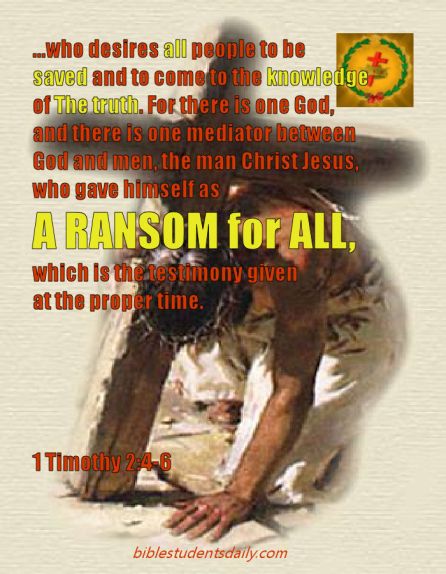
1 Timothy 2, 4-6 - with C & address

“Wherefore the law was our schoolmaster to bring us unto Christ, that we might be justified by faith” (Galatians 3:24).

On a hill far away stood an old rugged cross,
The emblem of suffering and shame.
And on that old cross the dearest and best,
For a world of lost sinners was slain.

It is a tragic picture to contemplate. A perfect man, so unjustly convicted, dying in the prime of life. But his greatest defeat was his greatest triumph. That was why he came. That was why he left the heavenly courts to become a man in the first place.

Note how obediently and willingly and humbly Jesus, the firstborn of all creation, the Bright Morning Star answered, when our Heavenly Father asked who should He send down to earth as the Redeemer, “Here am I, send me” (Isaiah 6:8). This is why the Son was the Almighty Heavenly Father’s delight.

Father Adam caused the death penalty to be imposed upon the whole human family, Christ’s willing sacrifice provided the value to redeem all mankind. Only a perfect being who was separate from God could accomplish the task of removing the death penalty upon Adam and his race, thus providing a way for mankind to be redeemed from the power of the grave.

Christ’s sacrifice provided a release from the curse, first for the Church class during the Gospel Age, and later for the World during the Millennial Age.

God loves mankind deeply (John 3:16). We cannot imagine the sorrow and pain that God experienced when Adam fell. We can only get some idea of this feeling when we observe the grief of parents when their children go astray.

God not only provided a mechanism to rescue His precious creation, but authorized His son to execute God’s plan for their redemption.

“By his knowledge the righteous one, my servant, will justify the many, as he will bear their iniquities” (Isaiah 53:11, NAS).

Not only did God provide the mechanism for mankind’s redemption, God also empowered this Righteous One, Jesus, to justify His chosen ones. “Wherefore Jesus, … that he might sanctify the people with his own blood, suffered without the gate” (Hebrews 13:12). Jesus was “delivered for our offences, and was raised again for our justification” (Romans 4:25). God has empowered His son to redeem us and justify us.

The death of our Savior, Jesus Christ, provided the price of our release from the curse. The scriptures speak of the life of Jesus, given for us, as a “ransom” for us. Today we think of a ransom as a price for the release of a hostage. The scriptural word “ransom” is from the Greek word “lutron,” which literally means a price of release (Matthew 20:28, Mark 10:45).

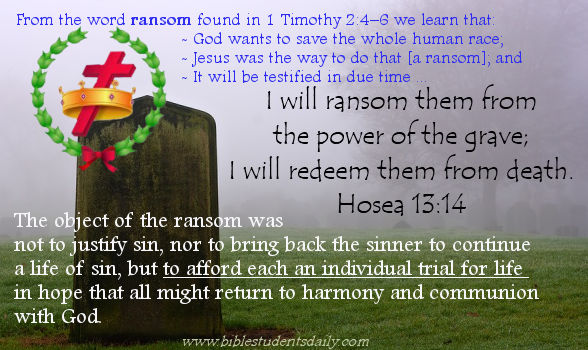
The word “ransom” also appears in 1 Timothy 2:4–6, from the Greek word “antilutron,” which means a corresponding price of release. This refers to the fact that the value of the life of Jesus, given for us corresponds to the price required. From the use of the word “ransom” we see that:

  • God wants to save the whole human race, and
  • Jesus provided the price necessary to release us from the death penalty imposed upon Adam and his race.

The PURPOSE of the Ransom

The object of the ransom was not to afford each individual a release from the original condemnation, in order to give them an opportunity to attain everlasting life. It allows mankind an opportunity to return to harmony and communion with God.

“I will ransom them from the power of the grave; I will redeem them from death: O death, I will be thy plagues; O grave, I will be thy destruction: repentance shall be hid from mine eyes” (Hosea 13:14).

HOSEA-13-14.jpg 
RANSOM STEPS

(1) Determine the Price — The price of release (the lutron or ransom) was the value of a human life. God established that the punishment for sin was death, and this was imposed upon Adam when he sinned. Adam passed his condemned life to all of the human race. In order to release mankind from this penalty, would require an obedient man to accept that punishment upon himself, so that it could be released from Adam and all those who received Adam’s life through procreation. Thus every person who descended from Adam — all humanity — will receive a release from death.

(2) Provide the Price — Jesus, as a perfect human being not subject to death, yielded his life in order to take upon himself, the penalty due us — so that we might be released. “By man came death, by man came also the resurrection of the dead. For as in Adam all die, even so in Christ shall all be made alive” (1 Corinthians 15:21, 22). Jesus’ life yielded, is the price for Adam’s life to be restored: Jesus for Adam, a perfect life for a perfect life. How beautifully they balance the scales of justice!

(3) Pay the Price — When Jesus died, he said “Father into thy hands I commend [deposit] my spirit” (Luke 23:46). The word “commend” is from the Greek word paratithemi, which means to deposit as a trust. In other words, Jesus committed to God the value of his life for later use, and all of Jesus’ interests for his future work in the Plan of God.

(4) Loosen the Captives The world has been under the penalty of death, but they will be loosed (“luo”) from this captivity in God’s due time, when Christ and his “bride” of 144,000 members rules with him to raise and bless mankind.

RELEASE FROM THE LAW

After Jesus was baptized, he meditated in the wilderness for 40 days. Part of this time he would have meditated on the Law of God, given to Israel through Moses at Mount Sinai. That law was perfect. Therefore, imperfect man could not keep it. As the Apostle Paul says in Romans 7:10, “The commandment, which was ordained to life, I found to be unto death.” For none of Adam’s imperfect race could perfectly keep the Law.

But Jesus did. By keeping a perfect law perfectly he demonstrated that he was a perfect man, and therefore that he could be a corresponding price for the only other perfect man in history, Adam. Like an index finger, the law pointed out the one person who could pay the ransom price.

Adam and Eve had no children until they left the garden of Eden. Therefore, all of their offspring inherited a condemned and imperfect life. Jesus, like Adam before he sinned, had the potential for a perfect human race in his loins. In this sense he was an appropriate value to redeem Adam and his race.

No wonder then we sing with rejoicing:

In the cross of Christ I glory,
Towering oer the wrecks of time.
So l’ll cherish the old rugged cross,
Till my trophies at last I lay down;
I will cling to that old rugged cross,
And exchange it some day for a crown.

As 1 Timothy 2:4-6 reads, God has willed or determined (rather than “desired”) that all mankind will:

  • Be saved from Adamic death, from the destruction of the grave, to be accomplished through the GREATEST MIRACLE the world will EVER experience: THE RESURRECTION!
  • Be saved from ignorance, blindness and deafness.
  • Come under a “new covenant” established by God, during the 1000 year Messianic Kingdom.
  • Be restored to perfection and an opportunity for eternal life.
  • Come to a knowledge of God, and thus secure a relationship with God forever.

The Ransom provides a salvation from the curse of death. It will be UNCONDITIONAL. It depends alone upon the will of God, and the price of release is the value of Jesus’ life, given for us all.

This Scriptural passage, 1 Timothy 2:4-6, speaks of a universal redemption. During the Millennium the curse will be remitted. Then each individual may begin walking up the “highway of holiness” toward everlasting life. Most of mankind will accept this free gift, and progress accordingly. Only a few will use their power of choice differently, and fail to attain everlasting life at the close of the Millennium (Revelation 20:7-9).

God will provide for the enlightenment of every individual when they awaken from the dead, so that everyone will have an accurate knowledge of God, His love, and His standards. The knowledge of Jehovah shall fill the earth (Isaiah 11:9). Mankind will have learned through experience the consequences of sin. During the Millennium, they will learn through experience the blessings of righteousness. All can then choose between the law of God which leads to life, and the law of sin which leads to death. Knowledge of truth is light, and Christ is “the true light, to lighten every man that cometh into the world” (John 1:9).

Jesus is an Advocate and helper presently to those who have consecrated their lives to follow in Jesus’ footsteps. They express this commitment by baptism, and rejoice in hope of resurrection glory with Christ in heaven. We suffer with Jesus in the present, by pursuing righteousness in world surrounded by sin. We will reign with Christ in glory, to assist him during the Millennium in drawing mankind back to God (Revelation 20:6).

During the Millennium, when God effects a new covenant for blessing Israel and the world (Jeremiah 31:31), Jesus will serve as Mediator, standing between God and men, in order to reconcile them by bringing mankind back to godliness. The saints who reign with Christ will be with Jesus in this mediatorial work of reclaiming mankind. Thus this work awaits the completion of the “Bride” class to be complete. Mediating for the world will then proceed. The saints will be associated with every feature of this work for the world, assisting them during the Millennium.

The word Mediator from the  Greek is mesite and means middle-man, reconciler, go-between. The Scriptures use the word respecting mediating a covenant between parties who are alienated. A mediator is one who interposes between persons who are at variance, with a view to reconciling them. Moses, as the Mediator of the Law Covenant, was a type of Jesus, the Mediator of the New Covenant.

At the close of the thousand years the Mediator will have completed its role. Thereafter God will stand before God, and demonstrate, during the “Little Season,” their condition of heart. Those who are obedient and godly, will receive everlasting life. Those who are disobedient and rebellious, will lose this privilege.

In 1 Timothy 2:5 we read about “The man Christ Jesus.” The Greek word for “man” is anthropos — human being. It refers to when Jesus when he was made flesh. Jesus “gave himself” as “the anointed” one (the word Christ signifies “the anointed”), who finished the giving of himself at Calvary. The name Jesus is but another form for Joshua, which signifies Deliverer. The name Christ is the Greek equivalent for the Hebrew word Messiah — The Anointed.

Jesus surrendered his perfect human life, that is, all of himself, his human rights and privileges — the full equivalent of Adam’s perfect life. By his willing sacrifice for men he secured the right to purchase Adam and the entire race. He has not applied this human life to Adam and his race. It remains a deposit, for use at the appropriate time to release mankind from the curse.

Christ was both Priest and Sacrifice. As a priest, he offered his sacrifice to God. As a Sacrifice, his human life was yielded up, given, for the benefit of mankind.

THOSE WHO ARE IN CHRIST PRESENTLY

As mentioned earlier, the ransom Jesus gave constitutes a price of release. Those who have come into Christ in the present time, accepting the value of his sacrifice by faith in him, are granted redemption presently. That is, God counts them as uncondemned, justified, by virtue of the value of Christ’s redeeming sacrifice (Romans 5:9). We then lay down this justified life in service and sacrifice with Jesus, as long as our days remain.

We thus give up our share in the earthly blessings awaiting mankind, in order to secure the higher, heavenly blessings offered during the present time.

The resurrection of Jesus was a testimony from God that Jesus performed his sacrifice correctly, and that all the blessings God has for us now — and the world later — are sure and established (Acts 17:31).

Another evidence of God’s acceptance of Jesus’ sacrifice was seen by sending the holy Spirit upon the saints on the day of Pentecost. There God’s anointing, the holy Spirit (symbolized in the Old Testament by the holy anointing oil), came upon the Church. It continues ever since on all the living members of the Church.

Jesus laid down his life as a sin-offering during the 3½ years, and Jesus applied the value of this for the Church class when he appeared in the presence of God for us. Jesus has not yet applied it for the whole world. That awaits the Millennium.

The ransom price that Jesus gave provides a release from condemnation, for us now, and for the world later. That was given on Calvary’s cross.

The sin offering that Jesus gave began at Jordan (when Jesus was 30 years of age), and continued through the 3½ years of Jesus’ ministry (until Jesus was 33 1/2 years old). Jesus was “made perfect,” or complete, in character, “by the things which he suffered” (Hebrews 5:8,9). Jesus was not imperfect at any time in the sense of being sinful (2 Corinthians 5:21, 1 John 3:5, 1 Peter 2:22). He was perfect, undefiled, in His glorious condition as the Logos, before He left the glory which He had with the Father and was made flesh. When born of Mary, the assurance given us is that He was still “holy, harmless, undefiled and separate from sinners” (Hebrews 7:26).  His sufferings, therefore, did not make Him perfect in the sense of making Him sinless, but rather, to prove his loyalty to the Father’s will, unto death, even the death of the cross. The promise of perfection on the highest plane — the promise of the Divine nature — was Christ’s reward for fulfilling his Covenant of Sacrifice faithfully and loyally. The beginning of that new nature was granted to Jesus at the time of his baptism, when he was begotten of the holy Spirit. But the new nature begotten there needed development, or perfecting; and it was for this purpose that the trials, difficulties and buffetings were permitted to come to Him (R5472). As our High Priest in glory, Christ — our Advocate (our personal “lawyer”), works with us through our experiences, to purge from us the propensity for sin.

The Church is not a part of the ransom price. However, we do have the privilege of suffering with Christ presently, and being raised in glory to be priests for the world during the Kingdom (Revelation 20:6). From that elevated standing, we will be able to assist Jesus in purging from mankind their propensity for sin. In this way we share with Christ in being an offering for sin.

The Church is not a part of the ransom price but does share in the sin-offering through grace. These two doctrines are inseparable. We could call them the TWIN DOCTRINES as they always work together in the process of salvation.

The ransom expresses God’s justice. For it shows that a payment for sin is necessary, in order to release mankind from the curse justly imposed upon our father Adam in Eden. But as steadfast as the penalty has been — so God’s commitment to release mankind from the curse, now that a payment has been made, is equally sure.

Christ has already redeemed mankind in the sense that he has laid down the ransom price. But he has not yet rescued mankind and applied to them the value of the ransom price provided. That awaits the Millennial Kingdom. In the meantime, God is selecting from among mankind people of faith, to be developed in the pattern established by Jesus, in order to assist Jesus in the world of lifting the world from their plight during the Millennium.

Then God will apply the price of release for Israel and the world. Then a New Covenant will be established for blessing of all who come under its blessings. When the Millennial age shall have been finished its work, and all are restored to harmony with God, then our heavenly Father will be ALL in ALL (1 Corinthians 15:28).

Suggested Further Reading

The Ransom. Faithbuilders Fellowship.

Click to access 02_ma_07.pdf

MATTHEW 26:27-29 — Drinking From Christ’s One Cuphttps://biblestudentsdaily.com/2018/03/19/matthew-2627-29-drinking-from-christs-one-cup/

JESUS — The Namehttps://biblestudentsdaily.com/2017/07/05/jesus-the-name/


The URL of this post:

Who is the World’s RANSOM and Why?

Enter your email address to subscribe to this blog and receive notifications of new posts by email.