“Be Thou Faithful Unto Death”

REVELATION-2-10.jpg

FAITHFUL when with tears thine eyes are dim,
Faithful when Joy’s cup o’erflows its brim;
Faithful when God seems to veil His face,
Faithful when He crowns thy work with grace.
Faithful, though thy loved ones turn aside,
Lips that praised thee once, in harshness chide;
Faithful, though success enwreathe thy brow,
Faithful, should the world before thee bow.
Faithful till hath fled life’s fleeting breath,
Eager hands lie folded still in death.

“Faithful unto death!” Lord, day by day,
Help me thus to keep the narrow way!
Strengthen me to bear the scorn and shame –
Portion of all those who take Thy name.
“Faithful unto death!” When all is done,
Cross is changed to Crown, the victory won,
Let me hear Thee say, O blessed Lord,
“Child, come enter into thy reward!
Faithful thou hast been, come share with Me
Glory, Honor, Immortality!”

Gertrude W. Seibert

REVELATION-14-12.jpg

Here is an excerpt from “Harvest Gleaning II” by Br. Charles T. Russell, page 121-124—

FAITHFUL UNTO DEATH
“Be thou faithful unto death, and I will give thee a crown of life.”

It will not be very long, dear fellow soldiers of the cross, until the battle will be over, the victory won; for the “King’s own” are called to victory and not to defeat. Our enlistment is in accord with the great plan of the ages which our Father previously mapped out, and we know that all His purposes shall be accomplished, that His Word which went forth for the calling of this little flock to joint-heirship with Jesus in the kingdom which is promised to be established and to bless all the families of the earth —that word cannot be broken, its fulfillment is sure. Yea, its fulfillment is nigh, even at the door.

Though we are in the world, but not of the world, we, nevertheless, are more or less affected by every matter which affects our neighbors; and hence in the great battle that is now impending between truth and error, between princes and people, between money and labor, and with more or less of right and wrong on both sides of all questions, the “King’s own,” the soldiers of the cross, will have some very trying experiences. It is the present time that the apostle emphasizes as “that evil day” — the period of special trial in the end of this age, saying, “Take unto you the whole armor of God, that ye may be able to stand in that evil day, and, having done all, to stand.” Analyzing these words, we see them to signify that in the end of this age there would be special trials of severe testing; but the apostle’s language also implies that the Lord will make special provision for the protection of His faithful ones, and that this will be an armor of truth, of knowledge, of information granted to them from the great armory, His Word, the Bible. The exhortation that we should take it implies that the Lord will not force it upon any, but to those who are in the right attitude of heart the doors of the armory will be open, and the proper armor supplied in due season, and that they must demonstrate their loyalty and obedience to the Captain by seeking this armor and putting it on. Those who do not thus yield obedience to the Captain’s word will not have the protection necessary for this time, and, as intimated in the text by the apostle, they will not be able to stand in this evil day.

Soldiers of the cross in previous times had not so much of the armor supplied, neither did they need the special armor that is needed now. They did not live in “this evil day.” The head knowledge that our grandfathers had respecting the divine plan will surely prove insufficient in this day of so-called higher criticism of the scriptures, evolution theories, theosophy and Christian Science. Whoever has not the proper armor necessary for the present time will be pretty sure to fall in this evil day, this day of special trial and testing; but he who puts on the armor of God, he who possesses the fruits of the Spirit, the Apostle Paul assures us shall never fall, but so doing an entrance shall be abundantly administered unto him into the everlasting kingdom of our Lord and Saviour, Jesus Christ.

Many of the tests of this evil day are already upon us, and, as the prophets have foretold, “A thousand shall fall at thy side, and ten thousand at thy right hand.” (Psa. 91:7) These are falling away from the faith because in many instances they were not spiritual Israelites indeed, but as the Lord declares through the prophet, “Wherefore, because this people draw nigh to me with their lips while their hearts are far from me.” The Lord wants as members of the “King’s own” those who are at heart loyal to Him, loyal to all who have His Spirit and loyal to righteousness and truth. If we are ashamed of Him, ashamed of His brethren, or ashamed of His Word, we are not of the kind that He is seeking now. Those who are to be with Him, to share His throne and glory and to join with Him in the great work of emancipating the world from the power of sin and death during the millennium, must all be loyal at heart, to the core, and the various trials and testings now permitted will demonstrate the degree of loyalty. Let us, dear brethren, be loyal; and even if the time should come when we shall be misunderstood by our neighbors and friends, the children of this world, let us put our confidence in the Lord; let us fight the good fight of faith against sin and error and selfishness within and without, and thus doing lay hold upon eternal life.

* * * *

There is never a path so hidden,
But God will show us the way,
If we seek for the Spirit’s guidance,
And patiently wait and pray.


Suggested Further Reading

The Letter To Smyrna by Br. David Skein. The Beauties of the Truth. February 2007. Volume 18. No. 1. http://www.beautiesofthetruth.org/Archive/Library/Doctrine/Mags/Bot/90s/BOTFEB07.PDF

A Special Calling by Br. David Rice. The Herald of Christ’s Kingdom. July /August 2016. https://herald-magazine.com/2016/07/01/the-bride-class/

Old Testament Portrayals of the Church by Br. Homer Montague. The Herald of Christ’s Kingdom. July/August 2004. http://www.heraldmag.org/2004/04ja_2.htm

The Song of Solomon by Br. Frank Shallieu. The Herald of Christ’s Kingdom. July/August 2004. http://www.heraldmag.org/2004/04ja_3.htm

The Bride and the Bridegroom by Br. Carl Hagensick. A Verse-by-verse Study of Psalm 45. The Herald of Christ’s Kingdom. July/August 2004. http://www.heraldmag.org/2004/04ja_4.htm

New Testament Portrayals of the Church by Br. Michael Nekora. A Precious Treasure. The Herald of Christ’s Kingdom. July/August 2004. http://www.heraldmag.org/2004/04ja_5.htm

A Chaste VirginThe Herald of Christ’s Kingdom. URL: http://www.heraldmag.org/literature/chliv_38.htm


The URL for this post is: https://biblestudentsdaily.com/2017/08/10/be-thou-faithful-unto-death/

Enter your email address to subscribe to this blog and receive notifications of new posts by email.

“Are You Able?”

 PSALM-17-5.jpg

ARE ye able to walk in the narrow, strait way,
With no friend by your side, and no arm for your stay?
Can ye bravely go on through the darkening night?
Can ye patiently wait till the Lord sends the Light? 

Are ye able to crush your soul’s longing for Love,
Will ye seek for no friendship save that from above?
Can ye pass through this world, lone, unnoticed, unknown,
While your faith faintly whispers, “He knoweth His own?” 

Where the feet of the Blessed One stood, can ye stand?
Can ye follow His steps to a wilderness land?
Are ye able to cast aside pleasure and fame?
Can ye live but to glorify His precious name?

Can ye smile as His dear voice says tenderly “No,
When “the field is so white,” and your heart yearns to go?
Can ye rest then in silence, contented and still,
Till your Lord, the Chief Reaper, revealeth His will?

Are ye able to lay on the altar’s pure flame
That most treasured possession, your priceless good name?
Can ye ask of your Father a blessing for those,
Who see naught in your life but to scorn and oppose?

When the conflict twixt Error and Truth fiercer grows,
Can ye wield the strong “Sword” against unnumbered foes?
Can ye lift up the “Standard” e’en higher and higher,
While His praises ye sing in the midst of the fire?

When ye see the Lord’s cause going down to defeat,
Will your courage endure in the seven-fold heat?
Will your faith keep you steadfast, though heart and flesh fail,
As the New Creature passes beneath the last “Veil?”

Ah, if thus ye can drink of the Cup He shall pour,
And if never the Banner of Truth ye would lower,
His Beloved ye are, and His crown ye shall wear,
In His Throne ye shall sit, and His Glory shall share!  – Gertrude W. Seibert

Consecration

Here is an extract from an article titled “Present Truth” by Bro. Carl Hagensick in the Nov. /Dec. 1998 issue of “The Herald of Christ’s Kingdom” Magazine.

The acceptance of Christ as a personal Savior and a dedication to the principles of
righteousness are seen by nearly all Christians as an essential to salvation. For many,
however, this means no more than a simple belief: “Believe on the Lord Jesus Christ and thou shalt be saved” (Acts 16:3; 8:3,7). Many Christians connect this with the concept that once one has been saved there is no chance of losing that salvation: “once in grace, always in grace.”

Quite to the contrary, the Bible’s view of belief is not mere passive acceptance. It
includes an active commitment to the service of God, a complete consecration of one’s
life to doing God’s will (Psalm 40:8). Consecration is seen as a voluntary surrender of one’s benefits under the ransom, the prospects of an earthly resurrection; thus one is in “jeopardy” of losing life forever if unfaithful to one’s consecration vows (1 Corinthians 15:30).

Even Paul did not “consider to have made it his own” (Philippians 3:13 RSV), but feared that he himself might become a “castaway” (1 Corinthians 9:27). It is little wonder that the Christian is admonished to be faithful “unto death” (Revelation 2:10).

The Christian commitment is not only to faithfulness but to learning from each of life’s
experiences those lessons which will be helpful to him in his future work of blessing the
human race. They are assured that they will have no temptation “but such as are common to man” (1 Corinthians 10:13). Commonality of temptation with their fellow men’ will qualify them to work side by side with their Master in his kingdom, for he has become a sympathetic high priest by the experiences he shared with his fellow man (Hebrews 2:17, 18; 4:15, 16).

Suggested Further Reading

Be Strong And of A Good Courage.  The Herald of Christ’s Kingdom. Reprinted from February 1961 HERALD, article by Br. John Ensoll, England.
http://www.heraldmag.org/literature/chliv_17.htm

Teachableness by Br. Richard Suraci. The Herald of Christ’s Kingdom. May-June 2002.
http://www.heraldmag.org/2002/02mj_4.htm

The King and His Kingdom. The Herald of Christ’s Kingdom. Jan-Feb. 2005.
http://www.heraldmag.org/2005/05jf_2.htm

A Christian’s Privilege of Fellowship. “Fellowship with Jesus by being His yoke fellow.” The Herald of Christ’s Kingdom. August 1931. 
http://www.heraldmag.org/archives/1931_8.htm#_Toc23239886


The URL for this post:
https://biblestudentsdaily.com/2017/07/04/are-you-able/

Enter your email address to subscribe to this blog and receive notifications of new posts by email.


GOD’S NAME – What Is The Heavenly Father’s Name That We Are To “Hallow” And Why?

MATTHEW-6-9-Rotherham.jpg

In Psalm 148:13 (KJV) the Psalmist David wrote, “Let them praise the name of the LORD: for his name alone is excellent; his glory is above the earth and heaven.”

But what is God’s actual name?

In this study we discuss the various names mentioned for God in the Old Testament Hebrew. Each of our Heavenly Father’s names describe different shades of His magnificent character, being, and personality, allowing us to know our Father better and learn what God wishes us to develop in our character, in order to bring joy, honor, glory, and praise to the Creator of all.

Almighty God—”El Shaddai”

The basic form for the Hebrew name of God is “El.” The word “El” means “might, strength, power.” The Schofield Reference Bible states that God (El) signifies the “Strong One.”

The word “Shaddai” is formed from the Hebrew words shadthe breast—and shadahto shed, to pour out. Thus, El Shaddai is “the God who pours out blessings, who gives them richly, abundantly, continually” (Adam Clark’s Commentary, Genesis 17:1). God is “Shaddai” because He is the nourisher, the strength‑giver, and thus the satisfier, who pours Himself into believing lives.

The primary translations of this root in the scriptures are “god” (for pagan or false gods), and “God” (for the true God of Israel). However, in Strong’s Concordance “El Shaddai” is not found under the English words “God” or “Lord,” but rather “Almighty” (Strong’s 7706). “All‑sufficient” would express the Almighty God (El Shaddai) for He not only enriches, but also makes fruitful. This is nowhere better illustrated than in the first occurrence of the name “El Shaddai” in the Bible, in Genesis 17:1.

“(1) And it came to pass that, when Abram was ninety and nine years old [being “as good as dead,” Hebrews 11:12] Yahweh appeared unto Abram, and said unto him, I, am GOD Almighty,—Walk, thou before me and become thou blameless: (2) That I may set my covenant betwixt me and thee, And may multiply thee, exceedingly. (3) And Abram fell on his face,—and God spake with him, saying: (4) As for me, lo! my covenant is with thee,—So shalt thou become—father of a multitude of nations; (5) And thy name shall no more be called Abram,—but thy name shall become Abraham, for father of a multitude of nations, have I appointed thee” (Genesis 17:1‑5, Rotherham).

All‑Powerful and All‑Sufficient

We can now best understand God’s character when combining these two named attributes of God’s being: All‑Powerful (“El“) and All‑Sufficient (“El Shaddai“).

Genesis 17:1 is a beautifully clear and direct statement from God of His unlimited, supreme, divine power and this quality of God can be best described in one word as God’s OMNIPOTENCE. Even simply because of God’s omnipotence, we should focus on being “blameless” through Christ. That is, through a firm belief (based on testing/studying the Scriptures, Romans 10:17, 1 Thessalonians 5:21), and thus from a steadfast faith (1 Corinthians 15:58, Hebrews 6:19) in Christ as a ransom for our sins (and for the whole world, 1 Corinthians 15:21), we are redeemed and reckoned as righteous children of God (Romans 8).

Our Heavenly Father is able to meet every need (Philippians 4:19) and protect us from any danger to our spiritual lives (Jude 1:24).

Our faith and trust in El Shaddai can turn any temporal difficulty into a spiritual blessing for our eternal interests (Romans 8:28). Our responsibility is to manifest complete faith and trust in God (Isaiah 40:28‑31, 41:10, Jeremiah 17:5, Exodus 15:2, 1 Chronicles 16:11, Luke 12:8‑10, John 12:37‑43, 2 Kings 5:13‑15, Genesis 15:6‑10). Then we can have perfect peace of mind in His all‑sufficient grace (Isaiah 26:3, 2 Corinthians 12:9).

“We must supply our best effort, which will always be too weak and insufficient to overcome all of our imperfections, but El Shaddai will supply whatever is needed to make up for our shortcomings. God’s name, El Shaddai, describes not only what God is, but also what He does for us. El Shaddai sustains us, nourishes us, comforts us, and provides everything we need. This should make us more grateful, more peaceful; and make us feel our complete dependence upon Him. Knowing God as El Shaddai helps us more readily to praise Jehovah, our Heavenly Father, in all the experiences of life” (Br. Allan Ross, “El Shaddai,” Beauties of the Truth, November 2014).

The Patriarchs were close to El Shaddai, our Heavenly Father. They depended on Him for everything in normal life. They were a pastoral people and depended on their crops and herds for food. If there was a drought, or a disease in their herds, they could starve. They did not have unemployment benefits or retirement plans through difficult times. They had El Shaddai and that was all they needed.

The Name “Jehovah”

Jehovahthe “Self Existing One,” “The Eternal One”—is God’s primary name. It is a translation of what is known as the Tetragrammaton. The Greek word “Tetragrammaton” means “four (tetra) letters (gramma)” because “Jehovah” comes from four Hebrew letters יהוה‎ (yod, he, waw, he)—transliterated into English as “JHWH” sometimes written as “YHWH.” Some Bible translations do render the Tetragrammaton as Jehovah, just as it occurs in the Hebrew Old Testament, such as The American Standard Version 1901 edition (in 6,823 places) and The Emphatic Diaglott (in 18 places.)

“Jehovah” is the name that God gave to himself in Exodus 3:13‑15.

“(13) Moses said unto God, Behold, when I come unto the children of Israel, and shall say unto them, The God of your fathers hath sent me unto you; and they shall say to me, what is his name? What shall I say unto them? (14) And God [elohiym, Strongs 430] said unto Moses, I AM [hayah, Strongs 1961] THAT I AM [hayah]: and he said, Thus shalt thou say unto the children of Israel, I AM [Jehovah] hath sent me unto you. (15) And God said moreover unto Moses, Thus shalt thou say unto the children of Israel, Jehovah God of your fathers, the God of Abraham, the God of Isaac, and the God of Jacob, hath sent me unto you: this is my name for ever, and this is my memorial unto all generations.”

The RVIC Bible (by Br. Jim Parkinson) has footnotes for Genesis 3:14‑15 which read:

“(14) Or, I AM BECAUSE I AM. or, I AM WHO AM. or, I WILL BE WHAT I WILL TO BE. or, I CONTINUE TO BE THE ONE CONTINUING EVERMORE. (15) Hb. Ehyeh — future tense (all three times). From the same root as Jehovah or Yahweh.”

Similarly Br. Ronald Day explains in his website study titled “The Divine Name” the following: “Yahweh [Jehovah] is the third person singular of the Hebrew verb hayah (to be or become). In Exodus 3:14 Jehovah gives Moses a different variation of his name in the first person: ‘I will be what I will be (Ehyeh’ asher’ ehyeh’).’ (Revised Standard Version – footnote) Many translations render this ‘I AM THAT I AM.’ However, according some authorities, the Hebrew word hayah, as used in this verse, means more than just to exist. It also carries with it the thought of coming into existence, or causing to exist. Thus the third person would mean: ‘He will cause to be,’ or ‘He causes to be.’

In relation to Exodus 3:14, the Catholic Encyclopedia, 1967, vol. 14, page 1065, states that in this particular verse “a merely folk etymology of the name, based on the qal form of the verb ‘to be,’ is given.” “Grammatically, because of its vocalization, yahweh can only be a … causative form of this verb, with the meaning ‘He causes to be, He brings into being.’ Probably, therefore, Yahweh is an abbreviated form of the longer, yahweh aser yihweh, ‘He brings into being whatever exists.’ The name, therefore, describes the God of Israel as the Creator of the universe.” (Ronald Day, “The Divine Name”.) That this meaning is correct can be seen by observing the indicated meaning of Jehovah in Exodus 6:2,3 – which is discussed further in this study.

Today you will not find the divine name “Jehovah” (English) (nor “Yahweh”) in the New American Standard Bible, not even in the four places that were in the original AKJV (i.e. Exodus 6:3, Psalms 83:18, Isaiah 12:2, Isaiah 26:4).

The name was removed quite simply because there was many thousands of years ago a Usurper to the throne of God, the great liar, the Adversary. His first act of rebellion was to accuse Jehovah of lying to Adam and Eve about the tree of knowledge telling Eve that if she ate of the fruit she would become like God knowing all things and that she would not die. Ever since, Satan has opposed the Most High and His Son as well as all faithful followers of God’s Word. Thus, by having the divine name removed and substituted with “Lord” it made it so much easier to introduce the false doctrine of the Trinity whereas both the Heavenly Father and His firstborn son, Jesus Christ, the Logos, are called “Lord,” and the word is interchangeable to mean that both are coeternal and equal which is not true. The Heavenly Father had no beginning and no end, while Jesus had a beginning, and was God’s firstborn son (Br. Richard Tazzyman, 2017 Discourse: “I Am”).

“For He rescued us from the domain of darkness, and transferred us to the kingdom of His beloved Son, (14) in whom we have redemption, the forgiveness of sins. (15) He is the image of the invisible God, the firstborn of all creation” (Colossians 1:13‑15).

This change of removing the name “Jehovah” stems from the 1880s when the council of the church of England recommended to the British Crown that a revision of the AKJV be produced, and at the same time a group of translators from the United States of America were invited to collaborate with the translators of the RV of the AKJV Bible to produce a version of the Bible in American English. Thus, the American Standard Version of 1901 was created. Br. Richard Tazzyman comments in his discourse “I AM” about how the original committee felt towards the importance of the divine name, in the Foreword of the 1901 ASV Bible.

“The change first proposed in the Appendix, that which substitutes JEHOVAH for LORD or GOD, is one which will be unwelcome to many, because of the frequency and familiarity of the terms displaced, but the American Revisers after a careful consideration were brought to the unanimous conviction that a Jewish substitution which regarded the divine name as too sacred to be uttered, ought no longer to dominate in the English or any other version of the old Testament.”

Here are two other texts with God’s name as “Jehovah.”

“I am Jehovah; this is my name, and my glory will I not give to another” (Isaiah 42:8).

“That men may know that thou whose name alone is Jehovah, art El Elyon, the Most High over all the earth” (Psalms 83:18).

[Note: the difference between the name “Jehovah” and “Yahweh” is that “Jehovah” is the English word that represents the name of God, just as Jesus is the English word that represents the name of our Savior. When one uses a name in one language, it is often not the same pronunciation or form as the name in the original language. For example, with the name “Joshua” — as there was no “J” in English for some centuries, it is evident that this name that we all know as a familiar English language name today sounded different before, and as to its actual pronunciation in Hebrew, who would recognize it if we tried to simulate Hebrew in the English language. Jesus is surely not the sound his contemporaries used when they called his name. But it is our English name for him. In the same way, we know the name of God as Jehovah. Yahweh is a closer sound alike to the Hebrew, perhaps — at least some seem to think so — but even that presumably is different than a real Hebrew speaker of antiquity would have pronounced the name. There is no necessity to modify the word that English speakers know the name as. It is Jehovah. When we use that name, we are communicating. If we all began to use some other pronunciation, most people may get the point, but there would be some confusion. However, whether one prefers “Yahweh,” or the more familiar “Jehovah,” may the name of God be “hallowed.”]

By What Name Was God Known to the Patriarchs?

The name “Jehovah” appears in Exodus 3:15.

“And God said moreover unto Moses, Thus shalt thou say to the children of Israel, The Lord [Jehovah] God of your fathers, the God of Abraham, the God of Isaac, and the God of Jacob, hath sent me to you: this is my name for ever, and this is my memorial unto all generations.”

Only three chapters onward, we read of “El Shaddai” and “Jehovah” both being mentioned in Exodus 6:2,3.

“God spake unto Moses, and said unto him, I am Jehovah; And I appeared unto Abraham, unto Isaac, and unto Jacob, by the name of El Shaddai [The All Mighty, All Sufficient God], but by my name JEHOVAH [“The Self Existing, Eternal One”] was I not known to them.”

This verse could not mean that up until the time of Exodus 6 no one knew God by the name of “Jehovah.” For even Adam knew God by the name of Jehovah as confirmed in Genesis 4:25,26.

“Adam knew his wife again; and she bare a son, and called his name Seth: For God, said she, hath appointed me another seed instead of Abel, whom Cain slew. And to Seth, to him also there was born a son; and he called his name Enos: then began men to call upon the name of Jehovah.” Adam lived 700 years after Seth begat Enos. Thus he would have been one of those that knew Jehovah by name.

In Genesis 15:2, God revealed himself to Abraham by this very name: “And he said unto him, I am JEHOVAH, that brought thee out of Ur of the Chaldees.”

From the very beginning the Patriarchs knew the name JEHOVAH El‑Shaddai, God All‑sufficient, since they recognized God’s continual provision made for them and the constant protection that God afforded them. However, the name “Jehovah” refers particularly to the accomplishment of promises already made; to giving them a being, and thus bringing them into existence, which could not have been done in the order of His providence sooner than until the deliverance from Egypt and the settlement in the promised land. Then the usage of “El Shaddai” became infrequent after the Law Covenant was established.

Hence in the earlier scripture mentioned — Exodus 6:2,3 — Jehovah had to be referring to the meaning of his name (as the one who causes) rather just to the word used to designate his name. In verse four Jehovah calls attention to the covenant he had made with Abraham, Isaac, and Jacob, to give them the land of Canaan. They never saw Jehovah cause the fulfillment of that promise. It is in this respect that Jehovah says that He did not make his name known to them. However, now, Jehovah is saying that he is going to cause a fulfillment of that promise. He will bring the Israelites out of Egypt into the land that he had promised to Abraham, Isaac, and Jacob (Exodus 6:6-8).

Thus the name Jehovah signifies the one who accomplishes what he desires and we can fully trust that His magnificent plan for man will be completely accomplished (Isaiah 55:11, 45:21).

El-Shaddai—An All-Sufficient, Covenant-Keeping God

When the patriarchs wanted to give the strongest assurance to those that were going on a dangerous mission, they used the divine name El Shaddai.

Genesis 28:1‑4—Isaac called Jacob, and blessed him, and charged him, and said unto him, Thou shalt not take a wife of the daughters of Canaan. Arise, go to Padan‑aram, to the house of Bethuel thy mother’s father; and take thee a wife from thence of the daughters of Laban thy mother’s brother. And El Shaddai bless thee, and make thee fruitful, and multiply thee, that thou mayest be a multitude of people; And give thee the blessing of Abraham, to thee, and to thy seed with thee; that thou mayest inherit the land wherein thou art a stranger, which God gave unto Abraham.”

“As Abraham had sent Eliezer to find a covenant wife for Isaac, so Isaac sent Jacob to find a covenant wife—not from the Canaanites, but from Abraham’s extended family. The patriarchs Abraham, Isaac, and Jacob, were all under the Abrahamic Covenant, a Covenant of Grace. As consecrated Christians, we also are under a Grace Covenant. Like Jacob, who here typified the New Creation, we have been sent on a journey and blessed by the antitypical Isaac, our Lord Jesus. So we can repeat this blessing, transferring the thought from the type to the antitype as coming from our Lord Jesus to us: ‘May El Shaddai bless thee’ (verses 3,4).

“That helps to reinforce the thought that our Savior assures us that El Shaddai, the Almighty, All sufficient One, will be with us all the way in our dangerous journey through life. He is always near, always sufficient for any contingency. In the Promised Land, the Patriarchs had complete trust in El Shaddai. If we can completely trust Him now, then we can rest in full assurance of faith in our spiritual inheritance in the Promised Land.”

“Genesis 35:9‑12—Here God confirmed His Covenant to Jacob and changed Jacob’s name to Israel.

‘God appeared unto Jacob again, when he came out of Padan‑aram, and blessed him. And God said unto him, Thy name is Jacob: thy name shall not be called any more Jacob, but Israel shall be thy name: and he called his name Israel. And God said unto him, I am El Shaddai: be fruitful and multiply; a nation and a company of nations shall be of thee, and kings shall come out of thy loins; And the land which I gave Abraham and Isaac, to thee I will give it, and to thy seed after thee will I give the land.’

“After this confirmation, Jacob journeyed to Bethlehem. There his wife, Rachel, died giving birth to Benjamin. Then Jacob travelled to Hebron where his father, Isaac, had died. Thus this revelation to Jacob of El Shaddai as his All Mighty, All Sufficient God was a specially needed blessing. It was a reassurance to Jacob to have the covenant confirmed to him, and to know that El Shaddai would be with him throughout his walk.

“Genesis 37:35—This text speaks of the time Joseph had been sold into Egypt, and Jacob was told that Joseph was dead.

‘All his sons and all his daughters rose up to comfort him; but he refused to be comforted; and he said, For I will go down into the grave unto my son mourning. Thus his father wept for him.’

“Though Rachel, Isaac, and Joseph—the three people that Jacob loved the most—were gone, and no one on earth could comfort him, El Shaddai comforted Jacob. There was nothing that he and El Shaddai could not handle together.

“Genesis 43:14—Later, Judah promised Jacob that he would return to Egypt as surety for Benjamin. But before sending Judah, Jacob asked the blessing of El Shaddai upon him in.

‘And El Shaddai give you mercy before the man, that he may send away your other brother, and Benjamin. If I be bereaved of my children, I am bereaved.’

“Genesis 48:3,4—Years later, when Jacob was on his death bed, Joseph brought his sons, Manasseh and Ephraim, to be blessed.

‘Jacob said unto Joseph, El Shaddai appeared unto me at Luz in the land of Canaan, and blessed me, And said unto me, Behold, I will make thee fruitful, and multiply thee, and I will make of thee a multitude of people; and will give this land to thy seed after thee for an everlasting possession.’

“Genesis 49:25—Jacob gave a final blessing to each of his sons just before he passed away.

‘Even by the God of thy father, who shall help thee; and by El Shaddai, who shall bless thee with blessings of heaven above, blessings of the deep that lieth under, blessings of the breasts, and of the womb.’ ” (Br. Allan Ross, “El Shaddai”).

EL SHADDAI in the Book of Ruth

By considering the usage of El Shaddai in the Book of Ruth and the Book of Job, we understand an additional aspect of what God does for His people, that He permits short‑term pain for long‑term blessings. God’s people do not always understand His Grace when they are in the midst of a painful experience. But we must fully trust our All‑Powerful, All‑Sufficient, God. El Shaddai only allows experiences that bless us, if we take them in the right way.

In the Book of Ruth, Naomi, her husband Elimelech, and their two sons left Bethlehem‑Judah because of a famine and travelled to Moab. Within ten years of entering Moab, Naomi’s husband and two sons died. Naomi was downcast and confused. If God was All‑Mighty, All‑Sufficient, why would he allow her husband and her sons to die so quickly? To answer this, we have to look at the big picture, the long‑term view. El Shaddai takes the long view.

Should Elimelech have taken Naomi and his sons and left Bethlehem to go to Moab in the first place?

No, since El Shaddai is All‑Sufficient, He would have cared for them IN the Promised Land. If Elimelech had a stronger faith, he would have kept his family in Judah and waited for El Shaddai to bless his faithfulness.

Short‑term satisfaction
of fleshly desires
will NOT bring
long‑term happiness.

As in Naomi’s case, God may allow afflictions to come so that we will return to Him. 

God took away what was keeping Naomi from being close to Him!

If Naomi had stayed in Moab we never would have heard of Naomi or Ruth. There would not be a Book of Ruth in the Bible. It was the return to El Shaddai that allowed El Shaddai to abundantly bless both Naomi and her daughter-in-law Ruth (who chose to return with Naomi to the Promised Land).

One of the guiding principles of this lesson is stated in James 4:8: “Draw near to God and he will draw near to you.”

Because Naomi and Ruth returned to the Promised Land, Ruth married Boaz. As King David’s great grandmother, Ruth became identified through the lineage of Mary with David’s greatest Son and Lord, our Lord Jesus.

Because Ruth drew near to God in devotion, she received eternal blessings.

EL SHADDAI in the Book of Job

The first use of the word “El Shaddai” in the Book of Job is in Job 5:17,18, where we read the words of Eliphaz to Job.

“Behold, happy is the man whom Eloah [Strongs 433, the Majestic God] correcteth: therefore despise not thou the chastening of El Shaddai [Strongs 7706, the All Sufficient God]: For he maketh sore, and bindeth up: he woundeth, and his hands make whole.”

The last use of “El Shaddai” in the Book of Job appears in Job 40:1,2.

“Moreover Jehovah [Strongs 3068, the Eternal One, the Existing One] answered Job, and said, Shall he that contendeth with El Shaddai [Strongs 7706, the All‑Mighty, All‑Sufficient One] instruct him? He that reproveth El‑oah [the Majestic God], let him answer it.”

New Testament References

In the New Testament, Jesus begins to refer to God as “Our Father” when he gives us the model prayer of Matthew 6:9: “After this manner therefore pray ye: Our Father which art in heaven, Hallowed be thy name.”

Jesus is the first person in Scripture to begin referring to God as my heavenly Father,” and our and your heavenly Father.” Jesus only used these terms in the presence of his disciples; they were not applied to others who were not yet prospective sons. Jesus was the first son of God, who opened up a “new and living way” gives us the opportunity to also become sons of God (John 1:141 John 3:1,2).

Revelation 15:3—refers to Jehovah as Almighty.

“They sing the song of Moses the servant of God, and the song of the Lamb, saying, Great and marvelous are thy works, Lord God Almighty; just and true are thy ways, thou King of saints.”

We also have scriptures that declare the almighty power of our Heavenly Father.

Psalm 77:10‑15—“I said, This is my infirmity: but I will remember the years of the right hand of the most High [El Elyon, The Supreme God]. I will remember the works of Jehovah [the Eternal One]: surely I will remember thy wonders of old. I will meditate also of all thy work, and talk of thy doings. Thy way, O God, is in the sanctuary: who is so great a God as our God? Thou art the God that doest wonders: thou hast declared thy strength among the people. Thou hast with thine arm [our Lord Jesus] redeemed thy people, the sons of Jacob and Joseph.”

Psalms 91:1‑3—In these verses David represents our Lord Jesus addressing his Church.

“He that dwelleth in the secret place of the most High [El Elyon, The Supreme God] shall abide under the shadow of El Shaddai [the All‑Sufficient One]. I will say of Jehovah [the Self‑Existing One], He is my refuge and my fortress: my [Elohiym] Supreme God; in him will I trust. Surely he shall deliver thee from the snare of the fowler, and from the noisome pestilence.”

Jesus is telling his Church that we, who abide in the Secret Place of consecration in the antitypical Tabernacle, close to Jehovah, have nothing to fear despite the dangers that surround us because our God will protect us. Thus in the above passage of Scripture, four of God’s names are invoked to emphasize this—El Elyon, El Shaddai, Elohiym and Jehovah.

God Has Many Names

As the various verses shared highlight, God has used many different names to describe Himself indicating to us, that one name is not sufficient to describe the Heavenly Father. If God wanted to have only one descriptive name for Himself, He could have had the Bible written that way. But instead God has been described as “Eternal (Ezekiel 1:24)”, “Majestic,” “All‑Mighty,” and “All‑Sufficient (Ezekiel 10:4,5).”

It would be unfortunate to always read these descriptive names generically as “God” or “Lord.” So when we read Scriptures, let us consider referring to the Rotherham’s version or RVIC for a more exact translation of the original biblical manuscripts. Then there is no confusion between whether the verse refers to our Heavenly Father, or if the verse(s) refer to Jesus, Jehovah’s firstborn creation and the world’s Redeemer.

Based on the understandings shared here about the breadth of God’s being and character through an examination of the Heavenly Father’s names, we conclude with these thoughts about our God, “Whose—

  • Memory never fails,
  • Judgment is never inaccurate,
  • Plans for eternity are without any possibility of even the minutest failure,
  • Timing of His Divine plans of eternity are with unerring precision,
  • Grandest, most mighty power and skill can harness even every opposing element, animate or inanimate, making them all work together for the accomplishment of his grand designs,
  • Tireless vigilance never ceases, nor seeks relief from the pressing cares of universal dominion,
  • Eye never sleeps, whose ear is ever open, and who is ever cognizant of all the necessities, and active in all the interests, of his broad domains.”

To answer our opening question—Jehovah occupies the highest position of authority and glory in the universe. We hallow our Heavenly Father’s authority and bow in reverent and humble submission before Him in ALL His glorious attire of royal grandeur.


PSALM-31-23-24.jpg


References:

Br. Allan Ross, “El Shaddai,” Beauties of the Truth, November 2014.

Br. Charles T. Russell. “Reprints of the Original Watch Tower and Herald of Christ’s Presence.

Br. Richard Tazzyman, 2017 Discourse: “I Am,” Australia. (Br Tazzyman’s discourse is to be given at the Bible Students Convention in England this year in July 2017.)

Br. Ronald Day. John 10:30 – The Oneness of Jesus and His God
http://jesusnotyhwh.blogspot.com.au/2016/10/john10-30.html

Br. W.J. Siekman. “One Lord and His Name One,” The Herald of Christ’s Kingdom, May-June 1986

Vines Expository Dictionary of OT and NT Words, page 161.

Br. Jim Parkinson’s RVIC BIBLE – The Revised Version (American Edition) Improved and Corrected from manuscripts discovered and published to A.D. 1999


Acknowledgement

The authors of the above references for their content utilized for the above written work.

Br. David Rice, editing.

Enter your email address to subscribe to this blog and receive notifications of new posts by email.


The Agony In Gethsemane

Jesus in Gethsemane.jpg

As we consider the solemn scenes of this lesson, let it be with reverence and deep gratitude, remembering it was our load the Master bore, that it was the chastisement of our peace that was upon him, and that with his stripes we are healed.

The narrative, so familiar to every Christian, is one full of precious lessons, especially to those who, by his grace, are endeavoring to follow in the Lord’s footsteps.

We observe:

(1) that when the Master realized that his hour of betrayal and fierce temptation was close at hand, having first comforted, counselled, and prayed for and with his disciples, his next strong impulse was to seek a solitary place for prayer and communion with God, that he might find grace to help in time of need.

(2) We note also his love for his disciples, and his desire for their love and sympathy in return. “Having loved his own, he loved them to the end.” And because he loved them, and knew that they loved him, he permitted them to accompany him to the place of prayer, that they might watch and pray with him.

Leaving all but Peter and James and John at the entrance of the garden, as a sort of outer guard against the sudden intrusion of his betrayer upon his last hour of prayer, he advanced with the three—the three in whose ardent natures he seemed to find the most active and consoling sympathy—and, with an earnest appeal to them to watch and pray, he left them and went about a stone’s throw beyond.

Three times did he rise from prayer and return to them in anguish of soul to feel the touch of human sympathy, saying, “My soul is exceeding sorrowful, even unto death.” It was a sorrow, an agony, which, of itself, would have worn him out shortly—an intense mental and nervous strain which caused him to sweat great drops of blood.

It was no sign of weakness in the Master that he thus craved human sympathy. His was no coarse, stoical nature, insensible to pain and shame and loss; nor was it a proud, self-centered nature which stood aloof from human fellowship, although those with whom he associated were so far beneath his glorious perfection. Gracefully he condescended to men of low estate, and esteemed them brethren beloved, of whom he was not ashamed.  His was a refined nature, keenly appreciative of all that is lovely and pure and good, and correspondingly sensitive to pain from everything to the contrary of these.

Human degradation and human woe must continually have borne heavily upon him during all his earthly life. 

But in this awful hour all the griefs and burdens of the whole world were rolled upon his shoulders, and he was to suffer as though he himself were the sinner—to suffer death, extinction of being, trusting alone in the Father’s grace for a resurrection. 

Into this one hour were crowded, not only the mental realization of death and the physical agony and shame, the cruelty and torture of a horrible death, but also the sense of desolation to be experienced when even his beloved disciples, overcome by fear and dismay, should forsake him; and the sorrowful reflections upon the irretrievable loss of Judas, and upon the course of the Jewish nation—”his own” people, who despised him and were about to call down upon their own heads the vengeance of his blood, saying, “His blood be upon us and on our children” (Matthew 27:25). He foresaw the terrible calamities that in consequence must soon overwhelm them. Then the degradation of a whole guilty world, which must continue to groan and travail in pain until by his sacrifice he should gain deliverance for them from sin and death, caused him to feel the burden of responsibility to an extent which we can only approximate, but cannot fully comprehend.

And in addition to all this was his knowledge of the fact that every jot and tittle of the law with reference to the sacrifice must be perfectly fulfilled according to the pattern in the typical sacrifice of the day of atonement.

If he should fail in any part of the work, all would be lost, both for himself and for men.

And yet, though a perfect man, he realized that the flesh, however perfect, was unequal to the task.

How much depended upon our Lord’s fortitude in that awful hour, alone and defenceless in the darkness of overwhelming night, awaiting the certain arrival of his betrayer and the will of his persecutors maddened with hate and full of the energy of Satan!

Oh, how the destinies of the world and of himself seemed to tremble in the balances!

Even the perfect human nature was not equal to such an emergency without divine aid, therefore it was that he offered up prayers and supplications with strong crying and tears unto him who was able to save him from death, by a resurrection.

The necessary comfort was provided through the Prophet Isaiah (42:1,6), by whom Jehovah said,

“Behold my servant whom I uphold, mine elect, in whom my soul delighteth: …I, the Lord, have called thee in righteousness, and will hold thine hand, and will keep thee [from falling or failure], and give thee for a covenant of the people, for a light of the Gentiles… He shall not fail nor be discouraged.

When the fearful ordeal in Gethsemane strained the powers of endurance almost to their utmost tension his prayer was only, “If it be possible, let this cup pass from me: nevertheless, not my will, but thine be done.” Then, though the cup might not pass from him, an angel came and ministered to him.  Just how, we know not, but probably by refreshing his mind with the precious promises and prophetic pictures of the coming glory, which none of his disciples had sufficiently comprehended to thus comfort him in this hour when the gloom of thick darkness settled down upon his soul, crowding out hope and bringing a sorrow exceeding great, “even unto death.”  Ah, it was Jehovah’s hand upholding him, blessed by his holy name! according to his promise, that he might not fail nor be discouraged.

 The result of that blessed ministry was a reinforced courage which commands the deepest admiration.  It was not a courage born of stoical indifference to pain and shame and loss, but a courage born of that faith which is anchored fast within the vail of the divine promises and power. With his eye of faith upon the glorious victory of truth and righteousness, when he should see of the travail of his soul and be satisfied—satisfied with:

  • the eternal joy and blessedness of a redeemed world,
  • with the welcome and wealth of the Father’s blessing, and
  • the love and gratitude of every loyal creature in heaven and in earth—yes, comforted and encouraged thus with a realizing sense of the rewards of faith and faithful endurance to the end, he could now calmly and even courageously, go forth to meet the foe.

Yes, this was the victory by which he overcame, even his faith, and so we also are to overcome.

Now commenced the realization of the dreadful forebodings of Gethsemane.

Mark his calm, dignified fortitude, as he addresses Judas and the Roman soldiers, and its effect upon them. They were so overpowered with the grandeur and nobility of this wonderful man that they could not have taken him had he not voluntarily placed himself in their hand. Notice, too, his kind consideration for the bewildered and weary disciples, and his loving excuse for them, “The spirit truly is willing, but the flesh is weak,” and his request to the Roman soldiers at the time of his arrest that they might be permitted to go their way (John 18:8), that so they might escape sharing in his persecutions.

Through all the trial and mocking, and finally the crucifixion, his courage and solicitude for the welfare of others never failed.

 As we thus view our Lord under a trial so crucial, and mark how the hand of Jehovah upheld him, let it strengthen the faith of all who are endeavoring to walk in his footsteps, to whom he says,

Be of good cheer, I have overcome the world: and this is the victory that overcometh, even your faith (John 16:33; 1 John 5:4).

Has not the Lord, Jehovah, commissioned his angels also to bear up the “feet” of the body of Christ, lest at any time they be dashed against a stone (lest some overwhelming trial should prove too much for them)? (Psalm 91:11,12). Yes, as surely as his hand upheld the Head, our Lord Jesus, so surely will he bear up the feet. “Fear not, little flock: it is your Father’s good pleasure to give you the Kingdom,” though through much tribulation ye shall enter it.

The angels are all ministering spirits sent forth to minister for them who shall be heirs of salvation.  Though their ministry is unseen by us, it is not therefore unreal, but potent for good. Our fellow-members, too, in the body of Christ, are all the Lord’s active messengers to each other, thus in turn sharing the privilege of bearing up the feet.

But to have this help in time of need we must invoke it. 

Every day and every hour is indeed a time of need; hence our necessity of living in an atmosphere of prayer—to pray without ceasing. 

And if the Lord needed often to seek retirement from the busy scenes of his active life to be alone with God, to keep the close bond of loving sympathy established, surely we need to do so; and in so doing we shall always find grace to help in time of need.

In seasons of heavy trial the darkness may indeed so deepen upon the soul, as in our dear Lord’s case, as almost to shut out the stars of hope; yet if, like the Lord, we hold on to the omnipotent arm of Jehovah and meekly say,

“Nevertheless, not my will, but thine be done,”

His grace will always be sufficient; and with the Psalmist we can say, Though my flesh and my heart fail, yet God is the strength of my heart and my portion forever (Psalm 73:26); and, with the Lord, our hearts will respond—“The cup which my Father hath given me, shall I not drink it?”

Acknowledgment and References:

Br. Charles Taze Russell – “The Agony of Gethsemane” —from Reprints (R.1801) of the Original Watchtower and Herald of Christ’s Presence.

JUST AS I AM


[Note: the same melody of the above song “Just As I Am” (sung by Alan Jackson) is Hymns No. 64 in the Hymns of Dawn hymnal and titled “I Come To Thee.”

I Come To Thee

I come to thee, I come to thee,
Thou precious Lamb who died for me;
I rest confiding in thy Word,
And cast my burden on the Lord.

I come to thee with all my grief,
To find in thee a sweet relief;
Thy blessed name my only plea,
With this, O Lord, I come to thee.

I come to thee, whose sovereign pow’r
Can cheer me in the darkest hour;
I come to thee thru storm and shade,
Since thou hast said, “Be not afraid.”

I come to thee with all my tears,
My pain and sorrow, griefs and fears:
Thou precious Lamb who died for me,
I come to thee, I come to thee.

To thee my trembling spirit flies,
When faith seems weak and comfort dies;
I bow adoring at thy feet,
And hold with thee communion sweet.

O wondrous love! what joy is mine,
To feel that I am truly thine.
Thou precious Lamb who died for me,
I come to thee, I come to thee.


Suggested Further Reading:

Gethsemane
https://biblestudentsdaily.com/2017/04/09/gethsemane/


The URL of this post:
https://biblestudentsdaily.com/2017/04/09/the-agony-in-gethsemane/

Enter your email address to subscribe to this blog and receive notifications of new posts by email.

Save

The Cost of Discipleship

luke-9-23-bible-students-daily-poem

Would you be my disciples? Consider again:
Can you follow my footsteps through trial and pain?
Can you throw away pleasure, and glory, and fame,
And live but to honor my cause and my name?

Can you turn from the glitter of fashion and mirth,
And dwell like a pilgrim and stranger on the earth.
Despising earth’s riches, and living to bless?
Can you follow the feet of the shelterless?

Can you ask from your heart the forgiveness of men?
Can you list to reproaches, nor answer again?
Can you pray that repentance to life may be theirs
Who have watched for your falling, who have set for you snares?

When you hear I am come, then can you arise,
The joy of your heart springing up in your eyes?
Can you come out to meet me whatever the cost be,
Though you come on the waves of a storm-crested sea?

When I call, can you turn and in gladness “come out”
From the home of your childhood, the friends of your heart?
With naught but my promise on which to rely,
Afar from their love — can ye lie down and die?

Yes! We’ll take up the cross and in faith follow you
And bear your reproach, your disciples to be.
Blest Savior, for courage to you we will fly;
Of grace you has promised abundant supply.

This poem is from “Poems of Dawn.”

*******

Hebrews 12:1-12 (KJV)

1 Wherefore seeing we also are compassed about with so great a cloud of witnesses, let us lay aside every weight, and the sin which doth so easily beset us, and let us run with patience the race that is set before us,

Looking unto Jesus the author and finisher of our faith; who for the joy that was set before him endured the cross, despising the shame, and is set down at the right hand of the throne of God.

For consider him that endured such contradiction of sinners against himself, lest ye be wearied and faint in your minds.

Ye have not yet resisted unto blood, striving against sin.

And ye have forgotten the exhortation which speaketh unto you as unto children, My son, despise not thou the chastening of the Lord, nor faint when thou art rebuked of him:

For whom the Lord loveth he chasteneth, and scourgeth every son whom he receiveth.

If ye endure chastening, God dealeth with you as with sons; for what son is he whom the father chasteneth not?

But if ye be without chastisement, whereof all are partakers, then are ye bastards, and not sons.

Furthermore we have had fathers of our flesh which corrected us, and we gave them reverence: shall we not much rather be in subjection unto the Father of spirits, and live?

10 For they verily for a few days chastened us after their own pleasure; but he for our profit, that we might be partakers of his holiness.

11 Now no chastening for the present seemeth to be joyous, but grievous: nevertheless afterward it yieldeth the peaceable fruit of righteousness unto them which are exercised thereby.

12 Wherefore lift up the hands which hang down, and the feeble knees;


The URL for this post:

The Cost of Discipleship

Enter your email address to subscribe to this blog and receive notifications of new posts by email.

Save

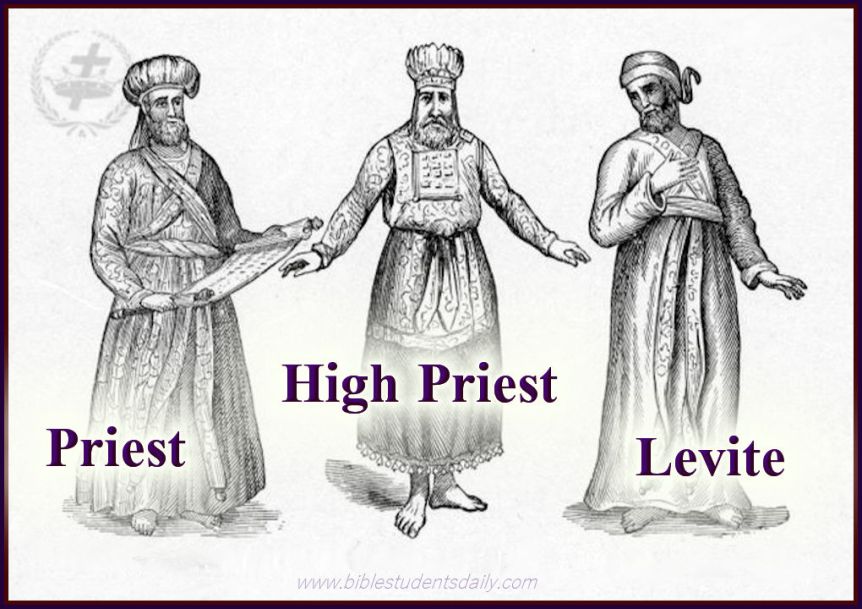
STUDY 6: The Levites

THE HIGH PRIEST, UNDER PRIEST & LEVITE - BEAUTIES OF THE TABERNACLE- STUDY 6 - THE LEVITES..jpg

In the third chapter of the book of Numbers, the Levites are introduced as a tribe that replaces the special place of the firstborn. The Israelites as a whole represent believers in Jesus during the Gospel Age, and the Levitesas with the firstborn on passover night represent the spirit begotten ones.

Subsequently, in Numbers 8:5-16, the Levites are required to wash their garments and are then presented to the priesthood as a helper class. When the Levites are thus distinguished from the Priests, this represents the end of the Gospel Age, when there is made a distinction between the Priests (the Bride class of overcomers), and the Great Company class, who wash their robes in the blood of the lamb, and are then made a helper class to the Church in glory (Revelation 7:9, Revelation 19:1). They will inherit a heavenly (spiritual) reward and bebefore the throne of God, and serve him day and night in his temple” (Revelation 7:15).

The Levites

The Levites that served the Tabernacle (from thirty to fifty years of age, Numbers 4:3, 23, 30, 35, 39) were from the clans of the Kohathites, Gershonites and Merarites. All were descendants of Levi, a tribe which had no inheritance in the land but lived off the tithes paid by their brethren (Leviticus 27:32–33; Numbers 18:21, 24), and the farming they did around the Levitical cities. A tenth of the tithe was also to be given to the priests (Numbers 18:26–28).

Here is a chart showing the descendants of Levi (who was one of Jacob’s 12 sons).

THE DESCENDANTS OF LEVI - STUDY 6- BEAUTIES OF THE TABERNACLE - BIBLE STUDENTS DAILY.jpg

  • Age Considerations

In Numbers 8:24–25 we are told that Levites who were 25 to 50 years of age could serve with work for the Tabernacle yet in Numbers 4:3, 23 & 30, the age range of 30 to 50 is stated.

Jamieson, Fausset, and Brown’s Commentary says this: “They entered on their work in their 25th year, as pupils and probationers, under the superintendence and direction of their senior brethren; and at 30 they were admitted to the full discharge of their official functions.” Perhaps so. Or, perhaps in chapter 4 it refers to the transporting of Tabernacle items, and in chapter 8 it refers to auxiliary duties helping others in the services.

Later during King David’s day, we note that the age for entering priestly service was from 20 years of age (see 1 Chronicles 23:27). Age 20 was the age of fighting men, and by the time of King David lifespans were decreased somewhat, so perhaps David made the adjustment for practical considerations. As to a spiritual meaning — this is only a conjecture—but 20 is a number (2, 20, 200, 2000) that refers to the holy Spirit (This is explained in Study 3 of “Beauties of the Tabernacle” on this website). As such the age of 20 may refer symbolically to those who have received the Spirit of God.

  • The Role of the Levites

The Levites fulfilled the following roles:

BEAUTIES OF THE TABERNACLE- POST 6- THE LEVITES. BIBLE STUDENTS DAILY.jpg

The Levites were explicitly permitted to go near the sacred furniture, and this special privilege distinguished them from ordinary Israelites (Numbers 8:19; 16:9–10; 18:22­–23). Yet the Levites were allowed to approach the sacred furniture only when it was covered (Numbers 18:3).

The Israelites who were not Levites had no right to go into the Tabernacle. The Tabernacle represents the condition of the spirit begotten, not merely believers.

Numbers 18:22–23, explains that “the stranger” (non-Levites) did not have the privilege of service regarding the Tabernacle that the Levites did.

22 Neither must the children of Israel henceforth come nigh the tabernacle of the congregation, lest they bear sin, and die. 23 But the Levites shall do the service of the tabernacle of the congregation, and they shall bear their iniquity: it shall be a statute for ever throughout your generations, that among the children of Israel they have no inheritance.”

  • Favoured Above Other Tribes

The reason the Levites were favoured above other tribes to be specially allocated to the service of God, is that they stepped forward to the side of Moses and God when the Israelites sinned with the golden calf in the wilderness. They were “set apart to the Lord” because when Moses asked the people “whoever is for the Lord come to me” the Levites “were against their own sons and brothers” and rallied to him. (Exodus 32:26, 29, NIV). They did as Moses commanded, slaying 3000 of the offending Israelites.

Numbers 3:14-17 describes the selection of the Levites as substitutes for the firstborn male Israelites — a class specially marked out for the service of God.

Antitypes

When considering the antitypes in relation to the Levites and the Priests (see Study 7 of “Beauties of the Tabernacle”) as well as for the Israelites (see Study 5 of “Beauties of the Tabernacle”) it must be considered on a situational basis, thus it is scripturally context specific, or for better words, contextually sensitive. Each of the three groups of Israelites cannot be considered as one static picture and mean the same thing in every case. In fact, all these three groups do not appear together in any particular case. Sometimes there are Levites and Israelites written about (such as in Numbers chapters 1–4). Sometimes there are priests and Levites (such as in Numbers chapter 8). Each of these cases has its own meaning as to who and what are represented. They are all separate pictures.

  • In Exchange for the Firstborn

To understand the symbolic meaning of the Levites in this exchange of the firstborn, one has to recall the symbolic meaning of the firstborn. Recall that on Passover night, all the Israelites were to remain in their homes, with the blood of the Passover lamb brushed onto the doorposts and lintels. All of them were to eat of the lamb. Thus the Israelites there represent people of faith — believers in Christ Jesus during the Gospel Age.

However, on Passover night only the firstborn were in jeopardy of death. The firstborn represent the consecrated, spirit begotten of the present Gospel Age, who are under jeopardy of losing their spiritual life if they do not remain in the house sanctified by the blood of the lamb. Paul refers to the “Church of the firstborn, which are written in heaven,” linking the symbol of firstborn to those begotten to a heavenly hope (Hebrews 12:23).

That is the foundation for the picture in Numbers 3:45, which reads, Take the Levites instead of all the firstborn among the children of Israel, and the cattle of the Levites instead of their cattle; and the Levites shall be mine: I am the Lord.”

The standing of the firstborn as specially devoted to God is now transferred to the Levites. As the “Church of the firstborn” do not have an inheritance in earthly things (1 Peter 1:4, Ephesians 1:11) but in heavenly things, so the Levites had no inheritance in the land. (Deuteronomy 10:9). They represent the ones “called out” of the world during the Gospel Age and described by the Apostle Paul in Romans 8:30, “Whom he did predestinate, them he also called: and whom he called, them he also justified: and whom he justified, them he also glorified,or honoured, with a “heavenly calling” (Hebrews 3:1).

  • The “Called Out” Ones

It is this “called out” class that James (who was later beheaded by King Herod Agrippa, the first grandson of Herod the Great) explains about, to a whole assembly of gathered believers in Acts 15:14-18, some of whom belonged to the party of the Pharisees and thought the Gentiles must be circumcised and required to obey the law of Moses:

“14 Simeon hath declared how God at the first did visit the Gentiles, to take out of them a people for his name. 15 And to this agree the words of the prophets; as it is written, 16 After this I will return, and will build again the tabernacle of David, which is fallen down; and I will build again the ruins thereof, and I will set it up: 17 That the residue of men might seek after the Lord, and all the Gentiles, upon whom my name is called, saith the Lord, who doeth all these things. 18 Known unto God are all his works from the beginning of the world.

Here the Apostle James appeals to the prophecy of Amos 9:11–12 to support what Apostle Peter (Simon) had said, namely that the Gentiles were receiving the Gospel of Christ. The Apostle James saw that “the residue of men” calling upon God was shown by the Gentile
converts coming into Christ. James said that the prophecy from Amos said this would occur after the “tabernacle of David” was raised up again.

The house or the “tabernacle of David,” the ruling house of Israel, had fallen when Zedekiah lost his throne six centuries earlier (587 bc, at Nebuchadnezzar’s third captivity of Israel). It had been raised up by virtue of Jesus of the tribe of Judah and descended for David, ascending to glory seated at the right hand of God, as our King and leader.

Jesus is our Melchizedek priest — a king and a priest.

  • Melchi is the Hebrew word for “king.”
  • Zedek is the Hebrew word for righteousness, and Jesus is “king-righteousness” — Melchi-zedek — “king of righteousness” (Hebrew 7:1–3).

Thus, the Apostle James explained that Jesus as king has been established as monarch in glory, the house of David had risen again, and it was timely for the “residue of men,” the Gentiles, to receive the grace of God through Jesus. Thus, as Apostle Peter and others testified was occurring here, the High Calling had started since Jesus’s ascension, allowing the “called out” ones of God (1 Peter 2:9), the opportunity to become Sons of God if faithful until death.

The following Scriptures are helpful concerning this calling: Jude 1:1, Galatians 1:6, Romans 11:29, Ephesians 4:1–4, 2 Thessalonians 1:11, 2 Thessalonians 2:14, Hebrews 3:1, 2, 1 Peter 5:10–11.

1 PETER 5, 10-11- BEAUTIES OF THE TABERNACLE- POST 6- THE LEVITES. BIBLE STUDENTS DAILY.jpg

  • In Numbers 8

In Numbers chapter eight, the Levites will be distinguished from the priests. In this distinction, the Levites represent the Great Company class, who will be distinguished from the elect Priest class, following the completion of the judgment period by the end of the Gospel Age.

In Numbers 8:7, the Levites “shave all their flesh,” and “wash their clothes, and so make themselves clean”. The shaving of their flesh pictures the beginning of the service of the Great Company beyond the vail resurrected as spirit beings of a high order, but subordinate to the Bride class. It also pictures the end of their consecrated walk on earth as those who had pressed “towards the mark for the prize of the high calling in God through Christ Jesus” (Philippians 3:12) during the Gospel Age, much like those who took the Nazarite vow were to shave at the conclusion of their vow (Numbers 6:13, 18). This even pertained to Joseph, when raised out of prison, representing Jesus raised out of death. Joseph had to shave and change his garment, to appear before Pharaoh, picturing that Jesus had completed his consecrated walk here, and had a change of nature in order to appear before God.

The Levites washing their clothes reminds us of the Great Company class washing their robes in the blood of the lamb, to cleanse them for their service in glory (Revelation 7:14–15). This distinction between the priests (the Church in glory) and the Levites (the Great Company in glory), also appears in Ezekiel 44:10–14 (Levites), compared to verses 15-24 (priests).

The “Great Multitude” are mentioned in Revelation 7:9-10, and reflected in types such as Rebecca’s maidservants, and Elisha who walked with Elijah.

Some points to be aware of:-

  • In the types of the Book of Leviticus, as far as we can see, the focus is on the Bride class, rather than on the Great Company class. This is because there is no separate calling to the Great Company class, so pictures about the Gospel Age calling to service and sacrifice do not show this class as a distinguished class of spirit begotten ones here, during the Gospel Age. The Great Company class are simply part of the spirit begotten class, all called in the one hope. The distinction between the Bride and the Great Company appears at the end of the Age or otherwise at the time of each member’s judgment time (final sentence/verdict). The Great Company class are depicted in the fifth chapter of the Song of Solomon where there is the lazy lover who does not rise for her betrothed, and misses her opportunities. (Song of Solomon 5: 2, 3, 6).
  • Only those who are finally judged as “more than overcomers” at death — who qualify to be of the Bride, the Elect, Little Flock class — fully share in the sin offering experiences of the present time, and are represented in the Lord’s goat of the Day of Atonement. The special focus on the Bride class in this picture can be compared to the picture of Eliezer in Genesis chapter 24 (who represents the holy Spirit), sent out by Abraham (God) to find a bride (the Church) for His son (Jesus). The bride is Rebekah. This picture is focused on the bride class, but in fact all who are spirit-begotten are called by the same spirit (Eliezer). So with sacrifice. We are all called to sacrifice, and all the spirit begotten do sacrifice. But the picture is focused on the bride class.

Another Kingdom Picture

There is another kingdom picture represented in the Levites if we consider just the four groups of Levites on their own, which may picture the state of the completed work of God’s great plan of the ages after the world of mankind reaches perfection in the kingdom as also seems to be the order suggested in Psalm 45:13–17.

EAST:  The AMRAM Levites (signifying highly exalted, very high) represented the “Little Flock” (144,000), the Bride. These had full charge of all things religious—their brethren—even all the Levites—being their honoured assistants or servants. “The king’s daughter is all glorious within: her clothing is of wrought gold. She shall be brought unto the king in raiment of needlework.” (Psalm 45:13–14).

NORTH:  The MERARI Levites (signifying bitterness) represented the “Great Company” of spirit-begotten ones (before the throne), the Bride’s “allies” and Companions who fail to win the prize of the Royal Priesthood, and are “saved so as by fire,” coming up through great tribulation and bitter experiences to the position of honor and service which they will occupy.

The Merari Levites were given four wagons and eight oxen to transport the gold-covered boards and posts, sockets, cords and pins, etc. (Numbers 3:36–37; 4:31–32; 7:8).

“The virgins her companions that follow her shall be brought unto thee. With gladness and rejoicing shall they be brought: they shall enter into the king’s palace.” (Psalm 45:14,15).

SOUTH:  The KOHATHITE Levites (signifying ally or comrade) represented the Princes, the “Ancient Worthies”—whose faith and obedience and loyalty to God and willingness to suffer for righteousness was so fully attested, and with whom we feel so close a kinship. They were, indeed, the Lord’s allies and ours.

“Instead of thy fathers shall be thy children, whom thou mayest make princes in all the earth(Psalm 45:16).

The Kohathite Levites were given no wagons. These had charge of the most sacred articles—the Altars, the Candlestick (lampstand), the Table and the Ark. (Numbers 3:31; 4:34–36; 7:9).

WEST:  The GERSHOM Levites (signifying refugees, or rescued) represented the saved “World of Mankind,” all of whom will be refugees succoured and delivered, rescued from the blindness and slavery of Satan.

“I will make thy name to be remembered in all generations: therefore shall the people praise thee for ever and ever” (Psalm 45:17).

The Gershom Levites had charge of the least important services — the porterage, etc., of the cords, outer curtains, hangings, gate, etc. which they first transported on two wagons and four oxen (Numbers 3:25–26; 4:22­­­­–26; 7:7).

References & Acknowledgment

Pastor Charles Russell: “Tabernacle Shadows,” “The Tabernacle and Its Teachings” —  Supplement to Feb. “Zion’s Watch Tower,” Pittsburgh, PA, 1882, Volume 6 — “Studies in the Scriptures,” Reprints of the Watch Tower.

Br. Anton Frey: “Notes on the Tabernacle,” pages 362-364; “Wilderness Wanderings.”

Jamieson, Fausset, and Brown’s Commentary.

Br. David Rice — some written content for this post.

Suggested Further Reading

STUDY 1: An Introduction To The Tabernacle And It’s Purpose
https://biblestudentsdaily.com/2016/09/02/study-1-an-introduction-to-the-tabernacle-and-its-purpose/

STUDY 2: The Pillar of Cloud By Day And The Pillar of Smoke By Night  https://biblestudentsdaily.com/2016/09/09/study-2-the-pillar-of-cloud-by-day-and-the-pillar-of-smoke-by-night/

STUDY 3: The Tabernacle Construction: The Holy and The Most Holy  https://biblestudentsdaily.com/2016/09/14/study-3-the-tabernacle-construction-the-holy-the-most-holy/

STUDY 4: The Court (“Holy Place”)

STUDY 4: The Court (“Holy Place”)

STUDY 5: The Camp. The Israelites.
URL: https://biblestudentsdaily.com/2016/10/28/study-5-the-camp-the-israelites/

STUDY 7: The Priests. The Day of Atonement.
https://biblestudentsdaily.com/2016/12/10/study-7-the-priests-the-day-of-atonement/

STUDY 8: The Tabernacle Coverings
https://biblestudentsdaily.com/2017/01/02/study-8-the-tabernacle-coverings/

STUDY 9: The Gate. The Door. The Vail.
https://biblestudentsdaily.com/2017/03/01/study-9-the-gate-the-door-the-vail/

The URL for this post:

STUDY 6: The Levites

Enter your email address to subscribe to this blog and receive notifications of new posts by email.

Save

Save

Save

Save

Great Gain(s)

1-timothy-6-6-poem-great-gains

A test of patient cheerful endurance
In faith currently still remains,
For the last feet members of the Church,

That will prove great gains.

These do experience ridicule

And rejection both from those near and far,
As the Gospel message they proclaim,

Even on their guitar.

Having no fleshly interests,
Just a desire to heed God’s will,
Their consciences are in tune with God’s voice,

As in their Father’s presence they remain still.

As they adhere to the Divine Words of Jehovah,

Leaning on Jesus as their rock,
They watch and pray and help others understand Divine Scriptures,

Like shepherds of a flock.

With heart and minds that desire
To know what is best,
What is purest and most righteous,

To be perfect like Christ—this is their quest.

Sacrificing every earthly and fleshly interest
Is a pleasure to do,
For it means a share in the sin offering through grace,

A privilege for only but a few.
 
When soon all 144,000 Bride members
Are beyond the Vail,
They shall begin their roles as the heavenly judges and kings—

WHY? Because they did not fail!

These win the prize of the High Calling,
Which was the longing of their hearts.
What mattered to these dear Ones most,
Was to please God, and of Him and His dear Son Jesus, to boast!

When Armageddon comes,
The faithful few will have been taken from earth;
They will have completed their race
Having proven their worth.
 
Belonging to Jesus—
They shall forever with him remain,
Bringing greatest pleasure to the Heavenly Father—
Like the Lamb of God that had once been slain.
 
So dear brethren in Christ Jesus
who are our crown and joy:

Let’s continue to put away behind us,
What would cloud the narrow way ahead,
Not even for a split second look back at the wrong,
Only disciplining the mind to keep focused on what Jesus has said.

Feasting on God’s Words in the Bible
Every moment we can in this life that remains,
God promises to reward justly,
For all good done, with great gains.

romans-2-6-7-c


The URL for this post:
https://biblestudentsdaily.com/2016/11/13/great-gain/

Enter your email address to subscribe to this blog and receive notifications of new posts by email.

Save

Save

Save

WILLINGLY & CHEERFULLY DOING GOD’S WILL: WHY, WHEN, HOW…

romans-8-18-ad

Acquiescing to GOD’s will is the only way to get true PEACE in the spiritual mind of the New Creation in CHRIST.

To acquiesce means to be at rest; to be yielding and not resisting no matter how severe the trial our Heavenly Father may permit to melt us, humble us, mould us, teach us how to “submit to one another out of reverence for Christ” (Ephesians 5:21, NIV) and sacrifice for the good of others, knowing it will lead to the greater good and which will bring glory and honour to GOD and which is centered upon RIGHTEOUSNESS – as this is THE ONLY STANDARD our Almighty Heavenly Father accepts, and it can be achieved through our intentions being reckoned as righteous thanks to Jesus Christ’s ransom sacrifice on Calvary once for all, for the sins of ALL humanity.

Our plans being frustrated is GOD’s better choice for us.

Consider the Apostle Paul…

About the “thorn in my flesh”, Paul in 2 Corinthians 12:8-9 wrote, “Three times I pleaded with the Lord about this, that it should leave me. But he said to me, ‘MY GRACE is sufficient for you, for my power is made perfect in weakness.’ Therefore I will boast all the more gladly of my weaknesses, so that the power of Christ may rest upon me.

Do we fully TRUST OUR HEAVENLY FATHER’s tender-hood?

man in wheelchair - c&ad..jpg

Let us consider faithful Job, (who may have lived before Abraham and probably Moses received the book of Job from times before him) :-

GOD allowed Satan to test Job’s faith …Here is an account of Job’s FIRST TEST, Job 1: 6-22 (ESV):-


“6 Now there was a day when the sons of God came to present themselves before the Lord, and Satan also came among them. The Lord said to Satan, “From where have you come?” Satan answered the Lord and said, “From going to and fro on the earth, and from walking up and down on it.” And the Lord said to Satan, “Have you considered my servant Job, that there is none like him on the earth, a blameless and upright man, who fears God and turns away from evil?” Then Satan answered the Lord and said, “Does Job fear God for no reason? 10 Have you not put a hedge around him and his house and all that he has, on every side? You have blessed the work of his hands, and his possessions have increased in the land. 11 But stretch out your hand and touch all that he has, and he will curse you to your face.” 12 And the Lord said to Satan, “Behold, all that he has is in your hand. Only against him do not stretch out your hand.” So Satan went out from the presence of the Lord.

Satan Takes Job’s Property and Children

13 Now there was a day when his sons and daughters were eating and drinking wine in their oldest brother’s house, 14 and there came a messenger to Job and said, “The oxen were plowing and the donkeys feeding beside them, 15 and the Sabeans fell upon them and took them and struck down the servants with the edge of the sword, and I alone have escaped to tell you.” 16 While he was yet speaking, there came another and said, “The fire of God fell from heaven and burned up the sheep and the servants and consumed them, and I alone have escaped to tell you.” 17 While he was yet speaking, there came another and said, “The Chaldeans formed three groups and made a raid on the camels and took them and struck down the servants with the edge of the sword, and I alone have escaped to tell you.” 18 While he was yet speaking, there came another and said, “Your sons and daughters were eating and drinking wine in their oldest brother’s house, 19 and behold, a great wind came across the wilderness and struck the four corners of the house, and it fell upon the young people, and they are dead, and I alone have escaped to tell you.”

20 Then Job arose and tore his robe and shaved his head and fell on the ground and worshiped. 21 And he said, “Naked I came from my mother’s womb, and naked shall I return. The Lord gave, and the Lord has taken away; blessed be the name of the Lord.”

22 In all this Job did not sin or charge God with wrong.”


FAITH can hold the hand of the Heavenly Father even when we cannot trace Him during our trials. Blessed be the name of the Lord GOD, because our Heavenly Father WILL TURN HUMAN DISAPPOINTMENT INTO HIS APPOINTMENT TO WORK out from each and every experience, an outcome that will result in the GREATER GOOD, EVEN IF IT RESULTS IN ONE’S DEATH.

If we wish to know how to DO GOD’s WILL WITH JOY then let us consider our Heavenly Father’s relationship with His Son and the World’s Redeemer, our Master and King JESUS CHRIST, who said:


5 “Sacrifice and offering Thou wouldest not have, but a body hast Thou prepared for Me.

In burnt offerings and sacrifices for sin Thou hast had no pleasure.

Then said I, ‘Lo, I come (in the volume of the Book it is written of Me) to do Thy will, O God.’”

Above when He said, ‘Sacrifice and offering and burnt offerings, and offering for sin Thou wouldest not have, neither hadst pleasure therein’ (which are offered in accordance with the law),

then said He, ‘Lo, I come to do Thy will, O God,’ He taketh away the first, that He may establish the second.

10 By this will we are sanctified through the offering of the body of Jesus Christ once for all.” Hebrews 10:5-10 (KJ21)


Job’s second test was that of GOD allowing the Adversary to afflict him “with painful sores from the soles of his feet to the top of his head.” (Job 1:7). Even his wife told him to “curse GOD and die” (Job 2:9) from all his mental pain and fleshly agony, yet here too, we read in Job 2:10 – “In all this, Job did not sin in what he said.” Despite Job wishing that GOD would allow him to die from the extent of his misery and pain (Job 6:9, Job 7:15), he still had this consolation – “my JOY in unrelenting pain – that I had not denied the words of the Holy One.”(Job 6:10). Job even became a “laughingstock” (Job 12:4) to his three friends – Eliphaz, Bildad and Zophar – who came to comfort him. Despite all, Job was still able to say:

“But He knows the way that I take; when He has tested me, I will come forth as gold” (Job 23:10, NIV)

Though He slay me, yet will I HOPE IN HIM.” (Job 13:15, NIV)

Can we say this too when disaster, or extreme agony of the mind or flesh “hit’s home”?

YES WE CAN! Because when our aim is to only want to do what the Heavenly Father would desire through our existence, then we have LET GO to what would weigh us down and to what would draw us away from running the race set before us to endure the battle of suffering and shame, knowing that “those who suffer with Christ shall reign with him.”(2 Timothy 2:12). This battle against sin is a daily one, until death (Revelation 2:10) and the strict discipline and serious training in the principles of righteousness becomes one that helps develop the true Christian into a mature member of the Royal Priesthood, a peculiar people, whos’ aims, intentions and desires are “NONE OF SELF and ALL OF THEE, HEAVENLY FATHER”. It is the fiery trials that are counted as “pleasing incense” to our Heavenly Father when there is willingness and patient, cheerful endurance exercised.

For if the willingness is there, the gift is acceptable according to what one has, not according to what one does not have” – 2 Corinthians 8:12 (NIV).

* THE AIM OF EXISTENCE is:
TO PLEASE OUR HEAVENLY FATHER YAHWEH, OUR EL-SHADDAI,
through His Son Jesus Christ.

“But the mercy of the LORD is from everlasting to everlasting upon them that fear him, and his righteousness unto children’s children…” – Psalm 103:17

“The fear of Jehovah is the beginning of knowledge; But the foolish despise wisdom and instruction.” – Proverbs 1:7 (ASV)

“He has told you, O man, what is good; and what does the LORD require of you but to do justice, and to love kindness, and to walk humbly with your God?” – Micah 6:8

During this Gospel Age (extending 6000 years for the permission of evil that is soon to end) when a Bride of 144,000 members (see Revelation 7 & 14) for Christ is being called out and tested, the consecrated unto the LORD GOD, are given the privileged opportunity in unfavourable circumstances to develop the heart character to make GOD’s will central in their lives.

Nothing can harm these, except as the Heavenly Father sees that the earthly injury or disadvantage would prove profitable to the individual new creature or the Lord’s general cause.” (R4926:6)

“Even if GOD should permit him to use his judgment in a way that afterward appeared not have been the best, nevertheless the Father may use it to bring some profitable lesson.” (R5212:6)

Our Heavenly Father wishes to give us the good things. Sometimes He sees best that we wait before getting an answer to our prayers. (R5480:4) Few lessons are harder to learn than this one—that GOD supervises the affairs of all who are truly His. (R5264:)

The consecrated shall have all needful instruction, grace, comfort, discipline, training and care; and such measure of temporal good as will be most conducive to highest spiritual and everlasting blessing. (R1396:3)

Sometimes our Heavenly Father sees best that we wait a long time before getting the answer to our petitions; at other times he may give us a speedy answer to our prayer. (R5480:4) “There shall no evil befall thee.” (Psa. 91:10)

“He who has buried his own will completely in the will of the Lord
can know no disappointment;
but in every affair of his life
he sees by faith divine appointment or supervision.” (R2412:6)

* HOW DO WE DO GOD’S WILL & WHY?

* IS DOING GOD’S WILL ENOUGH?

* DO WE DO GOD’S WILL CHEERFULLY & WITH PATIENT ENDURANCE, UNCOMPLAININGLY, JOYFULLY, NOT RELUCTANTLY, UNMURMURINGLY?

* WHO IN THE BIBLE DID GOD’S WILL?

These questions and others are discussed in the following video : “Acquiescing to GOD’s will”.

May it motivate, encourage and stimulate the New Mind in Christ in acquiescing to GOD’S will. GOD BLESS YOU.

“TRUST in the Lord with all your heart, and
do not lean on your own understanding.
In all your ways acknowledge him,
and he will make straight your paths.” 
Proverbs 3:5-6(ESV)

I Love Thy Will

I love thy will, O God!
Thy blessed, perfect will,
In which this once rebellious heart
Lies satisfied and still.

I love thy will, O God!
It is my joy, my rest;
It glorifies my common task,
It makes each trial blest.

I love thy will, O God!
The sunshine or the rain.
Some days are bright with praise, and some
Sweet with accepted pain.

I love thy will, O God!
O hear my earnest plea,
That as thy will is done in heav’n,
It may be done in me.

Hymn #114 from “Hymns of Dawn”

References:

Pastor Charles T. Russell – for quoted passages from the Reprints (R) of the Original Watchtower and Herald of Christ’s Presence.

BibleTruth411 (YouTube) – Video: “Acquiescing to God’s Will” by Bro. Stephen Suraci.

Hymns of Dawn – http://www.htdbv8.com/index.html

URL: https://biblestudentsdaily.com/2016/09/23/willingly-cheerfully-doing-gods-will-why-when-how/

Enter your email address to subscribe to this blog and receive notifications of new posts by email.


Save

2 PETER 1:5-11 – Is Mere FAITH IN GOD Enough?

2 Peter 1, 5-11 - C&C.jpg

The following post is an extract from “Epistles of Peter” by Bro. Frank Shallieu.

2 PETER 1:5: “And beside this, giving all diligence, add to your faith virtue; and to virtue knowledge.”

“Add to your faith virtue.”

The next step in the Apostle Peter’s evaluation is virtue.

The Apostle Paul breaks down the various fruits leading up to love, but Peter is talking from the standpoint of making one’s calling and election sure and his listing gives a sequential development. The Apostle Peter, the fisherman, is now a mature Christian feeding the lambs as well as the sheep. Having been qualified with a wealth of experience, he knows that death is imminent. Likewise, Paul realized the end of his life was approaching when he said, “Henceforth there is laid up for me a crown of righteousness, which the Lord, the righteous judge, shall give me at that day” (2 Timothy 4:8).
We are not reading a textbook but a very valuable, sobering account by one who speaks from experience as well as under the guidance of the holy Spirit.

Comment: Instead of the King James wording “And beside this,” the New International
Version has “For this very reason.” The NIV makes clearer the tie-in with the “exceeding
great and precious promises” of the preceding verse. In other words, “Because of the great and precious promises–for this very reason–you need to add to your faith virtue, etc.”

“Giving all diligence” is an important phrase, and it applies to all of the steps.
Give all diligence to add to your faith virtue.
Give all diligence to add to your virtue knowledge.
Give all diligence to add to your knowledge temperance, and so forth.

The great majority of Christians are immature seed.

In the parable, seed that falls in good ground and develops to maturity brings forth “some an hundredfold, some sixty, some thirty” (Matthew 13:23). In other words, full capacity is reached according to the content of the individual vessel. Some have
a 30 percent vessel, some have a 60 percent vessel, and the ten-talented person has a 100
percent vessel—and hence more responsibility. All three categories picture the Little Flock, children of the Kingdom in the real sense of the word.

Virtue means fortitude, strength of character.
Question: Doesn’t “virtue” also convey a morality aspect?

Answer: Yes, the breastplate of righteousness is part of virtue. From the simple rudiments of faith
and the milk of the Word, one now starts to get food that is a little stronger, and the body
grows proportionately stronger as well. The child grows, spiritually speaking, with moral
development and strength of character based on an outgrowth of faith.

Following initial faith, virtue is the first development of one who believes into Christ and starts to grow.

Many, thinking that knowledge follows faith, try to bypass virtue and want to teach and
write books when they are still babes. In the enthusiasm of our early days, we tend to be
overconfident. Those who talk that way are not mature Christians, and they betray
themselves by their immaturity of conduct, immaturity of reasoning, and immaturity in an assumed familiarity with Scripture. Thus the flesh tends to jump over virtue and go
straight to knowledge. However, Peter shows our need to go step by step by step.

Faith is the substratum of an entire Christian’s life. The just shall live by faith (Romans 1:17).
Faith in Jesus is the bottom line–faith that he is the Redeemer. We are to add to that faith, in successive order, the seven steps that Peter enumerates.

“Add … to virtue knowledge.” “Knowledge” is a broad term, for there are all kinds of knowledge.

2 PETER 1:6: “And to knowledge temperance; and to temperance patience; and to patience godliness.”

Peter continues to enumerate the various steps in the progression to maturity.

At the Last Supper, Jesus remarked to Peter, “I have prayed for thee, that thy faith fail not: and when thou art converted, strengthen thy brethren” (Luke 22:32).

After Jesus’ resurrection he gently rebuked Peter three times for the three denials. At that time Jesus said to Peter, “Feed my lambs.” The second time the Master said, “Feed my sheep.” And the third time was “Feed my sheep,” after which Peter said, “Thou knowest that I love thee” (John 21:15–17). Notice the progression: (1) “feed my lambs,” and then (2) “feed my sheep” and (3) “feed my sheep.” In other words, Peter was not in the position to feed mature adults at the time of our Lord’s ascension or even after Pentecost. At Pentecost, Peter possessed the first two qualities: faith and virtue. Peter had faith: “Thou art the Christ, the Son of the living God” (Matthew 16:16). Also, he and John spoke very boldly on the Day of Pentecost.

“Virtue” means strength, courage, fortitude.

Now when we study Peter’s epistles, we see a very different Peter from the impulsive one in the Gospels.

Peter tells us to add to or supplement our faith with virtue, knowledge, temperance, patience, godliness, brotherly kindness, and charity. In other words, Peter adds seven different qualities to the basic substratum of faith.
Let us consider “knowledge.”

Remember, Peter is speaking about character development. Regardless of the subsequent lack or fullness of development, we all start our Christian walk as babes with faith in Jesus. In his first epistle, Peter said that “as newborn babes, [we should] desire the sincere milk of the word, … [so that we] may grow thereby” (1 Peter 2:2). As the babe feeds on milk, his bones grow and he gets a little stronger so that, spiritually speaking, he can withstand opposition and persecution. This would be adding virtue to our faith.

To add knowledge, the babe needs milk for growth. “Milk” includes the knowledge of
God’s Word, for how can we instruct others if we have not been instructed ourselves?

To knowledge, we are to add temperance or self-control.

The growth of Peter in the area of self-control is amazing! He underwent a remarkable change from his earlier impulsiveness.

Jesus said to Peter, “Verily, verily, I say unto thee, When thou wast young, thou girdedst thyself, and walkedst whither thou wouldest: but when thou shalt be old, thou shalt stretch forth thy hands, and another shall gird thee, and carry thee whither thou wouldest not [to death in crucifixion]” (John 21:18). Jesus was referring to the manner in which Peter would die. When Jesus asked, “Who do men say that I am?” impulsive Peter responded, “Thou art the Christ, the Son of the living God” (Matthew 16:13–16).

Peter was a natural leader, but he needed to be instructed himself. The very fact Peter was naked in the boat after Jesus’ resurrection gives us an insight into his character. He did not want any restraints. He impulsively girt himself with his coat and jumped into the water to swim to Jesus, who was frying fish on the shore.

This same man, but a mature and developed Peter at the end of his life, said, “Add to your knowledge self-control and self-restraint.”

This self-restraint must come after knowledge.

Both of Peter’s epistles were written in the last years of his life, just before his death. How valuable is the instruction of Peter in his maturity!

When Paul discusses the various graces of the holy Spirit, he does not necessarily
enumerate them in succession. For instance, in describing love, he does not follow any
particular sequence, but Peter says, “Add to your faith virtue. Add to your virtue knowledge. Add to your knowledge temperance.” Thus Peter gives a sequence and Paul does not. The point is that the instruction of the two apostles does not conflict. Paul gives more detail but lists the graces of the holy Spirit in random fashion. (An exception would be Paul’s discussion of faith, hope, and love, which are in succession.)

Comment: It was Peter who lopped off the ear of Malchus in the Garden of Gethsemane at the arrest of Jesus. This act is another example of his impetuosity and impulsiveness.

Comment: In a practical sense, temperance could be along both material and spiritual lines. We need to have self-control over our life-style and how we expend our resources. Along spiritual lines, temperance would affect how we witness and preach the gospel. For example, as a general rule we would not deliberately make a spectacle of ourselves.

Comment: A comment in the Berean Manual says, “Moderation, self-restraint in all things–we are not to be hasty and hot-tempered, or rash and thoughtless, but evenly balanced, thoughtful and considerate.” We get this moderation through the knowledge of God’s Word.

Reply: Yes, “he that ruleth his spirit [is better] than he that taketh a city” (Proverbs 16:32).

“Let your moderation be known unto all men” (Philippians 4:5).

We should be temperate in language, money-getting, money saving, eating, drinking, joy, sorrow, at work, in the store, home, church, and schoolroom–everywhere.

Comment: On the other side of the coin, there is a danger in becoming too temperate and thus not having enough zeal for the truth, the Lord, and His service.

Reply: If we have too much self-control, we will be mute when we should speak. The other extreme is being so out of hand and rambunctious that we destroy whatever good we might do. The proper amount of self-control makes us much more effective.

Add “to temperance patience.” What is this “patience”?

The Greek word is hupomone, which means “endurance.” Hupomone conveys the thought of bearing under a burden, of enduring it and not chafing, of remaining under the burden and not giving up. The same word is used in Hebrews 12:1, “Wherefore seeing we also are compassed about with so great a cloud of witnesses, let us lay aside every weight, and the sin which doth so easily beset us, and let us run with patience the race that is set before us.” Of course a lot depends on the makeup of the individual, for we are all different. Some brethren under trial may react without a lot of apparent cheerful endurance and yet be faithful. The circumstances must be considered. Those who run a marathon race are not very cheerful when they near the end of the race, for they are pressing on to the utmost. Those who win have an extremely strong
desire to excel and be a champion.

Comment: James 5:11, in referring to Job, uses this same Greek word for “patience.”
“Behold, we count them happy which endure. Ye have heard of the patience of Job, and
have seen the end of the Lord; that the Lord is very pitiful, and of tender mercy.”

We are all familiar with Job and the conditions under which he endured.

Comment: “Patience” would be meekly submitting to discipline in every case. Add “to patience godliness.” “Godliness” is the wrong word, for that quality should be the
end, the highest step. Godliness and love are synonymous. The thought here should be
love and reverence for God, God-likeness. Thus the word “piety” is a better translation, for piety is a form of reverence. Piety can also be considered decorum, as in 1 Timothy 3:15, “Behave thyself in the house of God.”

Comment: Strong’s and the Diaglott use the word “piety.”
Reply: The Greek word is eusebeia, and a famous historian was Eusebius, a name meaning piety, a reverent one.

Comment: Reprint 2155 states that God-likeness, piety, is “that devout controlling reverence for God which yields a hearty, cheerful, loving conformity to his will–fervency of spirit in serving the Lord.”

Reply: Piety is especially fervency in spirit in obeying the Lord. He is looking for obedience in us–that is the bottom line.

Works by themselves are meaningless.

“To obey is better than sacrifice, and to hearken than the fat of rams [which is offered in sacrifice and may cost a little money]” (1 Samuel 15:22).

Obedience supersedes works.

2 PETER 1:7: “And to godliness brotherly kindness; and to brotherly kindness charity” 

Add to piety “brotherly kindness.” There are occasions where it is difficult to love all
brethren completely and indiscriminately. In other words, there are cases where we cannot manifest love to others because of their disobedience. For instance, 1 Corinthians 5:11 says, “I have written unto you not to keep company, if any man that is called a brother be a fornicator, or covetous, or an idolater, or a railer, or a drunkard, or an extortioner; with such an one no not to eat.”

The individual may not have even consecrated, but if he thinks he is a brother in truth and is a drunkard, a brawler, a fornicator, etc., we are to refrain from fellowship with him. Treating him in this manner is doing him a favor, for if he truly loves God, the truth, and the Lord’s people, he will feel he has done something wrong and will repent.

The Greek word for “brotherly kindness” is philadelphian. Some translations use “love of
the brotherhood,” and that is a better term.

We love those who fervently love God. We are drawn to such because they are of the brotherhood. Jesus particularly favored Peter, James, and John because they manifested a greater zeal for God. The incident in which Jesus raised the daughter of Jairus illustrates this favoritism (Mark 5:35–43). Another example is Jesus’ transfiguration (Matthew 17:1–9). That is the type of love we should have for the brotherhood.

We love those who love God, and the more they love Him, the more we love them.

Moreover, we are helped by their example. In the hymn “Onward, Christian Soldiers,”
when we sing the words “All one body we,” we are thinking not of individuals but of the
brotherhood, of those who love Christ and are trying to serve God.

Add “to brotherly kindness charity [love]. If the previous step was love for the brotherhood, what is this highest type of love? It is agape love.

Comment: We love those who love God and have a special affinity for them because of our common bond, but our love must go beyond that point to where we love mankind.

Comment: This would be a principled love versus phileo love with an emotional basis.

Comment: We love the Lord, the brethren, humanity, our enemies, and also the brute
creation.

Reply: That is true, for principled agape love is broad. The Law shows how we should treat the animals; for example, they should not be unequally yoked in plowing. Agape love includes love for our enemies and doing good to them that despitefully use us (Matthew 5:44).

With this principled love, “God so loved the world, that he gave his only begotten Son”
(John 3:16). Those who obey in the future will be saved, for God has made provision for the restitution of mankind. In other words, He will open the opportunity for salvation toothers besides the brotherhood. His love goes from the brotherhood to mankind and even to those who are enemies now but may not be once their eyes are opened in the Kingdom.

Only those who are incorrigible in iniquity will go into Second Death.

Remember that before Peter started the enumeration of the seven graces of the holy Spirit, he said, “And beside this, giving all diligence,” add to your faith, etc. (2 Peter 1:5).

Because we live in the world with its responsibilities and experiences, our time becomes important–the little time we have left after doing that which is right for family, employer, and others. We must give all diligence to add these seven qualities. Isn’t it remarkable that the impulsive Peter is like a statesman or a father in these epistles? True, he was a leader in the beginning of his Christian walk, but now he is more than that. In his first epistle, which was written only a couple of years before the second epistle, he called Marcus “my son” (1 Peter 5:13). Paul used the same terminology with Timothy, and that epistle was written near the end of Paul’s life. As the apostles aged in the truth, they matured. Peter underwent a radical, miraculous, almost unbelievable change from his days as a fisherman. True, he speaks according to the holy Spirit, but his own life is in harmony with that holy Spirit. He experienced these steps himself, and he is passing on the information to us. Later he says, “I am going to remind you of these things until the day I die, and the Lord Jesus has informed me that my death will occur soon.”

Comment: The verses being alluded to are quite touching: “Yea, I think it meet, as long as I am in this tabernacle, to stir you up by putting you in remembrance; Knowing that shortly I must put off this my tabernacle, even as our Lord Jesus Christ hath shown me” (2 Peter 1:13,14).

2 PETER 1:8: “For if these things be in you, and abound, they make you that ye shall neither be barren nor unfruitful in the knowledge of our Lord Jesus Christ.”

Comment: If “these things” (the seven steps above faith in verses 5–7) are in us and abound, we will make our calling and election sure. The fact that Peter uses the term “these things” five times in this chapter (verses 8–10, 12, 15) shows how important they are.

Reply: Yes, Peter is inclined to repeat words and references. For instance, the use of the
word “divine” twice in this chapter is unusual, for that word appears only three times in
the whole New Testament. The reason is that Peter recognized his own faults and weaknesses and how the Lord changed his life. He is admitting, as it were, that what God
did for him, He can do for us. Accordingly, Peter mentions the importance of developing
character and the various steps of grace that are required if we are to win a crown. We must have diligently tried to add the seven graces to our faith.

Comment: If the words “and abound” had been omitted, the meaning of the verse would have been a little different. All who get life on the spirit plane, including the Great
Company, must have these qualities, but to attain the Little Flock, to get an “abundant
entrance,” these qualities must abound in us and must increase more and more.

Reply: For example, when people do acts of kindness, are patient, etc., there is often a lack of consistency. With knowledge, some are satisfied with a certain level and stop there. These qualities must be diligently practiced if we would be more than overcomers.

Question: Is the “knowledge of our Lord Jesus Christ” in verse 8 the same “knowledge” that is in verse 5?

Answer: The Greek gnosis is used in verses 5 and 6, and epignosis (full knowledge) is used in verses 2, 3, and 8. The words are the same except that epignosis is expressed more powerfully, i.e. with more fullness. By faith we know (gnosis) that Jesus is the Savior, that he died for our sins, and through this knowledge we are forgiven for our sins. In addition, we should also know in more fullness (epignosis) his sermons and parables, his life and character, and how he lived to please the Father.

The “knowledge” (gnosis) of verses 5 and 6 is the second step in the various graces of the holy Spirit, but epignosis embraces all seven steps, which would include a comparison and study of Jesus’ statements and teachings. However, epignosis has nothing to do with the depth of our understanding, which is not always the same. If we have not searched the Scriptures daily, if we have not habitually familiarized ourselves with the Word of God, with the life of Jesus, with the Old Testament, etc., we will be lacking.

Comment: In the footnote for the text “If these things be in you, and abound … ye shall
neither be barren nor unfruitful,” “barren” means “idle.”

2 PETER 1:9: “But he that lacketh these things is blind, and cannot see afar off, and hath forgotten that he was purged from his old sins.”

To be “blind” in this sense is to be nearsighted, meaning the individual “cannot see afar
off.”

Question: What is the relationship between the first part of verse 9 and the second part? What does lacking the graces of the holy Spirit have to do with forgetting that we were purged from our old sins?

Answer: The object of our being purged from old sins is to grow in character. We are nearsighted if we do not always keep this goal in mind. Peter is saying, “It is not enough to just believe Jesus is the Savior and to be willing to suffer for him. We must have more understanding in order to please God.” Since we are imperfect and by nature fallen–our humanity is depraved–we must frequently occupy our minds with pure thoughts. Paul said, “Think on these things.” “Finally, brethren, whatsoever things are true, whatsoever things are honest, whatsoever things are just, whatsoever things are pure, whatsoever things are lovely, whatsoever things are of good report; if there be any virtue, and if there be any praise, think on these things” (Philippians 4:8).

If we do not feed on pure thoughts, our minds will naturally gravitate to unspiritual things.

Those who neglect or do not see the necessity of developing the fruits of the holy Spirit, are “blind,” nearsighted. Far-sighted vision would be making our calling and election sure. We are not at the goal yet, so we must keep running.

We cannot let ourselves drift in our thinking or in our actions, but must school ourselves with God’s Word.

Comment: If we stagnate and do not grow in character, we stay in the sins from which we were supposed to be purged.

Reply: We must try to distance ourselves from the old man as far as possible. Of course we cannot do this completely, for he is saddled on our backs, but we must separate as far as possible from our own reasoning and our own will.

2 PETER 1:10: “Wherefore the rather, brethren, give diligence to make your calling and election sure: for if ye do these things, ye shall never fall:”

The objective is to make our calling and election sure.

If we take our eyes off the goal, we will gravitate to our natural tendencies instead of to the supernatural tendencies of the Holy Spirit.

“If ye do these things, ye shall never fall.” The thought is that if we develop these fruits of the holy Spirit and they abound in us, we will never fail but will succeed in attaining the Bride class.

Comment: The Great Company will fall or fail to a certain extent.

2 PETER 1:11: “For so an entrance shall be ministered unto you abundantly into the
everlasting kingdom of our Lord and Saviour Jesus Christ.”

If we give all diligence to developing the fruits of the holy Spirit, if we have the right heart attitude and diligently practice Christianity throughout our Christian walk, we will get an abundant entrance into the Kingdom, for we will be obeying the promptings of God’s holy Spirit.

We are given “exceeding great and precious promises” so that we might inherit the divine nature.

The “everlasting kingdom” would be the age-lasting Kingdom (Greek aionian). The 144,000 will be on the throne and reign throughout the Kingdom Age.


Acknowledgment:

Bro. Frank Shallieu–for the content above which was an extract from “Epistles of Peter” The full study is on the Bible Study Library CD which can be accessed at the following link: https://herald-magazine.com/bookstore-2/#!/Bible-Study-Library/p/38387237/category=0


URL of this post: https://biblestudentsdaily.com/2016/08/06/2-peter-15-11-is-mere-faith-in-god-enough/

Enter your email address to subscribe to this blog and receive notifications of new posts by email.


Save

The Expanse of Divine Love – 3 poems

PSALM 63, 3 - WITH CROSS & address


THE EXPANSE OF LOVE DIVINE

He loves me! Oh how much the thought entails,
Love that is perfect, love that never fails.
That strengthens me in sorrow or in strife,
Soothes all the trials and the cares of life. 

Higher than highest Heaven; so sublime
This love that lifts me up to heights Divine,
Enfolds me, fills my grateful heart with praise,
And lights my pathway with its golden rays.

 So high it overlooks man’s dreadful sin
And plans the fallen race to save, and win
Mankind for righteousness. To give them life
And free them from the bonds of sin and strife.

 A love so deep that nothing can molest
The calm and stillness of its perfect rest;
So deep the very lowest of our race,
In Time shall feel His power and know its grace.

Not e’en the silent shadows of the grave
Can hide from Him the soul He seeks to save;
For in due time He’ll call them back again,
Reveal His love, mankind shall serve Him then.

Its length? It teaches out through endless ages–
This love that’s sung by prophets and by sages–
The love that never fails, knows no cessation–
Eternity its limit of duration.

So broad, this love, it takes the whole world in.
It sees the vast extent of human sin,
Yet knows no barriers of blood or race
But reaches all with its unfailing grace.

It fills the universe, it lights the stars.
No selfishness its perfect beauty mars.
Increasing–as the need for it increases–
It knows no limits, varies not, nor ceases.

Lord let me lose myself in that great love,
Knowing Thou watchest o’er me from above.
Oh let me feel the Everlasting Arms
That shield from all that threatens or alarms.

Then shall the earthborn shadows flee away
And self shall be absorbed in love’s pure ray.
Thine image on this faulty tablet trace
And every earth stain from my heart efface.

Till love like Thine I may–in measure–know
And daily like the perfect pattern grow.
Then, by Thy grace, I’ll hear Thy sweet “Well done.”
Life lived in love, eternity begun.

Let us then approach God’s throne of grace with confidence, so that we may receive mercy and find grace to help us in our time of need” (Hebrews 4:16, NIV).

“Do not be anxious about anything, but in everything by prayer and supplication with thanksgiving let your requests be made known to God” (Philippians 4:6, ESV).

[Note: “supplication” is the action of asking or begging for something earnestly and humbly.]

One thing have I asked of the LORD, that will I seek after: that I may dwell in the house of the LORD all the days of my life, to gaze upon the beauty of the Lord and to inquire in his temple” (Psalm 27:4 ).

————

THE STRONGER LOVE

All earthly love is a thread of gold,
Most fair but what the touch of time may sever:
But His is a cable sure, of strength untold
O, His love, it lasteth ever!

And this great love he will on thee bestow
The fullness of his grace make known,
Earnest of glory grant thee here below
If thou wilt be his own!

————

“For GOD so loved the world, that he gave his only begotten Son, that whosoever believeth in him should not perish, but have everlasting life” (John 3:16).

*******

LOVE DIVINE

Yahweh God to us in Christ hath given
The proof and pattern of a love divine,
And human love above, though nobly striven.
God’s love is greater far than thine or mine.
For Christ came down from heights unknown to us,
And thus did show to God and man a love–
A love maintained through trial torturous;
A love beyond all loves, save God’s above.

*******

God Is Love

1 John 4:7-21 (ESV) reads,

7Beloved, let us love one another, for love is from GOD, and whoever loves has been born of GOD and knows GOD. 8Anyone who does not love does not know GOD, because GOD is love. 9In this the love of GOD was made manifest among us, that GOD sent his only Son into the world, so that we might live through him.

10 In this is love, not that we have loved GOD but that he loved us and sent his Son to be the propitiation for our sins. 11Beloved, if GOD so loved us, we also ought to love one another. 12No one has ever seen GOD; if we love one another, God abides in us and his love is perfected in us.

13By this we know that we abide in him and he in us, because he has given us of his Spirit. 14And we have seen and testify that the Father has sent his Son to be the Savior of the world. 15Whoever confesses that Jesus is the Son of GOD, GOD abides in him, and he in GOD.

16So we have come to know and to believe the love that GOD has for us. GOD is love, and whoever abides in love abides in GOD, and GOD abides in him. 17By this is love perfected with us, so that we may have confidence for the day of judgment, because as he is so also are we in this world. 18There is no fear in love, but perfect love casts out fear. For fear has to do with punishment, and whoever fears has not been perfected in love.

19We love because he first loved us. 20If anyone says, “I love GOD,” and hates his brother, he is a liar; for he who does not love his brother whom he has seen cannot love GOD whom he has not seen. 21And this commandment we have from him: whoever loves GOD must also love his brother.


Reference:

“Poems of the Way” – Compiled by Martin C. Mitchell.


The URL for this post:

The Expanse of Divine Love – 3 poems


Enter your email address to subscribe to this blog and receive notifications of new posts by email.


Save

Save

Save

Save

Save

Save

Save

Save