

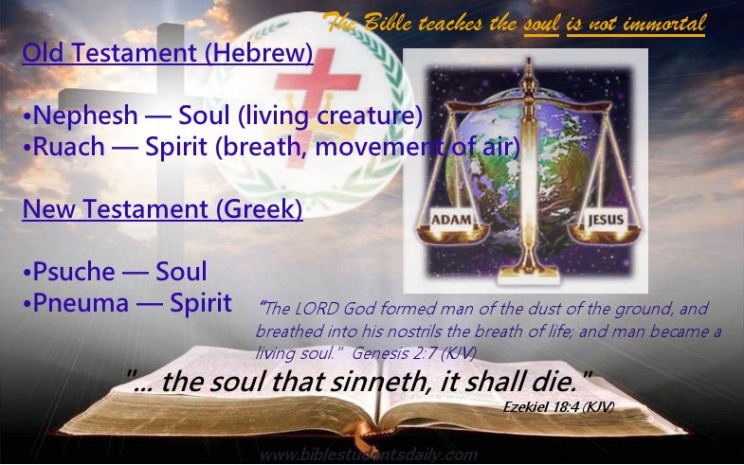
“The soul that sinneth, it shall die” (Ezekiel 18:4).
This brief text expresses a simple truth. Souls die. Against the speculations of some that there is something within a man, a “soul,” which remains alive after death, lingering as a disembodied spirit, the scriptures affirm to the contrary. Death is what it seems to be — death.
When a dog dies, what happens to the dog? It stops breathing, its body decays and returns to the elements. Thought and consciousness immediately terminate. There is no more dog. It does not go to some place prepared for old dogs, to chew bones in bliss, for there simply is no more dog. It is dead, it is gone, it is no more.
Death is the same for human beings. Death is the cessation of life. Psalm 146:4 describes what happens when a man dies. “His breath goeth forth, he returneth to his earth; in that very day his thoughts perish.”
“That which befalleth the sons of men befalleth beasts; even one thing befalleth them: as the one dieth, so dieth the other … they have all one breath … all go unto one place, all are of the dust, and all turn to dust again. (Ecclesiastes 3:19, 20).
The Resurrection
However, unlike the animals, man has the hope of a resurrection from the dead. Animals were made to live for a limited period of time, procreate, age, and pass away as part of the cycle of nature. But man, the height of God’s physical creation, was created with the capacity to live forever. They appreciate life, plan for the future, and cherish the hope for continued life. Accordingly, the prospect of living forever was offered to Adam in the Garden of Eden, by God who created him.
This offer was contingent upon obedience, a test which Adam and Eve failed. But even after being expelled from the Garden, so robust was the human frame that Adam lived 930 years before death claimed his life (Genesis 5:5). Almost 4000 years after Adam sinned, Jesus died as a ransom for father Adam (1 Timothy 2:6), which allows Adam and his posterity a release from the death penalty — in other words, a resurrection from the dead (1 Corinthians 15:22). For the world, this will come during the Millennium so near at hand.
In the meantime, where are all the dead of past ages? They are simply dead. They silently await the resurrection, when they will be reconstituted as the persons they were before they died, to learn the lessons God has for them during the Kingdom on earth.
What is a Soul?
From our opening text, it is apparent that souls do die. The expression “immortal soul,” sometimes used among Christians, is not found in the Bible.
A soul is a living being, whether animal or human, and neither animals nor humans are immortal.
The Hebrew word for soul is nephesh, word number 5315 in Strong’s Concordance, which gives this definition: “A breathing creature, i.e. animal or (abstractly) vitality; used very widely in a literal, accommodated or figurative sense.”
Genesis 2:7 uses the word “soul” for Adam.
“The LORD God formed man of the dust of the ground, and breathed into his nostrils the breath of life; and man became a living soul.”
Here the word nephesh, or soul, is defined as a living being, a body combined with the breathe of life. Thus we learn, that man does not possess a soul, but that he IS a soul, which means simply that man, when alive, is a living being.” Adam subsequently died, and he with all the others silently awaits the resurrection.
Animals as Souls
The “breath of life” which animates the human organism is no different than the breath of life given to the lower animals. In reference to the “beasts and every creeping thing” which perished in the Flood, we read, “All in whose nostrils was the breath of life, of all that was in the dry land, died” (Genesis 7:21,22). Ecclesiastes 3:19-21 informs us that both man and beast “have all one breath, so that a man hath no pre-eminence above a beast.”
As Strong’s Concordance notes, animals are also souls — living beings. However, in the common English version this is hidden by the translation, which confuses the subject to many readers. When the word nephesh, soul, refers to an animal, the translators rendered it with some other word, such as creature or beast.
For example, Genesis 1:20 says “let the waters bring forth abundantly the moving creature [nephesh, soul]…”
Verse 21, “God created great whales, and every living creature [nephesh, soul] that moveth…”
Verse 24, “And God said, Let the earth bring forth the living creature [nephesh, soul] after his kind, cattle, and creeping things, and beast of the earth after his kind: and it was so.”
Here are other texts of the same sort: Genesis 1:30, 2:14, 9:3, 4, 9, 10, 12, 18. And Isaiah 19:10, “… all that make sluices and ponds for fish [nephesh, souls].
This method of translating hides the fact that animals are souls. Were this fact more open and apparent, it would assist people to recognize that souls are not immortal, for no one supposes that animals are in any sense immortal.
Only once in the Old Testament did the translators render the word nephesh “soul” when it applied to animals, namely Numbers 31:28, where the word applies at one time both to people and animals: “one soul of five hundred, both of the persons, and of the beeves, and of the asses, and of the sheep.”
The Difference Between the Human Soul and the Animal Soul
The difference between the soul of a human and an animal is in the construction of the organism, particularly in the formation of the brain. Although some organisms of some of the lower animals may seem to be superior to man’s (such as a dog’s keen sense of smell and hearing and an eagle’s eyesight), God in his great wisdom created man in his own image, thus giving man the ability to reason, and to have a moral sense of right and wrong — possessing a conscience (1 John 3:20-22). Man has the ability to love and obey Jehovah-God as well as to love (agape) his enemies or those who do or wish him wrong through, striving to see all things through the eyes of their Bridegroom — Christ Jesus. He died as a “ransom for all” (1 Timothy 2:6) because of his great love of the Heavenly Father — stemming from a love for righteousness which comes from a knowledge, understanding and experience of the results of obeying the Heavenly Father, which permits the highest and purest form of joy to be felt, that joy that is felt through the eyes of faith, that joy that our Lord Jesus had in bringing the Heavenly Father joy, as reflected in his words: “My food is to do the will of him who sent me and to accomplish his work” (John 4:34, ESV).
Other Hidden References
There are other important places where the translators also obscured the use of nephesh. “There were certain men, who were defiled by the dead body [nephesh, soul] of a man … those men said unto him, We are defiled by the dead body [nephesh, soul] of a man … If any man of you or of your posterity shall be unclean by reason of a dead body [nephesh, soul] …” (Numbers 9:6, 7, 10). If the translation use “soul” in these places, it would be apparent to the reader that souls simply die. When Samson toppled the house of Dagon, he prayed to God: “Let me [my nephesh, soul] die with the Philistines” (Judges 16:30).
Expanded Use
The texts above give us the proper meaning of the word soul, namely any living being. However, Strong’s Concordance shows that nephesh is sometimes used figuratively for one’s life, being, or vitality. Here are two examples of this. (1) When Rachel was dying at the birth of Benjamin, Genesis 35:18 says “As her soul was in departing (for she died) … she called his name Benomi: but his father called him Benjamin.” (2) 1 Kings 17:21, speaking of the raisin of a young boy by Elijah, says he cried to God “let this child’s soul come into him again.” In both of these cases the word “life” or “being” is the meaning intended.
Sometimes the word is used of one’s deepest thoughts or feelings, distinguished from the mere body. Thus 2 Kings 4:27 says of a troubled woman, “her soul is vexed in her.” Language is flexible, and the word nephesh is used flexibly. But none of these cases are any predicate for believing some conscious force called “soul” mysteriously lingers after death. Death is death. It is the cessation of life.
Soul in the New Testament
The New Testament Greek word for soul is psuche. Whenever the word “soul” appears in the common English version of the New Testament, it is from this word (Strong’s number 5590).
1 Corinthians 15:45 uses psuche as the counterpart of the Hebrew nephesh, which serves to equate the two words. “The first man Adam was made a living soul [psuche].” This expression clearly draws from Genesis 2:7, where nephesh is used. This word is frequently rendered life. “Whosoever will save his life shall lose it” (Mark 8:35). “I lay down my life” (John 10:17). “They seek my life” (Romans 11:3), and many other examples. In these cases “life” refers to the being, the person. The same meaning attaches when the word is rendered “soul,” as in Acts 2:43, “fear came upon every soul” — every person, or being.
Revelation 8:9 and 16:3 apply the word to sea creatures. Revelation 6:9 and 20:4 use the term metaphorically of the spent life of the saints, awaiting the resurrection. John 12:27 says of Jesus “now is my soul troubled.” Thus there is a breadth in this Greek word that matches the breadth of its Hebrew counterpart.
In the Old Testament the condition of death is expressed by the Hebrew sheol, and its Greek counterpart in the New Testament is hades. This was the condition into which Jesus’ “soul,” psuche, passed for three days until his resurrection, for a soul, psuche, dies and is later raised from the dead.
The Soul Is Not Immortal
If the soul were truly immortal, the soul would be indestructible, yet it is not, because each human born under the curse of Adamic condemnation, dies until the curse shall be lifted up from humanity once Christ’s ransom price has been applied to all mankind. By then the Bride of Christ will have completed their share in the sin offering — and the antityical “atonement day” sin offering thus completed. The High Priest in Leviticus 16 made atonement for himself, his sons, and then, finally, for the sins of the people (the world of mankind). God warned Adam that if he disobeyed God’s rule, then as a living soul Adam would cease to exist. We read about this in Genesis 2:17, “but of the tree of the knowledge of good and evil you shall not eat, for in the day that you eat of it you shall surely die.” In Ezekiel 18:4 God said, “Behold, all souls are mine; as the soul of the father, so also the soul of the son is mine: the soul that sinneth it shall die.” This means that the person who sins shall die, and since all are born in sin, the entire human race has been dying for nearly 6000 years. Here are two examples of Scriptures about death being the consequence of sin:
“So death spread to all men, because all sinned” (Romans 5:12, NASV).
Every soul [person] sins and, as a consequence, every soul dies (Romans 6:16,23).
But God in his great love provided redemption from death for all sinful souls, or persons, through the gift of his beloved Son, Christ Jesus, who died as a corresponding ransom price to free mankind from the prison house of death. All of Adam’s progeny lost life through Adamic transgression and thus have inherited sin and imperfection. The Apostle Paul wrote that “in Adam all die,” adding to this, “even so in Christ shall all be made alive.” And again, “Since by man came death, by man came also the resurrection of the dead” (1 Corinthians 15:21,22). The Prophet Isaiah wrote that Christ’s “soul” was made an offering for sin, and also that he “poured out his soul unto death” (Isaiah 53:10,12).
John 3:16 says, “For God so loved the world, that he gave his only begotten Son, that whosoever believeth in him should not perish, but have everlasting life.” Adam and all past generations of his children have fallen asleep in death, but they have not “perished,” because through the redemption which is in Christ Jesus, and by the exercise of divine power, they are to be awakened in the resurrection and given an opportunity to believe. Then, upon the basis of their belief and obedience, they may live forever.
Those called to discipleship in the present life are given an opportunity to inherit eternal life by accepting Jesus as their personal Redeemer and responding to the invitation to take up their cross and follow him, gladly lay down their lives with him, and be planted together in the likeness of his death (Roman 6:3-6). These are referred to in Revelation 20:4 as the “souls” which are “beheaded for the witness of Jesus, and for the Word of God.”
The Apostle Paul wrote, “If Christ be not raised, your faith is vain; ye are yet in your sins. Then they also which are fallen asleep in Christ are perished” (1 Corinthians 15:17,18). Thus, Paul speaks of Christians who die as merely being “asleep,” and not in any sense perishing in death.
Genesis 12:11-13 (NASB) says Abraham was afraid that his soul would not live, and thus, that he would die. “It came about when he [Abram] came near to Egypt, that he said to Sarai his wife, See now, I know that you are a beautiful woman; and when the Egyptians see you, they will say, This is his wife; and they will kill me, but they will let you live. Please say that you are my sister so that it may go well with me because of you, and that I (“my soul,” nephesh) may live on account of you.” If the Hebrew word nephesh meant an indestructible immortal soul, Abram’s soul could not have died (Br. Peter Karavas, 2011).
Jesus emphasized this same important truth in an admonition to his disciples to meet courageously any and all opposition against them and any persecuted unto death, saying, “Fear not them which kill the body, but are not able to kill the soul; but rather fear him which is able to destroy both soul and body in hell [Gehenna]” (Matthew 10:28). Jesus here refers to the possibility of permanent cessation of life by God for the incorrigible, which the Bible terms as “second death.”
“This does not imply that the soul can live apart from the body, for actually the body is the organism of the soul. Rather, Jesus is speaking from the standpoint of the divine plan to awaken the dead in the resurrection. It was from this standpoint that Paul could say that Christians who fell asleep in death had not ‘perished.’ If an enemy puts a Christian to death, he has not perished as a soul. The body dies, but the person, the soul, merely ‘sleeps’ until the resurrection. But if a Christian becomes a willful sinner and is not worthy of a resurrection, then death means extinction of that person, or soul, forever.
“Jesus explained this from another standpoint, as recorded in Luke 20:37,38… ‘Now that the dead are raised, even Moses showed at the bush, when he calleth the Lord the God of Abraham, and the God of Isaac, and the God of Jacob. For he is not a God of the dead, but of the living: for all live unto him.’ Jesus did not say that Abraham, Isaac, and Jacob had gone to heaven to live with God. He simply explained that because there is to be a resurrection of the dead, and these faithful servants will be restored to life, God does not consider them as having gone out of existence — they ‘live unto him,’ or, to him they are alive.
“So it is with all God’s faithful servants of the past. They may have been ‘sawn asunder’ by their enemies; they may have been thrown to the lions, or beheaded, or burned at the stake, but to God they still live, they have not ‘perished,’ for he has the power and will use that power to awaken them from the sleep of death.
“The ‘souls’ which are ‘beheaded,’ as mentioned in Revelation 20:4, are brought forth in the ‘first resurrection’ to live and reign with Christ a thousand years. The ‘souls’ that died serving God during the ages preceding Jesus’ first advent will come forth to a ‘better resurrection,’ to serve as ‘princes in all the earth’ — Hebrews 11:35; Psalm 45:16” (The Dawn – and Herald of Christ’s Kingdom Magazine, January 1959 issue).
Lazarus – An Example that the Soul is not immortal
In John 11:11 Jesus said “Lazarus sleepeth.” Lazarus was dead for four days (John 11:39). Surely Jesus would not have retrieved Lazarus from the bliss of heaven. For those four days Lazarus did not go anywhere, nor did he see anyone, nor did he speak, eat, feel, or think. He was simply dead. When he was raised to life he began again to do all those things. In this respect the whole world sleeps in death, waiting for the resurrection — unaware of what is transpiring in the meantime, because the dead do not sense, feel or think anything. “The living know that they shall die: but the dead know not any thing” (Ecclesiastes 9:5). “There is no work, nor device, nor knowledge, nor wisdom, in the grave, whither thou goest” (Ecclesiastes 9:10).
In John 5:28,29 Jesus said that the hour is coming when all in their graves will come forth. If their souls were already in heaven, then there would be no need for Jesus to say that he would bring them forth from the grave? If physical bodies were needed in heaven, how have these presumably immortal souls survived without them? Scripture also tells us that “flesh and blood cannot inherit the kingdom of God, nor does the perishable inherit the imperishable” (1 Corinthians 15:50).
Seeking After Immortality
The Bible never equates immortality with the soul of common man, only with the saints, and then only as a gift for faithfulness (Romans 2:7, 1 Corinthians 15:53-54). The sleeping, unconscious dead will one day be awakened from their graves (John 5:28,29; Job 14:11-15; Psalm 17:15; Acts 24:15,16). At that time, ‘the earth shall be full of the knowledge of the LORD, as the waters cover the sea’ (Isaiah 11:9). ‘Many nations shall come, and say, Come, and let us go up to the mountain of the LORD, and to the house of the God of Jacob; and he will teach us of his ways, and we will walk in his paths’ (Micah 4:2). In God’s kingdom on earth, mankind will be raised from the dead and have their first real opportunity to learn God’s ways of righteousness because Satan will be bound and will no longer be able to deceive the world (Revelation 20:3) (Br. Peter Karavas, 2011).
The Dead Raised To Life In the Resurrection Age
“Possibly the spirit that returns to God contains the unique ‘data’ of each individual can be compared to computer information on a removable disk. The resurrection of an individual could be a recreation after the pattern of Adam. The original body had passed to dust so a new one, either spiritual or fleshly, would be created. The individual again comes to life when the (unique?) spirit is returned to the body and he becomes a living soul again. Whatever the exact process is, we know the resurrected fleshly body will be in its intended perfected state. Job intimates that the flesh will be fresher than a child’s and will have the beauty and vitality of youth (Job 33:25)” (Robert Davis, The Herald of Christ’s Kingdom article.)
Spirit
The word “spirit” in the Old Testament is usually from the Hebrew ruach, and in the New Testament it is usually from the Greek pneuma. Both terms refer to breath, inhalation, or the movement of air, whether gentle or forceful. But as these are invisible forces, the words are applied by extension to the “spirit” of a person which is the invisible mental force, personality, influence, or disposition of a person.
Thus the Old Testament uses ruach when speaking of the “spirit” of Jacob, Elijah, Cyrus, Zerubbabel, Joshua, God, and others. The New Testament uses pneuma when speaking of the “spirit” of Paul, Christ, and God.
These words are also used to describe the influence of various non-personal but good “spirits” — the spirit of Truth, Holiness, Life, Faith, Wisdom, Grace and Glory — and of an opposite spirit of Jealousy, Judgment, Burning, Heaviness, Infirmity, Divination, Bondage, Slumber, Fear and Error.
Ruach also refers to the “spirit of life” which we receive from God, which figuratively “returns” to him when we die. “Then shall the dust return to the earth as it was: and the spirit shall return unto God who gave it” (Ecclesiastes 12:7). This does not imply a transport of persons. It applies to the motivating force of life, of both good and bad people alike.
Both words sometimes refer to the essence of a person, that is, their identity, character, personality. In this sense Jesus commended his “spirit” to God when he died, which was restored on the third day when God raised Jesus from the dead (Luke 23:46, Psalms 31:5).
In this sense also Paul speaks of the “spirits of just men,” the faithful Ancient Worthies of the Old Testament, who were matured by the things they suffered, and await their resurrection reward in the Kingdom (Hebrews 12:23, 11:40).
None of these cases teach that any conscious entity persists after the death of a person, except metaphorically, in the memory of God. Not until the resurrection does a person who has died live again as a conscious, sentient being. The great hope for the world lies in such a Resurrection from the Dead. “There shall be a resurrection of the dead, both of the just and unjust” (Acts 24:15). “The hour is coming, in the which all that are in the graves shall hear his voice, and shall come forth” (John 5:28,29).
This assurance was secured for us at great cost, both by God who gave His dearest treasure, his son Jesus, and by Jesus who labored in his ministry for 3 ½ years, suffered accusation from the religious leaders of his day, and died for our sins on the cross.
“Christ also hath once suffered for sins, the just for the unjust … [to] bring us to God, being put to death in the flesh” (1 Peter 3:18). “By man [Adam] came death, by man [Jesus] came also the resurrection of the dead” (1 Corinthians 15:21).
For the saints of the Gospel Age, this resurrection occurs during the present “Harvest” period. For the remainder of the world, the resurrection will occur during the coming Millennium.
Do Angels Have a Soul?
As with human being, angels are souls, for they are the union of the spirit of life, together with a body, in this case a spiritual body. “The first man Adam was made a living soul…” (1 Corinthians 15:45). It would be the same with the angelic hosts, but on a higher scale. “There are also celestial bodies … but the glory of the celestial is one, and the glory of the terrestrial is another” (1 Corinthians 15:40).
——-
Acknowledgment & References
We are thankful for the permission of sharing content from a study titled “Soul and Spirit,” drawn from a study by Br. Gilbert Rice, featured in the “Faithbuilders Fellowship” Journal.
http://www.2043ad.com/journal/2006/01_jan_06.pdf
“Immortality and the Human Soul,” The Bible versus Tradition—Article IV, April 1959 in The Dawn – A Herald of Christ’s Presence (Monthly Magazine) Rutherford, NJ, USA.
http://www.dawnbible.com/1959/5904tbs1.htm
“Immortality of the Soul” by Br. Peter Karavas. The Herald of Christ’s Kingdom Magazine, May-June 2011.
http://www.heraldmag.org/2011/11mj_3.htm
“The Resurrection of the Dead” by Br. Robert Davis. The Herald of Christ’s Kingdom.
http://www.heraldmag.org/literature/doc_14.htm
Suggested Further Reading
Volume 5 of “Studies in the Scriptures” — “The Atonement Between God and Man” by Br. Charles Taze Russell, pages 383-404, Study 13, “Hopes For Life Everlasting and Immortality Secured by the Atonement.”
“What Is the Soul?” by Br. Robert Seklemian
http://www.heraldmag.org/olb/contents/treatises/seklemians%20discourses.htm
ACTS 23:6 — HOPE & RESURRECTION. Part A: What Is Jesus All About?https://biblestudentsdaily.com/2016/11/03/acts-236-hope-resurrection-part-a-what-is-jesus-all-about/
ACTS 23:6 — HOPE & RESURRECTION. Part B: Will Mankind Resurrect With the Same Mind?
ACTS 23:6 —HOPE & RESURRECTION. PART B. Will Mankind Resurrect With the Same Mind?
ACTS 23:6 — HOPE & RESURRECTION. Part C: The Order of the Resurrection Process
ACTS 23:6 —HOPE & RESURRECTION. PART C: The Order of the Resurrection Process
This post’s URL:







 BIBLE Students DAILY