STUDY 4: The Court (“Holy Place”)

1. COURT --- .jpg

The Tabernacle was surrounded by a yard, or “Court (Exodus 27:9-19), toward the rear of which it stood, and this courtyard is referred to by the Bible translators, as the “holy place” see Leviticus 6:26 and 14:13.

The Court represents the condition of justification, entered through faith in Christ, the “gate.” The tabernacle represents things from the time of Jesus forward. However, there are three time periods in the Plan of God when God through His holy Spirit deals with justified people:

  1.  The Ancient Worthies from Adam until Jordan;
  2.  The Church during the Gospel Age;
  3.  The world during the Millennium Age (Messianic 1000 year reign of Christ with the Church the 144,000 Elect Bride of Christ members).
  • The same is shown in the time in the ark (which pictures redemption) a total of 381 days, which is 3 x 127, that is, three times the age of Sarah, who represents the Abrahamic Covenant.
  • Also in the three times the doves were sent out from the ark in Genesis chapter 8 three missions of the holy Spirit.
  • And again in the three stories or levels of the ark, thus three time periods of justification.

Who Could Enter the Court?

Any Israelite (typical of a justified believer of the Gospel Age) was allowed to come into the Court, as indicated in Leviticus 1:1-3 (ESV):

“(1) The Lord called Moses and spoke to him from the tent of meeting, saying, (2) ‘Speak to the people of Israel and say to them, When any one of you brings an offering to the Lord, you shall bring your offering of livestock from the herd or from the flock. (3) If his offering is a burnt offering from the herd, he shall offer a male without blemish. He shall bring it to the entrance of the tent of meeting, that he may be accepted before the Lord.’”

Leviticus 1:11 shows also that Israelites were to bring their offerings into the court, and kill them there, “on the side of the altar northward before the Lord.” However, the priests would take the blood thereafter, for use at the altar. “And the priests, Aaron’s sons, shall sprinkle his blood round about upon the altar.”

Note: Northward is the direction of God, and the Heavenly Realm. Offering on the north side of the altar emphasizes that the offering is made to God.

The offerers (Israelites) represent believers, coming in faith to make an offering to God whether believers in this age, or in the next.

Israelites commonly came in to make offerings. But the “daily sacrifice” was one lamb in the morning, another in the late afternoon, and these were done by the priests (Exodus 29:38-39).

The daily sacrifice was a burnt offering and it represents the ransom sacrifice of Jesus, who fulfilled this type, thus causing it to cease. The morning and evening times correlate with Jesus being put on the cross in the morning and expiring in the afternoon.

The Apostle Paul explained that our sacrifice is not just to be twice a day but 24/7 hence he defined the consecrated ones of this Gospel Age of the “High Calling” into Christ, as “living sacrifices” who “are holy acceptable unto God, which is your reasonable service” (Romans 12:1).

Around and Inside the Court

(A) Copper

In the Court, the metal used most often was copper.

Copper represents human nature, either justified or perfect.

In John 3:14, Jesus compares himself to the copper serpent lifted up in the wilderness in the days of Moses, which healed those who looked to it. The copper of that serpent represents the perfect humanity of Jesus. The serpent symbol is used to represent that Jesus takes the burden of our sins upon himself, thus curing us from the “snakebite” of sin.

The court contained the “brazen altar” for use by the priests. Possibly Levites assisted the priests in some ways respecting the sacrifices (other than putting it on the altar).

(B) Court Measurements

The court was 50 cubits wide and 100 cubits long thus three of them could fit into the floor plan of Noah’s Ark, which was 50 cubits wide and 300 cubits long (Genesis 6:15). This also suggests that there are three time periods in God’s Plan (as explained at the start of this Tabernacle Study No. 4) where justified persons are called of God. It is notable that the “house of the forest”, picturing the call of the world during the Millennium, was also the size of the court (1 Kings 7:2).

The court was formed by a fence of white linen curtains (see Study 9 on this website in the series “Beauties of the Tabernacle,” titled “The Gate. The Door. The Veil”, suspended from silver hooks, set in the tops of wooden posts 5 cubits (7 1/2 feet high), which were set in heavy sockets of copper (mistranslated brass), and braced, like the tent which covered the Tabernacle, with cords and pins.

(C) The Silver Hooks

The silver hooks in the courtyard posts by which the posts held up the curtain, represent the divine Truth, by the knowledge of which the justified believer holds on to the righteousness of Christ. Silver is a general symbol of Truth but perhaps more specifically, that TRUTH which centers and deals with the RANSOM — the redemption accomplished in Christ Jesus (Tabernacle Shadows, page 114).

As these hooks were small in size they represent the small amount of Truth necessary to justify one.

Note: The Tabernacle Proper’s 100 silver sockets which supported the whole structure was made from the ransom or redemption money paid as a poll tax by the Israelites. (Exodus 30:12-16; 38:25-28.) In “Notes on the Tabernacle” (page 21) we read:

“. . . [God] enjoined that, whenever Israel was numbered as His people, every man must give a ransom for his soul. The price was fixed by God Himself.

Each man, whether poor or rich, must bring the same. One could not pay for another; but everyone must tender his own ransom-money of pure silver and of perfect weight. `Half a shekel, after the shekel of the sanctuary (a shekel is twenty gerahs), a half-shekel shall be the offering of the LORD.’ (Exodus 30:13) Other Gospel truths here shine out. When the question came to be one of ransom, the poor and the rich, the foolish and the wise, the ignorant and the learned, the immoral and the moral, stood on the same level. Each person was estimated by God at the same price. He proved Himself no respecter of persons.”

Hence, since most of the silver used in the Tabernacle was for the 100 foundation sockets for the Tabernacle Proper, this beautifully points to the TRUTH relative to the RANSOM sacrifice of our Lord as the foundation Truth upon which the entire plan of God rests.

“The four gold-plated pillars (posts) at the entrance of the Most Holy supporting the (second) Vail stood in four SILVER sockets, (reality, truth, verity) seeming to say to us, when you come inside this vail, you will be perfect – really and truly new creatures” (Tabernacle Shadows, page 115).

(D) The Posts (pillars)

The posts of the Court (Exodus 27:10-17) represent the justified believers whose imperfections are covered by Christ’s righteousness.

The function of the posts is to hold up to public view one’s faith in Christ who is represented by the linen curtain. This, brethren, is our purpose for being. This is why we are here. To show forth the mercy and goodness of Christ’s redemptive work, as Paul says, “in the midst of a crooked and perverse generation among whom ye shine as lights in the world” (Philippians 2:15).

The posts were made of wood which is a corruptible material thus implying that the class typified, are not actually perfect as human beings.

(E) Sockets of Copper

The posts were set in sockets of copper which were sunken in the sand for stability.

The copper sockets represent our standing of perfect human beings, and this beautifully represents justification by faith, (despite the actual fact of our personal imperfections) which we can only hold onto by the aid of the Truth. This is the justification spoken of in Romans 5:1, “Therefore being justified by faith, we have peace with God through our Lord Jesus Christ.”

Some use the term “tentative justification,” to describe a Christian in the court condition before they reach the point of consecration at the door of the Tabernacle. However the priests also served in the court, and the priests represent the fully consecrated/spirit begotten. So their justification is also indicated in the court. If we simply relate that the court represents justification through faith in Christ, perhaps this suffices. It need not be one way or another  only unconsecrated (not spirit begotten) believers or only consecrated (spirit begotten) believers — as the concept of being justified by one’s faith in Christ can pertain to believers before consecration or believers after consecration.

Thanks to being reckoned as righteous in God’s sight, we are judged as to faithfulness in our intentions rather than in our actions. “For if there be first a willing mind, it is accepted according to that a man hath, and not according to that he hath not” (2 Corinthians 8:12).

Now, with rejoicing we can say with the Apostle Paul, “I can do all things through Christ which strengtheneth me” (Philippians 4:13).

It is thus that our faith becomes “rooted” and the philosophy of the ransom begins to appear. It is of this which Paul speaks in Colossians 2:7, “rooted and built up in him, and stablished in the faith, as ye have been taught, abounding therein with thanksgiving.”

(F) Guy Lines/Ropes/Cords & Pegs
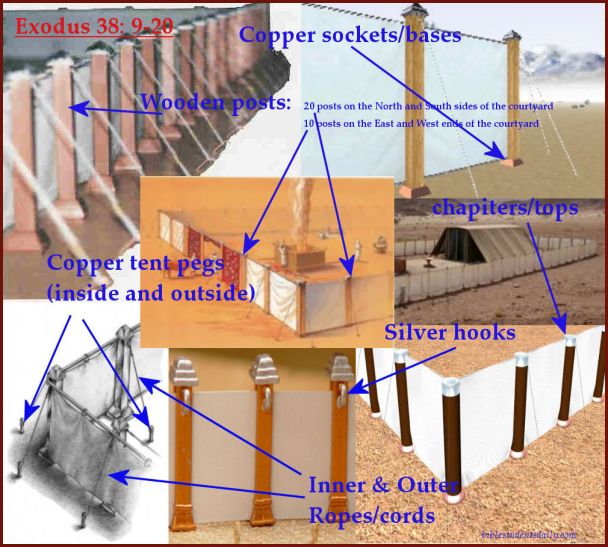
2. FENCE EQUIPMENT.jpg

There is more to the philosophy of the ransom that prevents our faith from becoming weak and unstable. This is shown in the system of guy lines which uphold the wall of the court and tie the posts to the ground.

These cords represented the things which tie the justified believer to the earth; and there were two sets of cords and pins, one set inside the Court, the other, outside.

The set outside of the Court, outside of the justified state, represented the sin in the flesh which ties the believer to the world.

The set inside the Court represented the earthly things: joys, studies, music, etc., right enough in themselves, which bind the believer to the world. These are the weights (Hebrews 12:1).

These ropes were anchored by copper pegs tent pegs. One of these was installed inside the court and the other on the outside. Being copper, as opposed to wood covered with copper, they showed actual human perfection.

As we scan the pages of history we see just two and no more perfect men: Adam and Jesus. We see the one who lost his standing in the court, Adam, as the peg driven outside the fence. The other, grounded firmly in the court, pictures Jesus. These two have one connection the ransom pictured by this cord even as it was by Rahab’s scarlet thread. It is this simple philosophy of the ransom a perfect human life for a perfect human lifethat gives stability to our faith. How beautiful! How simple! Substitutionary atonement is the central doctrine of the Bible.

“For since by man came death, by man came also the resurrection of the dead. For as in Adam all die, even so in Christ shall all be made alive” (1 Corinthians 15:21, 22).

“For if through the offence of one many be dead, much more the grace of God, and the gift by grace, which is by one man, Jesus Christ, hath abounded unto many” (Romans 5:15).

It is the very simplicity of the concept that speaks to its authenticity. Too good to be true? Too good not to be true! And yet our faith is sometimes weak. We need further support.
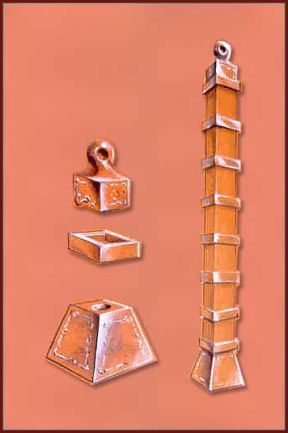
3. COURTYARD PILLARS, BANDS, BASES, SILVER EYELETS.jpgAccording to the Temple Institute in Israel:

The courtyard pillars, (amudim) were composed of three main components: The acacia pillars themselves, which were reinforced by silver bands, (chishukim); the copper bases, (adanim), into which the pillars were inserted; and the silver eyelets, (vavim), which were fitted onto the tops of the pillars, for stretching the curtains, (yeriot) across.

“fillets” Others have concluded that they were rigid, whether rods or bands, and served to stabilize the posts from leaning toward each other. We think that is correct.

The Furnishings In The Court

The Brazen Altar
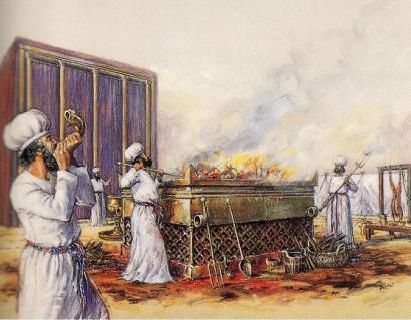
4. BRAZEN ALTAR.jpg

The Brazen Altar was the first item encountered in the Courtyard. It was five cubits square, and 3 cubits tall (Exodus 27:1).

In each of the four corners there was a horn made from the same piece of acacia wood as the altar itself and the altar was over-layed with copper.

The Brazen Altar was used to burn up sacrifices placed upon it, such as during the consecration of the priesthood and the Day of Atonement.

Various utensils belonged to its service fire pans (called censers), for carrying the fire to the ‘Incense Altar,’ basins to receive the blood, flesh hooks, shovels, etc.

A Christian understands this altar is not an ornament of the Court, but a place where bulls and goats were killed and sacrificed, a place many times covered with blood and ashes, with the smell of burning meat, and much smoke. The grate of this altar was not on the top like a modern barbecue. It was placed half way between the bottom and the top of the altar:

“Thou shalt put it [the grate] under the compass of the altar beneath, that the net may be even to the midst [Strong’s #2677: half or middle] of the altar” (Exodus 27:5). This placed the grate at the 1½ cubit mark, the same height as the mercy seat in the Most Holy. Both are considered in the design to be at the same “level;” neither towers above the other.

A Christian recognizes that Jesus has been sacrificed for him and starts to recognize that a similar sacrifice is needed from him if he is to enter beyond the next door. The sacrifice we have to offer, is as the Apostle Paul expresses it, in Romans 12:1.
rom-12-1-2-ad

Thus, the antitypical priesthood of this Gospel age are privileged to use this altar (Christ Jesus), in presenting their bodies “a living sacrifice, holy, acceptable unto God” for is it not the altar that sanctifies the gift?

You blind men! For which is greater, the gift or the altar that makes the gift sacred?” (Matthew 23:19).

“Your sacrifice would not be holy and acceptable, but it is made holy and acceptable as such by the Advocate [Christ Jesus] imputing of his merit to cover your sacrifice” (“What Pastor Russell Said,page 614).

Presenting our bodies as “living sacrifices” to God includes all our thoughts, words and doings and doing the best we can in all we do to bring God glory, honor and praise. It is Christ Jesus, our antitypical High Priest who alone is able to offer up the antitypical sacrifices. All that the followers of Jesus do, therefore, is to present (consecrate, set apart) themselves, as pictured in the type by the goat’s being, tied at the door of the Tabernacle. “It is after Jesus lays hold of this individual, accepts his consecration, imputes His own merit, and offers him to the Father, that the Father’s acceptance is manifested through the Son… by the begetting of the Holy Spirit. Thereforth, such an one is a member of the Body of Christ, and his name is written in the Lamb’s Book of Life, from which it will not be blotted out if he maintains his faithfulness” (What Pastor Russell Said, page. 614).

“It is the New Creature’s business to keep the old nature on the altar, upon which the great High Priest has put it. In other words, the New Creature must keep the old nature dead, hold it in subjection. When our flesh is brought into contact with the fires of experience for its consumption, it is the old creature that weeps, not the New Creature. Let the goat weep if it will. The New Creature will rejoice in the Lord and in His providential care, as daily it grows in grace and in knowledge. When the old creature is knocked out, or brow-beaten, as the Apostles says (1 Corinthians 9:27), it will groan; but the New Creature will be glad and rejoice in the Lord… We rejoice because God’s favor and blessing are with us as New Creatures.” (What Pastor Russell Said, page 613.) See also Acts 16:26, Philippians 4:4.

Jesus allowed himself to be sacrificed for the entire world of mankind. He was perfect and became flesh to do the will of his Heavenly Father (John 4:34, John 6:38).

The wood of the altar, typifying humanity, reminds us that Christ became a man for the express purpose of experiencing our infirmities and “to minister, and to give his life a ransom for many” (Mark 10:45).

“For we have not an high priest which cannot be touched with the feeling of our infirmities; but was in all points tempted like as we are, yet without sin” (Hebrews 4:15).
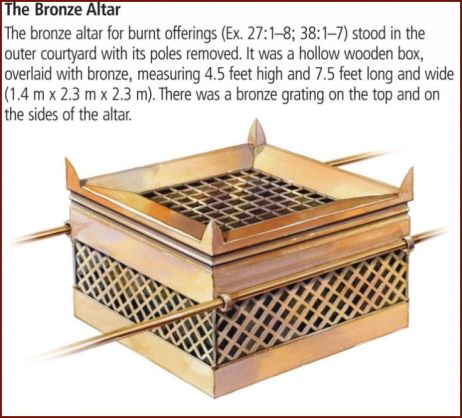
5-bronze-altar

There is a thought that wood was used to make the articles of lighter weight and thus, more easily portable, than if of solid metal. This was an important consideration when they traveled.

As discussed earlier in this series of “Beauties of the Tabernacle,” the use of copper represents the human nature in its perfection, a little lower than the angelic nature (unlike gold, which represents the divine nature, far above angels, principalities and powers).

As gold and copper are much alike in their appearance, yet different in quality, so the human nature is an image and likeness of the divine, adapted to earthly conditions.

“The Tabernacle’s altar of burnt-offering represents… the ransom-sacrifice of Christ Jesus (Tabernacle Shadows, page 22) — the ‘altar’ unto which the world of mankind in the Millennial age, will bring its sin-, trespass-, burnt-, and peace-offerings. (Tabernacle Shadows, page 95,96)” (“Notes on the Tabernacle,” page 134).

The horns of the Altar of Burnt Offering were in themselves symbols of power; yet this power came from the blood which sanctified it. The Scriptures do set forth the fact that one guilty of a sin against his fellowman, when in danger of being apprehended, might flee for asylum to the altar — take hold of its horns, and find a safe refuge there (1 Kings 1:50; 2:28).

“We too have an altar, the power of which stems from the blood of Christ Jesus, that sanctified it. We too, had sinned against our King, who could justly have destroyed us. But we fled to the altar and found sanctuary, an asylum, a refuge, there. Our faith in the precious blood, justified us — made us free as it were; but only on one condition could we continue to be free and that was that we covenant with our King thereafter to walk “worthily.” Having entered into this covenant we are safe from the “avenger.” But should the time ever come when we would break that covenant by profaning the blood of the covenant by which we were sanctified — outraging the Spirit of grace (Hebrews 10:29) — we would then fall directly into the hands of the “avenger” and be put to death — the Second Death!” (“Notes on the Tabernacle,” page 130).

Was there a ramp?

Some may question whether there was a ramp attached to this brazen altar which would assist the priests with getting the sacrifices onto the large surface area of the altar.

We read in Exodus 20:26, “Neither shalt thou go up by steps unto mine altar, that thy nakedness be not discovered thereon.”
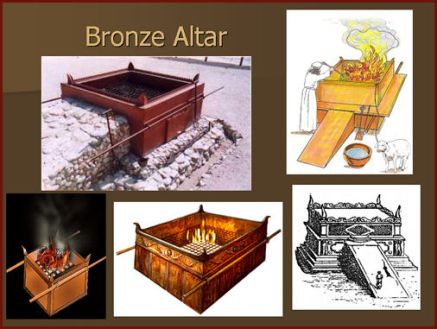
4.4 - BRONZE ALTAR.jpg
“It is worthy of note that the Hebrew word ‘maalah’ occurring [here] in Exodus 20:26 and there rendered ‘steps’ in the KJV, according to Young’s Analytical Concordance to the Bible means ‘a going up, ascent.’ It would therefore cover even such a thing as a ramp, though this latter term has nowhere been used in the common version of the Bible. It has been rendered ‘stairs’ (2 Kings 9:13; Nehemiah 3:15; 12:37; Ezekiel 40:6; 43:17) and ‘steps’ (Exodus 20:26; 1 Kings 10:19, 20; 2 Chronicles 9:18,19; Ezekiel 40:22, 26, 31, 34, 37, 49).

“No priests were ever to enter the precincts of Jehovah — the Tabernacle’s Court, Holy, or Most Holy — without the linen breeches ‘to cover their nakedness’ upon them (Exodus 28:42,43). Especially is the injunction given that Jehovah’s altar was not to have any steps (stairs or ramp) unto it, since an approach by way of such would necessitate the ‘lifting of the robe’ and the consequent exposure of the priest’s nakedness (Exodus 20:26)” (Br. Anton Frey, “Notes on the Tabernacle,” page 133).

The Laver
4..jpg
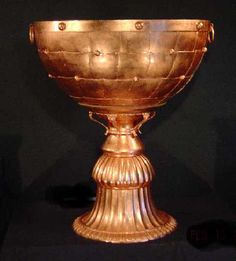
“The LORD spoke to Moses, saying, ‘You shall also make a laver of bronze, with its base of bronze, for washing; and you shall put it between the tent of meeting, and the altar, and you shall put water in it. Aaron and his sons shall wash their hands and their feet from it; when they enter the tent of meeting, they shall wash with water, so that they will not die; or when they approach the altar to minister, by offering up in smoke a fire sacrifice to the LORD. So they shall wash their hands and their feet, so that they will not die; and it shall be a perpetual statute for them, for Aaron and his descendants throughout their generations’” (Exodus 30:17-21).

The Laver stood between the brazen altar and the door of the Tabernacle or “sanctuary”. It was a receptacle for water where the priests washed his feet and hands leaving behind the last traces of the flesh and of his contact with the surrounding world, before entering the Tabernacle.

The Laver as a whole represented the Word of God, Jesus was the word who cleanses the believer through the washing of water by the Word (Ephesians 5:26).

The Laver was cast from the mirrors of women who served at the Tabernacle, thus it was made of polished copper (Exodus 38:8) which represents the brightness of Jesus’ perfection. As the priests looked into the laver, they could see the faces reflected in its polished surface, so the consecrated see the imperfections and failings of their own characters when they compare these characters to the bright perfection of Jesus by looking unto him.

2
The priests did not bathe in the Laver, but presumably drew water out of the laver using a copper pitcher for the purpose of washing his hands and feet (Exodus 40: 31, 32) otherwise the water in the laver would become dirty.

So we are greatly helped by concordances, dictionaries, etc. We cannot wash in them, but they help us in getting the Truth to cleanse us. And we likewise, cleanse our hands that they may do the will of God, and our feet that they may walk in Jesus’ footsteps, in the straight and narrow way.

At this step an approaching Christian accepts this purification as did all the followers of Jesus. Even if the Master did not need any purification, since he was perfect and without sin, by washing the feet of his disciples Jesus showed another important element of that washing: humility.

Now the Christian is at the door of the Tabernacle. After his journey through the Court, he is ready to follow his Master into the “greater and more perfect tabernacle” (Hebrews 9:11, KJV).

Acknowledgment

Br. Charles T. Russell for source material used from Tabernacle Shadows,” “What Pastor Russell Said” (Question Book).
Br. Anton Frey for source material used from Notes on the Tabernacle.
Br. David Rice & Br. George Tabac for sharing of content and editing for this post.
The Temple Institute in Israel for source material used.

Suggested Further Reading

STUDY 1: An Introduction To The Tabernacle And It’s Purpose
https://biblestudentsdaily.com/2016/09/02/study-1-an-introduction-to-the-tabernacle-and-its-purpose/

STUDY 2: The Pillar of Cloud By Day And The Pillar of Smoke By Night  https://biblestudentsdaily.com/2016/09/09/study-2-the-pillar-of-cloud-by-day-and-the-pillar-of-smoke-by-night/

STUDY 3: The Tabernacle Construction: The Holy and The Most Holy  https://biblestudentsdaily.com/2016/09/14/study-3-the-tabernacle-construction-the-holy-the-most-holy/

STUDY 5: The Camp. The Israelites.
https://biblestudentsdaily.com/2016/10/28/study-5-the-camp-the-israelites/

STUDY 6: The Levites
https://biblestudentsdaily.com/2016/11/18/study-6-the-levites/

STUDY 7: The Priests. The Day of Atonement.
https://biblestudentsdaily.com/2016/12/10/study-7-the-priests-the-day-of-atonement/

STUDY 8: The Tabernacle Coverings
https://biblestudentsdaily.com/2017/01/02/study-8-the-tabernacle-coverings/

STUDY 9: The Gate. The Door. The Vail.
https://biblestudentsdaily.com/2017/03/01/study-9-the-gate-the-door-the-vail/


The URL for this post:

STUDY 4: The Court (“Holy Place”)

Enter your email address to subscribe to this blog and receive notifications of new posts by email.

Save

Save

STUDY 2: The Pillar of Cloud by Day and The Pillar of Smoke by Night

“Moreover thou leddest them in the day by a cloudy pillar; and in the night by a pillar of fire, to give them light in the way wherein they should go.” (Nehemiah 9:12)

1-picture-1
THE HISTORY ABOUT THE PILLAR OF CLOUD AND FIRE

The First Appearance of the Cloud and Fire

God’s miraculous guidance of Israel from Egyptian bondage was evident through the sign of a pillar of a cloud. The first account of this pillar of cloud and fire in the Bible, is in Exodus 13:20-22 (ESV):

20 And they moved on from Succoth and encamped at Etham, on the edge of the wilderness. 21 And the Lord went before them by day in a pillar of cloud to lead them along the way, and by night in a pillar of fire to give them light, that they might travel by day and by night. 22 The pillar of cloud by day and the pillar of fire by night did not depart from before the people.”

This text suggests that the pillar appeared when the Israelites departed Succoth, the first camp after departing Rameses on 15 Abib (Nisan), 1445 BC (2513 years after the creation of Adam ). Smith’s Bible Dictionary (at BibleHub.com) says Succoth (“booths”) was reached at the close of the first day’s march and that the distance traversed each day was about 24 kilometres (fifteen miles).  Following is a map of Israel’s journey through the first part of their 40 years in the wilderness.

2-map

(This map follows a conventional view. “More recent opinions place Mount Sinai further north at Har Karkom. Please see http://www.Harkarkom.com for specifics”, Br.David Rice, 2016. For a detailed account of Israel’s journey, giving each encampment, refer to Numbers 33.)

The Second and Subsequent Accounts of the Cloud and Fire

The next account in the Bible of this pillar of cloud is in Exodus 14:19‑20, after God instructed Moses to raise his staff, stretch out his hand over the sea, and divide the waters of the Red Sea for the Israelites to escape Pharaoh and his army pursing the Israelites. They had overtaken the Israelites as they camped by the sea near Pi Hahiroth, opposite Baal Zephon (Exodus 14:16, 9).

Exodus 14:19-20 (ESV) reads, “19 Then the angel of God who was going before the host of Israel moved and went behind them, and the pillar of cloud moved from before them and stood behind them, 20 coming between the host of Egypt and the host of Israel. And there was the cloud and the darkness. And it lit up the night without one coming near the other all night.” Subsequently “during the last watch [“morning watch” – KJV] of the night, the LORD looked down from the pillar of fire and cloud at the Egyptian army and threw it into confusion” (Exodus 14:24, NIV). If there were four watches in the night, the last would have been about 3‑6 am. This suggests that the Israelites had crossed the Red Sea during the night, around the hours of 3‑6 am which would be classified as the 4th watch of the night (if there were four night watches).

The Pillar of Cloud and Fire and Its Association with the Tabernacle

When it was time for the long awaited moment of God’s glory to “move into” the newly built and consecrated Tent of Meeting:

34 Then a cloud covered the tent of the congregation, and the glory of the Lord filled the tabernacle.

35 And Moses was not able to enter into the tent of the congregation, because the cloud abode thereon, and the glory of the Lord filled the tabernacle.

36 And when the cloud was taken up from over the tabernacle, the children of Israel went onward in all their journeys.

37 But if the cloud were not taken up, then they journeyed not till the day that it was taken up.

38 For the cloud of the Lord was upon the tabernacle by day, and fire was on it by night, in the sight of all the house of Israel, throughout all their journeys” (Exodus 40:34-38).

This occurred on the first of Abib, the following year, after the Tabernacle had been erected (Exodus 40:1, 17). Later, when God led them away from mount Sinai, He continued to direct them by the movement of the cloud representing His presence. “They departed from the mount of the LORD three days’ journey: and the ark of the covenant of the Lord went before them in the three days’ journey, to search out a resting place for them. And the cloud of the Lord was upon them by day, when they went out of the camp” (Numbers 10:33-34).

The Last Account of the Pillar of Cloud and Fire

The pillar of cloud and fire was present throughout Israel’s 40 years in the wilderness (Exodus 40:38). Numbers 12:10 refers to it in the incident of Miriam’s complaint against Moses. “When the cloud removed from over the tent, behold, Miriam was leprous, like snow. And Aaron turned toward Miriam, and behold, she was leprous.” It is mentioned also in Numbers 14:14, 16:42, Deuteronomy 1:33, and Deuteronomy 31:15 as the life of Moses was drawing to a close.

In 960 BC the Temple of Solomon was dedicated, replacing the function originally served by the Tabernacle (and any other “temple” that may have been temporarily in use between the two, 1 Samuel 1:9).

The pillar of cloud was no longer required after Israel settled in Canaan, for they no longer needed a token from God to direct their travels, giving “them light on the way they were to take” (Nehemiah 9:12).

One commentary suggested the following about the Feast of Tabernacles that Israel observed after settling Canaan. “This feast, also called Succoth, was to commemorate the protection God provided in the wilderness and it may have marked the cessation of the fiery pillar” (The Herald of Christ’s Kingdom, May-June 2006, “A Pillar and a Fire,” Br. Carl Hagensick).

The manna had stopped the day after the Israelites ate the food from Canaan (Joshua 5:12).

Perhaps the pillar of cloud and fire had completed its purpose about that time also. Notably, the account of the crossing of the Jordan River into the Land of Canaan (Joshua chapters 3, 4) does not mention Israel following the cloud. Joshua 3:3‑4: “As soon as you see the ark of the covenant of the Lord your God being carried by the Levitical priests, then you shall set out from your place and follow it. 4Yet there shall be a distance between you and it, about 2,000 cubits in length. Do not come near it, in order that you may know the way you shall go, for you have not passed this way before.”

The “Dense Cloud”

The “dense cloud” over Mount Sinai apparently was different than the “pillar of cloud,” for “dense cloud” brought darkness, whereas the pillar of cloud evidently had not.

The Israelites came to Mount Sinai at the opening of month three after the Exodus (Exodus 19:1). At Sinai, God told Moses “I am going to come to you in a dense cloud, so that the people will hear me speaking with you and will always put their trust in you” (Exodus 19:9).

Three days later there was thunder and lightening with a thick cloud over Mount Sinai and a very loud trumpet blast. “Mount Sinai was covered with smoke because the Lord descended on it in fire. The smoke billowed up from it like smoke from a furnace, the whole mountain trembled violently” (Exodus 20:16, 18, NIV). Then God called Moses to the top of the mountain where he stayed 40 days and nights and was given the ten commandments. “The people remained at a distance while Moses approached the thick darkness where God was” (Exodus 20:21).

Though the “dense cloud” and the pillar of cloud were distinct, both indicated the presence of God. This would have been an enduring sign to the Israelites that God was with them all during their 40 years of wandering.

POSITION

If the pillar of cloud and fire remained over the Tabernacle, after it was constructed, then it would have been over the center of the camp of Israel, for the various tribes camped about the Tabernacle (Numbers 2:17). The Tabernacle was no longer “outside the camp”, where “Moses used to take a tent and pitch it … some distance away, calling it the “tent of meeting”. (Exodus 33:7)

When the cloud lifted to direct Israel, it moved forward, ahead of them. However, in Exodus 14:19, 20, 24, it move behind them to protect them. “And the angel of God, which went before the camp of Israel, removed and went behind them; and the pillar of the cloud went from before their face, and stood behind them: and it came between the camp of the Egyptians and the camp of Israel; and it was a cloud and darkness to them, but it gave light by night to these: so that the one came not near the other all the night. … And it came to pass, that in the morning watch the LORD looked unto the host of the Egyptians through the pillar of fire and of the cloud, and troubled the host of the Egyptians.”

Over the Most Holy

Apparently the usual resting place of the cloud was over the Most Holy of Israel’s tabernacle. It is theorized by some that the Shekinah light, that shone between the two golden cherubim on the Ark of the Covenant, was caused by an interaction between the electrically‑charged cloud and the Mercy Seat with its two carved angelic figures. If this conjecture is correct, it shows that divine wisdom, represented in the light, is a product of GOD, whose presence was indicated by the cloud, and the harmonious balance between the attributes of love and power, shown in the cherubim, and justice, represented by the Mercy Seat itself.

At the Door of the Tabernacle

On occasion, however, when GOD wished to make a pronouncement to His chosen people, the cloudy pillar took up a position at the door of the tabernacle. Three such occasions are mentioned (Exodus 33:9,10, Numbers 12:5, Deuteronomy 31:15).

SHAPE

There are two thoughts as to the shape of this miraculous cloud. Some view it as an upright plume as suggested by the word “pillar”, as shown here:

3-smoke
Others envision it more as a canopy similar to the cloud in this picture.

4. cloud.jpg
PURPOSE OF THE TWO PILLARS

The pillar of a cloud and of fire served in the following ways.

(1) God’s compass

It showed the Israelites where God wanted them to go and what God’s will for them was. The Psalmist David draws inspiration from this guiding light.

As Spirit begotten Christians, our compass is:

(a) God (Psalm 32:8) and Jesus (John 1:1‑12);
(b) the holy Spirit (Romans 8:26);
(c) the Word of God in the Bible;
(d) from the mouth of our brethren in Christ (Psalm 119:105).

(2) God’s instruction

The Israelites learned to discern God’s will by being given instruction through the movement of the pillars of cloud and fire. “Moses and Aaron among his priests, and Samuel among them that call upon his name; they called upon the Lord, and he answered them. He spake unto them in the cloudy pillar: they kept his testimonies, and the ordinance that he gave them” (Psalm 99:6,7).

As Christians we receive instruction also from the Word and God and the holy Spirit: “But the Comforter, even the holy Spirit, whom the Father will send in my name, it shall teach you all things, and bring to your remembrance all that I said unto you” (John 14:26).

(3) Israel’s Protection Mechanism

a) Shelter

Isaiah 4:5‑6 (RSV) sheds light on this point. “Then the LORD will create over the whole site of Mount Zion and over her assemblies a cloud by day, and smoke and the shining of a flaming fire by night; for over all the glory there will be a canopy and a pavilion (“defense” in the KJV). It will be for a shade by day from the heat, and for a refuge and a shelter from the storm and rain.”

The cloud served as a “canopy” that provided both “shade by day from the heat” and as “a refuge and a shelter from the storm and rain.” This implies a large cloud for the horde of two million Israelites plus their flocks and herds. Usually clouds bring rain, not shelter from rain. Clouds are porous and thus incapable of keeping out rain. But this miraculous pillar of cloud was unique in its ability to prevent the saturation of a down pour of desert rain.

Perhaps the lesson for us as Christians today is this: that God’s wisdom will not lead us where his grace cannot keep us. Faith can firmly trust him, come what may!

b) Security & Protection

The pillars of cloud and fire gave the Israelites a feeling of security—that God was watching over them. God accompanied the nation of Israel by either going ahead of them or placing himself in the rear of their group, thus protecting them against their enemies and against death itself (Exodus 14:19‑20).

Spiritual Israelites have the protection of the “armour of God” (Ephesians 6:10‑18):

“10 Finally, my brethren, be strong in the Lord, and in the power of his might. 11 Put on the whole armour of God, that ye may be able to stand against the wiles of the devil. 12 For we wrestle not against flesh and blood, but against principalities, against powers, against the rulers of the darkness of this world, against spiritual wickedness in high places. 13 Wherefore take unto you the whole armour of God, that ye may be able to withstand in the evil day, and having done all, to stand. 14 Stand therefore, having your loins girt about with truth, and having on the breastplate of righteousness; 15 And your feet shod with the preparation of the gospel of peace; 16 Above all, taking the shield of faith, wherewith ye shall be able to quench all the fiery darts of the wicked. 17 And take the helmet of salvation, and the sword of the Spirit, which is the word of God: 18 Praying always with all prayer and supplication in the Spirit, and watching thereunto with all perseverance and supplication for all saints.”

(4) A visual reminder to reverence God

The pillar of cloud and fire reminded the Israelites about who they were to serve. It was thus a warning, in a sense, to not worship foreign gods. It was a faith‑building and trust‑in‑God provoking tool for the Israelites (Exodus 19:9).

God wanted the Israelites to also show respect to Moses, the Mediator of the nation. So we, also, are taught to respect the Elders of the ecclesias that we meet with either for online meetings or physical meetings. They are chosen mouthpieces of God who deserve double honor (1 Timothy 5:17), “Let the elders who rule well be considered worthy of double honor, especially those who labor in preaching and teaching.”

Do we remember what happened when Solomon’s son Rehoboam did not listen to the Elders but followed the advice of the young men who he had grown up with? (1 Kings 12:6‑19). Let us learn from such examples to respect our Elders.

5. tab.jpg
The spirit begotten Christian is given reminders through the holy Spirit working within—we develop an educated conscience through studying the Word of GOD and through prayer. We also receive reminders from Brethren in Christ such as the Apostle Paul reminded the Brethren through the disciple Timothy (1 Timothy 1:14‑16, ESV) –

“14 Remind them of these things, and charge them before God not to quarrel about words, which does no good, but only ruins the hearers. 15 Do your best to present yourself to God as one approved, a worker who has no need to be ashamed, rightly handling the word of truth. 16 But avoid irreverent babble, for it will lead people into more and more ungodliness.”

In Titus 3:1‑11 (ESV), Paul wrote to Titus these words about what to remind the brethren in Crete.

“1 Remind them to be submissive to rulers and authorities, to be obedient, to be ready for every good work, 2 to speak evil of no one, to avoid quarreling, to be gentle, and to show perfect courtesy toward all people. 3 For we ourselves were once foolish, disobedient, led astray, slaves to various passions and pleasures, passing our days in malice and envy, hated by others and hating one another. 4 But when the goodness and loving kindness of God our Savior appeared,

5 he saved us, not because of works done by us in righteousness, but according to his own mercy, by the washing of regeneration and renewal of the Holy Spirit, 6 whom he poured out on us richly through Jesus Christ our Savior, 7 so that being justified by his grace we might become heirs according to the hope of eternal life. 8 The saying is trustworthy, and I want you to insist on these things, so that those who have believed in God may be careful to devote themselves to good works. These things are excellent and profitable for people.

9 But avoid foolish controversies, genealogies, dissensions, and quarrels about the law, for they are unprofitable and worthless. 10 As for a person who stirs up division, after warning him once and then twice, have nothing more to do with him, 11 knowing that such a person is warped and sinful; he is self‑condemned.”

(5) A sign of God’s power

Not only were these two pillars a witness to the Israelites but also a witness to the surrounding nations that Israel’s God was wise, powerful, and protective of his chosen people: “And they will tell it to the inhabitants of this land: for they have heard that thou Lord art among this people, that thou Lord art seen face to face, and that thy cloud standeth over them, and that thou goest before them, by day time in a pillar of a cloud, and in a pillar of fire by night” (Numbers 14:14).

6-tab

CLOUDS IN THE BIBLE

Clouds are mentioned throughout the Bible and often signify trouble, or a time of judgment. Here are some examples.

Psalms 97:2“Clouds and thick darkness surround Him; Righteousness and justice are the foundation of His throne.”

Job 37:11 “Also with moisture He loads the thick cloud; He disperses the cloud of His lightning.”

Revelation 14:14 “Then I looked, and behold, a white cloud, and sitting on the cloud was one like a son of man, having a golden crown on His head and a sharp sickle in His hand.”

Here the white cloud represents blessing as opposed to dark thunder clouds. Jesus sits on it showing that he is in control since the beginning of 1874 (Christ’s invisible second presence) when the end of the harvest, and the sifting of wheat and tares, began. This continues until the last member of the 144,000 Bride of Christ goes beyond the vail, that is, completes their sacrifice until death and becomes a Divine being. The sharp sickle held by Jesus is for gathering the Church, not the world.

1 Thessalonians 4:17“Then we who are alive and remain will be caught up together with them in the clouds to meet the Lord in the air, and so we shall always be with the Lord.”

This verse also applies to Christ’s (invisible) Parousia—the Suntelia periodthe ending period of the Gospel Age, described in Matthew 24.

Leviticus 16:2“The Lord said to Moses: ‘Tell your brother Aaron that he shall not enter at any time into the holy place inside the vail, before the mercy seat which is on the ark, or he will die; for I will appear in the cloud over the mercy seat.'” This refers to the cloud of incense, not the cloud over the Tabernacle.

1 Kings 8:10‑12“It happened that when the priests came from the holy place, the cloud filled the house of the Lord, so that the priests could not stand to minister because of the cloud, for the glory of the Lord filled the house of the Lord. Then Solomon said, “The Lord has said that He would dwell in the thick cloud.”

Fire in the Bible

Fire in the Bible represents: purging and destruction. Here are some examples of Scripture:

Hebrews 12:29“For our God [is] a consuming fire.”

Luke 3:16“John answered, saying unto [them] all, I indeed baptize you with water; but one mightier than I cometh, the latchet of whose shoes I am not worthy to unloose: he shall baptize you with the Holy Ghost and with fire:”

Jeremiah 20:9“Then I said, I will not make mention of him, nor speak any more in his name. But [his word] was in mine heart as a burning fire shut up in my bones, and I was weary with forbearing, and I could not [stay].”

Jeremiah 23:29“[Is] not my word like as a fire? saith the LORD; and like a hammer [that] breaketh the rock in pieces?”

Luke 12:49“I am come to send fire on the earth; and what will I, if it be already kindled?”

1 Corinthians 3:15“If any man’s work shall be burned, he shall suffer loss: but he himself shall be saved; yet so as by fire.”

Revelation 20:9“And they went up on the breadth of the earth, and compassed the camp of the saints about, and the beloved city: and fire came down from God out of heaven, and devoured them.”

Revelation 21:8“But the fearful, and unbelieving, and the abominable, and murderers, and whoremongers, and sorcerers, and idolaters, and all liars, shall have their part in the lake which burneth with fire and brimstone: which is the second death.”

The fire that purges evil from the world, is not literal fire, but a symbol of destruction of the evil systems of the world approaching in Armageddon. This will lead into the most glorious world government ever seen. Earth will be ruled by Christ and his Bride for 1000 years during a reign of righteousness until God shall be all in all.

No cloud or fire either figurative or literal will be required
in the future eternal eternities.

No longer will a Tabernacle or Temple be needed (Revelation 21:22-27), and God shall dwell in the hearts of all people as His laws will be in their minds (Hebrews 8:10; 10:16).

As the fiery pillar led Israel safely to the promised land of Canaan, may God’s presence in our lives lead us to our promised Zion, our heavenly and perfect and holy home.

7. flower -c.jpg

Acknowledgement

We wish to thank Br. David Rice for his great zeal in the Lord’s work and patient endurance in the editing and sharing of content for this post in the “Beauties of the Tabernacle” Series on http://www.BIBLEStudentsDAILY.com

References

Special thanks to Br. Carl Hagensick for source material from his article “A Pillar and a Fire,” The Herald of Christ’s Kingdom, May-June 2006.

Further Suggested Reading

STUDY 1: An Introduction To The Tabernacle And It’s Purpose
URL: https://biblestudentsdaily.com/2016/09/02/study-1-an-introduction-to-the-tabernacle-and-its-purpose/

STUDY 3: The Tabernacle Construction: The Holy and The Most Holy   https://biblestudentsdaily.com/2016/09/14/study-3-the-tabernacle-construction-the-holy-the-most-holy/

STUDY 4: The Court (“Holy Place”)
https://biblestudentsdaily.com/2016/09/20/study-4-the-court-holy-place/

STUDY 5: The Camp. The Israelites.
https://biblestudentsdaily.com/2016/10/28/study-5-the-camp-the-israelites/

STUDY 6: The Levites
https://biblestudentsdaily.com/2016/11/18/study-6-the-levites/

STUDY 7: The Priests. The Day of Atonement.
https://biblestudentsdaily.com/2016/12/10/study-7-the-priests-the-day-of-atonement/

STUDY 8: The Tabernacle Coverings
https://biblestudentsdaily.com/2017/01/02/study-8-the-tabernacle-coverings/

STUDY 9: The Gate. The Door. The Vail.
https://biblestudentsdaily.com/2017/03/01/study-9-the-gate-the-door-the-vail/

The URL of this post:

STUDY 2: The Pillar of Cloud by Day and The Pillar of Smoke by Night

Enter your email address to subscribe to this blog and receive notifications of new posts by email.


Save

Save

Save

STUDY 1: An Introduction to the Tabernacle and It’s Purpose

“LORD, I have loved the habitation of thy house, and the place where thine honour dwelleth.” – Psalm 26:8 (KJV)

1. 1 - TABERNACLE - WITH BORDERS.jpg
A Definition of the Tabernacle

The Lord said to Moses, …let them make me a sanctuary; that I may dwell among them” (Exodus 25:8). “I will put My tabernacle in your midst, and My soul shall not loathe you” (Leviticus 26:11).

The Tabernacle (which in Hebrew is: מִשְׁכַּן‎‎, mishkan and means “residence” or “dwelling place”), is also referred to by Yahweh God as the “Tent of Meeting” (Exodus 40) and comprised of both a “Holy” and “Most Holy” place which was surrounded by a fenced court area.

The Tabernacle represents how the plan of God proceeds during the age of sacrifice (the Gospel Age), as distinguished from the Temple of Solomon, which represents how the plan of God proceeds during the Millennium.

Length of Time of Operation

When was the Tabernacle first set up?

The Tabernacle was first set up “on the first day of the first month in the second year,” nearly a year after the nationwide exodus of the Israelites from Egypt (Exodus 40:2, 17).

The Isaelites departed Rameses “in the first month, on the fifteenth day” (Numbers 33:3), that would be Abib 15, 1445 BC. The Tabernacle was set up Abib 1, 1444 BC.

Abib is the month later named Nisan, as in Nehemiah 2:1, after the Babylonian captivity, deriving from the Babylonian month name Nisanu.) Abib/Nisan falls somewhere within our months of March and April. It changes in relation to our months because the Jews use a lunar calendar (months of 29 or 30 days), with an extra month inserted in the year periodically to maintain the seasons.

How long was the Tabernacle in use?

The Tabernacle and all its furnishings and surrounding court equipment was transported by the 3 clans of Levites (Kohathites, Gershonites and Meraritessee Numbers chapter 4) on their 40 year journey through the wilderness to the promised land.

It continued in use during the period of Judges for an unknown period of time. 1 Samuel 1:9 suggests that some other temporary structure may have been used by the time of Eli, the high priest.

The most sacred article of the Tabernacle was the Ark of the Covenant. This was captured by the Philistines during the time of Eli, who tumbled backward on hearing the news, and died at the age of 98 (1 Samuel 4:14-18). Four generations later, Solomon built a temple as the dwelling place of God.

When the ark had been captured by the Philistines it remained in their control for seven months (1 Samuel 6:1). Because of the plagues it caused them, the Philistines returned the ark to the Israelites, ultimately residing at Kiriath Jearim (1 Samuel 6:21). Twenty year later the Philistine oppression was broken by God under the leader of Samuel (1 Samuel 7:2 and following).

Solomon’s Temple superseded the Tabernacle. It was founded “in the four hundred and eightieth year after the Israelites had come out of Egypt, in the fourth year of Solomon’s reign over Israel in the month of Ziv(1 Kings 6:1).

{Note: “Ziv” in Hebrew meaning “light” or “glow” and after the Babylonian Exile, the name of this month was changed to being called “Iyar” and falls in April-June on the Gregorian calendar.}

The Temple was founded in 966 BC. It was part of seven years in building, and when complete the ark was moved into the Temple (1 Kings 8).

The Purpose of the Tabernacle

“The Tabernacle was necessary as a way to define Israel’s obedience to God, to unify them as a nation, and to bring organization to their daily life” (“Approaching God,” Bro. Regis Liberda. The Herald of Christ’s Kingdom, Nov.-Dec. 2002 ).

Most importantly, the Tabernacle served as a place where the Israelites could be reconciled to God.

The most sacred time of offerings was the annual Day of Atonement. On that day the high priest made atonement for the sins of himself, of the other priests, and for the transgressions of all the Israelites. On that day only, the high priest went into the Most Holy. With him he brought the blood from a bullock, and subsequently the blood of a goat. (Refer to Study 7 of “Beauties of the Truth” on this website titled “The Priests. The Day of Atonement.”)  We read about this in Leviticus 16:30:

“God said, ‘For it is on this day that atonement shall be made for you to cleanse you; you shall be clean from all your sins before the Lord.'”

In the book of Hebrews, the apostle Paul indicates that our access to the privilege of the Most Holy and the presence of God was not available until the blood of atonement was brought to the mercy seat. The blood of bulls and goats, apostle Paul points out, was a picture of a higher reality. This greater reality was the sacrifice of Christ, an offering which needed no annual repetition, as the type, but was given once, efficacious for all time.

“Therefore, brethren, [we have] boldness to enter into the holiest by the blood of Jesus, by a new and living way, which he hath consecrated for us, through the veil, that is to say, his flesh” (Hebrews 10:19, 20).

Further confirmation comes from apostle Paul’s second epistle to Timothy. There it says that our new spiritual privileges are “Now made manifest by the appearing of our Savior Jesus Christ, who hath abolished death, and hath brought life and immortality to light through the gospel” (2 Timothy 1:10).

Thus everything surrounding the Tabernacle arrangement pointed towards the Messiah, Christ Jesus, our anti-typical high priest who entered into the greater and more perfect Tabernacle, not made with hands and not with the blood of goats and calves, but with his own blood. Jesus entered the anti-typical Most Holy place (the Divine Realm, Hebrews 9:24) once for all, having obtained eternal redemption for us—the spirit begotten (Hebrews 9:11-14; 27-28).

(While in the flesh, the difference between the Bride of Christ Class and the Great Company Class is not distinct, as it is when the judgment is completed at the end of the age).

260px-Stiftshuette_Modell_TimnaparkAbove is a model of the Tabernacle in Timna Valley Park, Israel

A Copy and Shadow

In Hebrews 8:5 (NIV), the apostle Paul wrote that the Aaronic priests serve at a sanctuary [the Holy and Most Holy compartment] that is a copy and shadow of what is in heaven. This is why Moses was warned when he was about to build the tabernacle: ‘See to it that you make everything according to the pattern shown you on the mountain.’”

The Tabernacle which God commanded the people of Israel to construct in the Wilderness of Sin, and in connection with which all their religious services and ceremonies were instituted, was, the apostle Paul assures us, a shadow of good things to come.

In Colossians 2:17 we read, “These are a shadow of the things to come, but the substance belongs to Christ.”

In fact, the entire nation of Israel, it’s laws, religious services and ceremonies were typical. Our understanding of God’s plan and work of salvation is enhanced by carefully studying those “shadows” which the Israelites were caused to repeat year by year continually until the Gospel age introduced their antitypes—the realities.

1 Peter 1:10-11 (ESV) reads, Concerning this salvation, the prophets who prophesied about the grace that was to be yours searched and inquired carefully, inquiring what person or time the Spirit of Christ in them was indicating when he predicted the sufferings of Christ and the subsequent glories.”

Furthermore, the apostle Paul explains, “1 The law is only a shadow of the good things that are coming – not the realities themselves. For this reason it can never, by the same sacrifices repeated endlessly year after year, make perfect those who draw near to worship. Otherwise, would they not have stopped being offered? For the worshipers would have been cleansed once for all, and would no longer have felt guilty for their sins. But those sacrifices are an annual reminder of sins.It is impossible for the blood of bulls and goats to take away sins (Hebrews 10:1-4, NIV).

GOD’s DETAILED PRECISION

We see how God requires SERIOUS DETAILED PRECISION in ALL our works that we do for Him as ‘PITS’ = ‘Priests In Training’ through how God instructed Moses to make the Tabernacle.

In Exodus 25:40 (NKJV) God tells Moses “And see to it that you make them according to the pattern which was shown you on the mountain.”

Every detail in this work was to be performed exactly as God instructed, in the type, because it illustrated something greater and more important to come afterward.

So that the people might not become careless in performing this work exactly how God instructed, the usual penalty for any violation was death.

Let us look at some of the PRECISE instructions the Israelites had to adhere to:-

Exodus 28:42-43 (NIV)“Make linen undergarments as a covering for the body, reaching from the waist to the thigh. Aaron and his sons must wear them whenever they enter the tent of meeting or approach the altar to minister in the Holy Place, so that they will not incur guilt and die. This is to be a lasting ordinance for Aaron and his descendants.”

Numbers 4:15 (ESV)“And when Aaron and his sons have finished covering the sanctuary and all the furnishings of the sanctuary, as the camp sets out, after that the sons of Kohath shall come to carry these, but they must not touch the holy things, lest they die. These are the things of the tent of meeting that the sons of Kohath are to carry.”

1.2 - CARRYING ARK.jpg
Numbers 4:19-20 (NAS) – “But do this to them that they may live and not die when they approach the most holy objects: Aaron and his sons shall go in and assign each of them to his work and to his load; but they shall not go in to see the holy objects even for a moment, or they will die.”

Numbers 18:7But only you and your sons may serve as priests in connection with everything at the altar and inside the curtain (Vail). I am giving you the service of the priesthood as a gift. Anyone else who comes near the sanctuary (the Holy and Most Holy) is to be put to death.”

2 Samuel 6:6, 7 (KJV) –And when they came to Nachon’s threshingfloor, Uzzah put forth his hand to the ark of God, and took hold of it; for the oxen shook it. And the anger of the LORD was kindled against Uzzah; and God smote him there for his error; and there he died by the ark of God.”

Leviticus 10:1, 2 (NIV)“Aaron’s sons Nadab and Abihu took their censers, put fire in them and added incense; and they offered unauthorized fire before the Lord, contrary to his command. So fire came out from the presence of the Lord and consumed them, and they died before the Lord.”

Realizing God’s care in making the “shadow” gives us confidence in its correctness, that not one jot or tittle of it shall fail until all be fulfilled (Matthew 5:18), and awakens in us so great an interest in God’s plan leading us to examine closely and search carefully for the meaning of those shadows. And this, with God’s promised blessing, we now purpose to do, assured that “he that seeketh findeth; and to him that knocketh, it shall be opened” (Matthew 7:8).

Hebrews 9, 27-28.jpg

The Tabernacle

The Tabernacle too makes known
     God’s mighty plan, so vast, so real;
The bullock and the goat are shown;
     What sacrifice these types reveal!

The altar and the laver stand
     Within the Court, by sacred Word,
Then Altar, Table, Lamps so grand,
     Within the Holy of the Lord.

Oh wondrous thought! We here can dwell!
     To holiest place we can draw nigh;
And these great things so sacred, tell
     Of heavenly joys we’ll have on high.

So while the Harvest still is here,
     And ere descends the pall of night,
We have the peace that knows not fear,
        And praises God for Truth’s glorious light.

Poems of the Way (page 108)

Acknowledgement

We wish to thank Br. David Rice for his great zeal in the Lord’s work and patient endurance in the editing and sharing of content for this post in the “Beauties of the Tabernacle” series on http://www.BIBLEStudentsDAILY.com

References

Special thanks to Br. Regis Liberta for source material from his article “Approaching God,” (The Herald of Christ’s Kingdom, Nov.- Dec. 2002).

Further Suggested Reading

STUDY 2: The Pillar of Cloud By Day And The Pillar of Smoke By Night  https://biblestudentsdaily.com/2016/09/09/study-2-the-pillar-of-cloud-by-day-and-the-pillar-of-smoke-by-night/

STUDY 3: The Tabernacle Construction: The Holy and The Most Holy   https://biblestudentsdaily.com/2016/09/14/study-3-the-tabernacle-construction-the-holy-the-most-holy/

STUDY 4: The Court (“Holy Place”)

STUDY 4: The Court (“Holy Place”)

STUDY 5: The Camp. The Israelites.

STUDY 5: The Camp. The Israelites.

STUDY 6: The Levites

STUDY 6: The Levites

STUDY 7: The Priests. The Day of Atonement.

STUDY 7: The Priests. The Day of Atonement.

STUDY 8: The Tabernacle Coverings

STUDY 8: The Tabernacle Coverings

STUDY 9: The Gate. The Door. The Vail.

STUDY 9: The Gate. The Door. The Vail.

The URL for this post:

STUDY 1: An Introduction to the Tabernacle and It’s Purpose

Enter your email address to subscribe to this blog and receive notifications of new posts by email.

Save

Save

Save

Save

OUR PURPOSE & MISSION:- The Story Behind “BIBLE Students DAILY”

Dear Reader,

Upon receiving questions from both brethren and friends in Christ, here are some answers to the hows and whys behind the begins of this website—“BIBLE Students DAILY” which our Heavenly Father has allowed to be created and continue its ministering of God’s divine gems of Truth since March, 2016.

Gratitude and Thankfulness

Pastor Russell - C&CWe are thankful for the assistance of the Bible Student Elders in editing, correcting, and clarifying the content matter posted on BIBLE Students DAILY which has allowed this website to proceed forward.

We wish to specially acknowledge Br. David Rice’s help, who often assists and kindly responds when called upon.

We are also grateful for all the labours of love by our dearly beloved brothers and sisters in Christ, who share in our joys and efforts of striving to produce fruit that will last” (John 15:16).

“(22) But the fruit of the Spirit is love, joy, peace, forbearance, kindness, goodness, faithfulness (23) gentleness and self-control. Against such things there is no law. (24) Those who belong to Christ Jesus have crucified the flesh with its passions and desires” (Galatians 5:22-23). (See also 2 Peter 1:5-8).

The content shared here, is thus a melting together of many kindred minds who continue to inspire the creation of each post—and though their names and efforts may be hidden to many—they tarry onward as faithful stewards of Christ yet their reward shall be great (Romans 2:6, Matthew 5:12, Matthew 16:27) and even the works of those who now rest—“their deeds do follow them” (Revelation 14:13).

Above all, we thank our Heavenly Father for continuing to offer new opportunities of service and fellowship, of learning and of sharing about His Divine Truth. BIBLE Students DAILY has brought the family together throughout the week to read and discuss each post and we hope this ministry work can likewise touch the lives of all people wherever God wishes it to reach—from the farmers in the Outback to the Indigenous populations of Australia as well as to all peoples far and near throughout the world, so that the Gospel can be preached to all (Mark 16:15).

“Every member of the anointed Body, the Church of Christ, is anointed to preach the Gospel (Isaiah 61:1-3).” — R2157

Our Purpose and Mission

2016-07-11 19.41.28.jpg

Jesus commissioned his disciples to go into all the world to preach the Gospel, but he did not encourage them to believe that this would result in the world’s conversion. The purpose of this worldwide witness work is explained in Acts 15:14 (ESV): “God first visited the Gentiles, to take from them a people for his name.”

This “people for His name” are the “Sons of GOD” (Romans 8:14)—the Bride —comprising of 144,000 members (Revelation chapters 7 & 14) who are promised immortality at the first resurrection and shall reign with Christ for 1000 years bringing the world of mankind into harmony with God (2 Timothy 2:12, Revelation 20:6).

The High Calling to this position of sonship was opened up at the beginning of the Gospel Age, and to these were given the “power” (Margin: “right”, or “privilege”) to become the “Sons of God” (John 1: 11, 12). Since 33 A.D. Jesus’ power has been drawing out “a chosen generation, a royal priesthood, a holy nation, a peculiar people a peculiar people…” for his name.

The Heavenly Father has allotted a time period of 6,000 years for the permission of evil allowing mankind to experience the devastating and detrimental effects of sin—a consequence of original Adamic disobedience to God’s will. Currently, in 2016, we are in year 5,973 of the allotted time for evil to run its course. The 6,000 years will terminate at the beginning of the Messianic Age and the New Dispensation is soon to begin. In Acts 15:18 we read, Known unto God are all His works from the beginning of the world.” May these words give us great confidence in the precious promises of God our Almighty Creator and courage in our own efforts to know and to do His will (Psalm 118:8, Philippians 3:3 & 4:13, Hebrews 13:6, 1 John 5:14-21).

“Let us therefore come boldly unto the throne of grace,
that we may obtain mercy, and find grace to help in time of need.”
Hebrews 4:16

We hope the content shared here:

  • provides pain relief  (through “the peace of God that transcends all understand” received by God’s grace when meditating upon and studying the Word of God) to the suffering and pain-infested,
  • encourages the isolated and bereaving, and
  • inspires the Reader to be actively engaged in the Word—a tool in transforming one’s character into the likeness of Christ (Philippians 4:7, Romans 12:2, Ephesians 4:23, Colossians 3:15).

May the posts be a launching pad to further personal study as well as being a means of accessing eat-on-the-go “spiritual meals” to those swamped with work and the demands of daily life. We desire to proclaim the Kingdom message of Good News about our Heavenly Father’s Divine Plan of SALVATION TO ALL mankind which shall be testified in due time (1 Corinthians 15:22, 1 Timothy 2:6) proclaiming about Christ’s Kingdom, as well as allow for a forum on which to share various Biblical subject matter for spiritual edification to bind the bonds of Christian unity between the brethren in Christ worldwide and be a means of comfort, strength and joy to all whom have a hearing ear (Ephesians 5:19-20, Colossians 3:16-17, Luke 14:23, Matthew 22:9).

Some closer to home reasons for this website include: creating posts that would not only serve as English lessons for those of the immediate family requiring it, but most importantly be a spiritual teaching tool—to deliver spiritual food about God and His Plan and HIS beauties of Truth to the youngest members at home; to spiritually edify home ecclesia members through print-outs of the posts; to spiritually edify all interested Truth Seekers worldwide who would appreciate reading content based on God’s Word; to encourage and strengthen the ties of brotherly love and unity in Christ amongst the brethren through the globe, according to our Heavenly Father’s will.

The Apostle Paul encourages each to use and share their specific talent(s) in the service of the Lord.

(4) For just as each of us has one body with many members, and these members do not all have the same function, (5) so in Christ we, though many, form one body, and each member belongs to all the others. (6) We have different gifts, according to the grace given to each of us. If your gift is prophesying, then prophesy in accordance with your faith; (7) if it is serving, then serve; if it is teaching, then teach; (8) if it is to encourage, then give encouragement; if it is giving, then give generously; if it is to lead, do it diligently; if it is to show mercy, do it cheerfully (Romans 12:4-8, NIV).

Sharing God’s Divine Plans and Truths

Sharing about God’s Divine Plan can be compared to leading someone to

                      → the most precious treasure in the universe!

And if another chooses to accept it and feast upon it and study it for themselves, then God’s drawing power can be compared to a mountain literally moving! (John 6:44)

The power of character change in a human touched by God’s calling power is beyond fathomable!

Jehovah-GOD is unfathomably awesome! (Romans 11:33)

There is no magic about it… as magic is not based on PURE TRUTH whom God and His Son, Jesus Christ both represent (Deuteronomy 18:9-12, Leviticus 20:6 & 27, Isaiah 8:19, 20 & Isaiah 44:24-25, Zechariah 10:2, 2 Kings 21:6, Jeremiah 27:9-10, Acts 8:9-11 & 13:6-8).

Developing a relationship with God and Jesus through prayer and study makes one the richest soul on earth, and each true Christian has the responsibility to shine their light of God’s Truth to all who have a listening ear; “as freely you have received so freely give”! (Matthew 10:8). Spiritually food must be shared and ingested daily or like the manna the Israelites in the wilderness ate for 40 years, if kept over to the next day—it will not nourish; it will not be consumable (Exodus chapter 16). Hence the name “BIBLE Students DAILY” is one we hope stimulates the thought of regular consistent daily meditation upon the Word of God as did the Bereans in the Book of Acts (Acts 17:11).

May we learn to speak the holy language of God confidently and with great joy and enthusiasm in any situation, anywhere, at any time, always and everlastingly!

“(26) For consider your calling, brothers: not many of you were wise according to worldly standards, not many were powerful, not many were of noble birth. (27) But God chose what is foolish in the world to shame the wise; God chose what is weak in the world to shame the strong; (28) God chose what is low and despised in the world, even things that are not, to bring to nothing things that are, (29) so that no human being might boast in the presence of God. (30) And because of him you are in Christ Jesus, who became to us wisdom from God, righteousness and sanctification and redemption, (31) so that, as it is written,

Let the one who boasts, boast in the Lord.'”

(1 Corinthians 1:26-31)

And now the story …

With prayers, tears, patience… surrendering to loses of career, income, relationships, mobility and freedom from chronic pain and complications following a rare frozen hip (capsulitis) situation diagnosed after months of severe pain following a fall injury at the ecclesia hall, and the medical interventions that followed… after experiencing the incomprehensible… it was during the greatest failures of life, that God’s mercy and grace (undeserved kindness) opened up the most gloriously joyful opportunities in the Lord’s work—a permanent antidote for pain and mobility limitations, and a means by which to learn about and do the Father’s divine will, laying aside every weight and the sin which so easily entangle” keeping hope alive by saturating the mind with the exceedingly great and precious promises of God, and striving to keep the thoughts super-glued on Jesus by feasting on the Word of God (Hebrews 12:1-2; Hebrews 2:18).

The Phone Calls

It was the day after the last series of prolotherapy injections that followed some months after hip surgery that one’s bed became the office desk and numbers were dialed to various Website Designers in Melbourne and inquiries were made about help to start up a Christian website.

Through these phone conversations, Aussie locals were introduced to the Bible Students and a brief “tasting” of what the Bible teaches. (See post titled “BELIEFS”). Some heard about various topics wished to be discussed on the website such as how the purpose of the Gospel Age is to call out a Bride of 144,000 Elect members. Others were told about the nation of Israel and our desire to comfort our Jewish friends through sharing material about End Time prophetic fulfillment of both spiritual and natural Israel. The 1000 year Messianic Kingdom period of Christ was a topic not to be kept silent on either, highlighting the glorious blessings of joy that every single human will experience after Jacob’s Trouble and Armageddon where all shall learn righteousness who wish to have eternal life.

There is no doubt in one’s mind, this was the weirdest caller those receivers had ever encountered. But how can one miss an opportunity such as this of not sharing about grand and gloriously divine and perfect things which concern a PAIN-FREE future that will be for eternity to those who follow God’s only acceptable standard of righteousness in a world free of sin! How could one not share about the best, grandest, most rewarding, most joyful, satisfying and thirst-quenching for Truth activity that exists on this planet earth?! How could one remain silent about the SOURCE OF ETERNAL JOY—doing the will of our Heavenly Father through Christ who gives strength and satisfies one’s every longing and desire?! (Psalm 107:9, 1 John 2:17, Psalm 30:12, 37:4 & 46:1)

“Whom have I in heaven but thee?
and there is none upon earth that I desire beside thee” 

(Psalm 73:25).

After soon realizing that financially it would be impossible to even have the cheapest website designed by an expert in this field, continual prayers were offered up to the Heavenly Father in relation to this matter, and the next revelation of thought was … go buy a do-it-yourself CD website builder!

When road blocks here too were experienced,  another plan emerged—to try finding a TAFE or University student who had the “know how” to help set up the foundationals for a user-friendly website. And this is exactly what happened—positive and hopeful thoughts leading to a positive reality. Is this not what “thinking on things above” results in also?

(1) If then you have been raised with Christ, seek the things that are above, where Christ is, seated at the right hand of God. (2) Set your minds on things that are above, not on things that are on earth. (3) For you have died, and your life is hidden with Christ in God” (Colossians 3:1-3).

Inspirations from the past

The voices of encouragement from other dear saints seemed to be echoing a song of joyful Godly approval of the desires within, to create posts that could touch hearts and spark interest in desiring to know God and enhance Godly reverence in such a time as this.

There had once been a dear Sister in Christ, Sr. Olive, who’s daily email devotionals were just so inspiring and uplifting (when residing in the USA and involved in the harvest work of the Gospel Age, at The DAWN) and one’s desire was to return the favour and show appreciation through running with the flame of God’s Word that lightens up any dark place and purifies the mind through its loveliness, truth, honourability, justice, purity, excellence, and praise worthiness—this IS what the Word of Truth does (Proverbs 4:22, Hebrews 4:12, James 1:18).

Every word of God is pure: he is a shield unto them that put their trust in him”  (Proverbs 30:5).

Delivering Godly Truth to humanity is a most grand privilege! It reminds one of what our Lord Jesus had talked about in Luke 14:23:

And the master said to the servant, ‘Go out to the highways and hedges and compel people to come in, that my house may be filled.'”

The Lord never compels the acceptance of his favors, but he does constrain—by his love and grace and promises—those who love righteousness and truth (2 Corinthians 5:11,14,15). Here is food to satisfy every longing, more and better than we could ask or think, a spiritual feast of future good things—joys and pleasures in the presence of the Lord (R343:1). To come to this feast involves a leaving of worldly hopes, aims and pursuits. In proportion as earthly things are abandoned, each may feast now (R343:1).

Earlier on in life, the inspiring words of Romans 15:16 had remained engraved on the heart and mind after receiving this text from a dear isolated Sister In Christ—Sr. Elsie Hurd—who was visited when on a pilgrim trip with some dearly Beloved brethren, Br. Ray and Sr. Carmela Luke. This was another driving motivator to establishing BIBLE Students DAILY.

Romans 15:16 reads,to be a minister of Christ Jesus to the Gentiles. He gave me the priestly duty of proclaiming the gospel of God, so that the Gentiles might become an offering acceptable to God, sanctified by the Holy Spirit.”

The Effects of Godliness

What else does God’s Word of Truth do?

It provides eternal prosperity (Isaiah 40:8, Matthew 6:19-20, 24:35)…

It gives hope (Romans 5:2-7, 2 Peter 1:4) and it provides a future (Jeremiah 29:11, 1 Peter 2:9, Revelation 5:10)…

The Divinely inspired words of God in the Bible:

  • give life and give meaning to life (John 6:63);
  • are a lamp for one’s feet; a light on one’s path (Psalm 119:105);
  • useful for teaching, rebuking, correcting and training in righteousness, so that the servant of God may be thoroughly equipped for every good work (2 Timothy 3:16-17);
  • give freedom (Romans 8:2, James 1:25)… freedom from condemnation of sin by believing in the blood of Christ which can provide justification—where Jesus is no longer one’s mediator between God and man, but one’s personal Lawyer—one’s advocate, and prayers can be directed straight to Jehovah-God himself.

Freedom comes when one petitions to God for HIS help and one studies to develop true Faith rather than a blind faith (which lacks substance of understanding); it comes through patiently persisting in the “testing of all things” (1 Thessalonians 5:21).

God Finds the Help. God Makes Things Work Out Well.

“(6) So neither he who plants nor he who waters is anything, but only God who gives the growth. (8) … and each will receive his wages according to his labor” (1 Corinthians 3:6, 8).

A call was made to RMIT—a TAFE College in Melbourne’s CBD and within two to three weeks from the posting of an advertisement, a student with computer website and graphic design skills called up offering her services. At this stage of the journey, it felt like one had entered into Solomon’s Temple and could see as if, a staircase—a sense of hope that God had accepted the desires of the heart and was allowing for this work and its new avenues of witnessing opportunities to proceed. Any closures along this journey seem to be greeted by nearly immediate openings somewhere else. So our journey did continue …

The female student helped to set up the exact foundationals required to then continue building the website. Since then, ongoing adjustments continue to be made with the assistance of the online WordPress resources.

Minister Unto All

Today the world’s needs are great. Fear fills the hearts of the people and the nations are in distress. The Day of God’s Vengeance is approaching after which time the blind eyes will be opened, the deaf ears unstopped, and when the lame shall “leap as an hart” (Isaiah 35:6).

The followers of Jesus have today the same privilege as did our brethren in the early Church, which is to proclaim unpopular truth and be looked upon as ‘out of step’ with the world and the evil worldly church systems.

The “WAY” of the present Gospel Age is a narrow way,” and few there be that find it (Matthew 7: 14). But oh! How rich and full are the compensating joys of the narrow way which leads into the Heavenly Kingdom, among them being the great privilege of telling the world of the Earthly Kingdom blessings soon to come, when a “highway” will be opened upon which the world of mankind may return to Jehovah-God, and to health and life everlasting (Isaiah 35:5-10).

To the Proclamation of this Message, a small group of people, throughout the world, is dedicated to shout out:

“the due time for the world’s RESTITUTION is almost here!”

We rejoice to know that the earthly Kingdom Gospel is even now, bringing joy to many, enabling them to pray with understanding, “Thy Kingdom Come. Thy will be done in earth, as it is in heaven” (Matthew 6:10). And for those of us who seek to be of the Bride of Christ, such also rejoice in the fact that the heavenly Kingdom is almost completed.

We hope that this forum can continue to be a Bible Study Classroom that our readers find helpful, and ask for your prayers in the work we wish to continue to all do, to make our Heavenly Father well pleased, bring JOY to the Heavenly Father and His Son— our Beloved Head and Captain of our Salvation—Christ Jesus.

Most of the content found in each of the shared posts, comes from others. Therefore if the words read are well received, the credit for their good belongs to others. If you detect flaws in the content shared, please let us know.

May the Heavenly Father through Christ be praised, honored and glorified for any light we may see on the heavenly things shared on this website.

Finally dear friends, we wish to encourage you with the words of the Apostle Paul from 2 Timothy 4:2-5:-

(2) Preach the word; be ready in season and out of season; reprove, rebuke, and exhort, with complete patience and teaching. (3) For the time is coming when people will not endure sound teaching, but having itching ears they will accumulate for themselves teachers to suit their own passions, (4) and will turn away from listening to the truth and wander off into myths. (5) As for you, always be sober-minded, endure suffering, do the work of an evangelist, fulfill your ministry.”

In the “one hope our our calling” (Ephesians 4:4), your servants and fellow co-labourers in Christ Jesus,

The Olszewski Brethren and family – Melbourne, Victoria, AUSTRALIA.

2017-04-12 08.54.54.png

“As for me, I will behold thy face in righteousness: I shall be satisfied, when I awake, with thy likeness” (Psalm 17:15).

URL: https://biblestudentsdaily.com/2016/08/27/our-purpose-mission-the-story-behind-bible-students-daily/

Enter your email address to subscribe to this blog and receive notifications of new posts by email.

Save

Save

Save

He Restoreth My Soul

shutterstock_259693643-1080x670

I am often so weary of sorrow,
So weary of struggling with sin,
So timid concerning the morrow,
So faithless of entering in.

To the beautiful rest that remaineth
Secure in the City of God,
Where shall enter no evil that staineth,
Nor ever the spoiler hath trod.

But aye, when the struggle is sorest,
And dark the clouds grow o’er my soul,
Dear Lord, the sweet cup that Thou pourest
Hath blam, and I drink and am whole.

From the quenchless old well of salvation
I quaff the pure waters divine,
And a sense of triumphant elation
Is thrilled through this spirit of mine.

No hand but Thine own, blessed Master,
Could comfort and cheer in the day
When the touch of a sudden disaster
Hath cumbered and tangled the way.

No look but Thine own could illumine
When night gathers black o’er the land,
And strength that is failing and human
Lieth prone on the desolate strand.

But ever Thy help is the nearest
When help from the earth there is none,
And ever the word that is dearest
Is the word of the Crucified Son;

And aye, when the tempest-clouds gather,
I fly for sweet shelter and peace
Through the Son to the heart of the Father,
Then terror and tremor do cease.

He restoreth my soul, and I praise Him
Whose love is my chrism and crown;
He restoreth my soul; let me raise Him
A song that His favor will own;

For often so weary of sorrow,
So weary of fighting with sin,
I look and I long for the morrow
When the ransom’d their freedom shall win.

Psalm23

Here is a beautiful song titled “Psalm 23, The Lord is My Shepherd”


“Be anxious for nothing, but in everything by prayer and supplication with thanksgiving let your requests be made known to God” (Philippians 4:6).

“Seek the LORD and His strength; Seek His face continually” (Psalm 105:4).


The URL of this post:
https://biblestudentsdaily.com/2016/08/23/he-restoreth-my-soul/

Enter your email address to subscribe to this blog and receive notifications of new posts by email.

Save

Save

Save

Jesus’ Commission: Make Disciples. Baptize. Teach.

Mat. 28, 20 -2

Let’s begin with the words of Matthew 28:19‑20 (KJV)

19 Go ye therefore, and teach all nations, baptizing them in the name of the Father, and of the Son, and of the holy Spirit: 20 Teaching them to observe all things whatsoever I have commanded you: and, lo, I am with you always, even unto the end of the world. Amen.”

WHAT IS OUR WORK? 

We are definitely not travelling alone in this narrow way since GOD called out a faithful band of servants who, with every talent consecrated to His work, are steadily pursuing their course in the narrow way. We know some of them by name and by character and by their steady and progressive activity in the blessed work. And though not all of these have a copious amount of talents, they, nevertheless, quietly and unobtrusively go about from day to day preaching the wonderful words of life, and GOD is with them and is leading them on. Their hearts are full of joy and hope and they are kept securely amidst all the perils of this evil day. No amount of discouragement from the adversary, stops these that still remain amongst our midst, from continuing on with FULL ZEAL in the LORD’s work.

The ones who have the greatest appreciation of Truth,
are those who are FULLY enlisted in the LORD’s service.

If we bury our one or our many talents under a weight of worldly cares and encumbrances which might be avoided or set aside; if we bury them under worldly ambitions for either self or family — whether this be by wasting consecrated time upon science, philosophy, music or art; or upon business, politics or pleasures; or in pampering pride and appetite – then as unfaithful servants we will sooner or later go into outer darkness, by being caught in some of the snares of this “evil day.” and will be led farther and farther into error and away from truth. (R.1282)

In no single case have we seen one drift away from the Truth in these last years of the Gospel Age among those who were very active and FULLY enlisted in the LORD’s work, whose one aim and endeavor was to herald the truth and to bless others with it. (R.1282)

“To such the LORD says, ‘My grace is sufficient for thee’ – Ye shall never fail, for so an abundant entrance shall be ministered unto you into the everlasting kingdom of our Lord Jesus Christ .” (R.3696).

Each royal priest is the peer of each other one in authority and dignity of priesthood; though in talents, intelligence, etc., and therefore in fitness, they are not all equals. (R.1137:4)

Some stewards do not quickly enough note talents which might be utilized in the Lord’s service. (R.1047:5)

Jesus’ words of Matthew 28:19‑20 to the apostles, apply to all fully consecrated disciples of Christ – who are authorized to preach the Gospel in any and every way, publicly or privately, by word, pen, or printed page.

THE THREE PARTS OF JESUS’ COMMISSION

PART 1 – MAKE DISCIPLES of all nations

The word “disciple” signifies pupil, in the school of Christ, in the primary department. We are to first inform those who have ears to hear that they are sinners through the fall, but that GOD has made a provision for their rescue.

“We have a commission to proclaim the Gospel according to our opportunities and abilities.”(R5588:1)

The work of the Evangelist comes first, to make disciples. So let us continue to preach as the twelve disciples preached, by the wayside” (Matthew 13:4) or wherever you find a hearing ear (Mark 4:9).

Pastor Charles Russell encourages and suggests, the following:

“If you lack talent for preparing a discourse,
READ FORCIBLY AND CLEARLY
something touching the subject
you consider most needful to your hearers.” (R. 1047:5)

“This Gospel shall be preached in all the world for a witness unto all nations.” (Matthew 24:14)

Since Christ died on Calvary as our Passover Lamb, the message of redemption has gone out to all who are willing to be disciples of Christ – no longer restricted to the Jewish people. The early disciples became witnesses to the Truth, and we should follow that example.

“Ye shall be witnesses unto me, both in Jerusalem and in all Judea and in Samaria, and unto the uttermost parts of the earth” (Acts 1:8).

PART 2 – BAPTIZE them

Immersion is the correct translation and the original method of baptism, as acknowledged by many authorities. Water immersion is the outward symbol by which believers confess their faith in Jesus as their Redeemer. When a Christian devotes his or her life to GOD, one is “immersed” into the will of GOD, and thus into the service of Christ whom GOD appointed as our Lord and Master.

In Romans 6:3-11, Apostle Paul adds another dimension to our immersion into Christ – namely, immersion INTO the sacrificial DEATH OF CHRIST:

“Know ye not that so many of us as were baptized into Jesus Christ were baptized into his death?”

4 Therefore we are buried with him by baptism into death: that like as Christ was raised up from the dead by the glory of the Father, even so we also should walk in newness of life. 5 For if we have been planted together in the likeness of his death, we shall be also in the likeness of his resurrection:

6 Knowing this, that our old man is crucified with him, that the body of sin might be destroyed, that henceforth we should not serve sin. 7 For he that is dead is freed from sin.

8 Now if we be dead with Christ, we believe that we shall also live with him: 9 Knowing that Christ being raised from the dead dieth no more; death hath no more dominion over him.

10 For in that he died, he died unto sin once: but in that he liveth, he liveth unto God. 11 Likewise reckon ye also yourselves to be dead indeed unto sin, but alive unto God through Jesus Christ our Lord.”

WHO CAN PERFORM THE IMMERSION SERVICE?

“All authorized to teach are equally authorized to baptize. That includes every follower of Christ, not excluding females, only that modesty indicates that they should avoid such public services except in rare necessary cases” (R1541:4).

“All baptized would be commissioned to perform this symbol for others; and, if no consecrated could be found, an unconsecrated believer, or even a worldly person or unbeliever, might do it.” (Volume 6, “Studies in the Scriptures,” page 454).

The following words are recommended by Pastor Charles Russell for any immersion service:

“Brother … in the name of the Father, and of the Son, and of the holy Spirit, by this authority, I baptize thee into Christ” (Volume 6, “Studies in the Scriptures,” page 455).

There is the thought amongst some Bible Students that the words of Jesus in Matthew 28:19 may have been altered during the third century to support the development of the false doctrine of the trinity. This is well explained in a study titled “In the Name of the Father, the Son and the Holy Spirit” by Lenard Griehs (“Beauties of the Truth”, January, 1991). The evidence for this seems good.

However, if one favors the text as it appears in the common version, following are some comments that are helpful.

“Into the name of” – signifies into accord with, into fellowship with (R5587).

By the words “The Father” ‑ the meaning is that “all of Christ’s disciples are to recognize the Father’s name as standing for righteousness; and they are to become dead to every other principle than that which His name represents, and to be thoroughly immersed into that name of righteousness, justice, truth.” (R.5587 )

“These words do not imply three baptisms in one. The use of the three names is as if you were using a firm name, such as Smith, Jones and Brown; all three names would be used to show that it has the authorization of the whole firm. The Divine Three ‑ Father, Son and holy Spirit ‑ are related to our faith in the Creator, Redeemer and Regenerator; and this suggests the three steps in bringing men into the divine image.” (R.197:3)

The words “Of the Son ‑ shows that we ignore all sectarian names, Protestant or Catholic, but rather, recognize the name of Jesus, Yeshua, the Messiah, and desiring to be his members, his Bride and his Body, “the Church of the firstborn, whose names are written in heaven” (Hebrews 12:23, NIV).

The term “holy Spirit refers to GOD’s spirit, influence and character in our lives. The word in the Greek is “pneuma”, which means spirit (not “ghost” as in the King James version). The use of these words in Matthew 28:19 has been understood to signify that the immersed candidate’s own spirit or will becomes dead, and GOD’s holy will and mind are to become their will and purpose.

PART 3 ‑ TEACH them

The word “teach” in verse 19, is from a Greek word “matheteuo” and signifies proselyting or making disciples of.

It is not a command to convert the world but to gather out of all nations those willing to be disciples of Christ.

In verse 20, the words “teaching them” means instructing them regarding GOD’s divine character and plan, the graces of the spirit and the rooting out of the spirit of worldliness and selfishness. Not astronomy, geology, nor any of the vain philosophies about which the world speculates, but “the things which I have commanded you.” (R5045:4, 3200:2).

In Jesus’ words “observe all that I command you” we are reminded that all men are sinners, that Christ came to give himself a ransom, that he is the only way to life, that whosoever would come must take up his cross, that all believers are one with him, that every branch in him must bear fruit or be taken away, that those who trust in him are to hope for and expect his second coming, that we have a hope to be of those of the first resurrection, and that love is the fulfilling of the Law.

Jesus reassures, encourages, and strengthens us through his words to the Apostles, “I am with you always,” and we see this by the gift from GOD of the holy Spirit of GOD to guide and lead us through the age. By this, means Jesus is present with us in spirit. As our high priest, he sees to our spiritual interests. Jesus has been with his representatives in all their labors of love and self‑denial throughout the entire age so we are NEVER alone! We have the companionship of him who promised, “I will never leave thee nor forsake thee” (Hebrews 13:5).

In our Lord’s words, “even unto the end of the age,” the word “end” is from the Greek word suntelia, which means the ending period of the age. Now, in the present “Harvest,” or ending period of the Gospel Age, beginning with 1874 as pointed to in Daniel 12:12, Jesus is actively engaged on behalf of his saints to complete the Church, and inaugurate a period of transition into his Millennial Kingdom.

Jesus’ work for his people includes raising his sleeping saints in the first resurrection! Once the last member of the 144,000 shall have gone through the 2nd vail into the Divine Realm, then Jesus with His Bride, the Elect, shall establish his Kingdom, bless the nation of Israel with the New Covenant, and thus bless all mankind.

We are now not only in the Harvest, the ending period of the age, but even in the closing years of the harvest period itself. We have some years to go. Some brethren point to Acts chapter 27, and Paul’s voyage to Rome, as indicating the travel of the Church through the Harvest to the Kingdom, the center of world authority.

In this case, it is feasible that the 14 days of storm which precede the “Armageddon” crash of the ship of state, could suggest 14 years of distress closing the harvest.

In this case, those who consider that the blessed Millennium might commence another 27 years hence, find a milestone along the way, by which to check their expectations.

Meanwhile, let us not neglect our opportunities
to represent the Truth to all who may have a hearing ear.

We seek the last grains of wheat for the heavenly barn – so that thereafter the blessings of life can flow to the world. Then, through the elect, raised to heavenly glory, the inhabitants of the world shall all come to a saving knowledge of Christ, and secure wonderful, everlasting, earthly blessings.

“Let us remember, too, while using all the WISDOM we can in this service, that the Lord’s object in giving us a share in his work is not so much what we can accomplish as in the blessing that the labor will bring upon us. This will be an encouraging thought to the dear ones who are engaged in the “Volunteer” work; and if they find many discouragements and but small results the reflection that the Master knoweth them that are His, and that He appreciates every sincere effort made to serve His cause and to lay down our lives on behalf of the brethren, will give courage and strength to those who otherwise might faint by the way” (R. 2811).

“Let us see to it, not only that we do with our might what our hands find to do, but also that our every sacrifice and gift to the Lord and His cause is so full of love and devotion that the Lord will surely approve it; as done from love for Him and His, and not from vainglory” (R3166).


Acknowledgments:

Charles T.  Russell – “R” represents the “Reprints of the Original Watchtower and Herald of Christ’s Presence.” The numbers next to the “R” represent the page numbers of the reprinted articles.

Leonard Griehs’ – for his study from “Beauties of the Truth” – as referenced in the above post.

Click to access BOTJAN91.PDF


URL: https://biblestudentsdaily.com/2016/08/15/jesus-commission-make-disciples-baptize-teach/

Enter your email address to subscribe to this blog and receive notifications of new posts by email.


Save

But Do You Really Like Yourself?

static1.squarespace.com.jpg

Wretched man that I am! Who will set me free from the body of this death?” (Romans 7:24, NASB)

Ok so let’s be honest! Do you REALLY like yourself? Do you really think you’re not too this or too that? Maybe the “if only-ies” or “I wish I coulds” creep into your mind as the going gets a bit tougher and rougher than the flesh would want? Maybe your displeased with your reactions or actions? Are you becoming your mind’s worst enemy or nightmare?

Well friends, you are definitely NOT ALONE in your thinking! Many of us seem to fall hostage to the unhappiness of ourselves, which brings us to the question – as Christians, aren’t we supposed to like ourselves so we can be more like Jesus?

How often do we try to drill cliched sayings like this into our subconscious through self talk and perhaps even ‘recite’ one-liners like, “how can I love others if I can’t even love myself.” We start to loath the psychologist in us and end up wasting another day trying to figure out how to stop running away from the root cause to all our problems: coping with one’s self! As if we could do that, then couldn’t we cope with anyone else?

So, it’s time to stop right here and find some answers.

Let’s think BIGGER and think HIGHER as we delve into the world of thinking from a DIFFERENT PERSPECTIVE.

We’ll examine some Scriptural supported reasons why we may feel we don’t like who we are, with realistic solutions.

REASON 1:  I am inherently flawed!

Behold, I was brought forth in iniquity, and in sin my mother conceived me” (Psalm 51:5, NASB).

16For God so loved the world, that He gave His only begotten Son, that whoever believes in him shall not perish, but have eternal life. 17For God did not send the Son into the world to judge the world, but that the world might be saved through him” (John 3:16-17, NASB).

This Scripture very specifically says that God loves His human creation, so much, that He sent His son, Jesus with the intention to REDEEM EVERY SINGLE HUMAN!

That should tell us something. God loves us anyway!

Ok, so we know that, but do we really KNOW that?

Why not begin to look at ourselves through God’s own eyes? We like the idea of becoming godly and changing ourselves and growing, but when it comes to doing the work, we just like to talk about the idea. So do we just keep talking about what we want to change or do we actually role up our sleeves and start CHISELLING at ourselves to change and TRUSTING and DEPENDING on God to help us also be who HE wishes us to be?

TRUST comes from faith in our Creator and His Son Jesus, and faith comes from hearing the word of God (Romans 10:17).

God sees our sin much more fully than we do, but recognizes our sin in the context of His love.

God not only provides us needed lessons of learning accountability and obedience to HIS WILL, He provides us a pathway back to Him:

6 Behold, You desire truth in the innermost being, and in the hidden part You will make me know wisdom. Purify me with hyssop, and I shall be clean; Wash me, and I shall be whiter than snow. Make me to hear joy and gladness, let the bones, which You have broken rejoice. 9 Hide Your face from my sins and blot out all my iniquities. 10 Create in me a clean heart, O God, and renew a steadfast spirit within me. 11 Do not cast me away from Your presence and do not take Your Holy Spirit from me. 12 Restore to me the joy of Your salvation and sustain me with a willing spirit. 13 Then I will teach transgressors Your ways, and sinners will be converted to You” (Psalm 51:6-13, NASB).

David spoke these words after he had committed some pretty terrible sins and brought his guilt before God. But in these verses he began to realize his sins were being viewed through the eyes of love, compassion and mercy – as well as justice.

Make me know wisdom he is capable of knowing it if GOD helps him.

Purify me, and I shall be clean he is capable of being clean if he relies on GOD.

Do not cast me away from Your presence…Restore to me the joy of Your salvation –It was as if David was saying this in his prayer: “GOD, I love you and I know I am valuable in Your eyes, but I lost that value because of my actions. Help me get the value back that I know you see in me. Help me grow from my mistakes. I know am flawed, but I know you see beyond the flaws.”

This is a brilliant way to begin to address the issues of our lives. God sees our potential and encourages us to come up higher. We talk to God.

TELL GOD “THANK YOU” for forgiveness and seeing worth in me.

TELL GOD “I LOVE YOU.”

TELL GOD ” I’M SORRY.”

TELL GOD “PLEASE FORGIVE ME.”

TELL GOD  “I WANT TO PLEASE YOU”; “I WANT TO ONLY DO YOUR WILL AS IT IS AS PERFECT AS YOU ARE”; “I WANT TO CHANGE FOR THE BETTER.”

ASK GOD ” PLEASE FATHER, ABBA, HELP ME”; “WHAT IS YOUR WILL FOR ME?”; “SHOW ME WHAT YOU WANT OF ME FATHER.”  

If we do our part in wanting to improve, God will do His part. “Draw near to God, and he will draw near to you” (James 4:8).

When we do bring our flawed selves back to God it is a glorious time, as we can learn to live in His love:

1Bless the LORD, O my soul, And all that is within me, bless His holy name. 2Bless the LORD, O my soul, and forget none of His benefits; 3Who pardons all your iniquities, who heals all your diseases; 4Who redeems your life from the pit, who crowns you with loving-kindness and compassion; 5Who satisfies your years with good things, so that your youth is renewed like the eagle” (Psalm 103:1-5, NASB).

David found a way to see from God’s perspective and it was a cause for praise. David understood it is that perspective that could rule his life.

This is a huge ATTITUDE CHANGE! It came from learning God’s LOVE through learning about God’s forgiveness.

We can consciously work to make an attitude change, but if we do not keep it changed, it will reverse. This is a challenge!

Let’s keep telling ourselves “What gives us the right to not like ourselves if God loves us?”

We insult God’s name if we walk around feeling worthless!

God is the potter and we are His clay. We do not have the right to complain about the way in which he molds us if we have surrendered up our wills to Him, trusting that our perfect Creator will creator a perfect masterpiece out of what He has allowed to come to life.

clay-in-the-potters-hands.jpg

When we communicate with others, let’s try to speak in glowing terms and not be pessimistic, insulting or harsh. Our communication reveals what we are leaning on.

Here is what to lean on for positive, strong communication:

12 So, as those who have been chosen of God, holy and beloved, put on a heart of compassion, kindness, humility, gentleness and patience; 13 bearing with one another, and forgiving each other, whoever has a complaint against anyone; just as the Lord forgave you, so also should you. 14 Beyond all these things put on love, which is the perfect bond of unity. 15 Let the peace of Christ rule in your hearts, to which indeed you were called in one body; and be thankful. 16 Let the word of Christ richly dwell within you, with all wisdom teaching and admonishing one another with psalms and hymns and spiritual songs, singing with thankfulness in your hearts to God. 17 Whatever you do in word or deed do all in the name of the Lord Jesus, giving thanks through him to God the Father” (Colossians 3:12-17, NASB).

If we have the Lord Jesus in our hearts and minds, it will elevate our communication even when we are not talking about spiritual things.

REASON 2: I have made many bad choices based upon my sinful flesh and desires!

“1 And you were dead in your trespasses and sins, 2 in which you formerly walked according to the course of this world, according to the prince of the power of the air, of the spirit that is now working in the sons of disobedience. 3 Among them we too all formerly lived in the lusts of our flesh, indulging the desires of the flesh and of the mind, and were by nature children of wrath, even as the rest” (Ephesians 2:1-3, NASB).

Do you think that God is not aware of your bad choices? How does He see you in spite of them?

17 Every good thing given and every perfect gift is from above, coming down from the Father of lights, with whom there is no variation or shifting shadow. 18 In the exercise of His will He brought us forth by the word of truth, so that we would be a kind of first fruits among His creatures” (James 1:17-18, NASB).

Take a moment to ask yourself this: Why would God give me His love of the Truth for the benefit of all, if I were just trash?

Give God credit in His love for you.

Shine your joys of THANKFULNESS & GRATITUDE for all HIS BENEFITS shown towards you and this is what we are told to do in Psalm 116:-

“What shall I return to the Lord for all his goodness to me? I will sacrifice a thank offering to you and call on the name of the Lord. I will fulfill my vows to the Lord in the presence of all his people…” (Psalm 116: 12, 17, 18).

Let’s try to listen to God’s voice that says, “I love you, my child. I know you are broken, but that is why I am here in your life.”

2 COR. 4, 16.jpg

Regarding our bad choices, we cannot take away what has already happened – our personal history is there to stay.

Our personal history can be destructive, especially if we view it as our personal present and personal future.

Every time we use a Scripture that talks about how bad we are, we will go to the context to find out how good God is in correcting that.

So, how does God view our personal history?

4 But God, being rich in mercy, because of His great love with which He loved us, 5 even when we were dead in our transgressions, made us alive together with Christ 6 and raised us up with Him, and seated us with Him in the heavenly places in Christ Jesus, 7 so that in the ages to come He might show the surpassing riches of His GRACE in kindness toward us in Christ Jesus. 8 For by GRACE you have been saved through faith; and that not of yourselves, it is the gift of God; 9 not as a result of works, so that no one may boast. 10 For we are His workmanship, created in Christ Jesus for good works, which God prepared beforehand so that we would walk in them” (Ephesians 2:4-10, NASB).

God loved us even when we were dead in our transgressions.

Whose opinion, whose observation, whose assessment of your personal history is most reliable?

God’s of course.
Do we believe it intellectually or actually trust it is true?

It is okay to not like parts of ourselves–this is appropriate when we are not doing things right, kind or loving.

But God sees our character as POTENTIAL ground for goodness and godliness.

 So we need to learn to love ourselves in spite of not liking what we do.

That is part of the balance. We have to rely on God’s eyes and not our own. See things through God’s eyes.

6 The LORD performs righteous deeds and judgments for all who are oppressed. 7 He made known His ways to Moses, His acts to the sons of Israel. 8 The LORD is compassionate and gracious, slow to anger and abounding in loving-kindness. 9 He will not always strive with us, nor will He keep His anger forever. 10 He has not dealt with us according to our sins, nor rewarded us according to our iniquities. 11 For as high as the heavens are above the earth, so great is His loving-kindness toward those who fear Him” (Psalm 103:6-11, NASB).

We cannot comprehend the size and scope of God’s love. God’s grace, benevolence and plan are bigger than you or I can imagine! Why wouldn’t we trust His view of our broken selves?

4 Rejoice in the Lord always; again I will say, rejoice! 5 Let your gentle spirit be known to all men. The Lord is near. 6 Be anxious for nothing, but in everything by prayer and supplication with thanksgiving let your requests be made known to God. 7 And the peace of God, which surpasses all comprehension, will guard your hearts and your minds in Christ Jesus” (Philippians 4:4-7, NASB).

Drive your desires towards God’s mind and God’s way. He knows it is difficult which is why He gives us so many things we can rely on.

Comparing ourselves to others (and never measuring up) is one of Satan’s greatest tools of lies. Our comparisons should encourage us.

Let us learn to say, for example:

The Apostle Peter made a lot of mistakes but look how strong he became. I can learn from his experiences.”

We do not want to let the mess of our lives override the love of God in our lives. God loves us in spite of our sin and in spite of our difficulties.

Would the God of the Universe not understand us? We need to rethink the eyes we see ourselves with and the voice we listen to.

God appreciates our frailty and has made allowance for it. Do you do the same for yourself?

20 But now there are many members, but one body. 21 And the eye cannot say to the hand, I have no need of you; or again the head to the feet, I have no need of you. 22 On the contrary, it is much truer that the members of the body which seem to be weaker are necessary; 23 and those members of the body which we deem less honourable, on these we bestow more abundant honor, and our less presentable members become much more presentable…” (1 Corinthians 12:20-23, NASB).

There is great wisdom in the structure of the body of Christ. Different members do different things, and some have more honor than others. But so what? They all have value and are a part of something bigger.

REASON 3: I don’t always do what is right, even when I know better!

14 For we know that the Law is spiritual, but I am of flesh, sold into bondage to sin. 15 For what I am doing, I do not understand; for I am not practicing what I would like to do, but I am doing the very thing I hate” (Romans 7:14-15, NASB).

Are we not all so often walking contraditions? We see, we know, and we want to do God’s will, but we so often do less, or act contrary or even defy it.

We see this as a reason to beat ourselves down, but how does God see it?

21 I find then the principle that evil is present in me, the one who wants to do good. 22 For I joyfully concur with the law of God in the inner man, 23 but I see a different law in the members of my body, waging war against the law of my mind and making me a prisoner of the law of sin which is in my members. 24 Wretched man that I am! Who will set me free from the body of this death? 25 Thanks be to God through Jesus Christ our Lord! So then, on the one hand I myself with my mind am serving the law of God, but on the other, with my flesh the law of sin” (Romans 7:21-25, NASB).

God sees our flaming contradictions through the covering of Jesus. What is His reaction?

trusting God - with address.jpg

God sees us as being made right through Jesus. Surely we could begin to see what He sees!

We being imperfect can never truly please God, so aren’t we really fighting an unwinnable battle?

We are weak and lack in discipline and focus. We even hold onto things that may not be right in God’s eyes, yet our Heavenly Father sees the depth of our heart above and beyond all of these things!

5 One person regards one day above another; another regards every day alike. Each person must be fully convinced in his own mind. 6 He who observes the day, observes it for the Lord, and he who eats, does so for the Lord, for he gives thanks to God; and he who eats not, for the Lord he does not eat, and gives thanks to God. 7 For not one of us lives for himself, and not one dies for himself; 8 for if we live, we live for the Lord, or if we die, we die for the Lord; therefore whether we live or die, we are the Lord’s” (Romans 14:5-8, NASB).

The Apostle Paul was saying he was a slave to sin but did not want to be. He fought against that but acknowledged the fact that the fight existed.

One of the basic Christian principles is learning how to get beyond our own limitations when it comes to forgiveness.

REASON 4: Even when I do what is right, it seems to end up bad anyway!

6 For all of us have become like one who is unclean, and all our righteous deeds are like a filthy garment; and all of us wither like a leaf, and our iniquities, like the wind, take us away. 7 There is no one who calls on Your name, who arouses himself to take hold of You; for You have hidden Your face from us and have delivered us into the power of our iniquities” (Isaiah 64:6-7, NASB).

We see ourselves as so incomplete and so unworthy that we assume ourselves to be generally worthless, and this is the way we define our lives. What does God see?

God sees value, He sees worth, He sees potential. He sees what we can be in His hands:

But now, O LORD, You are our Father, we are the clay, and You our potter; And all of us are the work of Your hand” (Isaiah 64:8, NASB).

The way we see ourselves dictates in whose hands we place our lives.

Do you place your life in God’s hands or Satan’s?

15 As for man, his days are like grass; as a flower of the field, so he flourishes. 16 When the wind has passed over it, it is no more, and its place acknowledges it no longer. 17 But the loving-kindness of the LORD is from everlasting to everlasting on those who fear Him, and His righteousness to children’s children, 18 To those who keep His covenant and remember His precepts to do them” (Psalm 103:15-18, NASB).

God’s thoughts and plans are based on eternity – shouldn’t we rely on His judgment of us? Temporary vs. eternity? Flawed thinking vs. perfect thinking? Creator vs. created?

Are we making accomplishments in lifting others to higher spiritual levels?

16 Nevertheless knowing that a man is not justified by the works of the Law but through faith in Christ Jesus, even we have believed in Christ Jesus, so that we may be justified by faith in Christ and not by the works of the Law; since by the works of the Law no flesh will be justified… 19 For through the Law I died to the Law, so that I might live to God. 20 I have been crucified with Christ; and it is no longer I who live, but Christ lives in me; and the life, which I now live in the flesh I live by faith in the Son of God, who loved me and gave himself up for me. 21 I do not nullify the grace of God, for if righteousness comes through the Law, then Christ died needlessly” (Galatians 2:16, 19-21, NASB).

The Law served a great purpose, but its real purpose was to bring us to the next step. Our lives have to be in Christ so we can become acceptable to God. We are acceptable not because of our own doing; rather, because Christ “covers” us with his righteousness.

God does not call us in order to cover a piece of dirt with Christ, but He calls us because of the “YOU” He wants to draw out.

The lesson for us all is not to change the way we look through our eyes or through the eyes of other humans, because God is interested in our sincerity of heart deep within our soul.

Be the best “YOU” as God sees you!

So, are we doomed to trudge through life – trying, failing and then finally dying?

Doomed? No! Privileged? Yes!

God absolutely loves us and absolutely has our highest welfare in mind, after all, He IS our Father!

4 You have not yet resisted to the point of shedding blood in your striving against sin; 5 and you have forgotten the exhortation which is addressed to you as sons, my son, do not regard lightly the discipline of the Lord, nor faint when you are reproved by Him; 6 for those whom the Lord loves he disciplines, and he scourges every son whom he receives. 7 It is for discipline that you endure; God deals with you as with sons; for what son is there whom his father does not discipline?” (Hebrews 12:4-7).

REASON 5: I cannot escape from the mire of this pit of my own sin!

9 What then? Are we better than they? Not at all; for we have already charged that both Jews and Greeks are all under sin; 10 as it is written, there is none righteous, not even one; 11 there is none who understands, there is none who seeks for God; 12 all have turned aside, together they have become useless; there is none who does good, there is not even one. 13 their throat is an open grave, with their tongues they keep deceiving, the poison of asps is under their lips…” (Romans 3:9-13, NASB).

Jesus has released us from sin so what we need to do is TRUST in that release as we see the WHOLE picture in Scripture of how God sees us!

23 for all have sinned and fall short of the glory of God, 24 being justified as a gift by His grace through the redemption which is in Christ Jesus; 25 whom God displayed publicly as a propitiation in his blood through faith. This was to demonstrate his righteousness, because in the forbearance of God he passed over the sins previously committed; 26 for the demonstration, I say, of his righteousness at the present time, so that he would be just and the justifier of the one who has faith in Jesus. 27 Where then is boasting? It is excluded. By what kind of law? Of works? No, but by a law of faith. 28 For we maintain that a man is justified by faith apart from works of the Law” (Romans 3:23-28, NASB).

When you are justified, you are made right in God’s eyes. We are not actually “right” while still in our sinful state, which is why we need the “covering” of Christ’s righteousness.

When God sees us through the covering of Jesus, He sees our potential. This is just how we look at our own children when they make mistakes – we look at their potential.

Think of the reasons why you do not like yourself and replace those reasons with how God views you.

That does not mean we stop our work on character development into the likeness of Christ but it means we recognized that through God’s eyes we  see we have potential to improve and change and thus we can TRUST God’s ABILITY to mold us into something of incredible value. We start out as a lump of clay in a potter’s hand, and end up a beautiful vessel.

To live above our dislike for ourselves is to FINALLY breathe the fresh air of God’s mighty plan and really understanding what God’s Perfect Righteous LOVE feels like to learn how to develop this same kind of love.

19 The LORD has established His throne in the heavens, and His sovereignty rules over all. 20 Bless the LORD, you His angels, Mighty in strength, who perform His word, Obeying the voice of His word! 21 Bless the LORD, all you His hosts, you who serve Him, doing His will. 22 Bless the LORD, all you works of His, in all places of His dominion; Bless the LORD, O my soul!” (Psalm 103:19-22, NASB).

We choose what we set our minds upon. 

8 Finally, brethren, whatever is true, whatever is honorable, whatever is right, whatever is pure, whatever is lovely, whatever is of good repute, if there is any excellence and if anything worthy of praise, dwell on these things” (Philippians 4:8, NASB).

We must get out of the routine of, “I don’t like myself; I’m a failure,” and change that thinking to, “I love myself because I know unequivocally that God not only loves me, but He works with me and cares for me and has a plan for me. I am God’s MASTERPIECE. God sees great POTENTIAL in me. I can be an asset in the hands of God.”

We need to review Psalms 103 often!

God wants you to develop into something better–your potential. That is how we need to see ourselves. God has provided many inspirations for us to grab hold of. Learn to see ourselves through God’s eyes and put ourselves in God’s hands so His plan can be accomplished.

A text that easily puts the idea of loving ourselves into a positive light:

28 One of the scribes came and heard them arguing, and recognizing that he had answered them well, asked him, What commandment is the foremost of all? 29 Jesus answered, the foremost is, HEAR, O ISRAEL! THE LORD OUR GOD IS ONE LORD; 30 AND YOU SHALL LOVE THE LORD YOUR GOD WITH ALL YOUR HEART, AND WITH ALL YOUR SOUL, AND WITH ALL YOUR MIND, AND WITH ALL YOUR STRENGTH. 31 The second is this, YOU SHALL LOVE YOUR NEIGHBOR AS YOURSELF. There is no other commandment greater than these” (Mark 12:28-31, NASB).

Keep our love for ourselves in a positive and humble light:
3 For through the grace given to me I say to everyone among you not to think more highly of himself than he ought to think; but to think so as to have sound judgment, as God has allotted to each a measure of faith. 4 For just as we have many members in one body and all the members do not have the same function, 5 so we, who are many, are one body in Christ, and individually members one of another. 6 Since we have gifts that differ according to the grace given to us, each of us is to exercise them accordingly: if prophecy, according to the proportion of his faith; 7 if service, in his serving; or he who teaches, in his teaching; 8 or he who exhorts, in his exhortation; he who gives, with liberality; he who leads, with diligence; he who shows mercy, with cheerfulness. 9 Let love be without hypocrisy. Abhor what is evil; cling to what is good. 10 Be devoted to one another in brotherly love; give preference to one another in honor; 11 not lagging behind in diligence, fervent in spirit, serving the Lord; 12 rejoicing in hope, persevering in tribulation, devoted to prayer, 13 contributing to the needs of the saints, practicing hospitality” (Romans 12:3-13, NASB).

 Let love be without hypocrisy when we despise ourselves, it is actually a hypocritical act if we do in fact believe that God and Jesus love us and want to walk in the footsteps of Jesus as we serve God’s will.

A prayer of Daniel that reveals the sinful and broken state of himself and the nation of Israel:

4 I prayed to the LORD my God and confessed and said, Alas, O Lord, the great and awesome God, who keeps His covenant and loving-kindness for those who love Him and keep His commandments, we have sinned, committed iniquity, acted wickedly and rebelled, even turning aside from Your commandments and ordinances. 6 Moreover, we have not listened to Your servants the prophets, who spoke in Your name to our kings, our princes, our fathers and all the people of the land. 7 Righteousness belongs to You, O Lord, but to us open shame, as it is this day–to the men of Judah, the inhabitants of Jerusalem and all Israel, those who are nearby and those who are far away in all the countries to which You have driven them, because of their unfaithful deeds which they have committed against You. 8 Open shame belongs to us, O Lord, to our kings, our princes and our fathers, because we have sinned against You” (Daniel 9:4-8, NASB).

With such a state of affairs, the temptation could be to go down the road of self-loathing but Daniel was far more mature than that and simply lived his faith in God’s forgiveness. Are WE that mature?

The answer to such a humble and sincere prayer came in the form of an angel:

“20 Now while I was speaking and praying, and confessing my sin and the sin of my people Israel, and presenting my supplication before the LORD my God in behalf of the holy mountain of my God, 21 while I was still speaking in prayer, then the man Gabriel, whom I had seen in the vision previously, came to me in my extreme weariness about the time of the evening offering. 22 He gave me instruction and talked with me and said, O Daniel, I have now come forth to give you insight with understanding. 23 At the beginning of your supplications the command was issued, and I have come to tell you, for you are highly esteemed; so give heed to the message and gain understanding of the vision” (Daniel 9:20-23, NASB).

Acknowledgment:

The content for this post is based on a radio program by “Christian Questions”– http://christianquestions.com/
At the above link, you can find out how to tune in to the LIVE Broadcasts of the radio programs via the “Mixlr” App (anywhere in the world) as well as sign up for CQ Rewind, and obtain a written transcript of each weekly program which provides all of the Scriptures discussed on the program and the reasoning behind them, complete with graphics and illustrations. It’s a great Bible study and character development tool.
The URL for this post: https://biblestudentsdaily.com/2016/07/29/but-do-you-really-like-yourself/

Enter your email address to subscribe to this blog and receive notifications of new posts by email.

Save

Save

Save

Gratitude & Courage

IMG_7192

 Our hearts o’erflow in prayer and praise
To thee most gracious Lord,
That thou hast opened up our eyes
To understand thy Word.
That thou hast sought us out to run
This narrow heavenly way.
O lead us by thy Spirit, Lord,
For this we daily pray.

We’re thankful for our blessings too.
We never should complain,
For even trials are stepping stones
That bring us lasting gain.
Sometimes discouragement comes in
To hide our face from thee.
“Tis then, we pray, grasp tight our hand
That we may closer be.

Give us fresh courage to go on,
For in OUR strength, we’re weak.
We “need thee every hour,” dear Lord,
Thy will alone we seek.
With gratitude and courage then,
O let us follow on.
By faith we see the prize in sight
As we behold the dawn.

 (from “Poems of the Way” – compiled by Br. Martin Mitchell)

I Need Thee Every Hour

https://biblestudentsdaily.com/2016/07/21/gratitude-courage/

Enter your email address to subscribe to this blog and receive notifications of new posts by email.

Save

Save

Save

Save

The Expanse of Divine Love – 3 poems

PSALM 63, 3 - WITH CROSS & address


THE EXPANSE OF LOVE DIVINE

He loves me! Oh how much the thought entails,
Love that is perfect, love that never fails.
That strengthens me in sorrow or in strife,
Soothes all the trials and the cares of life. 

Higher than highest Heaven; so sublime
This love that lifts me up to heights Divine,
Enfolds me, fills my grateful heart with praise,
And lights my pathway with its golden rays.

 So high it overlooks man’s dreadful sin
And plans the fallen race to save, and win
Mankind for righteousness. To give them life
And free them from the bonds of sin and strife.

 A love so deep that nothing can molest
The calm and stillness of its perfect rest;
So deep the very lowest of our race,
In Time shall feel His power and know its grace.

Not e’en the silent shadows of the grave
Can hide from Him the soul He seeks to save;
For in due time He’ll call them back again,
Reveal His love, mankind shall serve Him then.

Its length? It teaches out through endless ages–
This love that’s sung by prophets and by sages–
The love that never fails, knows no cessation–
Eternity its limit of duration.

So broad, this love, it takes the whole world in.
It sees the vast extent of human sin,
Yet knows no barriers of blood or race
But reaches all with its unfailing grace.

It fills the universe, it lights the stars.
No selfishness its perfect beauty mars.
Increasing–as the need for it increases–
It knows no limits, varies not, nor ceases.

Lord let me lose myself in that great love,
Knowing Thou watchest o’er me from above.
Oh let me feel the Everlasting Arms
That shield from all that threatens or alarms.

Then shall the earthborn shadows flee away
And self shall be absorbed in love’s pure ray.
Thine image on this faulty tablet trace
And every earth stain from my heart efface.

Till love like Thine I may–in measure–know
And daily like the perfect pattern grow.
Then, by Thy grace, I’ll hear Thy sweet “Well done.”
Life lived in love, eternity begun.

Let us then approach God’s throne of grace with confidence, so that we may receive mercy and find grace to help us in our time of need” (Hebrews 4:16, NIV).

“Do not be anxious about anything, but in everything by prayer and supplication with thanksgiving let your requests be made known to God” (Philippians 4:6, ESV).

[Note: “supplication” is the action of asking or begging for something earnestly and humbly.]

One thing have I asked of the LORD, that will I seek after: that I may dwell in the house of the LORD all the days of my life, to gaze upon the beauty of the Lord and to inquire in his temple” (Psalm 27:4 ).

————

THE STRONGER LOVE

All earthly love is a thread of gold,
Most fair but what the touch of time may sever:
But His is a cable sure, of strength untold
O, His love, it lasteth ever!

And this great love he will on thee bestow
The fullness of his grace make known,
Earnest of glory grant thee here below
If thou wilt be his own!

————

“For GOD so loved the world, that he gave his only begotten Son, that whosoever believeth in him should not perish, but have everlasting life” (John 3:16).

*******

LOVE DIVINE

Yahweh God to us in Christ hath given
The proof and pattern of a love divine,
And human love above, though nobly striven.
God’s love is greater far than thine or mine.
For Christ came down from heights unknown to us,
And thus did show to God and man a love–
A love maintained through trial torturous;
A love beyond all loves, save God’s above.

*******

God Is Love

1 John 4:7-21 (ESV) reads,

7Beloved, let us love one another, for love is from GOD, and whoever loves has been born of GOD and knows GOD. 8Anyone who does not love does not know GOD, because GOD is love. 9In this the love of GOD was made manifest among us, that GOD sent his only Son into the world, so that we might live through him.

10 In this is love, not that we have loved GOD but that he loved us and sent his Son to be the propitiation for our sins. 11Beloved, if GOD so loved us, we also ought to love one another. 12No one has ever seen GOD; if we love one another, God abides in us and his love is perfected in us.

13By this we know that we abide in him and he in us, because he has given us of his Spirit. 14And we have seen and testify that the Father has sent his Son to be the Savior of the world. 15Whoever confesses that Jesus is the Son of GOD, GOD abides in him, and he in GOD.

16So we have come to know and to believe the love that GOD has for us. GOD is love, and whoever abides in love abides in GOD, and GOD abides in him. 17By this is love perfected with us, so that we may have confidence for the day of judgment, because as he is so also are we in this world. 18There is no fear in love, but perfect love casts out fear. For fear has to do with punishment, and whoever fears has not been perfected in love.

19We love because he first loved us. 20If anyone says, “I love GOD,” and hates his brother, he is a liar; for he who does not love his brother whom he has seen cannot love GOD whom he has not seen. 21And this commandment we have from him: whoever loves GOD must also love his brother.


Reference:

“Poems of the Way” – Compiled by Martin C. Mitchell.


The URL for this post:

The Expanse of Divine Love – 3 poems


Enter your email address to subscribe to this blog and receive notifications of new posts by email.


Save

Save

Save

Save

Save

Save

Save

Save

Two Canary & Sparrow Stories

Romans 12, 12 with address.jpg

Story 1: The Canary and the Sparrows

A story is told of a gentleman who had a beautiful singing canary. A friend wanted to try if he could teach his sparrows to sing by keeping the canary with them. He borrowed it, and placed it in the cage with his sparrows.

Instead, however, of teaching them to sing, the poor bird got so timid among the strange birds that it stopped singing altogether, and did nothing but chirp like the sparrows. The owner then took it back; but still it would not sing.

It then occurred to him to put it beside another canary, which sang well. This had the desired effect, and, regaining the old note, it sang as beautifully as ever.

Many Christians go, like the canary, into the strange company and atmosphere of the worldlings, and consequently they not only do not teach the world to sing their happy, glorious note of praise, but they cannot sing the old songs of praise in a strange land themselves, and soon they learn the sorrowful note of the world.

The best thing for such is to go back again into the more friendly, warm, encouraging and spiritually edifying society of happy, rejoicing Christian saints, among whom they will soon learn to sing the glorious notes of praise again, making melody in their hearts. 

“For where two or three are gathered together in my name, there am I in the midst of them” (Matthew 18:20, KJV).

Other Bible Texts to consider:

  • Bad company corrupts good character” (1 Corinthians 15:33, NIV).
  • 15 Be very careful, then, how you live–not as unwise but as wise, 16 making the most of every opportunity, because the days are evil. 17 Therefore do not be foolish, but understand what the Lord’s will is. 18 Do not get drunk on wine, which leads to debauchery. Instead, be filled with the Spirit, 19 speaking to one another with psalms, hymns, and songs from the Spirit. Sing and make music from your heart to the Lord, 20 always giving thanks to God the Father for everything, in the name of our Lord Jesus Christ” (Ephesians 5:15-20, NIV).
  • 24 And let us consider one another to provoke unto love and to good works: 25 Not forsaking the assembling of ourselves together, as the manner of some is; but exhorting one another: and so much the more, as ye see the day approaching” (Hebrews 10:24-25, KJV).
  • Finally, brethren, whatsoever things are true, whatsoever things are honest, whatsoever things are just, whatsoever things are pure, whatsoever things are lovely, whatsoever things are of good report; if there be any virtue, and if there be any praise, think on these things” (Philippians 4:8, KJV).
  • “Therefore encourage one another and build one another up, just as you are doing” (1 Thessalonians 5:11, ESV).
  • “Let the word of Christ dwell in you richly, teaching and admonishing one another in all wisdom, singing psalms and hymns and spiritual songs, with thankfulness in your hearts to God” (Colossians 3:16, ESV). 

110321.jpg

Are two canaries always content being together? We would hope so.

Are we content with the circumstances in our lives? 

Let our answer be YES as we daily surrender the fleshly preferences and exchange them for seeking and doing our Heavenly Father’s will, being living sacrifices “holy and acceptable to God” (Romans 12:1).

What if there be misunderstandings between our brothers and sisters in Christ?

As we are on trial for glory, honor and immortality, our test is to overcome our weaknesses of character and rather, to develop agape love towards our brethren, TRUST and reliance on God and patient cheerful endurance, learning to do the will of the Heavenly Father who knows best what we each need to develop in our characters, so that we can become “more precious than gold” to our Heavenly Father, and be heirs of God and fellow heirs with Christ, provided we suffer with him in order that we may also be glorified with him” (Romans 8:17).

IMG_7671

NO TRIAL OR TEST IS FOREVER. 

It is your faith that is on trial now.

In the calmer days, when the sun of favor shone brightly upon you, you were quietly laying the foundation of a knowledge of the Truth, and rearing the superstructure of Christian character.

Now you are in the furnace to be proved…

Summon therefore ALL your courage; fortify your patience; nerve yourself to endurance; hold fast to your hope; call to mind the promises, they are still yours; and “cast not away your confidence, which hath great recompense of reward” (Hebrews 10:35).

“In quietness and confidence shall be your strength” (Isaiah 30:15).

“Rest in the Lord, and wait patiently for Him” (Psalm 37:7) and faith has gained her victory.

 “57 But thanks be to God, which giveth us the victory through our Lord Jesus Christ. 58 Therefore, my beloved brethren, be ye stedfast, unmoveable, always abounding in the work of the Lord, forasmuch as ye know that your labour is not in vain in the Lord” (1 Corinthians 15:57-58, KJV).

“37 Nay, in all these things we are more than conquerors through him that loved us(Romans 8:37, KJV). 

*****

Story 2 – The Canary and the Sparrow

There once was a canary who would sing the most beautiful song during the day. This was so because he lived in a beautiful cage. His master brought him fresh water to drink and bathe in every morning. On top of this, he was fed the finest food. His house was set by the window with the best view and when the weather was pleasant, he would be refreshed by the fragrant breeze of the open window.

On a certain sunny day, a stray sparrow flew up to the window sill. He heard the song of the canary and then listened for a time. After a while he spoke and said, “Why are you singing so cheerfully since you are such a poor bird?” “What do you mean?” demanded the canary. “You live a confined life where your world is so small without any freedom,” answered the sparrow. “Your prison is so restricted, you can’t even try out your wings. Whereas, look at me… I can fly freely around” and then the sparrow flew up to the top of the neighbor’s house and back again, adding, “You surely are a poor bird.” Then the sparrow flew off without looking back.

After watching him fly off, the canary then looked at the bars on his cage. They wouldn’t move and he yearned to see a little more of the world around him very much. He started thinking more and more about his limited life, and soon became sad.

Before long, he lost his song. The next morning, his master brought him fresh, clean water for both drinking from and bathing in, but the bright yellow canary paid no attention. He stopped eating any of the delicious food prepared just for him and as the days went on, his head begun to hang down lower and lower and not one chirp or whistle came out of him.

The once happy canary had now become worse and not better and was truly a poor bird.

Then one bright morning, the sparrow reappeared as suddenly as he disappeared. He stopped and looked at the canary for a while. However the yellow bird with his head bowed low and filled with sadness, took no notice. The sparrow finally broke the silence and said, “What is wrong with you?” But the canary would not answer.

The sparrow now spoke with contempt, “You are even a poorer bird than I first thought.” Then, just as he was about to say something else to insult the canary, a cat jumped up on the window sill and caught the sparrow. The sparrow cried out for help, but there was no one who could help him. Then right before the canary’s eyes, the cat dined on the sparrow for lunch. When the cat had finished eating, he tried to get the canary also, but the bright, gold bars on his cage wouldn’t let him through.

When the canary’s master then heard the commotion, he briskly chased the cruel cat away.

After everything settled down and peace was restored again, the canary began to consider what had happened.

His cage protected him from his enemies, while the sparrow had no protection and was now dead. The canary had a master who cared for his welfare, meeting all his needs. The canary looked at the bars around him… he viewed the clean water to drink and bathe in, and gazed at the most delicious food for him to eat… and after thinking a long time, he decided he wasn’t poor anymore, but rather the richest and happiest of all birds. Understanding such great truth, he raised his most beautiful, yellow head and began to sing the most beautiful song!

Let us consider how much our heavenly Father lovingly cares for us, meeting ALL OUR NEEDS for our highest spiritual welfare!(Philippians 4:19)

Like the canary, we are protected from the Adversary—who, like the cat in this story—“prowls around like a roaring lion, seeking someone to devour.”  The Apostle Peter warns the Christians of the early Church to “be of sober spirit [serious], be on the alert” (1 Peter 5:8).

Some may say we are confined and restricted because of our consecration vows unto the Lord in following Christ and because of our strict training & disciplinary lives as we fight the good fight of faith and run in the race of the High Calling in such a way as to win— be more than overcomers (1 Corinthians 9:25)

Perhaps one could say, this is the strictest training school ever in existence because it is one which guarantees the highest reward—it guarantees glory, honor and immortality for eternal eternities in the Divine Realm if one patiently endures faithfully unto death (Romans 2:7).

Should you ever want to be like the sparrow in this story—seeking for earthly comfort … Or if you ever feel “caged in” or think the grass is greener on the other side” then it will help to remember what happened to the sparrow—he was caught and devoured by his enemy!

In a similar way, the Adversary will not be content until you are completely destroyed and your life is ruined!

Let us remember that when Satan tells us, “You are truly the poorest person without any freedom, with the most severest experiences which you do not deserve … there is something better than this for you now to experience… this life is about being free and having lots of fun etc.,” he is a liar!

Let us obey God’s Divine Principle of RIGHTEOUSNESS and sing our song of greatest JOY IN THE LORD reminding others & ourselves that we are the richest of all children because God is our Almighty Father who gives us only that which will work out for good. 

Let us declare the praises of him who called us out of darkness into His marvelous light (1 Peter 2:9). 

The Heavenly Father through Christ has promised a crown of life to those who are faithful to Him until death (Revelation 2:10).

Since we have surrendered our entire will to do the heavenly  Father’s Divine will in all, we cannot bemoan or wish for anything other than what our heavenly Father’s Perfect will IS and whatever His overruling providence has permitted, knowing that GOD IS THE GIVER OF EVERYTHING THAT IS GOOD (James 1:17).

Let us end with the exhortation of the Apostle Peter in 2 Peter 1:3-15.

“3 His divine power has granted to us everything pertaining to life and godliness, through the true knowledge of Him who called us by His own glory and excellence. 4 For by these He has granted to us His precious and magnificent promises, so that by them you may become partakers of the divine nature, having escaped the corruption that is in the world by lust. 5 Now for this very reason also, applying all diligence, in your faith supply moral excellence, and in your moral excellence, knowledge, 6 and in your knowledge, self-control, and in your self-control, perseverance, and in your perseverance, godliness, 7 and in your godliness, brotherly kindness, and in your brotherly kindness, love. 8 For if these qualities are yours and are increasing, they render you neither useless nor unfruitful in the true knowledge of our Lord Jesus Christ. 9 For he who lacks these qualities is blind or short-sighted, having forgotten his purification from his former sins. 10 Therefore, brethren, be all the more diligent to make certain about His calling and choosing you; for as long as you practice these things, you will never stumble; 11 for in this way the entrance into the eternal kingdom of our Lord and Savior Jesus Christ will be abundantly supplied to you. 12 Therefore, I will always be ready to remind you of these things, even though you already know them, and have been established in the truth which is present with you. 13 I consider it right, as long as I am in this earthly dwelling, to stir you up by way of reminder, 14 knowing that the laying aside of my earthly dwelling is imminent, as also our Lord Jesus Christ has made clear to me. And I will also be diligent that at any time after my departure you will be able to call these things to mind.”

His Eye is On the Sparrow

References:

Story 1 – R.878 (Reprints of the Original Watchtower and Herald of Christ’s presence); Bible Students Daily Heavenly Manna Book – June 4th

The URL for this post: https://biblestudentsdaily.com/2016/07/21/the-canary-and-the-sparrows/

Enter your email address to subscribe to this blog and receive notifications of new posts by email.


Save

Save

Save

Save