Pastor Charles Russell’s Last Days

Excerpts from the Reprints of the Original Watchtower and Herald of Christ’s Presence, pages 6001-6006, by Brother Menta Sturgeon (1867-1935):-
pastor-charles-russells-last-days-reprint-6001-6006

On Monday afternoon, October 16th, 1916 at 5 pm, Brother Russell left the Bethel home for the last time.

At the noon hour he informed the dearest family to him on earth that he expected to be absent from them for a short time, and expressed for them the hope that during his absence they might be happy and prosperous under the blessings of the Lord. He also said that he expected that he and the one accompanying him would enjoy themselves in the Lord’s service. Then, while he and the family stood at their places, he offered a solemn prayer, beginning with the words:

“O Lord, Thy promised grace impart, And fill each consecrated heart!”

Brother Russell afterwards, wrote out nine letters — giving instructions to various ones respecting their duties. At the appointed hour he went forth, never more to return, saying “goodbye” to the friends in the hall as he passed out and started for the station.

When the Lehigh Valley train pulled out of Jersey City at 6 pm, it carried away our precious Brother on his last pilgrim journey, which was to end in Heaven. Having held public meetings at Providence and Fall River the day previous, he was tired to start with, and consequently did not dictate on the train that evening, as was his custom. In fact, he retired earlier than usual, saying “Good-night” as he did so.

In the morning, in answer to the question as to how he rested, he gave his usual answer during his recent trips, “On both sides,” meaning, of course, that he changed sides frequently during the night.

He often told us of late that he scarcely slept at all, was awake every hour of the night, and thought pretty much day and night. He had the care of all the churches upon his heart, and his physical ailments would not permit much rest. He always ate sparingly, and would carefully note the effect of everything he ate or drank.

He had a beautiful way of making the one who traveled with him feel at ease, and not consider himself merely as a servant, by handing him enough money at the beginning of the journey to cover all his incidental expenses during the trip. He would then arrange that we pay each other’s expenses alternately; he paying all expenses for both one day, and his companion paying all expenses for both the next day, and so on during the entire trip.

DIFFICULTIES ON THE WAY

The wreckage of a freight train during the night had caused the delay, we were informed, and a detour of fifty miles would be necessary to enable us to reach our destination. There was no dining car on the train, and neither could we secure anything to eat on account of uncertainties. It was at this point that a box of peanut butter sandwiches, which had been given to us by a thoughtful friend in Brooklyn, came in just right…. It was at Chicago that his physical endurance was taxed to the limit. Circumstances made it necessary for us to walk several miles, until the writer was growing weary and was sure that Brother Russell must be worn out also, although no remarks of the kind passed between us. All of this occurred after a few hours’ rest during the previous night and with but little to eat.

How many times have I heard Pastor Russell ask people on the trains, in the stations, hotels, everywhere, “Are you consecrated?” He nearly always brought this in. He had many opportunities; for people recognized him everywhere and desired to speak or have a few words with him…Many a time people came to me on the train and inquired, “Is that not Pastor Russell?” and would say, “I knew him by his picture in the paper,” or “I heard him lecture at such and such a place.” Sometimes they would inquire just after he had walked through the train, “Who is that distinguished gentleman with you?” In this way we were able to send out many First Volumes and other printed matter of the Society.

At Kansas City on Thursday morning we encountered so many difficulties in purchasing tickets for the West that it became necessary that I make a trip up into the city through the rain, and with such delay that Brother Russell did here what we had never before known him to do; viz., run to catch a train. We are saying these things to show how different this trip was from anything that had ever preceded it, and how his trials increased as he proceeded on his journey.

We reached Wichita Thursday afternoon in time for an afternoon meeting; but it, with other work in Wichita, was more or less interfered with by the loss of Brother Russell’s valise.

BROTHER RUSSELL’S LAST MEAL

Traveling all night then and reaching the home of Sister Frost Tuesday morning, it was not surprising to find him in much physical pain. His labors were telling on him more than ever. His overworked body began to break at its weakest point. Cystitis was becoming acute. We secured various things for him that morning–in fact, everything he wished, and he seemed to know exactly what to get and do. He worked faithfully on his case all morning; and although we had gone to see a doctor who was somewhat interested in the Truth and who would gladly have called to see him, yet it was not his wish. He appreciated the kind offer, but indicated that he would not need a physician’s services.

Conditions were getting serious. Brother Russell signed a few letters we had written, gave us to understand that we were doing a more important work than we realized and then had us substitute for him at the 11 am meeting at the Hall. Sister Frost generously placed her car at our disposal, so that we could easily and quickly go to and fro. He went to dinner with us, talked pleasantly to everyone, and was as humorous as usual; but he ate nothing…After the meal we went upstairs together arm in arm to his room; and after talking for awhile, he asked us to take the consecration service at the Hall at 3 pm. This we did and returned immediately to his room.

HIS LAST PUBLIC DISCOURSE

The night was drawing on. I was seated on the low window sill close by his side, my hands rested upon his knee and my face was turned up toward his. Love like electricity was flowing from face to face and heart to heart. We talked in whispered tones; and he said during the quiet, lovely conversation, “Dear brother, please remain close tonight and be ready to pick up the thread of thought where I drop it.”

The evening lecture was given in the largest and best theater in San Antonio. It is indeed a beautiful structure. We have never seen a meeting more beautiful. The lecture on the subject of “The World on Fire” was begun under the most favorable conditions.

I was seated at his right, behind the screen, and could see every motion he made. All went well for about 45 minutes, when I thought I could see that he was going to leave the platform. Without any sign of suffering, with perfect self-poise, quietly did he walk off the rostrum, while I endeavored to walk on just as orderly and quietly, and, without a word of explanation, “picked up the thread where he had dropped it.” I continued for about five minutes…

EN ROUTE TO CALIFORNIA

It was just after leaving San Antonio that I had the privilege and pleasure of untying and removing his shoes for the first time. Hitherto he would not permit this, although I had several times made the offer; but now he acquiesced readily, and said, in his gracious manner, “Thank you!”

The next morning he was a sick man, although he was not ready to admit it. He kept to his bed all day Wednesday. While he lay there in his berth, I took a seat on the couch, near him. I watched every move he made, stroked his head, and thought what a stupendous amount of work that brain had done! Taking his soft, gentle right hand and letting it rest in the palm of my left hand, I gently stroked it with my right; and thinking of his lecture at San Antonio the previous night and of the many times I had seen him use that hand so graciously when exposing the errors of the creeds of men as contrasted with the Word of God, I said to him, “That is the greatest creed-smashing hand I ever saw! He replied that he did not think it would smash any more creeds.

This led me to inquire, “Who will smite the River Jordan?” To this he responded, “Someone else can do that.” “But how about the payment of the penny?” I asked. He hesitated for a moment and said, “I don’t know.” Brother Russell was evidently perplexed.

We then talked about his physical condition. What he said about his sufferings was this:

“I always thought I should have some severe sufferings before I finished my course, but thought when I had the trouble in Pittsburgh, that was it. But if the Lord wants to add this also, it is all right.”

DETAINED AT DEL RIO

We learned that a bridge ahead of us had been burned during the night and that we would likely be held up for some time….the weather was hot down there. But never one word of complaint did Brother Russell make.

The diner was three Pullmans ahead of us. Consequently we had to walk that distance for every little thing needed. After one full day’s delay we pulled out of Del Rio on Thursday morning, and were the first ones to pass over the rebuilt bridge. By that time we were over, whereupon we remarked, “Brother Russell, we have often heard you speak about the time when we shall pass over the river; and now, at last, we are over.” A sweet smile came over his face, but he said not a word. We began to think that he might pass over, but surely not very soon. It was October, and it occurred to us that as we were delayed one day before passing over the river in southern Texas, so he might tarry with us one prophetic day and pass over by October, 1917. With these thoughts running through our mind, we were doing our best to serve our dear, patient, uncomplaining, appreciative Brother Russell in every way we could.

All day Saturday, under severe pain, in great weakness, with obstructions piling up before him every moment, he struggled with business propositions like a giant. We have never seen or heard of anything to equal his heroism. Friends had disappointed him, and he wondered if the Lord were not against him in some things. His trials thickened and deepened. Not a murmur or complaint did he utter. He had promised the Lord that he would not, and he kept his promise. He was so great that I nearly always hesitated about drawing near to him.

TO LOS ANGELES

He would not yet admit that he was really sick. By 10 am we had reached the hotel, and I asked him if I could not get him something to eat. He said he was not hungry and asked me to suggest something…Upon bringing it to him, he asked if I had had my breakfast; and when I answered, no, he wanted to know why. I told him that it was because I wanted him to have his first. He said he would not eat his until I had first had my breakfast.

This was just like Brother Russell. He was always so considerate of others. Whenever he would ask me to do anything for him, he would say “Please”; and when it was done he would invariably say, “Thank you.”

BROTHER RUSSELL’S LAST ADDRESS TO THE CHURCH

He cautioned the brethren against exposing his physical condition by saying, “Don’t give me away, Brethren.”

You know that our dear Brother was so considerate of the feelings of others that he never drew much on the sympathy of the friends–so considerate was he, that but few knew that he had been a physical sufferer for thirty years.

On one occasion recently he sent word to the Bethel Family that he would not be down to breakfast; and afterwards he told me that it was on account of the family that he did not come–that they had such deep sympathy for him that he did not like to draw on their vitality. He had learned to lean on the Strong Arm alone! He did not need us particularly, but we needed him.

When he stepped to the front of the platform to begin to speak, out of consideration for the splendid audience before him he said, “I regret that I am not able to speak with force or power,” and then beckoned to the Chairman to remove the stand and bring a chair. As he sat down, he said, “Pardon me for sitting down, please.” In deep humility, in great suffering and in the most solemn manner, he spoke for about 45 minutes, and then answered questions for a short period.

THE RETURN JOURNEY BEGUN

He had me place various articles that he would need during the night in convenient places–under the covers, under his pillows, on the window-sills, so that he could reach them without disturbing me.

We were aroused from slumber by his knocking and calling us by name–it was probably a couple of hours. But we went to him quickly, did what was required, heard him say again “Thank you,” and again lay down. This time, however, we did so with the thought that we would not sleep so soundly. In another hour he knocked and called again; and we were at his side, and soon discovered that another chill was coming on. He had had his first one two nights before. We put five Pullman blankets upon him and tucked them in close on every side; but still he shook. We gave him what was required, and was glad when the rigors ceased. We remained by his side, lying down at times on the couch beside him.

PREPARATIONS FOR DEATH

… It was then that he stood again and said, “Please make me a Roman toga.” I said, “Brother Russell, I do not understand what you mean.” He said, “I will show you.” He had me take a clean sheet and turn it down twelve inches from the top; and then a second one the same. Placing his left hand on his right shoulder, he said, “Fasten them together here.” He stood erect before me for a moment without saying a word, then lay down on the couch on his back, closed his eyes, and lay there before me as in a shroud, a perfect picture of death.

The toga was worn by Roman officials and sometimes by priests, and sometimes symbolized victory and peace, and at other times that the one wearing it had fulfilled his vows. To the writer’s mind all these things are meant. He had fulfilled his vows! he had gained the victory! he was at peace! Thenceforth there was laid up for him a Crown of Righteousness, which the Lord would shortly place upon his noble brow.

CONCERNING THE SEVENTH VOLUME

…With thoughts of the end running through my mind, it was only natural for me to say to myself, Had you not better ask Brother Russell concerning some things? It was in this mood and in this connection that we inquired respecting the Seventh Volume (of “Studies In The Scriptures”), and received his answer, “Some one else can write that”…

… I was just about to sink into sleep when I thought I heard the words, “Brother Sturgeon.” As I came to him, the experiences of Samuel came into my mind. I leaned over him and said, “Brother Russell, did you call me?” He answered “Yes,” and gave me some little thing to do, after which I lay down the second time. Ere long I thought I heard my name called again. I inquired as before, bent over close to him and heard him whisper, “I am trying to find something for you to do.” From this I inferred, “Brother Russell wants me to stay awake tonight”; and it proved to be so.

DEATH DRAWING NEAR

I kept doing many little, necessary things in harmony with his words or signs until another chill (the third one) came on. I folded blanket after blanket over him, tucked them in close to him; but still he shook. I therefore lay on him and pressed my face to his until I felt the warmth returning to his body. The fact that this was the third chill in four nights deepened the impression in my mind that the end was drawing near.

About midnight a great change came over him. He no longer cared for any of his medicine, and did not even seem to thirst for water as heretofore. Some things almost ceased. His pain settled deeper in. He could no longer lie straight in bed as formerly….. When he could no longer make his wishes known by words, he would do so by signs. …I looked to the Lord, and steeled myself, saying, “I will stay with him to the finish.”

The most wonderful thing about this most wonderful man was that, during all his sufferings, trials, inconveniences and perplexities, he spoke not a word of complaint, he heaved not a sigh; he uttered not a moan; he shed not a tear. He had resolved that he would not murmur nor complain, and he kept his resolution to the end. He literally died in doing the Father’s will, and thus fulfilled his vow.

“Blessed are the dead who die in the Lord from now on” (Revelation 14:13)     

The Author–Brother Menta Sturgeon (1867-1935)
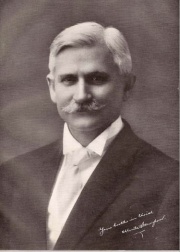
brother-menta-sturgeon-1867-1935

URL: https://biblestudentsdaily.com/2016/10/23/pastor-charles-russells-last-days/

Enter your email address to subscribe to this blog and receive notifications of new posts by email.

Save

Save

2 Corinthians 5:20 – What Does Being “Ambassadors for Christ” Mean ?

2 COR. 5, 20

What is an ambassador ?

According to Wikipedia, an ambassador is :

“an official envoy, especially a highest ranking diplomat who represents a state and is usually accredited to another sovereign state, or to an international organization as the resident representative of their own government or sovereign or appointed for a special and often temporary diplomatic assignment… They are stationed in a foreign country and they as well as the embassy staff are granted diplomatic immunity and personal safety while living abroad.”

Apostle Paul made it clear to us that those who are accepted of God and begotten of the holy spirit are ambassadors of another country:

“For our citizenship is in heaven; whence also we wait for a Saviour, the Lord Jesus Christ” (Philippians 3:20, ASV).

“For he has delivered us out of the dominion of the darkness, and transplanted us into the kingdom of his dear Son” (Colossians 11:13).

The Apostle Paul

Apostle Paul referred to himself as an “ambassador in chains” (Ephesians 6:20). This is hardly the view we take of diplomatic ambassadors today. But Paul does not say this to elicit pity. Rather he tells the Church not to lose heart over what he is suffering because it is for the Church’s glory.

Truly Apostle Paul was a great ambassador!

Should we not also represent our head, Christ Jesus and SHINE like stars in the sky, being blameless and pure, “children of God without fault in a warped and crooked generation”? (Philippians 2:15)

YES we MUST do so… not tomorrow… BUT NOWright NOW… the High Calling of the Gospel Age is soon to end and Christ’s Bride composed of 144,000 members, shall hath made herself ready!

Dear Brethren, we will not miss out for the chance of eternal eternities and forevermore to belong to the BODY of Christ… to be counted worthy of the prize of the High Calling… of bringing our Heavenly Father grandest JOY and who shall present the Bride as the most righteous gift to Christ!

Let us “trim our lamps” as the “wise virgins” (Matthew 25:7) and stay separate from this world (2 Corinthians 6:17); and be “peculiar people” renouncing the world and its evil desires!

“14 Do all things without murmurings and disputings:15 That ye may be blameless and harmless, the sons of God, without rebuke, in the midst of a crooked and perverse nation, among whom ye shine as lights in the world…” (Philippians 2:14-15).

Prepare yourselves through strict training and discipline to belong to the ONE BRIDEGROOM ONLYlet JESUS BE YOUR HEAD–SEEK him; SEARCH for him; COPY him; make him proud; REPRESENT him in spite of ALL RIDICULE and SUFFERING in this world.

“24 Do you not know that in a race all the runners run, but only one receives the prize? So run that you may obtain it.
25 Every athlete exercises self-control in all things. They do it to receive a perishable wreath, but we an imperishable.
26 So I do not run aimlessly; I do not box as one beating the air.
27 But I discipline my body and keep it under control, lest after preaching to others I myself should be disqualified” (1 Corinthians 9:24-27, ESV).

The Apostle Paul encourages us: “Now then we are ambassadors for Christ, as though God did beseech you by us: we pray you in Christ’s stead, be ye reconciled to God” (2 Corinthians 5:20, KJV).

Qualifications of an Ambassador

As ambassadors of Christ, how should we conduct ourselves? What is our role?
Let’s consider the following characteristics of an ideal ambassador:

  1. PATIENCE

An ambassador listens carefully to the citizens of the countries he is involved in helping to understand their needs and situation so that any conflicts or disagreements can be resolved in peace. The Apostle Paul was so patient through his experiences as a prisoner and in his dealings with rulers he sought to bring about mutual understanding concerning the Truth.

  1. WISDOM

An ambassador uses his knowledge of people to (as far as possible) resolve conflicts between any parties involved. We have an example of this by the Apostle Paul–when question by rulers and confronted by hostile Jews and Greeks, he used Godly wisdom to answer.

“Now when Paul perceived that one part were Sadducees and the other Pharisees, he cried out in the council, “Brothers, I am a Pharisee, a son of Pharisees. It is with respect to the hope and the resurrection of the dead that I am on trial” (Acts 23:6, ESV).

  1. GRACIOUS SPEECH

As a spokesperson for his country, an ambassador is one who encourages and entreats with his words rather than causing any offence or hostility, as well as seeking the good of all. We see this in Apostle Paul’s conduct here:

“32Give none offence, neither to the Jews, nor to the Gentiles, nor to the church of God: 33Even as I please all men in all things, not seeking mine own profit, but the profit of many, that they may be saved” (1 Corinthians 10:32-33, KJV).

Apostle Peter explains: 11Dearly beloved, I beseech you as strangers and pilgrims, abstain from fleshly lusts, which war against the soul; 12Having your conversation honest among the Gentiles: that, whereas they speak against you as evildoers, they may by your good works, which they shall behold, glorify God in the day of visitation” (1 Peter 2:11-12, KJV).

  1. GENEROUSAn ambassador will use his time and talents to help others, especially as it promotes the interests of his home government, even at personal sacrifice and we note how Apostle Paul laid down his life for kingdom interests  in Philippians 2:4:-

Phil. 2, 4.jpg

  1. REASONABLENESS

An ambassador will try to help those in his host country and persuade them to appreciate the benefit of his counsel. Paul continually appealed to others to accept his counsel concerning Christ’s kingdom and the blessing it will be to all.

  1. HONESTY

An ambassador tells the truth and uses facts to persuade others. He neither deceives nor exaggerates to achieve his way. Paul was forthright, even on occasion calling the attention of Peter and others to what appeared to be a misleading example.

11 But when Cephas came to Antioch, I opposed him to his face, because he stood condemned. 12 For before certain men came from James, he was eating with the Gentiles; but when they came he drew back and separated himself, fearing the circumcision party.13 And the rest of the Jews acted hypocritically along with him, so that even Barnabas was led astray by their hypocrisy. 14 But when I saw that their conduct was not in step with the truth of the gospel, I said to Cephas before them all, “If you, though a Jew, live like a Gentile and not like a Jew, how can you force the Gentiles to live like Jews?” (Galatians 2:11-14, ESV).

  1. UNDER READINESS OF MIND

An ambassador is ever alert to represent and promote the interest of his government even at the risk of personal benefit or gain.

Apostle Paul did not let opportunities slip by him, to regret latter. He embraced his appointed service with diligence. As Jesus, “for the joy set before him” endured ALL manner of rebuff and persecution, so Apostle Paul followed the example of Jesus (1 Corinthians 4:11-13).

  1. HUMILITY

An ambassador recognizes that he has no personal authority apart from the country he represents. Further, as he provides instruction and direction, he explains the laws of his home country.

Though Apostle Paul was a leading light in the early church, he considered himself the “least of the apostles” (1 Corinthians 15:9, Ephesians 3:8).

“If in this life only we have hope in Christ, we are of all men most miserable” (1 Corinthians 15:9).

“To me, though I am the very least of all the saints, this grace was given, to preach to the Gentiles the unsearchable riches of Christ (Ephesians 3:8, ESV).

Philippians-2-3.jpg

If we as Christians could keep these thoughts always prominent before our minds, what a dignity it would add to our character! What a transforming power it would be!

What an assistance to the new nature in its battle with the low and grovelling tendencies of the old nature now disowned by us and reckoned dead!

Dear friends, let us remember that “our citizenship is in heaven” (Philippians 3:20).

While still living in the world, we are not of it but have transferred our allegiance and citizenship to the Kingdom. And now, as appointees of our Kingdom, while still living in the world among aliens and strangers, we as representatives and ambassadors should feel both the dignity and the honor of the position and the weighty responsibilities and keep in memory the Apostle’s words,

Whatsoever ye do in word or deed do all in the name of the Lord Jesus(Colossians 3:23).

(Refer to Reprints of the Original Watch Tower page 3329 for a lovely article titled “Do All in the Name of the Lord Jesus.“)

We can learn by Apostle Paul’s wonderful example of ambassadorship and demonstrate, as he did, a ministry of reconciliation now.

Our Christ-like behavior in this world brings a certain amount of help and healing to a world that needs deliverance.

“A wicked messenger falleth into unhappiness; but a faithful ambassador bringeth healing
(Proverbs 13:17, Leeser).

This will prepare us well for the greater reconciliation of all mankind in which we will participate, no longer as ambassadors, but rather as kings and priests with Jesus.

What a hope is ours!

May we do ALL in our power to glorify our Heavenly Father Jehovah through Jesus Christ, GOD’s Son–in our bodies and our spirit which belong to our Head—Jesus CHRIST.

Reference:

Special thanks to Br. David Stein for source material from the article Paul the Ambassador“, The Herald of Christ’s Kingdom, August/September 2011.


The URL for this post is: https://biblestudentsdaily.com/2016/10/20/2-corinthians-520-what-does-being-ambassadors-for-christ-mean/

Enter your email address to subscribe to this blog and receive notifications of new posts by email.

Give In … (and Know That I am GOD)

rom-12-1-2-ad


“Be still, and know that I am GOD. I will be exalted among the nations, I will be exalted in the earth!”
Psalm 46:10  

I only wish to teach you right,
Why do you ignore the light?
You have to kick against the goads,
Clinging to your heavy load.
 

Will you not accept his way?
And praise him ever–all your days;
It truly is, son, for the best,
And then you would be really blessed.
 

You must give in and don’t fight GOD,
Yes, tread the way the Master trod;
Be submissive–do his will,
With JOY-your days He’ll fill.
 

He says “Give in, please do not fight,
To serve me you must know is right;
I am your Master, I am the LORD,
The one who bears the mighty sword.”

 
And soon will come the reign of peace,
The will to struggle–it will cease;
For everyone shall know my name,
The reason why–Christ Jesus came.
 

For soon the iron rod will rule,
So listen please, don’t be a fool;
For Jesus loves you–serve him now,
For soon to him all knees will bow.

 A poem from “Where Eagles Gather” by Sr. Rosemary Page of Blackpool, England


The URL for this post:
https://biblestudentsdaily.com/2016/10/14/give-in-and-know-that-i-am-god/

Enter your email address to subscribe to this blog and receive notifications of new posts by email.

Save

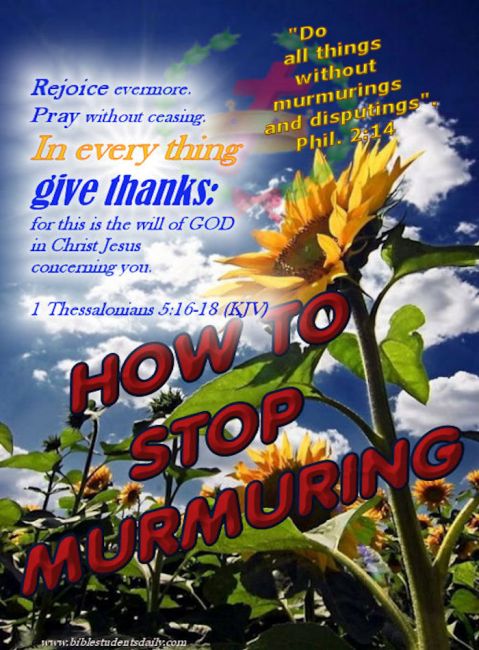
PHILIPPIANS 2:14 – How to Stop Murmuring & Reap Blessings

1 THES. 5, 16-18 & PHIL. 2, 14 - FINAL2.jpgHow do we find true JOY in living a life that would please God?

Answer: Getting rid of murmuring and complaining.

——-

YOU CAN CHOOSE to be bitter or better.

YOU CAN CHOOSE to repay unkindness with kindness.

YOU CAN CHOOSE to  accept God’s will (Romans 8:28).

——-

How To Stop Murmuring and Complaining

Let’s begin with the words from the Book of Jude, verses 12‑16 (KJV):

“(12) These are spots in your feasts of charity, when they feast with you, feeding themselves without fear: clouds they are without water, carried about of winds; trees whose fruit withereth, without fruit, twice dead, plucked up by the roots; (13) Raging waves of the sea, foaming out their own shame; wandering stars, to whom is reserved the blackness of darkness for ever. (14) And Enoch also, the seventh from Adam, prophesied of these, saying, Behold, the Lord cometh with ten thousands of his saints, (15) To execute judgment upon all, and to convince all that are ungodly among them of all their ungodly deeds which they have ungodly committed, and of all their hard speeches which ungodly sinners have spoken against him. (16) These are murmurers, complainers, walking after their own lusts; and their mouth speaketh great swelling words, having men’s persons in admiration because of advantage.”

The Apostle Jude warned of concerns rising in his day (i.e. the gnostic heresy, which undercut the foundation of Christ), and each of us can look within ourselves to see that inclinations in this direction within ourselves are rooted out. But we need not suppose that all the things Jude spoke about must be found among brethren of our fellowship. In our own Bible Student classes of today, the same things will not be so manifest. Yet we all need to take care of course.

The Apostle Paul also warned the elders at Ephesus that after Paul’s parting, “Also of your own selves shall men arise, speaking perverse things, to draw away disciples after them” (Acts 20:30).

The Apostle Peter similarly warned brethren of his day, that as there were false prophets among the Israelites, so some would appear teaching Christian principles and contrary to the sweet teachings of Christ. These influences would be harmful to the New Creature ways, and lead to the Truth being evil spoken of.

These words of warning from three apostles induce us to watch and pray.

BE HOLY STILL

Revelation 22:11 says, “He that is unjust, let him be unjust still: and he which is filthy, let him be filthy still: and he that is righteous, let him be righteous still: and he that is holy, let him be holy still.”

GOD allows experiences to manifest the heart attitude of every child of GOD. It is for us to follow Christian principles in each experience, and thus “be righteous still, and … holy still.”

Revelation 1:12‑15 pictures the “feet” members of the body of Christ as “fine copper.” The Apostle John saw the “Son of Man” (Jesus) clothed with a garment down to the feet, but saw the bright shining feet, suggesting the character of God’s people.

Copper represents perfect or justified human nature. This copper appeared “as if they burned in a furnace” (Revelation 1:15). It calls to mind the prophecy of Malachi 4:1, “The day … shall burn as an oven.” In a prophetic sense, we have been in that day since the return of Christ (his invisible presence, Parousia) in 1874. Thus “the time is come that judgment must begin at the house of God” (1 Peter 4:17).

In the present ending period of the Gospel Age, God allows trials to purge us, as a furnace of affliction, so that the copper of our justification may shine resplendent in the light of faithful and tested loyalty to GOD.

As Jude suggests, we are not to be surprised if there be murmurers, seeking more or less to have their own will confirmed. Could this include us also?!

— If we are guilty of murmuring, then let us ask God to change us. —

Sin can be a gangrenous growth, like a little bit of leaven that makes the whole bread sour. So murmuring can become a habit, and how easy is it to change a habit?

—– It requires prayer, petitioning to the throne of Grace. —–

But with GOD all things are possible — He can mold us for change (Luke 1:37).

The more degraded one may become, the MORE WORK is required to reverse the damage.

Wishing to change won’t get us anywhere.

We MUST DO AND ACT, while continuously seeking, knocking and asking God, for His help.

WHAT IS MURMURING?

Murmuring is “to utter complaints in a low, half‑articulate voice; to feel or express dissatisfaction or discontent; to grumble; often with, at or against” (Webster’s Online Dictionary).

Murmuring indicates we are out of harmony with our lot. First it expresses dissatisfaction; then perhaps pride and covetousness, leading us to rebel against God’s providence. As roots of bitterness lodge in our hearts and minds, disappointment and dissatisfaction with our environment and our circumstances of life allowed by GOD in His love and mercy, will spring up and growth to DISASTER, in our spiritual life.

Have we been guilty of complaining in regards to the Lord’s providential leadings?

Dear friends, if that very circumstance had not been the very best the loving heart of our Heavenly Father could devise for our edification and upbuilding in Christ Jesus, He would not have permitted that circumstance to occur. Shall not the God of all the earth do right? Of course He will.

“Content whatever lot I see, since ’tis God’s hand that leadeth me.”

We are ALL guilty to some degree to having failed to measure up to the Lord’s standard in this respect.

In Philippians 2:14, Paul relates murmuring even with activity in the Lord’s service.

DO all things without murmurings and disputings“.

The word “do” here is one of the smallest words, but one of the most forceful! It is not that we are to do some things that are hard and murmur about the rest; it is not to be satisfied with some things and be dissatisfied with others.

DOING “all things without murmuring is the test of our own hearts and minds!

Complaining is being ungrateful! If we complain we are wordly!

The murmuring ‘domino effect’ will continue until a break is made, and a change is effected. Once this weakness of character becomes a strength of character, it means the test has been overcome. (2 Corinthians 12:9).

1 Corinthians 10, 10.jpg
ANALOGY

Suppose we see a man carrying a corpse along the street, making a public display of it, we’d be mortified! Perhaps we’d ask him the reason and probably someone would phone the Police! Suppose this man replies that he must, day after day, carry this corpse with him, with all its loathsomeness. Would we not think him insane? But do some of us do this metaphorically?

In Colossians 3:3 the Apostle Paul says, YOU HAVE DIED, and your life has been hidden with Christ in God.”

Yet we hear the corpse complaining and murmuring every day, dissatisfied. What a peculiar corpse it would be from a natural standpoint, if after it was ready for burial we continued to preserve it, and it had the ability to murmur and complain against its condition!

Dear friends, if we bury the dead (and that is what we are to do with our fleshly interests, desires, wants, and preferences), then we must put it out of sight, put it in the tomb, bury it, and every time the “old man” complains, throw another shovel of dirt on him.

Live ABOVE the circumstances of your life.
“Set your affection on things above” (Colossians 3:2).

Then any temptation to murmur about the things below will be minimized by far!

EXAMPLES OF MURMURING IN THE BIBLE

We have many illustrations about murmuring in both the Old and New Testaments.

EXAMPLE 1.

The Old Testament book of Numbers could easily be renamed The Grumbler Chronicles. The Children of Israel grumbled against Moses, Aaron, and God.

In Numbers 12:1 we read, “And Miriam and Aaron spoke against Moses because of the Ethiopian woman whom he married.”

Miriam and Aaron were displeased that Moses had married at all, and that he was foolish enough to marry without consulting the wishes of the family, and in addition, that he had been foolish enough to marry an Ethiopian woman. Yet the real reason for their murmuring was due to pride and selfish ambitions of their own hearts.

In verse 2 we read them murmuring, Hath the Lord indeed spoken only by Moses? hath he not spoken also by us? And the Lord heard it.” We can rest assured that the Lord will hear and regard every attitude of dissatisfaction with his plans and purposes that may manifest itself in our hearts and lives; it is to be indeed charged up against us!

Notice the results of murmuringMiriam became leprous. Leprosy is a type of sin. Miriam perhaps represents a certain class, leaders in this rebellion against the Lord, and murmuring against his plans and purposes. Miriam’s seven days of punishment is a picture of the eternal punishment (i.e. second death, Revelation 20:6-15) for those who will lead in rebellion against the Lord and his arrangements (Jude 1:13). Miriam represents such who fail to recognize Christ as the leader of spiritual Israel and who fail to honor those whom he uses as his mouthpieces and servants. R4037:5 In this type, Aaron reflects those who are busy-bodying in other men’s matters. R3061:4 A weak character; as shown on this occasion and when he made the golden calf. R5308:3

God probably favored this marriage so the Jews would not choose Moses’ children as his successors; they were supposed to look to the Lord as their leader. R3061:4 Of an alien race, she replaced Miriam as first lady, arousing Miriam’s jealousy on religious grounds. R5308:1 Zipporah, typifying the Bride of Christ. R1651:6 Perhaps Moses’ first wife had died, and Zipporah was his second wife. R5308:1

[NOTE: R – denotes Reprints from the Watch Tower which can be read at http://www.htdbv8.com or Google: “Harvest Truth Data Base” for the latest version.]

EXAMPLE 2.

Matthew 20:1‑16 ‑ In his parable of the vineyard workers, Jesus noted of disciples how those who worked from the first hour, having “borne the burden and heat of the day,” murmured because they received the same wages as those who worked only the last hour. Jesus declared that such labourers in the Lord’s vineyard who murmur over what seems to them are life’s inequities, actually are murmuring “against the goodman of the house.” (Matthew 20:11).

The goodness of the Lord is attested to in so many ways—mansions await!so let us not allow any ungrateful thought to creep into the mind!

EXAMPLE 3

In the latter portion of Jesus’ ministry he began to be more direct. He declared that he was to be the true bread which came down from heaven, of which if any man would eat he would live forever; that God would raise him up at the last day. His hearers began to murmur inquiring, “Is not this the son of Joseph, the Nazarene, whom we know? Have we not been acquainted with him since the days of his youth? And he says he came down from heaven.” 

Oh, they murmured!

As Jesus continued to say that unless they ate his flesh and drank his blood they had no part or lot in the matter; others turned back saying, “This is a hard saying, who can bear it? This is difficult, hard to comprehend. Who can bear it? Look at the reproaches it will bring; look at the disturbances it will make in our life”. They do not like the reproach of the cross of Christ nor to bear the shame or to be made of no reputation. Recall the exhortation of Apostle Paul, “Let us go forth to him without the camp, bearing his reproach.” (Hebrews 13:13)

They said Jesus had a devil and was mad. His course was contrary to the world, and the world began to berate the Apostles, and they declared, “Lord we have left all and followed thee, what do we get in return? Others are turning away, what remains for us?” (Mat. 19:27) Jesus said, “Doth it also offend you?”(John 6: 61) Here, those who had followed Jesus closely began to be offended at him, and murmured.

The same spirit of pride and rebellion, discontent, eating at their very hearts, began to manifest itself under the severity of the tests that were coming on them. As it is written, “There are some of you who believe not.” (John 6:64) At one point Jesus turned longingly and lovingly to them, and said, “Will ye also go away?” Apostle Peter replied, “Lord, to whom shall we go? thou hast the words of eternal life” (John 6:68).

Indeed, to whom would he go? To whom will you go, if you go out of the Truth? If you are dissatisfied, discontented, with God’s plan and providential leadings, if you turn aside, unto whom will you go? And what is the remedy for murmuring?

With God’s help through prayer and petition, here are some helpful tools in regards to :

HOW DO WE STOP MURMURING?

Here are 6 suggestions:-

1. REALIZE THAT COMPLAINING IS A DANGEROUS SIN.

We know the enemy of our souls doesn’t want us to fulfill God’s intended purpose for our lives. If he can’t derail me, or you, because of lust or immorality in our private lives, then the devil will seek a different bait for his trap. For many of us, that snare is the temptation to gripe, grumble, and complain against God (1 Corinthians 9:24-10:13).

Murmuring is a sin. Here are 10 reasons why :

1.It is questioning God’s capacity, in the face of all God’s assurances to us in the Bible to display that He does care about us (Romans 8 :28, 1 Corinthians 15:22).

2. It is a rebellion against’s God’s will, (Job 23:2) and thus, dis-satisfaction with what God sees as the perfect experiences for us and in His perfect time (Ecclesiastes 3:1). Joshua and Caleb urged the murmuring Israelites not to “rebel against the Lord” (Numbers 14: 9). But rather than listen to reason, the Israelites were ready to elect new leaders who would oversee their rebellious plans.

3. It is another form of mocking God’s plan of salvation, where despite acknowledging God, one criticizes His ways by wanting things to be done in our ways, even though our ways are much lower ways. (Isaiah 55:8).

4. It ignores God’s potential. The report of the ten spies (see Numbers 13) reflected a godless perspective. God had opened the sea to save the Israelites, the heavens to feed them, and the rocks to provide water for them. He had defeated mighty armies throughout their wilderness trek. He had freed them from perhaps the most powerful nation on the planet (the Egyptians). Certainly He could deal with any problems the new land might present.

5. Murmuring leads to self-pity. “Would that we had died in the land of Egypt! Or would that we had died in this wilderness!” (Numbers 14: 2).

Murmurers often feel sorry for themselves and focus on how they have been mistreated, misused, and let down.

6. Murmuring is born in the context of bad report. Sins of the tongue that spread negative reports (beguilement, gossip, slander, false witness) create an environment in which murmuring can thrive.

Are we such complainers?

7. Murmuring also drains us from the energy we need to RUN the race of the High Calling set before us and energy to carry our cross. The cross can only “be light” as Jesus promised us in Matthew 11:30 if we do not carry the extra unnecessary and dangerous baggage of sin: “Therefore, since we are surrounded by so great a cloud of witnesses, let us also lay aside every weight, and sin which clings so closely, and let us run with endurance the race that is set before us…” (Hebrews 12:1, ESV)

8. Murmuring distorts good judgment. The murmurer misinterprets and misrepresents reality. For instance, after God gloriously delivered them from Egypt, the Israelites began to speak of their former life in Egypt as better, saying, “Yahweh delivered us out of Egypt only to kill us and our children in the desert. This Yahweh is no redeemer; he is more cruel than Pharaoh himself.” Here we see the utter inability to interpret reality correctly. And eventually these murmurers tried to stone Moses and return to Egyptian bondage, like a dog returning to its own vomit.

When people murmur, their hearts become darkened and they become incapable of interpreting reality correctly. Thus, good is evil, and evil is good: autonomy is good, and the Lordship of Christ is bad; worldly friends are good, parents and other authorities are bad. The sons of Eliab told Moses, “Isn’t it enough that you have brought us up out of a land flowing with milk and honey to kill us in the desert? And now you also want to lord it over us?” (Numbers 16:13).

9. A murmuring spirit is quick to jump to the wrong conclusion. Just like the Israelites wanted to return back to Egypt.

10. Murmuring thrives in an atmosphere of fear. Twice Joshua and Caleb exhorted the people not to be afraid (Numbers 14:9). But the Israelites’ fear of the unknown fanned the sparks of grumbling in their midst. They were in a situation beyond their control, and they felt threatened and insecure. Their faith disappeared as their fear increased.

2. TRUST THAT GOD KNOWS WHAT HE IS DOING –

GOD KNOWS WHAT HE IS DOING! So let us let God be in charge of what He sees must be our experiences if we have given up our wills to do His.

Look at Joseph – He was thrown into a pit by his brothers, sold by them into slavery, unjustly accused of fooling around with Potiphar’s wife, thrown into prison forgotten by a friend he had helped – and yet Scripture does not record even a single complaint!

Joseph could have become bitter against his brothers…
Joseph could have smashed his fist against the prison walls and complained that his circumstances were unjust...

But did he do that?

No. He surrendered to God’s power. He had TRUST IN GOD.

Let us not forget, through Joseph, to look unto Jesus, who suffered being tempted, yet without sin; who was slandered, and persecuted, and …“He was oppressed, and he was afflicted, yet he opened not his mouth: he is brought as a lamb to the slaughter, and as a sheep before her shearers is dumb, so he openeth not his mouth. (Isaiah 53:7)

What was the secret of Joseph’s complaint-free life?

The answer is in Genesis 45:5-8 where we find Joseph, now the Governor of Egypt, addressing his starving brothers,

(5) Now therefore be not grieved, nor angry with yourselves, that ye sold me hither: for God did send me before you to preserve life. (6) For these two years hath the famine been in the land: and yet there are five years, in the which there shall neither be earing nor harvest. (7) And God sent me before you to preserve you a posterity in the earth, and to save your lives by a great deliverance. (8) So now it was not you that sent me hither, but God: and he hath made me a father to Pharaoh, and lord of all his house, and a ruler throughout all the land of Egypt.

Three times in four verses Joseph says – “God sent me here”. Talk about perspective that comes as a result of an uncommon faith in an Omnipotent God. Joseph grasped the truth that God is in control, and that He knows what He is doing.

3. “GIVE THANKS IN ALL THINGS – 1 Thessalonians 5:18.

4. FOCUS ON OUR BLESSINGS we receive from the Lord, such as:

  • That our sins can be forgiven thanks to Jesus’s precious blood paid as the Ransom price to free all mankind from the prison house of death.
  • The assurance that God and Jesus are with us (Matthew 9:2; Hebrews 13:5).

HEB 13, 5&6.jpg

  • That situations of stress (from which such murmuring would emerge) are actually THE TESTS we are wanting to pass to develop CHEERFUL patient endurance in ALL things. (Colossians 1:11, Romans 5:4 & 12:12). The sooner we do this, the greater shall be our joy, in turn, in doing the Father’s will (John 4:34, John 15:11, 1 Thessalonians 2:19, John 6:38).

Don’t wish to trade your difficult experiences for anything as this is where all the effects happen — the positive changes in character, in the face of adversity, by God’s help, developing the New Creature in Christ to be fully surrendered to God’s will and delighting in fulfilling God’s will to bring the Heavenly Father greatest joy through cheerful, willing self-denial and self-sacrifice.

Here is a helpful prayer starter:

“Almighty Heavenly Father, could Your will be done in (E.g.) my life concerning … in this experience… in my relationship with …

“Heavenly Father, I do not know what to say … what to do …. Could You please show me. I trust in You. Please put the words in my mouth… Please direct my steps… Please put a seal on my tongue … Please let me not fail you … Please let me be like your Son in character … 

Have the DISCIPLINE to NOT COMPLAIN!
Pray for this DISCIPLINE of CHARACTER.

5. BE OF GOOD CHEER, BE CHEERFUL

“These things I have spoken unto you, that in me you might have peace. In the world you shall have tribulation: but be of good cheer; I have overcome the world.” (John 16:33, KJV)

Cheerfulness comes from COURAGE which comes from implicit TRUST in God. TRUST comes from firm FAITH in God – which develops from a life where one ‘walks and talks’ with God. (Proverbs 3:5, Psalm 37:4-6, Romans 8:28, Proverbs 3:6, Joshua 1:9)

Being of good cheer is contagious and in Proverbs 17:22, we are told it is “good medicine”.

6. BE GRATEFUL & CONTENT – for God gives us what we NEED not necessarily what the flesh would at times want, as He knows best what would develop in us greater love towards doing His will, and thus, what would help us BE RIGHTEOUS – without which no one can please God. (Hebrews 12:14)

Hebrews 13:5-6 (KJV) – “Let your conversation be without covetousness; and be content with such things as ye have: for he hath said, I will never leave thee, nor forsake thee. So that we may boldly say, The Lord is my helper, and I will not fear what man shall do unto me.

Other tips for how to be grateful:

  • Begin your prayers with all the “thank you’s” to God.
  • Each morning/day think about (or write out) all the things you are grateful for.
  • Lower your expectations of others, and rather, have implicit TRUST in the Heavenly Father’s precision and perfection of ALL details in your life!
  • Accept the circumstances.
  • Don’t take things personally.
  • Deal with the circumstances by relying upon God’s help through Christ.
  • Do your best.

CONCLUSION

Let us, then, “fix our eyes on Jesus, the author and perfecter of our faith” (Hebrews 12:2) and follow him all the way to the Heavenly City with singing. Let us give thanks in everything, knowing our Redeemer is with us to keep us from falling. He to whom all authority in heaven and on earth has been given is telling us, “Go into the world of trouble, and I will be with you always, even unto the end of the ages.”

Take encouragement from Paul’s message in Romans 8:35-39:

“(35) Who shall separate us from the love of Christ? shall tribulation, or distress, or persecution, or famine, or nakedness, or peril, or sword? (36) As it is written, For thy sake we are killed all the day long; we are accounted as sheep for the slaughter. (37) Nay, in all these things we are more than conquerors through him that loved us. (38) For I am persuaded, that neither death, nor life, nor angels, nor principalities, nor powers, nor things present, nor things to come, (39) Nor height, nor depth, nor any other creature, shall be able to separate us from the love of God, which is in Christ Jesus our Lord. We are saved, we are being saved, and we will be saved.”

May God help us not to murmur, but to pray and praise him in the midst of our problems, knowing there is divine design in every trouble he has ordained for us. May we rejoice, knowing that trouble is for our good, to humble us and test us, and may we believe in God’s promises and render him complete obedience, that it may be good for us in the end. Amen.

He Leadeth Me

He leadeth me, O blessed thought!
O words with heav’nly comfort fraught!
Whate’er I do, where’er I be,
Still ’tis God’s hand that leadeth me.

CHORUS

He leadeth me! he leadeth me!
By his own hand he leadeth me.
His faithful foll’wer I would be,
For by his hand he leadeth me.

Sometimes ‘mid scenes of deepest gloom,
Sometimes where Eden’s bowers bloom,
By waters still, o’er troubled sea‑
Still ’tis his hand that leadeth me.

Lord, I would clasp thy hand in mine,
Nor ever murmur or repine‑
Content whatever lot I see,
Since ’tis my God that leadeth me.

And when my task on earth is done,
When by thy grace the vict’ry’s won,
E’en death’s cold wave I will not flee,
Since God thro’ Jordan leadeth me.

URL: https://biblestudentsdaily.com/2016/10/10/philippians-214-how-to-stop-murmuring-reap-blessings/

How is Your Zeal?

eph-3-17-19

Based upon Reprint 1159 (from Zion’s Watch Tower):

AN ALLEGORY

I sat down in my arm-chair, weary with my work; my toil had been severe and protracted. The church wore an aspect of thrift and prosperity; and joy and hope and courage were the prevailing sentiments on every hand. As for myself, I was joyous in my work; my brethren were united; my sermons and exhortations were evidently telling on my hearers; my church was crowded with listeners; the whole community was more or less moved with the prevailing excitement; and so the work went on. I had been led into exhausting labors for its promotion.

Tired with my work, I soon lost myself in a sort of half forgetful state, though I seemed fully aware of my place and surroundings. Seemingly a stranger entered the room, without any preliminary tap, or “Come in.” I saw in his face benignity, intelligence and weight of character; but though he was passably well attired, he carried suspended about his person measures and chemical agents and implements, which gave him a very strange appearance.

The stranger came toward me, and extending his hand said, “How is your zeal?”

I supposed, when he began his question, that the query was to be for my health; but was pleased to hear his final word; for I was quite well pleased with my zeal, and doubted not the stranger would smile when he should know its proportions. Instinctively I conceived of it as a physical quantity, and putting my hand into my bosom, brought it forth and presented it to him for inspection.

He took it, and placing it in his scale, weighed it carefully. I heard him say, “One hundred pounds!”

I could scarce suppress an audible note of satisfaction; but I caught his earnest look as he noted down the weight; and I saw at once that he had drawn no final conclusion, but was intent on pushing his investigation.

He broke the mass to atoms, put it in his crucible, and put the crucible into the fire. When the mass was thoroughly fused, he took it out, and set it down to cool. It congealed in cooling, and when turned out on the hearth, exhibited a series of layers or strata; which all at the touch of the hammer fell apart, and were severally tested and weighed; the stranger making minute notes, as the process went on.

When he had finished, he presented the notes to me, and gave me a look of mingled sorrow and compassion, as, without a word, except, “May God save you!” he left the room.

I opened the note and read as follows:

“Analysis of the zeal of Junius, a candidate for a crown of glory: weight, in mass, 100 lbs., of which, on analysis, there proves to be, viz.:–

Bigotry                                                 –   10 parts
Personal ambition                           –   23     ”
Pride of talent                                   –   14     ”
Love of praise                                   –    19    ”
Pride of denomination                  –    15     ”
Love of authority                            –    12     ”
Love of God                                      –      4     ”
Love of man                                     –      3     ”

I had become troubled at the peculiar manner of the stranger, and especially, at his parting look and words; but when I looked at the figures my heart sank as lead within me. I made a mental effort to dispute the correctness of the record, but was suddenly startled into a more honest mood by an audible sigh, almost a groan, from the stranger, who had paused in the hall, and by a sudden darkness falling upon me, by which the record became at once obscured and nearly illegible. I suddenly cried out, “Lord, save me!”

I knelt down at my chair, with the paper in my hand, and my eyes fixed upon it. At once it became a mirror, and I saw my heart reflected in it:–The record is true!–I saw it; I felt it; I confessed it; I deplored it; and I besought God, with many tears, to save me from myself: and, at length, with a loud and irrepressible cry of anguish, I awoke.–Selected.

* * *

Since all of God’s consecrated saints are his ambassadors, ministers of his truth, and members of the royal priesthood, this allegory may be of profit to all. Love of God and love of our fellow-men are the only elements of real zeal in the above analysis. All the other parts are detestable dross in God’s sight and will be in ours, as we take God’s standpoint of criticism. Let each servant who desires to stand approved of God, examine his own heart, analyze his own zeal, his own motives.

Ephesians 3:14-21 (KJV):-

14 For this cause I bow my knees unto the Father of our Lord Jesus Christ,
15 Of whom the whole family in heaven and earth is named,
16 That he would grant you, according to the riches of his glory, to be strengthened with might by his Spirit in the inner man;
17 That Christ may dwell in your hearts by faith; that ye, being rooted and grounded in love,
18 May be able to comprehend with all saints what is the breadth, and length, and depth, and height;
19 And to know the love of Christ, which passeth knowledge, that ye might be filled with all the fulness of God.
20 Now unto him that is able to do exceeding abundantly above all that we ask or think, according to the power that worketh in us,
21 Unto him be glory in the church by Christ Jesus throughout all ages, world without end. Amen.

 URL: https://biblestudentsdaily.com/2016/10/06/how-is-your-zeal/

Enter your email address to subscribe to this blog and receive notifications of new posts by email.

Save

Save

Consolation

2016-08-01 21.09.34

Evening, and morning, and at noon, will I pray,
and cry aloud: and he shall hear my voice” 
(Psalm 55:17, KJV).

WHEN thy pathway straitened lies, beloved,
Call on Me;
Ever fix on Me thine eyes, beloved,
Follow Me;
I will never leave thee nor forsake thee,
Lean on Me!

When with trials sore beset, beloved,
Come to Me;
Calvary’s hour do not forget, beloved,
Think on Me;
I will never leave thee nor forsake thee,
Trust in Me.

When the dark night darker grows, beloved,
Cry to Me;
When the cold stream colder flows, beloved,
Cling to Me;
I will never leave thee, but will take thee
Home with Me!

“Keep your life free from love of money, and be content with what you have, for he has said, ‘I will never leave you nor forsake you.’ So we can confidently say, ‘The Lord is my helper; I will not fear; what can man do to me?’ ” (Hebrews 13: 5-6).

Reference:

Poem from “Poems of Dawn.”

Further Suggested Reading:

Just a Word—https://biblestudentsdaily.com/2016/08/06/just-a-word/
Our Trial—https://biblestudentsdaily.com/2016/11/10/our-trial/


The URL for this post:
https://biblestudentsdaily.com/2016/09/25/consolation/


Enter your email address to subscribe to this blog and receive notifications of new posts by email.

Save

Save

WILLINGLY & CHEERFULLY DOING GOD’S WILL: WHY, WHEN, HOW…

romans-8-18-ad

Acquiescing to GOD’s will is the only way to get true PEACE in the spiritual mind of the New Creation in CHRIST.

To acquiesce means to be at rest; to be yielding and not resisting no matter how severe the trial our Heavenly Father may permit to melt us, humble us, mould us, teach us how to “submit to one another out of reverence for Christ” (Ephesians 5:21, NIV) and sacrifice for the good of others, knowing it will lead to the greater good and which will bring glory and honour to GOD and which is centered upon RIGHTEOUSNESS – as this is THE ONLY STANDARD our Almighty Heavenly Father accepts, and it can be achieved through our intentions being reckoned as righteous thanks to Jesus Christ’s ransom sacrifice on Calvary once for all, for the sins of ALL humanity.

Our plans being frustrated is GOD’s better choice for us.

Consider the Apostle Paul…

About the “thorn in my flesh”, Paul in 2 Corinthians 12:8-9 wrote, “Three times I pleaded with the Lord about this, that it should leave me. But he said to me, ‘MY GRACE is sufficient for you, for my power is made perfect in weakness.’ Therefore I will boast all the more gladly of my weaknesses, so that the power of Christ may rest upon me.

Do we fully TRUST OUR HEAVENLY FATHER’s tender-hood?

man in wheelchair - c&ad..jpg

Let us consider faithful Job, (who may have lived before Abraham and probably Moses received the book of Job from times before him) :-

GOD allowed Satan to test Job’s faith …Here is an account of Job’s FIRST TEST, Job 1: 6-22 (ESV):-


“6 Now there was a day when the sons of God came to present themselves before the Lord, and Satan also came among them. The Lord said to Satan, “From where have you come?” Satan answered the Lord and said, “From going to and fro on the earth, and from walking up and down on it.” And the Lord said to Satan, “Have you considered my servant Job, that there is none like him on the earth, a blameless and upright man, who fears God and turns away from evil?” Then Satan answered the Lord and said, “Does Job fear God for no reason? 10 Have you not put a hedge around him and his house and all that he has, on every side? You have blessed the work of his hands, and his possessions have increased in the land. 11 But stretch out your hand and touch all that he has, and he will curse you to your face.” 12 And the Lord said to Satan, “Behold, all that he has is in your hand. Only against him do not stretch out your hand.” So Satan went out from the presence of the Lord.

Satan Takes Job’s Property and Children

13 Now there was a day when his sons and daughters were eating and drinking wine in their oldest brother’s house, 14 and there came a messenger to Job and said, “The oxen were plowing and the donkeys feeding beside them, 15 and the Sabeans fell upon them and took them and struck down the servants with the edge of the sword, and I alone have escaped to tell you.” 16 While he was yet speaking, there came another and said, “The fire of God fell from heaven and burned up the sheep and the servants and consumed them, and I alone have escaped to tell you.” 17 While he was yet speaking, there came another and said, “The Chaldeans formed three groups and made a raid on the camels and took them and struck down the servants with the edge of the sword, and I alone have escaped to tell you.” 18 While he was yet speaking, there came another and said, “Your sons and daughters were eating and drinking wine in their oldest brother’s house, 19 and behold, a great wind came across the wilderness and struck the four corners of the house, and it fell upon the young people, and they are dead, and I alone have escaped to tell you.”

20 Then Job arose and tore his robe and shaved his head and fell on the ground and worshiped. 21 And he said, “Naked I came from my mother’s womb, and naked shall I return. The Lord gave, and the Lord has taken away; blessed be the name of the Lord.”

22 In all this Job did not sin or charge God with wrong.”


FAITH can hold the hand of the Heavenly Father even when we cannot trace Him during our trials. Blessed be the name of the Lord GOD, because our Heavenly Father WILL TURN HUMAN DISAPPOINTMENT INTO HIS APPOINTMENT TO WORK out from each and every experience, an outcome that will result in the GREATER GOOD, EVEN IF IT RESULTS IN ONE’S DEATH.

If we wish to know how to DO GOD’s WILL WITH JOY then let us consider our Heavenly Father’s relationship with His Son and the World’s Redeemer, our Master and King JESUS CHRIST, who said:


5 “Sacrifice and offering Thou wouldest not have, but a body hast Thou prepared for Me.

In burnt offerings and sacrifices for sin Thou hast had no pleasure.

Then said I, ‘Lo, I come (in the volume of the Book it is written of Me) to do Thy will, O God.’”

Above when He said, ‘Sacrifice and offering and burnt offerings, and offering for sin Thou wouldest not have, neither hadst pleasure therein’ (which are offered in accordance with the law),

then said He, ‘Lo, I come to do Thy will, O God,’ He taketh away the first, that He may establish the second.

10 By this will we are sanctified through the offering of the body of Jesus Christ once for all.” Hebrews 10:5-10 (KJ21)


Job’s second test was that of GOD allowing the Adversary to afflict him “with painful sores from the soles of his feet to the top of his head.” (Job 1:7). Even his wife told him to “curse GOD and die” (Job 2:9) from all his mental pain and fleshly agony, yet here too, we read in Job 2:10 – “In all this, Job did not sin in what he said.” Despite Job wishing that GOD would allow him to die from the extent of his misery and pain (Job 6:9, Job 7:15), he still had this consolation – “my JOY in unrelenting pain – that I had not denied the words of the Holy One.”(Job 6:10). Job even became a “laughingstock” (Job 12:4) to his three friends – Eliphaz, Bildad and Zophar – who came to comfort him. Despite all, Job was still able to say:

“But He knows the way that I take; when He has tested me, I will come forth as gold” (Job 23:10, NIV)

Though He slay me, yet will I HOPE IN HIM.” (Job 13:15, NIV)

Can we say this too when disaster, or extreme agony of the mind or flesh “hit’s home”?

YES WE CAN! Because when our aim is to only want to do what the Heavenly Father would desire through our existence, then we have LET GO to what would weigh us down and to what would draw us away from running the race set before us to endure the battle of suffering and shame, knowing that “those who suffer with Christ shall reign with him.”(2 Timothy 2:12). This battle against sin is a daily one, until death (Revelation 2:10) and the strict discipline and serious training in the principles of righteousness becomes one that helps develop the true Christian into a mature member of the Royal Priesthood, a peculiar people, whos’ aims, intentions and desires are “NONE OF SELF and ALL OF THEE, HEAVENLY FATHER”. It is the fiery trials that are counted as “pleasing incense” to our Heavenly Father when there is willingness and patient, cheerful endurance exercised.

For if the willingness is there, the gift is acceptable according to what one has, not according to what one does not have” – 2 Corinthians 8:12 (NIV).

* THE AIM OF EXISTENCE is:
TO PLEASE OUR HEAVENLY FATHER YAHWEH, OUR EL-SHADDAI,
through His Son Jesus Christ.

“But the mercy of the LORD is from everlasting to everlasting upon them that fear him, and his righteousness unto children’s children…” – Psalm 103:17

“The fear of Jehovah is the beginning of knowledge; But the foolish despise wisdom and instruction.” – Proverbs 1:7 (ASV)

“He has told you, O man, what is good; and what does the LORD require of you but to do justice, and to love kindness, and to walk humbly with your God?” – Micah 6:8

During this Gospel Age (extending 6000 years for the permission of evil that is soon to end) when a Bride of 144,000 members (see Revelation 7 & 14) for Christ is being called out and tested, the consecrated unto the LORD GOD, are given the privileged opportunity in unfavourable circumstances to develop the heart character to make GOD’s will central in their lives.

Nothing can harm these, except as the Heavenly Father sees that the earthly injury or disadvantage would prove profitable to the individual new creature or the Lord’s general cause.” (R4926:6)

“Even if GOD should permit him to use his judgment in a way that afterward appeared not have been the best, nevertheless the Father may use it to bring some profitable lesson.” (R5212:6)

Our Heavenly Father wishes to give us the good things. Sometimes He sees best that we wait before getting an answer to our prayers. (R5480:4) Few lessons are harder to learn than this one—that GOD supervises the affairs of all who are truly His. (R5264:)

The consecrated shall have all needful instruction, grace, comfort, discipline, training and care; and such measure of temporal good as will be most conducive to highest spiritual and everlasting blessing. (R1396:3)

Sometimes our Heavenly Father sees best that we wait a long time before getting the answer to our petitions; at other times he may give us a speedy answer to our prayer. (R5480:4) “There shall no evil befall thee.” (Psa. 91:10)

“He who has buried his own will completely in the will of the Lord
can know no disappointment;
but in every affair of his life
he sees by faith divine appointment or supervision.” (R2412:6)

* HOW DO WE DO GOD’S WILL & WHY?

* IS DOING GOD’S WILL ENOUGH?

* DO WE DO GOD’S WILL CHEERFULLY & WITH PATIENT ENDURANCE, UNCOMPLAININGLY, JOYFULLY, NOT RELUCTANTLY, UNMURMURINGLY?

* WHO IN THE BIBLE DID GOD’S WILL?

These questions and others are discussed in the following video : “Acquiescing to GOD’s will”.

May it motivate, encourage and stimulate the New Mind in Christ in acquiescing to GOD’S will. GOD BLESS YOU.

“TRUST in the Lord with all your heart, and
do not lean on your own understanding.
In all your ways acknowledge him,
and he will make straight your paths.” 
Proverbs 3:5-6(ESV)

I Love Thy Will

I love thy will, O God!
Thy blessed, perfect will,
In which this once rebellious heart
Lies satisfied and still.

I love thy will, O God!
It is my joy, my rest;
It glorifies my common task,
It makes each trial blest.

I love thy will, O God!
The sunshine or the rain.
Some days are bright with praise, and some
Sweet with accepted pain.

I love thy will, O God!
O hear my earnest plea,
That as thy will is done in heav’n,
It may be done in me.

Hymn #114 from “Hymns of Dawn”

References:

Pastor Charles T. Russell – for quoted passages from the Reprints (R) of the Original Watchtower and Herald of Christ’s Presence.

BibleTruth411 (YouTube) – Video: “Acquiescing to God’s Will” by Bro. Stephen Suraci.

Hymns of Dawn – http://www.htdbv8.com/index.html

URL: https://biblestudentsdaily.com/2016/09/23/willingly-cheerfully-doing-gods-will-why-when-how/

Enter your email address to subscribe to this blog and receive notifications of new posts by email.


Save

Do Not Rush In – (…Where Angels Fear to Tread.)

PROVERBS-19-2


Gradually, Jehovah God, reveals to us his plan,
Of all the wondrous things he’ll do, to raise up sinful man;
How often in the past we’ve seen, so many rush ahead,
And lose out on the blessings that they could have had instead.
 

We do recall the bowl of stew that Esau rushed to eat,
And thereby lost the birthright-he cast it to his feet;
Saul rushed ahead of Samuel, offered up the sacrifice,
And so doing, lost the Kingship-he valued not the price.
 

Judas the betrayer, he rushed in to “meet the sword”
For thirty silver pieces, he so surely sold the Lord;
And Peter he did rush to say, “My Lord I’ll ne’er deny,”
But later begged with deep regret, forgiveness from on high.
 

And even Lot’s two daughters, rushed ahead to found the seed,
Lacking faith in God, who would, provide the One we need;
And not forgetting Moses, who rushed in and struck the rock,
The Promised Land was never his, for God held key and lock.
 

And though King David was a man after God’s own heart,
He rushed ahead-against God’s will-a census he did start;
Then, looking at Bathsheba, he did steal Uriah’s wife;
And the price, he had to pay, was his offspring’s life.
 

Ananias and Sapphira-rushed in and lived a lie,
They grieved God’s holy spirit, and so they had to die;
Achan hid the garment, the silver and the gold
He was stoned for disobedience, back there in days of old.
 

So many lessons we can learn, by looking to God’s Word,
For waiting on God patiently is much to be preferred…
To rushing in, where even…all God’s angels fear to go,
So, let’s follow their example, all God’s people have below.


A poem from “Where Eagles Gather” – Rosemary Page, Blackpool, England

The URL of this post:


Enter your email address to subscribe to this blog and receive notifications of new posts by email.


Save

Save

STUDY 4: The Court (“Holy Place”)

1. COURT --- .jpg

The Tabernacle was surrounded by a yard, or “Court (Exodus 27:9-19), toward the rear of which it stood, and this courtyard is referred to by the Bible translators, as the “holy place” see Leviticus 6:26 and 14:13.

The Court represents the condition of justification, entered through faith in Christ, the “gate.” The tabernacle represents things from the time of Jesus forward. However, there are three time periods in the Plan of God when God through His holy Spirit deals with justified people:

  1.  The Ancient Worthies from Adam until Jordan;
  2.  The Church during the Gospel Age;
  3.  The world during the Millennium Age (Messianic 1000 year reign of Christ with the Church the 144,000 Elect Bride of Christ members).
  • The same is shown in the time in the ark (which pictures redemption) a total of 381 days, which is 3 x 127, that is, three times the age of Sarah, who represents the Abrahamic Covenant.
  • Also in the three times the doves were sent out from the ark in Genesis chapter 8 three missions of the holy Spirit.
  • And again in the three stories or levels of the ark, thus three time periods of justification.

Who Could Enter the Court?

Any Israelite (typical of a justified believer of the Gospel Age) was allowed to come into the Court, as indicated in Leviticus 1:1-3 (ESV):

“(1) The Lord called Moses and spoke to him from the tent of meeting, saying, (2) ‘Speak to the people of Israel and say to them, When any one of you brings an offering to the Lord, you shall bring your offering of livestock from the herd or from the flock. (3) If his offering is a burnt offering from the herd, he shall offer a male without blemish. He shall bring it to the entrance of the tent of meeting, that he may be accepted before the Lord.’”

Leviticus 1:11 shows also that Israelites were to bring their offerings into the court, and kill them there, “on the side of the altar northward before the Lord.” However, the priests would take the blood thereafter, for use at the altar. “And the priests, Aaron’s sons, shall sprinkle his blood round about upon the altar.”

Note: Northward is the direction of God, and the Heavenly Realm. Offering on the north side of the altar emphasizes that the offering is made to God.

The offerers (Israelites) represent believers, coming in faith to make an offering to God whether believers in this age, or in the next.

Israelites commonly came in to make offerings. But the “daily sacrifice” was one lamb in the morning, another in the late afternoon, and these were done by the priests (Exodus 29:38-39).

The daily sacrifice was a burnt offering and it represents the ransom sacrifice of Jesus, who fulfilled this type, thus causing it to cease. The morning and evening times correlate with Jesus being put on the cross in the morning and expiring in the afternoon.

The Apostle Paul explained that our sacrifice is not just to be twice a day but 24/7 hence he defined the consecrated ones of this Gospel Age of the “High Calling” into Christ, as “living sacrifices” who “are holy acceptable unto God, which is your reasonable service” (Romans 12:1).

Around and Inside the Court

(A) Copper

In the Court, the metal used most often was copper.

Copper represents human nature, either justified or perfect.

In John 3:14, Jesus compares himself to the copper serpent lifted up in the wilderness in the days of Moses, which healed those who looked to it. The copper of that serpent represents the perfect humanity of Jesus. The serpent symbol is used to represent that Jesus takes the burden of our sins upon himself, thus curing us from the “snakebite” of sin.

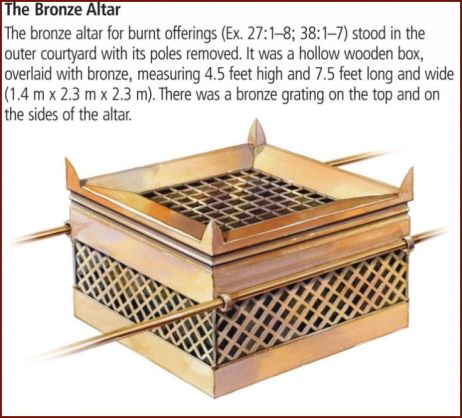
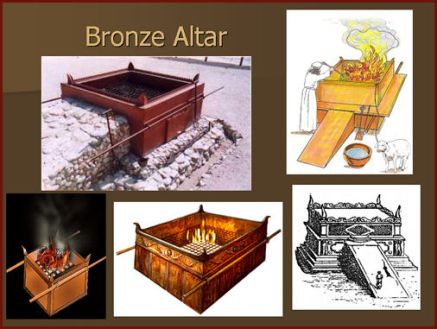
The court contained the “brazen altar” for use by the priests. Possibly Levites assisted the priests in some ways respecting the sacrifices (other than putting it on the altar).

(B) Court Measurements

The court was 50 cubits wide and 100 cubits long thus three of them could fit into the floor plan of Noah’s Ark, which was 50 cubits wide and 300 cubits long (Genesis 6:15). This also suggests that there are three time periods in God’s Plan (as explained at the start of this Tabernacle Study No. 4) where justified persons are called of God. It is notable that the “house of the forest”, picturing the call of the world during the Millennium, was also the size of the court (1 Kings 7:2).

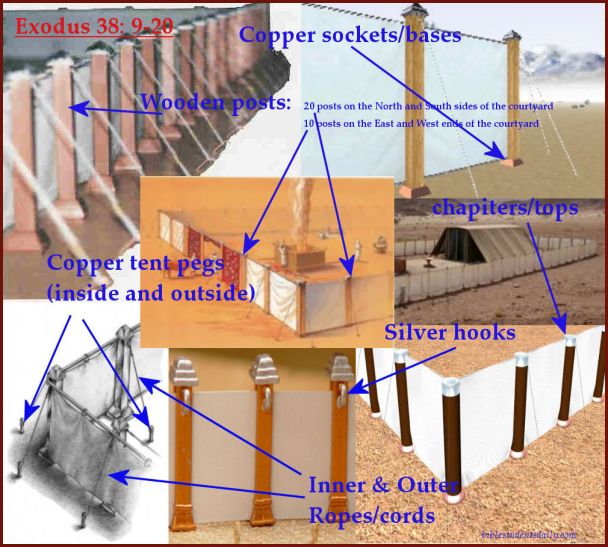
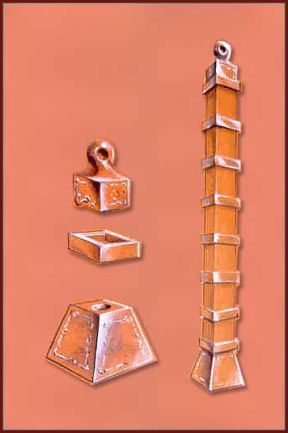
The court was formed by a fence of white linen curtains (see Study 9 on this website in the series “Beauties of the Tabernacle,” titled “The Gate. The Door. The Veil”, suspended from silver hooks, set in the tops of wooden posts 5 cubits (7 1/2 feet high), which were set in heavy sockets of copper (mistranslated brass), and braced, like the tent which covered the Tabernacle, with cords and pins.

(C) The Silver Hooks

The silver hooks in the courtyard posts by which the posts held up the curtain, represent the divine Truth, by the knowledge of which the justified believer holds on to the righteousness of Christ. Silver is a general symbol of Truth but perhaps more specifically, that TRUTH which centers and deals with the RANSOM — the redemption accomplished in Christ Jesus (Tabernacle Shadows, page 114).

As these hooks were small in size they represent the small amount of Truth necessary to justify one.

Note: The Tabernacle Proper’s 100 silver sockets which supported the whole structure was made from the ransom or redemption money paid as a poll tax by the Israelites. (Exodus 30:12-16; 38:25-28.) In “Notes on the Tabernacle” (page 21) we read:

“. . . [God] enjoined that, whenever Israel was numbered as His people, every man must give a ransom for his soul. The price was fixed by God Himself.

Each man, whether poor or rich, must bring the same. One could not pay for another; but everyone must tender his own ransom-money of pure silver and of perfect weight. `Half a shekel, after the shekel of the sanctuary (a shekel is twenty gerahs), a half-shekel shall be the offering of the LORD.’ (Exodus 30:13) Other Gospel truths here shine out. When the question came to be one of ransom, the poor and the rich, the foolish and the wise, the ignorant and the learned, the immoral and the moral, stood on the same level. Each person was estimated by God at the same price. He proved Himself no respecter of persons.”

Hence, since most of the silver used in the Tabernacle was for the 100 foundation sockets for the Tabernacle Proper, this beautifully points to the TRUTH relative to the RANSOM sacrifice of our Lord as the foundation Truth upon which the entire plan of God rests.

“The four gold-plated pillars (posts) at the entrance of the Most Holy supporting the (second) Vail stood in four SILVER sockets, (reality, truth, verity) seeming to say to us, when you come inside this vail, you will be perfect – really and truly new creatures” (Tabernacle Shadows, page 115).

(D) The Posts (pillars)

The posts of the Court (Exodus 27:10-17) represent the justified believers whose imperfections are covered by Christ’s righteousness.

The function of the posts is to hold up to public view one’s faith in Christ who is represented by the linen curtain. This, brethren, is our purpose for being. This is why we are here. To show forth the mercy and goodness of Christ’s redemptive work, as Paul says, “in the midst of a crooked and perverse generation among whom ye shine as lights in the world” (Philippians 2:15).

The posts were made of wood which is a corruptible material thus implying that the class typified, are not actually perfect as human beings.

(E) Sockets of Copper

The posts were set in sockets of copper which were sunken in the sand for stability.

The copper sockets represent our standing of perfect human beings, and this beautifully represents justification by faith, (despite the actual fact of our personal imperfections) which we can only hold onto by the aid of the Truth. This is the justification spoken of in Romans 5:1, “Therefore being justified by faith, we have peace with God through our Lord Jesus Christ.”

Some use the term “tentative justification,” to describe a Christian in the court condition before they reach the point of consecration at the door of the Tabernacle. However the priests also served in the court, and the priests represent the fully consecrated/spirit begotten. So their justification is also indicated in the court. If we simply relate that the court represents justification through faith in Christ, perhaps this suffices. It need not be one way or another  only unconsecrated (not spirit begotten) believers or only consecrated (spirit begotten) believers — as the concept of being justified by one’s faith in Christ can pertain to believers before consecration or believers after consecration.

Thanks to being reckoned as righteous in God’s sight, we are judged as to faithfulness in our intentions rather than in our actions. “For if there be first a willing mind, it is accepted according to that a man hath, and not according to that he hath not” (2 Corinthians 8:12).

Now, with rejoicing we can say with the Apostle Paul, “I can do all things through Christ which strengtheneth me” (Philippians 4:13).

It is thus that our faith becomes “rooted” and the philosophy of the ransom begins to appear. It is of this which Paul speaks in Colossians 2:7, “rooted and built up in him, and stablished in the faith, as ye have been taught, abounding therein with thanksgiving.”

(F) Guy Lines/Ropes/Cords & Pegs

2. FENCE EQUIPMENT.jpg

There is more to the philosophy of the ransom that prevents our faith from becoming weak and unstable. This is shown in the system of guy lines which uphold the wall of the court and tie the posts to the ground.

These cords represented the things which tie the justified believer to the earth; and there were two sets of cords and pins, one set inside the Court, the other, outside.

The set outside of the Court, outside of the justified state, represented the sin in the flesh which ties the believer to the world.

The set inside the Court represented the earthly things: joys, studies, music, etc., right enough in themselves, which bind the believer to the world. These are the weights (Hebrews 12:1).

These ropes were anchored by copper pegs tent pegs. One of these was installed inside the court and the other on the outside. Being copper, as opposed to wood covered with copper, they showed actual human perfection.

As we scan the pages of history we see just two and no more perfect men: Adam and Jesus. We see the one who lost his standing in the court, Adam, as the peg driven outside the fence. The other, grounded firmly in the court, pictures Jesus. These two have one connection the ransom pictured by this cord even as it was by Rahab’s scarlet thread. It is this simple philosophy of the ransom a perfect human life for a perfect human lifethat gives stability to our faith. How beautiful! How simple! Substitutionary atonement is the central doctrine of the Bible.

“For since by man came death, by man came also the resurrection of the dead. For as in Adam all die, even so in Christ shall all be made alive” (1 Corinthians 15:21, 22).

“For if through the offence of one many be dead, much more the grace of God, and the gift by grace, which is by one man, Jesus Christ, hath abounded unto many” (Romans 5:15).

It is the very simplicity of the concept that speaks to its authenticity. Too good to be true? Too good not to be true! And yet our faith is sometimes weak. We need further support.

3. COURTYARD PILLARS, BANDS, BASES, SILVER EYELETS.jpgAccording to the Temple Institute in Israel:
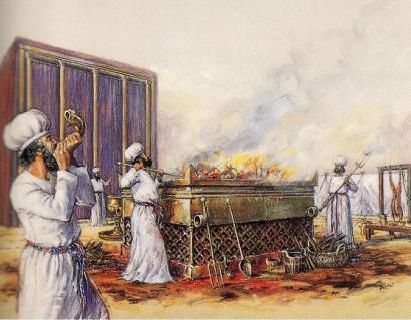
The courtyard pillars, (amudim) were composed of three main components: The acacia pillars themselves, which were reinforced by silver bands, (chishukim); the copper bases, (adanim), into which the pillars were inserted; and the silver eyelets, (vavim), which were fitted onto the tops of the pillars, for stretching the curtains, (yeriot) across.

“fillets” Others have concluded that they were rigid, whether rods or bands, and served to stabilize the posts from leaning toward each other. We think that is correct.

The Furnishings In The Court

The Brazen Altar

4. BRAZEN ALTAR.jpg

The Brazen Altar was the first item encountered in the Courtyard. It was five cubits square, and 3 cubits tall (Exodus 27:1).

In each of the four corners there was a horn made from the same piece of acacia wood as the altar itself and the altar was over-layed with copper.

The Brazen Altar was used to burn up sacrifices placed upon it, such as during the consecration of the priesthood and the Day of Atonement.

Various utensils belonged to its service fire pans (called censers), for carrying the fire to the ‘Incense Altar,’ basins to receive the blood, flesh hooks, shovels, etc.

A Christian understands this altar is not an ornament of the Court, but a place where bulls and goats were killed and sacrificed, a place many times covered with blood and ashes, with the smell of burning meat, and much smoke. The grate of this altar was not on the top like a modern barbecue. It was placed half way between the bottom and the top of the altar:

“Thou shalt put it [the grate] under the compass of the altar beneath, that the net may be even to the midst [Strong’s #2677: half or middle] of the altar” (Exodus 27:5). This placed the grate at the 1½ cubit mark, the same height as the mercy seat in the Most Holy. Both are considered in the design to be at the same “level;” neither towers above the other.

A Christian recognizes that Jesus has been sacrificed for him and starts to recognize that a similar sacrifice is needed from him if he is to enter beyond the next door. The sacrifice we have to offer, is as the Apostle Paul expresses it, in Romans 12:1.

rom-12-1-2-ad

Thus, the antitypical priesthood of this Gospel age are privileged to use this altar (Christ Jesus), in presenting their bodies “a living sacrifice, holy, acceptable unto God” for is it not the altar that sanctifies the gift?

You blind men! For which is greater, the gift or the altar that makes the gift sacred?” (Matthew 23:19).

“Your sacrifice would not be holy and acceptable, but it is made holy and acceptable as such by the Advocate [Christ Jesus] imputing of his merit to cover your sacrifice” (“What Pastor Russell Said,page 614).

Presenting our bodies as “living sacrifices” to God includes all our thoughts, words and doings and doing the best we can in all we do to bring God glory, honor and praise. It is Christ Jesus, our antitypical High Priest who alone is able to offer up the antitypical sacrifices. All that the followers of Jesus do, therefore, is to present (consecrate, set apart) themselves, as pictured in the type by the goat’s being, tied at the door of the Tabernacle. “It is after Jesus lays hold of this individual, accepts his consecration, imputes His own merit, and offers him to the Father, that the Father’s acceptance is manifested through the Son… by the begetting of the Holy Spirit. Thereforth, such an one is a member of the Body of Christ, and his name is written in the Lamb’s Book of Life, from which it will not be blotted out if he maintains his faithfulness” (What Pastor Russell Said, page. 614).

“It is the New Creature’s business to keep the old nature on the altar, upon which the great High Priest has put it. In other words, the New Creature must keep the old nature dead, hold it in subjection. When our flesh is brought into contact with the fires of experience for its consumption, it is the old creature that weeps, not the New Creature. Let the goat weep if it will. The New Creature will rejoice in the Lord and in His providential care, as daily it grows in grace and in knowledge. When the old creature is knocked out, or brow-beaten, as the Apostles says (1 Corinthians 9:27), it will groan; but the New Creature will be glad and rejoice in the Lord… We rejoice because God’s favor and blessing are with us as New Creatures.” (What Pastor Russell Said, page 613.) See also Acts 16:26, Philippians 4:4.

Jesus allowed himself to be sacrificed for the entire world of mankind. He was perfect and became flesh to do the will of his Heavenly Father (John 4:34, John 6:38).

The wood of the altar, typifying humanity, reminds us that Christ became a man for the express purpose of experiencing our infirmities and “to minister, and to give his life a ransom for many” (Mark 10:45).

“For we have not an high priest which cannot be touched with the feeling of our infirmities; but was in all points tempted like as we are, yet without sin” (Hebrews 4:15).

5-bronze-altar

There is a thought that wood was used to make the articles of lighter weight and thus, more easily portable, than if of solid metal. This was an important consideration when they traveled.

As discussed earlier in this series of “Beauties of the Tabernacle,” the use of copper represents the human nature in its perfection, a little lower than the angelic nature (unlike gold, which represents the divine nature, far above angels, principalities and powers).

As gold and copper are much alike in their appearance, yet different in quality, so the human nature is an image and likeness of the divine, adapted to earthly conditions.

“The Tabernacle’s altar of burnt-offering represents… the ransom-sacrifice of Christ Jesus (Tabernacle Shadows, page 22) — the ‘altar’ unto which the world of mankind in the Millennial age, will bring its sin-, trespass-, burnt-, and peace-offerings. (Tabernacle Shadows, page 95,96)” (“Notes on the Tabernacle,” page 134).

The horns of the Altar of Burnt Offering were in themselves symbols of power; yet this power came from the blood which sanctified it. The Scriptures do set forth the fact that one guilty of a sin against his fellowman, when in danger of being apprehended, might flee for asylum to the altar — take hold of its horns, and find a safe refuge there (1 Kings 1:50; 2:28).

“We too have an altar, the power of which stems from the blood of Christ Jesus, that sanctified it. We too, had sinned against our King, who could justly have destroyed us. But we fled to the altar and found sanctuary, an asylum, a refuge, there. Our faith in the precious blood, justified us — made us free as it were; but only on one condition could we continue to be free and that was that we covenant with our King thereafter to walk “worthily.” Having entered into this covenant we are safe from the “avenger.” But should the time ever come when we would break that covenant by profaning the blood of the covenant by which we were sanctified — outraging the Spirit of grace (Hebrews 10:29) — we would then fall directly into the hands of the “avenger” and be put to death — the Second Death!” (“Notes on the Tabernacle,” page 130).

Was there a ramp?

Some may question whether there was a ramp attached to this brazen altar which would assist the priests with getting the sacrifices onto the large surface area of the altar.

We read in Exodus 20:26, “Neither shalt thou go up by steps unto mine altar, that thy nakedness be not discovered thereon.”

4.4 - BRONZE ALTAR.jpg
“It is worthy of note that the Hebrew word ‘maalah’ occurring [here] in Exodus 20:26 and there rendered ‘steps’ in the KJV, according to Young’s Analytical Concordance to the Bible means ‘a going up, ascent.’ It would therefore cover even such a thing as a ramp, though this latter term has nowhere been used in the common version of the Bible. It has been rendered ‘stairs’ (2 Kings 9:13; Nehemiah 3:15; 12:37; Ezekiel 40:6; 43:17) and ‘steps’ (Exodus 20:26; 1 Kings 10:19, 20; 2 Chronicles 9:18,19; Ezekiel 40:22, 26, 31, 34, 37, 49).

“No priests were ever to enter the precincts of Jehovah — the Tabernacle’s Court, Holy, or Most Holy — without the linen breeches ‘to cover their nakedness’ upon them (Exodus 28:42,43). Especially is the injunction given that Jehovah’s altar was not to have any steps (stairs or ramp) unto it, since an approach by way of such would necessitate the ‘lifting of the robe’ and the consequent exposure of the priest’s nakedness (Exodus 20:26)” (Br. Anton Frey, “Notes on the Tabernacle,” page 133).

The Laver

4..jpg
“The LORD spoke to Moses, saying, ‘You shall also make a laver of bronze, with its base of bronze, for washing; and you shall put it between the tent of meeting, and the altar, and you shall put water in it. Aaron and his sons shall wash their hands and their feet from it; when they enter the tent of meeting, they shall wash with water, so that they will not die; or when they approach the altar to minister, by offering up in smoke a fire sacrifice to the LORD. So they shall wash their hands and their feet, so that they will not die; and it shall be a perpetual statute for them, for Aaron and his descendants throughout their generations’” (Exodus 30:17-21).

The Laver stood between the brazen altar and the door of the Tabernacle or “sanctuary”. It was a receptacle for water where the priests washed his feet and hands leaving behind the last traces of the flesh and of his contact with the surrounding world, before entering the Tabernacle.

The Laver as a whole represented the Word of God, Jesus was the word who cleanses the believer through the washing of water by the Word (Ephesians 5:26).

The Laver was cast from the mirrors of women who served at the Tabernacle, thus it was made of polished copper (Exodus 38:8) which represents the brightness of Jesus’ perfection. As the priests looked into the laver, they could see the faces reflected in its polished surface, so the consecrated see the imperfections and failings of their own characters when they compare these characters to the bright perfection of Jesus by looking unto him.

2
The priests did not bathe in the Laver, but presumably drew water out of the laver using a copper pitcher for the purpose of washing his hands and feet (Exodus 40: 31, 32) otherwise the water in the laver would become dirty.

So we are greatly helped by concordances, dictionaries, etc. We cannot wash in them, but they help us in getting the Truth to cleanse us. And we likewise, cleanse our hands that they may do the will of God, and our feet that they may walk in Jesus’ footsteps, in the straight and narrow way.

At this step an approaching Christian accepts this purification as did all the followers of Jesus. Even if the Master did not need any purification, since he was perfect and without sin, by washing the feet of his disciples Jesus showed another important element of that washing: humility.

Now the Christian is at the door of the Tabernacle. After his journey through the Court, he is ready to follow his Master into the “greater and more perfect tabernacle” (Hebrews 9:11, KJV).

Acknowledgment

Br. Charles T. Russell for source material used from Tabernacle Shadows,” “What Pastor Russell Said” (Question Book).
Br. Anton Frey for source material used from Notes on the Tabernacle.
Br. David Rice & Br. George Tabac for sharing of content and editing for this post.
The Temple Institute in Israel for source material used.

Suggested Further Reading

STUDY 1: An Introduction To The Tabernacle And It’s Purpose
https://biblestudentsdaily.com/2016/09/02/study-1-an-introduction-to-the-tabernacle-and-its-purpose/

STUDY 2: The Pillar of Cloud By Day And The Pillar of Smoke By Night  https://biblestudentsdaily.com/2016/09/09/study-2-the-pillar-of-cloud-by-day-and-the-pillar-of-smoke-by-night/

STUDY 3: The Tabernacle Construction: The Holy and The Most Holy  https://biblestudentsdaily.com/2016/09/14/study-3-the-tabernacle-construction-the-holy-the-most-holy/

STUDY 5: The Camp. The Israelites.
https://biblestudentsdaily.com/2016/10/28/study-5-the-camp-the-israelites/

STUDY 6: The Levites
https://biblestudentsdaily.com/2016/11/18/study-6-the-levites/

STUDY 7: The Priests. The Day of Atonement.
https://biblestudentsdaily.com/2016/12/10/study-7-the-priests-the-day-of-atonement/

STUDY 8: The Tabernacle Coverings
https://biblestudentsdaily.com/2017/01/02/study-8-the-tabernacle-coverings/

STUDY 9: The Gate. The Door. The Vail.
https://biblestudentsdaily.com/2017/03/01/study-9-the-gate-the-door-the-vail/


The URL for this post:

STUDY 4: The Court (“Holy Place”)

Enter your email address to subscribe to this blog and receive notifications of new posts by email.

Save

Save

STUDY 3: The Tabernacle Construction: The Holy & The Most Holy

1-holy-most-holy

The directions given to Moses for the construction of the Tabernacle are found in Exodus chapters 25 to 27, and the account of the performance of the work, in Exodus chapters 35 to 40.

Acacia Wood

The Tabernacle was a house constructed of a series of boards of shittim (acacia) wood, “overlaid” or plated with gold, set on end into sockets of silver, and firmly fastened together by bars of the same wood, also covered with gold.
2-b-acacia-wood-with-address

Measurements

The Tabernacle proper was 10 cubits (15 feet; 4.5m) wide, 10 cubits high and 30 cubits (45 feet; 13.5m) long, with it’s opening (entrance) on the east side. 

NOTE: Bible Measurements are calculated in cubits.
3. CUBITS, MEASUREMENT.jpg

The Boards

The boards of the Tabernacle proper were put as near together as possible. They were mortised into the sockets, and moisture would swell the joint and tighten it. The fact that they were joined in the same way in the Most Holy as they were in the Holy, illustrates that the union and fellowship which we now enjoy are a counterpart and foretaste of what we will have when united with our Lord.

There were 20 boards on the north side, and 20 on the south side; plus there were six boards in the back of the Tabernacle, as well as two corner boards—so a total 48 boards making up the Tabernacle proper. Each board was set in two sockets of silver, so we have 96 sockets of silver. Plus four sockets of silver for the pillars that held up the vail giving a total of 100 sockets of silver in relation to the Tabernacle Proper.

4. THE BOARDS OF THE TABERNACLE.jpg

Calculating the Tabernacle Proper

The outside length of the structure is calculated from the figures respecting the side boards in Exodus 26:16-18 which says each side contained 20 boards, each 1½ cubits wide, yielding 30 cubits overall for the Tabernacle’s outer side measurement. The inside width of the Tabernacle was 9 cubits, judging by verse 22 which says the back end of the Tabernacle contained 6 boards, presumably spanning the interior width between the two side walls. But as the Temple measures are given as 60 cubits long and 20 cubits wide in 1 Kings 6:2 (presumably exterior measurements), the inference from the proportions is that the Tabernacle would have been 10 cubits wide (exterior measurement), as the Tabernacle floor plan was half the size of the Temple of Solomon. Thus the boards were evidently ½ cubit thick.

5. DR -DIAGRAM 1.jpg
(Diagram: The Herald of Christ’s Kingdom, Nov./Dec. 2002, “The Holy,” Br. David Rice).

Exodus 26:33 tells us the interior was divided by a vail (“curtain”NIV) hung under the golden taches (“hooks”NIV) connecting the two parts of the white linen tapestry forming the ceiling of the Tabernacle proper (Exodus 26:1).
6-dr-diagram-of-curtains
Exodus 26:2-3 explains that each of the two parts of that tapestry was composed of five strips, with each strip measuring 4 cubits wide and 28 cubits long. Five strips would be 20 cubits wide. When the two five-strip sections were joined together with golden taches, the length would be 40 cubits. This covering began at the front of the Tabernacle structure, which means the taches fell 20 cubits from the entrance of the structure. Under these taches the vail was hung. Thus do we reason that the Holy was 20 cubits long.

(Diagram: The Herald of Christ’s Kingdom, Nov./Dec. 2002, “The Holy,” Br. David Rice).

The Number Two (2)

The Gospel Age is often represented by the NUMBER 2, or its greater magnitudes 20, 200, 2,000. A 20-cubit length for the Holy fits the symbolism. Perhaps two is used because the fruits of this age of the spirit are nourished by the two sources of instruction, the Old and New Testaments.

The following examples of two in the Bible all relate in one way or another to the Gospel age, or to the nourishment and care of the saints during it :-

  • two fishes (Matthew 14:17)
  • two pence (Luke 10:35)
  • 20 years oppression by Jabin (Judges 4:3)
  • 20 years of Samson (Judges 15:20)
  • 20 years of the ark at Kirjath-Jearim (1 Samuel 7:2)
  • 200 pennyworth of bread (Mark 6:37)
  • 200 cubits to shore (John 21:8)
  • 2,000 cubits from the ark to the Israelites (Joshua 3:4)

The Crossbars

In both Exodus 26:26-29 and Exodus 36:31-34, we read of the instructions God gave Moses regarding the making of crossbars that held the boards together for the three frames of the Tabernacle. Here is an illustration of this:

7. CROSS BARS - & A..jpg
As illustrated above, on three sides of the Tabernacle’s frames there were two bars end to end spanning the length on the upper side, two on the lower side, and one bar went end to end in the middle. Thus five bars altogether on each of the three frames/sides, which equals a total of 15 crossbars.

The Number Five

The NUMBER 5 in the Bible represents the Church, (the new creation) because it depends on the two elements indispensable for its development, the spirit (two) and blood (three).

Here are several instances where five is symbolic of the new creation: the five wise virgins in Matthew 25, Christ feeding 5000; in the time of Joseph the proportion of grain stored was one part in five (Genesis 41:34); in Numbers 31:27-31 the Lord’s share of the goods collected by the Israelites was 1 part out of 50 or out of 500 depending on the circumstance. As with the 2, 20, 200, and 2,000 discussed earlier, this number also appears in various orders of magnitude: 5, 50, 500, and 5,000.

The Number Fifteen (15)

The NUMBER 15 appears to symbolize deliverance, with the associated ideas of restoration, restitution, and healing. Here are some other Biblical examples of this:

  • Hosea 3:1-5Fifteen pieces of silver were paid by Hosea for the deliverance of the woman who represents the nation of Israel.
  • 2 Kings 20:1-6Hezekiah’s prayer was answered, his life was spared, and God granted him fifteen additional years of life.
  • John 11:18When Lazarus was raised from the dead, the distance between Bethany and Jerusalem was mentioned as “fifteen furlongs” symbolizing the journey of mankind from the misery of sin to the deliverance of Peace.
  • Genesis 7:20The waters of the Great Flood covered the tallest mountains by fifteen cubits reminding us that the flood of knowledge in the kingdom covering everything will effect the full deliverance, healing, and restoration of mankind by destroying every imperfection of sin. Genesis 7:24 says “the waters prevailed upon the earth an hundred and fifty days”ten times fifteen. Ten often symbolizes earthly wholeness or completeness. Perhaps this one hundred fifty indicates the complete deliverance of Noah and his family.
  • Genesis 31:41Jacob served Laban fourteen years as debt for acquiring Laban’s two daughters as wives. Thus the fifteenth year was one of final deliverance from this debt to his father-in-law.
  • Leviticus 23:6, 34The Feast of Unleavened Bread and the Feast of Tabernacles both commenced on the fifteenth day of the month (Nisan 15 and Tishri 15).
  • Ezekiel 40:22, 31In Ezekiel’s Temple, there were fifteen steps to the Sanctuary of the House of the Lordthe place of deliverance, healing, and restoration.
  • Numbers 33:3Israel’s deliverance from Egypt occurred on Nisan 15.
  • Micah 5:5the deliverers of Israel when the “Assyrian” attacks are seven shepherds and eight principal men (princes)—a total of fifteen deliverers.
  • Esther 9:18the Jews celebrate their deliverance from the enemy on the fifteenth day of the twelfth month.

Often symbols of the sacrifice of Jesus are implicitly associated with the number fifteen.

Let us now go back to our original verses from Exodus 26 and 36 concerning the fifteen crossbars in total. This may beautifully represent how love binds the church together.

“The love of Christ constraineth us.” (2 Corinthians 5:14).

The crossbars, covered with gold, represent the divine love Jesus has for the church, the same love expressed by those in the church. That there were fifteen bars suggests deliverance.

Perhaps the most dramatic deliverance effected by love is deliverance from fear. Love delivers from fear and substitutes trust.

“There is no fear in love; but perfect love casteth out fear (1 John 4:18).

The Tabernacle proper represents the two conditions of all who undergo a change of nature from human to spiritual. There are 2 phases or stages of the new life to which we are begotten by the holy Spirit. The tabernacle was composed of 2 compartments (see Exodus 26:33):

The Holy (Leviticus 16:17, 20, 23)

7. THE HOLY.jpg

The Holy was 10 cubits wide x 20 cubits long. It was the first compartment of what is sometimes termed the “Tabernacle of the congregation” (Exodus 38:8, KJV) or “Tent of Meeting.”

The Holy represents the present condition of all those begotten of GOD through the Word of Truth (James 1:18) who FULLY consecrate their human nature to death, that they might become partakers of the Divine nature (2 Peter 1:4).

During the Gospel age, such are called to consecrate and sacrifice their human nature in God’s service, and to inherit instead the spiritual nature—as members of the Body of Christ. These enjoy the inner light of the golden candlestick, while others are in outer darkness; these eat of special spiritual food, represented in the unleavened bread of presence, and offer incense at the golden altar, acceptable through Christ Jesus.

The spiritually-minded creature in the Holy BY FAITH looks forward through the rent vail into the Most Holy, catching glimpses of the glory, honor and immortality beyond the flesh; which HOPE is—as an anchor to the soul, sure and steadfast, entering into that which is beyond the vail. (Hebrews 6:19; 10:20)

Only those of the Levites who were consecrated to the work of sacrificing (the Priests only) had access to the Tabernacle; so only those of the household of faith who are consecrated to WILLINGLY SACRIFICE, even unto death, enter the divine conditions represented in the Tabernacle.

Only those whose consecrations have been accepted “in the Beloved” are represented as being in this Holy condition.

If we would attain the prize of the high calling which is of God in Christ Jesus, and enter through the Holy into the Most Holy, we must follow in the footsteps of Jesus, our Leader and Headthe High Priest whom we confess (Hebrews 3:1 NIV). Here are the ways in attaining the prize and please our Heavenly Father:-

(1) By faith in Christ’s ransom-sacrifice, represented in the Brazen Altar, we enter through the gate to the Courtyardthe veil of unbelief and sin is passed. This step is one which our Lord Jesus never took, because not being of Adamic stock, but holy, harmless, separate from sinners, he never was outside the Court condition.

(2) Renouncing our justified human wills, and all our human aspirations and hopes, we pass the first vail, or veil of human-mindednesscounting the human will as dead; henceforth consulting not it, but the will of God only. We now find ourselves as new creatures” in the Holyin the first of the “Heavenlies” or Holies (Ephesians 2:6see Diaglott), and begin to be enlightened by the golden candlestick (God’s Word) respecting spiritual things, “the deep things of God,” and to be refreshed and strengthened daily with the Truth, as represented in the shew-bread, lawful for only the Priests to eat (Matthew 12:4). Thus enlightened and strengthened, we should daily offer up sacrifices at the golden altar, acceptable to God through Jesus Christ—a sweet perfume to our Father (1 Peter 2:5).

The Most Holy

THE MOST HOLY.jpg

The Most Holy was a perfect cube measuring 10 cubits on all sidesthe only part of the tabernacle that was BALANCED, which represents the condition of divine nature (2 Peter 1:4).

We attain to the Most Holy by faithfully overcoming in the Gospel Age. We enter there, beyond the second veil, through death. These, after having completed their consecration in death, are fully changed, born from the dead in the first resurrection (Revelation 20:6, Hebrews 10:20, 1 John 3:2).

The volume of the ark of the covenant (the only furnishing within the Most Holy) was 5.625 cubic cubits (1½ x 1½ x 2½). The volume of the interior of the Most Holy was 810 cubic cubits (9 x 9 x 10). Dividing this volume of the Most Holy by the volume of the ark of the covenant produces a significant number: 144, a number relating to the church.

Revelation 14:1 describes a group of 144,000 standing upon symbolic “Mount Sion” with the symbolic “Lamb.” This refers to the overcoming Bride of Christ. Since the ark represents the Church that will gain the prize of the high calling in the condition that the Most Holy represents (the presence of God, the divine nature), the appearance of 144 does not seem accidental. The number 144 is not 144,000, for the scale of the Tabernacle does not permit the building of a Most Holy containing 144,000 arks. However, the factor of 1,000 is contained in the picture, since the exterior dimensions of the Most Holy were 10 cubits by 10 cubits by 10 cubits or 1,000 cubic cubits.

The (second) vail (as discussed in Study 9 of “Beauties of the Tabernacle” on this website and titled “The Gate. The Door. The Vail.”) was “a curtain of blue, purple and scarlet yarn and finely twisted linen, with cherubim worked into it” hung “with gold hooks on 4 posts of acacia wood overlaid with gold and standing on 4 silver bases.” .” (See Study 4 of “Beauties of the Tabernacle.”) It was hung “from the clasps.” (Exodus 26:31-33, NIV)

The (second) vail represents Christ (as do the gate and door).

Passing through this second vail into the Most Holy, involves “the death of the HUMAN body” (Tabernacle Shadows, p.22). Both the fleshly mind and fleshly body must be left behind before we can enter into the “holiest of all.” We will then be in the spirit realm, for flesh and blood cannot inherit the Kingdom of God (1 Corinthians 15:50).

References

Br. Charles T. RussellTabernacle Shadows.
Br. Anton Frey—Notes on the Tabernacle.
Br. David RiceThe Herald of Christ’s Kingdom Magazine (Nov/Dec 2002 Edition).
Br. David SteinThe Herald of Christ’s Kingdom Magazine (Nov/Dec 2005 Edition).

Suggested Further Reading

STUDY 1: An Introduction To The Tabernacle And It’s Purpose

STUDY 1: An Introduction to the Tabernacle and It’s Purpose

STUDY 2: The Pillar of Cloud By Day And The Pillar of Smoke By Night  https://biblestudentsdaily.com/2016/09/09/study-2-the-pillar-of-cloud-by-day-and-the-pillar-of-smoke-by-night/

STUDY 4: The Court (“Holy Place”)

STUDY 4: The Court (“Holy Place”)

STUDY 5: The Camp. The Israelites.

STUDY 5: The Camp. The Israelites.

STUDY 6: The Levites

STUDY 6: The Levites

STUDY 7: The Priests. The Day of Atonement.

STUDY 7: The Priests. The Day of Atonement.

STUDY 8: The Tabernacle Coverings

STUDY 8: The Tabernacle Coverings

STUDY 9: The Gate. The Door. The Vail.

STUDY 9: The Gate. The Door. The Vail.

The URL for this post:

STUDY 3: The Tabernacle Construction: The Holy & The Most Holy

Enter your email address to subscribe to this blog and receive notifications of new posts by email.

Save

Save

Save

Save

Save

Save

Save

Save

Save

Save

Save

Save

Save