2. Eating At the Table of the Lord

“The cup of blessing which we bless, is it not the communion of the blood of Christ? The bread which we break, is it not the communion of the body of Christ?” (1 Corinthians 10:16)

What does the Apostle Paul mean by the “communion of the blood and body of Christ”?

“You cannot drink the cup of the Lord and the cup of demons; you cannot partake of the Lord’s table and of the table of demons” (1 Corinthians 10:21).

In Chapter 10 of the first epistle to the Corinthian church, the Apostle Paul illuminates and puts in context his reference to our communion in partaking of the memorial emblems of the cup and bread.

What Pastor Charles Russell Taught

Pastor Charles Russell quoted 1 Corinthians 10:2 in The Reprints of the Original Watchtower and Herald of Christ’s Presence and taught that there was a secondary meaning to the bread and wine emblems: that the (1) “broken loaf” represents the breaking of all his mystical members” and “communion of the blood of Christ” means a “participation in the sufferings and death of Jesus.” R3364.

He based this teaching of a secondary meaning on the word “communion” in Corinthians 10:2 and that since the word “communion” comes from the ancient Greek word koinonia; which in its basic sense means a common union with someone in a shared experience, he thought that the shared experience is “the sufferings and death” and that the common union was with Jesus.

Let us now consider the 1 Corinthian Chapter 10 context, in order to understand the Apostle Paul’s teachings in this section, and thereby specifically examine whether this proposed secondary meaning is actually what the Apostle Paul was teaching or not.

The Context:

i) The Immediate Context: 1 Corinthians 10:1-22

The verses that define the immediate context for understanding the communion verse [16] are found in 1 Corinthians 10:1-22.

Moreover, brethren, I do not want you to be unaware that all our fathers were under the cloud, all passed through the sea” (1 Corinthians 10:1, NKJV).

δέ de; a primitive word; but, and, now

We notice that verse 1 uses the conjunction δέ, meaning but, and, now here, the NKJV translates δέ as “moreover.” This tells us that this section is also linked to what came before and therefore that there is a wider context to consider also.

ii) The Wider Context: It is Possible to Lose the Imperishable Crown

“… I have become all things to all men, that I might by all means save some” (1 Corinthians 9:22).

In the previous few Chapters in 1 Corinthians, the Apostle Paul outlines his determination to put nothing in the way of the Gospel and to be “all things to all men” in order to “save some.”

“And everyone who competes for the prize is temperate in all things. Now they do it to obtain a perishable crown, but we for an imperishable crown. 26 Therefore I run thus: not with uncertainty. Thus I fight: not as one who beats the air. 27 But I discipline my body and bring it into subjection, lest, when I have preached to others, I myself should become disqualified(1 Corinthians 9:25–27).

The paragraph immediately prior to Chapter 10, the Apostle Paul outlines the possibility that it is possible to be disqualified from gaining the imperishable crown if we do not run in the race with temperance and discipline, and therefore we can expect that what follows will be practical advice and warnings, as well as bringing to mind relevant aspects of our faith to give us strength and determination in order to gain the prize of that imperishable crown.

iii) The Immediate Context: Warnings Against the Conscious Pursuit of Evil Things

“Now these things became our examples, to the intent that we should not lust after evil things as they also lusted” (1 Corinthians 10:6).

The immediate context to the communion verse is that of the Apostle Paul’s warnings against the conscious pursuit of evil things because the end result of doing so is the loss of God’s favour and disqualification from the race for the prize of the high calling in Christ Jesus.

“No temptation has overtaken you except such as is common to man; but God is faithful, who will not allow you to be tempted beyond what you are able, but with the temptation will also make the way of escape, that you may be able to bear it” (1 Corinthians 10:13).

The Apostle Paul outlines that even though God will give us the means to escape these temptations, we have an important role in the matter; actively and consciously exercising temperance and discipline.

iii) The Apostle Uses Two Devices in His Warnings:

The Apostle Paul uses two didactic devices to highlight the danger and seriousness of consciously pursuing temptations: firstly, he uses the example of natural Israel during their wanderings in the desert; and secondly, he reminds us of the underlying meaning and significance of partaking of the cup and the bread at the memorial.

The Apostle Paul’s points and logic here have the purpose of ensuring that his fellow Christians are not disqualified from gaining the prize by pursuing evil things.

The Example of “Israel after the Flesh”

“Observe Israel after the flesh: Are not those who eat of the sacrifices partakers of the altar?” (1 Corinthians 10:18).

“Now all these things happened to them as examples, and they were written for our admonition, upon whom the ends of the ages have come” (1 Corinthians 10:11).

Here the Apostle Paul uses the experiences in the wilderness of natural Israel as a type to illustrate important lessons for spiritual Israel.

1) Idolatry,

2) Sexual immorality,

3) Testing of the Lord, and

4) Murmuring or complaining

The Apostle Paul specifically mentions four evil things “Israel after the flesh” engaged in:  idolatry, sexual immorality, testing of the Lord, and murmuring or complaining

“But with most of them God was not well pleased, for their bodies were scattered in the wilderness” (1 Corinthians 10:5).

Because of this, God was not pleased with them and their bodies He scattered in the wilderness. By outlining these experiences as examples for our instruction, Paul is warning that we face the same dangers – particularly if we become complacent; as he points out in 1 Corinthians 10:12 Therefore let him who thinks he stands take heed lest he fall.”

In the Apostle Paul’s references to “Israel after the flesh” here, he introduces the concept of natural Israel partaking of spiritual nourishment in the wilderness from God by way of our Lord Jesus Christ- for they all “drank of that spiritual Rock that followed them, and that Rock was Christ” (1 Corinthians 10:3-4).

“Our fathers ate the manna in the desert; as it is written, ‘He gave them bread from heaven to eat’” (John 6:31).

“Then Moses lifted his hand and struck the rock twice with his rod; and water came out abundantly, and the congregation and their animals drank” (Numbers 20:11).

God miraculously provided Israel with literal food and drink during their desert wanderings, but this is not what Paul is focusing on here. He is referring to spiritual food and drink.

The miraculous manna given to natural Israel was, of course, a great blessing but as Deuteronomy 8:3 tells us, it was intended to teach them the lesson that man lives – in the greater sense, by feeding on “every word that proceeds from the mouth of the Lord” – this is the real spiritual food. The word of God was imparted to them through Moses, so that they were guided and protected by God in their wanderings. God spoke to them through their covenant relationship, and through the many wonderful promises given to them, as well as their miraculous liberation from Egypt.

“They all ate the same spiritual food, and all drank the same spiritual drink…”(1 Corinthians 10: 3–4).

In this way, Israel after the flesh ate at the Lord’s table, for they all ate the same spiritual food and drank the same spiritual drink.

The Apostle Paul makes clear that it was all of natural Israel that ate at the Lord’s table and he mentions the all twice, probably to make this abundantly clear.

Crucially, we see that the benefits of the spiritual drink and the spiritual food flows from our Lord Jesus to all of the Israelites. It is clear that Jesus did not eat or drink this spiritual food or drink.

In summary: a commonality was established amongst the individual Israelites through all partaking of the same spiritual food and drink – the source of which was our Lord Jesus.

Paul is laying the ground work in his lead up to the important lesson that like Israel after the flesh, Israel after the spirit also eats and drinks at the table of the Lord – gaining far greater blessings but at the same time conferring important responsibilities.

All of Fleshly Israel Partakes, All of Spiritual Israel Partakes

“The cup of blessing which we bless, is it not the communion of the blood of Christ? The bread which we break, is it not the communion of the body of Christ?” (1 Corinthians 10:16)

In 1 Corinthians 10:16 the Apostle Paul reminds his fellow Christians that the literal partaking of the cup and bread is not a meaningless ritual. Rather, by partaking of the cup emblem we show that we are spiritually feeding on the blood of Jesus by gaining justification through faith. Also, by partaking of the bread emblem, we show that we are being spiritually nourished by appropriating the benefits of Jesus’ sacrificed body.

What Does Partaking of the Emblems (the cup and the bread) Show?

It shows that we are eating/drinking at the Table of the Lord with fellow believers; the communion, leading to eternal life.

“Whoever feeds on my flesh and drinks my blood has eternal life, and I will raise him up on the last day” (John 6:54).

i) Partaking of the Cup [drinking of the blood of Jesus] shows:

1) The New Covenant is Ratified and Operative for the Church by the Blood of Jesus, enabling:

– Learning of God

– Having God’s law written on our hearts

2) Believers have True Forgiveness of sins by faith through application of the blood of Jesus as the antitypical sin-offering under the administration of the better sacrifices

3) Believers are Reconciled to God [achieving atonement with God – from1)+2)]

4) Have Received The Promise of the holy spirit

5) Believers are Cleansed from ongoing inadvertent sin [purification through the antitypical ashes of the red heifer – depicted in Jesus washing of the disciples’ feet]

ii) Partaking of the Bread [eating of the flesh of Jesus] shows:

1) Believers Receive and Understand Jesus’ words of truth [through the holy spirit]

2) Have ongoing spiritual nutrition for spiritual growth of the new creature through the indwelling of the holy spirit given at baptism into Christ

– Growing in grace and knowledge

– Learning of God

– Having God’s law written on our hearts

“Then Jesus said to them, ‘Most assuredly, I say to you, unless you eat the flesh of the Son of Man and drink His blood, you have no life in you’” (John 6:53).

All of Jesus’ followers must eat his flesh and drink his blood.

The spiritual drink and spiritual food that we partake of leads to eternal life which is provided for us by the sacrifice of Jesus, by the grace of God.

** We notice in John 6:53 that Jesus is addressing his followers – unless you eat and drink, you have no life in you – plainly Jesus is not including himself here.

1 Corinthians 10:3–4 (NKJV) — all ate the same spiritual food, 4 and all drank the same spiritual drink. For they drank of that spiritual Rock that followed them, and that Rock was Christ.”

We notice again that the same relationship exists in spiritual Israel as it did in fleshly Israel. All the natural Israelites ate the spiritual food and drank the spiritual drink. There is no suggestion that Jesus somehow also ate and drank of the same spiritual food and drink as fleshly Israel.

“Then He took the cup, and gave thanks, and gave it to them, saying, “Drink from it, all of you” (Matthew 26:27).

Jesus did not say “let us all drink of it”, rather he said “drink from it, all of you.

Also, Jesus’ instructions were to do this “in remembrance of me not in remembrance of us.

“He who eats My flesh and drinks My blood abides in Me, and I in him. 57 As the living Father sent Me, and I live because of the Father, so he who feeds on Me will live because of Me. 58 This is the bread which came down from heaven—not as your fathers ate the manna, and are dead. He who eats this bread will live forever (John 6:56–58).

Israel after the flesh ate the manna, died

Spiritual Israel eat/drink of Jesus flesh/blood, live forever

Note how this parallels the type which emphasises its importance in understanding the communion relationship. The Apostle John, in John 6:58, beautifully links the type and the antitype for us: “This is the bread which came down from heaven—not as your fathers ate the manna, and are dead. He who eats this bread will live forever.”

“This is my blood of the covenant, which is poured out for many for the forgiveness of sins (Matthew 26:28).

“In the same way, after the supper he took the cup, saying, ‘This cup is the new covenant in my blood, which is poured out for you’” (Luke 22:20).

Jesus’ blood, through which we have forgiveness of sins, was poured out for us — that is for spiritual Israel. It is clear that Jesus could not eat of his flesh or drink his own blood as he was sinless and undefiled and hence did not require forgiveness. Moreover, if he had any sin, he would not have been able to provide life through his sacrifice. This shows the flow of the blessings of forgiveness of sins, from Jesus by virtue of his sacrificed flesh and poured out blood, is to us.

There is no indication that those feeding and drinking are contributing to the food and drink.

Sacrificial Nourishment for the Levites/Firstborn

“The priests, the Levites—all the tribe of Levi—shall have no part nor inheritance with Israel; they shall eat the offerings of the Lord made by fire, and His portion” (Deuteronomy 18:1).

Observe Israel after the flesh: Are not those who eat of the sacrifices partakers of the altar?”  (1 Corinthians 10:18).

The Apostle Paul then goes even further, and makes the illustration from the type even more specific in order to further illuminate the communion relationship and the significance of our partaking of the cup and bread memorial emblems. He does this by referring to the priests and Levites that did partake of the sacrifices from the altar in the tabernacle. The tribe of Levi had no inheritance in the Land of Israel and so they lived off the offerings made to the Lord. The offerings from the altar in the tabernacle were therefore their source of food.

This illustration is more specific to Christians and is introduced immediately after the communion verses to make clear the significance and nature of the communion relationship and he links the two situations by the word “observe.”

In the tabernacle picture, as with the firstborn of the Passover, the tribe of Levi represented the household of faith — which only has a heavenly inheritance. The tribe of Levi had no land of their own, picturing this heavenly inheritance of the Church of firstborns.

The priests and Levites ate of the sacrifices, indicating that they internalised the nutritional benefits to themselves. Again, there is no suggestion here that by eating of these sacrifices they were sharing in or contributing to the actual sacrifice. Rather, the benefit of the nutritional elements flowed in one direction and one direction only — from the altar to the priest or Levite. In the antitype this translates directly to the flow of spiritual benefits from the altar of God by way of Jesus’ sacrifice to the household of faith, which the Priests and Levites represented.

In this more specific typical picture, the Apostle Paul introduces the important principle that the altar from which the sacrificed food comes, identifies the source of the food. The priests and Levites ate of the sacrifices from the altar in the court of the tabernacle, thus identifying the source of the food as God.

Therefore, my beloved, flee from idolatry. 15 I speak as to wise men; judge for yourselves what I say. 16 The cup of blessing which we bless, is it not the communion of the blood of Christ? The bread which we break, is it not the communion of the body of Christ? 17 For we, though many, are one bread and one body; for we all partake of that one bread” (1 Corinthians 10:14–17).

The communion verses come immediately after the Apostle Paul’s admonition to flee from idolatry; which was a particular problem in the Corinthian church. The Corinthian church consisted of many Christians of Gentile background and these brethren were accustomed to eating food from the markets and in houses of unbelievers that had been sacrificed on pagan altars to pagan gods. The Apostle Paul’s aim here is to illustrate the dangers of continuing to eat these pagan sacrifices by pointing out the crucial significance of the altar from which the sacrifices come. Here he is teaching that those that partake of these sacrifices in the type, are commonly joined to one another by participating of the altar and what it represents, from which the sacrifice comes. In the same way, those that eat of pagan sacrifices are commonly joined by participating in eating from them.  

Partaking of pagan sacrifices means partaking of the table of demons.

“What am I saying then? That an idol is anything, or what is offered to idols is anything? 20 Rather, that the things which the Gentiles sacrifice they sacrifice to demons and not to God, and I do not want you to have fellowship with demons” (1 Corinthians 10:19–20).

Even though, as the Apostle Paul points out, idols are nothing in themselves, in reality the altar is demonic, so that by partaking of the pagan sacrifice, one is not only joining oneself in fellowship with those pagans that eat the sacrificed food, but is also partaking of the table of demons.

“You cannot drink the cup of the Lord and the cup of demons; you cannot partake of the Lord’s table and of the table of demons” (1 Corinthians 10:21).

And for a Christian to partake of the table of the Lord is incompatible with partaking of the table of demons.

Or do we provoke the Lord to jealousy? Are we stronger than He?” (1 Corinthians 10:22).

By partaking of these pagan sacrifices, Christians risk provoking the Lord to jealousy.

“You shall not bow down to them nor serve them. For I, the Lord your God, am a jealous God, …” (Exodus 20:5).

For our God is a jealous God and He will not tolerate other gods, for all other gods are no gods. So that the worship of anything but God is not only false but is also of Satan — for he is the great usurper, for he wanted to be as the Most High. Worship of anything else but God usurps the authority of God and displaces the true worship reserved only for God.

And this principle is embodied in the first and greatest commandment – “You shall love the Lord your God with all your heart, with all your soul, and with all your mind” (Matthew 22:37).

So, to summarize, it is evident that the food provided at these altars is not shared in the sense of being contributed to by the partaker. The flow of nutrition, whether typical or spiritual or idolatrous, flows from the altar to the recipient, for the benefit (or detriment) of the partaker.

The modern-day gods that we are in danger of worshipping tend to be more subtle and insidious.

“For many walk, of whom I have told you often, and now tell you even weeping, that they are the enemies of the cross of Christ: 19 whose end is destruction, whose god is their belly, and whose glory is in their shame— who set their mind on earthly things. 20 For our citizenship is in heaven, from which we also eagerly wait for the Savior, the Lord Jesus Christ…” (Philippians 3:18–20).

In our modern society we find people pursuing such things as knowledge, health, physical beauty, money, material things, status and respect. Even though most of these have benefits in moderation, when one is consumed by their pursuit it becomes a false god. Therefore, anything that takes our minds and desires from the heavenly things, anything that supplants the true and appropriate worship of our heavenly Father is a false god and amounts to idolatry when pursued to an excessive extent.

A particular danger for the household of faith is the supplanting, consciously or subconsciously, of the authority of the word of God with the words of any imperfect human being. Our faith must be based on the word of God, not on the words of a man. All teachings must be tested thoroughly against scripture.

KOINONIA

“The cup of blessing which we bless, is it not the communion (koinonia) of the blood of Christ? The bread which we break, is it not the communion (koinonia) of the body of Christ?” (1 Corinthians 10:16).

Koinonia is part of the koin- root word group which has the fundamental meaning of sharing in something (indicated by the genitive case) with someone (indicated by the dative case); or the simple cases may be replaced by a prepositional phrase.

“By which have been given to us exceedingly great and precious promises, that through these you may be partakers (koin-) of the divine nature (genitive case), having escaped the corruption that is in the world through lust” (2 Peter 1:4).

“Therefore, if there is any consolation in Christ, if any comfort of love, if any fellowship  (koin-) of the Spirit (genitive case), if any affection and mercy…” (Philippians 2:1).

Another example of the koin- root word group occurs in Philippians 2 verse 1. Paul is talking about the fellowship of the holy spirit – it is evident that each individual of the household of faith has a share in the holy spirit with all other believers. Spirit is in the genitive case indicating what they commonly share in. Importantly the sharing is in the holy spirit not with the holy spirit.

“And so also were James and John, the sons of Zebedee, who were partners (koin-) with Simon (dative case). And Jesus said to Simon, ‘Do not be afraid. From now on you will catch men.’” (Luke 5:10).

So, the word “koinonia” in 1 Corinthians 10:16 means that the household of faith share-the shared experience, in the drinking of the blood of Jesus and eating of his flesh with one another.

In our 1 Corinthians 10:14–22 context, we have the koin- root word used four times.

If drinking of the cup of the Lord meant sharing in the sufferings of the Lord, then those drinking of the cup of demons would have to mean sharing in the sufferings of demons — which evidently is not the case.

Here the Apostle Paul also uses the koin- root word with respect to the Levites being common sharers of the brazen altar and what it represents. Altar here is in the genitive case making clear what the Levites are participating in. It is clear from the actual type and the underlying grammar that the meaning of the koin- root word here does not mean a sharing with the altar and the sacrifices that come from it. The Levites did not contribute to the sacrifices or their suffering in any way — they ate of them and thereby benefitted from them.

By eating of the bread, and drinking of the cup introduced by Jesus at the memorial, we show that we are commonly – with one another, sharing in the eating of the flesh of Jesus and drinking of his blood. Thereby we receive the spiritual nutrition essential and indispensable for our salvation.

Although sharing in the sufferings and death of Jesus is clearly taught in the scriptures, Paul is not teaching this here in the communion verse.

“Is it Not”: Indicates a Reminder of Something Already Taught Not Something New

“The cup of blessing which we bless, is it not the communion of the blood of Christ? The bread which we break, is it not the communion of the body of Christ? 17 For we, though many, are one bread and one body; for we all partake of that one bread” (1 Corinthians 10:16–17).

That the Apostle Paul is bringing to mind something familiar rather than a new teaching [like a secondary meaning] is indicated by his use of the phrase “is it not”, twice in the communion verses.

Technically, “is it not” is a figure of speech referred to as “interrogation”; this occurs when a question is asked without waiting for the answer. There are different forms of interrogation and here it is called “interrogation in negative affirmation“; this occurs when the question is put in the negative, and the answer must be in the affirmative, and very emphatically so – indicating that the point made is or should be known already by those to whom the question is addressed.

Let us look at other instances of use of this figure of speech.

“Therefore, I say to you, do not worry about your life, what you will eat or what you will drink; nor about your body, what you will put on. Is not life more than food and the body more than clothing?” (Matthew 6:25).

We find it is used in Matthew 6:25 by Jesus to show that indeed life is more than food and the body more than clothing. The important point to glean here is that the “is not” did not introduce something they did not already know.

“So all bore witness to Him, and marveled at the gracious words which proceeded out of His mouth. And they said, ‘Is this not Joseph’s son?’” (Luke 4:22)

We find another example of this interrogative figure of speech in Luke 4 verse 22.  Because of the gracious words that proceeded out of Jesus’ mouth, the people assumed that he was a sage from a far-off land with new found wisdom, and yet the interrogation in negative affirmation “is not” emphasises the fact that Jesus and his family were well known to them.

Therefore, the use of this “is not” figure of speech suggests that the communion verses are a reminder or an emphasis of something that was clear and known, rather than introducing a new truth.

Partaking of the Memorial Emblems Shows That We are Eating and Drinking at the Table of the Lord.

The memorial truth that the Apostle Paul is reminding us of is that eating of the bread and the drinking of the cup emblems indicates that we are together figuratively partaking of the sacrificed body and shed blood of Jesus – and thereby we are eating and drinking at the table of the Lord.

Sharing in the Sufferings of Jesus an Important Teaching – But Not Shown in Partaking of the Memorial Emblems

Let us be clear that we are not saying that faithful followers of Jesus do not share in his sufferings and death – for this is taught clearly in the word of God. Philippians 3:10 is a case in point:

“that I may know Him and the power of His resurrection, and the fellowship of His sufferings, being conformed to His death…” (Philippians 3:10).

But this is not Paul’s teaching in his reference to our partaking of the memorial emblems in 1 Corinthians 10:16.

Fixing KJV 1 Corinthians 10:17

The Rendering of 1 Corinthians 10:17 in the KJV, NKJV and even the RVIC2016 is faulty.

“For we, though many, are one bread and one body; for we all partake of that one bread” (1 Corinthians 10:17, NKJV).

 104 seeing that we the many are one bread, one body: for we all partake.” (1 Corinthians 10:17, (RVIC2016).

When we read 1 Corinthians 10:17 in the KJV, NKJV and even the RVIC2016, we are left with the thought that by partaking of the bread emblem the followers of Jesus become that bread. Ostensibly this does not seem to make sense, but does seem to give credence to the thought that the Church becomes part of the sacrifice from which it benefits.

1 Corinthians 10:17 should read – seeing that there is one bread, we, who are many, are one body”

The Church is referred to as “one body” but never as “the/one bread.” Only Jesus is referred to as “the bread.”

The more modern translations, including the Diaglott, show that the greater number of modern translators overwhelmingly favour the alternate rendering – seeing that there is one bread, we, who are many, are one body. The“we” belongs with the many and one body, not the bread – for as the verse makes clear we are one body because we partake of that bread.

We Need to Keep Eating at the Table of the Lord in Order to Gain the Imperishable Crown

As followers of Jesus, we need to keep spiritually feeding on his flesh and drink his blood to continue to receive these incredibly gracious benefits during this age of darkness. We remind ourselves of these spiritual benefits flowing from God to us based on Jesus’ shed blood and sacrificed body, particularly at memorial time.

What a privilege it is to eat and drink at the table of the Lord; for it leads to eternal life. But doing so also carries all important responsibilities. We have to avoid all forms of idolatry, particularly the subtle forms, for truly we are on trial for life, now.

“Now the just shall live by faith; But if anyone draws back, My soul has no pleasure in him.” 39 But we are not of those who draw back to perdition, but of those who believe to the saving of the soul(Hebrews 10:38–39).

But if we are careful and listen to God’s word, for Jesus speaks to us through it, we will not be of those that draw back to destruction, but rather we will be of those that are faithful, temperate and disciplined, leading to eternal life – to the glory of our Heavenly Father.

“Thou preparest a table before me in the presence of mine enemies: Thou anointest my head with oil; my cup runneth over” (Psalm 23:5).

Amen.

“Until the Full Number of the Gentiles Has Come In”

Romans 11:25 reads: “I do not want you to be ignorant of this mystery, brothers and sisters, so that you may not be conceited: Israel has experienced a hardening in part until the full number of the Gentiles has come in…”

Many Bible Students believe this means that the Jews will open their hearts to God once the 144,000 Bride of Christ are complete beyond the vail, and have made their “calling and election sure” (2 Peter 1:10) and when the 1000-year Millennial Age begins. But then what about those of Jewish faith in the Gospel Age who have consecrate their lives to follow Jesus? Hence, can Romans 11:25 relate to the Gospel Age now and how?

“And so all Israel will be saved, as it is written: “The Deliverer will come out of Zion, And He will turn away ungodliness from Jacob” (Romans 11:26).

Moreover, the next verse refers to “all Israel” being saved. Much has been written about what these two verses mean.

Two Traditional Interpretations of “All Israel”

Traditionally there have been two views concerning what “all Israel” means.

The first interpretation says, with variations, that the Apostle Paul is speaking prophetically of a corporate salvation of the Jewish people (natural Israel) at the end of the Gospel age – this is sometimes called the Dispensational view and this was taught by Pastor Charles Russell.

The second interpretation, again with variations, says that the Apostle Paul is speaking of the salvation of all of God’s people of faith (spiritual Israel) during this Gospel age, whether they are of Jewish or Gentile background.

The first interpretation seems clearly incorrect, as it is based on a faulty understanding/translation of “kai hautos” in Romans 11:26 (discussed further below), moreover it is inconsistent with the immediate context of Romans Chapter 11 and the larger context of the unfolding lessons in the epistle of Romans.

The second interpretation seems closer to the correct view in that it pertains to the call of the faithful during the Gospel Age; which is consistent with the context, but is not fully correct as it does not explain the Apostle Paul’s immediate point and warning to the Roman Gentiles of their “conceit” (Romans 11:25). Also, it does not take into account the Apostle Paul’s aim of saving some (more) of his fellow Jews (Romans 11:14) who can be grafted back in again if they continue not in unbelief (Romans 11:23). The Roman Gentile believers became conceited as they thought all Jews were forever cast away from the call of God to be of the Abrahamic seed of blessing. Paul’s immediate argument is that this is not correct because they can be grafted back in again by God if they continue not in unbelief. The “blindness in part” of natural Israel (Romans 11:25) was not irrevocable, and some would be grafted back in so that “all” of the [believing] remnant of natural Israel would be saved.

“All Israel”

Here it is suggested that “all Israel” actually refers to the total remnant of believing natural Jews – the “fulness” of Israel (Romans 11:12). And this total remnant has two parts:

  1. The initial believing Jews (like the Apostles, and the other disciples) when the call was exclusive to natural Israel.

“God, having raised up his servant, sent him to you first, to bless you by turning every one of you from your wickedness” (Acts 3:26).

2. The later believing Jews that would be “provoked to jealousy” (Romans 11:14) once the “fullness” of the Gentiles believers came in, resulting in them being grafted back in again (Romans 11:23).

“if by any means I may provoke to jealousy those who are my flesh and save some of them” (Romans 11:14).

“And they also, if they do not continue in unbelief, will be grafted in, for God is able to graft them in again” (Romans 11:23).

It may seem odd to suggest that the “all” does not refer to all of natural Israel, but rather to all of Israel that find salvation through justification by faith in Jesus during the present Gospel Age – the remnant that the Apostle Paul talks about in Romans 9:27 and Romans 11:5.

“For if their rejection means the reconciliation of the world, what will their acceptance mean but life from the dead?” Romans 11:15

We note how this “all” of the believing remnant of Israel is consistent with the way the Apostle refers to the Gentile world in Romans 11:15, where he says “For if their [Israel as a nation] rejection means the reconciliation of the world” – clearly, he does not mean reconciliation of all Gentiles but only those of faith.

Both references to “Israel” in Romans 11:25-26 indicate natural Israel [although not all Israelites].

Romans 11:30–31 – “Just as (1) you were once disobedient to God but have now received mercy because of (2) their disobedience, 31 so they have now been disobedient in order that, by the mercy shown to you, (3) they too may now receive mercy.”

(1) = Gentile believers

(2) = natural Israel as a nation

(3) = the later part of the remnant of believing Jews

Romans 11:32 – “For God has consigned all to disobedience, that he may have mercy on all (Gentile believers and Jewish believers [initial + later]”).

Initially small number of Jews “came in” who believed first in Jesus and turned from their sins (Acts 3:26) – i.e. the Apostles, and the other disciples when the call was exclusive to natural Israel. Then, when the nation of Israel as a whole rejected Jesus and the call went to the Gentiles, the “fullness” of Gentiles came in. Once the “fullness” of Gentiles came in (and were grafted in) more natural Jews were “provoked to jealousy” and come to believe in Jesus and were thereby grafted back in again, and also be saved.

Important considerations:

In order to explain Romans 11:25-26 correctly and coherently, it seems important to consider the following:

i) The Apostle Paul’s immediate points concerning the “conceit” of some of the Gentile brethren in the Roman church (Romans 11:25).

In Romans 11:25 the Apostle Paul says that they [the Roman brethren – largely Gentile believers] should not be conceited [“wise in your own opinion”] and be not ignorant of this mystery [something previously unknown or hidden] viz blindness (unbelief) has happened in part to natural Israel until the “fullness” of the Gentiles come in, then by implication the rest of the believing remnant would have its blindness lifted [having been provoked to jealousy] resulting in Israel’s “fulness” (Romans 11:12) of the Abrahamic promise [like the fulness of the Gentiles in Romans 11:25].

ii) The Apostle Paul’s immediate aim to save some (more) of his fellow Jews (Romans 11:14) by “provoked them to jealousy” (Romans 11:11,14) and being grafted back into the Abrahamic Olive tree of promise (Romans 11:23).

iii) The immediate context of Romans Chapter 11.

The immediately preceding verses tell us how unbelieving Jews were broken off from the Israelite Abrahamic olive tree of promise and believing wild olive (Gentile) branches were grafted in. But the Apostle Paul’s main point is that the engrafted Gentile branches should not “boast” (Romans 11:18) and not to be “haughty” (Romans 11:20) because if the broken off natural branches (unbelieving Jews) continue not in unbelief they can be grafted back in again by God (Romans 11:23.) This is a continuation of the Apostle’s main aim stated in Romans11:11,14; that despite his commission to the Gentiles, he is seeking by any means to “provoke to jealousy” his fellow Jews and save some [more] of them.

iv) The wider context of the Apostle Paul’s logical and unfolding message in the epistle of Romans:

Especially that the inheritance of the eagerly sought Abrahamic promise [to be his seed that will bless all the families of the earth] is based solely on faith in Jesus – whether of Jewish background or Gentile background (Romans 4:16).

v) The underlying ancient Greek:

26 καὶ οὕτως πᾶς Ἰσραὴλ σωθήσεται, καθὼς γέγραπται… NA27

“kai hautos” at the beginning of Romans 11:26 does not mean “and then” in terms of time; it means “in this way.” Unfortunately, “kai hautos” has been mistranslated in Wilson’s Diaglott [which Pastor Russell based his understanding on] as “and then”  – and this mistranslation suggests that something new in time happens after the call of the seed is complete – it does not.

“In this way” all Israel (the initial and later parts of the believing remnant of natural Israel) would be saved – meaning that more natural Jews would come to believe, having been “provoked to jealousy” by faithful Gentiles and be grafted back into the Abrahamic olive tree of promise [the seed].

“kai hautos” – “In this way” refers to what Paul has said before, in verse 25. And therefore, what is said in Romans 11:25 shows how all Israel (the whole believing remnant of natural Israel – the initial and the later parts = the fulness of Israel [Romans 11:12]) gains salvation.

This explains the Apostle Paul’s warning of conceit to the Roman Gentile brethren in Romans 11:25 – some more Jews would be provoked to jealousy and believe and thereby be grafted back in. Just as God showed mercy to the Gentiles through Israel’s disobedience, mercy would be shown to Israel thereby there would be a “fulness of Israel” (Romans 11:12) also.

What Does “The Deliverer will Come out of Zion, and Banish Ungodliness from Jacob” Mean and When Did This Begin?

“And so all Israel will be saved, as it is written: “The Deliverer will come out of Zion, And He will turn away ungodliness from Jacob” (Romans 11:26).  

In Romans 11:26, the Apostle Paul refers to a prophetic quote to substantiate his point. He quotes from Isaiah 59:20, 21

“‘The Redeemer will come to Zion, And to those who turn from transgression in Jacob,’ Says the Lord” (Isaiah 59:20).

We note that the Isaiah verse says the Deliverer will come to Zion, not from Zion as in Romans 11:26. This means that the Apostle Paul has changed it – and probably for good reason.

“To you first, God, having raised up His Servant Jesus, sent Him to bless you, in turning away every one of you from your iniquities” (Acts 3:26).

“’The Redeemer will come to Zion, to those in Jacob who repent of their sins,’ declares the LORD” (Isaiah 59:20).

Also, Isaiah 59 gives us more information about what “banishing ungodliness from Jacob” actually means – the Deliverer comes to those (of Jacob – natural Israel) that turn from their transgression (sins). Now we outlined above (in the Acts 3 verses) that there were only a few [the initial part of the believing remnant] Jews who believed and turned away from their sins, and when they did, they had their sins forgiven. This all began to occur at and shortly after Pentecost not at the end of the Gospel Age.

That it is talking about the initial part of the believing remnant of natural Israel is shown in Acts 3 when it says “to you first” i.e. before the call went to the Gentiles – before the later part of the believing remnant of natural Israel would be provoked to jealousy and believe in Jesus.

Also, this time point tells us why the Apostle Paul changed the quote to “the Deliverer shall come from Zion” rather than to Zion,” as in Isaiah 59:20. And this is because in a typical way, Jesus had already come to Zion. When he came to Jerusalem on a foal triumphantly and hailed as king, the first thing he did was to go to the temple (which was situated on Mt Zion in Jerusalem) and overturned the money changers table – which showed in a literal way that he had already come to Zion and began the process of banishing ungodliness from Jacob, so that now [when the Apostle Paul was writing] after having come to Zion he came from Zion to (after His sacrifice) give to those few believing Jews that turned from the sins permanent and true forgiveness of sins.

“4 As you come to him, a living stone rejected by men but in the sight of God chosen and precious, 5 you yourselves like living stones are being built up as a spiritual house, to be a holy priesthood, to offer spiritual sacrifices acceptable to God through Jesus Christ. For it stands in Scripture: “Behold, I am laying in Zion a stone, a cornerstone chosen and precious, and whoever believes in him will not be put to shame” (1 Peter 2:4–6).

“God, having raised up his servant, sent him to you first, to bless you by turning every one of you from your wickedness” (Acts 3:26)

That Jesus came to Zion and laid the cornerstone on which the Church (the temple of God) would be built, occurred at his first Advent is made clear in 1 Peter 2: 4-6. The Church is being built now during the Gospel age. When Jesus laid that cornerstone, he was able to then first go to the house of Israel and begin banishing ungodliness from Jacob (the initial part of the remnant) Romans 11:26, Acts 3:26.

All of the (Natural) Israelite Remnant

“Isaiah cries out concerning Israel: ‘Though the number of the Israelites be like the sand by the sea, only the remnant will be saved’” (Romans 9:27).

That “all Israel” refers to all the remnant of natural Israel should not come as a surprise, for in Romans 9:27 the Apostle Paul has made it clear that only a remnant of Israel would be saved.

“Again I ask: Did they stumble so as to fall beyond recovery? Not at all! Rather, because of their transgression, salvation has come to the Gentiles to make Israel envious”  (Romans 11:11).

This “restricted” sense of the salvation of all of the natural Israel remnant also should not be surprising, since this is the same sense used in regards to the Apostle’s phrase “salvation has come to the Gentiles” in Romans 11:11. Salvation did not come to all Gentiles – only to some, and only to those of faith. Moreover, in the same verse it is very likely that not all Israel became envious — again suggesting that “to make Israel envious” means “to make some of Israel envious”.

Another reason for believing that “all Israel” means “all” of the [believing] remnant of natural Israel is that the Old Testament promise in Isaiah 59:20 in regards to the deliverer banishing ungodliness from Jacob, was made to natural Israel. The context of the promise in Isaiah suggests that we would expect a fulfilment in regards to natural Israel. These verses pointed to a time when ungodliness would be banished from natural Israel despite their stubbornness and faithlessness to God. But the added information from the Isaiah verse shows the Deliverer would only come to those that “repent of their sins.” Importantly this already occurred at the first advent of Jesus. Moreover, this suggests that the “all Israel” will be restricted to those that “repent of their sins (Isaiah 59:20).

“This is he who was spoken of through the prophet Isaiah: A voice of one calling in the wilderness, ‘Prepare the way for the Lord, make straight paths for him’”  (Matthew 3:3).

John the Baptist prepared the way for the Lord, he preached a Baptism of repentance from sins and thus made it easier for Jesus to identify those ready for faith in him. Importantly it is restricted to only those of natural Israel that repented of their sins and were therefore ready for faith in Jesus.

“For this reason Christ is the mediator of a new covenant, that those who are called may receive the promised eternal inheritance—now that he has died as a ransom to set them free from the sins committed under the first covenant.” Hebrews 9:15

This was a work which started at the beginning of the Gospel Age not at its end. Those of the remnant of Israel were set on the path to life by faith in Jesus. Only through deliverance from Adamic sins could they become the promised children of Abraham and inherit the eternal promise and eternal life. Through this new arrangement faithful Jews were able to be set free from the sins made manifest by the previous law covenant.

“If you belong to Christ, then you are Abraham’s seed, and heirs according to the promise” (Galatians 3:29).

For it is only those that belong to Christ that are the true seed of Abraham and heirs according to the promise (Galatians 3:29).

“You are sons of the prophets, and of the covenant which God made with our fathers, saying to Abraham, ‘And in your seed all the families of the earth shall be blessed.’ 26 To you first, God, having raised up His Servant Jesus, sent Him to bless you, in turning away every one of you from your iniquities.” Acts 3:25,26

In the same way the promise of the seed which would “bless all the families of the earth (Genesis 28:14)” had its first [partial] fulfilment at the first advent. Here the seed was Jesus. He was sent first to the house of Israel to bless them by turning them from their sins.

Subsequently, the blessing, in this restrictive sense went to the Gentiles, i.e. the rest of the nations of the earth. But again, we note that every person was not blessed – only those that turned from sin and looked to Jesus by faith would be blessed.

“If you belong to Christ, then you are Abraham’s seed, and heirs according to the promise” (Galatians 3:29).

But the ultimate [full] fulfilment, with which we are most familiar, will occur in the Millennium Age – the 1000-year Kingdom of God. Here the seed will be Jesus and his 144,000 body members. Note that this is not an extension of the same fulfilment. In the first, Jesus is the seed that blesses the prospective body members. These in turn with Jesus become the seed that will bless all the nations in the kingdom – making it a separate fulfilment.

We also note that because of the grammatical structure in relation to houtos and kathos, “all Israel will be saved” is correlative to “The deliverer will come from Zion; he will turn godlessness away from Jacob.” This means the “salvation of all Israel” occurs because the Deliverer shall banish ungodliness. The Deliverer banishing of ungodliness to those that repent of their sins in Jacob, makes clear that “all Israel will be saved” and it means deliverance from Adamic sin and eternal life rather than just a lifting of blindness, and this began to be fulfilled at the beginning of the Gospel Age, not when it ends.

Amen.

This post’s URL is: https://biblestudentsdaily.com/2024/11/18/until-the-full-number-of-the-gentiles-has-come-in/

Hope In Christ – Hymns of Dawn No. 15

Hope In Christ – Hymns of Dawn No. 15

Lyrics

1.
Ask ye what great thing I know
That delights and stirs me so?
What the high reward I win?
Whose the name I glory in?
Jesus Christ the Crucified.

2.
What is faith’s foundation strong?
What awakes my lips to song?
He who bore my sinful load,
Purchased for me peace with God,
Jesus Christ the Crucified.

3.
Who defeats my fiercest foes?
Who consoles my saddest woes?
Who revives my fainting heart,
Healing all its hidden smart?
Jesus Christ the Crucified.

4.
Who is life in life to me?
Who the death of death will be?
Who will place me on his right,
With the countless hosts of light?
Jesus Christ the Crucified.

5.
This is that great thing I know;
This delights and stirs me so:
Faith in him who died to save,
Him who triumphed o’er the grave,
Jesus Christ the Crucified.

Bible Scriptures Associated With This Hymn

  • 1 Peter 3:15 (Rotherham) — “But, the Lord Christ, hallow ye in your hearts, ready always for a defence, unto every one that is asking you a reason concerning, the hope within you,—nevertheless, with meekness and reverence:”
  •  Galatians 6:14 (Weymouth) — “But as for me, God forbid that I should glory in anything except the Cross of our Lord Jesus Christ, upon which the world is crucified to me, and I am crucified to the world.

The History Of This Hymn

Author Johann C. Schwedler (1672-1730). This hymn was translated into English by Benjamin H. Kennedy (1804-1889) in 1863.

ComposerCesar Malan (1787 – 1864); harm. by Lowell Mason (1841).

*******

  “THIS ONE THING I DO”

(An article from “Reprints of the Original Watchtower and Herald of Christ’s Presence,” R5044 – R5046)

“I determined not to know anything among you, save Jesus Christ and Him crucified” (1 Corinthians 2:2).

THE TALENTED APOSTLE PAUL gives in another place his testimony as to the wisdom of shaking off some of our plans and arrangements and of relaxing our efforts in various directions in order to concentrate our energies upon those things which we can best bring to perfection, saying, “This one thing I do” (Phil. 3:13). The Apostle’s one business in life was to be, so far as he was able, acceptable to the Lord, personally, and to do with his might what he could to assist others into the same condition.

In harmony with this, the thought of our text seems to be that whatever the Apostle knew respecting other matters prominent in his day—customs of the Age, scientific questions, etc.—he would ignore. He would be a specialist. He would confine his thoughts, words and teachings along this one line; for he thought it was worthy. He had been at Corinth as an ambassador of Christ. He was not there to air his knowledge, but to tell the message of the Kingdom. He would make preaching the Gospel his one business, to accomplish which he felt that all of his knowledge and energy were too little.

The Apostle did not determine to ignore all of his knowledge without having a good reason, or purpose therefore. It was because he wished to concentrate all of his attention and influence upon one great subject. That subject was Jesus Christ, Jesus the Anointed; Jesus the Messiah was the main thought of all his preaching. He realized that the great Messiah was a part of the Divine Program which had been promised—the “Seed” which was to bless all the families of the earth; that Jesus was that great Messiah, and that all men should recognize Him, should flock to His standard.

But St. Paul would preach, not only that Jesus was the Messiah, but that He was the crucified Messiah, for he would not be ashamed of the Divine teaching. He would preach that God sent forth His Son; and that the Son had left the glory He had with the Father, had lived on the earth, and had “died, the Just for the unjust,” for this very purpose—that He might manifest His obedience to the Divine arrangement. In thus preaching Christ and His crucifixion, the Apostle was not ignoring the fact that there was to be a Church; Jesus was the Anointed Head over His Body, the Church. Hence, in preaching Jesus the Anointed One, St. Paul was showing how the Divine Plan was being outworked under Divine supervision, and what the glorious results would be. To these things he had determined that all his time and attention should go.

How evident it is that today many ministers have lost something possessed by the Apostle, who thus recognized the importance of the Gospel of Christ! This loss very largely accounts for the various peculiar topics advertised for religious meetings; sometimes the topic is politics; sometimes temperance; sometimes woman-suffrage. The reason for this change from the old-time style of preaching is that during the Dark Ages the Gospel became perverted, misrepresented; and that now people are ashamed of what was formerly preached—”Be good and go to heaven; be bad and go to hell!” It is not a great message. We cannot wonder that an astute mind grasps the whole thing in a few minutes. We are rather glad, indeed, that ministers are ashamed to preach what their creeds profess, and that, therefore, their creeds must be kept in the background.

“NOT ASHAMED OF THE GOSPEL OF CHRIST”

For us, however, who see the importance of the Gospel, the case is different. We know that this Gospel of the Kingdom, of which the Apostle was not ashamed, teaches that the elect Church is to be the Bride of Christ; that Messiah is to bless the whole world; that Jesus is the Messiah; that He was crucified, dead, buried, raised from the dead by His Father; that His crucifixion was a part of the great Divine Plan, and that without this very arrangement no salvation could be effected, either for the Church, or for the world in the future.

Therefore, as the Apostle did, we are preaching Jesus, the Crucified One, who died for our sins, who rose again for our justification, and who, coming in glory with His Church, is the great Messiah, to bless the world through natural Israel.

Because we have found the Truth we, like St. Paul, feel constrained to preach nothing but this Message. The same truth that influenced Him should influence us. If, therefore, any of the brethren feel disposed to go out after the manner of Babylon and preach something else, here is the reproof“Not… anything save Jesus Christ and Him crucified.” This is the only subject. St. Paul would be as though he knew nothing else. This subject would be the one thing to which he would give his time and attention. Let it be so with us!

Beloved, as you value the glorious hope set before you, we beseech you that you give no heed to seducing spirits and doctrines of devils, as the Apostle terms them (1 Tim. 4:1); but that with fixedness of purpose you apply yourselves to the one thing to which you are called, and which as prospective heirs of Messiah’s Kingdom you are privileged to do. Let us not forget that we are a “peculiar people,” separate from the great body of nominal Christians, as well as from the world, having higher hopes, aims and ambitions, and favored with a clearer insight into the deep things of God, having been called out of our former darkness into His marvelous light.

Thus separate from the world and from Christians who partake largely of the spirit of the world, what wonder if we find them all out of harmony with us, and either ignoring or opposing us!

We expect such opposition; and we know that it will continue until our course has been finished in death. If we endure hardness as good soldiers for the Truth’s sake, no matter how that hardness may come, in our efforts to do the Lord’s will and to advance the interests of His Kingdom, then we are presenting our bodies as living sacrifices in the Divine service. To be really in His service includes both the careful and continual study of God’s Plan, and the imbibing of its spirit, leading to an enthusiastic zeal for its accomplishment, and to activity to the extent of ability in its service, whatever the cost or sacrifice it may require.

If faithful in this service we have neither time nor disposition to give heed to other themes having no bearing on the one thing to which we have solemnly dedicated our lives. If we have consecrated all to God our time is not our own; and consequently we have none to spare for the investigation of theories built upon any other foundation than that laid down in the Bible. Nor have we time to devote to the ideas and pursuits which engross the world’s attention, many of which are harmless or even elevating in themselves, but which would be harmful and degrading to us if we allow them to occupy consecrated time and to divert our attention from the one thing we ought to be doing.

The Apostle warns us to “Shun profane and vain babblings; for they will increase unto more ungodliness”; but counsels, “Study to show thyself approved unto God, a workman that needeth not to be ashamed, rightly dividing the Word of Truth“; “Teach no other doctrine, neither give heed to fables and endless genealogies, which minister questions rather than godly edifying which is in faith.”—2 Tim. 2:16,151 Tim. 1:3,4.

HOW NARROW THIS WAY!

Is not this a very narrow way? Yes, so narrow that our Lord foretold respecting it, “Strait [difficult] is the gate and narrow is the way which leadeth unto [the] life, and few there be that find it!” (Matt. 7:14.) It is so narrow that it is wide enough to admit only the Lord’s Plan and those who are willing to discard all other plans, projects and questionings, and to devote themselves fully to its service; and who are quite willing to bear any reproach it may bring.

Are you endeavoring from day to day to vindicate the Divine character and to make known God’s righteous ways?

Are you diligently studying to make yourself thoroughly familiar with the Truth, so that you may indeed be a living epistle known and read of all men within the circle of your influence?

Are you indeed a workman that need not be ashamed (2 Tim. 2:15)?

Are you of those who have really given themselves to the Lord, saying truthfully to Him: 

“Take myself—I will to be
Ever, only, all for Thee“?

If so, you are just narrow minded enough to say, “This one thing I do; and I make everything else bend to this one thing of showing forth God’s praises and of helping others into His marvelous light; and to this end I cultivate and use what talents I possess as a wise steward of my Heavenly Father.”

Dearly beloved, we impose neither vows nor bondage upon each other, but the call has its own limitations; the Master has directed us to teach all nations (for the Gospel is no longer confined to the Jewish nation), not astronomy nor geology nor any of the vain philosophies about which the world speculate, but—“Observe all things whatsoever I have commanded you.”Matt. 28:20.

This is what the Apostle Paul did. Hear him in his zeal for this one thing to which he had devoted his life:

“And I, brethren, when I came unto you, came not with the excellency of speech or of wisdom, declaring unto you the mystery of God; for I determined not to know anything among you save Jesus Christ and Him crucified. [I riveted your attention on this one thing! I kept this one thing continually before you.]…And my speech and my preaching were not with enticing words of man’s wisdom, but in demonstration of the Spirit and power [of the Truth], that your faith should not stand in the wisdom of men, but in the power of God.”—1 Cor. 2:1-5.

St. Paul was an outspoken, uncompromising teacher. When he knew that he had the Truth, he spoke it with confidence, and boldly declared that everything contrary to it is false doctrine. He also taught believers that it was not only their privilege, but their duty to be established in the faith, to know on the evidence of God’s Word, why they believed, and to be able to give to every man that inquired a reason for the hope that was in them.

Let it be so with us also. Each consecrated believer should ask himself, “How carefully have I studied that which I recognize as Divine Truth? How fully capable am I of handling the Sword of the Spirit?” Few indeed are those who can say they have fully digested and assimilated all they have received; and that they have let none of these things slip from memory; that they have so treasured it up in their hearts that it is their meditation by day and by night; that they have a ready answer—a “Thus saith the Lord”—for every man that asks them a reason for the hope that is in them, concerning any point of doctrine; that they can clearly and intelligently portray the Divine Plan, quote the Divine authority for each successive step of it, and, if need be, point out its place in the Divine system of types. To gain such proficiency in the Word is the work of a lifetime; but every day should see a closer approximation to that proficiency, and will if we are faithful students and faithful servants of the Truth.

If all the consecrated were thus busily engaged in putting on the armor of God, and in proving it by actual use in zealous endeavor to herald the Truth and to help others to stand, there would be no time left for even good temperance reform work, nor for work among the slums of the great cities, nor for the doctrine of healing, nor any such things.

We have no consecrated time for these matters, which are only side issues and not harmful in themselves, except as they divert attention and consume time which has been consecrated to another and higher use. All these works will be effectually accomplished in the “Times of Restitution” (Acts 3:19-22), now in the near future. Besides, there are others engaged in these works; we recognize and seek to accomplish the work set before us in the Divine Plan.

In all the history of the Church there has never been a time in which the great Adversary has been so active in diverting attention from the Truth by introducing unprofitable and irrelevant questions as at present. Just now, when the exaltation and glory of the Church are soon to be accomplished, and when the faithful are about to be received into the joy of their Lord, Satan is resorting to every device in order to beguile them of their reward and to frustrate this feature of the Divine Plan.

But really to frustrate any part of the Divine Plan is impossible.

God has purposed to take out from among men a “little flock,” “a people for His name”; and such a company is assuredly being gathered. Yet whether all those now in the race for the prize will surely be of that company, is still an open question. Take heed, beloved, that no man take thy crown (Rev. 3:11). If any come short of their privileges and prove unworthy of the rich inheritance, there are others who will quickly fill their places.

Our observation of those consecrated ones who have permitted other themes than this “Gospel of the Kingdom” to engross time and attention, leads us to advise such to be very jealous in husbanding time and talent for the ministry of the Gospel, leaving all subjects outside of this, however interesting they may be, to those who prefer to devote time to them now; and to the future life for ourselves, when all knowledge shall be ours. We have invariably observed that those who, for any avoidable cause, have turned aside from the true and only Gospel, are quickly turned out of the way or greatly hindered in their course toward the “prize” of our “high calling.”

May we, dear brethren, be able truthfully to express our position in the words of the Apostle: “This one thing I do; forgetting those things which are behind, and reaching forth unto those things which are before, I press toward the mark for the prize of the high calling of God in Christ Jesus”; “I determined not to know anything among you, save Jesus Christ, and Him crucified.”—Phil. 3:13,141 Cor. 2:2.

*******

“My Saviour” — Christ Jesus

Here are some free online articles in relation to the Heavenly Father — Jehovah, and his Son — Christ Jesus — “a ransom FOR ALL … to be testified in due time” (1 Timothy 2:6), as well as, about the holy Spirit (the invisible power and influence of God) with clear explanations about why the anti-Christ teaching of “the trinity” — introduced by the Roman Catholic Church system (the “Beast” in the Book of Revelation) — is not what the Bible teaches. The Bible Student Movement does not support the teaching of purgatory nor does it support the Roman Catholic System’s teaching about people being sent to a place where they burn up forever, which certainly does not reflect the perfect love of God — the Almighty Creator of all things.

Hence, for the interested Reader, we urge you to consider the following articles and posts:

The Doctrine of the Trinity – Mystery or Confusion by Br. David Rice.
http://www.heraldmag.org/1999/99nd_3.htm

The Origin of the Trinity – From Paganism To Constantine by Sr. Cher-El L. Hagensick.
http://www.heraldmag.org/olb/Contents/doctrine/The%20Origin%20of%20the%20Trinity.htm

Facts About the Trinity
http://www.heraldmag.org/olb/contents/doctrine/FACTS%20ABOUT%20THE%20TRINITY.htm

God and the Trinities
http://www.heraldmag.org/literature/doc_42.htm

Development of the “Trinity Doctrine” by Br. Tom Gilbert.
http://www.beautiesofthetruth.org/Archive/Library/Doctrine/Mags/Bot/90s/2010d.pdf

Understanding John 1:1 by Br. Richard Doctor.
http://www.beautiesofthetruth.org/Archive/Library/Doctrine/Mags/Bot/90s/2010d.pdf

Father, Son and Holy Spirit
https://biblestudentsdaily.com/2016/06/23/father-son-and-holy-spirit/

What Is the Heavenly Father’s Name
https://biblestudentsdaily.com/2017/06/27/gods-name-what-is-the-heavenly-fathers-name-that-we-are-to-hallow-and-why/

Jesus – The Name
https://biblestudentsdaily.com/2017/07/05/jesus-the-name/

The Doctrine of Christ – Booklet
http://www.biblestudents.com/docs/DoctrineChrist.pdf

Hymn Book Purchase

The Hymns Of Dawn (hymn book) can be purchased at:

The Chicago Bible Students Online Bookstore: https://chicagobible.org/product-category/books/page/4/

The Dawn Bible Students Association: http://www.dawnbible.com/dawnpub.htm

Acknowledgment & References

  • Br. Charles Taze Russell

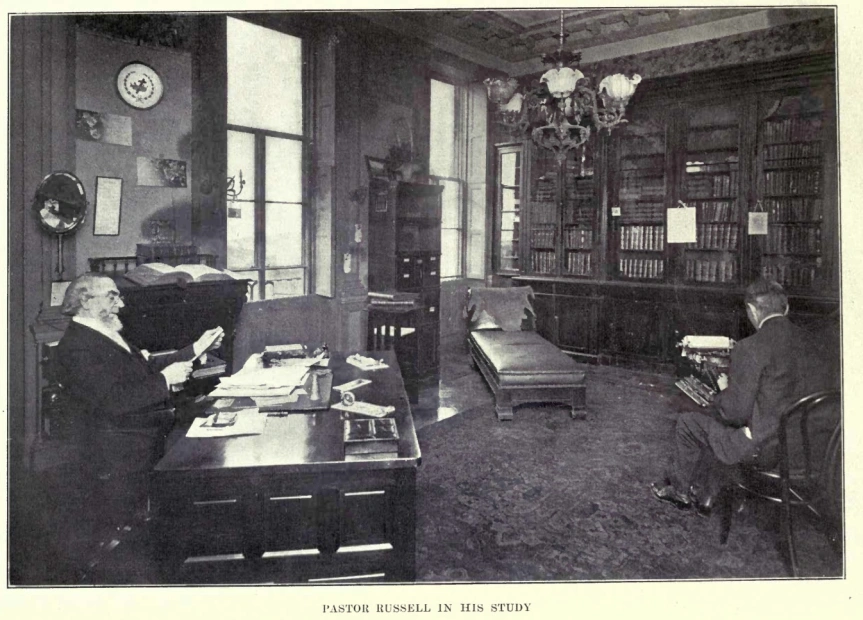
pastor-russell-in-his-study.jpg

Br. Charles Russell—the founder of the Bible Students movement, who is the compiler of “Poems and Hymns of Millennial Dawn” which was published in Allegheny, Pa., in 1890. This Bible Students’ devotional originally contained a total of 151 poems and 333 hymns.

POEMS-AND-HYMNS-OF-MILLENNIAL-DAWN

The following prefatory to the 1905 publication of Hymns of Millennial Dawn may be of historical interest to many of our readers.

We published in 1890, with several more recent editions, a volume entitled “Poems and Hymns of Millennial Dawn” without music. The same collection of hymns with the music is now urgently needed, and therefore appears in this volume. The poems, although highly prized, are omitted for greater convenience in size. We have preserved the same alphabetical order, because so many of our readers have the older book; and where a different tune is given from that originally suggested the latter is indicated by Alt. for alternative tune, with the number where that tune can be found.

Both words and music are credited to the same class to whom the work is dedicated—to the Lord and His faithful people, “the Saints.” The authors of many of the best of them are unknown to us, and, besides, slight changes have been made in the phraseology and sentiment of quite a number, which we could not be sure their original authors would approve, and to give personal credit to less than one half would seem invidious. To all of these dear “Saints” of all ages we therefore give united and hearty thanks for the blessings which they, as the Lord’s servants and handmaidens, have bestowed upon their fellow-members of “the Church of the Firstborn, whose names are written in Heaven.” Most of them died long ago: their abundant reward will be of the Lord in the resurrection.

That the collection is thoroughly undenominational, unsectarian, will be manifest to those recognizing the fact that it includes the choicest old hymns and tunes used by all denominations.

Although we have gathered far and near and winnowed carefully we cannot hope to have gotten all the golden grains, though we do hope that no chaff can be found. The collection is for the Church, for “believers” “reconciled,” and hence contains none of the “sinners” hymns, such as “Come, ye sinners poor and needy,” because willful sinners are in no sense members of the “Body” of Christ, nor are those who have not yet accepted the Lord as their Savior.

Those who will feel the deepest interest in this collection, and whose sentiments will be most fully voiced in its verses, will undoubtedly be those in fullest degree of sympathy with the divine plan of the ages, as set forth in the several volumes of Millennial Dawn – the eyes of whose understanding have been opened to the clearer, purer light now shining from our great Redeemer’s cross, showing the fulness and the completeness of his salvation.

In fact, this volume, while not numbered as one of the volumes of the Millennial Dawn series, is designed to be a companion volume, a melodious accompaniment to the “new song,” “the song of Moses and the Lamb” (the grand harmony of the Law and the Gospel), as presented in the regular Dawn series.

Let the music of God’s good and great plan ring through your hearts and lives, dear fellow-pilgrims and fellow members of the “royal priesthood,” so that every day and every hour shall be filled with joy and praise and thankfulness! And that this little volume may assist in deepening the work of grace in your hearts is our hope and prayer.

– Watch Tower Bible and Tract Society, July, 1905, Allegheny, PA, USA

——-

Later on, the hymns from this book formed a basis for the hymnal titled “Hymns of Dawn” which was published by the Dawn Bible Students Association in East Rutherford, New Jersey (USA) and the 1999 edition contains a total of 361 hymns.

Hymns of Dawn.jpg

Suggested Further Reading

Worthy To Be Praised
https://biblestudentsdaily.com/2016/05/15/worthy-to-be-praised/

DANIEL 3:17 – Our God Whom We Serve Is Able To Deliver Us
https://biblestudentsdaily.com/2017/10/14/daniel-317-our-god-whom-we-serve-is-able-to-deliver-us/

The Lord Is My Shepherd, (R1396) — Reprints of the Original Watch Tower and Herald of Christ’s Presence.

The Lord Is My Shepherd, (R3268) — Reprints of the Original Watch Tower and Herald of Christ’s Presence.

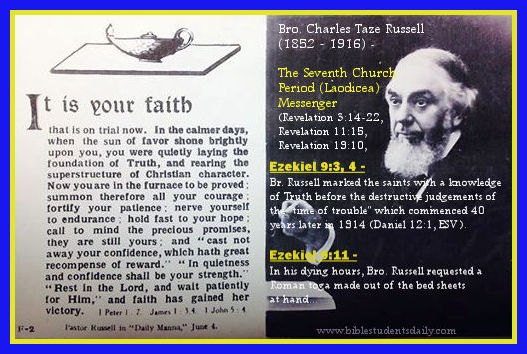
Charles-Taze-Russell-Laodicean-Messenger7.jpg


The URL of this post:
https://biblestudentsdaily.com/2018/04/09/hope-in-christ-hymns-of-dawn-no-15/

Enter your email address to subscribe to this blog and receive notifications of new posts by email.

2 Corinthians 5:20 – What Does Being “Ambassadors for Christ” Mean ?

2 COR. 5, 20

What is an ambassador ?

According to Wikipedia, an ambassador is :

“an official envoy, especially a highest ranking diplomat who represents a state and is usually accredited to another sovereign state, or to an international organization as the resident representative of their own government or sovereign or appointed for a special and often temporary diplomatic assignment… They are stationed in a foreign country and they as well as the embassy staff are granted diplomatic immunity and personal safety while living abroad.”

Apostle Paul made it clear to us that those who are accepted of God and begotten of the holy spirit are ambassadors of another country:

“For our citizenship is in heaven; whence also we wait for a Saviour, the Lord Jesus Christ” (Philippians 3:20, ASV).

“For he has delivered us out of the dominion of the darkness, and transplanted us into the kingdom of his dear Son” (Colossians 11:13).

The Apostle Paul

Apostle Paul referred to himself as an “ambassador in chains” (Ephesians 6:20). This is hardly the view we take of diplomatic ambassadors today. But Paul does not say this to elicit pity. Rather he tells the Church not to lose heart over what he is suffering because it is for the Church’s glory.

Truly Apostle Paul was a great ambassador!

Should we not also represent our head, Christ Jesus and SHINE like stars in the sky, being blameless and pure, “children of God without fault in a warped and crooked generation”? (Philippians 2:15)

YES we MUST do so… not tomorrow… BUT NOWright NOW… the High Calling of the Gospel Age is soon to end and Christ’s Bride composed of 144,000 members, shall hath made herself ready!

Dear Brethren, we will not miss out for the chance of eternal eternities and forevermore to belong to the BODY of Christ… to be counted worthy of the prize of the High Calling… of bringing our Heavenly Father grandest JOY and who shall present the Bride as the most righteous gift to Christ!

Let us “trim our lamps” as the “wise virgins” (Matthew 25:7) and stay separate from this world (2 Corinthians 6:17); and be “peculiar people” renouncing the world and its evil desires!

“14 Do all things without murmurings and disputings:15 That ye may be blameless and harmless, the sons of God, without rebuke, in the midst of a crooked and perverse nation, among whom ye shine as lights in the world…” (Philippians 2:14-15).

Prepare yourselves through strict training and discipline to belong to the ONE BRIDEGROOM ONLYlet JESUS BE YOUR HEAD–SEEK him; SEARCH for him; COPY him; make him proud; REPRESENT him in spite of ALL RIDICULE and SUFFERING in this world.

“24 Do you not know that in a race all the runners run, but only one receives the prize? So run that you may obtain it.
25 Every athlete exercises self-control in all things. They do it to receive a perishable wreath, but we an imperishable.
26 So I do not run aimlessly; I do not box as one beating the air.
27 But I discipline my body and keep it under control, lest after preaching to others I myself should be disqualified” (1 Corinthians 9:24-27, ESV).

The Apostle Paul encourages us: “Now then we are ambassadors for Christ, as though God did beseech you by us: we pray you in Christ’s stead, be ye reconciled to God” (2 Corinthians 5:20, KJV).

Qualifications of an Ambassador

As ambassadors of Christ, how should we conduct ourselves? What is our role?
Let’s consider the following characteristics of an ideal ambassador:

  1. PATIENCE

An ambassador listens carefully to the citizens of the countries he is involved in helping to understand their needs and situation so that any conflicts or disagreements can be resolved in peace. The Apostle Paul was so patient through his experiences as a prisoner and in his dealings with rulers he sought to bring about mutual understanding concerning the Truth.

  1. WISDOM

An ambassador uses his knowledge of people to (as far as possible) resolve conflicts between any parties involved. We have an example of this by the Apostle Paul–when question by rulers and confronted by hostile Jews and Greeks, he used Godly wisdom to answer.

“Now when Paul perceived that one part were Sadducees and the other Pharisees, he cried out in the council, “Brothers, I am a Pharisee, a son of Pharisees. It is with respect to the hope and the resurrection of the dead that I am on trial” (Acts 23:6, ESV).

  1. GRACIOUS SPEECH

As a spokesperson for his country, an ambassador is one who encourages and entreats with his words rather than causing any offence or hostility, as well as seeking the good of all. We see this in Apostle Paul’s conduct here:

“32Give none offence, neither to the Jews, nor to the Gentiles, nor to the church of God: 33Even as I please all men in all things, not seeking mine own profit, but the profit of many, that they may be saved” (1 Corinthians 10:32-33, KJV).

Apostle Peter explains: 11Dearly beloved, I beseech you as strangers and pilgrims, abstain from fleshly lusts, which war against the soul; 12Having your conversation honest among the Gentiles: that, whereas they speak against you as evildoers, they may by your good works, which they shall behold, glorify God in the day of visitation” (1 Peter 2:11-12, KJV).

  1. GENEROUSAn ambassador will use his time and talents to help others, especially as it promotes the interests of his home government, even at personal sacrifice and we note how Apostle Paul laid down his life for kingdom interests  in Philippians 2:4:-

Phil. 2, 4.jpg

  1. REASONABLENESS

An ambassador will try to help those in his host country and persuade them to appreciate the benefit of his counsel. Paul continually appealed to others to accept his counsel concerning Christ’s kingdom and the blessing it will be to all.

  1. HONESTY

An ambassador tells the truth and uses facts to persuade others. He neither deceives nor exaggerates to achieve his way. Paul was forthright, even on occasion calling the attention of Peter and others to what appeared to be a misleading example.

11 But when Cephas came to Antioch, I opposed him to his face, because he stood condemned. 12 For before certain men came from James, he was eating with the Gentiles; but when they came he drew back and separated himself, fearing the circumcision party.13 And the rest of the Jews acted hypocritically along with him, so that even Barnabas was led astray by their hypocrisy. 14 But when I saw that their conduct was not in step with the truth of the gospel, I said to Cephas before them all, “If you, though a Jew, live like a Gentile and not like a Jew, how can you force the Gentiles to live like Jews?” (Galatians 2:11-14, ESV).

  1. UNDER READINESS OF MIND

An ambassador is ever alert to represent and promote the interest of his government even at the risk of personal benefit or gain.

Apostle Paul did not let opportunities slip by him, to regret latter. He embraced his appointed service with diligence. As Jesus, “for the joy set before him” endured ALL manner of rebuff and persecution, so Apostle Paul followed the example of Jesus (1 Corinthians 4:11-13).

  1. HUMILITY

An ambassador recognizes that he has no personal authority apart from the country he represents. Further, as he provides instruction and direction, he explains the laws of his home country.

Though Apostle Paul was a leading light in the early church, he considered himself the “least of the apostles” (1 Corinthians 15:9, Ephesians 3:8).

“If in this life only we have hope in Christ, we are of all men most miserable” (1 Corinthians 15:9).

“To me, though I am the very least of all the saints, this grace was given, to preach to the Gentiles the unsearchable riches of Christ (Ephesians 3:8, ESV).

Philippians-2-3.jpg

If we as Christians could keep these thoughts always prominent before our minds, what a dignity it would add to our character! What a transforming power it would be!

What an assistance to the new nature in its battle with the low and grovelling tendencies of the old nature now disowned by us and reckoned dead!

Dear friends, let us remember that “our citizenship is in heaven” (Philippians 3:20).

While still living in the world, we are not of it but have transferred our allegiance and citizenship to the Kingdom. And now, as appointees of our Kingdom, while still living in the world among aliens and strangers, we as representatives and ambassadors should feel both the dignity and the honor of the position and the weighty responsibilities and keep in memory the Apostle’s words,

Whatsoever ye do in word or deed do all in the name of the Lord Jesus(Colossians 3:23).

(Refer to Reprints of the Original Watch Tower page 3329 for a lovely article titled “Do All in the Name of the Lord Jesus.“)

We can learn by Apostle Paul’s wonderful example of ambassadorship and demonstrate, as he did, a ministry of reconciliation now.

Our Christ-like behavior in this world brings a certain amount of help and healing to a world that needs deliverance.

“A wicked messenger falleth into unhappiness; but a faithful ambassador bringeth healing
(Proverbs 13:17, Leeser).

This will prepare us well for the greater reconciliation of all mankind in which we will participate, no longer as ambassadors, but rather as kings and priests with Jesus.

What a hope is ours!

May we do ALL in our power to glorify our Heavenly Father Jehovah through Jesus Christ, GOD’s Son–in our bodies and our spirit which belong to our Head—Jesus CHRIST.

Reference:

Special thanks to Br. David Stein for source material from the article Paul the Ambassador“, The Herald of Christ’s Kingdom, August/September 2011.


The URL for this post is: https://biblestudentsdaily.com/2016/10/20/2-corinthians-520-what-does-being-ambassadors-for-christ-mean/

Enter your email address to subscribe to this blog and receive notifications of new posts by email.