

Wondrous Grace – Hymns of Dawn No. 21
Here is a recording of Hymn No. 21 from the “Hymns of Dawn” to aid God’s people in singing and making melody in their hearts unto God.
“(1) Come, let us shout joyfully to Jehovah! Let us shout in triumph to our Rock of salvation. (2) Let us come into his presence with thanksgiving; Let us sing and shout in triumph to him” (Psalm 95:1,2).
“My mouth shall praise Thee with joyful lips” (Psalm 63:5).
Lyrics
1.
Behold, what wondrous grace
The Father hath bestowed
On members of a fallen race,
To make them sons of God.
2.
By His dear Son redeemed,
By grace then purified;
What favor that we should be named
For Christ’s joint heir and bride!
3.
Nor doth it yet appear
How great we must be made;
But when we see our Saviour here,
We shall be like our Head.
4.
A hope so much divine
May trials well endure;
May purify our souls from sin,
As Christ, The Lord, is pure.
5.
Now in our Father’s love
We share a filial part;
He grants the spirit from above
To dwell within each heart.
6.
We can no longer lie
Like slaves beneath the throne;
Our hearts now Abba, Father, cry,
And He the kindred owns.
*******
The History Of This Hymn
Author — Isaac Watts (1674-1748). Verse 2 in the “Hymns of Dawn” is not contained in the lyrics written by Isaac Watts and could not be found in any other Hymnal other than in the Hymns of Dawn.
Composer — No information. From a Google search, the earliest record of the same tune as contained in the Hymns of Dawn, has been found in the “Songs for Social and Public Worship” published in 1863, on page 144. Another tune arrangement (nearly identical to the “Hymns of Dawn” score) is found in “Every Sabbath: A new collection of music adapted to the wants and capacities of Sunday-Schools, the home circle, and devotional gatherings,” page 147 Hymn No. 145a published in 1874.
*******
Bible Scriptures Associated With This Hymn
John 1:11-13 (ESV)— “(11) He came to his own, and his own people did not receive him. (12) But to all who did receive him, who believed in his name, he gave the right to become children of God, (13) who were born, not of blood nor of the will of the flesh nor of the will of man, but of God.“
Acts 15:10, 11 (ESV) — “(10) Now, therefore, why are you putting God to the test by placing a yoke on the neck of the disciples that neither our fathers nor we have been able to bear? (11) But we believe that we will be saved through the grace of the Lord Jesus, just as they will.”
Romans 3:23, 24 (NIV) — “… for all have sinned and fall short of the glory of God, and all are justified freely by his grace through the redemption that came by Christ Jesus.”
Roman 5:1-2 (KJV) — “(1) Therefore being justified by faith, we have peace with God through our Lord Jesus Christ: (2) By whom also we have access by faith into this grace wherein we stand, and rejoice in hope of the glory of God.”
Romans 6:13, 14 (ESV) — “(13) Do not present your members to sin as instruments for unrighteousness, but present yourselves to God as those who have been brought from death to life, and your members to God as instruments for righteousness. (14) For sin will have no dominion over you, since you are not under law but under grace.”
2 Corinthians 6:1 — “(1) We then, as workers together with him, beseech you also that ye receive not the grace of God in vain. (2) (For he saith, I have heard thee in a time accepted, and in the day of salvation have I succoured thee: behold, now is the accepted time; behold, now is the day of salvation.)“
Ephesians 2:8, 9 (ESV) — “(8) For by grace you have been saved through faith. And this is not your own doing; it is the gift of God, (9) not a result of works, so that no one may boast.
Titus 2:11-14 (ESV) — “(11) For the grace of God has appeared, bringing salvation for all people, (12) training us to renounce ungodliness and worldly passions, and to live self-controlled, upright, and godly lives in the present age, (13) waiting for our blessed hope, the appearing of the glory of our great God and Savior Jesus Christ, (14) who gave himself for us to redeem us from all lawlessness and to purify for himself a people for his own possession who are zealous for good works.
Hebrews 4:16 (KJV) — “Let us therefore come boldly unto the throne of grace, that we may obtain mercy, and find grace to help in time of need.”
1 John 3:1-3 (KJV) — “(1) Behold, what manner of love the Father hath bestowed upon us, that we should be called the sons of God: therefore the world knoweth us not, because it knew him not. (2) Beloved, now are we the sons of God, and it doth not yet appear what we shall be: but we know that, when he shall appear, we shall be like him; for we shall see him as he is. (3) And every man that hath this hope in him purifieth himself, even as he is pure.”
*******
The words below are from Reprint No. 2283, from the Original Watchtower and Herald of Christ’s Presence.
“BY GRACE ARE YE SAVED.”

“For the grace of God that bringeth [leads to] salvation hath been manifested for all men—teaching us that renouncing ungodly desires we should live soberly, righteously and godly in this present age, waiting for the blessed hope, even the glorious manifestation of our great God and Savior Jesus Christ; who gave himself for us that he might redeem us from all iniquity and purify unto himself a peculiar people, devoted to good works.”—Titus 2:11-14.
[Note: The definition of “renouce” (or “say no to”— NIV Bible): formally declare one’s abandonment of (a claim, right, or possession). Synonyms: reject, refuse to abide by, refuse to recognize, desert, discard, disown, cut off, cast off, lay aside, refuse to fulfil, invalidate, nullify, disclaim, repudiate (which means reject, divorce from, refuse to accept).]
“GRACE, ’tis a charming sound,” sang the poet, nor did he exaggerate; for to all who have learned the true meaning of divine grace, that word, like the word “gospel,” is a synonym for all the divine mercies which God’s people may now or ever enjoy…
The word grace signifies favor—particularly unmerited [not deserved] favor. Acts of grace are thus to be clearly distinguished from acts of justice and from obligations… Every testimony to the effect that God is extending his “grace” to humanity or to the Church is a testimony to their unworthiness to justly demand those favors or blessings.
The spirit of the world in general is that of self-sufficiency and independence; following their own wisdom and lacking the instruction and wisdom from above, the worldly-wise regard themselves with complacency; they believe themselves to be quite sufficiently righteous to merit a good deal of divine blessing and reward: true, they admit also that they have imperfections, but these they expect to pay for to the full according to some law of divine retribution. Hence they are undisposed to look for or to accept pardon, forgiveness, justification through the great sacrifice for sins which God has provided… And so they regard all of the laws governing humanity as merciless, graceless—strictly just.
The Scripture presentation of the matter does not overlook the law of retribution—that sin of any kind, the transgression of any law, will surely bring its penalty, whoever may be the sinner and whatever may be the conditions. And the propositions respecting divine grace, rightly understood, are not in conflict with this universal law of retribution: the proposition of grace is … not to prevent the wages of sin from following transgression, but to succor the repentant who desire to reform, and to help him back to divine favor and full recovery, along the lines of strictest justice;—by a willing ransom-price.
And since this succor is wholly unmerited on man’s part and without just obligation on God’s part, it is purely of divine favor—”grace.” Indeed, if it were not for sin and its retributive punishments, there would be no room for grace: it is man’s necessity for grace that constitutes the divine opportunity for its exercise. Grace, however, operates in harmony with the divine laws, and not in violation of them.
Remembering that divine grace signifies God’s unmerited mercy and favor, let us examine its operation in the light of Scripture:—
(1) The first movement of divine grace toward mankind was the exercise of benevolence, love and compassion toward mankind in his fallen and sinful condition. There was nothing in man to merit this compassion and sympathy; quite to the contrary: we were aliens from God and enemies of his righteous rule through wicked works,—the depravity wrought in us through sin voluntarily committed by father Adam.
(2) It was in harmony with this thought of grace on God’s part, or, as we might term it, God’s gracious plan, that he revealed something respecting his purpose of ransom and restitution to father Abraham;—thus preaching first, beforehand, to him the good tidings of a coming blessing or grace, saying, “In thy seed shall all the families of the earth be blest.” Abraham, and others who believed God, rejoiced in mind under the influence of this gracious promise—altho even the beginning of its fulfilment was still nearly two thousand years off.
(3) The third step of grace was in the great gift of divine love, our Lord Jesus Christ. It included the gracious arrangement made with the only begotten Son of God, on account of which he joyfully laid aside his heavenly glories and conditions and humbled himself in death as the ransom or substitute for the first Adam and thus incidentally a “ransom for all” [1 Timothy 2:6] the race of Adam.
(4) It was a fourth step of grace when God, having determined to select a Church, a “little flock,” to be heirs of God and joint-heirs of Jesus Christ their Lord, in the dispensing of the divine favors or grace, promised through Abraham, began the work of selecting this Church—receiving at Pentecost the first installment, from the house of servants into the house of sons and joint-heirs. (John 1:12,13.) Altho tests were applied to those received into the family of sons, and altho character qualifications were imposed upon them and will be imposed upon all who will be called and accepted to this high calling [Philippians 3:14], nevertheless this also was a step of grace, because there were no obligations resting upon God to confer upon us such a “high calling,” such “riches of his grace in Jesus Christ our Lord.”
(5) Throughout this Gospel age the same grace has been in operation doing a twofold work; (a) justifying repentant believers from the guilt of their moral obliquity, and giving them thus a standing before God in Christ’s imputed righteousness;—thus making them eligible to the “high calling” to divine sonship and to joint-heirship in God’s Kingdom to come, and (b) then extending to them that “high calling,” inviting them through the divine Word to become the “very elect.” True, there are conditions imposed, and not all the many “called” will be among the few “chosen;” but nevertheless it is an inestimable privilege to be “called” and to have put within our grasp the opportunity and all the needful helps, whereby we may make our calling and election sure.
(6) The grace of God will still further be manifested when the “elect” Church shall all have been sought, found, tried, disciplined, and “made meet to be partakers of the inheritance of the saints in light;” for the blessings which will be conferred upon this glorified Church will not only be such as were not merited, such therefore as were not of obligation upon God’s part, but according to the divine testimony they will be additionally great, super-abounding in grace, “exceedingly abundantly more than we know how to ask or expect;” for “eye hath not seen, nor ear heard, neither hath entered into the heart of man, the things which God hath in reservation for those that love him.”—1 Cor. 2:9.
(7) Even then, God’s grace will not have exhausted itself;—even after having thus honored and blessed and exalted the Church, the body of Christ, whose only merit consisted first in an honest confession of sin and an acceptance of the divine favor, and second, in their “reasonable service” in rendering their lives in obedience to him who bought them and in and through whom the divine graces were extended.
Then divine grace will begin to be fully manifested—then all shall see it, all shall know it, and all who will may share it; for then will begin the glorious [R2284] “times of restitution of all things, which God hath spoken by the mouth of all his holy prophets since the world began”—the Millennial age of a thousand years; the time when the knowledge of the Lord shall graciously be caused to fill the whole earth; the time when all the sin-blinded eyes shall be opened; the time when all the prisoners of the pit (death) shall come forth, that they may be instructed in righteousness. Then, according to the grace of the divine promise, he who redeemed the world shall judge the world in righteousness, a trial, an opportunity, that whosoever will, with a knowledge of sin and its penalty, and with a knowledge of righteousness and its rewards, with a knowledge of the goodness and grace of God shining in the face of Jesus Christ our Lord, may then stand trial and be judged as to whether they will receive God’s grace and its provisions of eternal life, or whether they will reject these and die the second death.
Here we behold the wonderful steps of grace. No one can intelligently believe in divine grace who holds the theory of evolution or any other theory of salvation than the Scriptural one, which recognizes man’s original creation in the divine likeness, his fall into sin and death, his redemption therefrom by the death of our Redeemer, and his hope for recovery through divine grace extended now to the Church and to be extended by and by through the Church (under Christ its Head) to all the families of the earth.
Coming now to consider present manifestations of divine grace toward the Church, we note that many professed followers of the Lord fail … to appreciate this grace which it is their privilege to enjoy. This is attributable largely to false teaching and preaching… For instance, how common it is for people to hear and to believe that if they “do right” they will have divine rewards at the end of life’s race; but if they “do wrong” they shall have divine punishment at the end of the race. Such views ignore grace entirely…
If we are to be punished in proportion to our shortcomings and rewarded for our obedient deeds, where would be the “grace?“ Where would be the mercy? Where would be the necessity of a Savior, a sin-offering, an atonement and a reconciliation with God? Where would be the peace through our Lord and Savior Jesus Christ? None of these mercies and blessings can be rightly recognized except as the grace of God (his unmerited favor) is seen in them.
The fact is that the divine standard of righteousness is much higher than men generally understand: with God righteousness is synonymous with perfection; and hence “all unrighteousness [all imperfection, however or whenever or wherever]—is [a proof of] sin. Thus all men are proved to be sinners,—because all are imperfect, un-right. And the divine law is that the sinner, the wrongdoer, the un-right, the imperfect, shall not live. “The wages of sin is death.” Whoever [R2285] understands this can see at once that man’s only hope of eternal life lies not in his own perfection, but in divine mercy, grace.
But, says someone, That is not a fair statement of the case. God made me as I am, imperfect; and justice requires that he shall not demand of me an impossible perfection, nor punish me for weaknesses and imperfections beyond my control. Such reasoning implies a misunderstanding of the case. It is a mistake to assume that God made us imperfect. All “his work is perfect.” (Deut. 32:4; Psa. 18:30; Matt. 5:48.) He neither created idiots nor other physical and mental malformations of humanity, but, as the Scriptures declare, we were “born in sin and shapen in iniquity—in sin did my mother conceive me.”
Our blemishes come to us from our parents, not from God.
The Scriptures not only point out to us father Adam’s sinless perfection, saying that he was created in the image of God, but they plainly declare that it was by his disobedience that the divine sentence of death passed upon him and passed as an inheritance, a legacy of evil, to his offspring, saying, “By one man’s disobedience sin entered into the world and death as a result of sin, and so death passed upon all men, for all are sinners [imperfect].” Truly also, “The fathers have eaten a sour grape [disobedience] and the children’s teeth are set on edge.”—Rom. 5:12,17-19; Jer. 31:29; Ezek. 18:2.
The very basis of all our hopes, then, is this grace of God, operating toward us through Jesus Christ our Lord. God’s grace does not subvert or set aside God’s law, however, and he who would rightly appreciate and use the divine grace should recognize this fact. God’s grace was not intended to frustrate the spirit of his own law: it was not intended to clear the guilty, the wilful transgressor. It acknowledges the divine law, attests its justice, and has fully met its requirements in the person and sacrifice of our Lord Jesus on behalf of Adam and all his race involved in his transgression and his penalty—death. Hence it was that “Christ died, the just for the unjust” in order “that God might be just and yet be the justifier of him that believeth in Jesus.”
The only condition upon which God’s grace is offered is:
- our acknowledgment of our sin, weakness and imperfection,
- a sorrow for these and
- a repentance and
- reformation to the extent of our ability and
- an acceptance of Christ Jesus as the personification of divine grace.
Upon no other condition can we step into this grace of God or walk in its way and inherit its rewards.
And even after we have received Christ and God’s grace in him, and are no longer recognized as strangers, aliens to God, but sons, as servants of righteousness and no longer servants of sin, being imperfect, we are not free from blemishes of word, thought and deed; yet, God’s grace … continues with us to cover our blemishes until perfected in the resurrection. Under its provisions whatever is contrary to our wills, and purely the result of hereditary weakness, may be forgiven; and our obliquity and blameworthiness be gauged only by the measure of wilfulness or assent connected with the wrongdoing. Nevertheless, to some extent, chastisements or natural penalties for violations of law may be expected: but to those under grace these will come as helps by the way, causing them more and more to detest sin, as corrections in righteousness, as chastisements and disciplines for their blessing. And even these sure penalties may be to some extent ameliorated in accordance with the wisdom of our great High priest, who, having borne all our sins in his own body on the tree, is freely empowered to abate for us so much of the penalty of our misdeeds as grace may be able to cover as un-wilful [accidental, not deliberate] transgressions.
There is a disposition in our day, as there was a disposition in the days of the apostles, for those who have once accepted of divine forgiveness, the grace of God through Christ, to turn aside therefrom and to attempt to justify themselves by works. Even while first experiences were those of humble dependence upon divine mercy, subsequent experiences sometimes lead to the rejection of the grace that at first was so thankfully received. The Apostle wrote to some thus affected, saying, “Christ has become of none effect unto you, whosoever of you are justified by the law; ye are fallen from grace.” (Gal. 5:4.)
Judged from this same standard, how many Christians today have backslidden—fallen from grace—lost the trust in the merit of the precious blood and in divine favor extended to us through the great atonement sacrifice. Now, as then, the disposition is to trust to works of our own righteousness, which … our own consciences should prove to us are imperfect, “filthy rags” unfit and unable to cover us. Yes, we need a covering before we could in any manner or degree hope to be acceptable to God, and this covering of our imperfections with the imputed righteousness of Christ, is another statement of the grace of God extended to us. This tendency to depart from a recognition of God’s grace in Christ as our only hope for eternal life, and to take instead a hope of being able to walk righteously and to do justly, and thus to merit eternal life, is what the Apostle very properly calls “another gospel”—a false gospel.—Gal. 1:6.
This thought of the divine grace as the basis of all our mercies is interwoven with all the promises of God’s Word. Thus the Apostle speaks of the gracious plan of God, and Christ as the exponent of that plan as “the grace of God and the gift by grace.”—Rom. 5:15.
Our approach to God in prayer is spoken of as an approach, not to the throne of justice and equity, but as an approach to “the throne of grace,” where “we may obtain mercy and find grace to help in every time of need.”—Heb. 4:16.

Again we are exhorted that our hearts be established in grace; and again told that unto every one of us is given grace according to the measure of our faith; and again the Apostle declares of himself, “By the grace of God I am what I am” [1 Corinthians 15:10].
According to the testimony of our text this grace is general, “for ALL men,” and must therefore ultimately in some manner or other be extended to all men,—the dead as well as the living. The translation of our Common Version is manifestly faulty here; all men, even in this most enlightened day of the world’s history, have not yet beheld God’s grace in any degree, nor has it as yet brought them salvation. But since it has been provided freely for all, so ultimately it shall be extended to all, that all may avail themselves of it.
The teaching of this grace is not that we may continue in sin that grace may abound; for divine grace is intended to benefit only those who renounce sin and become servants of righteousness: and thus, as our text declares, God’s grace teaches us that we should repudiate sin and live separate from every ungodly desire, in righteousness, soberness and godlikeness. Furthermore, as our text declares, this grace of God does not claim to have reached its completeness, and to have accomplished in us and for us the grand designs of the God of all grace. On the contrary, it teaches us to WAIT for the consummation of this grace until the glorious manifestation of the Son of God in the majesty and power of his Kingdom, to unite his Church with himself as his Bride and joint heir, the channel of mercies and blessings through which God’s grace shall flow to all the groaning creation.—Rom. 8:18-22; 11:31.
“RECEIVE NOT THE GRACE OF GOD IN VAIN.”
“We then as workers together with him, beseech you also that ye receive not the grace of God in vain.”—2 Cor. 6:1.
This exhortation is addressed to such as have already recognized God’s gracious character and the gift [R2285] of his grace toward mankind,—the redemption which is in Christ Jesus. The Apostle has just been explaining this matter of how God’s grace had provided a reconciliation; “that God was in Christ reconciling the world unto himself, not imputing their trespasses unto them [but unto him who died for them].“ He declares himself an ambassador on behalf of God to declare this grace and exhorts his readers not only to accept of God’s grace in the forgiveness of sins through Christ, but additionally that they also should become fully reconciled or completely in harmony with the Lord, as would be represented by full consecration to him and his service, after the example of the Apostle himself.
We take it that this exhortation of our text is the equivalent of the same apostle’s exhortation elsewhere, namely, “I beseech you, brethren, by the mercies of God [already brethren because already believers in Christ and partakers through him of divine grace], that ye present your bodies living sacrifices, holy, acceptable unto God, which is your reasonable service.”—Rom. 12:1.
The Apostle was here urging progress on the part of the believers, advancement from “justification by faith” to the next higher step in divine grace and privilege,—full consecration even unto death, in response to the “call” to joint-heirship with Christ in his Kingdom,—to suffer with him in the present time, and to reign with him by and by in glory. These two steps are contrasted by the same Apostle, who says of himself and others who had taken both steps, (1) “Being justified by faith we have peace with God through our Lord Jesus Christ.” (2) “By whom also [additionally] we have access by faith into this [further] grace wherein we stand and rejoice in hope of [sharing] the glory of God.”—Rom. 5:1,2. [R2286]
In our text the Apostle distinctly implies the possibility that some may receive the grace of God in vain—to no purpose. We see from the connection as we have examined it, that he refers to the grace of God in justification, the forgiveness of our sins, and not to the second step of grace, our acceptance to the new nature through the begetting of the spirit. This implies, therefore, that the only object of justification by faith in this present age, is to give us a footing, a standing of acceptableness with God, from which we may be able to advance and take the second step of self-sacrifice, and become joint-heirs with Christ in his Kingdom. Nevertheless, this first step and all the privileges and blessings connected with it would be “in vain,”profitless to us, if we fail to take the second step, the particular feature of the divine plan which belongs to this Gospel age.
We are not to add to the Word of God, and to say that to receive justification in vain (by not making use of it to progress to a complete consecration and newness of nature) would mean eternal torment, or even the second death: we are simply to understand it as it reads, that the intention of the grace of justification, the first step, being to qualify us for the second step, those who fail to take the second step will have no particular benefit accrue to them from the first step, which would thus have been taken in vain, profitlessly, without permanent results and advantages.
… Only those who take the “narrow way” will gain any prize offered during this Gospel age, which is specifically the age set apart for the development of the “royal priesthood,” devoted to good works—to self-sacrifices in the service of the Lord and his cause. Indeed, there is only one prize and one hope of our calling during this age—the other prize and other hope and other call will be in the age to come. We cannot therefore expect that any who take the first step of faith in Christ, and who are therefore temporarily justified because of their faith, will have a reward for a faith which did not work by love. The faith that works by love speedily goes on to full consecration and self-sacrifice, and is a sure indication of the kind the Lord is seeking for his “little flock,” the “royal priesthood,” the “joint-heirs.” The faith, therefore, which refuses to work by love, cannot be considered an acceptable faith in God’s sight. Nor can we expect that this class will be counted worthy to share in the earthly phase of the Kingdom with Abraham, Isaac and Jacob and all the prophets.
… While not favored with the “high calling” to the divine nature and jointheirship with Christ, because this “call” was not yet due to be proclaimed, nevertheless, these ancient worthies manifested a faith and a trust in the Lord and his promises which worked, and by their works manifested a love for the Lord and a loyalty to him which did not hesitate to sacrifice reputation, wealth and life itself, in obedience to the principles of righteousness revealed to them… [R2286]
A much misunderstood text respecting grace is the one used as a caption for this article, namely, “By grace are ye saved, and that not of yourselves, it is the gift of God.” (Eph. 2:8.) The erroneous thought given by many is that our faith is not our own faith, not of our own volition, but an impartation, a gift from God. Of course, in one sense every gift and blessing which we enjoy is indirectly if not directly from God; “Every good gift and every perfect gift is from above, and cometh down from the Father of lights.” (Jas. 1:17.) But the proper understanding of the Apostle’s words, we believe, is this: It is of God’s grace and not of personal merit on our part that salvation is offered to us; and altho that salvation is offered to us as a reward of faith (including true faith’s obedience), yet we cannot even boast respecting our faith as tho it merited the Lord’s favor,—for our faith is something which is the indirect result of divine providence also; there are millions of others in the world who might exercise just as much faith as we if they had been favored of God with as much light, intelligence, knowledge, as a basis of faith: hence our faith is not to be credited as a meritorious condition but we are to be thankful to God for it, for the circumstances and conditions which have made it possible for us to exercise faith are of his grace.
====================
Hymn Book Purchase
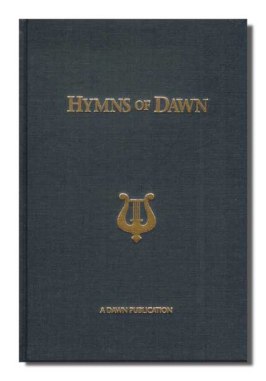
The Hymns Of Dawn (hymn book) can be purchased at:
The Chicago Bible Students Online Bookstore: https://chicagobible.org/product-category/books/page/4/
The Dawn Bible Students Association: http://www.dawnbible.com/dawnpub.htm
Acknowledgment & References
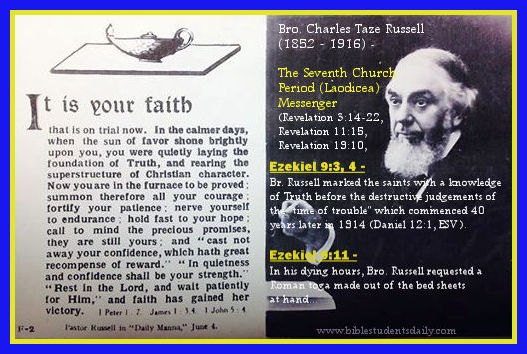
- Br. Charles Taze Russell

Br. Charles Russell—the founder of the Bible Students movement, who is the compiler of “Poems and Hymns of Millennial Dawn” which was published in Allegheny, Pa., in 1890. This Bible Students’ devotional originally contained a total of 151 poems and 333 hymns.

The following prefatory to the 1905 publication of Hymns of Millennial Dawn may be of historical interest to many of our readers.
We published in 1890, with several more recent editions, a volume entitled “Poems and Hymns of Millennial Dawn” without music. The same collection of hymns with the music is now urgently needed, and therefore appears in this volume. The poems, although highly prized, are omitted for greater convenience in size. We have preserved the same alphabetical order, because so many of our readers have the older book; and where a different tune is given from that originally suggested the latter is indicated by Alt. for alternative tune, with the number where that tune can be found.
Both words and music are credited to the same class to whom the work is dedicated-to the Lord and His faithful people, “the Saints.” The authors of many of the best of them are unknown to us, and, besides, slight changes have been made in the phraseology and sentiment of quite a number, which we could not be sure their original authors would approve, and to give personal credit to less than one half would seem invidious. To all of these dear “Saints” of all ages we therefore give united and hearty thanks for the blessings which they, as the Lord’s servants and handmaidens, have bestowed upon their fellow-members of “the Church of the Firstborn, whose names are written in Heaven.” Most of them died long ago: their abundant reward will be of the Lord in the resurrection.
That the collection is thoroughly undenominational, unsectarian, will be manifest to those recognizing the fact that it includes the choicest old hymns and tunes used by all denominations.
Although we have gathered far and near and winnowed carefully we cannot hope to have gotten all the golden grains, though we do hope that no chaff can be found. The collection is for the Church, for “believers” “reconciled,” and hence contains none of the “sinners” hymns, such as “Come, ye sinners poor and needy,” because willful sinners are in no sense members of the “Body” of Christ, nor are those who have not yet accepted the Lord as their Savior.
Those who will feel the deepest interest in this collection, and whose sentiments will be most fully voiced in its verses, will undoubtedly be those in fullest degree of sympathy with the divine plan of the ages, as set forth in the several volumes of Millennial Dawn—the eyes of whose understanding have been opened to the clearer, purer light now shining from our great Redeemer’s cross, showing the fulness and the completeness of his salvation.
In fact, this volume, while not numbered as one of the volumes of the Millennial Dawn series, is designed to be a companion volume, a melodious accompaniment to the “new song,” “the song of Moses and the Lamb” (the grand harmony of the Law and the Gospel), as presented in the regular Dawn series.
Let the music of God’s good and great plan ring through your hearts and lives, dear fellow-pilgrims and fellow members of the “royal priesthood,” so that every day and every hour shall be filled with joy and praise and thankfulness! And that this little volume may assist in deepening the work of grace in your hearts is our hope and prayer.
– Watch Tower Bible and Tract Society, July, 1905, Allegheny, PA, USA
——-
Later on, the hymns from this book formed a basis for the hymnal titled “Hymns of Dawn” which was published by the Dawn Bible Students Association in East Rutherford, New Jersey (USA) and the 1999 edition contains a total of 361 hymns.
Suggested Further Reading
Debtors To His Marvelous Grace, by J.J. Blackburn. The Herald of Christ’s Kingdom Magazine, July/August 1986.
http://www.heraldmag.org/archives/1986_4.htm#_Toc36907878
The Foreshadowing of Grace, by F.A. Essler. The Herald of Christ’s Kingdom Magazine, January/February 1986.
http://www.heraldmag.org/archives/1986_1.htm#_Toc36905444
A Special Calling by Br. David Rice. The Herald of Christ’s Kingdom. July /August 2016.
https://herald-magazine.com/2016/07/01/the-bride-class/
The Bride and the Bridegroom by Br. Carl Hagensick. A Verse-by-verse Study of Psalm 45. The Herald of Christ’s Kingdom. July/August 2004.
http://www.heraldmag.org/2004/04ja_4.htm
A Chaste Virgin. The Herald of Christ’s Kingdom.
http://www.heraldmag.org/literature/chliv_38.htm
His Loving Kindness – Hymns of Dawn No. 19
https://biblestudentsdaily.com/2018/06/19/his-loving-kindness-hymns-of-dawn-no-19/
Awake My Soul — Hymns of Dawn No. 20
https://biblestudentsdaily.com/2018/06/27/awake-my-soul-hymns-of-dawn-no-20/
The Sacrifice
https://biblestudentsdaily.com/2017/01/05/the-sacrifice/
Give Thanks In All Circumstances
https://biblestudentsdaily.com/2018/01/03/1-thessalonians-518-thankfulness/
The Truth About Hell. A Dawn Bible Association Publication. http://www.dawnbible.com/booklets/hell.htm
Hope Beyond the Grave. A Dawn Bible Association Publication. http://www.dawnbible.com/booklets/grave.htm
Christ and His Bride. BIBLE Students DAILY.
https://biblestudentsdaily.com/2017/06/25/christ-and-his-bride/
Our Beliefs — What Does the Bible Teach Us?
https://biblestudentsdaily.com/category/beliefs/
Bible Students’ Links and Bible Study Resources
https://biblestudentsdaily.com/category/links/
This post’s URL:
https://biblestudentsdaily.com/2018/07/25/wondrous-grace-hymns-of-dawn-no-21/






 BIBLE Students DAILY