Pastor Charles Russell’s Last Days

Excerpts from the Reprints of the Original Watchtower and Herald of Christ’s Presence, pages 6001-6006, by Brother Menta Sturgeon (1867-1935):-
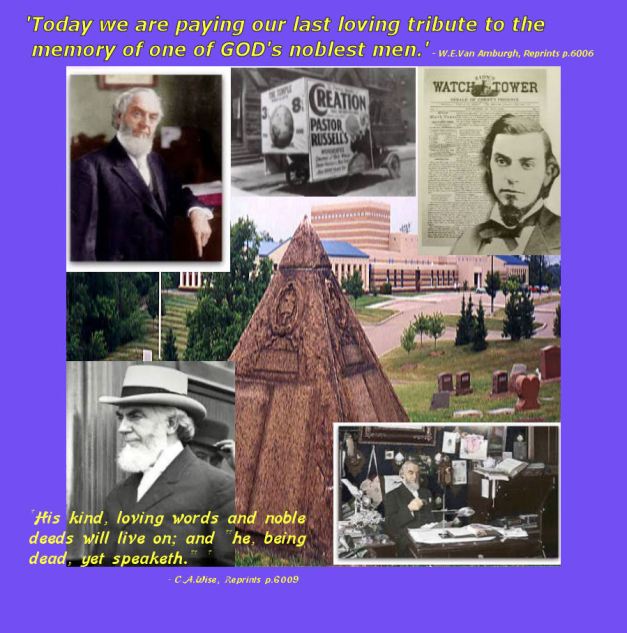
pastor-charles-russells-last-days-reprint-6001-6006

On Monday afternoon, October 16th, 1916 at 5 pm, Brother Russell left the Bethel home for the last time.

At the noon hour he informed the dearest family to him on earth that he expected to be absent from them for a short time, and expressed for them the hope that during his absence they might be happy and prosperous under the blessings of the Lord. He also said that he expected that he and the one accompanying him would enjoy themselves in the Lord’s service. Then, while he and the family stood at their places, he offered a solemn prayer, beginning with the words:

“O Lord, Thy promised grace impart, And fill each consecrated heart!”

Brother Russell afterwards, wrote out nine letters — giving instructions to various ones respecting their duties. At the appointed hour he went forth, never more to return, saying “goodbye” to the friends in the hall as he passed out and started for the station.

When the Lehigh Valley train pulled out of Jersey City at 6 pm, it carried away our precious Brother on his last pilgrim journey, which was to end in Heaven. Having held public meetings at Providence and Fall River the day previous, he was tired to start with, and consequently did not dictate on the train that evening, as was his custom. In fact, he retired earlier than usual, saying “Good-night” as he did so.

In the morning, in answer to the question as to how he rested, he gave his usual answer during his recent trips, “On both sides,” meaning, of course, that he changed sides frequently during the night.

He often told us of late that he scarcely slept at all, was awake every hour of the night, and thought pretty much day and night. He had the care of all the churches upon his heart, and his physical ailments would not permit much rest. He always ate sparingly, and would carefully note the effect of everything he ate or drank.

He had a beautiful way of making the one who traveled with him feel at ease, and not consider himself merely as a servant, by handing him enough money at the beginning of the journey to cover all his incidental expenses during the trip. He would then arrange that we pay each other’s expenses alternately; he paying all expenses for both one day, and his companion paying all expenses for both the next day, and so on during the entire trip.

DIFFICULTIES ON THE WAY

The wreckage of a freight train during the night had caused the delay, we were informed, and a detour of fifty miles would be necessary to enable us to reach our destination. There was no dining car on the train, and neither could we secure anything to eat on account of uncertainties. It was at this point that a box of peanut butter sandwiches, which had been given to us by a thoughtful friend in Brooklyn, came in just right…. It was at Chicago that his physical endurance was taxed to the limit. Circumstances made it necessary for us to walk several miles, until the writer was growing weary and was sure that Brother Russell must be worn out also, although no remarks of the kind passed between us. All of this occurred after a few hours’ rest during the previous night and with but little to eat.

How many times have I heard Pastor Russell ask people on the trains, in the stations, hotels, everywhere, “Are you consecrated?” He nearly always brought this in. He had many opportunities; for people recognized him everywhere and desired to speak or have a few words with him…Many a time people came to me on the train and inquired, “Is that not Pastor Russell?” and would say, “I knew him by his picture in the paper,” or “I heard him lecture at such and such a place.” Sometimes they would inquire just after he had walked through the train, “Who is that distinguished gentleman with you?” In this way we were able to send out many First Volumes and other printed matter of the Society.

At Kansas City on Thursday morning we encountered so many difficulties in purchasing tickets for the West that it became necessary that I make a trip up into the city through the rain, and with such delay that Brother Russell did here what we had never before known him to do; viz., run to catch a train. We are saying these things to show how different this trip was from anything that had ever preceded it, and how his trials increased as he proceeded on his journey.

We reached Wichita Thursday afternoon in time for an afternoon meeting; but it, with other work in Wichita, was more or less interfered with by the loss of Brother Russell’s valise.

BROTHER RUSSELL’S LAST MEAL

Traveling all night then and reaching the home of Sister Frost Tuesday morning, it was not surprising to find him in much physical pain. His labors were telling on him more than ever. His overworked body began to break at its weakest point. Cystitis was becoming acute. We secured various things for him that morning–in fact, everything he wished, and he seemed to know exactly what to get and do. He worked faithfully on his case all morning; and although we had gone to see a doctor who was somewhat interested in the Truth and who would gladly have called to see him, yet it was not his wish. He appreciated the kind offer, but indicated that he would not need a physician’s services.

Conditions were getting serious. Brother Russell signed a few letters we had written, gave us to understand that we were doing a more important work than we realized and then had us substitute for him at the 11 am meeting at the Hall. Sister Frost generously placed her car at our disposal, so that we could easily and quickly go to and fro. He went to dinner with us, talked pleasantly to everyone, and was as humorous as usual; but he ate nothing…After the meal we went upstairs together arm in arm to his room; and after talking for awhile, he asked us to take the consecration service at the Hall at 3 pm. This we did and returned immediately to his room.

HIS LAST PUBLIC DISCOURSE

The night was drawing on. I was seated on the low window sill close by his side, my hands rested upon his knee and my face was turned up toward his. Love like electricity was flowing from face to face and heart to heart. We talked in whispered tones; and he said during the quiet, lovely conversation, “Dear brother, please remain close tonight and be ready to pick up the thread of thought where I drop it.”

The evening lecture was given in the largest and best theater in San Antonio. It is indeed a beautiful structure. We have never seen a meeting more beautiful. The lecture on the subject of “The World on Fire” was begun under the most favorable conditions.

I was seated at his right, behind the screen, and could see every motion he made. All went well for about 45 minutes, when I thought I could see that he was going to leave the platform. Without any sign of suffering, with perfect self-poise, quietly did he walk off the rostrum, while I endeavored to walk on just as orderly and quietly, and, without a word of explanation, “picked up the thread where he had dropped it.” I continued for about five minutes…

EN ROUTE TO CALIFORNIA

It was just after leaving San Antonio that I had the privilege and pleasure of untying and removing his shoes for the first time. Hitherto he would not permit this, although I had several times made the offer; but now he acquiesced readily, and said, in his gracious manner, “Thank you!”

The next morning he was a sick man, although he was not ready to admit it. He kept to his bed all day Wednesday. While he lay there in his berth, I took a seat on the couch, near him. I watched every move he made, stroked his head, and thought what a stupendous amount of work that brain had done! Taking his soft, gentle right hand and letting it rest in the palm of my left hand, I gently stroked it with my right; and thinking of his lecture at San Antonio the previous night and of the many times I had seen him use that hand so graciously when exposing the errors of the creeds of men as contrasted with the Word of God, I said to him, “That is the greatest creed-smashing hand I ever saw! He replied that he did not think it would smash any more creeds.

This led me to inquire, “Who will smite the River Jordan?” To this he responded, “Someone else can do that.” “But how about the payment of the penny?” I asked. He hesitated for a moment and said, “I don’t know.” Brother Russell was evidently perplexed.

We then talked about his physical condition. What he said about his sufferings was this:

“I always thought I should have some severe sufferings before I finished my course, but thought when I had the trouble in Pittsburgh, that was it. But if the Lord wants to add this also, it is all right.”

DETAINED AT DEL RIO

We learned that a bridge ahead of us had been burned during the night and that we would likely be held up for some time….the weather was hot down there. But never one word of complaint did Brother Russell make.

The diner was three Pullmans ahead of us. Consequently we had to walk that distance for every little thing needed. After one full day’s delay we pulled out of Del Rio on Thursday morning, and were the first ones to pass over the rebuilt bridge. By that time we were over, whereupon we remarked, “Brother Russell, we have often heard you speak about the time when we shall pass over the river; and now, at last, we are over.” A sweet smile came over his face, but he said not a word. We began to think that he might pass over, but surely not very soon. It was October, and it occurred to us that as we were delayed one day before passing over the river in southern Texas, so he might tarry with us one prophetic day and pass over by October, 1917. With these thoughts running through our mind, we were doing our best to serve our dear, patient, uncomplaining, appreciative Brother Russell in every way we could.

All day Saturday, under severe pain, in great weakness, with obstructions piling up before him every moment, he struggled with business propositions like a giant. We have never seen or heard of anything to equal his heroism. Friends had disappointed him, and he wondered if the Lord were not against him in some things. His trials thickened and deepened. Not a murmur or complaint did he utter. He had promised the Lord that he would not, and he kept his promise. He was so great that I nearly always hesitated about drawing near to him.

TO LOS ANGELES

He would not yet admit that he was really sick. By 10 am we had reached the hotel, and I asked him if I could not get him something to eat. He said he was not hungry and asked me to suggest something…Upon bringing it to him, he asked if I had had my breakfast; and when I answered, no, he wanted to know why. I told him that it was because I wanted him to have his first. He said he would not eat his until I had first had my breakfast.

This was just like Brother Russell. He was always so considerate of others. Whenever he would ask me to do anything for him, he would say “Please”; and when it was done he would invariably say, “Thank you.”

BROTHER RUSSELL’S LAST ADDRESS TO THE CHURCH

He cautioned the brethren against exposing his physical condition by saying, “Don’t give me away, Brethren.”

You know that our dear Brother was so considerate of the feelings of others that he never drew much on the sympathy of the friends–so considerate was he, that but few knew that he had been a physical sufferer for thirty years.

On one occasion recently he sent word to the Bethel Family that he would not be down to breakfast; and afterwards he told me that it was on account of the family that he did not come–that they had such deep sympathy for him that he did not like to draw on their vitality. He had learned to lean on the Strong Arm alone! He did not need us particularly, but we needed him.

When he stepped to the front of the platform to begin to speak, out of consideration for the splendid audience before him he said, “I regret that I am not able to speak with force or power,” and then beckoned to the Chairman to remove the stand and bring a chair. As he sat down, he said, “Pardon me for sitting down, please.” In deep humility, in great suffering and in the most solemn manner, he spoke for about 45 minutes, and then answered questions for a short period.

THE RETURN JOURNEY BEGUN

He had me place various articles that he would need during the night in convenient places–under the covers, under his pillows, on the window-sills, so that he could reach them without disturbing me.

We were aroused from slumber by his knocking and calling us by name–it was probably a couple of hours. But we went to him quickly, did what was required, heard him say again “Thank you,” and again lay down. This time, however, we did so with the thought that we would not sleep so soundly. In another hour he knocked and called again; and we were at his side, and soon discovered that another chill was coming on. He had had his first one two nights before. We put five Pullman blankets upon him and tucked them in close on every side; but still he shook. We gave him what was required, and was glad when the rigors ceased. We remained by his side, lying down at times on the couch beside him.

PREPARATIONS FOR DEATH

… It was then that he stood again and said, “Please make me a Roman toga.” I said, “Brother Russell, I do not understand what you mean.” He said, “I will show you.” He had me take a clean sheet and turn it down twelve inches from the top; and then a second one the same. Placing his left hand on his right shoulder, he said, “Fasten them together here.” He stood erect before me for a moment without saying a word, then lay down on the couch on his back, closed his eyes, and lay there before me as in a shroud, a perfect picture of death.

The toga was worn by Roman officials and sometimes by priests, and sometimes symbolized victory and peace, and at other times that the one wearing it had fulfilled his vows. To the writer’s mind all these things are meant. He had fulfilled his vows! he had gained the victory! he was at peace! Thenceforth there was laid up for him a Crown of Righteousness, which the Lord would shortly place upon his noble brow.

CONCERNING THE SEVENTH VOLUME

…With thoughts of the end running through my mind, it was only natural for me to say to myself, Had you not better ask Brother Russell concerning some things? It was in this mood and in this connection that we inquired respecting the Seventh Volume (of “Studies In The Scriptures”), and received his answer, “Some one else can write that”…

… I was just about to sink into sleep when I thought I heard the words, “Brother Sturgeon.” As I came to him, the experiences of Samuel came into my mind. I leaned over him and said, “Brother Russell, did you call me?” He answered “Yes,” and gave me some little thing to do, after which I lay down the second time. Ere long I thought I heard my name called again. I inquired as before, bent over close to him and heard him whisper, “I am trying to find something for you to do.” From this I inferred, “Brother Russell wants me to stay awake tonight”; and it proved to be so.

DEATH DRAWING NEAR

I kept doing many little, necessary things in harmony with his words or signs until another chill (the third one) came on. I folded blanket after blanket over him, tucked them in close to him; but still he shook. I therefore lay on him and pressed my face to his until I felt the warmth returning to his body. The fact that this was the third chill in four nights deepened the impression in my mind that the end was drawing near.

About midnight a great change came over him. He no longer cared for any of his medicine, and did not even seem to thirst for water as heretofore. Some things almost ceased. His pain settled deeper in. He could no longer lie straight in bed as formerly….. When he could no longer make his wishes known by words, he would do so by signs. …I looked to the Lord, and steeled myself, saying, “I will stay with him to the finish.”

The most wonderful thing about this most wonderful man was that, during all his sufferings, trials, inconveniences and perplexities, he spoke not a word of complaint, he heaved not a sigh; he uttered not a moan; he shed not a tear. He had resolved that he would not murmur nor complain, and he kept his resolution to the end. He literally died in doing the Father’s will, and thus fulfilled his vow.

“Blessed are the dead who die in the Lord from now on” (Revelation 14:13)     

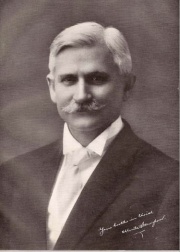
The Author–Brother Menta Sturgeon (1867-1935)
brother-menta-sturgeon-1867-1935

URL: https://biblestudentsdaily.com/2016/10/23/pastor-charles-russells-last-days/

Enter your email address to subscribe to this blog and receive notifications of new posts by email.

Save

Save

What Does It Mean To Be Baptized Into Christ?

matt-16-25

What types of baptism are practiced in the Churches?

There is more than one type of baptism practiced in the Christian world. There is:

  • Sprinkling or Pouring on the Head
  • Infant Baptism
  • Submersion under water.

Sprinkling or pouring water on the head

There are no Scriptures in the Bible that describe baptism as the sprinkling or pouring of water on the head.

The first instances in the Bible where individuals were baptized was accomplished by John the Baptist.

Did John the Baptist sprinkle water or submerse the person under water?

“Now John also was baptizing in Aenon near Salim, because there was much water there. And they came and were baptized” (John 3:23, NKJ).

And He [Jesus] went away again beyond the Jordan to the place where John was baptizing at first” (John 10:40, NKJ).

If all John was doing was sprinkling water to baptize, he did not need to worry about being near the “much water” of the Jordan River. Clearly, John was doing more than just sprinkling those he baptized.

Infant Baptism

Is infant baptism scriptural?

Nowhere in the Bible do we find infant baptism mentioned. Although at times the Scriptures do mention the baptism of households, they never specifically mention children or infants.

For example, in Acts 8, Philip preached to the people of Samaria.

“But when they believed Philip as he preached the things concerning the kingdom of God and the name of Jesus Christ, both men and women were baptized” (Acts 8:12, NKJ).

Notice, there is no mention of Philip baptizing infants in Samaria; just men and women.

In Mark 16:16, Jesus said, “He who believes and is baptized will be saved.”

It would not be possible for a newborn infant to understand who Christ is, let alone believe in him.

Remember the question Jesus asked James and John in Mark 10:38,

Are you able to be baptized with the baptism I am baptized with?”

A newborn infant would not be capable of answering Jesus’ question, let alone responsibly making such a commitment.

Submersion (Dunking) into Water

Now we do find examples in the New Testament of adult baptism and in every case we believe the baptism was a submersion into water. For example:

“When He [John] had been baptized, Jesus came up immediately from the water; and behold, the heavens were opened to Him, and He saw the Spirit of God descending like a dove and alighting upon Him” (Matthew 3:16).

” (38) So he [Philip] commanded the chariot to stand still. And both Philip and the eunuch went down into the water, and he baptized him. (39) Now when they came up out of the water, the Spirit of the LORD caught Philip away, so that the eunuch saw him no more; and he went on his way rejoicing” (Acts 8:38-39).

The only way Jesus and the Ethiopian eunuch could have “come up” out of the water is if they have been submersed under it.

Greek Definition Of Baptism:

In support of this conclusion that baptism is submersion, let us looks at some definitions.

STRONGS: 907 baptizo (bap-tid’-zo); to immerse, submerge; to make overwhelmed (i.e. fully wet).

VINES: baptism, baptist, baptize.

A. Nouns.

1. baptisma (908), “baptism,” consisting of the processes of immersion, submersion and emergence (from bapto, “to dip”).

B. Verb.

baptizo (907), “to baptize,” primarily a frequentative form of bapto, “to dip,” was used among the Greeks to signify the dyeing of a garment, or the drawing of water by dipping a vessel into another.

So this word has the meaning of complete submersion under water. Certainly when dying, the garment must be totally submerged in the dye.

There is a variation of this word.

2. baptismos (909), as distinct from baptisma (the ordinance), is used of the “ceremonial washing of articles,” in some texts; once in a general sense.

This word is only found four times in the New Testament and refers to ceremonial washings.

John’s Baptism & Its Purpose

Let us talk about John’s (the Baptist’s) baptism. John’s work was not for the Gentiles. His work of baptism was intended to reveal Jesus to the Israelites only, but John did not baptize believers into Christ. That would come later, after Pentecost. His work was not for the Gentiles.

In John 1:29-31 we read, “(29) The next day John saw Jesus coming toward him, and said, ‘Behold! The Lamb of God who takes away the sin of the world! (30) This is He of whom I said, After me comes a Man who is preferred before me, for He was before me. (31) I did not know Him; but that He should be revealed to Israel, therefore I came baptizing with water.‘”

So John the Baptist was baptizing in order to reveal Jesus to Israel only, not yet to the Gentiles.

Bearing fruit was an evidence of those who had sincerely baptized. As John the Baptist said, “Therefore bear fruits worthy of repentance” (Matthew 3:8, NKJ).

John’s baptism required a personal confession of sins. “And all the land of Judea, and those from Jerusalem, went out to him and were all baptized by him in the Jordan River, confessing their sins” (Mark 1:5, NKJ).

Repentance and typical cleansing restored repentant Jews back to the condition of harmony with God as enjoyed under the Law Covenant and through the tabernacle arrangement.

“John came baptizing in the wilderness and preaching a baptism of repentance for the remission of sins” (Mark 1:4, NKJ).

The Jews had not previously practiced individual baptism. The whole nation was recognized as “baptized into Moses in the sea and in the cloud” (1 Corinthians 10:1-2).

In what sense were the Israelites “baptized into Moses in the sea and in the cloud”? 
We answer: When the Israelites passed through the Red Sea they were surrounded by water, and Paul mentions that this is a picture of them being baptized. The cloud is mentioned in Exodus 13:22, “He took not away the pillar of the cloud by day, nor the pillar of fire by night, from before the people.” We think that that was the cloud Paul referred to as over the Israelites — so that in that sense they were surrounded from above by water as well.

The Jews were already children of God and heirs of the covenants and promises, and their washing away of their sins meant their coming near again to God, and into closer touch with all the promises and the blessings thereof (Harvest Gleanings I, 1HG255).

John the Baptist’s baptism, was “for the remission of avoidable sins, gross sins. The godly Jews were not intended, nor expected, to come to John to be baptized. He said, ‘Now come, if you want to get ready for Messiah’s kingdom, and try to keep the law the best you are able and take this water immersion, accepting this as a sign of your putting away sin and starting a new course of life.’ This is all that baptism meant to the Jews. That was not a regular institution. It was a peculiar thing that belonged just to the end of the [Jewish] age, and John tried there to especially prepare a people by this preaching of holiness and putting away of sin for the Messiah; for the testimony is that if they had believed John they would have believed Jesus. If they disbelieved John and disregarded what he said, and were not careful to come back into harmony with God, and become as holy as they were able to do, then they were not in a condition to receive the message God had to give” (What Pastor Russell Said – Question Book, Q34:3).

This typical cleansing available to the Jews is discussed in Leviticus & Hebrews.

“For on that day [of Atonement] the priest shall make atonement for you, to cleanse you, that you may be clean from all your sins before the LORD” (Leviticus 16:30).

“And every priest stands ministering daily and offering repeatedly the same sacrifices, which can never take away sins” (Hebrews 10:11).

So John baptized the Jews for repentance and remission of sins similar to the typical cleansing as was accomplished in the tabernacle by the sacrifice of bulls and goats on the Day of Atonement. Every Jew under the Law Covenant was a member of the house of Moses (Hebrews 3:5). As mentioned above, the Jews were baptized unto Moses in the sea and in the cloud (1 Corinthians 10:12). As natural branches of the olive tree the Jews did not need en-grafting into Christ (Romans 11:16-21). John could not baptize Gentiles since they could not by repentance be restored back to a position they had never occupied.

After Pentecost, John’s baptism was replaced by Christian baptism into Christ.

In the book of Acts we have an incident where some of John’s disciples, after hearing the gospel, were baptized again, this time into Christ; after which they received the holy Spirit.

Acts 19:1-6 – “(1)… Paul, having passed through the upper regions, came to Ephesus. And finding some disciples (2) he said to them, ‘Did you receive the holy Spirit when you believed?’ So they said to him, ‘We have not so much as heard whether there is a holy Spirit.’ (3) And he said to them, ‘Into what then were you baptized?’ So they said, ‘Into John’s baptism.’ (4) Then Paul said, ‘John indeed baptized with a baptism of repentance, saying to the people that they should believe on Him who would come after him, that is, on Christ Jesus.’ (5) When they heard this, they were baptized in the name of the Lord Jesus. (6) And when Paul had laid hands on them, the holy Spirit came upon them, and they spoke with tongues and prophesied. (7) Now the men were about twelve in all.”

These disciples were baptized twice (John’s & Christ’s). Bro. Charles T. Russell teaches, “The Apostle instructed them more fully, assuring them that John’s baptism was all right in its time and place, but that they should be baptized in the name of Jesus, baptized into Christ” (Harvest Gleanings I, HG732:6).

In Acts 2:41 three thousand people were baptized and among these, there may have also been some that had been baptized by John earlier.

‘Never is it said of any Gentile that he was baptized unto repentance and remission of sins, that he got back into Moses and in accord with the law. On the contrary, the apostle shows that we and all spiritual Israelites coming from among the Gentiles, come into Christ in a different way from that in which the Jews became related to him. I call your attention to the apostle’s argument in Rom. 11:17-24, where he uses an olive-tree as a symbol or picture. He tells us that that olive-tree was primarily the Jewish nation; that its root was the Abrahamic promise; its branches were the individual Jews. It was to those branches that John preached the baptism of repentance. Many of them were defiled, living in sin, and he urged them to repent and be washed, cleansed; that otherwise they would be broken off. And so it was when Messiah was manifest; the prepared ones, Israelites indeed, in whom was no guile, were ready for him, received him and he received them, and they continued to be branches of that olive, tree. But the great mass of the branches, as the apostle goes on to explain, were broken off because they did not receive our Lord, because they were not in the right condition of heart, not “Israelites indeed, without guile” (Harvest Gleanings I, HG).

Christian Baptism and Its Meaning

Christian baptism has many elements that are similar to John’s baptism and some elements that are different. As with the Jews baptized by John’s baptism, Christians are to confess and repent from their sins.

“And many who had believed came confessing and telling their deeds” (Acts 19:18).

“(46) Then he said to them, ‘Thus it is written, and thus it was necessary for the Christ to suffer and to rise from the dead the third day, (47) and that repentance and remission of sins should be preached in His name to all nations, beginning at Jerusalem'” (Luke 24:46-47).

“Then Peter said to them, ‘Repent, and let every one of you be baptized in the name of Jesus Christ for the remission of sins; and you shall receive the gift of the Holy Spirit'” (Acts 2:38).

Br. Charles Russell teaches, “This baptism was for Jews only, who had already been baptized into Moses in the sea and the cloud. Sins thus figuratively washed away did not include original sin, but merely minor transgressions against the Mosaic law.” (Reprints of the Original Watchtower 4308:5, 6th Volume of Studies in the Scriptures p.428, Harvest Gleanings I, 600:1,2)

John the Baptist could only provide typical remission. The Christian receives a real remission of sins through actual justification by Jesus’ blood.

John’s baptism pointed the Jews to Christ, but the Christian is to actually believe in Christ and accept Him as their Savior. Let’s see how this is shown in the Scriptures.

“(36) Now as they went down the road, they came to some water. And the eunuch said, ‘See, here is water. What hinders me from being baptized?’ (37) Then Philip said, ‘If you believe with all your heart, you may.’ And he answered and said, ‘I believe that Jesus Christ is the Son of God’” (Acts 8:36-37).

Then Crispus, the ruler of the synagogue, believed on the Lord with all his household. And many of the Corinthians, hearing, believed and were baptized” (Acts 18:8).

So faith in Jesus Christ is a requirement for the Christian baptism.

Baptism Into Christ – Not Into An Organization

Although those baptized into John’s baptism were to bear fruit, the Christian’s death to sin, walking in newness of life and drinking of the cup is a far deeper action. Christian baptism is more than the pursuit of righteousness. It is the total death of self will and a total commitment to sacrifice ALL — one’s time, talent and possessions to the Lord, often at the cost of suffering and persecution.

“Yes, and all who desire to live godly in Christ Jesus will suffer persecution” (2 Timothy 3:12).

“(3) Or do you not know that as many of us as were baptized into Christ Jesus were baptized into His death? (4) Therefore we were buried with Him through baptism into death, that just as Christ was raised from the dead by the glory of the Father, even so we also should walk in newness of life. (11) Likewise you also, reckon yourselves to be dead indeed to sin, but alive to God in Christ Jesus our Lord. (12) Therefore do not let sin reign in your mortal body, that you should obey it in its lusts. (13) And do not present your members as instruments of unrighteousness to sin, but present yourselves to God as being alive from the dead, and your members as instruments of righteousness to God” (Romans 6:3-13).

So we see from the 6th chapter of Romans and lowering the candidate into the water represents the death of the Old Man with his sinful ways and the raising up of the candidate shows our walk in newness of life as New Creatures in Christ Jesus. Notice how Romans 6:3 teaches that we are baptized into Christ’s death.

No scripture talks about being baptized into Jehovah’s organization. Also see how the following text show we are actually baptized into Christ.

For all of you who were baptized into Christ have clothed yourselves with Christ” (Galatians 3:27, NASV).

“Peter said to them, ‘Repent, and each of you be baptized in the name of Jesus Christ for the forgiveness of your sins; and you will receive the gift of the Holy Spirit'” (Acts 2:38, NASV).

Ultimate Purpose of Baptism

What is the ultimate purpose of Christian baptism? Certainly to lay down our lives in the Lord’s service is purpose enough, but the Bible shows a purpose even beyond that.

Just as going to medical school is of no benefit to humanity unless the student becomes a practicing doctor, so it is with the Christian.

Context:

“And the Scripture, foreseeing that God would justify the Gentiles by faith, preached the gospel to Abraham beforehand, saying, ‘In you all the nations shall be blessed'” (Galatians 3:8, NKJ).

“In your seed all the nations of the earth shall be blessed, because you have obeyed My voice” (Genesis 22:18).

“(27) For as many of you as were baptized into Christ have PUT ON Christ… (29) And if you are Christ’s, then you are Abraham’s seed, and heirs according to the promise” (Galatians 3:27,29).

Those who are baptized are Abraham’s seed through whom God’s purpose is to bless all the families of the earth. This is the ultimate purpose of baptism.

The same point is expressed in 1 Corinthians 15:29.

“Otherwise, what will they do who are baptized for the dead, if the dead do not rise at all? Why then are they baptized for the dead?”

This passage says that we are baptized for the dead,” not “into death.” The ultimate purpose of baptism is to bless all the families of the earth.

Many translations agree with this wording, “baptized for the dead.” The translators do not believe this. They would rather not translate this text. Peter puts it this way:

“receiving the end of your faith—the salvation of your souls” (1 Peter 1:9, NKJ).

The word “your” is in italics. The thought is that the outcome of our faith, THE ULTIMATE PURPOSE, will be the salvation of mankind.

Does water baptism cancel sins? 

The traditional view among Catholic and many Protestant denominations is that baptism is necessary for salvation, forgiveness and the cancellation of sins. Not only do they believe it necessary, but some feel it must be performed in a prescribed fashion in order to secure salvation.  Some of their supposed proof texts are:

“Then Peter said to them, ‘Repent, and let every one of you be baptized in the name of Jesus Christ for the remission of sins; and you shall receive the gift of the Holy Spirit’ ” (Acts 2:38).

“He who believes and is baptized will be saved; but he who does not believe will be condemned” (Mark 16:16).

“And now why are you waiting? Arise and be baptized, and wash away your sins, calling on the name of the Lord” (Acts 22:16).

“There is also an antitype which now saves us — baptism” (1 Peter 3:21).

These texts are telling us that those who are baptized will be saved and receive a remission or washing away, of sins. So are the Catholics and many Protestants correct in believing that the act of baptism is necessary for salvation?

No. Where these Christians are wrong is that it is NOT “water baptism” that saves us.  Rather, the true baptism saves us, that is, consecration and the resultant justification by Christ’s blood. Water baptism cannot save.  It is merely a symbol of the true baptism and the resultant justification that can save us.

Baptism is the outward sign of an invisible grace from our Heavenly Father through Jesus Christ.

“Since, therefore, we have now been justified by his blood, much more shall we be saved by him from the wrath of God” (Romans 5:9, ESV). 

We are saved by Jesus’ act of justification, not by our symbolic act of water baptism.

Water Baptism Is Symbolic

Many Scriptures establish that water baptism itself is merely a symbol and that it does not have intrinsic atoning qualities.

Luke 12:50 – “But I have a baptism to be baptized with, and how distressed I am till it is accomplished!”

Jesus had already received water baptism by John, so in this case the word “baptism” must be symbolic of more than the literal water baptism. This is also borne out in Mark 10:38-39 (see also Matthew 20:22-23):

“(38) Jesus said to them, ‘You do not know what you ask. Can you drink the cup that I drink, and be baptized with the baptism that I am baptized with?’ (39) They said to Him, ‘We are able.’ So Jesus said to them, ‘You will indeed drink the cup that I drink, and with the baptism I am baptized with you will be baptized.'” 

More evidence of the symbolic nature of water baptism is found in Colossians 2:11-12 (ESV):

“(11) In him also you were circumcised with a circumcision made without hands, by putting off the body of the flesh, by the circumcision of Christ, (12) having been buried with him in baptism, in which you were also raised with him through faith in the powerful working of God, who raised him from the dead.

Notice here that both circumcision & water baptism are symbolic of putting away sin.  Obviously “circumcision” here is not literal. The Christian is not literally required to be circumcised as were the Jews under the Law. This is the symbolic circumcision of the heart. So, just like circumcision is symbolic, likewise, water baptism here is also symbolic.

Next is another symbolic usage of baptism, although a much different one.

“(11) I baptize you with water for repentance, but he who is coming after me is mightier than I, whose sandals I am not worthy to carry. He will baptize you with the Holy Spirit and fire. (12) His winnowing fork is in his hand, and he will clear his threshing floor and gather his wheat into the barn, but the chaff he will burn with unquenchable fire” (Matthew 3:11-12, ESV). 

The baptism by “fire” is symbolic of the judgment and destruction upon the nation of Israel as stated in verse 12, “He will burn up the chaff with unquenchable fire.”

Just as the baptism by fire is symbolic, so is water baptism.

We are not saved by the symbol “water baptism,” but by the reality of it, the meaning of which we will get to shortly.

Born of Water – Spirit Begettal

Many believe John 3:5 teaches that unless you are baptized in water you cannot enter the kingdom of heaven. It says, “Jesus answered, ‘Most assuredly, I say to you, unless one is born of water and the Spirit, he cannot enter the kingdom of God.'”

The word “baptism” is no where to be found in this context. “Water here is symbolic of the Word of Truth. Without the Bible we would not have the necessary knowledge to grow in Christ and enter God’s Kingdom.

Our growth in Christ through his Word (the Holy Scriptures) is illustrated by the Greek word genno, that is Strongs #1080. Vines defines it as:

BEGET, BEAR (OF BEGETTING), BORN

gennao —“to beget,” in the passive voice, “to be born,” is chiefly used of men “begetting” children; more rarely of women “begetting” children (Vine’s Expository Dictionary of Biblical Words, 1985).

So in John 3:5 we are “begotten of water.” This means that we are spiritually begotten by Truth.

Br. Charles Russell writes “We see that symbolical water represents truth, and that our begetting of the holy Spirit is said to be also a begetting ‘through the Word of truth’” (James 1:18). (Reprints of the Original Watchtower: R.4124:6, R.3600:6, R.2422:1.)

In support of this we will quote four scriptures which relate begettal to the Word of God.

“Of his own will begat He us with the word of truth, that we should be a kind of firstfruits of his creatures” (James 1:18, KJV).

“For though you might have ten thousand instructors in Christ, yet you do not have many fathers; for in Christ Jesus I have begotten you through the gospel” (1 Corinthians 4:15, NKJ).

“…having been born again, not of corruptible seed but incorruptible, through the word of GOD which lives and abides forever” (1 Peter 1:23).

“…that He might sanctify and cleanse her with the washing of water by the word” (Ephesians 5:26).

So we see that John 3:5 does not teach that unless you are baptized in water you cannot enter the kingdom of heaven. It actually teaches that we are begotten as New Creatures in Christ by the Truth of God’s word. It is the guidance from God’s Word that develops the embryo New Creature in Christian growth, preparing us for our ultimate Spiritual birth, after the first resurrection.

Saved By Belief, Grace & Justification, Not Saved By Baptism

There are many more Scriptures that talk about us as being saved, but it’s not by water baptism, it is by belief in Jesus Christ and the resultant grace of God and justification to life.

“And it shall come to pass that whoever calls on the name of the Lord shall be saved” (Acts 2:21).

“Whoever calls on the name of the Lord shall be saved” (Romans 10:13).

“(30) And he [the jailer] brought them [Paul & Silas] out and said, ‘Sirs, what must I do to be saved?’ (31) So they said, ‘Believe on the Lord Jesus Christ, and you will be saved, you and your household'” (Acts 16:30-31).

“…that if you confess with your mouth the Lord Jesus and believe in your heart that God has raised Him from the dead, you will be saved” (Romans 10:9).

“Much more then, having now been justified by his blood, we shall be saved from wrath through him” (Romans 5:9).

“If anyone’s work is burned, he will suffer loss; but he himself will be saved, yet so as through fire” (1 Corinthians 3:15).

“(1) Moreover, brethren, I declare to you the gospel which I preached to you, which also you received and in which you stand, (2) by which also you are saved, if you hold fast that word which I preached to you– unless you believed in vain” (1 Corinthians 15:1-2).

“Even when we were dead in trespasses, made us alive together with Christ (by grace you have been saved.)” (Ephesians 2:5).

“For by grace you have been saved through faith, and that not of yourselves; it is the gift of God” (Ephesians 2:8).

The Jerusalem Counsel never addressed the issue of baptism when presenting minimum requirements expected of the Gentile brothers.

“(28) For it seemed good to the holy Spirit, and to us, to lay upon you no greater burden than these necessary things: (29) that you abstain from things offered to idols, from blood, from things strangled, and from sexual immorality. If you keep yourselves from these, you will do well. Farewell” (Acts 15:28-29).

Where is water baptism on this list? If it were necessary for salvation, certainly the Apostles would have required it of the Gentile brethren.

“And certain men came down from Judea and taught the brethren, ‘Unless you are circumcised according to the custom of Moses, you cannot be saved'” (Acts 15:1).

Some Christians today take the same approach with baptism as these Jews took of circumcision, that it is a requirement for salvation.

Saved By Baptism?

In 1 Peter we find scriptures used by many Christians to again attempt to prove that water baptism is necessary for salvation.

“(19) by whom also He [Jesus] went and preached to the spirits in prison, (20) who formerly were disobedient, when once the Divine long suffering waited in the days of Noah, while the ark was being prepared, in which a few, that is, eight souls, were saved through water. (21) There is also an antitype which now saves us—baptism (not the removal of the filth of the flesh, but the answer of a good conscience toward God), through the resurrection of Jesus Christ” (1 Peter 3:19-22).

Does this passage prove we are saved by literal water baptism? The simple answer here is that Peter is not talking about literal water baptism. In verse 21, He describes “baptism” as “a good conscience toward God.”  That word “conscience” is also used in the prior chapter.

“For this is thankworthy, if a man for conscience toward God endure grief, suffering wrongfully” (1 Peter 2:19, KJV).

So the word “conscience” connected with the word “baptism” refers to suffering for righteousness sake. Hence, the word “baptism” is talking about living our consecration.  Our consecration results in justification by the ransom to life. That is what saves us.

It is interesting to note from verse 21 that we are not saved by the “removal of the filth of the flesh,” that is, we are not saved simply by John’s baptism, the repentance from sin. But we must go beyond that to consecration INTO Christ’s death and this involves cheerful in the spirit, willing patient endurance and sacrifice of self-will and self-interest.

“I have been crucified with Christ. It is no longer I who live, but Christ who lives in me. And the life I now live in the flesh I live by faith in the Son of God, who loved me and gave himself for me” (Galatians 2:20).

Baptized In Who’s Name?

In whose name is the Christian baptized? Many quote the great commission of Matthew 28:19 to prove we are baptized into the Trinity, not into Jesus Christ alone.

“Go therefore and make disciples of all the nations, baptizing them in the name of the Father and of the Son and of the holy Spirit” (Matthew 28:19).

If we accept the translation as is, it does not prove that we are baptized into the Trinity, but merely the desperation of those who strive in vain to find support for this false doctrine, in Scripture. This passage does not state that these three are one person, nor anything of the kind.

In conflict with this, six other Scriptures refer baptism in the name of Jesus, not baptism in the name of the Father, Son and Holy Spirit of Matthew 28:19.

Let us look at these Scriptures that contradict Matthew 28:29. Notice that in none of these texts was anyone baptized in the name of the Father, Son and holy Spirit.

“Then Peter said to them, ‘Repent, and let every one of you be baptized in the name of Jesus Christ for the remission of sins; and you shall receive the gift of the Holy Spirit'” (Acts 2:38).

“But when they believed Philip as he preached the things concerning the kingdom of GOD and the name of Jesus Christ, both men and women were baptized” (Acts 8:12).

“For as yet He had fallen upon none of them. They had only been baptized in the name of the Lord Jesus(Acts 8:16).

“And he commanded them to be baptized in the name of the Lord. Then they asked him to stay a few days” (Acts 10:48).

“When they heard this, they were baptized in the name of the Lord Jesus” (Acts 19:5).

“Or do you not know that as many of us as were baptized into Christ Jesus were baptized into HIS DEATH ?” (Romans 6:3).

*******

How else are we “baptized into Christ’s death?

We need to surrender our wills to God, as Jesus did. He said, “Lo I come…to do thy will, O God. I delight to do thy will, O my God; thy law is written in my heart” (Psalm 40:7, 8; Hebrews 10:7).

We dedicate or consecrate our all to follow and obey the Lord with our minds, hearts, and our whole beings. This is a total dedication of service to do God’s will. When consecrated, we walk “in newness of life,” having a new, different direction or purpose. We pattern our lives after our dear Redeemer.

A few days before his crucifixion, Jesus stated, “But I have a baptism to undergo, and how distressed I am until it is accomplished!” (Luke 12:50) This shows that in Jesus’ baptism, water was a symbol of his real baptism in death. It was about to be accomplished at Calvary. Like Christ, we who dedicate our lives to the Lord make ourselves “dead” to the world’s pursuits. Instead, we pursue heavenly things, studying the scriptures to find out what God’s will is for us. Our desire is to prove faithful unto death and be resurrected with Christ in a divine and immortal body (Philippians 3:10, 11; Romans 2:7, Revelation 2:10).

Water baptism is a witness to others of what has taken place in our hearts with the Lord and our commitment to Him, as well as symbolizing that life of baptism. The individual places himself in the arms of another, and being fully immersed in the water, is dependent on that person to help him up. He comes out of the water into “newness of life.” This is the new life to which he has committed himself until he dies. Hence, we believe water baptism is necessary, not for salvation, but for a witness of that life of commitment.

SO WHAT NOW?

Are you interested to GIVE UP your life rights on earth to inherit what eye has not seen nor ear heard … to inherit a life with Jesus and those who have now given up the pride of life and disclaim all rights to themselves, to their soul, to their body, to their time, to their health, to their reputation, to their talents or to anything that they own?

 If you confess to be the property of Jesus Christ your Redeemer, then:

  DEDICATE YOURSELF

to belong entirely to Jesus now,

to serve, love and trust him as your life and salvation until your life’s end and show this through baptism.

“Present your bodies a living sacrifice, holy, acceptable unto God, which is your reasonable service” (Romans 12:1).

God is now selecting men and women of faith for special honors during the Millennium. Namely, to reign with Christ in heaven as spiritual rulers of the world, to lead the world to righteousness, godliness, and truth and raise all the dead of past Ages. Satan’s demons now lead the world into sin and ignorance. Then, Christ and his saints will lead the world into obedience and understanding (Revelation 20:1-6).

High Standards

When we understand the high honor to which the saints are called, we better appreciate the high standards that are expected of them.

(1) Godly conduct
(2) Character Development
(3) Study of the Truth
(4) Service and Sacrifice.

Consecration

We enter the race for the “prize of the High Calling of God in Christ Jesus” (Philippians 3:14) by consecrating our life to GOD.

This we do in personal prayer to God, committing our life and service and interests to God hereafter.

If this step is taken, then it is proper to symbolize that decision with water baptism, as a testimony to others.

(11) The saying is trustworthy, for: If we have died with him, we will also live with him; (12) if we endure, we will also reign with him; if we deny him, he also will deny us” (2 Timothy 2:11-12, ESV).

If you have not considered the matter of consecration, take time to do so.

Read our Lord’s words about this decision, thoughtfully, in Luke 14:27‑35.
Remember the blessings promised, and the conditions for them:

“by patient continuance in well doing seek for glory, honor, and immortality” (Romans 2:7).

Remember the privilege of being with Christ, in heaven, to bless “all the families of the earth” during the Millennium. God wishes us to respond favorably. “This is the will of God, even your sanctification” (1 Thessalonians 4:3).

So dear brethren, let us pursue our consecration with determination and great zeal, so that we may please our Father and be prepared for our future mission.

Click here to watch a baptism service video

References and Acknowledgement:

Br. Peter Karavas & our brethren in Christ at http://www.friendsofjehovahswitnesses.com/

Br. Charles Taze Russell: What Pastor Russell Said – Question Book, Q34:3; Harvest Gleanings I; Reprints of the Original Watch Tower and Herald of Christ’s Presence, Studies in the Scriptures – Volume 6.

Vine’s Expository Dictionary of Biblical Words, 1985.

STRONG’S Concordance.

This post’s URL:

What Does It Mean To Be Baptized Into Christ?

Enter your email address to subscribe to this blog and receive notifications of new posts by email.

Save

Save

Save