LUKE 22:17-20 – The Two Cups

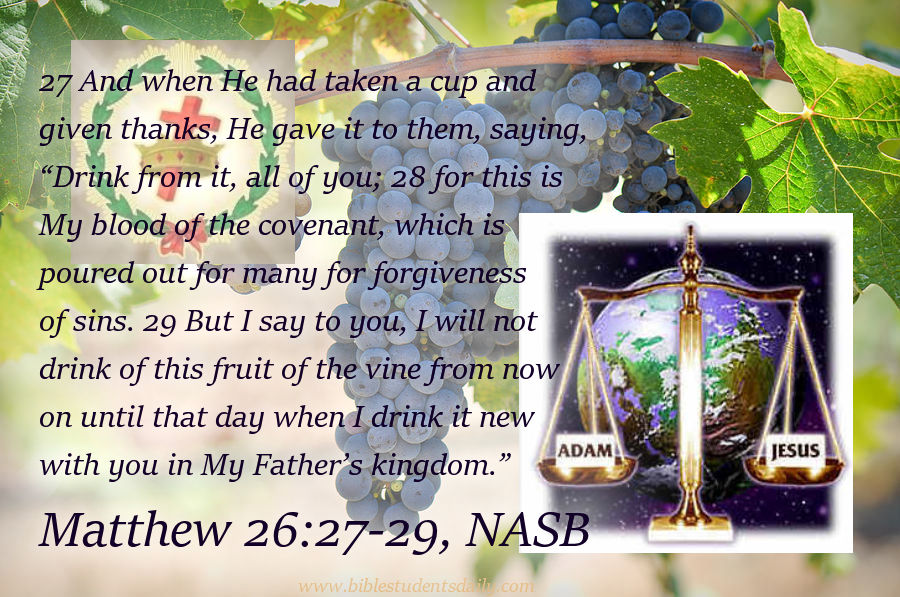
MATTHEW 26, 27-29, NASB.jpg

The Two Cups

Introduction

The Memorial is a special time of the year, a time when we refocus on the basis for our Christian existence and hope; by remembering the sacrifice Jesus made for us and thereby reconciled us to God.

On the night he was betrayed, at the beginning of the 14th of Nisan, Jesus instituted the emblems of the bread and wine after the last supper he had with his disciples. He gave us both to partake of, which simply but powerfully reminds us that only in him we have true life through forgiveness of sins.

That each Gospel account gives us additional details of the events, and from a slightly different perspective and approach, suggests that all of the accounts need to be taken together as a whole in order to get the most complete picture of those final moments of our Redeemer’s life. The Apostle Matthew arranges his Gospel more thematically whereas Luke arranges the events more chronologically.

Here we will focus on clarifying what the cup Jesus instituted means.

The Gospel of Matthew Account

Matthew 26:27–29 (ESV) And he took a cup, and when he had given thanks he gave it to them, saying, “Drink of it, all of you, 28 for this is my blood of the covenant, which is poured out for many for the forgiveness of sins. 29 I tell you I will not drink again of this fruit of the vine until that day when I drink it new with you in my Father’s kingdom.”

In the Matthew account in Chapter 26 verses 27–29, it appears that there is one cup, and that Jesus refers to it both as “my blood of the covenant, which is poured out for many for the forgiveness of sins” in verse 28 and as “this fruit of the vine” in verse 29. If we just take Matthew’s account as the basis for Jesus’ institution of the memorial cup emblem, we might get the impression that not only there was one cup, but that Jesus did drink of this cup – for he says according to the ESV in verse 29 “I will not drink again,” suggesting that he had already drank of it. And some suggest that this therefore shows that the disciples – and by implication all consecrated believers, share with Jesus in his sufferings – after all, like Jesus, we are told to present ourselves a living sacrifice in Romans 12:1.

If Jesus did drink of the memorial cup, what Jesus described as “this fruit of the vine” would seemingly and straightforwardly refer to wine consumed during a supper. The “vine” referring to a grapevine and its fruit as consumed and referred to at the time meant wine, i.e. fermented grape juice – for this was a way of preserving it. Grape juice would of course be an acceptable substitute for those inclined to do so. That Jesus does not refer to the contents according to the normal, commonly used ancient Greek word for wine, oinos, may be significant.

But if the cup was also “my blood of the covenant, which is poured out for many for the forgiveness of sins” – as Jesus states, and if Jesus also drank of it, then we are left with the uncomfortable suggestion that Jesus needed forgiveness of sins provided by his own sacrifice – which of course does not make sense as Jesus was sinless, and no sinner can redeem their own sin.

One solution to this problem seems to be that Jesus did not in fact drink of this cup. And this does seem to be supported by the questionable translation of the Greek preposition “apo” and adverb “arti” in the ESV as “again” in some Bibles. These two ancient Greek words literally mean “from now.” About 10 Bibles translate them as “again”, but at least 15 translate them as “from now” or “henceforth”, and the RVIC2016 as well as Wilson’s Diaglott translate them as “henceforth.” Importantly, the better translations of “henceforth” and “from now” are ambiguous in indicating whether Jesus did in fact drink of the cup or not.

The Gospel of Matthew Account

The Gospel of Mark account is much more succinct in general and here in regards to the institution of the memorial cup, is very similar to Matthew’s.

Luke 1:3 (ESV) “it seemed good to me also, having followed all things closely for some time past, to write an orderly account for you, most excellent Theophilus.”

The Gospel of Luke account of these events is however fuller, and as mentioned, Luke the physician, paid particularly attention to the sequence of events, and he states so in Luke 1:3, he says “having followed all things closely for some time past, to write an orderly account for you, most excellent Theophilus.” When he addresses the reader as “Theophilus” he means “lover of God”, which is what the word means in ancient Greek. That Luke wrote his account with particular attention to the sequence of events is important for us.

Luke 22:17–20 (ESV) And he took a cup, and when he had given thanks he said, “Take this, and divide it among yourselves. 18 For I tell you that from now on I will not drink of the fruit of the vine until the kingdom of God comes.” 19 And he took bread, and when he had given thanks, he broke it and gave it to them, saying, “This is my body, which is given for you. Do this in remembrance of me.” 20 And likewise the cup after they had eaten, saying, “This cup that is poured out for you is the new covenant in my blood.

Luke distinguishes between the cup of “the fruit of the vine” and the cup “that is poured out for you is the new covenant in my blood,” as partaking of the bread emblem occurred in between.

Two cups:

  • The “fruit of the vine” cup
  • The “new covenant in my blood, for the forgiveness of sins, poured out for you” cup

This is important information, for it tells us that there were, in fact, two cups – not one; firstly, the “fruit of the vine” cup and secondly – combining the Matthew and Luke accounts, of “the new covenant in my blood, for the forgiveness of sins, poured out for you.”

1 Corinthians 11:25 (ESV) In the same way also he took the cup, after supper, saying, “This cup is the new covenant in my blood. Do this, as often as you drink it, in remembrance of me.”

The first cup was seemingly partaken of during the last supper, as the second cup, the memorial cup was instituted by Jesus after supper – as the Apostle Paul tells us in 1 Corinthians 11:25.

An important question to ask at this point is, is this important? – one, two cups, what is the difference?

If they are the same cup and if Jesus did partake of it does affect what the cup means, and also what our relationship to Jesus in regards to the cup actually is. As mentioned, some suggest that by drinking of the cup shows that we share in “the sufferings of Christ” with Jesus. So, the implications of whether there are one or two cups is not insignificant.

The “Fruit of the Vine” Cup

If there are two cups, they are different. Does that mean that they signify different things, or anything at all beyond the literal contents of wine?

It seems that that both signify different things.

Both cups literally contained “fruit of the vine” – almost certainly wine. That the 2nd cup, the memorial cup meant more than the literal wine it contained may suggest that Jesus also meant more than the literal wine in the first cup. This seems to be supported by Jesus’ use of the unusual phrase “fruit of the vine” for the wine, as this phrase is only found 3 times in the New Testament and only in the Gospel accounts in relation to the memorial cup. No where else in the Scriptures is the phrase “fruit of the vine” used to refer to wine. The normal word for wine, oinos, is however widely and commonly used in the New Testament, some 34 times.

Luke 7:33–34 (NKJV) For John the Baptist came neither eating bread nor drinking wine, and you say, ‘He has a demon.’ 34 The Son of Man has come eating and drinking, and you say, ‘Look, a glutton and a winebibber, a friend of tax collectors and sinners!’

As an example, in Luke 7:33–34 we have the word oinos used twice in relation to John the Baptist and Jesus when the Pharisees criticized both – John for not eating bread and drinking wine saying he had a demon, and Jesus for eating bread and drinking wine saying he was a glutton and drunkard. If therefore the word for wine, oinos was commonly used, but that Jesus did not use it for the contents of the first cup but instead used the unusual phrase “fruit of the vine” suggests Jesus may have had a deeper meaning in mind.

John 6:48 (ESV) I am the bread of life.

John 15:5 (ESV) I am the vine; you are the branches. Whoever abides in me and I in him, he it is that bears much fruit, for apart from me you can do nothing.

Just as the memorial emblem of the bread that they all ate of indicates that Jesus “is the bread of life” – as Jesus explicitly states in John 6:48, the “fruit of the vine” reference may point to Jesus’ statement in John 15:5 that he is “the vine” and that his disciples are the branches – just as all consecrated Christians are. But if it is not literal, what is the metaphorical “fruit of the vine?” This would seem to be the fruits of the spirit that all those in Christ develop. And the full fruitage of the vine will not be evident till the body of Christ is completed at the end of the harvest period when the kingdom of God is established.

Galatians 5:22–23 (ESV) But the fruit of the Spirit is love, joy, peace, patience, kindness, goodness, faithfulness, 23 gentleness, self-control; against such things there is no law.

Here the “fruit of the vine” therefore seems to refer to the fruits of the holy spirit evident in all true consecrated believers in Jesus – love, joy, peace, patience, kindness, goodness, faithfulness, gentleness, and self-control. This would be consistent with Jesus’ statement that he would not drink of this 1st cup till the kingdom of God comes, or in other words that the full fruitage of the vine would not be evident till the kingdom.

What does it mean then if Jesus drank of this cup? If Jesus did drink of this cup, because he also received the holy spirit, he would also be a first fruit of the holy spirit – and so appropriately drink of the same cup.

Luke 22:16 (ESV) For I tell you I will not eat it until it is fulfilled in the kingdom of God.”

This would also seem to be consistent with Jesus’ statement that he would not eat of the Passover till it is fulfilled in the kingdom of God. This statement is also somewhat enigmatic and unlikely to be fulfilled literally in the future, but it does show that the antitype of the Passover is also still not fulfilled. When we examine the details of the Passover, we understand that Israel as a nation was a type for the world in general. The Passover ultimately led to the liberation from the Pharaoh and Egypt, but in the antitype, this has not occurred yet – the world in general has not yet been liberated from the Adversary and his kingdom. In the same way, the “fruitage of the vine” will not be completed and will not be able to be drank of by Jesus and his consecrated followers, till the church is complete and the marriage of the Lamb occurs.

The “New Covenant in My blood, for the forgiveness of sins, poured out for you” Cup

What then, does the second cup mean and indicate? This seems more self-explanatory – for Jesus actually tells us. Jesus says that the cup depicts “the new covenant in my blood, poured out for you, for the forgiveness of sins.” Jesus’s words seem plain and straightforward enough. Some have suggested that they do not apply to us [believers in the Gospel Age], and that the new covenant will only be inaugurated in the kingdom period. That Jesus says that his “blood, [is] poured out for you,” seems to unequivocally apply it to his consecrated followers now during the Gospel Age, not the kingdom age. When Jesus says “for you,” he means his disciples, and by extension us consecrated believers also.

1 Corinthians 15:19 (ESV) If in Christ we have hope in this life only, we are of all people most to be pitied.

Moreover, that Jesus’ blood provides forgiveness of sins – the prime requirement for reconciliation with God means that if we do not have forgiveness of sins in Christ, then we are still in our sins and most pitiable of men. Let us be clear, if the new covenant, which is the only means by which we can receive forgiveness of sins is not in operation, then how can we be reconciled to God by our faith?

That Jesus did not drink of this 2nd memorial cup, because it is a different cup, makes much better sense – for to partake of it would suggest that he needed forgiveness of sins; which of course he did not – for he was sinless.

That only all of the disciples did drink of this cup, showed that they were the recipients of the benefits of his sacrifice – for the forgiveness of their sins. We note what Jesus said when he gave them [and by extension us] to drink of the cup, he said “Drink of it, all of you” – he did not say let “us” drink of this cup.

Partaking of the cup did not indicate a sharing in the sufferings of Christ. Not that we do not partake in the sufferings of Christ – for the scriptures indicate that we do, but the memorial cup does not indicate this. It indicates that we together have in common that we are all dependent on the sacrifice of Jesus for our reconciliation with God through forgiveness of sins.

The Common Union of the Blood of Christ

1 Corinthians 10:16 (NKJV) The cup of blessing which we bless, is it not the communion of the blood of Christ? The bread which we break, is it not the communion of the body of Christ?

But what about 1 Corinthians 10:16, does this not indicate that we share in the sufferings of Christ, when the apostle Paul says “is not the cup we bless the communion in the blood of Christ?” It has been assumed that the common union in the blood of Christ here is a common union with Jesus, but the context and the grammatical usage here of “koinonia” [translated communion] indicate that the common union is with one another – a common participation of the blood of Jesus showing that we all receive forgiveness of sins through Jesus’ sacrifice.

Here in 1 Corinthians Chapter 10, the Apostle Paul outlines that “the cup we bless” – the memorial cup we ask a blessing for, is not an empty ritual but shows that we are eating at the table of the Lord – we are appropriating the merit of Jesus’ sacrifice to ourselves. And that eating at the table of the Lord is incompatible with eating at the table of demons – which eating of the sacrifices to idols then essentially was. The Apostle warns us to flee from idolatry. There is no suggestion here that we contribute to the food at the table of the Lord. The idolatry we face is much more subtle; it can be the pursuit of wealth, fame, respect, or even a sense of belonging at the expense of the truth but also includes anything that supplants the authority of God’s word.

John 6:54 (NKJV) Whoever eats My flesh and drinks My blood has eternal life, and I will raise him up at the last day.

Jeremiah 31:33–34 (NKJV) But this is the covenant that I will make with the house of Israel after those days, says the LORD: 1) I will put My law in their minds, and write it on their hearts; and I will be their God, and they shall be My people. 34 2) No more shall every man teach his neighbor, and every man his brother, saying, ‘Know the LORD,’ for they all shall know Me, from the least of them to the greatest of them, says the LORD. For 1) I will forgive their iniquity, and their sin I will remember no more.”

Jesus said, whoever drinks of my blood has eternal life…as John 6:54 says.

Faith in Jesus provides us with 1) forgiveness of sins, and thereby reconciliation with God, in order that we may, through baptism, receive of His holy spirit and be developed as new creatures, as 2) the holy spirit teaches us all things of God [rather than any man], even the deep things, and it writes 3) His royal law of agape love on our hearts – these are all functions of the holy spirit through the new covenant as outlined in Jeremiah 31; that we may be born on the spirit plane in the image of Jesus – when we will see the Passover fulfilled, when the fruit of the vine is complete through commonly with one another, partaking of the blood of Jesus shown in the memorial cup Jesus instituted – if we patiently endure to the end.

In Conclusion

In conclusion, it seems then that when Matthew talks about the cup of “the fruit of the vine” and the cup of Jesus’ “blood of the new covenant, for the forgiveness of sins, poured out for you” that they are in fact two separate cups – according to the Gospel of Luke. Jesus may have drank of the former – as the “fruit of the vine” seems to refer to the first fruits of the holy spirit – and which will not be evident till the marriage of the lamb, the seed of blessing is complete. The second cup is separate, a cup that Jesus did not drink of – but of which Jesus said they should all drink of, indicating their, and by extension, our dependence on the sacrifice of Jesus for forgiveness of sins and reconciliation to God. Without it God could not give us of His holy spirit in order to develop us as new creatures and be born on the spirit plane in the likeness of Jesus.

Hallelujah, O what a prospect! Praise be to our Heavenly Father and to His son Jesus.

Suggested Further Reading:

Eating at the Table of the Lord



ROMANS 8, 18 - ad..jpg

Sea-of-Galilee-Mount-of-Beatitudes.jpg

Suggested Further Reading

“Are We Actual Or Reckoned New Creatures?” The Reprints (No. 5325) of the Original Watch Tower and Herald of Christ Second Presence.

“The Ransom.” by Br. David Rice. Faithbuilders Fellowship Journal.
http://www.2043ad.com/journal/2007/02_ma_07.pdf

“Bread and Cup” by Br. James Parkinson. The Herald of Christ’s Kingdom Magazine, March-April 2018.

“Jesus The Name.”
https://biblestudentsdaily.com/2017/07/05/jesus-the-name/

“Who Is the World’s Ransom and Why?”
https://biblestudentsdaily.com/2016/03/29/who-is-the-worlds-ransom-and-why/?share=press-this&nb=1

“Nehemiah 8:10 — The Joy of the Lord Is Your Strength.”
https://biblestudentsdaily.com/2016/12/20/nehemiah-810-the-joy-of-the-lord-is-your-strength/


This post’s URL:
https://biblestudentsdaily.com/2018/03/19/matthew-2627-29-drinking-from-christs-one-cup/


Enter your email address to subscribe to this blog and receive notifications of new posts by email.


DANIEL 3:17 – Our God Whom We Serve Is Able To Deliver Us

OLYMPUS DIGITAL CAMERA

“Our God, whom we serve, is able to deliver us.” Daniel 3:17

The King of Babylon – King Nebuchadnezzar

Probably twenty years elapsed after Daniel and his companions reached Babylon in captivity before the scenes of the lesson in Daniel Chapter 3 were enacted. Meantime Daniel had been raised to a very high position in the empire, as the King’s counselor, while his three Jewish companions—Shadrach, Meshach and Abednegohad been made magistrates in the provinces of Babylon. We know that their prosperity did not tend to make them careless of their duties and responsibilities toward God, for otherwise they would not have been able to stand the severe test recounted in this lesson, and which proved a great blessing to them because of their fidelity to the Lord.

King Nebuchadnezzar just before this had won some great victories over surrounding nations—Egypt, Syria, etc.—as he had previously done with Judah, and as the Lord had predicted in the dream which Daniel had interpreted for the King, which showed the Babylonian Empire as the golden head of earthly dominion. His great success no doubt had tended to feelings of pride and a desire for display. Yet these were probably not the only motives which led to the program of the great festival in honor of his victories, and the erection of the great image which all were commanded to worship.

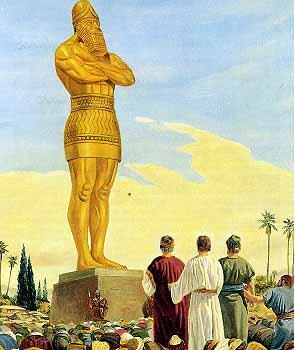
With a view to unifying the Babylonian empire by unifying the religious views and worship of the various peoples under his sway, Nebuchadnezzar had a great feast arranged, of which the very center of attraction was the great image that Nebuchadnezzar had set up.

Nebuchadnezzar's image

In Daniel 3:1 we read that this image, with its pedestal, was sixty cubits high (approximately 27 metres or 8 storeys high) and six cubits wide (approximately 2.7 metres wide). It was of gold, probably either made hollow or on a base of clay cement. It was located in the Plain of Dura, about the centre of the walled enclosure twenty-four miles square, known as the city of Babylon. As it is a level country, and as the structures were comparatively low, the image could probably be seen from every part of the great city.

The Festival

The appointed time for the festival having come, leading representatives, judges, treasurers, governors, sheriffs, etc., from all the divisions of the empire, clad in the gorgeous garments of the East, were present. A great band had been prepared, composed of all the musical instruments popular at that period.

As the people stood before the image that Nebuchadnezzar had set up, the herald proclaimed aloud:

“‘You are commanded, O peoples, nations, and languages, that when you hear the sound of the horn, pipe, lyre, trigon, harp, bagpipe, and every kind of music, you are to fall down and worship the golden image that King Nebuchadnezzar has set up. And whoever does not fall down and worship shall immediately be cast into a burning fiery furnace'” (Daniel 3:4-6).

By falling down and worshiping the image, the people would thus be indicating their loyalty, not only to King Nebuchadnezzar, but also to his gods who he believed had given him the wonderful victories which they were celebrating.

This was a crucial test for Shadrach, Meshach and Abednego. They knew that the King’s powers were autocratic, and that to cross his will meant death in some form, yet they wanted to be true to God, whatever the cost. It might be that their refusal to prostrate themselves before the image would pass entirely unnoticed by others, or it might be that, even if noticed, the incident might never reach the ears of the King, but such circumstances could make no change in the matter of their duty; whatever others might do, they must not bow the knee to any but the true God. Daniel is omitted from mention here, possibly because, occupying a different position as one of the king’s personal staff and household, his conduct would not come so directly in contrast with the general conduct.

The Hour of Trial

Finally, the hour of trial came, when the great King of Babylon was recognized not only as civil but also as religious ruler, and the image which he had set up was worshiped by the various representatives of his empire—except Shadrach, Meshach and Abed-nego. Their neglect to bow was quickly brought to the attention of the King, for no doubt these, like all good men, had their enemies: some enemies through jealousy and rivalry for the King’s favor; other enemies because, perhaps, they had been interrupted or hindered in dishonest practices and contracts with the government. The matter seems to have astounded the king, and hence his inquiry, Is it true, can it be true? Surely, no sane men would be so foolhardy as to oppose my decree, and that in my very presence, and upon such a fete-day as this? Not waiting an answer as respects matters of the past, the king voluntarily proposed for them a fresh test of loyalty and submission.

Perhaps the king’s mind shot a glance backward fifteen years, to the time when the God of the Hebrews, through Daniel, had told and interpreted his dream, a matter which none of the other gods of his wise men could do; and as though he had this in mind, and wishing to impress the matter upon these three Hebrews who had dared to challenge his power, he made the boast, “Who is that God that shall deliver you out of my hands?” In his arrogance of mind and under the flush of his mighty victories over the greatest nations and mightiest kings, Nebuchadnezzar felt prepared to have a contest even with the unseen and to him unknown invisible powers. He would not be backed down in his own capital city; he would demonstrate his power to inflict a penalty, regardless of what any of the gods might do in retaliation.

The answer of the three Hebrews was a wise one; seeing from the king’s mood that the discussion of the subject would be useless, they did not attempt to retaliate by threatening him with divine vengeance; neither did they attempt to convert the King to Judaism, knowing well that the provisions of the Jewish covenant were not for Gentiles. They simply responded that they were not anxious to avail themselves of the opportunity to argue the matter with the King. They assured him of their full confidence that their God was able to deliver them from the fiery furnace, and out of the hand or power of even the greatest king of the earth; but they answered:

 “O Nebuchadnezzar, we have no need to answer you in this matter. 17 If this be so, our God whom we serve is able to deliver us from the burning fiery furnace, and he will deliver us out of your hand, O king. 18 But if not, be it known to you, O king, that we will not serve your gods or worship the golden image that you have set up” (Daniel 3:16-18).

Angered that his great festal day should be thus marred by even the slightest opposition to his will, the king did not wait to give another opportunity wherein the Hebrews might relent. He saw that it was useless, that they were men of character and determination, and he resolved that he would make an example of them before all the people. The form of his visage or his countenance changed toward these men; whereas once he had admired them, as amongst his ablest counselors and magistrates, and an honor to his empire, now he hated them, as opponents whose course, if not interrupted, might introduce disorder into his empire, and lead to more or less sedition, if copied by others. In his rage he commanded that the furnace be heated seven times, or to its utmost capacity. The furnace, already heated for the occasion, may have been the one used in melting the gold for the image, and must have been of immense size.

Probably as a mark of his great authority, and to show that even the very greatest of his subjects were subordinate to his supreme authority, the king commanded that these three recalcitrant officials be cast into the fiery furnace by prominent officers of his army—no doubt to teach a lesson respecting the power of the army, and the willingness of its chief representatives to serve the king, as against everybody else.

The Hebrews, bound in their official garb, were evidently cast into the furnace from the top, because it is stated that they fell down bound, while the heat was so intense that it even killed those who cast them into the furnace, possibly by the inhalation of the flames, which might kill them instantly.

The King seemed to be having matters his own way, as usual; even the mighty God of the Hebrews had not delivered these men from his power. And yet the King was solicitous and eyed the furnace, and to his surprise beheld those who had been cast into the furnace bound, walking about free in the flames—seemingly uninjured. More than this, he saw a fourth person there, of most remarkable appearance, which caused the King to think and speak of him as one of the gods. No wonder he was astonished; he was evidently contending with a God of whose powers he had been ignorant.

Nebuchadnezzar realized he had made a great mistake in attempting the destruction of three of his most eminent magistrates, and that he was thus defying the great God. He was prompt to make acknowledgement, and approached the furnace, calling out, “Shadrach, Meshach, and Abednego, servants of the Most High God, come out, and come here!” In the presence of the king’s courtiers they came forth, and all beheld them that the fire had done them no injury, not even having singed their clothes or their hair. This was indeed a stupendous miracle, and doubtless was valuable in its influence, not only upon the Gentiles, but also upon the Hebrews residing throughout Babylon, who would thus hear of the power of Jehovah in delivering those faithful to him.

Whether this had a bearing on the subject or not, we know well that, while idolatry had been one of the chief sins of the Israelites before this captivity, there was comparatively little of idolatry in its crude forms in that nation afterward.

Nebuchadnezzar’s acknowledgement of the God of the Hebrews, who sent his messenger and delivered his servants that trusted in him, is very simple and very beautiful. He rejoiced in the noble character of these men, and at once made a decree:

“Any people, nation, or language that speaks anything against the God of Shadrach, Meshach, and Abednego shall be torn limb from limb, and their houses laid in ruins, for there is no other god who is able to rescue in this way(Daniel 3:30).

And furthermore, he promoted these faithful men to still higher positions, for they had still more of his confidence respecting their integrity.

Men who would thus hazard their lives for conscience’ sake could be trusted in the most important positions.

Lessons From This Bible Account

The Lord’s people may find in this Biblical story many valuable lessons and suggestions. Not all of God’s people are in such prominent positions as were these Hebrews; and not many have testings of exactly the same kind as were theirs, with a literal fiery furnace before their eyes. Nevertheless, there are trials before the Lord’s people today that are fully as severe.

Babylon the literal was in ruins long before the Apostle John on the Isle of Patmos was shown in prophetic vision the mystic or symbolic Babylon “which reigneth over the kings of the earth” today. The provinces of Babylon today are the various civilized nations—really “kingdoms of this world;” but deluded into calling themselves and thinking themselves kingdoms of Christ—“Christendom.” And parallels to the King and the image are also presented in Revelation—they are religious systems symbolically described as “the beast [Papacy] and his image” (Revelation 13:15-18).

The worship of this symbolic beast and his image are to be the great test or trial upon professing Christians in every province of symbolic Babylon in the end of this age and indeed, the testing is even now in progress. Only those who refuse to render worship to those powerfully influential religious systems (symbolized by “the beast and his image”) will be counted by the Lord as “overcomers” and be made his joint-heirs as members of his elect Church (Revelation 20:4).

As already pointed out, the “beast” represents not Roman Catholics (the people) but the Roman Catholic system, as an institution: and the image represents not Protestants (the people) but the consolidation of Protestant systems, as an institution. Those who absolutely refuse to worship its images are already exposed to fiery trials;—social ostracism and financial boycotts. Prominent amongst these is:

The Roman Catholic idolthat church sets itself as the representative of God, and demands worship, obedience and contribution to its funds;

The Greek Catholic Church idol: the Anglican is another; and the Lutheran, Methodist, Presbyterian, etc.all similarly demand worship, obedience and revenue. They have “pooled their issues,” to a certain extent, so as not to war upon each other’s devotees, but they unite in warfare against all who do not bow the knee to some such idol (who reverence and worship only the Almighty God, and recognize his only begotten Son as the only Head and Lord of the true Church, whose names are only written in heaven—not on earthly rolls of membership (Hebrews 12:23).

In the “dark ages,” when Papacy had a monopoly of the “church” business, it meant torture and the stake, as well as social ostracism. Today, in many instances there are evidences that the same spirit prevails, merely restrained by changed circumstances and lack of power. Thousands today are worshiping at the various shrines of Christendom who in their hearts long to be free from the sectarian bondage of fear—who fain would serve the Lord God only, had they the courage. And there are some the world over who, with a courage not less than that of Shadrach, Meshach and Abednego, declare publicly that the Lord God alone shall have the worship and the service which they can render. None, perhaps, know better than the writer the various fiery experiences to which these faithful few are exposedboycotted socially, boycotted in business, slandered in every conceivable manner, and often by those of whom they had least expected it, who, according to the Lord’s declaration, say “all manner of evil against them falsely” (Matthew 5:11,12).

But with these, as with the three Hebrews of our lesson, the chief trial is in connection with their faith; after they have taken a firm stand for the Lord and his truth they may indeed be bound and have their liberties of speech and of effort restrained, and they may indeed be cast into the fiery furnace, but nothing more than these things can be done to them. As soon as they have demonstrated their fidelity to God to this extent, their trials and troubles are turned into blessings and joys. As the form of the Son of God was seen with the Hebrews in the fiery furnace, so unseen, the Lord is present with those who trust him and who, because of faithfulness to him and to his Word, come into tribulation. How beautifully this is expressed in the familiar hymn,

“When through fiery trials thy pathway shall lie,
My grace all sufficient shall be thy supply;
The flame shall not hurt thee, I only design
Thy dross to consume, and thy gold to refine.”

And sometimes even the worldly can realize that the Lord’s people in the furnace of affliction are receiving a blessing, and sometimes thus our Heavenly Father’s name is glorified in the world, as in Nebuchadnezzar’s experience.

Sometimes the Lord’s people who are bound, restrained of liberty to proclaim the truth, find, as did those Hebrews, that the fire burns the cords and sets them free, and really gives them larger opportunities to testify to the glory of our God than they could have had by any other course.

The Lord’s providences vary, and it is not for his people to decide when shall come remarkable deliverances, and when they shall apparently be left entirely to the will of their enemies without any manifestation of divine favor on their behalf.

Note, for instance, the fact that, while the Lord interposed to deliver these three Hebrews from the fiery furnace, he did not interpose to prevent the beheading of John the Baptist, although of the latter it is specifically declared, “There hath not arisen a greater prophet than John the Baptist.” We remember that, while Peter was delivered from prison by the angel of the Lord, James was not delivered, but was beheaded. We remember also that Paul’s life was miraculously preserved on several occasions, and that the Apostle John, according to tradition, was once cast into a cauldron of boiling oil, but escaped uninjured, while on other occasions dire disaster came upon the Lord’s faithful ones, and that quickly, as in the case of Stephen, who was stoned.

It is not, therefore, for us to predetermine what shall be the divine providence in respect to ourselves; we are to note the point of right and duty and to follow it regardless of consequences, trusting implicitly in the Lord. This lesson is most beautifully set forth in the language of the three Hebrews, who declared to King Nebuchadnezzar that their God was entirely capable of delivering them from his power, but that, whether he chose to do so or not, they would not violate their conscience.

It is just such characters that the Lord is seeking for, and it is in order to their development and testing that multiform evil is now permitted to have sway.

While such testings have been in progress to a considerable extent throughout this entire Gospel age, the Scriptures clearly indicate to us that in some special sense all of the Lord’s people will be tested in the “harvest” or closing time of this age. Our Lord speaks of it, likening our Christian faith to a house, and represents the trials in the end of this age as a great storm which will beat upon every house, with the result that all that are founded upon the rock will stand, and all founded upon the sand will collapse. The Apostle Peter speaks of this trial-time, saying:

“Think it not strange concerning the fiery trial which shall try you, as tho some strange thing happened unto you” (1 Peter 4:12).

We are to expect a testing in the end of this age, just as there was a testing of the Jewish nominal church in the end of its age. As in that testing there was a thorough, complete separating of the “wheat” from the “chaff,” so here the separating will be complete between the “wheat” and the “tares,” as our Lord declares (Matthew 13:24-30). Throughout the age the “wheat” and the “tares,” by divine arrangement, have been permitted to grow side by side; but in the “harvest” the separation must occur, that the “wheat” may be “garnered,” received to the Kingdom.

The Apostle Paul, also, speaks of this time of fiery trial, and, likening the faith and works of a zealous Christian to a house built of gold, silver and precious stones, he declares that the fire of this day, in the end of this age, shall try every man’s work of what sort it is, and shall consume all but the genuine faith and character structures (1 Corinthians 3:11-15). But we are to remember that such loyal characters grow not suddenly, in a few hours or days—mushroom-like,—but are progressive developments, fine-grained and strong like the olive tree.

We who have become “new creatures” reckonedly, in Christ, know that we are to be tested (if our testing has not already commenced), and should realize that only as we practice self-denials in the little things of life, and mortify (deaden) the natural cravings of our flesh in respect to food, clothing, conduct, etc., will we become strong spiritually and be able to “overcome.”

Many deal slackly with themselves in respect to little violations of their consecration vow, saying,—“What’s the use” of such carefulness and so different a life from that of the world in general? Ah! there is great use in it, for victories in little things prepare for greater victories and make them possible: and on the contrary, surrender to the will of the flesh in the little things means sure defeat in the warfare as a whole. Let us remember the maxim laid down by our Great Teacher—that he that is faithful in the things that are least will be faithful also in the things which are great. And this is the operation of a law, whose operations may be discerned in all the affairs of life.

Our Lord expresses the same thought, saying,—To him that hath (used) shall be given (more), and from him that hath not (used) shall be taken away that which he hath. If we start on a Christian life ever so weak in the flesh and weak in spirit, we will find that faithfulness in the little things will bring increasing strength in the Lord and in the power of his might. But it is in vain that we pray, “Lord, Lord,” and hope for great victories and the “crown of rejoicing,” if we fail to do our best to conquer in the little affairs of daily life. In other words, our testing is in progress from the moment of our consecration, and the little trials are but preparations for greater ones which, when faithfully attained, we will be able to reckon with the Apostle as light afflictions which are but for a moment, and which are working out for us a far more exceeding and eternal weight of glory (2 Corinthians 4:17).

The answer of the Hebrews to Nebuchadnezzar,—“Our God whom we serve,” is worthy of note. They not only acknowledged God and worshiped him, but they additionally served him, according as they had opportunity. And so it will be found today: those who have the necessary strength of character to refuse to worship human institutions and thereby to “suffer the loss of all things,” counting them but as loss and dross, that they may win Christ and be found finally complete in him, as members of his glorified body, and joint-heirs in his Kingdom, not only practice self-denials, but gladly serve and confess the Lord in their daily life. Rightly appreciated, a profession of love for the Lord would always be a profession of service to his cause. Whoever is not rendering some service to our King in the present time of multiplied opportunities has at very most the “lukewarm” love that is offensive to the Master (Revelation 2:4; 3:16).

Let us resolve, dear brethren, as did the three Hebrews of this lesson, that we will worship and serve only the Lord our Godthat we will neither worship nor serve sectarianism, in any of its many forms, nor mammon, with its many enticements and rewards, nor fame, nor friends, nor self. 

God “seeketh such to worship him as worship him in spirit and in truth,” is the declaration of our Lord and Head (John 4:23,24).

Acknowledgement

Br. Charles Taze Russell – The above content is based on Reprint 2494-2497 – from The Reprints of the Original Watchtower and Herald of Christ’s Presence.

Suggested Further Reading

Daniel The Beloved
http://www.heraldmag.org/literature/bio_3.htm

Daniel and the Lions

Click to access BOTMAY98.PDF

Daniel In Babylon
http://www.heraldmag.org/literature/proph_31.htm

Trials

Click to access BOTFEB98.PDF

Time and Prophecy 

Click to access timeandprophecy.pdf

The Doctrine of the Trinity – Mystery or Confusion
http://www.heraldmag.org/1999/99nd_3.htm

The Origin of the Trinity – From Paganism To Constantine
http://www.heraldmag.org/olb/Contents/doctrine/The%20Origin%20of%20the%20Trinity.htm

Facts About the Trinity http://www.heraldmag.org/olb/contents/doctrine/FACTS%20ABOUT%20THE%20TRINITY.htm

God and the Trinities
http://www.heraldmag.org/literature/doc_42.htm

Father, Son and Holy Spirit
https://biblestudentsdaily.com/2016/06/23/father-son-and-holy-spirit/

What Is the Heavenly Father’s Name
https://biblestudentsdaily.com/2017/06/27/gods-name-what-is-the-heavenly-fathers-name-that-we-are-to-hallow-and-why/

Jesus – The Name
https://biblestudentsdaily.com/2017/07/05/jesus-the-name/

The Doctrine of Christ – Booklet
http://www.biblestudents.com/docs/DoctrineChrist.pdf

Daniel the Beloved of Jehovah (paper back book) by R.E. Streeter –

Streeter-Daniel-Paperback_cropped_with_shadow-424x600

This book can be purchased through the Chicago Bible Students bookstore at the following link:

Daniel The Beloved of Jehovah (Streeter)


book-of-daniel-activity-book-biblestudentsdaily-com

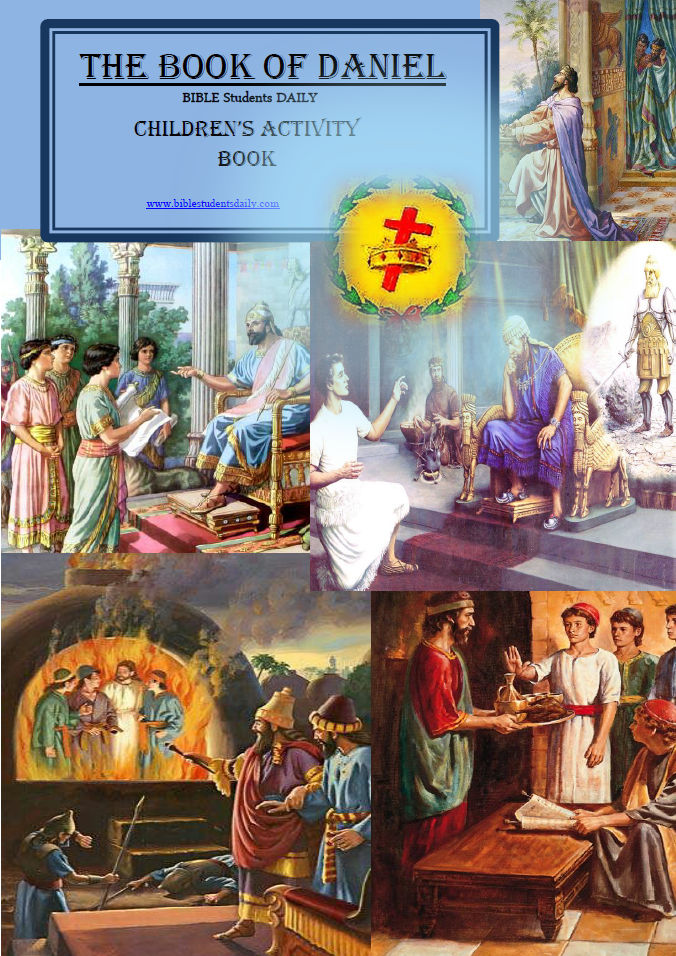
The Book of Daniel- Children’s Activity Book – free online here for use in proclaiming the glorious Gospel message:

The Book of Daniel – Children’s Activity Book


The URL for this post: https://biblestudentsdaily.com/2017/10/14/daniel-317-our-god-whom-we-serve-is-able-to-deliver-us/

Enter your email address to subscribe to this blog and receive notifications of new posts by email.

Matthew 28:20 – I am with you always…

Lo, I am with you always, even unto the end of the world. Matthew 28:20
THIS text contains a precious thought—that the Lord has been with his representatives in all their labors of love and self-denial, throughout the entire age, noting their efforts, assisting, encouraging, sustaining them, and surely watering and refreshing all who are making his service their special object in life—ministering his grace to others, watering and feeding them. And if this has been true in the past, all through the age, how specially true we may realize it to be now, in the end of the age, in the time of harvest, in the time of our Lord’s second presence! How we may realize that he is with us, in sympathy, in co-operation, in assistance, in sustaining grace, able and willing to make all of our experiences profitable to us, and to use us abundantly in showing forth the praises of him who has called us out of darkness into his marvelous light! Z’03-91 R3166:6 (Hymn 226)

Hymn 226   –  Delight In Thy Presence

O thou, in whose presence my soul takes delight,
On whom in affliction I call,
My comfort by day, and my song in the night,
My hope, my salvation, my all!

Where dost thou, at noontide, resort with thy sheep,
To feed in the pasture of love?
For why in the valley of death should I weep,
Or alone in the wilderness rove?

No longer I wander an alien from thee,
Or cry in the desert for bread;
My table is furnished with bounties so free,
My soul on thy Word is well fed.