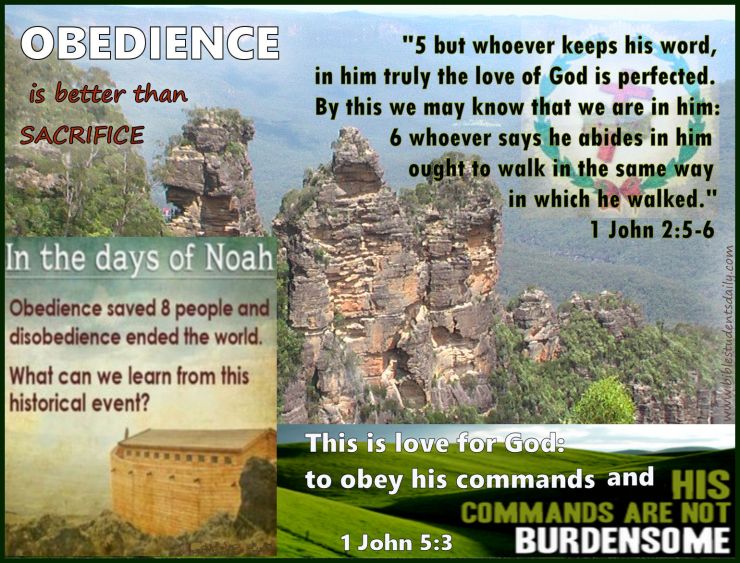
Why & How to OBEY GOD

Obedience to God- biblestudentsdaily.jpg

What is the Purpose of OBEDIENCE in our life?

Our OBEDIENCE to God YHWH is an indicator of our heart attitude.

In John 14:15 we read, “If you love me you will keep my commandments.”

So, obedience demonstrates our thankfulness, our appreciation, our devotion, our reverence for God and our praise.

“Faith by itself, if it does not have works, is dead.” (James 2:17, ESV)

—◊—◊—◊—◊—◊—◊—◊—◊—◊—◊—◊—◊—◊—◊—◊

HOW do we become OBEDIENT? Is there a method to it?

Here are some suggested steps to learning OBEDIENCE in order to please our Heavenly Father:-

Step 1: Reading the scriptures daily to know God’s will

The first step to doing God’s will is to actually know what it is, and learn about what pleases our Heavenly Father by reading His holy words in the Bible (2 Timothy 3:16).

And it [the Word of God] shall be with him, and he shall read therein all the days of his life: that he may learn to fear [reverence] the LORD his God, to keep all the words of this law and these statutes, to do them.” (Deuteronomy 17:19)

Proverbs 8:34 reads, “Blessed is the man that heareth me, watching daily at my gates.”

Why did the Apostle Paul describe the Brethren from Berea as “more noble” in character than the Thessalonians?

Acts 17:11 (ESV) tells us why. It is because “they received the word with all eagerness, examining the Scriptures daily to see if these things were so.”

It is a lot easier to deal with the issues of life, the trials, difficulties and testings that come to us, if we have daily input from the scriptures. It produces in our heart an overriding confidence and peace that “transcends all understanding” (Philippians 4:7), helping us “do ALL things through Christ” who strengthens us. (Philippians 4:13)

—◊—◊—◊—◊—◊—◊—◊—◊—◊—◊—◊—◊—◊—◊—◊

Step 2: Developing the will to do God’s will:

As we learn about the Heavenly Father’s will and what God wants us to do, we experience the “old man” (Ephesians 4:22-24, Romans 6:6-23), that is, the fallen nature appearing on the scene, that wishes to slow things down in our progress of maturity in Christ.

Fighting against the tendencies of the flesh, which we wish to put to “death” from moment to moment, IS THE BATTLE against sin!

How zealously and diligently with GREAT DISCIPLINE over our thoughts, words and actions do we barricade the fleshly interests… the fleshly wants… the fleshly tendencies in order to let the New Creature in us grow?

You see, the “Old Man” and the “New Creature [in Christ]” are AT WAR with each other! (2 Corinthians 5:17)

If the “old man” gains strength, the “New Creature” in Christ, weakens.


In Galatians 6:17-27 we read,

“17 For the desires of the flesh are against the Spirit, and the desires of the Spirit are against the flesh, for these are opposed to each other, to keep you from doing the things you want to do. 18 But if you are led by the Spirit, you are not under the law. 19 Now the works of the flesh are evident: sexual immorality, impurity, sensuality, 20 idolatry, sorcery, enmity, strife, jealousy, fits of anger, rivalries, dissensions, divisions, 21 envy, drunkenness, orgies, and things like these. I warn you, as I warned you before, that those who do such things will not inherit the kingdom of God. 22 But the fruit of the Spirit is love, joy, peace, patience, kindness, goodness, faithfulness, 23 gentleness, self-control; against such things there is no law. 24 And those who belong to Christ Jesus have crucified the flesh with its passions and desires. 25 If we live by the Spirit, let us also keep in step with the Spirit. 26 Let us not become conceited, provoking one another, envying one another. 27 Brothers, if anyone is caught in any transgression, you who are spiritual should restore him in a spirit of gentleness. Keep watch on yourself, lest you too be tempted.


  • Which one are we choosing to feed right NOW?
  • Which one will we choose to feed after we read this post?
  • Which one will choose to feed for the remainder of today?
  • How about tonight?
  • How about tomorrow and then for the remainder of this week and this month and year and until the day we die?

Are we consuming more spiritual food than earthly food?

Let’s say we eat breakfast, lunch and dinner with a few snacks in between, well, then that would mean the spiritual food would require to be served seven or more times a day or else the flesh will receive the growth and not the spiritual mind!

Better still, we shall like to feast on the spiritual ALL DAY as it is this kind of “food” that has no side effects but only most righteous and richest benefits (John 17:3, 1 John 2:25). Consuming spiritual food means feasting with Jesus and the spiritual “eagles” (Matthew 24:28; John 6:53-56, Isaiah 40:31).

In 2 Corinthians 5:15-18 the Apostle Paul well explains how all the “New Creatures” in Christ, should treat each other :


“14 For the love of Christ urges us on, because we are convinced that one has died for all; therefore all have died. 15 And he died for all, so that those who live might live no longer for themselves, but for him who died and was raised for them.

16 From now on, therefore, we regard no one [who is “in Christ”] from a human point of view; even though we once knew Christ from a human point of view, we know him no longer in that way.

17 So if anyone is in Christ, there is a new creation: everything old has passed away; see, everything has become new!

18 All this is from God, who reconciled us to himself through Christ, and has given us the ministry of reconciliation; 19 that is, in Christ God was reconciling the world to himself, not counting their trespasses against them, and entrusting the message of reconciliation to us. 20 So we are ambassadors for Christ, since God is making his appeal through us; we entreat you on behalf of Christ, be reconciled to God. 21 For our sake he made him to be sin who knew no sin, so that in him we might become the righteousness of God.”


May we find time each day to read a psalm and read or sing a hymnrecall and share some biblical verses with whomever we can edify along our day’s pilgrimage. Let us pray on our knees if we can, like the prophet Daniel did (Daniel 6:10)… like the Apostle Paul did (Ephesians 3:14), and above all, like our Lord Jesus did (Mark 1:35, Matthew 6:9-13, Matthew 14:23, Luke 6:12, Luke 22:32, 41-44, Luke 23:34, John 11:41-42, John 12:27-28, John 17:1-26, Hebrews 5:7). By being able to come boldly before the throne of Heavenly grace through our Advocate, Christ Jesus, we are able to keep on the right track, asking for our Father to mercifully show us His will EVER STEP of the narrow way. 

Do we with great joy in the hope set before us, thank our Heavenly Father even when severe stormy experiences come our way?

How much effort do we put in to represent our titles of members of “a royal priesthood”… the “peculiar people”“God’s special possession” (1 Peter 2:9)?

Brethren, how much do we strive to live in the world as citizens of heaven but NOT be “of the world”?

Do we long for earthly friendship OR are our minds consumed by the joys of our friendship with Jesus, whom we are training to be like in character-likeness?

Are we consumed by the friendship we have also in the Apostles and Ancient Worthies whom we are all getting to know actually RIGHT NOW?! The Bible is like a Reading Manual for our preliminary “Orientation” Program given to us by God’s grace, whereby we look forward to working with these whom proved faithful unto death.

The Apostle Paul explains that learning God’s will and wanting to do God’s will is a matter of development in our lives.


For it is God that worketh in you both to will and to do of his good pleasure.” (Philippians 2:13)


This means that we not only just learn to desire doing God’s will, but that we actually DO do it to the best of our abilities. These experiences and training in the school of Christ, involve TIME and we DO it with GREAT JOY being motivated by “the precious and very great promises” of God which in turn, gives us HOPE.

“And hope does not disappoint, because the love of God has been poured out within our hearts through the holy Spirit who was given to us” (Romans 5:3-5).

The Apostle Peter explains about these precious promises in 2 Peter 1:2-14 (ESV), which  reads:


“2 May grace and peace be multiplied to you in the knowledge of God and of Jesus our Lord. His divine power has granted to us all things that pertain to life and godliness, through the knowledge of him who called us to his own glory and excellence,by which he has granted to us his precious and very great promises, so that through them you may become partakers of the divine nature, having escaped from the corruption that is in the world because of sinful desire.

For this very reason, make every effort to supplement your faith with virtue, and virtue with knowledge, and knowledge with self-control, and self-control with steadfastness, and steadfastness with godliness, and godliness with brotherly affection, and brotherly affection with love. For if these qualities are yours and are increasing, they keep you from being ineffective or unfruitful in the knowledge of our Lord Jesus Christ.For whoever lacks these qualities is so nearsighted that he is blind, having forgotten that he was cleansed from his former sins. 10 Therefore, brothers, be all the more diligent to confirm your calling and election, for if you practice these qualities you will never fall. 11 For in this way there will be richly provided for you an entrance into the eternal kingdom of our Lord and Savior Jesus Christ.

12 Therefore I intend always to remind you of these qualities, though you know them and are established in the truth that you have. 13 I think it right, as long as I am in this body, to stir you up by way of reminder, 14 since I know that the putting off of my body will be soon, as our Lord Jesus Christ made clear to me. 15 And I will make every effort so that after my departure you may be able at any time to recall these things.”


By clinging onto the Divine gifts from God founded upon His word, the new mind in Christ, by God’s grace and mercy, is able to overtake or over-weigh the “old mind” of the flesh, growing into maturity in Christ through the tests of faith, to prove worthy as sharers in the grandest prize of all—belonging to Jesus’ body, bring the Heavenly Father greatest possible joy and being granted the privilege to bring the world of mankind into harmony with GOD during the 1000 year Millennial Kingdom Age.

We come to delight in God’s will and delight in doing it when the desire to do so is continuously presented before God.

If we do our part,
God will do HIS part in our lives
and IMMEASURABLY MORE!

(Ephesians 3:20)


1384059_with address

There is a wise saying:

“God helps those
who help themselves.”

Expecting miracles without asking, seeking and knocking is perhaps how this can be understood based on what we read in Matthew 7:7-11,

“Ask, and it will be given to you; seek, and you will find; knock, and it will be opened to you. For everyone who asks receives, and the one who seeks finds, and to the one who knocks it will be opened. Or which one of you, if his son asks him for bread, will give him a stone? 10 Or if he asks for a fish, will give him a serpent? 11 If you then, who are evil, know how to give good gifts to your children, how much more will your Father who is in heaven give good things to those who ask him!”


In Philippians 4:6, we are reminds:

DO NOT BE ANXIOUS ABOUT ANYTHING,
but IN EVERYTHING
by prayer and supplication with thanksgiving
let your requests be made known to God.”


In Isaiah 26:9 we read,

“With my soul have I desired thee in the night;
yea, with my spirit within me will I seek thee early.


A Desire to Serve God

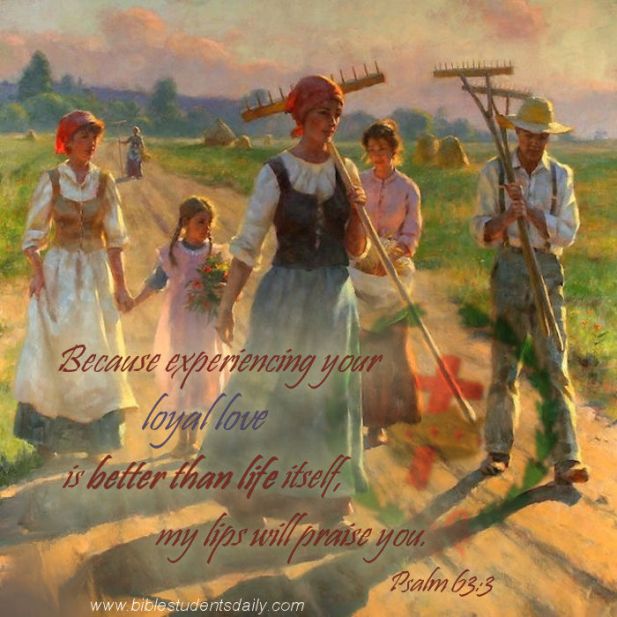
One of the ways that God brings us to the point where we desire to serve Him is by showing us His Divine Plan of Salvation that we can truly love and respect now “early” before the resurrection of the world—who will all desire God and turn to Him in the Millennium when all shall be taught to walk up the Highway of Holiness in order to gain eternal life, and most will seek life. For is not God’s love better than life itself.
PSALM 63, 3 - c&a

Let us think back in our lives to a time where we have studied scripture, or attended a convention, or had special fellowship with brethren or in some way come to a special appreciation of God’s character. For instance, when examining some glorious beauties of the Truth and recognizing the perfect harmonious relationship between the Scriptural types and anti-types. Perhaps it was that “eureka” moment of enlightenment upon some glorious gem of God’s Divine Truth that had never been realized before (Daniel 12:10, Proverbs 2:4-6).  Here we were left with a stronger desire and eagerness to seek and do God’s will since. We continuously learn that GOD is more perfect than any other living being that we have ever know.

The Heavenly Father’s love, is the TRUEST, MOST LOYAL LOVE because it is PERFECT LOVE—a love that is balanced perfectly with PERFECT JUSTICE, PERFECT WISDOM, PERFECT POWER and PERFECT STRENGTH (Ephesians 3:14-19).


“This God—his way is perfect; the word of the LORD proves true; he is a shield for all those who take refuge in him” (Psalm 18:30).


Jehovah’s love is reflected in Jesus—God’s only begotten Son (John 3:16).

When disappointment and discouragement comes with trials, testings and failures and the realisation of the emptiness of what the world has to offer, we know then that there is no real choice between serving God and serving the flesh/the world. This is another way God’s power works in our lives, guiding us through those experiences and teaching us things.

Perhaps the most painful experiences to the flesh are actually the GREATEST BLESSINGS to the New Creature’s development, for perhaps these are the moments of existence when the SURRENDERING up of self-will occurs fastest or with the best results. When we “let go” of the pain and not fight against the experience, we learn not to attach feeling or any label to the “what is” experiences of the flesh, trusting that “all things work out for good to those who love God” (Romans 8:28). By numbing the flesh in this way, one can concentrate on feeding the Spiritual Mind and take care to develop joy in the hope given to God’s people through the marvelous precious promises in the Bible.

The Bible is flooded with precious promises and we know they are true because already so many have prophecies have been fulfilled with the Nation of Israel as promised long ago, by the mouth of the holy prophets. For instance, what was once a valley of dry bones, is now an independent country which has gained not only “tendons” and “ligaments”, but “muscles” and soon “the bones” will live again and all things shall be renewed in the approaching millennial reign of Christ with his bride of 144,000 members. (Ezekiel 37, Revelation 7)

—◊—◊—◊—◊—◊—◊—◊—◊—◊—◊—◊—◊—◊—◊—◊


Step 3: Incorporating God’s will into our lifestyle:

We have responsibilities at work and with our families, entertainment, school, neighbours, activities with brethren etc., but how many opportunities do you think you have for obedience in any particular day?

Well, nearly everything we do is an opportunity for obedience.
Every time we interact with people is an opportunity.

A lot of the commandments in the Old Testament apply to us as well as in the New Testament. Let’s consider a few:

  • 2 Timothy 4:2: “Be instant in season and out of season.”

That’s about teaching the word, but really it can apply to us in every regard.

  • Hebrews 13:16: “Forget not to do good and communicate, for with such sacrifices God is well pleased.”

This is talking about an entire lifestyle, being connected with your brethren, being aware of what type of things they’re going through; because if you are, you will have no lack of opportunity to do good.

  • James 1:27: “Pure religion before God and the Father is this, to visit the fatherless and widows in their affliction and to keep himself unspotted from the world.”

That’s a commandment and a perfect balance between commitment to brethren and personal caring.

There are other things in the Old and New Testament about how to relate to other people, but there are other commandments that also tell us how to act when not with other people, even when we are by ourselves.

  • Philippians 4:8: “Finally brethren, whatsoever things are true, honest, just, pure, lovely and of good report; if there be any virtue and if there be any praise, think on these things. Also, Pray without ceasing.”
  • 1 Timothy 4:15: “Meditate upon these things: give yourself wholly to them, that your profiting may appear to all.”

This instructs us to take the necessary time to think about what we do in the eyes of God and respect it, so that we may stand in awe of the grandeur of the high standard of being Christ-like, and thus pleasing to our Heavenly Father as His Sons and Daughters.

  • Psalms 4: 4: “Stand in awe, and sin not; commune with your own heart upon your bed, and be still.”
  • In Hebrews 12:12  we read, “Wherefore lift up the hands which hang down, and the feeble knees.”


In other words, let us be a strengthening influence upon the brethren around us. Let us seek out those hands that hang down and lift them up. Remember Moses, when his hands were up the children of Israel would win and when down they would lose, so it was important for his hands to be held up. We have the same opportunity with our brethren.


  • Hebrews 12:13 “And make straight paths for your own feet lest that which is lame be turned out of the way; but rather let it be healed. Follow peace with all men, and holiness, without which no man shall see the Lord.” 

By striving to BE RIGHTEOUS IN THE EYES OF GOD—that is by being amongst the company of the the Bible characters during our daily meditations of the Word, we can be saturated with Godly thoughts… Godly words—which result in Godly actions. We can BE GOOD examples to others, someone others can look to for encouragement.


EPHES. 3, 20-21 esv.jpg

Acknowledgment:

This post was inspired by the content of an excerpt from a talk by Br. Tim Alexander titled “Five steps Towards Obedience.”

URL: https://biblestudentsdaily.com/2017/05/11/why-how-to-obey-god/

Enter your email address to subscribe to this blog and receive notifications of new posts by email.

2 PETER 1:5-11 – Is Mere FAITH IN GOD Enough?

2 Peter 1, 5-11 - C&C.jpg

The following post is an extract from “Epistles of Peter” by Bro. Frank Shallieu.

2 PETER 1:5: “And beside this, giving all diligence, add to your faith virtue; and to virtue knowledge.”

“Add to your faith virtue.”

The next step in the Apostle Peter’s evaluation is virtue.

The Apostle Paul breaks down the various fruits leading up to love, but Peter is talking from the standpoint of making one’s calling and election sure and his listing gives a sequential development. The Apostle Peter, the fisherman, is now a mature Christian feeding the lambs as well as the sheep. Having been qualified with a wealth of experience, he knows that death is imminent. Likewise, Paul realized the end of his life was approaching when he said, “Henceforth there is laid up for me a crown of righteousness, which the Lord, the righteous judge, shall give me at that day” (2 Timothy 4:8).
We are not reading a textbook but a very valuable, sobering account by one who speaks from experience as well as under the guidance of the holy Spirit.

Comment: Instead of the King James wording “And beside this,” the New International
Version has “For this very reason.” The NIV makes clearer the tie-in with the “exceeding
great and precious promises” of the preceding verse. In other words, “Because of the great and precious promises–for this very reason–you need to add to your faith virtue, etc.”

“Giving all diligence” is an important phrase, and it applies to all of the steps.
Give all diligence to add to your faith virtue.
Give all diligence to add to your virtue knowledge.
Give all diligence to add to your knowledge temperance, and so forth.

The great majority of Christians are immature seed.

In the parable, seed that falls in good ground and develops to maturity brings forth “some an hundredfold, some sixty, some thirty” (Matthew 13:23). In other words, full capacity is reached according to the content of the individual vessel. Some have
a 30 percent vessel, some have a 60 percent vessel, and the ten-talented person has a 100
percent vessel—and hence more responsibility. All three categories picture the Little Flock, children of the Kingdom in the real sense of the word.

Virtue means fortitude, strength of character.
Question: Doesn’t “virtue” also convey a morality aspect?

Answer: Yes, the breastplate of righteousness is part of virtue. From the simple rudiments of faith
and the milk of the Word, one now starts to get food that is a little stronger, and the body
grows proportionately stronger as well. The child grows, spiritually speaking, with moral
development and strength of character based on an outgrowth of faith.

Following initial faith, virtue is the first development of one who believes into Christ and starts to grow.

Many, thinking that knowledge follows faith, try to bypass virtue and want to teach and
write books when they are still babes. In the enthusiasm of our early days, we tend to be
overconfident. Those who talk that way are not mature Christians, and they betray
themselves by their immaturity of conduct, immaturity of reasoning, and immaturity in an assumed familiarity with Scripture. Thus the flesh tends to jump over virtue and go
straight to knowledge. However, Peter shows our need to go step by step by step.

Faith is the substratum of an entire Christian’s life. The just shall live by faith (Romans 1:17).
Faith in Jesus is the bottom line–faith that he is the Redeemer. We are to add to that faith, in successive order, the seven steps that Peter enumerates.

“Add … to virtue knowledge.” “Knowledge” is a broad term, for there are all kinds of knowledge.

2 PETER 1:6: “And to knowledge temperance; and to temperance patience; and to patience godliness.”

Peter continues to enumerate the various steps in the progression to maturity.

At the Last Supper, Jesus remarked to Peter, “I have prayed for thee, that thy faith fail not: and when thou art converted, strengthen thy brethren” (Luke 22:32).

After Jesus’ resurrection he gently rebuked Peter three times for the three denials. At that time Jesus said to Peter, “Feed my lambs.” The second time the Master said, “Feed my sheep.” And the third time was “Feed my sheep,” after which Peter said, “Thou knowest that I love thee” (John 21:15–17). Notice the progression: (1) “feed my lambs,” and then (2) “feed my sheep” and (3) “feed my sheep.” In other words, Peter was not in the position to feed mature adults at the time of our Lord’s ascension or even after Pentecost. At Pentecost, Peter possessed the first two qualities: faith and virtue. Peter had faith: “Thou art the Christ, the Son of the living God” (Matthew 16:16). Also, he and John spoke very boldly on the Day of Pentecost.

“Virtue” means strength, courage, fortitude.

Now when we study Peter’s epistles, we see a very different Peter from the impulsive one in the Gospels.

Peter tells us to add to or supplement our faith with virtue, knowledge, temperance, patience, godliness, brotherly kindness, and charity. In other words, Peter adds seven different qualities to the basic substratum of faith.
Let us consider “knowledge.”

Remember, Peter is speaking about character development. Regardless of the subsequent lack or fullness of development, we all start our Christian walk as babes with faith in Jesus. In his first epistle, Peter said that “as newborn babes, [we should] desire the sincere milk of the word, … [so that we] may grow thereby” (1 Peter 2:2). As the babe feeds on milk, his bones grow and he gets a little stronger so that, spiritually speaking, he can withstand opposition and persecution. This would be adding virtue to our faith.

To add knowledge, the babe needs milk for growth. “Milk” includes the knowledge of
God’s Word, for how can we instruct others if we have not been instructed ourselves?

To knowledge, we are to add temperance or self-control.

The growth of Peter in the area of self-control is amazing! He underwent a remarkable change from his earlier impulsiveness.

Jesus said to Peter, “Verily, verily, I say unto thee, When thou wast young, thou girdedst thyself, and walkedst whither thou wouldest: but when thou shalt be old, thou shalt stretch forth thy hands, and another shall gird thee, and carry thee whither thou wouldest not [to death in crucifixion]” (John 21:18). Jesus was referring to the manner in which Peter would die. When Jesus asked, “Who do men say that I am?” impulsive Peter responded, “Thou art the Christ, the Son of the living God” (Matthew 16:13–16).

Peter was a natural leader, but he needed to be instructed himself. The very fact Peter was naked in the boat after Jesus’ resurrection gives us an insight into his character. He did not want any restraints. He impulsively girt himself with his coat and jumped into the water to swim to Jesus, who was frying fish on the shore.

This same man, but a mature and developed Peter at the end of his life, said, “Add to your knowledge self-control and self-restraint.”

This self-restraint must come after knowledge.

Both of Peter’s epistles were written in the last years of his life, just before his death. How valuable is the instruction of Peter in his maturity!

When Paul discusses the various graces of the holy Spirit, he does not necessarily
enumerate them in succession. For instance, in describing love, he does not follow any
particular sequence, but Peter says, “Add to your faith virtue. Add to your virtue knowledge. Add to your knowledge temperance.” Thus Peter gives a sequence and Paul does not. The point is that the instruction of the two apostles does not conflict. Paul gives more detail but lists the graces of the holy Spirit in random fashion. (An exception would be Paul’s discussion of faith, hope, and love, which are in succession.)

Comment: It was Peter who lopped off the ear of Malchus in the Garden of Gethsemane at the arrest of Jesus. This act is another example of his impetuosity and impulsiveness.

Comment: In a practical sense, temperance could be along both material and spiritual lines. We need to have self-control over our life-style and how we expend our resources. Along spiritual lines, temperance would affect how we witness and preach the gospel. For example, as a general rule we would not deliberately make a spectacle of ourselves.

Comment: A comment in the Berean Manual says, “Moderation, self-restraint in all things–we are not to be hasty and hot-tempered, or rash and thoughtless, but evenly balanced, thoughtful and considerate.” We get this moderation through the knowledge of God’s Word.

Reply: Yes, “he that ruleth his spirit [is better] than he that taketh a city” (Proverbs 16:32).

“Let your moderation be known unto all men” (Philippians 4:5).

We should be temperate in language, money-getting, money saving, eating, drinking, joy, sorrow, at work, in the store, home, church, and schoolroom–everywhere.

Comment: On the other side of the coin, there is a danger in becoming too temperate and thus not having enough zeal for the truth, the Lord, and His service.

Reply: If we have too much self-control, we will be mute when we should speak. The other extreme is being so out of hand and rambunctious that we destroy whatever good we might do. The proper amount of self-control makes us much more effective.

Add “to temperance patience.” What is this “patience”?

The Greek word is hupomone, which means “endurance.” Hupomone conveys the thought of bearing under a burden, of enduring it and not chafing, of remaining under the burden and not giving up. The same word is used in Hebrews 12:1, “Wherefore seeing we also are compassed about with so great a cloud of witnesses, let us lay aside every weight, and the sin which doth so easily beset us, and let us run with patience the race that is set before us.” Of course a lot depends on the makeup of the individual, for we are all different. Some brethren under trial may react without a lot of apparent cheerful endurance and yet be faithful. The circumstances must be considered. Those who run a marathon race are not very cheerful when they near the end of the race, for they are pressing on to the utmost. Those who win have an extremely strong
desire to excel and be a champion.

Comment: James 5:11, in referring to Job, uses this same Greek word for “patience.”
“Behold, we count them happy which endure. Ye have heard of the patience of Job, and
have seen the end of the Lord; that the Lord is very pitiful, and of tender mercy.”

We are all familiar with Job and the conditions under which he endured.

Comment: “Patience” would be meekly submitting to discipline in every case. Add “to patience godliness.” “Godliness” is the wrong word, for that quality should be the
end, the highest step. Godliness and love are synonymous. The thought here should be
love and reverence for God, God-likeness. Thus the word “piety” is a better translation, for piety is a form of reverence. Piety can also be considered decorum, as in 1 Timothy 3:15, “Behave thyself in the house of God.”

Comment: Strong’s and the Diaglott use the word “piety.”
Reply: The Greek word is eusebeia, and a famous historian was Eusebius, a name meaning piety, a reverent one.

Comment: Reprint 2155 states that God-likeness, piety, is “that devout controlling reverence for God which yields a hearty, cheerful, loving conformity to his will–fervency of spirit in serving the Lord.”

Reply: Piety is especially fervency in spirit in obeying the Lord. He is looking for obedience in us–that is the bottom line.

Works by themselves are meaningless.

“To obey is better than sacrifice, and to hearken than the fat of rams [which is offered in sacrifice and may cost a little money]” (1 Samuel 15:22).

Obedience supersedes works.

2 PETER 1:7: “And to godliness brotherly kindness; and to brotherly kindness charity” 

Add to piety “brotherly kindness.” There are occasions where it is difficult to love all
brethren completely and indiscriminately. In other words, there are cases where we cannot manifest love to others because of their disobedience. For instance, 1 Corinthians 5:11 says, “I have written unto you not to keep company, if any man that is called a brother be a fornicator, or covetous, or an idolater, or a railer, or a drunkard, or an extortioner; with such an one no not to eat.”

The individual may not have even consecrated, but if he thinks he is a brother in truth and is a drunkard, a brawler, a fornicator, etc., we are to refrain from fellowship with him. Treating him in this manner is doing him a favor, for if he truly loves God, the truth, and the Lord’s people, he will feel he has done something wrong and will repent.

The Greek word for “brotherly kindness” is philadelphian. Some translations use “love of
the brotherhood,” and that is a better term.

We love those who fervently love God. We are drawn to such because they are of the brotherhood. Jesus particularly favored Peter, James, and John because they manifested a greater zeal for God. The incident in which Jesus raised the daughter of Jairus illustrates this favoritism (Mark 5:35–43). Another example is Jesus’ transfiguration (Matthew 17:1–9). That is the type of love we should have for the brotherhood.

We love those who love God, and the more they love Him, the more we love them.

Moreover, we are helped by their example. In the hymn “Onward, Christian Soldiers,”
when we sing the words “All one body we,” we are thinking not of individuals but of the
brotherhood, of those who love Christ and are trying to serve God.

Add “to brotherly kindness charity [love]. If the previous step was love for the brotherhood, what is this highest type of love? It is agape love.

Comment: We love those who love God and have a special affinity for them because of our common bond, but our love must go beyond that point to where we love mankind.

Comment: This would be a principled love versus phileo love with an emotional basis.

Comment: We love the Lord, the brethren, humanity, our enemies, and also the brute
creation.

Reply: That is true, for principled agape love is broad. The Law shows how we should treat the animals; for example, they should not be unequally yoked in plowing. Agape love includes love for our enemies and doing good to them that despitefully use us (Matthew 5:44).

With this principled love, “God so loved the world, that he gave his only begotten Son”
(John 3:16). Those who obey in the future will be saved, for God has made provision for the restitution of mankind. In other words, He will open the opportunity for salvation toothers besides the brotherhood. His love goes from the brotherhood to mankind and even to those who are enemies now but may not be once their eyes are opened in the Kingdom.

Only those who are incorrigible in iniquity will go into Second Death.

Remember that before Peter started the enumeration of the seven graces of the holy Spirit, he said, “And beside this, giving all diligence,” add to your faith, etc. (2 Peter 1:5).

Because we live in the world with its responsibilities and experiences, our time becomes important–the little time we have left after doing that which is right for family, employer, and others. We must give all diligence to add these seven qualities. Isn’t it remarkable that the impulsive Peter is like a statesman or a father in these epistles? True, he was a leader in the beginning of his Christian walk, but now he is more than that. In his first epistle, which was written only a couple of years before the second epistle, he called Marcus “my son” (1 Peter 5:13). Paul used the same terminology with Timothy, and that epistle was written near the end of Paul’s life. As the apostles aged in the truth, they matured. Peter underwent a radical, miraculous, almost unbelievable change from his days as a fisherman. True, he speaks according to the holy Spirit, but his own life is in harmony with that holy Spirit. He experienced these steps himself, and he is passing on the information to us. Later he says, “I am going to remind you of these things until the day I die, and the Lord Jesus has informed me that my death will occur soon.”

Comment: The verses being alluded to are quite touching: “Yea, I think it meet, as long as I am in this tabernacle, to stir you up by putting you in remembrance; Knowing that shortly I must put off this my tabernacle, even as our Lord Jesus Christ hath shown me” (2 Peter 1:13,14).

2 PETER 1:8: “For if these things be in you, and abound, they make you that ye shall neither be barren nor unfruitful in the knowledge of our Lord Jesus Christ.”

Comment: If “these things” (the seven steps above faith in verses 5–7) are in us and abound, we will make our calling and election sure. The fact that Peter uses the term “these things” five times in this chapter (verses 8–10, 12, 15) shows how important they are.

Reply: Yes, Peter is inclined to repeat words and references. For instance, the use of the
word “divine” twice in this chapter is unusual, for that word appears only three times in
the whole New Testament. The reason is that Peter recognized his own faults and weaknesses and how the Lord changed his life. He is admitting, as it were, that what God
did for him, He can do for us. Accordingly, Peter mentions the importance of developing
character and the various steps of grace that are required if we are to win a crown. We must have diligently tried to add the seven graces to our faith.

Comment: If the words “and abound” had been omitted, the meaning of the verse would have been a little different. All who get life on the spirit plane, including the Great
Company, must have these qualities, but to attain the Little Flock, to get an “abundant
entrance,” these qualities must abound in us and must increase more and more.

Reply: For example, when people do acts of kindness, are patient, etc., there is often a lack of consistency. With knowledge, some are satisfied with a certain level and stop there. These qualities must be diligently practiced if we would be more than overcomers.

Question: Is the “knowledge of our Lord Jesus Christ” in verse 8 the same “knowledge” that is in verse 5?

Answer: The Greek gnosis is used in verses 5 and 6, and epignosis (full knowledge) is used in verses 2, 3, and 8. The words are the same except that epignosis is expressed more powerfully, i.e. with more fullness. By faith we know (gnosis) that Jesus is the Savior, that he died for our sins, and through this knowledge we are forgiven for our sins. In addition, we should also know in more fullness (epignosis) his sermons and parables, his life and character, and how he lived to please the Father.

The “knowledge” (gnosis) of verses 5 and 6 is the second step in the various graces of the holy Spirit, but epignosis embraces all seven steps, which would include a comparison and study of Jesus’ statements and teachings. However, epignosis has nothing to do with the depth of our understanding, which is not always the same. If we have not searched the Scriptures daily, if we have not habitually familiarized ourselves with the Word of God, with the life of Jesus, with the Old Testament, etc., we will be lacking.

Comment: In the footnote for the text “If these things be in you, and abound … ye shall
neither be barren nor unfruitful,” “barren” means “idle.”

2 PETER 1:9: “But he that lacketh these things is blind, and cannot see afar off, and hath forgotten that he was purged from his old sins.”

To be “blind” in this sense is to be nearsighted, meaning the individual “cannot see afar
off.”

Question: What is the relationship between the first part of verse 9 and the second part? What does lacking the graces of the holy Spirit have to do with forgetting that we were purged from our old sins?

Answer: The object of our being purged from old sins is to grow in character. We are nearsighted if we do not always keep this goal in mind. Peter is saying, “It is not enough to just believe Jesus is the Savior and to be willing to suffer for him. We must have more understanding in order to please God.” Since we are imperfect and by nature fallen–our humanity is depraved–we must frequently occupy our minds with pure thoughts. Paul said, “Think on these things.” “Finally, brethren, whatsoever things are true, whatsoever things are honest, whatsoever things are just, whatsoever things are pure, whatsoever things are lovely, whatsoever things are of good report; if there be any virtue, and if there be any praise, think on these things” (Philippians 4:8).

If we do not feed on pure thoughts, our minds will naturally gravitate to unspiritual things.

Those who neglect or do not see the necessity of developing the fruits of the holy Spirit, are “blind,” nearsighted. Far-sighted vision would be making our calling and election sure. We are not at the goal yet, so we must keep running.

We cannot let ourselves drift in our thinking or in our actions, but must school ourselves with God’s Word.

Comment: If we stagnate and do not grow in character, we stay in the sins from which we were supposed to be purged.

Reply: We must try to distance ourselves from the old man as far as possible. Of course we cannot do this completely, for he is saddled on our backs, but we must separate as far as possible from our own reasoning and our own will.

2 PETER 1:10: “Wherefore the rather, brethren, give diligence to make your calling and election sure: for if ye do these things, ye shall never fall:”

The objective is to make our calling and election sure.

If we take our eyes off the goal, we will gravitate to our natural tendencies instead of to the supernatural tendencies of the Holy Spirit.

“If ye do these things, ye shall never fall.” The thought is that if we develop these fruits of the holy Spirit and they abound in us, we will never fail but will succeed in attaining the Bride class.

Comment: The Great Company will fall or fail to a certain extent.

2 PETER 1:11: “For so an entrance shall be ministered unto you abundantly into the
everlasting kingdom of our Lord and Saviour Jesus Christ.”

If we give all diligence to developing the fruits of the holy Spirit, if we have the right heart attitude and diligently practice Christianity throughout our Christian walk, we will get an abundant entrance into the Kingdom, for we will be obeying the promptings of God’s holy Spirit.

We are given “exceeding great and precious promises” so that we might inherit the divine nature.

The “everlasting kingdom” would be the age-lasting Kingdom (Greek aionian). The 144,000 will be on the throne and reign throughout the Kingdom Age.


Acknowledgment:

Bro. Frank Shallieu–for the content above which was an extract from “Epistles of Peter” The full study is on the Bible Study Library CD which can be accessed at the following link: https://herald-magazine.com/bookstore-2/#!/Bible-Study-Library/p/38387237/category=0


URL of this post: https://biblestudentsdaily.com/2016/08/06/2-peter-15-11-is-mere-faith-in-god-enough/

Enter your email address to subscribe to this blog and receive notifications of new posts by email.


Save

Philippians 4:8 -Whatsoever things are just…

“Whatsoever things are just,…think on these things” (Philippians 4:8).

March 3rd - WITH ADDRESS .jpg

We are not to allow our minds to run along lines that would be unjust, and we are to learn to apply this test of justice to every thought and word and act of ours, while learning at the same time to view the conduct of others from a different standpoint–so far as reason will permit, from the standpoint of mercy, forgiveness, pity, helpfulness. But we cannot be too careful how we criticize every thought we entertain, every plan we mature, that the lines of justice shall in no sense of the word be infringed by us with our hearts’ approval. Z.’03-9 R3129:3