

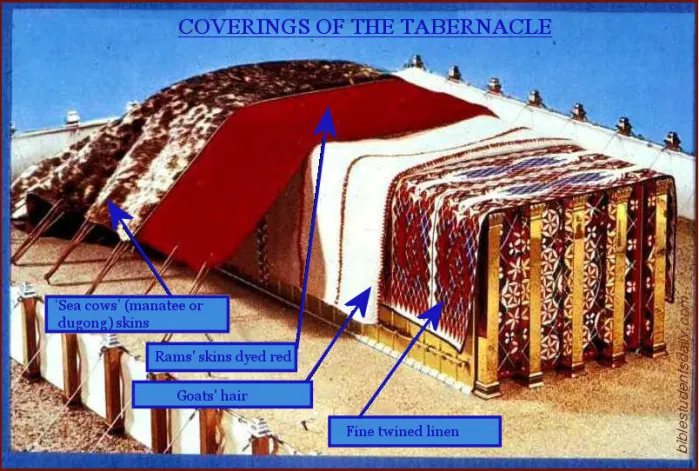
The Tabernacle structure was overlaid with 4 coverings as explained in detail in Exodus chapter 26 (and chapter 36). There were 2 primary coverings of measured dimensions and 2 additional coverings over those.
The Two Inner Coverings or Curtains
The two inner coverings formed the “MISHKAN” the Tabernacle proper.
- The First Covering
The Tabernacle was covered by a large white linen cloth composed of ten curtains interwoven with figures of cherubim, in blue, purple, and scarlet (Exodus 26:1, 36:8-13).
Each curtain was 28 cubits x 4 cubits, making a total of 28 cubits across and 40 cubits from front to back. The ten curtains were sewn into two sets 28 x 20 and these two sets were coupled together with 50 blue loops on each joined by 50 gold clasps. This joint would have been situated above the pillars of the vail (Exodus 26:33).
Since the dwelling was 30 x 10 cubits, this linen curtain covered the roof and both the northern and the southern side of the Tabernacle plus the back (western side).
If this linen curtain had have hung straight down, then it would have reached 9 cubits from the top of the Tabernacle structure (on the northern and southern side) and 10 cubits on the back (western side) and this would mean that the western corners of the curtain would be dragging along the dirty ground — and we do not believe this was the case. This white curtain presumably did not drape straight down, but was angled outward on the ropes that were secured by the pins and cords of both the Tabernacle and the court, Exodus 35:18:
“18 The pins (“tent pegs,” NIV) of the tabernacle, and the pins of the court, and their cords(“ropes,” NIV).”
If not for these cords (that would have kept the curtain from going straight down), then the two back corners would have lain on the dirty ground — just as the two corners of a bedspread go farther down than the bedspread on the three sides of a bed. Thus it we understand the curtain did not drag along the ground.
The pure linen covering with its embroidery represents the New Creation, holy (white linen), sanctified (set apart for God’s service), with the fruits of the spirit intertwined in their character.
This covering was in two main parts — five strips in each part.
The two main parts represents the two parts of the New Creation — our Lord Jesus, and the Church, his Bride class.
That there were five strips in each part is consistent with the use of the number five elsewhere in the Scriptures to represent the New Creation. (Thus the five wise virgins of the parable and their companions of the same number, the five foolish virgins.) As Jesus is the effulgence of God’s glory, so the Church will reflect the glory of God also, and thus the splendid beauty of this covering. [See Study 3 of “Beauties of the Tabernacle” on this website titled “The Tabernacle Construction: The Holy & The Most Holy.”]
The gold clasps suggest the divine nature to be obtained by the Church.
The loops of blue suggest the bonds of faith and fidelity that hold the Church as a unit. They are 50 in number, appropriate for the New Creation which is often represented by the number 5 or its higher orders, 50, 500, 5000. [see Study 3 of “Beauties of the Tabernacle”].
This overwhelming inner beauty of the Tabernacle may reflect our Heavenly Father’s interest in having a dwelling place of the holy Spirit where the inward detail of our lives is beautiful because of our efforts of striving for righteousness in all.
- The Second Covering
The second covering over the linen curtain was the goats hair curtain. (Exodus 26:7-13; 36:14-18). This one extended a cubit further on the back and 2 outer sides than did the first linen curtain underneath it.
It consisted of eleven curtains 30 cubits x 4 cubits. Eleven of the curtains made 30 cubits across (2 cubits wider than the first linen covering) and 42 cubits overall length (2 cubits longer than the first linen covering) from front to back (Exodus 26:9).
At the front of the Tabernacle, the 11th of the four-cubit-wide curtains was doubled over — (creating a one cubit vertical “ledge” above, at the front of the Tabernacle door) — something unique to this particular curtain, possibly signifies that when we begin our consecration we have a double measure of goat nature, but less of it later on.
Just like the white linen curtain, this goat’s hair curtain did not touch the ground in the back but would have been elevated by ropes (cords) that were pegged to the ground outside with bronze pegs so that it hung down at an angle preventing them from getting dirty and degraded easily.
The goats hair curtain was also sewn into two sets, but this time the two sets of 50 loops were joined by 50 bronze clasps.
Bronze, (chiefly copper) representing human nature which is noted in the bronze serpent (Numbers 21:9) — representing the justified human nature of Jesus that was sacrificed for us to remove our sins. Thus bronze clasps are appropriate here, because this covering represents the human nature (in its perfection — thanks only to the imputed robe of Christ’s righteousness covering us so that a fully consecrated justified believer can be reckoned as righteous in the eyes of God) of the New Creation while in the flesh.
In other words, the goat hair covering represents our old nature (the fleshly), in which we have our spiritual hopes.
It is interesting to note that there was no bronze inside the Tabernacle, showing that the calling of the saints is away from the flesh, into the spirit.
One wonders whether the joining clasp areas of the linen and goat hair coverings may have allowed some ventilation for the Tabernacle and a place of exit for the smoke from the incense altar and the lamps. Our “ventilation” from the sorrows and difficulties of the flesh also is upward, through our prayers to our Heavenly Father (Psalm 34:4).
However, this possibility seems foreclosed, because the clasped area for the linen covering, and the clasped area for the goat hair covering, did not line up with each other, to allow such ventilation. This is because of the stagger of 1/2 curtain width in one covering relative to the other, occasioned by folding one of the goat hair curtains in half at the front of the Tabernacle.
The Bride class is depicted in Song of Solomon 4:1 as having “hair as a flock of goats,” which further connects the goat hair curtain with the Church class.
This covering represented the Church, as sacrificed with Jesus, as an offering given for the purpose of cleansing the world from sin during the Millennium. In this, it reminds us of the goat for a sin offering that was offered on the Day of Atonement.
Jesus’ sacrifice as a sin offering was represented in the bullock for a sin offering on the Day of Atonement [as is discussed in Post 7 of “Beauties of the Tabernacle” on this website, titled “Study 7: The Priests. The Day of Atonement.”] The Church shares with Jesus in suffering and sacrifice during the present Gospel Age, in order to assist Jesus during the Kingdom to cleanse the world from their propensity for sin. The share of the Church class in this service is represented in the goat hair curtain.
As the Church is presently imperfect, they need a covering for their imperfections in order to be an acceptable sacrifice to God. That covering is the Ransom given by Jesus — represented in the covering of rams’ skins dyed red, which was above the goat hair curtain.
The 5 strips — represents the Church as the New Creation:
i.e.
2 (holy Spirit — the understanding of God’s divine plan and God’s influence on our character through studying the Old and New Testaments of the Bible)
+
3 (redemption through Christ’s blood)
=
5 (the New Creation in Christ).
The 6 strips — show we are still in sinful flesh.
The 11 strips in total — is a picture of the Church in the flesh but with their new hopes. Thus the need for the ram skin dyed red covering, of the ransom.
It is most interesting to note that the perimeter of this covering of goat’s hair, with the “sixth curtain” doubled over in the forefront of the Tabernacle (Exodus 26:9) measures exactly 144 cubits, which when multiplied by 1000 (God’s number in the Tabernacle), gives the number of those who will share with Jesus in the sin offering of atonement, 144,000 — the Elect, Bride of Christ (Revelation 7, 14).
The Outer Coverings
The outer coverings formed the “OHEL” — the large tent, that spread over the first two coverings (curtains), protecting them from the sun and rain. This was the covering mentioned in Exodus 40:19 which was put over the top of the tent (the curtains or Tabernacle proper). These coverings were a weather proof protection to the tabernacle and were held in place by cords and pins fixing them to the ground.
- The Third Covering
The third covering was made of ram skins dyed red (Exodus 26:14, 36:19; Numbers 4:25).
The ram skins dyed red covering represents the ransom sacrifice, which covers our imperfect humanity. It is over the goat hair covering, to show that it covers our flesh with its imperfections.
A ram is a grown male sheep and the head of the flock. A shepherd may have one or two rams in a flock of ewes to promote uniformity. The ram is forever in the eyes of the Jew as the substitute animal, faithful unto death. This is of course because God provided a ram as a substitute for Isaac on that day when Abraham’s faith was revealed (Genesis 22:12-13).
The ram’s skins were dyed red to represent the ransom sacrifice of Jesus shedding his blood on the cross for the redemption of all mankind from inherited Adamic sin.
John 1:29 — “The next day John saw Jesus coming toward him, and said, “Behold! The Lamb of God who takes away the sin of the world!”
Hebrews 2:9 — “But we see Jesus, who was made a little lower than the angels, for the suffering of death crowned with glory and honor, that He, by the grace of God, might taste death for everyone.”
Hebrews 2:17 — “Therefore, in all things He had to be made like His brethren, that He might be a merciful and faithful High Priest in things pertaining to God, to make propitiation for the sins of the people.”
Thus, the first layer typifies the New Creation, the second layer shows that we are still in the flesh, the third layer typifies that Jesus bore our sins and shed his blood to redeem us.
Measurements for both the 3rd (ram’s skin) & 4th (sea cow skin) coverings are not given in the Bible nor are we told precisely how they covered. Thus some artist conceptions show them as a covering tent, not in direct contact with the goat hair covering. In any case, we presume the third covering was more than sufficient to cover the second, and that the fourth was more than sufficient to cover the third.
Nevertheless, the reason for no dimension given for the ram’s skin covering may be as if to say that God’s love manifested toward the world, in the sending of his son “out of the realms of light into the shades of night,” to become the man Christ Jesus and thus to give himself a ransom for all, is immeasurable!! Who can measure it?
The ram and sea cow coverings were not divided into units as were the other two, which may mean that while the Church shares together with Jesus in the sin offering and in the glory of the kingdom, it cannot and does not share either in the humiliation of the Logos in leaving his glory to become the man Christ Jesus, nor in his death as the ransom sacrifice for the sins of the world.
- The Fourth Covering
The fourth and top covering was made of ‘sea cows’ (manatee or dugong) skins (mistranslated badger skins) (Exodus 26:14, 36:19).
This outward covering was serviceable for the elements of weather, rather than suited for attractive décor. Thus it was durable (Exodus 26:14). It was not especially attractive, just as the world sees no attraction to our service in the present time. However, in the Millennium they will see the Church class cleared of all unattractive conditions. She will then be seen in her glory and grandeur; just as the temple, a type of the glorified Church, was covered with plates of gold, there were no ugly skins.
As this outward covering hid all that was beneath it, so also, Jesus’ flesh did not reveal him to be what he truly was — the Messiah whom Israel so long sought. When he presented himself to his own people as simple and humble, “his own received him not” (John 1:11) for they beheld in him “no form nor comeliness … no beauty” that they should desire him (Isaiah 53:1-2). Jesus said, “though seeing they do not see, though hearing, they do not hear or understand” (Matthew 13:13). They see only the outer things. But blessed are those who use the eyes of faith and enter in.
To those of us who have accepted Jesus as our Personal Redeemer and Advocate and Sin offering, Jesus is to us part of our being… the “altogether lovely One” (Song of Solomon 5:16). He is the “Rose of Sharon,” the “Lily of the Valley” (Song of Solomon 2:1) and the “fairest among 10,000” (Song of Solomon 5:10) to our souls… Jesus Christ is our Bridegroom and our Head, our ultimate example of everything and everyone, our source of “oxygen” and the source of our eternal joy already now while still in the flesh, whom we long to belong to, forever more.
If anyone desired to look beyond the outer flesh covering they will see Christ’s glory. Just as questioned by Nathanael “Can any good thing come out of Nazareth?” (see Post titled: Will Mankind Need To Become “Israelites Indeed”) Jesus says, “Come and see.”
God does not attract anyone by apparent riches. We do not come to God because of the majesty and beauty of some building. Our reasons are not visible. The ones who endure to the end are those who do not have an outward beautiful appearance but who have an inward heavenly beauty and divine comeliness. Christ is both their content and covering, so nothing can damage or overcome them. We must learn to seek Christ in the spirit, as then we will enjoy the riches of Christ. Ultimately we will arrive at the measure of the stature of the fullness of Christ (Ephesians 3:8, 4:13).
Many think that the Truth is as unattractive as a manatee’s skin. Many think a Christian life is sad and dark; they do not know that for Christians the exterior has no value. Inside there is light, joy, richness, and peace — the “inside” being founded on the precious promises and the joy of pleasing a Creator whose standard of righteousness leads to the highest level of happiness and joy that anyone could imagine and which provides the means for us to gain immortality.
The Manatee

It was also a peculiar skin and this illustrates the peculiarity of God’s people. The world does not like this peculiarity and considers us a bit out of our minds.
The manatees are gentle, herbivorous, and possibly ritually clean creatures, like the Church, who are out of their natural habitat, “the heavenlies” of Ephesians 2:6. Jesus, in his pre-human existence, was “the Logos” (“the Word,” John 1:1). His natural habitat was the spirit plane on which he was created. Thus being on earth was being out of his natural, comfortable environment, also.
A Summary — The Antitypical Lesson Behind All Four Coverings
Since the Tabernacle depicts things as they are during the Gospel Age, the saints are a new creation (linen with cherubim), sacrificing in the flesh (goat hair curtain), covered by the ransom (ram skins dyed red), apparent to the world as a drab outer covering which refers to the flesh of the saints, reflective of how our Lord Jesus was treated during the 3 1/2 sacrificial years of his life as a sin offering (aged 30-33 1/2 years) who “was despised and rejected by men, a man of sorrows, and familiar with suffering… like one from whom men hide their faces he was despised…numbered with the transgressors,” until our precious Lord Jesus, “poured out his life unto death” (Isaiah 53:2-12, NIV).
Why Four Coverings?
Since four refers to the concept of testing or judgment, perhaps there being four coverings could suggest that this is how the Church is represented while under judgment in this life.
Likewise, at the entrance of the most holy of the Tabernacle, the time of judgment of the Church, there are four posts. Other Biblical examples of four representing judgment and testing include:
- the second feeding of four thousand by Jesus, representing the time of harvest and judgment closing the Gospel age;
- the forty years in the wilderness representing the Gospel age period of testing, trial, development;
- the four hundred years of Genesis 15:13 which describes the period of the affliction of the seed of Abraham and represents the Gospel age affliction of the Church. These four hundred years, if multiplied by the 360 days in a prophetic year, yield 144,000, the number of the church in Revelation.
- It is also noteworthy that of the dated visions of Jeremiah in chapters 25, 26, 27, 28, 29, and 36, three are dated in the fourth year of Jehoiakim, and three in the fourth year of Zedekiah — all six judgments are in a year four.
- When the seven times of punishment on Israel was represented in Nebuchadnezzar’s dream, the expression “seven times” appeared four times in the narrative, and four times in the warning by Moses (Daniel 4, Leviticus 26). These judgments were fulfilled by four Gentile kingdoms dominating Israel during the 2,520 years of their national punishment.
In all these uses, four is linked to the concept of trial, testing, probation, judgment.
Which one?
Out of the following four drawings, which do you think would be the most probable to represent the actual Tabernacle Proper’s covering setup?

Not the first one. All the four coverings were draped on cords at an angle (not downward straight as covering a box). If one stretched the cords entirely vertically, then the pegs would be right next to the boards and sockets of the Tabernacle which would be a clumsy arrangement and the back corners of the first two coverings would then both be dragged along the ground, become very dirty and corrupted. (This has been discussed earlier in this Post.)
The covering was unlikely to be as the one in the 4th picture because there is no reference to the supports that appear to be necessary in that case for holding up the curtains on the side before they go straight down.
If the outer covering were like a circus top, then another beam or pole(s) would most likely be mentioned in the Bible that gives the added pointy height, hence eliminating the possibility of covering appearing as in the third drawing.
On the other hand, such a ridge pole might simply be covered by the term “tent;” all tents requiring some poles for erecting them.
Based on the data read and researched, we conclude that the Tabernacle covering was most possibly as the 2nd drawing (top right) demonstrates. Probably the first two coverings were draped as suggested in Drawing No. 2. The last two coverings may have been a tent over the whole, like one of the bottom two. Artistically, the author likes the last one, perhaps even with an extension to the back like the side extensions. But one cannot be sure.
Hidden Beauty
It has been a matter of surprise to some, that the glories and beauties of the Tabernacle — its golden walls, its golden and beautifully engraved furniture, and vail of curious work — were so completely covered and hidden from view of the people; no sunlight from without even to illuminate its glorious beauty. Yet you see, there is a beautifully glorious lesson behind this.
God covered the type and hid its beauty under skins and curtains, so the glories and beauties of spiritual things are seen only when within by those who enter the Tabernacle.
During the Gospel Age it is the “royal priesthood” and “peculiar people” who respond to God’s invitation and suffer with Christ developing into His likeness of character and conduct who may enter a hidden glory which the world and all outside fail to recognize and comprehend. Their standing as new creatures in Christ are hidden from their fellow men.
“But the natural man receiveth not the things of the Spirit of God: for they are foolishness unto him: neither can he know them, because they are spiritually discerned” (1 Corinthians 2:14).
“Ah; these are of a royal line,
All children of a King,
Heirs of immortal crowns divine,
And lo, for joy they sing!
Why do they, then, appear so mean?
And why so much despised?
Because of their rich robes unseen
The world is not apprised.”
To these “God would make known what is the riches of the glory of this mystery among the Gentiles; which is Christ in you, the hope of glory: 28Whom we preach, warning every man, and teaching every man in all wisdom; that we may present every man perfect in Christ Jesus: 29Whereunto I also labour, striving according to his working, which worketh in me mightily” (Colossians 1:27-29).
References & Acknowledgment
“The Tabernacle and Its Teachings” — Supplement to Feb. ZION’S WATCH TOWER, 1882 page 52.
“Our Wilderness Wanderings” — by Br. Anton Frey.
Content — assisted by Br. David Rice.
Further Suggested Reading
STUDY 1: An Introduction To The Tabernacle And It’s Purpose
URL: https://biblestudentsdaily.com/2016/09/02/study-1-an-introduction-to-the-tabernacle-and-its-purpose/
STUDY 2: The Pillar of Cloud By Day And The Pillar of Smoke By Night https://biblestudentsdaily.com/2016/09/09/study-2-the-pillar-of-cloud-by-day-and-the-pillar-of-smoke-by-night/
STUDY 3: The Tabernacle Construction: The Holy and The Most Holy https://biblestudentsdaily.com/2016/09/14/study-3-the-tabernacle-construction-the-holy-the-most-holy/
STUDY 4: The Court (“Holy Place”)
https://biblestudentsdaily.com/2016/09/20/study-4-the-court-holy-place/
STUDY 5: The Camp. The Israelites.
https://biblestudentsdaily.com/2016/10/28/study-5-the-camp-the-israelites/
STUDY 6: The Levites
https://biblestudentsdaily.com/2016/11/18/study-6-the-levites/
STUDY 7: The Priests. The Day of Atonement.
https://biblestudentsdaily.com/2016/12/10/study-7-the-priests-the-day-of-atonement/
STUDY 8: The Tabernacle Coverings
https://biblestudentsdaily.com/2017/01/02/study-8-the-tabernacle-coverings/
STUDY 9: The Gate. The Door. The Vail.
https://biblestudentsdaily.com/2017/03/01/study-9-the-gate-the-door-the-vail/
The URL for this post:


 BIBLE Students DAILY