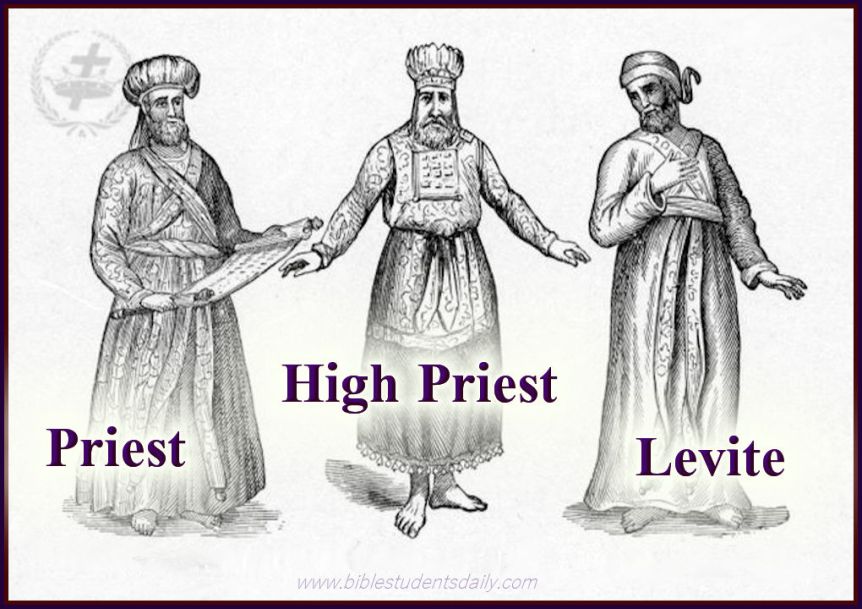
In the third chapter of the book of Numbers, the Levites are introduced as a tribe that replaces the special place of the firstborn. The Israelites as a whole represent believers in Jesus during the Gospel Age, and the Levites — as with the firstborn on passover night — represent the spirit begotten ones.
Subsequently, in Numbers 8:5-16, the Levites are required to wash their garments and are then presented to the priesthood as a helper class. When the Levites are thus distinguished from the Priests, this represents the end of the Gospel Age, when there is made a distinction between the Priests (the Bride class of overcomers), and the Great Company class, who wash their robes in the blood of the lamb, and are then made a helper class to the Church in glory (Revelation 7:9, Revelation 19:1). They will inherit a heavenly (spiritual) reward and be “before the throne of God, and serve him day and night in his temple” (Revelation 7:15).
The Levites
The Levites that served the Tabernacle (from thirty to fifty years of age, Numbers 4:3, 23, 30, 35, 39) were from the clans of the Kohathites, Gershonites and Merarites. All were descendants of Levi, a tribe which had no inheritance in the land but lived off the tithes paid by their brethren (Leviticus 27:32–33; Numbers 18:21, 24), and the farming they did around the Levitical cities. A tenth of the tithe was also to be given to the priests (Numbers 18:26–28).
Here is a chart showing the descendants of Levi (who was one of Jacob’s 12 sons).

In Numbers 8:24–25 we are told that Levites who were 25 to 50 years of age could serve with work for the Tabernacle yet in Numbers 4:3, 23 & 30, the age range of 30 to 50 is stated.
Jamieson, Fausset, and Brown’s Commentary says this: “They entered on their work in their 25th year, as pupils and probationers, under the superintendence and direction of their senior brethren; and at 30 they were admitted to the full discharge of their official functions.” Perhaps so. Or, perhaps in chapter 4 it refers to the transporting of Tabernacle items, and in chapter 8 it refers to auxiliary duties helping others in the services.
Later during King David’s day, we note that the age for entering priestly service was from 20 years of age (see 1 Chronicles 23:27). Age 20 was the age of fighting men, and by the time of King David lifespans were decreased somewhat, so perhaps David made the adjustment for practical considerations. As to a spiritual meaning — this is only a conjecture—but 20 is a number (2, 20, 200, 2000) that refers to the holy Spirit (This is explained in Study 3 of “Beauties of the Tabernacle” on this website). As such the age of 20 may refer symbolically to those who have received the Spirit of God.
The Levites fulfilled the following roles:

The Levites were explicitly permitted to go near the sacred furniture, and this special privilege distinguished them from ordinary Israelites (Numbers 8:19; 16:9–10; 18:22–23). Yet the Levites were allowed to approach the sacred furniture only when it was covered (Numbers 18:3).
The Israelites who were not Levites had no right to go into the Tabernacle. The Tabernacle represents the condition of the spirit begotten, not merely believers.
Numbers 18:22–23, explains that “the stranger” (non-Levites) did not have the privilege of service regarding the Tabernacle that the Levites did.
“22 Neither must the children of Israel henceforth come nigh the tabernacle of the congregation, lest they bear sin, and die. 23 But the Levites shall do the service of the tabernacle of the congregation, and they shall bear their iniquity: it shall be a statute for ever throughout your generations, that among the children of Israel they have no inheritance.”
- Favoured Above Other Tribes
The reason the Levites were favoured above other tribes to be specially allocated to the service of God, is that they stepped forward to the side of Moses and God when the Israelites sinned with the golden calf in the wilderness. They were “set apart to the Lord” because when Moses asked the people “whoever is for the Lord come to me” the Levites “were against their own sons and brothers” and rallied to him. (Exodus 32:26, 29, NIV). They did as Moses commanded, slaying 3000 of the offending Israelites.
Numbers 3:14-17 describes the selection of the Levites as substitutes for the firstborn male Israelites — a class specially marked out for the service of God.
Antitypes
When considering the antitypes in relation to the Levites and the Priests (see Study 7 of “Beauties of the Tabernacle”) as well as for the Israelites (see Study 5 of “Beauties of the Tabernacle”) it must be considered on a situational basis, thus it is scripturally context specific, or for better words, contextually sensitive. Each of the three groups of Israelites cannot be considered as one static picture and mean the same thing in every case. In fact, all these three groups do not appear together in any particular case. Sometimes there are Levites and Israelites written about (such as in Numbers chapters 1–4). Sometimes there are priests and Levites (such as in Numbers chapter 8). Each of these cases has its own meaning as to who and what are represented. They are all separate pictures.
- In Exchange for the Firstborn
To understand the symbolic meaning of the Levites in this exchange of the firstborn, one has to recall the symbolic meaning of the firstborn. Recall that on Passover night, all the Israelites were to remain in their homes, with the blood of the Passover lamb brushed onto the doorposts and lintels. All of them were to eat of the lamb. Thus the Israelites there represent people of faith — believers in Christ Jesus during the Gospel Age.
However, on Passover night only the firstborn were in jeopardy of death. The firstborn represent the consecrated, spirit begotten of the present Gospel Age, who are under jeopardy of losing their spiritual life if they do not remain in the house sanctified by the blood of the lamb. Paul refers to the “Church of the firstborn, which are written in heaven,” linking the symbol of firstborn to those begotten to a heavenly hope (Hebrews 12:23).
That is the foundation for the picture in Numbers 3:45, which reads, “Take the Levites instead of all the firstborn among the children of Israel, and the cattle of the Levites instead of their cattle; and the Levites shall be mine: I am the Lord.”
The standing of the firstborn as specially devoted to God is now transferred to the Levites. As the “Church of the firstborn” do not have an inheritance in earthly things (1 Peter 1:4, Ephesians 1:11) but in heavenly things, so the Levites had no inheritance in the land. (Deuteronomy 10:9). They represent the ones “called out” of the world during the Gospel Age and described by the Apostle Paul in Romans 8:30, “Whom he did predestinate, them he also called: and whom he called, them he also justified: and whom he justified, them he also glorified,” or honoured, with a “heavenly calling” (Hebrews 3:1).
It is this “called out” class that James (who was later beheaded by King Herod Agrippa, the first grandson of Herod the Great) explains about, to a whole assembly of gathered believers in Acts 15:14-18, some of whom belonged to the party of the Pharisees and thought the Gentiles must be circumcised and required to obey the law of Moses:
“14 Simeon hath declared how God at the first did visit the Gentiles, to take out of them a people for his name. 15 And to this agree the words of the prophets; as it is written, “16 After this I will return, and will build again the tabernacle of David, which is fallen down; and I will build again the ruins thereof, and I will set it up: 17 That the residue of men might seek after the Lord, and all the Gentiles, upon whom my name is called, saith the Lord, who doeth all these things. 18 Known unto God are all his works from the beginning of the world.”
Here the Apostle James appeals to the prophecy of Amos 9:11–12 to support what Apostle Peter (Simon) had said, namely that the Gentiles were receiving the Gospel of Christ. The Apostle James saw that “the residue of men” calling upon God was shown by the Gentile
converts coming into Christ. James said that the prophecy from Amos said this would occur after the “tabernacle of David” was raised up again.
The house or the “tabernacle of David,” the ruling house of Israel, had fallen when Zedekiah lost his throne six centuries earlier (587 bc, at Nebuchadnezzar’s third captivity of Israel). It had been raised up by virtue of Jesus of the tribe of Judah and descended for David, ascending to glory seated at the right hand of God, as our King and leader.
Jesus is our Melchizedek priest — a king and a priest.
- Melchi is the Hebrew word for “king.”
- Zedek is the Hebrew word for righteousness, and Jesus is “king-righteousness” — Melchi-zedek — “king of righteousness” (Hebrew 7:1–3).
Thus, the Apostle James explained that Jesus as king has been established as monarch in glory, the house of David had risen again, and it was timely for the “residue of men,” the Gentiles, to receive the grace of God through Jesus. Thus, as Apostle Peter and others testified was occurring here, the High Calling had started since Jesus’s ascension, allowing the “called out” ones of God (1 Peter 2:9), the opportunity to become Sons of God if faithful until death.
The following Scriptures are helpful concerning this calling: Jude 1:1, Galatians 1:6, Romans 11:29, Ephesians 4:1–4, 2 Thessalonians 1:11, 2 Thessalonians 2:14, Hebrews 3:1, 2, 1 Peter 5:10–11.

In Numbers chapter eight, the Levites will be distinguished from the priests. In this distinction, the Levites represent the Great Company class, who will be distinguished from the elect Priest class, following the completion of the judgment period by the end of the Gospel Age.
In Numbers 8:7, the Levites “shave all their flesh,” and “wash their clothes, and so make themselves clean”. The shaving of their flesh pictures the beginning of the service of the Great Company beyond the vail resurrected as spirit beings of a high order, but subordinate to the Bride class. It also pictures the end of their consecrated walk on earth as those who had pressed “towards the mark for the prize of the high calling in God through Christ Jesus” (Philippians 3:12) during the Gospel Age, much like those who took the Nazarite vow were to shave at the conclusion of their vow (Numbers 6:13, 18). This even pertained to Joseph, when raised out of prison, representing Jesus raised out of death. Joseph had to shave and change his garment, to appear before Pharaoh, picturing that Jesus had completed his consecrated walk here, and had a change of nature in order to appear before God.
The Levites washing their clothes reminds us of the Great Company class washing their robes in the blood of the lamb, to cleanse them for their service in glory (Revelation 7:14–15). This distinction between the priests (the Church in glory) and the Levites (the Great Company in glory), also appears in Ezekiel 44:10–14 (Levites), compared to verses 15-24 (priests).
The “Great Multitude” are mentioned in Revelation 7:9-10, and reflected in types such as Rebecca’s maidservants, and Elisha who walked with Elijah.
Some points to be aware of:-
- In the types of the Book of Leviticus, as far as we can see, the focus is on the Bride class, rather than on the Great Company class. This is because there is no separate calling to the Great Company class, so pictures about the Gospel Age calling to service and sacrifice do not show this class as a distinguished class of spirit begotten ones here, during the Gospel Age. The Great Company class are simply part of the spirit begotten class, all called in the one hope. The distinction between the Bride and the Great Company appears at the end of the Age or otherwise at the time of each member’s judgment time (final sentence/verdict). The Great Company class are depicted in the fifth chapter of the Song of Solomon where there is the lazy lover who does not rise for her betrothed, and misses her opportunities. (Song of Solomon 5: 2, 3, 6).
- Only those who are finally judged as “more than overcomers” at death — who qualify to be of the Bride, the Elect, Little Flock class — fully share in the sin offering experiences of the present time, and are represented in the Lord’s goat of the Day of Atonement. The special focus on the Bride class in this picture can be compared to the picture of Eliezer in Genesis chapter 24 (who represents the holy Spirit), sent out by Abraham (God) to find a bride (the Church) for His son (Jesus). The bride is Rebekah. This picture is focused on the bride class, but in fact all who are spirit-begotten are called by the same spirit (Eliezer). So with sacrifice. We are all called to sacrifice, and all the spirit begotten do sacrifice. But the picture is focused on the bride class.
Another Kingdom Picture
There is another kingdom picture represented in the Levites if we consider just the four groups of Levites on their own, which may picture the state of the completed work of God’s great plan of the ages after the world of mankind reaches perfection in the kingdom as also seems to be the order suggested in Psalm 45:13–17.
EAST: The AMRAM Levites (signifying highly exalted, very high) represented the “Little Flock” (144,000), the Bride. These had full charge of all things religious—their brethren—even all the Levites—being their honoured assistants or servants. “The king’s daughter is all glorious within: her clothing is of wrought gold. She shall be brought unto the king in raiment of needlework.” (Psalm 45:13–14).
NORTH: The MERARI Levites (signifying bitterness) represented the “Great Company” of spirit-begotten ones (before the throne), the Bride’s “allies” and Companions who fail to win the prize of the Royal Priesthood, and are “saved so as by fire,” coming up through great tribulation and bitter experiences to the position of honor and service which they will occupy.
The Merari Levites were given four wagons and eight oxen to transport the gold-covered boards and posts, sockets, cords and pins, etc. (Numbers 3:36–37; 4:31–32; 7:8).
“The virgins her companions that follow her shall be brought unto thee. With gladness and rejoicing shall they be brought: they shall enter into the king’s palace.” (Psalm 45:14,15).
SOUTH: The KOHATHITE Levites (signifying ally or comrade) represented the Princes, the “Ancient Worthies”—whose faith and obedience and loyalty to God and willingness to suffer for righteousness was so fully attested, and with whom we feel so close a kinship. They were, indeed, the Lord’s allies and ours.
“Instead of thy fathers shall be thy children, whom thou mayest make princes in all the earth” (Psalm 45:16).
The Kohathite Levites were given no wagons. These had charge of the most sacred articles—the Altars, the Candlestick (lampstand), the Table and the Ark. (Numbers 3:31; 4:34–36; 7:9).
WEST: The GERSHOM Levites (signifying refugees, or rescued) represented the saved “World of Mankind,” all of whom will be refugees succoured and delivered, rescued from the blindness and slavery of Satan.
“I will make thy name to be remembered in all generations: therefore shall the people praise thee for ever and ever” (Psalm 45:17).
The Gershom Levites had charge of the least important services — the porterage, etc., of the cords, outer curtains, hangings, gate, etc. which they first transported on two wagons and four oxen (Numbers 3:25–26; 4:22–26; 7:7).
References & Acknowledgment
Pastor Charles Russell: “Tabernacle Shadows,” “The Tabernacle and Its Teachings” — Supplement to Feb. “Zion’s Watch Tower,” Pittsburgh, PA, 1882, Volume 6 — “Studies in the Scriptures,” Reprints of the Watch Tower.
Br. Anton Frey: “Notes on the Tabernacle,” pages 362-364; “Wilderness Wanderings.”
Jamieson, Fausset, and Brown’s Commentary.
Br. David Rice — some written content for this post.
Suggested Further Reading
STUDY 1: An Introduction To The Tabernacle And It’s Purpose
https://biblestudentsdaily.com/2016/09/02/study-1-an-introduction-to-the-tabernacle-and-its-purpose/
STUDY 2: The Pillar of Cloud By Day And The Pillar of Smoke By Night https://biblestudentsdaily.com/2016/09/09/study-2-the-pillar-of-cloud-by-day-and-the-pillar-of-smoke-by-night/
STUDY 3: The Tabernacle Construction: The Holy and The Most Holy https://biblestudentsdaily.com/2016/09/14/study-3-the-tabernacle-construction-the-holy-the-most-holy/
STUDY 4: The Court (“Holy Place”)
STUDY 4: The Court (“Holy Place”)
STUDY 5: The Camp. The Israelites.
URL: https://biblestudentsdaily.com/2016/10/28/study-5-the-camp-the-israelites/
STUDY 7: The Priests. The Day of Atonement.
https://biblestudentsdaily.com/2016/12/10/study-7-the-priests-the-day-of-atonement/
STUDY 8: The Tabernacle Coverings
https://biblestudentsdaily.com/2017/01/02/study-8-the-tabernacle-coverings/
STUDY 9: The Gate. The Door. The Vail.
https://biblestudentsdaily.com/2017/03/01/study-9-the-gate-the-door-the-vail/
The URL for this post:
STUDY 6: The Levites
Save
Save
Save
Save











 BIBLE Students DAILY