“Until the Full Number of the Gentiles Has Come In”

Romans 11:25 reads: “I do not want you to be ignorant of this mystery, brothers and sisters, so that you may not be conceited: Israel has experienced a hardening in part until the full number of the Gentiles has come in…”

Many Bible Students believe this means that the Jews will open their hearts to God once the 144,000 Bride of Christ are complete beyond the vail, and have made their “calling and election sure” (2 Peter 1:10) and when the 1000-year Millennial Age begins. But then what about those of Jewish faith in the Gospel Age who have consecrate their lives to follow Jesus? Hence, can Romans 11:25 relate to the Gospel Age now and how?

“And so all Israel will be saved, as it is written: “The Deliverer will come out of Zion, And He will turn away ungodliness from Jacob” (Romans 11:26).

Moreover, the next verse refers to “all Israel” being saved. Much has been written about what these two verses mean.

Two Traditional Interpretations of “All Israel”

Traditionally there have been two views concerning what “all Israel” means.

The first interpretation says, with variations, that the Apostle Paul is speaking prophetically of a corporate salvation of the Jewish people (natural Israel) at the end of the Gospel age – this is sometimes called the Dispensational view and this was taught by Pastor Charles Russell.

The second interpretation, again with variations, says that the Apostle Paul is speaking of the salvation of all of God’s people of faith (spiritual Israel) during this Gospel age, whether they are of Jewish or Gentile background.

The first interpretation seems clearly incorrect, as it is based on a faulty understanding/translation of “kai hautos” in Romans 11:26 (discussed further below), moreover it is inconsistent with the immediate context of Romans Chapter 11 and the larger context of the unfolding lessons in the epistle of Romans.

The second interpretation seems closer to the correct view in that it pertains to the call of the faithful during the Gospel Age; which is consistent with the context, but is not fully correct as it does not explain the Apostle Paul’s immediate point and warning to the Roman Gentiles of their “conceit” (Romans 11:25). Also, it does not take into account the Apostle Paul’s aim of saving some (more) of his fellow Jews (Romans 11:14) who can be grafted back in again if they continue not in unbelief (Romans 11:23). The Roman Gentile believers became conceited as they thought all Jews were forever cast away from the call of God to be of the Abrahamic seed of blessing. Paul’s immediate argument is that this is not correct because they can be grafted back in again by God if they continue not in unbelief. The “blindness in part” of natural Israel (Romans 11:25) was not irrevocable, and some would be grafted back in so that “all” of the [believing] remnant of natural Israel would be saved.

“All Israel”

Here it is suggested that “all Israel” actually refers to the total remnant of believing natural Jews – the “fulness” of Israel (Romans 11:12). And this total remnant has two parts:

  1. The initial believing Jews (like the Apostles, and the other disciples) when the call was exclusive to natural Israel.

“God, having raised up his servant, sent him to you first, to bless you by turning every one of you from your wickedness” (Acts 3:26).

2. The later believing Jews that would be “provoked to jealousy” (Romans 11:14) once the “fullness” of the Gentiles believers came in, resulting in them being grafted back in again (Romans 11:23).

“if by any means I may provoke to jealousy those who are my flesh and save some of them” (Romans 11:14).

“And they also, if they do not continue in unbelief, will be grafted in, for God is able to graft them in again” (Romans 11:23).

It may seem odd to suggest that the “all” does not refer to all of natural Israel, but rather to all of Israel that find salvation through justification by faith in Jesus during the present Gospel Age – the remnant that the Apostle Paul talks about in Romans 9:27 and Romans 11:5.

“For if their rejection means the reconciliation of the world, what will their acceptance mean but life from the dead?” Romans 11:15

We note how this “all” of the believing remnant of Israel is consistent with the way the Apostle refers to the Gentile world in Romans 11:15, where he says “For if their [Israel as a nation] rejection means the reconciliation of the world” – clearly, he does not mean reconciliation of all Gentiles but only those of faith.

Both references to “Israel” in Romans 11:25-26 indicate natural Israel [although not all Israelites].

Romans 11:30–31 – “Just as (1) you were once disobedient to God but have now received mercy because of (2) their disobedience, 31 so they have now been disobedient in order that, by the mercy shown to you, (3) they too may now receive mercy.”

(1) = Gentile believers

(2) = natural Israel as a nation

(3) = the later part of the remnant of believing Jews

Romans 11:32 – “For God has consigned all to disobedience, that he may have mercy on all (Gentile believers and Jewish believers [initial + later]”).

Initially small number of Jews “came in” who believed first in Jesus and turned from their sins (Acts 3:26) – i.e. the Apostles, and the other disciples when the call was exclusive to natural Israel. Then, when the nation of Israel as a whole rejected Jesus and the call went to the Gentiles, the “fullness” of Gentiles came in. Once the “fullness” of Gentiles came in (and were grafted in) more natural Jews were “provoked to jealousy” and come to believe in Jesus and were thereby grafted back in again, and also be saved.

Important considerations:

In order to explain Romans 11:25-26 correctly and coherently, it seems important to consider the following:

i) The Apostle Paul’s immediate points concerning the “conceit” of some of the Gentile brethren in the Roman church (Romans 11:25).

In Romans 11:25 the Apostle Paul says that they [the Roman brethren – largely Gentile believers] should not be conceited [“wise in your own opinion”] and be not ignorant of this mystery [something previously unknown or hidden] viz blindness (unbelief) has happened in part to natural Israel until the “fullness” of the Gentiles come in, then by implication the rest of the believing remnant would have its blindness lifted [having been provoked to jealousy] resulting in Israel’s “fulness” (Romans 11:12) of the Abrahamic promise [like the fulness of the Gentiles in Romans 11:25].

ii) The Apostle Paul’s immediate aim to save some (more) of his fellow Jews (Romans 11:14) by “provoked them to jealousy” (Romans 11:11,14) and being grafted back into the Abrahamic Olive tree of promise (Romans 11:23).

iii) The immediate context of Romans Chapter 11.

The immediately preceding verses tell us how unbelieving Jews were broken off from the Israelite Abrahamic olive tree of promise and believing wild olive (Gentile) branches were grafted in. But the Apostle Paul’s main point is that the engrafted Gentile branches should not “boast” (Romans 11:18) and not to be “haughty” (Romans 11:20) because if the broken off natural branches (unbelieving Jews) continue not in unbelief they can be grafted back in again by God (Romans 11:23.) This is a continuation of the Apostle’s main aim stated in Romans11:11,14; that despite his commission to the Gentiles, he is seeking by any means to “provoke to jealousy” his fellow Jews and save some [more] of them.

iv) The wider context of the Apostle Paul’s logical and unfolding message in the epistle of Romans:

Especially that the inheritance of the eagerly sought Abrahamic promise [to be his seed that will bless all the families of the earth] is based solely on faith in Jesus – whether of Jewish background or Gentile background (Romans 4:16).

v) The underlying ancient Greek:

26 καὶ οὕτως πᾶς Ἰσραὴλ σωθήσεται, καθὼς γέγραπται… NA27

“kai hautos” at the beginning of Romans 11:26 does not mean “and then” in terms of time; it means “in this way.” Unfortunately, “kai hautos” has been mistranslated in Wilson’s Diaglott [which Pastor Russell based his understanding on] as “and then”  – and this mistranslation suggests that something new in time happens after the call of the seed is complete – it does not.

“In this way” all Israel (the initial and later parts of the believing remnant of natural Israel) would be saved – meaning that more natural Jews would come to believe, having been “provoked to jealousy” by faithful Gentiles and be grafted back into the Abrahamic olive tree of promise [the seed].

“kai hautos” – “In this way” refers to what Paul has said before, in verse 25. And therefore, what is said in Romans 11:25 shows how all Israel (the whole believing remnant of natural Israel – the initial and the later parts = the fulness of Israel [Romans 11:12]) gains salvation.

This explains the Apostle Paul’s warning of conceit to the Roman Gentile brethren in Romans 11:25 – some more Jews would be provoked to jealousy and believe and thereby be grafted back in. Just as God showed mercy to the Gentiles through Israel’s disobedience, mercy would be shown to Israel thereby there would be a “fulness of Israel” (Romans 11:12) also.

What Does “The Deliverer will Come out of Zion, and Banish Ungodliness from Jacob” Mean and When Did This Begin?

“And so all Israel will be saved, as it is written: “The Deliverer will come out of Zion, And He will turn away ungodliness from Jacob” (Romans 11:26).  

In Romans 11:26, the Apostle Paul refers to a prophetic quote to substantiate his point. He quotes from Isaiah 59:20, 21

“‘The Redeemer will come to Zion, And to those who turn from transgression in Jacob,’ Says the Lord” (Isaiah 59:20).

We note that the Isaiah verse says the Deliverer will come to Zion, not from Zion as in Romans 11:26. This means that the Apostle Paul has changed it – and probably for good reason.

“To you first, God, having raised up His Servant Jesus, sent Him to bless you, in turning away every one of you from your iniquities” (Acts 3:26).

“’The Redeemer will come to Zion, to those in Jacob who repent of their sins,’ declares the LORD” (Isaiah 59:20).

Also, Isaiah 59 gives us more information about what “banishing ungodliness from Jacob” actually means – the Deliverer comes to those (of Jacob – natural Israel) that turn from their transgression (sins). Now we outlined above (in the Acts 3 verses) that there were only a few [the initial part of the believing remnant] Jews who believed and turned away from their sins, and when they did, they had their sins forgiven. This all began to occur at and shortly after Pentecost not at the end of the Gospel Age.

That it is talking about the initial part of the believing remnant of natural Israel is shown in Acts 3 when it says “to you first” i.e. before the call went to the Gentiles – before the later part of the believing remnant of natural Israel would be provoked to jealousy and believe in Jesus.

Also, this time point tells us why the Apostle Paul changed the quote to “the Deliverer shall come from Zion” rather than to Zion,” as in Isaiah 59:20. And this is because in a typical way, Jesus had already come to Zion. When he came to Jerusalem on a foal triumphantly and hailed as king, the first thing he did was to go to the temple (which was situated on Mt Zion in Jerusalem) and overturned the money changers table – which showed in a literal way that he had already come to Zion and began the process of banishing ungodliness from Jacob, so that now [when the Apostle Paul was writing] after having come to Zion he came from Zion to (after His sacrifice) give to those few believing Jews that turned from the sins permanent and true forgiveness of sins.

“4 As you come to him, a living stone rejected by men but in the sight of God chosen and precious, 5 you yourselves like living stones are being built up as a spiritual house, to be a holy priesthood, to offer spiritual sacrifices acceptable to God through Jesus Christ. For it stands in Scripture: “Behold, I am laying in Zion a stone, a cornerstone chosen and precious, and whoever believes in him will not be put to shame” (1 Peter 2:4–6).

“God, having raised up his servant, sent him to you first, to bless you by turning every one of you from your wickedness” (Acts 3:26)

That Jesus came to Zion and laid the cornerstone on which the Church (the temple of God) would be built, occurred at his first Advent is made clear in 1 Peter 2: 4-6. The Church is being built now during the Gospel age. When Jesus laid that cornerstone, he was able to then first go to the house of Israel and begin banishing ungodliness from Jacob (the initial part of the remnant) Romans 11:26, Acts 3:26.

All of the (Natural) Israelite Remnant

“Isaiah cries out concerning Israel: ‘Though the number of the Israelites be like the sand by the sea, only the remnant will be saved’” (Romans 9:27).

That “all Israel” refers to all the remnant of natural Israel should not come as a surprise, for in Romans 9:27 the Apostle Paul has made it clear that only a remnant of Israel would be saved.

“Again I ask: Did they stumble so as to fall beyond recovery? Not at all! Rather, because of their transgression, salvation has come to the Gentiles to make Israel envious”  (Romans 11:11).

This “restricted” sense of the salvation of all of the natural Israel remnant also should not be surprising, since this is the same sense used in regards to the Apostle’s phrase “salvation has come to the Gentiles” in Romans 11:11. Salvation did not come to all Gentiles – only to some, and only to those of faith. Moreover, in the same verse it is very likely that not all Israel became envious — again suggesting that “to make Israel envious” means “to make some of Israel envious”.

Another reason for believing that “all Israel” means “all” of the [believing] remnant of natural Israel is that the Old Testament promise in Isaiah 59:20 in regards to the deliverer banishing ungodliness from Jacob, was made to natural Israel. The context of the promise in Isaiah suggests that we would expect a fulfilment in regards to natural Israel. These verses pointed to a time when ungodliness would be banished from natural Israel despite their stubbornness and faithlessness to God. But the added information from the Isaiah verse shows the Deliverer would only come to those that “repent of their sins.” Importantly this already occurred at the first advent of Jesus. Moreover, this suggests that the “all Israel” will be restricted to those that “repent of their sins (Isaiah 59:20).

“This is he who was spoken of through the prophet Isaiah: A voice of one calling in the wilderness, ‘Prepare the way for the Lord, make straight paths for him’”  (Matthew 3:3).

John the Baptist prepared the way for the Lord, he preached a Baptism of repentance from sins and thus made it easier for Jesus to identify those ready for faith in him. Importantly it is restricted to only those of natural Israel that repented of their sins and were therefore ready for faith in Jesus.

“For this reason Christ is the mediator of a new covenant, that those who are called may receive the promised eternal inheritance—now that he has died as a ransom to set them free from the sins committed under the first covenant.” Hebrews 9:15

This was a work which started at the beginning of the Gospel Age not at its end. Those of the remnant of Israel were set on the path to life by faith in Jesus. Only through deliverance from Adamic sins could they become the promised children of Abraham and inherit the eternal promise and eternal life. Through this new arrangement faithful Jews were able to be set free from the sins made manifest by the previous law covenant.

“If you belong to Christ, then you are Abraham’s seed, and heirs according to the promise” (Galatians 3:29).

For it is only those that belong to Christ that are the true seed of Abraham and heirs according to the promise (Galatians 3:29).

“You are sons of the prophets, and of the covenant which God made with our fathers, saying to Abraham, ‘And in your seed all the families of the earth shall be blessed.’ 26 To you first, God, having raised up His Servant Jesus, sent Him to bless you, in turning away every one of you from your iniquities.” Acts 3:25,26

In the same way the promise of the seed which would “bless all the families of the earth (Genesis 28:14)” had its first [partial] fulfilment at the first advent. Here the seed was Jesus. He was sent first to the house of Israel to bless them by turning them from their sins.

Subsequently, the blessing, in this restrictive sense went to the Gentiles, i.e. the rest of the nations of the earth. But again, we note that every person was not blessed – only those that turned from sin and looked to Jesus by faith would be blessed.

“If you belong to Christ, then you are Abraham’s seed, and heirs according to the promise” (Galatians 3:29).

But the ultimate [full] fulfilment, with which we are most familiar, will occur in the Millennium Age – the 1000-year Kingdom of God. Here the seed will be Jesus and his 144,000 body members. Note that this is not an extension of the same fulfilment. In the first, Jesus is the seed that blesses the prospective body members. These in turn with Jesus become the seed that will bless all the nations in the kingdom – making it a separate fulfilment.

We also note that because of the grammatical structure in relation to houtos and kathos, “all Israel will be saved” is correlative to “The deliverer will come from Zion; he will turn godlessness away from Jacob.” This means the “salvation of all Israel” occurs because the Deliverer shall banish ungodliness. The Deliverer banishing of ungodliness to those that repent of their sins in Jacob, makes clear that “all Israel will be saved” and it means deliverance from Adamic sin and eternal life rather than just a lifting of blindness, and this began to be fulfilled at the beginning of the Gospel Age, not when it ends.

Amen.

This post’s URL is: https://biblestudentsdaily.com/2024/11/18/until-the-full-number-of-the-gentiles-has-come-in/

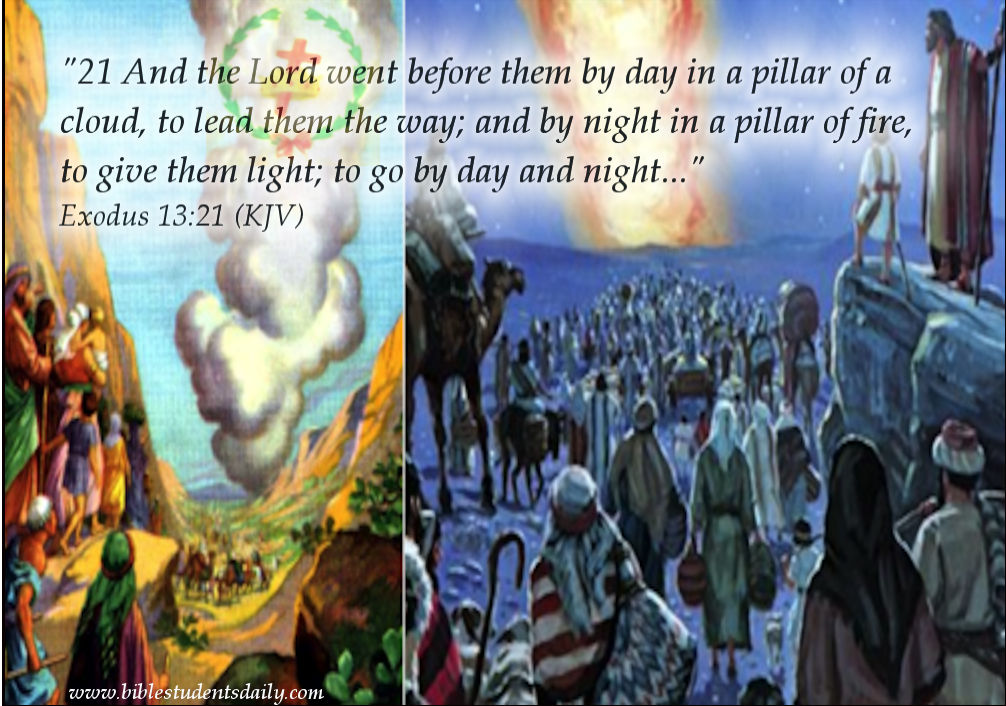
STUDY 2: The Pillar of Cloud by Day and The Pillar of Smoke by Night

“Moreover thou leddest them in the day by a cloudy pillar; and in the night by a pillar of fire, to give them light in the way wherein they should go.” (Nehemiah 9:12)

1-picture-1
THE HISTORY ABOUT THE PILLAR OF CLOUD AND FIRE

The First Appearance of the Cloud and Fire

God’s miraculous guidance of Israel from Egyptian bondage was evident through the sign of a pillar of a cloud. The first account of this pillar of cloud and fire in the Bible, is in Exodus 13:20-22 (ESV):

20 And they moved on from Succoth and encamped at Etham, on the edge of the wilderness. 21 And the Lord went before them by day in a pillar of cloud to lead them along the way, and by night in a pillar of fire to give them light, that they might travel by day and by night. 22 The pillar of cloud by day and the pillar of fire by night did not depart from before the people.”

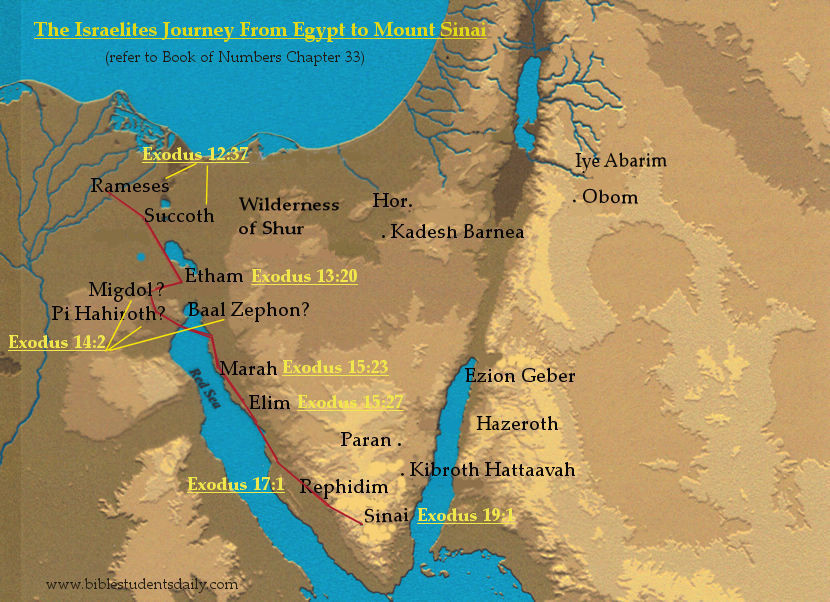
This text suggests that the pillar appeared when the Israelites departed Succoth, the first camp after departing Rameses on 15 Abib (Nisan), 1445 BC (2513 years after the creation of Adam ). Smith’s Bible Dictionary (at BibleHub.com) says Succoth (“booths”) was reached at the close of the first day’s march and that the distance traversed each day was about 24 kilometres (fifteen miles).  Following is a map of Israel’s journey through the first part of their 40 years in the wilderness.

2-map

(This map follows a conventional view. “More recent opinions place Mount Sinai further north at Har Karkom. Please see http://www.Harkarkom.com for specifics”, Br.David Rice, 2016. For a detailed account of Israel’s journey, giving each encampment, refer to Numbers 33.)

The Second and Subsequent Accounts of the Cloud and Fire

The next account in the Bible of this pillar of cloud is in Exodus 14:19‑20, after God instructed Moses to raise his staff, stretch out his hand over the sea, and divide the waters of the Red Sea for the Israelites to escape Pharaoh and his army pursing the Israelites. They had overtaken the Israelites as they camped by the sea near Pi Hahiroth, opposite Baal Zephon (Exodus 14:16, 9).

Exodus 14:19-20 (ESV) reads, “19 Then the angel of God who was going before the host of Israel moved and went behind them, and the pillar of cloud moved from before them and stood behind them, 20 coming between the host of Egypt and the host of Israel. And there was the cloud and the darkness. And it lit up the night without one coming near the other all night.” Subsequently “during the last watch [“morning watch” – KJV] of the night, the LORD looked down from the pillar of fire and cloud at the Egyptian army and threw it into confusion” (Exodus 14:24, NIV). If there were four watches in the night, the last would have been about 3‑6 am. This suggests that the Israelites had crossed the Red Sea during the night, around the hours of 3‑6 am which would be classified as the 4th watch of the night (if there were four night watches).

The Pillar of Cloud and Fire and Its Association with the Tabernacle

When it was time for the long awaited moment of God’s glory to “move into” the newly built and consecrated Tent of Meeting:

34 Then a cloud covered the tent of the congregation, and the glory of the Lord filled the tabernacle.

35 And Moses was not able to enter into the tent of the congregation, because the cloud abode thereon, and the glory of the Lord filled the tabernacle.

36 And when the cloud was taken up from over the tabernacle, the children of Israel went onward in all their journeys.

37 But if the cloud were not taken up, then they journeyed not till the day that it was taken up.

38 For the cloud of the Lord was upon the tabernacle by day, and fire was on it by night, in the sight of all the house of Israel, throughout all their journeys” (Exodus 40:34-38).

This occurred on the first of Abib, the following year, after the Tabernacle had been erected (Exodus 40:1, 17). Later, when God led them away from mount Sinai, He continued to direct them by the movement of the cloud representing His presence. “They departed from the mount of the LORD three days’ journey: and the ark of the covenant of the Lord went before them in the three days’ journey, to search out a resting place for them. And the cloud of the Lord was upon them by day, when they went out of the camp” (Numbers 10:33-34).

The Last Account of the Pillar of Cloud and Fire

The pillar of cloud and fire was present throughout Israel’s 40 years in the wilderness (Exodus 40:38). Numbers 12:10 refers to it in the incident of Miriam’s complaint against Moses. “When the cloud removed from over the tent, behold, Miriam was leprous, like snow. And Aaron turned toward Miriam, and behold, she was leprous.” It is mentioned also in Numbers 14:14, 16:42, Deuteronomy 1:33, and Deuteronomy 31:15 as the life of Moses was drawing to a close.

In 960 BC the Temple of Solomon was dedicated, replacing the function originally served by the Tabernacle (and any other “temple” that may have been temporarily in use between the two, 1 Samuel 1:9).

The pillar of cloud was no longer required after Israel settled in Canaan, for they no longer needed a token from God to direct their travels, giving “them light on the way they were to take” (Nehemiah 9:12).

One commentary suggested the following about the Feast of Tabernacles that Israel observed after settling Canaan. “This feast, also called Succoth, was to commemorate the protection God provided in the wilderness and it may have marked the cessation of the fiery pillar” (The Herald of Christ’s Kingdom, May-June 2006, “A Pillar and a Fire,” Br. Carl Hagensick).

The manna had stopped the day after the Israelites ate the food from Canaan (Joshua 5:12).

Perhaps the pillar of cloud and fire had completed its purpose about that time also. Notably, the account of the crossing of the Jordan River into the Land of Canaan (Joshua chapters 3, 4) does not mention Israel following the cloud. Joshua 3:3‑4: “As soon as you see the ark of the covenant of the Lord your God being carried by the Levitical priests, then you shall set out from your place and follow it. 4Yet there shall be a distance between you and it, about 2,000 cubits in length. Do not come near it, in order that you may know the way you shall go, for you have not passed this way before.”

The “Dense Cloud”

The “dense cloud” over Mount Sinai apparently was different than the “pillar of cloud,” for “dense cloud” brought darkness, whereas the pillar of cloud evidently had not.

The Israelites came to Mount Sinai at the opening of month three after the Exodus (Exodus 19:1). At Sinai, God told Moses “I am going to come to you in a dense cloud, so that the people will hear me speaking with you and will always put their trust in you” (Exodus 19:9).

Three days later there was thunder and lightening with a thick cloud over Mount Sinai and a very loud trumpet blast. “Mount Sinai was covered with smoke because the Lord descended on it in fire. The smoke billowed up from it like smoke from a furnace, the whole mountain trembled violently” (Exodus 20:16, 18, NIV). Then God called Moses to the top of the mountain where he stayed 40 days and nights and was given the ten commandments. “The people remained at a distance while Moses approached the thick darkness where God was” (Exodus 20:21).

Though the “dense cloud” and the pillar of cloud were distinct, both indicated the presence of God. This would have been an enduring sign to the Israelites that God was with them all during their 40 years of wandering.

POSITION

If the pillar of cloud and fire remained over the Tabernacle, after it was constructed, then it would have been over the center of the camp of Israel, for the various tribes camped about the Tabernacle (Numbers 2:17). The Tabernacle was no longer “outside the camp”, where “Moses used to take a tent and pitch it … some distance away, calling it the “tent of meeting”. (Exodus 33:7)

When the cloud lifted to direct Israel, it moved forward, ahead of them. However, in Exodus 14:19, 20, 24, it move behind them to protect them. “And the angel of God, which went before the camp of Israel, removed and went behind them; and the pillar of the cloud went from before their face, and stood behind them: and it came between the camp of the Egyptians and the camp of Israel; and it was a cloud and darkness to them, but it gave light by night to these: so that the one came not near the other all the night. … And it came to pass, that in the morning watch the LORD looked unto the host of the Egyptians through the pillar of fire and of the cloud, and troubled the host of the Egyptians.”

Over the Most Holy

Apparently the usual resting place of the cloud was over the Most Holy of Israel’s tabernacle. It is theorized by some that the Shekinah light, that shone between the two golden cherubim on the Ark of the Covenant, was caused by an interaction between the electrically‑charged cloud and the Mercy Seat with its two carved angelic figures. If this conjecture is correct, it shows that divine wisdom, represented in the light, is a product of GOD, whose presence was indicated by the cloud, and the harmonious balance between the attributes of love and power, shown in the cherubim, and justice, represented by the Mercy Seat itself.

At the Door of the Tabernacle

On occasion, however, when GOD wished to make a pronouncement to His chosen people, the cloudy pillar took up a position at the door of the tabernacle. Three such occasions are mentioned (Exodus 33:9,10, Numbers 12:5, Deuteronomy 31:15).

SHAPE

There are two thoughts as to the shape of this miraculous cloud. Some view it as an upright plume as suggested by the word “pillar”, as shown here:

3-smoke
Others envision it more as a canopy similar to the cloud in this picture.

4. cloud.jpg
PURPOSE OF THE TWO PILLARS

The pillar of a cloud and of fire served in the following ways.

(1) God’s compass

It showed the Israelites where God wanted them to go and what God’s will for them was. The Psalmist David draws inspiration from this guiding light.

As Spirit begotten Christians, our compass is:

(a) God (Psalm 32:8) and Jesus (John 1:1‑12);
(b) the holy Spirit (Romans 8:26);
(c) the Word of God in the Bible;
(d) from the mouth of our brethren in Christ (Psalm 119:105).

(2) God’s instruction

The Israelites learned to discern God’s will by being given instruction through the movement of the pillars of cloud and fire. “Moses and Aaron among his priests, and Samuel among them that call upon his name; they called upon the Lord, and he answered them. He spake unto them in the cloudy pillar: they kept his testimonies, and the ordinance that he gave them” (Psalm 99:6,7).

As Christians we receive instruction also from the Word and God and the holy Spirit: “But the Comforter, even the holy Spirit, whom the Father will send in my name, it shall teach you all things, and bring to your remembrance all that I said unto you” (John 14:26).

(3) Israel’s Protection Mechanism

a) Shelter

Isaiah 4:5‑6 (RSV) sheds light on this point. “Then the LORD will create over the whole site of Mount Zion and over her assemblies a cloud by day, and smoke and the shining of a flaming fire by night; for over all the glory there will be a canopy and a pavilion (“defense” in the KJV). It will be for a shade by day from the heat, and for a refuge and a shelter from the storm and rain.”

The cloud served as a “canopy” that provided both “shade by day from the heat” and as “a refuge and a shelter from the storm and rain.” This implies a large cloud for the horde of two million Israelites plus their flocks and herds. Usually clouds bring rain, not shelter from rain. Clouds are porous and thus incapable of keeping out rain. But this miraculous pillar of cloud was unique in its ability to prevent the saturation of a down pour of desert rain.

Perhaps the lesson for us as Christians today is this: that God’s wisdom will not lead us where his grace cannot keep us. Faith can firmly trust him, come what may!

b) Security & Protection

The pillars of cloud and fire gave the Israelites a feeling of security—that God was watching over them. God accompanied the nation of Israel by either going ahead of them or placing himself in the rear of their group, thus protecting them against their enemies and against death itself (Exodus 14:19‑20).

Spiritual Israelites have the protection of the “armour of God” (Ephesians 6:10‑18):

“10 Finally, my brethren, be strong in the Lord, and in the power of his might. 11 Put on the whole armour of God, that ye may be able to stand against the wiles of the devil. 12 For we wrestle not against flesh and blood, but against principalities, against powers, against the rulers of the darkness of this world, against spiritual wickedness in high places. 13 Wherefore take unto you the whole armour of God, that ye may be able to withstand in the evil day, and having done all, to stand. 14 Stand therefore, having your loins girt about with truth, and having on the breastplate of righteousness; 15 And your feet shod with the preparation of the gospel of peace; 16 Above all, taking the shield of faith, wherewith ye shall be able to quench all the fiery darts of the wicked. 17 And take the helmet of salvation, and the sword of the Spirit, which is the word of God: 18 Praying always with all prayer and supplication in the Spirit, and watching thereunto with all perseverance and supplication for all saints.”

(4) A visual reminder to reverence God

The pillar of cloud and fire reminded the Israelites about who they were to serve. It was thus a warning, in a sense, to not worship foreign gods. It was a faith‑building and trust‑in‑God provoking tool for the Israelites (Exodus 19:9).

God wanted the Israelites to also show respect to Moses, the Mediator of the nation. So we, also, are taught to respect the Elders of the ecclesias that we meet with either for online meetings or physical meetings. They are chosen mouthpieces of God who deserve double honor (1 Timothy 5:17), “Let the elders who rule well be considered worthy of double honor, especially those who labor in preaching and teaching.”

Do we remember what happened when Solomon’s son Rehoboam did not listen to the Elders but followed the advice of the young men who he had grown up with? (1 Kings 12:6‑19). Let us learn from such examples to respect our Elders.

5. tab.jpg
The spirit begotten Christian is given reminders through the holy Spirit working within—we develop an educated conscience through studying the Word of GOD and through prayer. We also receive reminders from Brethren in Christ such as the Apostle Paul reminded the Brethren through the disciple Timothy (1 Timothy 1:14‑16, ESV) –

“14 Remind them of these things, and charge them before God not to quarrel about words, which does no good, but only ruins the hearers. 15 Do your best to present yourself to God as one approved, a worker who has no need to be ashamed, rightly handling the word of truth. 16 But avoid irreverent babble, for it will lead people into more and more ungodliness.”

In Titus 3:1‑11 (ESV), Paul wrote to Titus these words about what to remind the brethren in Crete.

“1 Remind them to be submissive to rulers and authorities, to be obedient, to be ready for every good work, 2 to speak evil of no one, to avoid quarreling, to be gentle, and to show perfect courtesy toward all people. 3 For we ourselves were once foolish, disobedient, led astray, slaves to various passions and pleasures, passing our days in malice and envy, hated by others and hating one another. 4 But when the goodness and loving kindness of God our Savior appeared,

5 he saved us, not because of works done by us in righteousness, but according to his own mercy, by the washing of regeneration and renewal of the Holy Spirit, 6 whom he poured out on us richly through Jesus Christ our Savior, 7 so that being justified by his grace we might become heirs according to the hope of eternal life. 8 The saying is trustworthy, and I want you to insist on these things, so that those who have believed in God may be careful to devote themselves to good works. These things are excellent and profitable for people.

9 But avoid foolish controversies, genealogies, dissensions, and quarrels about the law, for they are unprofitable and worthless. 10 As for a person who stirs up division, after warning him once and then twice, have nothing more to do with him, 11 knowing that such a person is warped and sinful; he is self‑condemned.”

(5) A sign of God’s power

Not only were these two pillars a witness to the Israelites but also a witness to the surrounding nations that Israel’s God was wise, powerful, and protective of his chosen people: “And they will tell it to the inhabitants of this land: for they have heard that thou Lord art among this people, that thou Lord art seen face to face, and that thy cloud standeth over them, and that thou goest before them, by day time in a pillar of a cloud, and in a pillar of fire by night” (Numbers 14:14).

6-tab

CLOUDS IN THE BIBLE

Clouds are mentioned throughout the Bible and often signify trouble, or a time of judgment. Here are some examples.

Psalms 97:2“Clouds and thick darkness surround Him; Righteousness and justice are the foundation of His throne.”

Job 37:11 “Also with moisture He loads the thick cloud; He disperses the cloud of His lightning.”

Revelation 14:14 “Then I looked, and behold, a white cloud, and sitting on the cloud was one like a son of man, having a golden crown on His head and a sharp sickle in His hand.”

Here the white cloud represents blessing as opposed to dark thunder clouds. Jesus sits on it showing that he is in control since the beginning of 1874 (Christ’s invisible second presence) when the end of the harvest, and the sifting of wheat and tares, began. This continues until the last member of the 144,000 Bride of Christ goes beyond the vail, that is, completes their sacrifice until death and becomes a Divine being. The sharp sickle held by Jesus is for gathering the Church, not the world.

1 Thessalonians 4:17“Then we who are alive and remain will be caught up together with them in the clouds to meet the Lord in the air, and so we shall always be with the Lord.”

This verse also applies to Christ’s (invisible) Parousia—the Suntelia periodthe ending period of the Gospel Age, described in Matthew 24.

Leviticus 16:2“The Lord said to Moses: ‘Tell your brother Aaron that he shall not enter at any time into the holy place inside the vail, before the mercy seat which is on the ark, or he will die; for I will appear in the cloud over the mercy seat.'” This refers to the cloud of incense, not the cloud over the Tabernacle.

1 Kings 8:10‑12“It happened that when the priests came from the holy place, the cloud filled the house of the Lord, so that the priests could not stand to minister because of the cloud, for the glory of the Lord filled the house of the Lord. Then Solomon said, “The Lord has said that He would dwell in the thick cloud.”

Fire in the Bible

Fire in the Bible represents: purging and destruction. Here are some examples of Scripture:

Hebrews 12:29“For our God [is] a consuming fire.”

Luke 3:16“John answered, saying unto [them] all, I indeed baptize you with water; but one mightier than I cometh, the latchet of whose shoes I am not worthy to unloose: he shall baptize you with the Holy Ghost and with fire:”

Jeremiah 20:9“Then I said, I will not make mention of him, nor speak any more in his name. But [his word] was in mine heart as a burning fire shut up in my bones, and I was weary with forbearing, and I could not [stay].”

Jeremiah 23:29“[Is] not my word like as a fire? saith the LORD; and like a hammer [that] breaketh the rock in pieces?”

Luke 12:49“I am come to send fire on the earth; and what will I, if it be already kindled?”

1 Corinthians 3:15“If any man’s work shall be burned, he shall suffer loss: but he himself shall be saved; yet so as by fire.”

Revelation 20:9“And they went up on the breadth of the earth, and compassed the camp of the saints about, and the beloved city: and fire came down from God out of heaven, and devoured them.”

Revelation 21:8“But the fearful, and unbelieving, and the abominable, and murderers, and whoremongers, and sorcerers, and idolaters, and all liars, shall have their part in the lake which burneth with fire and brimstone: which is the second death.”

The fire that purges evil from the world, is not literal fire, but a symbol of destruction of the evil systems of the world approaching in Armageddon. This will lead into the most glorious world government ever seen. Earth will be ruled by Christ and his Bride for 1000 years during a reign of righteousness until God shall be all in all.

No cloud or fire either figurative or literal will be required
in the future eternal eternities.

No longer will a Tabernacle or Temple be needed (Revelation 21:22-27), and God shall dwell in the hearts of all people as His laws will be in their minds (Hebrews 8:10; 10:16).

As the fiery pillar led Israel safely to the promised land of Canaan, may God’s presence in our lives lead us to our promised Zion, our heavenly and perfect and holy home.

7. flower -c.jpg

Acknowledgement

We wish to thank Br. David Rice for his great zeal in the Lord’s work and patient endurance in the editing and sharing of content for this post in the “Beauties of the Tabernacle” Series on http://www.BIBLEStudentsDAILY.com

References

Special thanks to Br. Carl Hagensick for source material from his article “A Pillar and a Fire,” The Herald of Christ’s Kingdom, May-June 2006.

Further Suggested Reading

STUDY 1: An Introduction To The Tabernacle And It’s Purpose
URL: https://biblestudentsdaily.com/2016/09/02/study-1-an-introduction-to-the-tabernacle-and-its-purpose/

STUDY 3: The Tabernacle Construction: The Holy and The Most Holy   https://biblestudentsdaily.com/2016/09/14/study-3-the-tabernacle-construction-the-holy-the-most-holy/

STUDY 4: The Court (“Holy Place”)
https://biblestudentsdaily.com/2016/09/20/study-4-the-court-holy-place/

STUDY 5: The Camp. The Israelites.
https://biblestudentsdaily.com/2016/10/28/study-5-the-camp-the-israelites/

STUDY 6: The Levites
https://biblestudentsdaily.com/2016/11/18/study-6-the-levites/

STUDY 7: The Priests. The Day of Atonement.
https://biblestudentsdaily.com/2016/12/10/study-7-the-priests-the-day-of-atonement/

STUDY 8: The Tabernacle Coverings
https://biblestudentsdaily.com/2017/01/02/study-8-the-tabernacle-coverings/

STUDY 9: The Gate. The Door. The Vail.
https://biblestudentsdaily.com/2017/03/01/study-9-the-gate-the-door-the-vail/

The URL of this post:

STUDY 2: The Pillar of Cloud by Day and The Pillar of Smoke by Night

Enter your email address to subscribe to this blog and receive notifications of new posts by email.


Save

Save

Save

The Praise Belongs To Him

6. ALL PRAISE BELONGS TO HIM.jpg

I know if I am chosen to joint-heirship with my Lord,
To reign with Him in glory, to receive that great reward;

If after all my weaknesses a crown for me He’ll claim,
I know that choice will surely bring great glory to GOD’s name.

If I had been more worthy, and my stumblings had been few,
When men gave GOD the glory, they’d have praised my virtue, too;

If I’d ne’er lost a battle, or had never missed the mark,
As they talked about HIS goodness, mine, also, they’d remark.

But my being SO deficient, in thought and word and deed,
Means HE’LL get all the glory—HE deserves it all, indeed.

When they see this weak mortal raised to such immortal heights,
What praise will rise to HIM who in such nothingness delights!

I know that when my Savior did return to heaven above,
And was crowned with wondrous glory, it did prove His Father’s love;

But thinking of Christ’s merit, and His sinless life of grace,
‘Twas no wonder that Jehovah chose Him for such a place.

With me it is so different; I have not one thing to plead,
That I should be more honored than another bruised reed;

And truly there’s no reason to give me a mite of praise;
To HIM belongs all glory for the joys which crown my days.

If you knew all my failings, and my blemishes so vile,
And saw the loving patience my Father shows the while,

T’would amaze you beyond measure to think HE could or would
Make me an able servant who should do HIS people good.

But if to HIM such praise is due because of what I am—
Because of such a weakling HE has made a stronger man,

Then what will be HIS glory when HE’s raised me higher still,
And crowned me with His choicest on the top of Zion’s Hill?

That all these years of striving find me so imperfect still,
Does not speak much to my credit nor give a happy thrill;

Where I appear as worthy ’tis because HIS grace is there,
And in the praise and glory I deserve no part, no share.

I HATE my faults and failings, and I FIGHT them day by day,
But from self with all its weaknesses I cannot get away;

Despite this fact, HE uses me—beyond is still more grace—
And hosts will tell HIS glory—HIS who found poor me a place.

BENJAMIN H. BARTON.


The URL of this post:
https://biblestudentsdaily.com/2016/05/14/the-praise-belongs-to-him/

Enter your email address to subscribe to this blog and receive notifications of new posts by email.


Save