Water From The Rock

Moses-Obtains-Water-from-a-Rock-1.png

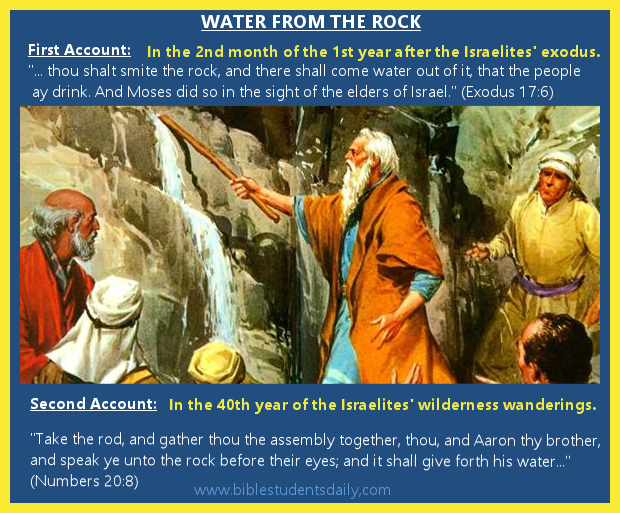
There are two occasions in the Old Testament of Moses smiting a rock to provide water for the despairing Israelites in the wilderness. Let us examine the events, their differences, and the lessons to be learned.

Exodus 17:1-7

In this account Moses, in the name of God, smote a rock in Horeb with his rod to release water for the thirsty Israelites who had camped at Rephidim (see map below), about 1 1/2 months after the Exodus (compare Exodus 19:1). From this rock gushed water, abundantly refreshing Israel.
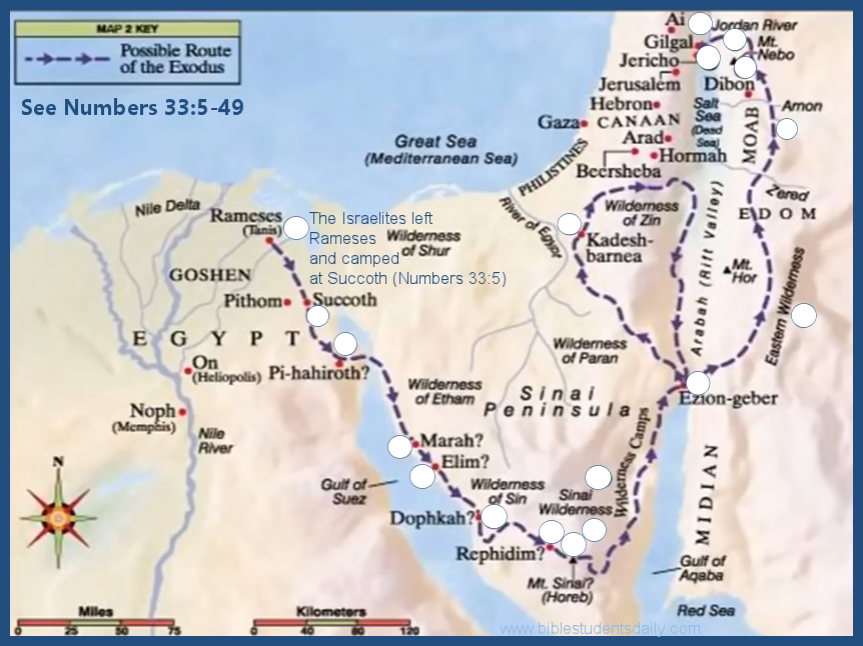
exodus-route-map-bible.png

Here is this account of Moses’ first smiting of the rock as recorded in Exodus 17:1-7 (KJV):

“(1) And all the congregation of the children of Israel journeyed from the wilderness of Sin, after their journeys, according to the commandment of the LORD, and pitched in Rephidim: and there was no water for the people to drink.

(2) Wherefore the people did chide with Moses, and said, Give us water that we may drink. And Moses said unto them, Why chide ye with me? wherefore do ye tempt the LORD?

(3) And the people thirsted there for water; and the people murmured against Moses, and said, Wherefore is this that thou hast brought us up out of Egypt, to kill us and our children and our cattle with thirst?

(4) And Moses cried unto the LORD, saying, What shall I do unto this people? they be almost ready to stone me.

(5) And the LORD said unto Moses, Go on before the people, and take with thee of the elders of Israel; and thy rod, wherewith thou smotest the river, take in thine hand, and go.

(6) Behold, I will stand before thee there upon the rock in Horeb; and thou shalt smite the rock, and there shall come water out of it, that the people may drink. And Moses did so in the sight of the elders of Israel.

(7) And he called the name of the place Massah, and Meribah, because of the chiding of the children of Israel, and because they tempted the LORD, saying, Is the LORD among us, or not?”

Numbers 20:1-13, 24 

The second occasion of Moses smiting a rock for water occurred much later, near the end of the 40 years of wilderness wandering. This is recorded in the fourth book of Moses, the book of Numbers, chapter 20. Here Moses and Aaron “rebelled against my word” (verse 24). For on this occasion God told Moses to speak to the rock, but in anger, and failing to credit God for caring for the Israelites, Moses asked the crowd “must we fetch you water out of this rock?,” and smote it twice.

Here is the account (Numbers 20:1‑13, 24 KJV):

“(1) Then came the children of Israel, even the whole congregation, into the desert of Zin in the first month: and the people abode in Kadesh; and Miriam died there, and was buried there.

(2) And there was no water for the congregation: and they gathered themselves together against Moses and against Aaron.

(3) And the people chode with Moses, and spake, saying, Would God that we had died when our brethren died before the Lord!

(4) And why have ye brought up the congregation of the Lord into this wilderness, that we and our cattle should die there?

(5) And wherefore have ye made us to come up out of Egypt, to bring us in unto this evil place? it is no place of seed, or of figs, or of vines, or of pomegranates; neither is there any water to drink.

(6) And Moses and Aaron went from the presence of the assembly unto the door of the tabernacle of the congregation, and they fell upon their faces: and the glory of the Lord appeared unto them.

(7) And the Lord spake unto Moses, saying,

(8) Take the rod, and gather thou the assembly together, thou, and Aaron thy brother, and speak ye unto the rock before their eyes; and it shall give forth his water, and thou shalt bring forth to them water out of the rock: so thou shalt give the congregation and their beasts drink.

(9) And Moses took the rod from before the Lord, as he commanded him.

(10) And Moses and Aaron gathered the congregation together before the rock, and he said unto them, Hear now, ye rebels; must we fetch you water out of this rock?

(11) And Moses lifted up his hand, and with his rod he smote the rock twice: and the water came out abundantly, and the congregation drank, and their beasts also.

(12) And the Lord spake unto Moses and Aaron, Because ye believed me not, to sanctify me in the eyes of the children of Israel, therefore ye shall not bring this congregation into the land which I have given them.

(13) This is the water of Meribah; because the children of Israel strove with the Lord, and he was sanctified in them.

(24) Aaron shall be gathered unto his people: for he shall not enter into the land which I have given unto the children of Israel, because ye rebelled against my word at the water of Meribah.”

Moses Not Permitted to go Into the Promised Land

One of the reasons why Moses was not permitted to lead Israel into the land of promise concerns this second occasion. Smiting the rock on the first occasion (Exodus. 17:1‑7) was by God’s direction, and the waters gushed forth. But the second time (Numbers 20:2‑12) the Lord said to Moses, “Speak unto the rock,” but instead he hit the rock with his rod twice.

Moses’ sin in the Numbers account was self‑assertion and lack of faith (R4047:6, R5315:5).

In Numbers 27:14, God clearly states to Moses that He punished Aaron and him for their disobedience. “For ye rebelled against my commandment in the desert of Zin, in the strife of the congregation, to sanctify me at the water before their eyes: that is the water of Meribah in Kadesh in the wilderness of Zin” (Numbers 27:14). By not saying that God would provide them water,  saying rather that they would give the whole community water, Moses and Aaron had disobeyed God.

Here, we are reminded of Ephesians 4:26, “If angry, beware of sinning” (Weymouth). Moses and Aaron, in anger with the Israelite complaints, took the matter in their own hands. Moses disregarded God’s direction, and failed to direct the people to God’s loving care for them. Evidently Moses remembered his striking the rock years earlier, and vented his anger here without regard for G6 mtqod’s instruction to “speak ye unto the rock before their eyes, and it shall give forth his water.”

As Moses and Aaron were punished for their wrong actions, so too, God’s people may have to live with the consequences of their poor decisions or impulsive actions. However, God still provides access to the the waters of spiritual life. God knows that no one could stand before God if every mistake were recorded and not forgiven.

“(3) If you, O LORD, should mark iniquities, O Lord, who could stand? (4) But with you there is forgiveness, that you may be feared. (5) I wait for the LORD, my soul waits, and in his word I hope; (6) my soul waits for the Lord more than watchmen for the morning, more than watchmen for the morning. (7) O Israel, hope in the LORD! For with the LORD there is steadfast love, and with him is plentiful redemption” (Psalm 130:3‑7, ESV).

Some time later, God led Moses up to Mount Pisgah’s top (Numbers 27:12), with an extended panoramic view of the Promised Land of Canaan. Moses saw this with his natural eyes, but Moses saw much more through the eye of faith, seeing the promises which God had made to the tribes of Israel through Abraham, Isaac, and Jacob. “We hear not a murmur respecting the transfer of leadership and the cessation of his own labors. If God had used Moses in his service to the extent that he was pleased to do, the servant was thankful and satisfied” (R3077).

“The most unjust thing we can do is judge Moses or any other man by his deeds and not by his fruits” (R4055:5).

Antitypical Meaning of “Smiting” the Rock

Christ Jesus, the true Rock, was to be smitten but once for our sins, and as a result of that one smiting at Calvary [i.e. Christ’s death, which made possible the access to God’s grace in Christ to those God has called out of the world] the water of life would be obtained for all true Israelites to all time; and if for a season the flow was stopped it was only necessary that the Rock should be invoked in the name of the Lord, that the waters might again flow forth. Christ dieth no more; death has no dominion over him; therefore in the type the Rock should not have been smitten a second time. But the second smiting, nevertheless, made a new type, because as the Apostle explains, there are some now who crucify Christ afresh, and put him to an open shame‑some of his professed followers denying or ignoring the value of the original sacrifice, denying the blood that bought them, are counted as committing the sin unto death — Second Death — and of these Moses became a type, and as a type of a class which would have to do with the antitype of the rock, he was debarred from Canaan — Hebrews 6:4‑6” (R3077).

Any denial of the Redeemer on the part of the consecrated would signify a crucifying afresh, a smiting of the rock a second time” (R5315:4).

“We might remark here, too, that those who smote the Lord the first time, at Calvary, have the promise of full forgiveness. They shall look upon him whom they pierced, and shall mourn for him, and the Lord will pour out upon them the spirit of prayer and supplication, and they shall have full opportunity of recompense and reconciliation (Zechariah 12:10). It is those who, with greater knowledge, and after they have become partakers of the holy Spirit, and have tasted the good Word of God, and the powers of the age to come, sin wilfully and count the blood of the covenant a common thing [unholy thing, Hebrews 10:29] — these are they who commit the real sin unto death, and for whom the Scriptures suggest no hope, or further opportunity, because they have sinned wilfully” (R3077).

What if Moses Had Not Smitten the Rock in the Numbers Account?

If Moses had not smitten the rock in the Numbers 20 account, would he have been permitted to enter the promised land? Br. Charles Taze Russell answers this question in R3077.

“… Moses would not have gone into the land of Canaan [even if he had obeyed God by “speaking to the rock”] because … he was the type of the Law Covenant, which must end before the people can enter into their rest. As Moses was the representative of the Law Covenant, so Joshua became the representative or type of the New Covenant and of its mediator, Jesus, the Deliverer. ‘The Law came by Moses, but grace and truth came by Jesus Christ.’ The Law was a pedagogue or guide to prepare and bring the Israelites along to the borders of Canaan, but the Law could never give them rest, could never take them into the land of promise. Christ, the antitype of Joshua, must do that. We are to remember, too, that Moses’ error in smiting the rock, did not involve him in the Second Death, nor will it work any injury to him as respects the future. It was comparatively a trivial matter, and taught him a valuable lesson which he evidently learned to the Lord’s pleasement, and his failure to go into the land of promise, therefore, should not indicate a continuance of divine indignation against him, but merely a continuance of the divine purpose in making of him a type of a class who would have to do with the antitypical rock, the antitypical water, and the antitypical smiting.”

Differences and Similarities Between the two Rock Smiting Accounts

Here are some differences and similarities noted between the Exodus and Numbers account concerning the smiting of the rock by Moses.

(1) Time — The first account occurred in the opening year of the Exodus while the other occurred near the opening of the 40th year after the Exodus. The Exodus account was in the second month of the first year, while the Numbers account was in the 1st month of the (last) 40th year of travelling.

(2) Location — Exodus account: in the Wilderness of Sin at Rephidim (Exodus 17:1); Numbers account: in the desert of Zin at Kadesh, in the first month of year 40 of their travels.

(3) Moses’ attitude — On the first occasion, Moses followed God’s instructions to the fullest and his attitude was noble and honorable, while in the closing account his attitude was angry and personal, rather than deferential: “Must we fetch you water?” were his words, rather than giving glory to God by saying something like “God will give you water,” and meekly directing the attention to Jehovah.

(4) Level of Obedience — In the opening account Moses hit the rock once as God told him to do, while in the closing account he was to speak to the rock but he disobeyed and instead hit the rock twice.

(5) The Rods — the rod in the Exodus account was Moses’ rod, while the rod in the Numbers account may have been the rod of Aaron. (Numbers 20:9, “Moses took the rod from before Jehovah” — perhaps the rod of Aaron that had been “before the testimony,” Numbers 17:10).

(6) Who was present — In the Exodus account Moses struck the rod in the sight of the Elders, while in the Numbers account, the whole assembly of the Israelites was present.

(7) All the Israelites still murmured and quarrelled during the 40 year wandering in the wilderness. Thus the only ones to enter the Promised Land of Canaan were Joshua, Caleb, and all the children of the Israelites who were less than 20 years of age (Numbers 14:20‑30).

(8) The Rock — in both cases the rock represents Christ, the Rock of Ages. “And all drank the same spiritual drink. For they drank from the spiritual Rock that followed them, and the Rock was Christ” (1 Corinthians 10:4).

(9) In both cases, the waters quenched the thirst of the Israelites.

(10) Two examples of the spiritual Rock are given during the life of Moses to show that there are two time periods in history during which the spiritual waters of life do flow — first for the Church class during this Gospel Age (from Pentecost in 33 AD) and next, in the kingdom age, for the world of mankind. In the Exodus account it was thus necessary for Christ to be smitten once: Romans 5:8, 1 Peter 3:18, John 7:32, 37. Before anyone can come unto Christ, he must thirst for the Truth. He must first have and show an appreciation of all that the Heavenly Father has to give. The waters beautifully picture the waters of eternal life that the Heavenly Father offers to those who have faith in Him, and the blessings that will flow through Him. The flowing waters satisfy the hearts of the Church class during the Gospel Age. These are pictured in the Elders in the Exodus account who were present with Moses. This water becomes a well spring of Truth in each one of us, with an opportunity to nourish others along the way.

(11) The Church’s sojourn began at the beginning of the Gospel Age, just as the Exodus account comes at the beginning of Israel’s wanderings in the wilderness. In Revelation 22:1 we read, “Then the angel showed me the river of the water of life, bright as crystal, flowing from the throne of God and of the Lamb.” Mankind will only receive that life‑giving water after the Kingdom is ushered in, just like in the Numbers account it comes at the end of the wilderness wanderings when the Gospel Age is complete. Then the resurrected world of mankind will receive the benefits of the Kingdom when they are ready to enter into the Promised Land, but on the earthly plane of existence.

(12) Christ will not then be smitten a second time. As pictured in the Numbers account, God will speak to Jesus at the appropriate time and the waters will not simply come forth, but they will come forth abundantly, as we are told in Numbers 20:11. Then the waters of life will be given to refresh all the people.

(13) The spiritual walk that we have entered into began with Christ. After crossing the Red Sea, the waters of Marah were bitter, representing the prevalence of sin throughout the world. Christ came to Jordan and offered his life and the first glimpse of the sweetened waters were given there. Next, at Elim, there were 70 palm trees and 12 wells. This relates to when our Lord sent out 70 into Galilee to preach the Gospel and he sent out 12 Apostles as the “wells” of spiritual Truth. Our Lord said he was “the true bread from heaven.” Yet the Israelites did not want that, but the quail. At Sinai, the tables of the Law were written into their hearts. Some have gone through difficult experiences like Miriam who was struck with Leprosy for 7 days, and some come back with a bad report and think it’s too much of a cost to bear, being consecrated to God. But those who endure with faith receive God’s blessings. In Numbers 21:6 the fiery serpents represent the affliction of sin, which the world can be relieved of by looking to Christ for their healing (Numbers 21:8).

Lessons

(1) Dependency on God

Not just to seek and ask God for answers and direction in our situations of daily life, but above all, in doing so, to  give God the glory in all that we say and do, and in any way the Heavenly Father permits, allow for the “hearers” as well as ourselves to recognize God’s influence in each matter. That is, see the presence of Christ through the actions, words and doings of the person(s) each does associate with in the experiences of this present life.

Example

Here is an example of a lesson to learn from Moses’ smiting the rock twice, in today’s world. If we give someone either financial or material gifts, then we should not think it is because of our power or our ability, but rather see that it is because of our Almighty Heavenly Father’s help — His love, justice, power, and wisdom working in harmony through His children called by Him, to do works that reflect Christ-likeness. We should do works in a way so as to fulfil God’s will and God’s purpose through us whom He has called to be partakers of the Heavenly calling now during the Gospel Age, from Pentecost forward.

St. Paul, by inspiration, points out to us that that rock represented Christ, that the smiting of the rock represented putting Christ to a shameful death, and that only by this means is the Water of Life provided for the people of God. As the waters of that rock followed the Israelites, so the stream of God’s favor, through the sacrifice of Christ, refreshes Christ’s disciples throughout their wilderness journey.

Refreshed in body and in faith, Israel journeyed onward, but encountered new obstacles. The Amalekites, a warlike people, considered the coming of Israel as an invasion of their country, and attacked them in battle. A people used to peaceful pursuits, as the Israelites had for centuries been, would naturally be at a disadvantage in a conflict with such opponents. Yet God gave them the victory. He indicated, however, that it was not by their prowess or skill, but of His grace that they conquered.

Moses, stationed upon a high hill, lifted up his hands in prayer to God for the people. While he did so, success was theirs; but when he ceased thus to pray, the Amalekites were the victors. Perceiving this, Aaron and Hur assisted in holding up the hands of Moses until the battle terminated with success for Israel. God thus indicated that Moses was the advocate or representative of Israel, and that without him they could do nothing.

(2) Regular Prayer = Close Communion with God

By having close communion with God through unceasing prayers, God’s people can seek the Heavenly Father’s direction and counsel in all of life’s affairs. Such complete dependency on God may by God’s grace and mercy result in a mind that desires and does only the will of God, which in turn, can result in glory, honour, and praise to our Heavenly Father through Christ.

Spiritual Israelites have conflicts with enemies too mighty for them without the Lord’s assistance. The world, the flesh, and the Devil make common cause against all who are seeking the Heavenly Canaan. We who are followers of Jesus have success in our warfare only as we have Him as our Advocate. “We have an Advocate with the Father, Jesus Christ the Righteous.” Through Him we may come off conquerors, yea, more than merely conquerors, victors in the highest sense — “through Him who loved us and bought us with His precious blood.”

(3) Avoiding pride.

C. S. Lewis said: “A proud man is always looking down on things and people; and, of course, as long as you are looking down, you cannot see something that is above you.”

Pride in any form and in anybody is a dangerous thing. In a worldly way the proverb is well attested, “Pride goeth before destruction and a haughty spirit before a fall.”

Moses was the “meekest man in all the earth” (Numbers 12:3). Perhaps this is one reason that this experience of Moses is recorded for our benefit — to alert us, that no matter our development of humility and meekness, we need to be careful lest a moment of self-assurance, or spiritual pride, does not cause us to forget our proper reliance upon, and respect for, our Heavenly Father.

“For the comfort of those who may feel that they have done much worse than Moses, or been much more self‑assertive, been much less careful to honor the Lord, have manifested much more spiritual pride‑for their comfort let us notice that the punishment here was severe because it was part of a type” (R5957).

“Neither are we to think that brethren who have manifested spiritual pride and done things in their own name, rather than in the name of the Lord and the name of the Class, have thereby committed the sin unto death. We are, however, to realize that a terrible danger goes with spiritual pride. … Realizing this, how anxious, how zealous we should be, not only in the eradication of every symptom of it we might find in ourselves, but also in being careful lest we should take the contagion or in any manner come under its influence or have any of its symptoms!” (R5957)

“When one attends a testimony meeting, or a Berean class, and hears no real good testimony but his own, hears no proper answer except his own to any of the questions, never sees an Elder in the chair who knows how to lead a meeting anyway — these should be considered dangerous symptoms of spiritual pride” (R5956).

The proper attitude, as all will agree, is that the Lord’s people should feel greatly humbled instead of greatly exalted and heady in respect to these opportunities for telling the Truth to others” (R5956).

“We should feel our unworthiness. We should realize that the Plan is not ours; that we have merely heard of it ourselves; that it is really God’s Plan; that we are honored as His servants to tell it out” (R5956).

“But if we allow any impression to go out that it is by any wisdom on our part, or any skill, that the beauty is seen in the Message, then to that extent we are taking glory to ourselves which belongs to the Lord, and doing injury to ourselves proportionately by failing to demonstrate our worthiness to be used by the Lord in the present and in the future. The wonderful privilege of speaking as ambassadors for the Lord, to tell of His greatness and Plan should humble us with the thought that He has privileged us, whereas He has angels, who excel in strength and whom He might have used in communicating this most wonderful Message” (R5956).

We should not feel offended if we are not elected as a deacon or Elder or assistant in the Lord’s service. Br. Russell writes that “in all meekness and humility they should feel a timidity even about taking a position where there would be such a responsibility. The admonition on this is that although all of the Church should, according to their knowledge of the Truth, be qualified to be teachers, nevertheless the safer place is not to be a teacher, knowing that such shall have the severer trial. Only a sense of responsibility to the Lord and to the brethren should make one willing to serve in such capacity, much as all ought to love to be the Lord’s representatives in the Church” (R5956).

The Need For Self‑Examination

“Let us not forget that while we are to exercise great leniency in viewing the words and deeds of others, ascribing only good intentions where they are professed, we are to scrutinize with all of our might our own hearts, our own intentions. We are to inquire why we did this thing or left undone the other thing; why we did this thing this way; why we spoke in such a tone, etc. Such a careful examination, weighing of thoughts, words and deeds, would be very unsatisfactory to a person who was not wishing to be in accord with the Lord. But those who have made a covenant with the Lord and are faithful to that covenant will find such a course to be a great blessing, comforting their hearts at the time, strengthening them for the future, and in connection with the Lord’s providences it will be fitting and preparing them for places in the Heavenly Kingdom” (R5958).

By relying on and asking the Heavenly Father through Christ to show us His way and do it, we can help keep the spiritual armour of Christ on 24/7 to protect us against sinning in a sudden moment that can creep up unexpectedly. Let us remember Moses’ situation and ask God to protect us from it happening to us, and trust that God is able to do more than we even ask for or imagine if He chooses to (Ephesians 3:20).

“To Him be glory in the church and in Christ Jesus throughout all generations, forever and ever. Amen” (Ephesians 3:21, ESV).

References:

Br. Charles Russell — Reprints of the Original Watch Tower and Herald of Christ’s Presence: R2299, R3077, R4047, R4055, R5285, R5315, R5955.

Bibletruth411 ‑ YouTube: “The Waters of Massah and Meribah.”

This post’s URL:

Water From The Rock

Enter your email address to subscribe to this blog and receive notifications of new posts by email.


EXODUS 3 & 4 – Overcoming Timidity and Fear of One’s Own Inabilities

Exodus 4, 12 - www.biblestudentsdaily.com.jpg

But Moses said to God, ‘Who am I that I should go to Pharaoh and bring the children of Israel out of Egypt?’” Exodus 3:11

Are you timid and fearful in using your abilities as Moses seemed to be when the Heavenly Father sent him to speak to the Egyptians and lead his people out of captivity?

  • Fear often prevents us from getting out of our comfort zone, even for righteousness’ sake.
  • Timidity can even stop us from standing alone and DEFENDING THE TRUTH.
  • Human emotions often causes us to fear rejection by our friends. It can even paralyze us and block the voice of God as He speaks through the Bible and providence.
  • Anxiety and depression can cause us to be overly concerned about something that is not reality.

If you can identify with any of these symptoms, then read on for some good news – as this post is for you!

As an infant, Moses was placed by faithful parents where an Egyptian princess could find him, amidst the bulrushes of the Nile. Seeing the young baby, she decided to adopt him.
Safe in the midst of his enemies, he received an ample education.

“And Moses was instructed in all the wisdom of the Egyptians, and he was mighty in his words and deeds.” (Acts 7:22)

The honors of the Egyptian Court were his, but when Moses learned the truth of his origin he no longer could enjoy the benefits of his high station while his kinsmen—the Israelites—suffered under the burden of slavery.

After killing an Egyptian taskmaster for his cruelty to an Israelite slave, he was disappointed when his brethren did not appreciate his endeavors to help them, but instead, reported him to the Egyptians (Exodus 2:11-22).

He fled to Midian, and was gone forty years. Then…

GOD’s time having come,

he was sent to deliver his people—Israel; but by now he was timid and feared his inability.

By Divine command, Aaron became his mouthpiece, and the message was carried to Pharaoh that Israel must be released from bondage. This commission to Moses was given at the burning bush which was not consumed. The Lord used this miracle to impress on Moses that God was with him. It provided the courage and confidence for Moses to fulfill his mission. We read of this in Exodus chapter 3-4.

Exodus Chapter 3 (ESV)

[Note: Most commentary in green from “Expanded Biblical Comments.”]

1Now Moses was keeping the flock of his father-in-law, Jethro, the priest of Midian, and he led his flock to the west side of the wilderness and came to Horeb, the mountain of God. And the angel of the Lord appeared to him in a flame of fire out of the midst of a bush. He looked, and behold, the bush was burning, yet it was not consumed. And Moses said, “I will turn aside to see this great sight, why the bush is not burned.” When the Lord saw that he turned aside to see, God called to him out of the bush, “Moses, Moses!” And he said, “Here I am.”

the burning bush

Then he said, “Do not come near; take your sandals off your feet, for the place on which you are standing is holy ground.” And he said, “I am the God of your father, the God of Abraham, the God of Isaac, and the God of Jacob.” And Moses hid his face, for he was afraid to look at God. Then the Lord said, “I have surely seen the affliction of my people who are in Egypt and have heard their cry because of their taskmasters. I know their sufferings, and I have come down to deliver them out of the hand of the Egyptians and to bring them up out of that land to a good and broad land, a land flowing with milk and honey, to the place of the Canaanites, the Hittites, the Amorites, the Perizzites, the Hivites, and the Jebusites.

And now, behold, the cry of the people of Israel has come to me, and I have also seen the oppression with which the Egyptians oppress them. 10 Come, I will send you to Pharaoh that you may bring my people, the children of Israel, out of Egypt.” 11 But Moses said to God, “Who am I that I should go to Pharaoh and bring the children of Israel out of Egypt?” 12 He said, “But I will be with you, and this shall be the sign for you, that I have sent you: when you have brought the people out of Egypt, you shall serve God on this mountain.”

13 Then Moses said to God, “If I come to the people of Israel and say to them, ‘The God of your fathers has sent me to you,’ and they ask me, ‘What is his name?’ what shall I say to them?” 14 God said to Moses, “I am who I am.” And he said, “Say this to the people of Israel: ‘I am has sent me to you.’” 15 God also said to Moses, “Say this to the people of Israel: ‘The Lord, the God of your fathers, the God of Abraham, the God of Isaac, and the God of Jacob, has sent me to you.’ This is my name forever, and thus I am to be remembered throughout all generations.

16 Go and gather the elders of Israel together and say to them, ‘The Lord, the God of your fathers, the God of Abraham, of Isaac, and of Jacob, has appeared to me, saying, “I have observed you and what has been done to you in Egypt, 17 and I promise that I will bring you up out of the affliction of Egypt to the land of the Canaanites, the Hittites, the Amorites, the Perizzites, the Hivites, and the Jebusites, a land flowing with milk and honey.”’ 18 And they will listen to your voice, and you and the elders of Israel shall go to the king of Egypt and say to him, ‘The Lord, the God of the Hebrews, has met with us; and now, please let us go a three days’ journey into the wilderness, that we may sacrifice to the Lord our God.’

19 But I know that the king of Egypt will not let you go unless compelled by a mighty hand. 20 So I will stretch out my hand and strike Egypt with all the wonders that I will do in it; after that he will let you go. 21 And I will give this people favor in the sight of the Egyptians; and when you go, you shall not go empty, 22 but each woman shall ask of her neighbor, and any woman who lives in her house, for silver and gold jewelry, and for clothing. You shall put them on your sons and on your daughters. So you shall plunder the Egyptians.”

Exodus Chapter 4 (ESV)

1 Then Moses answered, “But behold, they will not believe me or listen to my voice, for they will say, ‘The Lord did not appear to you.’”

The Lord said to him, “What is that in your hand?” He said, “A staff.”

[A staff signifies divine authority. R4058:4. A special manifestation of divine power and rule. R5419:5]

3 And he said, “Throw it on the ground.” So he threw it on the ground, and it became a serpent, and Moses ran from it.

[Became a serpent—Symbolizing that all the evil there is in the world is the result of God’s having let go of his rod of authority temporarily. R4058:4  Those things closest to us might become injurious except for God’s power to overrule. R5419:2  Antitype may be that the power of God may appear to be evil.]

4 But the Lord said to Moses, “Put out your hand and catch it by the tail”—so he put out his hand and caught it, and it became a staff in his hand— “that they may believe that the Lord, the God of their fathers, the God of Abraham, the God of Isaac, and the God of Jacob, has appeared to you.

[Put out your hand — Typifying God’s purpose to lay hold upon present evil conditions. R4058:4 It became a staff — Typifying the re-establishment of divine authority. R4058:4
Representing God’s power to turn evil things into good things through the operation of FAITH. R2910:4, R5419:3 From this we should realize that of ourselves we could accomplish nothing. R5419:2]

R3990: “The assurance that he would be able to give the people this demonstration [with the staff] and other demonstrations that God had sent him to them strengthened Moses’ confidence in God and made up for his lack of confidence in himself. And this should be the case with all of us; we are not to have confidence in ourselves, but if we go forth strong in the Lord and in the power of his might, confident and rejoicing because he is with us, we are not only safe as respects ourselves but in the proper condition for the Lord to more and more use us in his service—”He that humbleth himself shall be exalted; he that exalteth himself shall be abased,” is the divine method of procedure.”

6 Again, the Lord said to him, “Put your hand inside your cloak.” And he put his hand inside his cloak, and when he took it out, behold, his hand was leprous like snow.

[He put his hand — Leprosy is a symbol of sin. Divine power was first manifested without sin or imperfection or blemish (in Jesus Christ); secondly, that the same divine power, hidden for a time, was afterward manifest in sin and imperfection (in his Body members) and thirdly, that the same divine power, hidden again for a time, will subsequently be manifest without sin (in the glorified Christ) R4059:2]

7 Then God said, “Put your hand back inside your cloak.” So he put his hand back inside his cloak, and when he took it out, behold, it was restored like the rest of his flesh. 

[Restored — By and by the Church is to be received into Christ’s bosom and “changed” in the first resurrection. R4059:3
As his other flesh — Be used again of the Lord as his agent in stretching forth his rod and bringing forth the plagues, and delivering the residue of God’s people. R4059:3]

8 “If they will not believe you,” God said, “or listen to the first sign, they may believe the latter sign.

[Voice of the first sign — Literature on the subject of “Why evil was permitted” has been circulated to the extent of millions of copies throughout the world ever since the year 1879. R4058:6
Voice of the latter sign — The sign of the leprous hand—the “Millennial Dawn” series of volumes (later called “Studies in the Scriptures”) the first of which was published in 1886. In these books the relationship between justification, sanctification and deliverance is distinctly shown. R4059:4]

If they will not believe even these two signs or listen to your voice, you shall take some water from the Nile and pour it on the dry ground, and the water that you shall take from the Nile will become blood on the dry ground.”

[Water from the Nile — The truth, as contained in millions of pages of tracts, poured upon the symbolic earth, society, liberally on many lands and in many languages. R4059:6
Upon the dry land — Typifying society. R4059:5
Shall become blood — To society the truth seems repulsive, undesirable, bloody. They not only view the typical sacrifices as bloody but they resent the thought that the antitypical sacrifice for sins was the death (blood) of Christ. R4060:1]

10 But Moses said to the Lord, “Oh, my Lord, I am not eloquent, either in the past or since you have spoken to your servant, but I am slow of speech and of tongue.”

[I am not eloquent — Moses was so meek that he could not realize that with divine help he would be successful. R5262:2]

11 Then the Lord said to him, “Who has made man’s mouth? Who makes him mute, or deaf, or seeing, or blind? Is it not I, the Lord? 12 Now therefore go, and I will be with your mouth and teach you what you shall speak.”

*[I will be with thy mouth — So God declares to the humble ones now; that having no confidence in ourselves, we should have every confidence in God. R5262:4]*

13 But he said, “Oh, my Lord, please send someone else.” 14 Then the anger of the Lord was kindled against Moses and he said, “Is there not Aaron, your brother, the Levite? I know that he can speak well. Behold, he is coming out to meet you, and when he sees you, he will be glad in his heart.

[Aaron represents the Royal Priesthood still in the flesh, still sacrificing. R4058:3]

15 You shall speak to him and put the words in his mouth, and I will be with your mouth and with his mouth and will teach you both what to do. 16 He shall speak for you to the people [to true Israelites], and he shall be your mouth, and you shall be as God to him.

[The understanding of God through studying Scripture and prayer and developing the fruits of the spirit allows the called ones running for the prize of High Calling during the Gospel Age to be used as the “mouthpieces” of the Heavenly Father through Christ. 
Be as God to him — Moses was to be like God unto Aaron in that he would tell Aaron what he should say and do. Q498:5 Moses, not Aaron, was the one competent for the great work because of his schooling. Aaron was his servant, or mouthpiece, speaking only as authorized by Moses in whom, because of his meekness, God was reposing the responsibility. R5262:4, R4537:1; PD32]

17 And take in your hand this staff, with which you shall do the signs.” 

18 Moses went back to Jethro his father-in-law and said to him, “Please let me go back to my brothers in Egypt to see whether they are still alive.” And Jethro said to Moses, “Go in peace.” 19 And the Lord said to Moses in Midian, “Go back to Egypt, for all the men who were seeking your life are dead.”

20 So Moses took his wife and his sons and had them ride on a donkey, and went back to the land of Egypt [for the last 40 years of his life]. And Moses took the staff of God in his hand.

21 And the Lord said to Moses, “When you go back to Egypt, see that you do before Pharaoh all the miracles that I have put in your power. But I will harden his heart, so that he will not let the people go. 22 Then you shall say to Pharaoh, ‘Thus says the Lord, Israel is my firstborn son, 23 and I say to you, “Let my son go that he may serve me.” If you refuse to let him go, behold, I will kill your firstborn son.’”

24 At a lodging place on the way the Lord met him and sought to put him to death [because Moses has not circumcised their son.] 25 Then Zipporah took a flint and cut off her son’s foreskin and touched Moses’ feet with it and said, “Surely you are a bridegroom of blood to me!” 26 So he let him alone. It was then that she said, “A bridegroom of blood,” because of the circumcision.

[The circumcision — Symbolizing a cutting off, a separation from the flesh, its aims, hopes and desires. R3022:3]

27 The Lord said to Aaron, “Go into the wilderness to meet Moses.” So he went and met him at the mountain of God [Mount Horeb, one of the peaks of Mt. Sinai. R4011:3] and kissed him.

[Does not the Lord God also tell us: to shelter ourselves from all evil by finding rest under his wings of care and Divine supervision when feasting upon the Words of Life in Scripture and when in prayer communion with the Him through Christ. Here the New Creation can “meet” with Christ and his Body members – in sweet fellowship for as we are told “where two or three are gathered in my name, there am I among them” (Matthew 18:20) and “where the corpse is, there the vultures will gather” (Luke 17:37).]

28 And Moses told Aaron all the words of the Lord with which he had sent him to speak, and all the signs that he had commanded him to do.

This reminds us of Jesus’ words in John 14:26, “But the Helper, the Holy Spirit, whom the Father will send in my name, he will teach you all things and bring to your remembrance all that I have said to you.”

29 Then Moses and Aaron went and gathered together all the elders of the people of Israel. 30 Aaron spoke all the words that the Lord had spoken to Moses and did the signs in the sight of the people.

31 And the people believed; and when they heard that the Lord had visited the people of Israel and that he had seen their affliction, they bowed their heads and worshiped.

Moses’ experiences changed him for the better. How?

By God giving him the perfect experiences—which for the first 40 years of his life taught him to depend on his own strengths (i.e. he killed the Egyptian rather than depend on God to bring justice, etc); then the next 40 years of his life, Moses learned to not depend on his own strength (i.e. he worked for his Father-in-law looking after the sheep—which were not his own) and finally in the last 40 years of his life, Moses learned to put all his past experiences into practice hence why we read in Numbers 12:3 that “the man Moses was very humble, more than any man who was on the face of the earth.”

Lessons from the Burning Bush 

“God usually has a symbolical meaning in every miracle, and in this one the representation is supposed to be Israel in the midst of tribulation, yet not consumed. Later on, in Reformation times, the Church of Scotland appropriated this burning bush as its emblem on its banner, because its experience had been similar in that it had passed through severe afflictions and distresses and trials, yet had not been consumed.

Is not the burning bush a good illustration of the experience of Christ and all of his members? Are they not indeed surrounded by fiery trials? And do they not emerge from these unscathed, uninjured?—on the contrary, blessed, developed, strengthened, made meet for the inheritance of the saints in light? (R.3990)

The Fear, Reverence of the Lord – 

“Well do the Scriptures declare that the fear, reverence, of the Lord is the beginning of wisdom. We greatly deplore the growth of irreverence in our day, and urge upon all of our readers for themselves and for their families the cultivation of this proper attitude of mind, so helpful to our preparation for the life that now is and that which is to come. Liberty and independence, while excellent qualities, are always to be valued and conserved and protected, are never to become license, never to lead in any degree to irreverence. This is the more necessary to us for two reasons: (1) Because of the growing irreverence of the world about us, born of a declining faith in God and everything supernatural; (2) because of our growing enlightenment in the Truth, by which we see that the fears of an eternity of torture were groundless, there is a danger of losing that proper reverence for God which belongs to and is an integral part of love.

“The Prophet David writes, “Keep thy foot when thou goest into the house of God”—take heed to your standing, take heed to your walk, take heed to your conduct. Whether the house of God be a great temple, as in past times, under divine direction, or whether it be the temple of God, which is the Church of Christ in the flesh, we should realize that reverence is befitting to us in connection with everything that is holy and consecrated. We should realize that whoever neglects the cultivation of reverence in respect to these matters is making his own pathway slippery and dangerous. He who reverences little and is careless is much more likely to stumble, to fall, and be utterly cast down.

If even Moses, the “meekest man in all the earth,” needed from the Lord as his first instruction a lesson of humility, shall we not suppose that such a lesson is necessary to us? Yea, verily!

Let us honor the Lord in our hearts, in our outward demeanor. Whether we bow to give thanks for our daily bread, whether we bow our knee night and morning in acknowledgment of divine care and providences, or whether we meet with those of like precious faith, let us see to it that reverence marks our conduct and our words as well as rules in our hearts. Let us, too, take off our shoes, let us lay aside the ordinary conduct of life by which we are in contact with the world, and in all our ways acknowledge him, especially when we hearken to his voice in the study of his Word as his people.” (R.3990)

Like Moses was asked by God, does not our Heavenly Father also ask us:

“What is in your hand?” 

“God can use our humblest talent to his praise. If, then, we would serve, we should look to see what we have in our hands.” (R5419:2)

How to overcome timidity and fear

Jesus gives us the ANSWER in overcoming fear of others (i.e. timidity.)

  • Timidity of people

“And fear not them which kill the body, but are not able to kill the soul: but rather fear him which is able to destroy both soul and body in Gehenna. Are not two sparrows sold for a farthing? and one of them shall not fall on the ground without your Father. (Matthew 10:28, 29)

God is mindful of every creature that lives. He even knows when a sparrow dies. So, we can be confident that He cares for us and we have nothing to fear from others. David echoed this sentiment when he said, “The LORD is on my side; I will not fear: what can man do unto me?” (Psalm 118:6).

  • Fear of doing wrong in the eyes of God

My little children, these things write I unto you, that ye sin not. And if any man sin, we have an advocate with the Father, Jesus Christ the righteous: And he is the propitiation for our sins: and not for ours only, but also for the sins of the whole world (1 John 2:1, 2).

Christians who are committed to serving God have a special relationship with Him. Jesus, as their “Advocate” covers their sins. We can take great comfort in knowing we do not have to be perfect for God to accept us. The blood of Jesus provides our standing before God.

  • Fear of being misunderstood which can lead to being hated

 “Fear thou not; for I am with thee: be not dismayed; for I am thy God: I will strengthen thee; yea, I will help thee; yea, I will uphold thee with the right hand of my righteousness” (Isaiah 41:10).

Though every Christian should be sensitive to the feelings of others we should not fear what they will think of us. Only God’s view truly matters. If we live according to His principles and serve Him the best we can, then we have nothing to worry about.

  • Fear of standing for the Truth when others will not

And you will be hated by all for My name’s sake. But he who endures to the end will be saved. 23 When they persecute you in this city, flee to another. For assuredly, I say to you, you will not have gone through the cities of Israel before the Son of Man comes” (Matthew 10:22-24).

Enduring to the end is important as we stand for truth. God sees and remembers all that we do for the cause of Truth. That’s what matters most.

Do you deal with any of these fears? 

Then please STOP right here!  

God has the plan, man has the problem, the Bible has the solution.” – Dewey Aaron.

May the words of Holy Scripture , be your comfort and your strength.

Why and how to Obey GOD

We cannot do more than to give our best to the Heavenly Father as we present our bodies as living sacrifices (Romans 12:1). It sometimes involves much pain and suffering for righteousness sake. But whatever suffering we are asked to endure will be well worth it in knowing that God is pleased.


“As for other matters, brothers and sisters, we instructed you how to live in order to please God, as in fact you are living. Now we ask you and urge you in the Lord Jesus to do this more and more. For you know what instructions we gave you by the authority of the Lord Jesus.” (1 Thessalonians 4:1-5)


As Christians, we have a guidebook, as well as a guide, to show us how to live. The more we follow the instructions left by our guide, the more we begin to understand the plans, and influence others to do the same.


“And without faith it is impossible to please God, because anyone who comes to him must believe that he exists and that he rewards those who earnestly seek him.” (Hebrews 11:6)


We cannot seek God’s help if we do not believe that He will help us.

When we come to Him, we must do so with the faith that He knows all, sees all, and has power over all.


GOd's Power. Mt Sinai..jpg

“His pleasure is not in the strength of the horse, nor his delight in the legs of the warrior;  the Lord delights in those who fear him, who put their hope in his unfailing love.” (Psalm 147:10-11)


The Lord is not impressed with the things that the world sees as important.


Our Heavenly Father cares little for our physical strength, speed, or agility.


What makes our Heavenly Father smile is
the strength of our love for Him.


“My son, give me your heart, and let your eyes observe my ways.” Proverbs 23:26

This is the ANSWER to overcoming ALL things through CHRIST!


It involves falling in love with the one who reads the heart’s deepest sorrows… deepest regrets… deepest pains… deepest secrets of our good intentions …

The Heavenly Father’s delight comes when our faith in his perfect abilities is strong.

“Therefore, my dear friends, as you have always obeyed—not only in my presence, but now much more in my absence—continue to work out your salvation with fear and trembling, for it is God who works in you to will and to act in order to fulfill his good purpose.” (Philippians 2:12-16)

 FOCUS ON YOUR SPIRITUAL LIFE. 

This does not mean shutting ourselves away from everyone. The Lord wants us to serve one another and share each other’s burdens.

Bear ye one another’s burdens, and so fulfil the law of Christ.(Galatians_6:2 )


If physical or mental impairment prevent one from being able to meet the needs of others, this too, is something the Lord understands perfectly. He reads the heart and understands the difficulties we often face in life.

This is where PRAYERS for each other ARE WORTH MORE THAN GOLD.

The effectual fervent prayer of a righteous man availeth much.” (James 5:16)

Comfort and Reassurance

How reassuring to know that our Heavenly Father helps our weaknesses to become our strengths as we DEPEND WHOLEHEARTEDLY upon Him—that we might look to Him in every time of need and receive strength through CHRIST. He becomes our strength when we remain in Him and His Word remains in us.

Here are some Scriptures to meditate upon to gain strength from our Heavenly Father through CHRIST Jesus. These can give us great JOY. He is OUR STRENGTH as we fight the good fight of Faith to overcome sin and sorrow, focusing on the author and perfecter of our Faith, Christ Jesus.

CONFIDENCE & STRENGTH THROUGH CHRIST SCRIPTURES:-

“The Lord is my strength and my song, and he has become my salvation; this is my God, and I will praise him, my father’s God, and I will exalt him.” Exodus 15:2 (ESV)

“Have I not commanded you? Be strong and courageous. Do not be frightened, and do not be dismayed, for the Lord your God is with you wherever you go.” Joshua 1:9 (ESV)

“He will guard the feet of His saints, but the wicked shall be silent in darkness. For by strength no man shall prevail.” 1 Samuel 2:9 (NKJ)

“God is my strength and power, and He makes my way perfect.” 2 Samuel 22:33 (NKJ)

“Seek the Lord and his strength; seek his presence continually!” 1 Chronicles 16:11 (ESV)

“…the joy of the Lord is your strength.” Nehemiah 8:10 (ESV)

“I love you, O Lord, my strength. 2 The Lord is my rock and my fortress and my deliverer, my God, my rock, in whom I take refuge, my shield, and the horn of my salvation, my stronghold. 3 I call upon the Lord, who is worthy to be praised, and I am saved from my enemies.”  Psalm 18:1-3 (ESV)

“The king is not saved by his great army; a warrior is not delivered by his great strength.” Psalm 33:16 (ESV)

“The Lord is my light and my salvation; Whom shall I fear? The Lord is the strength of my life; Of whom shall I be afraid?”  Psalm 27:1 (NKJ)

“Be of good courage, and He shall strengthen your heart, all you who hope in the Lord.” Psalm 31:24 (NKJ)

“God, hear my cry; pay attention to my prayer. I call to You from the ends of the earth when my heart is without strength. Lead me to a rock that is high above me, for You have been a refuge for me, a strong tower in the face of the enemy. I will live in Your tent forever and take refuge under the shelter of Your wings. Selah” Psalm 61:1-4 (HCSB)

“My flesh and my heart may fail, but God is the strength of my heart and my portion forever.” Psalm 73:26 (ESV)

5 Blessed (happy, fortunate, to be envied) is the man whose strength is in You, in whose heart are the highways to Zion. 6 Passing through the Valley of Weeping (Baca), they make it a place of springs; the early rain also fills [the pools] with blessings.  7They go from strength to strength [increasing in victorious power]; each of them appears before God in Zion.”  Psalm 84:5-7 (AMP)

“28 Have you not known? Have you not heard? The Lord is the everlasting God, the Creator of the ends of the earth. He does not faint or grow weary; his understanding is unsearchable. 29 He gives power to the faint, and to him who has no might he increases strength. 30 Even youths shall faint and be weary, and young men shall fall exhausted; 31 but they who wait for the Lord shall renew their strength; they shall mount up with wings like eagles; they shall run and not be weary; they shall walk and not faint.” Isaiah 40:28-31 (ESV)

“…in quietness and in trust shall be your strength.”  Isaiah 30:15 (ESV)

“…Let the weak say, ‘I am strong.’”  Joel 3:10 (ESV)

“17 Though the fig tree does not blossom and there is no fruit on the vines, [though] the product of the olive fails and the fields yield no food, though the flock is cut off from the fold and there are no cattle in the stalls, 18 Yet I will rejoice in the Lord; I will exult in the [victorious] God of my salvation! 19 The Lord God is my Strength, my personal bravery, and my invincible army; He makes my feet like hinds’ feet and will make me to walk [not to stand still in terror, but to walk] and make [spiritual] progress upon my high places [of trouble, suffering, or responsibility]!” Habakkuk 3:17-19 (AMP)

“26 For consider your calling, brothers: not many of you were wise according to worldly standards, not many were powerful, not many were of noble birth. 27 But God chose what is foolish in the world to shame the wise; God chose what is weak in the world to shame the strong; 28 God chose what is low and despised in the world, even things that are not, to bring to nothing things that are, 29 so that no human being might boast in the presence of God.” 1 Corinthians 1:26-29 (ESV)

“And I, when I came to you, brothers, did not come proclaiming to you the testimony of God with lofty speech or wisdom. 2 For I decided to know nothing among you except Jesus Christ and him crucified. 3 And I was with you in weakness and in fear and much trembling, 4 and my speech and my message were not in plausible words of wisdom, but in demonstration of the Spirit and of power, 5 so that your faith might not rest in the wisdom of men but in the power of God.1 Corinthians 2:1-5 (ESV)

7 But we have this treasure in jars of clay, to show that the surpassing power belongs to God and not to us. 8 We are afflicted in every way, but not crushed; perplexed, but not driven to despair; 9 persecuted, but not forsaken; struck down, but not destroyed; 10 always carrying in the body the death of Jesus, so that the life of Jesus may also be manifested in our bodies. 11 For we who live are always being given over to death for Jesus’ sake, so that the life of Jesus also may be manifested in our mortal flesh.”  2 Corinthians 4:7-11 (ESV)

“On behalf of such a man I will boast; but on my own behalf I will not boast, except in regard to my weaknesses.”  2 Corinthians 12:5 (NASB)

“9 But He said to me, “My grace is sufficient for you, for power is perfected in weakness.” Therefore, I will most gladly boast all the more about my weaknesses, so that Christ’s power may reside in me. 10 So I take pleasure in weaknesses, insults, catastrophes, persecutions, and in pressures, because of Christ. For when I am weak, then I am strong.”  2 Corinthians 12:9-10 (HCSB)

“8 I know your works. Because you have limited strength, have kept My word, and have not denied My name, look, I have placed before you an open door that no one is able to close.Revelation 3:8 (HCSB)

“15 For we do not have a high priest who is unable to sympathize with our weaknesses, but one who in every respect has been tempted as we are, yet without sin. 16 Let us then with confidence draw near to the throne of grace, that we may receive mercy and find grace to help in time of need.”  Hebrews 4:15-16 (ESV)

“Thou Mayest Bring Forth My People”

Just as God used Moses to deliver the Israelites out of the hands of Pharaoh, so too, if  “the Lord may choose to send us on any special mission, we may be sure that he does not wish us to undertake it as our own mission, nor to claim the honor of the success attending it. He merely deigns to use us as his instrumentalities, whereas he could do the entire work much easier, we might say, without us. How wonderful it seems that God throughout all his dealings, past and present, has been willing to use his consecrated people. Telling them on the one hand that they are unworthy, he assures them on the other hand of his willingness to use their imperfections and to overrule and guide in respect to their services for him and his cause.” (R. 3990)

“The prime essentials evidently in the faithful performance of such a commission would be reverence for the Lord and humility as respects our own talents and abilities. It was so with Moses, the “meekest man in all the earth.” (R.3990)

Not stopping even to tell the Lord of his appreciation of the facts that he had been chosen for and had undertaken this great work, Moses was overwhelmed with the thought that the Lord would deign to use him as a messenger, and he promptly disclaimed any special qualifications therefor. Indeed, he evidently felt, as well as said, that there were others much more capable of the work than himself. (R.3990)

“But was it not this very appreciation of his own unworthiness that helped to make him suitable for the Lord’s business?

“And so with us: we may be sure that when we feel strong then we are weak, and when we feel weak in our own strength then we are best prepared to be strong in the Lord and in the power of his might and to be used of him as his instruments.” (R.3990)

“And all the members of the body of Christ, the antitypical body of Moses, are permitted to have a share, as the Lord’s representatives, in this work of declaring the fall of Babylon, the presence of the King, and the gathering together unto him of all who have made a covenant with him by sacrifice. While feeling our unworthiness of so great an honor, and our inability as respects so great a work, let us remember that the Lord himself is with us, and that since it is HIS work it will go onward and accomplish the designs intended, and gather out eventually all who are truly the Lord’s, whether we are faithful or whether we are unfaithful.

“Let each of us then, dear readers, impress upon our hearts the essence of this lesson, that if God be with us and for us, however humble and weak of ourselves, we may be mighty through him to the pulling down of the strongholds of error and for the building up of his people in the most holy faith, and for their deliverance from the bondage of error. Let us in the name of the Lord do with our might what our hands find to do, but always with the thought that we serve the Lord. ” (R. 3991)

Let his words in Isaiah 41:10 be the strength in our every endeavor in his name and cause.

“Fear not, for I am with you; be not dismayed, for I am your God; I will strengthen you, I will help you, I will uphold you with my righteous right hand.” Isaiah 41:10 (ESV)

By being faithful unto death, may we maintain the relationship to the great antitype of Moses, and ultimately be associated with him in the glories of the Kingdom, in the dispensing of the blessings and judgments of the future age.—Acts 3:23. (R.3

 EPHESIANS 6,10.jpg

References:
Br. Charles T. Russell, Reprints of the Original Watchtower and Herald of Christ’s Presence. (R)

“Expanded Biblical Comments” — http://www.htdbv8.com/ (Purchase hard copy—https://chicagobible.org/product/expanded‑biblical‑comments/)


Acknowledgment 
Br. Tom Ruggirello – for editing assistance.


Suggested Further Reading
The Burning Bush, by Br. Carl Hagensick in “The Beauties of the Truth,” Volume 11, No. 4, November 2000.


The URL for this post: https://biblestudentsdaily.com/2017/05/29/exodus-3-4-overcoming-timidity-and-fear-of-ones-own-inabilities/

Enter your email address to subscribe to this blog and receive notifications of new posts by email.