JOHN 13:14-15 – Washing One Another’s Feet – A Privilege

jesus-washing-apostles-feetJohn13,14-15.jpg

During Bible times, frequent washing of the feet was necessary as the Israelites wore sandals instead of shoes, and often went barefoot in the house. Thus, among the Israelites, it was the first duty of a host to give his guest water for washing his feet. To omit this was a sign of marked unfriendliness. According to the Jewish Encyclopedia, “it was also customary to wash the feet before meals and before going to bed (compare Cant. 5:3).” Abstaining for a long time from washing them was a sign of mourning (2 Samuel 19:24).

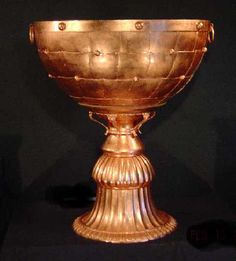
The priests had laws about this practice (Exodus 30:18-21). Here it is explained that a copper laver was placed in the court, between the Tabernacle and the altar of burnt offering, in which the priests had to wash their hands and feet before entering the Tabernacle or approaching the altar of burnt offerings, hence before all their priestly functions. As no one is allowed to approach a king or prince without due preparation, which includes the washing of the hands and feet, so the Israelite, and especially the priest, is forbidden in his unclean condition to approach God, for if such a one came defiled, he was subject to die.

Feet Washing in the Old Testament

The practice of providing water for guests to wash their feet is illustrated on the occasion of a mysterious visit by “three men” to Abraham.

In Genesis 18:24 we read: “And he lift up his eyes and looked, and, lo, three men stood by him: and when he saw them, he ran to meet them from the tent door, and bowed himself toward the ground, and said, My Lord, if now I have found favor in thy sight, pass not away, I pray thee, from thy servant: Let a little water, I pray you, be fetched, and wash your feet, and rest yourselves under the tree.”

Later, Abraham’s nephew (Genesis 11:27), Lot, made a similar offer to two angels who came to the city of Sodom where he and his family lived, to destroy the city because their immorality has become “so great before the LORD that the LORD has sent” angels to destroy it (verse 13).

“(1) Now the two angels came to Sodom in the evening as Lot was sitting in the gate of Sodom. When Lot saw them, he rose to meet them and bowed down with his face to the ground. (2) And he said, ‘Now behold, my lords, please turn aside into your servant’s house, and spend the night, and wash your feet; then you may rise early and go on your way.’ They said however, ‘No, but we shall spend the night in the square.’ (3) Yet he urged them strongly, so they turned aside to him and entered his house; and he prepared a feast for them, and baked unleavened bread, and they ate” (Genesis 19:13).

(See also Judges 19:20, 21. To understand the context here, starting from verse 1 may be good).

The act of feet washing in the above cases reflects a spirit of LOVE, SERVICE and HUMILITY = WILLING SACRIFICE TO PLEASE THE HEAVENLY FATHER, who reads the heart of men.

Feet Washing – In the New Testament

The Woman’s Tears and Perfume

those who are forgiven much love much

Feet washing in the New Testament is found in Luke 7:36-50. It is six days before the Passover (Luke 12:1) a Pharisee named Simon invited Jesus to his home for a meal. While he was seated at the table, a woman “who had lived a sinful life in that town” came to the Master with an alabaster jar of costly perfume.

“(38) and standing behind him [Jesus] at his feet, weeping, she began to wet his feet with her tears, and kept wiping them with the hair of her head, and kissing his feet and anointing them with the perfume. (39) Now when the Pharisee who had invited him saw this, he said to himself, ‘If this man were a prophet he would know who and what sort of person this woman is who is touching him, that she is a sinner.’

(40) And Jesus answered him, ‘Simon, I have something to say to you.’ And he replied, ‘Say it, Teacher.’ (41) ‘A moneylender had two debtors: one owed five hundred denarii, and the other fifty.

(42) When they were unable to repay, he graciously forgave them both.

So which of them will love him more?’

(43) Simon answered and said, ‘I suppose the one whom he forgave more.‘ 

And He said to him, ‘You have judged correctly.’

(44) Turning toward the woman, he said to Simon, ‘Do you see this woman? I entered your house; you gave me no water for my feet, but she has wet my feet with her tears and wiped them with her hair.

(45) You gave me no kiss; but she, since the time I came in, has not ceased to kiss my feet.

(46) You did not anoint my head with oil, but she anointed My feet with perfume.

(47) For this reason I say to you, her sins, which are many, have been forgiven, for she loved much; but he who is forgiven little, loves little.’

(48) Then he said to her, ‘Your sins have been forgiven.’ (49) Those who were reclining at the table with him began to say to themselves, ‘Who is this man who even forgives sins?’ (50) And he said to the woman, ‘Your faith has saved you; go in peace‘” (Luke 7:38-50 NASB).

Dear friends, what can WE do as did this woman?

In the Mark account of another occasion, Mary, the sister of Lazarus, even poured the perfume on Jesus’ head (Mark 14:3).

How can we anoint the minds of our brethren, as suggested by the head?

Perhaps by praying for our brethren’s strength, that they might endure all for CHRIST.

This is so important, as would we not ourselves wish others to pray for us to more than overcome, which is the desire of our entire existence—to bring JOY to the Father by pleasing Him more? What more than to feel his Perfect Loving counsel moment by moment?

Perhaps anointing the head of our brethren can also mean sharing spiritually edifying thoughts and asking faith-building questions as well as letting the subject matter discussed or studied, be one that feeds the New Creation in Christ so as to encourage fellow consecrated believers to be fully consumed in their thought processes upon heavenly things since “a mind set on the flesh is hostile toward God; for it does not subject itself to the law of God, for it is not even able to do so, and those who are in the flesh cannot please God. However, you are not in the flesh but in the Spirit, if indeed the Spirit of God dwells in you” (Romans 8:7-9).

How can we wash each other’s feet as this woman did for Jesus?
How can we show true hospitality likewise to our fellow brethren in Christ?

The specific and precise answer for each consecrated child of God may be unique and personal, just as each has been given by God uniquely specific talents to use in His service in the body of Christ. But how can we make sure our talents in God’s service are not buried? Perhaps by COURAGE IN CHRIST and by asking our Heavenly Father to eradicate FEAR of man from our lives while holding on to the REVERENTIAL FEAR of GOD—the fear of doing wrong in the eyes of God alone. See post titled: A Proper Fear

Does FEAR OF MAN … fear of past mistakes (as with the Apostle Paul before he became fully enlightened) … fear of being misunderstood and thus misrepresented and shunned or separated from the general assembly, or labelled “crazy” or “a missfit,” “the radical one,” stop us from BEING as CHRISTLIKE as we can and striving to moment by moment develop into the likeness of Christ by getting outside of the CARNAL COMFORT ZONE? Let it not!

This means, going BEYOND the PAIN BARRIER!

If you are not suffering for righteousness sake in some way, shape, or form, it means YOU ARE NOT working to your full potential in CHRIST.

“Indeed, all who desire to live godly in Christ Jesus will be persecuted.” (2 Timothy 3:12)

“For you have been called for this purpose, since Christ also suffered for you, leaving you an example for you to follow in His steps…” (1 Peter 2:21)

The consecrated until death “stars of heaven” class are the “heirs according to the promise” (Galatians 3:29) and coheirs of Christ (Romans 8:17). But such will be heirs only if they display the forgiving, repenting, and humble spirit among men, as we find in the weeping woman who washed Jesus’ feet with her tears of remorse and reverential thankfulness in being worthy of but touching the hem of the garments of Jesus. (Matthew 6:15) She had heard among the crowds that his kingdom was not of this world, and now she was able to SERVE him and be CLEANSED from her sins by him—because of her desire to have her sins forgiven. Later, if she continued on, she would be washed in this antitypical lamb’s blood. Her REVERENTIAL FEAR wished only to do right in God’s sight, recognizing her need for a redeemer.

Since Simon was a Pharisee, he may have considered himself to be rather important and may have felt he had bestowed an honor to Jesus by inviting him to dinner.

Was Simon embarrassed or afraid of what others would think of him if he showed Jesus hospitality? This Jesus who had allowed the woman considered in the public eye as inferior, to come near him?

Do you think Simon’s attitude was one of self-righteousness? Self-importance?
Do we ever allow this feeling to creep into us like LEAVEN?

To rid our minds of any such poison to the New Creation in CHRIST, let us focus our thoughts upon the Son of God who humbled himself even to the death of the cross (Philippians 2:8).

Anointing the Feet

In John 12:13 Mary anointed Jesus’ feet with costly ointment of spikenard six days before the Passover, when Jesus came to Bethany. [Note: this would be Nisan 10th after 6pm and an appropriate time for anointing the Passover lamb—whom Jesus himself was, symbolically.] Mary displayed her loving devotion to the Master by using her hair to wipe Jesus’ feet.

Although Judas’ perhaps insincere words highlight his dissatisfaction with Mary’s use of this expensive perfume (“worth a year’s wages”), Jesus said that she should be let alone, because she did what she could.

In fact, Jesus commended Mary’s actions, in Matthew 26:11-13: “(11) For you always have the poor with you, but you will not always have me. (12) In pouring this ointment on my body, she has done it to prepare me for burial. (13) Truly, I say to you, wherever this gospel is proclaimed in the whole world, what she has done will also be told in memory of her.”

What a beautiful illustration how true Christians should treat their most valuable assets on earth—the feet members of Christ that remain. In these we see Christ. They profess consecration, and evidence this with acts of true loving kindness, and manifestations of concern, gentleness, patience, assistance, and sympathy. They strive to bless others as Mary did with Jesus, lavishing costly, symbolic perfume upon the body of Christ, the Church.

As the washing of another’s feet is not a glamorous work, and considering the imperfections that each of us have, it takes a large measure of love, phileo and AGAPE love, and humility, to press forward in striving to serve our brethren.

Let us not allow differences along one line or another, nor misunderstandings, hinder us from seeking to do good unto all that we have opportunity, especially the household of faith. (Galatians 6:10, 1 Peter 3:11, Psalm 34:14, Micah 6:8)

Washing the Disciples’ Feet

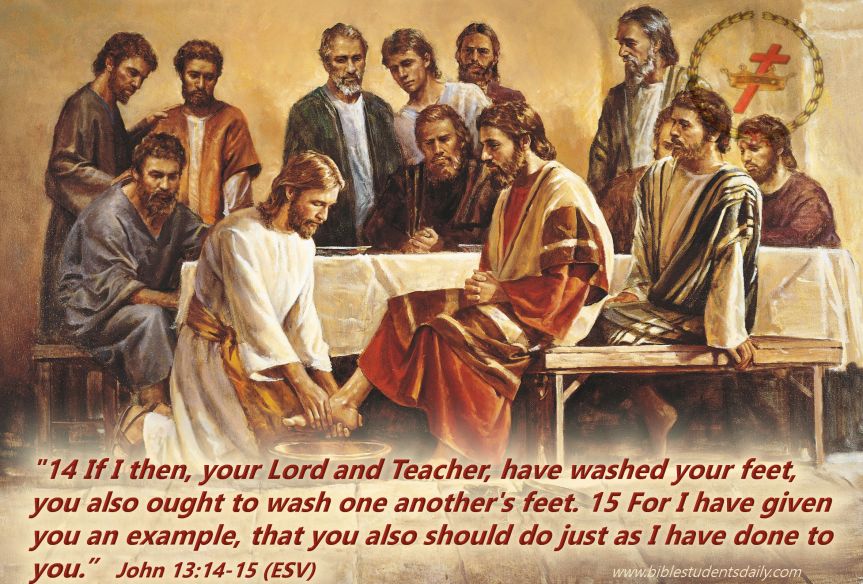
One of the marks of female saintship in the early church was, “if she have washed the saints’ feet” (1 Timothy 5:10). Feetwashing being necessary at that time, became a synonym of service and kind hospitality. To illustrate this same principle of service and humility, Jesus used this same custom on the night of the Last Supper:

At the end of Jesus’ ministry and “just before the Passover Feast,” and when “the evening meal was being served,” Jesus washed his disciples’ feet. The disciples must have been shocked and silent that the Great Teacher, their Lord, would do such a thing. Simon Peter did not want Jesus to wash his feet at first, until the Master said that unless he washed Peter’s feet, he could have no part with him in the kingdom. Then Peter was willing to have his whole body washed, yet Jesus pointed out that he who is clean needs only to wash his feet. Jesus pointed out that not all of them were clean, the reference obviously being made to Judas.

Jesus admonished the disciples: “(14) If I then, your Lord and Teacher, have washed your feet, you also ought to wash one another’s feet. (15) For I have given you an example, that you also should do just as I have done to you” (John 13:14-15).

Jesus’ act was intended as an example in humility and a lesson to the apostles who seem still to have had a spirit of rivalry for preeminence. To our understanding, the lesson was that our Lord’s followers were not to shun any service, however menial, that would enable them to assist or comfort one another.

Jesus’ lesson is amplified by his words in John 13:34, 35: “A new commandment I give unto you, That ye love one another; as I have loved you, that ye also love one another. By this shall all men know that ye are my disciples, if ye have love one to another.”

Not until they had received the holy Spirit on the day of Pentecost, were the disciples of Christ able to manifest their determination to serve Christ in a way that would enable them to become pillars of the Church (Acts 2:24, 16-18, 33, 38).

Feet Washing – TODAY

When it comes to helping brethren, let us gladly do the work of feet washing, illustrated for us by the Master himself who taught the disciplines the lesson of HUMILITY, “that they should love one another to such an extent that they would consider no service too great nor too degrading which would minister to each other’s comfort” (Br. Charles T. Russell, Biblical Expository 1).

Here are some encouraging words of Br. Oscar Magnuson from a 1932 Bible Students Reunion Convention Report:

“If we place a limit on what we are willing to do and to bear for the Lord, the Lord might find it necessary to give us a body with limited capacities in the resurrection. In that case a divine body would not suit us, for such a body is unlimited in bodily capacities.”

There are hundreds of opportunities of showing the meek, lowly, and loving spirit of our Master. As God’s stewards and servants, it is not self that we are to minister and serve and pamper, but it is our mission to “do good unto all men as we have opportunity, especially to the household of faith,” remembering that we are to walk in his footsteps who “came not to be ministered unto [served], but to minister [serve] and to give his life a ransom for many” (Mark 10:45, Matthew 20:28).

In Reprint 1101, Br Russell writes that “the entertainment of any of the household of faith, is really the fulfillment of our Lord’s injunction, ‘See that ye wash one another’s feet.’ But none should be permitted to overdo themselves in this blessed service, nor to deprive themselves of the spiritual communion of the meetings. To this end all have been urged to make only very simple arrangements, that both visitors and entertainers may have their principal feast upon the spiritual meat. Come, then, expecting a warm welcome to such plain things as we have ourselves.”

In our sympathetic desire to help others be more than overcomers, a reciprocal washing of one another’s feet can include:

  • Desiring and maintaining loving fellowship with the members of Christ’s body as did Jesus spend in that upper room SERVING his disciples;
  • Praying for each other, as our Lord Jesus taught in his prayer in John 17.
  • Encouraging each other to fight the good fight of faith and become transformed in newness of life by renewing the mind when we dwell on things that are above. For example, “Speaking to yourselves in psalms and hymns and spiritual songs, singing and making melody in your heart to the Lord” (Ephesians 5:19).
  • Within the ecclesia and among those with whom we have frequent fellowship, if we are actively engaged in promoting one another’s spiritual growth and development, we should be able to appreciate that all of our brethren have certain qualities, graces, or attributes that can benefit us; and we, likewise, should be on the alert as to how we can be of help to them.
  • Volunteering for ecclesia projects.
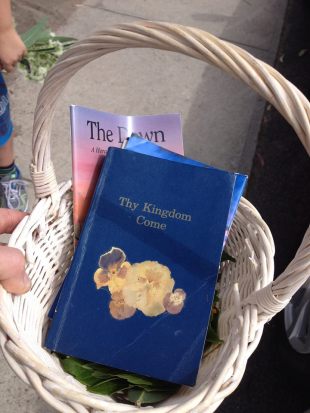
  • Entertaining visitors with an offer of a booklet or Divine Plan Book.
  • Witnessing to all humans at every single chat we have with another.
2..jpg

  • Providing transportation.
  • Sending messages of comfort to all who write messages on the Old Ron email list.
  • Sharing tapes or truth literature.
  • Typing, proofreading.
  • Testifying at Testimony meetings.
  • Sharing hymns, psalms, and Bible Scriptures over the phone or conference calls etc.
  • Sharing bible study magazine articles or poems written.
  • Sending little “keep pressing onward and upward” parcels of spiritual items to edify.
  • Sending item of use to our brethren worldwide E.g. Africa, Philippines…
  • Visiting the ill, hospitalized or isolated.
hospitalization.jpg

  • Reading the Scriptures morning and evening  with your own children/family.
  • If you have a garden: sharing some of your garden’s edible produce with brethren and friends.
  • Creating a one or 2 page witnessing ad/flier and distributing amongst the public as a family activity.
  • Helping your children leave fliers on the tables and seats at shopping centres and at supermarkets.
  • Sending in bill payments with a booklet inserted inside them letting someone know about GOD’s GLORIOUS KINGDOM to come to give the world HOPE!
  • Offering to set up Convention/Camp Book Tables.
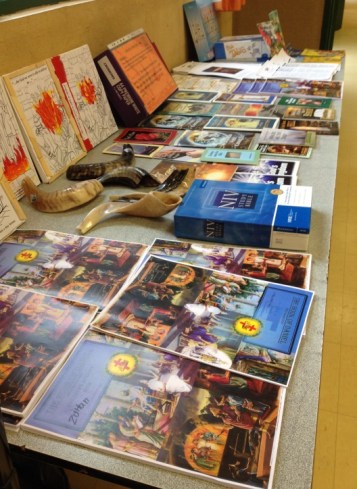
book table.jpg

  • Coordinating a class choir.
  • Opening up your home for a weekday Bible Study.
  • Having an email sign-off Scripture “logo” — let CHRIST be what others remember you by.
  • Asking the brethren who have websites how you can contribute your skills to aid in the witnessing efforts.
  • Asking your Elders how you could help lighten their load by supporting them in their preparations for the Ecclesia.
  • Making bookmarks from pressed leaves to sell to raise money for some Truth related cause or to give out as gifts and reminder of Scriptural words of encouragement.
  • Offering your time for Sunday School teaching and Children’s Camp /Convention lessons.
  • Sitting next to someone different during ecclesia meeting intermissions at ecclesia and share Scriptures and Scriptural thoughts.
  • Coming prepared to class studies.
  • Finding an Elder who you can be your mentor and have Bible studies, Question and Answer email studies etc.
  • Take the kids on “witnessing bike trips.”

boy.jpgesther witnessing.jpg

Each of us should realize that we have something to give for the edification of the body. We should be faithful in contributing to our ecclesia studies, praying for others, and being a model of someone whose life is undergoing the transformation process; being, therefore, an example of a believer.

Let us be faithful in washing one another’s feet!

2c9752511c569e1794549fdcca7c8aa6.jpg

Acknowledgement

  • Br. Homer Montague, for source material from his article in the Herald of Christ’s Kingdom (March/April 1998), titled “The Privilege of Feet Washing.”
  • Br. Charles T. Russell, Biblical Expository 1
  • Br. Oscar Magnuson for source material from a 1932 Bible Students Reunion Convention Report.


This post’s URL is:
https://biblestudentsdaily.com/2017/03/27/washing-one-anothers-feet-a-privilege/

Enter your email address to subscribe to this blog and receive notifications of new posts by email.

Save

Save

Save

STUDY 4: The Court (“Holy Place”)

1. COURT --- .jpg

The Tabernacle was surrounded by a yard, or “Court (Exodus 27:9-19), toward the rear of which it stood, and this courtyard is referred to by the Bible translators, as the “holy place” see Leviticus 6:26 and 14:13.

The Court represents the condition of justification, entered through faith in Christ, the “gate.” The tabernacle represents things from the time of Jesus forward. However, there are three time periods in the Plan of God when God through His holy Spirit deals with justified people:

  1.  The Ancient Worthies from Adam until Jordan;
  2.  The Church during the Gospel Age;
  3.  The world during the Millennium Age (Messianic 1000 year reign of Christ with the Church the 144,000 Elect Bride of Christ members).
  • The same is shown in the time in the ark (which pictures redemption) a total of 381 days, which is 3 x 127, that is, three times the age of Sarah, who represents the Abrahamic Covenant.
  • Also in the three times the doves were sent out from the ark in Genesis chapter 8 three missions of the holy Spirit.
  • And again in the three stories or levels of the ark, thus three time periods of justification.

Who Could Enter the Court?

Any Israelite (typical of a justified believer of the Gospel Age) was allowed to come into the Court, as indicated in Leviticus 1:1-3 (ESV):

“(1) The Lord called Moses and spoke to him from the tent of meeting, saying, (2) ‘Speak to the people of Israel and say to them, When any one of you brings an offering to the Lord, you shall bring your offering of livestock from the herd or from the flock. (3) If his offering is a burnt offering from the herd, he shall offer a male without blemish. He shall bring it to the entrance of the tent of meeting, that he may be accepted before the Lord.’”

Leviticus 1:11 shows also that Israelites were to bring their offerings into the court, and kill them there, “on the side of the altar northward before the Lord.” However, the priests would take the blood thereafter, for use at the altar. “And the priests, Aaron’s sons, shall sprinkle his blood round about upon the altar.”

Note: Northward is the direction of God, and the Heavenly Realm. Offering on the north side of the altar emphasizes that the offering is made to God.

The offerers (Israelites) represent believers, coming in faith to make an offering to God whether believers in this age, or in the next.

Israelites commonly came in to make offerings. But the “daily sacrifice” was one lamb in the morning, another in the late afternoon, and these were done by the priests (Exodus 29:38-39).

The daily sacrifice was a burnt offering and it represents the ransom sacrifice of Jesus, who fulfilled this type, thus causing it to cease. The morning and evening times correlate with Jesus being put on the cross in the morning and expiring in the afternoon.

The Apostle Paul explained that our sacrifice is not just to be twice a day but 24/7 hence he defined the consecrated ones of this Gospel Age of the “High Calling” into Christ, as “living sacrifices” who “are holy acceptable unto God, which is your reasonable service” (Romans 12:1).

Around and Inside the Court

(A) Copper

In the Court, the metal used most often was copper.

Copper represents human nature, either justified or perfect.

In John 3:14, Jesus compares himself to the copper serpent lifted up in the wilderness in the days of Moses, which healed those who looked to it. The copper of that serpent represents the perfect humanity of Jesus. The serpent symbol is used to represent that Jesus takes the burden of our sins upon himself, thus curing us from the “snakebite” of sin.

The court contained the “brazen altar” for use by the priests. Possibly Levites assisted the priests in some ways respecting the sacrifices (other than putting it on the altar).

(B) Court Measurements

The court was 50 cubits wide and 100 cubits long thus three of them could fit into the floor plan of Noah’s Ark, which was 50 cubits wide and 300 cubits long (Genesis 6:15). This also suggests that there are three time periods in God’s Plan (as explained at the start of this Tabernacle Study No. 4) where justified persons are called of God. It is notable that the “house of the forest”, picturing the call of the world during the Millennium, was also the size of the court (1 Kings 7:2).

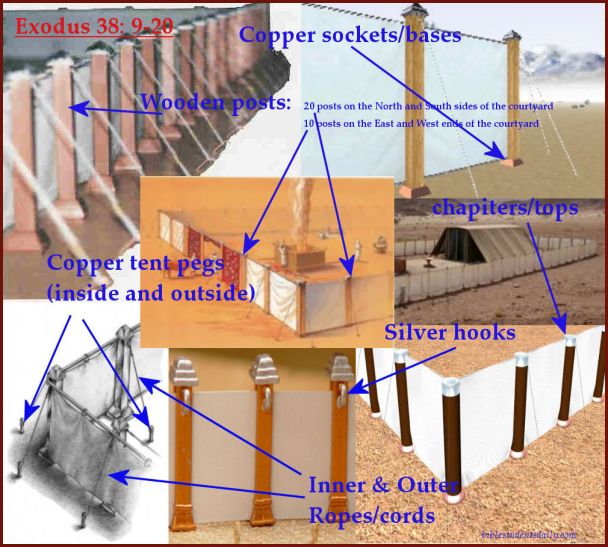
The court was formed by a fence of white linen curtains (see Study 9 on this website in the series “Beauties of the Tabernacle,” titled “The Gate. The Door. The Veil”, suspended from silver hooks, set in the tops of wooden posts 5 cubits (7 1/2 feet high), which were set in heavy sockets of copper (mistranslated brass), and braced, like the tent which covered the Tabernacle, with cords and pins.

(C) The Silver Hooks

The silver hooks in the courtyard posts by which the posts held up the curtain, represent the divine Truth, by the knowledge of which the justified believer holds on to the righteousness of Christ. Silver is a general symbol of Truth but perhaps more specifically, that TRUTH which centers and deals with the RANSOM — the redemption accomplished in Christ Jesus (Tabernacle Shadows, page 114).

As these hooks were small in size they represent the small amount of Truth necessary to justify one.

Note: The Tabernacle Proper’s 100 silver sockets which supported the whole structure was made from the ransom or redemption money paid as a poll tax by the Israelites. (Exodus 30:12-16; 38:25-28.) In “Notes on the Tabernacle” (page 21) we read:

“. . . [God] enjoined that, whenever Israel was numbered as His people, every man must give a ransom for his soul. The price was fixed by God Himself.

Each man, whether poor or rich, must bring the same. One could not pay for another; but everyone must tender his own ransom-money of pure silver and of perfect weight. `Half a shekel, after the shekel of the sanctuary (a shekel is twenty gerahs), a half-shekel shall be the offering of the LORD.’ (Exodus 30:13) Other Gospel truths here shine out. When the question came to be one of ransom, the poor and the rich, the foolish and the wise, the ignorant and the learned, the immoral and the moral, stood on the same level. Each person was estimated by God at the same price. He proved Himself no respecter of persons.”

Hence, since most of the silver used in the Tabernacle was for the 100 foundation sockets for the Tabernacle Proper, this beautifully points to the TRUTH relative to the RANSOM sacrifice of our Lord as the foundation Truth upon which the entire plan of God rests.

“The four gold-plated pillars (posts) at the entrance of the Most Holy supporting the (second) Vail stood in four SILVER sockets, (reality, truth, verity) seeming to say to us, when you come inside this vail, you will be perfect – really and truly new creatures” (Tabernacle Shadows, page 115).

(D) The Posts (pillars)

The posts of the Court (Exodus 27:10-17) represent the justified believers whose imperfections are covered by Christ’s righteousness.

The function of the posts is to hold up to public view one’s faith in Christ who is represented by the linen curtain. This, brethren, is our purpose for being. This is why we are here. To show forth the mercy and goodness of Christ’s redemptive work, as Paul says, “in the midst of a crooked and perverse generation among whom ye shine as lights in the world” (Philippians 2:15).

The posts were made of wood which is a corruptible material thus implying that the class typified, are not actually perfect as human beings.

(E) Sockets of Copper

The posts were set in sockets of copper which were sunken in the sand for stability.

The copper sockets represent our standing of perfect human beings, and this beautifully represents justification by faith, (despite the actual fact of our personal imperfections) which we can only hold onto by the aid of the Truth. This is the justification spoken of in Romans 5:1, “Therefore being justified by faith, we have peace with God through our Lord Jesus Christ.”

Some use the term “tentative justification,” to describe a Christian in the court condition before they reach the point of consecration at the door of the Tabernacle. However the priests also served in the court, and the priests represent the fully consecrated/spirit begotten. So their justification is also indicated in the court. If we simply relate that the court represents justification through faith in Christ, perhaps this suffices. It need not be one way or another  only unconsecrated (not spirit begotten) believers or only consecrated (spirit begotten) believers — as the concept of being justified by one’s faith in Christ can pertain to believers before consecration or believers after consecration.

Thanks to being reckoned as righteous in God’s sight, we are judged as to faithfulness in our intentions rather than in our actions. “For if there be first a willing mind, it is accepted according to that a man hath, and not according to that he hath not” (2 Corinthians 8:12).

Now, with rejoicing we can say with the Apostle Paul, “I can do all things through Christ which strengtheneth me” (Philippians 4:13).

It is thus that our faith becomes “rooted” and the philosophy of the ransom begins to appear. It is of this which Paul speaks in Colossians 2:7, “rooted and built up in him, and stablished in the faith, as ye have been taught, abounding therein with thanksgiving.”

(F) Guy Lines/Ropes/Cords & Pegs

2. FENCE EQUIPMENT.jpg

There is more to the philosophy of the ransom that prevents our faith from becoming weak and unstable. This is shown in the system of guy lines which uphold the wall of the court and tie the posts to the ground.

These cords represented the things which tie the justified believer to the earth; and there were two sets of cords and pins, one set inside the Court, the other, outside.

The set outside of the Court, outside of the justified state, represented the sin in the flesh which ties the believer to the world.

The set inside the Court represented the earthly things: joys, studies, music, etc., right enough in themselves, which bind the believer to the world. These are the weights (Hebrews 12:1).

These ropes were anchored by copper pegs tent pegs. One of these was installed inside the court and the other on the outside. Being copper, as opposed to wood covered with copper, they showed actual human perfection.

As we scan the pages of history we see just two and no more perfect men: Adam and Jesus. We see the one who lost his standing in the court, Adam, as the peg driven outside the fence. The other, grounded firmly in the court, pictures Jesus. These two have one connection the ransom pictured by this cord even as it was by Rahab’s scarlet thread. It is this simple philosophy of the ransom a perfect human life for a perfect human lifethat gives stability to our faith. How beautiful! How simple! Substitutionary atonement is the central doctrine of the Bible.

“For since by man came death, by man came also the resurrection of the dead. For as in Adam all die, even so in Christ shall all be made alive” (1 Corinthians 15:21, 22).

“For if through the offence of one many be dead, much more the grace of God, and the gift by grace, which is by one man, Jesus Christ, hath abounded unto many” (Romans 5:15).

It is the very simplicity of the concept that speaks to its authenticity. Too good to be true? Too good not to be true! And yet our faith is sometimes weak. We need further support.

3. COURTYARD PILLARS, BANDS, BASES, SILVER EYELETS.jpgAccording to the Temple Institute in Israel:
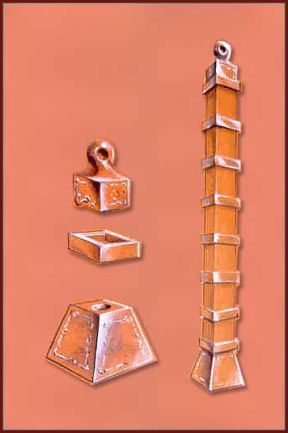
The courtyard pillars, (amudim) were composed of three main components: The acacia pillars themselves, which were reinforced by silver bands, (chishukim); the copper bases, (adanim), into which the pillars were inserted; and the silver eyelets, (vavim), which were fitted onto the tops of the pillars, for stretching the curtains, (yeriot) across.

“fillets” Others have concluded that they were rigid, whether rods or bands, and served to stabilize the posts from leaning toward each other. We think that is correct.

The Furnishings In The Court

The Brazen Altar

4. BRAZEN ALTAR.jpg

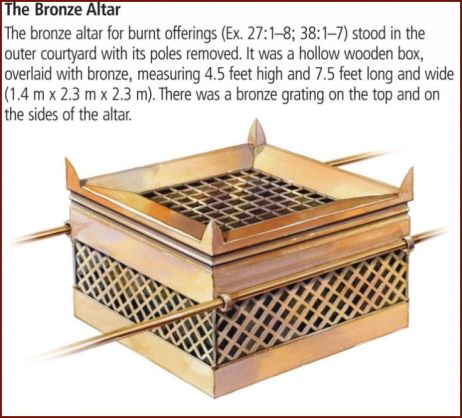
The Brazen Altar was the first item encountered in the Courtyard. It was five cubits square, and 3 cubits tall (Exodus 27:1).

In each of the four corners there was a horn made from the same piece of acacia wood as the altar itself and the altar was over-layed with copper.

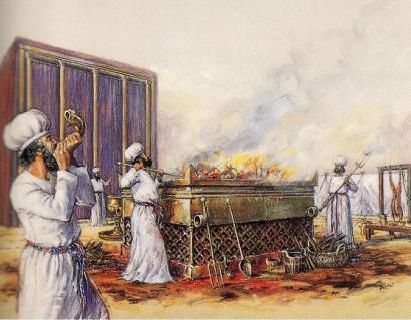
The Brazen Altar was used to burn up sacrifices placed upon it, such as during the consecration of the priesthood and the Day of Atonement.

Various utensils belonged to its service fire pans (called censers), for carrying the fire to the ‘Incense Altar,’ basins to receive the blood, flesh hooks, shovels, etc.

A Christian understands this altar is not an ornament of the Court, but a place where bulls and goats were killed and sacrificed, a place many times covered with blood and ashes, with the smell of burning meat, and much smoke. The grate of this altar was not on the top like a modern barbecue. It was placed half way between the bottom and the top of the altar:

“Thou shalt put it [the grate] under the compass of the altar beneath, that the net may be even to the midst [Strong’s #2677: half or middle] of the altar” (Exodus 27:5). This placed the grate at the 1½ cubit mark, the same height as the mercy seat in the Most Holy. Both are considered in the design to be at the same “level;” neither towers above the other.

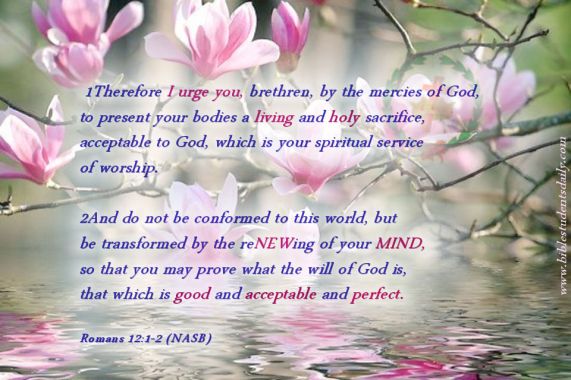
A Christian recognizes that Jesus has been sacrificed for him and starts to recognize that a similar sacrifice is needed from him if he is to enter beyond the next door. The sacrifice we have to offer, is as the Apostle Paul expresses it, in Romans 12:1.

rom-12-1-2-ad

Thus, the antitypical priesthood of this Gospel age are privileged to use this altar (Christ Jesus), in presenting their bodies “a living sacrifice, holy, acceptable unto God” for is it not the altar that sanctifies the gift?

You blind men! For which is greater, the gift or the altar that makes the gift sacred?” (Matthew 23:19).

“Your sacrifice would not be holy and acceptable, but it is made holy and acceptable as such by the Advocate [Christ Jesus] imputing of his merit to cover your sacrifice” (“What Pastor Russell Said,page 614).

Presenting our bodies as “living sacrifices” to God includes all our thoughts, words and doings and doing the best we can in all we do to bring God glory, honor and praise. It is Christ Jesus, our antitypical High Priest who alone is able to offer up the antitypical sacrifices. All that the followers of Jesus do, therefore, is to present (consecrate, set apart) themselves, as pictured in the type by the goat’s being, tied at the door of the Tabernacle. “It is after Jesus lays hold of this individual, accepts his consecration, imputes His own merit, and offers him to the Father, that the Father’s acceptance is manifested through the Son… by the begetting of the Holy Spirit. Thereforth, such an one is a member of the Body of Christ, and his name is written in the Lamb’s Book of Life, from which it will not be blotted out if he maintains his faithfulness” (What Pastor Russell Said, page. 614).

“It is the New Creature’s business to keep the old nature on the altar, upon which the great High Priest has put it. In other words, the New Creature must keep the old nature dead, hold it in subjection. When our flesh is brought into contact with the fires of experience for its consumption, it is the old creature that weeps, not the New Creature. Let the goat weep if it will. The New Creature will rejoice in the Lord and in His providential care, as daily it grows in grace and in knowledge. When the old creature is knocked out, or brow-beaten, as the Apostles says (1 Corinthians 9:27), it will groan; but the New Creature will be glad and rejoice in the Lord… We rejoice because God’s favor and blessing are with us as New Creatures.” (What Pastor Russell Said, page 613.) See also Acts 16:26, Philippians 4:4.

Jesus allowed himself to be sacrificed for the entire world of mankind. He was perfect and became flesh to do the will of his Heavenly Father (John 4:34, John 6:38).

The wood of the altar, typifying humanity, reminds us that Christ became a man for the express purpose of experiencing our infirmities and “to minister, and to give his life a ransom for many” (Mark 10:45).

“For we have not an high priest which cannot be touched with the feeling of our infirmities; but was in all points tempted like as we are, yet without sin” (Hebrews 4:15).

5-bronze-altar

There is a thought that wood was used to make the articles of lighter weight and thus, more easily portable, than if of solid metal. This was an important consideration when they traveled.

As discussed earlier in this series of “Beauties of the Tabernacle,” the use of copper represents the human nature in its perfection, a little lower than the angelic nature (unlike gold, which represents the divine nature, far above angels, principalities and powers).

As gold and copper are much alike in their appearance, yet different in quality, so the human nature is an image and likeness of the divine, adapted to earthly conditions.

“The Tabernacle’s altar of burnt-offering represents… the ransom-sacrifice of Christ Jesus (Tabernacle Shadows, page 22) — the ‘altar’ unto which the world of mankind in the Millennial age, will bring its sin-, trespass-, burnt-, and peace-offerings. (Tabernacle Shadows, page 95,96)” (“Notes on the Tabernacle,” page 134).

The horns of the Altar of Burnt Offering were in themselves symbols of power; yet this power came from the blood which sanctified it. The Scriptures do set forth the fact that one guilty of a sin against his fellowman, when in danger of being apprehended, might flee for asylum to the altar — take hold of its horns, and find a safe refuge there (1 Kings 1:50; 2:28).

“We too have an altar, the power of which stems from the blood of Christ Jesus, that sanctified it. We too, had sinned against our King, who could justly have destroyed us. But we fled to the altar and found sanctuary, an asylum, a refuge, there. Our faith in the precious blood, justified us — made us free as it were; but only on one condition could we continue to be free and that was that we covenant with our King thereafter to walk “worthily.” Having entered into this covenant we are safe from the “avenger.” But should the time ever come when we would break that covenant by profaning the blood of the covenant by which we were sanctified — outraging the Spirit of grace (Hebrews 10:29) — we would then fall directly into the hands of the “avenger” and be put to death — the Second Death!” (“Notes on the Tabernacle,” page 130).

Was there a ramp?

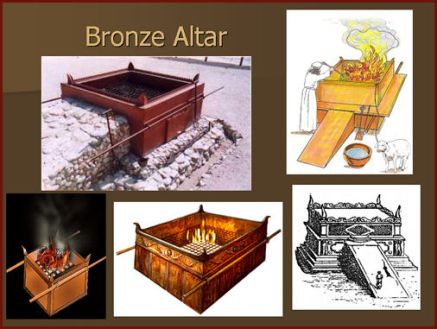
Some may question whether there was a ramp attached to this brazen altar which would assist the priests with getting the sacrifices onto the large surface area of the altar.

We read in Exodus 20:26, “Neither shalt thou go up by steps unto mine altar, that thy nakedness be not discovered thereon.”

4.4 - BRONZE ALTAR.jpg
“It is worthy of note that the Hebrew word ‘maalah’ occurring [here] in Exodus 20:26 and there rendered ‘steps’ in the KJV, according to Young’s Analytical Concordance to the Bible means ‘a going up, ascent.’ It would therefore cover even such a thing as a ramp, though this latter term has nowhere been used in the common version of the Bible. It has been rendered ‘stairs’ (2 Kings 9:13; Nehemiah 3:15; 12:37; Ezekiel 40:6; 43:17) and ‘steps’ (Exodus 20:26; 1 Kings 10:19, 20; 2 Chronicles 9:18,19; Ezekiel 40:22, 26, 31, 34, 37, 49).

“No priests were ever to enter the precincts of Jehovah — the Tabernacle’s Court, Holy, or Most Holy — without the linen breeches ‘to cover their nakedness’ upon them (Exodus 28:42,43). Especially is the injunction given that Jehovah’s altar was not to have any steps (stairs or ramp) unto it, since an approach by way of such would necessitate the ‘lifting of the robe’ and the consequent exposure of the priest’s nakedness (Exodus 20:26)” (Br. Anton Frey, “Notes on the Tabernacle,” page 133).

The Laver

4..jpg
“The LORD spoke to Moses, saying, ‘You shall also make a laver of bronze, with its base of bronze, for washing; and you shall put it between the tent of meeting, and the altar, and you shall put water in it. Aaron and his sons shall wash their hands and their feet from it; when they enter the tent of meeting, they shall wash with water, so that they will not die; or when they approach the altar to minister, by offering up in smoke a fire sacrifice to the LORD. So they shall wash their hands and their feet, so that they will not die; and it shall be a perpetual statute for them, for Aaron and his descendants throughout their generations’” (Exodus 30:17-21).

The Laver stood between the brazen altar and the door of the Tabernacle or “sanctuary”. It was a receptacle for water where the priests washed his feet and hands leaving behind the last traces of the flesh and of his contact with the surrounding world, before entering the Tabernacle.

The Laver as a whole represented the Word of God, Jesus was the word who cleanses the believer through the washing of water by the Word (Ephesians 5:26).

The Laver was cast from the mirrors of women who served at the Tabernacle, thus it was made of polished copper (Exodus 38:8) which represents the brightness of Jesus’ perfection. As the priests looked into the laver, they could see the faces reflected in its polished surface, so the consecrated see the imperfections and failings of their own characters when they compare these characters to the bright perfection of Jesus by looking unto him.

2
The priests did not bathe in the Laver, but presumably drew water out of the laver using a copper pitcher for the purpose of washing his hands and feet (Exodus 40: 31, 32) otherwise the water in the laver would become dirty.

So we are greatly helped by concordances, dictionaries, etc. We cannot wash in them, but they help us in getting the Truth to cleanse us. And we likewise, cleanse our hands that they may do the will of God, and our feet that they may walk in Jesus’ footsteps, in the straight and narrow way.

At this step an approaching Christian accepts this purification as did all the followers of Jesus. Even if the Master did not need any purification, since he was perfect and without sin, by washing the feet of his disciples Jesus showed another important element of that washing: humility.

Now the Christian is at the door of the Tabernacle. After his journey through the Court, he is ready to follow his Master into the “greater and more perfect tabernacle” (Hebrews 9:11, KJV).

Acknowledgment

Br. Charles T. Russell for source material used from Tabernacle Shadows,” “What Pastor Russell Said” (Question Book).
Br. Anton Frey for source material used from Notes on the Tabernacle.
Br. David Rice & Br. George Tabac for sharing of content and editing for this post.
The Temple Institute in Israel for source material used.

Suggested Further Reading

STUDY 1: An Introduction To The Tabernacle And It’s Purpose
https://biblestudentsdaily.com/2016/09/02/study-1-an-introduction-to-the-tabernacle-and-its-purpose/

STUDY 2: The Pillar of Cloud By Day And The Pillar of Smoke By Night  https://biblestudentsdaily.com/2016/09/09/study-2-the-pillar-of-cloud-by-day-and-the-pillar-of-smoke-by-night/

STUDY 3: The Tabernacle Construction: The Holy and The Most Holy  https://biblestudentsdaily.com/2016/09/14/study-3-the-tabernacle-construction-the-holy-the-most-holy/

STUDY 5: The Camp. The Israelites.
https://biblestudentsdaily.com/2016/10/28/study-5-the-camp-the-israelites/

STUDY 6: The Levites
https://biblestudentsdaily.com/2016/11/18/study-6-the-levites/

STUDY 7: The Priests. The Day of Atonement.
https://biblestudentsdaily.com/2016/12/10/study-7-the-priests-the-day-of-atonement/

STUDY 8: The Tabernacle Coverings
https://biblestudentsdaily.com/2017/01/02/study-8-the-tabernacle-coverings/

STUDY 9: The Gate. The Door. The Vail.
https://biblestudentsdaily.com/2017/03/01/study-9-the-gate-the-door-the-vail/


The URL for this post:

STUDY 4: The Court (“Holy Place”)

Enter your email address to subscribe to this blog and receive notifications of new posts by email.

Save

Save