

Prayer of the Consecrated – Hymns of Dawn No. 16
Here is a recording of Hymn No. 16 from the “Hymns of Dawn” to aid God’s people in singing and making melody in their hearts unto God.
“(1) Come, let us shout joyfully to Jehovah! Let us shout in triumph to our Rock of salvation. (2) Let us come into his presence with thanksgiving; Let us sing and shout in triumph to him” (Psalm 95:1,2).
“My mouth shall praise Thee with joyful lips” (Psalm 63:5).
Lyrics
1.
As with gladness men of old
Did the guiding star behold;
As with joy they hailed its light,
Leading onward, beaming bright;
So, most gracious Lord, may we
Evermore be led to thee.
2.
As with joyful steps they sped
Till they found his cradle bed,
There to bend the knee before
Him whom Heav’n and earth adore;
So may we, with willing feet
Ever seek the mercy seat.
3.
As they offered gifts most rare
To that precious child there;
So may we with holy joy,
Pure and free from sin’s alloy,
All our costliest treasures bring,
Christ, to thee, our glorious King.
4.
Holy Saviour, ev’ry day
Keep us in the narrow way;
And, when earthly things are past,
Bring our ransomed souls at last
Where they need no star to guide,
Where no clouds thy glory hide.
The History Of This Hymn
Author — W. Chatterton Dix (William Chatterton), 1837-1898.
Composer — Adapted from Conrad Kocher (1786-1872); arranged by William Henry Monk (1823-1889) in 1861.
Bible Scriptures Associated With This Hymn
Psalm 49:15 (KJV) — “But God will ransom my soul from the power of Sheol, for he will receive me. Selah.”
Psalm 105:4 (KJV) — “Seek the LORD and his strength; seek his presence continually!”
Matthew 2:11 (ESV) — “And going into the house, they saw the child with Mary his mother, and they fell down and worshiped him. Then, opening their treasures, they offered him gifts, gold and frankincense and myrrh.”
Hebrews 4:16 (NAS) — “Therefore let us draw near with confidence to the throne of grace, so that we may receive mercy and find grace to help in time of need.“
James 4:8 — “Draw near to God and He will draw near to you…”
Matthew 7:13, 14 (NAS) — “(13) Enter through the narrow gate; for the gate is wide and the way is broad that leads to destruction, and there are many who enter through it. (14) For the gate is small and the way is narrow that leads to life, and there are few who find it.”
*******
THE NARROW WAY TO LIFE
(The above words are based on content from Study 11, Volume 1, (p. 207-218) “Studies In the Scriptures” by Br. Charles Taze Russell)
Our Master tells us that it is because of the narrowness of this way that the many prefer to remain on the broad road to destruction (Matthew 7:14).
Before considering this way and its dangers and difficulties, let us notice the end to which it leads—life—which may be enjoyed on various planes of being, but here our Lord uses it in reference to that highest form of life, pertaining to the divine nature—immortality—the prize for which he invited us to run.
The Divine Being, Jehovah, is the great fountain of all life, from which all these springs are supplied. All living things result from and depend on Him for life. The creature is in no sense a part or an offspring of the Creator’s essence or nature, but he is God’s handiwork infused with life.
Only in the divine nature is life independent, unlimited, exhaustless, ever continuous and neither produced nor controlled by circumstances.
Immortal signifies death-proof, consequently disease and pain-proof; it may be used as a synonym for divinity. From the divine, immortal fountain proceed all life and blessing, every good and perfect gift, as from the sun the earth receives her light and vigor.
The sun is the great fountain of light to the earth, illuminating all things, producing many varieties of color and shades of light, according to the nature of the object upon which it shines. The same sunlight shining upon a diamond, upon a brick, and upon various kinds of glass, produces strikingly different effects. The light is the same, but the objects upon which it shines differ in their capacity to receive and to transmit it.
The polished diamond is so adapted to the light that it appears as though it possessed it within itself, and were itself a miniature sun. So with man, one of the masterpieces of God’s creation, made only “a little lower than the angels.” He was so grandly formed as to be able to receive and retain life by the use of the means which God supplied, and never grow dim. Yet as the diamond can reflect no light except when shone upon by the sun, so man can possess and enjoy life only as the supply of life is continued. Man has not inherent life: he is no more a fountain of life than a diamond is a fountain of light. One of the strongest evidences that we have not an exhaustless supply of life in ourselves, or, in other words, that we are not immortal, is that since sin entered, death has passed upon all our race.
God had arranged that man in Eden should have access to life-sustaining trees, and the paradise in which he was placed was abundantly supplied with numbers of “every [kind of] tree” good for food or for adornment (Gen. 2:9,16,17). Among the trees of life good for food was one forbidden. While for a time forbidden to eat of the tree of knowledge, he was permitted to eat freely of trees which sustained life perfectly; and he was separated from them only after transgression, that thereby the death-penalty might go into effect (Gen. 3:22).
Thus the glory and beauty of humanity are seen to be dependent on the continued supply of life, just as the beauty of the diamond is dependent on the continued supply of sunlight. When sin deprived humanity of the right to life, and the supply was withheld, immediately the jewel began to lose its brilliancy and beauty, and finally it is deprived of its last vestige in the tomb. His beauty consumes away like a moth (Psa. 39:11, Job 14:10, 21). “For there is no work, nor device, nor knowledge, nor wisdom, in the grave whither thou goest” (Eccl. 9:10). But since a ransom has been found, since the death penalty has been provided by the Redeemer, the jewel is to have its beauty restored, and is again to reflect perfectly the Creator’s image when the Sun of Righteousness shall arise with healing in his wings (Mal. 4:2). It is because of the sin-offering, the sacrifice of Christ, that “All that are in their graves shall come forth.” There shall be a restitution of all things; first an opportunity or offer of restitution to all, and ultimately the attainment of human perfection by all who will obey the Redeemer.
This, however, is not the reward to which Jesus refers as the end of the narrow way. The reward promised to those who walk the narrow way is the “divine nature”—life inherent, life in that superlative degree which only the divine nature can possess—immortality.
What a hope!
Dare we aspire to such a height of glory? Surely not without positive and explicit invitation could any rightfully thus aspire.
From 1 Tim. 6:14-16 we learn that the immortal or divine nature was originally the possession of divinity only. We read: “He [Jesus] in his time [the Millennial age] will show who is the blessed and only potentate—the King of kings and Lord of lords, who only hath immortality, dwelling in the light which no man can approach unto, whom no man hath seen nor can see.” All other beings, angels, men, beasts, birds, fish, etc., are but vessels holding each its measure of life, and all differing in character, capacity, and quality according to the organism which it has pleased the Creator to provide for each.
Jehovah, who alone possessed immortality originally, has highly exalted his Son, our Lord Jesus, to the same divine, immortal nature; hence he is now the express image of the Father’s person (Heb. 1:3). So we read, “As the Father hath LIFE IN HIMSELF [God’s definition of “immortality”—life in himself—not drawn from other sources, nor dependent on circumstances, but independent, inherent life], so hath he given to the Son to have LIFE IN HIMSELF” (John 5:26).
Since the resurrection of the Lord Jesus, then, two beings are immortal; and, amazing grace! the same offer is made to the Bride of the Lamb, the “little flock” of overcomers, being selected during the Gospel age… who so run as to obtain the prize; who follow closely in the Master’s footsteps; who, like him, walk the narrow way of sacrifice, even unto death. These, when born from the dead in the resurrection, will have the divine nature and form.
This class is not to be raised from the tomb as human beings; for we are assured by the Apostle that, though sown in the tomb natural bodies, they will be raised spiritual bodies. These all shall be “changed,” and even as they once bore the image of the earthly, human nature, they shall bear the image of the heavenly. But “it doth not yet appear what we shall be”—what a spiritual body is; but “we know that when he shall appear, we shall be like him,” and share in “the glory to be revealed” (1 John 3:2, Col. 1:27, 2 Cor. 4:17, John 17:22, 1 Pet. 5:10, 2 Thess. 2:14).
Not only is this high calling to a change of nature confined exclusively to the Gospel age, but it is the only offer of this age. All others are still on the broad road—these only have as yet escaped the condemnation that is on the world. This, the only way of life now open, because of its difficulty, finds few who care to walk in it. The masses of mankind in their weakness prefer the broad, easy way of self-gratification.
The narrow way, while it ends in life, in immortality, might be called a way of death, since its prize is gained through the sacrifice of the human nature even unto death. It is the narrow way of death to life. Being reckoned free from the Adamic guilt and the death penalty, the consecrated voluntarily surrender or sacrifice those human rights, reckoned theirs, which in due time they, with the world in general, would have actually received. As “the man Christ Jesus” laid down or sacrificed his life for the world, so these become joint-sacrificers with him. Not that his sacrifice was insufficient and that others were needed; but while his is all-sufficient, these are permitted to serve and to suffer with him in order to become his bride and joint-heir. So, then, while the world is under condemnation to death, and is dying with Adam, this “little flock,” through the process of faith reckonings and sacrifice, are said to die with Christ… in order to become partakers of the divine nature and glories with him; for we believe that if we be dead with him, we shall also live with him. If we suffer with him, we shall also be glorified together (Rom. 8:17, 2 Tim. 2:11,12).
In the beginning of the Millennial age, those who now walk the narrow way will have gained the great prize for which they ran, immortality; and being thus clothed with the divine nature and power, they will be prepared for the great work of restoring and blessing the world during that age.
With the end of the Gospel age, the narrow way to immortality will close, because the select “little flock” that it was designed to test and prove will have been completed.
“Now is the accepted [Greek, dektos, acceptable or receivable] time”—the time in which sacrificers, coming in the merit of Jesus and becoming dead with him, are acceptable to God—a sacrifice of sweet odor. Death, as the Adamic penalty, will not be permitted forever; it will be abolished during the Millennial age; as a sacrifice it will be acceptable and rewarded only during the Gospel age.
It is only as “new creatures” that the saints of this age are on the way to life; and only as human beings are we consecrated to destruction, as sacrifices. If, as human creatures, we be dead with Christ, as new, spiritual beings, we shall live with him (Rom. 6:8). The mind of God in us, the transformed mind, is the germ of the new nature.
The new life would be easily choked; and Paul assures us that when begotten of the spirit through the truth, if we live after the flesh, we shall die (lose our life), but if we, through the spirit, do mortify (put to death) the deeds of the body (the disposition of the human nature), we (as new creatures) shall live; for the sons of God are those led by the spirit of God (Rom. 8:13,14).
This is a thought of utmost importance to all the consecrated; for if we have covenanted with God to sacrifice the human nature, and if that sacrifice was accepted by him, it is useless to attempt to take it back. The human is reckoned of God as dead now, and must actually die, never again to be restored. All that can be gained, then, by turning back to live after the flesh, is a little human gratification at the expense of the new spiritual nature.
There are, however, many consecrated ones desirous of the prize, and who have been begotten of the spirit, who are partially overcome by the allurements of the world, the desires of the flesh, or the arts of the devil. They partially lose sight of the prize set before us, and try to walk upon a middle road—to keep the favor of God and the favor of the world, forgetting that “the friendship of the world is enmity with God” (James 4:4), and that the instructions to those running the race for the prize are:
Love not the world, and,
seek not honor one of another,
but that honor which cometh from God only
These, who love the present world, but who have not wholly forsaken the Lord and despised their covenant, receive a scourging and purifying by the fire of affliction. As the Apostle expresses it, they are delivered over to Satan for the destruction of the flesh, that the spirit (the newly begotten nature) may be saved in the day of the Lord Jesus (1 Cor. 5:5). And if rightly exercised by the discipline, they will finally be received into the spiritual condition. They will have everlasting, spirit life as angels have it, but will lose the prize of immortality. They will serve God in his temple, and stand before the throne, having palms in their hands (Rev. 7:9-17); but though that will be glorious, it will not be so glorious as the position of the “little flock” of overcomers, who will be kings and priests unto God, seated with Jesus in the throne as his bride and joint-heir, and with him crowned with immortality.
Ours is a rugged, steep, narrow way, and were it not that strength is furnished for each successive step of the journey, we could never reach the goal.
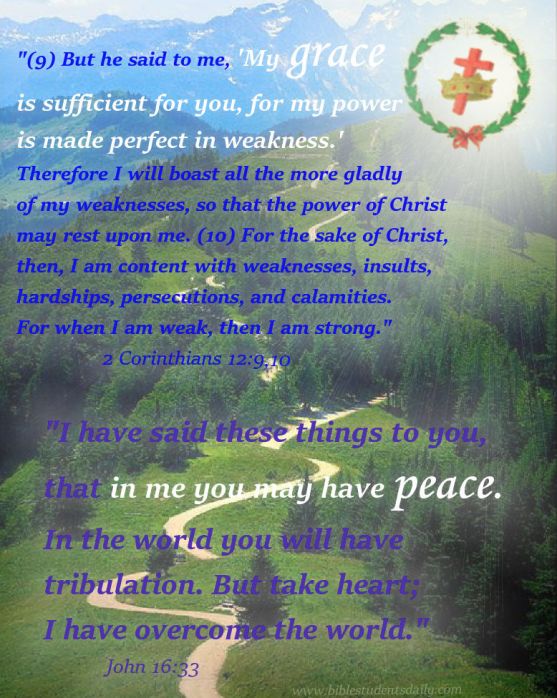
The difficulties of this way are to act as a separating principle to sanctify and refine a “peculiar people” to be “heirs of God and joint-heirs with Jesus Christ.” In view of these things, let us come boldly to the throne of grace, that we may obtain mercy and find grace to help in time of need, while we fight the good fight of faith and lay hold on “the crown of glory”—immortality, the divine nature (2 Tim. 4:8, 1 Peter 5:4).
The Highway of Holiness
While the special hope of the Gospel age is so surpassingly glorious, and the way to it is correspondingly difficult—narrow, hedged in by hardships and dangers at every step—so that few find it, and obtain the great prize at its end, the new order of things in the age to come is to be entirely different. As a different hope is held out, so also a different way leads to it.
The way to immortality has been a way which required the sacrifice [giving up, surrendering] of the otherwise lawful and proper hopes, ambitions and desires—the sacrifice forever of the human nature.
But the way to human perfection, to restitution, the hope of the world, requires only the putting away of sin: not the sacrifice of human rights and privileges, but their proper enjoyment. It will lead to personal purification and restoration to the image of God as enjoyed by Adam before sin entered the world.
The way back to actual human perfection is to be made very plain and easy; so plain that none may mistake the way; so plain that “the wayfaring man, and those unacquainted therewith, shall not go astray” (Isa. 35:8—Leeser); so plain that none will need to teach his neighbor, saying, Know the Lord, for all shall know the Lord from the least unto the greatest (Jer. 31:34). Instead of being a narrow way that few can find, it is termed “a highway,” a public roadway—not a narrow, steep, rugged, difficult, hedged byway, but a way specially prepared for easy travel—specially arranged for the convenience and comfort of the travelers. Verses 8 and 9 show that it is a public road, open to all the redeemed—every man. Every man for whom Christ died, who will recognize and avail himself of the opportunities and blessings purchased by the precious blood, may go up on this Highway of Holiness to the grand goal of perfect restitution to human perfection and everlasting life.
Nor will these be reckoned justified and granted a reckoned standing of holiness and perfection in the sight of God; when started upon this highway of holiness they may go up thereon to actual perfection, as a result of endeavor and obedience, to which all things will be made favorable by their Redeemer, then reigning in power. Each individual will, according to his necessities, be aided by the wise and perfect administration of the new kingdom. This, as will occur to some, is the legitimate result of the ransom.
Since our Lord, the man Christ Jesus, gave himself a ransom for all, and desires all to come to a knowledge of the truth, and thereby to actual perfection, why does he not at once make a good and broad highway for all?
Why does he not remove the obstructions, the stumbling-stones, the pitfalls and snares?
Why not help the sinner back to full harmony with God, instead of making the way narrow, rugged, thorny, hard to find, and still harder to walk in?
A failure rightly to divide the Word of truth, and to see that the present narrow way leads to the special prize, and is for the trial and selection of a little flock of joint-heirs, the body of Christ, which, when selected and exalted with their Head, shall bless all nations, has led some to very confused ideas on the subject.
Failing to see God’s plan, many try to preach a highway of holiness, an easy way to life, in the present age, when no such way exists, and they confuse and compromise the matter to fit the facts and the Scriptures with their mistaken theories.
On the highway soon to be opened, only sinful things will be prohibited, while those who travel the narrow way [now] must [page 217]:
- DENY themselves;
- SACRIFICE many things not sinful;
- War continually against besetting sins.
This is a pathway of SACRIFICE, as that of the coming age is to be a highway of righteousness.
Of that highway it is significantly stated in symbolic language that “No lion shall be there, nor any ravenous beast shall go up thereon; it shall not be found there” (Isa. 35:9). How many frightful lions are now in the way of those who would be glad to forsake sinful ways, and to pursue righteousness! There is the lion of a degenerate public sentiment, which deters many from venturing to obey the dictates of conscience in matters of everyday life—dress, home, and business arrangements, etc. The lion of temptation to strong drink hinders thousands who would be glad to see it removed. “Nor shall any ravenous beast go up thereon.” No giant corporations, organized to advance selfish, individual interests at the expense of the general good, will be tolerated. “They shall not hurt nor destroy in all my holy mountain” (kingdom) saith the Lord (Isa. 11:9).
Though there will be difficulties to labor against in overcoming propensities to evil, etc., yet, in comparison with the narrow way of this age, that will be an easy way. The stones (stumbling-stones) shall all be gathered out, and the standard of truth shall be lifted up for the people (Isa. 62:10). Ignorance and superstition will be things of the past, and righteousness will receive its due reward, while to evil will be meted out its just deserts (Mal. 3:15,18). By wholesome chastisements, fitting encouragements and plain instructions, as returned prodigals, mankind will be trained and disciplined up to the grand [page 218] perfection from which father Adam fell. Thus “the ransomed of the Lord shall return [from destruction, by the grand highway of holiness]… with songs and everlasting joy upon their heads; they shall obtain joy and gladness, and sorrow and sighing shall flee away” (Isa. 35:10).
Hence, the present “Narrow Way,” opened up by the merit of the same precious blood, is a special way leading to a special prize, and is made specially
narrow
and
difficult
as a test and discipline
for those now being selected to be made partakers of the divine nature and joint-heirs with our Lord Jesus in the Kingdom of glory soon to be revealed for the blessing of all. Such as have this hope—who see this prize—may count all other hopes as but loss and dross in comparison (Phil. 3:8-15).
Hymn Book Purchase
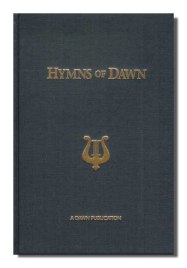
The Hymns Of Dawn (hymn book) can be purchased at:
The Chicago Bible Students Online Bookstore: https://chicagobible.org/product-category/books/page/4/
The Dawn Bible Students Association: http://www.dawnbible.com/dawnpub.htm
Acknowledgment & References
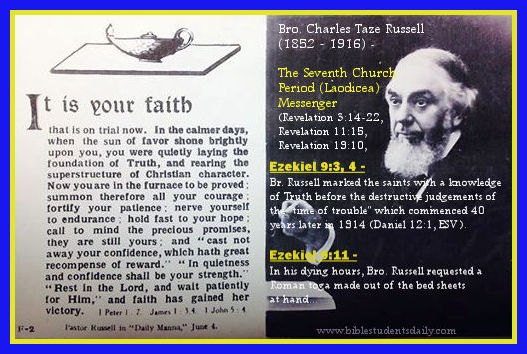
- Br. Charles Taze Russell

Br. Charles Russell—the founder of the Bible Students movement, who is the compiler of “Poems and Hymns of Millennial Dawn” which was published in Allegheny, Pa., in 1890. This Bible Students’ devotional originally contained a total of 151 poems and 333 hymns.

The following prefatory to the 1905 publication of Hymns of Millennial Dawn may be of historical interest to many of our readers.
We published in 1890, with several more recent editions, a volume entitled “Poems and Hymns of Millennial Dawn” without music. The same collection of hymns with the music is now urgently needed, and therefore appears in this volume. The poems, although highly prized, are omitted for greater convenience in size. We have preserved the same alphabetical order, because so many of our readers have the older book; and where a different tune is given from that originally suggested the latter is indicated by Alt. for alternative tune, with the number where that tune can be found.
Both words and music are credited to the same class to whom the work is dedicated—to the Lord and His faithful people, “the Saints.” The authors of many of the best of them are unknown to us, and, besides, slight changes have been made in the phraseology and sentiment of quite a number, which we could not be sure their original authors would approve, and to give personal credit to less than one half would seem invidious. To all of these dear “Saints” of all ages we therefore give united and hearty thanks for the blessings which they, as the Lord’s servants and handmaidens, have bestowed upon their fellow-members of “the Church of the Firstborn, whose names are written in Heaven.” Most of them died long ago: their abundant reward will be of the Lord in the resurrection.
That the collection is thoroughly undenominational, unsectarian, will be manifest to those recognizing the fact that it includes the choicest old hymns and tunes used by all denominations.
Although we have gathered far and near and winnowed carefully we cannot hope to have gotten all the golden grains, though we do hope that no chaff can be found. The collection is for the Church, for “believers” “reconciled,” and hence contains none of the “sinners” hymns, such as “Come, ye sinners poor and needy,” because willful sinners are in no sense members of the “Body” of Christ, nor are those who have not yet accepted the Lord as their Savior.
Those who will feel the deepest interest in this collection, and whose sentiments will be most fully voiced in its verses, will undoubtedly be those in fullest degree of sympathy with the divine plan of the ages, as set forth in the several volumes of Millennial Dawn – the eyes of whose understanding have been opened to the clearer, purer light now shining from our great Redeemer’s cross, showing the fulness and the completeness of his salvation.
In fact, this volume, while not numbered as one of the volumes of the Millennial Dawn series, is designed to be a companion volume, a melodious accompaniment to the “new song,” “the song of Moses and the Lamb” (the grand harmony of the Law and the Gospel), as presented in the regular Dawn series.
Let the music of God’s good and great plan ring through your hearts and lives, dear fellow-pilgrims and fellow members of the “royal priesthood,” so that every day and every hour shall be filled with joy and praise and thankfulness! And that this little volume may assist in deepening the work of grace in your hearts is our hope and prayer.
– Watch Tower Bible and Tract Society, July, 1905, Allegheny, PA, USA
——-
Later on, the hymns from this book formed a basis for the hymnal titled “Hymns of Dawn” which was published by the Dawn Bible Students Association in East Rutherford, New Jersey (USA) and the 1999 edition contains a total of 361 hymns.
- Harvest Truth Data Base
- Hymnary.org.
Suggested Further Reading
1 THESSALONIANS 5:16-18 – Prayer – The “Oxygen” for the New Creature in Christ.
https://biblestudentsdaily.com/2017/11/04/1-thessalonians-516-18-prayer-the-oxygen-for-the-new-creature-in-christ/
ACTS 23:6 – HOPE & RESURRECTION. PART A. What Is Jesus All About?
https://biblestudentsdaily.com/2016/11/03/acts-236-hope-resurrection-part-a-what-is-jesus-all-about/
ACTS 23:6 – HOPE & RESURRECTION. PART B. Will Mankind Resurrect With the Same Mind?
https://biblestudentsdaily.com/2016/11/05/acts-236-hope-resurrection-part-b-will-mankind-resurrect-with-the-same-mind/
ACTS 23:6 – HOPE & RESURRECTION. PART C. The Order of the Resurrection Process. https://biblestudentsdaily.com/2016/11/11/acts-236-hope-resurrection-part-c-the-order-of-the-resurrection-process/
ACTS 3:19-21 – The Restitution of All Things
https://biblestudentsdaily.com/2017/08/02/acts-319-21-the-restitution-of-all-things/
Epoch Periods In God’s Plan
https://biblestudentsdaily.com/2017/08/16/epoch-periods-in-gods-plan/
The Resurrection of the Dead. Faithbuilders Fellowship, Nov. – Dec. 2008 (Journal Section). http://www.2043ad.com/journal/2008/06_nd_08.pdf
Life After Death. Dawn Bible Students Association.
http://www.dawnbible.com/booklets/life.htm
What Does the Word “hell” really mean?
https://biblestudentsdaily.com/2017/05/18/what-does-the-word-hell-really-mean/
The Truth About Hell booklet, the Dawn Bible Association.
When A Man Dies booklet, the Dawn Bible Association.
What Everyone Should Know About Being Saved booklet, the Chicago Bible Students.
What Say the Scriptures About Hell, The Herald of Christ’s Kingdom Magazine.
The URL of this post:
https://biblestudentsdaily.com/2018/04/10/prayer-of-the-consecrated-hymns-of-dawn-no-16/



 BIBLE Students DAILY