1 CORINTHIANS 15:45 – How Long Until the Millennial Reign of the “Last Adam”?

1 Corinthians 15-45 -3.jpg

“Thus it is written, ‘The first man Adam became a living being’; the last Adam became a life‑giving spirit” (1 Corinthians 15:45).

Of the two natures, human nature and spirit nature, Br. Charles T. Russell wrote in R1259:5: “As surely as there are natural, human or earthly bodies, so surely also there is such a thing as a heavenly or spirit body.”

Adam was the first human man and all the peoples of the earth are descended from Adam, no matter how different in color, stature, intelligence, etc. they may now be (R2344:6). Adam generated no children until first Eve had been taken from his side (R4556:2). The first Adam is the sample of what an earthly body will attain to in the resurrection. (R1855:2, R3564:3).

The Apostle Paul in this statement from 1 Corinthians 15:45 does not contrast Adam and Jesus, but speaks of the “first Adam” and the “last Adam.” Christ is very unlike Adam. Jesus was obedient. However, Adam and Eve in some respects foreshadowed Christ and the Church in the sense that Christ will be the Great Life‑giver, or Father of mankind, while the Church (Hebrews 12:23, 2 Timothy 2:10) will be the mother or caretaker of the regenerated hosts (R5141:5, 777:1).

Jesus as the “Last Adam”

Jesus, as a “last Adam,” presently lifts us from condemnation and restores us to the fellowship of God through redemption. The saints have been regenerated by our Lord from heaven, but rather than grow to human perfection, they sacrifice their justified bodies in the service of Christ for a higher calling, theHigh calling of God in Christ Jesus” (Philippians 3:14). These, if faithful to their calling, will become, symbolically, a spiritual “bride” for Christ (Revelation 21:2). Then Christ and the Church will together restore and uplift the world, and bring them back to perfection during the Millennium. In this way Christ will be a “second Adam” or life giver to the world, and the Church will be a second “Eve” to nurture and assist them.

Adam was made a living soul since he was given a natural body, which is earthly. The “last Adam,” or life‑giving being, is Jesus, who from his resurrection forward is a glorious spirit being of highest magnitude.

“Who being the brightness of [his] glory, and the express image of his person, and upholding all things by the word of his power, when he had by himself purged our sins, sat down on the right hand of the Majesty on high” (Hebrews 1:3, KJV).

Eve was drawn from Adam when his side was opened up after he passed into a deep sleep. She was formed from a rib of Adam, “bone of my bones” (Genesis 2:23). Jesus also was caused to pass into a deep sleep, the sleep of death, and then his side was opened up by the spear of the soldier at the cross (John 19:34). From this came blood and water, which represents redemption and the water of the Spirit, by which the Church class is developed.

The Church class are “bone” of Jesus’ bones, in the sense that bones represent one’s hopes for the future. We share the same hopes for glory in the service of God, as our Lord Jesus had. Of Jesus it was said that “A bone of him shall not be broken” (John 19:36). That means that despite the tortuous trials and treatment suffered by Jesus, not one of his prospects for the future was in the least damaged. Those same prospects are sure for his bride also, “bone” of his bones.

The Bride of Christ shall be made Christ’s joint‑heir and help mate in the Kingdom who’s role will be to nourish and instruct all the willing and obedient back into harmony with God during the Millennial age (R4556:2, R5967).

“The plan of God proposes that the second Adam shall in relation to Adam take his place as the life‑giver to a race who shall possess the earth and enjoy it… as Father to our race does our Lord correspond to Adam—as the second Adam” (R4556:2). He is called the second Adam, in that he takes the place of the first Adam—undertakes to be the Father and life‑giver to Adam and every member of his race” (Expanded Biblical Comments). Upon condition of their obedience to him, they may then obtain everlasting life.

Our Redeemer presently enlivens us, in the respect that our old nature has been lifted from condemnation. This allows us to present ourselves in devotion and service to God, in order that we may grow a new life, a spiritual life, a heavenly life, to be secured in the first resurrection. Of that life God is Father, our “Heavenly Father.” “In accepting Christ as Redeemer, the believing one is reckoned no longer as a dying son of the dead Adam, but as a living son of the ‘last Adam,’ having a new life in Christ” (R1438:1). Our renewed standing is then laid down in sacrifice to God for the prospect of a heavenly life above. Our higher prospect is mentioned in Ephesians 2:6, NIV, “God raised us up with Christ and seated us with him in the heavenly realms in Christ Jesus.”

How Long from the Creation of Adam to the Millennial Reign of the “Last Adam”?

The period in question, judging by the Hebrew Scriptures, was on the order of 4000 years. As we are now on the order of 2000 years further, brethren of our fellowship recognize that it is now timely for the blessed Kingdom of God to become established on Earth. For there is a long standing view, held even by Jewish Sages in pre‑Christian times, that God intended a millennium of blessing for the world following six millenniums of sin and death.

The Holy Scriptures refer to a “day” with God as a thousand years:

“A thousand years in your sight are but as yesterday [one day] when it is past, or as a watch in the night” (Psalm 90:4).

“With the Lord one day is as a thousand years, and a thousand years as one day” (2 Peter 3:8).

By this measure, the six days of labor in the Jewish economy represent 6000 years of sin and death, and the sabbath of rest represents the 1000 year Millennium of restoration (Revelation 20:1‑6).

Ezekiel 46:1 (ESV) expresses this concept symbolically. “Thus says the Lord GOD: The gate of the inner court that faces east shall be shut on the six working days, but on the Sabbath day [the 7th day, which represents the Millennial Age of Revelation 20:4‑6] it shall be opened, and on the day of the new moon [when a new covenant will be inaugurated with Israel] it shall be opened.”

With this hope in mind, Christians throughout history have endeavoured to estimate when the close of 6000 years may come.

 A Historical Perspective

In the days of William Miller and the early Adventist Movement, they supposed 6000 years were drawing to a close in the mid 1800s. In fact, William Miller concluded that Christ would return in 1843, assuming that 6000 years would end then. When Christ did not return as expected, some brethren gave up their faith but others simply recognized that they needed to keep looking. Br. Nelson Barbour was among those. He came to believe that Jesus would return in 1873. Therefore, he assumed that 6000 years would end about that time. He went looking, and found in EB Elliott’s work, “Horae Apocalypticae,” written in the early 1800s, a version of Bible chronology suggested there that shows how 6000 years might conclude somewhere near the year 1872.

Br. Barbour was a younger associate of Br. Miller, so he followed Br. Miller’s assumption that 6000 years would approximately mark the return of Christ. As far as we know, Br. Barbour did not consider another option—namely that 6000 years would take us to the completion of the Church, rather than simply to the return of Christ.

Br. Russell met Br. Barbour in Philadelphia in 1876, and accepted the prophetic package, as it seemed reasonable. At the time they anticipated that the Church would be complete in 1878, after that they supposed it would be in 1881, and subsequently the expectation was reset to 1914. But concerns persisted. It seemed that a seventh “day” had commenced, and yet the “thousand years” of Revelation 20:4,6, was deferred. How could this be explained?

Some of the dear brethren seem unaware of the perplexity expressed on this issue by Pastor Russell himself. However, his words are clear and to the point about the uncertainty. It thus surprises us that even some who honor and revere his service bypass the important and specific points he advised brethren of, respecting this. However, the issue did not escape the attention of brethren in Pastor Russell’s own day. Thus, near the end of the year 1900, the following specific question was submitted to Pastor Russell.

“I understand from Revelation 20:4-6 that Christ will reign one thousand years, and from verses 2 and 7 that Satan will be bound during that period. If Christ began to reign in 1878, and Satan will not be bound until 1915, the two periods do not seem to synchronize; and … both extend beyond the seventh-thousand year period which … began in the Autumn of 1872. … Can you assist me?” (R2739

Pastor Russell’s answer is very different from what some appear to suppose it should have been.

Some today appear to suppose that the right answer would have been, “The reign, the binding of Satan, and the 1000 years all began in 1874.”

But not a word of this in Pastor Russell’s actual reply.

Instead, he refers to the “obscurity” of the issue as “an open question” that, at the time, was “not now ‘meat in due season for the household of faith.’ ” However, Pastor Russell did affirm the following part of the answer.

“The Scripture declaration respecting the saints, the ‘overcomers’ is, ‘They lived and reigned a thousand years.’ The reign of the saints cannot be properly said [R2740: page 368] to begin before all the ‘jewels’ have been gathered, nor before ‘the times of the Gentiles’ end, in 1914.”

It is clear from this direct answer to the brother’s question—on an issue that was declared as of then unresolved—that the 1000 years of Revelation 20:6 would not begin until the Church was complete. It was not apparent how this synchronized with the then-current view that 6000 years had been completed.

Pastor Charles Russell continued to affirm his view that the 1000 years of Revelation 20 would not commence until the Church was completed. Nor does he express any view other than this, respecting Revelation 20 directly. In R3460 (Diagram 3), you will find a diagram showing 1000 years beginning in 1914, when he supposed the Church to be complete. He later supplemented this with the following comments in later years.

R5115“The Church shall have passed into glory … Messiah will then reign for a thousand years.”

R5604 “The great Battle of Armageddon … will precede … Messiah’s glorious rule of a thousand years … (Revelation 20:6).”

R5692“Messiah’s kingdom shall be fully inaugurated. Then these shall … reign with Christ a thousand years (Revelation 20:4.)

R5919The Kingdom cannot come until the Royal Family is ready to take the Throne. Jesus, indeed, has long been ready; but in harmony with the Father’s Plan He has waited and has been doing a work in the preparation of the Church, His brethren, who are to be His joint-heirs in the Kingdom—otherwise styled ‘the Bride, the Lamb’s Wife.’ (Romans 8:17; Revelation 21:9,10.) Then for a thousand years the Restitution privileges will be open to the whole world of mankind. It will no longer be necessary to preach; for all will know the Lord, from the least unto the greatest, and unto Him every knee shall bow and every tongue confess. (Jeremiah 31:34; Philippians 2:9-11.)”

There is more. Sometime late in the year 1913, Br. Russell changed the chart to accord with the expression cited just above. Early on, the period from the parousia of Christ forward was labeled “Millennial Age.” But late in 1913, Pastor Russell changed the designation to the broad Messianic Age.”

Why this change?

The reason seems apparent. Strictly speaking, the 1000 years of Revelation 20:4-6 would not begin until the end of the Harvest. Thus, if one begins a period incipiently from the parousia forward, better to give it a more general designation, “Messianic Age,” to avoid the inference that the 1000 years proper, of Revelation 20:4-6, had commenced.

A perceptive awareness of these points is the foundation for a recent presentation by Br. George Tabac, “Harvest Timing Clarifications (2016),” which explains these points in remarkable detail. This presentation is specially excellent for brethren with high regard for the teaching of Pastor Russell.

What is the Answer?

What, then, is the answer to the question that has spurred so much discussion during the Harvest period? Namely—how does one reconcile the end of 6000 years early in the harvest of the Gospel Age, with the fact that the thousand years of Revelation 20:4-6 begins at the close of the harvest?

The answer is now at hand.

In the century and a half since the harvest began, and decades after Pastor Russell completed his course, the history of the Old Testament has clarified. 

Not because of the wisdom of men, but because it was God’s due time for greater clarity, to direct the Church to the approaching climax of their hopes.

The timeline from the Hebrew scriptures directly, respecting the synchronisms of the kings of Israel and Judah, shows that some of the kings of Judah (and of Israel) overlapped one another, in periods of coregencies. The testimony of these facts comes from the scriptures directly. However, the issues had not been solved while Pastor Russell lived. It was premature. “We may see some day just how [these synchronisms in the Hebrew Scriptures] can be harmonized, but at present we do not” (Question Book, page 42).

The overlapping of Judean kings, testified to in the Old Testament Scriptures, reduces the period of Kings from 513 years to 463 years. Affixing the end of this period to the firm date of the reign of Nebuchadnezzar, king of Babylon, establishes the year in which Israel’s last king, Zedekiah, lost his throne, was in 587 bc.

This means that we can now date the spring of Solomon’s fourth year to 966 bc, at which time was founded (but not yet operational) “Solomon’s Temple,” referred to in 1 Kings 6:1. From that text we can then place the Exodus at 1445 bc. (Note: 1445 bc is discussed in the following post: STUDY 2: The Pillar of Cloud by Day and The Pillar of Smoke by Night.)

As detailed in Volume Two of Studies in the Scriptures—“The Time is at Hand,” by Br. Charles Russell (page 43-47)—the time from Adam to the Exodus is widely agreed among brethren to be 2513 years. That is:

From Adam to the Flood

From the Covenant with Abraham to the giving of the law.jpg

If we now count from the Exodus date of 1445 bc, a period of 2513 years backward to Adam, the result is the date 3958 bc for the creation of Adam. Six thousand years forward from there will be the year 2043 ad—thus the date opening the Seventh Millennium, which apparently is the same as the 1000 year Millennium of Revelation chapter 20.

Now the answer to the conundrum that Pastor Russell said was an “open question” in his day, can be resolved—for it is timely, inasmuch as the end of the harvest approaches. The resolution is straight forward. The end of 6000 years of permission of evil synchronizes with the close of the harvest, rather than with the opening of the harvest. With this key, all is harmonious.


Acknowledgements


This post’s URL:
https://biblestudentsdaily.com/2017/06/06/1-corinthians-1545-how-long-until-the-millennial-reign-of-the-last-adam/

Enter your email address to subscribe to this blog and receive notifications of new posts by email.


STUDY 4: The Court (“Holy Place”)

1. COURT --- .jpg

The Tabernacle was surrounded by a yard, or “Court (Exodus 27:9-19), toward the rear of which it stood, and this courtyard is referred to by the Bible translators, as the “holy place” see Leviticus 6:26 and 14:13.

The Court represents the condition of justification, entered through faith in Christ, the “gate.” The tabernacle represents things from the time of Jesus forward. However, there are three time periods in the Plan of God when God through His holy Spirit deals with justified people:

  1.  The Ancient Worthies from Adam until Jordan;
  2.  The Church during the Gospel Age;
  3.  The world during the Millennium Age (Messianic 1000 year reign of Christ with the Church the 144,000 Elect Bride of Christ members).
  • The same is shown in the time in the ark (which pictures redemption) a total of 381 days, which is 3 x 127, that is, three times the age of Sarah, who represents the Abrahamic Covenant.
  • Also in the three times the doves were sent out from the ark in Genesis chapter 8 three missions of the holy Spirit.
  • And again in the three stories or levels of the ark, thus three time periods of justification.

Who Could Enter the Court?

Any Israelite (typical of a justified believer of the Gospel Age) was allowed to come into the Court, as indicated in Leviticus 1:1-3 (ESV):

“(1) The Lord called Moses and spoke to him from the tent of meeting, saying, (2) ‘Speak to the people of Israel and say to them, When any one of you brings an offering to the Lord, you shall bring your offering of livestock from the herd or from the flock. (3) If his offering is a burnt offering from the herd, he shall offer a male without blemish. He shall bring it to the entrance of the tent of meeting, that he may be accepted before the Lord.’”

Leviticus 1:11 shows also that Israelites were to bring their offerings into the court, and kill them there, “on the side of the altar northward before the Lord.” However, the priests would take the blood thereafter, for use at the altar. “And the priests, Aaron’s sons, shall sprinkle his blood round about upon the altar.”

Note: Northward is the direction of God, and the Heavenly Realm. Offering on the north side of the altar emphasizes that the offering is made to God.

The offerers (Israelites) represent believers, coming in faith to make an offering to God whether believers in this age, or in the next.

Israelites commonly came in to make offerings. But the “daily sacrifice” was one lamb in the morning, another in the late afternoon, and these were done by the priests (Exodus 29:38-39).

The daily sacrifice was a burnt offering and it represents the ransom sacrifice of Jesus, who fulfilled this type, thus causing it to cease. The morning and evening times correlate with Jesus being put on the cross in the morning and expiring in the afternoon.

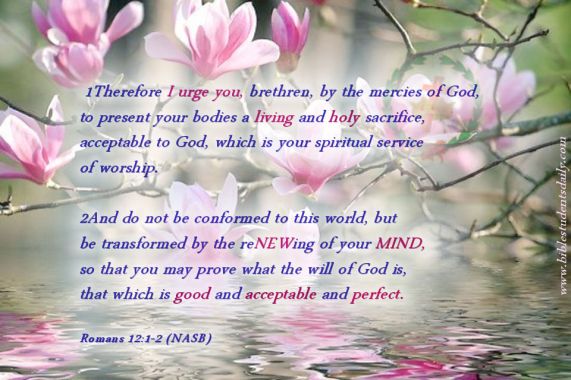
The Apostle Paul explained that our sacrifice is not just to be twice a day but 24/7 hence he defined the consecrated ones of this Gospel Age of the “High Calling” into Christ, as “living sacrifices” who “are holy acceptable unto God, which is your reasonable service” (Romans 12:1).

Around and Inside the Court

(A) Copper

In the Court, the metal used most often was copper.

Copper represents human nature, either justified or perfect.

In John 3:14, Jesus compares himself to the copper serpent lifted up in the wilderness in the days of Moses, which healed those who looked to it. The copper of that serpent represents the perfect humanity of Jesus. The serpent symbol is used to represent that Jesus takes the burden of our sins upon himself, thus curing us from the “snakebite” of sin.

The court contained the “brazen altar” for use by the priests. Possibly Levites assisted the priests in some ways respecting the sacrifices (other than putting it on the altar).

(B) Court Measurements

The court was 50 cubits wide and 100 cubits long thus three of them could fit into the floor plan of Noah’s Ark, which was 50 cubits wide and 300 cubits long (Genesis 6:15). This also suggests that there are three time periods in God’s Plan (as explained at the start of this Tabernacle Study No. 4) where justified persons are called of God. It is notable that the “house of the forest”, picturing the call of the world during the Millennium, was also the size of the court (1 Kings 7:2).

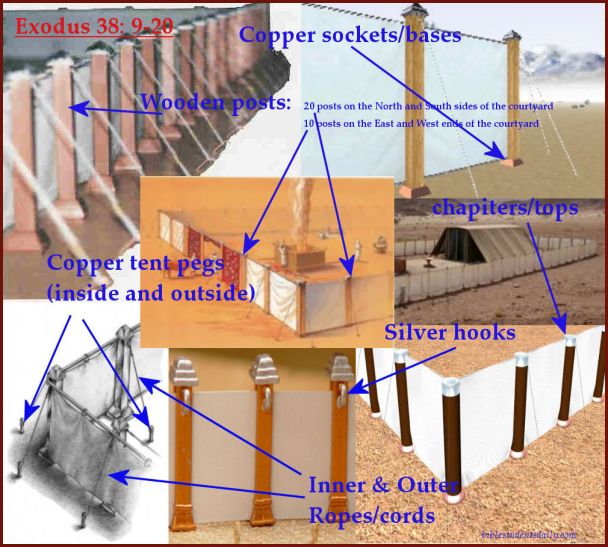
The court was formed by a fence of white linen curtains (see Study 9 on this website in the series “Beauties of the Tabernacle,” titled “The Gate. The Door. The Veil”, suspended from silver hooks, set in the tops of wooden posts 5 cubits (7 1/2 feet high), which were set in heavy sockets of copper (mistranslated brass), and braced, like the tent which covered the Tabernacle, with cords and pins.

(C) The Silver Hooks

The silver hooks in the courtyard posts by which the posts held up the curtain, represent the divine Truth, by the knowledge of which the justified believer holds on to the righteousness of Christ. Silver is a general symbol of Truth but perhaps more specifically, that TRUTH which centers and deals with the RANSOM — the redemption accomplished in Christ Jesus (Tabernacle Shadows, page 114).

As these hooks were small in size they represent the small amount of Truth necessary to justify one.

Note: The Tabernacle Proper’s 100 silver sockets which supported the whole structure was made from the ransom or redemption money paid as a poll tax by the Israelites. (Exodus 30:12-16; 38:25-28.) In “Notes on the Tabernacle” (page 21) we read:

“. . . [God] enjoined that, whenever Israel was numbered as His people, every man must give a ransom for his soul. The price was fixed by God Himself.

Each man, whether poor or rich, must bring the same. One could not pay for another; but everyone must tender his own ransom-money of pure silver and of perfect weight. `Half a shekel, after the shekel of the sanctuary (a shekel is twenty gerahs), a half-shekel shall be the offering of the LORD.’ (Exodus 30:13) Other Gospel truths here shine out. When the question came to be one of ransom, the poor and the rich, the foolish and the wise, the ignorant and the learned, the immoral and the moral, stood on the same level. Each person was estimated by God at the same price. He proved Himself no respecter of persons.”

Hence, since most of the silver used in the Tabernacle was for the 100 foundation sockets for the Tabernacle Proper, this beautifully points to the TRUTH relative to the RANSOM sacrifice of our Lord as the foundation Truth upon which the entire plan of God rests.

“The four gold-plated pillars (posts) at the entrance of the Most Holy supporting the (second) Vail stood in four SILVER sockets, (reality, truth, verity) seeming to say to us, when you come inside this vail, you will be perfect – really and truly new creatures” (Tabernacle Shadows, page 115).

(D) The Posts (pillars)

The posts of the Court (Exodus 27:10-17) represent the justified believers whose imperfections are covered by Christ’s righteousness.

The function of the posts is to hold up to public view one’s faith in Christ who is represented by the linen curtain. This, brethren, is our purpose for being. This is why we are here. To show forth the mercy and goodness of Christ’s redemptive work, as Paul says, “in the midst of a crooked and perverse generation among whom ye shine as lights in the world” (Philippians 2:15).

The posts were made of wood which is a corruptible material thus implying that the class typified, are not actually perfect as human beings.

(E) Sockets of Copper

The posts were set in sockets of copper which were sunken in the sand for stability.

The copper sockets represent our standing of perfect human beings, and this beautifully represents justification by faith, (despite the actual fact of our personal imperfections) which we can only hold onto by the aid of the Truth. This is the justification spoken of in Romans 5:1, “Therefore being justified by faith, we have peace with God through our Lord Jesus Christ.”

Some use the term “tentative justification,” to describe a Christian in the court condition before they reach the point of consecration at the door of the Tabernacle. However the priests also served in the court, and the priests represent the fully consecrated/spirit begotten. So their justification is also indicated in the court. If we simply relate that the court represents justification through faith in Christ, perhaps this suffices. It need not be one way or another  only unconsecrated (not spirit begotten) believers or only consecrated (spirit begotten) believers — as the concept of being justified by one’s faith in Christ can pertain to believers before consecration or believers after consecration.

Thanks to being reckoned as righteous in God’s sight, we are judged as to faithfulness in our intentions rather than in our actions. “For if there be first a willing mind, it is accepted according to that a man hath, and not according to that he hath not” (2 Corinthians 8:12).

Now, with rejoicing we can say with the Apostle Paul, “I can do all things through Christ which strengtheneth me” (Philippians 4:13).

It is thus that our faith becomes “rooted” and the philosophy of the ransom begins to appear. It is of this which Paul speaks in Colossians 2:7, “rooted and built up in him, and stablished in the faith, as ye have been taught, abounding therein with thanksgiving.”

(F) Guy Lines/Ropes/Cords & Pegs

2. FENCE EQUIPMENT.jpg

There is more to the philosophy of the ransom that prevents our faith from becoming weak and unstable. This is shown in the system of guy lines which uphold the wall of the court and tie the posts to the ground.

These cords represented the things which tie the justified believer to the earth; and there were two sets of cords and pins, one set inside the Court, the other, outside.

The set outside of the Court, outside of the justified state, represented the sin in the flesh which ties the believer to the world.

The set inside the Court represented the earthly things: joys, studies, music, etc., right enough in themselves, which bind the believer to the world. These are the weights (Hebrews 12:1).

These ropes were anchored by copper pegs tent pegs. One of these was installed inside the court and the other on the outside. Being copper, as opposed to wood covered with copper, they showed actual human perfection.

As we scan the pages of history we see just two and no more perfect men: Adam and Jesus. We see the one who lost his standing in the court, Adam, as the peg driven outside the fence. The other, grounded firmly in the court, pictures Jesus. These two have one connection the ransom pictured by this cord even as it was by Rahab’s scarlet thread. It is this simple philosophy of the ransom a perfect human life for a perfect human lifethat gives stability to our faith. How beautiful! How simple! Substitutionary atonement is the central doctrine of the Bible.

“For since by man came death, by man came also the resurrection of the dead. For as in Adam all die, even so in Christ shall all be made alive” (1 Corinthians 15:21, 22).

“For if through the offence of one many be dead, much more the grace of God, and the gift by grace, which is by one man, Jesus Christ, hath abounded unto many” (Romans 5:15).

It is the very simplicity of the concept that speaks to its authenticity. Too good to be true? Too good not to be true! And yet our faith is sometimes weak. We need further support.

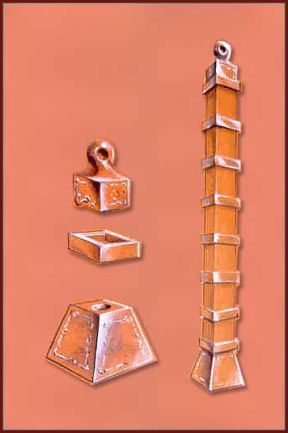
3. COURTYARD PILLARS, BANDS, BASES, SILVER EYELETS.jpgAccording to the Temple Institute in Israel:
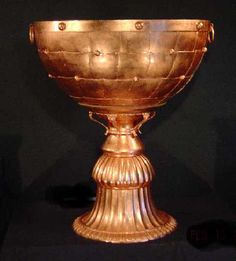
The courtyard pillars, (amudim) were composed of three main components: The acacia pillars themselves, which were reinforced by silver bands, (chishukim); the copper bases, (adanim), into which the pillars were inserted; and the silver eyelets, (vavim), which were fitted onto the tops of the pillars, for stretching the curtains, (yeriot) across.

“fillets” Others have concluded that they were rigid, whether rods or bands, and served to stabilize the posts from leaning toward each other. We think that is correct.

The Furnishings In The Court

The Brazen Altar

4. BRAZEN ALTAR.jpg

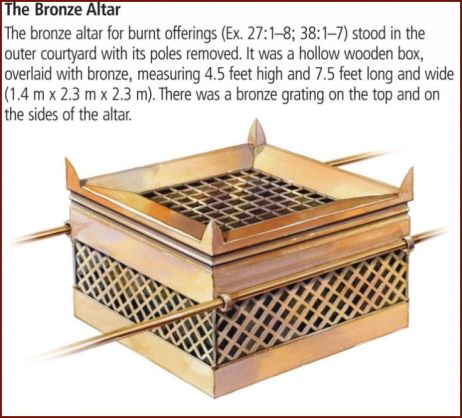
The Brazen Altar was the first item encountered in the Courtyard. It was five cubits square, and 3 cubits tall (Exodus 27:1).

In each of the four corners there was a horn made from the same piece of acacia wood as the altar itself and the altar was over-layed with copper.

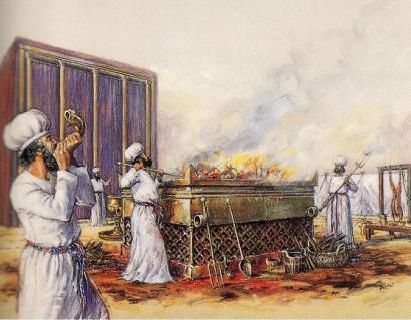
The Brazen Altar was used to burn up sacrifices placed upon it, such as during the consecration of the priesthood and the Day of Atonement.

Various utensils belonged to its service fire pans (called censers), for carrying the fire to the ‘Incense Altar,’ basins to receive the blood, flesh hooks, shovels, etc.

A Christian understands this altar is not an ornament of the Court, but a place where bulls and goats were killed and sacrificed, a place many times covered with blood and ashes, with the smell of burning meat, and much smoke. The grate of this altar was not on the top like a modern barbecue. It was placed half way between the bottom and the top of the altar:

“Thou shalt put it [the grate] under the compass of the altar beneath, that the net may be even to the midst [Strong’s #2677: half or middle] of the altar” (Exodus 27:5). This placed the grate at the 1½ cubit mark, the same height as the mercy seat in the Most Holy. Both are considered in the design to be at the same “level;” neither towers above the other.

A Christian recognizes that Jesus has been sacrificed for him and starts to recognize that a similar sacrifice is needed from him if he is to enter beyond the next door. The sacrifice we have to offer, is as the Apostle Paul expresses it, in Romans 12:1.

rom-12-1-2-ad

Thus, the antitypical priesthood of this Gospel age are privileged to use this altar (Christ Jesus), in presenting their bodies “a living sacrifice, holy, acceptable unto God” for is it not the altar that sanctifies the gift?

You blind men! For which is greater, the gift or the altar that makes the gift sacred?” (Matthew 23:19).

“Your sacrifice would not be holy and acceptable, but it is made holy and acceptable as such by the Advocate [Christ Jesus] imputing of his merit to cover your sacrifice” (“What Pastor Russell Said,page 614).

Presenting our bodies as “living sacrifices” to God includes all our thoughts, words and doings and doing the best we can in all we do to bring God glory, honor and praise. It is Christ Jesus, our antitypical High Priest who alone is able to offer up the antitypical sacrifices. All that the followers of Jesus do, therefore, is to present (consecrate, set apart) themselves, as pictured in the type by the goat’s being, tied at the door of the Tabernacle. “It is after Jesus lays hold of this individual, accepts his consecration, imputes His own merit, and offers him to the Father, that the Father’s acceptance is manifested through the Son… by the begetting of the Holy Spirit. Thereforth, such an one is a member of the Body of Christ, and his name is written in the Lamb’s Book of Life, from which it will not be blotted out if he maintains his faithfulness” (What Pastor Russell Said, page. 614).

“It is the New Creature’s business to keep the old nature on the altar, upon which the great High Priest has put it. In other words, the New Creature must keep the old nature dead, hold it in subjection. When our flesh is brought into contact with the fires of experience for its consumption, it is the old creature that weeps, not the New Creature. Let the goat weep if it will. The New Creature will rejoice in the Lord and in His providential care, as daily it grows in grace and in knowledge. When the old creature is knocked out, or brow-beaten, as the Apostles says (1 Corinthians 9:27), it will groan; but the New Creature will be glad and rejoice in the Lord… We rejoice because God’s favor and blessing are with us as New Creatures.” (What Pastor Russell Said, page 613.) See also Acts 16:26, Philippians 4:4.

Jesus allowed himself to be sacrificed for the entire world of mankind. He was perfect and became flesh to do the will of his Heavenly Father (John 4:34, John 6:38).

The wood of the altar, typifying humanity, reminds us that Christ became a man for the express purpose of experiencing our infirmities and “to minister, and to give his life a ransom for many” (Mark 10:45).

“For we have not an high priest which cannot be touched with the feeling of our infirmities; but was in all points tempted like as we are, yet without sin” (Hebrews 4:15).

5-bronze-altar

There is a thought that wood was used to make the articles of lighter weight and thus, more easily portable, than if of solid metal. This was an important consideration when they traveled.

As discussed earlier in this series of “Beauties of the Tabernacle,” the use of copper represents the human nature in its perfection, a little lower than the angelic nature (unlike gold, which represents the divine nature, far above angels, principalities and powers).

As gold and copper are much alike in their appearance, yet different in quality, so the human nature is an image and likeness of the divine, adapted to earthly conditions.

“The Tabernacle’s altar of burnt-offering represents… the ransom-sacrifice of Christ Jesus (Tabernacle Shadows, page 22) — the ‘altar’ unto which the world of mankind in the Millennial age, will bring its sin-, trespass-, burnt-, and peace-offerings. (Tabernacle Shadows, page 95,96)” (“Notes on the Tabernacle,” page 134).

The horns of the Altar of Burnt Offering were in themselves symbols of power; yet this power came from the blood which sanctified it. The Scriptures do set forth the fact that one guilty of a sin against his fellowman, when in danger of being apprehended, might flee for asylum to the altar — take hold of its horns, and find a safe refuge there (1 Kings 1:50; 2:28).

“We too have an altar, the power of which stems from the blood of Christ Jesus, that sanctified it. We too, had sinned against our King, who could justly have destroyed us. But we fled to the altar and found sanctuary, an asylum, a refuge, there. Our faith in the precious blood, justified us — made us free as it were; but only on one condition could we continue to be free and that was that we covenant with our King thereafter to walk “worthily.” Having entered into this covenant we are safe from the “avenger.” But should the time ever come when we would break that covenant by profaning the blood of the covenant by which we were sanctified — outraging the Spirit of grace (Hebrews 10:29) — we would then fall directly into the hands of the “avenger” and be put to death — the Second Death!” (“Notes on the Tabernacle,” page 130).

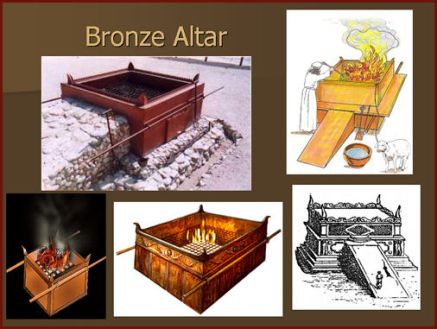
Was there a ramp?

Some may question whether there was a ramp attached to this brazen altar which would assist the priests with getting the sacrifices onto the large surface area of the altar.

We read in Exodus 20:26, “Neither shalt thou go up by steps unto mine altar, that thy nakedness be not discovered thereon.”

4.4 - BRONZE ALTAR.jpg
“It is worthy of note that the Hebrew word ‘maalah’ occurring [here] in Exodus 20:26 and there rendered ‘steps’ in the KJV, according to Young’s Analytical Concordance to the Bible means ‘a going up, ascent.’ It would therefore cover even such a thing as a ramp, though this latter term has nowhere been used in the common version of the Bible. It has been rendered ‘stairs’ (2 Kings 9:13; Nehemiah 3:15; 12:37; Ezekiel 40:6; 43:17) and ‘steps’ (Exodus 20:26; 1 Kings 10:19, 20; 2 Chronicles 9:18,19; Ezekiel 40:22, 26, 31, 34, 37, 49).

“No priests were ever to enter the precincts of Jehovah — the Tabernacle’s Court, Holy, or Most Holy — without the linen breeches ‘to cover their nakedness’ upon them (Exodus 28:42,43). Especially is the injunction given that Jehovah’s altar was not to have any steps (stairs or ramp) unto it, since an approach by way of such would necessitate the ‘lifting of the robe’ and the consequent exposure of the priest’s nakedness (Exodus 20:26)” (Br. Anton Frey, “Notes on the Tabernacle,” page 133).

The Laver

4..jpg
“The LORD spoke to Moses, saying, ‘You shall also make a laver of bronze, with its base of bronze, for washing; and you shall put it between the tent of meeting, and the altar, and you shall put water in it. Aaron and his sons shall wash their hands and their feet from it; when they enter the tent of meeting, they shall wash with water, so that they will not die; or when they approach the altar to minister, by offering up in smoke a fire sacrifice to the LORD. So they shall wash their hands and their feet, so that they will not die; and it shall be a perpetual statute for them, for Aaron and his descendants throughout their generations’” (Exodus 30:17-21).

The Laver stood between the brazen altar and the door of the Tabernacle or “sanctuary”. It was a receptacle for water where the priests washed his feet and hands leaving behind the last traces of the flesh and of his contact with the surrounding world, before entering the Tabernacle.

The Laver as a whole represented the Word of God, Jesus was the word who cleanses the believer through the washing of water by the Word (Ephesians 5:26).

The Laver was cast from the mirrors of women who served at the Tabernacle, thus it was made of polished copper (Exodus 38:8) which represents the brightness of Jesus’ perfection. As the priests looked into the laver, they could see the faces reflected in its polished surface, so the consecrated see the imperfections and failings of their own characters when they compare these characters to the bright perfection of Jesus by looking unto him.

2
The priests did not bathe in the Laver, but presumably drew water out of the laver using a copper pitcher for the purpose of washing his hands and feet (Exodus 40: 31, 32) otherwise the water in the laver would become dirty.

So we are greatly helped by concordances, dictionaries, etc. We cannot wash in them, but they help us in getting the Truth to cleanse us. And we likewise, cleanse our hands that they may do the will of God, and our feet that they may walk in Jesus’ footsteps, in the straight and narrow way.

At this step an approaching Christian accepts this purification as did all the followers of Jesus. Even if the Master did not need any purification, since he was perfect and without sin, by washing the feet of his disciples Jesus showed another important element of that washing: humility.

Now the Christian is at the door of the Tabernacle. After his journey through the Court, he is ready to follow his Master into the “greater and more perfect tabernacle” (Hebrews 9:11, KJV).

Acknowledgment

Br. Charles T. Russell for source material used from Tabernacle Shadows,” “What Pastor Russell Said” (Question Book).
Br. Anton Frey for source material used from Notes on the Tabernacle.
Br. David Rice & Br. George Tabac for sharing of content and editing for this post.
The Temple Institute in Israel for source material used.

Suggested Further Reading

STUDY 1: An Introduction To The Tabernacle And It’s Purpose
https://biblestudentsdaily.com/2016/09/02/study-1-an-introduction-to-the-tabernacle-and-its-purpose/

STUDY 2: The Pillar of Cloud By Day And The Pillar of Smoke By Night  https://biblestudentsdaily.com/2016/09/09/study-2-the-pillar-of-cloud-by-day-and-the-pillar-of-smoke-by-night/

STUDY 3: The Tabernacle Construction: The Holy and The Most Holy  https://biblestudentsdaily.com/2016/09/14/study-3-the-tabernacle-construction-the-holy-the-most-holy/

STUDY 5: The Camp. The Israelites.
https://biblestudentsdaily.com/2016/10/28/study-5-the-camp-the-israelites/

STUDY 6: The Levites
https://biblestudentsdaily.com/2016/11/18/study-6-the-levites/

STUDY 7: The Priests. The Day of Atonement.
https://biblestudentsdaily.com/2016/12/10/study-7-the-priests-the-day-of-atonement/

STUDY 8: The Tabernacle Coverings
https://biblestudentsdaily.com/2017/01/02/study-8-the-tabernacle-coverings/

STUDY 9: The Gate. The Door. The Vail.
https://biblestudentsdaily.com/2017/03/01/study-9-the-gate-the-door-the-vail/


The URL for this post:

STUDY 4: The Court (“Holy Place”)

Enter your email address to subscribe to this blog and receive notifications of new posts by email.

Save

Save