

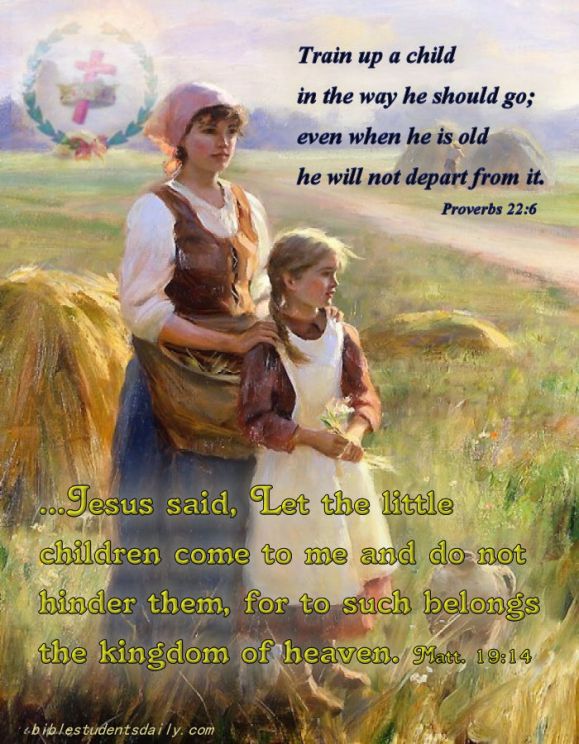
“He that spareth his rod, hateth his son.” (Prov. 13:24) “What son is he whom the Father chasteneth not?” “If ye be without chastisement…then are ye…not sons.” Hebrews 12:7
The content for this post comes from the 6th Volume written by Pastor Charles T. Russell and the topics discussed include:
- Order in the Home
- Rewards & Punishments
- Parental Discipline – Helps to Develop Character
- The Golden Rule
- The Atmosphere of the Home
- A Home in Which the Lord’s Spirit is not Manifested
- When a Child Reaches Manhood or Womanhood
- The Proper Amount of Education
- Our Children in the Time of Trouble
- Proper Amusements
Order in the Home
Nothing is further from our intention than to urge indiscriminate and frequent use of the rod in the training of children. We have cited these scriptures, however, to show the mistaken position of those who hold that corporal chastisement by parents, even when necessary, is wrong.
The home that is ruled with the rod must of necessity be an unhappy home.
The homes of the New Creatures should be ruled by love not by the rod. The rod is to be kept merely as an occasional necessity for enforcing the rules of love; and when it is administered it is to be wielded by the hand of love and never by the hand of anger.
The New Creatures, governed by the spirit of a sound mind, learn gradually that order is one of heaven’s first laws, and hence that it should be one of the first elements and characteristics of the homes of the New Creatures.
Order, however, does not of necessity mean absolute quiet, else the wilderness and the silent cities of the dead would be the only places where order would rule.
Order may mean joy as well as peace, happiness as well as rest, liberty as well as law. Order means law—with New Creatures the Golden Rule and the Law of Love governing the head of the house and his helpmate, as well as governing the children, making of the parents ensamples to the children in all the Christian graces. Law, even the Law of Love, means rewards and punishments, and in the family the parents have the dispensing of these.
According to their realized weaknesses they, in turn, need direction from the Heavenly Father that they may glorify him not only in their own hea
rts and wills, but that their homes shall be earthly ensamples of the homes of the righteous, the homes of those who have the mind of Christ.
Rewards & Punishments
Their rewards for their children should be in the provision of such comforts and blessings as circumstances, under control of a recognized pro
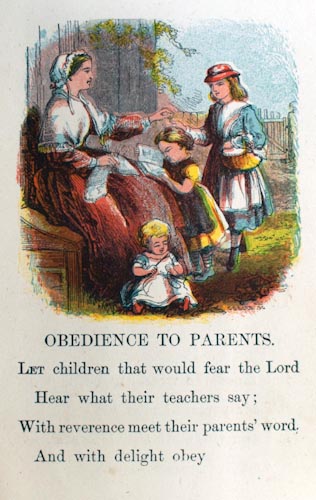
vidence, may permit.
Their punishments may be more or less severe according to the wilfulness of the child, but never according to the standard of justice, never in the atte
mpt to mete out to the child the full measure of what its conduct might justly demand—because we are not under ju
stice ourselves, but under mercy, under love, and are to show mercy, not only in our dealings with others, but specially in our dealings with our
own children, whose imperfections and blemishes are, doubtless, traceable in a greater or less degree to ourselves and our forebears.
Love may sometimes punish by the refusal of a kiss, as it may sometimes reward by the giving of a kiss; it may sometimes for a season banish the unruly one from the company of the obedient and from the pleasures provided for them.
The Law of Love may sometimes even exercise the rod of discipline to the extent of denying supper or of giving merely the necessities, bread and water, and withholding some of the additional comforts and luxuries; or may sometimes wield the literal rod of chastisement to enforce obedience, and thus preserve the order and blessings of the home, not only for the obedient children, but also for the chastised one, whom it hopes thus to bless and bring into full accord.
It is scarcely necessary to admonish the New Creation that they should not use angry or harsh words to their children; for such know that language of that kind is improper to any one under any circumstances. On the contrary, their “speech should be with grace,” with love, with kindness, even when reproving.
Nor is it necessary to suggest to the class we are addressing the impropriety of a hasty blow, which might do injury to the child not only physically—perhaps permanently injuring its hearing—but also wound its affections, develop in it a fear of the parent instead of love, which should be considered the only proper groundwork on which the obedience and order of the home are built.
Furthermore, the hasty blow or cutting remark would be wrong, would indicate a wrong condition of mind on the part of the parent—a condition unfavorable to a proper, just decision of the matter along the lines of the Law of Love.
The parent owes it to himself as a part of his own discipline, as well as to his child, that he shall never inflict a punishment which he has not sufficiently considered, and coolly and dispassionately found to be not more, but less, than justice might properly demand.
He owes it to himself also that the child shall fully understand the situation, the necessity for the preservation of order in the home, that the happiness of the home may continue to the blessing of all its inmates; that the child understand thoroughly also that the parent has no anger toward him, no malice, no hatred, nothing but sympathy and love and the desire to do him good.
Christian parents have—if they will use it—an immense leverage of advantage in dealing with their children. They should read to their children, from the Word, the divine sanction of parental authority—the divine requirement that a parent shall train up a child in the way he should go; and additionally he should point out the necessity for this—because we all are fallen and unable to come up to the divine standard, etc.; that all these means and corrections are necessary as helps to the counteraction of evil tendencies under which we have been born.
Parental Discipline – Helps to Develop Character
Many parents forget to look backward and to note at how early an age they themselves learned to appreciate principles of righteousness—to appreciate the parental care which neglected not to reprove, to correct, and even to chastise as seemed necessary. Let us recall, too, how keen was our sense of justice when we were children—how we mentally approved parental discipline when we understood its motive to be for the development of character, but how we resented it if we did not see a principle of justice, if we were reproved or otherwise punished for things of which we were not guilty, or if we were punished beyond a reasonable chastisement comporting with the offense.
Not only is it the best and surest way of controlling a child thus to direct its mind along the lines of right and wrong, truth and falsehood, justice and injustice, but this constitutes also a training of the child in character, when it is most susceptible to parental influence. It is character-building at a time when the conscience and judgment of the child are in their formative condition, and when it properly recognizes the parent as its sole lawgiver. If this work of character-building be ignored in infancy, the work is many times more difficult in future years, besides the disadvantages that will accrue both to parent and child and neighbors and friends in the interim.
It is all-important, then, to notice that the training of a child does not consist solely in teaching it respecting its outward deportment in politeness, cleanliness, obedience, etc., but further, and indeed chiefly, in the establishment of right principles in the heart—proper recognition there of the mind of the Lord as being the only standard of living, both for old and young.
The Golden Rule
The Golden Rule, the Law of Love, of generosity, meekness, patience, gentleness, forbearance, should be inculcated as respects the child’s relationship to other members of the family, to playmates, etc.
The child that is taught to be selfish, or one whose natural selfishness is not brought kindly to his attention (though not in the presence of others) and lovingly reproved and corrected, is missing a most important lesson at the most opportune moment.
The parent who neglects such an opportunity for giving instructions and corrections of the mind and judgment, as well as of outward conduct, is not only missing the most favorable opportunity in respect to his child, but is allowing weeds to grow in the heart garden where only the graces of the spirit should grow; and is thus laying up more or less of trouble for himself in dealing with that child throughout future years.
Many of the heartaches and tears of well-intentioned parents over the waywardness, wilfulness, selfishness and “wild oats” of their children might have been spared them had they done their duty by those children in infancy. Furthermore, such parents lose a great blessing in their own experiences; for it is undoubtedly true that the parent who is properly training his child in unselfishness, love, obedience, reverence to God, helpfulness to his fellow-creatures, etc., etc., will be getting valuable experiences for himself—growing in grace, growing in knowledge and growing in love, while endeavoring to teach these principles to his child.
He will learn, too, that the child will expect to find him illustrating in his daily conduct and in his relationship to God and to the members of his family, and to his fellowmen, the principles he seeks to inculcate in others.
This will make him the more careful of his own words, his own conduct; and such carefulness, such circumspection of all the little affairs of life, public and private, will assuredly develop in such a parent more and more of the graces of the Lord’s Spirit, thus making him more and more acceptable to the Lord, and preparing and perfecting him for the Kingdom.
The Atmosphere of the Home
The atmosphere of the home, however poor, should be one of purity.
Absolute purity in thought, word and deed we know to be impossible in our present conditions, just as material purity is absolutely impossible where the air is full of soot and dust.
But every Christian home should be as nearly absolutely clean as possible—as free from the outward soil and filth as circumstances will permit, and as free from moral obliquity and defilement as the imperfect earthen vessels can be made.
Every child should be able to look back upon its home, however humble, however scantily furnished, as a clean place, a house of God, a holy place.
He should be able to look back and in memory recall the voice of prayer at the family altar, the kind words of father or mother on various occasions, and the general spirit of peace and restfulness through contentment and submission to the divine providence. He should be able to sense the sweet odor of love pervading the home and associated with every member of it, manifesting itself in meekness, gentleness, kindness, helpfulness.
A child bred to and reared in such an atmosphere of love may be expected to desire to please the Lord and to obey him from the earliest moments of his consciousness; and from the time he reaches ten to twelve years of age he should be encouraged to consider the propriety of a full consecration to the Lord—to remember that his standing before the Lord during the period of immaturity of judgment is through the parent, but that in proportion as maturity of mind is reached the Lord expects a personal consecration.
Should such a child thus trained, neglect or refuse to make consecration to the Lord, we may be sure that the home influences would still continue, although when years of maturity had been reached and no covenant with the Lord had been made, such an one may properly hesitate to approach the throne of grace—hesitate to claim of the Lord the blessing he has promised to those who are his, because he has refused to become his. Nevertheless, to such there will still cling a precious memory of the seasons of approach to the throne of grace and of divine watchcare over the home of infancy and over themselves, and there will continually be a longing for the divine protection and for the privilege of approaching the Creator with the cry, “Abba, Father,” and the realization of relationship to him.
Should such an one become a parent, he will instinctively feel a desire to train his children as he was trained, and all these influences will gradually draw more and more upon his heart, and the strong probabilities are that at least by that time he will consecrate. In any event, the influences of a godly home will have been with him, a holy protection from many of the excesses under which otherwise he might have fallen.
A Home in Which the Lord’s Spirit is not Manifested
Contrast such a home, with its sweet odor of love, kindness, patience, gentleness, with the home in which the Lord’s Spirit is not manifested—the home in which selfishness is the law, in which the child notes the quarrels between the parents, and how each seeks his own at the expense of the other, in which the child hears little but chiding, complaining, faultfinding, angry words, harsh sounds, etc. These become contagious amongst the children, and they in turn quarrel over their little affairs, speak angrily to each other, and keep the household in perpetual turmoil. The continued practice of selfishness in the home develops this organ in the mind and in the conduct of the child.
If in an angry voice the parent calls it “a little rascal,” and the feelings of the child, at first hurt by such reflections against its character, become toughened, it gradually learns to glory in being a little rascal. When first it hears the angry and impatient mother exclaim, “I’ll thrash you within an inch of your life!” or “I’ll break your back!” no doubt there is a measure of terror conveyed by the words to the heart of the child, but it is not long in learning that these are idle threats, from which it has comparatively little to fear; and gradually as it learns that the civil laws of the land would not permit the parent to do it serious violence, the childish mind concludes that the parent had the will to do it evil, but simply lacked the liberty. From such a little mind much of the original instinct of love is driven out. It finds its parent equally untruthful in respect to promises—that the promises are frequently given without the slightest intention of their fulfilment. Thus the child is taught to lie, to threaten, to promise, to deceive others in respect to its real intentions.
Is there any wonder that such a child grows up a hard character?
The wonder, rather, is that between the bad training, the indifferent training and no training at all the civilized world is not a great deal worse than it is.
Children Born in Justification
In all these matters the New Creature has a decided advantage over all others in respect to his children. They should, to begin with, be better born, better endowed at birth. And this prenatal endowment should be fostered from the very earliest moments of infancy.
The babe of a few days is pretty sure to be nervous and irritable and distressed if the mother is so; an influence goes to the child, not only through the mother’s milk, but telepathically, electrically, from her person to the child.
What a general advantage, then, the New Creature has in the indwelling of the Spirit of the Lord, with its peace, love and joy; and how favored is the infant under such care!
Humanly speaking, how great are its possibilities as compared with the possibilities of others in respect to noble manhood and womanhood; and, speaking from the standpoint of the Lord’s Word, how great is its advantage when we remember that the children of the Lord’s consecrated people, like themselves, are under the supervision of divine providence in respect to all of their affairs; that the children of believers, too, come under the terms of the promise that “all things shall work together for good” to them!
It is not difficult to see that the children of New Creatures have a tentatively justified standing with God, in virtue of the relationship of their parents to him and to them.
As the disobedience and alienation of Adam and Eve from the heavenly Father brought alienation to all their offspring, so, too, the reconciliation of the Lord’s people, through the merits of the great atonement, not only brings them back to harmony with God, but their children as well are counted justified through their parents, and on account of their parents, up to such a time as the child shall have an intelligence and will of his own.
The question is more complex, however, when one parent is the Lord’s and the other is a stranger and alien from him; but the Apostle assures us that in such a case God counts the child as his, through whichever one of its parents is the Lord’s disciple. The influence of the believing parent, the consecrated parent, is counted as offsetting and overruling the influence of the unconsecrated parent, so far as the child is concerned. On this subject the Apostle says: “Else Were Your Children Unholy [Sinful, Condemned].”
“The unbelieving husband is sanctified by the [believing] wife, and the unbelieving wife is sanctified by the [believing] husband [in respect to the subject under consideration, viz., the offspring of their wedlock]; else were your children unholy [sinners under condemnation, unjustified, unrelated to God, aliens from his care and blessing]; but now [in view of this provision of divine grace] are they holy [that is, in a tentatively justified state with God, through which he may treat them, not as enemies].” 1 Corinthians 7:14
The question of the proper training of children may be a difficult one, but not too difficult for the Lord to manage; and, hence, the parent who has become a Christian may expect the Lord’s grace proportionately to abound in respect to his affairs, and should seek the more earnestly for the wisdom and help that come from above, that he may be rightly able to discharge his duties under the most trying circumstances. The Lord’s grace is sufficient for us in every condition.
The fact of the one being a New Creature, and the other an unbeliever, or unconsecrated, does not alter the divine arrangement in respect to the headship of the family. This still devolves upon the husband, and if a New Creature he must direct in respect to the affairs of his family as best he is able under the circumstances, and guided by the promised wisdom from on high.
If the wife be the New Creature, her soundness of mind, devotion to principles of righteousness, her gentleness, meekness, thoughtfulness, carefulness, should make her such a jewel in the family, should cause her light so to shine before her husband, that he might take pleasure in giving her practically the full control of the children, for which he would discern her to be specially adapted. Any rule or authority she should exercise, however, would be delegated by her husband, who, whether saint or sinner, is the responsible head of his family.
Likewise the husband, letting his light shine, should expect that ere long his wife, as well as his children, would discern his difference from irreligious men, his spirit of love, his gentleness and helpfulness, and spirit of a sound mind.
Nevertheless, if these results, which ought to be expected, do not come—if the greater the faithfulness the worse the treatment from the unbelieving partner—even to the extent that a separation might be necessary, let us remember that the Lord’s counsel forewarned us that such might be our experience; saying, “Think it not strange concerning the fiery trial which shall try you”; and again, “A man’s foes shall be they of his own household.” And again, “I have not come to send peace on the earth but a sword.”
My message, although it is a message of peace and blessing in the present time, frequently results in strife, because the children of darkness hate the light, and because many of them, under the deception of the Adversary and the weaknesses of their [F534] own fallen nature, will wage a continual warfare against it.
Think it not strange, consider it a part of your trial, endure it as a part of the divine will, until the Lord shall open up a door of escape.
How to Rectify Wrong Child-raising Practices
The Lord, undoubtedly, will be pleased to find us regretful for having failed of duty in the past, and he no doubt will be pleased to have us ask his forgiveness for such shortcomings, and to have us promise greater faithfulness henceforth in seeking for and pursuing our obligations toward those dependent upon us. He would surely be pleased to have us take present experiences with unruly children with patience, with forebearance, as a part of that chastisement for sins of omission or of commission in respect to their training; and thus received, these trials may serve for our polishing and preparation for the Kingdom.
As for the duty of such a parent toward such children, it would unquestionably be to begin by teaching them the lessons they should have been taught in infancy, concerning responsibility toward the Lord, the principles of right, of justice, of love toward each other and toward all.
And this instruction should be given with great love and forebearance and patience, which would be a notable lesson to the child of the power of grace in the parent’s heart.
According to the age of the child and other related circumstances—the extent to which wrong principles had become rooted, etc.—results should be waited for with patience; and such restrictions as seemed absolutely necessary should be applied with gentleness and consideration and explanations.
Parental authority should be established kindly, not rudely.
Children who have been in the habit of ruling the household should not be expected to become good and obedient children instantaneously.
Wisdom from on high should be sought in respect to the details of the home arrangements and government, for no outsider is competent [F536] to understand thoroughly all the affairs of the family of another, nor to give specific directions respecting its proper government.
Two principles should guide:
- Love for the Lord and for the children—This love should be guided and directed by the Word of God;
- The Word of God, as the source of authority and instruction, should be continually appealed to.
Furthermore, all parents should learn to treat children with consideration. Whether they be children properly trained or otherwise, they should realize that the parent respects their consciences and their judgments, and endeavors to deal with them in harmony with these elements of character.
When a Child Reaches Manhood or Womanhood
Especially as the child reaches a condition of manhood or womanhood should his or her reason be appealed to, and in the same proportion force and corporal chastisement should be abandoned.
The principle of justice, to which we have already referred, is to be found to some extent in almost every human being, and especially if the sense of justice is found to cooperate with selfishness.
Thus, when the age of manhood or womanhood is reached the child instinctively feels that he has passed a line, and:
- should no longer be treated as a child, but as a companion;
- should no longer be commanded in anything, but requested;
- should no longer be required to give a strict account in detail of all moneys earned, but should be permitted a larger discretion and personality than previously.
Wise, just, loving parents should not attempt a violation of these rights of maturity; but rather seek from that period onward to deal with the child as with a younger brother or sister—as adviser and best friend.
While, prior to maturity, the parent had full control, after maturity the child has a personality and individuality which should be recognized and appealed to. It is the duty of the child to make provision for the parent, but properly appealed to, the provision should be the more promptly and lovingly made. The obligation of the child to aged parents for their support corresponds exactly with the responsibility of the parent for the care and reasonable support of the child in infancy and immaturity.
The parent who has done justly and lovingly by his child will surely rarely be left to want while that child shall have strength to provide.
The Proper Amount of Education
We are of those who appreciate highly the value of an education; and yet we believe that great wisdom should be exercised in respect to what constitutes an education.
Education is like polish. Almost any stone may be made to look beautiful by careful polishing, but careful polishing is not alike valuable or helpful to all stones. In the case of a diamond or a ruby or other precious stone, polishing is absolutely necessary to the development of the latent qualities [F538] of the stone; without the facets, the glories and brilliancies of the stone could not be appreciated nor shed their luster.
But the same polishing bestowed upon a cobblestone from the street would be a waste of energy; worse than that, it would make the cobblestone too valuable, too nice, for use as a cobblestone. Moreover, it would be less fit for its duties as a cobblestone after being faced than if it had been let alone, or merely chipped in a general way, to make it fit its place.
And so we perceive it is in respect to education, the polishing of the mind with a “classical course” in college. Some would be benefited by such a course, while others would be injured. Who has not seen men so educated that they could not occupy the place in life for which their natural talents fitted them? They were over-educated, and, like the man in the parable, they could yet dig, and to beg they were ashamed, and for anything else unfit.
If in the Lord’s providence the parents found that they had a child of very brilliant mind, and if that providence guided their affairs so that financial and other considerations opened the way for a collegiate course to such a child, they might well consider whether or not these indications were the Lord’s direction in respect to their duty to the child, and should follow their convictions.
Nevertheless, in sending him to college at the present time they should feel a great trepidation, a great fear, lest this outward polish in the wisdom of this world should efface all the polish of faith and character and heart which they as the parents and proper instructors of the child had been bestowing upon it from infancy and before.
The Lord’s people of the New Creation should learn to appreciate the education of heart and character and faith in God as a superior education in every respect to anything that could be attained in the schools of this world—that the “wisdom from above, first pure, then peaceable, easy of entreatment, full of mercy and good works,” is more to be desired than all the wisdom of earth. They should consider well whether their child was so thoroughly rooted and [F539] grounded in character, in principle, in loyalty to the Lord and his Word, that the infidel tendencies of the schools of our day, and their rationalistic teachings called Higher Criticism, Evolution, etc., could never displace the well-grounded faith in the Lord and in his Word.
We write with full consciousness that to the worldly minded this advice is foolishness or worse.
Nevertheless, we have learned to view matters from what we believe to be the divine standpoint, and recommend that all of the Lord’s consecrated people shall endeavor in this and in all matters to seek this standpoint—the Lord’s view of this matter.
Relaxation & Recreation
Relaxation and recreation should be secured chiefly through change of occupation, rather than through idleness or useless exercise.
The little girl takes pleasure in dressing her doll and caring for it, and “playing house.” The little boy “plays shop,” and with sand, etc., as substitutes, he makes imaginary dealings in tea and coffee and sugar and potatoes; or he “plays horse,” teamster, or imagines himself a preacher or a missionary or a schoolteacher or a doctor. All such plays are in the right direction, and should be encouraged in the little ones.
As they grow older they should be drawn from these to consider it as a part of their recreation to help keep the home in order or to assist in the real store or shop with their parents or guardians or others.
If they be taught to take pleasure in usefulness, helpfulness to others, financially or otherwise; if they be taught that idleness is a sin and a shame, a discredit to any person and a waste of valuable opportunities, they will be in a proper attitude to face the duties of life with pleasure, and not to envy those who waste both time and money in looking at a ball game, or in participating in something equally foolish and profitless.
Economy of time as well as of means should be inculcated from infancy—not with a view to cultivating selfishness, but an economy in accord with the divine will that nothing be wasted.
The Master, after feeding the multitude, commanded that the fragments be gathered and not wasted, thus indicating his mind in respect to all affairs, that there be no wastefulness; that we recognize a responsibility [F541] toward him for every moment, every dollar, every day; not a responsibility which would keep us in fear, but a responsibility which delights to note the divine will, to be as fully in accord with it as possible, and which realizes that such a course is pleasing to the Lord, and, therefore, may be thoroughly enjoyed.
The Proper Exercise of the Child-Mind
As the child grows and realizes how much there is in the world to learn, he should be encouraged to read, but from the first he should be taught to discriminate wisely between the “chips” of fiction and the “apples” of knowledge.
He should be shown that every chip stored away in his mind is worse than valueless, an injury or encumbrance, besides having cost valuable time, which might have been used to advantage in storing up knowledge, shortly so necessary in the proper discharge of the duties of life. He should be encouraged to read such books as would give information, and not novels. He should know considerable respecting the history of his native land, and have a reasonable knowledge of the remainder of the world. He can secure these through histories: we do not mean merely the histories which give the order of kingdoms and battles and generals but more particularly such works as show the social, moral and intellectual development of the ages past, and of the world as it is today. In a pleasant and kindly manner the child should be shown the importance of such information as a feature of education for his future—his reason and judgment should be appealed to, and thus his will enlisted in favor of such educative reading, and in opposition to all weedy, trashy, dreamy literature, that will do him harm and leave him unprepared for the duties of life.
The Confidence of Children
If the confidence of the child in the parent have its roots in a recognition of the fact that the parent is a member of [F548] the Royal Priesthood, a child of God, and that the parent has fellowship with God through prayer and is instructed by God through his Word—ministers being merely assistants in the understanding of the Word, etc.—and if additionally, the spirit of love and its various graces of meekness and patience and kindness pervade the home and flow through its various channels, and if the parents seek and exercise the wisdom that cometh from above, pure, peaceable, merciful, the child’s confidence will naturally rest in that parent in respect to all of life’s affairs. Then the many questions naturally presenting themselves to the opening mind—religious, moral, secular, social and physical—will all be carried most naturally to such a parent.
Such questions should be expected and invited, and should be given wise and respectful answers, according to the age of the child.
Confidential questions should never be treated lightly nor confidences broken.
Many a parent forfeits the future confidence of his child by making light of its sentiments or secrets.
We do not mean that all questions should be answered in full (regardless of age); a very partial answer may be wisest sometimes, with the suggestion that a full explanation of the matter will be given later—perhaps setting a date—as for instance, “I will explain the matter to you fully when you are thirteen years of age if your mind and character then seem to be sufficiently developed to make this the proper course. You may come to me with the question then, and in the meantime should dismiss it entirely from your mind.”
To the rightly trained child this course will at once commend itself, and in any event it should understand that the parent’s word is positive, that it had not been given without mature consideration, and that once given it must stand, until some further information on the subject should alter the judgment of the parent.
A proper observance of the Lord’s words, “Let your yea by yea, and your nay, nay,” would save many parents much trouble, and greatly promote the general peace and order of the household.
From [F549] earliest infancy the child should learn obedience, and that without a repetition of the command. But this in turn implies a recognition on the part of the parent of his responsibilities, and a desire on his part to grant all the reasonable requests of his children, so far as his circumstances will permit. Love, wisdom, and justice must combine in the parent in order to make his power and authority valuable to the home and all of its members.
The Power of Suggestion in Child Training
The Bible is full of suggestion—all proper preaching is in the nature of suggestion—that selfish and sinful thoughts and acts bring divine disfavor and react to our disadvantage; but that loving thoughts, words and deeds yield blessed fruits to others as well as to ourselves for the future as well as for the present.
Mark how the Apostle, after pointing out the results of wilful sinning to be Second Death, turns and declares suggestively, and therefore helpfully to many: “But we are not of them that draw back, but of those who believe to the saving of their souls.” (Heb. 10:39)
The mother who every morning greets her child with a cheery face and voice, gives her child a happy suggestion, good for it both mentally and physically. While dressing it, her little talk about the pretty wee birdies and about the big sun looking in at the window and calling all to get up and be good and happy, and learn more lessons about God, and to be helpful to each other, are additional profitable suggestions; whereas a complaint about “another scorching day” would be a suggestion of heat, discomfort and discontent, breeding unhappiness.
If, instead of sunshine, there is rain and a gloomy outlook, it will only make matters worse to think of the day gloomily and to suggest gloomy thoughts to others. Rainy days have their blessings for us as well as for others, and our minds should be quick to note these and to pass them along by suggestion to companions.
The mother should anticipate the child’s disappointment by calling its attention to the beautiful rain which God has provided for giving the flowers and trees and grass a drink and a bath to refresh them, that they may be bright and cheerful to us and yield their increase; and provided also for the cattle and for us to drink and bathe and be clean and happy, and praise him and love him and serve him.
Another helpful suggestion can perhaps there be introduced, viz., that this will be an opportunity [F551] for wearing storm cloak and heavy boots, and how thankful we should be that we have these and a rainproof home and school.
Or the suggestion can be given that, “My little boy and girl must take good care to avoid mud and water puddles, so as always to look neat and tidy, and neither track mud into the schoolhouse nor into the home. Pigs like the mud and have little sense about anything, and therefore must be kept in a pen; but God gives us reason and power to appreciate the beautiful and the clean. Therefore to copy after pigs and lower animals in uncleanness, etc., is to dishonor ourselves and our Creator and tends to degradation. It is honorable for anyone to get dirty in some useful and necessary employment, but no one should get dirtier than necessary nor take rest or ease until he had cleaned up.”
Discontent, one of the serious evils of our day, would find little to stimulate its growth in a family in which all were intent on giving happifying suggestions to themselves and each other.
The parent who thus greets his or her little child must of course have first cultivated happy suggestions in his own heart; and this being true, it follows that such good and happifying suggestions will not be confined to the children, but will likewise flow out to the wife, husband, neighbors, employees, etc.; and even the animals will be blessed by it.
The same method should be adopted in the guidance of the child’s dietary in sickness or health. Never should the child have aches or pains suggested, for the mind will almost certainly fasten upon these and tend to aggravate any weakness or pain, nor should aches and ailments be made the topic of conversation—especially not at table, where every thought and influence should be cheerful, healthful. [F552]
The good suggestion should be given early and be oft repeated:
“Is my little boy feeling happy this morning?
Does he love papa and mamma and sister and brother and doggie? Yes, that’s right—I thought so!
Is he hungry for some nice breakfast?—some nice porridge with sugar and milk and cracker and bread and butter and jam?
Now we must remember not to eat any unripe apples; these give my little boy the stomachache. Instead we will have something else for him specially good for him.
Won’t that be nice? There will be corn on the table today, but that would not be good for my little man, and so when the dish passes he will say, ‘No, thank you!’ He wants to be well and strong as God wants him to be and as papa and mamma desire to see him. That will be a good lesson in self-denial, too, and papa and mamma will take pleasure in seeing their little boy (or girl) learning this great lesson, so necessary to true manhood and womanhood. God wants all Christians to practice self-denial in respect to sins and in respect to everything which would hinder his cause in any degree. And even worldly people all recognize that the person who is a slave to his appetites is pitiably weak and unmanly or unwomanly. Now papa and mamma will be watching to see how strong is the will power of their little boy and we feel sure he will succeed bravely.” How highly God appreciates self-control is shown by the Scripture statement, “Better is he that ruleth his own spirit [will] than he that taketh a city.” Prov. 16:32
The child-mind, taught early and persistently to admire the noble and the true, has a bulwark reared in his mind against mean and dishonorable conduct in general. If never sanctified by the Truth, if never begotten of the Spirit, he has deeply laid the character needful to noble manhood or womanhood, and if sanctified and begotten of the Spirit, he or she will have the larger opportunities for successful service, both in the present and the future life.
In the event of the child’s disobedience and hence its need for reproof or correction, it should be admonished from the standpoint of sympathy and confidence in its good intentions.
“I know that my little girl whom I love so much and endeavor continually to make happy, and to train as the Lord would approve, did not willingly disobey me. I am sure this disobedience was rather the result of following the example of others and not sufficiently exerting her will to do as mamma told her to do. I believe that this time I shall forgive you and not punish you at all, except that tonight I will give you no good night kiss—just to impress the matter upon your mind, my dear. Now you’ll try still harder next time to exercise self-control and do as I direct—won’t you, dear? I am sure you will!”
Next time take the matter still more seriously, but never question the child’s proper desires or intentions.
“I am so sorry that my little daughter failed again. I do not doubt your good intentions, dear, but I am sorry to see that you do not exercise your will power in the matter as I am sure you could do, and as I earnestly hope you will do in the future. It is necessary, my child, that I do my duty toward you and punish you, though it would be far more to my pleasure to commend you. I trust I may soon be enabled to rejoice with you in your victory over this besetment. The matter affects far more than is directly involved in the disobedience; it affects your entire future, for if you do not now learn to say ‘No’ to temptation you will fail also in the more important and weighty questions of life as they present themselves in the future. But I am confident that my love and confidence and instructions will yet bear fruit. And remember, my child, that our very defeats, as in [F554] this case of yours, may become helps to us, if we but set our wills the more firmly for the right. We learn to be specially on guard at points where we find by experience that we are weak. Let us bow before the Lord and ask his blessing, that this failure may be a profitable lesson, and ask his assistance in laying it to heart, that your conduct may be more pleasing to him when next you are assailed by temptation.“
All suggestions should take into consideration the Lord—
“The fear [reverence] of the Lord is the beginning of wisdom.”
Scripture text cards in every room in the house should continually remind parents and children and visiting friends that the Lord’s will is the only standard recognized, that the Lord is cognizant of all our doings and affairs, and that God is “for us,” his newly begotten ones, and for all who are seeking righteousness in humility.
Our Children in the Time of Trouble
When the time shall come that men shall cast their gold and silver into the streets, and they shall not be able to deliver them (Ezek. 7:19; Zeph. 1:18), gold and silver, bank notes and bonds evidently will be of little value, and will fail to procure either protection or comforts or luxuries. If we look away, then, to country places, where we [F555] might suppose that food at least would be obtainable, we have the intimation of the Scriptures that the distress of those days will affect the country places as well as the cities: “There shall be no peace to him that goeth out nor to him that cometh in, for I have set every man against his neighbor.” Zech. 8:10
There is just one promise which seems to hold during that time of trouble, and it appears to be a general one, applicable to all who are meek and lovers of righteousness. This class should include all mature children of the consecrated ones, who have been rightly taught in the precepts of the Lord, rightly instructed out of his Word.
The promise reads, “Seek meekness, seek righteousness; it may be that ye shall be hid in the day of the Lord’s anger.” Zeph. 2:3
Christian parents sometimes feel loath to leave their dear ones, even though full of confidence that they themselves would be with the Lord immediately they should pass through the veil—that they would be changed and partake of the powers of the First Resurrection, and be with the Lord and all his holy ones and share his glory. The new mind is sometimes thus hindered, and made anxious in respect to the members of the family left behind—desirous of continuing with them for their counsel, assistance and guidance.
Such should realize that having given their all to the Lord, in accepting them the Lord accepted all of their proper interests; and that they may wisely commit to his loving care every earthly concern.
As they more and more learn of the lengths and breadths and heights and depths of love divine, and how ultimately the benefits of the great redemption shall extend to every member of Adam’s race, they will gain the greater confidence and trust in the Lord in respect to their dear ones.
Additionally, such should remember that they themselves, on the other side the veil, will have still as good an opportunity of watching over the interests of their loved ones as they now have, and a much better opportunity than now to exercise a protecting care over them—a providential guidance in their affairs under [F556] divine wisdom, with which they will then concur absolutely.
What, then, is the best provision possible for the New Creation to make for their children according to the flesh? We answer that the best provision is in their proper training. This, as already shown, would include a reasonable education in the common branches, and a particular training and instruction in matters pertaining to God—in reverence for him and his Word, in faith in his promises, and in the cultivation of those characteristics pointed out in the Scriptures as the divine will, the Golden Rule.
Such children, if left without one dollar of earthly wealth, are rich; because they have in heart and in head and in molded character a kind of riches which neither moth nor rust nor anarchy nor any other thing in the world can take from them. They will be rich toward God, as the Apostle expresses it, and as again he declares, “Godliness with contentment is great gain,” great riches.
Earnestly striving by the grace of God to thus properly equip and qualify their children for every emergency—both for the life that now is and that which is to come—the New Creatures may feel comparatively free from all concern respecting temporal interests, remembering that the same Lord who has provided things needful and expedient in the past is both able and willing to continue his supervision and provision, adapted to all the circumstances and conditions of that time as well as this—for those who love and trust him.
Proper Amusements
Mirth and humor are elements of our human nature, too often educated out of all proportion to the more serious and useful qualities. Babies are spoiled by being kept in a constant excitement of amusement until their contentment is destroyed and they will cry for amusement. This thought of amusement continues during childhood, when the child should be entertaining itself investigating the affairs of life and asking explanations of its parents or of books. Desire to be amused thus cultivated, in due time craves the theater [F557] and the nonsense of the clown.
Members of the New Creation should from first to last train their offspring along opposite lines—to be actors in the great drama of life, to deprecate shams, and to seek to perform as great acts of usefulness and benevolence on the world-stage as their talents and opportunities will permit.
Reference:
Br. Charles T. Russell – Volume 6, p.525-557 ( Note: some passages were omitted from the original text referenced.)
https://biblestudentsdaily.com/2017/04/23/proverbs-226-train-up-a-child-in-the-way-he-should-go/


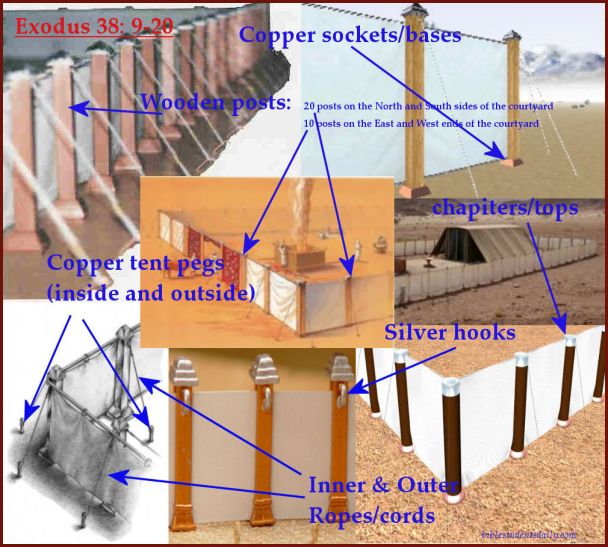
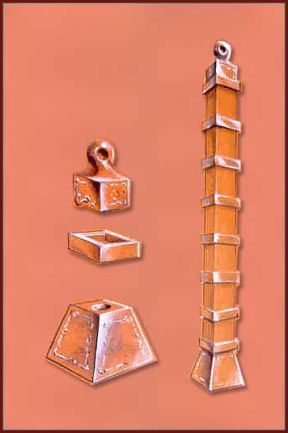 According to the Temple Institute in Israel: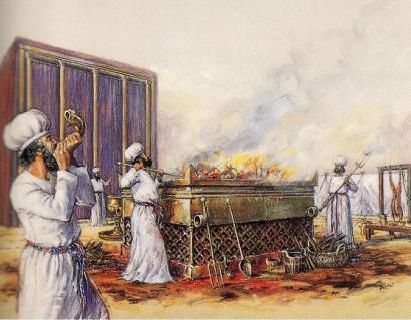



 BIBLE Students DAILY