

“The cup of blessing which we bless, is it not the communion of the blood of Christ? The bread which we break, is it not the communion of the body of Christ?” (1 Corinthians 10:16)
What does the Apostle Paul mean by the “communion of the blood and body of Christ”?
“You cannot drink the cup of the Lord and the cup of demons; you cannot partake of the Lord’s table and of the table of demons” (1 Corinthians 10:21).
In Chapter 10 of the first epistle to the Corinthian church, the Apostle Paul illuminates and puts in context his reference to our communion in partaking of the memorial emblems of the cup and bread.
What Pastor Charles Russell Taught
Pastor Charles Russell quoted 1 Corinthians 10:2 in The Reprints of the Original Watchtower and Herald of Christ’s Presence and taught that there was a secondary meaning to the bread and wine emblems: that the (1) “broken loaf” represents the “breaking of all his mystical members” and “communion of the blood of Christ” means a “participation in the sufferings and death of Jesus.” R3364.
He based this teaching of a secondary meaning on the word “communion” in Corinthians 10:2 and that since the word “communion” comes from the ancient Greek word koinonia; which in its basic sense means a common union with someone in a shared experience, he thought that the shared experience is “the sufferings and death” and that the common union was with Jesus.
Let us now consider the 1 Corinthian Chapter 10 context, in order to understand the Apostle Paul’s teachings in this section, and thereby specifically examine whether this proposed secondary meaning is actually what the Apostle Paul was teaching or not.
i) The Immediate Context: 1 Corinthians 10:1-22
The verses that define the immediate context for understanding the communion verse [16] are found in 1 Corinthians 10:1-22.
Moreover, brethren, I do not want you to be unaware that all our fathers were under the cloud, all passed through the sea” (1 Corinthians 10:1, NKJV).
δέ de; a primitive word; but, and, now
We notice that verse 1 uses the conjunction δέ, meaning but, and, now – here, the NKJV translates δέ as “moreover.” This tells us that this section is also linked to what came before and therefore that there is a wider context to consider also.
ii) The Wider Context: It is Possible to Lose the Imperishable Crown
“… I have become all things to all men, that I might by all means save some” (1 Corinthians 9:22).
In the previous few Chapters in 1 Corinthians, the Apostle Paul outlines his determination to put nothing in the way of the Gospel and to be “all things to all men” in order to “save some.”
“And everyone who competes for the prize is temperate in all things. Now they do it to obtain a perishable crown, but we for an imperishable crown. 26 Therefore I run thus: not with uncertainty. Thus I fight: not as one who beats the air. 27 But I discipline my body and bring it into subjection, lest, when I have preached to others, I myself should become disqualified” (1 Corinthians 9:25–27).
The paragraph immediately prior to Chapter 10, the Apostle Paul outlines the possibility that it is possible to be disqualified from gaining the imperishable crown if we do not run in the race with temperance and discipline, and therefore we can expect that what follows will be practical advice and warnings, as well as bringing to mind relevant aspects of our faith to give us strength and determination in order to gain the prize of that imperishable crown.
iii) The Immediate Context: Warnings Against the Conscious Pursuit of Evil Things
“Now these things became our examples, to the intent that we should not lust after evil things as they also lusted” (1 Corinthians 10:6).
The immediate context to the communion verse is that of the Apostle Paul’s warnings against the conscious pursuit of evil things because the end result of doing so is the loss of God’s favour and disqualification from the race for the prize of the high calling in Christ Jesus.
“No temptation has overtaken you except such as is common to man; but God is faithful, who will not allow you to be tempted beyond what you are able, but with the temptation will also make the way of escape, that you may be able to bear it” (1 Corinthians 10:13).
The Apostle Paul outlines that even though God will give us the means to escape these temptations, we have an important role in the matter; actively and consciously exercising temperance and discipline.
iii) The Apostle Uses Two Devices in His Warnings:
The Apostle Paul uses two didactic devices to highlight the danger and seriousness of consciously pursuing temptations: firstly, he uses the example of natural Israel during their wanderings in the desert; and secondly, he reminds us of the underlying meaning and significance of partaking of the cup and the bread at the memorial.
The Apostle Paul’s points and logic here have the purpose of ensuring that his fellow Christians are not disqualified from gaining the prize by pursuing evil things.
The Example of “Israel after the Flesh”
“Observe Israel after the flesh: Are not those who eat of the sacrifices partakers of the altar?” (1 Corinthians 10:18).
“Now all these things happened to them as examples, and they were written for our admonition, upon whom the ends of the ages have come” (1 Corinthians 10:11).
Here the Apostle Paul uses the experiences in the wilderness of natural Israel as a type to illustrate important lessons for spiritual Israel.
1) Idolatry,
2) Sexual immorality,
3) Testing of the Lord, and
4) Murmuring or complaining
The Apostle Paul specifically mentions four evil things “Israel after the flesh” engaged in: idolatry, sexual immorality, testing of the Lord, and murmuring or complaining
“But with most of them God was not well pleased, for their bodies were scattered in the wilderness” (1 Corinthians 10:5).
Because of this, God was not pleased with them and their bodies He scattered in the wilderness. By outlining these experiences as examples for our instruction, Paul is warning that we face the same dangers – particularly if we become complacent; as he points out in 1 Corinthians 10:12 “Therefore let him who thinks he stands take heed lest he fall.”
In the Apostle Paul’s references to “Israel after the flesh” here, he introduces the concept of natural Israel partaking of spiritual nourishment in the wilderness from God by way of our Lord Jesus Christ- for they all “drank of that spiritual Rock that followed them, and that Rock was Christ” (1 Corinthians 10:3-4).
“Our fathers ate the manna in the desert; as it is written, ‘He gave them bread from heaven to eat’” (John 6:31).
“Then Moses lifted his hand and struck the rock twice with his rod; and water came out abundantly, and the congregation and their animals drank” (Numbers 20:11).
God miraculously provided Israel with literal food and drink during their desert wanderings, but this is not what Paul is focusing on here. He is referring to spiritual food and drink.
The miraculous manna given to natural Israel was, of course, a great blessing but as Deuteronomy 8:3 tells us, it was intended to teach them the lesson that man lives – in the greater sense, by feeding on “every word that proceeds from the mouth of the Lord” – this is the real spiritual food. The word of God was imparted to them through Moses, so that they were guided and protected by God in their wanderings. God spoke to them through their covenant relationship, and through the many wonderful promises given to them, as well as their miraculous liberation from Egypt.
“They all ate the same spiritual food, and all drank the same spiritual drink…”(1 Corinthians 10: 3–4).
In this way, Israel after the flesh ate at the Lord’s table, for they all ate the same spiritual food and drank the same spiritual drink.
The Apostle Paul makes clear that it was all of natural Israel that ate at the Lord’s table and he mentions the all twice, probably to make this abundantly clear.
Crucially, we see that the benefits of the spiritual drink and the spiritual food flows from our Lord Jesus to all of the Israelites. It is clear that Jesus did not eat or drink this spiritual food or drink.
In summary: a commonality was established amongst the individual Israelites through all partaking of the same spiritual food and drink – the source of which was our Lord Jesus.
Paul is laying the ground work in his lead up to the important lesson that like Israel after the flesh, Israel after the spirit also eats and drinks at the table of the Lord – gaining far greater blessings but at the same time conferring important responsibilities.
All of Fleshly Israel Partakes, All of Spiritual Israel Partakes
“The cup of blessing which we bless, is it not the communion of the blood of Christ? The bread which we break, is it not the communion of the body of Christ?” (1 Corinthians 10:16)
In 1 Corinthians 10:16 the Apostle Paul reminds his fellow Christians that the literal partaking of the cup and bread is not a meaningless ritual. Rather, by partaking of the cup emblem we show that we are spiritually feeding on the blood of Jesus by gaining justification through faith. Also, by partaking of the bread emblem, we show that we are being spiritually nourished by appropriating the benefits of Jesus’ sacrificed body.
What Does Partaking of the Emblems (the cup and the bread) Show?
It shows that we are eating/drinking at the Table of the Lord with fellow believers; the communion, leading to eternal life.
“Whoever feeds on my flesh and drinks my blood has eternal life, and I will raise him up on the last day” (John 6:54).
i) Partaking of the Cup [drinking of the blood of Jesus] shows:
1) The New Covenant is Ratified and Operative for the Church by the Blood of Jesus, enabling:
– Learning of God
– Having God’s law written on our hearts
2) Believers have True Forgiveness of sins by faith through application of the blood of Jesus as the antitypical sin-offering under the administration of the better sacrifices
3) Believers are Reconciled to God [achieving atonement with God – from1)+2)]
4) Have Received The Promise of the holy spirit
5) Believers are Cleansed from ongoing inadvertent sin [purification through the antitypical ashes of the red heifer – depicted in Jesus washing of the disciples’ feet]
ii) Partaking of the Bread [eating of the flesh of Jesus] shows:
1) Believers Receive and Understand Jesus’ words of truth [through the holy spirit]
2) Have ongoing spiritual nutrition for spiritual growth of the new creature through the indwelling of the holy spirit given at baptism into Christ
– Growing in grace and knowledge
– Learning of God
– Having God’s law written on our hearts
“Then Jesus said to them, ‘Most assuredly, I say to you, unless you eat the flesh of the Son of Man and drink His blood, you have no life in you’” (John 6:53).
All of Jesus’ followers must eat his flesh and drink his blood.
The spiritual drink and spiritual food that we partake of leads to eternal life which is provided for us by the sacrifice of Jesus, by the grace of God.
** We notice in John 6:53 that Jesus is addressing his followers – unless you eat and drink, you have no life in you – plainly Jesus is not including himself here.
1 Corinthians 10:3–4 (NKJV) — “all ate the same spiritual food, 4 and all drank the same spiritual drink. For they drank of that spiritual Rock that followed them, and that Rock was Christ.”
We notice again that the same relationship exists in spiritual Israel as it did in fleshly Israel. All the natural Israelites ate the spiritual food and drank the spiritual drink. There is no suggestion that Jesus somehow also ate and drank of the same spiritual food and drink as fleshly Israel.
“Then He took the cup, and gave thanks, and gave it to them, saying, “Drink from it, all of you” (Matthew 26:27).
Jesus did not say “let us all drink of it”, rather he said “drink from it, all of you.“
Also, Jesus’ instructions were to do this “in remembrance of me” not in remembrance of us.
“He who eats My flesh and drinks My blood abides in Me, and I in him. 57 As the living Father sent Me, and I live because of the Father, so he who feeds on Me will live because of Me. 58 This is the bread which came down from heaven—not as your fathers ate the manna, and are dead. He who eats this bread will live forever” (John 6:56–58).
Israel after the flesh ate the manna, died
Spiritual Israel eat/drink of Jesus flesh/blood, live forever
Note how this parallels the type which emphasises its importance in understanding the communion relationship. The Apostle John, in John 6:58, beautifully links the type and the antitype for us: “This is the bread which came down from heaven—not as your fathers ate the manna, and are dead. He who eats this bread will live forever.”
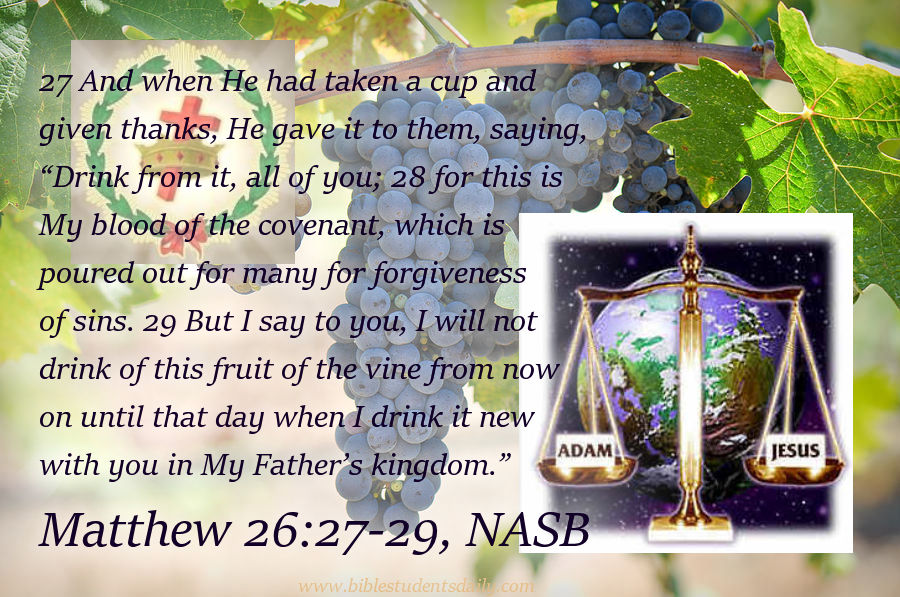
“This is my blood of the covenant, which is poured out for many for the forgiveness of sins” (Matthew 26:28).
“In the same way, after the supper he took the cup, saying, ‘This cup is the new covenant in my blood, which is poured out for you’” (Luke 22:20).
Jesus’ blood, through which we have forgiveness of sins, was poured out for us — that is for spiritual Israel. It is clear that Jesus could not eat of his flesh or drink his own blood as he was sinless and undefiled and hence did not require forgiveness. Moreover, if he had any sin, he would not have been able to provide life through his sacrifice. This shows the flow of the blessings of forgiveness of sins, from Jesus by virtue of his sacrificed flesh and poured out blood, is to us.
There is no indication that those feeding and drinking are contributing to the food and drink.
Sacrificial Nourishment for the Levites/Firstborn
“The priests, the Levites—all the tribe of Levi—shall have no part nor inheritance with Israel; they shall eat the offerings of the Lord made by fire, and His portion” (Deuteronomy 18:1).
“Observe Israel after the flesh: Are not those who eat of the sacrifices partakers of the altar?” (1 Corinthians 10:18).
The Apostle Paul then goes even further, and makes the illustration from the type even more specific in order to further illuminate the communion relationship and the significance of our partaking of the cup and bread memorial emblems. He does this by referring to the priests and Levites that did partake of the sacrifices from the altar in the tabernacle. The tribe of Levi had no inheritance in the Land of Israel and so they lived off the offerings made to the Lord. The offerings from the altar in the tabernacle were therefore their source of food.
This illustration is more specific to Christians and is introduced immediately after the communion verses to make clear the significance and nature of the communion relationship and he links the two situations by the word “observe.”
In the tabernacle picture, as with the firstborn of the Passover, the tribe of Levi represented the household of faith — which only has a heavenly inheritance. The tribe of Levi had no land of their own, picturing this heavenly inheritance of the Church of firstborns.
The priests and Levites ate of the sacrifices, indicating that they internalised the nutritional benefits to themselves. Again, there is no suggestion here that by eating of these sacrifices they were sharing in or contributing to the actual sacrifice. Rather, the benefit of the nutritional elements flowed in one direction and one direction only — from the altar to the priest or Levite. In the antitype this translates directly to the flow of spiritual benefits from the altar of God by way of Jesus’ sacrifice to the household of faith, which the Priests and Levites represented.
In this more specific typical picture, the Apostle Paul introduces the important principle that the altar from which the sacrificed food comes, identifies the source of the food. The priests and Levites ate of the sacrifices from the altar in the court of the tabernacle, thus identifying the source of the food as God.
“Therefore, my beloved, flee from idolatry. 15 I speak as to wise men; judge for yourselves what I say. 16 The cup of blessing which we bless, is it not the communion of the blood of Christ? The bread which we break, is it not the communion of the body of Christ? 17 For we, though many, are one bread and one body; for we all partake of that one bread” (1 Corinthians 10:14–17).
The communion verses come immediately after the Apostle Paul’s admonition to flee from idolatry; which was a particular problem in the Corinthian church. The Corinthian church consisted of many Christians of Gentile background and these brethren were accustomed to eating food from the markets and in houses of unbelievers that had been sacrificed on pagan altars to pagan gods. The Apostle Paul’s aim here is to illustrate the dangers of continuing to eat these pagan sacrifices by pointing out the crucial significance of the altar from which the sacrifices come. Here he is teaching that those that partake of these sacrifices in the type, are commonly joined to one another by participating of the altar and what it represents, from which the sacrifice comes. In the same way, those that eat of pagan sacrifices are commonly joined by participating in eating from them.
Partaking of pagan sacrifices means partaking of the table of demons.
“What am I saying then? That an idol is anything, or what is offered to idols is anything? 20 Rather, that the things which the Gentiles sacrifice they sacrifice to demons and not to God, and I do not want you to have fellowship with demons” (1 Corinthians 10:19–20).
Even though, as the Apostle Paul points out, idols are nothing in themselves, in reality the altar is demonic, so that by partaking of the pagan sacrifice, one is not only joining oneself in fellowship with those pagans that eat the sacrificed food, but is also partaking of the table of demons.
“You cannot drink the cup of the Lord and the cup of demons; you cannot partake of the Lord’s table and of the table of demons” (1 Corinthians 10:21).
And for a Christian to partake of the table of the Lord is incompatible with partaking of the table of demons.
“Or do we provoke the Lord to jealousy? Are we stronger than He?” (1 Corinthians 10:22).
By partaking of these pagan sacrifices, Christians risk provoking the Lord to jealousy.
“You shall not bow down to them nor serve them. For I, the Lord your God, am a jealous God, …” (Exodus 20:5).
For our God is a jealous God and He will not tolerate other gods, for all other gods are no gods. So that the worship of anything but God is not only false but is also of Satan — for he is the great usurper, for he wanted to be as the Most High. Worship of anything else but God usurps the authority of God and displaces the true worship reserved only for God.
And this principle is embodied in the first and greatest commandment – “You shall love the Lord your God with all your heart, with all your soul, and with all your mind” (Matthew 22:37).
So, to summarize, it is evident that the food provided at these altars is not shared in the sense of being contributed to by the partaker. The flow of nutrition, whether typical or spiritual or idolatrous, flows from the altar to the recipient, for the benefit (or detriment) of the partaker.
The modern-day gods that we are in danger of worshipping tend to be more subtle and insidious.
“For many walk, of whom I have told you often, and now tell you even weeping, that they are the enemies of the cross of Christ: 19 whose end is destruction, whose god is their belly, and whose glory is in their shame— who set their mind on earthly things. 20 For our citizenship is in heaven, from which we also eagerly wait for the Savior, the Lord Jesus Christ…” (Philippians 3:18–20).
In our modern society we find people pursuing such things as knowledge, health, physical beauty, money, material things, status and respect. Even though most of these have benefits in moderation, when one is consumed by their pursuit it becomes a false god. Therefore, anything that takes our minds and desires from the heavenly things, anything that supplants the true and appropriate worship of our heavenly Father is a false god and amounts to idolatry when pursued to an excessive extent.
A particular danger for the household of faith is the supplanting, consciously or subconsciously, of the authority of the word of God with the words of any imperfect human being. Our faith must be based on the word of God, not on the words of a man. All teachings must be tested thoroughly against scripture.
“The cup of blessing which we bless, is it not the communion (koinonia) of the blood of Christ? The bread which we break, is it not the communion (koinonia) of the body of Christ?” (1 Corinthians 10:16).
Koinonia is part of the koin- root word group which has the fundamental meaning of sharing in something (indicated by the genitive case) with someone (indicated by the dative case); or the simple cases may be replaced by a prepositional phrase.
“By which have been given to us exceedingly great and precious promises, that through these you may be partakers (koin-) of the divine nature (genitive case), having escaped the corruption that is in the world through lust” (2 Peter 1:4).
“Therefore, if there is any consolation in Christ, if any comfort of love, if any fellowship (koin-) of the Spirit (genitive case), if any affection and mercy…” (Philippians 2:1).
Another example of the koin- root word group occurs in Philippians 2 verse 1. Paul is talking about the fellowship of the holy spirit – it is evident that each individual of the household of faith has a share in the holy spirit with all other believers. Spirit is in the genitive case indicating what they commonly share in. Importantly the sharing is in the holy spirit not with the holy spirit.
“And so also were James and John, the sons of Zebedee, who were partners (koin-) with Simon (dative case). And Jesus said to Simon, ‘Do not be afraid. From now on you will catch men.’” (Luke 5:10).
So, the word “koinonia” in 1 Corinthians 10:16 means that the household of faith share-the shared experience, in the drinking of the blood of Jesus and eating of his flesh with one another.
In our 1 Corinthians 10:14–22 context, we have the koin- root word used four times.
If drinking of the cup of the Lord meant sharing in the sufferings of the Lord, then those drinking of the cup of demons would have to mean sharing in the sufferings of demons — which evidently is not the case.
Here the Apostle Paul also uses the koin- root word with respect to the Levites being common sharers of the brazen altar and what it represents. Altar here is in the genitive case making clear what the Levites are participating in. It is clear from the actual type and the underlying grammar that the meaning of the koin- root word here does not mean a sharing with the altar and the sacrifices that come from it. The Levites did not contribute to the sacrifices or their suffering in any way — they ate of them and thereby benefitted from them.
By eating of the bread, and drinking of the cup introduced by Jesus at the memorial, we show that we are commonly – with one another, sharing in the eating of the flesh of Jesus and drinking of his blood. Thereby we receive the spiritual nutrition essential and indispensable for our salvation.
Although sharing in the sufferings and death of Jesus is clearly taught in the scriptures, Paul is not teaching this here in the communion verse.
“Is it Not”: Indicates a Reminder of Something Already Taught Not Something New
“The cup of blessing which we bless, is it not the communion of the blood of Christ? The bread which we break, is it not the communion of the body of Christ? 17 For we, though many, are one bread and one body; for we all partake of that one bread” (1 Corinthians 10:16–17).
That the Apostle Paul is bringing to mind something familiar rather than a new teaching [like a secondary meaning] is indicated by his use of the phrase “is it not”, twice in the communion verses.
Technically, “is it not” is a figure of speech referred to as “interrogation”; this occurs when a question is asked without waiting for the answer. There are different forms of interrogation and here it is called “interrogation in negative affirmation“; this occurs when the question is put in the negative, and the answer must be in the affirmative, and very emphatically so – indicating that the point made is or should be known already by those to whom the question is addressed.
Let us look at other instances of use of this figure of speech.
“Therefore, I say to you, do not worry about your life, what you will eat or what you will drink; nor about your body, what you will put on. Is not life more than food and the body more than clothing?” (Matthew 6:25).
We find it is used in Matthew 6:25 by Jesus to show that indeed life is more than food and the body more than clothing. The important point to glean here is that the “is not” did not introduce something they did not already know.
“So all bore witness to Him, and marveled at the gracious words which proceeded out of His mouth. And they said, ‘Is this not Joseph’s son?’” (Luke 4:22)
We find another example of this interrogative figure of speech in Luke 4 verse 22. Because of the gracious words that proceeded out of Jesus’ mouth, the people assumed that he was a sage from a far-off land with new found wisdom, and yet the interrogation in negative affirmation “is not” emphasises the fact that Jesus and his family were well known to them.
Therefore, the use of this “is not” figure of speech suggests that the communion verses are a reminder or an emphasis of something that was clear and known, rather than introducing a new truth.
Partaking of the Memorial Emblems Shows That We are Eating and Drinking at the Table of the Lord.
The memorial truth that the Apostle Paul is reminding us of is that eating of the bread and the drinking of the cup emblems indicates that we are together figuratively partaking of the sacrificed body and shed blood of Jesus – and thereby we are eating and drinking at the table of the Lord.
Let us be clear that we are not saying that faithful followers of Jesus do not share in his sufferings and death – for this is taught clearly in the word of God. Philippians 3:10 is a case in point:
“that I may know Him and the power of His resurrection, and the fellowship of His sufferings, being conformed to His death…” (Philippians 3:10).
But this is not Paul’s teaching in his reference to our partaking of the memorial emblems in 1 Corinthians 10:16.
Fixing KJV 1 Corinthians 10:17
The Rendering of 1 Corinthians 10:17 in the KJV, NKJV and even the RVIC2016 is faulty.
“For we, though many, are one bread and one body; for we all partake of that one bread” (1 Corinthians 10:17, NKJV).
“104 seeing that we the many are one bread, one body: for we all partake.” (1 Corinthians 10:17, (RVIC2016).
When we read 1 Corinthians 10:17 in the KJV, NKJV and even the RVIC2016, we are left with the thought that by partaking of the bread emblem the followers of Jesus become that bread. Ostensibly this does not seem to make sense, but does seem to give credence to the thought that the Church becomes part of the sacrifice from which it benefits.
1 Corinthians 10:17 should read – “seeing that there is one bread, we, who are many, are one body”
The more modern translations, including the Diaglott, show that the greater number of modern translators overwhelmingly favour the alternate rendering – seeing that there is one bread, we, who are many, are one body. The“we” belongs with the many and one body, not the bread – for as the verse makes clear we are one body because we partake of that bread.
We Need to Keep Eating at the Table of the Lord in Order to Gain the Imperishable Crown
As followers of Jesus, we need to keep spiritually feeding on his flesh and drink his blood to continue to receive these incredibly gracious benefits during this age of darkness. We remind ourselves of these spiritual benefits flowing from God to us based on Jesus’ shed blood and sacrificed body, particularly at memorial time.
What a privilege it is to eat and drink at the table of the Lord; for it leads to eternal life. But doing so also carries all important responsibilities. We have to avoid all forms of idolatry, particularly the subtle forms, for truly we are on trial for life, now.
“Now the just shall live by faith; But if anyone draws back, My soul has no pleasure in him.” 39 But we are not of those who draw back to perdition, but of those who believe to the saving of the soul” (Hebrews 10:38–39).
But if we are careful and listen to God’s word, for Jesus speaks to us through it, we will not be of those that draw back to destruction, but rather we will be of those that are faithful, temperate and disciplined, leading to eternal life – to the glory of our Heavenly Father.
“Thou preparest a table before me in the presence of mine enemies: Thou anointest my head with oil; my cup runneth over” (Psalm 23:5).
Amen.




 BIBLE Students DAILY