Water From The Rock

Moses-Obtains-Water-from-a-Rock-1.png

There are two occasions in the Old Testament of Moses smiting a rock to provide water for the despairing Israelites in the wilderness. Let us examine the events, their differences, and the lessons to be learned.

Exodus 17:1-7

In this account Moses, in the name of God, smote a rock in Horeb with his rod to release water for the thirsty Israelites who had camped at Rephidim (see map below), about 1 1/2 months after the Exodus (compare Exodus 19:1). From this rock gushed water, abundantly refreshing Israel.
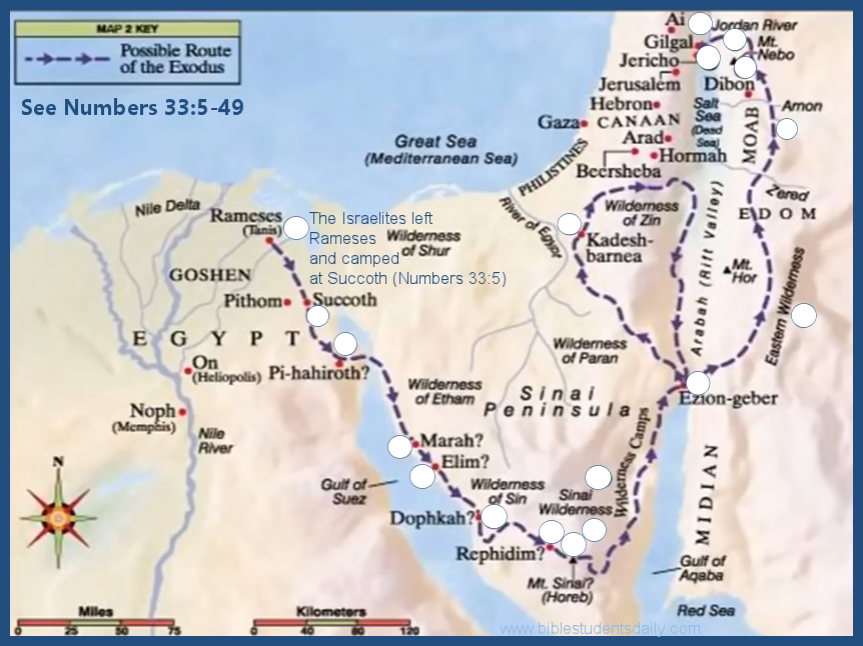
exodus-route-map-bible.png

Here is this account of Moses’ first smiting of the rock as recorded in Exodus 17:1-7 (KJV):

“(1) And all the congregation of the children of Israel journeyed from the wilderness of Sin, after their journeys, according to the commandment of the LORD, and pitched in Rephidim: and there was no water for the people to drink.

(2) Wherefore the people did chide with Moses, and said, Give us water that we may drink. And Moses said unto them, Why chide ye with me? wherefore do ye tempt the LORD?

(3) And the people thirsted there for water; and the people murmured against Moses, and said, Wherefore is this that thou hast brought us up out of Egypt, to kill us and our children and our cattle with thirst?

(4) And Moses cried unto the LORD, saying, What shall I do unto this people? they be almost ready to stone me.

(5) And the LORD said unto Moses, Go on before the people, and take with thee of the elders of Israel; and thy rod, wherewith thou smotest the river, take in thine hand, and go.

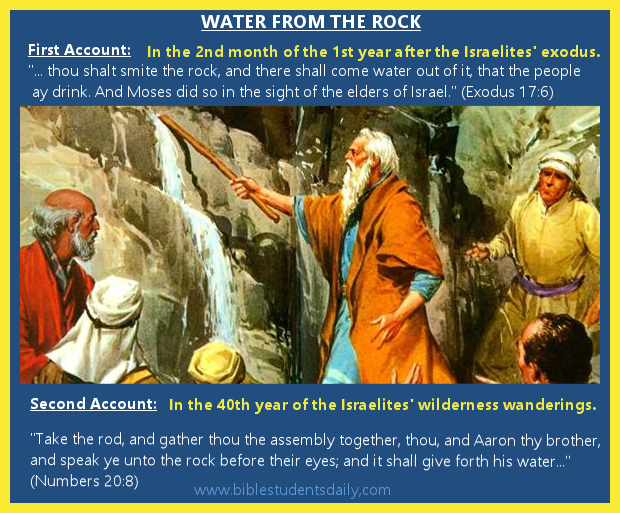
(6) Behold, I will stand before thee there upon the rock in Horeb; and thou shalt smite the rock, and there shall come water out of it, that the people may drink. And Moses did so in the sight of the elders of Israel.

(7) And he called the name of the place Massah, and Meribah, because of the chiding of the children of Israel, and because they tempted the LORD, saying, Is the LORD among us, or not?”

Numbers 20:1-13, 24 

The second occasion of Moses smiting a rock for water occurred much later, near the end of the 40 years of wilderness wandering. This is recorded in the fourth book of Moses, the book of Numbers, chapter 20. Here Moses and Aaron “rebelled against my word” (verse 24). For on this occasion God told Moses to speak to the rock, but in anger, and failing to credit God for caring for the Israelites, Moses asked the crowd “must we fetch you water out of this rock?,” and smote it twice.

Here is the account (Numbers 20:1‑13, 24 KJV):

“(1) Then came the children of Israel, even the whole congregation, into the desert of Zin in the first month: and the people abode in Kadesh; and Miriam died there, and was buried there.

(2) And there was no water for the congregation: and they gathered themselves together against Moses and against Aaron.

(3) And the people chode with Moses, and spake, saying, Would God that we had died when our brethren died before the Lord!

(4) And why have ye brought up the congregation of the Lord into this wilderness, that we and our cattle should die there?

(5) And wherefore have ye made us to come up out of Egypt, to bring us in unto this evil place? it is no place of seed, or of figs, or of vines, or of pomegranates; neither is there any water to drink.

(6) And Moses and Aaron went from the presence of the assembly unto the door of the tabernacle of the congregation, and they fell upon their faces: and the glory of the Lord appeared unto them.

(7) And the Lord spake unto Moses, saying,

(8) Take the rod, and gather thou the assembly together, thou, and Aaron thy brother, and speak ye unto the rock before their eyes; and it shall give forth his water, and thou shalt bring forth to them water out of the rock: so thou shalt give the congregation and their beasts drink.

(9) And Moses took the rod from before the Lord, as he commanded him.

(10) And Moses and Aaron gathered the congregation together before the rock, and he said unto them, Hear now, ye rebels; must we fetch you water out of this rock?

(11) And Moses lifted up his hand, and with his rod he smote the rock twice: and the water came out abundantly, and the congregation drank, and their beasts also.

(12) And the Lord spake unto Moses and Aaron, Because ye believed me not, to sanctify me in the eyes of the children of Israel, therefore ye shall not bring this congregation into the land which I have given them.

(13) This is the water of Meribah; because the children of Israel strove with the Lord, and he was sanctified in them.

(24) Aaron shall be gathered unto his people: for he shall not enter into the land which I have given unto the children of Israel, because ye rebelled against my word at the water of Meribah.”

Moses Not Permitted to go Into the Promised Land

One of the reasons why Moses was not permitted to lead Israel into the land of promise concerns this second occasion. Smiting the rock on the first occasion (Exodus. 17:1‑7) was by God’s direction, and the waters gushed forth. But the second time (Numbers 20:2‑12) the Lord said to Moses, “Speak unto the rock,” but instead he hit the rock with his rod twice.

Moses’ sin in the Numbers account was self‑assertion and lack of faith (R4047:6, R5315:5).

In Numbers 27:14, God clearly states to Moses that He punished Aaron and him for their disobedience. “For ye rebelled against my commandment in the desert of Zin, in the strife of the congregation, to sanctify me at the water before their eyes: that is the water of Meribah in Kadesh in the wilderness of Zin” (Numbers 27:14). By not saying that God would provide them water,  saying rather that they would give the whole community water, Moses and Aaron had disobeyed God.

Here, we are reminded of Ephesians 4:26, “If angry, beware of sinning” (Weymouth). Moses and Aaron, in anger with the Israelite complaints, took the matter in their own hands. Moses disregarded God’s direction, and failed to direct the people to God’s loving care for them. Evidently Moses remembered his striking the rock years earlier, and vented his anger here without regard for G6 mtqod’s instruction to “speak ye unto the rock before their eyes, and it shall give forth his water.”

As Moses and Aaron were punished for their wrong actions, so too, God’s people may have to live with the consequences of their poor decisions or impulsive actions. However, God still provides access to the the waters of spiritual life. God knows that no one could stand before God if every mistake were recorded and not forgiven.

“(3) If you, O LORD, should mark iniquities, O Lord, who could stand? (4) But with you there is forgiveness, that you may be feared. (5) I wait for the LORD, my soul waits, and in his word I hope; (6) my soul waits for the Lord more than watchmen for the morning, more than watchmen for the morning. (7) O Israel, hope in the LORD! For with the LORD there is steadfast love, and with him is plentiful redemption” (Psalm 130:3‑7, ESV).

Some time later, God led Moses up to Mount Pisgah’s top (Numbers 27:12), with an extended panoramic view of the Promised Land of Canaan. Moses saw this with his natural eyes, but Moses saw much more through the eye of faith, seeing the promises which God had made to the tribes of Israel through Abraham, Isaac, and Jacob. “We hear not a murmur respecting the transfer of leadership and the cessation of his own labors. If God had used Moses in his service to the extent that he was pleased to do, the servant was thankful and satisfied” (R3077).

“The most unjust thing we can do is judge Moses or any other man by his deeds and not by his fruits” (R4055:5).

Antitypical Meaning of “Smiting” the Rock

Christ Jesus, the true Rock, was to be smitten but once for our sins, and as a result of that one smiting at Calvary [i.e. Christ’s death, which made possible the access to God’s grace in Christ to those God has called out of the world] the water of life would be obtained for all true Israelites to all time; and if for a season the flow was stopped it was only necessary that the Rock should be invoked in the name of the Lord, that the waters might again flow forth. Christ dieth no more; death has no dominion over him; therefore in the type the Rock should not have been smitten a second time. But the second smiting, nevertheless, made a new type, because as the Apostle explains, there are some now who crucify Christ afresh, and put him to an open shame‑some of his professed followers denying or ignoring the value of the original sacrifice, denying the blood that bought them, are counted as committing the sin unto death — Second Death — and of these Moses became a type, and as a type of a class which would have to do with the antitype of the rock, he was debarred from Canaan — Hebrews 6:4‑6” (R3077).

Any denial of the Redeemer on the part of the consecrated would signify a crucifying afresh, a smiting of the rock a second time” (R5315:4).

“We might remark here, too, that those who smote the Lord the first time, at Calvary, have the promise of full forgiveness. They shall look upon him whom they pierced, and shall mourn for him, and the Lord will pour out upon them the spirit of prayer and supplication, and they shall have full opportunity of recompense and reconciliation (Zechariah 12:10). It is those who, with greater knowledge, and after they have become partakers of the holy Spirit, and have tasted the good Word of God, and the powers of the age to come, sin wilfully and count the blood of the covenant a common thing [unholy thing, Hebrews 10:29] — these are they who commit the real sin unto death, and for whom the Scriptures suggest no hope, or further opportunity, because they have sinned wilfully” (R3077).

What if Moses Had Not Smitten the Rock in the Numbers Account?

If Moses had not smitten the rock in the Numbers 20 account, would he have been permitted to enter the promised land? Br. Charles Taze Russell answers this question in R3077.

“… Moses would not have gone into the land of Canaan [even if he had obeyed God by “speaking to the rock”] because … he was the type of the Law Covenant, which must end before the people can enter into their rest. As Moses was the representative of the Law Covenant, so Joshua became the representative or type of the New Covenant and of its mediator, Jesus, the Deliverer. ‘The Law came by Moses, but grace and truth came by Jesus Christ.’ The Law was a pedagogue or guide to prepare and bring the Israelites along to the borders of Canaan, but the Law could never give them rest, could never take them into the land of promise. Christ, the antitype of Joshua, must do that. We are to remember, too, that Moses’ error in smiting the rock, did not involve him in the Second Death, nor will it work any injury to him as respects the future. It was comparatively a trivial matter, and taught him a valuable lesson which he evidently learned to the Lord’s pleasement, and his failure to go into the land of promise, therefore, should not indicate a continuance of divine indignation against him, but merely a continuance of the divine purpose in making of him a type of a class who would have to do with the antitypical rock, the antitypical water, and the antitypical smiting.”

Differences and Similarities Between the two Rock Smiting Accounts

Here are some differences and similarities noted between the Exodus and Numbers account concerning the smiting of the rock by Moses.

(1) Time — The first account occurred in the opening year of the Exodus while the other occurred near the opening of the 40th year after the Exodus. The Exodus account was in the second month of the first year, while the Numbers account was in the 1st month of the (last) 40th year of travelling.

(2) Location — Exodus account: in the Wilderness of Sin at Rephidim (Exodus 17:1); Numbers account: in the desert of Zin at Kadesh, in the first month of year 40 of their travels.

(3) Moses’ attitude — On the first occasion, Moses followed God’s instructions to the fullest and his attitude was noble and honorable, while in the closing account his attitude was angry and personal, rather than deferential: “Must we fetch you water?” were his words, rather than giving glory to God by saying something like “God will give you water,” and meekly directing the attention to Jehovah.

(4) Level of Obedience — In the opening account Moses hit the rock once as God told him to do, while in the closing account he was to speak to the rock but he disobeyed and instead hit the rock twice.

(5) The Rods — the rod in the Exodus account was Moses’ rod, while the rod in the Numbers account may have been the rod of Aaron. (Numbers 20:9, “Moses took the rod from before Jehovah” — perhaps the rod of Aaron that had been “before the testimony,” Numbers 17:10).

(6) Who was present — In the Exodus account Moses struck the rod in the sight of the Elders, while in the Numbers account, the whole assembly of the Israelites was present.

(7) All the Israelites still murmured and quarrelled during the 40 year wandering in the wilderness. Thus the only ones to enter the Promised Land of Canaan were Joshua, Caleb, and all the children of the Israelites who were less than 20 years of age (Numbers 14:20‑30).

(8) The Rock — in both cases the rock represents Christ, the Rock of Ages. “And all drank the same spiritual drink. For they drank from the spiritual Rock that followed them, and the Rock was Christ” (1 Corinthians 10:4).

(9) In both cases, the waters quenched the thirst of the Israelites.

(10) Two examples of the spiritual Rock are given during the life of Moses to show that there are two time periods in history during which the spiritual waters of life do flow — first for the Church class during this Gospel Age (from Pentecost in 33 AD) and next, in the kingdom age, for the world of mankind. In the Exodus account it was thus necessary for Christ to be smitten once: Romans 5:8, 1 Peter 3:18, John 7:32, 37. Before anyone can come unto Christ, he must thirst for the Truth. He must first have and show an appreciation of all that the Heavenly Father has to give. The waters beautifully picture the waters of eternal life that the Heavenly Father offers to those who have faith in Him, and the blessings that will flow through Him. The flowing waters satisfy the hearts of the Church class during the Gospel Age. These are pictured in the Elders in the Exodus account who were present with Moses. This water becomes a well spring of Truth in each one of us, with an opportunity to nourish others along the way.

(11) The Church’s sojourn began at the beginning of the Gospel Age, just as the Exodus account comes at the beginning of Israel’s wanderings in the wilderness. In Revelation 22:1 we read, “Then the angel showed me the river of the water of life, bright as crystal, flowing from the throne of God and of the Lamb.” Mankind will only receive that life‑giving water after the Kingdom is ushered in, just like in the Numbers account it comes at the end of the wilderness wanderings when the Gospel Age is complete. Then the resurrected world of mankind will receive the benefits of the Kingdom when they are ready to enter into the Promised Land, but on the earthly plane of existence.

(12) Christ will not then be smitten a second time. As pictured in the Numbers account, God will speak to Jesus at the appropriate time and the waters will not simply come forth, but they will come forth abundantly, as we are told in Numbers 20:11. Then the waters of life will be given to refresh all the people.

(13) The spiritual walk that we have entered into began with Christ. After crossing the Red Sea, the waters of Marah were bitter, representing the prevalence of sin throughout the world. Christ came to Jordan and offered his life and the first glimpse of the sweetened waters were given there. Next, at Elim, there were 70 palm trees and 12 wells. This relates to when our Lord sent out 70 into Galilee to preach the Gospel and he sent out 12 Apostles as the “wells” of spiritual Truth. Our Lord said he was “the true bread from heaven.” Yet the Israelites did not want that, but the quail. At Sinai, the tables of the Law were written into their hearts. Some have gone through difficult experiences like Miriam who was struck with Leprosy for 7 days, and some come back with a bad report and think it’s too much of a cost to bear, being consecrated to God. But those who endure with faith receive God’s blessings. In Numbers 21:6 the fiery serpents represent the affliction of sin, which the world can be relieved of by looking to Christ for their healing (Numbers 21:8).

Lessons

(1) Dependency on God

Not just to seek and ask God for answers and direction in our situations of daily life, but above all, in doing so, to  give God the glory in all that we say and do, and in any way the Heavenly Father permits, allow for the “hearers” as well as ourselves to recognize God’s influence in each matter. That is, see the presence of Christ through the actions, words and doings of the person(s) each does associate with in the experiences of this present life.

Example

Here is an example of a lesson to learn from Moses’ smiting the rock twice, in today’s world. If we give someone either financial or material gifts, then we should not think it is because of our power or our ability, but rather see that it is because of our Almighty Heavenly Father’s help — His love, justice, power, and wisdom working in harmony through His children called by Him, to do works that reflect Christ-likeness. We should do works in a way so as to fulfil God’s will and God’s purpose through us whom He has called to be partakers of the Heavenly calling now during the Gospel Age, from Pentecost forward.

St. Paul, by inspiration, points out to us that that rock represented Christ, that the smiting of the rock represented putting Christ to a shameful death, and that only by this means is the Water of Life provided for the people of God. As the waters of that rock followed the Israelites, so the stream of God’s favor, through the sacrifice of Christ, refreshes Christ’s disciples throughout their wilderness journey.

Refreshed in body and in faith, Israel journeyed onward, but encountered new obstacles. The Amalekites, a warlike people, considered the coming of Israel as an invasion of their country, and attacked them in battle. A people used to peaceful pursuits, as the Israelites had for centuries been, would naturally be at a disadvantage in a conflict with such opponents. Yet God gave them the victory. He indicated, however, that it was not by their prowess or skill, but of His grace that they conquered.

Moses, stationed upon a high hill, lifted up his hands in prayer to God for the people. While he did so, success was theirs; but when he ceased thus to pray, the Amalekites were the victors. Perceiving this, Aaron and Hur assisted in holding up the hands of Moses until the battle terminated with success for Israel. God thus indicated that Moses was the advocate or representative of Israel, and that without him they could do nothing.

(2) Regular Prayer = Close Communion with God

By having close communion with God through unceasing prayers, God’s people can seek the Heavenly Father’s direction and counsel in all of life’s affairs. Such complete dependency on God may by God’s grace and mercy result in a mind that desires and does only the will of God, which in turn, can result in glory, honour, and praise to our Heavenly Father through Christ.

Spiritual Israelites have conflicts with enemies too mighty for them without the Lord’s assistance. The world, the flesh, and the Devil make common cause against all who are seeking the Heavenly Canaan. We who are followers of Jesus have success in our warfare only as we have Him as our Advocate. “We have an Advocate with the Father, Jesus Christ the Righteous.” Through Him we may come off conquerors, yea, more than merely conquerors, victors in the highest sense — “through Him who loved us and bought us with His precious blood.”

(3) Avoiding pride.

C. S. Lewis said: “A proud man is always looking down on things and people; and, of course, as long as you are looking down, you cannot see something that is above you.”

Pride in any form and in anybody is a dangerous thing. In a worldly way the proverb is well attested, “Pride goeth before destruction and a haughty spirit before a fall.”

Moses was the “meekest man in all the earth” (Numbers 12:3). Perhaps this is one reason that this experience of Moses is recorded for our benefit — to alert us, that no matter our development of humility and meekness, we need to be careful lest a moment of self-assurance, or spiritual pride, does not cause us to forget our proper reliance upon, and respect for, our Heavenly Father.

“For the comfort of those who may feel that they have done much worse than Moses, or been much more self‑assertive, been much less careful to honor the Lord, have manifested much more spiritual pride‑for their comfort let us notice that the punishment here was severe because it was part of a type” (R5957).

“Neither are we to think that brethren who have manifested spiritual pride and done things in their own name, rather than in the name of the Lord and the name of the Class, have thereby committed the sin unto death. We are, however, to realize that a terrible danger goes with spiritual pride. … Realizing this, how anxious, how zealous we should be, not only in the eradication of every symptom of it we might find in ourselves, but also in being careful lest we should take the contagion or in any manner come under its influence or have any of its symptoms!” (R5957)

“When one attends a testimony meeting, or a Berean class, and hears no real good testimony but his own, hears no proper answer except his own to any of the questions, never sees an Elder in the chair who knows how to lead a meeting anyway — these should be considered dangerous symptoms of spiritual pride” (R5956).

The proper attitude, as all will agree, is that the Lord’s people should feel greatly humbled instead of greatly exalted and heady in respect to these opportunities for telling the Truth to others” (R5956).

“We should feel our unworthiness. We should realize that the Plan is not ours; that we have merely heard of it ourselves; that it is really God’s Plan; that we are honored as His servants to tell it out” (R5956).

“But if we allow any impression to go out that it is by any wisdom on our part, or any skill, that the beauty is seen in the Message, then to that extent we are taking glory to ourselves which belongs to the Lord, and doing injury to ourselves proportionately by failing to demonstrate our worthiness to be used by the Lord in the present and in the future. The wonderful privilege of speaking as ambassadors for the Lord, to tell of His greatness and Plan should humble us with the thought that He has privileged us, whereas He has angels, who excel in strength and whom He might have used in communicating this most wonderful Message” (R5956).

We should not feel offended if we are not elected as a deacon or Elder or assistant in the Lord’s service. Br. Russell writes that “in all meekness and humility they should feel a timidity even about taking a position where there would be such a responsibility. The admonition on this is that although all of the Church should, according to their knowledge of the Truth, be qualified to be teachers, nevertheless the safer place is not to be a teacher, knowing that such shall have the severer trial. Only a sense of responsibility to the Lord and to the brethren should make one willing to serve in such capacity, much as all ought to love to be the Lord’s representatives in the Church” (R5956).

The Need For Self‑Examination

“Let us not forget that while we are to exercise great leniency in viewing the words and deeds of others, ascribing only good intentions where they are professed, we are to scrutinize with all of our might our own hearts, our own intentions. We are to inquire why we did this thing or left undone the other thing; why we did this thing this way; why we spoke in such a tone, etc. Such a careful examination, weighing of thoughts, words and deeds, would be very unsatisfactory to a person who was not wishing to be in accord with the Lord. But those who have made a covenant with the Lord and are faithful to that covenant will find such a course to be a great blessing, comforting their hearts at the time, strengthening them for the future, and in connection with the Lord’s providences it will be fitting and preparing them for places in the Heavenly Kingdom” (R5958).

By relying on and asking the Heavenly Father through Christ to show us His way and do it, we can help keep the spiritual armour of Christ on 24/7 to protect us against sinning in a sudden moment that can creep up unexpectedly. Let us remember Moses’ situation and ask God to protect us from it happening to us, and trust that God is able to do more than we even ask for or imagine if He chooses to (Ephesians 3:20).

“To Him be glory in the church and in Christ Jesus throughout all generations, forever and ever. Amen” (Ephesians 3:21, ESV).

References:

Br. Charles Russell — Reprints of the Original Watch Tower and Herald of Christ’s Presence: R2299, R3077, R4047, R4055, R5285, R5315, R5955.

Bibletruth411 ‑ YouTube: “The Waters of Massah and Meribah.”

This post’s URL:

Water From The Rock

Enter your email address to subscribe to this blog and receive notifications of new posts by email.


GOD’S NAME – What Is The Heavenly Father’s Name That We Are To “Hallow” And Why?

MATTHEW-6-9-Rotherham.jpg

In Psalm 148:13 (KJV) the Psalmist David wrote, “Let them praise the name of the LORD: for his name alone is excellent; his glory is above the earth and heaven.”

But what is God’s actual name?

In this study we discuss the various names mentioned for God in the Old Testament Hebrew. Each of our Heavenly Father’s names describe different shades of His magnificent character, being, and personality, allowing us to know our Father better and learn what God wishes us to develop in our character, in order to bring joy, honor, glory, and praise to the Creator of all.

Almighty God—”El Shaddai”

The basic form for the Hebrew name of God is “El.” The word “El” means “might, strength, power.” The Schofield Reference Bible states that God (El) signifies the “Strong One.”

The word “Shaddai” is formed from the Hebrew words shadthe breast—and shadahto shed, to pour out. Thus, El Shaddai is “the God who pours out blessings, who gives them richly, abundantly, continually” (Adam Clark’s Commentary, Genesis 17:1). God is “Shaddai” because He is the nourisher, the strength‑giver, and thus the satisfier, who pours Himself into believing lives.

The primary translations of this root in the scriptures are “god” (for pagan or false gods), and “God” (for the true God of Israel). However, in Strong’s Concordance “El Shaddai” is not found under the English words “God” or “Lord,” but rather “Almighty” (Strong’s 7706). “All‑sufficient” would express the Almighty God (El Shaddai) for He not only enriches, but also makes fruitful. This is nowhere better illustrated than in the first occurrence of the name “El Shaddai” in the Bible, in Genesis 17:1.

“(1) And it came to pass that, when Abram was ninety and nine years old [being “as good as dead,” Hebrews 11:12] Yahweh appeared unto Abram, and said unto him, I, am GOD Almighty,—Walk, thou before me and become thou blameless: (2) That I may set my covenant betwixt me and thee, And may multiply thee, exceedingly. (3) And Abram fell on his face,—and God spake with him, saying: (4) As for me, lo! my covenant is with thee,—So shalt thou become—father of a multitude of nations; (5) And thy name shall no more be called Abram,—but thy name shall become Abraham, for father of a multitude of nations, have I appointed thee” (Genesis 17:1‑5, Rotherham).

All‑Powerful and All‑Sufficient

We can now best understand God’s character when combining these two named attributes of God’s being: All‑Powerful (“El“) and All‑Sufficient (“El Shaddai“).

Genesis 17:1 is a beautifully clear and direct statement from God of His unlimited, supreme, divine power and this quality of God can be best described in one word as God’s OMNIPOTENCE. Even simply because of God’s omnipotence, we should focus on being “blameless” through Christ. That is, through a firm belief (based on testing/studying the Scriptures, Romans 10:17, 1 Thessalonians 5:21), and thus from a steadfast faith (1 Corinthians 15:58, Hebrews 6:19) in Christ as a ransom for our sins (and for the whole world, 1 Corinthians 15:21), we are redeemed and reckoned as righteous children of God (Romans 8).

Our Heavenly Father is able to meet every need (Philippians 4:19) and protect us from any danger to our spiritual lives (Jude 1:24).

Our faith and trust in El Shaddai can turn any temporal difficulty into a spiritual blessing for our eternal interests (Romans 8:28). Our responsibility is to manifest complete faith and trust in God (Isaiah 40:28‑31, 41:10, Jeremiah 17:5, Exodus 15:2, 1 Chronicles 16:11, Luke 12:8‑10, John 12:37‑43, 2 Kings 5:13‑15, Genesis 15:6‑10). Then we can have perfect peace of mind in His all‑sufficient grace (Isaiah 26:3, 2 Corinthians 12:9).

“We must supply our best effort, which will always be too weak and insufficient to overcome all of our imperfections, but El Shaddai will supply whatever is needed to make up for our shortcomings. God’s name, El Shaddai, describes not only what God is, but also what He does for us. El Shaddai sustains us, nourishes us, comforts us, and provides everything we need. This should make us more grateful, more peaceful; and make us feel our complete dependence upon Him. Knowing God as El Shaddai helps us more readily to praise Jehovah, our Heavenly Father, in all the experiences of life” (Br. Allan Ross, “El Shaddai,” Beauties of the Truth, November 2014).

The Patriarchs were close to El Shaddai, our Heavenly Father. They depended on Him for everything in normal life. They were a pastoral people and depended on their crops and herds for food. If there was a drought, or a disease in their herds, they could starve. They did not have unemployment benefits or retirement plans through difficult times. They had El Shaddai and that was all they needed.

The Name “Jehovah”

Jehovahthe “Self Existing One,” “The Eternal One”—is God’s primary name. It is a translation of what is known as the Tetragrammaton. The Greek word “Tetragrammaton” means “four (tetra) letters (gramma)” because “Jehovah” comes from four Hebrew letters יהוה‎ (yod, he, waw, he)—transliterated into English as “JHWH” sometimes written as “YHWH.” Some Bible translations do render the Tetragrammaton as Jehovah, just as it occurs in the Hebrew Old Testament, such as The American Standard Version 1901 edition (in 6,823 places) and The Emphatic Diaglott (in 18 places.)

“Jehovah” is the name that God gave to himself in Exodus 3:13‑15.

“(13) Moses said unto God, Behold, when I come unto the children of Israel, and shall say unto them, The God of your fathers hath sent me unto you; and they shall say to me, what is his name? What shall I say unto them? (14) And God [elohiym, Strongs 430] said unto Moses, I AM [hayah, Strongs 1961] THAT I AM [hayah]: and he said, Thus shalt thou say unto the children of Israel, I AM [Jehovah] hath sent me unto you. (15) And God said moreover unto Moses, Thus shalt thou say unto the children of Israel, Jehovah God of your fathers, the God of Abraham, the God of Isaac, and the God of Jacob, hath sent me unto you: this is my name for ever, and this is my memorial unto all generations.”

The RVIC Bible (by Br. Jim Parkinson) has footnotes for Genesis 3:14‑15 which read:

“(14) Or, I AM BECAUSE I AM. or, I AM WHO AM. or, I WILL BE WHAT I WILL TO BE. or, I CONTINUE TO BE THE ONE CONTINUING EVERMORE. (15) Hb. Ehyeh — future tense (all three times). From the same root as Jehovah or Yahweh.”

Similarly Br. Ronald Day explains in his website study titled “The Divine Name” the following: “Yahweh [Jehovah] is the third person singular of the Hebrew verb hayah (to be or become). In Exodus 3:14 Jehovah gives Moses a different variation of his name in the first person: ‘I will be what I will be (Ehyeh’ asher’ ehyeh’).’ (Revised Standard Version – footnote) Many translations render this ‘I AM THAT I AM.’ However, according some authorities, the Hebrew word hayah, as used in this verse, means more than just to exist. It also carries with it the thought of coming into existence, or causing to exist. Thus the third person would mean: ‘He will cause to be,’ or ‘He causes to be.’

In relation to Exodus 3:14, the Catholic Encyclopedia, 1967, vol. 14, page 1065, states that in this particular verse “a merely folk etymology of the name, based on the qal form of the verb ‘to be,’ is given.” “Grammatically, because of its vocalization, yahweh can only be a … causative form of this verb, with the meaning ‘He causes to be, He brings into being.’ Probably, therefore, Yahweh is an abbreviated form of the longer, yahweh aser yihweh, ‘He brings into being whatever exists.’ The name, therefore, describes the God of Israel as the Creator of the universe.” (Ronald Day, “The Divine Name”.) That this meaning is correct can be seen by observing the indicated meaning of Jehovah in Exodus 6:2,3 – which is discussed further in this study.

Today you will not find the divine name “Jehovah” (English) (nor “Yahweh”) in the New American Standard Bible, not even in the four places that were in the original AKJV (i.e. Exodus 6:3, Psalms 83:18, Isaiah 12:2, Isaiah 26:4).

The name was removed quite simply because there was many thousands of years ago a Usurper to the throne of God, the great liar, the Adversary. His first act of rebellion was to accuse Jehovah of lying to Adam and Eve about the tree of knowledge telling Eve that if she ate of the fruit she would become like God knowing all things and that she would not die. Ever since, Satan has opposed the Most High and His Son as well as all faithful followers of God’s Word. Thus, by having the divine name removed and substituted with “Lord” it made it so much easier to introduce the false doctrine of the Trinity whereas both the Heavenly Father and His firstborn son, Jesus Christ, the Logos, are called “Lord,” and the word is interchangeable to mean that both are coeternal and equal which is not true. The Heavenly Father had no beginning and no end, while Jesus had a beginning, and was God’s firstborn son (Br. Richard Tazzyman, 2017 Discourse: “I Am”).

“For He rescued us from the domain of darkness, and transferred us to the kingdom of His beloved Son, (14) in whom we have redemption, the forgiveness of sins. (15) He is the image of the invisible God, the firstborn of all creation” (Colossians 1:13‑15).

This change of removing the name “Jehovah” stems from the 1880s when the council of the church of England recommended to the British Crown that a revision of the AKJV be produced, and at the same time a group of translators from the United States of America were invited to collaborate with the translators of the RV of the AKJV Bible to produce a version of the Bible in American English. Thus, the American Standard Version of 1901 was created. Br. Richard Tazzyman comments in his discourse “I AM” about how the original committee felt towards the importance of the divine name, in the Foreword of the 1901 ASV Bible.

“The change first proposed in the Appendix, that which substitutes JEHOVAH for LORD or GOD, is one which will be unwelcome to many, because of the frequency and familiarity of the terms displaced, but the American Revisers after a careful consideration were brought to the unanimous conviction that a Jewish substitution which regarded the divine name as too sacred to be uttered, ought no longer to dominate in the English or any other version of the old Testament.”

Here are two other texts with God’s name as “Jehovah.”

“I am Jehovah; this is my name, and my glory will I not give to another” (Isaiah 42:8).

“That men may know that thou whose name alone is Jehovah, art El Elyon, the Most High over all the earth” (Psalms 83:18).

[Note: the difference between the name “Jehovah” and “Yahweh” is that “Jehovah” is the English word that represents the name of God, just as Jesus is the English word that represents the name of our Savior. When one uses a name in one language, it is often not the same pronunciation or form as the name in the original language. For example, with the name “Joshua” — as there was no “J” in English for some centuries, it is evident that this name that we all know as a familiar English language name today sounded different before, and as to its actual pronunciation in Hebrew, who would recognize it if we tried to simulate Hebrew in the English language. Jesus is surely not the sound his contemporaries used when they called his name. But it is our English name for him. In the same way, we know the name of God as Jehovah. Yahweh is a closer sound alike to the Hebrew, perhaps — at least some seem to think so — but even that presumably is different than a real Hebrew speaker of antiquity would have pronounced the name. There is no necessity to modify the word that English speakers know the name as. It is Jehovah. When we use that name, we are communicating. If we all began to use some other pronunciation, most people may get the point, but there would be some confusion. However, whether one prefers “Yahweh,” or the more familiar “Jehovah,” may the name of God be “hallowed.”]

By What Name Was God Known to the Patriarchs?

The name “Jehovah” appears in Exodus 3:15.

“And God said moreover unto Moses, Thus shalt thou say to the children of Israel, The Lord [Jehovah] God of your fathers, the God of Abraham, the God of Isaac, and the God of Jacob, hath sent me to you: this is my name for ever, and this is my memorial unto all generations.”

Only three chapters onward, we read of “El Shaddai” and “Jehovah” both being mentioned in Exodus 6:2,3.

“God spake unto Moses, and said unto him, I am Jehovah; And I appeared unto Abraham, unto Isaac, and unto Jacob, by the name of El Shaddai [The All Mighty, All Sufficient God], but by my name JEHOVAH [“The Self Existing, Eternal One”] was I not known to them.”

This verse could not mean that up until the time of Exodus 6 no one knew God by the name of “Jehovah.” For even Adam knew God by the name of Jehovah as confirmed in Genesis 4:25,26.

“Adam knew his wife again; and she bare a son, and called his name Seth: For God, said she, hath appointed me another seed instead of Abel, whom Cain slew. And to Seth, to him also there was born a son; and he called his name Enos: then began men to call upon the name of Jehovah.” Adam lived 700 years after Seth begat Enos. Thus he would have been one of those that knew Jehovah by name.

In Genesis 15:2, God revealed himself to Abraham by this very name: “And he said unto him, I am JEHOVAH, that brought thee out of Ur of the Chaldees.”

From the very beginning the Patriarchs knew the name JEHOVAH El‑Shaddai, God All‑sufficient, since they recognized God’s continual provision made for them and the constant protection that God afforded them. However, the name “Jehovah” refers particularly to the accomplishment of promises already made; to giving them a being, and thus bringing them into existence, which could not have been done in the order of His providence sooner than until the deliverance from Egypt and the settlement in the promised land. Then the usage of “El Shaddai” became infrequent after the Law Covenant was established.

Hence in the earlier scripture mentioned — Exodus 6:2,3 — Jehovah had to be referring to the meaning of his name (as the one who causes) rather just to the word used to designate his name. In verse four Jehovah calls attention to the covenant he had made with Abraham, Isaac, and Jacob, to give them the land of Canaan. They never saw Jehovah cause the fulfillment of that promise. It is in this respect that Jehovah says that He did not make his name known to them. However, now, Jehovah is saying that he is going to cause a fulfillment of that promise. He will bring the Israelites out of Egypt into the land that he had promised to Abraham, Isaac, and Jacob (Exodus 6:6-8).

Thus the name Jehovah signifies the one who accomplishes what he desires and we can fully trust that His magnificent plan for man will be completely accomplished (Isaiah 55:11, 45:21).

El-Shaddai—An All-Sufficient, Covenant-Keeping God

When the patriarchs wanted to give the strongest assurance to those that were going on a dangerous mission, they used the divine name El Shaddai.

Genesis 28:1‑4—Isaac called Jacob, and blessed him, and charged him, and said unto him, Thou shalt not take a wife of the daughters of Canaan. Arise, go to Padan‑aram, to the house of Bethuel thy mother’s father; and take thee a wife from thence of the daughters of Laban thy mother’s brother. And El Shaddai bless thee, and make thee fruitful, and multiply thee, that thou mayest be a multitude of people; And give thee the blessing of Abraham, to thee, and to thy seed with thee; that thou mayest inherit the land wherein thou art a stranger, which God gave unto Abraham.”

“As Abraham had sent Eliezer to find a covenant wife for Isaac, so Isaac sent Jacob to find a covenant wife—not from the Canaanites, but from Abraham’s extended family. The patriarchs Abraham, Isaac, and Jacob, were all under the Abrahamic Covenant, a Covenant of Grace. As consecrated Christians, we also are under a Grace Covenant. Like Jacob, who here typified the New Creation, we have been sent on a journey and blessed by the antitypical Isaac, our Lord Jesus. So we can repeat this blessing, transferring the thought from the type to the antitype as coming from our Lord Jesus to us: ‘May El Shaddai bless thee’ (verses 3,4).

“That helps to reinforce the thought that our Savior assures us that El Shaddai, the Almighty, All sufficient One, will be with us all the way in our dangerous journey through life. He is always near, always sufficient for any contingency. In the Promised Land, the Patriarchs had complete trust in El Shaddai. If we can completely trust Him now, then we can rest in full assurance of faith in our spiritual inheritance in the Promised Land.”

“Genesis 35:9‑12—Here God confirmed His Covenant to Jacob and changed Jacob’s name to Israel.

‘God appeared unto Jacob again, when he came out of Padan‑aram, and blessed him. And God said unto him, Thy name is Jacob: thy name shall not be called any more Jacob, but Israel shall be thy name: and he called his name Israel. And God said unto him, I am El Shaddai: be fruitful and multiply; a nation and a company of nations shall be of thee, and kings shall come out of thy loins; And the land which I gave Abraham and Isaac, to thee I will give it, and to thy seed after thee will I give the land.’

“After this confirmation, Jacob journeyed to Bethlehem. There his wife, Rachel, died giving birth to Benjamin. Then Jacob travelled to Hebron where his father, Isaac, had died. Thus this revelation to Jacob of El Shaddai as his All Mighty, All Sufficient God was a specially needed blessing. It was a reassurance to Jacob to have the covenant confirmed to him, and to know that El Shaddai would be with him throughout his walk.

“Genesis 37:35—This text speaks of the time Joseph had been sold into Egypt, and Jacob was told that Joseph was dead.

‘All his sons and all his daughters rose up to comfort him; but he refused to be comforted; and he said, For I will go down into the grave unto my son mourning. Thus his father wept for him.’

“Though Rachel, Isaac, and Joseph—the three people that Jacob loved the most—were gone, and no one on earth could comfort him, El Shaddai comforted Jacob. There was nothing that he and El Shaddai could not handle together.

“Genesis 43:14—Later, Judah promised Jacob that he would return to Egypt as surety for Benjamin. But before sending Judah, Jacob asked the blessing of El Shaddai upon him in.

‘And El Shaddai give you mercy before the man, that he may send away your other brother, and Benjamin. If I be bereaved of my children, I am bereaved.’

“Genesis 48:3,4—Years later, when Jacob was on his death bed, Joseph brought his sons, Manasseh and Ephraim, to be blessed.

‘Jacob said unto Joseph, El Shaddai appeared unto me at Luz in the land of Canaan, and blessed me, And said unto me, Behold, I will make thee fruitful, and multiply thee, and I will make of thee a multitude of people; and will give this land to thy seed after thee for an everlasting possession.’

“Genesis 49:25—Jacob gave a final blessing to each of his sons just before he passed away.

‘Even by the God of thy father, who shall help thee; and by El Shaddai, who shall bless thee with blessings of heaven above, blessings of the deep that lieth under, blessings of the breasts, and of the womb.’ ” (Br. Allan Ross, “El Shaddai”).

EL SHADDAI in the Book of Ruth

By considering the usage of El Shaddai in the Book of Ruth and the Book of Job, we understand an additional aspect of what God does for His people, that He permits short‑term pain for long‑term blessings. God’s people do not always understand His Grace when they are in the midst of a painful experience. But we must fully trust our All‑Powerful, All‑Sufficient, God. El Shaddai only allows experiences that bless us, if we take them in the right way.

In the Book of Ruth, Naomi, her husband Elimelech, and their two sons left Bethlehem‑Judah because of a famine and travelled to Moab. Within ten years of entering Moab, Naomi’s husband and two sons died. Naomi was downcast and confused. If God was All‑Mighty, All‑Sufficient, why would he allow her husband and her sons to die so quickly? To answer this, we have to look at the big picture, the long‑term view. El Shaddai takes the long view.

Should Elimelech have taken Naomi and his sons and left Bethlehem to go to Moab in the first place?

No, since El Shaddai is All‑Sufficient, He would have cared for them IN the Promised Land. If Elimelech had a stronger faith, he would have kept his family in Judah and waited for El Shaddai to bless his faithfulness.

Short‑term satisfaction
of fleshly desires
will NOT bring
long‑term happiness.

As in Naomi’s case, God may allow afflictions to come so that we will return to Him. 

God took away what was keeping Naomi from being close to Him!

If Naomi had stayed in Moab we never would have heard of Naomi or Ruth. There would not be a Book of Ruth in the Bible. It was the return to El Shaddai that allowed El Shaddai to abundantly bless both Naomi and her daughter-in-law Ruth (who chose to return with Naomi to the Promised Land).

One of the guiding principles of this lesson is stated in James 4:8: “Draw near to God and he will draw near to you.”

Because Naomi and Ruth returned to the Promised Land, Ruth married Boaz. As King David’s great grandmother, Ruth became identified through the lineage of Mary with David’s greatest Son and Lord, our Lord Jesus.

Because Ruth drew near to God in devotion, she received eternal blessings.

EL SHADDAI in the Book of Job

The first use of the word “El Shaddai” in the Book of Job is in Job 5:17,18, where we read the words of Eliphaz to Job.

“Behold, happy is the man whom Eloah [Strongs 433, the Majestic God] correcteth: therefore despise not thou the chastening of El Shaddai [Strongs 7706, the All Sufficient God]: For he maketh sore, and bindeth up: he woundeth, and his hands make whole.”

The last use of “El Shaddai” in the Book of Job appears in Job 40:1,2.

“Moreover Jehovah [Strongs 3068, the Eternal One, the Existing One] answered Job, and said, Shall he that contendeth with El Shaddai [Strongs 7706, the All‑Mighty, All‑Sufficient One] instruct him? He that reproveth El‑oah [the Majestic God], let him answer it.”

New Testament References

In the New Testament, Jesus begins to refer to God as “Our Father” when he gives us the model prayer of Matthew 6:9: “After this manner therefore pray ye: Our Father which art in heaven, Hallowed be thy name.”

Jesus is the first person in Scripture to begin referring to God as my heavenly Father,” and our and your heavenly Father.” Jesus only used these terms in the presence of his disciples; they were not applied to others who were not yet prospective sons. Jesus was the first son of God, who opened up a “new and living way” gives us the opportunity to also become sons of God (John 1:141 John 3:1,2).

Revelation 15:3—refers to Jehovah as Almighty.

“They sing the song of Moses the servant of God, and the song of the Lamb, saying, Great and marvelous are thy works, Lord God Almighty; just and true are thy ways, thou King of saints.”

We also have scriptures that declare the almighty power of our Heavenly Father.

Psalm 77:10‑15—“I said, This is my infirmity: but I will remember the years of the right hand of the most High [El Elyon, The Supreme God]. I will remember the works of Jehovah [the Eternal One]: surely I will remember thy wonders of old. I will meditate also of all thy work, and talk of thy doings. Thy way, O God, is in the sanctuary: who is so great a God as our God? Thou art the God that doest wonders: thou hast declared thy strength among the people. Thou hast with thine arm [our Lord Jesus] redeemed thy people, the sons of Jacob and Joseph.”

Psalms 91:1‑3—In these verses David represents our Lord Jesus addressing his Church.

“He that dwelleth in the secret place of the most High [El Elyon, The Supreme God] shall abide under the shadow of El Shaddai [the All‑Sufficient One]. I will say of Jehovah [the Self‑Existing One], He is my refuge and my fortress: my [Elohiym] Supreme God; in him will I trust. Surely he shall deliver thee from the snare of the fowler, and from the noisome pestilence.”

Jesus is telling his Church that we, who abide in the Secret Place of consecration in the antitypical Tabernacle, close to Jehovah, have nothing to fear despite the dangers that surround us because our God will protect us. Thus in the above passage of Scripture, four of God’s names are invoked to emphasize this—El Elyon, El Shaddai, Elohiym and Jehovah.

God Has Many Names

As the various verses shared highlight, God has used many different names to describe Himself indicating to us, that one name is not sufficient to describe the Heavenly Father. If God wanted to have only one descriptive name for Himself, He could have had the Bible written that way. But instead God has been described as “Eternal (Ezekiel 1:24)”, “Majestic,” “All‑Mighty,” and “All‑Sufficient (Ezekiel 10:4,5).”

It would be unfortunate to always read these descriptive names generically as “God” or “Lord.” So when we read Scriptures, let us consider referring to the Rotherham’s version or RVIC for a more exact translation of the original biblical manuscripts. Then there is no confusion between whether the verse refers to our Heavenly Father, or if the verse(s) refer to Jesus, Jehovah’s firstborn creation and the world’s Redeemer.

Based on the understandings shared here about the breadth of God’s being and character through an examination of the Heavenly Father’s names, we conclude with these thoughts about our God, “Whose—

  • Memory never fails,
  • Judgment is never inaccurate,
  • Plans for eternity are without any possibility of even the minutest failure,
  • Timing of His Divine plans of eternity are with unerring precision,
  • Grandest, most mighty power and skill can harness even every opposing element, animate or inanimate, making them all work together for the accomplishment of his grand designs,
  • Tireless vigilance never ceases, nor seeks relief from the pressing cares of universal dominion,
  • Eye never sleeps, whose ear is ever open, and who is ever cognizant of all the necessities, and active in all the interests, of his broad domains.”

To answer our opening question—Jehovah occupies the highest position of authority and glory in the universe. We hallow our Heavenly Father’s authority and bow in reverent and humble submission before Him in ALL His glorious attire of royal grandeur.


PSALM-31-23-24.jpg


References:

Br. Allan Ross, “El Shaddai,” Beauties of the Truth, November 2014.

Br. Charles T. Russell. “Reprints of the Original Watch Tower and Herald of Christ’s Presence.

Br. Richard Tazzyman, 2017 Discourse: “I Am,” Australia. (Br Tazzyman’s discourse is to be given at the Bible Students Convention in England this year in July 2017.)

Br. Ronald Day. John 10:30 – The Oneness of Jesus and His God
http://jesusnotyhwh.blogspot.com.au/2016/10/john10-30.html

Br. W.J. Siekman. “One Lord and His Name One,” The Herald of Christ’s Kingdom, May-June 1986

Vines Expository Dictionary of OT and NT Words, page 161.

Br. Jim Parkinson’s RVIC BIBLE – The Revised Version (American Edition) Improved and Corrected from manuscripts discovered and published to A.D. 1999


Acknowledgement

The authors of the above references for their content utilized for the above written work.

Br. David Rice, editing.

Enter your email address to subscribe to this blog and receive notifications of new posts by email.