A Lily of Christ

SONGS 6, 3-bsd

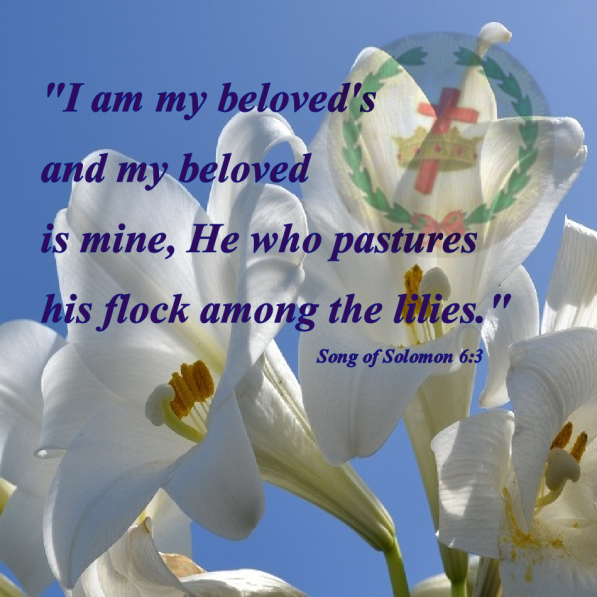
“I am my beloved’s, and my beloved is mine: he feedeth among the lilies”
(Song of Solomon 6:3, KJV).

Once on earth did live a pure white lily,
The sweetest flower of all God’s family.
With head bent low, in reverent humility,
He was fixed to a cross, to free you and me!

White lilies are found in fields and valleys,
Among thorns they grow, graceful and lovely,
From fruitful bulbs, with fragrance alluring,
White and clean as Christ, thus so endearing.

To become a white lily with open face,
Turn fully to God, receiving His grace,
His favouring breeze with gladness embrace,
Christ’s lily, growing bright, in whatever our place.

Nothing on this earth is more chiefly desired,
Than to serve with joy as God may require,
Running the race with patience, nothing other aspired,
Daily, devotedly, even if tired.

LORD grant your wisdom, to do what is right,
Refrain from the wrong and walk in Christ’s light.
Diligently watch and pray, for victory’s gain —
As Christ’s holy name, we ever proclaim!

Our cross we bare and press forward, on —
Our crown not to lose, but to overcome!
Assured that the battle is ours to be won,
And then, finally, the rest surely will come.

Thus praising Jehovah, wholeheartedly!
As a sacrifice, living, pleasing to Thee,
By grace, we endure, all faithful to be,
Sealed thine everlasting, this is our plea! 


To be a lily of Christ, let us each strive to be: simple and sincere in humility (Philippians 2:3); sweet and fragrant in gentleness, compassion, mercy, and long-suffering towards all; and joyful in hope (Romans 12:12), enduring patiently (1 Peter 2:20, 2 Timothy 2:24) with contentment (1 Timothy 6:6). May we be at peace, in the valley that God has planted us in to be watered by His steams of living water, found in the Word of God, delivered to the saints by God’s grace and mercy in order for God to be glorified, honored, and praised BY ALL in due time (1 Timothy 2:6, 1 Peter 4:11).


******* 

I AM MY BELOVED’S, AND MY BELOVED IS MINE
(Song of Solomon 6:3).

The following words are from the Reprints (R4783) of The Original Watch Tower and Herald of Christ’s Presence (which can be freely accessed from the Harvest Truth Data Base website at the following link and under the subheading “ZWT” (Zion’s Watch Tower): http://www.htdb.one/).

RIGHTLY understood we find the Bible to be a love story of surpassing interest. No earthly love story will compare with it. First, we have the Father’s love for our race, which, originally created in his likeness, fell by disobedience under just condemnation. What a wonderful story of parental Love blended with Divine Justice is conveyed to us in the narrative of how God so loved the world while we were yet sinners, that he gave his Only Begotten Son to be our Redeemer, that he might restore again to Divine favor and blessing whosoever wills to return after learning of his loving provision.

How different this view of the Divine character and Plan from the one which once terrorized us—when we thought of God as almighty in power and knowledge, but destitute of love and sympathy; when we thought of him according to the universally accepted false teachings as having, with cold indifference, sat in the councils of eternity, before the creation of the earth or our race, and there planned our creation and everlasting destiny; that he there deliberately arranged (“according to the council of his own will,” as the catechism expresses it) that he would place us as a race under such unfavorable conditions that only a mere handful, comparatively, would ever attain to a life of bliss, either in the present world or in that which is to come. Deciding also that the vast majority, ignorant (whom the God of this world hath blinded), steeped in inherited sin and degradation, born in sin and shapen in iniquity, should, nevertheless, be so constituted and preserved that they could never end their miserable existences; and, withal, providing, we were told, a great place for their eternal torture, from which would ascend for ever and ever, alike futile and unheeded, their prayers, their curses and their groans.

RELIEF TO KNOW THAT GOD IS REALLY A GOD OF LOVE

What a relief do we experience as finally we awake to a better knowledge of God and of his precious Word, to find that all these teachings of the Dark Ages were but a horrible nightmare, as unreal as they were cruel and unjust—as unscriptural as they are contrary to every reasonable conception of every reasonable mind, of the proper exercise of Justice, Wisdom, Love and Power—the Divine attributes. We are reminded of the nursery tales of childhood, told to children by parents and nurses who, with grossly mistaken ideas of wisdom and propriety, used them as a lash of terror with which to secure a frightened obedience. As the bugaboos of infancy faded from memory, or at least ceased to inspire terror, as we grew older and began to take note of the deceptions which had been practiced; so as children of a larger growth we have learned that many of the “terrors of the Lord”—which, however severe, are reasonable and just—have been distorted by theologians and others who would fain exercise a terrorizing influence upon the world, to restrain from evil. We have learned, in the language of Scripture, that “their fear toward me is taught by the precepts of men,” and not by any of the Divine precepts—Isaiah 29:13.

Oh, what a relief it has brought to our hearts to know God as really and truly a God of love, who is not only willing to save unto the uttermost, but able to save unto the uttermost all who put their trust in him! and who is so willing thus to save that he has made abundant [R4783] provision that every member of Adam’s race must come to a clear knowledge of his grace and to a full opportunity—by obedience to the extent of his ability—to attain eternal life through Christ Jesus.

It does us good at times to look back and view, not only the horrible pit and miry clay of sin out of which Jehovah lifted us when he placed our feet upon the Rock, Christ Jesus, but also to remember his mercy toward us in the anointing of our eyes, now in the end of the Age, that we may see wonderful things in his Word; that we may realize how he has graciously brought us “out of darkness into his marvelous light,” in permitting us to brush away the veil of superstition, misunderstanding and mistranslation which has befogged his Word, beclouded our understanding and bedimmed our view and appreciation of the great Father of lights, from whom cometh every good and every perfect gift—James 1:17.

NOT ONE, BUT MANY INDIVIDUALS CHOSEN TO BE BRIDE OF CHRIST

But our text deals specially with another part of this great love story of the Scriptures. Our loving Father, having provided a redemption for ALL our race through Christ Jesus, did more: he highly honored and glorified our dear Redeemer as a reward for those things he endured faithfully through obedience to the Father (Philippians 2:8-11), and in addition to this arranged to select a Bride and joint-heir in glory for his Son, our Lord Jesus. It was not an individual that was chosen to be the Bride, but many individuals, and yet in all, compared with the world, a “little flock,” the “elect Church,” called and in process of selection and perfection, to be “the Bride, the Lamb’s Wife.”

Of all the plots and peculiarities of love stories which have been conjured up by human brains, none will compare with this story of how Christ loved the Church and gave himself for her—redeeming her with his own life; and how, being rewarded with excellent glory by the Father, these who would be his companions, are invited to share his cross, his suffering, his death, and to be received up into glory with him, to share his love and his throne and the Father’s favor. We will not go into details here; we have done this before and our readers are familiar with every feature—so, instead, we pass on to consider some of the conditions of acceptance with the Bridegroom, and how we may make our calling and our election sure to this position of honor and blessing to which he has invited us.

ONLY A FEW CAN SAY FROM THE HEART, “I AM MY BELOVED’S”

Our text briefly, yet very pointedly, states the entire matter.

(1) “I am my Beloved’s.” There is no possibility for any one to get into this special elect class, “the Bride, the Lamb’s Wife,” without knowing it. There is therefore no possibility that heathen philosophers or others who lived and who died without a personal knowledge of Christ as their personal Savior, can ever be members of the elect Church, the Bride; all who are of it will be able to say, “I am my Beloved’s.” Very manifestly also, for the same reason, many who are Church members “in good and regular standing,” have neither part nor lot in this matter; for only a few can say, from the heart, truly, “I am my Beloved’s.” This union with the Beloved (Christ) implies that the step of justification through repentance and faith in the precious blood has first taken place; because only the justified are “called.”

(2) It is implied that the one who can say, “I am my Beloved’s,” has not only heard of Christ but has made a definite, positive compact or contract with him. And this contract—to be his in every thought and word and deed, to the extent of our ability, if he will accept us and be our Bridegroom, is our marriage vow or covenant.

The Scriptures assure us that in the present time, while evil prevails and the God of this world blinds the minds of the vast majority, none can come to the Lord Jesus, except as the Father draws them (John 6:44). The Father is not drawing all mankind now, but only believers. He is leaving the general work of drawing the worldly for the next Age, the Messianic Age, when Christ and the Church glorified shall, as God’s agents, cause the whole earth to be filled with the knowledge of the Truth. Whenever the Truth reaches the heart and understanding its influence is to draw, although the drawing may be resisted not only in the present Age, but also in the Age to come (Acts 3:23). But, it is only the few who are being drawn to Christ by a knowledge of the Truth now, because only a few have a knowledge of the Truth. And while many resist the truth and refuse the opportunity of union with the great Bridegroom, some have gladly accepted and given themselves wholly to the Lord, thus sealing the covenant binding themselves to him and by his grace binding him to them.

IF FAITHFUL IT IS THE PRIVILEGE OF EACH TO SAY, “MY BELOVED IS MINE”

It is proper that each one should decide for himself positively, whether or not he has ever accepted the Divine invitation to give himself (Proverbs 23:26; Romans 12:1) [R4784] to the Lord, to be ultimately accepted as a member of his Bride if he continue faithful to his engagement to the end. If we are faithful, and so long as we continue to be faithful, it is our privilege to look up with confidence and be assured of the second part of our text, “My Beloved is mine.” And if we will, it is possible for us to continue in this attitude, “faithful unto death”; and so doing we may know that in the resurrection we shall be with our Lord, and be like him, and share his glory and his throne—Revelation 3:21.

How much is implied in this statement, “My Beloved is mine”! We are reminded of the Scripture which declares, “He that hath the Son hath life”—eternal life. More than this, the Apostle assures us that those who have Christ, who can truly, Scripturally say, “My Beloved is mine,” are really possessors of “all things.” For since Christ is the heir of all things, if we have become associates with him, then, indeed, “all things are yours (things present and things to come) for ye are Christ’s, and Christ is God’s” (1 Corinthians 3:22,23). If it lifted from us a great load to know that our sins were graciously forgiven through the merit of the precious blood, how much more of a load of care does it lift from us to know that we are vitally united with the illustrious Son of the great King of the Universe—the Son in whom the Father is well pleased and whom he has made his sole associate in the glory and dominion of the Universe.

Nor does this promise of blessings in Christ apply merely to the future. The glories and honors truly are not now, but by and by to be revealed; but the Bridegroom’s care, protection, provision and comfort belong to his betrothed even now, while we are in this tabernacle; so that while we are passing through the “valley of the shadow of death,” we need fear no evil, for he is with us, and his rod and staff comfort us.

All who abide faithful to him, all who truthfully can say, “I am my Beloved’s, and my Beloved is mine,” have not only the promise of the life that is to come, but also [R4784] the promise of this present life. They hear the Master’s voice saying, “Lo, I am with you always, even unto the end of the Age,” and in the end of the Age he is to be specially near, specially precious, and is to reveal himself to his faithful in an especial manner, even before she is so changed as to behold him in his glory.

ALL THE “EXCEEDING GREAT AND PRECIOUS PROMISES” BELONG TO THIS CLASS

It is the privilege of these to apply to themselves, and to realize as properly theirs, all the “exceeding, great and precious promises” of the Divine Word. These may hear the voice of the Lord, saying, I will be with thee in six troubles and in the seventh I will not forsake thee. “My grace is sufficient for thee.” “Call upon me in the day of trouble and I will deliver thee.” Indeed, we are assured and “know that all things shall work together for good to them that love God, to the called ones according to his purpose [to be the Bride, the Lamb’s Wife]Job 5:19; 2 Corinthians 12:9; Psalm 50:15; Romans 8:28.

These promises of the Lord have been well summed up in the expression of the poet:—

“In every condition, in sickness, in health,
In poverty’s vale, or abounding in wealth,
At home and abroad, on the land or the sea,
As thy days may demand, shall thy strength ever be.

“When through the deep waters I call thee to go,
The rivers of woe shall not thee overflow;
For I will be with thee thy troubles to bless,
And sanctify to thee thy deepest distress.

“When through fiery trials thy pathway shall lie,
My grace all-sufficient shall be thy supply;
The flames shall not hurt thee—I only design
Thy dross to consume, and thy gold to refine.”

What a blessing of peace, quietness of spirit, ability to endure hardness as a good soldier of Christ, and sustenance and strength in time of trial, lies behind these precious assurances of the Bridegroom to those who can see and realize unquestionably, “I am my Beloved’s, and my Beloved is mine,” no tongue can express. It has in the past permitted his faithful ones to pass through many dark and trying experiences with a fortitude that has surprised the world, which has seen them in the fiery furnace, but has not seen that there is with them the form of the Son of God (Daniel 3:25). They have endured as seeing him who is invisible (Hebrews 11:27). The poor world who know not this invisible Friend above all others, and are unacquainted with this Heavenly Bridegroom, and know not his sustaining grace in every hour of trial are, indeed, to be greatly pitied. They must largely bear alone those burdens which the Lord’s people, his betrothed, are privileged to lay at the feet of the great Burden Bearer, whose invitation is, “Come unto me, all ye that labor and are heavy laden, and I will give you rest” (Matthew 11:28-29).

But, if the case of the world is a sad one, because it knows not our Bridegroom, how much worse is the case of those who having once known him, and having once experienced his tender care and helpfulness in all of life’s affairs as a Counselor and Guide, have wandered off, having lost their first love; having forgotten that they were purged from their old sins, and become deaf to the “exceeding great and precious promises” pertaining to the present as well as to the future life; and are now striving merely for the things which perish, and which at most are but for a moment (2 Corinthians 4:17,18). These are in a much worse condition than the world.

As the Apostle declares, “It had been better for them not to have known the way of righteousness, than, after they have known it, to turn from the holy commandment”—2 Peter 2:21.

Let us who have named the name of Christ, who have assumed his name, abide in him—by continuing in faith, in love and in zeal, to walk in his footsteps and thus make our calling and our election sure.

====================

Further Suggested Reading

“The Song of Solomon” by Br. David Rice. The Beauties of the Truth Periodical http://www.beautiesofthetruth.org/Archive/Library/Doctrine/Mags/Bot/90s/BOTMAY02.PDF

“Notes on the Song of Solomon” by Br. Anton Frey. These study notes are from the “BIBLE STUDY LIBRARY” CD which can be purchased from The Herald of Christ’s Kingdom Bookstore at the following link: https://herald-magazine.com/bookstore-2/

“Notes on the Song of Solomon” by Br. Frank Shallieu. These study notes are also from the “BIBLE STUDY LIBRARY” CD. (Same link as above.)

“The Song of Songs A short series of devotional meditations – No. 1 by Br. F. A. Shuttleworth, Scot., The Herald of Christ’s Kingdom, April 1958. Here is the direct link: http://www.heraldmag.org/archives/1958_4.htm#_Toc36391359

“I Am My Beloved’s, and My Beloved Is Mine.” The Dawn Magazine, Sept. 1989, in the Christian Life and Doctrine section.
http://www.dawnbible.com/1989/8909cl-4.htm

“SONG OF SOLOMON 2:1, 2, 16; 4:5 – The Rose of Sharon & the Lily of the Valleys.” BIBLE Students DAILY.

SONG OF SOLOMON 2:1, 2, 16; 4:5 – The Rose of Sharon & the Lily of the Valleys


Enter your email address to subscribe to this blog and receive notifications of new posts by email.

STUDY 7: The Priests. The Day of Atonement.

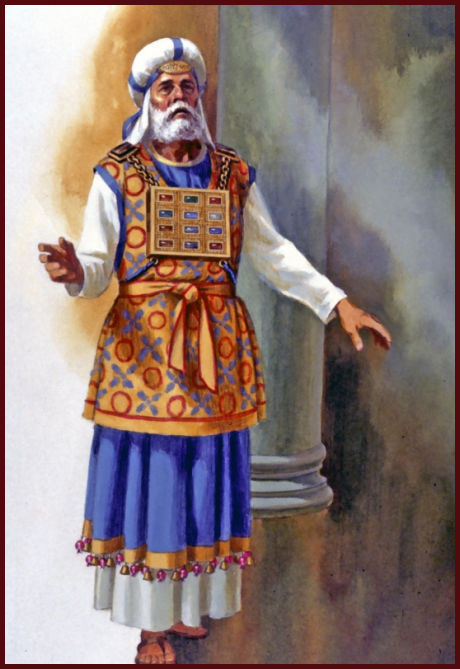
ex39-high-priest-garmentsThe Priests

In Leviticus, the ones serving at the altar and approaching near with the blood of offerings were the priests.

The priests had a special service regarding the sacrifices of the Law — representing the saints who have the privilege of sacrifice and service during the present time, together with their High Priest, Jesus.

Only the High Priest and the under-priests were to approach the altar for the service of performing the sacrifices and offerings, as we read in Numbers 3:10, “And thou shalt appoint Aaron and his sons, and they shall wait on their priest’s office: and the stranger that cometh nigh shall be put to death.”

On the Day of Atonement, according to the 16th chapter of Leviticus, the High Priest is said to have offered the sacrifices. This is explained in the following passages of the Bible:

Leviticus 16:1-3, 17: “And the Lord spake unto Moses after the death of the two sons of Aaron, when they offered before the Lord, and died; And the Lord said unto Moses, Speak unto Aaron thy brother, that he come not at all times into the holy place within the vail before the mercy seat, which is upon the ark; that he die not: for I will appear in the cloud upon the mercy seat. Thus shall Aaron come into the holy place: with a young bullock for a sin offering, and a ram for a burnt offering.”

17 And there shall be no man in the tabernacle of the congregation when he goeth in to make an atonement in the holy place, until he come out, and have made an atonement for himself, and for his household, and for all the congregation of Israel.

Hebrews 9:7 (NLT): “But only the high priest ever entered the Most Holy Place, and only once a year. And he always offered blood for his own sins and for the sins the people had committed in ignorance.”

The ark of the covenant was especially sacred. Levites were not allowed to see the ark. Thus Numbers 4:5 says it was to be covered by priests for moving, before the Levites accessed it.

Who Could Become a Priest?

The first High Priest of Israel was Aaron and the first under-priests were Aaron’s sons. We read about this in Exodus 28:1:

“And take thou unto thee Aaron thy brother, and his sons with him, from among the children of Israel, that he may minister unto me in the priest’s office, even Aaron, Nadab and Abihu, Eleazar and Ithamar, Aaron’s sons.

God chose Aaron as His mouthpiece (Exodus 4:16). In the Book of Hebrews, the Apostle Paul explains to us that “no man taketh this honour unto himself, but he that is called of God, as was Aaron (Hebrews 5:4).

In the generations after Aaron, the sons and grandsons and great grandsons (etc.) of Aaron, were qualified to become High Priests (as long as they were not otherwise impaired). They did not have to be sons of the then current High Priest.

The High Priests could only come from the Israelite — Levitical — Kohathitical — Amramic and Aaronic line, thus, they could only come from Aaron’s descendants (see Exodus 6:16-18).

In Ezra 7:1-5 there is an abbreviated list of the High Priests and in 1 Chronicles 6:4-14 there is a more complete list up to the captivity.

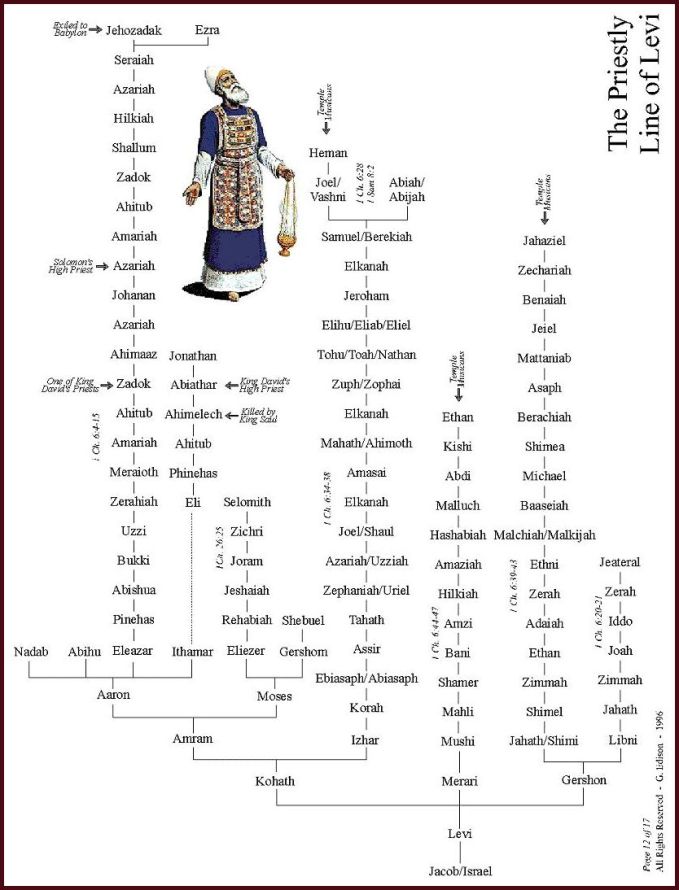
Here is a chart listing the names of the High Priests (in the two ascending rows to the left of the chart) descending from Eleazar and Ithamar, based on the recorded information by Ezra in 1 Chronicles chapter 6 — that is, until the deportation of Jehozadak when the Lord sent Judah and Jerusalem into exile to Babylon by the hand of Nebuchadnezzar.

(Note: There are also other names from the Levitical line listed in the chart below, yet these others were not priests.)

12 The Priestly Line of Levi.jpg

Why was Jesus — our “Melchizedek” priest & “King of Righteousness” (Hebrew 7:1–3)not born through the Levitical Tribe, but rather through the Tribe of Judah?

Jesus was born through the tribe of Judah, because Judah received the chain of genealogy that went from Reuben (disqualified) to Simeon (disqualified) to Levi (disqualified) to Judah.

Jesus by coming through Judah, was in the line of descent of Abraham, Isaac, Jacob, Judah as a genealogically clear line. Had Jesus come from Levi, one might suppose that he was a successor priest, and that the Levitical priesthood was intended to continue — which it was not.

(But Aaron married Eli-sheba, of Judah, and Jesus’ mother was from Judah — and her cousin Elizabeth, which is Greek for Eli-sheba, was evidently of Judah like Mary, but married Zachariah, a priest and thus from Levi — so at the beginning the two tribes were united in this way, and at the ending point when John (Levite) and Jesus (Judahite) came, the two tribes were united in this way.)

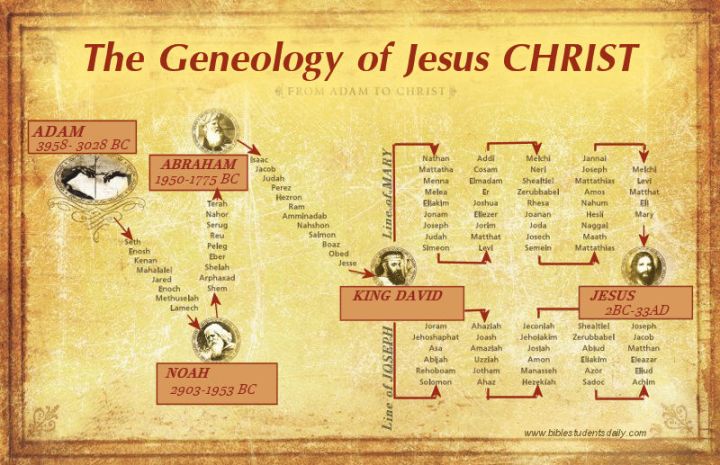
Here is a chart showing Jesus’ Geneology:

geneology-of-jesus-beauties-of-the-tabernacle-biblestudentsdaily-com

The Function of the Priests

16And Eleazar the son of Aaron the priest shall have charge of the oil for the light, the fragrant incense, the regular grain offering, and the anointing oil, with the oversight of the whole tabernacle and all that is in it, of the sanctuary and its vessels (Numbers 4:16).

Here is a brief summary of the priests’ functions, which included:

  • Primarily offering sacrifices on the altar for sins. This included the sprinkling of blood and burning portions of sacrifices (Leviticus 17:6, Hebrews 5:1).
  • Looking after the fire of the brazen altar (in the Court) and the burning incense on the hot coals on the incense altar in the Holy of the Tabernacle.
  • Overseeing the duties of the sanctuary performed by the Levites (Numbers 3:32).
  • Resolving arguments / deciding all cases of dispute and assault — be the ‘mediators’ between 2 parties of Israelites in any dispute (Deuteronomy 21:5, Hebrews 5:2).
  • Covering the holy furnishings and all the holy articles when the camp is to move (Numbers 4:5-15).

Some of the differences between the High Priest and the under-priests (who originally were composed of Aaron’s sons) include:

The high priest:

– Was the spiritual leader of the people of Israel;

– Wore different clothing compared to the other priests. e.g. the breast plate was only worn by the high priest (Exodus 28:29)

– Wore/had access to the Urim and the Thummim (Exodus 28:30).

– Offered sacrifices on the Day of Atonement, and on this day, was allowed to enter the Most Holy of the Tabernacle. The under-priests (i.e. Aaron’s sons) could not enter the Most Holy compartment of the Tabernacle, regardless if it was the Day of Atonement or not, unless for the sole purpose of covering the ark of the testimony when the camp was to move (Leviticus 16, Hebrews 9:7, Leviticus 10:1-5, Numbers 4:5). In Leviticus 10, evidently Nadab and Abihu died in front of the sanctuary, where these non-priests could retrieve the bodies. Had they entered the holiest place, their bodies would have been behind the veil, beyond which only the High Priest had authority to enter.

The Antitypical Priesthood

The Priesthood, one body under one chief or High Priest, was typical of the “little flock” (Luke 12:32) which, with its “head” and “High Priest,” Jesus, will constitute a royal priesthood in glory (1 Corinthians 11:3, Colossians 1:18, Hebrews 3:1, 4:14). Members of this priesthood, after the present time of sacrificing, will be kings and priests unto God, and reign over earth for a thousand years (Revelation 5:10, 20:6). But before the under-priests (the members of the Body of Christ) will be united to their “head” and begin their reign as the “Bride of Christ,” the 144,000, they must suffer with him,” sharing in the antitypical sacrifices in order to be glorified together with Christ (2 Timothy 2:12, Romans 8:17).

Those who qualify (at the point of death) as members of the Bride of Christ, shall receive the highest reward due to their sacrifice unto death, suffering for Christ’s sake (2 Timothy 2:12).

“They shall be priests of God and of Christ, and shall reign with him a thousand years (Revelation 20:6).

These are the 144,000 described in Revelation 7:4, who shall sit with Christ in his throne (Revelation 3:21).

The Apostle Peter addresses these sanctified ones (represented by the Aaronic priests), as “an holy priesthood … acceptable to God by Jesus Christ” (1 Peter 2:5).

About the spirit-begotten of the present time, Pastor Charles T. Russell wrote, “They are all ministers (servants) of the truth, though not all preachers and Doctors of Divinity: and each must do his share at self-sacrifice ere he will be accounted worthy to be a joint-heir with Christ” (Tabernacle Shadows, page 27).

It is the Bride class that will inherit immortality and live in the Divine Realm reigning with Jesus, as they are the ones described in Revelation 14:4, “which were not defiled with women; for they are virgins. These are they which follow the Lamb whithersoever he goeth. These were redeemed from among men, being the firstfruits unto God and to the Lamb.”

  • Few In Number

Jesus once addressed his followers (representative of the entire Gospel Age) as a “little flock” (Luke 12:32). This term “little flock” refers to the Bride of Christ class from the “called out” ones — that is, “the few” chosen from the “many” consecrated and spiritually begotten of the Gospel Age (Matthew 22:14). The 144,000 members of this Bride class, make their “calling and election sure” (2 Peter 1:10) revealed at the final verdict of judgment, that is, at one’s death, which is the point of time in the flesh, until one is to be “faithful until” (Revelation 2:10).

In Numbers 4:46–48, the number of Levites (in this context, representative of all the spirit begotten of the Gospel Age) prepared for service, was similarly few, 8580, compared to the population of Israelites as a whole (representative here, of the world of mankind). When we consider the priests inaugurated to serve at the time the Tabernacle was established, the number is remarkably few, five persons in all — Aaron and four sons (Exodus 28:1). Two of those priests were subsequently lost to the priesthood — Nadab and Abihu — evidently through intoxication (Leviticus 10:1, 2, 9). It is a lesson to us how careful we should be to avoid the intoxicating spirit of this world, lest we fall away from our privileges in Christ.

As those called of God to become priests who draw the world back to God, these have special privileges now.

Only the “Priestly” called-out class of this Gospel Age can see the glorious beauties of God’s Divine Plan. Others may know of them only as they hear them described — they have never seen the hidden light and beauty; never eaten of the “bread of presence;” never offered acceptable incense at the “golden altar.” To enjoy these privileges we must pass beyond the “door” of the “Holy,” through an entire (full) consecration to God, displayed even in the smallest intricacies of conduct — such as in one’s gentleness, tone of voice, modesty in clothing attire; not focusing on outward beauty such as (in the case of women) through the use of make-up or wearing of jewelry or expensive clothing or the braiding of hair as is explained by the Apostle Paul in 1 Timothy 2:9.

Rather, let us desire to add “shine” to the inner characterthe New Creation — by developing the fruits of the spirit to resemble the character of Christ. We still have this privilege presently, but soon it will draw to a close (Luke 13:25).

The Day of Atonement (Leviticus 16:1–34)

The Day of Atonement type reflects Jesus and His Church during the Gospel Age (Leviticus 23:27–28). The Day of Atonement is also known as Yom Kippur and was the most solemn holy day of all the Israelite feasts and festivals, occurring once a year on the tenth day of Tishri, the seventh month of the Hebrew calendar. On that day, the High Priest performed elaborate rituals to atone for the sins of Israel — that is, present a sin offering for himself (Aaron) and his “house” (Aaron’s sons), and present a sin offering for the “people” (the Israelites).

The Levites are not mentioned in Leviticus 16. Aaron and his sons were covered by the first sin offering, and the remainder of the Israelites were covered by the second sin offering, including the Levites other than the priests. As of Leviticus 16, the Levites (other than only Aaron and his sons) had not yet been given any special status. For their status was transferred to the Levites from the firstborn in the second year of Israel in the wilderness, whereas the first Day of Atonement occurred during the autumn of the first year of Israel in the wilderness (Numbers 1:1, 3:12).

The Day of Atonement was the only day of the year when the High Priest would enter the Most Holy of the Tabernacle to complete the sin offering ordinance.

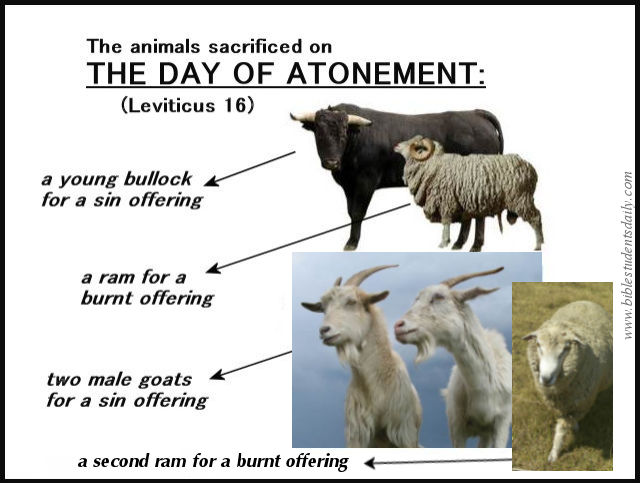
Specific animals were sacrificed.

The Animals Sacrificed ON the DAY of ATONEMENT.jpg

We are told of this in Leviticus 16:6, 11 & 33:

 “And Aaron shall offer his bullock of the sin offering, which is for himself, and make an atonement for himself, and for his house.

11 And Aaron shall bring the bullock of the sin offering, which is for himself, and shall make an atonement for himself, and for his house, and shall kill the bullock of the sin offering which is for himself:

33 And he shall make an atonement for the holy sanctuary [the Most Holy area of the Tabernacle], and he shall make an atonement for the Tabernacle of the congregation [the Holy area of the Tabernacle], and for the altar [the golden altar in the Holy], and he shall make an atonement for the priests, and for all the people of the congregation [for the world].”

Two animals were sacrificed for the ATONEMENT DAY sin offering: (a) a bullock and (b) a goat.

  • (a) The Bullock

The bullock (on this specific day) represents our Lord Jesus as a man — as expressed in the Scriptures, “a body hast thou prepared me” (Hebrews 10:5).

Our Lord’s sacrifice took place at the beginning of his ministry and was finished at its close. Under the Law, it was only from the age of thirty, when Jesus could begin the sin offering sacrifice, and thus at thirty, Jesus came to John at the river Jordan to be baptised (Luke 3:23). It was here that Jesus presented himself in sacrifice to God, at the earliest possible time. It was at Jordan that Jesus fulfilled the prophecy (in Psalm 40:7) saying, “Lo, I have come, as in the volume of the Book it is written of me, to do thy will, O God. Thy law is written in my heart.”

Our Lord Jesus came to “taketh away the first that he may establish the second” (Hebrews 10:9); to set aside the typical for the “better sacrifices.”

From the moment of his consecration at baptism he was reckonedly dead and, at the same time, begotten of the holy Spirit. He was reckonedly alive as a new creature, an embryo spirit-being, during the three and a half years, the flesh being consumed and the new nature growing strong in the Lord, developing in harmony with the Divine will (R 4436).

Although the offering up of our Lord Jesus’ life was instantaneous (consecrating himself in a moment to give up all, even life itself, in the Father’s service), it is the presentation of his body to the trials and difficulties of life (i.e. his actual giving of time, influence, strength and vitality), that continued throughout the three and a half years of his ministry, ending at Calvary, on the cross.

“His House”

Jesus was the sin offering for “his house.” Jesus’ “house” is composed of the High Calling spirit begotten members consecrated to God during the current Gospel Age — those who have been running the race of the high calling during the Gospel Age, striving to present themselves as “living” sacrifices “holy, acceptable unto God(Romans 12:1).

It is only ONE house since there is only ONE high calling to be of the Bride of Christ — and this Bride class will be completed when the last “feet” members shall have passed beyond the “vail” at death of the flesh just before “the four winds” are let loose, signalling the beginning of Armageddon.

The “house” of Aaron are the priests, Aaron’s sons (not the tribe from which Aaron descended), just as the “house of David” meant David’s descendants, not his tribe.

Leviticus 16:6 says that the bullock was to make atonement for the Priest “himself:”

And Aaron shall offer his bullock of the sin offering, which is for himself, and make an atonement for himself, and for his house.

How then can we understand that Jesus required making atonement for “himself” if Jesus was without sin? (2 Corinthians 5:21)

We have the same question in Exodus 30:19, “For Aaron and his sons shall wash their hands and their feet thereat” (that is, at the laver). “His sons,” the priests, wash — representing that we wash from our sins. But why does Aaron wash, if he represents Jesus? The answer to this question is that Aaron washes in order to be a fitting picture of the sinless Jesus. This then, also answers the question why Aaron is atoned for — in order to be a picture of the sinless Jesus.

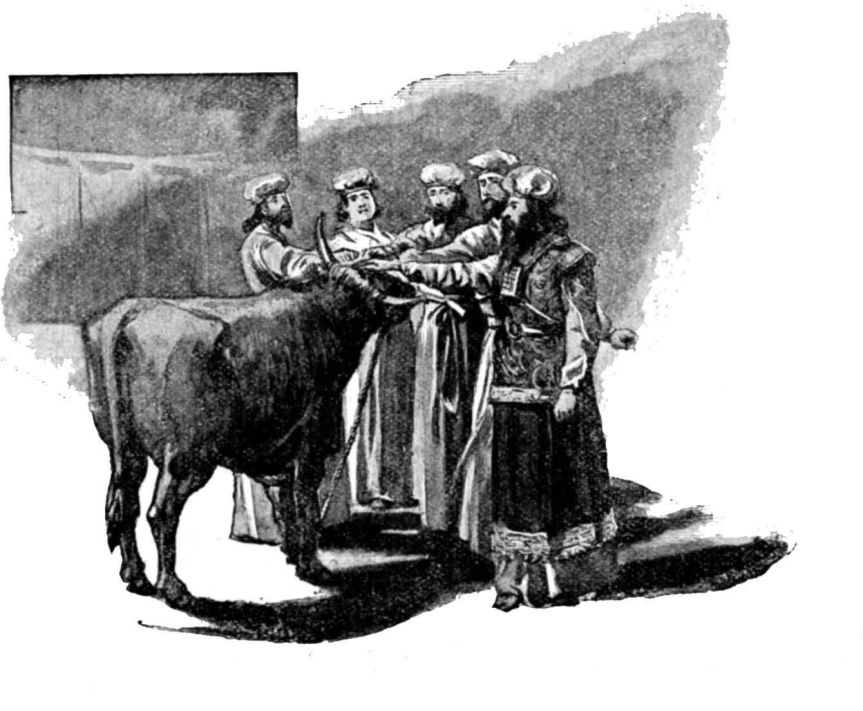
Let us now explain this, using the picture in Leviticus chapter eight (about the consecration of the priesthood). Leviticus 8:14 says, “And he brought the bullock for the sin offering: and Aaron and his sons laid their hands upon the head of the bullock for the sin offering.”

lev 8 - aaron and his sons laid their hands upon the bullock.jpgHere Aaron was consecrated and also his sons were consecrated. Since Aaron here represents Jesus, and his sons represent the priests (spirit begotten, consecrated of the Gospel Age) it is clear that here Aaron as a picture does not include the Church, for they are separately represented in the sons of Aaron. And yet, Aaron had to be atoned for (Leviticus 8:14), and he had to be “washed” (Leviticus 8:6). These are symbols of cleansing, yet Jesus did not need cleansing. Here is Br. Charles Russell’s comment on this in Tabernacle Shadows, page 29. Being but a sinful man, like others, Aaron had to be washed in order fitly to represent the purity of the antitype, Jesus, who knew no sin.”

Similarly, Aaron in Leviticus 16, after making an atonement for himself, was cleansed, in order to be a fitting representation of sinless Jesus. Thus, atonement for Aaron needed to be made because he personally had sin, and also for him to represent the sinless Jesus.

The non-priest Levites are not mentioned in Leviticus chapter eight, nine or sixteen. So they would not be part of the picture needing to have some fulfilment in the antitype. They are simply part of the “people,” part of the “congregation.” In the book of Numbers, we have a different picture. In the opening chapters of that book we have two classes the Israelites in general, and the Levites as a separate, consecrated class. In that picture (where no priests are mentioned), the Israelites represent believers in Jesus during the Gospel Age, and the Levites represent consecrated believers of the Gospel Age.

Aaron and his sons were atoned for by the bullock, while the “people” were atoned for by the Lord’s goat.

  • (b) The Goat

Besides the bullock being sacrificed on the Day of Atonement, there were also two goats presented before the Lord at the entrance of the “Holy” of the Tabernacle.

We read about this in Leviticus 16:8–10,

“8 And Aaron shall cast lots upon the two goats; one lot for the Lord, and the other lot for the scapegoat.

And Aaron shall bring the goat upon which the Lord’s lot fell, and offer him for a sin offering.

10 But the goat, on which the lot fell to be the scapegoat, shall be presented alive before the Lord, to make an atonement with him, and to let him go for a scapegoat into the wilderness.”

The Lord’s goat represents the Church of the Gospel Age (the spirit begotten and consecrated members of the High Calling).

The scapegoat was a vehicle for showing that the sins of the people were sent away and gone. It is a means of representing the removal of the sins of Israel, as a picture that the sins of the world will be cleansed and gone from the world of mankind, during the Millennium, as a consequence of the antitypical Atonement Day sacrifices of the Gospel Age. “As far as the east is from the west, so far hath he removed our transgressions from us” (Psalm 103:12).

The sacrifices of the Day of Atonement represent the Gospel Age.

The removal of sin from Israel represents what the world will appreciate in the Millennial Age soon to commence within a generation when the great High Priest (Jesus) will apply the blood of the antitypical goat on behalf of all the world of mankind — who, by restitution and instruction, will be brought into relationship with God as his people. In due time these will all become true Israelites indeed and the Heavenly Father shall become “All in All”  (1 Corinthians 15:28).

Garments of Glory

After offering the blood of the goat, the High Priest put off his sacrificial garments and put on his garments of glory and beauty, typified by the glorious qualities of Christ’s character and the honorable mission to which he had been anointed as the world’s Prophet, Priest, King, Judge, and Mediator. Thus coming forth he represents our Lord’s Second Advent and assumption of divine glory and power, at which time the Church will be with him as members of his Body, to cooperate in the dispensing of the blessings of the New Covenant to Israel and to all the families of the earth.

As on the Day of Atonement the people of Israel put on sackcloth and ate no pleasant food, but fasted and waited for the High Priest to appear in his garments of glory and beauty, so it has been throughout this Gospel Age. The whole world is under the power of the wicked one (1 John 5:19), overwhelmed in sin and death and corruption.

The Apostle Paul declares, “For we know that the whole creation groaneth and travaileth in pain together until now. For the earnest expectation of the creation waiteth for the manifestation of the sons of God” (Romans 8:22,19) — waiting for the Jesus and the Church (the Bride of Christ composed of 144,000 members) to appear to the world in glory and beauty to serve as their priesthood to bring all humanity back to harmony with God.

If in the type a blessing is portrayed, how much greater will be the blessing in reality!

As in days of old the people could then  arise, threw off their sackcloth and fasting and rejoice in their forgiveness, so in the Millennial morning, the world, coming to an appreciation of the great High Priest and the sacrifices of Atonement, will arise from sin and degradation and death and REJOICE in divine favor and in the realization of the many blessings of restitution set before Israel, as declared by the mouth of all the holy prophets since the world began (Acts 3:20).

References

Pastor Charles Russell: “Tabernacle Shadows,” “The Tabernacle and Its Teachings” — Supplement to Feb. “Zion’s Watch Tower,” Pittsburgh, PA, 1882, Volume 6 — “Studies in the Scriptures,” Reprints of the Watch Tower: R.4427.

Br. Anton Frey: “Notes on the Tabernacle,” pages 362-364; “Wilderness Wanderings.”

Br. David Rice — written content.

Further Suggested Reading

STUDY 1: An Introduction To The Tabernacle And It’s Purpose
https://biblestudentsdaily.com/2016/09/02/study-1-an-introduction-to-the-tabernacle-and-its-purpose/

STUDY 2: The Pillar of Cloud By Day And The Pillar of Smoke By Night  https://biblestudentsdaily.com/2016/09/09/study-2-the-pillar-of-cloud-by-day-and-the-pillar-of-smoke-by-night/

STUDY 3: The Tabernacle Construction: The Holy and The Most Holy  https://biblestudentsdaily.com/2016/09/14/study-3-the-tabernacle-construction-the-holy-the-most-holy/

STUDY 4: The Court (“Holy Place”)

STUDY 4: The Court (“Holy Place”)

STUDY 5: The Camp. The Israelites.
URL: https://biblestudentsdaily.com/2016/10/28/study-5-the-camp-the-israelites/

STUDY 6: The Levites
https://biblestudentsdaily.com/2016/11/18/study-6-the-levites/

STUDY 8: The Tabernacle Coverings
https://biblestudentsdaily.com/2017/01/02/study-8-the-tabernacle-coverings/

STUDY 9: The Gate. The Door. The Vail.
https://biblestudentsdaily.com/2017/03/01/study-9-the-gate-the-door-the-vail/

The URL for this post:

STUDY 7: The Priests. The Day of Atonement.


Enter your email address to subscribe to this blog and receive notifications of new posts by email.

Save

Save