Let us Help Others Hear the Knock

PASTOR CHARLES RUSSELL’S DREAM – Sunrise Prayer and Praise Meeting –
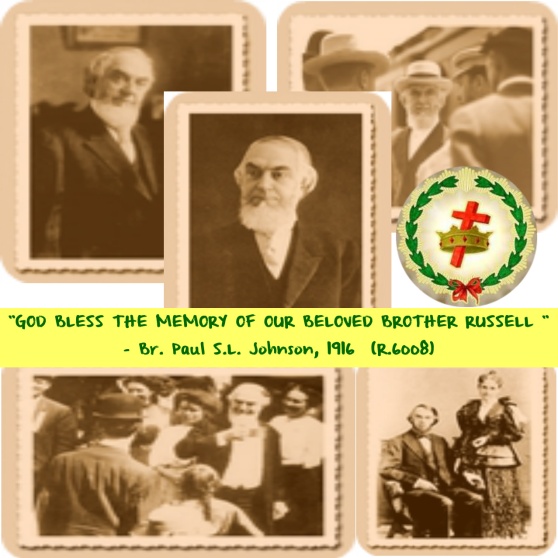
Br Charles Russell (3)

WHEN we entered the hall at 5:15 A.M., there were fully 100 persons present. Promptly at 5:30 Bro. Russell stepped upon the platform and there were by that time 225 present; before the meeting closed there were over 400. The service opened by singing No. 19, “Awake My Soul to Joyful Lays.” This was followed with prayer by Bro. LaFerrey. Then we sang hymn No. 206, “O, How Happy Are We Who in Jesus Agree.”

Bro. Russell: Dear brothers and sisters, I am very glad to greet so many of you this morning and to see that so many of you enjoy the prospect of an early morning prayer meeting. As I saw a number of you headed this way as I was coming to this meeting, it made me think of some of the reasons that draw us together….

So, one reason we like to meet together in conventions and on every occasion is because the Lord seems to give us something special to eat where we are in fellowship, where two and three are gathered together, etc., so when two or three of us meet in His name, we may be sure of His blessing and a refreshment of spirit. In this morning time, more than at any other time, though it has been true throughout all the ages where His people met, but now early in the new morning, when, the new day, the grand Millennial Day, He is inviting us together; He tells us that there will be a great gathering, all the wheat from the tares, all the sons of God, that glorious gathering, which will mean the establishment of the Kingdom of God, out of which will flow all the blessings of God to all the families of the earth. So we have many reasons for thankfulness this morning as we think of the blessed scripture references to this morning time in which we are living such as, “God will help her right early in the morning.”

You remember a picture in the 91st and 45th Psalm, and how the Lord in the 45th Psalm tells of the time of trouble. As we see that day gathering all about us, we hear the Lord’s word coming to us with special emphasis and we will not fear though the earth be removed, though society be shaken and the Kingdoms be carried into the midst of the sea, because we have made the Lord our habitation. In this connection the Lord tells us He will help her, the church right early in the morning. How precious the thought that we are in the early morning, when the shadows are fleeing and we can see more clearly than they could in the centuries past. It was not the Father’s purpose that the special light should shine then, they had all they needed as saints of God that they might be separate from things of this world, but it was not the time to give the glorious sunlight of truth as now.

Thus, dear brothers and sisters, if any fail to get that thought, they fail to get one of the most inspiring thoughts of our time, namely: that the light of the truth which you and I are now seeing is not that you and I are brighter than other men to see it, but it is God’s due time–it is morning time. Why can you see brighter than you could an hour or two ago? Because the great sun has begun to shine upon the earth. Is that all we shall have? Oh, no, that is only the early light. Bye and bye the great sun of righteousness with full power, strength and light will fill the whole earth with the Glory of the Lord. How glad we are that the blessed day is already dawning, what a blessing it has brought into our hearts; we cannot feast on that thought too much.

I might tell you without any injury to any of you about a dream that I had some years ago that had great influence upon my life. Now do not misunderstand me, I do not wish to commend dreams, I think many are nonsensical dreams. I have had many myself, probably from indigestion. I know of a great many people who lay too much stress upon dreams. I pay very little attention to dreams, only so much attention as would be in harmony with God’s word, so as to feel sure the dream came from neither a piece of pie nor inspired by the adversary and I think a great many dreams are inspired by the adversary. I think a safe course is to let no dream have any influence upon our minds except as we can prove them by the word of God. That is our standard. If it agrees not with the word it is because there is no light in it.

But this dream that I will tell you about may help some of you.

I might remark that at the time I had this dream, I was giving attention to the Lord’s work to some extent, I was publishing the Truth and some thought I was neglecting my business. I had five stores at that time, and people would say I guess Mr. Russell is fanatical on the subject of religion. I knew I was not, so was in no danger.

I thought I was not giving enough time, that I ought to give all my time, and this dream helped me.

I dreamed that I was in an attic room, the front looking to the east, and the ceiling was sloping and I thereby knew it was a top room in a house. All around the room was a platform raised about ten inches and on it were mattresses strewn and upon them bed coverings of various kinds; some had been occupied and were vacant and others were occupied by sleepers, and I was in one corner. Over yonder was a door on the right.

I heard a knock that awakened me and I remember how sleepy I felt, I could hardly get my eyes open.

There I saw a servant, one that I never saw or knew, he said they are waiting for you for breakfast and they sent me up to see if you were coming.

Oh! my, it is late, I have overslept myself. Tell them not to wait for me.

With that I thought to get up, but as I started to rise, I was heavy with sleep and my foot caught in the arm of the man sleeping next to me and I went sprawling. I thought well, what will he do? But he was sound asleep, my falling over him had not awakened him.

Something in my dream told me that it was Sunday morning, with that I awakened.

What did it mean?

Well I might take a meaning out of it, that might be in full accord with the truth. I said first of all, this is an upper room and the Lord speaks of housetop saints. Well, then I am glad. Seemingly I was amongst the housetop saints, I was glad that I was not down in the basement.

Then it was Sabbath morning, early in the morning. The sunlight was coming in, all that fits well, the sun is coming in and it is time I was thoroughly awake. Then the empty beds around us, yes, yes, so far as we know, most of the housetop saints have gone in, here a few of us still sleeping; in a dozing way over-charged with the cares of this life. Well, you remember how tired and sleepy you feel almost as if you had been intoxicated. Yes, well that is a good deal the spirit of the world. You are glad you got awake, you felt so stupid, but still next to you was one still more so, and even your falling over him does not awaken him. You are glad you are awake and did not need a knock.

What was that you told the servant?

Have me excused, tell them not to wait for me. Our dear Lord has provided a bridal feast, not a supper or a dinner but a breakfast. So I knelt down and asked the Lord to wait on me for a little;

I determined to be more earnest and diligent in His service.

So I say that while I do not attach much weight to dreams and consider most of them fleshly and of the adversary, but if we think upon them and the words of the Lord, and accept nothing but what will agree with the Scriptures, we may get a good lesson from it.

Well, we are house-top Christians; we have heard the knock informing us that it was morning, that it was the time of the feast and informing us that there is but little time to get ready.

We have heard the knock and how glad we are.

Yet we find some here and there who are still asleep.

Let us help them also to hear the knock that it may go to all parts of the world and let it not be said that there were some in some parts of the world to whom you failed to give the knock.
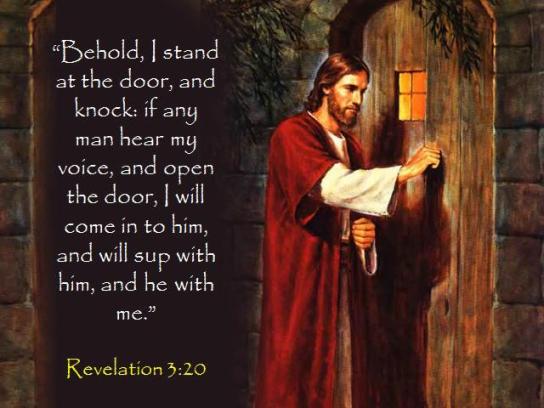
Jesus-Knocking-At-The-Door-Picture-Revelation-3-20

So we have heard the knock and already on this side of the veil we have entered in and are getting some of the food and refreshment- how glad we are.

The whole world, a greater part of it, as we came here, are still asleep. Some others are awake besides ourselves; you saw the butcher and the baker and the milkman and others all busily engaged looking after their dollars and cents and that was proper in its way.

We also have a business, we have left the world behind, we have become new creatures in Christ Jesus and we must be about our Father’s business.

A principle proper to apply, how energetic have you and I ever been in the affairs of earth in our scramble for dollars and cents? In that proportion let the Lord see that you will be no less energetic in the Spiritual.

Some say Brother Russell, you work late and early; well I used to work late and early for selfish interests, I now have something I love far better, why not work late and early in the Lord’s cause as well as in the early interests?

If the Lord should find that I was careless of His interests in comparison of my previous experience in life, what would He say? It would indicate that I would love the earthly more than the Heavenly.

We do not want Him to say that we ever loved earthly things more than the Heavenly. We are not children of the night, but of the day, let us walk in the light. Ye brethren are not in darkness that that day should come upon you as a thief, but it shall come as a thief and a snare upon the whole world and they shall not escape. Ye brethren are not to fear or measure yourselves from a worldly standpoint. They have no hope such as we have.

Surely, very few persons hope as we do.

What manner of persons ought we to be, said the Apostle, in all manner of conversation, etc., hastening to that glorious time which shall be ushered in by the great time of trouble, the time of refreshing from the Lord, because the times of restitution shall then be near.

I am glad that we have this blessed privilege of meeting this morning.

———-

BE VIGILANT

UP then, and linger not, thou saint of God,

Fling from thy shoulders each impeding load;

Be BRAVE and WISE, SHAKE OFF earth’s soil and SIN,

That with the Bridegroom thou mayst enter in.

O watch and pray!

====================

wallpaper1371_1280x1024

Romans 13:8-14

Fulfilling the Law Through Love

Owe no one anything, except to love each other, for the one who loves another has fulfilled the law. For the commandments, “You shall not commit adultery, You shall not murder, You shall not steal, You shall not covet,” and any other commandment, are summed up in this word: “You shall love your neighbor as yourself.” 10 Love does no wrong to a neighbor; therefore love is the fulfilling of the law.

11 Besides this you know the time, that the hour has come for you to wake from sleep. For salvation is nearer to us now than when we first believed. 12 The night is far gone; the day is at hand. So then let us cast off the works of darkness and put on the armor of light. 13 Let us walk properly as in the daytime, not in orgies and drunkenness, not in sexual immorality and sensuality, not in quarreling and jealousy. 14 But put on the Lord Jesus Christ, and make no provision for the flesh, to gratify its desires.

Reference :

1907 Part II Bible Students Convention Report, Sunrise Prayer and Praise Meeting – Tues Sept 3rd 1907

URL: https://biblestudentsdaily.com/2016/06/08/let-us-help-others-hear-the-knock/

Enter your email address to subscribe to this blog and receive notifications of new posts by email.

Save

Save

Understanding Psalm 50 — “Gather My saints together unto Me”

Psalm 50, 1.jpgThis Psalm is a Psalm of judgment. It opens with a proclamation.

VERSE 1: “The Mighty One, God, Jehovah, hath spoken, and called the earth from the rising of the sun unto the going down thereof.”

The various names of God here are impressive. He is called “Yaweh El Elohim,” or Jehovah the mighty one of mighty ones, or Yaweh, the God of Gods. Clearly, we understand the powerful God we are dealing with here.

The Psalm proclaims that this mighty One “hath spoken.” How does Jehovah speak?

The answer is, almost always through intermediaries.

“God, who at sundry times and in divers manners spake in time past unto the fathers by the prophets, Hath in these last days spoken unto us by his Son, whom he hath appointed heir of all things, by whom also he made the worlds [ages]” (Hebrews 1:1,2).

Paul explains here that in the times before Christ the mighty Jehovah spoke by the prophets, but in the first century, he spoke by His Son, Jesus.

This first verse reports Jehovah calling the “earth from the rising of the sun unto the going down thereof.” This interesting expression is used to mark the beginning of the Millennial Age. It occurs twice in Malachi.

“For from the rising of the sun even unto the going down of the same my name shall be great among the Gentiles; and in every place incense shall be offered unto my name, and a pure offering: for my name shall be great among the heathen, saith the LORD of hosts (Malachi 1:11).

This is a clear reference to the Millennial Kingdom. Only in that Kingdom will the name of Jehovah be “great among the Gentiles,” and only in that Kingdom will incense be offered “in every place.”

With healing in his wings; and ye shall go forth, and grow up as calves of the stall (Malachi 4:2).

Who would deny that this beautiful metaphor is a reference to Jesus himself?

Our Lord Jesus, with Kingly power and love, will heal the nations in the Millennium.

A text in Psalms speaks of the same thing. Note the link between “sun” and “bridegroom.”

“Their line is gone out through all the earth, and their words to the end of the world. In them hath he set a tabernacle for the sun, Which is as a bridegroom coming out of his chamber, and rejoiceth as a strong man to run a race” (Psalms 19:4,5).

Here the line or rule of God’s glory goes out through all the earth. This describes the sun in a tent which is opening up, and compares it to a bridegroom coming out of his chamber.

The work of the Mediatorial Kingdom is to raise mankind to perfection… to re-stand them where Adam once stood… to resurrect them!

Having achieved that and put down all enemies, Jesus surrenders his oversight back to the heavenly Father.

“When all things shall be subdued unto him, then shall the Son also himself be subject unto him that put all things under him, that God may be all in all” (1 Corinthians 15:28).

This idea is further advanced with an observation about Hebrews 7:17, “He testifieth, Thou art a priest for ever after the order of Melchisedec.”

The word “forever” is from the Greek eis ton aiona (Strong’s #165). It means “for the age” (“unto the age” in Marshall’s Interlinear). In other words, Jesus functions as a Priest for the world only during the Millennium. Once mankind is made perfect, they need no intercessory Priest, they need no Mediator. They can stand holy and pure before God without fear.

Zion, the Perfection of Beauty

Verse 2: “Out of Zion, the perfection of beauty, God hath shined forth.”

The literal location of “Zion” was in Jerusalem. It was the location of David’s throne. Looking in God’s word for uses of this word, “Zion,” we find several references to the heavenly government of Christ, the heavenly phase of the Kingdom. Here are a few:

  • “Yet have I set my king upon my holy hill of Zion” (Psalms 2:6). The second Psalm is prophetic of the conflict in the earth when the Kingdom is being set up. Jehovah himself installs Jesus as King, “upon my holy hill of Zion.” The heavenly Kingdom—God’s holy hill—is said to be of Zion.
  • Similarly, “Great is the LORD, and greatly to be praised in the city of our God, in the mountain of his holiness. Beautiful for situation, the joy of the whole earth, is mount Zion, on the sides of the north, the city of the great King (Psalms 48:1, 2).
  • “The LORD loveth the gates of Zion more than all the dwellings of Jacob. Glorious things are spoken of thee, O city of God. Selah…Of Zion it shall be said, This and that man was born in her: and the highest himself shall establish her” (Psalms 87:2-3; 5). Verse 5 refers to the faithful followers of Jesus, who, like Jesus, will be born in Zion and comprise part of that Heavenly government.
  • The Apostle John refers to this same class in the book of Revelation. “And I John saw the holy city, new Jerusalem, coming down from God out of heaven, prepared as a bride adorned for her husband” (Revelation 21:2).
  • They are mentioned again with emphasis in chapter 14: “And I looked, and, lo, a Lamb stood on the mount Sion [Zion], and with him 144,000, having his Father’s name written in their foreheads” (Revelation 14:1). The light of God shines forth out through this government, and this shining is done through Christ and his completed Bride.

Verse 3: “Our God cometh, and doth not keep silence: A fire devoureth before him, And it is very tempestuous round about him.”

This “fire” reminds one of Sinai where the Law was given. Fire also is a general symbol of discerning judgment and purification.

God has kept silence during the permission of evil. It is necessary for man to learn about the exceeding sinfulness of sin. But the time for judgment eventually comes. The symbol of fire is often connected with judgment, both positive and negative. When Israel came to Mount Sinai to receive the Law, Jehovah “came down” upon the mountain. Fire is included in the manifestations of the presence of the Lawgiver (Exodus 19:18).

The picture of Israel receiving the Law and standing before the great Judge foreshadows the same activity for the world at the setting up of the Kingdom. But in this period of judgment, the judgment begins with the house of God (1 Peter 4:17).

Malachi provides a positive example where judgment begins with the servants of God.

“Who may abide the day of his coming? and who shall stand when he appeareth? for he is like refiner’s fire, and like fullers’ soap: And he shall sit as a refiner and purifier of silver: and he shall purify the sons of Levi … as gold and silver, that they may offer unto the LORD an offering in righteousness” (Malachi 3:2-3).

The fire of judgment reveals the true character of each one.

Paul used a similar expression. “Every man’s work shall be made manifest … the day shall declare it … it shall be revealed by fire; and the fire shall try every man’s work of what sort it is. If any man’s work abide which he hath built thereupon, he shall receive a reward. If any man’s work shall be burned, he shall suffer loss: but he himself shall be saved; yet so as by fire (1 Corinthians 3:13-15).

Gathering of the Saints

Verse 4: “He calleth to the heavens above, and to the earth, that he may judge people.”

The twin symbols of “heavens” and “earth” often refer to the religious and civil powers in the world during the reign of sin and death.

This judgment is of God’s true and professed people, both. Christendom at this time comes under intense judgment revealing their true nature. Recall that the tares of Jesus’ parable are burned (Matthew 13:40).

The individuals who are the tares are not necessarily destroyed; their professions are exposed as false. Following this begins the process of making the new heavens and new earth.

“And I saw a new heaven and a new earth: for the first heaven and the first earth were passed away (Revelation 21:1).

Through this judgment comes what is the hope and joy of all of the consecrated at the end of the age, namely, their gathering to Christ (2 Thessalonians 2:1).

Verse 5: “Gather my saints together unto me, Those that have made a covenant with me by sacrifice.” This gathering occurs simultaneously on two fronts.

  1. The gathering of the saints out of Christendom during the Harvest (Mark 13:27; Luke 17:30, 37; Revelation 3:20).

Even our conversations are being gathered and recorded. This evidence is compiled to determine who will eventually make up the Kingdom, the “jewels” of Jehovah.

  1. The gathering of the saints beyond the veil to their heavenly home (1 Thessalonians 4:15-17).

This is the gathering in glory, the ultimate recognition and reward for faithfulness and willing cheerful (in the spirit) sacrifice.

“Present your bodies a living sacrifice, holy, acceptable unto God, which is your reasonable service” (Romans 12:1).

Presenting ourselves in sacrifice is our vow or covenant of consecration until death which we can do only thanks to the gift of justification by the blood of Jesus which makes us acceptable and holy in the eyes of God. This verb “present” is a specific act, as indicated by its use in Luke 2:22. There, the baby Jesus is presented before the high priest, as prescribed in Leviticus 12:1-4,6: And when the days of her purification according to the law of Moses were accomplished, they brought him to Jerusalem, to present him to the Lord.”

That our “covenant by sacrifice” is a sacrificial death of the flesh is seen in Romans 6:3-6:

“So many of us as were baptized into Jesus Christ were baptized into his death … we are buried with him by baptism into death … If we have been planted together in the likeness of his death, we shall be also in the likeness of his resurrection: Knowing this, that our old man is crucified with him, that the body of sin might be destroyed, that henceforth we should not serve sin.” Note the following parallels that Paul makes:

Verse 6: “The heavens shall declare his righteousness; For God is judge himself. Selah.”

These heavens are the new heavens, for the old heavens seldom honored God for His righteousness.

Distinctions in the Service of God

Verse 7: “Hear, O my people, and I will speak; O Israel, and I will testify against thee: I am God, even thy God.”

Remembering that the Psalm is about judgment, we see in this verse a return of attention to nominally Christian organizations for judgment, just as in ancient times. The testimony now is against those who claim to be God’s people but do not behave accordingly, as seen the texts above.

Jesus said there would be true, devoted, faithful followers, as well as nominal followers for whom Christianity exerted no real power in their lives. We also have those among the truly spirit begotten that lose their way and lose their focus. These, while accepted of God, nevertheless fail as respects that HIGHEST reward due to a dilution of their consecrations.

In this regard, we might enumerate the classes of Christians that exist during the Gospel Age:

  • The Little Flock, faithful and zealous to the end (Luke 12:32).
  • The Great Company, ultimately faithful, but lost focus and zeal during their walk (Revelation 7:9-17).
  • The Second Death Class (Hebrews 10:26-30).
  • Nominal Christians, Christians in name only. They believe they have some sort of relationship with Christ, but have nothing of the sort in reality (Matthew 7:21-23).

God, through Christ, deals with all of these classes in one way or another.

Verse 8: “I will not reprove thee for thy sacrifices or thy burnt offerings, to have been continually before me.”

Burnt offerings bring to mind the law for free-will offerings (Leviticus 22:18-21).

God does not criticize or “reprove” free-will offerings, that is, good works. But “good works” are not sufficient in the Day of Judgment. Many nominal Christians view their service to God as if it were a monetary exchange, where God owes them something for their good works to Him. But God does not. He sees no obligation when an offering is made. The next two verses make this clear.

Verses 9-11: “I will take no bullock out of thy house nor he goats out of thy folds. For every beast of the forest is mine, and the cattle upon a thousand hills. I know all the fowls … and the wild beasts of the field are mine.”

God is not interested merely in things. Anything that they design to give Him, He already owns! All of the animals offered on the altars of ancient Israel were the property of Jehovah–the assets of God!

In addition, when someone makes an offering to God with the expectation of reward, they exhibit an ignorance of what God really looks for. This can be tragic.

“Many will say to me in that day, Lord, Lord, have we not prophesied in thy name? and in thy name have cast out devils? and in thy name done many wonderful works? And then will I profess unto them, I never knew you: depart from me, ye that work iniquity” (Matthew 7:22,23).

Is this not sad? How careful we must be not to imbibe of the spirit of nominalism.

God owes us nothing. He blesses us out of His own love. We are creatures OF GRACE who have the PRIVILEGE of knowing him and worshiping him.

Verses 12, 13: “If I were hungry, I would not tell thee: for the world is mine, and the fullness thereof. Will I eat the flesh of bulls, or drink the blood of goats?”

Recall that this Psalm began with a majestic introduction of God—El Elohim, Yahweh! This is the Grand Creator, the source of all energy and life. God is not intimate with any nominal believer. He does not share with such His needs for they have no resource to meet His requirements. On the contrary, it is their needs that require God’s resources!

Our Thanksgiving to God

Verse 14: “Offer unto God thanksgiving; and pay thy vows unto the most High.”

Those who worship God with “spirit and truth” (John 4:23) must offer “thanksgiving” and pay their “vows.”

The Hebrew word for “thanksgiving” is todah (Strong’s #8426) and it means “a thank offering or praise.” It is interesting to see the various meal offerings that were to be offered with “thank-offerings.”

“If he offer it for a thanksgiving, then he shall offer with the sacrifice … unleavened cakes mingled with oil, and unleavened wafers anointed with oil, and cakes mingled with oil, of fine flour, fried. Besides the cakes, he shall offer for his offering leavened bread with the sacrifice of thanksgiving” (Leviticus 7:12,13).

Four types of bread were to be provided with a “thank-offering”:

  1. Unleavened cakes mingled with oil — Our Justification and Sanctification. Unleavened bread is a symbol of purity, of sinlessness, and brings our minds to the state of justification, being declared righteous through the blood of Christ. The mingling with oil brings to mind our spirit begettal, as olive oil is often used to signify the holy Spirit, as in the holy anointing oil.
  1. Unleavened wafers anointed with oil — Our hope of glorification: A wafer is translucent. Light passes through it but not with clarity, though one can discern shadows and shapes. This suggests our hope of glory. It is not yet seen clearly, but it is an anchor for the soul which purifies us (1 John 3:2,3, 1 Corinthians 13:12, Hebrews 6:19).
  1. Fried cakes mingled with oil— Our Fiery Experiences. The church must be severely tried. Without such experiences, no one can expect to receive the divine nature. As Jesus had to endure, so must each one of his followers. These trials are like refining fire. They purge and purify!
  1. Leavened bread — Thankfulness in spite of our sinful flesh. God justifies us, but does not make our flesh perfect. We must serve under difficult conditions of sin in our flesh and in the world. We must not allow these conditions to break our thankfulness! They are important in our development and allow us to show how much we love our God.

The second key Hebrew word in verse 14 is “vows.” It is from the Hebrew word nedar (Strong’s #5088) and it simply means vow. Vows under the law were associated with blood sacrifices (Leviticus 22:18-21).

A true consecration during the Gospel age involves vows unto death and “dying daily” (1 Corinthians 15:31). This association with sacrificial death is even stronger in Psalm 116:14-18,

“I will pay my vows unto the LORD now in the presence of all his people. Precious in the sight of the LORD is the death of his saints. O LORD, truly I am thy servant … thou hast loosed my bonds. I will offer to thee the sacrifice of thanksgiving, and will call upon the name of the LORD. I will pay my vows unto the LORD now in the presence of all his people.”

Nested between the two references to paying vows is the thought that “Precious in the sight of the LORD is the death of his saints.” Also notice the particular details mentioned in these verses:

  • “In the presence of all his people” — this is a public display of loyalty and faithfulness!
  • “Precious” — this is how God values our consecrations. From a study of what is precious to Jehovah, here are five items:

– Psalm 49:8; 72:14 — The Ransom Price.

– Psalm 116:15 — The Death of his Saints.

– Psalm 126:6 — Seed, representing the freeing of captivity.

– Psalm 133:2 — Ointment, representing the Holy Spirit.

– Psalm 139:17 — The thoughts of God.

  • “Death of his saints” — death in the service of God is the fate of the consecrated, the called ones, the “saints.”

Final Deliverance and Blessings

Verse 15: “And call upon me in the day of trouble: I will deliver thee, and thou shalt glorify me.”

Making vows unto God and giving him daily thanksgiving will often result in persecution. Our loving heavenly Father promises deliverance from these. He is with the Church at all times and will strengthen us in times of trouble. Although the deliverance may be through death, there will be a final deliverance and blessings. What a deliverance that will be!

“Unto him that is able to keep you from falling, and to present you faultless before the presence of his glory with exceeding joy” (Jude 24).

We may only come into “the presence of his glory” through death. But awakening in the first resurrection will certainly be with exceeding joy!

In verses 16 through 22, the Psalmist considers those who do not have the spirit of consecrated sacrifice unto death. As mentioned earlier, this is a judgment Psalm, and the judgment against the wicked and those who falsely take on the mantle of God’s servants is severe. Particularly, Christians who are but nominally so need to take heed. Their pretensions will be unmasked in the sight of all.

Verse 23: “Whoso offereth praise glorifieth me: and to him that ordereth his conversation aright will I shew the salvation of God.” This final verse shows the value of praising God.

It is not that Jehovah needs our praise. Rather, our God understands from our makeup that praising Him will not only bring us the greatest joy in life, but will also develop an attitude and character that will preserve us for all eternity. Praising God is good for us!

The word “conversation” here is from the Hebrew derek (Strong’s #1870). It means “way, journey, habit, course of life.” This verse speaks of our conduct as worshippers of God. We must “order” our lives to be in harmony with the Divine will. Doing so will bring us to “the salvation of God.”

Among the many lessons from this Psalm we may make three important observations:

  • The 50th Psalm is a prophetic Psalm that shows the judgments of God and the setting up of Christ’s Kingdom.
  • We must make sure that our “covenant by sacrifice” defines our lives so that we may be gathered with the saints to our heavenly home.
  • We must not fail to pay our vows and we must die a precious death.


Acknowledgement: Br. David Stein

This post’s URL: https://biblestudentsdaily.com/2016/05/31/understanding-psalm-50-gather-my-saints-together-unto-me/

Save