


The Tabernacle was surrounded by a yard, or “Court” (Exodus 27:9-19), toward the rear of which it stood, and this courtyard is referred to by the Bible translators, as the “holy place” — see Leviticus 6:26 and 14:13.
The Court represents the condition of justification, entered through faith in Christ, the “gate.” The tabernacle represents things from the time of Jesus forward. However, there are three time periods in the Plan of God when God through His holy Spirit deals with justified people:
- The Ancient Worthies from Adam until Jordan;
- The Church during the Gospel Age;
- The world during the Millennium Age (Messianic 1000 year reign of Christ with the Church — the 144,000 Elect Bride of Christ members).
- The same is shown in the time in the ark (which pictures redemption) — a total of 381 days, which is 3 x 127, that is, three times the age of Sarah, who represents the Abrahamic Covenant.
- Also in the three times the doves were sent out from the ark in Genesis chapter 8 — three missions of the holy Spirit.
- And again in the three stories or levels of the ark, thus three time periods of justification.
Who Could Enter the Court?
Any Israelite (typical of a justified believer of the Gospel Age) was allowed to come into the Court, as indicated in Leviticus 1:1-3 (ESV):
“(1) The Lord called Moses and spoke to him from the tent of meeting, saying, (2) ‘Speak to the people of Israel and say to them, When any one of you brings an offering to the Lord, you shall bring your offering of livestock from the herd or from the flock. (3) If his offering is a burnt offering from the herd, he shall offer a male without blemish. He shall bring it to the entrance of the tent of meeting, that he may be accepted before the Lord.’”
Leviticus 1:11 shows also that Israelites were to bring their offerings into the court, and kill them there, “on the side of the altar northward before the Lord.” However, the priests would take the blood thereafter, for use at the altar. “And the priests, Aaron’s sons, shall sprinkle his blood round about upon the altar.”
Note: Northward is the direction of God, and the Heavenly Realm. Offering on the north side of the altar emphasizes that the offering is made to God.
The offerers (Israelites) represent believers, coming in faith to make an offering to God — whether believers in this age, or in the next.
Israelites commonly came in to make offerings. But the “daily sacrifice” was one lamb in the morning, another in the late afternoon, and these were done by the priests (Exodus 29:38-39).
The daily sacrifice was a burnt offering and it represents the ransom sacrifice of Jesus, who fulfilled this type, thus causing it to cease. The morning and evening times correlate with Jesus being put on the cross in the morning and expiring in the afternoon.
The Apostle Paul explained that our sacrifice is not just to be twice a day but 24/7 hence he defined the consecrated ones of this Gospel Age of the “High Calling” into Christ, as “living sacrifices” who “are holy acceptable unto God, which is your reasonable service” (Romans 12:1).
Around and Inside the Court
(A) Copper
In the Court, the metal used most often was copper.
Copper represents human nature, either justified or perfect.
In John 3:14, Jesus compares himself to the copper serpent lifted up in the wilderness in the days of Moses, which healed those who looked to it. The copper of that serpent represents the perfect humanity of Jesus. The serpent symbol is used to represent that Jesus takes the burden of our sins upon himself, thus curing us from the “snakebite” of sin.
The court contained the “brazen altar” for use by the priests. Possibly Levites assisted the priests in some ways respecting the sacrifices (other than putting it on the altar).
(B) Court Measurements
The court was 50 cubits wide and 100 cubits long — thus three of them could fit into the floor plan of Noah’s Ark, which was 50 cubits wide and 300 cubits long (Genesis 6:15). This also suggests that there are three time periods in God’s Plan (as explained at the start of this Tabernacle Study No. 4) where justified persons are called of God. It is notable that the “house of the forest”, picturing the call of the world during the Millennium, was also the size of the court (1 Kings 7:2).
The court was formed by a fence of white linen curtains (see Study 9 on this website in the series “Beauties of the Tabernacle,” titled “The Gate. The Door. The Veil”, suspended from silver hooks, set in the tops of wooden posts 5 cubits (7 1/2 feet high), which were set in heavy sockets of copper (mistranslated brass), and braced, like the tent which covered the Tabernacle, with cords and pins.
(C) The Silver Hooks
The silver hooks in the courtyard posts by which the posts held up the curtain, represent the divine Truth, by the knowledge of which the justified believer holds on to the righteousness of Christ. Silver is a general symbol of Truth but perhaps more specifically, that TRUTH which centers and deals with the RANSOM — the redemption accomplished in Christ Jesus (Tabernacle Shadows, page 114).
As these hooks were small in size they represent the small amount of Truth necessary to justify one.
Note: The Tabernacle Proper’s 100 silver sockets which supported the whole structure was made from the ransom or redemption money paid as a poll tax by the Israelites. (Exodus 30:12-16; 38:25-28.) In “Notes on the Tabernacle” (page 21) we read:
“. . . [God] enjoined that, whenever Israel was numbered as His people, every man must give a ransom for his soul. The price was fixed by God Himself.
Each man, whether poor or rich, must bring the same. One could not pay for another; but everyone must tender his own ransom-money of pure silver and of perfect weight. `Half a shekel, after the shekel of the sanctuary (a shekel is twenty gerahs), a half-shekel shall be the offering of the LORD.’ (Exodus 30:13) Other Gospel truths here shine out. When the question came to be one of ransom, the poor and the rich, the foolish and the wise, the ignorant and the learned, the immoral and the moral, stood on the same level. Each person was estimated by God at the same price. He proved Himself no respecter of persons.”
Hence, since most of the silver used in the Tabernacle was for the 100 foundation sockets for the Tabernacle Proper, this beautifully points to the TRUTH relative to the RANSOM sacrifice of our Lord as the foundation Truth upon which the entire plan of God rests.
“The four gold-plated pillars (posts) at the entrance of the Most Holy supporting the (second) Vail stood in four SILVER sockets, (reality, truth, verity) seeming to say to us, when you come inside this vail, you will be perfect – really and truly new creatures” (Tabernacle Shadows, page 115).
(D) The Posts (pillars)
The posts of the Court (Exodus 27:10-17) represent the justified believers whose imperfections are covered by Christ’s righteousness.
The function of the posts is to hold up to public view one’s faith in Christ who is represented by the linen curtain. This, brethren, is our purpose for being. This is why we are here. To show forth the mercy and goodness of Christ’s redemptive work, as Paul says, “in the midst of a crooked and perverse generation among whom ye shine as lights in the world” (Philippians 2:15).
The posts were made of wood which is a corruptible material thus implying that the class typified, are not actually perfect as human beings.
(E) Sockets of Copper
The posts were set in sockets of copper which were sunken in the sand for stability.
The copper sockets represent our standing of perfect human beings, and this beautifully represents justification by faith, (despite the actual fact of our personal imperfections) which we can only hold onto by the aid of the Truth. This is the justification spoken of in Romans 5:1, “Therefore being justified by faith, we have peace with God through our Lord Jesus Christ.”
Some use the term “tentative justification,” to describe a Christian in the court condition before they reach the point of consecration at the door of the Tabernacle. However the priests also served in the court, and the priests represent the fully consecrated/spirit begotten. So their justification is also indicated in the court. If we simply relate that the court represents justification through faith in Christ, perhaps this suffices. It need not be one way or another — only unconsecrated (not spirit begotten) believers or only consecrated (spirit begotten) believers — as the concept of being justified by one’s faith in Christ can pertain to believers before consecration or believers after consecration.
Thanks to being reckoned as righteous in God’s sight, we are judged as to faithfulness in our intentions rather than in our actions. “For if there be first a willing mind, it is accepted according to that a man hath, and not according to that he hath not” (2 Corinthians 8:12).
Now, with rejoicing we can say with the Apostle Paul, “I can do all things through Christ which strengtheneth me” (Philippians 4:13).
It is thus that our faith becomes “rooted” and the philosophy of the ransom begins to appear. It is of this which Paul speaks in Colossians 2:7, “rooted and built up in him, and stablished in the faith, as ye have been taught, abounding therein with thanksgiving.”
(F) Guy Lines/Ropes/Cords & Pegs
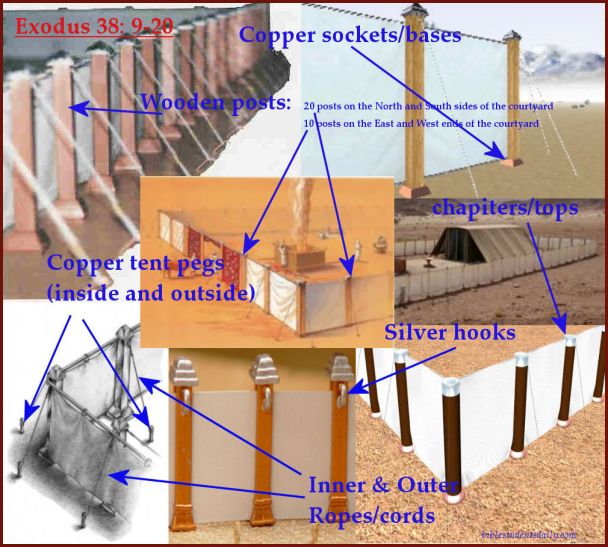
There is more to the philosophy of the ransom that prevents our faith from becoming weak and unstable. This is shown in the system of guy lines which uphold the wall of the court and tie the posts to the ground.
These cords represented the things which tie the justified believer to the earth; and there were two sets of cords and pins, one set inside the Court, the other, outside.
The set outside of the Court, outside of the justified state, represented the sin in the flesh which ties the believer to the world.
The set inside the Court represented the earthly things: joys, studies, music, etc., right enough in themselves, which bind the believer to the world. These are the weights (Hebrews 12:1).
These ropes were anchored by copper pegs — tent pegs. One of these was installed inside the court and the other on the outside. Being copper, as opposed to wood covered with copper, they showed actual human perfection.
As we scan the pages of history we see just two — and no more — perfect men: Adam and Jesus. We see the one who lost his standing in the court, Adam, as the peg driven outside the fence. The other, grounded firmly in the court, pictures Jesus. These two have one connection — the ransom — pictured by this cord even as it was by Rahab’s scarlet thread. It is this simple philosophy of the ransom — a perfect human life for a perfect human life—that gives stability to our faith. How beautiful! How simple! Substitutionary atonement is the central doctrine of the Bible.
“For since by man came death, by man came also the resurrection of the dead. For as in Adam all die, even so in Christ shall all be made alive” (1 Corinthians 15:21, 22).
“For if through the offence of one many be dead, much more the grace of God, and the gift by grace, which is by one man, Jesus Christ, hath abounded unto many” (Romans 5:15).
It is the very simplicity of the concept that speaks to its authenticity. Too good to be true? Too good not to be true! And yet our faith is sometimes weak. We need further support.
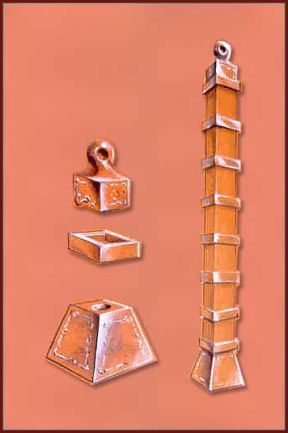 According to the Temple Institute in Israel:
The courtyard pillars, (amudim) were composed of three main components: The acacia pillars themselves, which were reinforced by silver bands, (chishukim); the copper bases, (adanim), into which the pillars were inserted; and the silver eyelets, (vavim), which were fitted onto the tops of the pillars, for stretching the curtains, (yeriot) across.
“fillets” — Others have concluded that they were rigid, whether rods or bands, and served to stabilize the posts from leaning toward each other. We think that is correct.
The Furnishings In The Court
The Brazen Altar
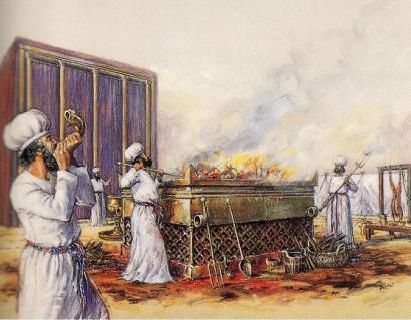
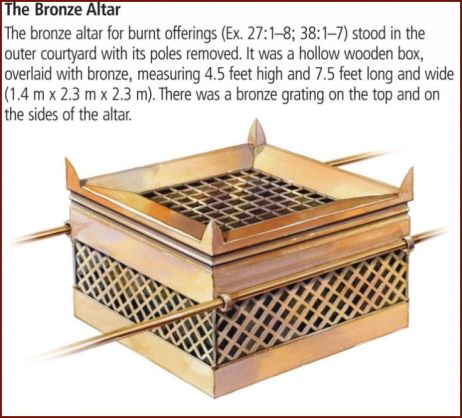
The Brazen Altar was the first item encountered in the Courtyard. It was five cubits square, and 3 cubits tall (Exodus 27:1).
In each of the four corners there was a horn made from the same piece of acacia wood as the altar itself and the altar was over-layed with copper.
The Brazen Altar was used to burn up sacrifices placed upon it, such as during the consecration of the priesthood and the Day of Atonement.
Various utensils belonged to its service — fire pans (called censers), for carrying the fire to the ‘Incense Altar,’ basins to receive the blood, flesh hooks, shovels, etc.
A Christian understands this altar is not an ornament of the Court, but a place where bulls and goats were killed and sacrificed, a place many times covered with blood and ashes, with the smell of burning meat, and much smoke. The grate of this altar was not on the top like a modern barbecue. It was placed half way between the bottom and the top of the altar:
“Thou shalt put it [the grate] under the compass of the altar beneath, that the net may be even to the midst [Strong’s #2677: half or middle] of the altar” (Exodus 27:5). This placed the grate at the 1½ cubit mark, the same height as the mercy seat in the Most Holy. Both are considered in the design to be at the same “level;” neither towers above the other.
A Christian recognizes that Jesus has been sacrificed for him and starts to recognize that a similar sacrifice is needed from him if he is to enter beyond the next door. The sacrifice we have to offer, is as the Apostle Paul expresses it, in Romans 12:1.
Thus, the antitypical priesthood of this Gospel age are privileged to use this altar (Christ Jesus), in presenting their bodies “a living sacrifice, holy, acceptable unto God” for is it not the altar that sanctifies the gift?
“You blind men! For which is greater, the gift or the altar that makes the gift sacred?” (Matthew 23:19).
“Your sacrifice would not be holy and acceptable, but it is made holy and acceptable as such by the Advocate [Christ Jesus] imputing of his merit to cover your sacrifice” (“What Pastor Russell Said,” page 614).
Presenting our bodies as “living sacrifices” to God includes all our thoughts, words and doings and doing the best we can in all we do to bring God glory, honor and praise. It is Christ Jesus, our antitypical High Priest who alone is able to offer up the antitypical sacrifices. All that the followers of Jesus do, therefore, is to present (consecrate, set apart) themselves, as pictured in the type by the goat’s being, tied at the door of the Tabernacle. “It is after Jesus lays hold of this individual, accepts his consecration, imputes His own merit, and offers him to the Father, that the Father’s acceptance is manifested through the Son… by the begetting of the Holy Spirit. Thereforth, such an one is a member of the Body of Christ, and his name is written in the Lamb’s Book of Life, from which it will not be blotted out if he maintains his faithfulness” (What Pastor Russell Said, page. 614).
“It is the New Creature’s business to keep the old nature on the altar, upon which the great High Priest has put it. In other words, the New Creature must keep the old nature dead, hold it in subjection. When our flesh is brought into contact with the fires of experience for its consumption, it is the old creature that weeps, not the New Creature. Let the goat weep if it will. The New Creature will rejoice in the Lord and in His providential care, as daily it grows in grace and in knowledge. When the old creature is knocked out, or brow-beaten, as the Apostles says (1 Corinthians 9:27), it will groan; but the New Creature will be glad and rejoice in the Lord… We rejoice because God’s favor and blessing are with us as New Creatures.” (What Pastor Russell Said, page 613.) See also Acts 16:26, Philippians 4:4.
Jesus allowed himself to be sacrificed for the entire world of mankind. He was perfect and became flesh to do the will of his Heavenly Father (John 4:34, John 6:38).
The wood of the altar, typifying humanity, reminds us that Christ became a man for the express purpose of experiencing our infirmities and “to minister, and to give his life a ransom for many” (Mark 10:45).
“For we have not an high priest which cannot be touched with the feeling of our infirmities; but was in all points tempted like as we are, yet without sin” (Hebrews 4:15).
There is a thought that wood was used to make the articles of lighter weight and thus, more easily portable, than if of solid metal. This was an important consideration when they traveled.
As discussed earlier in this series of “Beauties of the Tabernacle,” the use of copper represents the human nature in its perfection, a little lower than the angelic nature (unlike gold, which represents the divine nature, far above angels, principalities and powers).
As gold and copper are much alike in their appearance, yet different in quality, so the human nature is an image and likeness of the divine, adapted to earthly conditions.
“The Tabernacle’s altar of burnt-offering represents… the ransom-sacrifice of Christ Jesus (Tabernacle Shadows, page 22) — the ‘altar’ unto which the world of mankind in the Millennial age, will bring its sin-, trespass-, burnt-, and peace-offerings. (Tabernacle Shadows, page 95,96)” (“Notes on the Tabernacle,” page 134).
The horns of the Altar of Burnt Offering were in themselves symbols of power; yet this power came from the blood which sanctified it. The Scriptures do set forth the fact that one guilty of a sin against his fellowman, when in danger of being apprehended, might flee for asylum to the altar — take hold of its horns, and find a safe refuge there (1 Kings 1:50; 2:28).
“We too have an altar, the power of which stems from the blood of Christ Jesus, that sanctified it. We too, had sinned against our King, who could justly have destroyed us. But we fled to the altar and found sanctuary, an asylum, a refuge, there. Our faith in the precious blood, justified us — made us free as it were; but only on one condition could we continue to be free and that was that we covenant with our King thereafter to walk “worthily.” Having entered into this covenant we are safe from the “avenger.” But should the time ever come when we would break that covenant by profaning the blood of the covenant by which we were sanctified — outraging the Spirit of grace (Hebrews 10:29) — we would then fall directly into the hands of the “avenger” and be put to death — the Second Death!” (“Notes on the Tabernacle,” page 130).
Was there a ramp?
Some may question whether there was a ramp attached to this brazen altar which would assist the priests with getting the sacrifices onto the large surface area of the altar.
We read in Exodus 20:26, “Neither shalt thou go up by steps unto mine altar, that thy nakedness be not discovered thereon.”
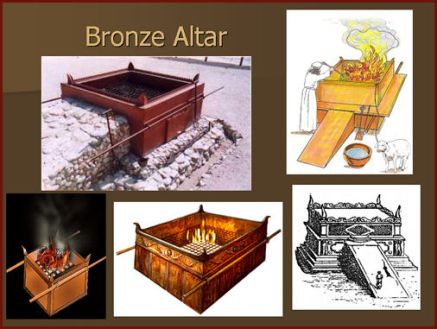
“It is worthy of note that the Hebrew word ‘maalah’ occurring [here] in Exodus 20:26 and there rendered ‘steps’ in the KJV, according to Young’s Analytical Concordance to the Bible means ‘a going up, ascent.’ It would therefore cover even such a thing as a ramp, though this latter term has nowhere been used in the common version of the Bible. It has been rendered ‘stairs’ (2 Kings 9:13; Nehemiah 3:15; 12:37; Ezekiel 40:6; 43:17) and ‘steps’ (Exodus 20:26; 1 Kings 10:19, 20; 2 Chronicles 9:18,19; Ezekiel 40:22, 26, 31, 34, 37, 49).
“No priests were ever to enter the precincts of Jehovah — the Tabernacle’s Court, Holy, or Most Holy — without the linen breeches ‘to cover their nakedness’ upon them (Exodus 28:42,43). Especially is the injunction given that Jehovah’s altar was not to have any steps (stairs or ramp) unto it, since an approach by way of such would necessitate the ‘lifting of the robe’ and the consequent exposure of the priest’s nakedness (Exodus 20:26)” (Br. Anton Frey, “Notes on the Tabernacle,” page 133).
The Laver
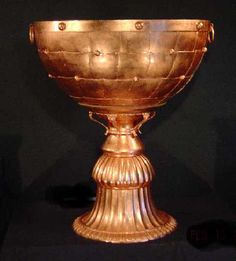
“The LORD spoke to Moses, saying, ‘You shall also make a laver of bronze, with its base of bronze, for washing; and you shall put it between the tent of meeting, and the altar, and you shall put water in it. Aaron and his sons shall wash their hands and their feet from it; when they enter the tent of meeting, they shall wash with water, so that they will not die; or when they approach the altar to minister, by offering up in smoke a fire sacrifice to the LORD. So they shall wash their hands and their feet, so that they will not die; and it shall be a perpetual statute for them, for Aaron and his descendants throughout their generations’” (Exodus 30:17-21).
The Laver stood between the brazen altar and the door of the Tabernacle or “sanctuary”. It was a receptacle for water where the priests washed his feet and hands leaving behind the last traces of the flesh and of his contact with the surrounding world, before entering the Tabernacle.
The Laver as a whole represented the Word of God, Jesus was the word who cleanses the believer through the washing of water by the Word (Ephesians 5:26).
The Laver was cast from the mirrors of women who served at the Tabernacle, thus it was made of polished copper (Exodus 38:8) which represents the brightness of Jesus’ perfection. As the priests looked into the laver, they could see the faces reflected in its polished surface, so the consecrated see the imperfections and failings of their own characters when they compare these characters to the bright perfection of Jesus by looking unto him.

The priests did not bathe in the Laver, but presumably drew water out of the laver using a copper pitcher for the purpose of washing his hands and feet (Exodus 40: 31, 32) — otherwise the water in the laver would become dirty.
So we are greatly helped by concordances, dictionaries, etc. We cannot wash in them, but they help us in getting the Truth to cleanse us. And we likewise, cleanse our hands that they may do the will of God, and our feet that they may walk in Jesus’ footsteps, in the straight and narrow way.
At this step an approaching Christian accepts this purification as did all the followers of Jesus. Even if the Master did not need any purification, since he was perfect and without sin, by washing the feet of his disciples Jesus showed another important element of that washing: humility.
Now the Christian is at the door of the Tabernacle. After his journey through the Court, he is ready to follow his Master into the “greater and more perfect tabernacle” (Hebrews 9:11, KJV).
Acknowledgment
Br. Charles T. Russell — for source material used from “Tabernacle Shadows,” “What Pastor Russell Said” (Question Book).
Br. Anton Frey — for source material used from “Notes on the Tabernacle.”
Br. David Rice & Br. George Tabac — for sharing of content and editing for this post.
The Temple Institute in Israel — for source material used.
Suggested Further Reading
STUDY 1: An Introduction To The Tabernacle And It’s Purpose
https://biblestudentsdaily.com/2016/09/02/study-1-an-introduction-to-the-tabernacle-and-its-purpose/
STUDY 2: The Pillar of Cloud By Day And The Pillar of Smoke By Night https://biblestudentsdaily.com/2016/09/09/study-2-the-pillar-of-cloud-by-day-and-the-pillar-of-smoke-by-night/
STUDY 3: The Tabernacle Construction: The Holy and The Most Holy https://biblestudentsdaily.com/2016/09/14/study-3-the-tabernacle-construction-the-holy-the-most-holy/
STUDY 5: The Camp. The Israelites.
https://biblestudentsdaily.com/2016/10/28/study-5-the-camp-the-israelites/
STUDY 6: The Levites
https://biblestudentsdaily.com/2016/11/18/study-6-the-levites/
STUDY 7: The Priests. The Day of Atonement.
https://biblestudentsdaily.com/2016/12/10/study-7-the-priests-the-day-of-atonement/
STUDY 8: The Tabernacle Coverings
https://biblestudentsdaily.com/2017/01/02/study-8-the-tabernacle-coverings/
STUDY 9: The Gate. The Door. The Vail.
https://biblestudentsdaily.com/2017/03/01/study-9-the-gate-the-door-the-vail/
The URL for this post:


 BIBLE Students DAILY